

When you're facing a major financial decision, the last thing you want is a nasty tax surprise down the track. An ATO private ruling is your official safety net—a formal, legally binding written opinion from the Australian Taxation Office (ATO) that clarifies how tax law applies to your specific situation.
- What Is an ATO Private Ruling
- When Do You Actually Need a Private Ruling?
- Who Benefits Most from Seeking a Ruling
- How to Apply for Your Private Ruling
- Understanding Your Application Outcome
It gives you certainty before you commit, so you know the exact tax consequences of a significant transaction or arrangement in advance.
What Is an ATO Private Ruling

Think of it like getting building approval from the council before you start a major renovation. You wouldn't pour thousands of dollars into foundations and materials without knowing your plans are compliant. A private ruling offers the same kind of rock-solid assurance for your financial moves.
Instead of trying to interpret general advice or guessing how a complex tax law might apply, you get a definitive, personalised answer straight from the source. This isn't just a helpful suggestion; it's a legally binding confirmation that protects you, as long as you've laid all your cards on the table and disclosed the relevant facts.
Why Certainty Matters
Navigating Australia's tax system can feel like walking through a maze. Ambiguity is your enemy, often leading to costly mistakes and unexpected bills. A private ruling cuts through that confusion, giving individuals and businesses a clear, reliable path forward when dealing with big financial events.
If you want to brush up on the basics first, our guide on how taxation works in Australia provides some excellent background.
The main reasons why getting this formal sign-off is so valuable are:
- Risk Mitigation: It helps you sidestep surprise tax bills, interest, and penalties that could otherwise pop up years later.
- Informed Decision-Making: With a clear picture of the tax outcome, you can structure your transactions in the most effective and compliant way possible.
- Dispute Prevention: A binding ruling dramatically lowers the chances of having a future disagreement with the ATO about the specific transaction it covers.
A private ruling transforms financial ambiguity into predictable compliance. It's your official green light from the ATO, offering peace of mind when the stakes are high.
Ultimately, seeking an ATO private ruling is a smart, proactive step for anyone in a complex tax scenario. Whether you're a property investor trying to clarify Capital Gains Tax or a business owner planning a major restructure, it's a powerful tool for building your financial plans on a solid, compliant foundation.
For a quick overview, this table summarises what a private ruling offers.
ATO Private Ruling at a Glance
| Feature | What It Means for You |
|---|---|
| Legally Binding | The ATO is bound by the ruling, giving you legal protection. |
| Personalised Advice | It applies specifically to your circumstances, not just general rules. |
| Future-Focused | You get clarity before you make a major financial decision. |
| Risk Reduction | Minimises the chance of unexpected tax liabilities and penalties. |
| Dispute Avoidance | Significantly reduces the likelihood of future arguments with the ATO. |
In short, it's about replacing guesswork with certainty.
When Do You Actually Need a Private Ruling?
So, you know that an ATO private ruling offers certainty, but the real trick is knowing when it's actually worth getting one. A private ruling isn’t for asking simple questions you could find on the ATO’s website or for getting a thumbs-up on everyday tax deductions. It’s a specialised tool, reserved for complex, high-stakes situations where the tax law gets murky or its application to your specific circumstances is far from clear.
Think of it like this: asking your accountant about claiming work-from-home expenses is like getting general advice. Applying for a private ruling, on the other hand, is like asking a judge for a definitive ruling on a complex legal contract before you sign on the dotted line. The crucial difference is that a private ruling is legally binding—the ATO has to honour it.
High-Stakes Financial Decisions
You should be thinking about an ATO private ruling when you’re standing at a financial crossroads, and the path you take has major tax consequences that aren't straightforward. It’s all about swapping uncertainty for a predictable, compliant outcome before you commit serious money or finalise a major transaction. This is especially true when you're dealing with large sums or arrangements that could easily attract the ATO's attention down the track.
A few common scenarios where a ruling makes sense include:
- Complex Property Transactions: Not sure how Capital Gains Tax (CGT) will apply to the sale of that inherited property? Or the block of land you’ve just subdivided?
- Business Restructuring: Does the rollover relief for a proposed merger or demerger actually apply to your specific business structure? The details matter.
- Unusual Income Streams: How on earth are you supposed to treat income from a new cryptocurrency investment or a complicated international deal?
A private ruling delivers something incredibly valuable: peace of mind. It acts as your official shield against future disputes, shock tax bills, and penalties, especially when the tax treatment isn't black and white.
Transforming Uncertainty into Predictability
For instance, a business owner wrestling with how to apply GST across a complicated multi-stage supply chain would find a ruling invaluable. Without it, they might get the GST wrong, leading to a massive, unexpected liability.
Another classic example is figuring out whether a worker is an employee or an independent contractor. This distinction has huge flow-on effects for superannuation and payroll tax. If you need more clarity, you can learn about the differences between an employee and an independent contractor in our detailed guide. Getting a private ruling on this provides a definite answer, protecting the business from costly future claims.
Ultimately, a private ruling is your best move for managing tax risk when things get complicated. It’s not just about getting an answer; it’s about getting a binding guarantee from the ATO. This allows you to plan your financial future with confidence, knowing you’re playing by the rules and are fully compliant with Australian tax law.
Who Benefits Most from Seeking a Ruling
While an ATO private ruling is a powerful tool, it’s not something everyone needs. Its real value shines when you’re facing a complex financial crossroad, where one wrong turn could lead to a serious tax headache down the track.
Let’s look at some real-world situations to see who really gets the most out of this official clarification.
Think about a property investor who has lived in their rental property on and off over the years. When they decide to sell, working out the Capital Gains Tax (CGT) is anything but simple. The main residence exemption might apply in part, but how do you get the apportionment right? A private ruling gives you a definitive, legally binding answer, helping you avoid a future ATO audit and nasty penalties.
It’s a similar story for a small business owner getting ready to sell a major asset, whether that’s a piece of specialised equipment or the entire business itself. They’re suddenly facing a maze of tax laws. Questions about GST, depreciation, and CGT concessions can be incredibly complicated. Getting a ruling beforehand means the sale can be structured in the most tax-effective and compliant way, offering total peace of mind during what is already a stressful transaction.
Navigating Personal and Complex Finances
But it’s not just business owners and property investors who can benefit. Individuals with unique financial circumstances often find themselves in tax grey areas.
Take someone earning income from overseas. The tax rules can be murky due to double-tax agreements and foreign tax credits. A private ruling makes their obligations crystal clear, preventing accidental mistakes. Another classic example is a complex salary sacrifice arrangement, where figuring out the Fringe Benefits Tax (FBT) implications is absolutely critical.
Other situations where a ruling is invaluable include:
- Deceased Estates: Executors carry a heavy weight of responsibility. A private ruling can clarify how assets distributed to beneficiaries should be taxed, especially with tricky areas like superannuation death benefits.
- Trusts: Managing a family or testamentary trust often throws up complex tax scenarios. A binding opinion from the ATO is a lifesaver for trustees trying to do the right thing.
For anyone facing a situation where the tax law is ambiguous and the financial stakes are high, a private ruling isn't just helpful—it's essential. It turns "I think this is right" into "I know this is right," with the ATO's official backing.
Each of these examples shares a common thread: a significant financial decision clouded by tax uncertainty. If any of this sounds familiar, it’s a strong sign that seeking an ATO private ruling would be a smart, protective move. It delivers the clarity you need to move forward with confidence.
How to Apply for Your Private Ruling
So, you're ready to get some certainty from the tax office? Applying for an ATO private ruling is a formal process, but it's one designed to get you a clear, binding answer. Think of it like preparing a detailed brief for a legal matter—your success hinges on laying out all the relevant facts, clearly and accurately, right from the start.
The absolute cornerstone of a successful application is providing a ‘full and true disclosure’ of everything related to your situation. This isn't the time for fuzzy details or missing pieces. The ATO needs the complete picture to give you a ruling that you can actually rely on.
Gathering Your Essential Documents
Before you even think about filling out a form, your first job is to get all your paperwork in order. This groundwork is what allows your tax advisor to build a rock-solid application on your behalf. Good documentation is non-negotiable. It’s a good idea to make sure your record-keeping practices are up to scratch—our guide on ATO record-keeping requirements can help get you organised.
As you compile everything, keep in mind that any legal documents not in English will need to be professionally translated. You can find specialised legal document translation services to make sure this is handled correctly.
The specific documents you’ll need will vary depending on your circumstances, but a solid starting point usually includes things like:
- Relevant Contracts: Sale agreements, employment contracts, or partnership deeds.
- Financial Statements: Profit and loss statements, balance sheets, or trust accounts.
- Correspondence: Key emails or letters that are central to the transaction or arrangement.
- Valuations: Independent property or business valuations where they're relevant.
This diagram gives you a sense of the typical journey for different people seeking a ruling.
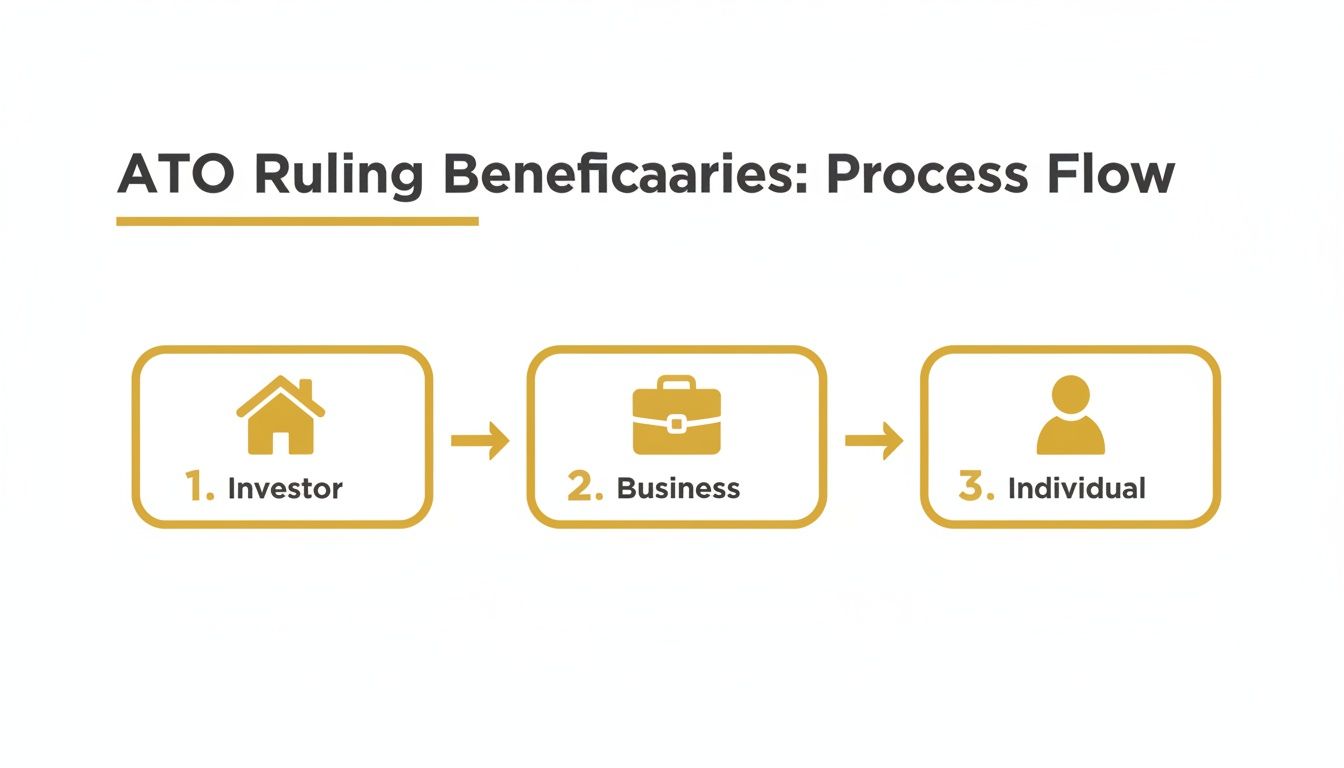
As you can see, whether you're an investor, a business owner, or an individual, the process begins with a clear need for tax certainty.
Framing Your Question with Precision
Once your documents are organised, the next critical step is shaping your question. You have to resist the urge to ask broad or hypothetical questions like, "What are the tax implications of selling my business?"
You need to be laser-focused. A much better question would be something like: "Will the small business CGT concessions under Division 152 of the ITAA 1997 apply to the sale of my business, 'ABC Pty Ltd', based on the attached sale agreement dated 15 July 2024?" A precise question gets you a precise answer.
The quality of your ruling is directly tied to the quality of your application. Incomplete information or a poorly framed question is the quickest way to get a rejection or a ruling that doesn’t actually help you.
The ATO's own statistics back this up. For the period between 1 July 2020 and 30 June 2025, over 96.5% of private rulings from direct applications were favourable. This incredibly high success rate comes down to applicants providing the full story and getting the process right from the get-go.
Working with an experienced tax professional is easily the best way to make sure your application is complete, your question is framed perfectly, and all your supporting documents are included before it lands on the ATO's desk.
Understanding Your Application Outcome
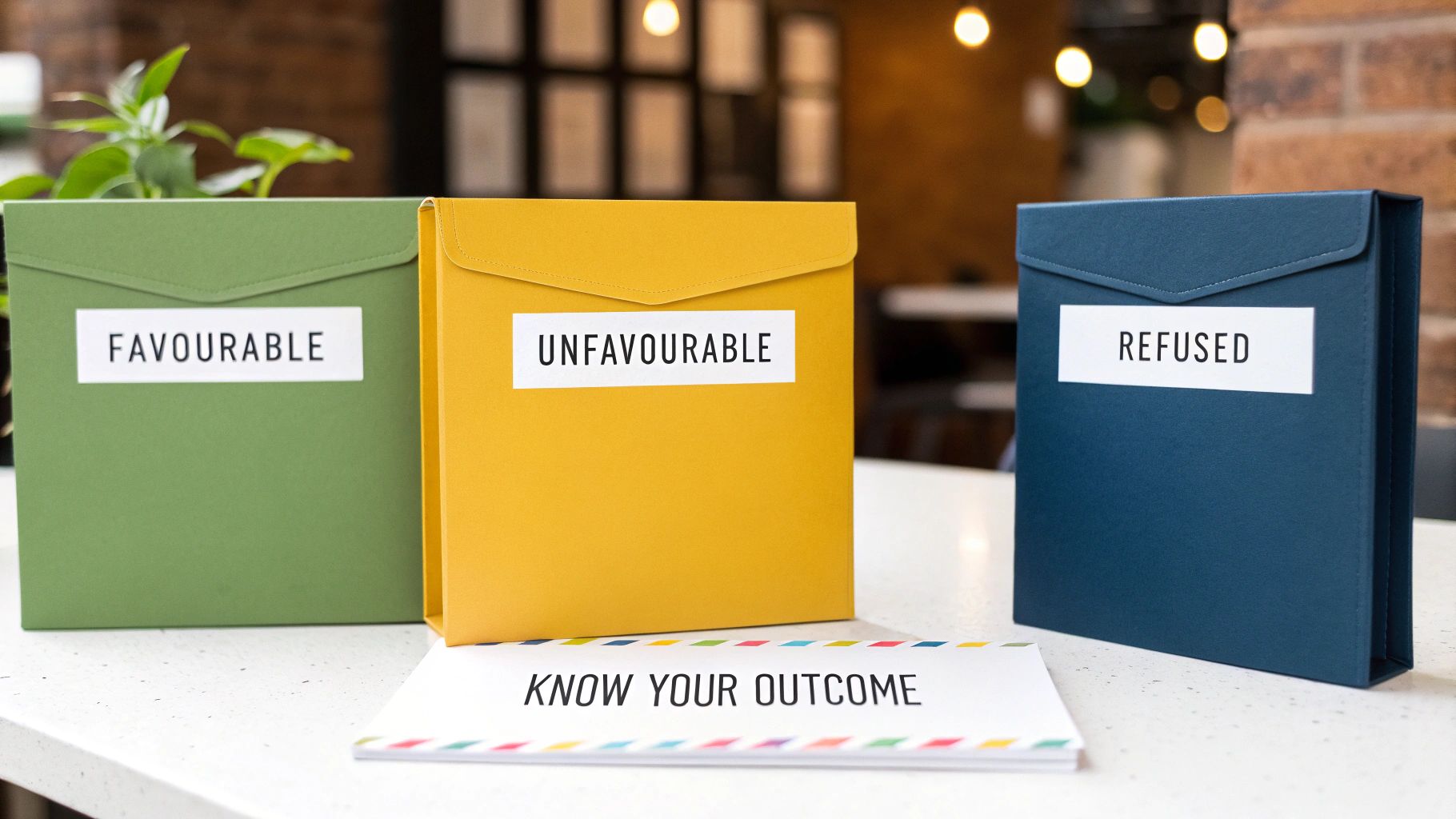
After lodging your application for an ATO private ruling, that waiting period can feel pretty tense. But if you know the potential outcomes beforehand, you can manage your expectations and be ready for the next steps, no matter which way the decision goes. Once the ATO has reviewed your case, you'll get one of three possible responses.
Each outcome gives you a specific kind of clarity. A favourable ruling is a green light, an unfavourable one is a clear warning sign, and a refusal to rule tells you there’s an issue with the application itself. Let's break down what each of these really means for you.
The Favourable Ruling Green Light
This is the ideal result. A favourable private ruling confirms the ATO agrees with your interpretation of how tax law applies to your specific situation. It’s legally binding, which means the ATO can’t change its mind later, as long as the arrangement you carry out is exactly as you described it in your application.
This outcome gives you the highest level of certainty, basically acting as your official approval to go ahead with your transaction. It shields you from future tax liabilities, penalties, and interest on the matter, giving you complete peace of mind.
The Unfavourable Ruling Valuable Insight
Getting an unfavourable ruling can be disappointing, but it's far from useless. This decision simply means the ATO disagrees with your proposed tax treatment. While it’s not the news you wanted, it provides incredibly valuable intel by showing you precisely where the tax office stands.
This clarity allows you to sidestep a costly mistake. Think of an unfavourable ruling as a clear signal to pause and rethink your plans. You can now adjust your strategy to ensure you're compliant, potentially saving yourself from a huge tax bill and penalties down the track. It turns a potential future dispute into a manageable decision today.
An ATO private ruling provides critical clarity, no matter the outcome. Even an unfavourable decision empowers you to make informed, compliant choices, preventing far more significant problems in the future.
The Refusal to Rule A Signal to Revisit
In some instances, the ATO might decline to provide a ruling at all. This isn't a judgement on the tax treatment itself but usually points to a problem with the application. Common reasons for a refusal include:
- Incomplete Information: The application was missing crucial facts or documents.
- Hypothetical Scenarios: The question was too broad or wasn't based on a specific, intended transaction.
- Existing Guidance: The matter is already clearly covered by existing public rulings or legislation.
A refusal is your cue to review the application with your tax advisor. You might need to gather more information or reframe your question to meet the ATO's requirements before you try again.
It’s reassuring to know that outright refusals are pretty rare when applications are well-prepared. Between 1 July 2020 and 30 June 2025, the ATO processed around 738 private rulings for high-assurance taxpayers, with a massive 92% getting a favourable outcome. Refusal rates were minimal, dropping from just 3% to 1% over this period, which really highlights the system's reliability.
To properly understand your ruling’s implications, it’s also helpful to have a grasp of the underlying contract interpretation principles that often guide how legal documents are read. And if you do receive an unfavourable decision, remember you have the right to object, which kicks off a formal review process. This is a complex area where professional guidance is absolutely essential.
Your Top Questions About ATO Private Rulings
Even when you get your head around the concept of an ATO private ruling, there are always a few practical questions that pop up. We get them all the time. This section cuts straight to the chase, answering the common queries we hear from clients every day.
Let’s dig into the details that really matter when you're thinking about going down this path.
How Much Does a Private Ruling Cost?
This is the first question on everyone's lips, and the answer is great news. The ATO does not charge a fee to process your application. This is a massive plus, making the system accessible whether you’re an individual, a small business owner, or a much larger company.
But hold on—that doesn’t mean it's completely free. The real investment is in the expertise needed to prepare a rock-solid application. You’ll almost certainly need a tax agent or accountant in your corner. The cost comes from their professional time spent digging into documents, researching the right tax laws, and wording your question with the precision the ATO demands.
How Long Does the ATO Take to Respond?
Patience is a virtue here. The ATO doesn’t offer a guaranteed turnaround time because every case is different. A simple query about a common issue might get sorted in a few weeks. A highly complex case tangled up in obscure legislation could easily take several months.
As a general rule, the ATO tries to process standard applications within 28 days of getting all the information they need. If your situation is a real head-scratcher, they’ll usually get in touch with you or your advisor to give you a rough completion date. The best way to speed things up? Make sure your application is perfect from the get-go.
Is My Private Ruling Confidential?
Yes, 100%. The details of your ruling are locked down by strict tax secrecy laws. The ATO can’t just go sharing your personal or financial details with the public or anyone who isn't authorised.
You might see edited versions of some private rulings published by the ATO to help educate the public, but they scrub all the identifying details first.
Your name, Tax File Number (TFN), and any other bit of personal information will be completely blacked out. This means your financial affairs stay private while still helping others understand how tax law works in practice.
Can I Withdraw My Application?
Absolutely. You can pull your application for an ATO private ruling at any point before it’s officially issued. This often happens if your circumstances change—maybe that big transaction you were planning is no longer on the table.
All it takes is a written notification to the ATO from you or your tax advisor. It’s that simple.
What Happens If I Disagree with the Ruling?
Getting a ruling you don't like isn't the end of the road. You have the right to object. An objection is your formal way of asking the ATO to take a second look at its decision, but you have to act fast—usually within 60 days of receiving the ruling.
This isn’t just a quick email, though. It involves putting together a detailed written argument explaining exactly why you think the ruling is wrong, backed up with legal points and evidence. Given what’s at stake, this is a step you should never take without professional help to make sure your case is as strong as it can possibly be. It's your official channel for an appeal.
The ATO provides guidance through ato.gov.au, the Small Business Support Line (13 28 66), and Online Services for individuals and businesses. For complex situations, a registered tax agent provides advice tailored to your specific circumstances and professional indemnity protection. You can verify agent registration at the TPB register at tpb.gov.au.
Most tax records must be kept for five years from the date of lodgement or the date the transaction occurred, whichever is later. Records must be in English or convertible to English and must be sufficient to explain the income and deductions in your return. The ATO can request records at any time during the retention period.
Consider a registered tax agent when your affairs involve multiple income sources, business activity, investment properties, capital gains, or overseas income. Agents extend your lodgement deadline, provide safe harbour protection, and take professional responsibility for the advice given. Verify registration at tpb.gov.au.
The failure to lodge penalty is based on penalty units ($313 per unit from 1 July 2023), accruing per 28-day period for late returns and BAS lodgements. Incorrect information penalties range from 25% to 75% of the tax shortfall depending on whether the behaviour was careless, reckless, or intentional. Proactive disclosure before an audit begins typically results in significantly reduced penalties.
Tax minimisation is the legal arrangement of your affairs to reduce tax — claiming all eligible deductions, using appropriate structures, and timing income and expenses. Tax avoidance involves arrangements that technically comply with the law but achieve outcomes parliament did not intend. The ATO can apply Part IVA anti-avoidance rules to cancel benefits from avoidance arrangements.
Navigating the world of an ATO private ruling demands expert guidance. The team at Australia Wide Tax Solutions is here to make sure your application is precise, thorough, and has the best possible chance of a favourable outcome. Secure your financial certainty and let our specialists handle the process for you. https://www.awts.net.au
