

2026 Tax Return Due Dates
If you lodge your own return, the deadline for the 2025–26 financial year is 31 October 2026 (ATO). Miss it and the ATO can apply failure-to-lodge penalties — but there's a way to get more time.
- Lodge through a registered tax agent and you can usually extend well into the following year — often as late as 15 May 2027 — provided you're on the agent's books before 31 October 2026.
- Already behind? See our guide to late tax returns — it's far better to lodge late than not at all.
Beat the deadline the easy way: book in with AWTS before 31 October and we'll secure your extension and lodge once your data is ready — book an appointment or lodge online.
Your Guide to Key Australian Tax Deadlines
Trying to keep track of Australian tax deadlines can sometimes feel like a moving target, but the system is actually quite straightforward. Everything revolves around the Australian financial year, which runs from 1 July to 30 June. For anyone lodging their own return through myTax or with a paper form, the Australian Taxation Office (ATO) expects it to be submitted by 31 October of that same year. But that’s not the end of the story. There's another, much later deadline that millions of Australians take advantage of by engaging a registered tax agent.How a Tax Agent Changes Your Deadline
This is where things get interesting. When you sign up with a registered tax agent before the 31 October deadline, the game changes completely. Your due date is almost always extended until 15 May of the following year. That’s more than six extra months to get your documents in order and ensure everything is spot-on.This extension is one of the most common and effective ways to manage your tax obligations without the last-minute rush. It provides valuable breathing room, especially for those with more complex financial situations like investments or business income.This generous extension is a key reason why so many people choose to work with a tax professional. For a deeper dive into how these dates work, you can explore our guide on navigating Australian tax return deadlines. To make it even clearer, here’s a quick summary of the most common deadlines you need to know.
Key Australian Tax Return Deadlines at a Glance
This table breaks down the two main paths for lodging your personal tax return and the deadlines associated with each.| Lodgment Method | Standard Due Date | Eligibility |
|---|---|---|
| Self-lodgment (e.g., using myTax) | 31 October | Anyone lodging their own tax return. |
| Using a Registered Tax Agent | 15 May (of the following year) | Anyone who registers with a tax agent before the 31 October deadline. |
Choosing Your Path: Self-Lodging vs. a Tax Agent
When tax time rolls around, every Australian taxpayer faces a choice that directly sets their deadline: go it alone or bring in a professional. It’s a simple decision, but one that has a massive impact on your tax return due date. The first route is to self-lodge using the ATO’s myTax platform. This is a great option if your financial situation is pretty straightforward—say, you’ve got a salary from one job and some simple deductions to claim. If you take this path, your deadline is locked in: 31 October. No ifs, no buts.The Tax Agent Advantage
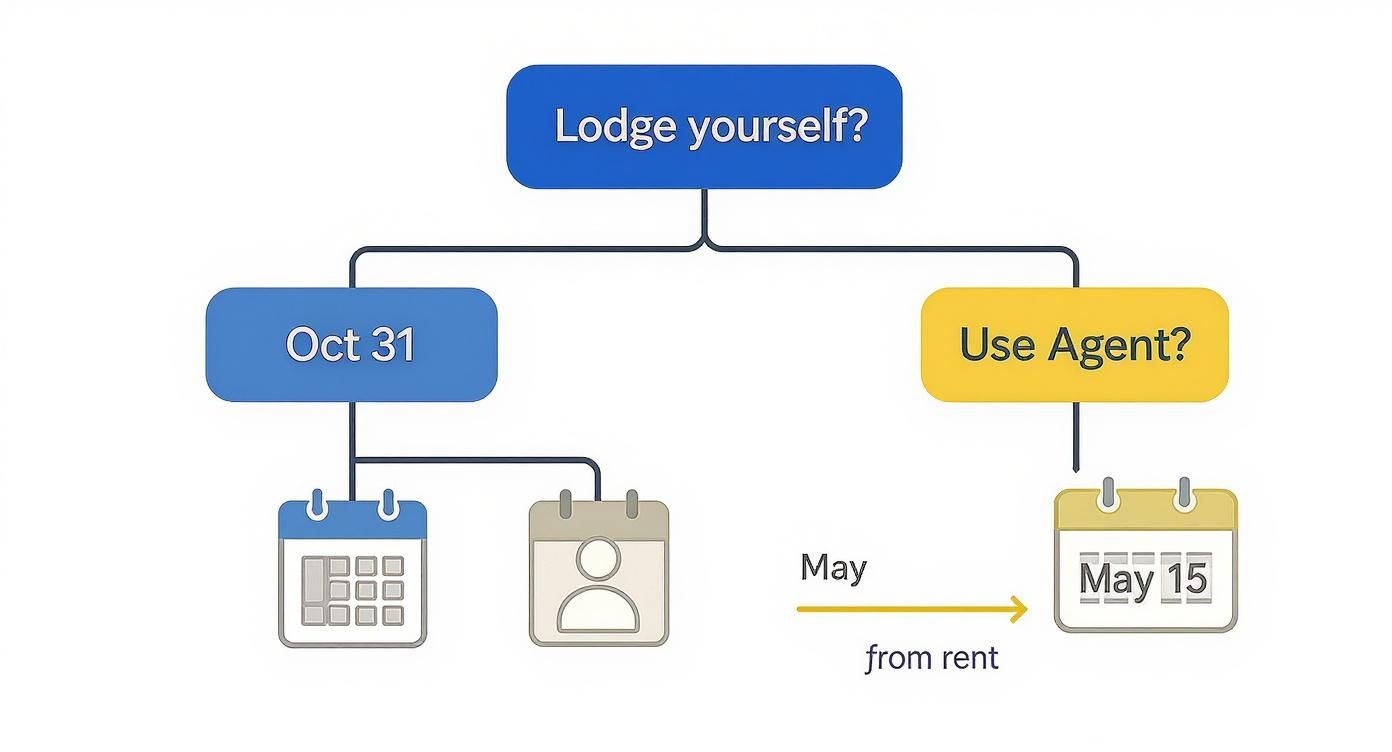
The other option, and one that millions of Australians take, is to use a registered tax agent. The biggest perk here? A huge deadline extension. As long as you’re on an agent’s books before the 31 October cut-off, your due date is usually pushed all the way back to 15 May of the next year. That extra six months is more than just a bit of breathing room. It’s valuable time to get all your paperwork in order—from investment statements and capital gains calculations to rental property expenses. It gives you the best shot at lodging an accurate return and maximising your refund. For anyone with investments, a side hustle, or complex deductions, it’s a strategic no-brainer.The decision between self-lodging and using a tax agent is a common one, with statistics from the ATO showing a near-even split. More than 5.5 million returns were self-prepared, while over 5.1 million were submitted through agents. This highlights that while many Australians are confident in managing their own returns, a huge number value the expertise and extended timeline an agent provides. You can review the full tax time lodgment statistics on the ATO website.This simple infographic visualises how your lodging choice directly impacts your deadline.
How to Get a Tax Lodgment Extension

Using a Tax Agent for an Extension
This agent-assisted extension is a standard arrangement with the ATO, but it's not a free pass for everyone. To qualify, you need to have a good track record. This generally means you don’t have a history of overdue returns or outstanding tax debts from previous years. It's the perfect solution if you need that extra time to sort through more complex finances, like an investment property or business income streams. To get a better idea of how a professional can lighten the load, check out the many benefits of using a tax agent in Australia.Engaging a registered tax agent is a highly effective strategy for managing your Australian tax return due date. This professional arrangement can extend the lodgment date to 15 May, giving you crucial breathing room without incurring penalties, provided you meet the ATO's eligibility criteria.
Applying for a Direct Deferral
But what if life throws a major curveball your way? For truly exceptional and unforeseen circumstances, you can apply directly to the ATO for what’s called a lodgment deferral. This is a less common option, reserved for serious situations that genuinely stop you from being able to lodge on time. Valid reasons for a direct deferral typically involve things like:- A serious illness affecting you or a close family member.
- The impact of a natural disaster, like a flood or bushfire.
- Losing critical documents through no fault of your own.
What Happens If You Miss the Due Date
Understanding Failure to Lodge Penalties
Think of the FTL penalty like a library fine that grows the longer you hold onto that overdue book. The ATO system often issues these penalties automatically once a return is significantly late and you don't have a valid extension organised. For someone lodging after the 31 October deadline without an approved extension, the penalties start at AUD 313 for being just under a month late. This can escalate all the way up to AUD 1,565 for more significant delays. It's a surprisingly common issue, affecting about 5% to 7% of taxpayers who miss the cut-off each year. You can get a deeper dive into how late lodgment penalties are applied from tax experts.It's crucial to remember that penalties are often just the starting point. If you also have a tax bill to pay, the ATO will apply a General Interest Charge (GIC) to the unpaid amount, which compounds daily.
How to Minimise the Damage
Even if the due date is in your rearview mirror, taking swift action can dramatically reduce the financial fallout. The ATO is often reasonable and may agree to reduce or completely waive penalties, especially if you have a solid history of lodging on time. Here are the best steps to take right now:- Lodge immediately: This is the single most important thing you can do. The sooner your return is in, the lower any potential penalty will be.
- Communicate proactively: Don't wait for the ATO to chase you. Get on the phone with them or have your tax agent do it for you to explain what’s happened. A proactive approach is always seen in a better light.
- Request a remission: If you have a legitimate reason for the delay—like a serious illness or a natural disaster—you can formally ask the ATO to waive the penalty.
Tax Deadlines for Businesses, Companies and Trusts
When it comes to the Australian tax return due date, businesses, companies, and trusts play by a completely different set of rules. The familiar 31 October deadline that applies to individuals? For businesses, it's pretty much irrelevant. Instead, the ATO uses a staggered schedule based on things like your business's size, its history of lodging on time, and whether you had tax to pay last year. Think of it this way: while individuals have one main highway with a single deadline, businesses are navigating a complex road network. A brand-new small business with a clean slate will take a different exit—and have a different deadline—than a large company that had a hefty tax bill the previous year. This system is designed to manage the flow of complex returns into the ATO. For most businesses that use a registered tax agent like us, the deadlines are spread throughout the financial year. This avoids a massive logjam and gives everyone enough breathing room to get the complex financial reporting done right.Common Business Lodgment Schedules
Knowing your specific due date is absolutely critical. Getting it wrong means risking unnecessary penalties from the ATO. While your tax agent will always confirm your exact date, the lodgment program follows a fairly predictable pattern determined by your company's history and tax status.For business entities, the Australian tax return due date is not a fixed point on the calendar but part of a dynamic schedule. The ATO's staggered system ensures a more manageable workload for both the tax office and accounting professionals, reflecting the greater complexity of business tax affairs.To give you a clearer picture, we've put together a table outlining the typical lodgment due dates for different business structures that are on a tax agent's program.
Common Business Lodgment Due Dates
This table provides a great overview of the typical tax return due dates for various Australian business entities when lodged through a tax agent.| Entity Type | Typical Due Date (with Tax Agent) | Key Conditions |
|---|---|---|
| New Registrants | 28 February | This applies to new companies and trusts that weren't required to lodge a return in the previous year. |
| Small Businesses | 15 May | This is the most common deadline for small companies and trusts with a solid, on-time lodgment history. |
| Large/Medium Entities | 15 January | Typically for companies that had tax payable over a certain threshold in the prior year. |
| Self-Managed Super Funds (SMSFs) | 28 February (for new funds) or 15 May (for existing funds) | The deadline really depends on whether the fund is newly set up or has a history of lodging on time. |
Common Questions About Tax Return Due Dates
Even when you know the key deadlines, real-life situations always throw up a few tricky questions. Let's tackle some of the most common ‘what if’ scenarios we see every year to make sure you're never caught out.What If I Earned No Income This Year?
It’s a common mistake to think that earning no income (or less than the $18,200 tax-free threshold) means you can just ignore tax time altogether. The ATO, however, will still be expecting to hear from you. Instead of lodging a full return, you need to submit a non-lodgment advice. It's a quick and simple declaration that tells the ATO you don't need to lodge for that financial year. Getting this done—which you can do easily via your myGov account—stops the ATO's system from flagging you as overdue and saves you from a string of annoying follow-up letters.Does the Due Date Change If I Am Getting a Refund?
Nope, the lodgment deadline is the same for everyone, whether you’re getting a nice refund or bracing for a tax bill. That 31 October date for self-lodgers is set in stone, regardless of the outcome. The only date that changes is when you need to pay any tax you owe, which will be clearly stated on your Notice of Assessment. Don't mix these two up! The ATO issues late lodgment penalties for missing the filing date, which is completely separate from any interest charges you might get for paying your bill late.Can I Get an Extension by Hiring a Tax Agent After 31 October?
This is a classic and costly myth. To get the benefit of a tax agent's extended deadline (usually 15 May), you absolutely must be on their client list before the 31 October deadline hits. Think of it like getting on the guest list for an exclusive event before the doors shut for the night. If you show up on 1 November trying to hire an agent, you've already missed the original cut-off, and the ATO will consider you late. Acting before the end of October is the only way to unlock an agent's later due date.Being proactive is everything. The ATO’s system is automated—you need to be on an agent's client list by 31 October to be included in their lodgment program. Trying to sign up afterwards won't turn back the clock on a missed deadline.
What If I Am Travelling Overseas When My Tax Is Due?
Being out of the country, unfortunately, doesn't give you a free pass. Your Australian tax obligations don't go on holiday with you, and you're still expected to meet the standard due date. If you know you'll be overseas around 31 October, you have two simple ways to stay on the right side of the ATO:- Lodge Early: Just get it done and submitted before you fly out.
- Engage an Agent: Sign up with a tax agent before you leave (and well before 31 October). They can then handle your lodgment under their extended deadline, leaving you free to travel without any tax worries back home.
Navigating these specific scenarios is much simpler with an expert on your side. The team at Australia Wide Tax Solutions can manage your lodgment, ensure you meet every deadline, and help you maximise your tax outcome, no matter where you are in the world. Contact us today to make tax time stress-free.
The ATO provides guidance through ato.gov.au, the Small Business Support Line (13 28 66), and Online Services for individuals and businesses. For complex situations, a registered tax agent provides advice tailored to your specific circumstances and professional indemnity protection. You can verify agent registration at the TPB register at tpb.gov.au.
Most tax records must be kept for five years from the date of lodgement or the date the transaction occurred, whichever is later. Records must be in English or convertible to English and must be sufficient to explain the income and deductions in your return. The ATO can request records at any time during the retention period.
Consider a registered tax agent when your affairs involve multiple income sources, business activity, investment properties, capital gains, or overseas income. Agents extend your lodgement deadline, provide safe harbour protection, and take professional responsibility for the advice given. Verify registration at tpb.gov.au.
The failure to lodge penalty is based on penalty units ($313 per unit from 1 July 2023), accruing per 28-day period for late returns and BAS lodgements. Incorrect information penalties range from 25% to 75% of the tax shortfall depending on whether the behaviour was careless, reckless, or intentional. Proactive disclosure before an audit begins typically results in significantly reduced penalties.
Tax minimisation is the legal arrangement of your affairs to reduce tax — claiming all eligible deductions, using appropriate structures, and timing income and expenses. Tax avoidance involves arrangements that technically comply with the law but achieve outcomes parliament did not intend. The ATO can apply Part IVA anti-avoidance rules to cancel benefits from avoidance arrangements.
