

Getting your Business Activity Statement (BAS) lodgement right is a non-negotiable part of running a business in Australia. It’s the main way you report and pay critical taxes like GST and PAYG withholding to the Australian Taxation Office (ATO). Nail this process, and you’re well on your way to solid financial health and compliance.
- Getting a Handle on Your BAS Lodgement Obligations
- How to Prepare for a Smooth BAS Lodgement
- Choosing The Best BAS Lodgement Method For Your Business
- Know Your BAS Lodgement Deadlines and Payment Options
- Common BAS Mistakes and How to Avoid Them
Getting a Handle on Your BAS Lodgement Obligations
The Business Activity Statement isn't just another form to fill out. Think of it as a summary of your tax life for a given period. If your business is registered for Goods and Services Tax (GST)—which is mandatory for most businesses with a GST turnover of $75,000 or more per year (or $150,000 for non-profits)—then lodging a BAS is a must-do.
Once you're registered for GST, the ATO will automatically start sending you a BAS when it's time to lodge. The beauty of the BAS is that it bundles several tax obligations into one report, which definitely simplifies things. If you're new to this, we’ve got a great primer that breaks down the basics in our article, what is BAS in accounting.
What Does a BAS Actually Cover?
When you open up your BAS, you’ll see sections for different taxes, depending on what your business does. The usual suspects are:
- Goods and Services Tax (GST): This is the classic balancing act. You calculate the GST you’ve collected from customers and subtract the GST credits you can claim on your business expenses. The difference is what you owe the ATO (or what they owe you).
- Pay As You Go (PAYG) Withholding: Got employees? This is where you report the income tax you’ve held back from their pay packets. That money doesn't belong to you; you’re just holding it for the ATO.
- Pay As You Go (PAYG) Instalments: This is a smart system to help you pre-pay your business's income tax throughout the year. It stops you from getting hit with a massive, and often unexpected, tax bill when you lodge your annual return.
To get this all done without a headache, you need a solid system for collecting your financial data. A good tax information form can be a great start to make sure nothing gets missed.
Figuring Out Your Reporting Cycle
How often you need to lodge your BAS comes down to your GST turnover. The ATO will assign you a reporting cycle, and this sets the rhythm for your bookkeeping and lodgement deadlines.
For the vast majority of small and medium businesses in Australia, quarterly reporting is the standard. It hits the sweet spot—frequent enough to keep on top of your taxes, but not so often that it becomes a massive admin burden.
Here are the three main cycles you might be on:
- Quarterly: This is the most common setup, for businesses with a GST turnover under $20 million. It means you'll be lodging four times a year.
- Monthly: If your GST turnover hits $20 million or more, the ATO will put you on a monthly cycle. Some smaller businesses also opt for this to keep a tighter rein on their cash flow.
- Annually: This is an option for very small businesses turning over less than $75,000 who have voluntarily registered for GST. It's the simplest, but least common, cycle.
Knowing your specific cycle is the first step to a stress-free BAS process. It dictates your deadlines and helps you build a bookkeeping routine that ensures you’re always prepared to lodge accurately and on time. No last-minute scrambles.
How to Prepare for a Smooth BAS Lodgement
An accurate Business Activity Statement lodgement starts long before you even think about logging into the ATO portal. Real success is built on a solid foundation of organised, up-to-date records. Without them, you’re basically flying blind, risking simple errors that could easily spiral into audits, penalties, or missed GST credit claims.
Think of your BAS prep as gathering all the ingredients before you start cooking. Each bit of financial data is a crucial component, and having everything ready to go makes the whole process faster and way less stressful. Let’s walk through exactly what you need to have on hand.
This quick graphic breaks down the key stages of your BAS obligations, from checking your GST threshold right through to lodging the final statement.
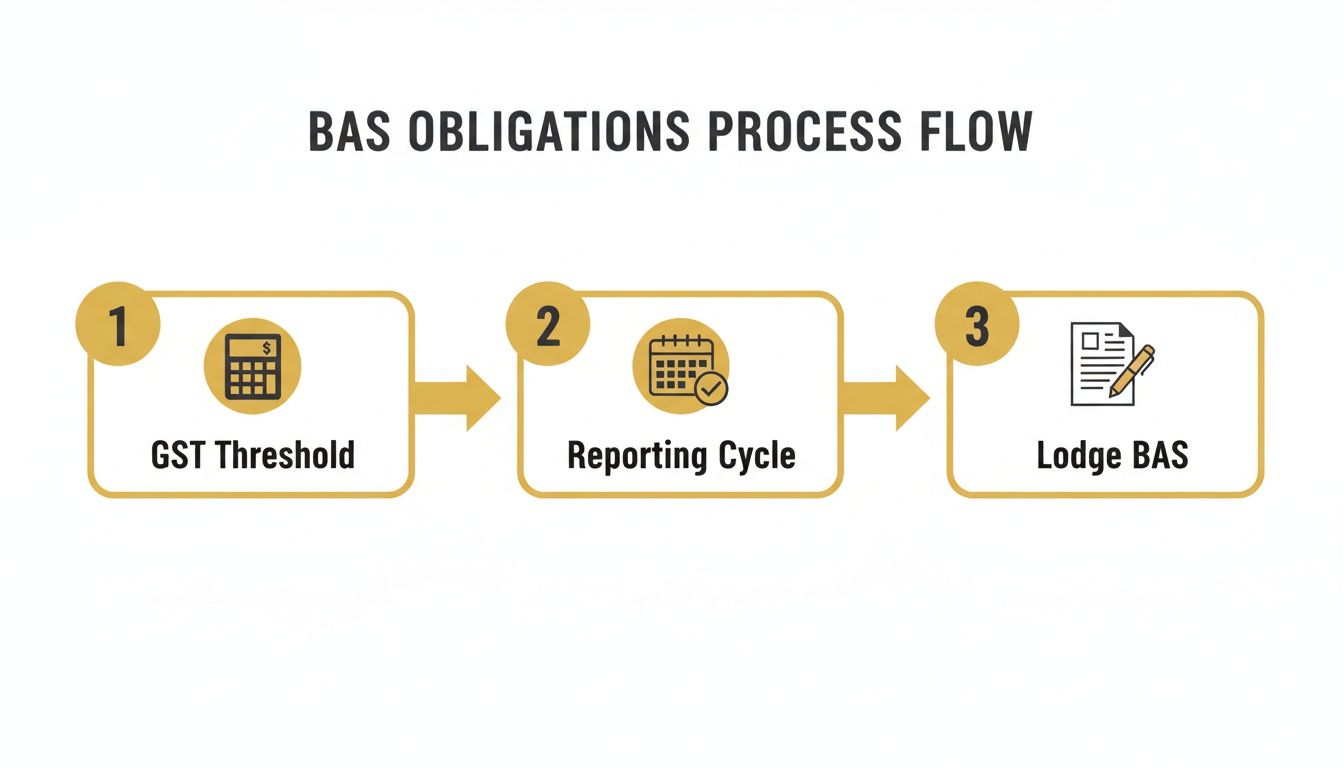
It’s a simple reminder of the journey, making it clear where preparation fits into the bigger compliance picture.
Compiling Your Sales and Income Records
First up, you need a complete picture of every dollar your business brought in during the reporting period. This isn't just about a grand total; it’s about correctly classifying each transaction so you can calculate the right amount of GST.
You'll need to pull together:
- Tax invoices you've issued: These are the bread and butter of your sales records. Make sure they clearly show the total price, the GST amount, and your ABN.
- Bank statements: Use these to cross-reference every deposit with your sales invoices. It's the best way to make sure nothing has slipped through the cracks. Keep an eye out for any odd deposits that might be business income you forgot to invoice.
- Cash sales records: If you take cash, your daily till reconciliations or cash sales summaries are absolutely vital. These need to be meticulous, as they're often the first thing the ATO looks at.
A classic mistake we see all the time is failing to separate GST-free sales from taxable ones. For instance, if you run a small grocery store, sales of basic foods like bread and milk are GST-free, but soft drinks are taxable. Getting this wrong can lead to you overpaying or underpaying GST.
Gathering Your Expense and Purchase Documents
This is where you get your money back. It's your chance to claim back the GST you’ve paid on business purchases. Missing out on these GST credits literally means you're leaving money on the table for the ATO. Every legitimate dollar you claim reduces your final BAS bill.
To make sure you're claiming everything you're entitled to, you'll need:
- Supplier tax invoices: For any purchase over $82.50 (including GST), you must have a valid tax invoice to claim the GST credit. No invoice, no credit.
- Receipts for smaller purchases: Don't throw them out! Keep all receipts for smaller business-related expenses, as they add up.
- Bank and credit card statements: Go through these line by line to spot all business-related debits and match them to an invoice or receipt.
A big part of BAS prep involves pulling financial data from all over the place. To save yourself a massive headache and reduce errors, it's worth looking at ways to automate processes like how to extract invoice data efficiently.
Assembling Payroll Information
If you have a team, your BAS also involves reporting on Pay As You Go (PAYG) withholding. This is the tax you’ve held back from your staff's wages, which you then need to pass on to the tax office.
Key Takeaway: Your payroll records must perfectly match the figures you report on your BAS. The ATO’s data-matching systems are incredibly sophisticated these days and will flag discrepancies between your BAS and your Single Touch Payroll (STP) reports almost instantly.
Before you even start your BAS, have your payroll summary report for the period ready. This report needs to clearly show the total gross wages paid and the total tax withheld. Reconciling this figure against your bank records for wage payments is a final check you absolutely can't skip. For a deeper dive into organising your documents, check out our comprehensive BAS preparation checklist.
By methodically gathering and organising these three sets of documents—income, expenses, and payroll—you're creating a complete and defensible snapshot of your business finances. This doesn't just guarantee an accurate business activity statement lodgement; it turns a daunting chore into a routine business health check.
Choosing The Best BAS Lodgement Method For Your Business

Once your books are in order, the next big decision is how you're actually going to get your BAS to the ATO. This isn't just about clicking a button; your choice of lodgement method can make a real difference to your accuracy, how much time you spend on it, and even your due dates.
While there are a few ways to lodge your business activity statement, the overwhelming shift is towards digital. Modern online methods are simply faster, more secure, and far less likely to cause the kinds of human errors that were common with old-school paper forms.
H3: Lodging Directly With ATO Online Services
For business owners who like to keep things hands-on, lodging directly through the ATO’s own digital platforms is a solid option. It puts you in the driver's seat, giving you complete control over the entire submission process.
You have two main portals for this:
- Online services for business: This is the ATO's standard, secure platform built for businesses. It's the go-to for most companies, trusts, and partnerships managing their own tax affairs.
- myGov: If you're a sole trader, you can link your ABN to your personal myGov account and handle your BAS lodgement from there.
The online process is generally pretty user-friendly. The forms come pre-filled with your business details, and the system has built-in checks that often catch simple mistakes before you hit submit. If you're after a detailed walkthrough, our guide on how to lodge your BAS online breaks it down step-by-step.
H3: Partnering With A Registered BAS or Tax Agent
Let's be honest, for many business owners, handing off BAS lodgement to a professional is the smartest thing they can do. A registered BAS or tax agent does more than just fill out a form; they provide a full service that ensures accuracy, maximises your claims, and keeps you compliant with tax laws that seem to change every other week.
This path is perfect if you:
- Are simply too busy running your business to get bogged down in bookkeeping.
- Aren't 100% confident in calculating GST, PAYG, and other complex figures.
- Want the peace of mind that comes from having an expert double-check everything.
One of the biggest perks of using an agent is getting access to extended lodgement and payment deadlines. This isn't a myth—it's a real concession from the ATO that can give you critical breathing room during hectic times. A good agent will review your records, spot potential red flags, and make sure every last GST credit you're entitled to is claimed.
H3: The Traditional Paper Lodgement Option
While it still technically exists, lodging a paper BAS is quickly becoming a thing of the past. The ATO has been pushing businesses towards digital for years, and now, most are required to lodge electronically.
Paper lodgement is slow, you get no instant confirmation that it's been received, and it's wide open to manual errors—both on your end and when someone at the ATO has to process it. Unless you have a specific and rare exemption, you're far better off choosing one of the digital methods. It ensures your business activity statement lodgement is handled smoothly, efficiently, and without any unnecessary headaches.
The ATO provides guidance through ato.gov.au, the Small Business Support Line (13 28 66), and Online Services for individuals and businesses. For complex situations, a registered tax agent provides advice tailored to your specific circumstances and professional indemnity protection. You can verify agent registration at the TPB register at tpb.gov.au.
Most tax records must be kept for five years from the date of lodgement or the date the transaction occurred, whichever is later. Records must be in English or convertible to English and must be sufficient to explain the income and deductions in your return. The ATO can request records at any time during the retention period.
Consider a registered tax agent when your affairs involve multiple income sources, business activity, investment properties, capital gains, or overseas income. Agents extend your lodgement deadline, provide safe harbour protection, and take professional responsibility for the advice given. Verify registration at tpb.gov.au.
The failure to lodge penalty is based on penalty units ($313 per unit from 1 July 2023), accruing per 28-day period for late returns and BAS lodgements. Incorrect information penalties range from 25% to 75% of the tax shortfall depending on whether the behaviour was careless, reckless, or intentional. Proactive disclosure before an audit begins typically results in significantly reduced penalties.
Tax minimisation is the legal arrangement of your affairs to reduce tax — claiming all eligible deductions, using appropriate structures, and timing income and expenses. Tax avoidance involves arrangements that technically comply with the law but achieve outcomes parliament did not intend. The ATO can apply Part IVA anti-avoidance rules to cancel benefits from avoidance arrangements.
Comparison of BAS Lodgement Methods
Deciding how to lodge can feel like a big choice. To make it easier, we've broken down the key differences between the three main methods. This should help you see at a glance which approach best fits your business needs, your confidence level with tax matters, and how much time you have to spare.
| Feature | ATO Online Services | Registered BAS/Tax Agent | Paper Lodgement |
|---|---|---|---|
| Control | Full control over the entire process. | You provide records, the agent handles the rest. | Full manual control, but with significant risks. |
| Accuracy | Relies on your own knowledge. Built-in checks help. | High. Professional review minimises errors and ensures claims. | Low. Highly prone to manual calculation and data entry errors. |
| Time Commitment | Moderate. You need to do the calculations and lodgement. | Low. Outsource the entire process. | High. Requires manual form completion and postage. |
| Deadlines | Standard ATO deadlines apply. | Access to extended lodgement and payment due dates. | Standard, shorter deadlines apply. No extensions. |
| Support | General ATO support channels available. | Personalised, expert advice and support. | Limited to general ATO phone lines. |
| Cost | Free to use the ATO portals. | Professional fees apply. | Postage costs, but the main cost is your time and error risk. |
| Best For | DIY business owners confident with their bookkeeping. | Business owners who value time, accuracy, and peace of mind. | Businesses with a specific ATO exemption (very rare). |
Ultimately, while lodging yourself online is a viable option for those with the time and confidence, partnering with a registered agent almost always provides the best outcome. The expertise, extended deadlines, and sheer peace of mind are well worth the investment, letting you focus on what you do best: running your business.
Know Your BAS Lodgement Deadlines and Payment Options
Staying on top of your Business Activity Statement deadlines is non-negotiable for tax compliance. Let's be blunt: missing these dates isn’t a minor slip-up. The Australian Taxation Office (ATO) can hit you with penalties and interest charges, putting a completely unnecessary strain on your cash flow.
The first step to staying out of trouble is understanding the rhythm of your BAS cycle. Your due dates hinge entirely on your reporting frequency—whether you lodge monthly, quarterly, or annually.
Mapping Out Your Lodgement Calendar
For most small and medium-sized businesses, the quarterly cycle is the sweet spot. It strikes a good balance between staying on top of your tax obligations and not getting bogged down in administrative work every single month.
Quarterly lodgement is still the standard for a reason. Over 70% of small businesses in Australia stick to this frequency. This schedule lines up perfectly with the ATO's standard due dates of 28 October, 28 February, 28 April, and 28 July. You can find out more about the ATO's agent lodgement program on their official site.
Let's break down the key deadlines:
- Quarterly Lodgers: If you're lodging yourself, your deadline is the 28th day of the month after the quarter ends.
- Monthly Lodgers: For businesses with a higher turnover, the BAS is due on the 21st of the following month. For example, your July BAS is due by 21 August.
- Annual Lodgers: This is less common, but if you're eligible, your due date is typically 31 October.
One of the biggest perks of working with a registered BAS or tax agent is getting access to their extended lodgement program. This can give you an extra four weeks for most quarterly deadlines—a priceless buffer during hectic times.
Making Your BAS Payment
Once you've lodged your BAS and know what you owe, the ATO offers a few straightforward ways to settle up. The key is to pick a method that works for your business and guarantees the payment lands on time.
The most common payment methods we see are:
- BPAY: You can pay directly from your bank account using the unique Biller Code and reference number found on your BAS.
- Credit or Debit Card: The ATO's online payment portal lets you use a card, but keep in mind a processing fee might apply.
- Direct Debit: You can set up a one-off or recurring direct debit through ATO online services. This is a great set-and-forget option to avoid missed payments.
Always, always double-check the payment reference number. A simple typo can send your payment into limbo, causing delays and a massive administrative headache to sort out.
Pro Tip: Set up a separate business bank account just for GST and PAYG withholding. Every time you get paid or run payroll, transfer the tax portion into this account. When your BAS is due, the money is already sitting there, quarantined from your daily operational cash flow.
What to Do If You Can't Lodge or Pay on Time
Life happens. Sometimes unexpected issues make it impossible to meet your tax obligations on time.
If you find yourself in this situation, the absolute worst thing you can do is bury your head in the sand. The ATO is often willing to help, but only if you're proactive and communicate with them.
As soon as you know you're going to miss a deadline, contact the ATO or your tax agent. You might be able to arrange a lodgement deferral or a payment plan that fits your situation. This simple act of communication shows you're taking your obligations seriously and can help you avoid or reduce penalties.
Common BAS Mistakes and How to Avoid Them
Even with the best intentions, it’s frighteningly easy to make a slip-up during your business activity statement lodgement. These aren't just minor admin headaches; they can lead to ATO scrutiny, unexpected tax bills, and hours of wasted time trying to fix things.
Understanding where business owners commonly go wrong is the first step to getting your lodgement right, every single time.

From simple calculation errors to claiming credits you’re not entitled to, we’ve seen it all. Getting these details right not only keeps you compliant but also protects your cash flow from completely avoidable penalties.
Miscalculating GST and Claiming Invalid Credits
This is, without a doubt, the most frequent pitfall we see. A simple maths error or a misunderstanding of GST law can create significant problems down the track. One of the classic mistakes is claiming GST credits on purchases that don't actually include GST in the first place.
Here are a few real-world examples that trip people up constantly:
- Bank Fees: Most standard bank fees, like your monthly account-keeping charge, are input-taxed. This means they don't include GST, so you can't claim a credit on them.
- GST-Free Purchases: Did you buy milk and bread for the office kitchen? Most basic food items are GST-free, which means there’s no credit to claim back.
- Supplier ABN: If you get an invoice from a contractor or supplier who isn't registered for GST, there will be no GST component to claim, even if it's a legitimate business expense. Always check the invoice.
Another area of confusion is client entertainment. Taking a client out for a meal is generally not a deductible expense for income tax, and as a result, you can't claim the GST credits on it either. It’s a small detail, but it’s one the ATO’s systems are specifically designed to flag.
Missing Lodgement and Payment Deadlines
Failing to lodge your BAS on time is a mistake with immediate and painful financial consequences. The ATO's penalty system is automated and unforgiving, applying charges even if you don't actually owe any tax for that period.
Failure to lodge on time results in penalties that escalate quickly. For a small business, this starts at $313 per overdue statement and can climb to a maximum of $1,565 per statement. On top of that, any late payments attract the General Interest Charge (GIC), which compounds daily on the unpaid amount. You can see a full breakdown of these penalties and important BAS due dates on CleanSlate.net.au.
The lesson here is crystal clear: even if you can't pay the amount owed, you must still lodge the BAS by the deadline. It's a far better strategy to lodge on time and then arrange a payment plan with the ATO than to simply ignore the due date.
Keeping Disorganised or Incomplete Records
At the end of the day, your BAS is only as accurate as the records you keep. Messy bookkeeping is the root cause of most lodgement errors, turning what should be a straightforward process into a stressful, time-sucking nightmare.
Disorganised records almost always lead to:
- Missing GST Credits: Lost receipts and unrecorded expenses mean you're literally giving money back to the ATO by not claiming legitimate credits.
- Under-reporting Sales: Forgetting to record cash sales or other miscellaneous income can result in you underpaying GST—a major red flag for auditors.
- Incorrect PAYG Withholding: If your payroll records don't perfectly align with what you report on your BAS, the ATO’s sophisticated data-matching systems will spot the discrepancy very quickly.
Using good accounting software and sticking to a consistent weekly bookkeeping routine are your two best defences against this.
A Final Review Checklist Before You Lodge
Before you hit that submit button, take ten minutes to run through this quick checklist. It’s a simple habit that can save you from a world of trouble.
- Reconcile Your Accounts: Are all bank accounts, credit cards, and clearing accounts fully reconciled for the period? No exceptions.
- Review GST Coding: Run a detailed GST report from your accounting software. Scan it for any large or unusual items and double-check that expenses have been correctly coded as either containing GST or being GST-free.
- Check Payroll Figures: Does the total gross wages and tax withheld on your BAS match your payroll summary report for the exact same period? They need to be identical.
- Confirm Your Details: A simple one, but crucial. Are your business name, ABN, and the reporting period correct on the form?
Performing these final checks ensures your business activity statement lodgement is clean, accurate, and ready for scrutiny.
Your Top Business Activity Statement Lodgement Questions
Even after you've got the prep work down and the due dates circled on the calendar, a few nagging questions about business activity statement lodgement always seem to crop up. Getting straight answers is the key to lodging with confidence and keeping the ATO happy.
Think of this as the final checklist—clearing up those last-minute uncertainties and "what if" scenarios that can throw you off your game.
What Should I Do If I Find a Mistake on a Lodged BAS?
Realising you've made a mistake on a BAS you've already sent off can be a heart-stopping moment, but don't panic. It's a common and fixable issue. The ATO has clear processes for corrections, and jumping on it quickly is always the best approach.
For small errors under a certain financial threshold, the ATO usually lets you make an adjustment on your next BAS. This is the simplest fix for minor GST or fuel tax credit mistakes, saving you from having to formally amend old paperwork.
But for bigger mistakes, or anything that relates to a previous financial year, you’ll need to lodge a revision of the original statement. You can do this yourself through the ATO's online services, or you can have your registered agent handle it for you. The sooner you correct it, the better—it shows good faith and helps minimise any potential interest or penalties.
Do I Still Need to Lodge a BAS with No Business Activity?
Yes. Absolutely. This is a non-negotiable rule that catches so many new business owners out. Even if you had zero sales, made zero purchases, and paid no wages for the entire reporting period, you are still legally required to lodge your BAS.
This is what’s known as lodging a 'nil' BAS.
Filing a nil BAS is how you officially report to the ATO that you've met your obligation for that period and that no activity took place. If you don't, you can still be hit with a Failure to Lodge (FTL) penalty, even when you owe no tax. The good news? Lodging a nil BAS is incredibly fast and can be done online in just a couple of minutes.
Is It Possible to Get an Extension on My BAS Due Date?
While you can't just decide to lodge late on your own terms, getting an official extension on your BAS due date is definitely possible in certain situations. They aren't handed out automatically, though—it all depends on your circumstances.
The easiest way to get more time is to use a registered tax or BAS agent. Agents have access to a special lodgement schedule for their clients, which typically adds an extra four weeks to most quarterly deadlines. This is one of the biggest perks of having a professional in your corner.
If you lodge yourself and get hit by something unexpected—like a serious illness, a natural disaster, or another major personal event—you can contact the ATO directly before the deadline to request a lodgement deferral.
Key Takeaway: Communication is everything. The ATO is far more likely to be accommodating if you reach out proactively to explain your situation rather than waiting for them to chase you for an overdue lodgement.
How Is GST Turnover Different from My Total Sales?
This is a critical distinction that directly impacts your tax obligations, and getting it wrong can cause major headaches. Your 'total business sales' is exactly what it sounds like—all the revenue your business has brought in. Your 'GST turnover', however, is a specific calculation the ATO uses for tax purposes.
Your GST turnover is your gross business income, but with a few key items excluded:
- Any GST you included in the price of your sales.
- Sales that aren't part of your main business activities.
- Input-taxed sales, like residential rent or financial supplies.
This is the figure that determines whether you need to register for GST (the threshold is $75,000) and how often you need to report. Always use the ATO's precise definition of GST turnover when making these decisions to ensure you stay compliant.
Navigating the world of BAS lodgement can feel complex, but you don't have to do it alone. The expert team at Australia Wide Tax Solutions is here to take the guesswork out of your tax obligations, ensuring your BAS is prepared accurately and lodged on time, every time.
Let us handle your BAS and tax needs so you can focus on what you do best.
