
An Activity Statement is the form Australian businesses use to report and pay key taxes like GST and employee tax withholdings to the Australian Taxation Office (ATO). Think of it as your business’s regular ‘tax check-in’. The two main types are the Business Activity Statement (BAS) for GST-registered businesses and the Instalment Activity Statement (IAS) for everyone else.
- What Is an Activity Statement in Plain English
- How to Read Your Business Activity Statement (BAS)
- Who Needs to Lodge an Activity Statement and When
- Navigating Lodgement Deadlines and Avoiding Penalties
- Your Step-by-Step Guide to Lodging Your Activity Statement
What Is an Activity Statement in Plain English
Let's cut through the confusing tax jargon for a moment.
Imagine your business is a small shop. Throughout the month, you collect a little extra on every sale for the government (that's the GST). At the same time, you set aside money from your employees' wages for their income tax (PAYG Withholding). An Activity Statement is simply the form you use to tell the ATO exactly how much you’ve collected and then pay it to them.
But it’s a two-way street. The form is also where you claim back the GST you paid on things you bought for your business, like new equipment or office supplies. This ensures you only hand over the net difference.
The Activity Statement is essentially the scorecard that keeps your business and the ATO on the same page. It reconciles the taxes you've collected on the government's behalf with the tax credits you're entitled to claim.
The Two Main Types of Activity Statements
While many people use the term "BAS" as a catch-all, there are actually two distinct forms you might receive from the ATO. Getting this right is the first step to staying compliant.
- Business Activity Statement (BAS): This is the one most businesses deal with. You'll use a BAS if your business is registered for Goods and Services Tax (GST). It’s an all-in-one form for reporting your GST, PAYG withholding for staff, PAYG instalments for your own income tax, and a few other tax obligations. You can get a deeper look at the fundamentals in our guide explaining what BAS is in accounting.
- Instalment Activity Statement (IAS): This is a much simpler version. You’ll receive an IAS if you are not registered for GST but still need to report other taxes to the ATO. This is common for businesses that need to remit PAYG withholding for employees or pay their own PAYG instalments to pre-pay income tax throughout the year.
The table below breaks down the key taxes you'll find on a typical Activity Statement.
Key Taxes Reported on Your Activity Statement
This table breaks down the primary taxes on a typical Business Activity Statement, helping you quickly identify what applies to your business.
| Tax Component | What It Means for You | Who It Typically Affects |
|---|---|---|
| GST | Reconciling the Goods and Services Tax you’ve collected on sales against the GST you’ve paid on purchases. | All businesses registered for GST (turnover of $75,000+ or voluntary registration). |
| PAYG Withholding | Reporting and paying the income tax you’ve withheld from your employees' wages and salaries. | Any business with employees. |
| PAYG Instalments | Pre-paying your estimated income tax in instalments throughout the year so you don't face a large bill at tax time. | Sole traders, partners, and other individuals who earn business or investment income. |
| FBT Instalment | Paying your estimated Fringe Benefits Tax liability for benefits provided to employees, like a company car for private use. | Businesses that provide fringe benefits to staff and have a liability over a certain threshold. |
Understanding these components is crucial because it directly impacts your business's cash flow and compliance. Missing one can lead to trouble down the road.
Why Is It So Important for Your Business
Your Activity Statement isn't just another bit of paperwork; it's a fundamental part of Australia's tax system. Introduced alongside the GST on 1 July 2000, the BAS has become the backbone of tax compliance for over 4.5 million businesses as of 2025. You can explore more government statistics on the Australian economy at the ABS website.
For the businesses we work with every day at Australia Wide Tax Solutions, lodging an Activity Statement correctly and on time is non-negotiable. It ensures you meet your legal obligations, helps you manage cash flow by giving you a clear picture of your tax liabilities, and—most importantly—prevents stressful and expensive penalties from the ATO for late or incorrect reporting.
How to Read Your Business Activity Statement (BAS)
Cracking open your first Business Activity Statement can feel intimidating. It often looks like a wall of codes, boxes, and tax jargon that makes little sense at first glance.
But once you know what you’re looking at, that jumble of numbers starts to tell a clear story about your business's financial health over the last quarter. Think of it less as a chore and more as a financial snapshot—a tool you can use to stay on top of your obligations.
Let's walk through it with a simple, real-world example. Imagine you’re a digital marketing consultant. Every time you invoice a client, you include GST. And every time you buy software or a new laptop for your business, you pay GST. The BAS is simply where these two sides of the coin meet.
The diagram below shows exactly how your day-to-day business activities flow through to the ATO via your Activity Statement.

This visualises the direct line connecting what you do every day in your business, the ATO’s reporting framework, and the BAS form that makes it all official.
Decoding the GST Section
For most businesses, the heart of the BAS is the GST section. This is where you'll spend most of your time.
- G1 Total Sales: This is your starting point—the total amount you've invoiced during the period. It includes all your sales, whether they had GST on them or not. For our consultant, this would be the total of all their client invoices for the quarter.
- 1A GST on Sales: Here, you report only the GST component you collected on behalf of the ATO. If our consultant invoiced a total of $11,000, they would report $1,000 at 1A (which is 1/11th of the total sales figure).
- 1B GST on Purchases: This is where you get your money back. You report the total GST you paid on business-related purchases and expenses. Think software subscriptions, fuel, office supplies, or that new laptop.
The final calculation is simple: 1A (GST collected) minus 1B (GST paid). If you get a positive number, you owe that amount to the ATO. If it's negative, congratulations—the ATO owes you a refund.
At its core, the BAS is a balancing act. It ensures you only pay the net difference between the GST you collected for the government and the GST you paid as a business expense.
Understanding Your Payroll and Income Tax Obligations
If you have staff or you're a sole trader paying your own income tax in advance, your BAS will cover these areas too.
- W1 Total Salary, Wages, and Other Payments: If you have employees, you report the total gross amount you paid them right here.
- W2 Amount Withheld from Payments at W1: This is the income tax (PAYG Withholding) you've held back from your employees' pay. You're now passing this on to the ATO on their behalf.
For sole traders, the PAYG Instalment section is just as important. This is how you pre-pay your own income tax throughout the year to avoid a massive bill at tax time. The ATO will either give you a set amount to pay (T1) or a rate to calculate the payment yourself (T2).
Since its introduction with the GST back in 2000, the Business Activity Statement has become a cornerstone of the Australian tax system, processing trillions in business transactions. With GST collections projected to hit a staggering $87.6 billion in the 2024-25 financial year, getting it right is crucial. At Australia Wide Tax Solutions, we see that 78% of the small-to-medium businesses we work with prefer quarterly lodgement cycles, which speaks to its power as a regular tool for financial management. You can find more insights about BAS in Australia from recent analyses.
Who Needs to Lodge an Activity Statement and When
Figuring out if you need to lodge an activity statement can feel confusing, but the rules are actually quite clear once you know what to look for. Not every business owner has to do it, and understanding where you stand is the first step to avoiding missed deadlines and unnecessary stress.
The main trigger for lodging a Business Activity Statement (BAS) comes down to one thing: GST registration. If your business has a current or projected annual turnover of $75,000 or more, the law says you must register for GST. Once you're registered, lodging a BAS becomes a non-negotiable part of your tax life. This threshold ensures smaller operators and side-hustles aren’t tangled up in the same reporting as larger companies. For non-profit organisations, that bar is set higher at $150,000.
At its core, the requirement to lodge is all about accountability. If you're collecting GST on behalf of the government or withholding tax from employee wages, the ATO needs a formal way for you to report and hand over those funds. The activity statement is that official channel.
But it’s not just about GST. If your business has employees, you have to withhold tax from their wages under the Pay As You Go (PAYG) withholding system. This obligation means you must report those amounts to the ATO through an activity statement, even if you’re not registered for GST.
Your Lodgement Frequency
How often you need to report to the ATO depends on the size and turnover of your business. Your lodgement frequency is automatically set when you register for an Australian Business Number (ABN) and GST.
- Quarterly: This is the default for most small to medium-sized businesses. If your annual turnover is less than $20 million, you’ll generally lodge your BAS every three months. It's the most common cycle we see with our clients.
- Monthly: Once your business grows and your annual turnover hits $20 million or more, you’ll be moved to a monthly lodgement schedule. Some smaller businesses also opt for monthly reporting to keep a tighter grip on their cash flow.
- Annually: This is reserved for very small businesses that have voluntarily registered for GST but still have an annual turnover below the $75,000 threshold.
Don't Forget the Instalment Activity Statement (IAS)
So, what happens if you have tax obligations but you're not registered for GST? This is where the Instalment Activity Statement (IAS) comes into play. You’ll need to lodge an IAS if you handle PAYG withholding for employees but don't meet the GST registration threshold.
On top of that, individuals and sole traders who earn significant business or investment income might be asked by the ATO to pay PAYG instalments. This is a system designed to help you pre-pay your income tax in smaller chunks throughout the year, so you don't get hit with a massive tax bill when you lodge your annual return. If this applies to you, the ATO will send you an IAS to report and pay these amounts.
Navigating Lodgement Deadlines and Avoiding Penalties
Getting your activity statements lodged on time isn’t just good housekeeping—it's absolutely critical for avoiding some hefty penalties from the Australian Taxation Office (ATO). The first step to staying in control of your business finances and keeping the ATO happy is knowing exactly when your lodgements are due.
For most small and medium businesses, this means lodging on a quarterly basis. Getting ahead of these dates is non-negotiable, as the ATO has a very strict compliance framework.

Standard Quarterly BAS Lodgement Deadlines for 2026-2027
To keep you on track, here is a clear schedule of the standard ATO lodgement and payment due dates for quarterly Business Activity Statements for the upcoming financial year.
| Quarter | Period Covered | Due Date |
|---|---|---|
| Quarter 1 | 1 July 2026 – 30 September 2026 | 28 October 2026 |
| Quarter 2 | 1 October 2026 – 31 December 2026 | 28 February 2027 |
| Quarter 3 | 1 January 2027 – 31 March 2027 | 28 April 2027 |
| Quarter 4 | 1 April 2027 – 30 June 2027 | 28 July 2027 |
It's vital to remember that these aren't just suggestions. Missing these dates triggers a cascade of financial consequences that can turn a simple oversight into a significant debt.
The Real Cost of Being Late
The ATO doesn’t mess around with late lodgements. For a small business, a penalty is calculated at a rate of one penalty unit for every 28-day period (or part thereof) that your statement is overdue, capped at a maximum of five penalty units.
But that’s not all. On top of the initial penalty, the ATO applies a General Interest Charge (GIC) to any tax you haven't paid. This interest compounds daily, meaning a small debt can snowball with alarming speed.
Late filings are a massive issue. In the 2024-25 period alone, there were 180,000 overdue BAS lodgements. This resulted in a staggering $52 million in penalties, with fines ranging from $313 to $3,130 per late lodgement, plus the GIC on top. You can dig into these figures in the latest Treasury economic and fiscal updates.
The combination of a Failure to Lodge (FTL) penalty and compounding daily interest creates a double-hit that can seriously impact your business's cash flow. What might start as a small unpaid GST amount can spiral into a debt several times larger if left unaddressed.
The Advantage of Using a Tax Professional
Here’s a crucial tip: one of the biggest advantages of working with a registered tax professional like us at Australia Wide Tax Solutions is gaining access to extended lodgement deadlines. Because we lodge electronically for our clients, the ATO gives us special agent-only due dates.
This can give you up to an extra four weeks to lodge and pay your quarterly BAS.
That extra breathing room is invaluable. It dramatically reduces compliance stress, gives you more time to get your records in order, and is the single best way to avoid the harsh penalties that come with being late. If you’re finding it hard to keep up, our guide on tax deadlines and how to avoid fines is packed with more detailed strategies.
Your Step-by-Step Guide to Lodging Your Activity Statement
Lodging your Activity Statement shouldn't be a quarterly headache. When you have a solid process, it becomes just another part of your business rhythm. This guide breaks it all down into simple, repeatable steps, turning what feels like a complicated chore into a straightforward task.

Step 1: Get Your Records in Order
Before you even touch the form, you need clean and accurate records. Good bookkeeping isn't just a "nice-to-have"; it’s the absolute foundation of a painless BAS lodgement.
Start by pulling together all the key documents for the reporting period. Here’s your must-have checklist:
- Sales Records: A complete summary of your business sales, making sure to separate taxable sales from any GST-free ones.
- Expense Records: Every single receipt and invoice for business purchases where you paid GST. Don't miss any – these are your credits!
- Bank Statements: All your business bank and credit card statements. Use these to double-check your transactions so nothing slips through the cracks.
- Payroll Summary: If you have staff, you'll need the total gross wages you paid (W1) and the total tax you withheld from their pay (W2).
Having this information organised and ready to go makes everything that follows a thousand times easier. For a deeper dive, our guide on https://awts.net.au/blog/how-to-prepare-business-activity-statement/ is an invaluable resource.
Step 2: Choose How You'll Lodge
With your numbers sorted, it's time to decide how you're going to file your statement. You have a few options, and the right one depends on your business and your confidence level.
Choosing your lodgement method comes down to a trade-off between convenience, cost, and how comfortable you are with the process. What’s perfect for a sole trader might not work for a growing business with a team.
Here are the main ways to lodge:
| Lodgement Method | The Good | The Not-So-Good |
|---|---|---|
| Accounting Software | Highly automated, slashes manual errors, and links directly with your bookkeeping (e.g., Xero, MYOB). | You'll need a paid subscription and some initial setup time. |
| Directly via myGov | It’s free and gives you direct access to your ATO online services. | It's a completely manual process, which means the risk of making an error is much higher. |
| Registered Agent | Guarantees accuracy, gives you access to expert advice, and often comes with extended deadlines. | Involves a professional fee for the service. |
Many business owners find online portals a good middle ground. If you’re going it alone, you can find a solid guide on how to lodge BAS online to walk you through it.
Step 3: Settle the Account
Once you've lodged, the final piece of the puzzle is settling up with the ATO. If the GST you collected on sales (1A) is more than the GST you paid on purchases (1B), you'll have a bill to pay.
The ATO offers plenty of ways to pay, including BPAY, credit/debit card, or setting up a direct debit.
On the flip side, if you’re owed a refund, the ATO will usually deposit it straight into your nominated bank account within 14 days. This final step closes the loop on your Activity Statement for the period, keeping you compliant and on track.
Take Control of Your Business Tax Obligations
Getting your head around what an activity statement is is a great first step. But real control comes from getting the lodgement right, every single time.
For most business owners we talk to, managing BAS or IAS lodgements feels like a constant battle. It’s a grind of time-consuming admin, the ever-present risk of costly mistakes, and the stress of a deadline that’s always just around the corner. This is where getting the right professional support can turn a major headache into a smooth, strategic part of your business.
At Australia Wide Tax Solutions, we offer BAS services specifically designed to take this pressure completely off your shoulders. Our expert accountants make sure every detail is accurate, every credit you're entitled to is claimed, and every lodgement is on time, guaranteed.
The Benefits of Expert Support
Working with us is about more than just ticking a compliance box; it’s about giving you genuine peace of mind. Here’s what our clients gain:
- Extended Lodgement Deadlines: As registered tax agents, we get access to later due dates from the ATO, giving you valuable breathing room to get your information together.
- Maximised Credits: We comb through your expenses to ensure you claim every single dollar of GST credit you're entitled to. This directly improves your cash flow.
- Guaranteed Accuracy: Our professional review process eliminates the risk of those small errors that can attract unwanted ATO attention and painful penalties.
We provide expert guidance tailored for small businesses and property investors, all backed by convenient online services and offices right across Australia. When our team is handling your activity statements, you can get back to focusing your energy on what you actually love doing—running and growing your business.
Let us help you turn your tax obligations into a seamless and efficient part of your financial strategy.
Frequently Asked Questions About Activity Statements
Even after you get your head around the basics, a few specific questions always seem to pop up right when it's time to lodge. We hear these all the time from business owners, so let's tackle the most common ones to clear up any confusion for good.
What Happens if I Make a Mistake on My BAS?
It’s a common worry, but don't panic—it's usually fixable. If you find a mistake on a BAS you've already lodged, you can often correct it on your next activity statement. The ATO allows this as long as the error is within certain time and value limits.
For bigger or more complicated errors, you might need to formally revise the original statement. A tax professional can quickly figure out the best way to handle it, ensuring you stay compliant without creating a bigger headache down the track.
Do I Have to Lodge a BAS with No Business Activity?
Yes, absolutely. If you're registered for GST, you have to lodge an activity statement for every single reporting period, even if you made zero sales and had zero expenses. This is what's known as lodging a 'nil' BAS.
Failing to lodge, even when you don't owe any tax, can still trigger penalties for lodging late. Lodging a nil BAS is a non-negotiable step that tells the ATO you're on top of your obligations, you just had nothing to report for that period.
Lodging a 'nil' BAS is a crucial signal to the ATO. It communicates that you are actively managing your tax obligations, preventing your business from being flagged for non-compliance.
Can I Get an Extension on My BAS Due Date?
Requesting a deferral directly from the ATO is possible in truly exceptional circumstances, but it’s definitely not a standard option. The most reliable way to get an extension is to work with a registered tax or BAS agent.
Agents have access to a special lodgement program with later due dates for their clients. This often gives you up to an extra four weeks to get everything prepared and filed without risking a penalty.
Of course, your questions might go beyond just activity statements. For other frequently asked questions, you can find great resources that provide extra context.
Feeling overwhelmed by your BAS or IAS? Let the experts at Australia Wide Tax Solutions take the stress out of tax time. We ensure your lodgements are accurate, on time, and optimised to maximise your credits. Contact us today to streamline your business tax obligations.
#TaxTips #SmallBusinessAU #BAS #ATO #AccountingSolutions #AWTS #BusinessCompliance #ActivityStatement #AustralianTax #Bookkeeping
The ATO provides guidance through ato.gov.au, the Small Business Support Line (13 28 66), and Online Services for individuals and businesses. For complex situations, a registered tax agent provides advice tailored to your specific circumstances and professional indemnity protection. You can verify agent registration at the TPB register at tpb.gov.au.
Most tax records must be kept for five years from the date of lodgement or the date the transaction occurred, whichever is later. Records must be in English or convertible to English and must be sufficient to explain the income and deductions in your return. The ATO can request records at any time during the retention period.
Consider a registered tax agent when your affairs involve multiple income sources, business activity, investment properties, capital gains, or overseas income. Agents extend your lodgement deadline, provide safe harbour protection, and take professional responsibility for the advice given. Verify registration at tpb.gov.au.
The failure to lodge penalty is based on penalty units ($313 per unit from 1 July 2023), accruing per 28-day period for late returns and BAS lodgements. Incorrect information penalties range from 25% to 75% of the tax shortfall depending on whether the behaviour was careless, reckless, or intentional. Proactive disclosure before an audit begins typically results in significantly reduced penalties.
Tax minimisation is the legal arrangement of your affairs to reduce tax — claiming all eligible deductions, using appropriate structures, and timing income and expenses. Tax avoidance involves arrangements that technically comply with the law but achieve outcomes parliament did not intend. The ATO can apply Part IVA anti-avoidance rules to cancel benefits from avoidance arrangements.
Keeping on top of your Business Activity Statement (BAS) is non-negotiable, and thankfully, the BAS due dates for 2025 follow a predictable quarterly rhythm. Typically, your BAS is due on the 28th of the month right after the end of a quarter.
- Your Quick Reference Guide to 2025 BAS Due Dates
- A Detailed Look at Quarterly BAS Deadlines
- Monthly and Annual BAS Lodgements: Who Fits Where?
- The Strategic Advantage of Using a Registered Agent
- Understanding the Penalties for a Late BAS
For instance, the BAS for the October-December 2024 quarter needs to be lodged by 28 February 2025. Similarly, the January-March 2025 quarter has a deadline of 28 April 2025. Hitting these dates is absolutely essential if you want to steer clear of penalties from the Australian Taxation Office (ATO).
Your Quick Reference Guide to 2025 BAS Due Dates
So, what exactly is a Business Activity Statement? It’s a reporting form that any Australian business registered for Goods and Services Tax (GST) has to lodge with the ATO. It’s designed to bundle several tax obligations into one report, making it simpler to stay compliant. If your business turns over less than $20 million in GST, you'll almost certainly be reporting on a quarterly basis.
This guide lays out the key lodgement and payment deadlines for the 2025 calendar year. Knowing these dates is the first step toward managing your business's financial health and avoiding unnecessary fines. The timeline below gives you a quick visual summary of the different reporting schedules—monthly, quarterly, and annual—that apply to different businesses.
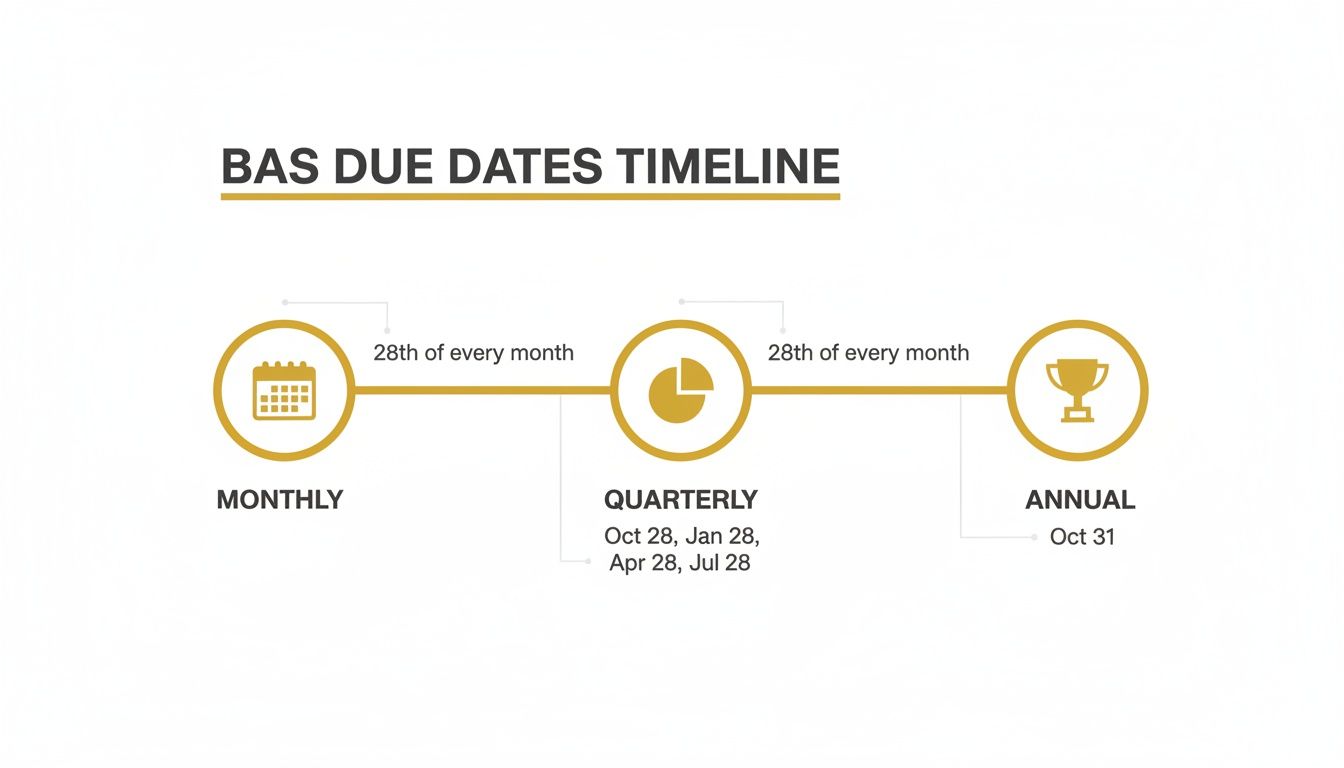
The key takeaway here is pretty clear: your lodgement frequency is directly tied to the size and turnover of your business, with the vast majority of small businesses landing in that quarterly cycle.
Who Needs to Lodge a BAS?
First things first, you need to be certain about your obligations. You're required to lodge a BAS if your business is registered for GST. This kicks in for most businesses once their annual turnover hits $75,000 or more (or $150,000 for non-profits).
Your BAS is used to report on a few key tax areas all at once:
- Goods and Services Tax (GST) you've collected on sales, minus any GST credits you can claim on purchases.
- Pay As You Go (PAYG) Withholding for the tax you’ve withheld from employee salaries.
- Pay As You Go (PAYG) Instalments to cover your own estimated income tax bill.
- Other taxes like fringe benefits tax (FBT) or fuel tax credits, if they apply to you.
If you want to get a better handle on what a BAS involves and why it's such a fundamental part of business accounting, our detailed article explains what BAS is in accounting. Having that foundational knowledge makes navigating the BAS due dates for 2025 a whole lot easier.
A Detailed Look at Quarterly BAS Deadlines
For most small businesses in Australia, lodging your BAS quarterly is the standard. It’s the default rhythm for keeping on top of your tax obligations. This applies to any business with a GST turnover of less than $20 million, and it strikes a good balance between staying compliant and not getting buried in paperwork. Getting these BAS due dates for 2025 right is one of the fundamentals of keeping the ATO happy.
The quarterly system simply chops the financial year into four reporting periods. For each quarter, you’ll need to pull together your GST info, PAYG withholding, and any other relevant tax figures, then lodge and pay by a set date. The deadlines are predictable, which helps a lot when you’re trying to plan your bookkeeping and manage cash flow.

Key Quarterly BAS Periods and Dates for 2025-2026
It's easy to get mixed up, as the 2025 calendar year straddles two different Australian financial years. You have to be careful to track the deadlines for both to make sure nothing slips through the cracks.
Here are the specific quarterly deadlines you need to circle in your calendar.
Covering the 2024-2025 Financial Year:
- Quarter 2 (October - December 2024): Due by 28 February 2025
- Quarter 3 (January - March 2025): Due by 28 April 2025
- Quarter 4 (April - June 2025): Due by 28 July 2025
Covering the 2025-2026 Financial Year:
- Quarter 1 (July - September 2025): Due by 28 October 2025
- Quarter 2 (October - December 2025): Due by 28 February 2026
Just remember, if a due date lands on a weekend or public holiday, the ATO gives you a pass—you can lodge and pay on the next business day without any drama.
The Power of Using a Registered BAS Agent
Handing your BAS over to a professional does more than just give you peace of mind. It unlocks some serious perks, with the biggest one being deadline extensions. The ATO offers concessional lodgement programs exclusively to registered BAS and tax agents, giving their clients a valuable buffer to get their books finalised.
Let's put that into perspective. Imagine you run a busy cafe in Sydney. You're juggling suppliers, staff, and customers, and suddenly the Quarter 1 BAS deadline for the 2025-26 financial year is staring you down. That period, from 1 July to 30 September 2025, has a standard lodgement date of 28 October 2025 if you're lodging it yourself.
But if you work with a registered BAS agent who lodges it electronically for you, that deadline gets pushed back to 25 November 2025. That extra month can be a complete lifesaver, giving you time to reconcile everything properly without the last-minute panic. You can find more details on how these extensions work across different quarters by exploring lodgement date insights from tax professionals.
This extension provides crucial breathing room, turning a stressful compliance scramble into a structured, calm process. It gives you and your agent the time needed to ensure total accuracy, seriously cutting down the risk of mistakes and a potential ATO audit.
Monthly and Annual BAS Lodgements: Who Fits Where?
While most businesses get into a comfortable quarterly BAS rhythm, your reporting schedule isn't a one-size-fits-all deal. The Australian Taxation Office (ATO) actually sets your frequency based on your turnover, creating different rules for big players and tiny operators. Knowing exactly where your business stands is key to hitting the right BAS due dates in 2025.
For the big end of town, the cycle is much faster. If your business has a GST turnover of $20 million or more, you’re on the hook for monthly BAS lodgements. This keeps a steady stream of tax information and payments flowing to the ATO, which makes sense given the sheer volume of transactions these larger companies handle.
This monthly schedule also helps big businesses manage their tax liabilities in smaller, more predictable chunks, which is a massive help for accurate cash flow forecasting.
Monthly Lodgement Deadlines
The rule for monthly lodgers is beautifully simple: your BAS is due on the 21st day of the month right after the end of the reporting period. Critically, there are no lodgement extensions available from registered agents for monthly BAS, so this date is set in stone.
- Example for a large wholesaler: Imagine a large import-export company in Sydney with a GST turnover of $25 million. They have to report monthly. For all their business activity in January 2025, their BAS lodgement and payment deadline is 21 February 2025. For February's activity, the due date is 21 March 2025, and so on throughout the year.
This constant rhythm keeps their financial data current and makes tax compliance a regular part of their monthly accounting process, rather than a monster task that builds up every quarter.
Annual Lodgement Rules and Dates
On the complete opposite end of the scale, some very small businesses can radically simplify their paperwork by reporting just once a year. This option is generally available to businesses that have voluntarily registered for GST and have an annual GST turnover of less than $75,000 (or $150,000 for non-profits).
The standard due date for an annual BAS is 31 October, following the end of the financial year. Conveniently, this lines up with the deadline for individual tax returns, letting business owners tackle both obligations in one go.
A sole trader running a small online craft store who voluntarily registered for GST is a perfect example. Annual reporting is a game-changer for them. Instead of wrestling with quarterly paperwork, they can consolidate all their GST info for the 2024-25 financial year and lodge their single BAS by 31 October 2025.
There's a handy exception, too. If you aren't required to lodge a tax return, the deadline for your annual BAS is pushed out to 28 February of the following year. And, as always, using a registered tax or BAS agent often opens up different due dates, making life even easier for micro-businesses.
The Strategic Advantage of Using a Registered Agent
Managing your Business Activity Statements is about more than just hitting deadlines. It's a core financial task where getting the numbers right is everything. Bringing a registered BAS or tax agent on board isn't just about outsourcing the work; it's a strategic move that turns a stressful compliance chore into a smoothly managed part of your business.
These professionals bring the expertise needed to sidestep the kind of costly errors that can quickly attract the wrong sort of attention from the Australian Taxation Office (ATO).
More importantly, working with a registered agent gets you access to the ATO's lodgement concession program. This is a game-changer for many businesses, as it provides valuable extensions on your quarterly BAS due dates for 2025. That extra time isn't just a buffer—it's crucial breathing room to get your accounts finalised without rushing. You can do a proper reconciliation, ensuring every GST credit is claimed and every dollar of PAYG withholding is accounted for correctly.

Comparing Due Dates: A Clear Advantage
The difference in deadlines between lodging yourself and using an agent is significant. This isn't just about avoiding a late lodgement; it’s a smart way to manage your finances better.
Let's look at a straight comparison for the main quarterly periods in the 2025-26 financial year:
| Reporting Period (2025-26) | Standard Due Date (Self-Lodged) | Registered Agent Due Date | Extra Time Gained |
|---|---|---|---|
| Quarter 1 (Jul - Sep 2025) | 28 October 2025 | 25 November 2025 | 4 weeks |
| Quarter 3 (Jan - Mar 2026) | 28 April 2026 | 26 May 2026 | 4 weeks |
| Quarter 4 (Apr - Jun 2026) | 28 July 2026 | 25 August 2026 | 4 weeks |
As you can see, you get an entire extra month for most quarters. The one exception is Quarter 2 (covering Oct-Dec), where the standard 28 February deadline already accounts for the Christmas and New Year break, so no further agent extension is typically offered. This extra time allows you to finalise your records without being under the pump, which always leads to better quality reporting.
Beyond Extensions: The Broader Benefits
The real value of using a registered agent goes well beyond just getting more time. Their expertise acts as a powerful defence against the financial pain and administrative headaches that come with non-compliance.
- Fewer Mistakes: Agents are trained to spot the common slip-ups in GST calculations, payroll figures, and income reporting. This protects you from those unintentional errors that could easily trigger an audit.
- Less Stress: Handing off the complexities of BAS prep frees up your time and mental energy. It lets you get back to focusing on what you do best—running and growing your business.
- Proactive Tax Management: A good agent does more than just lodge forms. They'll offer advice on managing cash flow around your BAS payments and keep you up to speed on any changes in tax law that affect you.
By bringing in an agent, you’re not just buying time. You're investing in accuracy, compliance, and genuine peace of mind. This proactive step dramatically reduces your risk of copping the Failure to Lodge penalties and General Interest Charges we detail in our section on penalties.
Understanding the Penalties for a Late BAS
Missing one of the key BAS due dates in 2025 is more than just a minor slip-up; it can trigger some pretty significant and escalating financial penalties from the Australian Taxation Office (ATO). The consequences go far beyond a simple late fee, hitting your business's cash flow and damaging your compliance record. Knowing what these penalties are is the first step to making sure you never have to pay them.
The main penalty you’ll face for missing a deadline is the Failure to Lodge (FTL) penalty. This is an automated system that applies a fine for every 28-day period (or even part of a period) that your BAS is outstanding. The amount isn't arbitrary—it's calculated using a system of penalty units, which the government adjusts from time to time.
How FTL Penalties Are Calculated
The size of the FTL penalty is directly tied to the size of your business. The ATO does this to ensure the fines are proportionate to turnover, but it means bigger businesses feel the sting much more.
- Small entities: If your business has a turnover of less than $1 million, you'll face a penalty for each 28-day block, capped at five penalty units.
- Medium entities: For businesses with turnover from $1 million up to $20 million, that penalty rate is doubled.
- Large entities: For those with turnover exceeding $20 million, the penalty rate is five times the base amount.
This tiered system means that an oversight that costs a small business a few hundred dollars could easily cost a larger company thousands for the exact same mistake.
The Real Cost of a Late BAS
Let's break it down with an example. A single penalty unit is currently $330. If a small business lodges its BAS just one day late, it immediately gets hit with a $330 penalty. If that BAS is still unlodged 30 days later, another $330 penalty is applied, bringing the total to $660. This can climb up to a maximum of $1,650 for a single late statement.
The reality is that the ATO is ramping up its enforcement activities. The penalty system works a bit like driver demerit points—initial fines get worse with each overdue cycle, hitting repeat offenders the hardest. With over 14.1 million individual tax returns lodged by April 2025 (a 3% jump from the previous year), it’s clear that more people are coming under increased ATO scrutiny.
On top of the FTL penalty, the ATO also applies a General Interest Charge (GIC) on any unpaid tax. This isn't a one-off charge; it's calculated daily and compounds, meaning your debt just keeps growing until both the outstanding tax and the FTL penalty are paid in full.
This one-two punch of penalties makes late lodgement a very expensive mistake. If you do find yourself falling behind, our guide on managing late BAS payments offers practical strategies to get back on track.
A Practical Checklist for Accurate BAS Preparation
Good preparation is the secret to lodging a Business Activity Statement without the usual last-minute panic. If you’re systematic about it, you can avoid common mistakes, claim every credit you're entitled to, and have everything ready long before the BAS due dates in 2025. A simple checklist can turn what feels like a complex chore into a manageable process.
This is a tool that helps you pull your financial data together methodically, whether you're lodging the BAS yourself or just getting the figures ready for your accountant. It's really about building a solid, repeatable habit that cleans up your bookkeeping and gives you real confidence in the numbers you're reporting.

To make this even easier, we've put together an actionable checklist. You can use this table each quarter to track your progress and make sure nothing gets missed.
Quarterly BAS Preparation Checklist
| Task | Status (To Do / Complete) | Notes |
|---|---|---|
| FINANCIAL RECONCILIATION | ||
| Reconcile all bank & credit card accounts | Match all transactions in your accounting software. | |
| Clear out any 'suspense' or unallocated accounts | Every transaction needs a proper home. | |
| Review accounts receivable and payable reports | Ensure invoices/bills are in the correct period. | |
| GST & SALES VERIFICATION | ||
| Check all sales for correct GST coding | GST-free vs. taxable sales. | |
| Verify you have a valid tax invoice for all GST credits claimed | No tax invoice = no GST credit claim. | |
| Review non-deductible expenses (e.g., entertainment) | Make sure you haven't claimed GST on these. | |
| PAYROLL & PAYG | ||
| Reconcile PAYG withholding from payroll reports to the ledger | The figures must match perfectly. | |
| Confirm gross wages reported on the BAS match payroll summaries | A common ATO check area. | |
| FINAL REVIEW & LODGEMENT | ||
| Generate BAS report from software and review all figures | Do the numbers look reasonable? | |
| Lodge the BAS via your preferred method | E.g., Online services for business, registered agent. | |
| Set a reminder for the payment due date | Lodge and pay are separate steps! |
Following these steps methodically will put you in a great position for a smooth, accurate BAS lodgement every single time. Now, let's break down the key areas in more detail.
Financial Reconciliation and Review
Before you even glance at the BAS form, your core financial accounts need to be spot-on. This is the foundation, and getting it right is non-negotiable for correct reporting.
- Reconcile All Bank Accounts: Go through every transaction in your business bank accounts, credit cards, and loan accounts. Make sure they are all matched and accounted for in your bookkeeping software. No exceptions.
- Clear Suspense Accounts: Take a look at your general ledger for anything sitting in "suspense" or "uncategorised" accounts. These are red flags. They must be properly allocated before you finalise your BAS.
- Review Accounts Receivable and Payable: Check that your outstanding invoices and bills are correctly dated. This ensures they land in the right reporting period, which is crucial for accurate GST timing.
To get your BAS right, you need to understand the mechanics behind the numbers. A great resource for this is a guide on how to work out VAT, as the principles of calculating tax on transactions are fundamental to GST.
GST and Sales Verification
Your Goods and Services Tax figures are the absolute heart of the BAS. A quick double-check here can prevent you from overpaying the ATO or, just as bad, claiming credits you aren't actually entitled to.
Honestly, the most common BAS errors we see come from incorrect GST coding. Taking ten minutes to review your sales and purchase transactions can save you from massive headaches and potential ATO penalties down the line.
Here’s exactly what to verify:
- Check All Sales for Correct GST: Run a sales report and scan it to make sure GST has been applied to all your taxable sales. At the same time, confirm your GST-free sales are coded correctly.
- Verify GST Credits on Purchases: Go through all your business purchases. You must hold a valid tax invoice for every single GST credit you intend to claim. The ATO is very strict on this.
- Account for Non-Deductible Expenses: Look at expenses like client entertainment or certain travel costs to ensure you haven’t incorrectly claimed GST credits on them. It's an easy mistake to make.
Payroll and PAYG Withholding
Finally, your payroll data must line up perfectly with what you report on the Business Activity Statement. Any discrepancies here will eventually be flagged.
- Reconcile PAYG Withholding: Match the total PAYG withholding from your payroll reports for the quarter with the corresponding liability account in your general ledger. The two figures should be identical.
- Confirm Gross Wages: Ensure the total gross wages figure you report on the BAS is exactly what your payroll summary reports show for the period. This is another critical number the ATO uses for data matching.
How to Lodge and Pay Your BAS Correctly
Once your Business Activity Statement is prepared and looks spot on, the final steps are lodging the form and paying whatever you owe the Australian Taxation Office (ATO). The ATO has several electronic methods designed to make this whole process as painless as possible, helping you hit those crucial BAS due dates for 2025 without any last-minute panic.
For many business owners, the most direct path is using the ATO’s Online services for business. It’s a secure government portal where you can lodge your BAS, look at old statements, and manage your tax accounts from one spot. It's a reliable, straightforward option if you handle your own compliance.
Another very efficient way to get it done is by lodging through Standard Business Reporting (SBR) enabled software. If you're already using an accounting platform like Xero, MYOB, or QuickBooks, you can usually lodge your BAS right from the software. This is a game-changer because it connects your bookkeeping directly to your reporting, slashing the risk of manual data entry errors.
Choosing Your Lodgement Method
How you choose to lodge often comes down to your business setup and how comfortable you are with digital tools. Each method has its own clear advantages.
- Online Services for Business: This is ideal for sole traders and small businesses who manage their own books and prefer to deal directly with the ATO's own platform.
- SBR-Enabled Software: Absolutely perfect for businesses that have their finances sorted in accounting software. It keeps everything neat and tidy within a single system.
- Registered BAS or Tax Agent: This is the best option if you want an expert to cast their eye over everything, check for accuracy, and get you access to those handy extended lodgement deadlines.
Lodging electronically isn't just a nice-to-have anymore; it's the standard way of doing things. It gives you a secure digital receipt of your submission and makes sure the ATO gets your info instantly—which is vital when a deadline is breathing down your neck.
Making Your BAS Payment
Just remember, lodging your BAS and paying it are two separate actions. Submitting the form on time is critical, but making sure the payment actually lands with the ATO by the due date is just as important.
The ATO offers a few different payment options to suit everyone. BPAY is one of the most common, letting you pay straight from your bank account using the unique biller code and reference number on your BAS. You can also pay online through the ATO website with a credit or debit card, but keep in mind a card payment fee might apply.
For a completely set-and-forget process, you can set up a direct debit from your ATO Online services account. This gives the ATO permission to withdraw the amount you owe on the due date, ensuring you never miss a payment. If you want to get a deeper understanding of the entire lodgement and payment cycle, our detailed guide on the Business Activity Statement lodgement process breaks it all down for you.
Answering Your Top BAS Deadline Questions
When it comes to your Business Activity Statement, a few common questions pop up time and time again. Getting these sorted is key to staying on the right side of the ATO and avoiding any last-minute panic as the BAS due dates for 2025 roll around. We've compiled the most frequent queries we get from business owners just like you.
One of the biggest questions is about due dates that land on a weekend or public holiday. Good news here: the Australian Taxation Office (ATO) gives you a bit of breathing room. The deadline automatically shifts to the next business day, so you can lodge and pay then without any risk of a penalty.
Correcting Mistakes and Asking for More Time
So, what happens if you spot a mistake right after you’ve lodged your BAS? Don't stress, it happens more often than you think, and the ATO has a clear process for fixing things. For most minor errors with GST or fuel tax credits, you can simply adjust it on your next BAS, as long as the mistake is within the ATO's defined limits.
For bigger stuff, especially anything related to PAYG withholding, you'll likely need to go back and revise the original BAS you submitted. The golden rule is to act fast and be upfront with the ATO—it goes a long way in maintaining a good compliance record.
Another hot topic is whether you can apply for a lodgement extension yourself. While registered BAS and tax agents get automatic extensions for their clients, you can ask the ATO for a deferral directly if you're facing exceptional circumstances.
To apply, you’ll need a solid reason, like a natural disaster, a serious personal illness, or another major event that's genuinely stopped you from lodging on time. You absolutely must get in touch with the ATO before the due date to talk through your situation.
Just remember, these kinds of deferrals are decided case-by-case and aren't a sure thing. If you want consistent, reliable extensions and professional oversight, partnering with a registered agent is still the sharpest strategy for managing your BAS obligations.
Feeling the pressure of BAS deadlines and compliance? The expert team at Australia Wide Tax Solutions can take BAS preparation and lodgement completely off your plate. We ensure everything is accurate and on time, so you can get back to what you do best—running your business. Contact us today to make your tax obligations simple by visiting https://www.awts.net.au.
The ATO provides guidance through ato.gov.au, the Small Business Support Line (13 28 66), and Online Services for individuals and businesses. For complex situations, a registered tax agent provides advice tailored to your specific circumstances and professional indemnity protection. You can verify agent registration at the TPB register at tpb.gov.au.
Most tax records must be kept for five years from the date of lodgement or the date the transaction occurred, whichever is later. Records must be in English or convertible to English and must be sufficient to explain the income and deductions in your return. The ATO can request records at any time during the retention period.
Consider a registered tax agent when your affairs involve multiple income sources, business activity, investment properties, capital gains, or overseas income. Agents extend your lodgement deadline, provide safe harbour protection, and take professional responsibility for the advice given. Verify registration at tpb.gov.au.
The failure to lodge penalty is based on penalty units ($313 per unit from 1 July 2023), accruing per 28-day period for late returns and BAS lodgements. Incorrect information penalties range from 25% to 75% of the tax shortfall depending on whether the behaviour was careless, reckless, or intentional. Proactive disclosure before an audit begins typically results in significantly reduced penalties.
Tax minimisation is the legal arrangement of your affairs to reduce tax — claiming all eligible deductions, using appropriate structures, and timing income and expenses. Tax avoidance involves arrangements that technically comply with the law but achieve outcomes parliament did not intend. The ATO can apply Part IVA anti-avoidance rules to cancel benefits from avoidance arrangements.
Getting your Business Activity Statement (BAS) lodgement right is a non-negotiable part of running a business in Australia. It’s the main way you report and pay critical taxes like GST and PAYG withholding to the Australian Taxation Office (ATO). Nail this process, and you’re well on your way to solid financial health and compliance.
- Getting a Handle on Your BAS Lodgement Obligations
- How to Prepare for a Smooth BAS Lodgement
- Choosing The Best BAS Lodgement Method For Your Business
- Know Your BAS Lodgement Deadlines and Payment Options
- Common BAS Mistakes and How to Avoid Them
Getting a Handle on Your BAS Lodgement Obligations
The Business Activity Statement isn't just another form to fill out. Think of it as a summary of your tax life for a given period. If your business is registered for Goods and Services Tax (GST)—which is mandatory for most businesses with a GST turnover of $75,000 or more per year (or $150,000 for non-profits)—then lodging a BAS is a must-do.
Once you're registered for GST, the ATO will automatically start sending you a BAS when it's time to lodge. The beauty of the BAS is that it bundles several tax obligations into one report, which definitely simplifies things. If you're new to this, we’ve got a great primer that breaks down the basics in our article, what is BAS in accounting.
What Does a BAS Actually Cover?
When you open up your BAS, you’ll see sections for different taxes, depending on what your business does. The usual suspects are:
- Goods and Services Tax (GST): This is the classic balancing act. You calculate the GST you’ve collected from customers and subtract the GST credits you can claim on your business expenses. The difference is what you owe the ATO (or what they owe you).
- Pay As You Go (PAYG) Withholding: Got employees? This is where you report the income tax you’ve held back from their pay packets. That money doesn't belong to you; you’re just holding it for the ATO.
- Pay As You Go (PAYG) Instalments: This is a smart system to help you pre-pay your business's income tax throughout the year. It stops you from getting hit with a massive, and often unexpected, tax bill when you lodge your annual return.
To get this all done without a headache, you need a solid system for collecting your financial data. A good tax information form can be a great start to make sure nothing gets missed.
Figuring Out Your Reporting Cycle
How often you need to lodge your BAS comes down to your GST turnover. The ATO will assign you a reporting cycle, and this sets the rhythm for your bookkeeping and lodgement deadlines.
For the vast majority of small and medium businesses in Australia, quarterly reporting is the standard. It hits the sweet spot—frequent enough to keep on top of your taxes, but not so often that it becomes a massive admin burden.
Here are the three main cycles you might be on:
- Quarterly: This is the most common setup, for businesses with a GST turnover under $20 million. It means you'll be lodging four times a year.
- Monthly: If your GST turnover hits $20 million or more, the ATO will put you on a monthly cycle. Some smaller businesses also opt for this to keep a tighter rein on their cash flow.
- Annually: This is an option for very small businesses turning over less than $75,000 who have voluntarily registered for GST. It's the simplest, but least common, cycle.
Knowing your specific cycle is the first step to a stress-free BAS process. It dictates your deadlines and helps you build a bookkeeping routine that ensures you’re always prepared to lodge accurately and on time. No last-minute scrambles.
How to Prepare for a Smooth BAS Lodgement
An accurate Business Activity Statement lodgement starts long before you even think about logging into the ATO portal. Real success is built on a solid foundation of organised, up-to-date records. Without them, you’re basically flying blind, risking simple errors that could easily spiral into audits, penalties, or missed GST credit claims.
Think of your BAS prep as gathering all the ingredients before you start cooking. Each bit of financial data is a crucial component, and having everything ready to go makes the whole process faster and way less stressful. Let’s walk through exactly what you need to have on hand.
This quick graphic breaks down the key stages of your BAS obligations, from checking your GST threshold right through to lodging the final statement.
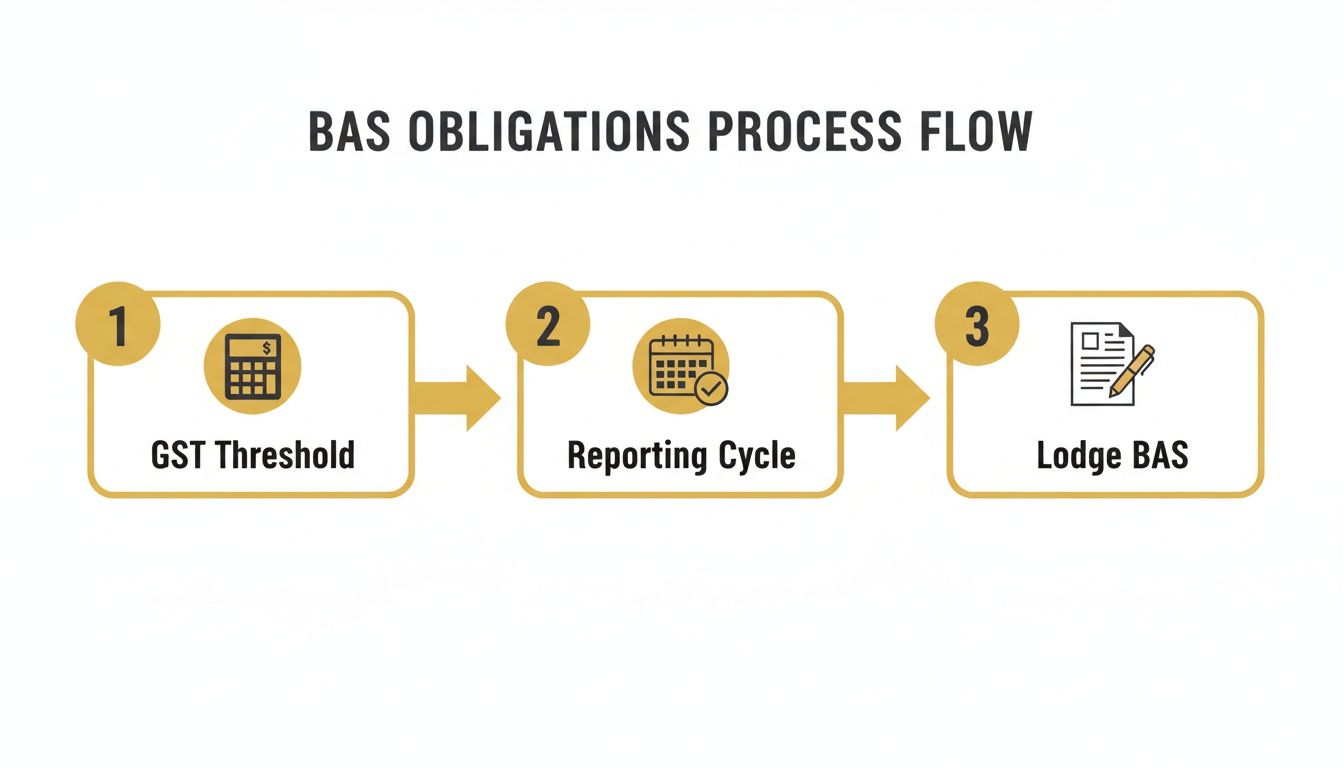
It’s a simple reminder of the journey, making it clear where preparation fits into the bigger compliance picture.
Compiling Your Sales and Income Records
First up, you need a complete picture of every dollar your business brought in during the reporting period. This isn't just about a grand total; it’s about correctly classifying each transaction so you can calculate the right amount of GST.
You'll need to pull together:
- Tax invoices you've issued: These are the bread and butter of your sales records. Make sure they clearly show the total price, the GST amount, and your ABN.
- Bank statements: Use these to cross-reference every deposit with your sales invoices. It's the best way to make sure nothing has slipped through the cracks. Keep an eye out for any odd deposits that might be business income you forgot to invoice.
- Cash sales records: If you take cash, your daily till reconciliations or cash sales summaries are absolutely vital. These need to be meticulous, as they're often the first thing the ATO looks at.
A classic mistake we see all the time is failing to separate GST-free sales from taxable ones. For instance, if you run a small grocery store, sales of basic foods like bread and milk are GST-free, but soft drinks are taxable. Getting this wrong can lead to you overpaying or underpaying GST.
Gathering Your Expense and Purchase Documents
This is where you get your money back. It's your chance to claim back the GST you’ve paid on business purchases. Missing out on these GST credits literally means you're leaving money on the table for the ATO. Every legitimate dollar you claim reduces your final BAS bill.
To make sure you're claiming everything you're entitled to, you'll need:
- Supplier tax invoices: For any purchase over $82.50 (including GST), you must have a valid tax invoice to claim the GST credit. No invoice, no credit.
- Receipts for smaller purchases: Don't throw them out! Keep all receipts for smaller business-related expenses, as they add up.
- Bank and credit card statements: Go through these line by line to spot all business-related debits and match them to an invoice or receipt.
A big part of BAS prep involves pulling financial data from all over the place. To save yourself a massive headache and reduce errors, it's worth looking at ways to automate processes like how to extract invoice data efficiently.
Assembling Payroll Information
If you have a team, your BAS also involves reporting on Pay As You Go (PAYG) withholding. This is the tax you’ve held back from your staff's wages, which you then need to pass on to the tax office.
Key Takeaway: Your payroll records must perfectly match the figures you report on your BAS. The ATO’s data-matching systems are incredibly sophisticated these days and will flag discrepancies between your BAS and your Single Touch Payroll (STP) reports almost instantly.
Before you even start your BAS, have your payroll summary report for the period ready. This report needs to clearly show the total gross wages paid and the total tax withheld. Reconciling this figure against your bank records for wage payments is a final check you absolutely can't skip. For a deeper dive into organising your documents, check out our comprehensive BAS preparation checklist.
By methodically gathering and organising these three sets of documents—income, expenses, and payroll—you're creating a complete and defensible snapshot of your business finances. This doesn't just guarantee an accurate business activity statement lodgement; it turns a daunting chore into a routine business health check.
Choosing The Best BAS Lodgement Method For Your Business

Once your books are in order, the next big decision is how you're actually going to get your BAS to the ATO. This isn't just about clicking a button; your choice of lodgement method can make a real difference to your accuracy, how much time you spend on it, and even your due dates.
While there are a few ways to lodge your business activity statement, the overwhelming shift is towards digital. Modern online methods are simply faster, more secure, and far less likely to cause the kinds of human errors that were common with old-school paper forms.
H3: Lodging Directly With ATO Online Services
For business owners who like to keep things hands-on, lodging directly through the ATO’s own digital platforms is a solid option. It puts you in the driver's seat, giving you complete control over the entire submission process.
You have two main portals for this:
- Online services for business: This is the ATO's standard, secure platform built for businesses. It's the go-to for most companies, trusts, and partnerships managing their own tax affairs.
- myGov: If you're a sole trader, you can link your ABN to your personal myGov account and handle your BAS lodgement from there.
The online process is generally pretty user-friendly. The forms come pre-filled with your business details, and the system has built-in checks that often catch simple mistakes before you hit submit. If you're after a detailed walkthrough, our guide on how to lodge your BAS online breaks it down step-by-step.
H3: Partnering With A Registered BAS or Tax Agent
Let's be honest, for many business owners, handing off BAS lodgement to a professional is the smartest thing they can do. A registered BAS or tax agent does more than just fill out a form; they provide a full service that ensures accuracy, maximises your claims, and keeps you compliant with tax laws that seem to change every other week.
This path is perfect if you:
- Are simply too busy running your business to get bogged down in bookkeeping.
- Aren't 100% confident in calculating GST, PAYG, and other complex figures.
- Want the peace of mind that comes from having an expert double-check everything.
One of the biggest perks of using an agent is getting access to extended lodgement and payment deadlines. This isn't a myth—it's a real concession from the ATO that can give you critical breathing room during hectic times. A good agent will review your records, spot potential red flags, and make sure every last GST credit you're entitled to is claimed.
H3: The Traditional Paper Lodgement Option
While it still technically exists, lodging a paper BAS is quickly becoming a thing of the past. The ATO has been pushing businesses towards digital for years, and now, most are required to lodge electronically.
Paper lodgement is slow, you get no instant confirmation that it's been received, and it's wide open to manual errors—both on your end and when someone at the ATO has to process it. Unless you have a specific and rare exemption, you're far better off choosing one of the digital methods. It ensures your business activity statement lodgement is handled smoothly, efficiently, and without any unnecessary headaches.
The ATO provides guidance through ato.gov.au, the Small Business Support Line (13 28 66), and Online Services for individuals and businesses. For complex situations, a registered tax agent provides advice tailored to your specific circumstances and professional indemnity protection. You can verify agent registration at the TPB register at tpb.gov.au.
Most tax records must be kept for five years from the date of lodgement or the date the transaction occurred, whichever is later. Records must be in English or convertible to English and must be sufficient to explain the income and deductions in your return. The ATO can request records at any time during the retention period.
Consider a registered tax agent when your affairs involve multiple income sources, business activity, investment properties, capital gains, or overseas income. Agents extend your lodgement deadline, provide safe harbour protection, and take professional responsibility for the advice given. Verify registration at tpb.gov.au.
The failure to lodge penalty is based on penalty units ($313 per unit from 1 July 2023), accruing per 28-day period for late returns and BAS lodgements. Incorrect information penalties range from 25% to 75% of the tax shortfall depending on whether the behaviour was careless, reckless, or intentional. Proactive disclosure before an audit begins typically results in significantly reduced penalties.
Tax minimisation is the legal arrangement of your affairs to reduce tax — claiming all eligible deductions, using appropriate structures, and timing income and expenses. Tax avoidance involves arrangements that technically comply with the law but achieve outcomes parliament did not intend. The ATO can apply Part IVA anti-avoidance rules to cancel benefits from avoidance arrangements.
Comparison of BAS Lodgement Methods
Deciding how to lodge can feel like a big choice. To make it easier, we've broken down the key differences between the three main methods. This should help you see at a glance which approach best fits your business needs, your confidence level with tax matters, and how much time you have to spare.
| Feature | ATO Online Services | Registered BAS/Tax Agent | Paper Lodgement |
|---|---|---|---|
| Control | Full control over the entire process. | You provide records, the agent handles the rest. | Full manual control, but with significant risks. |
| Accuracy | Relies on your own knowledge. Built-in checks help. | High. Professional review minimises errors and ensures claims. | Low. Highly prone to manual calculation and data entry errors. |
| Time Commitment | Moderate. You need to do the calculations and lodgement. | Low. Outsource the entire process. | High. Requires manual form completion and postage. |
| Deadlines | Standard ATO deadlines apply. | Access to extended lodgement and payment due dates. | Standard, shorter deadlines apply. No extensions. |
| Support | General ATO support channels available. | Personalised, expert advice and support. | Limited to general ATO phone lines. |
| Cost | Free to use the ATO portals. | Professional fees apply. | Postage costs, but the main cost is your time and error risk. |
| Best For | DIY business owners confident with their bookkeeping. | Business owners who value time, accuracy, and peace of mind. | Businesses with a specific ATO exemption (very rare). |
Ultimately, while lodging yourself online is a viable option for those with the time and confidence, partnering with a registered agent almost always provides the best outcome. The expertise, extended deadlines, and sheer peace of mind are well worth the investment, letting you focus on what you do best: running your business.
Know Your BAS Lodgement Deadlines and Payment Options
Staying on top of your Business Activity Statement deadlines is non-negotiable for tax compliance. Let's be blunt: missing these dates isn’t a minor slip-up. The Australian Taxation Office (ATO) can hit you with penalties and interest charges, putting a completely unnecessary strain on your cash flow.
The first step to staying out of trouble is understanding the rhythm of your BAS cycle. Your due dates hinge entirely on your reporting frequency—whether you lodge monthly, quarterly, or annually.
Mapping Out Your Lodgement Calendar
For most small and medium-sized businesses, the quarterly cycle is the sweet spot. It strikes a good balance between staying on top of your tax obligations and not getting bogged down in administrative work every single month.
Quarterly lodgement is still the standard for a reason. Over 70% of small businesses in Australia stick to this frequency. This schedule lines up perfectly with the ATO's standard due dates of 28 October, 28 February, 28 April, and 28 July. You can find out more about the ATO's agent lodgement program on their official site.
Let's break down the key deadlines:
- Quarterly Lodgers: If you're lodging yourself, your deadline is the 28th day of the month after the quarter ends.
- Monthly Lodgers: For businesses with a higher turnover, the BAS is due on the 21st of the following month. For example, your July BAS is due by 21 August.
- Annual Lodgers: This is less common, but if you're eligible, your due date is typically 31 October.
One of the biggest perks of working with a registered BAS or tax agent is getting access to their extended lodgement program. This can give you an extra four weeks for most quarterly deadlines—a priceless buffer during hectic times.
Making Your BAS Payment
Once you've lodged your BAS and know what you owe, the ATO offers a few straightforward ways to settle up. The key is to pick a method that works for your business and guarantees the payment lands on time.
The most common payment methods we see are:
- BPAY: You can pay directly from your bank account using the unique Biller Code and reference number found on your BAS.
- Credit or Debit Card: The ATO's online payment portal lets you use a card, but keep in mind a processing fee might apply.
- Direct Debit: You can set up a one-off or recurring direct debit through ATO online services. This is a great set-and-forget option to avoid missed payments.
Always, always double-check the payment reference number. A simple typo can send your payment into limbo, causing delays and a massive administrative headache to sort out.
Pro Tip: Set up a separate business bank account just for GST and PAYG withholding. Every time you get paid or run payroll, transfer the tax portion into this account. When your BAS is due, the money is already sitting there, quarantined from your daily operational cash flow.
What to Do If You Can't Lodge or Pay on Time
Life happens. Sometimes unexpected issues make it impossible to meet your tax obligations on time.
If you find yourself in this situation, the absolute worst thing you can do is bury your head in the sand. The ATO is often willing to help, but only if you're proactive and communicate with them.
As soon as you know you're going to miss a deadline, contact the ATO or your tax agent. You might be able to arrange a lodgement deferral or a payment plan that fits your situation. This simple act of communication shows you're taking your obligations seriously and can help you avoid or reduce penalties.
Common BAS Mistakes and How to Avoid Them
Even with the best intentions, it’s frighteningly easy to make a slip-up during your business activity statement lodgement. These aren't just minor admin headaches; they can lead to ATO scrutiny, unexpected tax bills, and hours of wasted time trying to fix things.
Understanding where business owners commonly go wrong is the first step to getting your lodgement right, every single time.

From simple calculation errors to claiming credits you’re not entitled to, we’ve seen it all. Getting these details right not only keeps you compliant but also protects your cash flow from completely avoidable penalties.
Miscalculating GST and Claiming Invalid Credits
This is, without a doubt, the most frequent pitfall we see. A simple maths error or a misunderstanding of GST law can create significant problems down the track. One of the classic mistakes is claiming GST credits on purchases that don't actually include GST in the first place.
Here are a few real-world examples that trip people up constantly:
- Bank Fees: Most standard bank fees, like your monthly account-keeping charge, are input-taxed. This means they don't include GST, so you can't claim a credit on them.
- GST-Free Purchases: Did you buy milk and bread for the office kitchen? Most basic food items are GST-free, which means there’s no credit to claim back.
- Supplier ABN: If you get an invoice from a contractor or supplier who isn't registered for GST, there will be no GST component to claim, even if it's a legitimate business expense. Always check the invoice.
Another area of confusion is client entertainment. Taking a client out for a meal is generally not a deductible expense for income tax, and as a result, you can't claim the GST credits on it either. It’s a small detail, but it’s one the ATO’s systems are specifically designed to flag.
Missing Lodgement and Payment Deadlines
Failing to lodge your BAS on time is a mistake with immediate and painful financial consequences. The ATO's penalty system is automated and unforgiving, applying charges even if you don't actually owe any tax for that period.
Failure to lodge on time results in penalties that escalate quickly. For a small business, this starts at $313 per overdue statement and can climb to a maximum of $1,565 per statement. On top of that, any late payments attract the General Interest Charge (GIC), which compounds daily on the unpaid amount. You can see a full breakdown of these penalties and important BAS due dates on CleanSlate.net.au.
The lesson here is crystal clear: even if you can't pay the amount owed, you must still lodge the BAS by the deadline. It's a far better strategy to lodge on time and then arrange a payment plan with the ATO than to simply ignore the due date.
Keeping Disorganised or Incomplete Records
At the end of the day, your BAS is only as accurate as the records you keep. Messy bookkeeping is the root cause of most lodgement errors, turning what should be a straightforward process into a stressful, time-sucking nightmare.
Disorganised records almost always lead to:
- Missing GST Credits: Lost receipts and unrecorded expenses mean you're literally giving money back to the ATO by not claiming legitimate credits.
- Under-reporting Sales: Forgetting to record cash sales or other miscellaneous income can result in you underpaying GST—a major red flag for auditors.
- Incorrect PAYG Withholding: If your payroll records don't perfectly align with what you report on your BAS, the ATO’s sophisticated data-matching systems will spot the discrepancy very quickly.
Using good accounting software and sticking to a consistent weekly bookkeeping routine are your two best defences against this.
A Final Review Checklist Before You Lodge
Before you hit that submit button, take ten minutes to run through this quick checklist. It’s a simple habit that can save you from a world of trouble.
- Reconcile Your Accounts: Are all bank accounts, credit cards, and clearing accounts fully reconciled for the period? No exceptions.
- Review GST Coding: Run a detailed GST report from your accounting software. Scan it for any large or unusual items and double-check that expenses have been correctly coded as either containing GST or being GST-free.
- Check Payroll Figures: Does the total gross wages and tax withheld on your BAS match your payroll summary report for the exact same period? They need to be identical.
- Confirm Your Details: A simple one, but crucial. Are your business name, ABN, and the reporting period correct on the form?
Performing these final checks ensures your business activity statement lodgement is clean, accurate, and ready for scrutiny.
Your Top Business Activity Statement Lodgement Questions
Even after you've got the prep work down and the due dates circled on the calendar, a few nagging questions about business activity statement lodgement always seem to crop up. Getting straight answers is the key to lodging with confidence and keeping the ATO happy.
Think of this as the final checklist—clearing up those last-minute uncertainties and "what if" scenarios that can throw you off your game.
What Should I Do If I Find a Mistake on a Lodged BAS?
Realising you've made a mistake on a BAS you've already sent off can be a heart-stopping moment, but don't panic. It's a common and fixable issue. The ATO has clear processes for corrections, and jumping on it quickly is always the best approach.
For small errors under a certain financial threshold, the ATO usually lets you make an adjustment on your next BAS. This is the simplest fix for minor GST or fuel tax credit mistakes, saving you from having to formally amend old paperwork.
But for bigger mistakes, or anything that relates to a previous financial year, you’ll need to lodge a revision of the original statement. You can do this yourself through the ATO's online services, or you can have your registered agent handle it for you. The sooner you correct it, the better—it shows good faith and helps minimise any potential interest or penalties.
Do I Still Need to Lodge a BAS with No Business Activity?
Yes. Absolutely. This is a non-negotiable rule that catches so many new business owners out. Even if you had zero sales, made zero purchases, and paid no wages for the entire reporting period, you are still legally required to lodge your BAS.
This is what’s known as lodging a 'nil' BAS.
Filing a nil BAS is how you officially report to the ATO that you've met your obligation for that period and that no activity took place. If you don't, you can still be hit with a Failure to Lodge (FTL) penalty, even when you owe no tax. The good news? Lodging a nil BAS is incredibly fast and can be done online in just a couple of minutes.
Is It Possible to Get an Extension on My BAS Due Date?
While you can't just decide to lodge late on your own terms, getting an official extension on your BAS due date is definitely possible in certain situations. They aren't handed out automatically, though—it all depends on your circumstances.
The easiest way to get more time is to use a registered tax or BAS agent. Agents have access to a special lodgement schedule for their clients, which typically adds an extra four weeks to most quarterly deadlines. This is one of the biggest perks of having a professional in your corner.
If you lodge yourself and get hit by something unexpected—like a serious illness, a natural disaster, or another major personal event—you can contact the ATO directly before the deadline to request a lodgement deferral.
Key Takeaway: Communication is everything. The ATO is far more likely to be accommodating if you reach out proactively to explain your situation rather than waiting for them to chase you for an overdue lodgement.
How Is GST Turnover Different from My Total Sales?
This is a critical distinction that directly impacts your tax obligations, and getting it wrong can cause major headaches. Your 'total business sales' is exactly what it sounds like—all the revenue your business has brought in. Your 'GST turnover', however, is a specific calculation the ATO uses for tax purposes.
Your GST turnover is your gross business income, but with a few key items excluded:
- Any GST you included in the price of your sales.
- Sales that aren't part of your main business activities.
- Input-taxed sales, like residential rent or financial supplies.
This is the figure that determines whether you need to register for GST (the threshold is $75,000) and how often you need to report. Always use the ATO's precise definition of GST turnover when making these decisions to ensure you stay compliant.
Navigating the world of BAS lodgement can feel complex, but you don't have to do it alone. The expert team at Australia Wide Tax Solutions is here to take the guesswork out of your tax obligations, ensuring your BAS is prepared accurately and lodged on time, every time.
Let us handle your BAS and tax needs so you can focus on what you do best.
For any Australian business owner, the term Business Activity Statement (BAS) quickly becomes part of your vocabulary. But what is it, really? Think of it as your business's regular tax report card. It’s the official form you send to the Australian Taxation Office (ATO) to report and pay for several key taxes in one go, keeping everything neat and tidy.Demystifying the Business Activity Statement

- Goods and Services Tax (GST): This is the main event—balancing the GST you’ve collected against the GST credits you can claim.
- Pay As You Go (PAYG) Withholding: This is the income tax you’ve withheld from your employees' wages.
- Pay As You Go (PAYG) Instalments: These are the regular prepayments you make towards your business's own income tax bill.
- Other taxes: For some businesses, it might also include things like luxury car tax or wine equalisation tax.
Understanding the Core Components of Your BAS

Goods and Services Tax (GST)
This is the heart of your BAS. Managing your GST comes down to two simple figures:- GST on Sales: This is all the GST you’ve collected from your customers. If you sell a product for $110, you’ve collected $10 in GST on behalf of the ATO. Your BAS is where you report the grand total you've collected from all your sales.
- GST Credits: This is the flip side – the GST you paid on your business-related purchases. When you buy stock, pay for fuel, or purchase new equipment, you pay GST to your suppliers. You can claim these amounts back as credits, which directly reduces the tax you have to pay.
Pay As You Go (PAYG) Withholding
This section is for you if you have employees. PAYG Withholding is the tax you are legally required to hold back from your employees' wages and salaries each pay run. You’re essentially acting as a collection agent for the tax office here. This money doesn’t belong to your business; it belongs to the ATO. Your BAS is the official report where you declare the total amount you’ve withheld, making sure you pass those funds on correctly. It’s a crucial process that helps your team meet their personal income tax obligations throughout the year.The BAS is more than just a tax form; it’s a snapshot of your business operations. It reflects your sales, your purchases, and your role as an employer, all in one document.
Pay As You Go (PAYG) Instalments
For many businesses, the BAS also includes PAYG Instalments. Now, this is a different beast from withholding. This is how your business pays its own estimated income tax in smaller, more manageable chunks during the year, instead of facing one massive bill after lodging your annual tax return. It’s a way to smooth out your cash flow and stay on top of your own tax obligations. To get a better handle on the specifics, you can read our detailed guide on what is a PAYG instalment. By reporting these components accurately, you keep your business compliant and maintain a clear, up-to-date financial picture with the ATO. The various labels on the BAS form can be confusing at first glance. This table breaks down what some of the most common ones actually mean for your business.Key Sections on a Typical BAS Form Explained
| BAS Label | What It Means | Example for a Small Business |
|---|---|---|
| G1 | Total Sales | The total revenue your business earned during the period, including any GST. |
| 1A | GST on Sales | The portion of your total sales (G1) that is GST. For most items, this is G1 divided by 11. |
| 1B | GST on Purchases | The total GST you paid on business-related expenses and assets. This is what you claim back. |
| W1 | Total salary, wages, and other payments | The gross amount you paid to your employees before any tax was withheld. |
| W2 | Amount withheld from salaries... | The total income tax you held back from your employees' pay (from W1). |
Your BAS Lodgement Schedule and Deadlines
Let's be blunt: missing a Business Activity Statement deadline is a surefire way to get unwanted attention from the ATO. The frequency you need to lodge—monthly, quarterly, or annually—all comes down to your business's turnover. For most small businesses, the quarterly cycle is the standard rhythm of their financial year. Knowing your schedule is the first, most critical step towards staying compliant. If your GST turnover is less than $20 million, you’ll almost certainly be lodging quarterly. This gives you a predictable routine for managing your tax obligations without the pressure of monthly reporting. For the big players with a GST turnover of $20 million or more, the ATO wants to hear from you monthly. It’s all about keeping a tighter rein on larger tax liabilities. On the flip side, some very small businesses might only need to report annually, which massively simplifies things for them.Standard Quarterly Deadlines
Most businesses run on the quarterly clock. Pop these dates in your calendar right now—they’re non-negotiable.- Quarter 1 (July, August, September): Due 28 October
- Quarter 2 (October, November, December): Due 28 February
- Quarter 3 (January, February, March): Due 28 April
- Quarter 4 (April, May, June): Due 28 July
When you work with a registered tax or BAS agent, you often get access to lodgement extensions. This isn’t a loophole; it’s a professional courtesy from the ATO that gives you precious extra time to get your numbers right. For example, that 28 October deadline can often be pushed to late November.
The Value of Professional Support
It’s not just about the extra time. A good agent ensures your figures are accurate, saving you from costly mistakes and future headaches. With the tax industry facing an aging workforce—where 65% of individual BAS agents are over 50—finding a reliable, long-term expert is more important than ever for your business's stability. You can get a sense of these trends by looking at the demographics shaping the Australian tax industry. A professional helps you cut through the complexity of the BAS system and makes sure you hit every deadline without the stress. To see what’s involved, a great starting point is our BAS preparation checklist, which breaks down the key steps for a smooth lodgement.A Practical Walkthrough of Your BAS Calculation
Theory is one thing, but seeing the numbers in action is where it all clicks. Let’s walk through a typical quarterly BAS for a fictional freelance graphic designer, Chloe, to turn the abstract rules into a real-world process. During the July to September quarter, Chloe had a solid run. Her total sales for graphic design services hit $22,000. Because all her services are subject to GST, we need to work out how much of that she collected for the ATO. The calculation is pretty simple: $22,000 / 11 = $2,000. This $2,000 is her GST liability, which gets reported at label 1A on the BAS form.Tallying Up Business Expenses
Of course, Chloe didn't just bank all that money. She had expenses to keep her business running. She bought a new graphics tablet, paid for professional software subscriptions, and covered the electricity for her home office. Her total business purchases for the quarter came to $5,500 (GST inclusive). To find the GST she paid on these items, we use the same formula: $5,500 / 11 = $500. This $500 represents her GST credits (reported at label 1B), which she can claim back from the ATO.At its heart, your BAS calculation is just a simple subtraction: the GST you collected from sales minus the GST you paid on your business purchases. The result tells you whether you owe the ATO money or if you're getting a refund.The diagram below shows the standard reporting timelines, which usually depend on your business's annual turnover.

The Final Calculation
Now, let's bring the two key figures together to get the final number.- GST Collected (1A): $2,000
- GST Paid (1B): $500
How Your BAS Helps Shape the Australian Economy
Lodging your Business Activity Statement can feel like just another bit of paperwork, but it's so much more than a simple compliance chore. The numbers you report are actually a crucial piece of a much larger puzzle, giving policymakers a real-time snapshot of the nation's economic health. Think of it like this: each business lodging a BAS adds a single, vital pixel to a high-resolution image of the Australian economy. Without your piece, the picture is incomplete. Government bodies, especially the Australian Bureau of Statistics (ABS), collect and aggregate the turnover data from countless BAS reports. This ocean of information is then used to track how different industries are performing, spot emerging growth sectors, and get a handle on consumer spending habits. It’s one of the key metrics that informs massive decisions on everything from interest rates to major infrastructure projects.A Key Economic Barometer
The ABS transforms this raw data into some of the country's most important economic indicators. While your BAS turnover is mainly about sorting out GST, on a macro level, it serves as an incredibly timely signal of business activity across the country. The data primarily comes from corporations with a GST turnover above $20 million, but it also captures information from smaller businesses that report monthly. You can get a deeper look into how the ABS uses this business data on their website.By lodging your BAS, you’re not just settling up with the tax office. You're an active participant in the national economic conversation, feeding in the real-world data that shapes government policy and financial forecasts.Once you understand this bigger context, the whole process takes on new meaning. Your routine accounting work stops being just a task and becomes a genuine contribution to painting a clear and current portrait of Australia's economic landscape.
Common BAS Questions Answered
When you're running a business, navigating the world of BAS can throw up some practical questions. Let's tackle some of the most common queries we hear from business owners to give you clear, straightforward answers.What Happens If I Make a Mistake on My BAS?
First off, don't panic. Discovering an error on a BAS you've already lodged is a surprisingly common scenario. The Australian Taxation Office (ATO) has clear procedures in place for corrections. For small, simple errors, you can often just make an adjustment on your next BAS. However, if it's a more significant mistake or it relates to an older statement, you'll probably need to file a formal BAS amendment. The most important thing is to act as soon as you find the mistake—this can help minimise any potential penalties or interest charges from the ATO.The smartest way to handle any BAS correction is to get professional advice. A registered agent can make sure the amendment is lodged correctly, preventing any further headaches and giving you complete peace of mind.
Do I Need to Lodge a BAS with No Business Activity?
Yes, absolutely. This is a non-negotiable rule from the ATO. If your business is registered for GST, you are required to lodge a BAS for every single reporting period. It doesn't matter if you had zero sales and made zero purchases. This is called lodging a "nil" BAS, where you simply enter zeros in the relevant fields. It’s a quick process but an incredibly important one. Failing to lodge, even for an inactive period, can lead to the ATO hitting you with penalties for non-lodgement. It’s a simple step that keeps your compliance record clean.What Is the Difference Between a BAS Agent and a Tax Agent?
While both are registered tax professionals, they specialise in different areas. Think of it like the difference between a GP and a specialist doctor. A BAS Agent is specifically authorised to advise on and manage all your BAS-related obligations. Their expertise covers:- Goods and Services Tax (GST)
- Pay As You Go (PAYG) Withholding
- Other indirect taxes like fuel tax credits
Navigating BAS requirements doesn't have to be something you tackle alone. The team at Australia Wide Tax Solutions can manage your BAS preparation and lodgement, ensuring everything is accurate and on time so you can get back to focusing on your business. Find out how we can help at https://www.awts.net.au.
The ATO provides guidance through ato.gov.au, the Small Business Support Line (13 28 66), and Online Services for individuals and businesses. For complex situations, a registered tax agent provides advice tailored to your specific circumstances and professional indemnity protection. You can verify agent registration at the TPB register at tpb.gov.au.
Most tax records must be kept for five years from the date of lodgement or the date the transaction occurred, whichever is later. Records must be in English or convertible to English and must be sufficient to explain the income and deductions in your return. The ATO can request records at any time during the retention period.
Consider a registered tax agent when your affairs involve multiple income sources, business activity, investment properties, capital gains, or overseas income. Agents extend your lodgement deadline, provide safe harbour protection, and take professional responsibility for the advice given. Verify registration at tpb.gov.au.
The failure to lodge penalty is based on penalty units ($313 per unit from 1 July 2023), accruing per 28-day period for late returns and BAS lodgements. Incorrect information penalties range from 25% to 75% of the tax shortfall depending on whether the behaviour was careless, reckless, or intentional. Proactive disclosure before an audit begins typically results in significantly reduced penalties.
Tax minimisation is the legal arrangement of your affairs to reduce tax — claiming all eligible deductions, using appropriate structures, and timing income and expenses. Tax avoidance involves arrangements that technically comply with the law but achieve outcomes parliament did not intend. The ATO can apply Part IVA anti-avoidance rules to cancel benefits from avoidance arrangements.
Your Complete Guide to Staying Compliant and On Track
Published on BAS Lodgement Day - Don't let this crucial deadline catch you off guard
- Your Complete Guide to Staying Compliant and On Track
- Why Do We Need to Lodge BAS Returns?
- Why Timing Matters: The Critical Importance of Lodging on Time
- Who Needs to Lodge BAS Returns?
- Understanding PAYG and BAS Timing
What is a Business Activity Statement (BAS)?
A Business Activity Statement (BAS) is one of the most critical compliance documents for Australian businesses. It's your formal report to the Australian Taxation Office (ATO) that summarises your business's tax obligations over a specific period. Think of it as your business's tax report card – it shows how much GST you've collected, what you can claim back, your PAYG obligations, and other tax-related activities.
For many business owners, the BAS represents a quarterly checkpoint that keeps their tax affairs in order and ensures they're meeting their obligations to the ATO. At Australia Wide Tax Solutions (AWTS), we process hundreds of these statements each quarter, and we've seen firsthand how proper BAS management can make or break a business's cash flow and compliance status.
Why Do We Need to Lodge BAS Returns?
Legal Compliance Requirements
The primary reason businesses must lodge BAS returns is simple: it's the law. If your business is registered for GST, has employees, or meets certain turnover thresholds, the ATO requires you to submit regular BAS returns. This isn't optional – it's a fundamental part of operating a business in Australia.
GST Reconciliation
Your BAS is where you reconcile all the GST you've collected from customers (GST on sales) against the GST you've paid on business purchases (GST credits). This process ensures you're paying the correct amount of GST to the government – no more, no less.
PAYG Obligations
If you have employees, your BAS includes your Pay As You Go (PAYG) withholding obligations. This covers the income tax you've withheld from employee wages and must remit to the ATO.
Business Transparency
The BAS system provides the ATO with visibility into your business operations, helping them understand your business activity levels and ensuring the tax system operates fairly for all businesses.
Why Timing Matters: The Critical Importance of Lodging on Time
Avoiding Penalties and Interest
Late BAS lodgements attract significant penalties. The ATO imposes failure-to-lodge penalties that can range from $210 for small businesses to over $1,050 for larger entities – and that's per period! Additionally, if you owe money, interest charges accrue daily on unpaid amounts.
Cash Flow Management
Timely BAS lodgement is crucial for cash flow planning. If you're entitled to a GST refund, late lodgement means delayed refunds. Conversely, if you owe money, knowing your obligations early allows for better financial planning.
Maintaining Good Standing with the ATO
Consistent on-time lodgement builds a positive compliance history with the ATO. This can be beneficial if you ever need to request payment plans, dispute assessments, or apply for certain business concessions.
Business Reputation
Your BAS lodgement history can impact your business's credit rating and reputation with suppliers, lenders, and business partners who may check your ATO compliance status.
Who Needs to Lodge BAS Returns?
GST-Registered Businesses
Any business registered for GST must lodge BAS returns, regardless of size. This includes:
- Businesses with annual turnover of $75,000 or more
- Businesses that choose to register for GST voluntarily
- Non-profit organizations with annual turnover of $150,000 or more
Employers
Businesses with employees must lodge BAS returns to report PAYG withholding, even if they're not registered for GST.
Other Obligations
Some businesses may need to lodge BAS returns for other reasons, including:
- Luxury car tax obligations
- Wine equalisation tax
- Fuel tax credits
- Fringe benefits tax (in some cases)
Understanding PAYG and BAS Timing
PAYG Withholding and BAS Integration
Yes, PAYG withholding amounts are typically paid at the same time as your BAS lodgement. Your BAS includes a section for PAYG withholding where you report the total tax withheld from employee wages during the reporting period.
Payment Timing
Both your GST obligations and PAYG withholding amounts are generally due on the same date as your BAS lodgement. This integrated approach simplifies compliance by consolidating multiple tax obligations into a single reporting and payment process.
Instalment Activity Statements
Some businesses may also have PAYG instalments (advance payments of income tax) included in their BAS, which are also due at the same time.
The Consequences of Late Lodgement
Financial Penalties
The ATO doesn't take late BAS lodgements lightly. Penalties include:
- Failure to lodge on time: $210-$1,050 per period, depending on business size
- Late payment penalties: Additional penalties if amounts owed aren't paid by the due date
- General interest charge: Daily interest on unpaid amounts
Cash Flow Disruption
Late lodgement can severely disrupt your cash flow:
- Delayed GST refunds if you're owed money
- Accumulated interest charges if you owe money
- Potential ATO garnishee actions on bank accounts
Compliance Consequences
Repeated late lodgements can result in:
- Increased ATO scrutiny and potential audits
- Loss of certain concessions or payment plan eligibility
- Director penalty notices for company directors
- Potential legal action in extreme cases
When Are BAS Payments Due?
Standard Lodgement Dates
Most businesses lodge BAS returns quarterly, with standard due dates:
- Quarter 1 (July-September): Due 28 October
- Quarter 2 (October-December): Due 28 February
- Quarter 3 (January-March): Due 28 April
- Quarter 4 (April-June): Due 28 July
Monthly Lodgement
Some businesses lodge monthly, typically those with:
- Annual turnover exceeding $20 million
- Businesses that choose monthly lodgement for cash flow reasons
Monthly BAS returns are due by the 21st of the following month.
Annual Lodgement
Small businesses with simple affairs may be eligible for annual BAS lodgement, due by 28 February following the end of the financial year.
How AWTS Streamlines Your BAS Process
Our Comprehensive BAS Service
At Australia Wide Tax Solutions, we don't just prepare your BAS – we provide a complete compliance solution. Our service includes:
- Quarterly BAS preparation and lodgement
- GST reconciliation and optimisation
- PAYG compliance management
- Cash flow planning and advice
- ATO correspondence handling
Why Choose AWTS for Your BAS Needs
Fixed Pricing Structure: Unlike many accounting firms, we offer transparent, fixed pricing. Our business BAS services start from $330 per BAS, with monthly packages from $350 for comprehensive ongoing support.
48-Hour Turnaround: By providing your bank files in CSV format, we process your BAS within 48 hours, ensuring you never miss a deadline.
Comprehensive Service: We require all four BAS returns for the year, plus your annual tax return – this integrated approach ensures consistency and maximises your tax position.
Expert Knowledge: Our team specialises in various industries, including trades, medical professionals, ecommerce, and crypto businesses, ensuring industry-specific expertise for your BAS preparation.
Red Flags: When It's Time to Switch Accountants
Warning Signs Your Current Accountant Isn't Delivering
If you're experiencing any of these issues, it might be time to consider switching to AWTS:
Consistently Late Lodgements: If your accountant regularly lodges your BAS late, you're paying unnecessary penalties and interest.
Poor Communication: If you can't reach your accountant or get timely responses about your BAS obligations, you need better service.
Surprise Tax Bills: If your BAS consistently results in unexpectedly large payments without advance warning, your cash flow planning needs improvement.
Limited Industry Knowledge: Generic accounting advice doesn't work for specialised industries. You need an accountant who understands your specific business challenges.
Reactive Rather Than Proactive: If your accountant only contacts you when lodgements are due rather than providing ongoing advice and planning, you're missing opportunities.
Take Action Today: Don't Let Another BAS Deadline Catch You Off Guard
Why Today Matters
Today is BAS lodgement day – a perfect reminder of how critical these deadlines are to your business success. If you're reading this and feeling stressed about your BAS obligations, or if you're not confident your current accountant has everything under control, it's time to make a change.
What AWTS Offers That Others Don't
Guaranteed Service Standards: We process BAS returns within 48 hours and provide fixed pricing so you know exactly what to expect.
Industry Specialisation: Whether you're in trades, medical, ecommerce, or crypto, we have specific expertise in your industry's unique BAS requirements.
Comprehensive Compliance: We handle all four quarterly BAS returns plus your annual tax return, ensuring integrated tax planning and compliance.
Proactive Communication: Our automated follow-up systems keep you informed and ensure nothing falls through the cracks.
Done on time: We never ask you to let us know we are late, as we have already done it in advance before lodgement time.
Ready to Make the Switch?
Don't let another BAS deadline stress you out. Contact Australia Wide Tax Solutions today and experience the difference professional, specialised BAS management can make to your business.
Call us now: 0488 854 200 Visit our website: awts.net.au
Office: 58/20-40 Meagher St, Chippendale NSW 2008
Our Sydney office is open Monday to Saturday, 2 PM to 11:45 PM, and we offer online consultations for your convenience.
Remember, with AWTS, you're not just getting BAS compliance – you're getting peace of mind, expert advice, and the confidence that comes from working with Australia's most trusted tax professionals.
The ATO provides guidance through ato.gov.au, the Small Business Support Line (13 28 66), and Online Services for individuals and businesses. For complex situations, a registered tax agent provides advice tailored to your specific circumstances and professional indemnity protection. You can verify agent registration at the TPB register at tpb.gov.au.
Most tax records must be kept for five years from the date of lodgement or the date the transaction occurred, whichever is later. Records must be in English or convertible to English and must be sufficient to explain the income and deductions in your return. The ATO can request records at any time during the retention period.
Consider a registered tax agent when your affairs involve multiple income sources, business activity, investment properties, capital gains, or overseas income. Agents extend your lodgement deadline, provide safe harbour protection, and take professional responsibility for the advice given. Verify registration at tpb.gov.au.
The failure to lodge penalty is based on penalty units ($313 per unit from 1 July 2023), accruing per 28-day period for late returns and BAS lodgements. Incorrect information penalties range from 25% to 75% of the tax shortfall depending on whether the behaviour was careless, reckless, or intentional. Proactive disclosure before an audit begins typically results in significantly reduced penalties.
Tax minimisation is the legal arrangement of your affairs to reduce tax — claiming all eligible deductions, using appropriate structures, and timing income and expenses. Tax avoidance involves arrangements that technically comply with the law but achieve outcomes parliament did not intend. The ATO can apply Part IVA anti-avoidance rules to cancel benefits from avoidance arrangements.