
You sign the sale papers. Relief kicks in for about five minutes. Then your accountant sends the draft tax position, and the capital gain looks big enough to punch a hole in your retirement plan.
I've seen this too many times. Owners spend years building a business, negotiate hard on price, and then treat the tax side like an admin task. That's backwards. A sale isn't finished when the contract is signed. It's finished when the after-tax cash is in your hands.
The good news is Australia has small business CGT concessions built for genuine small business owners. The bad news is they're technical, easy to misuse, and expensive to get wrong. If you need a broader primer on the sale side first, BizBuySell has a practical guide to capital gains tax for sellers. If you're also trying to work out timing, this overview on when you pay capital gains tax helps frame the lodgement side.
- The Million-Dollar Question After Selling Your Business
- First Hurdle Passing the Basic Eligibility Tests
- The Four Concessions A Tool for Every Situation
- Strategy Over Checklist The Critical Order of Application
- A Worked Example From Cafe Sale to Tax Saved
Table of Contents
- The Million-Dollar Question After Selling Your Business
- First Hurdle Passing the Basic Eligibility Tests
- The Four Concessions A Tool for Every Situation
- Strategy Over Checklist The Critical Order of Application
- A Worked Example From Cafe Sale to Tax Saved
- Paper Trails and Pitfalls Your Compliance Checklist
- Final Verdict When to Stop DIY and Call a Specialist
The Million-Dollar Question After Selling Your Business
You sell the business. The money hits the account. Then your accountant tells you a big slice of that gain may be taxable because nobody planned the concession pathway before the contract was signed.
That is the moment small business owners realise the sale price was only half the job.
The question is simple. How much of the gain do you get to keep, and how much do you hand over because the concessions were treated like a year-end checklist instead of a sale strategy?
Small business CGT concessions can reduce, ignore, or defer part of the gain on the sale of an active business asset. There are four of them, and the order you apply them can change the outcome dramatically. Get the sequence right and you can strip out a large tax bill. Get it wrong and you can burn through money that should have stayed in your retirement fund or gone back into the next venture.
Small business CGT concessions are a planning regime, not a box-ticking exercise. Treat the order casually and you will pay for it.
The expensive mistake is waiting until tax return time to ask the CGT question. By then, the asset mix is set, the paperwork is done, and the wrong entity may already be locked into the gain. I see owners focus on the headline sale price and ignore how goodwill, business premises, shares, units, or trust interests are being sold. That is how avoidable tax bills happen.
If you need a plain-English refresher on when capital gains tax applies to a business sale, read that first. Then come back to the concession strategy, because the tax does not sort itself out after settlement.
A decent guide to capital gains tax for sellers can help you frame the issue, but significant savings come from applying the rules in the right order and backing every step with evidence.
This sale may fund retirement, clear debt, or bankroll the next chapter. A sloppy approach is expensive.
First Hurdle Passing the Basic Eligibility Tests
Settlement is done. The price looks good. Then your accountant asks a question that should have been dealt with months earlier. Did the seller qualify for the small business CGT concessions?
That is the first trap.
The concessions only help if you clear the basic eligibility tests first. If you miss them, the later strategy means nothing. Worse, many owners test the wrong entity, the wrong asset, or the wrong group, then build an entire tax position on bad assumptions. That mistake gets expensive fast.

Start with the seller, not the concession
Do not start by asking which concession sounds best. Start by asking who made the gain, what was sold, and whether that asset qualifies at all.
The basic tests boil down to three questions.
-
Does the seller satisfy an entry test?
Usually that means the small business entity route based on aggregated turnover, or the maximum net asset value route based on the group's net assets. -
Was the asset an active asset?
Owning an asset near the business is not enough. It must have been used in the business in the way the law requires. -
If shares or trust interests were sold, do the extra conditions stack up?
This is where many DIY claims fall apart. Shares and units bring extra rules, and sloppy assumptions here can wipe out the concession outcome.
The ATO's eligibility overview for small business CGT concessions is the right starting point for the legal framework. Then you need to apply it to your structure, your sale documents, and your evidence.
The costly mistake is testing the trading entity in isolation
Owners often look at the business they run day to day and stop there. That is not how these rules work.
Turnover and net asset tests can pull in connected entities and affiliates. A family trust holding the premises, a spouse's company, a second entity carrying staff or equipment, or a holding company sitting over the top can all change the result. If you ignore those links, your numbers are wrong before the calculation even starts.
Entity structure matters here more than people think. If you need a refresher, read this guide on business legal structures in Australia and how they affect tax treatment.
A common failure looks like this. The trading company appears small enough on its own. The owner assumes the turnover test is met. But once related entities are grouped in, the threshold is blown. Or the turnover test fails, yet nobody checks the net asset route, even though that second gate might still save the claim. Good advice is not about memorising the tests. It is about applying them in the right order and checking every available path before giving up.
Active asset is where loose language causes real damage
“Business asset” is not the same as “active asset.”
That distinction matters.
Goodwill usually gets the attention because it is obviously tied to the business. Other assets are less straightforward. Business premises, shares, units, loan accounts, and assets used partly for business and partly for investment need closer analysis. If the asset does not meet the active asset rules for the required period, the concession claim can collapse even if the business itself is well under the thresholds.
I see this mistake with properties all the time. Owners say, “It was part of the business.” That is not evidence. You need records that show how the asset was used, by which entity, and for how long.
Check the file before you check the tax saving
Before anyone models the tax outcome, get the file in order:
- Entity map: who owns each entity, who controls it, and which entity sold the asset
- Group analysis: connected entities, affiliates, and assets held outside the trading entity
- Asset analysis: what exactly was sold and why it qualifies as an active asset
- Financial records: accounts, valuations, and working papers that support the entry test used
- Sale documents: contracts that match the actual transaction, not a vague commercial summary
This is risk management, not paperwork for its own sake. If the eligibility position is weak, every later concession is exposed. And if you test eligibility early, you still have time to fix documents, challenge assumptions, and choose the right path instead of cleaning up a mess after settlement.
The Four Concessions A Tool for Every Situation
Once you're inside the rules, you've got four tools. Not four magic tricks. Four distinct tools with different jobs.
Bad advice on this subject proves expensive. Too many guides throw the concessions into one pile and make them sound interchangeable. They're not. One can wipe out the gain. One cuts it. One can shelter part of what remains. One pushes the problem down the road. If you don't know the purpose of each, you'll choose badly.
What each concession is really for
The 15-year exemption is the premium outcome. Lawpath's summary notes that it can disregard the entire capital gain if the asset was owned for at least 15 years and the owner is over 55 and retiring, with the retirement exemption carrying a lifetime limit of $500,000 per individual. It also notes that for companies, a CGT concession stakeholder must generally hold at least 20% to qualify (Lawpath guide).
That first concession is the one owners dream about, and for good reason. If you qualify, the gain can disappear for tax purposes. But this is also where people get sloppy. They hear “retiring”, hear “owned it for ages”, and assume they're home. They aren't home until every condition is checked.
The 50% active asset reduction is more mechanical. It's often the workhorse concession in ordinary business sales. It doesn't have the glamour of the 15-year exemption, but it can still be the move that changes a painful gain into a manageable one.
Then there's the retirement exemption. Despite the name, don't reduce it to a retirement story in your head. It's a tax concession with rules, choices, and consequences. It can be powerful because it lets you disregard part of the remaining gain, but it's not something to apply casually just because it sounds beneficial.
The rollover relief is different again. It's about deferral. Sometimes that's exactly what a business owner needs. Sometimes it just delays a problem while creating fresh compliance pressure.
The best concession is the one that fits your facts, not the one with the best headline.
Comparing the four small business CGT concessions
| Concession Name | Primary Benefit | Key Requirement |
|---|---|---|
| 15-year exemption | Can disregard the entire capital gain | Asset owned for at least 15 years, with qualifying retirement or incapacity conditions |
| 50% active asset reduction | Reduces the gain by half | Asset must qualify and the basic conditions must be satisfied |
| Retirement exemption | Can disregard part of the remaining gain | Lifetime limit of $500,000 per individual |
| Rollover relief | Defers the gain | Replacement planning and ongoing compliance need to be managed carefully |
A few blunt calls from practice:
- Best for clean exits: The 15-year exemption is the strongest outcome if you qualify.
- Best for ordinary sales: The active asset reduction often does the heavy lifting where the 15-year exemption isn't available.
- Best when flexibility matters: The retirement exemption can finish the job on a reduced gain.
- Best when you're still moving pieces around: Rollover relief suits owners changing assets, not owners chasing a simple final outcome.
If you want a broader view of where these rules sit within the tax system, this explainer on capital gains tax exemptions in Australia gives useful context.
Why this matters: picking the right concession, or combination, can radically change the after-tax result from the same sale.
Strategy Over Checklist The Critical Order of Application
A business owner sells, hears the words "small business CGT concessions," and assumes it is a menu. Pick one. Maybe stack another. Job done. That lazy approach is how people overpay tax and burn through concessions they did not need to use.
The core issue is order. These rules work in a set sequence, and the sequence changes the dollars. Treat it like a checklist and you miss the strategy. Treat it like a calculation with consequences and you keep more of the sale proceeds.

The sequence drives the outcome
As noted earlier, the order is fixed. You deal with capital losses first. Then you apply the general CGT discount if it is available. Then comes the 50% active asset reduction. After that, you decide whether the retirement exemption or rollover relief should deal with what is left.
That order is not a technical footnote. It decides how much gain survives to each later step. If you change the order on paper, you change the tax result, and usually not in your favour.
Read the process the way an accountant does:
- Start with the capital gain: Get the raw number right before touching any concession.
- Apply capital losses first: Old or current year capital losses reduce the gain before anything else.
- Apply the general CGT discount if eligible: If the asset and taxpayer qualify, reduce the gain here.
- Apply the 50% active asset reduction next: This often cuts the remaining gain harder than owners expect.
- Use the retirement exemption or rollover last: These are end-stage choices, not opening moves.
If you want a broader practical guide to reducing capital gains tax on a business sale, read that separately. Then come back to the sequencing issue, because the expensive mistakes happen there.
The costly mistake. Using the retirement exemption too early
Plenty of business owners fixate on the retirement exemption because it sounds like the biggest prize. Wrong instinct.
If the active asset reduction is available, you first reduce the gain through the required sequence, then decide how much of the retirement exemption you need. That matters because the retirement exemption has a lifetime cap. Waste it on a gain that could have been reduced earlier and you have permanently lost room that may matter later.
The right question is simple: what is the smallest taxable gain left after applying the rules in the correct order?
That is the strategy.
Risk management matters just as much as tax saved
Rollover relief is another trap. Owners often grab it because deferring tax feels attractive. Sometimes it is. Sometimes it just pushes a problem into the future and adds compliance risk if the replacement asset rules are not handled properly.
Use rollover relief when it supports a real commercial plan. Do not use it as a reflex. Deferring tax without a clear replacement strategy is how businesses create future mess, future amendments, and future adviser fees.
The bottom line is blunt. The concessions are not a shopping list. They are a sequence of tools, and the order decides whether you preserve flexibility, minimise tax, and avoid wasting limited relief. Getting that order wrong is expensive.
A Worked Example From Cafe Sale to Tax Saved
Let's make this concrete. Sarah owns a café she's run for years. She sells the business asset and ends up with a capital gain. No jargon. No hand waving. Just the mechanics.

Sarah's sale in plain English
Sarah sells for $1.2 million and her cost base is $400,000. That leaves a capital gain of $800,000.
Now the important part. We don't jump straight to an exemption and hope for the best. We test whether she's in the small business CGT concessions regime, then we follow the order of application. If you're unsure how sale price and asset value get assessed in the first place, this primer on the business valuation formula is worth a look.
For this example, assume Sarah passes the basic conditions and the asset qualifies. She has owned and operated the café for 12 years, so the 15-year exemption is not in play.
Sarah's outcome doesn't depend on finding a loophole. It depends on applying ordinary rules properly.
Applying the sequence step by step
Start with the gain of $800,000.
Then apply the general CGT discount. That takes the gain down to $400,000.
After that, apply the 50% active asset reduction. That takes the remaining gain down to $200,000.
At that point, Sarah can use the retirement exemption to disregard the final $200,000. Because the retirement exemption has a lifetime limit of $500,000 per individual, that amount sits within the limit described earlier.
#SmallBusinessTax #CGT #TaxConcessions #AustralianBusiness #TaxPlanning #BusinessExit
Here's the worked flow in table form:
| Step | Calculation | Remaining gain |
|---|---|---|
| Starting position | Capital gain | $800,000 |
| General CGT discount | Reduce by 50% | $400,000 |
| 50% active asset reduction | Reduce by 50% | $200,000 |
| Retirement exemption | Disregard remaining amount | $0 |
That's the difference between reading about concessions and using them properly. Same sale. Same facts. Very different after-tax result.
A short explainer can help if you want to hear another walkthrough before talking to your adviser:
One warning. This example is useful because it's simple. Real sales often aren't. The minute you add multiple entities, property held outside the trading business, trust distributions, or sale proceeds split across different asset classes, the “easy” calculation stops being easy.
Why this matters: once you see the sequence work on a real number, it becomes obvious why sloppy ordering is so expensive.
Paper Trails and Pitfalls Your Compliance Checklist
Claiming a concession is one thing. Defending it is another.
The ATO won't accept “my accountant said it should be fine” as evidence. If your file is thin, inconsistent, or built after the fact, you've handed them a problem to investigate. A good claim needs records that line up with the law, the contract, and the tax return.
What records actually matter
Keep the documents that prove the story from start to finish:
- Acquisition records: Contracts, settlement statements, and anything showing when and how the asset was acquired.
- Sale records: The sale agreement, adjustments, and supporting schedules that show what was sold.
- Business use evidence: Lease arrangements, operating records, financials, and other material supporting active use in the business.
- Entity documents: Company registers, trust deeds, unit holdings, and anything else proving who owned the asset and who controlled the entity.
- Valuation support: If a value question affects eligibility or allocation, get evidence that would survive scrutiny.
- Tax working papers: Keep the CGT calculation, assumptions, elections, and adviser notes together in one file.
Practical rule: If someone new picked up your file in two years' time, they should be able to reconstruct the claim without guessing.
Lodgement also matters. The concession doesn't live in your head or in your email chain. It has to be reflected correctly in the return and supporting schedules. If your records and your lodged position don't match, you've created your own audit trigger.
Common Pitfall last-minute changes create ugly problems
I see this often. Owners change structure, move assets, tidy up ownership, or alter business use near the sale date because someone told them it would “make things cleaner”. Sometimes it does the opposite.
A rushed restructure can muddy the ownership history. A late shift in asset use can weaken the active asset position. A vague allocation in the sale contract can create a valuation dispute you didn't need. These problems don't always show up on settlement day. They show up when the return is lodged and someone tries to justify the claim line by line.
Use this quick pre-lodgement checklist:
- Check ownership history: Make sure legal ownership and tax records align.
- Check active use evidence: Don't rely on memory. Pull documents.
- Check group relationships: Review related entities before signing off on eligibility assumptions.
- Check calculation order: The maths must follow the required sequence.
- Check elections and records: If a concession requires a formal choice or internal record, deal with it properly and on time.
Why this matters: a claim without documents is just a story, and stories don't survive review.
Final Verdict When to Stop DIY and Call a Specialist
Here's the blunt view. If your sale is simple, your structure is simple, and the asset history is clean, a competent adviser can usually map the path without drama. But many “small” businesses aren't simple at all. They're family groups, related entities, mixed-use assets, old trusts, stale company registers, and records spread across ten folders and three software systems.
That's when DIY stops being brave and starts being reckless.
Red flag checklist
Call a specialist if any of these apply:
- You operate through a company or trust: The rules become more technical, especially around ownership interests and stakeholder requirements.
- You have related entities or family group assets: Eligibility testing gets harder fast when control and ownership sit across multiple entities.
- The sale includes more than one asset: Allocation issues can distort the CGT result if handled badly.
- You're relying on the retirement exemption: This is not the place for rough calculations or assumptions.
- You want rollover relief: Deferral brings future compliance with it. If you don't manage that properly, today's tax problem becomes tomorrow's tax problem.
- Your records are incomplete: Missing evidence turns even a good technical position into a risky claim.
- You're deciding structure after signing heads of agreement: Late planning is better than none, but it's still late.
The blunt recommendation
If you tick even one of those boxes, stop trying to solve the whole issue from blog posts and scattered notes.
Get a proper review before the return is lodged. Better yet, get advice before the contract is locked in. The biggest tax savings usually come from decisions made while the transaction is still flexible. Once the deal is done, many options are gone and all that's left is damage control.
Why this matters: the cost of expert advice is usually tiny compared with the cost of getting a major CGT claim wrong.
CGT is not a separate tax — a capital gain is included in your assessable income for the year a CGT event occurs. It applies when you dispose of a CGT asset including shares, investment properties, business assets, and cryptocurrency. Your primary residence is generally exempt, though partial exemptions apply in specific circumstances.
The capital gain is capital proceeds (sale price) minus the cost base. The cost base includes purchase price, stamp duty, legal fees, and capital improvement costs. If the asset was held for more than 12 months, apply the 50% CGT discount to reduce the gain before adding it to taxable income. Keep all acquisition records from the purchase date.
Australian resident individuals and trusts that have held a CGT asset for more than 12 months can reduce their capital gain by 50% before inclusion in assessable income. Superannuation funds receive a one-third discount. Companies do not qualify. The holding period begins on the purchase date and ends on the disposal contract date.
Shares are CGT assets. When you sell shares, the gain or loss is proceeds less cost base (purchase price plus brokerage). Gains on shares held more than 12 months qualify for the 50% discount. Capital losses can only offset capital gains — they cannot reduce other income. Carry forward unused losses to offset future gains.
The main residence exemption can entirely or partially exempt the gain from selling your home. Full exemption applies if the property was your main residence throughout the ownership period, was never used to produce income, and sits on land of two hectares or less. Partial exemption applies where it was rented or used for business during part of the ownership period.
If you're selling a business asset, dealing with overdue returns, or trying to work out whether the small business CGT concessions apply to your situation, Australia Wide Tax Solutions can help you get the numbers right before an avoidable mistake becomes an expensive one. Their team works with individuals and business owners across Australia on capital gains tax, business accounting, BAS, late lodgements, and practical tax planning, with clear advice that focuses on the after-tax result.
When you sell your home for a profit, the fantastic news is that most Australians don't pay a cent of capital gains tax. This is all thanks to the Main Residence Exemption, a powerful rule designed to protect your family home from the taxman. But, as with most things tax-related, the situation gets a bit more complicated if the property was an investment or used to earn an income.
- Your Guide to Capital Gains Tax on Selling a Home
- The Main Residence Exemption Explained
- How to Calculate Capital Gains Tax on Your Property
- Navigating Partial Exemptions and Special Cases
- Strategies to Legally Minimise Your CGT Bill
Your Guide to Capital Gains Tax on Selling a Home

Let's cut through the jargon. Think of Capital Gains Tax (CGT) as simply a tax on the profit you make when you sell a valuable asset for more than you paid for it. When it comes to property, that "cost" isn't just the purchase price; it also includes a whole range of other expenses we'll get into.
For the vast majority of Aussie homeowners, selling the family home is a completely tax-free event. This exemption is the cornerstone of our property tax system, making sure the wealth you build in your primary home stays yours.
However, CGT becomes a very real consideration in a few common scenarios. You'll almost certainly need to get your head around the rules if you're:
- Selling an investment property you've been renting out.
- Selling a holiday home that was never your main residence.
- Selling a home where you also ran a business.
- Selling a property you inherited, depending on the circumstances.
When CGT Applies to Your Home Sale at a Glance
To make it even clearer, here's a quick summary of when you're likely to encounter CGT.
| Property Scenario | Is CGT Likely to Apply? | Key Consideration |
|---|---|---|
| Selling your family home (main residence) | No | You've lived in it continuously since purchase. |
| Selling a rental property | Yes | The property was used to generate income. |
| Selling a home you lived in, then rented out | Partial | You'll likely pay CGT for the period it was rented. |
| Selling a property you inherited | It depends | Was it the deceased's main residence? When did you sell? |
| Selling a "fix and flip" property | Yes | This is often treated as business income, not a capital gain. |
This table is just a starting point, of course. The specifics of your situation will always determine the final outcome.
The Basic Idea of Capital Gains
At its heart, the concept is pretty straightforward. The Australian Taxation Office (ATO) is interested in the difference between what you sold your property for and what it cost you to buy, hold, and sell it. This profit is your "capital gain," which then gets added to your taxable income for that financial year.
It's crucial to understand that CGT isn't a separate tax. Instead, the net capital gain from your property sale is included in your income tax return and taxed at your personal marginal rate. This distinction can make a huge difference to the final tax bill.
To get a complete picture, it’s useful to know how the ATO views profits from different property activities. For example, there's a big tax difference between a long-term investment and a quick 'flip'. For anyone interested in that side of things, understanding taxes for flipping houses provides some great context on when profits are seen as capital gains versus regular business income.
Core Concepts to Get Started
Before we get into the nitty-gritty, let's lock down two key terms you'll see again and again. Getting these right is the first step to an accurate calculation.
- Capital Proceeds: This is the money you walk away with from the sale. It's usually just the selling price, but you get to subtract certain direct costs, like the real estate agent's commission and the legal fees for the sale.
- Cost Base: This is where things get a bit more detailed. It starts with the original purchase price, but you also add a range of other expenses. Think stamp duty, legal fees from when you bought it, and the cost of major capital improvements like a new kitchen or an extension.
The simplest way to think about it is as a basic subtraction sum: Capital Proceeds – Cost Base = Capital Gain (or Loss). Our goal in this guide is to break down each part of that equation so you can navigate the rules with confidence.
The Main Residence Exemption Explained
For most Aussie homeowners, the phrase "capital gains tax" is something that happens to other people. That's because of a cornerstone in our tax system called the main residence exemption. It's the single most important rule that lets you sell your family home and walk away with the profit, completely tax-free.
But what actually makes a house your "main residence"? It's not just about the address on your driver's licence. The Australian Taxation Office (ATO) wants to see that it's genuinely your home base.
They’ll look at a few practical things to connect the dots:
- Do you and your family actually live there?
- Is that where you keep your personal belongings?
- Is it the address your mail gets sent to?
- Are you on the electoral roll at that address?
- Are the utility bills, like electricity and gas, in your name?
Here’s a crucial point: you can only have one main residence at any given time. If you own a few properties and split your time between them, you have to nominate just one as your main residence for tax purposes. You can't claim the exemption on two places at once.
Understanding the Temporary Absence Rule
Life happens. Maybe you get a great job offer interstate, decide to travel the world for a year, or just want to try living somewhere else for a bit. This is where the temporary absence rule, often called the "six-year rule," is an absolute game-changer.
This rule lets you move out of your home, rent it out, and generate income for up to six years without losing the full main residence exemption. The catch is you can't buy and treat another property as your main residence during that period. Even better, if you move back in before the six years is up, the clock resets, and you can rent it out again later for another six-year stretch.
This is a powerful strategy for homeowners needing to relocate temporarily. It means you can have a tenant paying your mortgage while your property's tax-free status is preserved, giving you incredible financial flexibility.
The Six-Year Rule in Action
Let’s run through a quick example to see how it works on the ground.
Sarah and Tom bought their home in Melbourne in 2018 and lived in it as their main residence. In 2022, Tom landed a four-year work contract in Brisbane. Instead of selling, they decided to rent out their Melbourne place and rent a home for themselves in Brisbane.
- 2022: They pack up and their Melbourne home gets its first tenants.
- 2026: Tom's contract finishes, and they move back into their Melbourne house.
- 2028: They decide it's time to sell.
Because they moved back within the six-year window and didn't buy another home to live in, they can treat their Melbourne house as their main residence for the entire time they owned it. The result? The whole capital gain from the sale is completely exempt from CGT. For a more detailed breakdown, our guide on the capital gains tax main residence exemption has you covered.
But what if they'd stayed in Brisbane for seven years before selling? The exemption would no longer fully apply. In that scenario, they'd be up for a partial CGT bill, calculated on the period the property was income-producing after that initial six-year grace period. It just goes to show how critical timing and knowing these rules are.
How to Calculate Capital Gains Tax on Your Property
Figuring out the capital gains tax on your property sale might feel a bit daunting, but it’s really just a logical, step-by-step process. If you break it down, you can get a really clear picture of what your tax bill might look like. The whole calculation hinges on three key stages: nailing down your cost base, working out your capital proceeds, and then calculating the final gain.
This isn’t as simple as subtracting what you paid from what you sold it for. It’s about being meticulous and accounting for every legitimate cost along the way to make sure you’re only paying tax on your actual profit.
Stage One: Understanding Your Cost Base
The first—and most important—step is to calculate your property's cost base. This number represents the total amount the property has cost you from the day you bought it to the day you sold it. A common mistake is thinking the cost base is just the purchase price, which can lead to a nasty surprise in the form of a much bigger tax bill.
Your cost base is actually the sum of a few different parts:
- The purchase price: This is the straightforward one—the original amount you paid for the property.
- Incidental costs of buying: Think back to when you first bought the home. This includes things like stamp duty, legal fees, and conveyancing costs.
- Capital improvements: This is where you account for major upgrades that added lasting value. We're talking about a new kitchen, adding a deck, or building a room extension—not minor repairs.
- Ownership costs: In some situations, you can include costs like council rates, insurance, and interest on your home loan. This generally only applies if the property was bought after 20 August 1991 and you haven’t already claimed these costs as a tax deduction (for instance, against rental income).
- Costs of selling: This covers the final expenses, like real estate agent commissions, legal fees, and any advertising costs you paid to sell the property.
It’s absolutely vital to keep detailed records of every single one of these expenses. Why? Because a higher cost base directly reduces your capital gain, which means less tax to pay.
Stage Two: Determining Your Capital Proceeds
Once your cost base is locked in, the next piece of the puzzle is determining your capital proceeds. In plain English, this is the money you receive from selling your property.
For most sales, the capital proceeds will simply be the sale price listed on the contract. But you are allowed to subtract the direct costs of the sale itself. This typically includes the real estate agent's commission and the legal fees for handling the sale. What’s left is your net proceeds.
The Calculation in a Nutshell:
Capital Proceeds (Sale Price - Selling Costs)
MINUS
Cost Base (Purchase Price + Buying Costs + Improvements)
EQUALS
Your Gross Capital Gain
This simple bit of maths gives you your total, or gross, capital gain. But hold on—this isn't the final number the ATO taxes you on. The next step is where a massive tax-saving opportunity comes into play for anyone who has held their property for a decent amount of time.
Stage Three: Applying the 50% CGT Discount
Here’s where a bit of patience really pays off. The Australian tax system rewards long-term property investors with a very powerful tax break: the 50% CGT discount.
If you're an Australian resident individual and have owned the property for more than 12 months, you can slash your calculated capital gain in half. This is, without a doubt, the most effective way to minimise the capital gains tax you’ll pay.
Let's say you owned an investment property for a few years and sold it, making a capital gain of $100,000 after all your costs are accounted for. Because you held it for more than 12 months, you qualify for that all-important 50% discount. This instantly cuts your taxable gain down to just $50,000. That's the figure that gets added to your other income for the year and taxed at your marginal rate. You can dive deeper into how CGT applies to investment properties on liviti.com.au.
This flowchart gives you a simple visual of how to think about the main residence exemption, which is always the first thing to consider before you even start calculating.
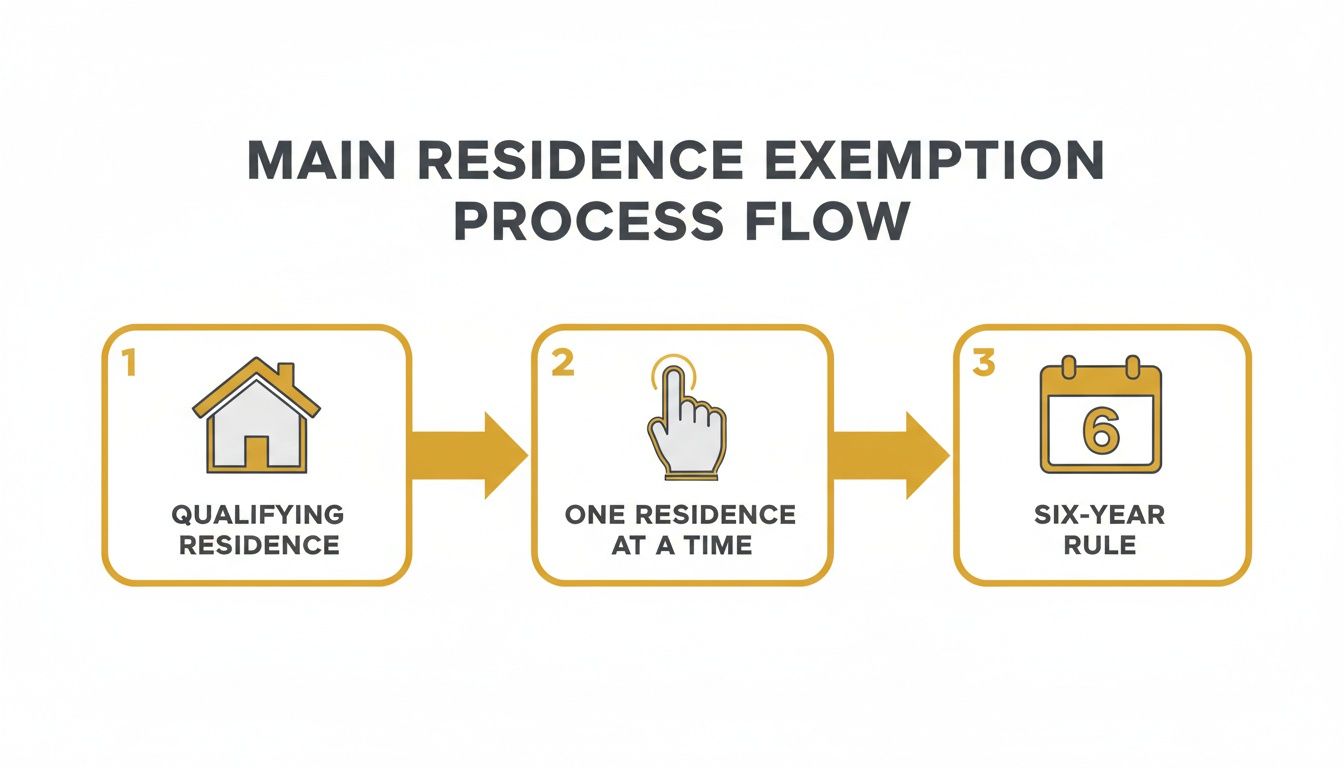
As you can see, checking if your property qualifies, making sure you only have one main residence at a time, and knowing about things like the six-year rule are the foundational concepts you need to get right.
Of course, here is the rewritten section, crafted to sound completely human-written and natural, following the style of the provided examples.
CGT is not a separate tax — a capital gain is included in your assessable income for the year a CGT event occurs. It applies when you dispose of a CGT asset including shares, investment properties, business assets, and cryptocurrency. Your primary residence is generally exempt, though partial exemptions apply in specific circumstances.
The capital gain is capital proceeds (sale price) minus the cost base. The cost base includes purchase price, stamp duty, legal fees, and capital improvement costs. If the asset was held for more than 12 months, apply the 50% CGT discount to reduce the gain before adding it to taxable income. Keep all acquisition records from the purchase date.
Australian resident individuals and trusts that have held a CGT asset for more than 12 months can reduce their capital gain by 50% before inclusion in assessable income. Superannuation funds receive a one-third discount. Companies do not qualify. The holding period begins on the purchase date and ends on the disposal contract date.
Shares are CGT assets. When you sell shares, the gain or loss is proceeds less cost base (purchase price plus brokerage). Gains on shares held more than 12 months qualify for the 50% discount. Capital losses can only offset capital gains — they cannot reduce other income. Carry forward unused losses to offset future gains.
The main residence exemption can entirely or partially exempt the gain from selling your home. Full exemption applies if the property was your main residence throughout the ownership period, was never used to produce income, and sits on land of two hectares or less. Partial exemption applies where it was rented or used for business during part of the ownership period.
Navigating Partial Exemptions and Special Cases
The main residence exemption is wonderfully straightforward when a property has only ever been your family home. But life is rarely that simple.
What happens when your home doubles as your workplace, or you start renting out a spare room to help with the mortgage? In these situations, the tax-free status of your home sale can become partial, meaning a portion of your capital gain suddenly becomes taxable.
Think of your home's tax-free status like a whole pie. If you use a part of it to earn an income, the Australian Taxation Office (ATO) considers that you've cut out a slice for business purposes. When you sell, the "family home" part of the pie is still exempt from tax, but the "business slice" is now on the table for capital gains tax.
This is a really common scenario for many Australians, especially with the rise of remote work and the gig economy. The key is understanding how to correctly portion out the gain so you only pay tax on what you absolutely have to.
When Your Home Is Also Your Workplace
Using part of your home to run a business or renting out a room directly affects your main residence exemption. If you've ever claimed tax deductions for "interest on your home loan" or other running costs against your business income, you will almost certainly face a partial CGT bill when you sell.
The ATO needs you to figure out the taxable portion based on two key factors:
- Floor Area: You have to work out the percentage of your home's total floor area that was used for income-producing activities. For example, if your dedicated home office takes up 10% of your home's floor space, that’s your starting point.
- Time Period: You also need to calculate the exact period you used the space to earn an income. If you ran the business from home for five of the ten years you owned the property, you’ll need to account for that timeframe.
The taxable part of your capital gain is then calculated based on a blend of both the space and the time it was used for business.
Calculating the Taxable Portion
Let's run through a quick example. Imagine you sell your home and make a capital gain of $200,000. You used a home office, which makes up 15% of the house's floor area, to run a business for the entire 8 years you owned the property.
In this simplified case, 15% of your capital gain would be subject to CGT.
- Taxable Portion: $200,000 (Total Gain) x 15% (Business Use Area) = $30,000
This $30,000 is your gross capital gain. And because you've owned the home for more than 12 months, you can then apply the 50% CGT discount, reducing your taxable gain to just $15,000.
This apportionment principle is crucial. It ensures you’re not unfairly taxed on the part of your home you genuinely lived in, while still accounting for the slice that helped you earn an income and claim deductions.
Other Complex Scenarios to Consider
Partial exemptions aren't just for home businesses. Other special cases can complicate your capital gains tax on selling a home, often needing careful calculations and professional advice.
For instance, inheriting a property comes with its own set of rules. The CGT implications depend on when the deceased bought it, whether it was their main residence, and how long you hold onto it before selling. Similarly, if you move into a home you previously rented out, you can't just wipe the slate clean. You’ll need to get a market valuation of the property at the time it first became your main residence, as this value is used to calculate the cost base for your tax-exempt period.
The property market's performance makes these calculations even more significant. For example, CoreLogic data shows Sydney dwelling values recently climbed 1.1% in a single quarter. With forecasts suggesting further rises, a partial CGT liability on a property could represent a substantial sum, making accurate calculations absolutely essential. You can explore more about these trends and their impact in this Australian housing market update from parisfinancial.com.au.
Given the complexities, getting it right is paramount.
Strategies to Legally Minimise Your CGT Bill
Getting the best sale price for your property is only half the battle. The other half is making sure you keep as much of that profit as you legally can.
While paying tax on a capital gain is non-negotiable, there are several legitimate, ATO-approved strategies you can use to reduce your final bill. These aren’t sneaky loopholes; they’re simply the result of smart, forward-thinking financial decisions. By understanding the rules and planning ahead, you can make sure you don't pay a dollar more in tax than necessary.
Hold Your Property for Over 12 Months
Without a doubt, the single most powerful strategy for cutting down your CGT bill is patience. If you're an Australian resident and you hold an investment property for at least 12 months before selling, you unlock the 50% CGT discount.
This is a game-changer. It allows you to slash your taxable capital gain in half, straight off the top. So, if you've calculated a capital gain of $80,000, holding the property for that extra day over the 12-month mark instantly reduces your taxable gain to just $40,000. It’s the cornerstone of managing capital gains tax on selling a home that isn’t your main residence.
The CGT discount is a major wealth-building tool, though it's worth noting its impact. Data from the Parliamentary Budget Office shows the discount heavily favours high-income earners. In 2022–23, a staggering 24,000 millionaires received nearly half of the entire discount's benefit, which gives you an idea of its power.
Time the Sale Strategically
Here’s a crucial detail many people miss: your capital gain is taxed in the financial year you sign the sale contract, not when you settle. This small detail opens up a massive strategic opportunity to time your sale to fall in a year when your other income is lower.
Think about these scenarios:
- Nearing Retirement: Selling after you've officially stopped working could mean your gain is taxed at a much lower marginal rate.
- Taking a Career Break: If you're planning to take a sabbatical or switch to part-time work, that financial year might be the perfect window to sell.
- Launching a Business: In the early years of a start-up, personal income is often much lower, creating an ideal tax environment for a property sale.
By aligning the sale with a lower-income year, you ensure the gain doesn't push you into a higher tax bracket, potentially saving you thousands.
Another smart move is to maximise your deductions in the year of sale. Making a strategic contribution to your superannuation, for example, can be a highly effective way to lower your total taxable income, which in turn reduces the tax hit from your capital gain.
Maximise Your Cost Base
A higher cost base means a lower capital gain. It’s that simple. But so many property owners make the mistake of thinking the cost base is just the purchase price, leaving thousands of dollars in legitimate expenses on the table.
You need to be meticulous. Track and include every single allowable expense to build up your cost base. This includes more than you might think:
- Initial buying costs like stamp duty, legal fees, and buyer's agent fees.
- Major capital improvements, such as renovations, adding an extension, or significant landscaping projects.
- Selling costs, including real estate agent commissions, styling, and advertising fees.
Every receipt you keep for a capital improvement could save you real money when it comes time to sell. For a deeper dive into managing your tax obligations, it's worth exploring general tax planning strategies.
When it comes to tax, planning is everything. Our team can help you navigate all the available options. Check out our detailed article for more on how to reduce capital gains tax.
Essential Record Keeping For A Smooth Tax Return
When it comes to capital gains tax, meticulous records are your best friend. Seriously. They're your best defence against overpaying the Australian Taxation Office (ATO) and your greatest tool for saving money.
Think of your records as the building blocks for your property’s cost base. Every receipt and invoice you save can potentially increase this base, which in turn directly reduces your taxable capital gain. A shoebox of faded receipts is better than nothing, but a well-organised file—digital or physical—is the key to a stress-free tax season.
Your Essential Document Checklist
From the day you even start thinking about buying a property to the day you sell it, you should be collecting documents. These records are absolutely crucial for accurately calculating the capital gains tax on selling a home.
Make sure you keep a clear trail of the following:
- Purchase Documents: This includes the original contract of sale, settlement statements, and receipts for things like stamp duty and your solicitor's fees.
- Improvement Costs: Got invoices for capital improvements? Keep them. This means significant upgrades like a kitchen renovation, adding a deck, or building an extension—not minor repairs like fixing a leaky tap.
- Ownership Costs: Where applicable, you'll need records of council rates, land tax, and the interest you've paid on your home loan.
- Selling Documents: Gather the final contract of sale, settlement statements, and receipts for the real estate agent's commission, legal fees, and any advertising costs.
The ATO requires you to keep these documents for the entire time you own the property, plus another five years after you lodge the relevant tax return. For a more detailed breakdown, our guide on which tax records to keep has you covered.
Good records do more than just satisfy the ATO. They empower you to make informed financial decisions and ensure you claim every legitimate cost you are entitled to, maximising your final profit from the sale.
How To Report Your Capital Gain
Once you have all your records in order and have crunched the numbers to find your net capital gain, the final step is reporting it on your annual tax return. A key point here: you report it in the financial year that you sign the contract of sale, not the year the sale finally settles. This catches a lot of people out.
In the myTax portal, you'll head to the "Capital gains or losses" section. This is where you'll input the key details from your calculations, including your total capital proceeds and the property's all-important cost base.
The system will then prompt you to apply any relevant discounts, like the 50% CGT discount if you've owned the property for more than 12 months. The final number is your net capital gain, which gets added to your assessable income for the year and is then taxed at your marginal rate.
Got More Questions About CGT on Property?
Working through the capital gains tax rules often brings up a few tricky "what if" scenarios. When your situation isn't a simple buy-and-sell, things can get complicated. Let's tackle some of the most common questions property owners ask.
What Happens If I Make a Capital Loss on My Property?
It's a tough pill to swallow, but sometimes you have to sell a property for less than what you paid for it. When this happens, you’ve made a capital loss. While it’s certainly not the outcome you hoped for, this loss has a very specific purpose in the eyes of the tax man.
You can't use a capital loss to reduce your regular taxable income, like your salary from work. Instead, you have to use it to offset any capital gains you’ve made from other assets in the same year. If you don't have any gains to offset, the loss isn't gone for good. You can carry it forward indefinitely to wipe out capital gains in future years, which is why it's so important to report every loss to the ATO.
Do I Pay CGT on an Inherited Property?
The tax rules for inherited properties can be a real maze, and the answer depends entirely on the history of the property. For example, if the person who left you the property bought it before CGT even existed (pre-20 September 1985), you might be completely exempt if you sell it within two years.
A similar two-year grace period often applies if the property was the deceased's main residence right up until they passed away. But if it was their investment property, you effectively step into their shoes and inherit their original cost base. CGT is then calculated on the growth from that point when you eventually decide to sell. Given how many variables are at play, this is one area where getting professional tax advice is a very smart move.
Inheriting a property doesn’t mean an automatic tax bill. The critical factors are how the deceased used the property and how quickly you act on selling it. Getting your head around these conditions is the key to managing any potential CGT you might face.
Can I Avoid CGT by Moving Into My Rental Property Before Selling?
It’s a common idea: move into your rental property for a while, call it your home, and then sell it tax-free. While this strategy can definitely reduce your CGT, it's not a magic loophole that will wipe the slate clean.
The ATO looks at the entire time you owned the property and requires a proportional calculation. You'll need to figure out the total capital gain over your ownership period and then split it. The gain is apportioned based on the number of days it was rented out versus the days it was your genuine main residence. You'll still pay CGT for the period it was an investment, but the gain attributed to the time you lived there will be exempt.