
Tax time for teachers can feel like you’re being handed yet another pile of marking to get through. But what if you thought of it differently? Instead of a chore, your tax return is a chance to get back some of the money you’ve poured into your classroom and career all year long.
- Your Guide to Teacher Tax Deductions
- Claiming Your Classroom and Teaching Supplies
- Maximising Self-Education and Professional Development Claims
- Navigating Uniforms, Travel, and Other Key Deductions
- Mastering Record-Keeping to Stay ATO-Compliant
If you’ve paid for something to help you do your job and your school didn’t reimburse you, there’s a very good chance you can claim it as a deduction. This includes everything from classroom supplies and professional development courses to union fees and the work-related slice of your home office and technology costs.
Your Guide to Teacher Tax Deductions

Navigating your tax obligations doesn't have to be a headache. For educators right across Australia, the Australian Taxation Office (ATO) allows for a whole host of deductions that are directly tied to the unique demands of being a teacher. Think of your tax return as your final exam for the financial year—and showing your work through good record-keeping is what gets you top marks.
The ATO is known to pay close attention to work-related expense claims, so it’s crucial to know exactly what you can and can't claim. Getting a clear picture of your finances is the first step, and that starts with understanding your payslips and deductions. This guide will act as your cheat sheet, breaking down the essentials so you can lodge your return with complete confidence.
Common Claims at a Glance
To make things easier, we’ve put together a quick-reference table of the most common deductions for teachers. Use it as a starting point to jog your memory about expenses you might have forgotten over the busy school year.
Getting these details right can make a huge difference, with the average tax refund for Australian teachers often landing between $1,000 and $3,000.
Just remember the golden rule of tax deductions: If you spent the money yourself to help earn your income, weren't reimbursed for it, and have a record to prove it, you can almost certainly claim it.
Teacher Tax Deductions at a Glance
This checklist summarises the typical claims available to teachers. It's a great tool to have handy as you gather your receipts and get ready to lodge.
| Category | Deductible Items | Key Condition |
|---|---|---|
| Classroom Essentials | Stationery, art supplies, teaching aids, textbooks, posters, and reward stickers. | Must be purchased for use in your teaching activities and not reimbursed. |
| Professional Growth | Union/association fees, professional journal subscriptions, and self-education directly related to your current role. | The expense must maintain or improve the specific skills required for your job. |
| Home & Travel | Work-related portion of phone/internet, home office running costs, and car expenses for travel between workplaces. | You must be able to demonstrate the work-related percentage of use with clear records. |
By keeping these categories in mind throughout the year, you’ll be in a much better position to maximise your refund when tax time rolls around.
Claiming Your Classroom and Teaching Supplies
Every teacher knows the feeling of digging into their own pocket for classroom supplies. From colourful posters that brighten up the walls to reward stickers that motivate students, these out-of-pocket costs are just part of the job. The good news? These expenses can become valuable tax deductions, putting that hard-earned money right back where it belongs.
It’s easy to tick off the basics like pens, paper, and art supplies. But what you can claim is often much broader than you think. You just have to think about the specific tools you need to do your job well.
If your school didn’t reimburse you for an item you bought for work, it’s almost certainly claimable. That simple rule is your best starting point.
Looking Beyond the Basics
To get the most out of your tax return, you need to look past the stationery cupboard. Think about all the unique resources that you rely on day-to-day.
Here are a few less-obvious examples that are perfectly legitimate claims:
- Educational Software and Apps: Those subscriptions to platforms like Canva for Education or Kahoot! add up. If you're paying for them yourself, you can claim them.
- Teaching Aids: This is a huge category. It covers everything from posters and wall charts to educational games, flashcards, and any props you use for demonstrations in class.
- Subject-Specific Resources: A science teacher might claim safety goggles and lab coats. A music teacher could deduct the cost of new sheet music or instrument maintenance supplies.
- Student Rewards: The stickers, small prizes, or certificates you buy to encourage and celebrate your students? That’s a work expense.
The golden rule is that the item must have a direct link to your role as a teacher and help you get your job done.
A primary school teacher who buys laminated numeracy and literacy charts is making a direct investment in their classroom. Because these tools are used exclusively for their teaching role, the full cost is typically deductible.
Understanding Apportionment for Mixed-Use Items
So, what about things you use for both work and your personal life? This is where a concept called apportionment comes into play. It’s just the ATO’s way of saying you need to figure out the work-related portion of an expense and only claim that part.
Think of it like splitting a pizza. If you pay for the whole eight-slice pizza but only eat two slices yourself, you can’t claim the cost of all eight. You only claim your fair share—the two slices you actually ate. Tax deductions work exactly the same way.
Let's look at a real-world example. Imagine you subscribe to a digital magazine. You use it for lesson planning, but your family also enjoys reading it.
Example of Apportionment:
- Find the Total Cost: Your annual subscription is $120.
- Estimate Your Work-Related Use: You sit down and figure out you use the magazine for work about 75% of the time. The other 25% is just for personal reading.
- Calculate the Deductible Amount: You can claim 75% of the total cost.
- $120 (Total Cost) x 0.75 (Work Use) = $90
You can claim a $90 tax deduction. It’s vital to keep a record of how you landed on that 75%—a quick diary note or a simple log is perfect. This logic applies to all sorts of mixed-use items, from your phone and internet bills to computer equipment. By confidently applying apportionment, you ensure you’re claiming exactly what you’re entitled to, no more and no less.
Maximising Self-Education and Professional Development Claims
In teaching, ongoing learning isn’t just a nice-to-have—it’s a core part of the job. As you pour time and money into sharpening your skills, the good news is that the Australian Taxation Office (ATO) lets you claim these expenses back. But before you start tallying up receipts, there's a crucial rule you have to get your head around. It’s the gatekeeper for all self-education claims.
The expense must be directly tied to improving the skills you need for your current teaching role. Think of it like upgrading the software on your current work laptop, not buying a whole new computer for a different career. The link has to be clear and immediate to the work you do in the classroom every day.
For instance, a primary teacher taking a workshop on "Managing Students with Learning Difficulties" can absolutely claim it. This directly helps them do their job better. On the flip side, if that same teacher enrols in a Master of Education to qualify for a future role as a school principal, the ATO won't allow it. Why? Because it’s about getting a new job, not getting better at the one they have now.
The Golden Rule of Self-Education
The principle is simple: the study must have a strong enough connection to your current employment as a teacher. The ATO is very clear that self-education deductions are only for expenses that maintain or improve the specific skills required for your current job. This is a vital distinction that often trips people up. It’s what stops a teacher’s aide, for example, from claiming the cost of a university degree to become a fully qualified teacher.
At its heart, any course, seminar, or conference you attend must be likely to lead to an increase in your income from your current teaching activities. If it’s designed to open up a completely new way of earning income, it generally won’t pass the test.
If you’re on the fence about whether your course qualifies, it's always a good idea to dig deeper into when self-education is deductible to make sure you get it right.
What Specific Costs Can You Claim?
Once you've confirmed your course is eligible, a whole host of related costs become claimable. It’s not just the course fees. You need to think about every dollar you spent to make that learning happen.
Here’s a quick rundown of common self-education expenses you can claim:
- Course and Tuition Fees: This is the most obvious one. If you paid upfront for a university course, TAFE program, or a professional workshop, that’s deductible.
- Textbooks and Professional Journals: Any required books, academic journals, or subscriptions directly related to your course are claimable.
- Stationery and Supplies: Don't forget the small stuff! This covers everything from notebooks and pens to the printer ink and paper you used for your studies.
- Depreciation of Assets: If you bought a new laptop or computer primarily for your course, you can claim its decline in value over time (known as depreciation).
- Travel and Accommodation: For courses or conferences that require you to travel, these expenses are often deductible.
That last point on travel is a big one, but it also demands careful record-keeping, especially if you mix in a little personal holiday time.
A Real-World Example: Interstate Conference
Let’s follow a real-world scenario. Sarah, a high school English teacher from Melbourne, flies to Sydney for a three-day professional development conference. She decides to make a long weekend of it and stays for an extra day of sightseeing, making her total trip four days long.
Here’s how Sarah would break down her claim:
Add Up Total Costs:
- Return Flights: $400
- Conference Registration: $550
- Accommodation: $800 (4 nights at $200/night)
- Meals: $240 (4 days at $60/day)
Apportion for Personal Time: The conference was the reason for the trip and lasted for three of the four days. That means the trip was 75% work-related (3 days ÷ 4 days). The conference fee itself is 100% deductible since it had no personal element.
Calculate the Deductible Amount:
- Flights: $400 x 75% = $300
- Conference Fee: $550 (100% claimable)
- Accommodation: $800 x 75% = $600
- Meals: $240 x 75% = $180
Sarah’s total claim for her professional development trip comes to $1,630. By keeping clear records and doing a proper apportionment, she can confidently claim what she's owed and boost her tax return.
When your living room doubles as a marking room and your personal laptop becomes a lesson-planning powerhouse, you’re stepping into the world of home office expenses. For many Aussie teachers, working from home isn't a choice; it's a necessity.
The good news is that those after-hours spent prepping lessons, marking assignments, and emailing parents can translate into valuable tax deductions. The Australian Taxation Office (ATO) gives you two main ways to claim these costs: the simple 'fixed-rate' method and the more detailed 'actual cost' method. Getting your head around the difference is key to picking the right approach for your situation and making sure you claim every dollar you're entitled to.
The Simple Approach: The Fixed-Rate Method
Think of the fixed-rate method as the express lane for your home office claim. It’s designed for simplicity, cutting down on complex calculations and mountains of paperwork. The ATO sets a specific rate per hour that bundles up the general running costs of your home office.
As of the current tax year, the revised fixed rate is 67 cents for every hour you work from home. This single rate is a package deal, covering the work-related chunk of several common costs:
- Home and mobile internet expenses
- Mobile and home phone usage
- Electricity and gas for heating, cooling, and lighting
- Stationery and computer consumables (like printer ink and paper)
To use this method, you just need to keep a log of the hours you work from home. This can be as simple as a diary, timesheet, or a spreadsheet noting the dates and hours you put in. You also need to have at least one bill or receipt for each type of expense covered by the rate (e.g., one phone bill, one electricity bill) to prove you actually incurred the costs in the first place.
This straightforward approach is perfect for teachers who regularly work from home but don't want the headache of calculating the work-related percentage of every single utility bill.
It's important to know the fixed-rate method doesn't cover everything. You can still make separate claims for the depreciation of assets like computers and office furniture, along with any other running expenses not included in the 67-cent rate.
For Bigger Claims: The Actual Cost Method
If you suspect your home office expenses are much higher than what the fixed-rate method will give you, then the 'actual cost' method might be your best bet. It’s definitely more involved, but it can lead to a much bigger deduction if you’ve got substantial costs. It’s like being your own financial detective, tracking down every single work-related expense.
With this method, you calculate the actual work-related portion of all your home office running costs. This means digging into your utility bills, phone records, and internet statements to figure out the percentage of use that is directly linked to your teaching work. You'll also need a dedicated home office space to claim occupancy expenses like rent or mortgage interest, though this is pretty rare for most teachers.
Here’s a rough idea of how you’d tackle it:
- Calculate Your Work-Related Percentage: You need a logical way to do this. For electricity, you might work out the floor area of your office as a percentage of your home's total area. For your phone and internet, you could analyse a typical one-month bill to find the percentage of work-related use and apply that across the year.
- Track Every Expense: You absolutely must keep all your receipts for electricity, gas, phone, internet, stationery, and any other running costs.
- Claim Depreciation: For those big-ticket items like a new laptop, desk, or ergonomic chair costing over $300, you can’t claim the full cost upfront. Instead, you claim its decline in value (depreciation) over its effective life.
This method demands meticulous record-keeping, but for teachers who have invested in a serious home office setup, the payoff can be well worth it. For a deeper dive, check out our complete guide to the home office tax deduction to make sure you capture every last detail.
Home Office Claims Compared: Fixed Rate vs Actual Cost Method
So, which path should you choose? It really comes down to your personal circumstances and how much time you're prepared to spend on record-keeping. Sometimes the simple route is best; other times, the extra effort pays off.
This table breaks down the key differences to help you decide which method suits you.
| Feature | Fixed-Rate Method | Actual Cost Method |
|---|---|---|
| Simplicity | High - simple calculation based on hours worked. | Low - requires detailed calculation of all individual expenses. |
| Record-Keeping | Minimal - need a log of hours worked and one bill for each expense type. | Extensive - requires all receipts and a clear basis for apportionment. |
| What's Covered | Bundles internet, phone, utilities, and stationery into one rate. | All actual running costs can be claimed individually. |
| Depreciation | Claimed separately for assets over $300 (e.g., laptops, furniture). | Claimed separately for assets over $300. |
| Best For | Teachers who want a simple, low-admin claim. | Teachers with high running costs and a well-documented office setup. |
Ultimately, the goal is to maximise your return without creating a compliance nightmare for yourself. Weigh the potential refund against the effort required and choose the method that gives you the best result for the least amount of stress.
Navigating Uniforms, Travel, and Other Key Deductions

It’s easy to focus on big-ticket items like your home office or a new laptop, but some of the most significant boosts to your tax refund come from smaller, everyday work expenses. These are the costs that are easiest to forget because they feel like just another part of the job.
But when you add them all up, they can represent a huge chunk of money you’re entitled to claim back. From the polo shirt you have to wear to the kilometres you drive for school camps, let's unpack these often-missed deductions.
The Rules for Claiming Uniforms and Clothing
When it comes to clothing, the Australian Taxation Office (ATO) has very firm rules. You can’t just claim any old clothes you wear to work, like a business suit or a smart dress. The ATO sees conventional clothing as a private expense, even if your school has a general "business attire" dress code.
To be deductible, your work clothes must fit into one of three distinct categories:
- Compulsory Uniform: This is the most common one for teachers. It’s a specific set of clothes your school requires you to wear, with a strictly enforced policy. Critically, it must have a permanent logo or emblem that clearly identifies you as an employee of the school.
- Non-Compulsory Uniform: If your school has an optional uniform, you can only claim a deduction if the design has been officially registered with AusIndustry. This is quite rare, so don't bank on it.
- Protective Clothing: This includes any gear you need to wear to protect yourself from illness or injury on the job. For teachers, this could be a sun hat for yard duty, safety goggles for science class, or even a lab coat.
So, that polo shirt with the school crest you’re forced to wear? 100% deductible. The plain black pants you bought to wear with it, however, are not. The good news is that the costs of laundering and dry-cleaning your eligible uniform items are also claimable.
Claiming Your Car Expenses
As a teacher, your daily drive from home to your school is considered a private commute and isn’t deductible. But what about all the other driving you do for work? The ATO is clear: any travel that is part of your work duties after you’ve arrived at school is fair game.
The easiest way to claim these costs is by using the cents-per-kilometre method. For the 2023-24 financial year, the ATO allows you to claim 85 cents per kilometre. This rate is designed to cover all your running costs—fuel, insurance, wear and tear, and depreciation. You can claim a maximum of 5,000 work-related kilometres per car, per year with this method.
Examples of travel you can absolutely claim include:
- Driving from your main campus to another for a meeting.
- Travelling to a parent-teacher interview at a student’s home.
- Attending school excursions, sports carnivals, or camps.
- Driving to a professional development course held away from your usual school.
The key is to keep a record. A simple diary note or a logbook app detailing the date, reason for the trip, and kilometres travelled is all the proof you need to back up your claim.
Don’t Forget These Other Common Deductions
Beyond clothing and your car, there are several other professional costs that teachers often pay for out-of-pocket. These are directly tied to your role and career progression, making them legitimate deductions.
Think about whether you've paid for any of these during the financial year:
- Union and Professional Association Fees: Your annual membership fees for teacher unions or subject-specific professional bodies are fully deductible.
- First Aid Courses: If you are required to hold a first aid certificate for your role (like for sports coaching or playground duty), the course cost is claimable.
- Teaching Registration: The yearly fee you pay to your state or territory’s teaching institute to maintain your registration is a direct cost of being able to work, so you can claim it.
- Work-Related Bags: That briefcase, laptop bag, or sturdy backpack you use to lug marking, lesson plans, and your computer between school and home is deductible. Just remember to apportion the cost if you also use the bag for personal trips.
Mastering Record-Keeping to Stay ATO-Compliant
Figuring out what you can claim as a teacher is only half the battle. The other, arguably more important half, is proving it.
Think of your tax deductions like a science experiment: your claim is the hypothesis, and your records are the hard data that prove it’s true. Without that solid proof, even the most legitimate claim can be rejected by the Australian Taxation Office (ATO).
The ATO has a sharp focus on work-related expenses. It uses sophisticated data-matching technology to compare your claims against those of other teachers in similar roles. This means if your deductions seem unusually high without a clear reason, it could trigger a review. Your best defence? A bulletproof audit trail built on organised, thorough records.
Your Evidence Checklist
Building this audit trail doesn't have to be a headache. It's really just about consistently collecting the right pieces of evidence throughout the financial year.
Here’s the essential proof you’ll need for your claims:
- Receipts and Invoices: This one is non-negotiable. For any expense, you need a clear receipt showing the supplier, the cost, the date, and exactly what you purchased.
- Bank or Credit Card Statements: While not a substitute for a proper receipt, these statements can act as secondary proof that you actually paid for an expense.
- Logbooks or Diaries: For ongoing costs like car or home office use, a logbook is absolutely essential to show your work-related percentage. A simple diary note or spreadsheet tracking hours or kilometres is perfect.
Keeping these records organised is crucial. For teachers who also earn extra income through tutoring, meticulous financial management is key. Using specialised tutoring billing software can help streamline income and expense tracking, making sure everything is in order for the ATO.
The core principle is simple: if the ATO asks you to verify a claim, you must be able to produce a record that validates it. If you can't prove it, you can't claim it.
The Tale of Two Teachers: An Audit Story
Let’s imagine two teachers, Ben and Chloe, who both claim car expenses for attending a regional sports carnival.
Ben kept a detailed logbook, noting the date, kilometres travelled, and the event he was attending. He also has a folder with all his fuel receipts neatly filed.
Chloe, on the other hand, just estimated her travel. She knows she went to the carnival but has no logbook entry or receipts to back up her claim.
When the ATO flags both their returns for review, Ben confidently sends in his documentation. His claim is approved almost immediately. Chloe, however, can’t provide any evidence. Her claim is disallowed, and she receives an amended tax bill, plus potential penalties. Ben’s organised approach saved him time, stress, and money.
To avoid Chloe's situation, it helps to understand the ATO’s record-keeping requirements in detail. This knowledge empowers you to build an unshakeable foundation for your claims, giving you complete peace of mind. By making record-keeping a simple, year-round habit, you ensure you can confidently claim every single dollar you deserve.
Frequently Asked Questions About Teacher Tax Claims
When it comes to teacher tax claims, a few common questions always pop up. Let's clear up some of the most frequent grey areas so you can lodge your return with confidence.
Can I Claim Gifts I Buy for My Students?
It's a lovely thought, but unfortunately, gifts you buy for your students—like birthday presents or end-of-year thank-yous—are not tax-deductible. The Australian Taxation Office (ATO) views these as private expenses, not a necessary cost of earning your income, even though it happens in a work context.
A better strategy is to focus on claiming items that are genuinely essential tools for your job. This means things like classroom resources, teaching supplies, and professional development courses that directly help you in your current role.
How Does a Tutoring Side Job Affect My Tax?
Any income you earn from a private tutoring side gig must be declared on your tax return. But here's the good news: you can also claim deductions for expenses directly related to that work. This could include specific teaching materials you buy for tutoring, advertising costs, or the work-related portion of your internet bill.
If your tutoring business starts to take off, you might need to get an Australian Business Number (ABN). It's a smart move to chat with a tax professional to make sure you're meeting all your obligations while claiming everything you're entitled to for both your teaching and tutoring work.
I Am a Relief Teacher—Can I Claim My Travel to Different Schools?
Yes, absolutely! Casual and relief teachers often have much more extensive travel claims than their permanently employed colleagues. While your trip from home to the first school you visit is usually considered private travel, any subsequent trips you make between different schools on the same day are fully deductible.
If your work is itinerant—meaning you regularly work at multiple locations each day—you may even be able to claim the travel from your home to your very first school. To make these claims stick, keeping a detailed and accurate car logbook is non-negotiable. It’s the proof you need to show the ATO your work-related kilometres.
The ATO provides guidance through ato.gov.au, the Small Business Support Line (13 28 66), and Online Services for individuals and businesses. For complex situations, a registered tax agent provides advice tailored to your specific circumstances and professional indemnity protection. You can verify agent registration at the TPB register at tpb.gov.au.
Most tax records must be kept for five years from the date of lodgement or the date the transaction occurred, whichever is later. Records must be in English or convertible to English and must be sufficient to explain the income and deductions in your return. The ATO can request records at any time during the retention period.
Consider a registered tax agent when your affairs involve multiple income sources, business activity, investment properties, capital gains, or overseas income. Agents extend your lodgement deadline, provide safe harbour protection, and take professional responsibility for the advice given. Verify registration at tpb.gov.au.
The failure to lodge penalty is based on penalty units ($313 per unit from 1 July 2023), accruing per 28-day period for late returns and BAS lodgements. Incorrect information penalties range from 25% to 75% of the tax shortfall depending on whether the behaviour was careless, reckless, or intentional. Proactive disclosure before an audit begins typically results in significantly reduced penalties.
Tax minimisation is the legal arrangement of your affairs to reduce tax — claiming all eligible deductions, using appropriate structures, and timing income and expenses. Tax avoidance involves arrangements that technically comply with the law but achieve outcomes parliament did not intend. The ATO can apply Part IVA anti-avoidance rules to cancel benefits from avoidance arrangements.
Ready to take the guesswork out of your tax return? The team at Australia Wide Tax Solutions are experts in handling teacher tax claims. We'll ensure you get every deduction you're entitled to with our maximum refund guarantee. Get started with your online tax return today!
If you've ever changed jobs, moved house, or even just worked a casual gig years ago, there's a good chance you have some missing super. It’s not just a minor bit of admin you forgot about; it’s a super common side effect of a modern career, and it could be costing you a fortune in unnecessary fees.
- Why You Might Have a Missing Super and Not Even Know It
- Your Primary Tool for Finding Lost Super
- Got No myGov Access? Here's How to Track Down Old Super Accounts
- Why Consolidating Your Super Is a Power Move
- When to Get Professional Help with Your Super
Why You Might Have a Missing Super and Not Even Know It
It’s surprisingly easy to lose track of a super account. Think back through your own work history.
Remember that part-time job you had as a teenager? The short-term contract you picked up between roles? Every time you start a new job, there's a risk a new super account is opened for you, especially if you didn't nominate a preferred fund. This is exactly how most people end up with lost super.
The real problem isn't just that the money is "lost"—it's that it's actively being eaten away.
Every single one of those extra accounts is likely charging its own set of administration fees and insurance premiums. A few dollars here and there might not seem like much, but over a 30 or 40-year career, this can literally add up to tens of thousands of dollars that should have been growing for your retirement.
The scale of this is staggering. The Australian Taxation Office (ATO) reports there's over $20 billion in unclaimed super sitting in around 4.5 million accounts across the country. That's a huge amount of money that isn't working for its owners.
This is why getting a handle on your superannuation guarantee contributions is so important. It's your money, and you need to protect it.
Some of the most common ways people lose track of their super include:
- Changing your name after getting married or divorced, but not updating every single super fund.
- Moving house and forgetting to pass on your new address to an old fund. Mail gets returned, and the account is flagged as "lost."
- Working for multiple employers in a short space of time, leading to a new default fund being opened for each job.
At the end of the day, finding and consolidating your super isn't just a box-ticking exercise. It's one of the smartest financial moves you can make to secure your future. It stops the fee leakage and puts your retirement savings back where they belong—working hard for you.
Your Primary Tool for Finding Lost Super
Forget digging through dusty old paperwork or trying to remember the name of an employer from a decade ago. The most effective and direct way to find your missing super is through the Australian Taxation Office's (ATO) online services, all conveniently linked to your myGov account.
Think of this secure portal as your central command centre for all things superannuation.
If you don’t have a myGov account yet, that's your first port of call. Setting one up is pretty straightforward and gives you access to a whole range of government services, not just the ATO. Once you're in, you’ll need to link it to the ATO, which just involves verifying your identity with details like your Tax File Number (TFN).
This little bit of admin is a one-time effort that pays off big time. It provides a complete overview of your super history, showing every account that has ever been held in your name.
Navigating the ATO Portal to Find Your Funds
Once you’re logged into myGov and have clicked through to the linked ATO service, find the 'Super' tab. This section is where the magic happens. Here, you'll find a list of all known super accounts tied to your TFN. It’s often a real eye-opener for people who didn’t realise how many small pots of money they had scattered around.
And we're not just talking about pocket change. Lost superannuation is a massive issue in Australia. APRA's latest stats revealed over 11 million inactive accounts holding a staggering $17.8 billion in unclaimed funds. As you can see from the APRA annual superannuation data, it affects everyone from Aussies working overseas to small business owners who've had a few jobs over the years.
While the average inactive balance was $1,620, some of these forgotten pots were worth over $50,000. That’s a serious amount of money to leave on the table.
This infographic shows just how easily it can happen.

As you can see, simple life events like changing your job or address are the main culprits. It’s easy to lose track.
To make things easier, here’s a quick rundown of your options for tracking down lost super.
A Quick Comparison of Super Search Methods
| Method | What You Need | Best For | Potential Outcome |
|---|---|---|---|
| myGov/ATO Portal | myGov login, TFN | The most comprehensive and direct method for finding all known accounts. | Complete list of all accounts; ability to consolidate online instantly. |
| Contacting Your Super Fund | Your member number, personal details | If you know which fund you were with and just need to update details or find a balance. | Confirmation of your account and balance with that specific fund. |
| Paper Statement Search | Old paperwork, historical addresses | A last resort if you can't access online services or have no TFN record. | Finding details of a specific fund to contact directly; often slow and difficult. |
| Using a Financial Adviser | Professional engagement | Complex financial situations or if you prefer professional assistance. | A consolidated view and strategic advice, but involves fees. |
While other methods exist, starting with the myGov/ATO portal is almost always the fastest and most thorough approach.
Understanding Your Super Account Status
Inside the portal, you’ll see your accounts listed with different statuses. It's important to know what these mean.
- Held by fund: This means your money is still with a retail, industry, or self-managed super fund. It's active, even if you've forgotten about it.
- Held by ATO: This tells you an account was classified as "lost" or had a low balance and was transferred to the ATO for safekeeping. Don't worry, it's still your money.
The myGov portal does more than just show you where your money is; it gives you the power to act on it immediately. You can start the process of consolidating your various funds into a single, preferred account right from the dashboard.
Got No myGov Access? Here's How to Track Down Old Super Accounts
If you can't get into your myGov account or you just prefer a more hands-on approach, don't stress. There are still a few old-school, but very effective, ways to find your missing super. It takes a little bit of detective work, but it’s a solid backup plan for tracking down those forgotten accounts.

Your first port of call should be your previous employers. Their payroll or HR department will have records of which super fund they paid into for you. This is especially handy for jobs you held before the ‘stapled super’ rules kicked in.
Time to Contact Past Employers
When you get in touch, whether it's by phone or email, you’ll need to give them enough information to find you in their old system. Be ready with:
- Your full name (and any previous names you used while working there).
- The rough dates you were employed.
- Your date of birth.
With that, they should be able to dig up the name of the super fund and maybe even your old member number. Funnily enough, a lot of the logic behind finding super is similar to tracking down anything else you've misplaced. If you're curious, you can check out some general strategies to find lost items fast for a different perspective.
A quick phone call is often the fastest way to get what you need. Ask to speak with someone in payroll or HR, as they’re the ones most likely to have access to historical super contribution records.
If you’ve managed to hang onto an old payslip or a super statement, you're one step ahead. That bit of paperwork will have the fund's name and your membership number right there, letting you go straight to the source.
When you call the fund, have your Tax File Number (TFN) handy, as they'll need it to confirm your identity. If you've lost your TFN, don't worry—our guide on how to find your lost Tax File Number has you covered. Taking this direct route can sometimes uncover accounts that, for one reason or another, haven't been properly linked to your ATO profile.
Why Consolidating Your Super Is a Power Move
Finding those lost super accounts is a fantastic start, but the real game-changer is rolling them all into one hardworking fund.
Think of it this way: every single super account you have is probably charging its own set of fees. They might seem small, but these fees are like tiny leaks in a bucket, constantly draining your retirement savings without you even noticing.
Let's say you've got three different super accounts from old jobs. Each one might be stinging you for a $100 admin fee and another $300 for insurance you don't need. That adds up to a staggering $1,200 a year just to keep accounts you've likely forgotten about.
Over a 30-year career, that’s a whopping $36,000 gone, and that's before you even factor in the lost investment growth on that money.

Consolidating your super instantly plugs those leaks. By moving everything into a single account, you pay just one set of fees. That leaves a whole lot more of your hard-earned cash in the pot to compound and grow over time. Getting a handle on your super fund fees and whether yours are high or low is a critical first step here.
Gain Clarity and Control Over Your Future
Beyond just saving a fortune on fees, consolidation seriously simplifies your financial life. No more juggling multiple statements or trying to keep track of different investment strategies.
You get one clear, simple picture of your retirement savings. This makes it so much easier to:
- Track your performance: See exactly how your single investment portfolio is doing at a glance.
- Adjust your strategy: Make smart decisions about your investment options without needing to log into three different websites.
- Manage your insurance: Check that you have the right level of life and disability cover in one place, instead of paying for multiple, overlapping policies.
Consolidating your super is all about taking back control. It turns a messy pile of forgotten accounts into a single, powerful asset that you can actively manage to build the future you actually want.
The principle of simplifying and centralising your retirement savings is a universal one. While our Australian system is unique, the core idea holds true globally. For a look at how this works in other systems, you can find some great insights on managing multiple retirement accounts. It just reinforces the value of bringing all your assets under one roof for maximum efficiency—a key benefit once you find and consolidate that lost super.
When to Get Professional Help with Your Super
Look, hunting down your own lost super is often a pretty straightforward DIY job. For most people, a few clicks on myGov is all it takes. But let's be real—some financial situations are just plain messy.
If you're a small business owner, have a few overdue tax returns lurking, or you're juggling investment properties, that’s when it’s smart to call in an expert.
It's More Than Just Paperwork
A good tax agent or financial adviser does way more than just fill out forms. Their real value is in navigating the tricky tax implications that can pop up when you start moving super around. Depending on the amounts and the funds involved, consolidating your super isn't always as simple as it sounds.
They’ll make sure all your ducks are in a row with the ATO before any money gets moved, which can save you a world of headaches.
Making a Strategic Move for Your Future
Bringing in a professional isn't about admitting defeat; it's about making a smart, strategic decision for your financial future. They can look at your specific goals and advise on the best fund structure to get you there, making sure your retirement savings are working as hard as you are.
A professional can spot the pitfalls you’d never see coming. Think losing valuable life insurance that was tied to an old fund, or accidentally creating a surprise tax bill just by consolidating your accounts in the wrong order.
This kind of expert advice is absolutely essential in more unique circumstances, like:
- Running a Self-Managed Super Fund (SMSF).
- Sorting out superannuation from a deceased estate.
- Planning a retirement that involves multiple streams of income.
Ultimately, getting the right help is about giving yourself peace of mind. It ensures your financial future is not only secure but fully optimised for growth.
Got Questions About Finding Your Super?
Diving into the world of super can feel a bit confusing, and it's natural to have a few questions before you start. Let's tackle some of the most common ones we hear from clients, so you can get started with confidence.
How Long Does This Whole Process Take?
Finding your super accounts using the ATO's online service via myGov is incredibly fast. In most cases, you'll see a list of all your known accounts pop up almost instantly.
Once you’ve spotted them and decided to consolidate, the next step—kicking off the transfer online—only takes a few minutes.
The actual heavy lifting, where the money moves between your old and new super funds, is pretty quick too. You can usually expect the transfer to be wrapped up within three to seven business days. If you’re claiming super held directly by the ATO, they generally pay it out to you or your chosen fund within 28 days of your claim being processed.
What Happens to My Insurance When I Consolidate?
This is a big one, and it’s something people often miss. When you close an old super account, you’re not just moving money—you’re also cancelling any insurance cover attached to it. That includes things like life, Total and Permanent Disablement (TPD), or income protection insurance.
Before you hit that consolidate button, you absolutely must check the insurance you have in each account. Compare what you're about to lose with the cover you'll have in your main account. The last thing you want is to be left unintentionally uninsured.
Sometimes, you might need to apply for new or increased cover in your main fund before you close down the old ones.
Is There a Fee for This Service?
Good news—no, there isn't. Using the ATO's services through myGov to track down and consolidate your super is completely free. Most super funds have also done away with fees for rolling your money in or closing an old account.
It’s always a good idea to double-check with the funds involved, just in case they have specific exit fees, though this is becoming quite rare.
Just be wary of any third-party services that pop up offering to find your super for a fee. You can easily do it yourself for free, so there's no need to pay someone else for it.
If you're sorting through a more complex financial picture or just want an expert eye to make sure your super consolidation is done right, the team at Australia Wide Tax Solutions is here to help. We guide you through the process to ensure you’re making smart decisions that optimise your financial future. Reach out to us for personalised advice at https://www.awts.net.au.
The ATO provides guidance through ato.gov.au, the Small Business Support Line (13 28 66), and Online Services for individuals and businesses. For complex situations, a registered tax agent provides advice tailored to your specific circumstances and professional indemnity protection. You can verify agent registration at the TPB register at tpb.gov.au.
Most tax records must be kept for five years from the date of lodgement or the date the transaction occurred, whichever is later. Records must be in English or convertible to English and must be sufficient to explain the income and deductions in your return. The ATO can request records at any time during the retention period.
Consider a registered tax agent when your affairs involve multiple income sources, business activity, investment properties, capital gains, or overseas income. Agents extend your lodgement deadline, provide safe harbour protection, and take professional responsibility for the advice given. Verify registration at tpb.gov.au.
The failure to lodge penalty is based on penalty units ($313 per unit from 1 July 2023), accruing per 28-day period for late returns and BAS lodgements. Incorrect information penalties range from 25% to 75% of the tax shortfall depending on whether the behaviour was careless, reckless, or intentional. Proactive disclosure before an audit begins typically results in significantly reduced penalties.
Tax minimisation is the legal arrangement of your affairs to reduce tax — claiming all eligible deductions, using appropriate structures, and timing income and expenses. Tax avoidance involves arrangements that technically comply with the law but achieve outcomes parliament did not intend. The ATO can apply Part IVA anti-avoidance rules to cancel benefits from avoidance arrangements.
Your Quick Guide to Claiming Laundry Expenses
When it comes to lodging your tax return, knowing your options for laundry deductions is a simple way to boost your refund without getting on the wrong side of the ATO. Think of it as choosing between a straightforward shortcut for smaller claims and a more detailed route for the bigger ones. This quick overview should help you figure out which path makes the most sense for your situation. To make it even clearer, this flowchart breaks down the decision-making process.
H3: Cents-Per-Load vs Actual Costs
Most people go for the cents-per-load method because it’s the easiest. But it's not a free $150 deduction—that’s a common mistake. Instead, for laundry claims up to this amount (covering washing, drying, and ironing), you can skip collecting receipts. You still need to be able to show the ATO how you worked out your claim if they ask. The ATO's set rates are:- $1 per load if the wash contains only work-related clothing.
- 50 cents per load if you've mixed your work gear in with your personal items.
Laundry Claim Methods at a Glance
This table breaks down the key differences between the two ATO-approved methods, helping you pick the best approach.| Feature | Cents-Per-Load Method | Actual Cost Method |
|---|---|---|
| Claim Limit | Up to $150 total for laundry expenses | No upper limit; claim the full work-related portion |
| Record-Keeping | No written receipts needed, but must show calculations | Requires detailed receipts for all expenses |
| Best For | Smaller, straightforward claims with minimal fuss | High laundry costs or when you want to maximise claims |
| Calculation | Based on a set rate per load ($1 or 50c) | Based on a percentage of your actual expenditure |
So, What Laundry Expenses Can You Actually Claim?
Before you start adding up those laundry loads, it's crucial to know if your work clothes even qualify. The Australian Taxation Office (ATO) has pretty specific rules, and it’s not as simple as just wearing something to your job. Think of it as a checklist for your work wardrobe. To be claimable, what you’re washing needs to fall into one of a few distinct categories. This is the ATO's way of making sure the clothing is undeniably for work and isn’t something you’d wear on the weekend.What Clothing Makes the Cut?
The ATO gives the green light to claims for washing specific types of work gear. The items that usually get a tick include:- Protective Clothing: This is the obvious one. We're talking about items that shield you from illness or injury on the job. Think a tradie’s high-vis vest, steel-capped boots, or the scrubs worn by a dental assistant.
- Occupation-Specific Clothing: These are garments that are instantly recognisable as part of a particular profession. A chef's chequered pants or a barrister's robes are perfect examples—you wouldn't see someone wearing them down at the shops.
- Compulsory Uniforms: If your boss makes you wear it and it clearly identifies your employer, you're in business. This usually means a permanently attached company logo, like the branded polo shirt you see on retail workers everywhere.
Here's the golden rule: the clothing cannot be 'conventional'. If it’s something you could reasonably wear outside of work—like a standard business suit, plain black trousers, or a normal dress shirt—the ATO considers it a private expense, and you can't claim the laundry costs.Getting this distinction right is fundamental. It’s the difference between a legitimate claim and one that could get you in hot water. To get a better handle on what else you might be able to claim, check out our broader guide on what expenses you can claim on tax. Knowing the rules helps you confidently assess your work wardrobe and claim everything you're entitled to.
Calculating Your Claim the Easy Way
If the thought of collecting receipts for every bottle of detergent sounds like a massive headache, the cents-per-load method is your new best friend. It’s a simple, no-fuss approach designed for claims under the $150 threshold for washing and drying. This method completely removes the need to hoard dockets for every little thing. Instead, you can calculate your deduction based on set rates provided by the Australian Taxation Office (ATO).
- $1 per load if that wash only contains your eligible work clothes.
- 50 cents per load if you mix your work gear in with personal items.
Putting It into Practice
Let's look at a real-world example. Imagine a nurse who washes their scrubs twice a week. Because they have a family, they always chuck their scrubs in a mixed load with other household laundry. Here’s how the numbers stack up:- Loads per week: 2
- Rate per load: 50 cents (because it's a mixed load)
- Weeks worked: 48 (allowing for 4 weeks of leave)
- Calculation: 2 loads x $0.50 x 48 weeks = $48.00
The most important takeaway here is that "no receipts" doesn't mean "no proof." While you can skip the docket-hoarding, you still need a logical basis for your claim. A simple diary, spreadsheet, or even a logbook noting how often you wash your work gear each week is all the evidence you need if the ATO ever asks.
Maximizing Your Claim with the Actual Cost Method
While the cents-per-load method is simple, it hits a hard ceiling at $150. If your work-related laundry costs are piling up, sticking to that flat rate is like trying to pay for a full grocery shop with loose change – you're leaving serious money on the table. For a bigger, more accurate deduction, you need to switch to the actual cost method. Yes, this approach takes a bit more effort, but the payoff can be a much healthier tax refund. Think of it like splitting household bills with a flatmate; instead of guessing, you calculate the specific 'work' portion of your laundry expenses. You’re not using a flat rate – you're claiming a percentage of what you actually spent.
What Can You Actually Tally Up?
The actual cost method lets you claim a work-related percentage of several key expenses, and it goes well beyond just the soap. Here’s what you can factor into your calculation:- Detergent and Fabric Softener: The cost of the products you use for your work clothes.
- Electricity and Gas: The power your washing machine and dryer chew through.
- Water: The cost of water used for each relevant wash cycle.
- Appliance Depreciation: A portion of the value decline of your washer and dryer.
An Example Calculation in Action
To really see how much you can claim for laundry this way, let’s look at a Fly-In-Fly-Out (FIFO) worker who’s constantly washing their high-vis gear. After tracking their laundry for a month, they find that 40% of all loads are work-related. Based on this, they can put together a solid claim. A 40% work-use could easily result in a $164 total deduction, broken down as $48 for washing machine depreciation, $36 for electricity, $20 for water, and $60 for detergent. This blows the cents-per-load cap out of the water, but only if your records are airtight. You can get more detail on apportioning expenses directly from the ATO website.The key takeaway here is simple: if you use the actual cost method, record-keeping is non-negotiable. You must hang on to receipts for all your cleaning products, utility bills, and the original purchase of your appliances. A little bit of admin work can directly translate into a bigger tax refund.
Essential Record Keeping to Stay out of ATO Trouble
Let's be blunt: a laundry claim is only as strong as the records that back it up. Without the right paperwork, you’re leaving yourself wide open to ATO scrutiny. The good news is, getting it right is pretty straightforward. Think of your records as the foundation of your claim. If you're using the simple cents-per-load method, all you need is a basic diary or logbook. Just jot down the number of work-only versus mixed loads you do each week. This creates a clear, logical trail for your calculation. Simple. However, if you're using the actual cost method or your total laundry claim is over $150, your record-keeping needs to be far more robust. To make sure your claim is bulletproof, check out these effective receipt organization strategies for tax purposes.Records for Each Claim Type
The proof you need to keep really depends on the method you choose and your total work-related expenses (WRE).- Cents-per-load (under $150): A simple logbook showing your calculation is usually enough, but only if your total WRE is under $300.
- Actual Cost (any amount): You must keep receipts for absolutely everything. This means the purchase receipt for your washing machine, copies of your utility bills, and proof of purchase for detergents.
The $300 total work-related expenses threshold is a critical line in the sand. If all your work claims combined add up to more than $300, you must have written evidence for every single one—even your under-$150 laundry claim.Building good habits is what this all comes down to. It’s worth exploring different ways of record keeping to find a system that works for you. That way, you can lodge your tax return with complete confidence, knowing everything is in order.
Navigating Dry Cleaning Costs And Employer Allowances

What To Do With Laundry Allowances
Getting a laundry allowance from your boss is another area where people often trip up. You have to handle this correctly on your tax return.An employer allowance is considered assessable income. You must declare it on your tax return, and it will be taxed along with your regular salary or wages.Here's the key: you can't just subtract the allowance from your laundry expenses and call it a day. You still need to calculate your full laundry deduction—using either the cents-per-load or actual cost method—and claim that total amount separately. The allowance simply gets added to your income. Sometimes, employer allowances don't cover the true cost of keeping your uniform clean. Understanding the process of claiming back payments is vital in these situations. While it's based on UK rules, this guide to expense reimbursement offers some really useful principles on the topic.
Common Questions About Laundry Claims
Diving into the nitty-gritty of laundry claims can often feel a bit confusing. To cut through the noise, we've answered the most common questions we hear from taxpayers when it's time to work out exactly what they can claim for washing their work gear.Can I Claim the $150 Laundry Deduction if My Total Work Expenses Are Over $300?
Yes, but here’s where you need to be careful. The moment your total work-related expense claims go past $300, the easy, receipt-free concession for your laundry disappears. Even if the laundry part of your claim is under $150, you’ll need written evidence showing how you came up with that figure—a simple diary will do. That handy "no receipts needed" rule only works if your total work claims stay under the $300 mark.How Much of My New Washing Machine Can I Claim?
You can’t just claim the full purchase price in one go. Instead, what you claim is its decline in value (or depreciation), but only for the work-related portion. Say you buy an $800 washing machine and figure out that 10% of its use is for washing your eligible work clothes. In that case, you can claim depreciation on $80 of its value. This is a core part of using the 'actual cost' method and really highlights the need for good record-keeping.The Australian Taxation Office is crystal clear on this: you can't claim laundry expenses for washing conventional, everyday clothing, even if your boss insists you wear it. A plain black uniform, for instance, just isn't considered distinctive enough to qualify.
Can I Claim Laundry for My Plain Black Uniform?
Unfortunately, the answer is no. A plain black shirt or pair of trousers is considered conventional clothing, even if you only ever wear it for your job. For a laundry claim to be on the table, the clothing has to be a compulsory uniform that clearly shows your employer's logo, be protective in nature (like hi-vis gear), or be specific to your occupation, such as a chef's chequered pants.Ready to take the guesswork out of your tax return? The expert team at Australia Wide Tax Solutions can help you confidently claim every dollar you're entitled to. Visit https://www.awts.net.au to book your appointment today.
The ATO provides guidance through ato.gov.au, the Small Business Support Line (13 28 66), and Online Services for individuals and businesses. For complex situations, a registered tax agent provides advice tailored to your specific circumstances and professional indemnity protection. You can verify agent registration at the TPB register at tpb.gov.au.
Most tax records must be kept for five years from the date of lodgement or the date the transaction occurred, whichever is later. Records must be in English or convertible to English and must be sufficient to explain the income and deductions in your return. The ATO can request records at any time during the retention period.
Consider a registered tax agent when your affairs involve multiple income sources, business activity, investment properties, capital gains, or overseas income. Agents extend your lodgement deadline, provide safe harbour protection, and take professional responsibility for the advice given. Verify registration at tpb.gov.au.
The failure to lodge penalty is based on penalty units ($313 per unit from 1 July 2023), accruing per 28-day period for late returns and BAS lodgements. Incorrect information penalties range from 25% to 75% of the tax shortfall depending on whether the behaviour was careless, reckless, or intentional. Proactive disclosure before an audit begins typically results in significantly reduced penalties.
Tax minimisation is the legal arrangement of your affairs to reduce tax — claiming all eligible deductions, using appropriate structures, and timing income and expenses. Tax avoidance involves arrangements that technically comply with the law but achieve outcomes parliament did not intend. The ATO can apply Part IVA anti-avoidance rules to cancel benefits from avoidance arrangements.
If you're an employee or sole trader working from home, you might be able to claim a home office tax deduction. This is a great way to lower your taxable income, but you absolutely have to play by the Australian Taxation Office (ATO) rules.
- Understanding Your Eligibility for Home Office Deductions
- Choosing Your Calculation Method: Fixed Rate vs Actual Cost
- Making the Revised Fixed Rate Method Work for You
- Maximising Claims with the Actual Cost Method
- Keeping Records The ATO Will Accept
What's New for Home Office Claims in 2026
For the 2025–26 year, the ATO's working-from-home fixed rate is 70 cents per hour, and you must keep a record of every hour worked from home across the full year — estimates and 4-week diaries are no longer accepted (ATO, Fixed rate method, 2026).
- The 70c rate covers electricity, gas, phone, internet and consumables — you can't claim those separately on top.
- Prefer the actual cost method if you have high running costs or bought equipment this year. See our 2026 work-from-home guide.
- Keep one bill per expense type and a real-time log of your hours.
Not sure which method maximises your refund? AWTS lodges over 10,000 returns a year — book an appointment or lodge online.
Understanding Your Eligibility for Home Office Deductions
Before you even think about pulling out a calculator, the first question you need to ask is: am I actually eligible?
The entire concept hinges on one simple idea: did you rack up additional running costs specifically because you had to work from home? Getting this right is the bedrock of a solid claim. The ATO needs to see a direct, undeniable link between your work and the expenses you’re claiming. Casually checking emails from the sofa after dinner won't cut it.
The Key Eligibility Tests
The ATO has a few straightforward tests to see if you qualify. You’ll generally need to prove that you:
- Incurred additional running expenses: This is non-negotiable. Your electricity, internet, or phone bills must have gone up as a direct result of you working from home.
- Were required to work from home: This isn't just about convenience. There should be a formal agreement with your employer, or it should be the fundamental nature of your business if you're a sole trader.
- Kept records to prove it: No matter which calculation method you use, records are king. You need a log of the hours you worked from home to back up your claim.
A common trip-up is the difference between an employee who chooses to work from home and one who has to. If your boss provides a perfectly good office but you prefer your home setup one day a week, your claim is much weaker than someone in a fully remote role with no company desk to go to.
Scenarios in Practice
Let’s look at two real-world examples. A sole trader graphic designer who uses a dedicated room in her house as her main office? She's clearly incurring extra costs and is well-positioned to claim a deduction.
On the other hand, a teacher who brings marking home in the evenings generally isn't eligible. Those minor tasks don't usually lead to a significant spike in running costs. While you're sorting out the tax side of things, it’s also a good idea to look at comprehensive resources on home office setups to make sure your workspace is both functional and ergonomic.
Understanding where you fit in is crucial. It helps you make an honest assessment and avoids raising red flags with the ATO down the track. For a bigger picture, you can learn more about what expenses you can claim on tax in our detailed guide.
Choosing Your Calculation Method: Fixed Rate vs Actual Cost
So, you’ve confirmed you’re eligible to claim a home office deduction. Great. The next big decision is how you’re going to calculate your claim. The Australian Taxation Office (ATO) gives you two paths to follow: the Fixed Rate Method and the Actual Cost Method.
Each has its own set of rules and record-keeping demands. Your choice really boils down to your specific work-from-home setup, the expenses you’re incurring, and frankly, how much time you're willing to spend digging through receipts and bills. Understanding the difference is crucial for getting the biggest possible refund. One method is all about simplicity, while the other requires more legwork but can pay off with a much larger claim.
This visual decision tree is a great starting point to see if your situation lines you up for claiming additional expenses beyond the basics.
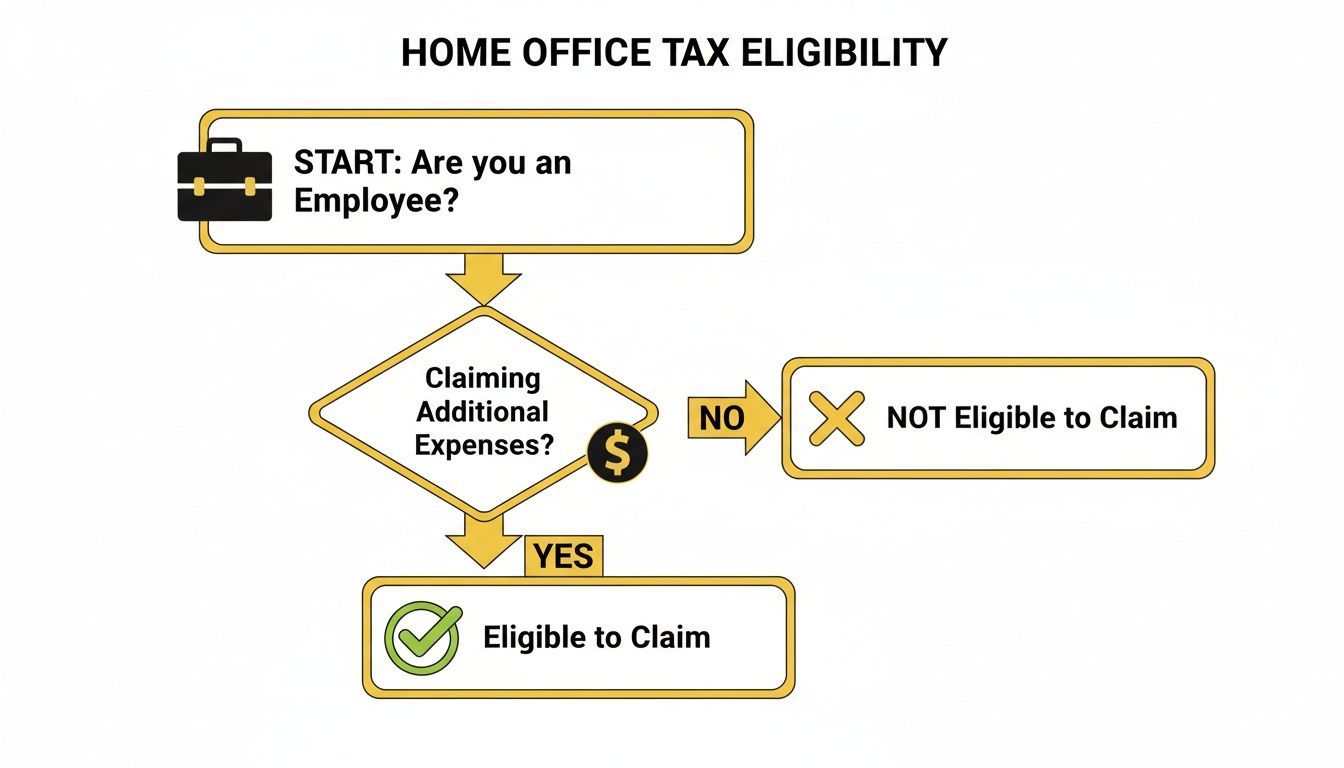
As you can see, being an employee who is genuinely out of pocket from working at home is the most common path to making a successful claim. Now let's break down the two ways you can calculate it.
The Simplicity of the Fixed Rate Method
The fixed rate method is the straightforward, no-fuss option. It’s designed for people who want to claim common running costs without the headache of tracking every single bill. The ATO sets a standard rate for each hour you work from home, which bundles together costs like electricity, gas, internet, and mobile phone usage.
This method is perfect if you don't have a dedicated room and you’re working from a shared space, like the kitchen bench or the living room sofa. You don't need to get out the calculator to figure out the work-related slice of your utility bills. All you need is a diligent log of the hours you worked from home for the entire financial year.
The real power of the fixed rate method is its accessibility. It strips away the complex calculations, opening up the home office deduction to a huge range of remote and hybrid workers who might not have big, easily separable expenses.
Let’s look at a real-world scenario. Diego worked 800 hours from home last year. Using the fixed rate method gave him a deduction of $560. When he tried to tally up his actual energy, phone, and internet costs, the work-related portion only came to $199. By choosing the simpler method, he pocketed an extra $361. It's a clear win.
It's no surprise that since the ATO revised the rules from 1 July 2022, around 70% of claims now use this method. You can dive into more detailed examples of how the fixed rate method works by checking out TaxNextGen.com.au.
The Precision of the Actual Cost Method
On the other hand, the actual cost method is more hands-on but can be far more rewarding if your home office expenses are substantial. This approach requires you to calculate the exact work-related portion of every single eligible running cost. It’s the go-to option for anyone with a dedicated home office, as it allows you to claim a percentage of household bills based on the floor area of your workspace.
With this method, you have to be meticulous. You’ll need to track and keep records for:
- Utility bills: This includes electricity, gas, and even water.
- Telecommunications: Your internet and phone expenses.
- Depreciation: The decline in value of your office desk, chair, and computer.
- Consumables: Things like stationery, printer ink, and other supplies you use up.
Yes, it demands detailed record-keeping. But the potential payoff is much higher. If you've invested in a proper office setup or your running costs are significant, the effort can translate into a much larger tax deduction than the fixed rate would ever allow.
Fixed Rate Method vs Actual Cost Method at a Glance
Choosing the right method can feel tricky, so I've put together a quick comparison to highlight the key differences. This should help you see which one aligns better with your circumstances.
| Feature | Fixed Rate Method | Actual Cost Method |
|---|---|---|
| What it Covers | A set rate per hour for energy (electricity & gas), internet, mobile/home phone, and stationery/computer consumables. | The actual work-related portion of all running expenses, including utilities, depreciation, repairs, and consumables. |
| Record-Keeping | Simpler. You need a record of total hours worked from home and proof you paid for the expenses covered by the rate. | Extensive. You need receipts for all expenses, a log of hours, and calculations for work-related usage (e.g., floor space). |
| Best For | People working in shared spaces (e.g., kitchen table), those with low running costs, or anyone seeking simplicity. | Individuals with a dedicated home office, significant equipment purchases, or high utility bills. |
| Potential Deduction | Capped by the set hourly rate. Generally results in a smaller, but easier, claim. | No cap. The potential deduction is higher and directly reflects your actual expenses. |
Ultimately, the best method for you depends on your personal situation. If you've got a dedicated office and are willing to track everything, the actual cost method will likely give you a better return. But for many, the sheer convenience of the fixed rate method makes it the smarter choice.
Making the Revised Fixed Rate Method Work for You
The revised fixed rate method is a popular choice for claiming home office expenses, and for a good reason—it’s a whole lot simpler than digging up every single bill. But don't mistake simplicity for a free pass. You still need to get the details right to make sure your claim is solid and won't raise any red flags with the ATO.

Think of this method as a bundled rate for your most common running costs. It gives you a set amount for every hour you work from home, saving you the headache of calculating the work-related percentage of half a dozen different bills.
What the Rate Covers
When you opt for the revised fixed rate, the hourly rate is essentially a shortcut. The ATO has already done the maths to figure out a fair amount for the work-related portion of these specific running costs:
- Energy expenses: This covers the extra electricity and gas you’re using to light, heat, or cool your workspace while you're on the clock.
- Internet expenses: The cost of keeping your home connected to get your job done.
- Mobile and home phone usage: This accounts for the work-related portion of your phone services.
- Stationery and computer consumables: It covers the everyday items you chew through, like printer paper, ink, pens, and other supplies.
Now, here’s the catch: you must have actually paid for these things and have a record (like a bill) to prove it. You can't just claim the rate if, for example, your employer covers your entire internet bill. That’s a no-go.
The rate itself has evolved, reflecting the massive shift in how we work. Back in 2020, the ATO rolled out a temporary rate to help the millions of us suddenly working from our kitchen tables. That rate has now climbed to 70 cents per hour for 2024-25, a change driven by rising costs and the fact that over 2 million Australians claimed working-from-home deductions in a single recent tax year. You can get the full story on the ATO's fixed rate method and its history directly from them.
What You Can Claim Separately
Just because the rate is a package deal doesn't mean it covers everything. This is a critical point many people miss, and it can mean leaving serious money on the table.
The fixed rate method only covers running costs. It absolutely does not include the decline in value of your equipment or furniture. You can—and should—claim these items separately.
Here are the big-ticket items you can still claim on top of the hourly rate:
- Depreciation of office equipment: This is the decline in value of your work computer, laptop, printer, and monitor.
- Depreciation of office furniture: Your desk and that fancy ergonomic chair also lose value over time, and you can claim that depreciation.
- Repairs and maintenance: If your work laptop needed a repair, you can claim the business-use portion of that cost.
Putting It All Together
Let's look at a real-world example. Imagine a full-time remote marketer who clocks 1,800 hours from home in a year. Using the 70 cents per hour rate, their base claim for running costs comes to $1,260. Simple.
But they also invested in a $2,000 ergonomic office chair this year. They can claim the depreciation for that chair separately, adding a significant amount to their total home office deduction. It's this combination of the straightforward hourly rate plus the separate claims for big assets that makes the fixed rate method so powerful.
Maximising Claims with the Actual Cost Method
While the fixed rate method is straightforward, the actual cost method is your ticket to a potentially much larger home office tax deduction. Yes, this approach is more hands-on, but for anyone with a dedicated office or significant running expenses, the extra effort often pays off in a bigger refund.
Instead of a simple hourly rate, this method lets you calculate the precise work-related portion of your actual home running costs. It demands good record-keeping, but it reflects the true cost of your home workspace, which can be surprisingly substantial.
Calculating Your Work-Related Percentage
The heart of the actual cost method is figuring out what percentage of your household expenses truly relates to your work. The most common and ATO-accepted way to do this is based on your home office's floor area.
It's a simple calculation:
- Measure Your Office: Work out the square metres of the dedicated room or space you use for work.
- Measure Your Home: Then, calculate the total square metres of your entire home.
- Find the Percentage: Divide your office area by your home's total area and multiply by 100. That number is your work-use percentage.
For example, if your home office is 15 square metres and your total home size is 150 square metres, your work-related percentage is 10%. You can now apply this percentage to your shared household running costs.
Apportioning Your Running Expenses
Once you have that work-use percentage, you can start tallying up the deductible portion of your household bills. This is where keeping all your receipts and invoices becomes non-negotiable.
Common running costs you can apportion include:
- Energy Bills: Claim your work-related percentage of electricity and gas bills for lighting, heating, and cooling your workspace.
- Home and Contents Insurance: You can claim a portion of the premium that covers your home office and its contents.
- Rent or Mortgage Interest: This is a big one. If your home is your principal place of business (which is more common for sole traders), you might be able to claim a portion of these occupancy costs.
The key is to separate direct costs from indirect ones. A new light bulb specifically for your office lamp is a 100% direct expense. Your overall electricity bill, however, is an indirect expense you must apportion using your work-use percentage.
Claiming Depreciation on Assets
One of the biggest advantages of the actual cost method is the ability to claim depreciation on your big-ticket office items. Depreciation is simply the decline in an asset's value over time, and the ATO lets you claim this decline as a tax deduction.
This applies to assets like:
- Office desks and ergonomic chairs
- Computers, monitors, and printers
- Filing cabinets and bookshelves
Each asset has an "effective life" set by the ATO, and you claim the depreciation over several years. For instance, a $1,500 desk might be depreciated over ten years. You can find detailed information on the useful life of various assets by reviewing the official ATO depreciation rates to make sure your claims are spot-on.
Let's look at a freelance graphic designer with a dedicated home studio that makes up 10% of their home. Their annual electricity bill is $2,400, and their internet is $960. They can claim $240 for electricity (10% of $2,400) and the full $960 for the internet (as it's 100% for work). On top of that, they bought a new $3,000 computer, which allows for a substantial first-year depreciation claim.
When you add it all up, these deductions will almost always far exceed what the fixed rate method could ever offer.
Keeping Records The ATO Will Accept
A home office tax deduction is only as solid as the records you keep to back it up. With the Australian Taxation Office (ATO) now taking a much closer look at work-from-home claims, good documentation isn't just a suggestion—it's your primary defence against having your claim questioned or outright denied. The goal is to create an audit-proof trail that justifies every single dollar you claim.
Whether you're using the fixed rate method or calculating actual costs, the burden of proof falls squarely on your shoulders. The old days of getting by with a "reasonable estimate" or a quick diary entry are long gone.
Documenting Your Hours Worked
For anyone using the revised fixed rate method, the ATO now requires a complete log of all hours worked from home for the entire income year. A four-week diary just doesn't cut it anymore.
Your records need to be a true and accurate reflection of your work habits. You can do this with:
- A digital timesheet or a simple spreadsheet you update regularly.
- A physical diary or notebook where you jot down your start and finish times.
- Time-tracking software that logs activity on your work computer.
The ATO's approach has hardened significantly. This shift to a mandatory full-year log is a direct response to the massive increase in remote work, and they are actively using data-matching to compare your claims against what your employer has on record.
Your timesheet doesn't need to be fancy, but it absolutely must be factual and complete. A simple spreadsheet with columns for the date, hours worked, and a quick note on the tasks you did is perfect. Consistency is what the ATO is really looking for.
Receipts And Invoices For The Actual Cost Method
If you're going down the actual cost method route, your record-keeping workload gets a lot bigger. You must keep every single receipt and invoice for the expenses you're claiming. This means hanging onto:
- Utility Bills: Copies of your electricity, gas, and internet bills.
- Asset Purchases: Invoices for your desk, chair, computer, and any other big-ticket office gear.
- Repairs and Consumables: Receipts for things like printer ink, stationery, or any maintenance you’ve had done on your equipment.
Trying to manage a shoebox full of fading paper receipts is a recipe for a tax-time headache. A much smarter move is to look into the best receipt scanning apps and expense tracking solutions to simplify things. These tools digitise your records, making them easy to store, categorise, and pull up in a flash if the ATO ever comes knocking.
Having a robust system in place not only makes lodging your return easier but also gives you invaluable peace of mind. For more tips on setting up a system that keeps you compliant, check out our guide on the different ways of record-keeping for tax purposes.
Common Questions About Home Office Deductions
Working out the specifics of home office deductions can be tricky, and we often get the same questions from clients trying to navigate the rules. Let's clear up some of the most common queries to help you lodge your claim with total confidence.
Can I Claim My Rent or Mortgage Interest?
This is a big one, but for most employees, the answer is a straightforward no.
Generally, you can't claim occupancy expenses like rent, mortgage interest, property insurance, or council rates. The Australian Taxation Office (ATO) considers these private costs, drawing a firm line between the cost of having a home and the cost of working from it.
Employee claims are pretty much restricted to running expenses—the bills you rack up from actually using your home for work. The rare exception is for people whose home is their principal place of business, a scenario far more common for sole traders than for employees on a payroll.
What if I Work from the Kitchen Table?
Good news! You no longer need a separate, dedicated home office to be eligible for a deduction. This is a massive shift, thanks to the introduction of the revised fixed rate method.
If you use this method, you can claim for the hours you work from any area of your home, whether that's a makeshift desk in the living room or the kitchen bench.
However, if you're brave enough to tackle the more complex actual cost method, having a clearly defined workspace is crucial. To claim a portion of household bills based on floor area, you absolutely need a distinct space to accurately calculate the work-use percentage.
The key takeaway is that your workspace doesn't have to be a separate room anymore, thanks to the revised fixed rate method. This change acknowledges the reality of modern remote work and opens up the deduction to many more people.
How Do I Prove My Hours Worked from Home?
Gone are the days of rough estimates. The ATO has tightened the screws on proving the hours you've worked from home, especially if you're using the revised fixed rate method.
You must keep a comprehensive record for the entire income year that shows your total hours. A simple four-week diary just won't cut it anymore.
Here are a few practical ways to keep accurate records:
- A detailed spreadsheet you update regularly.
- A physical diary where you log your start and finish times each day.
- A digital timesheet or time-tracking app on your computer or phone.
The goal is to have a complete, factual log you can show the ATO if they ever come knocking. No guesswork allowed.
Can I Claim for Something My Employer Paid For?
Absolutely not. This is a non-negotiable rule.
You can only claim a deduction for an expense that you personally paid for and were not reimbursed for. If your employer has already covered the cost of an item or paid you back for it, you cannot claim it on your tax return.
This applies to everything—from that new monitor your company bought you to the portion of your internet bill they might cover as part of your employment package. Claiming an expense you didn't actually pay for is a surefire way to attract unwanted attention from the ATO.
Estate planning ensures assets are distributed according to your wishes, minimises disputes among beneficiaries, and can reduce the tax and administrative burden on your estate. Without a valid Will, your estate is distributed under intestacy laws that may not reflect your intentions. A complete plan also addresses superannuation, powers of attorney, and advance care directives.
No. Superannuation is not automatically an estate asset and does not pass according to your Will. Your super fund trustee decides who receives the death benefit, guided by any binding death benefit nomination you have made. Without a valid binding nomination, the trustee has discretion to pay your legal personal representative or directly to a dependant.
Australia has no inheritance tax or estate duty. However, selling inherited assets can trigger CGT. The cost base of inherited assets is generally the market value at the date of death, and the 50% CGT discount applies if the beneficiary holds the asset for more than 12 months. Pre-CGT assets (acquired before 20 September 1985) have special rules.
Probate is a court order confirming a Will is valid and authorising the executor to administer the estate. It is generally required for estates that include real property, or when financial institutions require legal authority before releasing assets. Smaller estates where assets are held jointly may not require probate. The process is handled through the Supreme Court of the relevant state.
Review your Will after any major life event: marriage (which automatically revokes most Wills), divorce, birth of children, significant changes in financial position, or a beneficiary or executor dying. As a general rule, review every three to five years even without a triggering event to ensure it remains current.
Feeling confident about your home office tax deduction is one thing, but getting it right is another. The team at Australia Wide Tax Solutions are experts in helping individuals and businesses maximise their legitimate claims. We can handle everything from late returns to complex investment property schedules, ensuring you get the best possible outcome with our maximum refund guarantee. Book your appointment online today!
- What You Can Actually Claim Without a Receipt
- Understanding the ATO $300 Rule for Work Expenses
- Claiming Car Expenses Without Keeping Every Receipt
- Using Bank Statements as Valid Proof of Purchase
- How a Diary Can Substantiate Small Expenses
ATO guide to work expenses.
Lost a receipt? It happens to the best of us. But don't write off that work-related expense just yet. The Australian Taxation Office (ATO) knows that paper receipts can be lost, damaged, or not provided. You might still be able to claim a deduction.
The most important thing to remember is this: 'no receipt' does not mean 'no record'. You absolutely still need to prove the expense was legitimate.
What You Can Actually Claim Without a Receipt

A missing docket doesn't automatically kill your claim. But it also isn't a free pass to claim whatever you want. To successfully deduct any expense from your taxable income—with or without a perfect paper trail—it has to pass the ATO’s three golden rules.
The Three Golden Rules of Tax Deductions
Think of these rules as a non-negotiable checklist for every single dollar you want to claim. They are the bedrock of Australia’s tax laws, and every claim must satisfy all three.
- You must have spent the money yourself. The expense had to come out of your own pocket, and you can’t have been paid back for it by your boss.
- The expense must be directly related to earning your income. There needs to be a clear, logical link between what you bought and how you make a living. A new laptop for your work-from-home setup? Absolutely. A new gaming console? Not a chance.
- You must have a record to prove it. This is the crucial part when a receipt goes missing. Without that original piece of paper, the burden is on you to provide some other form of solid evidence.
The core principle is simple: a claim must be legitimate, and you must be able to prove it. The ATO’s flexibility on receipts is a practical measure, not a loophole to be exploited.
Moving Beyond the Paper Receipt
So, what counts as a proper record if you don't have a receipt? The ATO accepts various forms of proof, and the documentation you need often depends on the type of expense and its amount.
This could be a detailed bank or credit card statement showing the transaction, a properly kept logbook for car expenses, or even a diary entry noting small cash purchases. For a deeper dive into what’s generally deductible, check out our guide on what you can claim on your tax return.
But what about the specific allowances the ATO provides for claims without receipts? Let's break down those rules, including the handy $300 total limit for work expenses, and look at exactly what kind of alternative records will keep you in the clear.
A Quick Summary of the Rules
To make things clearer, here’s a table that breaks down the main allowances and requirements for making a claim when you don’t have a standard receipt.
Key Allowances for Claims Without Receipts
| Allowance Category | Claim Limit or Rule | What You Need Instead |
|---|---|---|
| Small Expenses | Individual expenses of $10 or less, up to a total of $200 per year | A diary or notebook entry with the date, amount, and what it was for. |
| Total Work Expenses | Up to $300 for all work-related expenses, without needing receipts for any of them. | You still need to show how you calculated the claim (e.g., diary notes, bank statements). |
| Laundry Expenses | Up to $150 per year for laundering compulsory uniforms or protective clothing. | You don't need receipts, but you must show how you calculated the claim. |
| Car Expenses (Cents per km) | Claim up to 5,000 business kilometres per car, per year. | A logbook or diary records to show how you calculated your business kilometres. |
This table provides a great starting point, but it's important to understand the details behind each rule to make sure your claims are solid and ATO-proof.
Understanding the ATO $300 Rule for Work Expenses
Ah, the old "$300 rule". It’s one of the most talked-about parts of Australian tax law, yet so often misunderstood. Many people hear about it and think it's a free pass from the tax office—an automatic, no-questions-asked discount on their tax.
Let's be clear: that’s a risky way to think about it, and the ATO doesn't see it that way.
The rule allows you to claim up to $300 in work-related expenses without keeping individual receipts for each purchase. But this isn't a magic wand. You still have to prove you actually spent the money and that the expense was directly tied to earning your income.
What Is Covered by the $300 Rule?
This rule was really designed to make life a bit easier for those small, incidental costs that pop up in most jobs. Think of it as a way to handle the minor, everyday purchases you make to do your work.
Common things that fall under this umbrella include:
- Stationery like pens, notepads, and printer paper.
- Professional publications such as industry magazines or journals.
- Small tools and equipment you need for your trade.
- Union fees or professional association memberships.
For instance, a teacher buying stickers and posters for their classroom, or a graphic designer paying for a monthly subscription to a design journal, could potentially count these towards their $300 claim.
The $300 allowance is a threshold, not a gift. It simply changes the type of proof you need, shifting the focus from individual receipts to a credible explanation of how you calculated your claim.
What Is Not Covered by the Rule?
It's absolutely crucial to know where the line is drawn. This rule has firm limits, and certain expenses are completely excluded, no matter how small the cost. These categories have much stricter record-keeping rules.
You cannot use the $300 rule for:
- Car expenses (these must be claimed using the cents per kilometre or logbook method).
- Travel expenses like flights, accommodation, and meals away from home.
- Meal expenses (unless they're part of a formal travel allowance).
- Expenses for depreciating assets (items that lose value over time).
This provision allows employees and sole traders to claim up to $300 in total for certain work costs without receipts, as long as the expenses are genuine and work-related. If you want to dive deeper, you can discover more insights about tax deductions in Australia on scalesuite.com.au.
Essentially, the ATO has carved out this exception for minor, miscellaneous costs. For bigger or more specific claims like using your car for work, the standard of proof is much, much higher. You’ll need detailed logs and records to back up your claim and stay out of trouble if the ATO comes knocking.
Claiming Car Expenses Without Keeping Every Receipt
When it comes to work-related travel, the thought of hoarding a receipt for every single litre of petrol or every kilometre driven can feel overwhelming. Nobody wants that shoebox full of crumpled paper.
Thankfully, the Australian Taxation Office (ATO) gets it. They've set up a couple of ways to claim car expenses that don't demand such intense paperwork. These methods are designed to make life easier while still making sure your claims are fair and legitimate.
The two main paths you can take are the cents per kilometre method and the logbook method. Which one is right for you really depends on how often you're using your personal car for work.
The Cents Per Kilometre Method Explained
Think of this as the simple, set-and-forget option. The cents per kilometre method lets you claim a fixed rate for every work-related kilometre you drive, capped at a maximum of 5,000 kilometres per car, each year.
This method is perfect if you only use your car for work occasionally—maybe for driving to client meetings, visiting different work sites, or running a work-related errand. Its biggest selling point is simplicity. You can forget about keeping receipts for fuel, oil changes, insurance, or rego.
All you need is a way to show the ATO how you worked out your kilometres. A simple diary or note of your trips is usually enough.
This flowchart breaks down the key rules for claiming expenses without a receipt, including the all-important $300 rule.
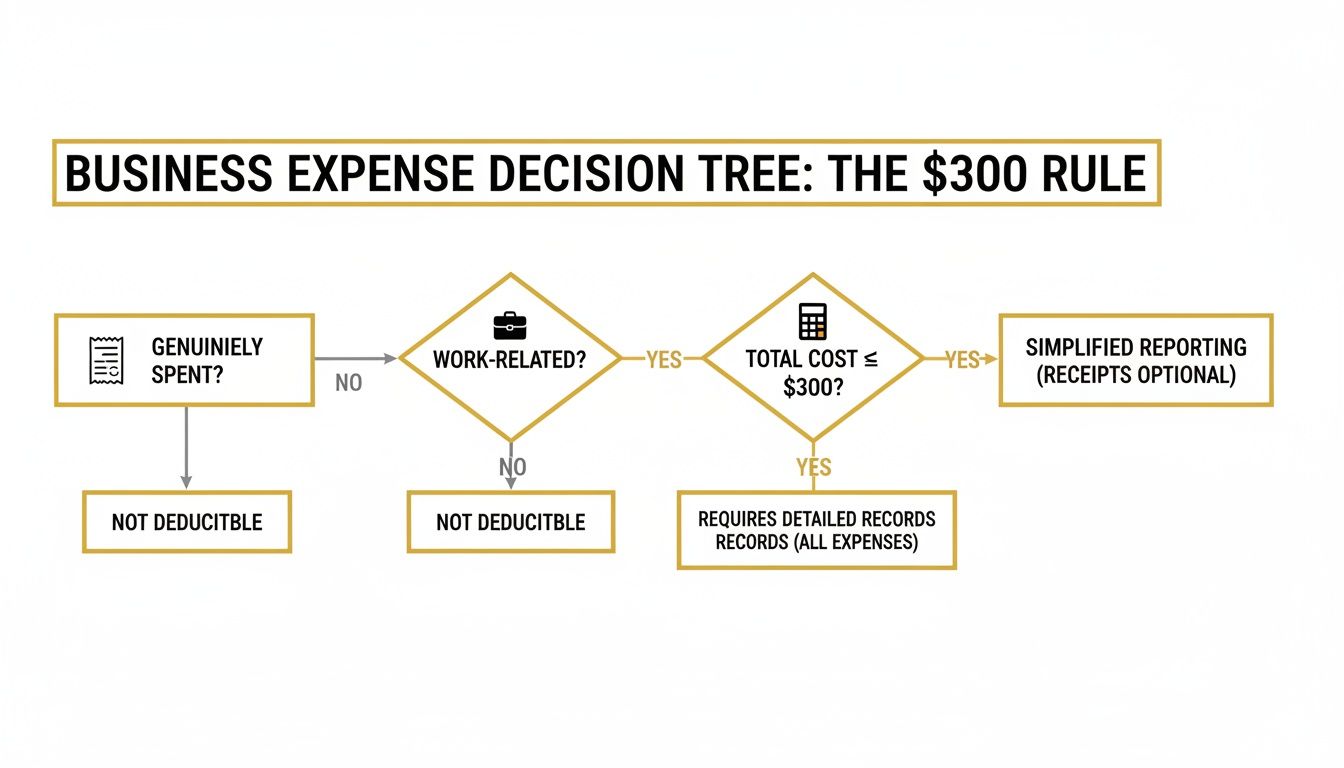
The key takeaway here is that every claim—receipt or not—has to be a genuine work expense that you actually paid for and falls within the ATO's limits.
When the Logbook Method Is Better
So, what happens if you're on the road constantly and clock up well over 5,000 work kilometres a year? The cents per kilometre method will hit its ceiling pretty fast, meaning you could be missing out on a much bigger deduction.
This is where the logbook method steps in. It does require a bit more effort upfront, but for people who drive a lot for work, it almost always leads to a significantly larger claim.
To use this method, you need to keep a detailed logbook for a continuous 12-week period. This snapshot of your driving habits is then used to calculate your car's business-use percentage.
The real power of the logbook is its longevity. Once you've done that initial 12-week stint, you can use that business-use percentage to calculate your claims for up to five years, as long as your driving patterns don't drastically change.
You then apply this percentage to all your actual car running costs—fuel, maintenance, insurance, depreciation, the lot. While you'll need to keep receipts for these costs, the logbook itself means you don't have to track every single trip for the next five years. For a deeper dive, check out our guide on claiming work-related car expenses.
Travel and Meal Allowances
The ATO also has rules for travel and meal allowances that can cut down on your receipt-keeping. If your employer pays you a travel allowance and your claim for accommodation, food, and other small costs is within the ATO's official 'reasonable amounts', you generally don't need to keep receipts.
But be careful. These "reasonable amounts" are very specific and change based on your salary, where you're travelling, and for how long. If you try to claim more than the reasonable amount, the ATO will want to see written evidence for your entire claim, not just the part that's over the limit. It pays to know what these thresholds are before you travel.
Using Bank Statements as Valid Proof of Purchase
We’ve all had that sinking feeling. You’ve lost a receipt for a decent-sized work expense, and you can almost hear the deduction disappearing. Before you give up, pull up your bank or credit card statements. In the eyes of the ATO, these financial records are often your next best thing.
A bank statement acts as clear, third-party proof that you actually spent the money. It shows the date, the exact amount paid, and who you paid it to. This is a powerful starting point for substantiating claims without receipts, especially for those bigger items where a simple note in your diary just won't cut it.
But hold on—a line on a bank statement is only one piece of the puzzle. By itself, it doesn't tell the whole story. A transaction entry for "Officeworks $150" doesn't explain what you bought or why it was essential for your job. To make it a rock-solid piece of evidence, you need to add some context.
How to Annotate Your Statements for the ATO
Think of your bank statement as the foundation of a house. Your own notes are the walls that complete the structure and make it useful. Without them, the ATO is left guessing. To turn a simple transaction line into compelling proof, you have to add the details that answer the questions an auditor would ask.
Your notes should clearly explain:
- What you bought: Be specific. Instead of "office supplies," write "HP printer ink cartridges and 2 reams of A4 paper."
- Who the supplier was: The statement usually shows this, but it’s good practice to clarify if the trading name is a bit obscure or different from the shopfront name.
- The nature of the expense: State its purpose directly. For example, "For printing client reports from my home office."
- How it connects to your work: This is the most crucial part. You must explicitly link the purchase to earning your income.
The goal is to paint a complete picture for the ATO. Your annotations should leave no doubt that the expense was legitimate, directly related to your work, and that you were the one who paid for it.
The Limitations of Bank Statements
While they are incredibly helpful, bank statements aren't a silver bullet for every lost receipt. It's important to understand their limits and know where they fall short.
The most obvious blind spot is cash purchases. If you paid with cash and lost the receipt, your bank statement won't show the transaction at all. You’re left with no financial trail to follow, which is exactly why keeping a diary is so vital for those small, under-$10 cash expenses.
Vague transaction descriptions can also weaken your claim. A payment to "General Store" or a simple person-to-person transfer doesn't offer much clarity. In these situations, you’ll need to back up the statement with other forms of evidence, like an email confirmation or even a photo of the item, to build a stronger case.
How a Diary Can Substantiate Small Expenses
It’s often the smallest expenses that are the biggest headache to track. Think about all those little cash costs that crop up in your workday—parking meters, road tolls, or buying a quick coffee for a client. Individually, they’re tiny, but over a full year, they can easily add up to a decent deduction. The problem? Getting a paper receipt for every single one is just not practical.
This is where a simple diary becomes one of your most powerful tax tools. The ATO understands that it’s not always possible to get a receipt for minor cash transactions. They allow you to use a diary or a similar record for small work-related expenses that are $10 or less each, as long as the total of these specific claims doesn’t go over $200 for the financial year.
This rule is tailor-made for those frequent, low-value cash outlays. Your diary essentially acts as a substitute receipt, so it needs to contain all the crucial details the ATO would look for on an actual docket to prove the expense is legitimate.
Crafting the Perfect Diary Entry
A valid diary entry is much more than a quick scribble in a notebook. To be compliant, it has to be detailed and, crucially, created at or very near the time you spent the money—not months later when you’re scrambling to do your tax.
For each entry to count, it must clearly state:
- The date the expense happened.
- The supplier or business name (e.g., "City Council Parking").
- The exact cost of the item or service.
- The nature of the goods or services and how it connects to your work (e.g., "Parking for client meeting at Collins St").
Consistency is your best friend here. If an auditor sees entries made regularly throughout the year, it paints a credible picture of your spending habits and gives your claim real strength.
A well-kept diary transforms vague memories into concrete evidence. It shows diligence and proves you are actively tracking your expenses, which is exactly what the ATO wants to see for any claim made without a standard receipt.
Real-World Diary Examples
Let's see what this looks like in practice. Imagine you're a sales rep who is constantly out of the office meeting clients. Your expense diary for one week might look something like this:
Sample Diary Entries
| Date | Supplier | Item | Cost | Work Purpose |
|---|---|---|---|---|
| 21 Oct | Central Brew Cafe | Coffee | $5.50 | Meeting with J. Smith |
| 22 Oct | City Council Parking | Parking Meter | $7.00 | Site visit at CBD project |
| 24 Oct | Metro Trains | Train Ticket | $4.80 | Travel to industry seminar |
This level of detail leaves no room for doubt. It clearly outlines each small expense and its direct link to earning your income, making it a rock-solid way to substantiate those everyday costs you can’t get receipts for.
Building a Proactive Record-Keeping System
The best way to handle the stress of a missing receipt is to build a system that prevents it from becoming a problem in the first place.
When you shift from a reactive mindset ("Where did that receipt go?") to a proactive one, tax time stops being a frantic scramble and turns into a simple, organised process. Good record-keeping isn't just about ticking compliance boxes; it's about having total clarity over your finances.
A solid system gives you the confidence to claim every single dollar you're entitled to. This all starts with embracing a few modern tools and simple, consistent habits. Instead of letting receipts pile up in a shoebox, you can lock them in digitally the moment you get them.
Go Digital with Your Receipts
The easiest first step is right in your pocket: your smartphone. Heaps of apps are designed specifically to scan, categorise, and store your receipts safely in the cloud. This creates an immediate, searchable digital backup that the ATO happily accepts as valid proof.
The key benefits of using receipt-scanning apps are pretty clear:
- Instant Backup: You’ll never have to worry about losing a paper receipt or watching the ink fade to nothing.
- Easy Categorisation: Tag expenses on the fly as travel, supplies, or meals right when you make the purchase.
- Simple Reporting: When tax time rolls around, generating expense reports is almost effortless.
This digital-first approach is one of the most effective ways of record-keeping available today, and it will save you countless hours of manual sorting down the line.
A proactive system isn't about giving yourself more work; it's about working smarter. A few seconds spent digitising a receipt today saves hours of hunting for it months from now.
Create a Dedicated Financial Workflow
For businesses or anyone with significant work-related expenses, separating your finances is an absolute game-changer.
Go and open a dedicated bank account or credit card used only for work-related purchases. This simple move creates a clean, automatic record of all your business spending, making it incredibly easy to review transactions without mixing them up with personal coffees or groceries.
If you're looking to build a more formalised approach, you could even use specialised process documentation software to map out a clear, repeatable workflow for how you and your team manage every expense.
But don't toss out your physical records entirely. It's still wise to maintain a simple folder system, maybe with sections for different expense types or months. By combining a dedicated bank account, digital receipt capture, and a basic physical filing method, you create a powerful, multi-layered system that has your back.
This ensures that when tax time arrives, you have all the information you need, right at your fingertips. No stress, no searching.
Common Questions About Claims Without Receipts
It’s easy to get tangled up in the rules for claiming expenses without receipts, so let's clear up a few of the most common points of confusion. Getting these right will give you the confidence that your claims will stand up to ATO scrutiny.
One of the biggest myths we see is the $300 rule. A lot of people think they can automatically claim $300 for work-related expenses, even if they never spent the money. This is a huge red flag for the ATO and completely incorrect.
The $300 limit is simply the threshold where you don't need to provide traditional receipts. It's not a free deduction. You absolutely must have spent the money on legitimate work costs.
What Happens During an ATO Audit?
So, the inevitable question: what if the ATO questions a claim and you don't have the receipt? This is where your other records become your safety net. The ATO will ask you for alternative evidence to prove you actually incurred the expense.
Your best defence will be things like annotated bank statements, detailed diary entries, or a well-kept logbook. If you can’t produce any proof at all, the ATO will almost certainly disallow the deduction. That means paying back the tax you saved, and you could also get hit with interest and penalties on top.
For anyone looking to get their bank records organised for tax time, a bank statement converter to Excel can be a massive help, turning messy statements into a neat, auditable spreadsheet.
How Long to Keep Your Records
Finally, how long do you need to hang onto all this proof? The ATO’s rule is clear: you must keep all tax-related records for five years from the date you lodge your tax return.
This five-year rule applies to everything—paper receipts, digital copies, diaries, and logbooks. It’s always a smart move to back up digital records to secure cloud storage, just in case your hardware fails.
Keeping good records isn't just about ticking a compliance box; it's about protecting every dollar you're entitled to claim.
Navigating the rules for tax claims can be complex, but you don't have to do it alone. The experts at Australia Wide Tax Solutions can provide personalised advice to ensure you claim everything you're entitled to while staying compliant. Maximise your tax outcome with confidence today.
The ATO provides guidance through ato.gov.au, the Small Business Support Line (13 28 66), and Online Services for individuals and businesses. For complex situations, a registered tax agent provides advice tailored to your specific circumstances and professional indemnity protection. You can verify agent registration at the TPB register at tpb.gov.au.
Most tax records must be kept for five years from the date of lodgement or the date the transaction occurred, whichever is later. Records must be in English or convertible to English and must be sufficient to explain the income and deductions in your return. The ATO can request records at any time during the retention period.
Consider a registered tax agent when your affairs involve multiple income sources, business activity, investment properties, capital gains, or overseas income. Agents extend your lodgement deadline, provide safe harbour protection, and take professional responsibility for the advice given. Verify registration at tpb.gov.au.
The failure to lodge penalty is based on penalty units ($313 per unit from 1 July 2023), accruing per 28-day period for late returns and BAS lodgements. Incorrect information penalties range from 25% to 75% of the tax shortfall depending on whether the behaviour was careless, reckless, or intentional. Proactive disclosure before an audit begins typically results in significantly reduced penalties.
Tax minimisation is the legal arrangement of your affairs to reduce tax — claiming all eligible deductions, using appropriate structures, and timing income and expenses. Tax avoidance involves arrangements that technically comply with the law but achieve outcomes parliament did not intend. The ATO can apply Part IVA anti-avoidance rules to cancel benefits from avoidance arrangements.
Salary packaging (also called salary sacrifice) is one of the most effective legal tax minimisation strategies available to Australian employees in 2026. By redirecting part of your pre-tax salary into benefits — including superannuation, cars, laptops, and work-related costs — you reduce your taxable income and potentially your overall tax liability. However, the rules differ significantly between employees of FBT-exempt organisations (hospitals, charities) and commercial employers. Here is what you need to know.
How Salary Packaging Works
Salary packaging redirects part of your gross (pre-tax) salary into benefits before income tax is calculated. Your taxable income is reduced by the packaged amount, reducing PAYG withholding and your end-of-year tax liability. Benefits packaged may include super, a novated car lease, portable electronic devices, professional memberships, and (for eligible employers) living expenses.
FBT-Exempt Employers: Hospitals, Charities, and NFPs
Employees of public hospitals, registered charities, and certain not-for-profit organisations can package up to $9,010 in living expenses (meals, mortgage/rent payments, school fees) per FBT year with no Fringe Benefits Tax payable. An additional $2,650 in meals and entertainment can be packaged via a meal entertainment card. These exemptions are unique to FBT-exempt employers and provide substantial tax benefits unavailable to commercial sector employees.
Example: An FBT-exempt employee earning $85,000 who packages $9,010 in living expenses reduces their taxable income to approximately $75,990 — saving ~$1,900 in income tax while the FBT is exempt for the employer.
Novated Car Leases
A novated lease allows employees of any employer (not just NFPs) to salary package a car. The employer makes lease payments from the employee's pre-tax salary, and the employee uses after-tax "employee contributions" to reduce the FBT liability. For electric vehicles, FBT is fully exempt under the Electric Car Discount scheme, making EV novated leases exceptionally tax-effective in 2026. For petrol vehicles, the FBT calculation reduces but does not eliminate the cost.
Super and Other Salary Sacrifice Benefits
- Super: All employees can salary sacrifice into super, taxed at 15% instead of their marginal rate. Most tax-effective benefit for most employees.
- Portable electronic devices: Work-related laptops, phones, and tablets can be salary packaged — FBT-exempt if primarily used for work
- Professional memberships and subscriptions: FBT-exempt if work-related
- Briefcases and tools of trade: FBT-exempt
Frequently Asked Questions
Does salary packaging affect my tax return?
Yes. Reportable fringe benefits amounts (RFBAs) from salary packaging appear on your payment summary / income statement and are used to calculate income-tested obligations including Medicare levy surcharge, HECS repayments, private health rebate eligibility, and Centrelink income tests — even though they are not directly subject to income tax. Super salary sacrifice is reported separately as reportable employer super contributions (RESC) and is included in your adjusted income for some tests.
Can I salary package at any employer?
Salary packaging is available at any employer that offers it — but the benefits and FBT treatment vary significantly. FBT-exempt employers (public hospitals, registered charities) offer the most generous packaging benefits including living expenses. Commercial sector employers can offer super, novated car leases, and portable electronic devices but not FBT-exempt living expense packaging. Check whether your employer has a salary packaging provider.
Want to maximise your salary packaging strategy for 2026? Contact AWTS — we help employees and NFP workers structure packaging arrangements to legally minimise their tax.
The "cash economy" — businesses and individuals conducting transactions in cash to avoid recording income — is one of the ATO's highest-priority compliance targets in 2026. The ATO uses sophisticated data-matching, lifestyle audits, and third-party reporting to identify discrepancies between reported income and actual economic activity. Businesses and sole traders operating in cash-heavy industries face heightened scrutiny and severe penalties for non-compliance. Here is what small businesses need to know.
What Is the Cash Economy?
The cash economy refers to economic activity that goes unreported to the ATO — primarily transactions conducted in cash that are not recorded in business books, undeclared ABN income, and payments to workers "off the books" without PAYG withholding or super contributions. The ATO estimates the cash economy costs the tax system over $10 billion annually.
How the ATO Detects Cash Economy Activity
- Data matching: The ATO cross-matches business income against BAS lodgements, payroll records (STP), bank transactions, and third-party reporting from banks, payment platforms (Square, Tyro, Stripe, Eftpos), and share economy operators
- Industry benchmarking: The ATO publishes benchmark ratios for over 100 industries — cash, cost of sales, and labour ratios. Returns significantly below benchmark trigger review
- Lifestyle audits: The ATO compares reported income against assets owned, overseas travel, property purchases, and living standards
- Tip-offs: The ATO receives thousands of tip-offs annually from former employees, competitors, and customers
- Third-party data: Building permit data, vehicle registrations, rental income from property managers
Consequences of Cash Economy Non-Compliance
- Shortfall penalties: 25-75% of the unpaid tax, depending on whether the behaviour was careless, reckless, or intentional
- General Interest Charge: ~11% p.a. on unpaid amounts from the date tax was due
- Criminal prosecution: For deliberate and repeated tax fraud, the ATO refers matters to the Commonwealth Director of Public Prosecutions
- Director penalty notices: Company directors can be personally liable for unpaid PAYG and super amounts
Legitimate Cash Business Obligations
Running a legitimate cash business in 2026 requires:
- Recording all cash receipts and issuing receipts or invoices for all transactions
- Reporting all income on BAS (GST) and in your income tax return
- Withholding PAYG from cash wages and reporting through Single Touch Payroll
- Paying super guarantee on all eligible wages, including cash wages
- Maintaining records for 5 years (or 7 years for some CGT records)
Frequently Asked Questions
Is it legal to pay employees in cash in Australia?
Yes, paying wages in cash is legal — but the employer must still withhold the correct PAYG amount, report the payments through Single Touch Payroll (STP), and pay super guarantee contributions on the ordinary time earnings. Paying employees in cash without meeting these obligations is illegal and exposes the business to payroll tax audits, super guarantee charges, and penalties.
What is the ATO's benchmark program?
The ATO's Small Business Benchmarks compare key financial ratios (cost of goods sold %, wages %, cash as a % of sales) for businesses in the same industry and income range. If your business ratios are significantly outside the benchmark range, the ATO may contact you to explain the difference or conduct an audit. Businesses should check how they compare to benchmarks at ato.gov.au/benchmarks.
Operating a cash business and want to ensure full ATO compliance? Contact AWTS — we help small businesses establish compliant bookkeeping, BAS, and payroll processes.