
A step-by-step guide to lodging your 2025–26 Australian tax return — key dates, what you need, common deductions, and how AWTS can help you get it right.
Tax time comes around every year, but that doesn't mean it gets any less confusing. Between remembering what you can claim, chasing down payment summaries, and trying to figure out whether you're better off lodging yourself or using an agent, it's easy to put your tax return off until the last minute.
This guide walks you through everything you need to know to complete and lodge your 2025–26 tax return — the return that covers income you earned between 1 July 2025 and 30 June 2026. We'll cover the key dates, what's changed this year, what to gather before you start, how to lodge, and the deductions people most commonly miss.
Key dates for the 2025–26 tax return
Missing a deadline is one of the easiest ways to end up with a penalty, so it's worth putting these dates in your calendar now.
- 1 July 2026 — Tax time officially opens, and you can lodge your return. It's usually worth waiting a couple of weeks before you lodge, since employers, banks and health funds have until mid-to-late July to finalise their data with the ATO. Lodging too early can mean your pre-fill information is incomplete, increasing the risk you'll need to amend it later. Please never lodge before 18 July 20XX, any year.
- 31 October 2026 — The deadline to lodge your own tax return if you're not using a registered tax agent. This applies whether you lodge through myTax or on paper.
- 15 May 2027 — You can access the extended deadline if you're registered with a tax agent, such as AWTS, by 31 October 2026. To qualify for this extension, you generally need to be up to date with your previous returns and not have any overdue debts with the ATO or Centrelink.
If you can't lodge by 31 October and you're not signed up with a tax agent, it's worth registering with one before that date — even if your agent doesn't get to your return straight away, being on their client list before the deadline can protect you from late lodgment penalties.
What's new for the 2025–26 tax return
A few things have changed since last year that are worth knowing about before you lodge.
Gifts and donations. The old $2 minimum for claiming a tax-deductible gift has been removed, so donations of any amount to an eligible deductible gift recipient can now be claimed, provided you have the right records.
Interest charges are no longer deductible. General interest charges (GIC) and shortfall interest charges (SIC) that you incur on or after 1 July 2025 can no longer be claimed as a tax deduction.
If you're carrying ATO debt, this makes it more important than ever to pay it down or set up a payment plan. Or refinance it with an external provider, which will be tax-deductible.
Rental property rules have been clarified. The ATO has issued updated guidance on when rental income is assessable and which expenses are deductible, including how to apportion expenses fairly for holiday homes and properties with mixed personal and rental use. If you own an investment property, it's worth reviewing your records against the latest guidance, or better yet, having an agent check it for you. You need to remember the grandfathering rules for existing properties before budget night.
The Junior Minerals Exploration Incentive has ended. This scheme closed on 30 June 2025, so exploration credits can no longer be claimed for the 2025–26 year onwards.
One thing that's not changing this year: the income tax brackets. The next round of tax cuts (a drop in the 16% rate to 15%) doesn't take effect until 1 July 2026, so it will apply to next year's return, not this one.
What you need before you start
Getting your paperwork together before you sit down to lodge will save you a lot of back-and-forth. Have these ready:
- Your tax file number (TFN) and myGov account linked to the ATO.
- Income statements from your employer(s) — most are now sent electronically via Single Touch Payroll and will show as "Tax ready" in myGov, but check every employer you worked for during the year, including short-term or casual roles.
- Bank interest statements and details of any dividend income, managed fund distributions, or crypto asset disposals.
- Government payment summaries, if you received JobSeeker, Youth Allowance, or other Centrelink payments.
- Private health insurance statement, if applicable. Recommended for incomes over $90k for singles.
- Records of work-related expenses — receipts, logbooks, or diary entries for anything you plan to claim.
- Details of any spouse's income, since this affects offsets like the Medicare levy surcharge and some tax offsets.
- Bank account details for your refund.
How to lodge your return
You have three main options.
1. Lodge yourself through myTax. This is the ATO's free online lodgment service, accessed through myGov. Most of your income information — wages, bank interest, private health insurance — will be pre-filled automatically once your employer and financial institutions report it, usually by late July. You then add any deductions, check everything is correct, and submit. Most electronic returns are processed within two weeks.
2. Use a registered tax agent. A tax agent can lodge on your behalf, offer advice on what you're entitled to claim, and give you access to the later 15 May deadline. Only registered agents are legally allowed to charge a fee for preparing and lodging your return, and their fee is generally tax-deductible next year. This is usually the better option if your return is more complex — multiple income sources, an investment property, capital gains, or a business — or if you'd simply rather have a professional check your figures than risk an ATO review later.
3. Lodge a paper return. Still possible, but slower, with refunds typically taking up to 50 business days. Most people avoid this option unless they have a specific reason to use it.
Deductions people often miss
The golden rule for any deduction is that you must have spent the money yourself, it must directly relate to earning your income, and you need a record to prove it. Some commonly overlooked deductions include:
- Working-from-home costs, using either the fixed rate method (which covers electricity, internet, phone and stationery at a set rate per hour) or the actual cost method, provided you keep the right records for whichever method you choose.
- Self-education expenses, where the course directly relates to your current role.
- Income protection insurance premiums, if the policy isn't paid through your super fund.
- Union and professional membership fees.
- Tools, equipment and uniforms specific to your job, including laundering costs for compulsory or protective uniforms.
- Donations to registered charities, now deductible from the first dollar.
- The cost of managing your tax affairs, including any fee you paid a tax agent last year.
- Please download our quote and tax checklist and deductions spreadsheet for the 2026 year here: Tax Checklist
If you're not sure whether something qualifies, it's far safer to ask than to guess — over-claiming is one of the most common triggers for an ATO review.
Mistakes that slow things down or cost you money
A few things consistently trip people up at tax time:
- Lodging before your income statement is finalised, which often means having to amend your return later.
- Forgetting a second job, short-term gig work, or bank interest, all of which the ATO can already see through data-matching, even if you don't declare it.
- Claiming deductions without records. The ATO can (and does) ask for evidence, sometimes years after you've lodged.
- Missing the 31 October deadline without being registered with a tax agent, which can trigger a failure-to-lodge penalty.
- Not declaring capital gains from selling shares, crypto, or an investment property.
Do you need a tax agent?
If your tax situation is simple — one employer, no investments, straightforward deductions — lodging through myTax yourself is often perfectly manageable. But if you've got rental property income, capital gains, multiple income streams, or you're just not confident you're claiming everything you're entitled to, a registered tax agent can make a real difference, both in accuracy and in what ends up in your refund.
Frequently asked questions
What happens if I miss the 31 October deadline? If you're not registered with a tax agent and you lodge late, the ATO can apply a failure-to-lodge penalty, generally charged in 28-day blocks. If you know you're going to be late, the best move is to lodge as soon as you can, or register with a tax agent before the deadline to access the extended date.
Do I still need to lodge if I earned under the tax-free threshold? Possibly. Even if your income was below $18,200, you may still need to lodge a return or receive a non-lodgment advice, particularly if tax was withheld from your pay. It's worth checking rather than assuming you're exempt. If you think you may inherit property overseas, we suggest lodging a tax return so you can qualify for the certificate of residency.
How long does it take to get my refund? Returns lodged online through myTax or a tax agent are usually processed within two weeks. Paper returns can take up to 50 business days.
Can I amend my return after I've lodged it? Yes. If you realise you've left something out or made a mistake, you can request an amendment through myGov or ask your tax agent to do it for you. It's far better to fix it yourself than to wait for the ATO to catch it.
Getting it right the first time
At AWTS, we specialise in making tax returns simple. Whether you've got a straightforward return, a late lodgment to sort out, or something more complex like an investment property or a deceased estate to manage, we'll walk you through exactly what you need and take care of the lodgment for you. Get in touch to book a consultation, online or in person, before the rush hits closer to the October deadline. For all quotes, click here; for just the individual tax checklist, click here; for a business tax checklist, click here
This article is general information only and doesn't take into account your personal circumstances. For advice specific to your situation, speak with a registered tax agent.
AWTS Tax Registered number is 78641007
Please text us for everything else. Please include your email and first name in the sms or WHATSAPP 0488854200
It’s a question every Australian taxpayer eventually asks: when exactly are my taxes due?
- Why Does the Australian Tax Year Run From July to June?
- Tax Deadlines for Individuals and Sole Traders
- Managing Business Tax Dates: BAS, PAYG, and Super
- Handling Special Tax Situations and Deadlines
- Your Action Plan for a Stress-Free Tax Time
For most people going it alone, the answer is simple: 31 October. But the story doesn't start there. The Australian tax year actually runs from 1 July to 30 June, a financial calendar that sets us apart from many other countries. This unique timeline, combined with different deadlines for businesses and those who use a tax agent, can easily cause confusion.
Getting these key dates right is the first step toward a stress-free tax season. It means you can lodge on time, avoid a headache, and steer clear of any unnecessary penalties from the ATO.
Decoding the Australian Tax Year: More Than Just One Date
The Australian financial year, stretching from 1 July to 30 June, is the foundational 12-month block for everything tax-related. This structure isn't just a random choice; it has historical roots designed to align with the country's economic rhythms and is formally set out in the Income Tax Assessment Act 1997. This specific timeframe is what dictates when you need to tally up your income, claim your deductions, and ultimately, lodge your tax return.
Think of the tax year as a financial snapshot. Every dollar you earn, from your main job to a side hustle, and every deductible expense, from a work-related training course to a donation to your favourite charity, is counted within this July-to-June window. Once the clock ticks past midnight on 30 June, that window closes. Then, the process of reporting that financial picture to the Australian Taxation Office (ATO) begins.
Here’s a simple look at the core timeline:

This visual shows the main dates every taxpayer should have on their radar. The period between 1 July and 31 October is your opportunity to get your financial house in order and prepare to lodge.
But while the 31 October deadline gets all the attention, it’s not the only date that matters. The tax system has a web of deadlines depending on your specific situation:
- Individuals and Sole Traders: If you’re lodging your own tax return, the deadline is firm: 31 October.
- Businesses: Companies, trusts, and other business structures often follow a different rhythm, with quarterly Business Activity Statement (BAS) deadlines throughout the year.
- Using a Tax Agent: Here's where things get interesting. Engaging a registered tax agent, like the experts here at AWTS, gives you a significant advantage. Tax agents have access to special lodgement programs that can extend your deadline, often well into the following year. This gives you much-needed breathing room to gather your documents and make sure your return is spot on.
Staying on top of these dates is crucial for avoiding late lodgement penalties, which the ATO can issue for every 28-day period your return is overdue. To get a clearer picture of how these deadlines might affect you, you can explore our detailed guide on tax return due dates. Understanding this framework is the first step to managing your tax obligations with confidence.
Why Does the Australian Tax Year Run From July to June?
Ever found yourself frantically gathering receipts in October while your American mates were done with their taxes back in April? It’s a common point of confusion, but Australia's unique financial year, running from 1 July to 30 June, wasn’t just picked at random. It’s a system deeply rooted in a blend of colonial history and agricultural common sense.
The tradition stems from our ties to Great Britain. Back in the day, the UK tax year ended on 25 March, which lined up neatly with the end of the farming season. As a British colony, Australia inherited many of its administrative structures, including the financial calendar. Over time, this was tweaked to a 30 June end date, a far better fit for the seasonal rhythms of the Southern Hemisphere and our once-dominant agricultural economy.

A Timeline That Matches Our Economic Heartbeat
For a country built on the back of farming and agriculture, ending the financial year mid-way through the calendar year just made sense.
- Harvest and Sales Cycles: Winter signals the end of the main harvest for many key crops. This timing lets farmers and agricultural businesses tally up their income and expenses for the entire production cycle before they need to settle their tax affairs.
- Smarter Business Planning: It creates a natural break for all businesses to review their performance and finalise their books. Crucially, it avoids the major holiday disruptions of Christmas and Easter, allowing for cleaner planning and reporting.
This pragmatic structure stuck, becoming woven into the very fabric of Australia's financial and legal systems.
A Century of Tax Evolution
While South Australia first introduced an income tax in 1884, it was the immense pressure of World War I that led to a federal income tax in 1915. For decades, Aussies were double-taxed, paying both state and federal governments. It wasn't until World War II that income tax was centralised under the federal government in 1942, a move that saw the national tax-to-GDP ratio explode from 5% in 1901 to 12% by 1945.
This 1 July to 30 June fiscal year was officially locked into law, most recently in the Income Tax Assessment Act 1997. This Act also cemented the standard 31 October deadline for anyone lodging their own tax return.
Since then, the revenue collected has ballooned, growing from around $355 billion in 2015 to well over $550 billion by 2022, funding everything from our hospitals to our highways. It's interesting to note that despite these huge figures, Australia's tax-to-GDP ratio remains one of the lower ones among developed nations. You can read more about the history of Australian income tax on Wikipedia.
Did You Know? The 1 July start date is a massive day on the legislative calendar. It’s the go-live date for countless new rules, including superannuation changes, award rate increases, and adjustments to government fees, all kicking in at the start of the new financial year.
Today, this timeline dictates the financial rhythm of the entire country. It’s when we finalise our records, when businesses close their books, and when we all turn our minds to tax. While it might seem a bit odd to the rest of the world, our July-to-June financial year is a direct link to our history—and a practical system that has served our economy for over a century.
Tax Deadlines for Individuals and Sole Traders
If you're an individual or a sole trader, the Australian financial year wraps up on June 30th. Once it does, the clock starts ticking towards one of the most important dates on your calendar: October 31st.
This is the standard deadline for lodging your own tax return. For many, it’s a date that looms large, bringing with it the pressure of gathering documents, untangling your obligations, and hoping you haven’t missed anything important.
Failing to meet this deadline isn't just a minor slip-up; it can have real financial consequences. The Australian Taxation Office (ATO) can impose a Failure to Lodge (FTL) penalty, which is calculated for every 28-day period your return is late. This can add up surprisingly quickly, turning a simple task into a costly mistake.
But what if you need more time? Life happens. You might be waiting on important documents, dealing with a complex financial situation, or simply feeling overwhelmed. This is where a strategic approach can turn tax time from a stressful scramble into a managed process.
The Power of a Tax Agent: Extending Your Deadline
Many people believe the October 31st deadline is set in stone, but it's not the only option. By engaging a registered tax agent, you can access a much more flexible timeline. The ATO has a special lodgment program for clients of registered agents, which can extend your deadline well into the following year, often as late as May.
This extension isn't a loophole; it’s a system designed to ensure accuracy and compliance. The ATO recognises that professionals need more time to properly manage their clients' affairs. Here's how it works:
- You must be on an agent's client list by October 31st. This is the crucial step. You can't wait until November and then ask an agent to get you an extension.
- The agent manages your new deadline. Your new due date will depend on your individual circumstances and lodgment history, but it’s almost always much later than the standard one.
- It provides valuable breathing room. This extra time allows you to gather all your necessary paperwork—from bank statements and receipts to investment summaries—without the last-minute panic.
This extended timeframe is especially helpful for sole traders, who often have more complex tax affairs than a standard PAYG employee. Properly categorising your income and expenses is vital for maximising your return, and a longer deadline ensures you don't miss out on legitimate claims. For a deeper understanding of what you can claim, it's worth reviewing a comprehensive small business tax deductions list, which can help you identify all eligible expenses.
By using a tax agent, you're not just buying time; you're investing in peace of mind and professional expertise to ensure your tax return is both compliant and optimised.
From Reactive to Proactive: A Smarter Approach
Shifting your mindset from simply meeting a deadline to proactively managing your tax obligations makes a world of difference. Instead of a frantic race to October 31st, working with a professional turns the process into a structured, year-round conversation. This approach allows you to:
- Plan ahead: Discuss potential tax implications of financial decisions before you make them.
- Maximise deductions: An expert can identify deductions and offsets you might have overlooked.
- Ensure accuracy: Reduce the risk of errors that could trigger an audit or penalties.
- Gain peace of mind: Hand over the stress of tax compliance to someone who does it for a living.
Ultimately, understanding and using the available tax deadlines is about more than just avoiding trouble. It’s about taking control of your financial health and making the system work for you, not against you.
Managing Business Tax Dates: BAS, PAYG, and Super
For business owners, the 30 June financial year-end is just one date on a packed calendar. Unlike individuals who mostly worry about one annual tax return, businesses run on a continuous cycle of reporting and payments to the Australian Taxation Office (ATO). Getting a handle on this schedule isn't just good admin; it's essential for keeping your business financially healthy and avoiding nasty penalties.
Three acronyms rule the world of business tax: BAS (Business Activity Statement), PAYG (Pay As You Go), and Super (Superannuation Guarantee). They might sound like jargon, but they represent distinct, ongoing tasks that keep your business compliant all year round.
Decoding Your Business Obligations
First things first, let's break down what each of these actually means for you and your business. They’re not just boxes to tick; they’re fundamental parts of your financial management.
Business Activity Statement (BAS): This is your regular report card to the ATO. It's where you report the Goods and Services Tax (GST) you’ve collected on sales and claim back the GST you’ve paid on business expenses. Most small businesses do this every quarter.
Pay As You Go (PAYG): This system has two main parts. PAYG withholding is where you, as an employer, hold back tax from your employees' wages and send it to the ATO. Then there's PAYG instalments, which are pre-payments towards your own business's income tax bill, helping you sidestep a massive, unexpected debt at tax time.
Superannuation Guarantee (SG): As an employer, you are legally required to pay super contributions into your eligible employees' chosen super funds. These payments are due quarterly and are based on a percentage of their earnings. As of 1 July 2023, the super guarantee rate is 11%.
Think of these as regular check-ins with the ATO. They break down what would otherwise be a huge annual task into smaller, more manageable chunks, helping both your business and the government maintain stable cash flow. For a deep dive into what goes into your activity statements, you can learn more about Business Activity Statement lodgement.
Your Quarterly Business Compliance Calendar
For most small and medium businesses, these key obligations fall into a predictable quarterly rhythm. Knowing these dates is absolutely non-negotiable.
Here’s a clear look at the recurring deadlines that should be locked into your calendar.
| Quarter | Period Covered | BAS & PAYG Instalment Deadline | Superannuation Guarantee Deadline |
|---|---|---|---|
| 1 | 1 July – 30 Sept | 28 October | 28 October |
| 2 | 1 Oct – 31 Dec | 28 February | 28 January |
| 3 | 1 Jan – 31 Mar | 28 April | 28 April |
| 4 | 1 Apr – 30 June | 28 July | 28 July |
This quarterly pulse is the heartbeat of your business’s tax compliance. As you can see, the due dates for BAS and PAYG instalments mostly fall on the 28th of the month after the quarter ends. The key exception is the December quarter lodgement, which is pushed back to 28 February to give businesses a bit of breathing room after the holiday period.
Notice that super payments have slightly different timing for the second quarter. It's a small detail, but missing it can cause big headaches.
The Real Cost of Missing Deadlines
The ATO is serious about these dates. For the quarterly BAS, the key deadlines are 28 October, 28 February, 28 April, and 28 July. Fail to lodge on time, and you could be looking at penalties of up to $222 per outstanding statement, even for a small business.
Staying organised isn't just about good bookkeeping; it's a critical risk management strategy. Setting calendar reminders, using accounting software, and working with a tax professional are all effective ways to ensure you never miss a beat.
To stay on top of PAYG withholding and superannuation, good payroll software solutions are a game-changer. These tools can automate calculations, manage payments, and send reminders, massively reducing the risk of human error and the costly penalties that follow.
Handling Special Tax Situations and Deadlines
While most of us work with the standard tax year and its deadlines, life and business rarely fit into neat little boxes. Things like working overseas, investing in property, or even just falling behind on paperwork create special tax situations. It can all feel a bit daunting, but with the right approach, it's entirely manageable.
For many Australians, the most common "special situation" is simply falling behind. Life gets in the way, the shoebox of receipts overflows, and suddenly you're staring down the barrel of multiple overdue tax returns. This is more common than you might think, and the worst thing you can do is nothing.
The Australian Taxation Office (ATO) can hit you with a Failure to Lodge (FTL) penalty for every 28-day period a return is late. Letting these obligations slide only makes the financial sting and the stress worse. The best first step is always to get a tax professional involved; they can talk to the ATO for you and help you get back on track.
Tax Implications for Property Investors
If you're a property investor, the 30 June end of financial year isn't just a date—it's a critical deadline for strategic planning. The decisions you make around this time can have a massive impact on your tax bill, especially when it comes to Capital Gains Tax (CGT).
- The 12-Month Rule: This is a big one. If you hold an investment property for at least 12 months before selling, you're eligible for the 50% CGT discount. Timing your sale to fall just after that 12-month anniversary can literally halve your taxable gain.
- Repairs vs. Improvements: Getting repairs and maintenance done before 30 June means you can claim those expenses in the current financial year. But you need to be careful. A repair (like fixing a broken window) is immediately deductible, while a capital improvement (like a new kitchen) is depreciated over time. A good tax agent is invaluable for telling the difference.
- Pre-Paying Expenses: You can often claim a deduction for certain costs this year, even if they cover the next one, by prepaying them before 30 June. This includes things like insurance premiums and the interest on your investment loan.
Navigating International and Estate-Related Tax
As our lives become more global, so do our tax affairs. Working overseas or managing the final tax matters for a deceased loved one requires careful handling to make sure every box is ticked correctly.
For Aussies living and working abroad, the single most important factor is your tax residency status. This determines whether you need to declare your worldwide income to the ATO or just the income you've earned in Australia. It's a notoriously complex area of tax law, and getting it wrong can be a very expensive mistake.
Managing a deceased estate is similar in its need for precision. It involves lodging a final tax return, often called a "date of death" return, which reports all income the person earned up to their passing.
Whether you've fallen behind, are juggling property investments, or have overseas income, these situations have specific rules. For those with unlodged returns, penalties can start adding up from the 31 October deadline. However, working with a professional gives you access to personalised service and expertise to get back in control and claim any refunds you're owed. You can find more detail on the general rules on the Wikipedia page for income tax in Australia.
Ultimately, whether you're dealing with back taxes, property investments, or international tax law, you don't have to figure it all out alone. The tax system has frameworks for all these situations, but they almost always need an expert to navigate them effectively. A qualified tax agent provides the clarity and support to handle these special circumstances with confidence.
Your Action Plan for a Stress-Free Tax Time
Feeling like you're staring at a complex puzzle when it comes to the Australian tax year? You're not alone. But with a solid plan, you can tackle it confidently and avoid that last-minute scramble. Whether you’re a seasoned business owner or lodging for the first time, breaking the process down into simple, manageable steps is the secret to a smooth tax season.
The first rule? Get your records in order. Don't put it off until June, thinking you'll "get around to it." A little organisation throughout the year will save you from a mountain of paperwork and stress later on.
Step 1: Gather Your Essential Documents
Before you can even think about lodging, you need to pull together all your key financial information from the past financial year. This isn’t just about digging up a few receipts; it’s about painting a complete picture of your financial life.
- Income Statements: This includes your PAYG payment summary from your employer, details of any government payments you've received, and records of all income, whether from rental properties, investments, or that side hustle you've been running.
- Deduction Records: Hold onto every receipt for work-related expenses. Think vehicle use, home office costs, and self-education. Having these ready means you can claim every single dollar you're entitled to. For a detailed list, our comprehensive tax return checklist is an invaluable resource.
- Investment Details: If you have investments, you'll need all the relevant statements showing dividends, interest earned, and any capital gains or losses from selling off assets.
Step 2: Choose Your Lodgement Path
Once you’ve got all your documents in a neat pile, you need to decide how you're going to lodge your return. You really have two main paths: go it alone or bring in a registered tax agent.
If you're lodging on your own, burn this date into your memory: 31 October. This single deadline is the cornerstone of the entire Australian tax system. To give you some perspective, this system processed over $801.7 billion in revenue in 2023-24—a 6.1% jump from the previous year—and handled over 15 million individual and business returns. It's a massive operation, and you're a part of it.
But if you feel overwhelmed, or if your situation has a few more moving parts—like rental properties or capital gains—engaging a professional like AWTS is a smart move. It's not just about us finding every possible deduction for you; we also give you access to extended lodgement deadlines, buying you precious extra time to get everything spot on.
Frequently Asked Questions About Tax Deadlines
The world of Australian tax is filled with dates and deadlines that can easily become a blur. To give you some clarity and confidence, we've put together answers to some of the most common questions we hear from taxpayers about deadlines and tricky situations.

What Happens If I Miss the 31 October Tax Deadline?
Missing the 31 October self-lodgement deadline is a classic trap that can trigger a Failure to Lodge (FTL) penalty from the ATO. This isn't a one-off fine; the penalty is calculated for every 28-day period your return is overdue, so it can stack up fast.
Even worse, the ATO might issue a default assessment. This is their own estimate of your tax bill, and it’s almost always higher than what you actually owe.
If you’ve missed the date, the single best thing you can do is contact a tax agent right away. They can often lodge your return under their extended schedule and communicate with the ATO on your behalf, which is a key step in getting penalties waived or reduced.
Can I Get an Extension on My BAS Lodgement?
Yes, extensions for your Business Activity Statement (BAS) are possible, but they are certainly not automatic. While registered tax and BAS agents get slightly extended due dates for their clients, you can't just decide to file late without a consequence.
If an unexpected event throws a spanner in the works and stops you from lodging on time, your agent can formally request a deferral from the ATO. The crucial part? This request must be made before the original deadline hits. Proactively managing this with a professional is the best way to stay compliant and sidestep unnecessary penalties and interest.
Do I Need to Lodge a Tax Return If I Live Overseas?
This is a big one, and the answer hinges entirely on your residency status for tax purposes. It’s a notoriously complex area of tax law, but the fundamental rules are:
- Australian Resident for Tax Purposes: If the ATO classifies you as a tax resident, you’re required to declare your worldwide income. It doesn’t matter where you earned it; it all needs to be reported in your Australian tax return.
- Foreign Resident: If you’re considered a foreign resident, you generally only need to lodge an Australian return if you've earned income from an Australian source. This could be from a rental property, local investments, or work you physically performed while in Australia.
Because getting residency status wrong can lead to major headaches and ATO scrutiny down the track, getting professional advice is non-negotiable. It ensures you meet your obligations correctly from the start.
The ATO provides guidance through ato.gov.au, the Small Business Support Line (13 28 66), and Online Services for individuals and businesses. For complex situations, a registered tax agent provides advice tailored to your specific circumstances and professional indemnity protection. You can verify agent registration at the TPB register at tpb.gov.au.
Most tax records must be kept for five years from the date of lodgement or the date the transaction occurred, whichever is later. Records must be in English or convertible to English and must be sufficient to explain the income and deductions in your return. The ATO can request records at any time during the retention period.
Consider a registered tax agent when your affairs involve multiple income sources, business activity, investment properties, capital gains, or overseas income. Agents extend your lodgement deadline, provide safe harbour protection, and take professional responsibility for the advice given. Verify registration at tpb.gov.au.
The failure to lodge penalty is based on penalty units ($313 per unit from 1 July 2023), accruing per 28-day period for late returns and BAS lodgements. Incorrect information penalties range from 25% to 75% of the tax shortfall depending on whether the behaviour was careless, reckless, or intentional. Proactive disclosure before an audit begins typically results in significantly reduced penalties.
Tax minimisation is the legal arrangement of your affairs to reduce tax — claiming all eligible deductions, using appropriate structures, and timing income and expenses. Tax avoidance involves arrangements that technically comply with the law but achieve outcomes parliament did not intend. The ATO can apply Part IVA anti-avoidance rules to cancel benefits from avoidance arrangements.
Navigating these complexities doesn't have to be a solo journey. The experts at Australia Wide Tax Solutions are here to provide clear, reliable guidance for your unique situation. Whether you're behind on your returns or managing a complex investment portfolio, we can help you stay compliant and maximise your financial outcome. Visit us at https://www.awts.net.au to learn more and book a consultation today.
A Guide for Investors
- Your Guide to Understanding Franking Credits
- How Franking Credits Work: A Practical Breakdown
- Who Can Actually Claim Franking Credits
- The True Impact of Franking Credits on Your Portfolio
- Three Real-World Scenarios for Claiming Credits
Ever glanced at your dividend statement and been stumped by the term 'franking credit'? You're not alone. Think of a franking credit as a tax voucher that comes attached to dividend payments from Australian companies.
The whole system is designed to solve one simple problem: preventing company profits from being taxed twice. It stops the tax man from taking a slice when the company earns the profit, and then another slice from you when you receive it as a dividend.
Your Guide to Understanding Franking Credits
At its heart, the franking credit system is all about tax fairness. When an Australian company turns a profit, it pays company tax to the ATO. Simple enough. But when it decides to share those post-tax profits with shareholders, those dividends are called 'franked'.
The attached franking credit is a record of the tax the company has already paid on your slice of the profit.
This clever setup, known as the dividend imputation system, kicked off back in 1987. It lets you, the shareholder, claim a credit for the company tax that's already been settled. The goal is to stop that double taxation and give investor returns a welcome boost.
Why This Matters to You
Getting your head around this is the first real step to making your investments work harder for you. For any Aussie investor, these credits can have a massive impact on your after-tax income.
It’s like the company has pre-paid a chunk of your tax bill. When you do your tax return, you declare both the dividend you received and the franking credit as income. But here's the kicker: you also get to subtract the full credit amount from the tax you owe.
This has some powerful implications, especially for different types of investors:
- Tax Reduction: It directly slashes the amount of tax you owe on your investment earnings.
- Potential Refunds: This is where it gets really interesting. If your personal tax rate is lower than the company tax rate (usually 30%), the ATO will actually pay you the difference in cold, hard cash.
- Strategic Investing: It makes investing in dividend-paying Aussie shares incredibly attractive, particularly if you're in a lower tax bracket or enjoying retirement.
By effectively turning a company's tax payment into a personal tax credit, the system ensures that profits are taxed only once, at the shareholder's marginal tax rate.
If you're just starting to dip your toes into the world of shares and want to build a solid foundation for growing your wealth, our guide on stock market investing for beginners is a great place to start.
How Franking Credits Work: A Practical Breakdown
To really get your head around franking credits, we need to ditch the theory and look at how they play out in the real world. When you get a dividend from an Australian company, the statement will tell you if it's 'fully franked' or 'partially franked'.
A fully franked dividend means the company has already paid tax at the full corporate rate (usually 30%) on its profits before sending you your share.
A partially franked dividend means only some tax has been paid, and an 'unfranked' dividend means no Australian tax was paid on that profit at all. The franking credit amount attached to your dividend is your ticket to a tax benefit.
This flowchart maps out the basic journey, from a company making a profit to you receiving a franked dividend with those valuable credits attached.

As you can see, the process starts with company profit. The ATO takes its cut via company tax, and what's left is paid out to you, the shareholder, along with a credit for the tax already paid.
The All-Important Gross-Up Process
Here’s a crucial step that trips a lot of people up. When you do your tax return, you don't just declare the cash dividend that landed in your bank account. The Australian Taxation Office (ATO) requires you to 'gross-up' your dividend income.
It sounds technical, but it’s really just adding the franking credit amount back onto the cash dividend you received. This step is designed to show the full, pre-tax amount of your share of the company's profit.
Let's walk through it. Imagine you own shares in an Australian company and receive a fully franked dividend of $70. Your dividend statement also notes a franking credit of $30.
- Step 1 Cash Dividend: You receive $70 in your bank account.
- Step 2 Franking Credit: Your statement shows a $30 imputation credit.
- Step 3 Gross-Up: You must add these two figures together: $70 + $30 = $100.
So, for tax purposes, you declare $100 of income, not just the $70 cash you received.
To make this crystal clear, here's how the franking credit is calculated and then 'grossed up' with the dividend. This example assumes a 30% corporate tax rate.
Franked Dividend Calculation Example
| Step | Calculation | Example (on $70 Dividend) | Description |
|---|---|---|---|
| 1. Find the Gross-Up Factor | Corporate Tax Rate / (1 - Corporate Tax Rate) | 0.30 / (1 - 0.30) = 0.42857 | This factor converts the post-tax dividend back to its pre-tax value. |
| 2. Calculate Franking Credit | Cash Dividend x Gross-Up Factor | $70 x 0.42857 = $30 | The franking credit represents the tax already paid by the company. |
| 3. Calculate Grossed-Up Dividend | Cash Dividend + Franking Credit | $70 + $30 = $100 | This is the total pre-tax income you must declare to the ATO. |
This table shows the maths behind the scenes, but your dividend statement will thankfully provide you with the key figures: the cash dividend and the franking credit.
The 'grossed-up' amount represents your share of the company's profit before it paid any tax. This is the figure the ATO uses to calculate your tax liability.
This step is critical because it puts the pre-tax profit back on the table, which allows the tax system to work fairly from there.
How Franking Credits Reduce Your Tax Bill
Once you’ve declared the grossed-up income of $100, the ATO calculates the tax you owe on it based on your personal marginal tax rate. And this is where the magic happens.
That $30 franking credit isn't just a number on a statement; it acts like a tax pre-payment you can use to slash your tax bill.
Let's say your personal tax rate is 19%. On your $100 of grossed-up dividend income, the tax would be $19.
Because you have a $30 credit sitting there, you can use it to completely wipe out that $19 tax bill. Better yet, you still have $11 left over ($30 credit - $19 tax). The ATO will pay this excess amount back to you as a cash refund.
This simple example shows just how franking credits work to either reduce your tax or even put cash back in your pocket, making them a powerful tool for savvy investors.
Who Can Actually Claim Franking Credits
Getting a dividend statement with franking credits attached is a great start, but it doesn’t automatically mean you get to use them. The Australian Taxation Office (ATO) has a few key rules you need to meet, designed to make sure the system is used fairly and as it was intended.

First and foremost, you have to be an Australian resident for tax purposes. The entire franking credit system is a feature of our local tax laws, so it’s generally not available to non-residents filing an Australian tax return.
Beyond residency, the ATO has put some important integrity rules in place. These exist to stop people from trying to game the system by buying shares just to grab the tax credit, without ever having any real skin in the game.
The Critical Holding Period Rule
One of the biggest integrity measures is the holding period rule, which you’ll often hear called the “45-day rule.” It’s a make-or-break condition for many investors.
To be eligible for franking credits, you must hold the shares “at risk” for a continuous period of at least 45 days. Critically, this clock doesn’t include the day you buy the shares or the day you sell them.
The whole point of the holding period rule is to stamp out a practice called "dividend washing." This is where someone buys shares right before a dividend is paid and then sells them straight after, just to pocket the franking credits without taking on any genuine investment risk.
The ATO wants to see that you’re a real investor, not just a trader popping in for a quick tax benefit. By holding the shares for that minimum period, you’re exposed to the normal market fluctuations, which proves your investment is truly “at risk.”
Are There Any Exceptions to This Rule?
Yes, and it’s a big one that helps out most everyday investors. It’s known as the small shareholder exemption.
You’re exempt from the 45-day rule if the total value of the franking credits you’re claiming for the financial year is less than $5,000. This makes life much simpler for individuals with smaller share portfolios, as you don't have to stress about tracking the holding period for every single parcel of shares.
Eligibility for Different Entities
It’s not just individual investors who can claim franking credits, though the specifics can change depending on the structure.
- Self-Managed Super Funds (SMSFs): SMSFs are huge beneficiaries of the franking credit system. Whether the fund is in the accumulation phase (taxed at 15%) or the pension phase (taxed at 0%), it can use the credits to slash its tax bill or even get a full cash refund.
- Trusts and Partnerships: If you get franked dividends through a trust or partnership, the franking credits are usually passed straight through to you as the beneficiary or partner. You then claim them on your personal tax return, where all the same eligibility rules apply.
Getting your head around these criteria is vital. It’s the difference between correctly claiming every credit you’re entitled to and potentially missing out—or worse, making a mistake that attracts the ATO’s attention.
The True Impact of Franking Credits on Your Portfolio
Franking credits are much more than just a small entry on your annual tax return; they are a powerful force that actively shapes investment strategies and total returns for anyone holding Australian shares. Their real magic lies in how they boost the after-tax income you receive from local companies, making them an incredibly attractive asset for Australian investors.
This tax advantage is so significant that it’s one of the main reasons for a well-known investor habit called ‘home bias’. It’s the tendency for Australians to invest more heavily in local shares than they might otherwise. The franking credit system is a huge part of that pull.
How the Market Prices In Franking Credits
Now, it’s important to understand that the value of a franking credit isn't always a straight dollar-for-dollar win. The stock market is a pretty efficient beast, and it tends to 'price in' the expected value of these tax credits. In simple terms, the share prices of companies known for paying fully franked dividends often already reflect this benefit.
You can see this in action when a company’s stock goes ‘ex-dividend’. The share price will typically drop by an amount close to the cash dividend plus a portion of the franking credit’s value. This market adjustment is why simply chasing stocks with the highest franked dividend yields isn't a guaranteed winning strategy.
The actual value an investor pockets is shaped by this market pricing. In fact, research suggests that franking credits are often 40-80% priced-in to a company's share value. This means investors don't always capture the full face value of the credit as a pure bonus.
Franking Credits and Your Overall Returns
Grasping this concept is vital when you're trying to balance your portfolio. While international shares are great for diversification, they don't offer franking credits. That makes a direct comparison of their dividend yields against Australian shares completely misleading. To get the full picture of how franking credits contribute to your wealth, it's critical to understand the mechanics of accurately calculating portfolio returns.
The real value of a franked dividend isn’t just the cash that lands in your bank account; it’s the grossed-up dividend yield minus the tax you ultimately pay. For investors on low or zero tax rates, this can deliver a return that easily beats unfranked or international dividends.
This effective boost to your returns is a cornerstone of investing in Australia. It gives you the proper context when deciding how to allocate your money between local and global shares, ensuring you're comparing apples with apples. For a deeper look at the tax side of things, our guide on dividend tax in Australia offers even more detail.
Ultimately, franking credits transform Australian shares into a unique asset class, offering tax benefits that are almost impossible to find anywhere else in the world.
Three Real-World Scenarios for Claiming Credits
Theory is great, but it only gets you so far. The best way to really grasp the power of franking credits is to see them in action with real numbers and different financial situations. It's your personal marginal tax rate that truly dictates how much value you get from these credits.
Let's walk through three common investor profiles to see how the numbers play out. For each one, we'll use the same simple example: an investor receives a $70 fully franked dividend which comes with a $30 franking credit. This means they have to declare a total of $100 in grossed-up income to the ATO.
As you'll see, the final result is dramatically different for each person.
The High-Income Earner at 45 Percent
First up is Alex, a high-income earner whose marginal tax rate is 45%. For simplicity, we'll ignore the Medicare levy in these examples. When Alex does their tax return, they declare the $100 grossed-up dividend.
The ATO calculates the initial tax on this income:
- Tax Calculation: $100 (Grossed-Up Income) x 45% (Tax Rate) = $45.00
Without franking credits, Alex would owe the tax office $45 on that dividend. But this is where the $30 franking credit steps in, acting as a direct discount on their tax bill.
- Final Tax Payable: $45.00 (Initial Tax) - $30.00 (Franking Credit) = $15.00
Instead of a $45 tax hit, Alex only has to pay an extra $15. The franking credit has effectively slashed their tax bill on this dividend by two-thirds.
The Average Income Earner at 32.5 Percent
Now, let's look at Ben, who's in the 32.5% marginal tax bracket. Just like Alex, Ben declares $100 of grossed-up dividend income from the same investment.
The ATO's initial calculation for Ben is a bit lower:
- Tax Calculation: $100 (Grossed-Up Income) x 32.5% (Tax Rate) = $32.50
Ben's initial tax bill is $32.50. He then applies his $30 franking credit to offset this.
- Final Tax Payable: $32.50 (Initial Tax) - $30.00 (Franking Credit) = $2.50
The franking credit has almost completely wiped out the tax Ben would have otherwise paid. He’s left with a tiny $2.50 tax bill on his dividend income, showing just how well the system aligns the tax paid with an individual's actual tax rate.
The Retiree in Pension Phase at 0 Percent
Finally, we have Chloe, a retiree whose Self-Managed Super Fund (SMSF) is entirely in the pension phase. This is critical because her fund's tax rate is 0%. This is where franking credits reveal their most powerful side.
Chloe's SMSF also declares the $100 grossed-up dividend income.
- Tax Calculation: $100 (Grossed-Up Income) x 0% (Tax Rate) = $0.00
Because the fund is tax-free, its initial tax liability is zero. But the $30 franking credit doesn't just vanish.
Since there's no tax bill to reduce, the franking credit can't be used as an offset. Instead, the ATO treats this excess credit as an overpayment of tax and refunds the full amount in cash.
- Final Outcome: $0.00 (Initial Tax) - $30.00 (Franking Credit) = -$30.00
Chloe’s SMSF receives the $70 cash dividend and then gets an additional $30 cash refund directly from the ATO at tax time. Her total return is $100, completely tax-free, highlighting why franking credits are such a vital source of income for many Australian retirees.
Why Franking Credits Are a Cornerstone for SMSFs
For many Aussie retirees, franking credits aren't just a nice little tax-time bonus. They're a fundamental pillar of their retirement income strategy, especially for those running their own super. This is particularly true for Self-Managed Super Funds (SMSFs), where the ability to get cash refunds for excess credits can create a significant and reliable income stream.
This powerful outcome happens whenever a fund's tax rate is lower than the corporate tax rate of 30% that the dividend was franked at.
Let's look at an SMSF in the accumulation phase. It pays tax at just 15%. When it receives a franking credit (which represents tax already paid at 30%), it can use that credit to wipe out its own tax bill and then get the remaining 15% back from the ATO as a straight cash refund.
The Power of the Zero Percent Tax Rate
The benefit gets even better for an SMSF in the pension phase, where its earnings are completely tax-free.
When an SMSF in the pension phase has a 0% tax rate, it has no tax bill to reduce. Consequently, the Australian Taxation Office (ATO) refunds the entire franking credit amount in cash, directly boosting the fund's returns.
This unique feature has made dividend-paying Australian shares a go-to asset for countless retirees. Getting the structure right is key, and you can learn more in our detailed guide explaining what an SMSF is. This direct cash injection effectively pumps up the yield on their investments, providing crucial income to fund their retirement lifestyle.
A Politically Sensitive Topic
The refundability of these credits has made them a hot-button political issue, largely because the benefits tend to flow to older, wealthier Australians.
The Parliamentary Budget Office (PBO) once estimated that a massive 60% of the revenue from a 2018-2019 proposal to axe cash refunds would have come from SMSFs. The bulk of that would have been from the top 10% of funds with the largest balances.
Despite the ongoing debates, cash refunds for excess franking credits remain a vital part of the Australian superannuation landscape for now.
Common Questions About Franking Credits
Even after getting your head around the basics, a few common questions always seem to pop up for investors new to franking credits. We've pulled together the most frequent ones we hear to give you some quick, clear answers.
Do Franking Credits Only Apply to Australian Residents?
Yes, absolutely. The ability to claim franking credits is a unique feature of the Australian tax system, designed to benefit local investors. You must be an Australian resident for tax purposes to use these credits to lower your tax bill or get a cash refund.
Unfortunately for overseas investors, non-resident shareholders generally can't claim these credits on their Australian tax returns.
What Is a Partially Franked Dividend?
Good question. A partially franked dividend simply means the company has only paid some Australian tax on its profits before paying you. Because of this, only a portion of your dividend payment will have a franking credit attached.
The rest of the dividend is considered 'unfranked' income, which you’ll still need to declare, but without the tax credit benefit.
Is There a Limit to How Much I Can Claim?
For most everyday investors, the main rule to be aware of is the small shareholder exemption. This is a handy shortcut designed to simplify things.
If your total franking credits for the financial year are less than $5,000, you’re exempt from the tricky 45-day holding period rule. This makes claiming your credits much more straightforward.
Navigating dividend income and franking credits can feel like a maze, but you don't have to figure it out on your own. The experts at Australia Wide Tax Solutions can make sure you tick all the boxes and get the maximum tax refund you're entitled to. Book your appointment online today.
The ATO provides guidance through ato.gov.au, the Small Business Support Line (13 28 66), and Online Services for individuals and businesses. For complex situations, a registered tax agent provides advice tailored to your specific circumstances and professional indemnity protection. You can verify agent registration at the TPB register at tpb.gov.au.
Most tax records must be kept for five years from the date of lodgement or the date the transaction occurred, whichever is later. Records must be in English or convertible to English and must be sufficient to explain the income and deductions in your return. The ATO can request records at any time during the retention period.
Consider a registered tax agent when your affairs involve multiple income sources, business activity, investment properties, capital gains, or overseas income. Agents extend your lodgement deadline, provide safe harbour protection, and take professional responsibility for the advice given. Verify registration at tpb.gov.au.
The failure to lodge penalty is based on penalty units ($313 per unit from 1 July 2023), accruing per 28-day period for late returns and BAS lodgements. Incorrect information penalties range from 25% to 75% of the tax shortfall depending on whether the behaviour was careless, reckless, or intentional. Proactive disclosure before an audit begins typically results in significantly reduced penalties.
Tax minimisation is the legal arrangement of your affairs to reduce tax — claiming all eligible deductions, using appropriate structures, and timing income and expenses. Tax avoidance involves arrangements that technically comply with the law but achieve outcomes parliament did not intend. The ATO can apply Part IVA anti-avoidance rules to cancel benefits from avoidance arrangements.
When you own shares in an Australian company, any dividends you receive aren't subject to a special "dividend tax." Instead, they're simply treated as part of your regular income, just like a salary. The amount of tax you'll pay on these dividends depends on your personal marginal tax rate.
- Demystifying Australian Dividend Tax
- Understanding Australia's Franking Credit System
- How to Calculate Tax on Franked Dividends
- Dividend Tax Rules for Non-Residents and Expats
- How to Report Dividend Income on Your Tax Return
But here's where it gets interesting. Australia has a unique system built around something called franking credits, which is designed to stop company profits from being taxed twice.
Demystifying Australian Dividend Tax

When a company you've invested in makes a profit, it can decide to share a slice of that profit with its shareholders. That payment is a dividend, and the Australian Taxation Office (ATO) views it as assessable income.
However, the Australian system has a clever feature designed to be fair to local investors. Before a company pays you that dividend, it has almost always paid company tax on its profits first. To prevent you from also having to pay tax on that same money, the system uses franking credits.
The Concept of Double Taxation
Imagine for a moment that franking credits didn't exist. A company earns $100 in profit and pays $30 in company tax. It then pays out the remaining $70 to you as a dividend. You'd then have to pay your personal income tax on that $70.
In this scenario, the original $100 profit gets taxed twice—first at the corporate level and then again at your personal level. Australia's imputation system was created specifically to stop this from happening.
Think of a franking credit as a pre-paid tax voucher. It represents the tax the company has already paid on your behalf, which you can then use to reduce your own tax bill.
Grasping this is fundamental to understanding the true return on your investments. The impact of the dividend imputation system is massive, especially for maximising your after-tax returns. While you apply your marginal tax rate (which can be up to 47%), you get to offset it with these credits.
Understanding how dividend income works is crucial, especially when considering how a dividend reinvestment strategy can affect your portfolio and future tax obligations. Ultimately, the whole system is about creating a fairer distribution of the tax burden between companies and their shareholders.
Understanding Australia's Franking Credit System
Australia's approach to dividend tax is built on a pretty straightforward idea: fairness. The whole point is to stop company profits from being taxed twice—first when the company earns them, and then again when they land in your bank account. The magic ingredient that makes this happen is the franking credit, sometimes called an imputation credit.
The easiest way to think of a franking credit is as a pre-paid tax voucher. When an Aussie company makes a profit, it pays company tax. If it then decides to share that profit with you as a dividend, it can attach a credit that says, "Hey, we've already paid the tax on this bit of profit for you."
This system, officially known as the dividend imputation system, kicked off on 1 July 1987 and completely changed the game. Before this, profits got hit with corporate tax—which climbed as high as 49% by 1986—and then shareholders got taxed again on their dividend income. This reform lit a fire under companies to pay out more dividends. In fact, between 2005 and 2015, Aussie listed companies handed back an average of 67% of their profits to shareholders, a massive leap compared to places like the United States (48%).
Franked vs Unfranked Dividends Explained
How much tax the company has paid on your behalf directly affects the type of dividend you get and, ultimately, what your tax bill looks like.
Dividends usually come in three flavours:
- Fully Franked Dividends: This is the one you want to see. It means the company paid the full Australian corporate tax rate (25% or 30%) on the profit before sending it your way. You get the maximum possible franking credit attached.
- Partially Franked Dividends: This happens when a company has only paid some tax on its profits, often because a chunk of its earnings came from overseas where different tax rules apply. You still get a franking credit, but it won't cover the full amount.
- Unfranked Dividends: This simply means no company tax was paid on the profit before you received it. Because of this, there’s no franking credit attached, and you'll have to pay tax on the entire dividend at your personal tax rate.
Let's quickly compare what these dividend types mean for your tax return.
Types of Dividends and Their Tax Implications
| Dividend Type | Company Tax Paid | Franking Credit for Shareholder | Impact on Your Tax Return |
|---|---|---|---|
| Fully Franked | Company paid the full tax rate (25% or 30%) on the profit. | You receive the maximum possible franking credit. | The credit significantly reduces your tax payable; may even lead to a refund. |
| Partially Franked | Company paid some tax, but less than the full rate. | You receive a partial credit, reflecting the tax that was paid. | The credit reduces your tax payable, but not by the full amount. |
| Unfranked | Company paid no Australian tax on the profit. | You receive zero franking credit. | You must pay tax on the full dividend amount at your personal marginal tax rate. |
As you can see, the type of dividend you receive makes a huge difference.
The core purpose of franking credits is to ensure that company profits are ultimately taxed at the individual shareholder's marginal tax rate, and not a cent more.
Why Franking Credits Matter to You
Getting your head around these differences is absolutely essential for managing your investments in Australia. A fully franked dividend can slash your tax bill, and for many investors—especially those on lower incomes or in retirement—it can even lead to a cash refund from the Australian Taxation Office (ATO). An unfranked dividend, on the other hand, is taxed just like any other income you earn.
Luckily, you don't have to guess. The dividend statement you get from the company will always clearly state whether the dividend is fully franked, partially franked, or unfranked, along with the exact dollar value of the credit. For a more detailed walkthrough, you can also check out our guide on how do franking credits work?. This statement is the single most important document you’ll need when tax time rolls around.
How to Calculate Tax on Franked Dividends
Understanding the theory behind franking credits is one thing, but seeing how it actually hits your tax return is where it all clicks. The good news is that calculating the tax on franked dividends isn't some complex formula. It’s a logical three-step process designed to make sure you’re only taxed at your personal marginal rate.
Let’s walk through it. The core idea is simple: add the franking credit back to your dividend, calculate the tax on that total amount, and then use the credit to help pay that tax.
This flowchart shows exactly how profit flows from a company to you, the shareholder, through the franking credit system.

As you can see, the tax already paid by the company becomes a credit that directly reduces what you ultimately owe.
Step 1: Gross Up Your Dividend
The first step uses a concept called "grossing up." All this means is you have to declare both the cash dividend you received and the franking credit as your income. You’re essentially reporting the dividend's pre-tax value.
Imagine you receive a $700 fully franked dividend. Your dividend statement will show an attached franking credit of $300.
To "gross up" the dividend, you just add them together:
- Grossed-up Dividend: $700 (Cash Dividend) + $300 (Franking Credit) = $1,000
You must report this $1,000 on your tax return as assessable income—not just the $700 that landed in your bank account.
Step 2: Calculate the Initial Tax
Next, you figure out the tax payable on this grossed-up amount using your personal marginal tax rate. This tells you what your initial tax bill would be on that dividend income, before applying the credit.
Let's stick with our example and assume you're an investor with a marginal tax rate of 32.5%. We'll also add the 2% Medicare Levy, for a total rate of 34.5%.
- Initial Tax Payable: $1,000 (Grossed-up Dividend) x 34.5% = $345
If franking credits didn't exist, you'd owe the Australian Taxation Office (ATO) $345 on this dividend income.
Step 3: Apply the Franking Credit
This is the final and most powerful step. You now subtract the franking credit from the initial tax you just calculated. This reveals your final tax position—whether you owe more tax, owe nothing at all, or are even due a refund.
Using our ongoing example:
- Final Tax Calculation: $345 (Initial Tax) - $300 (Franking Credit) = $45
In this scenario, the investor has a final tax bill of just $45 on their dividend income. The $300 franking credit covered most of their tax liability.
The outcome of this calculation depends entirely on one thing: how your personal marginal tax rate compares to the company tax rate that generated the credit. This is why the result is different for everyone.
To show how this plays out, we've put together a quick table summarising the steps for our investor.
Franked Dividend Tax Calculation Example
| Step | Calculation | Amount |
|---|---|---|
| Dividend Received | Cash dividend from the company. | $700 |
| Franking Credit | Tax credit from the company. | $300 |
| 1. Gross-up Dividend | $700 (Cash) + $300 (Credit) | $1,000 |
| 2. Calculate Initial Tax | $1,000 x 34.5% (Marginal Rate + Medicare Levy) | $345 |
| 3. Apply Credit | $345 (Initial Tax) - $300 (Franking Credit) | $45 |
| Final Result | Tax to be paid to the ATO. | $45 |
This step-by-step process clearly shows how the franking credit dramatically reduces the final tax bill from $345 down to only $45.
The real power of Australia's dividend imputation system becomes crystal clear when we compare outcomes across different income levels:
- Low Tax Bracket (e.g., 19% rate): An investor in this bracket would have an initial tax bill of $210 (including the 2% Medicare levy). Applying their $300 credit would result in a $90 tax refund from the ATO.
- High Tax Bracket (e.g., 45% rate): An investor here would have an initial tax bill of $470 (including the 2% Medicare levy). Applying the $300 credit still helps, but leaves them with $170 of tax to pay.
This straightforward three-step process is the engine of the franking credit system, ensuring company profits are ultimately taxed at each shareholder’s individual rate.
Dividend Tax Rules for Non-Residents and Expats
Once you're no longer an Australian resident for tax purposes, the game completely changes. The franking credit system, a massive benefit for local investors, is designed exclusively for Australian residents. It simply doesn't apply to you.
Instead, for non-residents and Australian expats, a different set of rules kicks in. Your dividend income is subject to a final withholding tax. This means a flat percentage is taken out of your dividend payment before it even hits your bank account.
Understanding Withholding Tax Rates
The Australian Taxation Office (ATO) has default withholding tax rates for dividends paid to non-residents. For any unfranked dividends, the standard rate is typically 30%.
But here's a crucial detail many expats miss: for franked dividends, the rules are much more favourable. No withholding tax is applied to the franked part of a dividend paid to a non-resident. The logic is that the company has already paid tax in Australia on that profit. Since you can't use the franking credits anyway, withholding more tax would be unfair.
For non-residents, this withholding tax is usually the final tax you'll pay on your Australian dividend income. You generally won't need to lodge an Australian tax return to declare it, as the tax is dealt with at the source.
The Role of Double Taxation Agreements
That standard 30% withholding rate isn't always the end of the story. Australia has signed Double Taxation Agreements (DTAs) with many countries across the globe to prevent people and companies from being taxed twice on the same income.
One of the key features of these treaties is often to reduce the dividend withholding tax rate. Depending on the specific agreement between Australia and your country of residence, the tax on unfranked dividends can be lowered, often to 15%.
Here’s what that means in practice:
- Check the Treaty: You must find out if Australia has a DTA with the country you now live in.
- Apply the Reduced Rate: This lower rate isn't automatic. You usually need to provide your details to the share registry to ensure they apply the correct, lower percentage.
- Country-Specific Rules: Every treaty is different, so the exact rate and conditions can vary.
Getting a handle on these rules is vital for managing your obligations correctly from overseas. If you need more detail on how your residency status affects your tax, our guide on non-resident tax rates in Australia provides a deeper dive.
How to Report Dividend Income on Your Tax Return

Getting your dividend income reported correctly is the final, crucial step in sorting out your tax obligations. Thankfully, the whole process is pretty straightforward, especially with the Australian Taxation Office (ATO) and the super-detailed statements from share registries lending a hand.
The key document for this job is your dividend statement, which you'll get for every dividend payment. This piece of paper is gold—it breaks down exactly what you received and all the tax details that go with it. Think of it as your personal roadmap for this part of your tax return.
Locating the Key Information
When you get your dividend statement, you're looking for three specific figures. These are the building blocks you'll need to report your dividend income correctly.
You'll need to pinpoint:
- Total unfranked amount: The slice of your dividend that had no company tax paid on it.
- Total franked amount: The cash dividend paid from profits the company had already paid tax on.
- Total franking credit: This is the value of that "pre-paid tax voucher" attached to your franked dividend.
Once you’ve got these numbers from all your dividend statements for the financial year, you’re ready to plug them into your tax return.
Using the ATO Pre-filling Service
The ATO’s pre-filling service, which you can access via myTax or through your tax agent's portal, is a genuine time-saver. For most people invested in major ASX-listed companies, the ATO automatically pulls this dividend data from share registries and fills in the fields for you.
It's an incredibly helpful feature that cuts down on manual entry and the chance of making a silly mistake. But you should never just assume it's 100% accurate without a quick check.
Always cross-reference the ATO's pre-filled data with your own dividend statements. It is your responsibility to ensure the figures are correct before lodging, as discrepancies can lead to delays or future adjustments.
Mistakes can and do happen. Maybe you’ve recently moved house, or data from smaller, unlisted companies hasn't made its way to the ATO yet. A quick check gives you complete peace of mind.
Where to Enter Your Dividend Details
In your tax return, you’ll find a specific section labelled "Dividends." This is where you'll enter the totals you added up from your statements. The online forms have dedicated boxes for the unfranked amount, franked amount, and the franking credit.
By entering these three figures, the tax system does the heavy lifting for you. It automatically performs the "gross-up" calculation—adding the franked amount and the franking credit together—to figure out your assessable dividend income. It then applies the credit to lower your overall tax bill.
Properly declaring all your investment income is non-negotiable for staying on the right side of the ATO. For a broader overview, you can learn more about declaring investment income in our complete guide. Taking a few extra minutes to verify your dividend details ensures you meet your obligations and get the correct tax outcome.
Common Questions About Dividend Tax in Australia
Even after getting a handle on the system, a few specific questions about dividend tax always seem to pop up. Let's run through some of the most common queries we hear from investors to make sure every piece of the puzzle fits perfectly.
Think of this as a final check-in to clear up any lingering confusion before you tackle your tax return.
What Happens If My Franking Credits Are More Than the Tax I Owe?
This is a fantastic position to be in, and it's where the real magic of the imputation system shines through.
If your total franking credits are worth more than the tax you owe on your entire taxable income for the year, the Australian Taxation Office (ATO) will pay you the difference. That's right—it comes back to you as a cash refund. The excess credit isn't lost; it's yours to keep.
This happens all the time for people on lower marginal tax rates, like retirees or students whose total income might even be below the tax-free threshold. For them, fully franked dividends can become a source of tax-free income, topped up with a nice refund from the ATO.
Do I Pay Tax on a Dividend Reinvestment Plan?
Yes, you absolutely do. This is a crucial detail that catches out many new investors.
A Dividend Reinvestment Plan (DRP) lets you use your dividend payment to automatically buy more shares in the company instead of getting the cash. While it might feel like you haven't received any income because no money hit your bank account, the ATO sees it differently. That dividend is still treated as assessable income for the financial year it was paid.
You must declare the value of the reinvested dividend and any attached franking credits on your tax return, just as you would for a cash dividend. Your dividend statement will lay out all the numbers you need.
Forgetting to declare DRP income is an easy mistake to make, but one that can lead to an ATO adjustment down the track. From a tax perspective, receiving shares is the same as receiving cash and then immediately choosing to buy more shares with it.
How Do I Find Out If a Dividend Is Franked?
You don't need to do any detective work here. The company provides all this information directly to you.
The dividend statement sent out by the company's share registry is your single source of truth. This document clearly breaks down every part of your payment, including:
- The total cash dividend paid.
- The franking level (e.g., "fully franked" or "partially franked").
- The exact dollar value of the franking credit attached to your dividend.
Make sure you keep these statements organised. They're essential for filling out your tax return correctly and for double-checking any data the ATO has pre-filled for you. If you can't find a statement, you can almost always download a copy from the share registry’s online portal.
The ATO provides guidance through ato.gov.au, the Small Business Support Line (13 28 66), and Online Services for individuals and businesses. For complex situations, a registered tax agent provides advice tailored to your specific circumstances and professional indemnity protection. You can verify agent registration at the TPB register at tpb.gov.au.
Most tax records must be kept for five years from the date of lodgement or the date the transaction occurred, whichever is later. Records must be in English or convertible to English and must be sufficient to explain the income and deductions in your return. The ATO can request records at any time during the retention period.
Consider a registered tax agent when your affairs involve multiple income sources, business activity, investment properties, capital gains, or overseas income. Agents extend your lodgement deadline, provide safe harbour protection, and take professional responsibility for the advice given. Verify registration at tpb.gov.au.
The failure to lodge penalty is based on penalty units ($313 per unit from 1 July 2023), accruing per 28-day period for late returns and BAS lodgements. Incorrect information penalties range from 25% to 75% of the tax shortfall depending on whether the behaviour was careless, reckless, or intentional. Proactive disclosure before an audit begins typically results in significantly reduced penalties.
Tax minimisation is the legal arrangement of your affairs to reduce tax — claiming all eligible deductions, using appropriate structures, and timing income and expenses. Tax avoidance involves arrangements that technically comply with the law but achieve outcomes parliament did not intend. The ATO can apply Part IVA anti-avoidance rules to cancel benefits from avoidance arrangements.
Navigating the specifics of dividend tax can feel complex, but you don't have to do it alone. The expert team at Australia Wide Tax Solutions is here to ensure you meet your obligations and maximise your refund. From correctly reporting investment income to handling complex tax situations, we provide personalised, efficient service you can trust. Get in touch with our tax specialists today.
The big question for any business owner in Australia—sole trader or company—really boils down to one thing: how your profits are taxed. As a sole trader, every dollar you earn is taxed at your personal marginal rate. As your business grows, so does your tax bill. In contrast, a company pays a flat corporate tax rate, which can be a game-changer for reinvesting profits and scaling up.
- Choosing Your Business Structure: Key Tax Differences
- How Tax Rates And Profit Treatment Differ
- Navigating Deductions And Business Expenses
- Comparing Asset Protection And Legal Liability
- Understanding Compliance Costs And Administration
This single difference is the foundation upon which your financial future is built. Getting it wrong can mean handing over a huge chunk of your hard-earned profits to the tax office.
Choosing Your Business Structure: Key Tax Differences
Deciding to operate as a sole trader versus a company is one of the most important financial calls you'll make. It directly shapes your tax bill, how protected your personal assets are, and your capacity to grow. The simplicity of being a sole trader is tempting, but the tax realities are worlds apart from a company structure.
Let's cut through the noise and focus on what really hits your bottom line: the tax treatment of your profits.
- Tax Treatment: As a sole trader, your business profit is your personal income, so it's taxed at ever-increasing individual rates. Company profits are taxed at a fixed, lower corporate rate, creating a clear advantage for keeping more money in the business to fuel growth.
- Legal Liability: When you're a sole trader, there's no legal distinction between you and the business. Your personal assets—your house, your car—are on the line. A company is a separate legal entity, which acts as a shield to protect your personal wealth from business debts.
- Administrative Burden: Sole traders have it easy here with minimal setup and compliance. Companies demand formal registration with ASIC, annual reviews, and much more rigorous record-keeping. It's more work, no doubt about it.
This infographic gives you a quick visual snapshot of the key trade-offs.
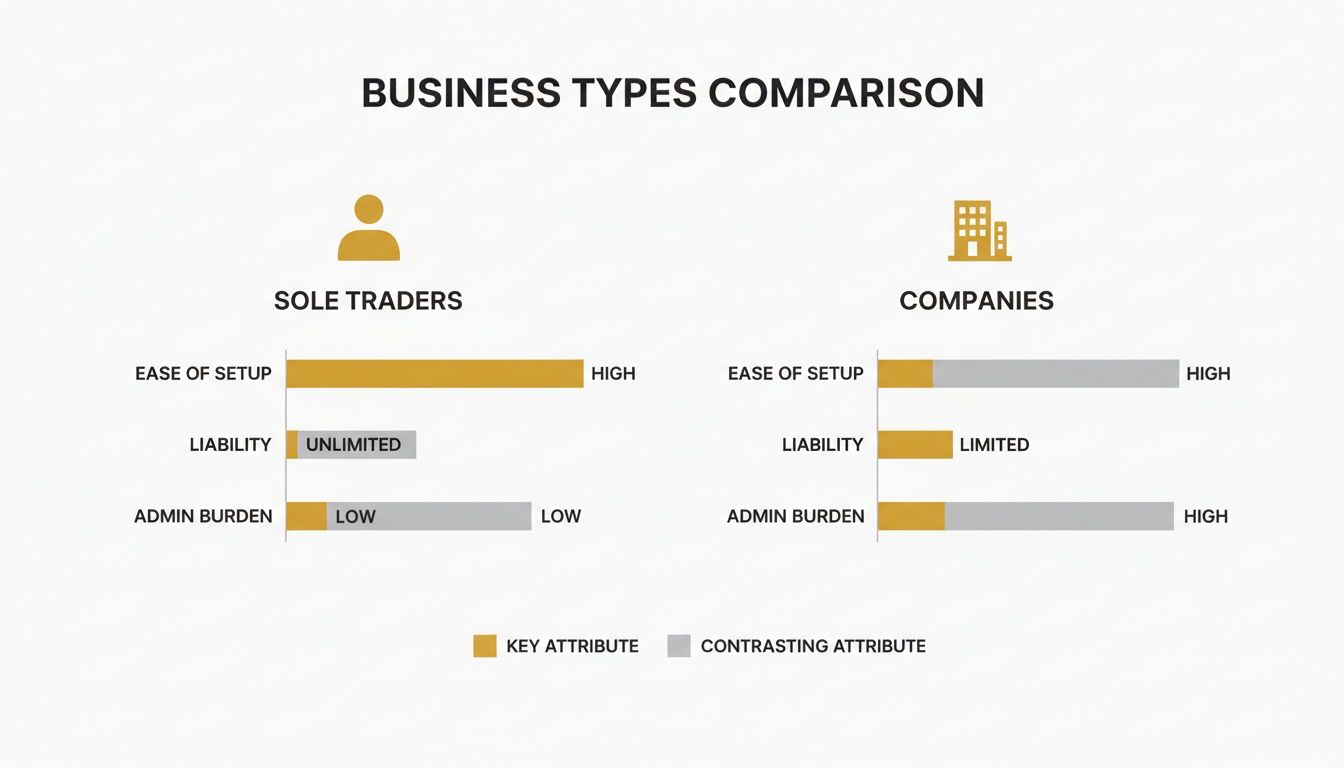
As you can see, it's a classic balancing act. The sole trader route offers simplicity but comes with high personal risk. A company provides that crucial legal protection but at the cost of more admin.
The core decision hinges on balancing immediate simplicity against long-term financial efficiency and legal protection. As your business grows, the tax benefits of a company structure often become too significant to ignore.
In Australia, where a massive 67% of businesses are sole traders, the tax pain kicks in quickly as you become more successful. Under the 2023-24 ATO rates, a sole trader pulling in $180,000 in profit pays an effective tax rate of around 40%. A company with the same profit (as a base rate entity) is taxed at a flat 25%. That's a huge difference that highlights a powerful path for scaling your operations.
When you're trying to make this call, a solid guide on how to choose your business structure can be invaluable, especially when you start weighing up these significant tax implications.
How Tax Rates And Profit Treatment Differ
The biggest financial question when comparing a sole trader to a company comes down to one thing: how each dollar of profit gets taxed. This isn't just a small detail on a tax form; it's the core difference that could save—or cost—you thousands over the life of your business. The structure you choose directly dictates how much cash stays in your pocket and how much you can reinvest.
For a sole trader, the maths is simple. Your business profit is your personal income. It gets lumped in with any other income you earn and is taxed at your marginal personal income tax rate. As your business grows and your profits climb, you inevitably get pushed into higher tax brackets, meaning the ATO takes a bigger slice of every new dollar you make.
A company, however, is a completely separate legal and tax entity. It pays tax on its profits at a flat corporate rate, which for most small businesses in Australia is currently 25%. This separation is what creates a clear and often immediate tax advantage, especially for businesses that want to keep profits in the tank to fund future growth.

A Real-World Profit Scenario
Let's make this tangible. Imagine you're a skilled plumber in Sydney having a great year, clearing $80,000 in profit. As a sole trader, that entire $80,000 lands on your personal tax return. Once you account for the different tax brackets and the 2% Medicare levy, you'd be looking at a tax bill of roughly $18,447.
Now, let's see what happens if that same business is structured as a company. The $80,000 profit is first taxed at the flat 25% corporate rate, resulting in a $20,000 tax bill. The crucial part is what happens next. The company now holds the remaining $60,000. That money can be used to buy new equipment, hire staff, or invest in marketing—all without you personally paying any more tax on it until it's paid out to you as a wage or dividend.
Here's the key takeaway: As a sole trader, every dollar of profit is taxed at your personal rate, straight away. With a company, only the money you physically take out is taxed at your personal rate. Profits left inside the business are taxed at the lower, flat corporate rate.
Tax Liability At Different Income Levels
This difference in tax treatment becomes much more dramatic as your income rises. Because personal tax rates are progressive, a sole trader's tax burden accelerates far more quickly than a company's. For a closer look at how the brackets work, check out our detailed guide on Australian sole trader tax rates.
To really see the impact, let's run the numbers and compare the tax payable at different profit levels. This shows the potential savings a company offers if you plan on retaining profits in the business.
Tax Liability Comparison: Sole Trader vs Company
This table breaks down the tax payable for each structure, assuming all profits are kept within the business for the company scenario.
| Taxable Income | Sole Trader Tax Payable (incl. Medicare Levy) | Company Tax Payable (at 25%) | Potential Annual Tax Saving on Retained Profits |
|---|---|---|---|
| $80,000 | ~$18,447 | $20,000 | -$1,553 (Sole trader is slightly better) |
| $150,000 | ~$44,247 | $37,500 | $6,747 |
| $250,000 | ~$87,497 | $62,500 | $24,997 |
As you can see, the numbers tell a clear story. Once your taxable income climbs past the $90,000 mark, the company structure starts to pull ahead, delivering significant tax savings on any profits you want to reinvest. For any business owner focused on scaling up, this is a critical tipping point to be aware of.
Navigating Deductions And Business Expenses
On the surface, both sole traders and companies can claim deductions for legitimate business costs. But that’s where the similarities end. The real story behind the tax benefits of a company versus a sole trader emerges when you dig into the strategic planning opportunities a company structure unlocks.
Sure, both can deduct everyday expenses like rent, supplies, and marketing. However, the company’s status as a separate legal entity opens up powerful avenues for reducing taxable profit that a sole trader simply can't access.
When you're weighing up these structures, understanding how to properly claim everything you're entitled to is essential. For sole traders, knowing the full scope of available sole trader tax deductions can make a huge difference to your final tax bill, ensuring nothing gets missed.
The game changes with a company, though, as it introduces deductions that are completely off the table for a sole trader.
Strategic Deductions for Companies
A massive advantage for a proprietary limited company is its ability to pay its owners (who are also directors) a salary, superannuation, and even director's fees. These aren't just drawings; they are treated as legitimate business expenses.
This directly reduces the company's taxable profit before the 25% corporate tax rate is even applied.
For example, paying yourself a director's salary provides a steady personal income while simultaneously lowering the company's tax bill. On top of that, the compulsory superannuation contributions paid on that salary are also a deductible expense for the business. It’s a tax-efficient way to pull money out of the business while building your own retirement nest egg.
The ability to treat owner remuneration and superannuation as deductible business expenses is a fundamental tax benefit of the company structure. It allows you to strategically lower company profit while building personal wealth in a tax-effective manner.
Limitations for Sole Traders
Sole traders, on the other hand, run into a few walls that companies don't. The biggest one is the Personal Services Income (PSI) rules. If the ATO decides your income is mainly a reward for your personal skills or effort, your ability to claim certain deductions can be severely restricted. This can include things like payments to family members for non-principal work or even some superannuation contributions.
A company structure also naturally enforces better record-keeping. The formal separation between business and personal finances creates a much clearer paper trail. This not only makes tax time simpler but also significantly lowers your risk profile if the ATO ever comes knocking for an audit, making it a much safer vehicle for growth.
Comparing Asset Protection And Legal Liability
While the tax benefits are a massive part of the sole trader vs company debate, we can't stop there. For a lot of business owners I speak to, this next point is actually more important than saving a few dollars on tax. It's about personal liability, and it hits right at your financial security and peace of mind, especially as your business starts to grow and take on bigger risks.
As a sole trader, the law sees absolutely no difference between you and your business. You are one and the same. This means if your business gets into financial strife or someone decides to sue you, your personal assets are fair game. We're talking about your family home, your car, your savings – it's all on the line to settle business debts.
This complete lack of separation is hands down the single biggest risk of being a sole trader. If you're in an industry with a higher chance of things going wrong, like construction or professional consulting, this unlimited liability can be a constant source of stress.

The Company's Corporate Veil
Now, flip the coin. A company is a separate legal entity. This isn't just fancy legal talk; it creates a genuine barrier, often called the 'corporate veil', that stands between the business's finances and your personal finances. It's one of the most powerful reasons to incorporate, completely separate from any tax advantages.
What this legal wall means is that if the company racks up debt or gets sued, the liability is generally capped at the assets the company itself owns. Creditors can go after the business bank account or its equipment, but your personal assets are safely tucked away on the other side of that veil.
The corporate veil is your personal financial shield. It means a business failure doesn't have to become a personal financial catastrophe, giving you the confidence to take calculated risks and grow your venture.
A Practical Liability Scenario
Let's make this real. Imagine a business lawsuit goes badly and results in a $100,000 liability.
- Sole Trader Outcome: The business only has $30,000 in assets. The creditors can, and will, legally come after the owner for the remaining $70,000. This could mean being forced to sell your car or even having a lien slapped on your family home.
- Company Director Outcome: The company has the same $30,000 in assets. The creditors can only claim that $30,000. The director's personal assets are protected. Assuming they've acted lawfully, they are not personally on the hook for the $70,000 shortfall.
This stark difference shows exactly why asset protection is a critical piece of the sole trader vs company tax benefits conversation. The legal shield a company provides is often invaluable, laying a much safer foundation for long-term, sustainable growth.
Understanding Compliance Costs And Administration
Beyond the tax rates themselves, the day-to-day admin is a huge factor that hits your two most valuable resources: your time and your money. For many new ventures, the sheer simplicity of being a sole trader is its biggest selling point. The setup is dead simple—often just an Australian Business Number (ABN)—and the ongoing compliance is just as straightforward, usually just rolling everything into your personal tax return.
A company, on the other hand, is a completely different beast when it comes to admin. Getting started means a formal registration with the Australian Securities and Investments Commission (ASIC), which has its own upfront costs. And that’s really just the first step on a much more demanding compliance journey.
The Ongoing Demands Of A Company
Running a company means committing to a whole host of ongoing regulatory requirements. These aren't just 'nice-to-haves'; they're legal obligations, and ignoring them comes with hefty penalties. The administrative price tag you pay for the tax and liability benefits is significantly higher.
Here’s a taste of the key ongoing obligations you’re signing up for:
- Annual ASIC Review: Every year, you have to pay an annual review fee just to keep your company registered.
- Separate Tax Returns: You’ll need to prepare and lodge a separate, more complex company tax return each year. We break this down in our guide on how to lodge a company tax return.
- Stricter Record-Keeping: Corporate law demands that you keep meticulous financial records. This isn't just about receipts; it includes formal minutes of meetings and resolutions from the director.
All this extra work almost always translates into higher fees from your accountant. For instance, companies have to deal with ASIC reporting, which includes annual fees of $311, and you can expect accounting costs to be two or three times higher than for a sole trader. Despite these costs, the ATO still sees around 83% compliance among small businesses, which tells you that for many, the trade-off is worth it. You can find out more by reading this in-depth analysis of the company structure vs sole trader costs.
It all boils down to a fundamental trade-off: Do the potential tax savings and asset protection a company offers actually outweigh the extra costs and administrative headaches? This is exactly where getting professional advice is non-negotiable for making a smart financial decision.
Ultimately, the right choice really depends on the scale of your business, your risk profile, and where you see it going. A sole trader structure is perfect for low-risk, simple operations where keeping costs and complexity down is the number one priority. A company is built for businesses with big growth plans, those who need to protect their personal assets, and are ready to take on the administrative load that comes with it.
Making The Right Choice: When To Switch To a Company
Deciding when to jump from a sole trader to a company structure isn't just about tax; it’s a strategic pivot for your business's future. The beautiful simplicity of being a sole trader is perfect for getting off the ground, but there are clear signals that it’s time to evolve.
Ignoring these signs can mean handing over unnecessary tax to the ATO, putting your personal assets on the line, and artificially capping your growth potential.
This isn’t about hitting a single magic number. It's about a combination of factors reaching a tipping point. The key is spotting these triggers before they become problems, ensuring your business structure is a springboard for your long-term goals, not an anchor holding you back.

Key Triggers for Incorporation
Thinking about making the switch? Keep an eye out for these classic scenarios. If one or more of these sounds familiar, it’s a strong sign that a company structure is the next logical move.
Your Income Is Hitting Higher Tax Brackets: Once your taxable income as a sole trader consistently pushes past the $120,000 mark, your personal marginal tax rate starts to seriously outpace the flat 25% corporate rate. This is the most common financial trigger we see.
You Need to Protect Your Personal Assets: As your business grows, so does its risk profile. If you've built up personal wealth—like a family home or an investment portfolio—the unlimited liability of a sole trader structure becomes a huge, unacceptable risk. A company creates a legal firewall.
You Want to Reinvest Profits Into the Business: A company is a far more tax-efficient vehicle for growth. It lets you keep post-tax profits (taxed at just 25%) in the business to fund expansion, buy assets, or hire staff, without that money first being hit at your higher personal tax rate.
The decision to incorporate is fundamentally a forward-looking one. It’s about building a foundation that can handle increased profit, greater risk, and future complexity, turning your successful operation into a scalable and protected enterprise.
- You're Bringing on Partners or Investors: If the plan is to bring other people into the business, a company structure is non-negotiable. It provides a clean, clear framework for issuing shares, defining ownership, and managing control in a way a sole trader setup simply can't.
Recognising these triggers is the first step; the next is taking action. If you're ready to look into this more deeply, our guide on how to set up a PTY LTD company in Australia lays out a clear roadmap for the incorporation process. Making this change at the right time is absolutely crucial for locking in the best possible financial outcomes.
Your Questions Answered
When you're weighing up the sole trader vs company structure, a lot of specific questions pop up. Let's tackle some of the most common ones we hear from clients every day.
How Do I Pay Myself from a Company?
This is a fundamental shift from being a sole trader. As a sole trader, you just take 'drawings' from the business profits whenever you like. Simple.
When you're a director of a company, it’s more formal. You pay yourself a proper salary or wage, just like any other employee. This payment becomes a deductible business expense for the company, which helps lower its taxable profit.
The catch is that this brings you into the formal payroll system. You'll need to manage Pay As You Go (PAYG) withholding and meet your superannuation guarantee obligations. Your salary is then taxed at your individual marginal rate, completely separate from the company's tax affairs.
How Does Capital Gains Tax Differ?
The way Capital Gains Tax (CGT) is handled really highlights the structural divide between these two setups.
If a sole trader sells a business asset and makes a profit, that capital gain just gets added to their personal income for the year. The good news is they can often access the 50% CGT discount if they've owned the asset for more than 12 months, effectively halving the tax impact.
A company, on the other hand, gets no such discount. The entire capital gain is taxed at the flat corporate rate. It’s not all bad news, though. Companies can often access a different set of small business CGT concessions which can sometimes reduce or even wipe out the tax bill. It's a complex area, but potentially very rewarding.
The loss of the 50% CGT discount is a major sticking point for companies. However, the other small business CGT concessions available can sometimes lead to a better outcome. This is definitely not a DIY calculation—getting professional advice is essential when selling significant assets.
Is It Hard to Switch from a Sole Trader to a Company?
Making the jump isn't just paperwork; it’s a formal process with real financial implications. The transition involves registering a new company with ASIC and then officially transferring all your business assets—think equipment, client lists, and goodwill—from your name over to the new company entity.
Here's the critical part: that transfer can trigger tax events. Moving assets can crystallise a capital gain (and a CGT bill) or even attract stamp duty in some states.
Because of this, you absolutely need to get professional guidance. A good accountant can help you structure the transition in the most tax-effective way, ensuring you don't get hit with unexpected financial penalties during the changeover.
The four main structures are sole trader, partnership, company, and trust. A sole trader is simplest and cheapest but offers no liability protection. A company provides limited liability at a flat tax rate but costs more to run. A trust offers tax flexibility and asset protection but is complex to administer. The right choice depends on income, risk profile, and growth plans.
Base rate entities — companies with aggregated turnover under $50 million that derive no more than 80% of income from passive sources — pay 25%. All other companies pay 30%. Shareholders pay income tax on dividends, potentially offset by franking credits for tax already paid at the corporate level.
Consider a company when business net profit consistently exceeds $100,000–$120,000 and the rate differential generates meaningful savings, when you need liability protection from business creditors, when you plan to bring in investors, or when you want to retain earnings at the lower corporate rate rather than distributing everything as personal income.
A family trust (discretionary trust) holds assets for a class of beneficiaries. The trustee decides each year how much income to distribute to each beneficiary. By directing income to members in lower tax brackets, the trust reduces the overall family tax burden. Income retained in the trust is taxed at the highest marginal rate (47%).
Ongoing costs include the ASIC annual review fee (currently $310 for a proprietary company), company tax return lodgement fees, accounting fees for financial statements, and potentially payroll and BAS compliance. Total annual compliance costs typically range from $2,000 to $8,000 depending on activity levels and complexity.
- Decoding the Company Tax Return Form
- Choosing Your Lodgement Path: DIY or Tax Agent
- Avoiding Common and Costly Tax Return Mistakes
- What to Do After You Have Lodged Your Return
- Your Top Company Tax Return Questions, Answered
How to Lodge Company Tax Return A Guide for Australian Businesses
Lodging your company tax return isn't a single action, but a three-part process: you gather your records, get the numbers right on the form, and then submit it to the ATO. It sounds simple, but the real work happens before you even log into any online portal.
Getting the preparation right is everything. Having your financial statements ready and reconciled from the get-go is the difference between a smooth lodgement and a stressful one.
Gathering Your Financials for a Smooth Lodgement
Before touching the company tax return form itself, you need to get your financial records in order. This isn't just about ticking off a list; it's about building a bulletproof foundation for your return. I’ve seen it time and again—business owners who rush this stage end up with missed deductions or incorrectly reported income, creating major headaches down the track.
Key Documents and Why They Matter
Think of your financial documents as the evidence that backs up every single number on your tax return. Without them, you're just guessing.
Let's break down the non-negotiables.
Your Pre-Lodgement Document Checklist
This table summarises the core documents you'll need to pull together. Think of these as the absolute minimum for a compliant and accurate tax return.
| Document Type | What It Shows | Why It's Critical |
|---|---|---|
| Profit and Loss (P&L) Statement | A complete story of your company's income and expenses over the financial year. | This is the engine of your tax return, determining your taxable income. Every dollar must be accounted for. |
| Balance Sheet | A snapshot of your company’s assets, liabilities, and equity at year-end. | The ATO uses this to check the financial health and structure of your company. It must reconcile perfectly. |
| Bank Reconciliations | Proof that your accounting software transactions match your business bank statements exactly. | This confirms no income has been missed or expenses duplicated—a common area for ATO audits. |
Having these three reports finalised and double-checked is your green light to start the lodgement process. It ensures the numbers you're about to enter are solid.
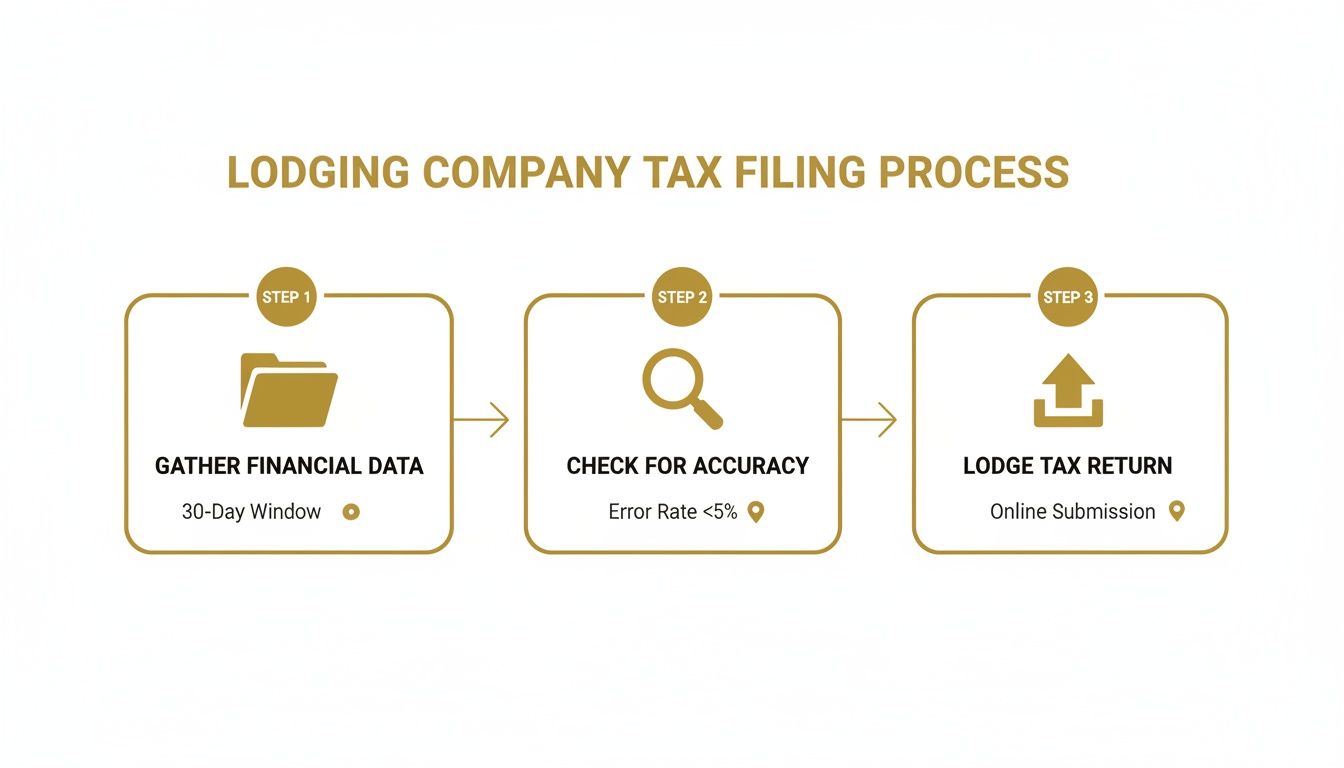
As you can see, the "Gather" phase is the foundation. Nail this, and the rest of the process becomes much, much easier.
A Common Pitfall to Avoid
I recently worked with a small retail business owner who nearly missed out on thousands in legitimate deductions. She was fantastic at recording her major supplier invoices but had a literal shoebox full of receipts for smaller items—stationery, client coffees, minor store repairs. On top of that, a loan she’d made to the company wasn't properly documented, blurring the lines between personal and business funds.
This scenario is incredibly common. Those small, disorganised expenses add up to significant deductions. And getting director loans wrong is a huge red flag for the ATO. Proper documentation is crucial for compliance.
A big piece of this puzzle is mastering revenue recognition principles, which ensures the income on your P&L statement is reported in the correct period.
For a complete rundown of everything you’ll need, grab our comprehensive https://awts.net.au/business-tax-checklist/. Taking the time to organise your records now is your best insurance policy against future ATO questions.
Decoding the Company Tax Return Form
Let's be honest, opening the official Company Tax Return form for the first time can feel like trying to decipher a secret code. It’s dense, littered with jargon, and seems almost designed to be confusing. But don't let it intimidate you.
At its core, the form is just a structured way for you to tell the ATO your company's financial story for the year. The trick is to stop seeing it as one giant, impossible puzzle and start viewing it as a series of smaller, more manageable questions about your business. Each section simply asks for a specific piece of your financial history—from what you earned to what you spent.

Reporting Your Company Income
The first major section you'll tackle is all about the money your company brought in. This isn’t just your primary sales revenue; the ATO needs a complete picture of your assessable income.
You'll find that the form asks you to report different types of income in specific sections. For instance, a small consulting company's income might be broken down like this:
- Gross professional fees: The total amount you've billed clients for your services.
- Interest income: Any interest earned from your business bank accounts or term deposits.
- Capital gains: Profit made from selling a significant asset, like an office space or even company shares.
Each of these needs to be correctly categorised. A common mistake we see is people lumping everything into a single "sales" figure, which can lead to miscalculations and attract unwanted attention from the ATO.
Demystifying Business Deductions
Once you've laid out your income, it's time to claim your deductions. This is where you get to subtract your legitimate business expenses from your income to figure out your actual profit. Think of it as telling the ATO, "We earned this much, but it cost us this much to do it."
The golden rule for deductions is simple: the expense must be directly related to earning your assessable income. And you absolutely must have a record, like a receipt or invoice, to prove it.
Some of the most common deductions businesses claim include:
- Operating Costs: Everyday expenses like office rent, utility bills, and supplier invoices.
- Employee Salaries: All the wages, superannuation contributions, and other benefits you pay your staff.
- Asset Depreciation: The decline in value of business assets worth over $300, such as computers, vehicles, or machinery. You don't claim the full cost upfront; instead, you claim a portion of it over several years.
Getting these deductions right is absolutely critical for an accurate return. It’s the difference between paying the correct amount of tax and needlessly overpaying.
Calculating Your Taxable Income
After you’ve listed all your income and subtracted all your legitimate deductions, you arrive at your company's taxable income. This is the final profit figure that the ATO will apply tax to.
The calculation itself is straightforward:
Total Assessable Income - Total Deductions = Taxable Income
With this number, you then apply the correct company tax rate. While the standard rate is 30%, many small and medium businesses actually qualify for a lower rate of 25%. To be eligible, your company needs an aggregated turnover under AUD 50 million and less than 80% of its assessable income can come from passive sources (like rent or interest).
This is a key incentive, particularly for clients of firms like AWTS who might be dealing with overdue returns or BAS preparations. For a deeper dive, you can find more insights on corporate tax rates in Australia from PwC.
Knowing which rate applies to your business is the final piece of the puzzle. It transforms all your financial data into a clear tax obligation, completing the main part of lodging your company tax return.
Choosing Your Lodgement Path: DIY or Tax Agent
Alright, you've got your financials sorted and you've wrestled with the company tax return form. Now you’ve hit a fork in the road. Do you tackle the ATO’s online services yourself, or do you bring in a registered tax agent?
This isn’t a small decision. It directly affects your deadlines, your stress levels, and your chances of making a costly error.
The DIY route always looks tempting at first glance. The biggest draw is saving money on professional fees, no doubt about it. You get to keep total control of the process from start to finish. If your company's finances are dead simple—maybe just a handful of transactions and no complicated investments—then going it alone can be a perfectly reasonable choice.
But be warned, flying solo has its risks. The most immediate one is the deadline. If you’re lodging yourself, the ATO expects your company return much earlier than if you use an agent. More importantly, the odds of making an honest mistake shoot way up. A simple mix-up with a deduction rule or one wrong calculation can put you on the ATO’s radar and lead to penalties down the line.
The Case for Using a Tax Agent
This is where you see the real value of bringing in a professional. A registered tax agent is much more than a form-filler; they're your expert guide and a critical safety net. They live and breathe Australian tax law, making sure you claim every single deduction you're entitled to while keeping everything above board.
One of the biggest perks is getting access to extended lodgement deadlines. That extra time can be a lifesaver for busy business owners who are already juggling a dozen other things.
Beyond the extra time, the real benefit of an agent is confidence. Having an expert look over your figures, ask the tough questions, and sign off on the return gives you a peace of mind that’s hard to put a price on.
The official numbers back this up. The ATO’s latest tax time statistics show just how many people rely on professional help, especially when things get complicated with capital gains or overdue returns. You can dive into the full tax time lodgement statistics from the ATO to see the trends for yourself.
Of course, choosing an agent means handing over sensitive financial data. It's smart to ask about their security protocols, like whether they use a professional cloud backup for accountants to keep your information safe. To get a better feel for what an agent can bring to the table, check out our breakdown of the key benefits of using a tax agent in Australia.
Avoiding Common and Costly Tax Return Mistakes
Even the most organised business owners can get tripped up by common tax traps. Getting your company tax return wrong can be a painful lesson, costing you not just in ATO penalties but also in the time and stress it takes to unravel the mess.
The good news? Most of these errors are entirely avoidable once you know what to look for.
One of the first things the ATO’s systems flag is a mismatch in your GST reporting. The total GST you’ve collected and paid on your Business Activity Statements (BAS) throughout the year must line up perfectly with the figures you report in your annual income tax return. Any discrepancy, no matter how small, is a clear signal that something’s not right with your books.
Another huge red flag is blurring the lines between business and personal expenses. It’s so easy to claim a chunk of your home internet or mobile phone bill, but you absolutely must have clear, justifiable records that prove the business-use percentage. Claiming 100% of a personal mobile bill as a business expense is a classic mistake the ATO’s systems are specifically designed to catch.
Poor Records and Unsubstantiated Claims
At the end of the day, flimsy record-keeping is the root cause of most tax return headaches. Without the right receipts, invoices, and logbooks, your claims are just numbers on a form with zero evidence to back them up. This gets particularly dicey when you’re dealing with more complex areas of tax law.
A classic example I see with new or struggling businesses is misunderstanding the non-commercial loss rules. If your company has a side hustle or an activity that consistently loses money, you generally can't just offset that loss against your other income unless you meet some very specific tests. Getting this wrong can quickly lead to a detailed ATO review.
Navigating these complexities is precisely why so many business owners bring in an expert. The ATO consistently spotlights issues like income omissions, GST errors, and non-commercial losses as key audit triggers for small businesses.
Timely, accurate lodgement is your best line of defence. For small businesses, the ATO's 2025 focus areas are crystal clear on these red flags. With audit activity on the rise, penalties for shortfalls can be severe—sometimes reaching up to 75% of the tax you owe, plus interest. You can read more about corporate tax obligations from PwC.
To sidestep these issues, you need to get meticulous with your finances:
- Reconcile regularly. Don't leave your BAS vs. annual return reconciliation until the last minute. Get into the habit of checking it every quarter.
- Keep finances separate. A dedicated business bank account and credit card are non-negotiable. This keeps a clean separation between your personal and business spending.
- Document everything. Keep detailed logbooks for any vehicle use and write down your reasoning for splitting costs like your internet and phone bills.
By learning from these common missteps, you can lodge a clean, accurate return with confidence—one that won’t attract any unwanted attention.
What to Do After You Have Lodged Your Return
Hitting ‘lodge’ on your company tax return feels like the finish line, but it’s really just the start of the final lap. What you do next is critical for staying on the right side of the Australian Taxation Office (ATO). The first thing you'll be waiting for is your Notice of Assessment (NOA).
This is the ATO’s official verdict on your return. It’s their calculation of your tax position, and it will clearly state whether you have a tax bill to pay, a refund coming your way, or if everything is square. You absolutely must check this document thoroughly the moment it arrives.
Reading Your Notice of Assessment
Don't just file it away. Pull out your own records—or the final figures from your tax agent—and compare them line by line with the NOA. Does the taxable income match? Is the tax payable what you expected?
If there’s a discrepancy, you need to find out why, fast. The ATO sometimes makes adjustments based on data they hold, and you need to understand the reason. For a deeper dive, you can learn more about how to get your notice of assessment and what it all means.
If the NOA shows a tax liability, it will have a non-negotiable due date. Miss it, and the ATO will start adding interest charges and potential penalties, so make sure you pay on time.
After lodging, your focus must shift from preparation to verification and record-keeping. The NOA is your first checkpoint, and retaining your financial records for a minimum of five years is your ongoing legal obligation.
Maintaining Your Records and Ongoing Compliance
Even after you've settled any tax bill, you’re not quite done. The law is clear: companies must keep all financial records related to their tax return for at least five years from the date they lodged it. This isn’t optional. We're talking everything from receipts and invoices to bank statements and asset registers.
Think of this five-year rule as your safety net. If the ATO ever comes knocking for an audit or a review, solid, organised records are your best and only defence.
Beyond record-keeping, remember that your company tax return is just one piece of a much larger compliance puzzle. You still need to stay on top of your other obligations, like lodging your Business Activity Statements (BAS) on time and paying employee superannuation. These things all contribute to your overall relationship with the ATO.
Economic shifts can also play a part. Recent ABS government finance statistics revealed that company income tax totalled $143.3 billion for 2024-25, a slight dip influenced by market fluctuations. It’s a good reminder that the business landscape is always changing. You can explore more government finance statistics on the ABS website.
Your Top Company Tax Return Questions, Answered
Lodging a company tax return always seems to bring up a few last-minute questions. It's perfectly normal. Dealing with the Australian Taxation Office (ATO) can feel complex, and you want to get it right.
Let's run through some of the most common queries we hear from business owners every single tax season. Getting these straight can save you from simple mistakes that might cause delays or, worse, flag your return for a closer look.
How Long Does a Company Tax Return Take to Process?
This is, without a doubt, the question we get asked most. You’ve done the work, you’ve lodged the return, and now you just want to know where you stand.
For most online lodgements, the ATO aims to process company tax returns within 14 business days. But think of that as a guideline, not a guarantee. A few things can easily stretch out that timeline.
- Manual Reviews: If your return includes unusually large deductions, complex asset write-offs, or anything out of the ordinary for your business, the ATO might pull it aside for a manual review. This is just them doing their due diligence.
- Outstanding Debts: Have an existing debt with the ATO or another government agency? The process will take longer while they sort out the accounts and determine your final position.
- Multiple Lodgements: Trying to catch up by filing a few years' worth of returns all at once can create a logjam in the system and lead to delays.
And if you're lodging by paper? Be prepared for a much longer wait—up to 50 business days. It’s a powerful argument for lodging electronically, either through ATO online services or with a tax agent.
What Happens if I Miss the Lodgement Deadline?
Life happens, and sometimes deadlines get missed. The key is not to bury your head in the sand. The ATO is far more reasonable when you're upfront about the situation.
Ignoring the deadline can lead to financial penalties and interest charges stacking up. The initial penalty for failing to lodge on time is just the start; it can increase for every 28-day period your return remains overdue, up to a maximum of five periods. On top of that, the General Interest Charge (GIC) will start ticking on any unpaid tax from the original due date.
If you know you're going to miss the deadline, the absolute best thing you can do is contact the ATO or your tax agent immediately. It’s often possible to get a deferral or set up a payment plan, which looks infinitely better on your record than radio silence.
Can I Amend a Return After I Have Lodged It?
Yes, you can. It’s more common than you think. You might unearth a folder of receipts for deductions you forgot to claim or realise you keyed in an income figure incorrectly after hitting 'submit'.
You can amend your company tax return, but there's a time limit. Generally, you have a two-year window from the date your Notice of Assessment was issued to make changes.
The simplest way to file an amendment is through the same channel you used to lodge originally—either via ATO online services or by asking your tax agent to handle it for you. Once you submit the amendment, the ATO will process it and send you an amended Notice of Assessment, showing any change to your tax bill or refund. Just be aware that lodging an amendment will reset that processing clock.
Navigating your company's tax obligations can be a minefield, but you don't have to walk it alone. The team at Australia Wide Tax Solutions is here to make sure your lodgement is accurate, on time, and structured to get you the best possible outcome. Let our experts handle the ATO, so you can get back to what you do best. https://www.awts.net.au
The ATO provides guidance through ato.gov.au, the Small Business Support Line (13 28 66), and Online Services for individuals and businesses. For complex situations, a registered tax agent provides advice tailored to your specific circumstances and professional indemnity protection. You can verify agent registration at the TPB register at tpb.gov.au.
Most tax records must be kept for five years from the date of lodgement or the date the transaction occurred, whichever is later. Records must be in English or convertible to English and must be sufficient to explain the income and deductions in your return. The ATO can request records at any time during the retention period.
Consider a registered tax agent when your affairs involve multiple income sources, business activity, investment properties, capital gains, or overseas income. Agents extend your lodgement deadline, provide safe harbour protection, and take professional responsibility for the advice given. Verify registration at tpb.gov.au.
The failure to lodge penalty is based on penalty units ($313 per unit from 1 July 2023), accruing per 28-day period for late returns and BAS lodgements. Incorrect information penalties range from 25% to 75% of the tax shortfall depending on whether the behaviour was careless, reckless, or intentional. Proactive disclosure before an audit begins typically results in significantly reduced penalties.
Tax minimisation is the legal arrangement of your affairs to reduce tax — claiming all eligible deductions, using appropriate structures, and timing income and expenses. Tax avoidance involves arrangements that technically comply with the law but achieve outcomes parliament did not intend. The ATO can apply Part IVA anti-avoidance rules to cancel benefits from avoidance arrangements.
Sole Trader vs Company: An At-a-Glance Comparison
Picking the right business structure is one of the first, and most important, decisions you'll make as an entrepreneur in Australia. It sets the foundation for your personal risk, tax obligations, and ongoing compliance workload. To really get this, it helps to understand the definition of a sole proprietorship as the most basic business form. The sole trader structure is hands-down the simplest and cheapest way to get started. All you really need is an Australian Business Number (ABN), and from a tax perspective, the business’s income is simply your personal income. While that simplicity is a huge drawcard, it comes with a major catch: unlimited liability. There's no legal wall between you and the business. If the business racks up debt, your personal assets—your house, your car—could be on the line. On the other hand, a company, specifically a Proprietary Limited (Pty Ltd) company, offers the protection of limited liability. This creates a crucial barrier between your personal finances and the business's debts, because the company is legally its own 'person'. Of course, this protection doesn't come for free. It involves higher setup costs, stricter rules, and much more complex annual reporting duties. This visual breaks down the core differences in liability, tax, and setup complexity.
Key Differences: Sole Trader vs Company at a Glance
This table cuts straight to the chase, comparing the key features of each structure.| Feature | Sole Trader | Company (Pty Ltd) |
|---|---|---|
| Legal Status | You and the business are the same legal entity. | A separate legal entity from its owners (shareholders). |
| Liability | Unlimited personal liability for all business debts. | Limited liability; personal assets are usually safe. |
| Tax Rate | Taxed at your individual marginal income tax rates. | Taxed at the flat corporate tax rate (25% or 30%). |
| Setup Cost & Complexity | Simple and cheap—often just an ABN registration. | More complex and costly; requires ASIC registration. |
| Ongoing Compliance | Much simpler; report income on your personal tax return. | More complex; needs annual reviews & separate tax returns. |
Understanding Your Legal and Financial Risk

The Protective Shield of a Company
In stark contrast, a registered company is its own separate legal entity. This isn't just a bit of paperwork; it creates a powerful protective barrier known as limited liability, and it fundamentally changes your entire risk profile. Because the company is legally distinct from its owners (the shareholders), any business debts or legal dramas are the company's problem, not yours. Your personal assets are generally shielded, safe from being used to pay for business liabilities. This separation is the single biggest reason why entrepreneurs in higher-risk industries like construction or consulting almost always opt for a company structure from day one.Key Insight: Limited liability isn’t just about protecting what you have now. It’s about building a safe foundation for future growth. It gives you the confidence to take calculated business risks, like hiring staff or taking out a loan, without gambling with your family’s financial security.
Liability in Real-World Scenarios
To see how this plays out in practice, let’s imagine a landscaping business that accidentally causes major property damage.- As a Sole Trader: The owner is personally sued. If the business insurance doesn’t cover the full cost of the damages awarded by the court, the owner’s home and personal savings could be liquidated to pay off the rest.
- As a Company: The company itself gets sued. The liability is capped at the company's assets. The owner’s personal home, car, and savings remain completely protected from the lawsuit, assuming no fraudulent activity or personal guarantees were involved.
Navigating Tax and Financial Compliance

How Companies Approach Taxation
A company, on the other hand, is a completely separate legal entity, and its tax treatment is entirely different. The company's profit is taxed at a fixed corporate tax rate—currently 25% for small businesses that meet the criteria, or 30% for all other companies. This flat rate can be a game-changer once your business profits start pushing you into the higher personal income tax brackets. But you can't just take money out of the business account whenever you like. You need to pay yourself formally, either as a director's salary (with PAYG withholding) or by distributing profits to shareholders as dividends.Key Takeaway: The tax structure difference is fundamental. A sole trader's profit is taxed at escalating personal rates, while a company's profit is taxed at a flat corporate rate. This creates strategic opportunities for tax planning in a company structure that simply don't exist for a sole trader.
Compliance and Reporting Obligations
The simplicity of the sole trader structure carries through to its ongoing compliance. While you still need to keep good financial records and may have to lodge Business Activity Statements (BAS) if you're registered for GST, the overall administrative load is pretty light. Your main job is lodging that annual personal tax return. In stark contrast, running a company brings a much heavier burden of financial and legal compliance.- Annual Company Tax Return: You are legally required to prepare and lodge a separate, detailed tax return just for the company.
- ASIC Annual Review: Every single year, you must review and confirm your company's details with the Australian Securities and Investments Commission (ASIC) and pay the annual review fee.
- Director Duties: As a company director, you have strict legal duties under the Corporations Act 2001 to always act in the best interests of the company. These aren't just suggestions; they're legally enforceable.
- Strict Record-Keeping: Both the ATO and ASIC demand a higher standard of record-keeping for companies, including maintaining proper financial statements and company registers.
Comparing Setup Costs and Ongoing Administration
When you're starting out, every dollar and every minute counts. The initial setup costs and the long-term admin load are two of the most practical differences between a sole trader and a company. This isn’t just about paperwork; it directly hits your wallet and your schedule. Registering as a sole trader is as straightforward as it gets. The main step is getting an Australian Business Number (ABN), which is completely free. For many, this simple online application is all it takes to start trading. It’s hands down the fastest and cheapest way to get your business off the ground. Setting up a company, on the other hand, is a much bigger deal, both in terms of effort and cost. You have to formally register with the Australian Securities and Investments Commission (ASIC), which comes with a significant one-off fee. As of 2024, you’re looking at over $500 just for the registration – a stark contrast to the zero cost of an ABN.The Initial Setup Hurdle for Companies
It’s not just the money; it’s the administrative legwork. You need to officially choose a company name, appoint directors, issue shares to owners, and set up a registered office address. This isn't just a to-do list; it's the formal governance structure of your business, and it needs to be right from day one. If you're going down this path, our detailed guide on how to set up a Pty Ltd company in Australia is a must-read.Weighing Ongoing Administrative Burdens
Once you're up and running, the day-to-day admin requirements couldn't be more different. For sole traders, the main ongoing task is lodging your annual personal tax return, where you simply include your business income and expenses. The record-keeping is simpler because it’s all tied to you personally. Companies, however, are in a different league. They have a heavy compliance load and are legally bound by the standards in the Corporations Act 2001. This brings a list of non-negotiable annual jobs that demand time, attention, and often, professional help. Key Annual Company Obligations:- ASIC Annual Review: Every year, you have to pay an annual review fee to ASIC (currently over $300) and formally confirm your company details are still correct.
- Separate Company Tax Return: A company must lodge its own, more complex tax return, completely separate from your personal finances.
- Formal Record-Keeping: Directors are legally required to maintain detailed financial records, keep minutes of important meetings, and manage a register of all members (shareholders).
This isn't just about extra paperwork. A company’s compliance is a serious legal responsibility. If you fail to meet your ASIC obligations, you can be hit with late fees and penalties personally as a director. It’s a whole other layer of accountability.For any business, but especially for trades and service-based companies, getting systems in place for efficient job and cost tracking from the start is essential to manage this burden. Ultimately, your choice has to match how much time and money you’re prepared to commit to ongoing admin.
Choosing the Right Structure for Your Goals
When a Sole Trader Structure Makes Sense
In many common scenarios, operating as a sole trader is simply the most logical and efficient way to go. This structure is all about simplicity, low costs, and minimal paperwork, making it ideal for testing out a business idea without a massive commitment. Think about these situations where being a sole trader is the clear winner:- Testing a New Business Idea: If you're launching a side hustle or trying out a new concept with very little capital, the sole trader setup lets you start trading almost instantly with just a free ABN.
- Freelancers and Consultants: For graphic designers, writers, IT consultants, and other independent professionals, this model is a natural fit. Your income is tied directly to your personal work, and the administrative simplicity means you can focus on clients instead of paperwork.
- Gig Economy Participants: Anyone earning income from platforms like Uber, Airtasker, or Deliveroo can easily manage their tax obligations as a sole trader.
When a Company Structure Is the Right Move
As your business grows, so do your risks and your needs. Moving to a company structure often becomes not just a good idea, but an essential step for businesses that are planning to scale, build credibility, and protect themselves. A company is the better path when your plans involve:- Hiring Employees: The moment you start taking on staff, the limited liability a company offers becomes critical. It shields your personal assets from things like workplace claims or other liabilities.
- Seeking Investment: Investors nearly always insist on a formal company structure. It makes selling shares straightforward and provides a clear, regulated framework for them to manage their investment.
- Operating in High-Risk Industries: For trades like construction or businesses that offer professional advice, the "corporate veil" is non-negotiable. It protects your personal wealth if the business runs into major debts or faces a lawsuit.
A company structure is a signal to the market—to clients, lenders, and investors—that you are building a serious, scalable, and enduring enterprise. It builds a level of credibility and trust that is often harder to achieve as a sole trader. This framework is designed for growth.
Answering Your Key Questions
Even after laying out the core differences, many entrepreneurs we talk to still have those nagging "what if" questions when deciding between a sole trader and company setup. It’s often these practical, real-world scenarios that make all the difference. This section tackles the most common queries we hear day in and day out. Think of this as the final piece of the puzzle, designed to give you the confidence to move forward by clearing up any lingering doubts about flexibility, growth, and long-term planning.Can I Change My Business Structure Later On?
Yes, absolutely. In fact, it’s one of the most common pathways for a successful Australian business. Starting out as a sole trader and then switching to a company structure as you grow is a well-trodden path. The process involves registering a new company with ASIC and then formally transferring the business assets, name, and ABN from your sole trader setup to the new company. It definitely requires some administrative work—and getting advice from an accountant is a smart move—but it's a standard procedure.Key Insight: Starting as a sole trader isn't a life sentence. It’s a flexible starting point that lets you test your business idea with minimal cost and paperwork before you take on the bigger responsibilities of running a company.This flexibility means you can pick the structure that fits you right now, without stressing that you're locked in forever. Your legal structure can—and should—scale up right alongside your business success.
Can a Sole Trader Hire Employees?
Yep, a sole trader can legally hire employees. You’ll need to get set up for Pay As You Go (PAYG) withholding with the ATO and make sure you’re meeting your superannuation obligations for any eligible staff. However, this is where the unlimited liability of a sole trader becomes a serious risk. The moment you have employees, you’re responsible for their safety at work and become exposed to potential issues like unfair dismissal claims or workplace accidents. Because there's no legal wall between you and the business, any liability from your role as an employer lands squarely on your personal shoulders. This is one of the biggest reasons many businesses incorporate before they even think about building a team. The company structure acts as a container, keeping that employment-related risk inside the business and away from your personal assets.Which Structure Is Better for Getting a Business Loan?
When it comes to securing serious business finance, a company structure is generally looked upon much more favourably by banks and lenders. There are a few very clear reasons why. Lenders see a company as a more formal, stable, and permanent entity. The strict reporting and governance rules give them a lot more confidence in the business's financial management and its chances of long-term survival. A company's status as a separate legal entity also creates a cleaner framework for securing loans. A lender can take security over the company's assets, which is far more straightforward than trying to untangle an individual's personal and business assets, which are all mixed together in a sole trader structure. While it's not impossible for a sole trader to get a big business loan, it’s often a much tougher conversation.Navigating these structural decisions is a critical step in setting up your business for success. For expert guidance tailored to your specific situation, the team at Australia Wide Tax Solutions can help you understand the tax and compliance implications of each choice, ensuring you start on the right foot.
The four main structures are sole trader, partnership, company, and trust. A sole trader is simplest and cheapest but offers no liability protection. A company provides limited liability at a flat tax rate but costs more to run. A trust offers tax flexibility and asset protection but is complex to administer. The right choice depends on income, risk profile, and growth plans.
Base rate entities — companies with aggregated turnover under $50 million that derive no more than 80% of income from passive sources — pay 25%. All other companies pay 30%. Shareholders pay income tax on dividends, potentially offset by franking credits for tax already paid at the corporate level.
Consider a company when business net profit consistently exceeds $100,000–$120,000 and the rate differential generates meaningful savings, when you need liability protection from business creditors, when you plan to bring in investors, or when you want to retain earnings at the lower corporate rate rather than distributing everything as personal income.
A family trust (discretionary trust) holds assets for a class of beneficiaries. The trustee decides each year how much income to distribute to each beneficiary. By directing income to members in lower tax brackets, the trust reduces the overall family tax burden. Income retained in the trust is taxed at the highest marginal rate (47%).
Ongoing costs include the ASIC annual review fee (currently $310 for a proprietary company), company tax return lodgement fees, accounting fees for financial statements, and potentially payroll and BAS compliance. Total annual compliance costs typically range from $2,000 to $8,000 depending on activity levels and complexity.
Quick Snapshot Of Dividend Tax Rates

Summary Of Dividend Tax Rates
| Investor Type | Dividend Type | Tax Rate | Withholding Tax Rate |
|---|---|---|---|
| Resident | Franked | Marginal rate | 0% |
| Resident | Unfranked | Marginal rate | 0% |
| Non-resident | Franked | N/A | 30% |
| Non-resident | Unfranked | N/A | 30% |
- Residents unlock a franking credit to cancel out company tax already paid.
- Unfranked dividends are simply taxed at your personal marginal rate.
- All dividends to non-residents incur a 30% withholding tax.
- Even franked payments to non-residents get taxed on their unfranked portion.
Key takeaway: Franking credits act like a voucher for company tax paid, preventing you from being taxed twice.Before we dive into worked examples, keep these figures front of mind as your quick reference.
Key Rate Highlights
To bring these numbers to life, consider a mid-income Australian resident on a 30% marginal rate. If they receive a $70 fully franked dividend (with a gross-up to $100), their franking credit wipes out any extra tax—leaving them square.- A fully franked dividend carries a 30% credit for company tax already paid.
- Unfranked dividends are added to your assessable income and taxed at your full marginal rate.
- Non-resident investors see 30% withheld before you even touch the cash.
- Double tax agreements can slice that withholding—depending on your home country.
Treaty example: A UK resident might only pay 15% under the Australia–UK Double Tax Agreement.Cross-checking your dividend statement with these highlights makes sure you never miss franking credits or spot under-withholding.
Next Steps
Now that you’ve got the big picture, grab your latest dividend statement and match it line-by-line. If anything feels murky, chat with an AWTS adviser for clear, expert guidance. This overview paves the way for the detailed sections ahead—where we’ll break down gross-up calculations, credit claims and non-resident treaty nuances. Bookmark this guide for your next tax return lodgement.Understanding Dividend Tax Concepts
Dividends are a way companies share profits with investors. It’s your return for owning a slice of the business. When you hold shares, you’ll often see a cash payment labelled a dividend. Sometimes these payments come with a tax offset, depending on how much company tax has already been paid. Imagine handing out sweets from a packet. Each share is like a ticket in the draw. The more tickets you hold, the more sweets you collect. Without a franking credit, it can feel like paying twice for the same treat.- Franked Dividends include a credit for company tax already paid.
- Unfranked Dividends have no tax offsets attached.
- Franking Credits can reduce or even eliminate extra tax bills.
Key Dividend Definition
A franked dividend brings with it a franking credit, matching the tax the company has already paid on that profit. This mechanism stops you from being taxed twice. By contrast, an unfranked dividend carries no credit. You pay tax on the full amount at your personal marginal rate.Franking credits act like coupons for tax already paid, offsetting what you owe at tax time.
How Imputation Works
Australia’s dividend imputation system hands company tax paid straight to shareholders as credits. Picture a company earning $100 in profit, paying $30 in tax, then distributing $70 cash plus a $30 credit. Key steps include:- Company earns profit and pays tax at 30%
- Company issues a dividend with an attached franking credit
- Shareholder reports the grossed-up dividend as income and claims the credit
Why System Matters
By preventing double taxation, the imputation system keeps more money in investors’ pockets. Without it, profits would be taxed at the corporate level and again on your personal return. It also makes Australian shares more appealing by aligning company and shareholder tax outcomes.| Feature | Before | After |
|---|---|---|
| Taxation | Double taxed | Single tax with credit |
- Lower overall tax on dividends
- Simpler reporting at lodgement time
- Better alignment between company profits and investor returns
Case Study
Anna holds 100 shares in XYZ Ltd. She receives an $80 fully franked dividend with a $34.29 credit. At her marginal rate of 34.5%, she owes no extra tax and even sees a small refund.Historical Shift Explained
On 1 July 1987, Australia reformed its dividend tax rules to stamp out double taxation. Before this change, shareholders paid personal income tax on dividends with no credit for company tax already paid. Learn more about the 1987 imputation reform on EndureGo.Key takeaway: Franking credits ensure you aren’t taxed twice on the same profit, supporting fairer and more efficient capital markets.Understanding these fundamentals sets you up to tackle resident versus non-resident dividend rules. Next, we’ll unpack how different tax rates apply depending on where you live.
Resident And Nonresident Dividend Tax Rates
Your residency status can make a huge difference to how dividends are taxed in Australia. If you’re an Australian resident, every dollar of dividend income slides into your marginal tax bracket. Non-residents, by contrast, face a fixed withholding rate on dividends. Each tax year, the ATO applies tests—domicile, physical presence and intention—to determine where you stand. It pays to review your situation annually so you’re not caught off-guard at lodgement time.Resident Rates For Dividends
For Aussie residents, franked dividends come with an attached franking credit representing the 30% company tax already paid. Think of it as a prepaid tax voucher. When you lodge your return, you offset that credit against your personal tax bill. Unfranked dividends, however, land straight into your taxable income and get hit at your marginal rate. If you sit in the 34.5% bracket, there’s no franking credit to soften the blow. Key Points:- Franked Dividends carry a credit equal to the 30% company tax.
- Unfranked Dividends have no credit and attract full personal tax.
- You claim franking credits on lodgement to reduce tax payable.
- If your marginal rate is below 30%, excess credits become a refund.
Nonresident Withholding Rules
Non-residents pay a flat 30% withholding tax on most dividends. But thanks to Australia’s network of double tax agreements, that rate can drop significantly.Under many double tax agreements, withholding rates can drop from 30% to between 0–15% depending on country.A simple example: a UK resident typically sees withholding fall to 15% under the Australia–UK treaty. You simply supply your foreign tax ID and the ATO applies the reduced rate at source.
Side By Side Rate Comparison
Let’s walk through a $100 dividend to see who keeps what:| Profile | Dividend Type | Gross Amount | Tax Outcome |
|---|---|---|---|
| Resident | Fully Franked | $100 | $0 net tax after credits |
| Resident | Unfranked | $100 | $34.50 at 34.5% rate |
| Non-Resident | Any Dividend | $100 | $30 withheld (30%) |
| UK Resident* | Any Dividend | $100 | $15 withheld (15% treaty) |
Tips To Optimise Your Position
Smart planning can trim your tax on dividends:- Confirm your residency each year against ATO guidelines.
- Keep dividend statements and franking credit certificates organised.
- Apply the correct withholding rate under relevant double tax agreements.
- Seek professional advice to ensure compliance and spot savings.
Residency Test Example
Meet Maria, who arrived in Brisbane from Singapore on July 1 and leased a flat for six months. She intended to stay long-term, so the ATO treated her as an Australian resident.- Her dividend portfolio was registered to her Aussie address.
- She provided an Australian bank account for all payouts.
- On her tax return, franking credits wiped out company tax entirely.
How Franking Credits Work
When an Australian company pays you a franked dividend, it’s like receiving a prepaid tax voucher. Because the company has already met its 30% tax obligation on profits, you pick up that tax as a franking credit attached to your dividend. Think of each credit as a $1 store voucher you can use to offset your own tax bill.- The company pays tax at 30% on its profits.
- The dividend is then grossed up by the amount of tax already paid.
- A matching franking credit attaches to your dividend payment.
- https://youtube.com/shorts/EJmk8hRFMy4?feature=share
Gross Up And Offset Example
Let’s break it down with numbers. You receive a $70 franked dividend, but it’s grossed up to $100 because of the attached $30 credit. On your tax return, you declare the full $100 as assessable income. Then you claim back the $30 franking credit to reduce your tax liability. Dividend imputation has made Australia a go-to market for yield hunters. By offsetting personal tax with franking credits valued at the 30% corporate rate, investors across brackets enjoy healthier after-tax payouts. A $70 franked dividend grossed to $100 with a $30 credit not only cushions your tax but fuels stronger dividend policies. Discover more about high-dividend strategies in Australia through this S&P Global research.
Tax Impact Across Brackets
How much you benefit depends on your marginal rate:| Marginal Rate | Dividend Grossed | Franking Credit | Tax Owing or Refund |
|---|---|---|---|
| 25% | $100 | $30 | $5 refund |
| 30% | $100 | $30 | $0 net tax |
| 45% | $100 | $30 | $15 owing |
“Franking credits are like prepaid tax vouchers that ensure you never pay tax twice.”Learn more about franking credits in our article on How Franking Credits Work
Common Misconceptions And Tips
- Misconception: Lower-rate taxpayers can’t get refunds. In fact, rates under 30% receive cash back.
- Misconception: Non-residents enjoy franking credits. They don’t—non-residents face withholding on unfranked portions.
- Tip: Check your dividend statement for the exact franking percentage.
- Tip: Lodge your return early to claim any refunds sooner.
How To Claim Your Credits
- Gather your dividend statements and note the franking details.
- Report the grossed-up dividend amount under your assessable income (Label 6).
- Enter the franking credits in the credits section of your tax return.
- Lodge online or via a tax agent before the deadline.
Practical Example For Investors
Sarah, a retiree on a 19% marginal rate, collects two fully franked dividends totalling $140. The grossed-up amount is $200 ($140 cash + $60 credit). Her tax on $200 at 19% is $38, but she holds $60 in credits—so she receives a $22 refund. Sarah also has unfranked dividends that flow straight into her assessable income. By blending franked and unfranked streams, she designs a diversified income plan with clear tax outcomes.Key Takeaway
Franking credits transform company tax into your own prepaid tax vouchers. Use the gross-up and credit steps to cut your liability or secure refunds—and boost the net return on your dividend income. Start planning today.Calculation Examples For Dividend Tax
Turning ideas into action is the best way to truly get dividend tax. Below, you’ll find three clear examples: a fully franked dividend for a middle-income resident, an unfranked payout for a high-income earner, and a non-resident withholding tax scenario. Each walk-through shows how to gross up dividends, apply the right rate, and land on your final tax number.Standard Steps For Dividend Tax Calculation
Before you dive into the maths, break the process into bite-sized tasks:- Decide if your dividend is franked or unfranked.
- Confirm your residency status for tax.
- Gross up franked dividends by adding the imputation credit to your assessable income.
- Apply your marginal rate (residents) or withholding rate (non-residents).
- Subtract the franking credit or withheld tax.
- Note your net cash result and any refund or payable amount.
Middle-Income Resident With Fully Franked Dividend
Imagine you’re on a 30% tax rate and you get a $70 fully franked dividend. You add the $30 imputation credit to report $100 of assessable income.- Grossed-up income: $100
- Attached franking credit: $30
- Tax on $100 at 30%: $30
- Credit offsets tax: $30
- Final tax payable: $0
“Franking credits prevent double taxation—and if your rate sits below the company rate, you might even get a refund.”Case Study: Emma picks up four fully franked dividends of $75 each from BlueCo. She ends up with no quarterly tax bill and even spots a small refund at year end, thanks to her 28% effective rate.
High-Earner Resident With Unfranked Dividend
Now picture a top-bracket earner on a 45% rate taking home a $1,000 unfranked dividend. With no franking credit to cushion the blow, the entire amount faces tax.- Dividend: $1,000
- Marginal rate: 45%
- Tax due: $450
| Component | Amount |
|---|---|
| Dividend received | $1,000 |
| Tax at 45% | $450 |
| Net cash after tax | $550 |
Non-Resident Withholding Tax Computation
Non-residents face a flat 30% withholding on dividends. If you’re paid $500, the ATO automatically takes $150, and you pocket $350.- Gross dividend: $500
- Withholding rate: 30%
- Tax withheld: $150
- Net payment: $350
Key takeaway: Always budget for withholding at source and explore any treaty benefits you can claim.If your home country has a 15% treaty rate—say, the UK—you can apply for the lower rate. On a $500 dividend, that saves you $75, leaving $425 in your account. Case Study: Li, studying in Australia, receives a $2,000 dividend and uses her UK tax ID to claim the 15% rate. She saves $300 compared to the standard 30% withholding.
Calculation Template For Your Portfolio
Here’s a template you can copy into your own spreadsheet:| Field | Value |
|---|---|
| Dividend amount | $ |
| Franking percentage | % |
| Gross-up calculation | $ |
| Franking credit | $ |
| Applicable tax rate | % |
| Tax on grossed income | $ |
| Tax withheld (non-resident) | $ |
| Final tax payable or refund | $ |
| Net dividend after tax | $ |
- Fill in your dividend amount and franking percentage.
- Calculate the grossed-up figure and credit.
- Apply your marginal or withholding rate.
- Deduct credits or withheld tax.
- Review your net cash and any refund.
Pro tip: Save a blank version of this table so you can plug in new dividend statements without reformatting.
Advanced Tips And Common Pitfalls
Attention to detail pays off. A small slip in your franking percentage or residency label can throw off the result.- Double-check your residency status if you move mid-year.
- Request a franking credit statement from the payer if it isn’t provided.
Reflection On Tax Opportunities
Looking across these examples reveals clear strategies:- Middle-income taxpayers often pay zero on fully franked dividends.
- High earners can boost after-tax returns by favouring franked shares.
- Non-residents should always verify treaty rates to cut withholding.
Lodgement And Compliance For Dividend Tax

Key Lodgement Steps
The first step is simple: collect all your dividend statements from share registries and franking credit certificates. Treat this as gathering the pieces of a puzzle. Next, log in to myTax or hand over your paperwork to a registered tax agent. Your goal here is to slot each figure into the right label in your tax return.- Step 1 Gather dividend statements and franking certificates to confirm exact amounts.
- Step 2 Report grossed-up dividends under Label 6 as part of your assessable income.
- Step 3 Enter total franking credits in the credits section to reduce your tax bill.
- Step 4 Double-check every figure to catch common data-entry errors.
Expert Insight: “Precise dividend reporting stops unexpected ATO queries in their tracks,” notes a senior AWTS tax adviser.Deadlines are non-negotiable. The standard lodgement date is 31 October, but if you’ve engaged an agent by then, you may qualify for an extended due date.
| Common Error | Fix |
|---|---|
| Missing franking credit | Cross-check your registry statement |
| Incorrect gross-up amount | Use the ATO’s official formula |
| Omitted dividend entry | Reconcile against all registry data |
Correcting Past Lodgement Errors
Under-claiming franking credits is like leaving money on the table. Don’t do it. Amendments delayed beyond two years can attract interest or penalties, so tackle them as soon as they surface.- Keep dividend statements and franking certificates organised for at least five years.
- Match dividend payments against your bank records.
- Archive copies of any correspondence with the ATO.
- For complex corrections, consider professional help from AWTS.
Record Keeping Best Practices
Think of your digital filing system as your safety net during audits and corrections. Create clear folders labelled by year and type, then drop all relevant documents inside.- Save dividend statements, franking certificates and broker confirmations together.
- Log arrival dates of statements and payments for quick cross-checks.
- Back up your files regularly and protect them with passwords.
- Retain records for a minimum of five years, per ATO rules.
Case Study: When John merged his spreadsheets with his broker’s data, he uncovered a missing $500 credit—right before lodgement.Solid record keeping isn’t just about avoiding chaos; it gives you confidence in every number. Start your lodgement process well ahead of deadlines, and you’ll reduce stress come tax time.
Frequently Asked Questions
First off, many investors ask: how exactly do residents claim franking credits on dividends? It all comes down to the gross-up and offset rules when you file your return. For instance, if you receive a $70 franked dividend, you’ll gross it up to $100 and show a $30 franking credit. You report the full $100 as income, then use that $30 credit to shave down your tax bill. Next, what withholding rates apply to non-residents? In most cases, a flat 30% is withheld from dividend payments at source.Common Scenarios
- Non-resident franked dividends face 30% withholding on their unfranked portion.
- Under double tax treaties, you might see that rate cut to 0–15%.
Clarity around dividend statements prevents costly mistakes and ensures you capture every franking credit.So, how do you stay on top of it all? Keep accurate dividend statements, make sure to lodge before the deadlines and consider a professional review for peace of mind. These FAQs should clear up the confusion around Australia’s tax on dividends and give you the confidence to lodge correctly.
- Download your dividend statement.
- Schedule a chat with an AWTS adviser for any questions.
Get clarity on your dividend tax with Australia Wide Tax Solutions
The ATO provides guidance through ato.gov.au, the Small Business Support Line (13 28 66), and Online Services for individuals and businesses. For complex situations, a registered tax agent provides advice tailored to your specific circumstances and professional indemnity protection. You can verify agent registration at the TPB register at tpb.gov.au.
Most tax records must be kept for five years from the date of lodgement or the date the transaction occurred, whichever is later. Records must be in English or convertible to English and must be sufficient to explain the income and deductions in your return. The ATO can request records at any time during the retention period.
Consider a registered tax agent when your affairs involve multiple income sources, business activity, investment properties, capital gains, or overseas income. Agents extend your lodgement deadline, provide safe harbour protection, and take professional responsibility for the advice given. Verify registration at tpb.gov.au.
The failure to lodge penalty is based on penalty units ($313 per unit from 1 July 2023), accruing per 28-day period for late returns and BAS lodgements. Incorrect information penalties range from 25% to 75% of the tax shortfall depending on whether the behaviour was careless, reckless, or intentional. Proactive disclosure before an audit begins typically results in significantly reduced penalties.
Tax minimisation is the legal arrangement of your affairs to reduce tax — claiming all eligible deductions, using appropriate structures, and timing income and expenses. Tax avoidance involves arrangements that technically comply with the law but achieve outcomes parliament did not intend. The ATO can apply Part IVA anti-avoidance rules to cancel benefits from avoidance arrangements.
Finding yourself without your Tax File Number can be stressful, especially when tax time approaches. Don't worry – you're not alone, and there are several straightforward ways to retrieve your lost TFN. Here's your comprehensive guide to getting back on track.
- What is a Tax File Number?
- Quick Ways to Find Your Lost TFN
- How to Apply for a New TFN (If You Never Had One)
- What If You Can't Find Your TFN?
- Important Reminders
What is a Tax File Number?
Your Tax File Number (TFN) is a unique identifier issued by the Australian Taxation Office (ATO) that stays with you for life. It's essential for:
- Lodging tax returns
- Starting new employment
- Opening bank accounts
- Accessing government services
- Claiming tax-free thresholds
Quick Ways to Find Your Lost TFN
1. Check Your myGov Account
The fastest way to find your TFN is through your myGov account:
- Log in to myGov.gov.au
- Link to the ATO if not already connected
- Your TFN will be displayed on your ATO online services dashboard
- If you can't access myGov, you can recover your account using your email or mobile number
2. Look Through Your Documents
Your TFN appears on various documents you might have at home:
- Previous tax returns or notices of assessment
- Group certificates or payment summaries
- Bank account opening documents
- Superannuation statements
- Centrelink correspondence
3. Contact Your Employer or Previous Employers
Your current or former employers will have your TFN on file. Simply call their payroll or HR department and request it.
4. Check with Your Bank
If you provided your TFN when opening bank accounts, your bank can provide it to you upon request with proper identification.
How to Apply for a New TFN (If You Never Had One)
If you've never had a TFN, you'll need to apply for one:
Online Application
- Visit ato.gov.au
- Complete the online TFN application
- You'll need proof of identity documents
- Processing takes 10-28 days
Paper Application
- Download form NAT 1432 from the ATO website
- Complete and mail with certified copies of identity documents
- Processing takes longer than online applications
What If You Can't Find Your TFN?
Contact the ATO Directly
If other methods don't work:
- Call the ATO on 13 28 61
- Have your personal details ready for verification
- Have a document identification ready so they can verify you (NOA)
- The ATO can help you retrieve your existing TFN or issue a replacement
Visit an ATO Shopfront
For face-to-face assistance:
- Book an appointment at your nearest ATO office
- Bring photo identification
- ATO staff can help retrieve or reissue your TFN
Important Reminders
You Only Get One TFN for Life
- Your TFN never expires
- You don't need to renew it
- Keep it secure and confidential
Protect Your TFN
- Never share it unnecessarily
- Only provide it to authorised entities
- Report suspected misuse to the ATO immediately
Common Mistakes to Avoid
- Don't apply for multiple TFNs – you only need one
- Don't delay – start looking for your TFN as soon as you realise it's missing
- Don't panic – there are always solutions available
Professional Help Available
If you're struggling with tax-related issues beyond just finding your TFN, consider consulting with a qualified tax professional. At Australia Wide Tax Solutions, we help thousands of Australians navigate their tax obligations efficiently, ensuring you don't miss out on legitimate deductions due to simple oversights like incomplete yes/no boxes that can cost thousands.
Conclusion
Losing your TFN isn't the end of the world. With these methods, you should be able to retrieve it quickly and get back to managing your tax affairs. Remember, your TFN is for life, so once you find it, store it securely for future reference.
The key is acting promptly – whether you're checking your myGov account, contacting employers, or reaching out to the ATO directly, there's always a solution available. Please do not contact us unless you are our current client.
The ATO provides guidance through ato.gov.au, the Small Business Support Line (13 28 66), and Online Services for individuals and businesses. For complex situations, a registered tax agent provides advice tailored to your specific circumstances and professional indemnity protection. You can verify agent registration at the TPB register at tpb.gov.au.
Most tax records must be kept for five years from the date of lodgement or the date the transaction occurred, whichever is later. Records must be in English or convertible to English and must be sufficient to explain the income and deductions in your return. The ATO can request records at any time during the retention period.
Consider a registered tax agent when your affairs involve multiple income sources, business activity, investment properties, capital gains, or overseas income. Agents extend your lodgement deadline, provide safe harbour protection, and take professional responsibility for the advice given. Verify registration at tpb.gov.au.
The failure to lodge penalty is based on penalty units ($313 per unit from 1 July 2023), accruing per 28-day period for late returns and BAS lodgements. Incorrect information penalties range from 25% to 75% of the tax shortfall depending on whether the behaviour was careless, reckless, or intentional. Proactive disclosure before an audit begins typically results in significantly reduced penalties.
Tax minimisation is the legal arrangement of your affairs to reduce tax — claiming all eligible deductions, using appropriate structures, and timing income and expenses. Tax avoidance involves arrangements that technically comply with the law but achieve outcomes parliament did not intend. The ATO can apply Part IVA anti-avoidance rules to cancel benefits from avoidance arrangements.