
Understanding the Concessional Contributions Cap

What Counts Towards the Cap
It’s easy to think the cap only applies to extra money you choose to put in, but that's not the case. The ATO adds up all the pre-tax funds that land in your super account during the financial year. Before we dive into the specifics, here’s a quick summary of what counts.| Contribution Type | Description | Who It's For |
|---|---|---|
| Employer Super Guarantee (SG) | The mandatory 11.5% your employer pays on your wages. | All employees. |
| Salary Sacrifice | Extra pre-tax money you ask your employer to direct to your super. | Employees wanting to boost their super and lower their taxable income. |
| Personal Deductible Contributions | Money you add from your own pocket and then claim as a tax deduction. | Self-employed people, or anyone wanting to top up their super. |
- Employer Superannuation Guarantee (SG): This is the big one. It's the compulsory 11.5% of your ordinary time earnings that your boss has to pay into your super. For many people, this makes up the bulk of their concessional contributions.
- Salary Sacrifice Contributions: This is a popular strategy where you arrange for your employer to pay a portion of your pre-tax salary directly into your super. It’s a double win: you boost your retirement savings and reduce your taxable income at the same time.
- Personal Deductible Contributions: This is when you make a contribution using your after-tax money, then claim it as a tax deduction when you lodge your return. It’s a great tool for the self-employed or anyone looking to top up their contributions at the end of the year.
The concessional contributions cap isn't a target to be ignored, but a strategic guideline. By staying within its limits, you ensure every pre-tax dollar you contribute to your super works as efficiently as possible for your retirement.When you look at it this way, the cap stops being a restriction and becomes a roadmap. It helps you structure your savings for the best possible outcome, whether you're salary sacrificing, managing business profits, or using super to offset other income.
Understanding How the Contribution Cap Has Changed
The concessional contributions cap isn't some fixed number set in stone. Think of it more like a speed limit that the government adjusts every so often, trying to find that sweet spot between encouraging us to save for retirement and keeping the national budget in check. Understanding how and why it’s changed over the years isn't just a history lesson—it gives you real context for the rules we have today and why careful planning is so critical. A key driver behind these shifts is a metric called Average Weekly Ordinary Time Earnings (AWOTE). The government links the cap to this figure, which means as general wages go up across the country, the cap is designed to follow suit. It’s a way of making sure the limit stays relevant.A Look Back at Previous Caps
If you wind the clock back, the super landscape looked quite different. The rules have come a long way, moving from a system based on your age to the more uniform cap we see today. In the early days, older Australians often had much higher contribution caps. This was a deliberate move to help people closer to retirement make a final push and top up their nest egg before they hung up their boots for good. For instance, back in the 2007–08 financial year, the cap was a hefty $50,000 for anyone aged 50 or over. We saw another key change in 2013–14 when it temporarily jumped to $35,000 for those aged 59 or older, giving that group one more chance to boost their super before tax. You can dig into the full history of these changes over on the ATO website's page on super rates and thresholds.Why This History Matters to You
You might be thinking, "Why do I care about old numbers?" Fair question. But this historical context is actually super important for a few practical reasons, especially if you’re sorting out your tax affairs.- Lodging Late Tax Returns: If you’re playing catch-up on old tax returns, you can't just apply today's rules. You have to use the specific cap that was in place for that financial year. You can’t use the current cap for a tax return from 2014.
- Understanding Carry-Forward Rules: This is a big one. The carry-forward rule, which we'll dive into next, lets you use up any leftover cap space from previous years. To do that accurately, you first need to know exactly what the cap was in those prior years.
- Anticipating Future Changes: Seeing how the cap has been tweaked in the past gives you a better feel for how it might change in the future. It helps you build a more flexible, resilient retirement strategy that isn't easily derailed by policy shifts.
Knowing the history of the concessional contributions cap isn’t just for trivia night. It's a practical tool for staying compliant on late tax returns and making smarter decisions about your future contributions.Ultimately, the shift from those higher, age-based limits to the standardised cap we have now is part of a bigger trend in super policy. The goal is to create a consistent framework for everyone, while still offering powerful tools like carry-forward contributions to give you the flexibility you need.
Using Carry-Forward Contributions to Your Advantage
One of the most powerful—and often overlooked—rules in super is the ability to use carry-forward contributions. Think of it as a second chance to catch up on your retirement savings, letting you use any leftover concessional cap space from previous years in one strategic move. This isn't some sneaky loophole; it's a feature designed to give you flexibility. It’s a recognition that life isn't always linear. Your income might jump around, you might take time off work, or a sudden financial windfall—like selling a property—could create the perfect opening to seriously boost your super and slash your tax bill.Who Is Eligible for Carry-Forward Contributions?
Before you start planning a big contribution, there's a crucial checkpoint you have to pass. The main eligibility rule is all about your total superannuation balance. To use your unused cap amounts, your total super balance must have been less than $500,000 on the 30th of June of the previous financial year. For example, to make a carry-forward contribution in the 2024–25 financial year, your total super balance on 30 June 2024 needed to be under that threshold. It’s a clear line in the sand, making sure this benefit is there for people still in the process of building their retirement nest egg.How the Five-Year Rolling Window Works
The carry-forward rule operates on a five-year rolling basis. This means you can look back over the past five financial years and scoop up any unused portion of your concessional cap from each of those years. But there’s a catch: these unused amounts expire. The oldest unused cap from five years ago is the first to disappear. It's a "use it or lose it" system that creates a powerful incentive for proactive financial planning. The infographic below shows how the standard concessional cap has changed over the years, which is essential context for calculating what you have available.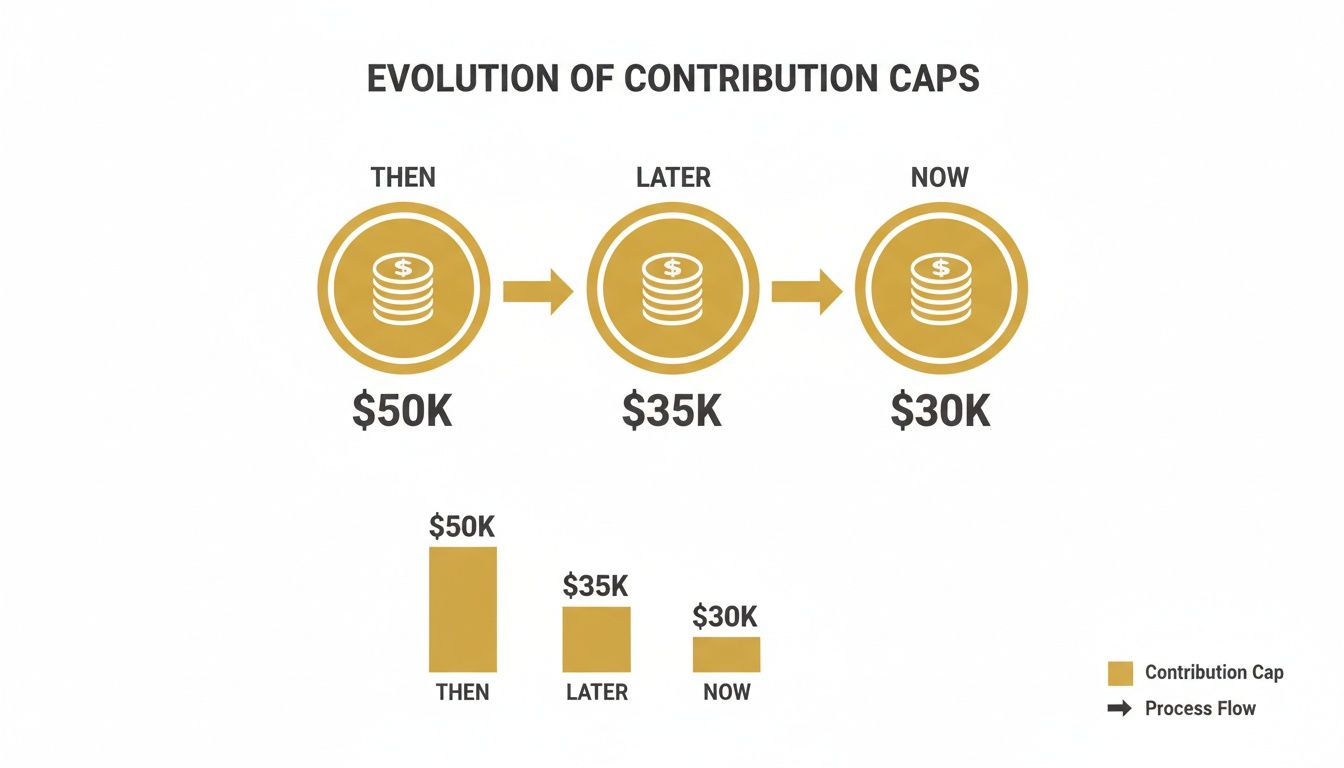
A Practical Example of the Carry-Forward Rule
Let’s walk through how this works in a real-world scenario. Imagine a business owner whose income has been a bit up and down.- Financial Year: 2023–24
- Total Super Balance on 30 June 2023: $420,000 (safely below the $500k threshold)
- Goal: Make a large, tax-deductible contribution to offset a recent spike in business profits.
| Financial Year | Concessional Cap | Contributions Made | Unused Cap Amount |
|---|---|---|---|
| 2019–20 | $25,000 | $15,000 | $10,000 |
| 2020–21 | $25,000 | $15,000 | $10,000 |
| 2021–22 | $27,500 | $18,000 | $9,500 |
| 2022–23 | $27,500 | $18,000 | $9,500 |
| Total Unused Carry-Forward: | $39,000 |
The carry-forward rule transforms the concessional contributions cap from a rigid annual limit into a flexible, multi-year savings tool. It’s perfect for those with lumpy income or one-off capital gains.This strategy can be incredibly powerful. Since its introduction on 1 July 2018, the rules allow eligible individuals to consolidate substantial amounts. For the 2025–26 financial year, someone with a super balance below $500,000 on 30 June 2025 could potentially access unused caps from the previous five years, which could total over $137,500, plus the current year's cap. It pays to stay informed about these limits as they change.
How to Handle Exceeding the Contributions Cap
Accidentally tipping over the concessional contributions cap can feel like a costly mistake, but knowing how the process works makes it much more manageable. While it’s definitely something to avoid, the Australian Taxation Office (ATO) has a clear procedure for dealing with these situations. When you contribute more than the annual limit, the excess amount doesn’t just get hit with a flat penalty tax. Instead, the ATO simply adds these excess concessional contributions to your assessable income for that financial year. This means the extra amount is taxed at your marginal tax rate—just like your salary or business income. To be fair, you get a 15% tax offset to account for the tax your super fund already paid. It's a logical approach, but it can still leave you with an unexpected tax bill.What Happens Step by Step
The ATO will spot the excess amount after your super fund reports all the contributions you've received for the year and you lodge your tax return. Once they connect the dots, they’ll issue you an excess concessional contributions determination. This notice will spell out a few key things:- The total amount of your excess concessional contributions.
- The extra income tax you now owe on this amount.
- An interest charge, known as the excess concessional contributions charge (ECCC), which compensates the government for the deferred tax.
The Financial Impact: An Example
Let's see how this plays out for a high-income earner. Meet Sarah, who earns $195,000 a year. During the 2024–25 financial year, a miscalculation leads her to contribute $35,000 to her super—that’s $5,000 over the $30,000 concessional cap. Here’s how the ATO handles her $5,000 excess:- Added to Taxable Income: The $5,000 is tacked onto her assessable income, pushing it from $195,000 to $200,000.
- Taxed at Marginal Rate: This excess amount is taxed at her top marginal rate of 45% (plus the Medicare levy).
- 15% Tax Offset: She receives a 15% tax offset on the excess amount, recognising the contributions tax her super fund already paid.
An Extra Consideration: Division 293 Tax
For high-income earners like Sarah, there’s another layer to think about: Division 293 tax. This is an extra 15% tax on concessional contributions for anyone whose combined income and contributions go over the $250,000 threshold.Because Sarah's adjusted taxable income plus her total concessional contributions ($200,000 + $30,000) is well over this threshold, the extra tax applies. This is exactly why careful monitoring is essential, particularly for those in higher tax brackets.Navigating an excess contribution scenario can get complicated. While the ATO's process is clear, the financial fallout highlights just how important it is to plan meticulously and get professional advice to keep your super strategy on track.
Practical Strategies to Optimise Your Contributions

Align Your Contributions with Your Financial Goals
The best strategy is always the one that fits your specific financial situation. Whether you're an employee, a business owner, or an investor, there are specific moves you can make to get the cap working for you. A fantastic starting point for employees is a salary sacrifice arrangement. This is simply an agreement with your employer to direct a slice of your pre-tax salary straight into your super fund. It’s a straightforward but powerful way to consistently build your super while trimming down your taxable income for the year. To get into the nitty-gritty, you can learn more about how salary sacrifice works in our detailed guide. For those with more unpredictable incomes, like freelancers or business owners, timing is everything. You can make personal deductible contributions and then claim them back on your tax return. This is especially handy in high-profit years, letting you make a chunky contribution that directly offsets a larger tax bill.Monitor Your Contributions in Real Time
Honestly, one of the most common reasons people go over the concessional contributions cap is that they just lose track. It's easy to forget that your employer’s Superannuation Guarantee (SG) payments, any salary sacrifice amounts, and your own personal contributions all get funnelled into the same bucket.The easiest way to keep tabs on everything is through your myGov account linked to the ATO. Head to the 'Super' tab, and you can see your concessional contributions in near real-time. This gives you a clear picture of exactly how much cap space you have left to play with.This quick check can save you from a very costly mistake. And remember, contributions are counted when your fund receives the money, not when your employer pays it. That little timing difference, especially around the 30th of June, trips a lot of people up.
Advanced Strategies for Business Owners and Investors
Once you’ve got the basics down, certain situations open the door for more sophisticated planning, turning what would be a tax headache into a genuine savings opportunity.- Business Owners: If you run your business through a company, you’re in the driver’s seat when it comes to timing director fees and dividends. You can strategically time these payments to land in a year where you have plenty of cap space available—including any carry-forward amounts—to make a large, tax-deductible super contribution.
- Property Investors: Selling an investment property can create a massive capital gains tax event. With a bit of forward planning, you can use your carry-forward concessional contributions to make a significant contribution in the same year you sell. You're effectively using your super to help absorb the capital gain and shrink your overall tax liability.
Common Contribution Mistakes (And How to Avoid Them)
Navigating the super contribution rules can feel like a minefield. Even the most switched-on savers can slip up, leading to unexpected tax bills or missed opportunities. Knowing where the common traps lie is the first step to making sure your super strategy stays on course. Most of these mistakes boil down to simple misunderstandings about what counts towards your cap and, crucially, when it counts. A little bit of know-how here can save you a massive headache later on. Let’s walk through the most frequent errors so you can sidestep them with confidence.Getting the Timing Wrong
This is probably the most common and costly mistake we see. People confuse the date they pay a contribution with the date the super fund receives it. This becomes a massive issue as the 30 June deadline looms.Key Takeaway: The ATO doesn't care when the money left your bank account. A contribution only counts for the financial year once the cash is physically sitting in your super fund's account.If you make a last-minute payment on 29 June, there's a good chance it won't clear until 1 July. That means it gets counted towards the next financial year's cap, which can completely derail your plans. The simple fix? Get your contributions in well before the end of June.
Forgetting Your Employer's Contributions
It’s so easy to get focused on the extra amounts you're putting in, like salary sacrificing or personal deductible contributions. The big oversight here is forgetting to account for your employer’s compulsory Superannuation Guarantee (SG) payments. Those SG payments chew up a big chunk of your annual concessional cap. Before you even think about adding extra money, you have to work out how much of your cap your employer has already used up for you. Forgetting this step is the fastest way to accidentally go over the limit. You can keep a close eye on all contributions, including SG, by linking your myGov account to the ATO. It gives you a near real-time view of where you stand.Miscalculating Your Remaining Cap Space
Another classic error is getting the maths wrong on how much cap space you have left, especially if you’re using a few different contribution methods. This is where people who combine strategies often get caught out. Here’s a scenario that happens all the time:- Salary Sacrificing: You set up a regular salary sacrifice at the start of the year, thinking you've got it all planned out.
- An Unexpected Bonus: You get a performance bonus you weren't banking on. Your employer pays SG on that bonus, using up more of your cap than you had factored in.
- A Final Top-Up: Not realising the bonus SG has reduced your available room, you make a personal deductible contribution at year-end and accidentally push yourself over the annual limit.
Got Questions About Contribution Caps? We've Got Answers.
When you're dealing with concessional contribution caps, a few common questions always seem to pop up. Let's tackle them head-on with some straightforward, practical answers.How Do I Check My Unused Carry-Forward Cap?
The best and most reliable source for this information is directly from the tax office. You can find your exact carry-forward balance by logging into your myGov account and making sure it's linked to the Australian Taxation Office (ATO). Once you're in, it's a simple three-step process:- Head to the ‘Super’ section.
- From there, select ‘Information’.
- Finally, click on ‘Concessional contributions’.
Concessional vs Non-Concessional Contributions
The easiest way to think about this is "pre-tax money vs. after-tax money."- Concessional Contributions: This is money that flows into your super before your regular income tax rate has been applied. It covers things like your employer's super guarantee payments, any salary sacrificing you do, and personal contributions you claim as a tax deduction. This money gets taxed at a friendly 15% inside your super fund and counts towards the annual concessional contributions cap.
- Non-Concessional Contributions: This is money you've already paid income tax on, which you then transfer into your super from your personal bank account. Since the tax has already been paid, it isn't taxed again when it enters your super fund. These contributions have their own, much higher limit called the non-concessional contributions cap.
Can I Still Use the Carry-Forward Rule if My Balance Is Now Over the Limit?
This is a great question, and the answer comes down to timing. Your eligibility to use the carry-forward rule hinges on your total super balance on a very specific date: 30 June of the previous financial year. To be eligible, your balance must have been under $500,000 on that day.This is a crucial detail many people miss: The check is based on your balance at the start of the financial year, not the end.Let's say your balance was $480,000 on 30 June. Even if good investment returns pushed it to $510,000 by December, you are still eligible to make a carry-forward contribution for that entire financial year. This rule creates a valuable window of opportunity for people whose balances are getting close to that $500,000 mark. However, the moment your balance ticks over $500,000 on 30 June, you lose access to the carry-forward strategy for the next financial year. It really highlights why getting timely, personalised advice is so important for making the most of these rules.
Getting your concessional contributions right can make a huge difference to your retirement nest egg and your tax bill each year. For expert guidance tailored to your specific situation, the team at Australia Wide Tax Solutions is here to help you navigate the rules with confidence. Get in touch with us today.
The ATO provides guidance through ato.gov.au, the Small Business Support Line (13 28 66), and Online Services for individuals and businesses. For complex situations, a registered tax agent provides advice tailored to your specific circumstances and professional indemnity protection. You can verify agent registration at the TPB register at tpb.gov.au.
Most tax records must be kept for five years from the date of lodgement or the date the transaction occurred, whichever is later. Records must be in English or convertible to English and must be sufficient to explain the income and deductions in your return. The ATO can request records at any time during the retention period.
Consider a registered tax agent when your affairs involve multiple income sources, business activity, investment properties, capital gains, or overseas income. Agents extend your lodgement deadline, provide safe harbour protection, and take professional responsibility for the advice given. Verify registration at tpb.gov.au.
The failure to lodge penalty is based on penalty units ($313 per unit from 1 July 2023), accruing per 28-day period for late returns and BAS lodgements. Incorrect information penalties range from 25% to 75% of the tax shortfall depending on whether the behaviour was careless, reckless, or intentional. Proactive disclosure before an audit begins typically results in significantly reduced penalties.
Tax minimisation is the legal arrangement of your affairs to reduce tax — claiming all eligible deductions, using appropriate structures, and timing income and expenses. Tax avoidance involves arrangements that technically comply with the law but achieve outcomes parliament did not intend. The ATO can apply Part IVA anti-avoidance rules to cancel benefits from avoidance arrangements.
What Are Reportable Super Contributions

Why This Distinction Matters
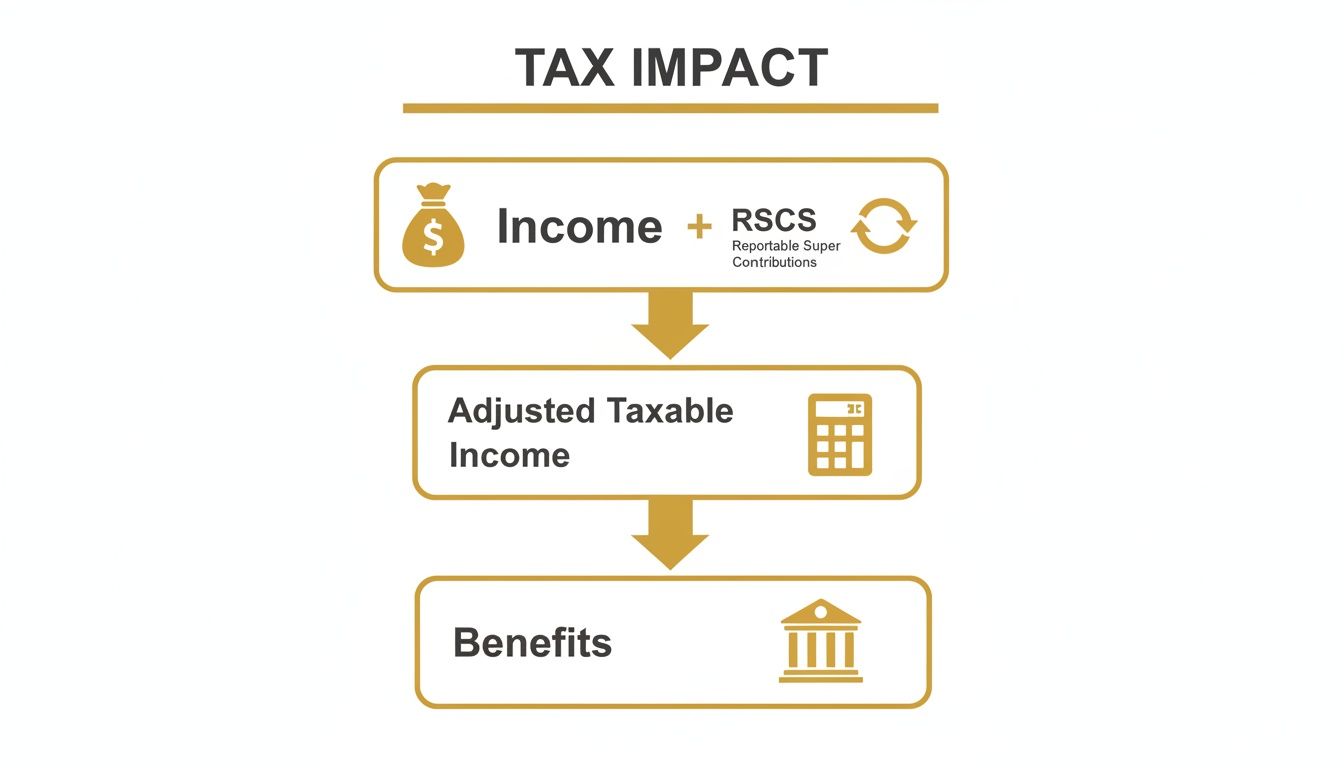
Getting your head around the difference between standard SG and reportable contributions is crucial for every Aussie taxpayer. While RSCs aren't taxed as part of your regular salary, the ATO adds them back to your taxable income to create a figure called your "adjusted taxable income." This adjusted figure is what the government uses to work out your eligibility for a whole range of benefits and liabilities. It's a critical number that can influence:- Government Benefits: Your eligibility for payments like the Family Tax Benefit or Child Care Subsidy.
- Tax Offsets: Whether you qualify for offsets like the seniors and pensioners tax offset.
- Surcharges and Levies: If you're liable for the Medicare levy surcharge or the Division 293 tax for high-income earners.
- Student Loans: How much you need to repay on your HECS-HELP loan each year.
In a nutshell, while reportable super contributions are a fantastic, tax-effective way to grow your retirement savings, they have a very real impact on your financial situation right now. Overlook them, and you could be in for a surprise tax bill or find your government support reduced.To make this clearer, let's break down the key differences between standard employer contributions and the extra, reportable ones.
Standard Super vs Reportable Super Contributions at a Glance
This table simplifies the core distinctions between the compulsory Superannuation Guarantee (SG) and the additional Reportable Super Contributions (RSC) you might make.| Attribute | Superannuation Guarantee (SG) | Reportable Super Contributions (RSC) |
|---|---|---|
| Nature | Compulsory payment by employer | Voluntary payments made by you or your employer |
| Who Makes It | Employer | You (via salary sacrifice) or your employer (as an extra benefit) |
| From Which Income | Paid on top of your ordinary time earnings | Paid from your pre-tax salary |
| Is it Reportable? | No | Yes, must be reported to the ATO |
| Impact on Income Tests | Not included in adjusted taxable income | Added back to calculate your adjusted taxable income |
Common Examples of RSCs
By far the most common type of reportable super contribution is a salary sacrifice arrangement. This is a formal agreement you make with your employer to have them pay a portion of your pre-tax salary straight into your super fund. It lowers your taxable income while boosting your retirement savings. Another frequent example is making personal deductible contributions. This happens when you put your own after-tax money into your super fund and then claim a tax deduction for that amount in your annual tax return. The moment you claim that deduction, the contribution officially becomes 'reportable'. In this guide, we'll walk you through exactly how these contributions are calculated, what they mean for your tax bill, and how you can manage them effectively to get the best possible financial outcome.What Counts as a Reportable Contribution

Salary Sacrifice Contributions
This is the one most people are familiar with. A salary sacrifice arrangement is a deal you make with your employer to have a slice of your pre-tax pay sent directly to your super fund. Instead of that money landing in your bank account and being taxed at your usual rate, it heads straight to your super. Once there, it's typically taxed at the concessional rate of just 15%. For most working Australians, that’s a significant tax saving compared to their personal income tax rate. Because this setup effectively lowers your taxable income on paper, your employer has to report the amount you’ve sacrificed to the ATO. Getting a clear handle on how does salary sacrifice work is a brilliant first step for anyone serious about building a bigger retirement fund.Personal Deductible Contributions
The other main type is personal deductible contributions. This method is a game-changer for self-employed people or anyone whose employer doesn't offer salary sacrificing, giving you much more control. Here’s how it works in three simple steps:- You make a voluntary contribution into your super fund from your own after-tax bank account.
- You then formally tell your super fund that you plan to claim that contribution as a tax deduction. This is a crucial step!
- Come tax time, you claim the deduction in your annual tax return, which in turn reduces your overall taxable income for the year.
What Is Not a Reportable Contribution
It's just as important to know what doesn't get counted. The following types of payments are not considered reportable super contributions:- Compulsory Employer Contributions: The standard Superannuation Guarantee (SG) payments your boss makes for you are not reportable. This is the mandatory stuff.
- After-Tax Contributions (Non-Concessional): Any money you add to your super from your post-tax savings, and for which you do not claim a tax deduction, isn't reportable.
- Spouse Contributions: Payments you make directly into your partner's super account.
The key takeaway is this: if the contribution is made from pre-tax money or you claim a tax deduction for it, it’s a reportable super contribution. It will be counted towards your concessional contributions cap.This distinction is crucial. All your reportable super contributions add up and count towards your annual concessional contributions cap. For the 2025–26 financial year, this cap is set at $30,000. That figure includes your employer's SG payments, anything you've salary sacrificed, and any personal contributions you've claimed as a tax deduction. With the compulsory SG rate rising to 12% from 1 July 2025, the space left in your cap is getting smaller. This makes tracking your reportable contributions more important than ever to avoid accidentally going over the limit and copping extra tax.
How RSCs Impact Your Taxes and Benefits
Putting extra money into your super might seem like a straightforward way to boost your retirement savings, but it's not that simple. These contributions, known as reportable super contributions, create ripples that affect your finances right now, not just in the future. While they do lower your taxable income on your payslip, the Australian Taxation Office (ATO) has a special way of looking at things. They add those contributions straight back on to figure out what they call your adjusted taxable income (ATI). Think of ATI as the ATO's "real world" measure of your income. It’s this adjusted figure, not just your base salary, that they use to decide if you’re eligible for a whole range of government benefits and tax offsets. This is a classic trap for the unwary. A smart move like salary sacrificing can lower your income tax but simultaneously push your ATI over a critical threshold, leading to some nasty financial surprises.The Ripple Effect on Your Finances
Making a big reportable super contribution could be a brilliant long-term play, but you have to look at the whole picture. A higher ATI can reduce or completely wipe out your eligibility for a host of government programs. Here are some of the most common areas that get hit:- Family Tax Benefit (FTB) Parts A and B: Your ATI is one of the main numbers used to calculate if you qualify for these payments and exactly how much you’ll get.
- Child Care Subsidy (CCS): Government help with childcare fees is directly linked to your family's combined ATI. A small increase can make a big difference.
- Private Health Insurance Rebate: That government rebate on your health insurance premiums? It's income-tested against your ATI. A higher ATI could shrink your rebate or get rid of it altogether.
- Medicare Levy Surcharge (MLS): If you earn over the threshold ($97,000 for singles, $194,000 for families in 2024-25) and don't have private hospital cover, you'll get slapped with this extra tax. Your RSCs are included in that income calculation.
- Seniors and Pensioners Tax Offset (SAPTO): This valuable tax offset for eligible older Australians is also income-tested using your ATI.
High-Income Earners and the Division 293 Tax Sting
For anyone on a higher income, reportable super contributions have a much more direct tax consequence. They can trigger what’s known as Division 293 tax, an extra tax designed to claw back some of the tax benefits high-income earners get on their super contributions. Here’s how it works: if your adjusted taxable income plus your concessional super contributions adds up to more than $250,000 in a financial year, those contributions get hit with an additional 15% tax. This brings the total tax on those contributions to 30%.Real-World Example: Let's look at David. He earns a salary of $245,000 and decides to salary sacrifice an extra $15,000 into his super. Great for his retirement fund, but for the Division 293 tax test, his income is now calculated as $260,000 ($245,000 + $15,000). Because he's crossed the $250,000 threshold, that entire $15,000 contribution is now subject to the extra 15% Division 293 tax.David's situation is a perfect example of how a well-meaning strategy can result in an unexpected tax bill if you don't know all the rules. The key is to carefully weigh the long-term gains in your super against the immediate tax pain and the potential loss of government benefits. Planning your contributions strategically is the only way to get the best result for today and for your future.
Navigating the Concessional Contributions Cap
Think of your annual concessional contributions cap like a strict budget for pre-tax money flowing into your superannuation. It's the maximum amount you and your employer can put into your super fund each financial year using pre-tax dollars, and it includes both compulsory payments and any reportable super contributions you choose to make. This limit, known as the concessional contributions cap, is a critical number for every Australian to be aware of. It lumps together a few key types of payments:- Your employer's compulsory Superannuation Guarantee (SG) payments.
- Any extra contributions you make through a salary sacrifice arrangement.
- Personal contributions you decide to make and then claim a tax deduction for.
Understanding How the Cap Works in Practice
For the 2025–26 financial year, the concessional cap is set at $30,000. It's important to remember that with the mandatory SG rate climbing to 12% from 1 July 2025, a bigger chunk of that cap gets eaten up by your employer's payments before you even think about making extra contributions. This leaves less room for voluntary strategies like salary sacrificing. Recent data shows that as rules change, Australians are putting more into their super voluntarily. Member contributions shot up by 25.8% to $59.1 billion for the year to June 2025. This surge shows just how important it is for individuals to keep a close eye on their contributions to avoid accidentally going over the cap.The Carry-Forward Rule: A Smart Way to Catch Up
Luckily, the system has a fantastic feature that gives you some much-needed flexibility: the carry-forward rule. This clever rule lets you use any leftover, unused portion of your concessional cap from previous years.Put simply, if you didn't use your full cap last year, you can "carry" the unused amount forward and add it to this year's cap. It's a powerful way to make a larger, tax-effective contribution when you can afford to, like after you get a bonus or sell an asset.There is one key condition, though. To be eligible to use this rule, your total super balance must have been under $500,000 on 30 June of the previous financial year. You can roll forward unused cap amounts for up to five years before they expire.
A Special Note for High-Income Earners
If you're a high-income earner, managing your concessional cap becomes even more crucial. Breaching the cap doesn't just mean paying more tax on the excess; it can also trigger other tax implications. All your concessional contributions, including any reportable ones, count towards the $250,000 income threshold for Division 293 tax. It's vital to understand what is Division 293 tax, as it slaps an extra 15% tax on the super contributions of those above this income level. Careful planning is essential to build your super effectively while staying on the right side of all the caps and tax rules.Real-World Scenarios for Reporting Your Contributions
Theory is great, but seeing how these rules play out in the real world is where it really clicks. Let's walk through a few common scenarios to see how reportable super contributions actually affect everyday people. We'll follow three individuals—Amelia, Ben, and Cathy—who each have completely different financial situations. Their stories bring to life how reportable super contributions are calculated, where they show up, and what they mean for tax and those all-important contribution caps.Amelia the Salaried Employee
Amelia has a marketing job and earns $110,000 a year. She's keen to give her retirement savings a boost, so she's set up a salary sacrifice arrangement with her employer to tip an extra $12,000 into her super fund annually. Here’s how her contributions break down for the year:- Employer SG Contribution: 12% of $110,000 = $13,200
- Amelia's Salary Sacrifice (RSC): $12,000
Cap Calculation: $13,200 (SG) + $12,000 (RSC) = $25,200 in total concessional contributions. This total slots in nicely under the $30,000 cap for the 2025–26 financial year, which means Amelia sidesteps any pesky excess contributions tax. It's important to know, though, that the $12,000 RSC will be added back to her income when testing her eligibility for certain government benefits.
Ben the High-Income Earner
Ben is an executive with a total income package of $280,000. This package is structured to include his salary plus a reportable super contribution of $18,000, which his employer makes on top of the compulsory Superannuation Guarantee. Let's see how this unfolds for him:- Assessable Income: $280,000 - $18,000 = $262,000
- Reportable Super Contributions (RSC): $18,000
Cathy the Sole Trader
Cathy runs a successful graphic design business as a sole trader. Unlike an employee, she doesn't get compulsory super from an employer. To build her retirement nest egg, she decides to make a personal contribution of $20,000 from her business earnings and then claim it as a tax deduction. For this to work correctly, Cathy has to follow a few critical steps:- Make the Contribution: First, she transfers the $20,000 into her super fund.
- Lodge a 'Notice of Intent': This is crucial. She must formally notify her super fund in writing that she intends to claim a tax deduction for that contribution.
- Receive Acknowledgement: The fund will then send her a confirmation letter. She needs to hang onto this, as it's proof for her tax records.
Got Questions About RSCs? We've Got Answers
Even when you have the basics down, reportable super contributions can throw up some curly questions. The rules can feel a bit tangled, especially when your work situation or income changes. Let's clear up some of the most common queries we get from clients. Our goal here is to sort out any lingering confusion so you can manage your super with total confidence.Can I Make Reportable Super Contributions If I'm Self-Employed?
Yes, you absolutely can! In fact, this is one of the most powerful tools a sole trader or contractor has for building their retirement nest egg in a tax-smart way. When you're self-employed, there's no boss making compulsory Superannuation Guarantee (SG) payments for you—that job falls squarely on your shoulders. You can make what are called personal deductible contributions straight from your business or personal account into your super fund. But there's a crucial process you have to follow to make them 'reportable' and get that sweet tax deduction.- First, make the payment into your super fund.
- Next, send your fund a formal 'Notice of intent to claim a deduction' form.
- Finally, you must get a written acknowledgement back from your fund before you lodge your tax return.
What Should I Do If My Employer Reports an Incorrect Amount?
Finding a mistake on your income statement is always a worry, but don't panic—it's usually something that can be fixed. If you think the reportable super contribution amount from your employer is wrong, you need to act fast. Start by digging out your payslips for the financial year and add up all the salary sacrifice deductions. Compare that total to what’s on your income statement. If the numbers don't match, your first call should be to your employer’s payroll or HR team.Most of the time, this comes down to a simple admin error that's easily corrected. Your employer can resubmit the correct information to the ATO, which will then issue you with an updated income statement.If you hit a roadblock and can't get it sorted out with your employer, the next step is to get in touch with the ATO directly. They can offer guidance and, if needed, look into it further to make sure your records are set straight.
How Do RSCs Affect My HECS-HELP Student Loan Repayments?
This is a big one, and it catches a lot of people out. The compulsory repayment you make on your HECS-HELP loan is based on something called your 'repayment income', which isn't the same as your regular taxable income. To figure out your repayment income, the ATO takes your taxable income and then adds a few things back on top, most notably:- Any reportable super contributions you’ve made.
- Your total net investment losses (if you have any).
- Reportable fringe benefits.
Are Matched Contributions from My Employer Reportable?
Yes, they almost always are. If your employer has a generous policy where they match your personal super contributions, those matched payments are treated as reportable super contributions. The best way to think about it is that the matched amount is an extra, voluntary payment made from pre-tax money, over and above the standard SG. Because it's an additional contribution, your employer is required to report it to the ATO. Both your own salary-sacrificed amounts and your employer's matched portion will count towards your annual concessional contributions cap. It's a brilliant way to turbo-charge your retirement savings, but you have to be diligent in tracking both types of contributions to make sure you don't go over the limit.Trying to get your head around the ins and outs of tax and super can feel like a full-time job. The good news is, you don't have to do it alone. The team at Australia Wide Tax Solutions are experts in helping people and businesses navigate their financial obligations with confidence. Whether it’s getting your tax return right, getting advice on salary sacrificing, or sorting out your BAS lodgement, we’re here to give you clear, practical support. Get in touch with Australia Wide Tax Solutions today to ensure your finances are in expert hands.
Yes, if you are under 75 and meet the work test (if aged 67–74). Lodge a notice of intent to claim with your fund before the earlier of the tax return due date or the lodgement date. Once the fund acknowledges the notice, the contribution becomes concessional and is taxed at 15% inside the fund.
The concessional contributions cap for 2025-26 is $30,000. This covers employer SG contributions, salary sacrifice, and personal deductible contributions combined. Contributions above the cap are included in assessable income at your marginal rate, with a 15% tax offset for the tax already paid inside the fund.
The Super Guarantee rate for 2025-26 is 11.5%, rising to 12% from 1 July 2025. Employers must contribute this percentage of each eligible employee's ordinary time earnings to a complying super fund at least quarterly. Late or missing payments trigger the Super Guarantee Charge, which includes interest and is not tax deductible.
Salary sacrifice contributions come from pre-tax income and are taxed at 15% inside super rather than at your marginal rate (up to 47%). The difference is your tax saving. A taxpayer in the 37% bracket saves 22 cents per dollar sacrificed, subject to the $30,000 concessional cap.
Yes, if your total super balance was below $500,000 on 30 June of the prior year. Unused cap amounts from the previous five years can be carried forward and used in a higher-income year. The oldest unused amounts are applied first, allowing catch-up contributions that significantly reduce tax for eligible individuals.