
In Australia, the standard GST rate is 10% on most goods and services. That sounds simple enough until you're staring at an invoice that says “plus GST”, trying to work out whether to charge it, collect it, or claim some of it back.
I’ve seen that moment plenty of times. A small business owner sends their first proper invoice and suddenly realises the hard part isn’t the maths. It’s knowing what the number means in real life. If you’re a property investor, the confusion often lands a bit differently. You’re looking at rent, repairs, maybe a sale down the track, and wondering why some things involve GST and others don’t.
That’s why “what is the gst rate in australia” isn’t really a one-line question. The rate is straightforward. The rules around when it applies, when it doesn’t, and how it flows through your BAS are where people get stuck. Let’s clear that up in plain English.
- That Simple 10% GST Can Get Complicated Fast
- The Core Concept Of Australian GST
- Deciding If You Must Register for GST
- Navigating GST-Free and Input Taxed Supplies
- Basic GST Calculations and BAS Reporting
Table of Contents
- That Simple 10% GST Can Get Complicated Fast
- The Core Concept Of Australian GST
- Deciding If You Must Register for GST
- Navigating GST-Free and Input Taxed Supplies
- Basic GST Calculations and BAS Reporting
- Common GST Traps for Businesses and Investors
- Your Next Steps to GST Compliance with AWTS
- Frequently Asked GST Questions
- Do I add GST to every invoice
- Can I register even if I am under the threshold
- Does residential rent include GST
- How often do I lodge BAS
- What if I missed GST or BAS obligations
- Is GST always just 10% of the total price
- I’m a small operator. Can I just keep it simple and estimate
- What confuses people most about GST
That Simple 10% GST Can Get Complicated Fast
You quote a job at a clean round figure. The client replies, “Is that inclusive or exclusive of GST?” Your stomach drops a bit because you know the rate is 10%, but you’re not fully sure what answer changes on the invoice, in your bank account, or at BAS time.
That’s where a lot of people first realise GST isn’t just a tax rate. It’s a system. You might collect GST from a customer, but that doesn’t mean the whole amount is yours to keep. You might pay GST on tools, software, repairs, or supplies, and that can matter too. If you’re around the registration threshold, the question gets sharper because one decision affects your pricing, paperwork, and cash flow.
Property investors run into a different version of the same stress. Residential rent is treated differently from many business sales, and that leads people to assume all property transactions work the same way. They don’t. That’s where expensive mistakes start.
You don’t need more jargon. You need to know when the 10% applies, when it doesn’t, and what to do with the money in between.
If you’ve ever had to pause before sending a quote because you weren’t sure whether the price should be GST-inclusive, this guide on exclusive of GST pricing helps clear up the wording people trip over most.
Why this matters: if you treat GST like “just adding 10%”, you can price jobs wrongly, misread your cash position, and create BAS problems you didn’t see coming.
The Core Concept Of Australian GST
Australia’s Goods and Services Tax is a value-added tax charged at a standard rate of 10% on most goods and services sold or consumed in the country, and it was introduced on 1 July 2000. A simple example from the ATO shows it clearly. A pre-GST price of $200 becomes $220 after GST, with the GST component equal to $20, and GST in a GST-inclusive price is 1/11th of the final amount. In the 2023–2024 financial year, GST collections reached nearly $85.58 billion AUD according to the ATO’s explanation of how Australian GST works.

Think of GST like a relay baton
I explain GST like a relay race over coffee because that’s usually the easiest way to make it click.
A manufacturer sells to a wholesaler and adds GST. The wholesaler sells to a retailer and adds GST. The retailer sells to the end customer and adds GST. At each handover, the business can usually claim credits for the GST it paid on business purchases, then pass on GST on its own sale.
That’s why registered businesses aren’t usually the final bearer of the tax. They collect it and report it. The final consumer, who isn’t claiming GST credits, carries the cost at the end of the chain.
If you’re still sorting out the business identity side of compliance, this guide on VAT numbers and Australian registration concepts gives useful context for how GST registration fits into the wider admin picture.
The 1/11th rule matters more than people expect
People often know how to add GST, but they freeze when they need to pull GST back out of a total.
The shortcut is this. If a price already includes GST, the GST part is 1/11th of that total. So if something costs $220 including GST, the GST is $20 and the GST-exclusive amount is $200.
That rule matters on invoices, bookkeeping, and BAS preparation.
Practical rule: When a price is already GST-inclusive, don’t take 10% of the total. Use the 1/11th rule instead.
Why this matters: once you understand that GST moves through the supply chain and that inclusive prices use the 1/11th rule, the whole system stops feeling random.
Deciding If You Must Register for GST
The line in the sand is your turnover. Once your annual GST turnover goes over $75,000, registration becomes mandatory for both residents and non-residents, and the requirement is triggered within 28 days according to Stripe’s guide to Australia’s GST rate. For non-profits, the threshold is $150,000 under the verified ATO-based rules in the background data.

The threshold is the tipping point
I think of the threshold like a waterline on a boat. Stay under it and registration may be optional. Cross it and the rules change fast.
That’s where many owners get caught. They focus on profit, not turnover. GST registration doesn’t hinge on whether you feel “small” or whether cash is tight. It turns on whether your turnover has moved past the required threshold.
If you’re at the stage of formalising your structure, banking, and registrations, a practical guide on how to set up a business in Australia can help you line up the admin properly from day one.
Voluntary registration can help, but it adds work
If you’re below the threshold, you can still choose to register. That can make sense when you buy a lot of business inputs and want to claim GST credits on those purchases.
But I’m skeptical of blanket advice here. Voluntary registration isn’t a magic trick. It creates reporting obligations. You’ll need better records, cleaner invoicing, and a BAS routine you can stick to.
Pro tip: If you crossed the threshold without realising it, act quickly. The fix usually starts with working out when the obligation began, then cleaning up registration and reporting from that point rather than guessing.
For anyone ready to get the process sorted, this walkthrough on how to register for GST in Australia is a useful next read.
A quick decision guide helps:
- Over the threshold: Registration is mandatory.
- Under the threshold with regular business purchases: Voluntary registration may be worth considering.
- Under the threshold with very simple activity: Staying unregistered may keep admin lighter.
- Not sure what counts toward turnover: Don’t guess. Review it before the ATO reviews it for you.
Why this matters: registration changes your pricing, invoices, record-keeping, and BAS obligations, so the timing matters almost as much as the rate itself.
Navigating GST-Free and Input Taxed Supplies
Many find this confusing because both categories can involve a sale with no GST charged, but they do not work the same way.
Two labels that sound similar but work very differently
Think of GST-free supplies as a two-way street. You don’t charge GST on the sale, but you can still generally claim GST credits for the business purchases that relate to making that sale.
Think of input taxed supplies as a one-way street. You don’t charge GST on the sale, and you generally can’t claim GST credits for related purchases either.
That difference matters a lot for small business owners and property investors.
The verified GST rules allow exemptions for things such as basic fresh foods, certain medical and healthcare services, education, childcare, water and sewerage, and exports under the listed conditions. The same verified material also notes that financial services and residential rents are input taxed, which means no GST is charged but input credits are generally not available on related costs.
Here’s the mistake I see often. Someone says, “There’s no GST on it, so it must all work the same.” It doesn’t. The credit side is where the pain turns up later.
GST-Free vs. Input Taxed Supplies Compared
| Attribute | GST-Free Supplies | Input Taxed Supplies |
|---|---|---|
| GST on sale | No | No |
| GST credits on related business purchases | Generally yes | Generally no |
| Typical examples from the verified data | Basic fresh foods, certain healthcare, education, childcare, exports, water and sewerage | Financial services, residential rent |
| Cash flow effect | You may still recover GST on inputs | GST paid on related inputs can stay as a real cost |
| Why people confuse it | Both show no GST on the outward sale | Both show no GST on the outward sale |
Where property investors get caught
Residential rent is a classic problem area. Many investors assume that because they spend money on repairs, fees, or property-related costs, they should be able to claim GST credits across the board. That assumption can fall apart when the supply is input taxed.
The same goes for people dealing with financial supplies. The verified material flags that these classifications can produce claim errors if handled casually.
If a supply is input taxed, the pain usually shows up on the purchase side, not the sales side.
A useful way to sense-check your own situation is to ask two separate questions instead of one:
- Do I charge GST on what I’m selling?
- Can I claim GST on what I’m buying to provide it?
Why this matters: confusing GST-free with input taxed can change whether you claim credits at all, and that can distort your records and your refund expectations.
Basic GST Calculations and BAS Reporting
The maths part of GST is the easiest part once you use the right shortcuts. The discipline part is harder. That’s your BAS.

The two calculations most people need
If your price is before GST, multiply by 1.1 to get the GST-inclusive total.
If your price is already GST-inclusive, divide by 11 to find the GST component. The verified examples also note that dividing a GST-inclusive amount by 1.1 gives you the ex-GST amount.
Simple examples help:
- Adding GST: A service priced at $200 before GST becomes $220 in total.
- Finding the GST portion: If the total is $220, the GST component is $20.
- Finding the ex-GST amount: If the total is $220, divide by 1.1 to get $200.
For businesses that need cleaner records, a checklist on what receipts to keep for taxes is worth bookmarking. Good GST reporting starts with keeping the right paperwork, not with scrambling at BAS time.
Your BAS is your GST scoreboard
Your Business Activity Statement is where you report the GST you collected on sales and the GST credits you can claim on business purchases. What you pay is your net GST position.
BAS frequency scales with turnover. Businesses over A$20 million lodge monthly, those in the $75k to A$20M range generally lodge quarterly, and businesses at A$75k or less that registered voluntarily may lodge annually according to Chargebee’s summary of Australian GST BAS frequency and compliance points.
The same verified source notes that 90%+ compliance via electronic lodgement reduces penalties, and non-compliance can attract a general interest charge of about 8.5% per year, compounding daily.
If BAS still feels abstract, this plain-English guide on what an activity statement is helps connect the form to your actual bookkeeping.
Common pitfall: Spending the GST you collected as if it’s operating cash. When the BAS due date arrives, the money isn’t there and the stress multiplies quickly.
A simple working habit helps:
- Split the funds early: Move GST collected into a separate bank account.
- Reconcile often: Don’t wait until lodgement week to sort receipts and invoices.
- Use e-lodgement tools: The verified data indicates electronic lodgement is linked with lower penalty risk.
- Check timing: Monthly, quarterly, and annual cycles create very different cash pressure.
A short explainer may help if you prefer to watch the concepts first.
Why this matters: correct GST calculation is only half the job. BAS reporting is where good intentions either turn into clean compliance or into debt and interest.
Common GST Traps for Businesses and Investors
GST doesn’t usually go wrong because the rate is hard to remember. It goes wrong because people assume the same rule applies to every sale, expense, and invoice. It doesn’t.
The verified data says 28% of small businesses missed BAS deadlines in 2024-25, with average penalties of AU$222 per quarter, and it also notes 18% error rates in claims involving input-taxed financial supplies in ATO audits according to Taxually’s Australia GST manual. That tells you something useful. The problem isn’t intelligence. It’s complexity plus poor systems.
Trap one for property investors
A common investor mistake is treating all property-related spending as if GST credits should naturally follow.
Residential rent is input taxed under the verified rules covered earlier. So if someone starts claiming GST credits on costs tied to that activity without checking the classification, the bookkeeping can drift away from the legal position pretty quickly. The fix is boring but effective. Map each property activity by type before claiming anything.
Trap two for business owners
Invoices cause more grief than they should. If your client needs a valid tax invoice and your paperwork is missing key details, their claim can be affected and your records won’t look great either.
The verified material notes that tax invoices over A$1,000 need to itemise GST per line. That’s one reason I tell owners not to wing invoice templates. Use proper accounting software or have your template checked once, then reuse the compliant version.
If you want a clearer sense of what belongs on one, this guide on what is a tax invoice covers the essentials.
Clean invoices aren’t admin theatre. They protect your claim, your client’s claim, and your audit trail.
Trap three that catches both groups
Mixed-use spending is where people overclaim without realising it. A phone, laptop, car expense, or subscription that serves both business and personal use can’t always support a full GST credit.
Then there’s the threshold trap. Businesses near the registration line sometimes keep weak records, underestimate turnover, and realise too late that they should have registered earlier. At that point, the clean-up is rarely fun.
Three habits lower the risk:
- Separate accounts: Keep business and personal spending apart from the start.
- Review turnover monthly: Don’t wait for year-end to discover you crossed the line.
- Classify before claiming: Especially for property and finance-related transactions.
Why this matters: the biggest GST mistakes usually start as “small” shortcuts, then turn into late lodgements, denied credits, and preventable penalties.
Your Next Steps to GST Compliance with AWTS
You don’t need a heroic reset. You need a short list and a calm hour to work through it.
A practical checklist
-
Check your last 12 months of turnover
Work out whether you’re under the threshold, over it, or close enough that registration needs active monitoring. -
Review how you price your work
Make sure your quotes and invoices clearly show whether amounts are GST-inclusive or GST-exclusive. -
Separate your money today
If you collect GST, move that portion aside so you’re not accidentally spending tax you’ll later need to remit. -
Sort your records before your next BAS
Gather sales invoices, purchase receipts, and any notes about mixed-use expenses. Clean records reduce guesswork. -
Check your supply types
If you deal with property, health, education, exports, finance, or anything that may not follow the standard rule, classify it properly before claiming credits. -
Fix overdue issues early
If you missed a BAS, delayed registration, or aren’t sure whether past claims were right, the best move is to address it directly rather than waiting.
The fastest way to reduce GST stress is to replace memory with a repeatable system.
Why this matters: GST compliance gets easier when you turn it into a routine instead of a rescue mission.
Frequently Asked GST Questions
Do I add GST to every invoice
No. The standard rate is 10% on most goods and services, but not every sale is treated the same. Some supplies are GST-free. Some are input taxed. Whether you charge GST depends on the type of supply and whether you’re registered or required to be registered.
Can I register even if I am under the threshold
Yes. Voluntary registration is allowed below the turnover threshold, and the verified data notes that this can let you claim input tax credits on purchases. The trade-off is extra compliance work, so it should be a deliberate choice, not an automatic one.
Does residential rent include GST
Residential rent is generally treated as input taxed in the verified material used for this guide. That usually means no GST is charged on the rent, and GST credits on related costs are generally not available in the same way they might be for a taxable business supply.
How often do I lodge BAS
It depends on turnover and your registration position. Some businesses lodge monthly, some quarterly, and some annual voluntary registrants may lodge annually. If you’re not sure which cycle applies, check before the due date rather than after it.
What if I missed GST or BAS obligations
Don’t guess and don’t ignore it. Work out when the issue started, gather the records, and correct the position properly. The sooner you deal with missed lodgements or registration problems, the easier it usually is to reconstruct the trail and limit further complications.
Is GST always just 10% of the total price
No. If a total price already includes GST, the GST component is 1/11th of that total, not 10% of the inclusive figure. That’s one of the most common calculation errors I see.
I’m a small operator. Can I just keep it simple and estimate
You can keep it simple, but you shouldn’t estimate where records should exist. Simple systems beat messy ones every time. A separate bank account, consistent invoice wording, and a basic receipt process usually solve more GST headaches than fancy software no one uses properly.
What confuses people most about GST
Usually one of these:
- Thinking collected GST is income: It isn’t all yours to spend.
- Assuming no GST on a sale means credits still apply: That depends on whether the supply is GST-free or input taxed.
- Waiting too long to register: Near-threshold businesses often leave this review too late.
- Treating BAS as year-end admin: It’s an ongoing reporting obligation, not a once-a-year tidy-up.
Why this matters: most GST questions aren’t really about the rate. They’re about applying the rate correctly to your own situation.
The ATO provides guidance through ato.gov.au, the Small Business Support Line (13 28 66), and Online Services for individuals and businesses. For complex situations, a registered tax agent provides advice tailored to your specific circumstances and professional indemnity protection. You can verify agent registration at the TPB register at tpb.gov.au.
Most tax records must be kept for five years from the date of lodgement or the date the transaction occurred, whichever is later. Records must be in English or convertible to English and must be sufficient to explain the income and deductions in your return. The ATO can request records at any time during the retention period.
Consider a registered tax agent when your affairs involve multiple income sources, business activity, investment properties, capital gains, or overseas income. Agents extend your lodgement deadline, provide safe harbour protection, and take professional responsibility for the advice given. Verify registration at tpb.gov.au.
The failure to lodge penalty is based on penalty units ($313 per unit from 1 July 2023), accruing per 28-day period for late returns and BAS lodgements. Incorrect information penalties range from 25% to 75% of the tax shortfall depending on whether the behaviour was careless, reckless, or intentional. Proactive disclosure before an audit begins typically results in significantly reduced penalties.
Tax minimisation is the legal arrangement of your affairs to reduce tax — claiming all eligible deductions, using appropriate structures, and timing income and expenses. Tax avoidance involves arrangements that technically comply with the law but achieve outcomes parliament did not intend. The ATO can apply Part IVA anti-avoidance rules to cancel benefits from avoidance arrangements.
If you’re behind on BAS, unsure about GST registration, or want a second set of eyes on your records, Australia Wide Tax Solutions can help you get compliant and move forward with confidence.
Before you even think about filling out a single form, the first thing to figure out is whether you actually need to register for GST. For most Australian businesses, there's a magic number you need to know: $75,000 in annual turnover. If your business income crosses that line, GST registration isn't optional—it's mandatory.
- Do You Really Need to Register for GST?
- Get Your Information Ready for a Smooth Registration
- The Easiest Ways to Complete Your GST Registration
- You’re Registered for GST – Now What?
- Common GST Mistakes and How to Avoid Them
Getting this right from the start can save you a world of administrative headaches down the track.
Do You Really Need to Register for GST?
This is the first question every single business owner in Australia should ask themselves. The answer usually comes down to your turnover, but it's not always that simple. The ATO has specific rules and some important nuances that can easily catch you out if you're not careful.
Understanding these thresholds isn't just a box-ticking exercise; it's about setting up your business finances correctly from day one.

Understanding the Turnover Thresholds
For most businesses, the main trigger for mandatory GST registration is hitting a specific turnover figure. But it's not the same for everyone.
To give you a quick overview, here are the key thresholds you need to be aware of.
GST Registration Thresholds at a Glance
| Entity Type | Mandatory Registration Turnover Threshold | Special Conditions |
|---|---|---|
| Most Businesses | $75,000 or more (GST-exclusive) | Turnover is based on current or projected gross income, not profit. |
| Non-Profit Organisations | $150,000 or more (GST-exclusive) | Applies to charities, community groups, and other NFP entities. |
| Taxi & Rideshare | $1 | No threshold. Registration is required from the very first dollar earned. |
It's vital to remember that before you can even think about registering for GST, you must have an Australian Business Number (ABN).
Now, let's break down what "turnover" really means. It’s the total value of all sales your business makes, not just your profit. This includes:
- Sales of goods and services here in Australia.
- Income from any exports (even if they are technically 'GST-free').
- Every other stream of business income you have.
A common pitfall we see all the time is business owners thinking turnover is calculated only within a single financial year. It's actually calculated on a rolling 12-month basis. You could easily cross the threshold in the middle of February, not just on 30 June.
Special Cases for Immediate Registration
While that $75,000 figure covers most businesses, some industries play by different rules.
The big one is for anyone providing taxi, limousine, or rideshare services. If you drive for a company like Uber or Didi, you must register for GST from the very first dollar you earn. There is no minimum turnover threshold. Period.
This rule exists because these services fall under the 'taxi travel' industry classification, which has always had its own specific GST obligations. If you fail to register immediately, you could be facing some serious penalties and back-dated tax bills from the Australian Taxation Office (ATO). You can dive deeper into this in our article about when you need to register for GST.
Voluntary GST Registration
So, what happens if your turnover is well below $75,000? You actually have the choice to register for GST voluntarily.
Sure, this means you'll have to start charging GST on your sales and lodging Business Activity Statements (BAS). But it also unlocks a major benefit: you can claim GST credits. These are essentially refunds for the GST included in the price of goods and services you buy for your business.
For a new business spending big on equipment, stock, or setup costs, registering voluntarily can be a really smart financial move. It can significantly improve your cash flow by letting you claim back the GST you paid on all those initial expenses.
Get Your Information Ready for a Smooth Registration
Nothing stalls an online application faster than having to stop and search for a missing document. Trust me, the single best thing you can do to make GST registration quick and painless is to get your paperwork in order before you start.
Think of it as your pre-flight checklist. Getting these items together first prevents that frustrating stop-start dance with the online portal and helps you submit an accurate application right from the get-go.
Core Business Identifiers You Will Need
At a bare minimum, the Australian Taxation Office (ATO) will ask for a few key pieces of information to identify your business.
These are completely non-negotiable, so make sure you have them on hand:
- Australian Business Number (ABN): Your ABN is the cornerstone of your business identity. If you don't have one yet, you absolutely must apply for it first. We cover this in our guide to registering an Australian Business Number (ABN) in Australia.
- Tax File Number (TFN): You'll need your personal TFN if you’re a sole trader. If you operate as a company, trust, or partnership, you’ll need the business's TFN instead.
When you're pulling all this together, using a good document management software can seriously streamline the process. It just makes life easier by keeping your important records organised and accessible when you need them most.
Business Details and Financial Projections
Beyond the basic identifiers, the application will dig into the specifics of how your business actually runs. Having clear answers ready for these questions will save you a huge amount of time.
For example, a freelance copywriter applying for GST will need to confirm their business structure (most likely a sole trader) and give a solid estimate of their projected turnover. On the other hand, a new retail shop owner should have their expected annual sales figures ready to justify the registration from day one.
A crucial tip: be realistic with your turnover projections. The ATO uses this information to get a clear picture of your business activity. Even if you're registering voluntarily, your projected figures should still reflect a genuine commercial enterprise.
You should also be prepared to provide:
- Your desired GST registration start date. This can be today, a date in the future, or in some specific cases, a past date (this is called backdating).
- Your chosen accounting basis. You'll need to select either 'cash' or 'accrual' for reporting GST. This is a key decision, so know which one suits your business.
- Your primary business activity. Be ready to clearly describe what your business does. The ATO uses this to assign you an industry code.
The Easiest Ways to Complete Your GST Registration
Alright, you've got your key business details sorted. Now for the main event: the actual GST registration. The good news is the Australian Taxation Office (ATO) gives you a few different ways to get this done, so you can pick whatever works best for you. For most business owners I talk to, doing it online is the clear winner for speed and convenience.
Before you dive in, just make sure you have your ABN, TFN, and identity documents ready to go. Think of it like a quick pre-flight check.
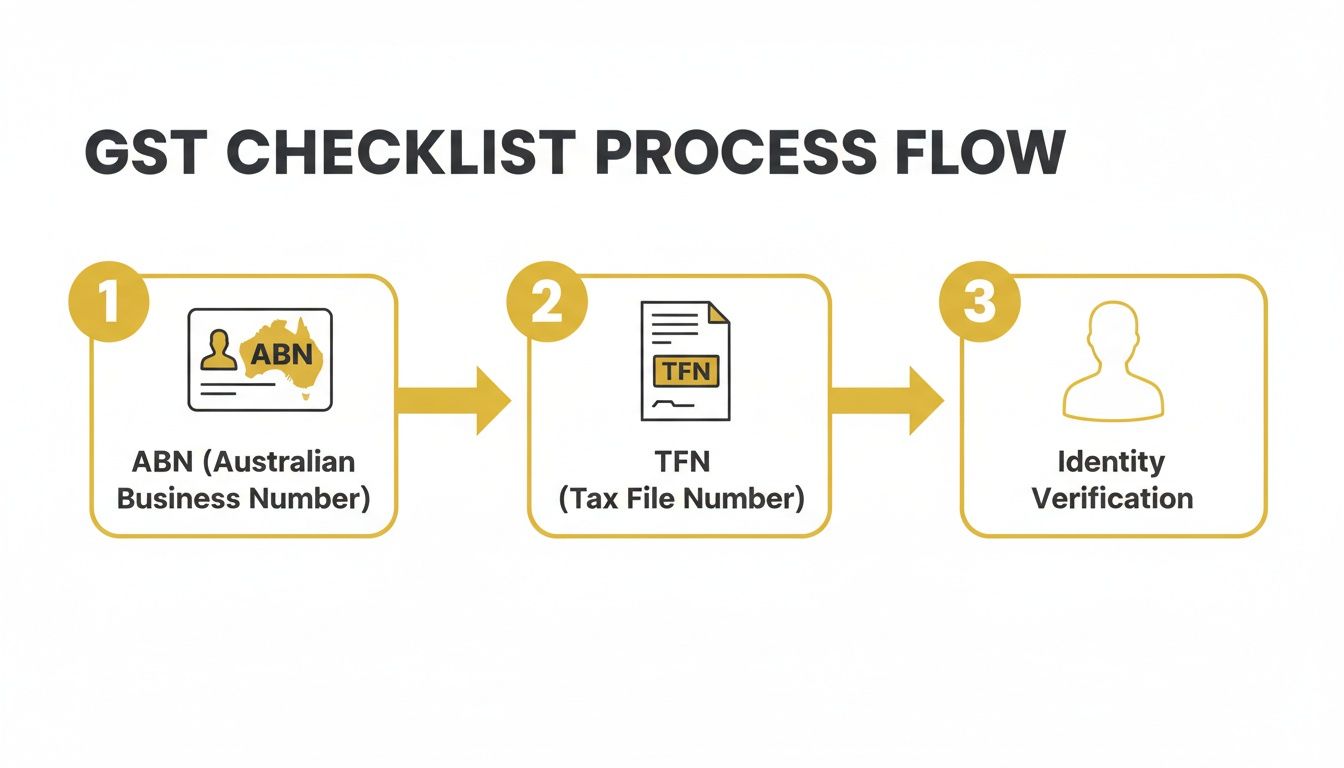
Essentially, your ABN and TFN are the foundations, and proving you are who you say you are is the final piece of the puzzle.
Getting It Done Online
The most direct and efficient route for most people is registering online. You can tackle this through the Australian Business Register (ABR) website or via the ATO's online services, which you access securely with your myGovID.
The great thing about the online portal is that it lets you add GST (and other tax registrations like PAYG withholding) to an existing ABN. This streamlines everything into one straightforward task rather than having you jump through multiple hoops.
The Two Big Questions You'll Have to Answer
As you work through the online form, you’ll hit two crucial questions. Your answers will have a real impact on your bookkeeping down the track, so it pays to understand them before you click "submit".
- When do you want your registration to start? You can choose today's date, a future date, or even backdate it. Backdating is a must if you've already shot past the $75,000 turnover threshold, but be aware it means you'll be on the hook for GST from that earlier date.
- How will you account for GST? You have to pick either a 'cash' or 'accrual' basis. This decision determines when you report and pay the GST you owe.
For most small businesses, especially service-based ones, the 'cash' basis is usually much simpler. It means you only account for GST on money that has actually landed in your bank account, which lines up perfectly with your real-world cash flow. The 'accrual' basis, on the other hand, means you have to report GST the moment you issue an invoice—even if your client hasn't paid you yet.
What if I Don't Want to Do It Online?
While the online portal is fantastic, it's not the only way. It's good to know the alternatives are there if you're not comfortable with the digital process or you'd just rather have an expert handle it.
Even if you go old-school, the ATO typically processes registrations within 28 days, so it’s smart to get the ball rolling well before you hit that $75,000 turnover mark.
Let’s quickly weigh up the other options.
Using a Registered Tax or BAS Agent
This is the "do it for me" choice. An agent, like our team here at Australia Wide Tax Solutions, takes care of the entire registration for you from start to finish.
- Pros: You get complete peace of mind that it's done correctly. An agent provides expert advice on those tricky decisions like the start date and accounting basis, and it saves you a ton of time. It's the perfect option if your business structure is a bit complex or you just want it handled right, the first time.
- Cons: Naturally, this professional service comes with a fee.
Registering Over the Phone
You can also just call the ATO directly. An operator will walk you through all the questions over the phone.
- Pros: You get to speak to a real person at the ATO who can answer any immediate questions you might have during the process.
- Cons: You’ll likely have to wait on hold, and you still need to have all your information organised and ready to read out clearly and accurately.
Ultimately, the best method comes down to your own confidence, how complex your business is, and what you feel your time is worth. For the vast majority, online is the way to go, but knowing that expert help is available is a pretty good safety net to have.
You’re Registered for GST – Now What?
Getting that GST registration confirmation is a fantastic milestone for your business. It's a sign of growth. But before you get too comfortable, it's important to understand that this is where the real work begins. Your business operations now need to adapt to your new tax responsibilities to stay compliant with the Australian Taxation Office (ATO).
This transition isn't just about adding 10% to your prices; it's about weaving your GST obligations into the fabric of your daily workflow. From how you invoice to the way you keep records, a few key changes are needed right away.

Master Your Business Activity Statement
Your most important new responsibility is lodging your Business Activity Statement (BAS). Think of the BAS as your regular report card to the ATO. It’s where you tell them how much GST you’ve collected on sales and how much GST you’ve paid on business purchases.
The difference between these two figures determines whether you owe the ATO more money or if you’re getting a refund. Timely lodgement isn't just a suggestion—it's non-negotiable and crucial for avoiding penalties. For a deeper dive, our guide on Business Activity Statement lodgement has all the details.
Your reporting frequency is directly linked to your business turnover. It scales with your size:
- Monthly if your turnover is over $20 million.
- Quarterly for most businesses turning over between $75,000 and $20 million.
- Annually for some smaller, voluntarily registered businesses.
While around 18% of businesses still lodge on paper, the vast majority—over 95%—lodge digitally for greater speed and accuracy.
Issue Compliant Tax Invoices
Now that you're registered, every invoice you issue for a taxable sale has to be a compliant tax invoice. This is more than just a standard invoice with "plus GST" added at the bottom. The ATO has specific rules.
To be valid, a tax invoice must include:
- The words "Tax Invoice" clearly displayed.
- Your business name and ABN.
- The date the invoice was issued.
- A brief description of the items sold.
- The GST amount, shown separately or with a statement like "Total price includes GST".
For example, if you're a builder invoicing a client for a $5,000 job, your invoice must clearly show $500 as the GST component, making the total $5,500. If you don't issue a compliant tax invoice, your client can't claim a GST credit for your service. That can create headaches for them and really damage your professional reputation.
Claiming Back GST Credits
One of the biggest perks of being GST-registered is claiming back the GST you pay on business expenses. This is known as a GST credit or an input tax credit, and it’s a game-changer for your cash flow.
To claim these credits on your BAS, you absolutely must hold a valid tax invoice for any purchase over $82.50 (including GST). This makes meticulous record-keeping non-negotiable.
Let's go back to our builder. Say you buy $2,200 worth of timber for a job. That price includes $200 in GST. By holding onto the tax invoice from the supplier, you can claim that $200 back from the ATO on your next BAS. Over a year, these credits add up to significant savings and make a real difference to your bottom line.
Common GST Mistakes and How to Avoid Them
Getting your head around new GST obligations can feel like you’re trying to navigate a minefield blindfolded. Even with the best of intentions, it's incredibly easy for business owners to make small mistakes that quickly snowball into major headaches.
The best way to stay out of trouble? Learn from the common slip-ups others have made. It’s the fastest way to keep your business compliant and financially healthy right from the start.
One of the most frequent errors we see is choosing the wrong registration start date. If you suddenly realise you passed the $75,000 turnover threshold three months ago, you absolutely must backdate your registration to that point. Kicking the can down the road can lead to penalties for uncollected GST, putting you on the back foot with the Australian Taxation Office (ATO) before you've even started.
Another classic trap is picking an accounting method that strangles your cash flow. While the accrual basis makes sense for bigger companies with dedicated finance teams, most small businesses find the cash basis far more practical. It neatly lines up your GST payments with the actual money hitting your bank account. This simple choice prevents that painful scenario where you owe tax on an invoice your client hasn't even paid yet.
The High Cost of Poor Record-Keeping
Messy records aren't just an admin nightmare—they're a direct hit to your bank account. Without proper tax invoices for your business purchases, you simply can't claim any GST credits. It's that black and white.
Let's say you're a café owner and you've just dropped $11,000 on a shiny new coffee machine. That price tag includes $1,000 in GST. If you lose that tax invoice, you've just waved goodbye to claiming that $1,000 back from the ATO. Over a year, these missed credits can easily add up to thousands of dollars in lost cash.
To make sure this doesn't happen to you:
- Keep every single tax invoice for business buys over $82.50. No exceptions.
- Use accounting software to snap a photo and digitally file your receipts.
- Reconcile your accounts regularly—weekly is ideal—to make sure nothing slips through the cracks.
Staying on top of your bookkeeping isn't just "good practice"; it's a fundamental financial strategy. Meticulous records ensure you claim every single credit you're entitled to, which directly pumps up your cash flow and profitability.
Understanding the Consequences of Non-Compliance
The ATO takes GST compliance very seriously. The penalties for getting it wrong aren't a slap on the wrist; they can be severe enough to cripple a small business. Failing to lodge your Business Activity Statement (BAS) on time or pay what you owe will attract significant penalties, and fast.
At Australia Wide Tax Solutions, we specialise in BAS preparation and lodgement for small businesses. Our job is to make sure you claim every possible input tax credit and steer clear of penalties that can sting up to 200% of the unpaid GST. Don't let overdue BAS pile up. Our team is here to make compliance a breeze. You can get a better sense of the landscape by checking out these insights on Australian GST rules.
Honestly, just staying organised and lodging on time is the simplest way to avoid these expensive and stressful dramas. Pop calendar reminders in your phone for BAS due dates and shunt the GST you collect into a separate bank account. These two small habits can save you a world of trouble down the line.
Your GST Registration Questions Answered
Even after you’ve gone through the motions of registering, a few tricky questions always seem to pop up. These are the details that can trip up even savvy business owners, so let’s get them sorted so you can move forward with confidence.
Getting these specifics right is every bit as important as lodging the initial application.
Can I Backdate My GST Registration?
Yes, you can. In fact, sometimes you have to. This is a classic scenario for businesses that suddenly realise they crossed the $75,000 turnover threshold in a previous quarter without even noticing. It happens more often than you'd think.
When you backdate your registration, you’re officially telling the Australian Taxation Office (ATO) that your GST obligations started on that earlier date. Just be ready for what comes next. It means you’ll need to go back and lodge any overdue Business Activity Statements (BAS) and pay the GST you should have collected for that entire period.
Picking the right date to backdate to is critical. Go back too far, and you create a mountain of unnecessary paperwork. Don't go back far enough, and you risk penalties. If you're even slightly unsure, getting advice from a tax professional is a smart move that can save you a lot of headaches later on.
Cash vs. Accrual GST Accounting
This is one of the biggest decisions you’ll make during registration, and it all boils down to timing. Your choice here has a direct and immediate impact on your business's cash flow.
Here’s the simple breakdown:
- Cash Basis: You only account for GST when money actually moves. You report GST on a sale once the customer has paid you, and you claim GST credits only after you’ve paid a supplier.
- Accrual Basis: You account for GST from the moment an invoice is issued or received, regardless of whether any money has changed hands.
For most small businesses, the cash basis is a no-brainer. It gives you a much clearer picture of the actual cash in your bank account, preventing that painful situation where you owe the ATO GST for an invoice your client hasn't even paid yet.
What Are the GST Rules for Overseas Customers?
This is a huge one for online service providers, consultants, and e-commerce stores. What happens when your clients are scattered all over the globe?
Generally, sales made to customers outside of Australia are considered 'GST-free' exports. That’s the good news—it means you don't add the 10% GST to these sales.
However—and this is the important part—the income you earn from those international sales still counts towards your annual turnover when calculating the registration threshold.
So, if your combined Australian and overseas sales push you over the $75,000 mark, you must register for GST. The silver lining? Once you're registered, you can start claiming back the GST credits on all the local business expenses you incurred to generate those international sales.
Navigating the complexities of backdating, accounting methods, and international sales can be challenging. The team at Australia Wide Tax Solutions provides expert guidance to ensure your GST registration is handled correctly from the start, protecting your business and maximising your financial position. Learn more at https://www.awts.net.au.
The ATO provides guidance through ato.gov.au, the Small Business Support Line (13 28 66), and Online Services for individuals and businesses. For complex situations, a registered tax agent provides advice tailored to your specific circumstances and professional indemnity protection. You can verify agent registration at the TPB register at tpb.gov.au.
Most tax records must be kept for five years from the date of lodgement or the date the transaction occurred, whichever is later. Records must be in English or convertible to English and must be sufficient to explain the income and deductions in your return. The ATO can request records at any time during the retention period.
Consider a registered tax agent when your affairs involve multiple income sources, business activity, investment properties, capital gains, or overseas income. Agents extend your lodgement deadline, provide safe harbour protection, and take professional responsibility for the advice given. Verify registration at tpb.gov.au.
The failure to lodge penalty is based on penalty units ($313 per unit from 1 July 2023), accruing per 28-day period for late returns and BAS lodgements. Incorrect information penalties range from 25% to 75% of the tax shortfall depending on whether the behaviour was careless, reckless, or intentional. Proactive disclosure before an audit begins typically results in significantly reduced penalties.
Tax minimisation is the legal arrangement of your affairs to reduce tax — claiming all eligible deductions, using appropriate structures, and timing income and expenses. Tax avoidance involves arrangements that technically comply with the law but achieve outcomes parliament did not intend. The ATO can apply Part IVA anti-avoidance rules to cancel benefits from avoidance arrangements.
So, when do you actually have to register for GST? Let's cut through the jargon.
- The 21-Day Countdown After You Hit the Threshold
- When the $75k Threshold Does Not Apply
- Voluntary GST Registration: Is It Right for You?
- How to Get Your GST Registration Sorted
- Life After Registration: Your Ongoing Responsibilities
The magic number you need to remember is $75,000. If your business's GST turnover hits this amount—or you expect it to—within any 12-month period, it’s time to register.
Crucially, this isn't about your annual profit. It’s the total sales your business makes before you subtract any expenses.
Decoding The GST Registration Threshold
The $75,000 GST turnover threshold is the key trigger. Think of it less like a fixed finish line at the end of the financial year and more like a moving window that’s always looking at your revenue.
This rule has been a cornerstone of Australian business tax since GST was introduced way back in 2000. It applies to any rolling 12-month period, which means you need to look at both your sales from the last 12 months and what you reasonably expect to make in the next 12 months.
Your Business Revenue Radar
Imagine your business has a 'revenue radar' constantly scanning your income. This radar looks backwards at the last 12 months of sales and forwards at your projected income for the upcoming year.
The second that radar shows your turnover hitting (or being very likely to hit) $75,000, your obligation to register is triggered. This proactive mindset is what keeps you off the ATO's naughty list and prevents nasty surprises down the track.
Of course, for your radar to work, you need a solid grip on your small business bookkeeping basics. Without clean records, you’re flying blind.
What Counts as GST Turnover?
This is where people often get tripped up. What exactly does the ATO include in "GST turnover"?
It’s your gross business income, which is a lot more than just the cash from your main product or service. It generally includes:
- Total income from the sales of your goods or services.
- The value of any goods you take from the business for your own personal use.
- Income from selling business assets, like that old office printer or company ute.
However, some things are left out. You don't need to count sales that aren't for payment, aren't connected to your business activities (like a personal hobby), or involve selling your entire business as a going concern.
It’s also vital to separate your genuine business activities from personal projects. If you're unsure where the line is, our guide on https://awts.net.au/blog/is-it-a-business-or-a-hobby/ can help clear things up.
The most common mistake business owners make is forgetting that GST turnover is a rolling measure. A quiet January doesn't reset the clock if the previous eleven months were strong. You must always be looking at the bigger picture.
This flowchart gives you a simple visual for making the call.
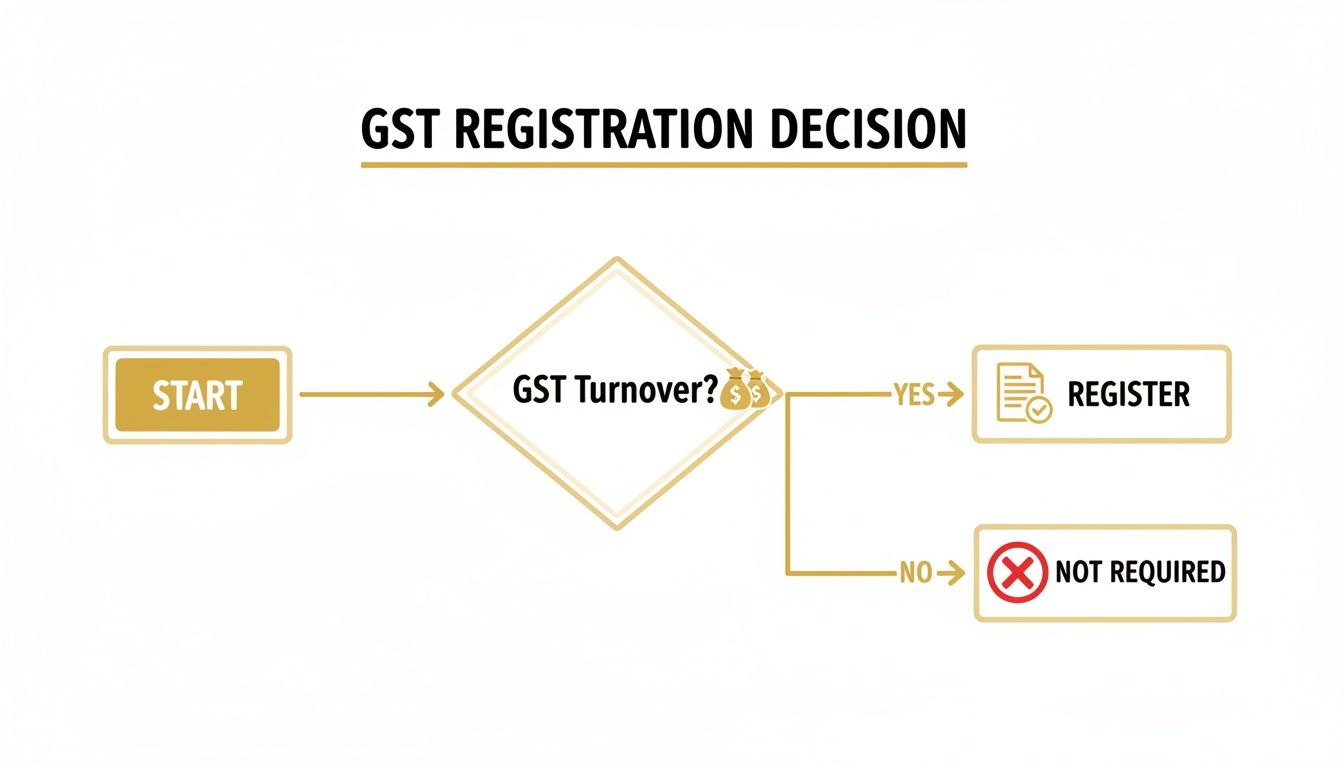
As the infographic shows, it’s a straightforward rule: if your turnover is over the threshold, registration isn’t optional—it’s mandatory.
Calculating Your GST Turnover: What to Include and Exclude
To make it even clearer, here’s a quick reference table to help you figure out what counts towards that $75,000 figure.
| Revenue Type | Include in GST Turnover? | Example |
|---|---|---|
| Sales of Goods & Services | Yes | A bakery selling $80,000 worth of cakes and bread in a year. |
| Export Sales | No | An artist selling paintings to a gallery in New York. |
| Sales of Business Assets | Yes | A courier selling their old delivery van for $10,000. |
| Input-Taxed Sales | No | A landlord receiving residential rent (this is financial supply). |
| Personal Use of Stock | Yes | A cafe owner taking home $100 worth of coffee beans each month. |
| Sale of a Business | No | Selling your entire business as a 'going concern' to a new owner. |
Keeping this table in mind will help you stay on top of your numbers and avoid accidentally crossing the threshold without realising it.
The 21-Day Countdown After You Hit the Threshold
Knowing your turnover is one thing; acting on it is the real test. The moment your business's 'revenue radar' pings to confirm you've crossed the $75,000 threshold—or you can see it's about to happen—a critical timer starts. The Australian Taxation Office (ATO) gives you exactly 21 days to get registered for GST.
Make no mistake, this isn't a friendly suggestion. It’s a hard legal deadline. That 21-day window kicks off the second your GST turnover officially passes the threshold, and ignoring it can lead to some serious financial headaches. We’re talking back-dated GST liabilities and ATO penalties that can chew a hole straight through your profits.
A Real-World Scenario
Let's put this into perspective. Imagine you're a freelance marketing consultant. For months, things have been ticking along nicely at around $6,000 per month. Then, a huge opportunity lands in your lap: two big retainer clients sign on in the same month. Suddenly, your projected annual turnover skyrockets to well over $80,000.
Your 21-day countdown starts from the day you sign those contracts—the point where you can reasonably expect to exceed the threshold. If you put it off and wait a couple of months to register, the ATO will simply backdate your registration to when you should have done it.
This is where the pain starts. It means you owe GST on every single taxable invoice you've sent since that backdated registration date, even if you never actually charged your clients for it. Trying to circle back to a client weeks later to ask for an extra 10% is an awkward, unprofessional conversation nobody wants to have.
The biggest risk of registering late is having to pay the GST out of your own pocket. For a business running on tight margins, an unexpected tax bill for 1/11th of two months' revenue can cause a serious cash flow crisis.
Proactive Strategies to Stay Ahead
Instead of letting the threshold sneak up on you, get out in front of it. Modern accounting software is your best friend here. You can set up custom reports and alerts that act as an early warning system, keeping a close eye on your rolling 12-month turnover.
Here are a few simple, actionable steps to avoid a last-minute scramble:
- Set Revenue Alerts: Jump into your accounting software (Xero or MYOB, for example) and configure an email notification to ping you when your turnover hits a certain point, say, $65,000.
- Monthly Check-ins: Carve out just 15 minutes at the start of each month to review your turnover for the previous 12 months. It's a simple habit that keeps you fully informed and in control.
- Forecast Your Pipeline: If you have a solid sales pipeline with several large projects on the horizon, don't ignore it. Factor this projected income into your calculations to see what's coming.
By understanding the deadline and actively monitoring your revenue, you can turn a potential compliance disaster into a straightforward admin task. You’ll know exactly when the time is right to register for GST and can manage your obligations with complete confidence.
When the $75k Threshold Does Not Apply
While the $75,000 turnover rule is a reliable guide for most businesses, it’s definitely not a one-size-fits-all situation. Certain industries operate under a completely different set of rules, and assuming the standard threshold applies can land you in hot water with the Australian Taxation Office (ATO).
Understanding these exceptions is absolutely critical if you operate in one of these specific sectors. For these businesses, the question of when to register for GST has a completely different answer—often requiring registration from the very first dollar earned.

Rules for Taxi and Ride-Sourcing Services
If your business involves providing taxi, limousine, or ride-sourcing services, the GST rules are strict and immediate. The $75,000 threshold simply does not apply to you. Full stop.
You must register for GST from the moment you start your business, no matter how much you expect to earn. This means if you sign up to drive for a ride-sourcing platform like Uber or DiDi and complete your very first trip, you are legally required to be registered for GST.
For taxi and ride-sourcing drivers, GST registration is not a milestone to be reached; it is a Day One requirement. Failing to register immediately means you are operating outside of tax law from your very first fare.
This special rule exists to ensure a level playing field in the passenger transport industry. You'll also need to issue proper tax invoices and start lodging Business Activity Statements (BAS) to report your GST obligations right away.
Special Threshold for Non-Profit Organisations
Non-profit organisations also play by a different set of rules, but in their case, the threshold is higher, offering a bit more breathing room.
A non-profit is only required to register for GST if its annual turnover hits $150,000 or more. That’s double the standard threshold for for-profit businesses. This higher limit acknowledges the unique community focus of these entities and helps reduce their administrative load.
This higher threshold applies to specific types of organisations:
- Charitable Institutions: This includes any organisation endorsed by the ATO as a charity.
- Trustee of a Charitable Fund: This applies to funds set up purely for charitable purposes.
- Gift Deductible Entities: Any organisation that can receive tax-deductible donations.
- Government Schools: Public primary and secondary schools also fall under this category.
If your non-profit’s turnover stays below $150,000, you don't have to register. However, you can still choose to register voluntarily if it makes financial sense for your organisation—for instance, to claim back the GST credits on significant purchases or expenses.
Voluntary GST Registration: Is It Right for You?
Just because your business turnover is safely below the $75,000 threshold doesn’t mean the GST system is off-limits. For many ambitious businesses, choosing to register for GST voluntarily is a powerful strategic move, not just another tax chore.
Making this call is about more than just compliance; it can seriously impact your cash flow and how other businesses see you in the market. It’s a trade-off, weighing immediate financial perks against new administrative duties. Thinking about this before you’re legally required to is a sign you’re on top of your finances.
The Power of Claiming GST Credits
The single biggest drawcard for voluntary registration is the ability to claim back the GST you pay on business expenses. These are known as GST credits or input tax credits.
Without being registered, that 10% GST you pay on supplies, equipment, and services is just a dead cost that eats into your profit. Once you register, that 10% becomes reclaimable from the ATO.
Let’s say you’re launching a new cafe. The initial fit-out is a huge expense, with big-ticket items like a coffee machine, fridges, and furniture.
- Commercial Espresso Machine: $11,000 (which includes $1,000 in GST)
- Refrigeration Units: $8,800 (including $800 in GST)
- Cafe Furniture & Decor: $5,500 (including $500 in GST)
In this scenario, you've shelled out $2,300 just on the GST component of these essential items. By registering for GST voluntarily from day one, you can claim this entire amount back on your first Business Activity Statement (BAS). That’s a massive cash injection right when a new business needs it the most.
Weighing the Pros and Cons
Voluntary registration isn’t a one-way street. While claiming back GST is a huge win, it comes with extra responsibilities. The main hurdle is the admin workload of tracking GST, reporting it accurately, and lodging your BAS on time. You’ll also need to add 10% GST to your own prices, which could make you less competitive if your customers are mainly individuals who can't claim it back.
Choosing to register for GST is about more than just tax; it’s about positioning your business for growth. It signals to suppliers and larger clients that you're established and operate within the formal tax system, which can seriously boost your credibility.
To help you figure out if it's the right move for you, here’s a straightforward breakdown of the pros and cons.
Voluntary GST Registration Pros vs Cons
| Consideration | Pros (Advantages of Registering) | Cons (Disadvantages of Registering) |
|---|---|---|
| Business Expenses | You can claim back the GST paid on your purchases and operating costs, improving cash flow. | You must track all GST paid and collected, increasing your bookkeeping workload. |
| Pricing & Competition | May not impact B2B sales, as your business clients can claim back the GST you charge. | You must add 10% GST to your prices, potentially making you more expensive for retail customers. |
| Administration | Encourages better financial record-keeping habits from the start. | You are legally required to lodge a Business Activity Statement (BAS) regularly (monthly or quarterly). |
| Business Credibility | An ABN registered for GST can make your business appear more established and professional to larger clients. | Missing BAS lodgement deadlines can result in penalties and interest charges from the ATO. |
Ultimately, the right choice comes down to your specific business model, your customer base, and your plans for the future. If you’re a B2B business or have high startup costs, the benefits of registering early often far outweigh the administrative headaches.
How to Get Your GST Registration Sorted
Alright, so you’ve worked out that you need to register for GST. The next part is mostly admin—think of it as officially putting your hand up and telling the Australian Taxation Office (ATO) that your business is now in the GST club.
To make this painless, it’s a smart move to get all your business details lined up before you start. A bit of prep work here saves a lot of headaches and back-and-forth later.
What You'll Need to Have Ready
Before you jump into the application, pull together these key details. It'll make the whole thing much smoother.
- Your Australian Business Number (ABN): This is non-negotiable. If you don't have an ABN yet, you'll need to sort that out first. Our guide on how to register a business in Australia walks you through it.
- Proof of Identity: You’ll need some basic details to confirm you are who you say you are.
- Business Contact Details: This means your registered business address, phone number, and a good email contact.
- What Your Business Does: Just a straightforward description of your main business activities.
- Projected GST Turnover: Your best estimate of the business's annual income.
- The Start Date: You need to pick the date your GST registration officially kicks in. The good news is this can be backdated if you’ve already shot past the threshold.
The Different Ways to Register
Once you have your info packet ready, you’ve got a few different paths you can take to get registered. Each one is designed for different needs, so you can pick the one that feels right for you.
- Do It Yourself Online: The quickest and most popular route is using the ATO’s online services. You'll use your myGovID linked to the Relationship Authorisation Manager (RAM) to get into the Business Registration Service. It’s a self-service portal that guides you through each step.
- Get a Pro to Handle It: If you're feeling a bit lost or just want to be 100% sure it's done right, using a registered tax or BAS agent is your best bet. They’ll take care of the whole process for you, giving you total peace of mind that it's all correct.
- Give Them a Call: You can also register by phoning the ATO. This is a solid option if you have some specific questions and would rather talk it through with an actual person.
Choosing how to register really comes down to convenience versus confidence. While going online is fast, having a tax professional handle it takes all the guesswork out of the equation. They make sure you’re set up correctly from day one, which can save you from a world of compliance pain down the track.
Life After Registration: Your Ongoing Responsibilities
Flipping the switch to 'GST registered' isn't the finish line; it’s really just the beginning. It introduces a new rhythm into your business operations, where your main job is to balance the GST you collect on sales against the GST you pay on your business buys.
This whole process is managed through your Business Activity Statement (BAS). The simplest way to think about the BAS is as your regular financial check-in with the Australian Taxation Office (ATO). It’s where you report the GST you’ve collected, claim back GST credits on your expenses, and then settle the difference. Getting your head around how to prepare a business activity statement is a core skill for any registered business owner in Australia.
Your Reporting Cycle
Once you're in the system, the ATO will pop you onto a reporting cycle, which just dictates how often you need to lodge your BAS. For most new businesses, this will be a quarterly schedule.
- Quarterly: This is the default setting for most small businesses. You'll lodge your BAS every three months, keeping your compliance manageable without being overwhelming.
- Monthly: If your business has a GST turnover of $20 million or more, the ATO will generally require you to report on a monthly basis.
- Annually: This is much less common and is typically reserved for very small businesses that have registered voluntarily and have a low turnover.
The key here is consistency. Lodging and paying on time, every single time, is non-negotiable. Missing those deadlines can lead to penalties and interest charges that can snowball surprisingly quickly.
A crucial point to remember: once you're registered, you have to lodge a BAS for every single reporting period. This applies even if you had zero business activity. A 'nil' BAS still needs to be filed to let the ATO know what’s going on.
Invoicing and Record Keeping
Your invoicing process will need an immediate upgrade. Every invoice you send to another business must now be a proper tax invoice. This isn't just a suggestion; it's a legal requirement. It means including specific details like your ABN, clearly stating "Tax Invoice," and showing the exact amount of GST charged.
Finally, meticulous record-keeping becomes your new best friend. The law mandates that you hold onto all business records related to your tax obligations for at least five years. This includes every tax invoice and receipt. Think of this documentation as your proof; it’s what you’ll rely on if the ATO ever has questions about your BAS lodgements. Building these habits from day one makes compliance a simple, stress-free part of your business routine.
Common Questions About GST Registration
Even with the clearest roadmap, you're bound to have questions when figuring out your GST obligations. This final section tackles some of the most common queries we hear from business owners, helping you tie up any loose ends.
What Happens if I Register Late?
This is a scenario you want to avoid. If you register for GST late, the Australian Taxation Office (ATO) will backdate your registration to the day you were first required to do so.
What does that mean for you? You’ll be liable for GST on every taxable sale you've made since that backdated start date, even if you never included GST in your prices. On top of that, you could be hit with penalties and interest charges for the delay. The best move is to act fast and get a tax professional involved to help manage the fallout and minimise any financial pain.
Can I Cancel My GST Registration?
Yes, you can, but only in specific situations. Usually, this happens if your business has shut down, been sold, or if your GST turnover has dropped below the $75,000 threshold and you expect it to stay there.
To cancel because of low turnover, you generally need to have been registered for at least 12 months. Be aware that you'll have to lodge a final BAS, and you might have to repay any GST credits you claimed on business assets you still own.
Should I Have a Separate Bank Account for GST?
While it’s not legally required, it’s one of the smartest financial habits you can build.
Opening a separate bank account just for the GST you collect is a game-changer. Think of it as parking the ATO's money somewhere safe. It prevents that money from being accidentally swallowed up by business expenses, making sure it's ready to go when your BAS payment is due.
Putting the GST portion of every sale into a dedicated account makes managing your tax obligations so much less stressful. It stops cash flow surprises dead in their tracks.
Navigating GST registration and staying compliant can feel like a minefield, but you don't have to walk it alone. The team at Australia Wide Tax Solutions offers expert accounting and BAS services to make sure you meet every obligation, accurately and on time. Let us handle the details so you can get back to what you do best: growing your business with complete confidence. https://www.awts.net.au
The ATO provides guidance through ato.gov.au, the Small Business Support Line (13 28 66), and Online Services for individuals and businesses. For complex situations, a registered tax agent provides advice tailored to your specific circumstances and professional indemnity protection. You can verify agent registration at the TPB register at tpb.gov.au.
Most tax records must be kept for five years from the date of lodgement or the date the transaction occurred, whichever is later. Records must be in English or convertible to English and must be sufficient to explain the income and deductions in your return. The ATO can request records at any time during the retention period.
Consider a registered tax agent when your affairs involve multiple income sources, business activity, investment properties, capital gains, or overseas income. Agents extend your lodgement deadline, provide safe harbour protection, and take professional responsibility for the advice given. Verify registration at tpb.gov.au.
The failure to lodge penalty is based on penalty units ($313 per unit from 1 July 2023), accruing per 28-day period for late returns and BAS lodgements. Incorrect information penalties range from 25% to 75% of the tax shortfall depending on whether the behaviour was careless, reckless, or intentional. Proactive disclosure before an audit begins typically results in significantly reduced penalties.
Tax minimisation is the legal arrangement of your affairs to reduce tax — claiming all eligible deductions, using appropriate structures, and timing income and expenses. Tax avoidance involves arrangements that technically comply with the law but achieve outcomes parliament did not intend. The ATO can apply Part IVA anti-avoidance rules to cancel benefits from avoidance arrangements.
In Australia, knowing when to register for GST is a critical step for any growing business. The main trigger is your turnover: once your business hits $75,000 or more in a 12-month period, the clock starts ticking. You have just 21 days to get registered with the Australian Taxation Office (ATO).
- The $75,000 Threshold Explained
- The Rideshare and Taxi Driver Exception
- When to Register Based on Future Projections
- Should You Register for GST Voluntarily?
- How to Complete Your GST Registration
The $75,000 Threshold Explained
The magic number for GST registration is $75,000. But this isn't about your profit or a single big sale; it's your GST turnover. Think of this as the total gross income your business generates before taking out any expenses, and it doesn't include any GST you've already collected on sales.
It’s a rolling tally, not just something you check at the end of the financial year. You need to keep an eye on your income continuously.
Once you realise your turnover is going to cross that threshold, the ATO gives you a tight 21-day window to register. Missing this deadline isn't something to take lightly. In the 2022-23 financial year, businesses who were late faced average penalties of around $1,100. It’s a costly oversight.
This flowchart breaks down the key questions to help you figure out if you need to register.

As you can see, while turnover is the main driver, some industries—like ridesharing—play by a completely different set of rules and have to register from their first dollar earned.
Calculating Your GST Turnover
So, what exactly counts towards your GST turnover? It’s pretty broad and includes the total value of almost everything your business supplies.
It’s crucial to understand what goes into the calculation:
- All business income: This means revenue from your main operations, any side hustles, and even the sale of some business assets.
- Projected income: This is a big one. If you have good reason to believe your turnover will hit $75,000 in the next 12 months, you need to register now. You can't wait until you've already passed the mark.
However, a few specific types of sales are excluded from this calculation. Getting this right is fundamental, as it directly impacts your tax obligations and ultimately determines who pays GST on your transactions.
Quick Guide to GST Registration Thresholds
To make it simple, here's a quick summary of the main turnover thresholds that trigger mandatory GST registration in Australia.
| Entity Type | Annual GST Turnover Threshold | Registration Deadline |
|---|---|---|
| Most Businesses | $75,000 or more | Within 21 days of reaching the threshold |
| Non-Profit Organisations | $150,000 or more | Within 21 days of reaching the threshold |
| Taxi & Ridesharing | $1 (from the first dollar) | Before starting the service |
These thresholds are the primary triggers, but always remember to monitor your turnover closely to avoid any unexpected surprises from the ATO.
The Rideshare and Taxi Driver Exception
While the $75,000 turnover rule is a solid benchmark for most businesses, there's a huge exception that trips a lot of people up. If you're providing taxi, limousine, or rideshare services, you can forget about the standard GST threshold. It simply doesn't apply.
There's no grace period and no minimum income you need to hit first.
This means you are legally required to register for GST from the very first dollar you earn. Let's say you're an Uber driver in Chippendale, Sydney, and your first day on the road nets you $100. Boom. You need to be registered for GST.

This zero-dollar rule has been in place since 2016, designed to level the playing field between traditional taxis and the booming gig economy. With over 100,000 active rideshare drivers by 2023, this policy ensures the 10% GST is collected on every single fare—a move that brought in an estimated $200 million in extra GST collections in its first year alone. You can get more specific details about this requirement on Stripe's resource page.
Ultimately, this immediate registration requirement makes sure everyone in the passenger transport game plays by the same tax rules.
Another Important Exception
Beyond ridesharing, there’s one more key scenario where you must register for GST, no matter what your turnover is. This one applies to any business that wants to claim fuel tax credits.
If your business runs on fuel—think transport, construction, or agriculture—then registering for GST is the only way you can claim back the tax you pay at the pump. This can be a massive cost-saving measure for fuel-heavy operations, making voluntary GST registration a very smart financial move, even if you're well under the $75,000 threshold.
When to Register Based on Future Projections
Knowing when you need to register for GST isn’t just about looking back at what you've already sold; you also have to look ahead. The Australian Taxation Office (ATO) has what’s called a 'forward-looking test', which means you must register if you project your GST turnover will hit or pass the $75,000 threshold in the current month plus the next 11 months.
This is a critical rule, especially for businesses on a growth spurt. Think about a new startup with a killer business plan, a company launching a hot new product, or any business that's suddenly seeing a surge in demand. In all these cases, you have to consider your future earnings, not just what's already in the bank.
Get this wrong, and you could be in for a nasty surprise. The ATO can backdate your registration to the day you should have registered. This leaves you on the hook for GST on sales you’ve already made—even if you never charged it to your customers.

Forecasting for Compliance
So, how does this play out in the real world? Let’s say you’re starting a new import business in Queensland. Your financial forecasts clearly show you’ll breeze past $75,000 in your first year. Under the ATO rules, you can't wait until you hit the magic number; you have to register for GST right from day one.
This prospective test is a key part of GST compliance. In 2023, ATO data showed that about 15% of new business audits were triggered by underestimated growth projections, leading to $150 million in recovered GST.
The penalties for getting this wrong aren't trivial, often averaging 25% of the GST shortfall. This really drives home the importance of accurate forecasting as a tool for staying on the right side of the tax office, a topic you can dive deeper into with guides on Australian GST. A bit of forward-thinking now can save you from a world of unexpected tax bills and penalties later on.
Should You Register for GST Voluntarily?
What if your business is comfortably sitting below the $75,000 threshold? The ATO doesn't require you to register for GST, but you still have the option to do so voluntarily. For some businesses, this is a surprisingly savvy move that can unlock significant financial benefits right from the start.
But it’s not a decision to jump into without a second thought. Voluntary registration comes with its own set of pros and cons, and whether it’s the right call really boils down to your specific business model, your expenses, and how much admin you're prepared to handle. It's a classic trade-off: claiming back tax versus taking on more paperwork.
The single biggest drawcard is the ability to claim GST credits. This means you can get a refund for the 10% GST baked into the price of goods and services you buy for your business.
Weighing the Pros and Cons
Imagine a freelance graphic designer who needs to splash out on a new high-end computer and a suite of expensive software. By registering for GST, they can claim back the GST portion of that chunky purchase, potentially putting hundreds of dollars back in their pocket. Likewise, a new café buying ovens, coffee machines, and furniture can reclaim a substantial amount through GST credits.
Registering voluntarily allows eligible businesses to claim credits for the GST they pay on expenses. This can seriously reduce your net tax bill, especially for businesses with high initial setup costs or hefty ongoing operational expenses.
On the flip side, the main drawback is the extra administrative load. Once you’re in the GST system, you have to start lodging regular Business Activity Statements (BAS) with the ATO. This demands meticulous record-keeping and can be a real time-sink if you’re not prepared.
Another key thing to think about is your pricing. When you're registered, you must charge GST on your sales. This bumps up your prices by 10%, which could make you less competitive, especially if your customers are individuals or other small businesses that aren't registered for GST themselves.
Here’s a quick breakdown to help you decide:
- Consider registering if: You have high business setup costs, you regularly buy expensive equipment, or you mainly sell to other GST-registered businesses (because they can claim back the GST you charge them).
- Maybe hold off if: Your customers are mostly the general public, your business expenses are low, or you just don't have the systems in place yet to handle regular BAS reporting.
Ultimately, deciding to register for GST voluntarily is a strategic choice. It’s all about weighing the cash flow boost from GST credits against the complexity of BAS lodgements and the potential hit to your pricing structure.
How to Complete Your GST Registration
So, you've figured out you need to register for GST. The good news is, getting it done is pretty straightforward.
First thing's first: you absolutely must have an Australian Business Number (ABN). This 11-digit number is your business's unique identifier for everything tax-related. If you don't have one yet, it's the very first box to tick. We cover the whole process in our guide to registering an Australian Business Number (ABN) in Australia.
With your ABN in hand, you've got a few ways to get your GST registration sorted. Think of it like choosing your own adventure – pick the path that feels right for your business.
Your Registration Options
You can go directly through the Australian Taxation Office (ATO) or have a professional handle it for you.
- Online via the ATO Business Portal: This is easily the quickest route for most business owners. You can simply add GST registration to your existing ABN details through the Business Portal or the Australian Business Register.
- Through a Registered Agent: Many business owners prefer to leave it to the experts. When you consult an accountant or a registered BAS agent, they can manage the registration for you. This is a great way to ensure every detail is spot on from day one.
- Over the Phone: It’s also possible to register by calling the ATO. Just be prepared that this option can sometimes involve a bit of a wait.
No matter which path you take, being prepared is key. Having your information ready before you start will save you a world of time and potential headaches down the line.
You’ll need to have your ABN and proof of identity, like your tax file number (TFN), ready to go. The ATO will also ask for details about your business structure (are you a sole trader, company, etc.?) and your estimated GST turnover. Finally, they'll need your preferred start date for GST registration, which is usually the date you realised you'd crossed the threshold.
Life After Registration: Your Ongoing Obligations
Deciding when you need to register for GST is the first big step, but it’s definitely not the last. Once you're on the books, your business takes on a new set of ongoing responsibilities to stay compliant with the Australian Taxation Office (ATO). It’s a shift in how you operate day-to-day.
From the moment you're registered, you must start including an additional 10% GST on the price of all your taxable sales. This isn't optional anymore; it becomes a fundamental part of your pricing and how you invoice your customers.
Your Core Duties
Your main ongoing task is lodging a Business Activity Statement (BAS). This is the ATO's form for reporting and paying taxes, and it's where you'll balance the GST you’ve collected against the GST you’ve paid on your own business expenses.
Think of a BAS as your regular tax check-in with the ATO. It adds up the GST collected from your customers and then subtracts the GST credits you can claim on your business purchases. You only pay the difference.
Getting this right hinges on diligent record-keeping. You'll need to issue proper tax invoices that clearly show the GST amount and keep a clean, detailed trail of all your income and expenses. This isn’t just good practice—it’s crucial for preparing your BAS accurately.
For a deeper dive into what’s involved, you can learn more about what a BAS is in accounting to get fully prepared. Nailing these obligations from the start is the key to a stress-free relationship with the ATO and keeps your business finances in good health.
Common GST Registration Questions
Once you get your head around the basics, a few specific "what if" scenarios always seem to pop up. Let's tackle some of the most common questions business owners ask us about GST registration.
What Happens If I Register for GST Late?
Don't let this one slip. If you register late, the ATO has the power to backdate your registration to the day you were first required to be registered.
This means you could suddenly owe GST on sales you made weeks or even months ago—even if you never charged it to your customers. On top of that, you can expect penalties and interest charges for late lodgement. Getting it right from the start is crucial.
Do Overseas Sales Count Towards the Threshold?
Yes, they absolutely do. Any income you earn from overseas clients is generally included when calculating your GST turnover. This is a common tripwire for freelancers and online businesses.
The twist is that once you're registered, these international sales are typically considered 'GST-free'. So, while they push you over the $75,000 threshold, you don't actually charge GST on those specific invoices.
Can I Cancel My GST Registration?
You can, but there are a couple of conditions. If your turnover drops below the $75,000 threshold and you're confident it will stay there, you can apply to cancel your registration.
The main rule to remember is that you must have been registered for at least 12 months before the ATO will let you cancel.
The ATO provides guidance through ato.gov.au, the Small Business Support Line (13 28 66), and Online Services for individuals and businesses. For complex situations, a registered tax agent provides advice tailored to your specific circumstances and professional indemnity protection. You can verify agent registration at the TPB register at tpb.gov.au.
Most tax records must be kept for five years from the date of lodgement or the date the transaction occurred, whichever is later. Records must be in English or convertible to English and must be sufficient to explain the income and deductions in your return. The ATO can request records at any time during the retention period.
Consider a registered tax agent when your affairs involve multiple income sources, business activity, investment properties, capital gains, or overseas income. Agents extend your lodgement deadline, provide safe harbour protection, and take professional responsibility for the advice given. Verify registration at tpb.gov.au.
The failure to lodge penalty is based on penalty units ($313 per unit from 1 July 2023), accruing per 28-day period for late returns and BAS lodgements. Incorrect information penalties range from 25% to 75% of the tax shortfall depending on whether the behaviour was careless, reckless, or intentional. Proactive disclosure before an audit begins typically results in significantly reduced penalties.
Tax minimisation is the legal arrangement of your affairs to reduce tax — claiming all eligible deductions, using appropriate structures, and timing income and expenses. Tax avoidance involves arrangements that technically comply with the law but achieve outcomes parliament did not intend. The ATO can apply Part IVA anti-avoidance rules to cancel benefits from avoidance arrangements.
Navigating GST obligations can feel like a maze, but you don't have to figure it out alone. Australia Wide Tax Solutions offers expert BAS preparation and accounting support to keep your business compliant and stress-free. Let our team handle the details so you can focus on what you do best.
Contact us today for a consultation.
For any Australian business owner, the term Business Activity Statement (BAS) quickly becomes part of your vocabulary. But what is it, really? Think of it as your business's regular tax report card. It’s the official form you send to the Australian Taxation Office (ATO) to report and pay for several key taxes in one go, keeping everything neat and tidy.Demystifying the Business Activity Statement

- Goods and Services Tax (GST): This is the main event—balancing the GST you’ve collected against the GST credits you can claim.
- Pay As You Go (PAYG) Withholding: This is the income tax you’ve withheld from your employees' wages.
- Pay As You Go (PAYG) Instalments: These are the regular prepayments you make towards your business's own income tax bill.
- Other taxes: For some businesses, it might also include things like luxury car tax or wine equalisation tax.
Understanding the Core Components of Your BAS

Goods and Services Tax (GST)
This is the heart of your BAS. Managing your GST comes down to two simple figures:- GST on Sales: This is all the GST you’ve collected from your customers. If you sell a product for $110, you’ve collected $10 in GST on behalf of the ATO. Your BAS is where you report the grand total you've collected from all your sales.
- GST Credits: This is the flip side – the GST you paid on your business-related purchases. When you buy stock, pay for fuel, or purchase new equipment, you pay GST to your suppliers. You can claim these amounts back as credits, which directly reduces the tax you have to pay.
Pay As You Go (PAYG) Withholding
This section is for you if you have employees. PAYG Withholding is the tax you are legally required to hold back from your employees' wages and salaries each pay run. You’re essentially acting as a collection agent for the tax office here. This money doesn’t belong to your business; it belongs to the ATO. Your BAS is the official report where you declare the total amount you’ve withheld, making sure you pass those funds on correctly. It’s a crucial process that helps your team meet their personal income tax obligations throughout the year.The BAS is more than just a tax form; it’s a snapshot of your business operations. It reflects your sales, your purchases, and your role as an employer, all in one document.
Pay As You Go (PAYG) Instalments
For many businesses, the BAS also includes PAYG Instalments. Now, this is a different beast from withholding. This is how your business pays its own estimated income tax in smaller, more manageable chunks during the year, instead of facing one massive bill after lodging your annual tax return. It’s a way to smooth out your cash flow and stay on top of your own tax obligations. To get a better handle on the specifics, you can read our detailed guide on what is a PAYG instalment. By reporting these components accurately, you keep your business compliant and maintain a clear, up-to-date financial picture with the ATO. The various labels on the BAS form can be confusing at first glance. This table breaks down what some of the most common ones actually mean for your business.Key Sections on a Typical BAS Form Explained
| BAS Label | What It Means | Example for a Small Business |
|---|---|---|
| G1 | Total Sales | The total revenue your business earned during the period, including any GST. |
| 1A | GST on Sales | The portion of your total sales (G1) that is GST. For most items, this is G1 divided by 11. |
| 1B | GST on Purchases | The total GST you paid on business-related expenses and assets. This is what you claim back. |
| W1 | Total salary, wages, and other payments | The gross amount you paid to your employees before any tax was withheld. |
| W2 | Amount withheld from salaries... | The total income tax you held back from your employees' pay (from W1). |
Your BAS Lodgement Schedule and Deadlines
Let's be blunt: missing a Business Activity Statement deadline is a surefire way to get unwanted attention from the ATO. The frequency you need to lodge—monthly, quarterly, or annually—all comes down to your business's turnover. For most small businesses, the quarterly cycle is the standard rhythm of their financial year. Knowing your schedule is the first, most critical step towards staying compliant. If your GST turnover is less than $20 million, you’ll almost certainly be lodging quarterly. This gives you a predictable routine for managing your tax obligations without the pressure of monthly reporting. For the big players with a GST turnover of $20 million or more, the ATO wants to hear from you monthly. It’s all about keeping a tighter rein on larger tax liabilities. On the flip side, some very small businesses might only need to report annually, which massively simplifies things for them.Standard Quarterly Deadlines
Most businesses run on the quarterly clock. Pop these dates in your calendar right now—they’re non-negotiable.- Quarter 1 (July, August, September): Due 28 October
- Quarter 2 (October, November, December): Due 28 February
- Quarter 3 (January, February, March): Due 28 April
- Quarter 4 (April, May, June): Due 28 July
When you work with a registered tax or BAS agent, you often get access to lodgement extensions. This isn’t a loophole; it’s a professional courtesy from the ATO that gives you precious extra time to get your numbers right. For example, that 28 October deadline can often be pushed to late November.
The Value of Professional Support
It’s not just about the extra time. A good agent ensures your figures are accurate, saving you from costly mistakes and future headaches. With the tax industry facing an aging workforce—where 65% of individual BAS agents are over 50—finding a reliable, long-term expert is more important than ever for your business's stability. You can get a sense of these trends by looking at the demographics shaping the Australian tax industry. A professional helps you cut through the complexity of the BAS system and makes sure you hit every deadline without the stress. To see what’s involved, a great starting point is our BAS preparation checklist, which breaks down the key steps for a smooth lodgement.A Practical Walkthrough of Your BAS Calculation
Theory is one thing, but seeing the numbers in action is where it all clicks. Let’s walk through a typical quarterly BAS for a fictional freelance graphic designer, Chloe, to turn the abstract rules into a real-world process. During the July to September quarter, Chloe had a solid run. Her total sales for graphic design services hit $22,000. Because all her services are subject to GST, we need to work out how much of that she collected for the ATO. The calculation is pretty simple: $22,000 / 11 = $2,000. This $2,000 is her GST liability, which gets reported at label 1A on the BAS form.Tallying Up Business Expenses
Of course, Chloe didn't just bank all that money. She had expenses to keep her business running. She bought a new graphics tablet, paid for professional software subscriptions, and covered the electricity for her home office. Her total business purchases for the quarter came to $5,500 (GST inclusive). To find the GST she paid on these items, we use the same formula: $5,500 / 11 = $500. This $500 represents her GST credits (reported at label 1B), which she can claim back from the ATO.At its heart, your BAS calculation is just a simple subtraction: the GST you collected from sales minus the GST you paid on your business purchases. The result tells you whether you owe the ATO money or if you're getting a refund.The diagram below shows the standard reporting timelines, which usually depend on your business's annual turnover.

The Final Calculation
Now, let's bring the two key figures together to get the final number.- GST Collected (1A): $2,000
- GST Paid (1B): $500
How Your BAS Helps Shape the Australian Economy
Lodging your Business Activity Statement can feel like just another bit of paperwork, but it's so much more than a simple compliance chore. The numbers you report are actually a crucial piece of a much larger puzzle, giving policymakers a real-time snapshot of the nation's economic health. Think of it like this: each business lodging a BAS adds a single, vital pixel to a high-resolution image of the Australian economy. Without your piece, the picture is incomplete. Government bodies, especially the Australian Bureau of Statistics (ABS), collect and aggregate the turnover data from countless BAS reports. This ocean of information is then used to track how different industries are performing, spot emerging growth sectors, and get a handle on consumer spending habits. It’s one of the key metrics that informs massive decisions on everything from interest rates to major infrastructure projects.A Key Economic Barometer
The ABS transforms this raw data into some of the country's most important economic indicators. While your BAS turnover is mainly about sorting out GST, on a macro level, it serves as an incredibly timely signal of business activity across the country. The data primarily comes from corporations with a GST turnover above $20 million, but it also captures information from smaller businesses that report monthly. You can get a deeper look into how the ABS uses this business data on their website.By lodging your BAS, you’re not just settling up with the tax office. You're an active participant in the national economic conversation, feeding in the real-world data that shapes government policy and financial forecasts.Once you understand this bigger context, the whole process takes on new meaning. Your routine accounting work stops being just a task and becomes a genuine contribution to painting a clear and current portrait of Australia's economic landscape.
Common BAS Questions Answered
When you're running a business, navigating the world of BAS can throw up some practical questions. Let's tackle some of the most common queries we hear from business owners to give you clear, straightforward answers.What Happens If I Make a Mistake on My BAS?
First off, don't panic. Discovering an error on a BAS you've already lodged is a surprisingly common scenario. The Australian Taxation Office (ATO) has clear procedures in place for corrections. For small, simple errors, you can often just make an adjustment on your next BAS. However, if it's a more significant mistake or it relates to an older statement, you'll probably need to file a formal BAS amendment. The most important thing is to act as soon as you find the mistake—this can help minimise any potential penalties or interest charges from the ATO.The smartest way to handle any BAS correction is to get professional advice. A registered agent can make sure the amendment is lodged correctly, preventing any further headaches and giving you complete peace of mind.
Do I Need to Lodge a BAS with No Business Activity?
Yes, absolutely. This is a non-negotiable rule from the ATO. If your business is registered for GST, you are required to lodge a BAS for every single reporting period. It doesn't matter if you had zero sales and made zero purchases. This is called lodging a "nil" BAS, where you simply enter zeros in the relevant fields. It’s a quick process but an incredibly important one. Failing to lodge, even for an inactive period, can lead to the ATO hitting you with penalties for non-lodgement. It’s a simple step that keeps your compliance record clean.What Is the Difference Between a BAS Agent and a Tax Agent?
While both are registered tax professionals, they specialise in different areas. Think of it like the difference between a GP and a specialist doctor. A BAS Agent is specifically authorised to advise on and manage all your BAS-related obligations. Their expertise covers:- Goods and Services Tax (GST)
- Pay As You Go (PAYG) Withholding
- Other indirect taxes like fuel tax credits
Navigating BAS requirements doesn't have to be something you tackle alone. The team at Australia Wide Tax Solutions can manage your BAS preparation and lodgement, ensuring everything is accurate and on time so you can get back to focusing on your business. Find out how we can help at https://www.awts.net.au.
The ATO provides guidance through ato.gov.au, the Small Business Support Line (13 28 66), and Online Services for individuals and businesses. For complex situations, a registered tax agent provides advice tailored to your specific circumstances and professional indemnity protection. You can verify agent registration at the TPB register at tpb.gov.au.
Most tax records must be kept for five years from the date of lodgement or the date the transaction occurred, whichever is later. Records must be in English or convertible to English and must be sufficient to explain the income and deductions in your return. The ATO can request records at any time during the retention period.
Consider a registered tax agent when your affairs involve multiple income sources, business activity, investment properties, capital gains, or overseas income. Agents extend your lodgement deadline, provide safe harbour protection, and take professional responsibility for the advice given. Verify registration at tpb.gov.au.
The failure to lodge penalty is based on penalty units ($313 per unit from 1 July 2023), accruing per 28-day period for late returns and BAS lodgements. Incorrect information penalties range from 25% to 75% of the tax shortfall depending on whether the behaviour was careless, reckless, or intentional. Proactive disclosure before an audit begins typically results in significantly reduced penalties.
Tax minimisation is the legal arrangement of your affairs to reduce tax — claiming all eligible deductions, using appropriate structures, and timing income and expenses. Tax avoidance involves arrangements that technically comply with the law but achieve outcomes parliament did not intend. The ATO can apply Part IVA anti-avoidance rules to cancel benefits from avoidance arrangements.
The Ins and Outs of Collecting and Paying GST in Australia
Welcome to our comprehensive guide on collecting and paying Goods and Services Tax (GST) in Australia. In this blog post, we will delve into the intricacies of GST, its importance, and how it affects businesses and consumers alike. Whether you are a business owner or an individual looking to understand the GST system better, this post will provide you with the necessary knowledge to navigate the world of GST in Australia.
- The Ins and Outs of Collecting and Paying GST in Australia
- Section 1: Understanding Goods and Services Tax (GST)
- Section 2: Businesses and GST Registration
- Section 3: Collecting GST
- Section 4: Reporting and Lodging BAS
Section 1: Understanding Goods and Services Tax (GST)
GST is a broad-based tax levied on the supply of most goods, services, and anything else consumed or sold in Australia. The Australian Taxation Office (ATO) administers the GST system, which plays a vital role in funding the government's activities and services. The current GST rate in Australia is 10%, which is calculated based on the price of goods or services provided.
Section 2: Businesses and GST Registration
GST Registration Threshold:
Businesses with an annual turnover of $75,000 or more are required to register for GST. However, for non-profit organizations, the threshold is $150,000. It is important to note that even if your turnover is below these thresholds, you can still choose to register for GST voluntarily.
Benefits of GST Registration:
Registering for GST offers several benefits to businesses, including:
- Input Tax Credits: Registered businesses can claim input tax credits for the GST they pay on purchases related to their business activities. This helps reduce the overall GST liability.
- Professional Image: Being registered for GST can enhance your credibility and professionalism in the eyes of your customers or clients.
- Tax Invoices: Registered businesses are required to issue tax invoices to their customers for sales over $82.50 (including GST). This allows businesses to claim input tax credits on their purchases.
Section 3: Collecting GST
Tax Invoices and Record Keeping:
When collecting GST, businesses must issue a tax invoice that complies with the ATO's requirements. A valid tax invoice should include specific details such as the seller's name and ABN, a description of the goods or services supplied, the price including GST, and more. Businesses must maintain accurate records of their sales and purchases to ensure compliance with GST regulations.
Timing of GST Collection:
Businesses must collect GST at the time of making a taxable sale. The total amount collected should be displayed on tax invoices and separate from the price of goods or services. It is important to note that businesses cannot claim GST on sales until they have remitted the collected GST to the ATO.
Section 4: Reporting and Lodging BAS
Business Activity Statement (BAS):
A BAS is a form used by businesses to report their GST obligations to the ATO. It includes information about sales, purchases, and other relevant financial details. Registered businesses are required to lodge BAS either monthly, quarterly, or annually, depending on their turnover and reporting obligations.
Reporting GST on BAS:
When reporting GST on BAS, businesses need to calculate the difference between the total GST collected from sales and the total GST paid on purchases during the reporting period. This determines whether a business owes additional GST or is eligible for a refund.
Lodging BAS:
BAS can be lodged online using the ATO's Business Portal or through accounting software that is compatible with the ATO's system. It is crucial to lodge BAS on time to avoid penalties or interest charges.
Section 5: Paying GST
Payment Due Dates:
The due date for paying GST depends on the reporting period chosen by the business. For monthly lodgers, the payment is due by the 21st day of the following month. For quarterly lodgers, it is due by the 28th day after the end of each quarter. For annual lodgers, payment is due by the 28th day after the end of the financial year.
Payment Methods:
Businesses can choose from various payment methods to remit their GST liabilities, including online payments through the ATO portal, direct debit, credit card, BPAY, or in-person at Australia Post.
Late Payment Consequences:
Late payment of GST can result in penalties and interest charges imposed by the ATO. Businesses must pay their GST liabilities on time to avoid additional costs and potential audits.
Section 6: Special Cases and Exemptions
GST-Free Supplies:
Certain goods and services are exempt from GST and are referred to as "GST-free supplies." Some examples include basic food items, medical services, education courses, and some exports.
Input Taxed Supplies:
Input-taxed supplies are transactions that do not attract GST. Examples include financial services such as bank fees, residential rental income, and some types of insurance.
International Transactions:
When dealing with international transactions, different rules apply regarding GST collection and payment. Exported goods and services are generally not subject to GST, while imported goods may attract customs duties and other taxes.
Section 7: Record-Keeping Requirements
To ensure compliance with GST regulations, businesses must maintain accurate records related to their sales, purchases, tax invoices, BAS statements, payment receipts, and any other relevant documents. These records should be kept for at least five years in case of audits or ATO inquiries.
Section 8: Penalties and Audits
The ATO conducts regular audits to ensure businesses are complying with their GST obligations. Non-compliance can result in penalties ranging from fines to criminal charges in severe cases of intentional fraud or evasion. Businesses need to maintain proper records, lodge BAS on time, and seek professional advice if uncertain about any aspect of their GST obligations.
Conclusion:
Understanding the ins and outs of collecting and paying GST in Australia is essential for both businesses and individuals alike. By adhering to the GST regulations set by the ATO, businesses can ensure compliance while maximizing their input tax credits. Individuals can also benefit from understanding how GST impacts their purchases and transactions. We hope this comprehensive guide has provided you with valuable insights into navigating the world of GST in Australia. Remember to consult with a qualified tax professional for personalized advice regarding your specific circumstances.
Any business with a GST turnover of $75,000 or more (or $150,000 for non-profits) must register for GST. Ride-share and taxi drivers must register regardless of turnover. Businesses below the threshold can register voluntarily, which may be beneficial when dealing with GST-registered clients or claiming input tax credits on purchases.
To find the GST in a GST-inclusive price, divide the total by 11. To add GST to an exclusive price, multiply by 0.1. GST is currently 10% of the taxable supply value. Always confirm whether a supply is taxable, GST-free, or input-taxed before applying the calculation.
A GST-free supply (most fresh food, health services, exports) has no GST charged, but the supplier can still claim input tax credits on related purchases. An input-taxed supply (residential rent, financial services) also has no GST charged, but the supplier cannot claim input tax credits on purchases related to that supply.
Most businesses lodge a BAS quarterly. Businesses with turnover above $20 million must lodge monthly. Smaller businesses may elect to lodge annually if they meet eligibility criteria. The reporting period determines when GST collected is remitted and when input tax credits can be claimed.
Keep tax invoices for all business purchases over $82.50 (GST-inclusive) on which you claim input tax credits. Records must show the supplier's ABN, the GST amount, and a description of the goods or services. The ATO requires GST records to be kept for five years. Missing invoices are the most common cause of disallowed credits in audits.
A Comprehensive Guide to Registering an Australian Business Number (ABN)
- Introduction
- Section 1: What is an ABN?
- Section 2: Benefits of having an ABN
- Section 3: Eligibility Criteria for ABN Registration
- Section 4: Step-by-Step Guide to Registering an ABN
Introduction
Are you planning to start a business in Australia? One of the first steps you need to take is registering for an Australian Business Number (ABN). An ABN is a unique 11-digit identifier that allows you to conduct business legally in Australia. In this comprehensive guide, we will walk you through the process of registering an ABN, its benefits, eligibility criteria, and important considerations to keep in mind.
Section 1: What is an ABN?
Before we dive into the registration process, let's understand what an ABN is. An ABN is a unique identifier issued by the Australian Taxation Office (ATO) to businesses and organizations operating in Australia. It serves as a universal identification number for businesses, enabling them to interact with government agencies, suppliers, and customers.
Section 2: Benefits of having an ABN
Having an ABN offers several benefits for your business:
2.1 Taxation and GST
With an ABN, you can register for Goods and Services Tax (GST), which is a broad-based tax of 10% on most goods, services, and other items sold or consumed in Australia. By registering for GST, you can claim input tax credits for the GST included in your business purchases.
2.2 Credibility and Professionalism
Having an ABN adds credibility and professionalism to your business. Customers and clients often prefer to deal with businesses that have a registered ABN, as it signifies that the business is legitimate and compliant with Australian regulations.
2.3 Access to Government Contracts
Many government contracts require businesses to have a valid ABN. By registering for an ABN, you can unlock opportunities to bid for government contracts and expand your business prospects.
2.4 Claiming Business Expenses
An ABN allows you to claim business expenses and deductions related to your business activities. This can help reduce your taxable income and potentially save you money.
2.5 Simplified Business Transactions
With an ABN, you can easily identify your business when dealing with other businesses, suppliers, or customers. It simplifies transactions and streamlines administrative processes.
Section 3: Eligibility Criteria for ABN Registration
To be eligible for an ABN, you must meet the following criteria:
3.1 Operating a Business
You must be operating a genuine business or intending to start one. A business is defined as any activity conducted with the intention of making a profit.
3.2 Australian Business Structure
You must have an appropriate business structure in Australia. This can include sole traders, partnerships, companies, or trusts.
3.3 Tax Obligations
You must have met all your tax obligations, including lodging any outstanding tax returns and paying any outstanding debts.
3.4 Identity Verification
You must provide accurate identification details and satisfy the identity verification requirements as set by the ATO.
Section 4: Step-by-Step Guide to Registering an ABN
4.1 Gather Required Information
Before starting the registration process, gather the following information:
- Personal details (name, date of birth, address)
- Business details (name, address)
- Business activity description
- Estimated annual turnover
- Contact details (phone number, email)
4.2 Determine the Appropriate Business Structure
Choose the appropriate business structure based on your needs and preferences. The most common structures include sole trader, partnership, company, and trust.
4.3 Online Registration
The easiest and quickest way to register for an ABN is through the online registration portal provided by the ATO. Visit their website (www.abr.gov.au) and follow the step-by-step instructions to complete the registration form.
4.4 Provide Business Activity Details
In the registration form, you will be required to provide detailed information about your business activities. This includes the nature of your business, products or services offered, and the industry in which you operate.
4.5 Provide Personal Information
Fill in your personal details accurately, including your full name, date of birth, residential address, and contact information.
4.6 Provide Business Address Details
Enter the address where your business is located or where your records are kept. This can be a physical address or a registered office address.
4.7 Provide Contact Details
Include your phone number and email address so that the ATO can contact you regarding your ABN registration if needed.
4.8 Estimated Annual Turnover
Provide an estimate of your expected annual turnover. This helps the ATO determine whether you are eligible for certain tax obligations such as GST registration.
4.9 Submit the Application
Review all the information provided and submit your application. You will receive a reference number once your application has been successfully lodged.
4.10 Await Confirmation
The ATO will review your application and may contact you if additional information is required. Once approved, you will receive your ABN via email or post within a few days.
Section 5: Important Considerations
5.1 GST Registration
After obtaining an ABN, you may need to register for GST if your annual turnover exceeds $75,000 (or $150,000 for non-profit organizations). GST registration requires additional reporting obligations and may affect how you price your goods or services.
5.2 Ongoing Obligations
Once registered for an ABN, it is important to comply with ongoing obligations such as updating your business details with the ATO, lodging activity statements, and fulfilling tax obligations.
5.3 ABN Renewal
ABNs are not issued with an expiry date but may be canceled if they are inactive for a certain period of time. To ensure continuity in your business operations, regularly review and update your ABN details as necessary.
5.4 Seek Professional Advice
If you have any doubts or concerns during the registration process or about managing your ABN afterward, it is advisable to seek guidance from a qualified accountant or business advisor who can provide tailored advice based on your specific circumstances.
Conclusion
Registering an ABN is a crucial step for any business operating in Australia. It not only provides numerous benefits but also ensures compliance with taxation and regulatory requirements. By following this comprehensive guide and meeting the eligibility criteria, you can successfully register for an ABN and set yourself up for success in the Australian business landscape. Remember to stay updated on any changes or obligations related to your ABN to ensure smooth operations in the long run.
The ATO provides guidance through ato.gov.au, the Small Business Support Line (13 28 66), and Online Services for individuals and businesses. For complex situations, a registered tax agent provides advice tailored to your specific circumstances and professional indemnity protection. You can verify agent registration at the TPB register at tpb.gov.au.
Most tax records must be kept for five years from the date of lodgement or the date the transaction occurred, whichever is later. Records must be in English or convertible to English and must be sufficient to explain the income and deductions in your return. The ATO can request records at any time during the retention period.
Consider a registered tax agent when your affairs involve multiple income sources, business activity, investment properties, capital gains, or overseas income. Agents extend your lodgement deadline, provide safe harbour protection, and take professional responsibility for the advice given. Verify registration at tpb.gov.au.
The failure to lodge penalty is based on penalty units ($313 per unit from 1 July 2023), accruing per 28-day period for late returns and BAS lodgements. Incorrect information penalties range from 25% to 75% of the tax shortfall depending on whether the behaviour was careless, reckless, or intentional. Proactive disclosure before an audit begins typically results in significantly reduced penalties.
Tax minimisation is the legal arrangement of your affairs to reduce tax — claiming all eligible deductions, using appropriate structures, and timing income and expenses. Tax avoidance involves arrangements that technically comply with the law but achieve outcomes parliament did not intend. The ATO can apply Part IVA anti-avoidance rules to cancel benefits from avoidance arrangements.