
When it comes to paying off your HECS-HELP debt, you've got two main routes: the automatic deductions that come out of your pay, and any extra payments you decide to make yourself. Getting a handle on both is the key to chipping away at that student loan without any nasty surprises.
- Understanding Your HECS-HELP Debt Repayment Options
- How Compulsory HECS Repayments Work Through Your Salary
- Using Voluntary Repayments To Clear Your Debt Faster
- How Recent Government Changes Impact Your Repayments
- Actionable Tips for Managing Your HECS Debt
Understanding Your HECS-HELP Debt Repayment Options
The whole HECS-HELP system can feel a bit complicated at first glance, but it’s actually set up to be pretty manageable. The government fronts the cost of your tuition, and you don’t have to start paying it back until you’re earning a decent wage. Because it's "income-contingent," your repayments scale up or down with what you earn.
The Two Core Repayment Methods
Your journey to being HECS-free will involve one or both of these methods. They each have a different role to play.
Compulsory Repayments: This is the default option. Once your income hits the minimum repayment threshold for the year, your employer will automatically start taking repayments out of your salary. It’s the standard, set-and-forget way most Aussies tackle their student debt.
Voluntary Repayments: This is when you take matters into your own hands and choose to pay extra directly to the Australian Taxation Office (ATO). You can do this whenever you like. Making these extra contributions is a great way to reduce your loan balance faster and potentially save on indexation down the track.
The big difference here is control. Compulsory repayments are sorted out for you, but voluntary ones let you call the shots and clear your debt on your own schedule.
To give you a clearer picture, here’s a quick breakdown of how these two methods stack up against each other.
Comparing HECS-HELP Repayment Methods
| Repayment Method | How It Works | Best For |
|---|---|---|
| Compulsory Repayments | Automatic deductions from your salary once your income hits the annual threshold. Handled by your employer. | Everyone with a HECS-HELP debt who is earning above the threshold. It’s the standard, passive repayment system. |
| Voluntary Repayments | You make direct, one-off or recurring payments to the ATO via BPAY or credit/debit card. | Individuals who want to pay off their debt faster, reduce the impact of indexation, or clear their loan before a major financial event. |
Ultimately, choosing between them—or using a combination of both—depends entirely on your financial goals and current situation.
Why Indexation Matters
One of the most important things to understand is indexation. Your HECS-HELP debt doesn't accumulate interest like a normal loan. Instead, on 1 June every year, the outstanding balance is adjusted to keep up with the cost of living, which is measured by the Consumer Price Index (CPI). If you want to dig deeper into the real-world impact of this, you can learn more about what your HECS debt is costing you this year in our detailed guide.
This annual adjustment can add a pretty significant chunk to your total debt, especially when inflation is high.
A savvy move is to make a voluntary payment just before the 1 June deadline. This lowers your outstanding balance before the indexation rate is applied, which means less money gets added to your debt. It's a powerful little strategy for getting ahead.
How Compulsory HECS Repayments Work Through Your Salary
For most grads, paying back a HECS debt is something that just happens in the background, almost on autopilot. It’s all managed through the Pay As You Go (PAYG) tax system, where your employer sets aside a bit of your pay each cycle and sends it off to the Australian Taxation Office (ATO).
When you kick off a new job, you’ll get a Tax File Number (TFN) declaration form. There's a crucial little box on there you have to tick, the one that says you have a Higher Education Loan Program (HELP) debt. Don't skip it! Ticking that box is the signal your employer needs to start withholding extra tax to cover your future HECS repayment.
Now, this extra cash doesn't go straight to your loan. Instead, the ATO holds onto it throughout the financial year. Think of it as a holding account that slowly builds up. The money only officially gets knocked off your HECS-HELP balance after you’ve lodged your annual tax return.
Understanding Repayment Thresholds and Rates
Your compulsory repayment isn’t a flat fee. It’s calculated as a percentage of your repayment income, which is a specific figure the ATO uses. This includes not just your taxable salary but also things like reportable fringe benefits, total net investment losses, and any extra super contributions you’ve made.
The system is tiered, so the more you earn, the higher the percentage of your income goes towards the loan. For the 2024-25 income year, you won't make any compulsory repayments until your income hits $54,435. If you earn less than that, you pay nothing.
A common trap people fall into is thinking the money withheld by their employer is paying down the loan in real-time. It’s not. Your HECS balance stays put all year—still getting hit with indexation—until your tax return is processed and that lump sum is finally applied.
Here’s a quick look at how the repayment rates scale up for the 2024-25 financial year:
| Repayment Income Range | Repayment Rate |
|---|---|
| Below $54,435 | 0% |
| $54,435 – $60,211 | 1.0% |
| $84,936 – $90,463 | 5.0% |
| $159,516 and above | 10.0% |
This progressive approach makes sure your repayments are always tied to what you can actually afford. The ATO updates the full table of rates and thresholds every year, so it’s always a good idea to check them out.
Navigating Multiple Jobs or Self Employment
Things can get a little trickier if you're juggling a couple of jobs or running your own show.
If you have two or more jobs, and each one pays you less than the repayment threshold, there’s a good chance neither employer will withhold enough for your HECS. The problem is, your combined income might push you over the threshold, leaving you with a nasty surprise tax bill after you lodge. To get ahead of this, you can ask one of your employers to withhold extra tax or start making your own voluntary contributions.
For the self-employed and sole traders out there, the responsibility is all yours. With no employer to handle PAYG withholding, you have to budget for your HECS repayment yourself. This is usually managed through the pay-as-you-go (PAYG) instalment system, which helps you put money aside during the year to cover what you'll eventually owe.
Using Voluntary Repayments To Clear Your Debt Faster
While your employer chipping away at your HECS debt is the standard path, making voluntary repayments is your secret weapon for getting ahead. It’s a proactive approach that involves sending extra money directly to the Australian Taxation Office (ATO), giving you full control over how quickly you knock down your loan.
Unlike the money your boss withholds, which only gets applied after you lodge your tax return, a voluntary payment hits your principal balance almost immediately. This is a crucial distinction, especially with that 1 June indexation deadline looming every year.
Why Timing Your Payments Matters
The biggest win from making a voluntary payment is its power to blunt the impact of indexation. Every dollar you pay off before 1 June is a dollar that won't be hit with that year's CPI adjustment. Over the life of your loan, this can save you a serious amount of cash.
Let's look at a real-world scenario:
- Meet Chloe: A recent grad with a $27,600 HECS debt.
- Her Goal: Cut down her balance before the next indexation hits.
- Her Action: Chloe decides to make a $1,000 voluntary repayment in May.
By doing this, she lowers her loan balance to $26,600 before the indexation rate is applied. It might not sound like a huge amount, but these consistent contributions really add up. They chip away at the principal and shrink the total amount of indexation you'll pay over time.
This diagram shows the standard repayment process that’s always running in the background.
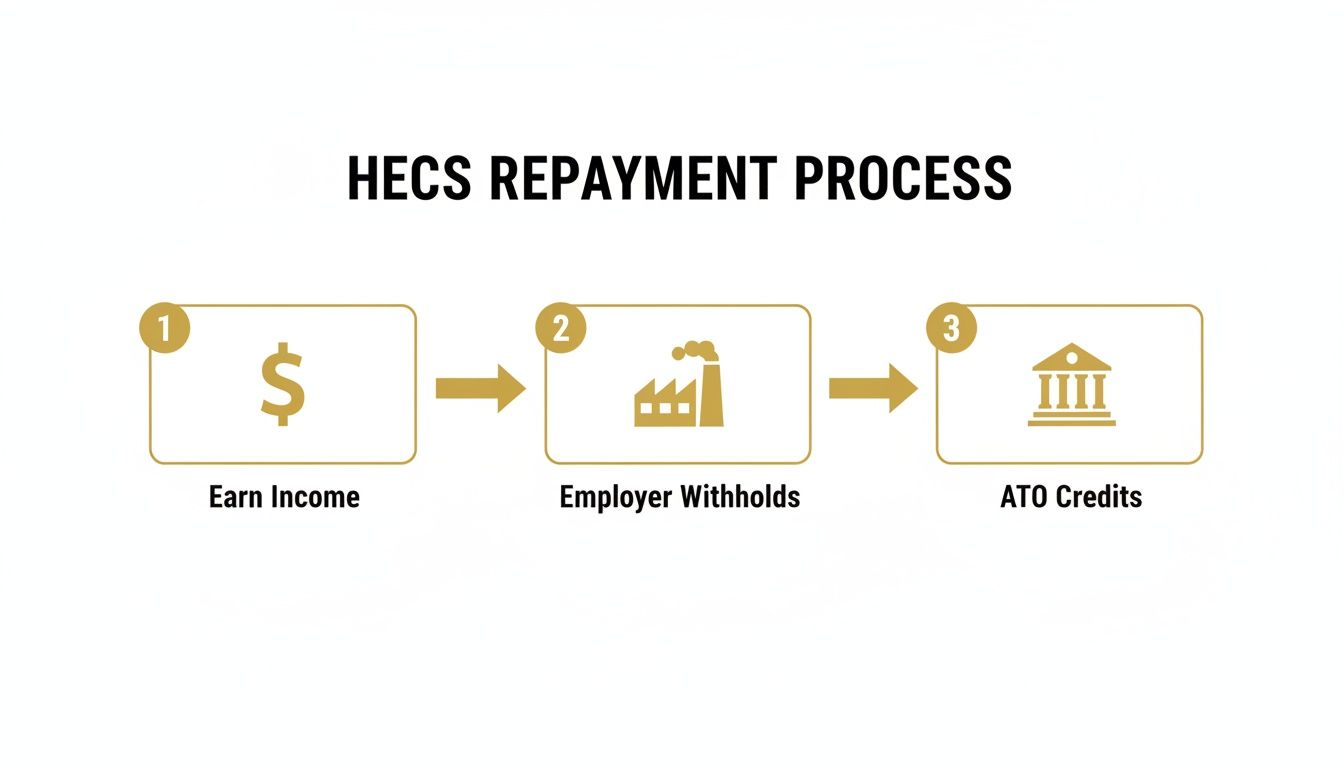
As you can see, your income triggers employer withholdings, which are eventually credited by the ATO. Voluntary payments completely bypass this and go straight to your debt.
How To Make a Voluntary HECS Repayment
Making a payment is actually pretty straightforward. The ATO gives you a couple of simple methods, so you can choose what works best for your banking setup.
You can pay using BPAY or a credit/debit card through your myGov account (as long as it's linked to the ATO). The most important thing you'll need is your Payment Reference Number (PRN) to make sure the funds land in the right place—your HELP account.
Your PRN is unique to you and is absolutely essential for any direct payments to the ATO for your study loan. You can find it on your Notice of Assessment or within your ATO online services account.
The government has also stepped in to provide a bit of relief. A one-off credit began rolling out in June 2025, slashing student debt for over 3 million Australians. This move wipes about $16 billion from existing loan balances before indexation. For someone with an average HELP debt of $27,600, this translates to a reduction of around $5,520.
Even with this helping hand, making your own voluntary repayments can put you on the fast track. If you're really keen to get rid of your education debt, exploring proven student loan payoff strategies can significantly cut down your HECS burden. Combining these tactics with well-timed voluntary payments is a powerful way to become debt-free much sooner.
How Recent Government Changes Impact Your Repayments
The world of HECS-HELP debt is always changing, but recent government reforms have brought some of the biggest shifts we’ve seen in years. These aren't just small administrative tweaks; they're major changes that will directly affect your take-home pay and how you plan your finances long-term.
Getting your head around these new policies is key to managing your loan smartly. The updates are designed to give millions of Australians some much-needed financial breathing room and make the whole repayment system a bit simpler. It’s crucial to know how you can take advantage of them.
The New Minimum Repayment Threshold
One of the most significant changes is the massive hike in the minimum income you need to earn before compulsory repayments kick in. This is a deliberate move to ease the financial squeeze on recent graduates and lower-income earners, especially with the cost of living on everyone's mind.
From 1 July 2025, the minimum HECS repayment threshold will jump to $67,000 for the 2025-26 income year. That's a huge leap from the previous threshold of $54,435.
What this means in plain English is if you earn less than $67,000 a year, you’ll no longer have compulsory HECS payments automatically taken out of your salary. For a closer look at the new figures, the ATO's study and training loans page has all the details.
This gives immediate, direct financial relief, putting more cash back into the pockets of hundreds of thousands of Aussies. If you fall into this bracket, you can even ask your employer to vary your Pay As You Go (PAYG) withholding to reflect this change.
This isn't just a number on a spreadsheet; it's a real boost to your weekly budget. For someone earning $65,000, this reform means they go from having repayments taken out every payday to having none at all. That’s a lot of extra cash flow freed up.
Lower Repayment Rates Across the Board
It's not just about raising the floor. The government has also tweaked the repayment rates for people earning above the new $67,000 threshold. If your income is somewhere between the old threshold and $180,000, your compulsory repayment amount will likely be lower than it was before. Even as a middle-income earner, you should see a reduction in the HECS amount withheld from your pay.
Let’s run through a quick example to see what this looks like in the real world.
Case Study: Anika's Savings
- Income: Anika earns $80,000 a year.
- Old Repayment Rate (2024-25): At her salary, her compulsory repayment rate was 4.5%. This meant she was paying back $3,600 per year, which is about $69 a week.
- New Repayment Rate (from 2025-26): Under the new system, her repayment percentage drops. Let's say the new rate for her income bracket is 3.5%.
- The Result: Her new annual repayment is now $2,800—an $800 saving each year.
That reduction translates directly into more disposable income. It could help you save for a house deposit, chip away at a credit card, or just make day-to-day expenses more manageable. These adjustments are all about keeping the HECS-HELP system fair and in line with the economic reality most graduates are facing.
When you lodge your next tax return, make sure to check your Notice of Assessment to see exactly how these new, lower rates have positively impacted your bottom line.
Actionable Tips for Managing Your HECS Debt
Managing your HECS debt effectively is about more than just letting the compulsory repayments tick away in the background. If you want to get ahead, a few proactive steps can give you a much clearer picture of your financial situation and keep you on the right side of the ATO, whether you're living in Australia or overseas.
The first port of call for anything HECS-related should always be your myGov account linked to the ATO. This is your single source of truth for your loan balance. It's a common mistake to think the money your employer withholds is immediately applied, but that's not the case—it only hits your loan after you lodge your tax return. So, your myGov balance is the most accurate reflection of what you actually owe.
Stay on Top of Your Details
It’s surprisingly easy to fall out of sync with the ATO, but keeping your details current is absolutely non-negotiable. If you move house, change your name, or get a new phone number, jump into myGov and update your information straight away.
This simple bit of admin ensures you receive critical documents, like your Notice of Assessment, without any delays. Outdated details can lead to missed deadlines and a world of unnecessary stress. A quick check-in a couple of times a year is a smart habit to get into.
Your Notice of Assessment is more than just a tax summary; it’s a progress report on your HECS debt. It clearly shows the total compulsory repayment credited to your loan for the financial year and your new closing balance. Scrutinise this document every year—it helps you track your progress and verify that everything is in order.
Managing HECS Debt While Overseas
Thinking of moving abroad? Your HECS debt doesn't just disappear when you board the plane. The obligation to repay follows you, and the rules are just as strict. Australian expats are required to make repayments if their worldwide income exceeds the minimum repayment threshold.
To stay compliant from overseas, you must:
- Update your contact details: Make sure the ATO can reach you by providing your overseas address and phone number.
- Report your global income: You need to lodge an Australian tax return (or a non-lodgement advice) declaring all income you’ve earned, no matter where in the world you earned it.
Failing to report your worldwide income can result in penalties, so it's vital to stay on top of this annual requirement. The good news is the ATO makes it simple to do this online through myGov. For a deeper dive into tackling educational loans, check out these smart student loan repayment strategies to help fine-tune your financial approach.
Integrating HECS Into Your Financial Plan
It’s time to stop thinking of your HECS debt as a separate, passive thing and start treating it as an integral part of your overall financial health. Why? Because it directly impacts your borrowing capacity for big purchases like a home and influences your disposable income.
By actively monitoring your balance and understanding your obligations, you can make smarter financial decisions. For instance, knowing how repayments affect your earnings can be useful when you're looking for ways to reduce your taxable income in Australia. This proactive mindset transforms HECS from a background worry into an active part of your wealth-building strategy, empowering you to clear your debt with confidence.
Common Questions About HECS Debt Repayments
When it comes to managing your HECS-HELP debt, the day-to-day details can bring up some very practical questions, especially when you're hitting major life milestones. We've tackled the most common queries we get from clients to give you clear, straightforward answers.
Does My HECS Debt Affect Getting a Home Loan?
Absolutely. When you walk into a bank to apply for a home loan, your HECS-HELP debt is definitely part of the conversation.
Lenders don't see it as a "bad debt" in the same way they view a maxed-out credit card, but it's a critical piece of the puzzle for them. Why? Because your compulsory repayments directly reduce your take-home pay. This impacts what banks call your "serviceability"—basically, how much they believe you can comfortably afford to repay each month. A larger HECS debt means higher repayments, which can lower your borrowing power.
However, the tide is starting to turn. We're seeing some banks soften their policies for applicants with student loans. The government's recent indexation changes and debt reductions also provide a bit of relief, helping millions of Aussies get closer to meeting lending criteria.
When you're gearing up to apply, having your tax affairs in perfect order is non-negotiable. For a deeper dive into how your student loan interacts with your tax obligations, check out our guide on HECS and student tax.
What Happens to My HECS Debt if I Move Overseas?
Thinking of a working holiday or a more permanent move? Your HECS-HELP debt will be coming with you. Moving overseas doesn't wipe the slate clean; you're still legally required to make repayments once your worldwide income hits the minimum threshold.
To stay on the right side of the ATO, you must declare your global earnings to them every single year. This allows them to correctly calculate your repayment amount, no matter which currency you're earning in. Ignoring this can lead to some nasty penalties down the track, so it pays to be proactive.
Should I Use My Savings to Pay Off HECS Debt Early?
This is one of the great personal finance debates, and honestly, there's no single right answer. HECS debt is often called "good debt" for a reason—its indexation rate is usually much lower than the interest you'd pay on a mortgage, car loan, or credit card debt.
The main advantage of making a voluntary repayment is to chip away at your loan principal before the 1 June indexation date. A smaller balance means less indexation gets added, saving you money over the life of the loan.
But you have to weigh this against your other financial goals. Is it smarter to blitz that high-interest credit card first? Or would that cash be better off fueling your house deposit or going into an investment portfolio? It really comes down to your personal situation, and a chat with a financial advisor can help you map out the best strategy.
The ATO provides guidance through ato.gov.au, the Small Business Support Line (13 28 66), and Online Services for individuals and businesses. For complex situations, a registered tax agent provides advice tailored to your specific circumstances and professional indemnity protection. You can verify agent registration at the TPB register at tpb.gov.au.
Most tax records must be kept for five years from the date of lodgement or the date the transaction occurred, whichever is later. Records must be in English or convertible to English and must be sufficient to explain the income and deductions in your return. The ATO can request records at any time during the retention period.
Consider a registered tax agent when your affairs involve multiple income sources, business activity, investment properties, capital gains, or overseas income. Agents extend your lodgement deadline, provide safe harbour protection, and take professional responsibility for the advice given. Verify registration at tpb.gov.au.
The failure to lodge penalty is based on penalty units ($313 per unit from 1 July 2023), accruing per 28-day period for late returns and BAS lodgements. Incorrect information penalties range from 25% to 75% of the tax shortfall depending on whether the behaviour was careless, reckless, or intentional. Proactive disclosure before an audit begins typically results in significantly reduced penalties.
Tax minimisation is the legal arrangement of your affairs to reduce tax — claiming all eligible deductions, using appropriate structures, and timing income and expenses. Tax avoidance involves arrangements that technically comply with the law but achieve outcomes parliament did not intend. The ATO can apply Part IVA anti-avoidance rules to cancel benefits from avoidance arrangements.
At Australia Wide Tax Solutions, we help individuals and businesses across Australia manage their tax obligations with confidence. If you need expert advice on how your HECS debt impacts your tax return, get in touch with our team for personalised service. Visit us at https://www.awts.net.au.
Navigating the Path to Paying Off Your HECS Debt
Graduating from university is an exciting milestone, but it often comes with the added responsibility of managing a HECS (Higher Education Contribution Scheme) debt. As a former student, you may wonder, "How do I repay my HECS debt?" This blog post will provide a comprehensive guide to understanding your HECS obligations and exploring effective strategies to pay off your debt.
- Navigating the Path to Paying Off Your HECS Debt
- Understanding Your HECS Debt
- Strategies for Paying Off Your HECS Debt
- Staying Motivated and Disciplined
- Conclusion
Understanding Your HECS Debt
The HECS system is a government loan program that helps Australian students finance their higher education. When enrolling in a university course, you could pay your tuition fees upfront or defer the payment through the HECS scheme. If you chose the HECS option, you accumulated a debt you are now required to repay once your income reaches a certain threshold.
To begin, it's essential to familiarize yourself with the details of your HECS debt. This includes:
- Debt Amount: Knowing the exact amount of your HECS debt is crucial for developing a repayment plan. You can find this information on your myGov account or by contacting the Australian Taxation Office (ATO).
- Interest Rate: HECS debts do not accrue interest in the traditional sense. Instead, they are indexed annually to the Consumer Price Index (CPI) to maintain their actual value. This means your debt will increase slightly yearly to keep pace with inflation.
- Repayment Threshold: The HECS repayment threshold is the minimum income level at which you are required to start making compulsory repayments. For the 2022-2023 financial year, the threshold is set at $47,014 per year.
- Repayment Rate: Once your income exceeds the repayment threshold, you must make compulsory HECS repayments. The repayment rate is a percentage of your taxable income, ranging from 2% to 10%, depending on your income level.
Understanding these key details will help you develop a well-informed plan for tackling your HECS debt.
Strategies for Paying Off Your HECS Debt
Now that you have a better understanding of your HECS debt let's explore some effective strategies for repaying it:
1. Make Voluntary Repayments
One of the most straightforward ways to pay off your HECS debt faster is by making voluntary repayments. This involves making additional payments on top of your compulsory repayments, which can significantly reduce the overall interest charges and the time it takes to pay off your debt.
To make a voluntary repayment, you can either:
- Pay directly to the ATO using BPAY or direct debit
- Authorize your employer to withhold additional amounts from your pay and forward them to the ATO
The advantage of making voluntary repayments is that you have the flexibility to pay as much as you can afford whenever you can afford it. This can help you pay off your debt more quickly and save on long-term costs.
2. Prioritize HECS Repayments
When managing your finances, it's essential to prioritize your HECS repayments. While it may be tempting to allocate your extra funds towards other financial goals, such as saving for a house or investing, focusing on your HECS debt can have significant long-term benefits.
Consider the following:
- HECS debts do not accrue interest in the traditional sense, but they are indexed to the CPI. This means that the longer you take to repay your debt, the more it will grow due to inflation.
- By making additional repayments, you can save on the overall cost of your HECS debt and free up funds for other financial goals in the future.
- Paying off your HECS debt can also improve your credit score, which can be beneficial when applying for loans or mortgages.
Prioritizing your HECS repayments, even if it means making small sacrifices in other areas, can be a wise financial decision in the long run.
3. Explore Income-Boosting Opportunities
Another strategy for accelerating your HECS debt repayment is increasing your income. Earning a higher income can make larger compulsory and voluntary repayments, ultimately paying off your debt more quickly.
Here are some ideas to consider:
- Seek out promotions or pay raises in your current job.
- Explore opportunities for overtime or additional work hours
- Consider taking on a side gig or freelance work
- Invest in professional development to increase your earning potential
- Look for ways to monetize your skills or hobbies
Remember, the higher your income, the faster you can make HECS repayments and the less you'll pay in the long run due to your debt's indexation.
4. Take Advantage of Tax Deductions
As you work to pay off your HECS debt, it's essential to be mindful of potential tax deductions that can help reduce your taxable income and, in turn, your HECS repayment obligations.
Some standard tax deductions that may be applicable include:
- Work-related expenses: If you incur expenses related to your job, such as work-from-home costs, professional development, or equipment, you may be able to claim these as deductions.
- Charitable Donations to eligible charities and organizations can be claimed as tax deductions, potentially lowering your taxable income and HECS repayment amount.
- Investment property expenses: If you own an investment property, you can claim deductions for expenses such as mortgage interest, property management fees, and maintenance costs.
Taking advantage of these tax deductions can reduce your taxable income and potentially lower your HECS repayment obligations, allowing you to pay off your debt more quickly.
5. Explore Loan Repayment Assistance Programs
Depending on your circumstances and career path, you may be eligible for loan repayment assistance programs to help you manage your HECS debt.
Some examples include:
- HECS Reimbursement Schemes: Certain government and public sector employers may offer HECS reimbursement schemes, covering a portion or all of your HECS debt as an employee benefit.
- Scholarships and Grants: Some organizations and institutions provide scholarships or grants designed to help individuals pay off their HECS debts.
- Overseas Repayment Deferment: If you plan to live and work overseas for an extended period, you may be able to defer your HECS repayments until you return to Australia.
Researching and taking advantage of these programs can provide valuable assistance in managing and paying off your HECS debt.
Staying Motivated and Disciplined
How do I repay my HECS debt? It can be a long-term process, and it's essential to maintain motivation and discipline throughout the journey. Here are some tips to help you stay on track:
- Set Specific Goals: Establish clear, measurable goals for your HECS debt repayment, such as a target repayment amount or a timeline for paying off the debt. Regularly review and adjust these goals as needed.
- Create a Budget: Develop a comprehensive budget that allocates funds to your HECS repayments and other financial priorities. Stick to your budget and make adjustments as your circumstances change.
- Celebrate Milestones: Recognize and celebrate your progress, whether hitting a specific repayment target or reaching a significant milestone in your debt reduction journey.
- Seek Support: Don't hesitate to contact family, friends, or financial advisors for support and encouragement as you work towards paying off your HECS debt.
- Stay Informed: Keep up-to-date with any changes or updates to the HECS system and any new government initiatives or programs that may assist you in managing your debt.
By maintaining motivation and discipline, you can stay focused on your HECS debt repayment goals and achieve financial freedom more quickly. Contact us, if you need more strategies.
Conclusion
Paying off a HECS debt can be a challenging but rewarding process. By understanding the details of your debt, exploring various repayment strategies, and staying motivated, you can take control of your financial future and work towards becoming debt-free.
Remember, every voluntary repayment you make, every income-boosting opportunity you pursue, and every tax deduction you claim can contribute to the successful repayment of your HECS debt. Stay persistent, be patient, and celebrate your progress along the way. With a well-planned approach and a commitment to financial responsibility, you can navigate the path to paying off your HECS debt and achieve your long-term financial goals.
The ATO provides guidance through ato.gov.au, the Small Business Support Line (13 28 66), and Online Services for individuals and businesses. For complex situations, a registered tax agent provides advice tailored to your specific circumstances and professional indemnity protection. You can verify agent registration at the TPB register at tpb.gov.au.
Most tax records must be kept for five years from the date of lodgement or the date the transaction occurred, whichever is later. Records must be in English or convertible to English and must be sufficient to explain the income and deductions in your return. The ATO can request records at any time during the retention period.
Consider a registered tax agent when your affairs involve multiple income sources, business activity, investment properties, capital gains, or overseas income. Agents extend your lodgement deadline, provide safe harbour protection, and take professional responsibility for the advice given. Verify registration at tpb.gov.au.
The failure to lodge penalty is based on penalty units ($313 per unit from 1 July 2023), accruing per 28-day period for late returns and BAS lodgements. Incorrect information penalties range from 25% to 75% of the tax shortfall depending on whether the behaviour was careless, reckless, or intentional. Proactive disclosure before an audit begins typically results in significantly reduced penalties.
Tax minimisation is the legal arrangement of your affairs to reduce tax — claiming all eligible deductions, using appropriate structures, and timing income and expenses. Tax avoidance involves arrangements that technically comply with the law but achieve outcomes parliament did not intend. The ATO can apply Part IVA anti-avoidance rules to cancel benefits from avoidance arrangements.
Your HECS-HELP debt is costing you more than you might think in 2026. The mandatory repayment threshold has risen to $54,435 for the 2025-26 income year, and compulsory repayment rates range from 1% to 10% of your income depending on your earnings. Add in the annual indexation of the debt balance (CPI-linked), and many Australians with HECS are paying more than they realise. Here is exactly what your HECS-HELP debt is costing you in 2026.
HECS-HELP Indexation Rate in 2026
HECS-HELP debts are indexed to the Consumer Price Index (CPI) each year on 1 June. After the extraordinary indexation of 7.1% in June 2023, the rate moderated in 2024 and 2025 as inflation eased. The 2025 indexation rate (applied to debts on 1 June 2025) was approximately 4.7%. For a borrower with a $35,000 HECS debt, a 4.7% indexation adds approximately $1,645 to the debt balance in a single year.
2025-26 Compulsory Repayment Thresholds and Rates
- Under $54,435: No compulsory repayment required
- $54,435 to $62,828: 1% of total income
- $62,829 to $66,981: 2% of total income
- $66,982 to $79,099: 2.5%
- $79,100 to $92,969: 3.5%
- $92,970 to $107,276: 4.5%
- $107,277 to $114,231: 5.5%
- $114,232 to $135,596: 6.5%
- $135,597 to $159,843: 7.5%
- $159,844 to $174,546: 8.5%
- $174,547 to $186,457: 9%
- Above $186,457: 10%
How HECS Affects Your Mortgage Borrowing Power
Lenders view HECS repayments as a debt commitment that reduces your net take-home pay. On an $80,000 income in 2026, HECS repayments of 3.5% ($2,800/year or $54/week) reduce your assessed disposable income — lowering your borrowing capacity by approximately $20,000-$30,000 with most lenders. Voluntary HECS repayment before applying for a home loan is worth modelling carefully.
Should I Make Voluntary HECS Repayments in 2026?
With indexation now lower than peak 2023 levels, the case for aggressive voluntary repayment depends on your alternative uses for that money. Compare the effective cost of the HECS debt (indexation rate) against the after-tax return you could earn by investing that money instead. If your HECS debt is above $50,000 and you are applying for a home loan, voluntary repayment to eliminate the debt has a clear benefit through improved borrowing capacity.
Frequently Asked Questions
Can I claim a HECS repayment as a tax deduction?
No. HECS-HELP compulsory and voluntary repayments are not tax deductible. They are a government loan repayment — not an expense incurred in earning income. Unlike income protection insurance or investment loan interest, there is no deduction available for student loan repayments in Australia.
What happens to my HECS debt if I go overseas?
Since 1 July 2017, Australians living overseas with HECS-HELP debts must make repayments if their worldwide income exceeds the repayment threshold. You must register your overseas presence with the ATO and lodge an overseas levy assessment. Failure to comply results in penalties. The debt also continues to be indexed annually on 1 June regardless of where you live.
How is the HECS repayment amount calculated?
Your HECS repayment is calculated on your "repayment income" — your taxable income plus reportable fringe benefits, total net investment loss, reportable employer super contributions, and exempt foreign employment income. The ATO calculates this when you lodge your tax return and any shortfall from insufficient withholding becomes a tax debt.
Want to understand how HECS affects your tax and borrowing position? Contact AWTS for a personalised review.
HECS-HELP debt and student taxation in Australia in 2026 have undergone important changes — including the June 2025 legislation that reduced all existing HECS-HELP debts by 20% and changed the indexation method from CPI to the lower of CPI or Wage Price Index (WPI). If you have a HECS-HELP balance or are considering higher education, here is what you need to know about how student debt and taxation interact in 2026.
The 20% HECS-HELP Debt Reduction (2025)
In June 2025, the Australian Parliament passed legislation reducing all existing HECS-HELP, VSL, SSL, ABSTUDY SSL, and other income-contingent loan balances by 20%. This reduction was applied automatically — if you had a $50,000 balance, it became approximately $40,000. The reduction was not taxable income. The change also applied to the new indexation cap: from 2025 onwards, HECS-HELP indexation is limited to the lower of CPI or the Wage Price Index, preventing the large indexation spikes seen in 2023 (+7.1%) and 2024 (+4.7%).
HECS-HELP Repayment Thresholds 2025-26
HECS-HELP repayments are compulsory once your income reaches the minimum repayment threshold:
- $54,435 - $62,850: 1.0% of total income
- $62,851 - $66,620: 2.0%
- $66,621 - $70,618: 2.5%
- $70,619 - $74,855: 3.0%
- $74,856 - $79,346: 3.5%
- $79,347 - $84,107: 4.0%
- $84,108 - $88,492: 4.5%
- $88,493 - $93,968: 5.0%
- $93,969 and above: Rates increase to a maximum of 10% of income
Repayments are calculated on your "repayment income" — a broader measure than taxable income that includes reportable fringe benefits, reportable employer super contributions, and total net investment losses.
Employer Withholding for HECS-HELP
Employers withhold additional PAYG to cover your HECS-HELP repayment obligation, provided you have declared your student debt on your tax file number declaration. If you have not declared your HECS-HELP debt to your employer, insufficient tax is withheld and you will have a tax debt when you lodge your return. Always tick the HECS-HELP box on your TFN declaration when starting a new job.
Frequently Asked Questions
Does HECS-HELP debt affect my tax return?
Yes. Your compulsory HECS-HELP repayment is calculated when you lodge your tax return based on your repayment income for the year. If your employer has withheld enough, the repayment is already covered. If not (e.g., you had multiple employers, investment income, or reportable fringe benefits pushing your repayment income higher), you will have an additional payment to make with your tax return assessment.
Does HECS-HELP debt affect getting a home loan?
Yes. Lenders include your compulsory HECS-HELP repayment as a debt obligation when assessing your borrowing capacity. For example, a $60,000 income earner with HECS-HELP debt has approximately $600/year ($50/month) in compulsory repayments — this reduces the amount you can borrow. Higher incomes with higher repayment percentages have a more noticeable impact on borrowing capacity. Paying off HECS-HELP voluntarily can improve your borrowing power, though there is no government bonus for doing so.
Have HECS-HELP or student loan questions? Contact AWTS — we help graduates navigate student debt repayment and tax return obligations.