
When you own shares in an Australian company, any dividends you receive aren't subject to a special "dividend tax." Instead, they're simply treated as part of your regular income, just like a salary. The amount of tax you'll pay on these dividends depends on your personal marginal tax rate.
- Demystifying Australian Dividend Tax
- Understanding Australia's Franking Credit System
- How to Calculate Tax on Franked Dividends
- Dividend Tax Rules for Non-Residents and Expats
- How to Report Dividend Income on Your Tax Return
But here's where it gets interesting. Australia has a unique system built around something called franking credits, which is designed to stop company profits from being taxed twice.
Demystifying Australian Dividend Tax

When a company you've invested in makes a profit, it can decide to share a slice of that profit with its shareholders. That payment is a dividend, and the Australian Taxation Office (ATO) views it as assessable income.
However, the Australian system has a clever feature designed to be fair to local investors. Before a company pays you that dividend, it has almost always paid company tax on its profits first. To prevent you from also having to pay tax on that same money, the system uses franking credits.
The Concept of Double Taxation
Imagine for a moment that franking credits didn't exist. A company earns $100 in profit and pays $30 in company tax. It then pays out the remaining $70 to you as a dividend. You'd then have to pay your personal income tax on that $70.
In this scenario, the original $100 profit gets taxed twice—first at the corporate level and then again at your personal level. Australia's imputation system was created specifically to stop this from happening.
Think of a franking credit as a pre-paid tax voucher. It represents the tax the company has already paid on your behalf, which you can then use to reduce your own tax bill.
Grasping this is fundamental to understanding the true return on your investments. The impact of the dividend imputation system is massive, especially for maximising your after-tax returns. While you apply your marginal tax rate (which can be up to 47%), you get to offset it with these credits.
Understanding how dividend income works is crucial, especially when considering how a dividend reinvestment strategy can affect your portfolio and future tax obligations. Ultimately, the whole system is about creating a fairer distribution of the tax burden between companies and their shareholders.
Understanding Australia's Franking Credit System
Australia's approach to dividend tax is built on a pretty straightforward idea: fairness. The whole point is to stop company profits from being taxed twice—first when the company earns them, and then again when they land in your bank account. The magic ingredient that makes this happen is the franking credit, sometimes called an imputation credit.
The easiest way to think of a franking credit is as a pre-paid tax voucher. When an Aussie company makes a profit, it pays company tax. If it then decides to share that profit with you as a dividend, it can attach a credit that says, "Hey, we've already paid the tax on this bit of profit for you."
This system, officially known as the dividend imputation system, kicked off on 1 July 1987 and completely changed the game. Before this, profits got hit with corporate tax—which climbed as high as 49% by 1986—and then shareholders got taxed again on their dividend income. This reform lit a fire under companies to pay out more dividends. In fact, between 2005 and 2015, Aussie listed companies handed back an average of 67% of their profits to shareholders, a massive leap compared to places like the United States (48%).
Franked vs Unfranked Dividends Explained
How much tax the company has paid on your behalf directly affects the type of dividend you get and, ultimately, what your tax bill looks like.
Dividends usually come in three flavours:
- Fully Franked Dividends: This is the one you want to see. It means the company paid the full Australian corporate tax rate (25% or 30%) on the profit before sending it your way. You get the maximum possible franking credit attached.
- Partially Franked Dividends: This happens when a company has only paid some tax on its profits, often because a chunk of its earnings came from overseas where different tax rules apply. You still get a franking credit, but it won't cover the full amount.
- Unfranked Dividends: This simply means no company tax was paid on the profit before you received it. Because of this, there’s no franking credit attached, and you'll have to pay tax on the entire dividend at your personal tax rate.
Let's quickly compare what these dividend types mean for your tax return.
Types of Dividends and Their Tax Implications
| Dividend Type | Company Tax Paid | Franking Credit for Shareholder | Impact on Your Tax Return |
|---|---|---|---|
| Fully Franked | Company paid the full tax rate (25% or 30%) on the profit. | You receive the maximum possible franking credit. | The credit significantly reduces your tax payable; may even lead to a refund. |
| Partially Franked | Company paid some tax, but less than the full rate. | You receive a partial credit, reflecting the tax that was paid. | The credit reduces your tax payable, but not by the full amount. |
| Unfranked | Company paid no Australian tax on the profit. | You receive zero franking credit. | You must pay tax on the full dividend amount at your personal marginal tax rate. |
As you can see, the type of dividend you receive makes a huge difference.
The core purpose of franking credits is to ensure that company profits are ultimately taxed at the individual shareholder's marginal tax rate, and not a cent more.
Why Franking Credits Matter to You
Getting your head around these differences is absolutely essential for managing your investments in Australia. A fully franked dividend can slash your tax bill, and for many investors—especially those on lower incomes or in retirement—it can even lead to a cash refund from the Australian Taxation Office (ATO). An unfranked dividend, on the other hand, is taxed just like any other income you earn.
Luckily, you don't have to guess. The dividend statement you get from the company will always clearly state whether the dividend is fully franked, partially franked, or unfranked, along with the exact dollar value of the credit. For a more detailed walkthrough, you can also check out our guide on how do franking credits work?. This statement is the single most important document you’ll need when tax time rolls around.
How to Calculate Tax on Franked Dividends
Understanding the theory behind franking credits is one thing, but seeing how it actually hits your tax return is where it all clicks. The good news is that calculating the tax on franked dividends isn't some complex formula. It’s a logical three-step process designed to make sure you’re only taxed at your personal marginal rate.
Let’s walk through it. The core idea is simple: add the franking credit back to your dividend, calculate the tax on that total amount, and then use the credit to help pay that tax.
This flowchart shows exactly how profit flows from a company to you, the shareholder, through the franking credit system.
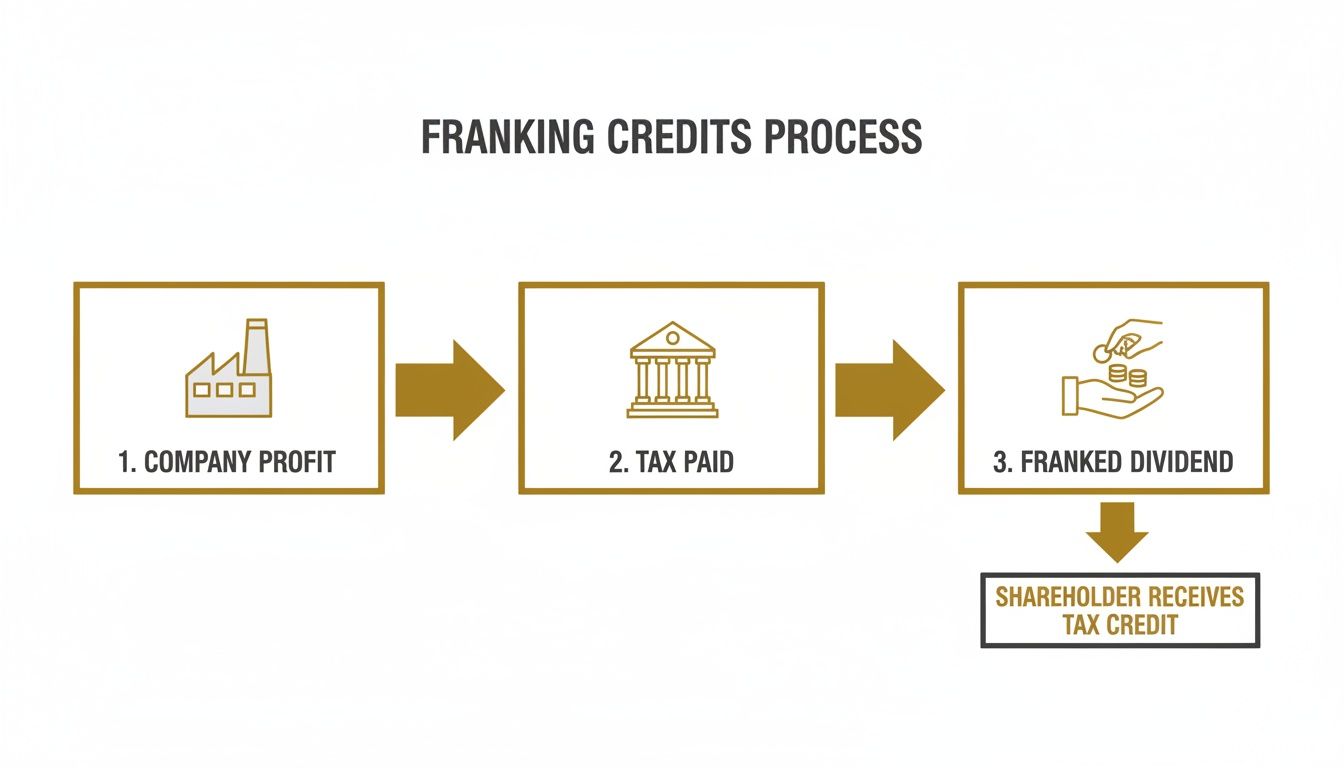
As you can see, the tax already paid by the company becomes a credit that directly reduces what you ultimately owe.
Step 1: Gross Up Your Dividend
The first step uses a concept called "grossing up." All this means is you have to declare both the cash dividend you received and the franking credit as your income. You’re essentially reporting the dividend's pre-tax value.
Imagine you receive a $700 fully franked dividend. Your dividend statement will show an attached franking credit of $300.
To "gross up" the dividend, you just add them together:
- Grossed-up Dividend: $700 (Cash Dividend) + $300 (Franking Credit) = $1,000
You must report this $1,000 on your tax return as assessable income—not just the $700 that landed in your bank account.
Step 2: Calculate the Initial Tax
Next, you figure out the tax payable on this grossed-up amount using your personal marginal tax rate. This tells you what your initial tax bill would be on that dividend income, before applying the credit.
Let's stick with our example and assume you're an investor with a marginal tax rate of 32.5%. We'll also add the 2% Medicare Levy, for a total rate of 34.5%.
- Initial Tax Payable: $1,000 (Grossed-up Dividend) x 34.5% = $345
If franking credits didn't exist, you'd owe the Australian Taxation Office (ATO) $345 on this dividend income.
Step 3: Apply the Franking Credit
This is the final and most powerful step. You now subtract the franking credit from the initial tax you just calculated. This reveals your final tax position—whether you owe more tax, owe nothing at all, or are even due a refund.
Using our ongoing example:
- Final Tax Calculation: $345 (Initial Tax) - $300 (Franking Credit) = $45
In this scenario, the investor has a final tax bill of just $45 on their dividend income. The $300 franking credit covered most of their tax liability.
The outcome of this calculation depends entirely on one thing: how your personal marginal tax rate compares to the company tax rate that generated the credit. This is why the result is different for everyone.
To show how this plays out, we've put together a quick table summarising the steps for our investor.
Franked Dividend Tax Calculation Example
| Step | Calculation | Amount |
|---|---|---|
| Dividend Received | Cash dividend from the company. | $700 |
| Franking Credit | Tax credit from the company. | $300 |
| 1. Gross-up Dividend | $700 (Cash) + $300 (Credit) | $1,000 |
| 2. Calculate Initial Tax | $1,000 x 34.5% (Marginal Rate + Medicare Levy) | $345 |
| 3. Apply Credit | $345 (Initial Tax) - $300 (Franking Credit) | $45 |
| Final Result | Tax to be paid to the ATO. | $45 |
This step-by-step process clearly shows how the franking credit dramatically reduces the final tax bill from $345 down to only $45.
The real power of Australia's dividend imputation system becomes crystal clear when we compare outcomes across different income levels:
- Low Tax Bracket (e.g., 19% rate): An investor in this bracket would have an initial tax bill of $210 (including the 2% Medicare levy). Applying their $300 credit would result in a $90 tax refund from the ATO.
- High Tax Bracket (e.g., 45% rate): An investor here would have an initial tax bill of $470 (including the 2% Medicare levy). Applying the $300 credit still helps, but leaves them with $170 of tax to pay.
This straightforward three-step process is the engine of the franking credit system, ensuring company profits are ultimately taxed at each shareholder’s individual rate.
Dividend Tax Rules for Non-Residents and Expats
Once you're no longer an Australian resident for tax purposes, the game completely changes. The franking credit system, a massive benefit for local investors, is designed exclusively for Australian residents. It simply doesn't apply to you.
Instead, for non-residents and Australian expats, a different set of rules kicks in. Your dividend income is subject to a final withholding tax. This means a flat percentage is taken out of your dividend payment before it even hits your bank account.
Understanding Withholding Tax Rates
The Australian Taxation Office (ATO) has default withholding tax rates for dividends paid to non-residents. For any unfranked dividends, the standard rate is typically 30%.
But here's a crucial detail many expats miss: for franked dividends, the rules are much more favourable. No withholding tax is applied to the franked part of a dividend paid to a non-resident. The logic is that the company has already paid tax in Australia on that profit. Since you can't use the franking credits anyway, withholding more tax would be unfair.
For non-residents, this withholding tax is usually the final tax you'll pay on your Australian dividend income. You generally won't need to lodge an Australian tax return to declare it, as the tax is dealt with at the source.
The Role of Double Taxation Agreements
That standard 30% withholding rate isn't always the end of the story. Australia has signed Double Taxation Agreements (DTAs) with many countries across the globe to prevent people and companies from being taxed twice on the same income.
One of the key features of these treaties is often to reduce the dividend withholding tax rate. Depending on the specific agreement between Australia and your country of residence, the tax on unfranked dividends can be lowered, often to 15%.
Here’s what that means in practice:
- Check the Treaty: You must find out if Australia has a DTA with the country you now live in.
- Apply the Reduced Rate: This lower rate isn't automatic. You usually need to provide your details to the share registry to ensure they apply the correct, lower percentage.
- Country-Specific Rules: Every treaty is different, so the exact rate and conditions can vary.
Getting a handle on these rules is vital for managing your obligations correctly from overseas. If you need more detail on how your residency status affects your tax, our guide on non-resident tax rates in Australia provides a deeper dive.
How to Report Dividend Income on Your Tax Return
Getting your dividend income reported correctly is the final, crucial step in sorting out your tax obligations. Thankfully, the whole process is pretty straightforward, especially with the Australian Taxation Office (ATO) and the super-detailed statements from share registries lending a hand.
The key document for this job is your dividend statement, which you'll get for every dividend payment. This piece of paper is gold—it breaks down exactly what you received and all the tax details that go with it. Think of it as your personal roadmap for this part of your tax return.
Locating the Key Information
When you get your dividend statement, you're looking for three specific figures. These are the building blocks you'll need to report your dividend income correctly.
You'll need to pinpoint:
- Total unfranked amount: The slice of your dividend that had no company tax paid on it.
- Total franked amount: The cash dividend paid from profits the company had already paid tax on.
- Total franking credit: This is the value of that "pre-paid tax voucher" attached to your franked dividend.
Once you’ve got these numbers from all your dividend statements for the financial year, you’re ready to plug them into your tax return.
Using the ATO Pre-filling Service
The ATO’s pre-filling service, which you can access via myTax or through your tax agent's portal, is a genuine time-saver. For most people invested in major ASX-listed companies, the ATO automatically pulls this dividend data from share registries and fills in the fields for you.
It's an incredibly helpful feature that cuts down on manual entry and the chance of making a silly mistake. But you should never just assume it's 100% accurate without a quick check.
Always cross-reference the ATO's pre-filled data with your own dividend statements. It is your responsibility to ensure the figures are correct before lodging, as discrepancies can lead to delays or future adjustments.
Mistakes can and do happen. Maybe you’ve recently moved house, or data from smaller, unlisted companies hasn't made its way to the ATO yet. A quick check gives you complete peace of mind.
Where to Enter Your Dividend Details
In your tax return, you’ll find a specific section labelled "Dividends." This is where you'll enter the totals you added up from your statements. The online forms have dedicated boxes for the unfranked amount, franked amount, and the franking credit.
By entering these three figures, the tax system does the heavy lifting for you. It automatically performs the "gross-up" calculation—adding the franked amount and the franking credit together—to figure out your assessable dividend income. It then applies the credit to lower your overall tax bill.
Properly declaring all your investment income is non-negotiable for staying on the right side of the ATO. For a broader overview, you can learn more about declaring investment income in our complete guide. Taking a few extra minutes to verify your dividend details ensures you meet your obligations and get the correct tax outcome.
Common Questions About Dividend Tax in Australia
Even after getting a handle on the system, a few specific questions about dividend tax always seem to pop up. Let's run through some of the most common queries we hear from investors to make sure every piece of the puzzle fits perfectly.
Think of this as a final check-in to clear up any lingering confusion before you tackle your tax return.
What Happens If My Franking Credits Are More Than the Tax I Owe?
This is a fantastic position to be in, and it's where the real magic of the imputation system shines through.
If your total franking credits are worth more than the tax you owe on your entire taxable income for the year, the Australian Taxation Office (ATO) will pay you the difference. That's right—it comes back to you as a cash refund. The excess credit isn't lost; it's yours to keep.
This happens all the time for people on lower marginal tax rates, like retirees or students whose total income might even be below the tax-free threshold. For them, fully franked dividends can become a source of tax-free income, topped up with a nice refund from the ATO.
Do I Pay Tax on a Dividend Reinvestment Plan?
Yes, you absolutely do. This is a crucial detail that catches out many new investors.
A Dividend Reinvestment Plan (DRP) lets you use your dividend payment to automatically buy more shares in the company instead of getting the cash. While it might feel like you haven't received any income because no money hit your bank account, the ATO sees it differently. That dividend is still treated as assessable income for the financial year it was paid.
You must declare the value of the reinvested dividend and any attached franking credits on your tax return, just as you would for a cash dividend. Your dividend statement will lay out all the numbers you need.
Forgetting to declare DRP income is an easy mistake to make, but one that can lead to an ATO adjustment down the track. From a tax perspective, receiving shares is the same as receiving cash and then immediately choosing to buy more shares with it.
How Do I Find Out If a Dividend Is Franked?
You don't need to do any detective work here. The company provides all this information directly to you.
The dividend statement sent out by the company's share registry is your single source of truth. This document clearly breaks down every part of your payment, including:
- The total cash dividend paid.
- The franking level (e.g., "fully franked" or "partially franked").
- The exact dollar value of the franking credit attached to your dividend.
Make sure you keep these statements organised. They're essential for filling out your tax return correctly and for double-checking any data the ATO has pre-filled for you. If you can't find a statement, you can almost always download a copy from the share registry’s online portal.
The ATO provides guidance through ato.gov.au, the Small Business Support Line (13 28 66), and Online Services for individuals and businesses. For complex situations, a registered tax agent provides advice tailored to your specific circumstances and professional indemnity protection. You can verify agent registration at the TPB register at tpb.gov.au.
Most tax records must be kept for five years from the date of lodgement or the date the transaction occurred, whichever is later. Records must be in English or convertible to English and must be sufficient to explain the income and deductions in your return. The ATO can request records at any time during the retention period.
Consider a registered tax agent when your affairs involve multiple income sources, business activity, investment properties, capital gains, or overseas income. Agents extend your lodgement deadline, provide safe harbour protection, and take professional responsibility for the advice given. Verify registration at tpb.gov.au.
The failure to lodge penalty is based on penalty units ($313 per unit from 1 July 2023), accruing per 28-day period for late returns and BAS lodgements. Incorrect information penalties range from 25% to 75% of the tax shortfall depending on whether the behaviour was careless, reckless, or intentional. Proactive disclosure before an audit begins typically results in significantly reduced penalties.
Tax minimisation is the legal arrangement of your affairs to reduce tax — claiming all eligible deductions, using appropriate structures, and timing income and expenses. Tax avoidance involves arrangements that technically comply with the law but achieve outcomes parliament did not intend. The ATO can apply Part IVA anti-avoidance rules to cancel benefits from avoidance arrangements.
Navigating the specifics of dividend tax can feel complex, but you don't have to do it alone. The expert team at Australia Wide Tax Solutions is here to ensure you meet your obligations and maximise your refund. From correctly reporting investment income to handling complex tax situations, we provide personalised, efficient service you can trust. Get in touch with our tax specialists today.
Investing in property can be a lucrative venture, but it also brings with it a host of financial responsibilities. Maximizing your investment property deductions is a crucial aspect of managing your property portfolio effectively. By understanding the ins and outs of property deductions, you can ensure that you are making the most of your investment. In this article, we will delve into the key strategies that will assist you in maximizing your investment property deductions.Understanding Investment Property Deductions
Before we dive into the specific strategies, it is essential to have a strong foundation of understanding regarding investment property deductions. This section will provide you with the basics of property deductions, as well as introduce you to the key terms and concepts associated with this topic. Investing in property can be a lucrative venture, but it also comes with its fair share of expenses. However, the good news is that many of these expenses can be claimed as deductions, helping you reduce your taxable income and ultimately save on taxes. When it comes to investment property deductions, there are several key expenses that you can claim. These include interest on loans, property management fees, repairs and maintenance costs, insurance premiums, and depreciation. Let's take a closer look at each of these deductions:- Interest on Loans: If you have taken out a loan to finance your investment property, you can deduct the interest paid on that loan. This deduction can be a significant benefit, especially in the early years of your investment when interest payments are typically higher.
- Property Management Fees: If you hire a property management company to handle the day-to-day operations of your investment property, the fees you pay them can be claimed as a deduction. This includes fees for advertising, tenant screening, rent collection, and property maintenance.
- Repairs and Maintenance Costs: Any expenses incurred for repairs and maintenance of your investment property can be deducted. This includes fixing plumbing issues, repainting walls, replacing broken appliances, and other similar expenses. It is important to note that improvements that add value to the property, such as renovations, are not considered repairs and may not be fully deductible.
- Insurance Premiums: The insurance premiums you pay to protect your investment property can also be claimed as a deduction. This includes coverage for property damage, liability, and rental income loss.
- Depreciation: Depreciation refers to the gradual decrease in the value of an asset over time. In the context of property deductions, depreciation can be claimed as an expense, reflecting the wear and tear on your investment property. This deduction can be a significant benefit, as it allows you to account for the declining value of your property and recoup some of the initial investment.
- Depreciation: Depreciation refers to the gradual decrease in the value of an asset over time. In the context of property deductions, depreciation can be claimed as an expense, reflecting the wear and tear on your investment property.
- Taxable Income: This refers to the portion of your income that is subject to taxation after deductions have been applied. Maximising your deductions can reduce your taxable income and potentially lower your tax liability.
- Tax Compliance: Tax compliance refers to adhering to the tax authorities' regulations and laws to report and pay taxes correctly. It is important to stay up to date with the latest tax laws and seek professional advice if needed to ensure you comply with all applicable regulations.
The Role of Depreciation in Maximizing Deductions
Depreciation is a crucial factor in maximising your investment property deductions. By understanding how depreciation works and how it impacts your deductions, you can optimise your financial position.Depreciation Explained
Depreciation refers to the decrease in value of an asset over time due to wear and tear, aging, or obsolescence. In the context of investment property, both the building and the fixtures within it can be depreciated. There are two types of depreciation: capital works and plant and equipment. Capital works depreciation pertains to the building's structure, while plant and equipment depreciation relates to the assets within the building, such as air conditioning units, carpets, and furniture.How Depreciation Impacts Your Deductions
Claiming depreciation as an expense can significantly impact your deductions and ultimately reduce your taxable income. By accurately calculating and claiming depreciation expenses, you can recoup a portion of the property's value over time. It is essential to engage a qualified quantity surveyor or tax depreciation specialist to conduct a depreciation schedule and maximize your deductions. This professional will assess your property and identify all depreciable assets, ensuring that you claim the maximum deduction available to you.Strategies for Maximizing Your Deductions
Now that you have a solid understanding of investment property deductions and the role of depreciation, it's time to explore some strategies that can help you maximize your deductions and ultimately save on taxes.Timing Your Expenses
Timing is key when it comes to maximizing your deductions. By carefully timing when you incur expenses, you can ensure that you receive the maximum benefit from your deductions. For example, if you are planning significant repairs or renovations on your property, strategically scheduling these expenses to span over different financial years can help you optimize your deductions. Additionally, keeping detailed records of all your expenses throughout the year will make it easier to claim deductions when tax time rolls around. Utilizing accounting software or apps specifically designed for property investors can simplify expense tracking and ensure that nothing falls through the cracks.Utilizing Professional Services
When it comes to navigating the complex world of property deductions, professional guidance can be invaluable. Engaging the services of a qualified accountant or tax advisor who specializes in investment properties can provide you with expert advice tailored to your specific circumstances. A knowledgeable professional can help you identify all eligible deductions, ensure that you are complying with tax regulations, and maximize your tax savings. This investment in professional services can yield significant financial benefits and provide peace of mind.Common Mistakes to Avoid
While maximizing your investment property deductions is essential, it is equally important to avoid common pitfalls and mistakes that could undermine your efforts. Let's explore some of the common mistakes and how to avoid them.Overlooking Small Deductions
It's easy to focus on significant expenses when it comes to property deductions but overlooking small expenses can add up over time. Every deductible expense counts, so it's important to meticulously track and document even the smallest costs. Keeping a dedicated folder or digital file for all your expense receipts and invoices will ensure that you have a comprehensive record of all eligible deductions. This attention to detail will help you maximize your savings and reduce the risk of missing out on potential deductions.Misunderstanding the Rules
Another common mistake property investors make is misunderstanding the rules and regulations surrounding investment property deductions. Tax laws can be complex and subject to change, so it's crucial to stay informed and up to date with the latest legislation. Regularly reviewing the relevant tax authorities' websites, attending property investment seminars, or joining investor forums can provide you with valuable insights and help you stay ahead of any changes. Seeking professional advice when needed can also help clarify any confusion or gray areas.Navigating Tax Laws and Regulations
The landscape of tax laws and regulations is ever-evolving. As an investment property owner, it is crucial to stay up to date with any changes that may impact your deductions. Let's explore some strategies for navigating this complex environment.Keeping Up with Changes
Staying informed and proactive is key to navigating the ever-changing tax landscape. Subscribing to newsletters or updates from tax authorities, consulting with professionals, and regularly reviewing the relevant legislation will help ensure that you are aware of any changes that may affect your deductions. Allocating dedicated time each year to review your investment property deductions and staying up to date with any new rules or regulations will set you up for success and prevent any unpleasant surprises at tax time.Seeking Legal Advice
Tax laws can be complex, and seeking legal advice can provide you with the clarity and assurance you need to navigate this terrain successfully. Consulting with a qualified real estate attorney can help you navigate any legal complexities specific to your investment property and ensure that you are fully compliant with all relevant regulations.Conclusion
Maximising your investment property deductions requires a solid understanding of the key strategies and concepts involved. By effectively utilising depreciation, strategically timing your expenses, and seeking professional advice, you can optimise your deductions and save on taxes. It is crucial to avoid common mistakes such as overlooking small deductions and misunderstanding the rules. By staying informed and proactive, you can navigate the ever-changing tax landscape successfully. Remember, maximising your investment property deductions takes time, effort, and attention to detail, but the financial benefits make it well worth the investment. By implementing the strategies outlined in this article, you can make substantial tax savings and maximise the return on your investment property portfolio.Depreciation reduces an asset's cost base. When you sell, previously claimed Division 40 depreciation triggers a balancing adjustment. For Division 43 capital works deductions claimed from 1 July 2017, the amount reduces the building's cost base, increasing the eventual capital gain. The interaction between depreciation and CGT requires careful calculation at time of sale.
A quantity surveyor prepares a tax depreciation schedule by physically inspecting the property and identifying all depreciable assets and their values. The ATO accepts these estimates for depreciation claims where original receipts are unavailable. The fee is tax deductible. A schedule maximises your annual depreciation claims based on a comprehensive site assessment.
Division 43 covers the capital works deduction on structural components (walls, floors, roof) at 2.5% per year for buildings constructed after 15 September 1987. Division 40 covers plant and equipment (appliances, carpet, blinds) depreciated over their ATO-determined effective life. Post-May 2017 legislation restricts Division 40 claims on second-hand residential assets for new buyers.
Yes. The May 2017 restrictions on second-hand plant and equipment only apply to residential properties. Commercial property investors can still claim Division 40 depreciation on second-hand assets. Division 43 capital works deductions apply to both property types based on construction date, not acquisition date.
Keep the purchase contract, settlement statement, receipts for capital improvements, and a quantity surveyor's depreciation schedule. The ATO can request these records for five years after the relevant income year. Without records, depreciation claims can be reduced or disallowed on audit, and you may lose the ability to substantiate cost base adjustments at sale.
The interest rate landscape in Australia is always a topic of keen interest, as changes in these crucial economic indicators can have far-reaching implications for individuals, businesses, and the overall economy. As we look ahead to the next five years, we are curious about what the future may hold for interest rates in the country.
- The Current Interest Rate Environment in Australia
- Factors Influencing Interest Rate Predictions in Australia
- Interest Rate Predictions for the Next 5 Years
- Implications for Australians
- Conclusion
This comprehensive blog post will delve into the key factors influencing interest rate predictions in Australia over the next half-decade. We'll explore the current economic climate, analyze the potential drivers of rate fluctuations, and provide insights into what Australians can expect when it comes to borrowing, saving, and investing in the years to come.
The Current Interest Rate Environment in Australia
Examining the current landscape is important to understanding the future trajectory of interest rates. At the time of writing, the Reserve Bank of Australia (RBA) has maintained the official cash rate at a historically low level of 0.10% since November 2020. This record-low rate was introduced as part of the RBA's efforts to stimulate the economy and support recovery after the COVID-19 pandemic.
The RBA's primary objective in setting the cash rate is maintaining price stability and full employment. By keeping rates low, the central bank aims to encourage borrowing, investment, and consumer spending, which can drive economic growth and keep inflation within the target range of 2-3%.
However, the low-interest-rate environment has also presented challenges, particularly for savers and retirees who rely on interest earnings to supplement their income. This has prompted the RBA to balance its policy decisions carefully, weighing the needs of borrowers, savers, and the broader economy.
Factors Influencing Interest Rate Predictions in Australia
Interest rate predictions next 5 years Australia, as we look ahead to the next five years, several key factors will likely shape the trajectory of interest rates in Australia. These include:
1. Inflation Dynamics
Inflation is a crucial consideration for the RBA when setting monetary policy. If inflation rises above the target range, the central bank may be compelled to raise interest rates to cool down the economy and bring prices under control. Conversely, if inflation remains low or falls below the target, the RBA may opt to maintain or lower interest rates to stimulate economic activity.
The RBA's inflation forecasts and assessment of the underlying drivers of price pressures will be a significant factor in its interest rate decision-making over the next five years.
2. Economic Growth and Employment Trends
The strength of the Australian economy, as measured by factors such as GDP growth, business investment, and employment levels, will also play a key role in shaping interest rate predictions. If the economy is performing well and unemployment is low, the RBA may be more inclined to raise rates to prevent the economy from overheating. Conversely, if the economic outlook is more subdued, the central bank may maintain low rates to support growth and job creation.
3. Global Economic Conditions and Monetary Policy Decisions
Australia's interest rates are not set in isolation; global economic trends and the monetary policy decisions of other major central banks, such as the U.S. Federal Reserve and the European Central Bank, influence them. Changes in interest rates in these key economies can have ripple effects on Australia's interest rate environment as investors and lenders adjust their expectations and investment flows accordingly.
4. Household Debt and Housing Market Dynamics
The high levels of household debt in Australia, particularly mortgage debt, are another important consideration for the RBA. If debt levels continue to rise rapidly, the central bank may be compelled to raise rates to cool down the housing market and limit the risk of financial instability. Conversely, if household debt growth moderates, the RBA may have more flexibility in its interest rate decisions.
5. Geopolitical Factors and Uncertainty
Unexpected global events, such as trade disputes, political tensions, or natural disasters, can also impact interest rate predictions in Australia. These uncertainties can influence investor sentiment, financial market volatility, and the overall economic outlook, affecting the RBA's policy decisions.
Interest Rate Predictions for the Next 5 Years
Given the various factors, what can Australians expect regarding interest rates over the next five years? Here's a closer look:
2023: Gradual Tightening
In 2023, the consensus among economists and financial analysts is that the RBA will begin a gradual process of raising interest rates. This is primarily driven by the expectation that inflation will continue to rise, potentially exceeding the central bank's target range.
The RBA has signaled that it is prepared to act to curb inflationary pressures, and many experts predict a series of rate hikes throughout the year, potentially taking the cash rate to around 1.5-2.0% by the end of 2023.
2024: Further Tightening
As the RBA continues monitoring inflation and economic conditions, interest rate increases are likely in 2024. The extent of these hikes will depend on the effectiveness of the previous year's actions and the ongoing performance of the Australian economy.
Most forecasts suggest that the cash rate could reach 2.5-3.0% by the end of 2024 as the central bank seeks to balance controlling inflation and supporting sustainable economic growth.
2025-2027: Stabilization and Potential Adjustments
The interest rate trajectory becomes more uncertain in the latter half of the forecast period. While the RBA may maintain a relatively tight monetary policy to keep inflation in check, the pace and magnitude of any further rate hikes will depend on a range of factors, including:
- The success of the previous rate increases in curbing inflation
- The strength and resilience of the Australian economy
- Developments in global economic and geopolitical conditions
- Trends in household debt and the housing market
The RBA may pause or even slightly lower interest rates during this period if the economic conditions warrant it. However, the central bank will likely remain vigilant, ready to adjust rates to fulfill its dual mandate of price stability and full employment.
Implications for Australians
Interest Rate Predictions next 5 years Australia, the changes in interest rates will have significant implications for various segments of the Australian population:
Borrowers
Homeowners with variable-rate mortgages or those looking to take out new loans can expect their borrowing costs to rise gradually over the forecast period. This may lead to a slowdown in the housing market as affordability becomes more challenging. Businesses and individuals seeking loans for other purposes, such as personal or commercial financing, will also face higher interest rates.
Savers
Interest rate predictions next 5 years Australia, Australians who rely on interest earnings, such as retirees and those with savings accounts, will likely see a gradual return improvement as interest rates rise. However, the extent of these increases may not fully offset the impact of higher inflation, so savers may still struggle to maintain their purchasing power.
Investors
The changing interest rate environment will have implications for various investment asset classes. For example, rising rates may put downward pressure on the prices of fixed-income securities, such as bonds, as their yields become less attractive relative to newer, higher-yielding instruments. Equity investors may also need to adjust their strategies to navigate the shifting interest rate landscape.
The Overall Economy
Interest rate predictions next 5 years Australia, the RBA's interest rate decisions will aim to strike a balance between controlling inflation and supporting economic growth. Higher rates can slow down consumer spending and business investment, which could have ripple effects on employment, GDP, and other economic indicators. However, if the central bank successfully controls inflation, the long-term benefits for the Australian economy may outweigh the short-term challenges.
Conclusion
The next five years will likely change Australia's interest rate landscape significantly. As the RBA navigates the delicate balance between managing inflation and supporting economic growth, Australians can expect a gradual tightening of monetary policy, with the cash rate potentially reaching 2.5-3.0% by the end of 2024.
These interest rate adjustments will impact borrowers, savers, investors, and the broader economy. Therefore, individuals and businesses must stay informed about the evolving interest rate environment and adjust their financial strategies accordingly.
By understanding the key factors influencing interest rate predictions and the potential impacts on different population segments, Australians can better prepare for the challenges and opportunities that lie ahead. As the RBA continues to monitor the economic landscape, it will be crucial for the public to stay engaged and informed about the central bank's policy decisions and their implications for the nation's financial future.
Please get in touch with us if you need to refinance at any point in time.
The ATO provides guidance through ato.gov.au, the Small Business Support Line (13 28 66), and Online Services for individuals and businesses. For complex situations, a registered tax agent provides advice tailored to your specific circumstances and professional indemnity protection. You can verify agent registration at the TPB register at tpb.gov.au.
Most tax records must be kept for five years from the date of lodgement or the date the transaction occurred, whichever is later. Records must be in English or convertible to English and must be sufficient to explain the income and deductions in your return. The ATO can request records at any time during the retention period.
Consider a registered tax agent when your affairs involve multiple income sources, business activity, investment properties, capital gains, or overseas income. Agents extend your lodgement deadline, provide safe harbour protection, and take professional responsibility for the advice given. Verify registration at tpb.gov.au.
The failure to lodge penalty is based on penalty units ($313 per unit from 1 July 2023), accruing per 28-day period for late returns and BAS lodgements. Incorrect information penalties range from 25% to 75% of the tax shortfall depending on whether the behaviour was careless, reckless, or intentional. Proactive disclosure before an audit begins typically results in significantly reduced penalties.
Tax minimisation is the legal arrangement of your affairs to reduce tax — claiming all eligible deductions, using appropriate structures, and timing income and expenses. Tax avoidance involves arrangements that technically comply with the law but achieve outcomes parliament did not intend. The ATO can apply Part IVA anti-avoidance rules to cancel benefits from avoidance arrangements.
HECS-HELP debt and student taxation in Australia in 2026 have undergone important changes — including the June 2025 legislation that reduced all existing HECS-HELP debts by 20% and changed the indexation method from CPI to the lower of CPI or Wage Price Index (WPI). If you have a HECS-HELP balance or are considering higher education, here is what you need to know about how student debt and taxation interact in 2026.
The 20% HECS-HELP Debt Reduction (2025)
In June 2025, the Australian Parliament passed legislation reducing all existing HECS-HELP, VSL, SSL, ABSTUDY SSL, and other income-contingent loan balances by 20%. This reduction was applied automatically — if you had a $50,000 balance, it became approximately $40,000. The reduction was not taxable income. The change also applied to the new indexation cap: from 2025 onwards, HECS-HELP indexation is limited to the lower of CPI or the Wage Price Index, preventing the large indexation spikes seen in 2023 (+7.1%) and 2024 (+4.7%).
HECS-HELP Repayment Thresholds 2025-26
HECS-HELP repayments are compulsory once your income reaches the minimum repayment threshold:
- $54,435 - $62,850: 1.0% of total income
- $62,851 - $66,620: 2.0%
- $66,621 - $70,618: 2.5%
- $70,619 - $74,855: 3.0%
- $74,856 - $79,346: 3.5%
- $79,347 - $84,107: 4.0%
- $84,108 - $88,492: 4.5%
- $88,493 - $93,968: 5.0%
- $93,969 and above: Rates increase to a maximum of 10% of income
Repayments are calculated on your "repayment income" — a broader measure than taxable income that includes reportable fringe benefits, reportable employer super contributions, and total net investment losses.
Employer Withholding for HECS-HELP
Employers withhold additional PAYG to cover your HECS-HELP repayment obligation, provided you have declared your student debt on your tax file number declaration. If you have not declared your HECS-HELP debt to your employer, insufficient tax is withheld and you will have a tax debt when you lodge your return. Always tick the HECS-HELP box on your TFN declaration when starting a new job.
Frequently Asked Questions
Does HECS-HELP debt affect my tax return?
Yes. Your compulsory HECS-HELP repayment is calculated when you lodge your tax return based on your repayment income for the year. If your employer has withheld enough, the repayment is already covered. If not (e.g., you had multiple employers, investment income, or reportable fringe benefits pushing your repayment income higher), you will have an additional payment to make with your tax return assessment.
Does HECS-HELP debt affect getting a home loan?
Yes. Lenders include your compulsory HECS-HELP repayment as a debt obligation when assessing your borrowing capacity. For example, a $60,000 income earner with HECS-HELP debt has approximately $600/year ($50/month) in compulsory repayments — this reduces the amount you can borrow. Higher incomes with higher repayment percentages have a more noticeable impact on borrowing capacity. Paying off HECS-HELP voluntarily can improve your borrowing power, though there is no government bonus for doing so.
Have HECS-HELP or student loan questions? Contact AWTS — we help graduates navigate student debt repayment and tax return obligations.
Purchasing a second property in Australia — whether as an investment, a holiday home, or a future primary residence — involves specific tax, finance, and legal considerations that differ from your first purchase. In 2026, understanding land tax obligations, the absence of first home buyer concessions, CGT treatment, and how lenders assess your borrowing capacity for a second property is essential for making a financially sound decision. Here are three core things you need to know before purchasing your second property.
1. Land Tax Now Applies on Every Property You Own Except Your Home
Your principal place of residence is exempt from land tax — but every other property you own in Australia is subject to state land tax. This is one of the most overlooked costs for second property purchasers in 2026. Land tax is an annual tax on the unimproved land value of your investment properties, calculated by each state:
- New South Wales: Threshold approximately $1,075,000 in total land value; 1.6% on the excess (plus a $100 base)
- Victoria: Threshold $300,000 in total land value; rates from 0.2% to 2.55%
- Queensland: Threshold $600,000 per individual in land value; rates from 1 cent per $1 to 1.75%
- Western Australia: Threshold $300,000; rates from 0.1% to 2.67%
For investment properties, land tax is deductible as a rental expense. For holiday homes used personally, land tax is not deductible.
2. CGT Will Apply When You Sell Your Second Property
Unlike your principal place of residence (which is CGT-exempt), a second property is fully subject to capital gains tax when you sell it. The key CGT rules for your second property in 2026:
- Cost base: Purchase price + stamp duty + legal fees + improvement costs + selling costs
- Capital gain: Sale price minus cost base
- 50% CGT discount: Applies if you owned the property for more than 12 months before sale — halving the taxable gain
- Depreciation recapture: If you claimed building depreciation (Division 43) or plant and equipment depreciation (Division 40), these amounts are not added back to the cost base — but accelerated depreciation claimed under the simplified depreciation rules is deducted
Planning to minimise CGT starts at the time of purchase — keeping meticulous records of all costs that form part of the cost base can significantly reduce the taxable gain years later.
3. Borrowing Capacity Is Assessed on ALL Your Debts Combined
Getting finance for a second property is more challenging than for your first home. Lenders assess your ability to service both your existing home loan and the new investment loan simultaneously — at the APRA-mandated stress rate of 3% above the offered rate (approximately 9-10% in 2026). Strategies to improve borrowing capacity for a second property:
- Equity release: Use equity in your existing home (80% of value minus outstanding loan) as the deposit for the second property
- Rental income offset: Lenders count 70-80% of expected rental income when assessing serviceability for an investment property
- Reduce other debts: Paying off credit cards and reducing limits before applying can significantly improve borrowing power
- Separate investment loan: Keeping your investment loan separate from your home loan preserves tax deductibility of the investment loan interest
Frequently Asked Questions
Do I pay stamp duty on a second property?
Yes. First home buyer stamp duty concessions do not apply to second property purchases — full stamp duty rates apply. In NSW, stamp duty on a $900,000 second property is approximately $36,000. Some states also apply an investor surcharge or additional duties for properties that are not your principal place of residence. Factor stamp duty into your purchase budget as it must be paid upfront and cannot be added to your loan in most cases.
Can I make my investment property my main residence later to get the CGT exemption?
Yes — but only for future periods, not the prior investment period. The main residence exemption applies proportionally based on the period you actually used the property as your home. If you lived in a property for 5 years and rented it for 3 years, 5/8ths of the gain on sale may be exempt, with 3/8ths subject to CGT (minus the 50% discount if held 12+ months). You cannot retrospectively apply the exemption to a period of investment use.
Planning to purchase a second property in 2026? Contact AWTS for tax-effective structuring advice, land tax calculations, and CGT planning for your investment property portfolio.