
The main residence exemption 6-year rule is a powerful provision from the Australian Taxation Office (ATO) that can save property owners a fortune in Capital Gains Tax (CGT). In short, it allows you to treat your home as your main residence for tax purposes for up to six years after you stop living in it.
- What Is the 6-Year Absence Rule and When Can You Use It?
- How the 6 Year Rule Works in Practice
- Calculating Capital Gains With The 6-Year Rule
- Navigating Common Pitfalls and Special Cases
- Essential Record Keeping for ATO Compliance
This means you can move out, rent the property, and still potentially sell it completely tax-free, as long as you meet a few key conditions.
What Is the 6-Year Absence Rule and When Can You Use It?
Think of the 6-year rule as a 'pause button' on your CGT obligations. Normally, as soon as you start renting out a property, it becomes an investment, and selling it triggers capital gains tax. This rule, however, lets your former home keep its tax-free status even while it's earning you rental income, offering incredible financial flexibility.
This isn’t some obscure loophole. It’s a deliberate part of Australia's tax law, designed to accommodate common life events. The ATO recognises that people often need to move temporarily for work or family reasons without being forced into a fire sale of their home.
Who Benefits From the 6-Year Rule?
Many Australians find themselves in situations where this rule is an absolute lifesaver. It’s specifically for property owners who have genuinely lived in a property, established it as their home, and then need to move away for a while.
Common scenarios we see all the time include:
- Work Relocations: You get a fantastic job offer interstate or an overseas secondment. You can take the opportunity without having to sell your property, perhaps in a down market.
- Lifestyle Changes: Life happens. You might move in with a new partner, need to care for a sick relative, or just want to 'try out' living in a new area before making a permanent decision.
- Upsizing or Downsizing: You've bought a new home that's a better fit for your family, but you decide to keep the old one as an investment property, at least for a few years.
For example, say you're a professional in Sydney who has lived in your Chippendale apartment for years. A new role takes you to Brisbane. Under the 6-year rule, you could rent out your Sydney apartment from the day it first generates income—let's say 1 July 2026—and still be eligible for the full CGT exemption for up to six years, as long as you don’t buy and nominate another property as your main residence in that time.
Crucial Condition: This is the most important part: to use the 6-year rule, you cannot treat any other property you own as your main residence during your absence. You only get one main residence exemption at a time.
The 6-Year Rule at a Glance
Before you count on this exemption, it's essential to understand how it works. While every situation has its nuances, the core principles are straightforward.
Here's a quick summary of the key conditions you'll need to satisfy.
| Condition | What It Means for You |
|---|---|
| Initial Residence | The property must have been your genuine main residence before you moved out. You can't buy an investment and claim it. |
| No Other Main Residence | You can't nominate another property as your main residence while claiming the exemption on the first one. |
| Income-Producing | The six-year clock starts on the first day the property is genuinely available to produce income (i.e., rented out). |
| Six-Year Limit | You can claim the full exemption if you sell the property within six years of moving out. |
| Resetting the Clock | If you move back in and re-establish it as your home, the six-year clock resets for any future absence. |
Mastering these conditions is the first step toward using this significant tax advantage. For a deeper dive into the primary exemption itself, you can learn more about the capital gains tax main residence exemption in our detailed guide.
How the 6 Year Rule Works in Practice
Knowing the theory behind the main residence exemption 6 year rule is one thing, but putting it into practice correctly is where the real money is saved. The practical details are what stand between you and a massive Capital Gains Tax (CGT) bill. It all comes down to knowing exactly when the clock starts ticking, what actions can reset it, and how to safeguard the value your home built up before it ever became a rental.
The most critical moment is when the six-year countdown begins. This clock doesn’t start the day you pack up your boxes and move out. Instead, the Australian Taxation Office (ATO) starts the timer on the very first day your former home is genuinely available to produce income. For most people, this is simply the date it’s first listed for rent.
This distinction is huge. If you move out on 1 March but the property isn’t ready for tenants and only gets listed for rent on 1 May, your six-year period kicks off on 1 May. From that date, you have up to six years to sell the property without triggering CGT, as long as you don’t nominate another property as your main residence in the meantime.
This decision tree gives you a great visual of how the 6-year rule flows, from the moment you establish your home as your main residence right through to selling it within that precious exempt window.

As you can see, the key to a full exemption is finalising the sale before that six-year, income-producing period runs out.
The Power to Reset the Clock
One of the best parts of the 6 year rule is its flexibility. You’re not just stuck with a single six-year window. If life changes direction, you can always move back into the property and re-establish it as your genuine main residence.
By doing this, you effectively reset the clock. If you need to move out and rent the property again down the track, a brand-new six-year exemption period starts from the date it next begins to produce income. This is a powerful feature that allows homeowners to adapt to life’s curveballs—like a second job placement or changing family needs—without forfeiting this fantastic tax break.
For instance, say you rent out your home for four years. If you move back in and live there for a good while, that original four-year absence is done and dusted. If you later move out and put it up for rent again, a fresh six-year countdown begins.
Protecting Pre-Rental Growth with a Valuation
For anyone who first rented out their main residence after 20 August 1996, the ‘market value substitution rule’ is a non-negotiable strategy. This rule is specifically designed to protect all the capital growth your home enjoyed while you were living in it, shielding it completely from CGT.
To lock in this protection, you must get a formal market valuation of your property at the time it is first used to produce income. This valuation sets a new ‘cost base’ for CGT purposes.
What this means is the ATO will only look at the change in value from that specific point forward when calculating any potential capital gain. All the value your property gained before it became a rental is completely ignored, locking in those tax-free gains for good.
Let's walk through a real-world example:
- You bought your home back in 2015 for $600,000.
- You lived there until 2024, by which time its market value had shot up to $1,000,000.
- In 2024, you get a formal valuation done for $1,000,000 and immediately start renting it out.
By getting that valuation, you’ve essentially "banked" $400,000 of tax-free capital growth. Even if you end up renting the property for more than six years and become liable for some CGT, the tax will only apply to the growth that happens after that $1,000,000 valuation date. Skipping this step is a costly mistake that could expose years of tax-free growth to an unnecessary tax bill.
Calculating Capital Gains With The 6-Year Rule
Understanding the theory is one thing, but running the numbers is where the main residence exemption 6-year rule really proves its worth. Knowing how to correctly calculate your Capital Gains Tax (CGT) liability—or better yet, confirm you have none—is how this powerful rule translates into real, tangible savings.
Let's walk through some practical, number-driven examples to demystify the process and show you exactly how the calculations work in different situations. We’ll look at both a full exemption and a partial one.

Scenario 1: A Full Exemption
The simplest and most rewarding outcome is getting a complete CGT exemption. This is what happens when you sell your property while the six-year, income-producing clock is still ticking.
Imagine you bought your home in 2017 for $700,000. You lived in it as your main residence until 2022, when you had to move interstate for a new job. You immediately rented it out and ended up selling it in 2026 for $1,100,000, netting a capital gain of $400,000.
Because you sold the property only four years after it first started producing income—well inside the six-year limit—and you didn’t nominate another property as your main residence, the outcome is refreshingly simple.
Result: You pay $0 in Capital Gains Tax. The entire $400,000 gain is sheltered by the main residence exemption.
This is the ideal use of the 6-year rule, showcasing its power to protect your profits during a temporary absence. But of course, not every situation fits so neatly into this perfect box.
Scenario 2: A Partial Exemption Calculation
Life is unpredictable, and sometimes you might end up renting out your former home for longer than the six-year period. When this happens, you don't lose the entire exemption. Instead, you get what’s called a partial exemption.
This means CGT is only calculated on the portion of time the property was rented after the six-year grace period ended. The Australian Taxation Office (ATO) uses a specific formula to figure this out:
Capital Gain x (Non-Main Residence Days / Total Ownership Days) = Taxable Portion
Let's break this down with a more detailed example.
- Total Ownership Period: You own a property for 10 years (3,650 days).
- Main Residence Period: You lived in it as your main residence for the first 2 years (730 days).
- Income-Producing Period: You then rented it out for the remaining 8 years (2,920 days).
Of those 8 years it was rented, the first 6 years are covered by the 6-year rule. This means only 2 years (730 days) are counted as "non-main residence days" for tax purposes.
Now, let's crunch the numbers.
1. Calculate Your Total Capital Gain:
- Sale Price: $1,500,000
- Purchase Price & Costs (Cost Base): $600,000
- Total Capital Gain: $900,000
2. Apply the Apportionment Formula:
- $900,000 (Capital Gain) x (730 Non-Main Residence Days / 3,650 Total Ownership Days)
- $900,000 x 0.20 = $180,000 (This is your taxable portion before any discounts)
3. Apply the 50% CGT Discount:
- Because you owned the property for more than 12 months, you're eligible for the 50% CGT discount.
- $180,000 x 50% = $90,000
In this scenario, only $90,000 is added to your assessable income for the financial year you sold the property. The other $810,000 of your gain is completely tax-free. Our in-depth guide to capital gains tax on selling a home explores these calculations in more detail.
The financial benefit here is massive. If you were taxed at a marginal rate of 37%, your tax liability would be around $33,300. Without the partial exemption, your taxable gain could have been far higher, leading to a tax bill of over $150,000.
Remember, beyond capital gains, you need to manage all tax implications of a rental. A rental income tax calculator can help you stay on top of your ongoing obligations while the property is generating income under the 6-year rule. As you can see, getting this apportionment formula right is crucial to minimising your final tax bill.
Navigating Common Pitfalls and Special Cases
While the main residence exemption 6-year rule offers fantastic flexibility, real-world property ownership often comes with complexities. Certain situations can create costly tax traps if you’re not paying close attention.
Understanding these common pitfalls and special cases is essential for protecting your exemption and avoiding an unexpected Capital Gains Tax (CGT) bill down the track.
The Critical 'No Other Main Residence' Choice
One of the most frequent traps we see involves the 'no other main residence' condition. This rule is absolute: you and your spouse can only claim one property as your tax-free main residence at any given time for your combined family unit.
If you move out of your old home and buy a new one that you start living in, you face a choice. You can't just apply the 6-year rule to the old place while simultaneously treating the new property as your main residence.
You must decide which property gets the main residence exemption for that overlapping period. Claiming the exemption on your new home immediately stops the 6-year rule clock on your old property from that point forward.
Even simple administrative actions can have huge tax consequences. For example, updating your address on the electoral roll to your new property is a strong signal to the Australian Taxation Office (ATO) that you've established a new main residence. This one action can inadvertently kill the 6-year rule on your former home, exposing it to CGT from the date you made the change.
A Gotsis Accounting case study illustrates this perfectly. An owner named Sam rented out his Melbourne home on 1 September 2013 after moving to Sydney. He could have claimed a full tax exemption until 2019, but he jointly bought a new Sydney property in 2015 and claimed it as his main residence. This decision cut his 6-year exemption period short for the Melbourne home. As you can see, choosing your main residence has direct financial impacts.
Joint Ownership and Deceased Estates
The rules for joint ownership and deceased estates also demand careful attention. When you own a property with a spouse or partner, the ATO treats you as a single unit for main residence purposes. You can't each nominate a different property to double your tax-free gains.
Things get even more nuanced when dealing with a deceased estate. If you inherit a property that was the deceased's main residence, you might be able to continue the exemption, but specific conditions and time limits apply.
Generally, selling an inherited property within two years of the person's death often allows for a full CGT exemption. However, if the deceased was using the 6-year rule when they passed away, the rules for the beneficiary become much more complex. This is a situation where professional tax advice is almost always required to navigate correctly.
Key Takeaway: The ATO views a couple as a single entity for the main residence exemption. You cannot claim two main residences simultaneously, even if you each own a property in your own name.
Holiday Homes Versus Temporary Absences
Another common mistake is trying to apply the main residence exemption 6-year rule to a holiday home. This rule was never intended for investment properties or weekenders that weren't your genuine home in the first place.
To be eligible, you must have first established the property as your actual main residence. The ATO looks for clear evidence of this, such as:
- Your personal belongings being kept there.
- Receiving your mail at that address.
- Having utilities connected in your name.
- Being registered on the electoral roll at that address.
A holiday home that you occasionally rent out just won't meet this initial test. Without first establishing the property as your genuine home, any absence—whether for six years or six months—doesn't qualify for the exemption. Misunderstanding this distinction is a frequent and expensive error that can lead to a significant tax bill when you sell.
Essential Record Keeping for ATO Compliance
When it comes to the main residence exemption 6 year rule, keeping meticulous records isn’t just good practice—it's your most critical line of defence. The Australian Taxation Office (ATO) puts the burden of proof squarely on you, the taxpayer. Without the right documents, you risk having your claim denied and being hit with a substantial Capital Gains Tax (CGT) bill.
Think of your records as the evidence that tells the story of your property's life. They need to prove it was your genuine home before you moved out and then justify the period of your absence. This paperwork is the foundation of any successful claim.

Proving It Was Your Main Residence
Before you can even think about claiming an exemption for an absence, you first have to prove the property was your legitimate main residence. The ATO isn't interested in your word for it; they look for objective, third-party evidence showing you actually lived there and treated it as your home.
Key documents to lock this down include:
- Electoral Roll Registration: Having your name on the electoral roll at that address is a powerful indicator.
- Utility Bills: Gas, electricity, and internet bills in your name, delivered to the property.
- Personal Mail: Bank statements, government correspondence, and other personal mail showing the property as your address.
- Insurance Policies: Home and contents insurance policies that list the property as your primary residence.
Documenting Your Absence and Rental Period
Once you've established the property as your home, the next step is to document the period you were away. This is especially important if you rented it out, as these records prove when the six-year clock started and are vital for any partial exemption calculations.
Crucial Document Alert: If you first used your home to generate income (i.e., rented it out) after 20 August 1996, getting a formal market valuation at that time is absolutely non-negotiable. This valuation sets a new "cost base," effectively protecting all the capital growth your home earned while you lived there from any future CGT.
Your checklist for this period should include:
- Market Valuation Report: A formal valuation from a qualified professional, dated to when the property was first available for rent.
- Rental Agreements: Copies of all lease agreements with tenants, showing dates, names, and rental income.
- Property Manager Statements: The end-of-year financial statements from your real estate agent are perfect for this.
- Expense Records: Keep all invoices and receipts for income-producing expenses like repairs, agent fees, and council rates during the rental period.
Keeping these files organised isn't just a compliance headache; it's a practical necessity for getting your tax calculations right. For a broader overview, our guide on ATO record keeping requirements is a great resource. Strong records give you peace of mind and ensure you can confidently justify your tax position if the ATO ever comes knocking.
Maximizing Your Outcome with Professional Tax Advice
Getting your head around the main residence exemption 6 year rule can be tricky, but the rewards are huge. When applied correctly, it gives you incredible flexibility to adapt to life's changes—like taking a job interstate or overseas—without being forced into a premature sale of your home. The biggest win, of course, is the potential for massive Capital Gains Tax (CGT) savings, and the power to reset the six-year clock just by moving back in is a massive long-term advantage.
But knowing the rules is one thing; applying them to your real-life situation is another. Going it alone can be a risky move when there are significant financial consequences on the line.
When to Call in an Expert
While some straightforward cases might be manageable, certain scenarios should be a clear signal to pick up the phone and get professional advice. Seeking expert help is a must if you're dealing with:
- Complex partial exemption calculations, especially where your property was rented for more than six years.
- The property is part of a deceased estate, which brings its own tangled web of tax rules.
- You own multiple properties and need to make the right call on which one to nominate as your main residence.
- You’re living overseas but are still an Australian resident for tax purposes.
In these situations, one small misstep can easily lead to a large—and completely avoidable—tax bill.
An experienced tax specialist at AWTS provides personalised advice tailored to your specific circumstances. We make sure you stay fully compliant with ATO requirements while strategically using every part of the 6-year rule to your benefit.
Beyond just the 6-year rule, understanding other ways to maximize your rental property tax benefits is key to keeping the ATO happy and ensuring a healthy return on your investment.
Don’t leave your tax outcome to chance. With an expert in your corner, you can confidently apply the main residence exemption and lock in the best possible financial result.
Common Questions About The 6-Year Rule
When it comes to the main residence exemption 6-year rule, the devil is in the detail. Getting these details right is the difference between legally minimising your Capital Gains Tax (CGT) and facing an unexpected bill from the ATO. Here are some clear answers to the questions property owners ask us most often.
Can I Use the 6-Year Rule for a Holiday Home I Rent Out?
No, the 6-year rule won't apply to a property that has only ever been a holiday home. This exemption is strictly for a property that you first established as your genuine main residence.
The Australian Taxation Office (ATO) needs to see clear proof that the property was your primary home before you started your absence. This means things like having your mail delivered there, being registered on the electoral roll at that address, and keeping your personal belongings on-site. A property you use for occasional getaways, even if you rent it out, simply doesn't meet this fundamental test.
What if I Move Back in for Only a Few Months?
Moving back into the property and re-establishing it as your main residence can reset the six-year clock. This is one of the most powerful features of the rule, but be warned: your intention is everything.
A brief stay of just a few weeks or months could easily be scrutinised by the ATO. To successfully reset the clock, you have to genuinely make the property your home again. This is more than just a token visit; it involves concrete actions like changing your address on the electoral roll, redirecting mail, and making it your primary place of dwelling.
I Moved Overseas—Will I Lose the Exemption?
Moving overseas doesn't automatically mean you lose access to the main residence exemption 6-year rule. As long as you remain an Australian resident for tax purposes, you can still apply the rule for up to six years, provided you don't buy and nominate another property as your main residence.
However, the game changes completely if you become a non-resident for tax purposes. Recent legislative changes mean that if you are a non-resident when you sign the contract of sale, you generally lose access to the main residence exemption entirely, unless specific life events apply. This makes seeking advice before you sell from overseas absolutely critical.
My Spouse and I Own Two Properties. Can We Claim Separate Main Residences?
No, you can't. For any given period, a couple (including spouses and de facto partners) can only have one main residence for the entire family. You can't each nominate a different home to try and get two tax-free properties.
ATO Rule of Thumb: If you and your spouse own two homes, you must choose which one will be treated as the main residence for both of you during any overlapping period. Making this choice has direct financial consequences for CGT when you eventually sell either property.
CGT is not a separate tax — a capital gain is included in your assessable income for the year a CGT event occurs. It applies when you dispose of a CGT asset including shares, investment properties, business assets, and cryptocurrency. Your primary residence is generally exempt, though partial exemptions apply in specific circumstances.
The capital gain is capital proceeds (sale price) minus the cost base. The cost base includes purchase price, stamp duty, legal fees, and capital improvement costs. If the asset was held for more than 12 months, apply the 50% CGT discount to reduce the gain before adding it to taxable income. Keep all acquisition records from the purchase date.
Australian resident individuals and trusts that have held a CGT asset for more than 12 months can reduce their capital gain by 50% before inclusion in assessable income. Superannuation funds receive a one-third discount. Companies do not qualify. The holding period begins on the purchase date and ends on the disposal contract date.
Shares are CGT assets. When you sell shares, the gain or loss is proceeds less cost base (purchase price plus brokerage). Gains on shares held more than 12 months qualify for the 50% discount. Capital losses can only offset capital gains — they cannot reduce other income. Carry forward unused losses to offset future gains.
The main residence exemption can entirely or partially exempt the gain from selling your home. Full exemption applies if the property was your main residence throughout the ownership period, was never used to produce income, and sits on land of two hectares or less. Partial exemption applies where it was rented or used for business during part of the ownership period.
Navigating the complexities of the main residence exemption 6-year rule, especially with ever-changing laws and your own personal circumstances, can be a minefield. The team at Australia Wide Tax Solutions are specialists in property tax. We provide the clear, tailored advice you need to make confident decisions and secure the best possible tax outcome.
Find out how we can help by visiting us at https://www.awts.net.au.
When you sell your home for a profit, the fantastic news is that most Australians don't pay a cent of capital gains tax. This is all thanks to the Main Residence Exemption, a powerful rule designed to protect your family home from the taxman. But, as with most things tax-related, the situation gets a bit more complicated if the property was an investment or used to earn an income.
- Your Guide to Capital Gains Tax on Selling a Home
- The Main Residence Exemption Explained
- How to Calculate Capital Gains Tax on Your Property
- Navigating Partial Exemptions and Special Cases
- Strategies to Legally Minimise Your CGT Bill
Your Guide to Capital Gains Tax on Selling a Home

Let's cut through the jargon. Think of Capital Gains Tax (CGT) as simply a tax on the profit you make when you sell a valuable asset for more than you paid for it. When it comes to property, that "cost" isn't just the purchase price; it also includes a whole range of other expenses we'll get into.
For the vast majority of Aussie homeowners, selling the family home is a completely tax-free event. This exemption is the cornerstone of our property tax system, making sure the wealth you build in your primary home stays yours.
However, CGT becomes a very real consideration in a few common scenarios. You'll almost certainly need to get your head around the rules if you're:
- Selling an investment property you've been renting out.
- Selling a holiday home that was never your main residence.
- Selling a home where you also ran a business.
- Selling a property you inherited, depending on the circumstances.
When CGT Applies to Your Home Sale at a Glance
To make it even clearer, here's a quick summary of when you're likely to encounter CGT.
| Property Scenario | Is CGT Likely to Apply? | Key Consideration |
|---|---|---|
| Selling your family home (main residence) | No | You've lived in it continuously since purchase. |
| Selling a rental property | Yes | The property was used to generate income. |
| Selling a home you lived in, then rented out | Partial | You'll likely pay CGT for the period it was rented. |
| Selling a property you inherited | It depends | Was it the deceased's main residence? When did you sell? |
| Selling a "fix and flip" property | Yes | This is often treated as business income, not a capital gain. |
This table is just a starting point, of course. The specifics of your situation will always determine the final outcome.
The Basic Idea of Capital Gains
At its heart, the concept is pretty straightforward. The Australian Taxation Office (ATO) is interested in the difference between what you sold your property for and what it cost you to buy, hold, and sell it. This profit is your "capital gain," which then gets added to your taxable income for that financial year.
It's crucial to understand that CGT isn't a separate tax. Instead, the net capital gain from your property sale is included in your income tax return and taxed at your personal marginal rate. This distinction can make a huge difference to the final tax bill.
To get a complete picture, it’s useful to know how the ATO views profits from different property activities. For example, there's a big tax difference between a long-term investment and a quick 'flip'. For anyone interested in that side of things, understanding taxes for flipping houses provides some great context on when profits are seen as capital gains versus regular business income.
Core Concepts to Get Started
Before we get into the nitty-gritty, let's lock down two key terms you'll see again and again. Getting these right is the first step to an accurate calculation.
- Capital Proceeds: This is the money you walk away with from the sale. It's usually just the selling price, but you get to subtract certain direct costs, like the real estate agent's commission and the legal fees for the sale.
- Cost Base: This is where things get a bit more detailed. It starts with the original purchase price, but you also add a range of other expenses. Think stamp duty, legal fees from when you bought it, and the cost of major capital improvements like a new kitchen or an extension.
The simplest way to think about it is as a basic subtraction sum: Capital Proceeds – Cost Base = Capital Gain (or Loss). Our goal in this guide is to break down each part of that equation so you can navigate the rules with confidence.
The Main Residence Exemption Explained
For most Aussie homeowners, the phrase "capital gains tax" is something that happens to other people. That's because of a cornerstone in our tax system called the main residence exemption. It's the single most important rule that lets you sell your family home and walk away with the profit, completely tax-free.
But what actually makes a house your "main residence"? It's not just about the address on your driver's licence. The Australian Taxation Office (ATO) wants to see that it's genuinely your home base.
They’ll look at a few practical things to connect the dots:
- Do you and your family actually live there?
- Is that where you keep your personal belongings?
- Is it the address your mail gets sent to?
- Are you on the electoral roll at that address?
- Are the utility bills, like electricity and gas, in your name?
Here’s a crucial point: you can only have one main residence at any given time. If you own a few properties and split your time between them, you have to nominate just one as your main residence for tax purposes. You can't claim the exemption on two places at once.
Understanding the Temporary Absence Rule
Life happens. Maybe you get a great job offer interstate, decide to travel the world for a year, or just want to try living somewhere else for a bit. This is where the temporary absence rule, often called the "six-year rule," is an absolute game-changer.
This rule lets you move out of your home, rent it out, and generate income for up to six years without losing the full main residence exemption. The catch is you can't buy and treat another property as your main residence during that period. Even better, if you move back in before the six years is up, the clock resets, and you can rent it out again later for another six-year stretch.
This is a powerful strategy for homeowners needing to relocate temporarily. It means you can have a tenant paying your mortgage while your property's tax-free status is preserved, giving you incredible financial flexibility.
The Six-Year Rule in Action
Let’s run through a quick example to see how it works on the ground.
Sarah and Tom bought their home in Melbourne in 2018 and lived in it as their main residence. In 2022, Tom landed a four-year work contract in Brisbane. Instead of selling, they decided to rent out their Melbourne place and rent a home for themselves in Brisbane.
- 2022: They pack up and their Melbourne home gets its first tenants.
- 2026: Tom's contract finishes, and they move back into their Melbourne house.
- 2028: They decide it's time to sell.
Because they moved back within the six-year window and didn't buy another home to live in, they can treat their Melbourne house as their main residence for the entire time they owned it. The result? The whole capital gain from the sale is completely exempt from CGT. For a more detailed breakdown, our guide on the capital gains tax main residence exemption has you covered.
But what if they'd stayed in Brisbane for seven years before selling? The exemption would no longer fully apply. In that scenario, they'd be up for a partial CGT bill, calculated on the period the property was income-producing after that initial six-year grace period. It just goes to show how critical timing and knowing these rules are.
How to Calculate Capital Gains Tax on Your Property
Figuring out the capital gains tax on your property sale might feel a bit daunting, but it’s really just a logical, step-by-step process. If you break it down, you can get a really clear picture of what your tax bill might look like. The whole calculation hinges on three key stages: nailing down your cost base, working out your capital proceeds, and then calculating the final gain.
This isn’t as simple as subtracting what you paid from what you sold it for. It’s about being meticulous and accounting for every legitimate cost along the way to make sure you’re only paying tax on your actual profit.
Stage One: Understanding Your Cost Base
The first—and most important—step is to calculate your property's cost base. This number represents the total amount the property has cost you from the day you bought it to the day you sold it. A common mistake is thinking the cost base is just the purchase price, which can lead to a nasty surprise in the form of a much bigger tax bill.
Your cost base is actually the sum of a few different parts:
- The purchase price: This is the straightforward one—the original amount you paid for the property.
- Incidental costs of buying: Think back to when you first bought the home. This includes things like stamp duty, legal fees, and conveyancing costs.
- Capital improvements: This is where you account for major upgrades that added lasting value. We're talking about a new kitchen, adding a deck, or building a room extension—not minor repairs.
- Ownership costs: In some situations, you can include costs like council rates, insurance, and interest on your home loan. This generally only applies if the property was bought after 20 August 1991 and you haven’t already claimed these costs as a tax deduction (for instance, against rental income).
- Costs of selling: This covers the final expenses, like real estate agent commissions, legal fees, and any advertising costs you paid to sell the property.
It’s absolutely vital to keep detailed records of every single one of these expenses. Why? Because a higher cost base directly reduces your capital gain, which means less tax to pay.
Stage Two: Determining Your Capital Proceeds
Once your cost base is locked in, the next piece of the puzzle is determining your capital proceeds. In plain English, this is the money you receive from selling your property.
For most sales, the capital proceeds will simply be the sale price listed on the contract. But you are allowed to subtract the direct costs of the sale itself. This typically includes the real estate agent's commission and the legal fees for handling the sale. What’s left is your net proceeds.
The Calculation in a Nutshell:
Capital Proceeds (Sale Price - Selling Costs)
MINUS
Cost Base (Purchase Price + Buying Costs + Improvements)
EQUALS
Your Gross Capital Gain
This simple bit of maths gives you your total, or gross, capital gain. But hold on—this isn't the final number the ATO taxes you on. The next step is where a massive tax-saving opportunity comes into play for anyone who has held their property for a decent amount of time.
Stage Three: Applying the 50% CGT Discount
Here’s where a bit of patience really pays off. The Australian tax system rewards long-term property investors with a very powerful tax break: the 50% CGT discount.
If you're an Australian resident individual and have owned the property for more than 12 months, you can slash your calculated capital gain in half. This is, without a doubt, the most effective way to minimise the capital gains tax you’ll pay.
Let's say you owned an investment property for a few years and sold it, making a capital gain of $100,000 after all your costs are accounted for. Because you held it for more than 12 months, you qualify for that all-important 50% discount. This instantly cuts your taxable gain down to just $50,000. That's the figure that gets added to your other income for the year and taxed at your marginal rate. You can dive deeper into how CGT applies to investment properties on liviti.com.au.
This flowchart gives you a simple visual of how to think about the main residence exemption, which is always the first thing to consider before you even start calculating.
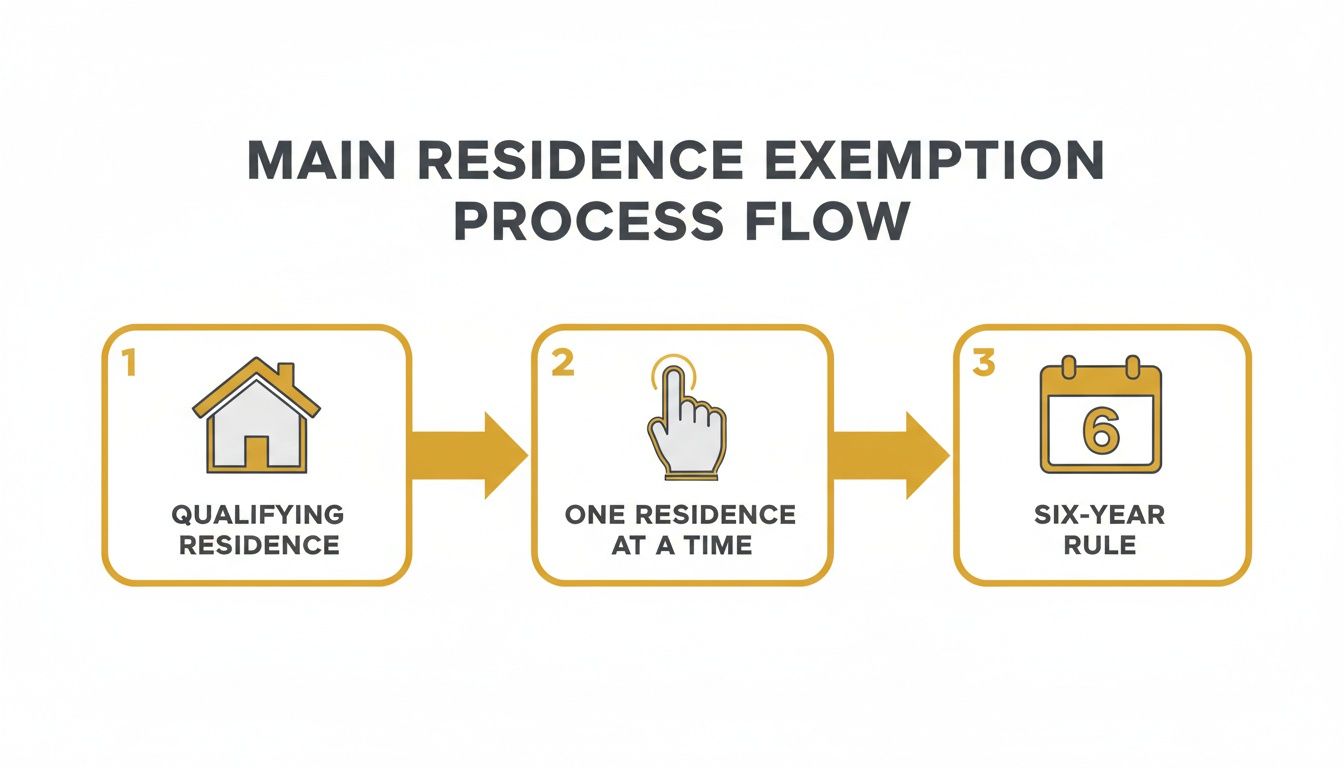
As you can see, checking if your property qualifies, making sure you only have one main residence at a time, and knowing about things like the six-year rule are the foundational concepts you need to get right.
Of course, here is the rewritten section, crafted to sound completely human-written and natural, following the style of the provided examples.
CGT is not a separate tax — a capital gain is included in your assessable income for the year a CGT event occurs. It applies when you dispose of a CGT asset including shares, investment properties, business assets, and cryptocurrency. Your primary residence is generally exempt, though partial exemptions apply in specific circumstances.
The capital gain is capital proceeds (sale price) minus the cost base. The cost base includes purchase price, stamp duty, legal fees, and capital improvement costs. If the asset was held for more than 12 months, apply the 50% CGT discount to reduce the gain before adding it to taxable income. Keep all acquisition records from the purchase date.
Australian resident individuals and trusts that have held a CGT asset for more than 12 months can reduce their capital gain by 50% before inclusion in assessable income. Superannuation funds receive a one-third discount. Companies do not qualify. The holding period begins on the purchase date and ends on the disposal contract date.
Shares are CGT assets. When you sell shares, the gain or loss is proceeds less cost base (purchase price plus brokerage). Gains on shares held more than 12 months qualify for the 50% discount. Capital losses can only offset capital gains — they cannot reduce other income. Carry forward unused losses to offset future gains.
The main residence exemption can entirely or partially exempt the gain from selling your home. Full exemption applies if the property was your main residence throughout the ownership period, was never used to produce income, and sits on land of two hectares or less. Partial exemption applies where it was rented or used for business during part of the ownership period.
Navigating Partial Exemptions and Special Cases
The main residence exemption is wonderfully straightforward when a property has only ever been your family home. But life is rarely that simple.
What happens when your home doubles as your workplace, or you start renting out a spare room to help with the mortgage? In these situations, the tax-free status of your home sale can become partial, meaning a portion of your capital gain suddenly becomes taxable.
Think of your home's tax-free status like a whole pie. If you use a part of it to earn an income, the Australian Taxation Office (ATO) considers that you've cut out a slice for business purposes. When you sell, the "family home" part of the pie is still exempt from tax, but the "business slice" is now on the table for capital gains tax.
This is a really common scenario for many Australians, especially with the rise of remote work and the gig economy. The key is understanding how to correctly portion out the gain so you only pay tax on what you absolutely have to.
When Your Home Is Also Your Workplace
Using part of your home to run a business or renting out a room directly affects your main residence exemption. If you've ever claimed tax deductions for "interest on your home loan" or other running costs against your business income, you will almost certainly face a partial CGT bill when you sell.
The ATO needs you to figure out the taxable portion based on two key factors:
- Floor Area: You have to work out the percentage of your home's total floor area that was used for income-producing activities. For example, if your dedicated home office takes up 10% of your home's floor space, that’s your starting point.
- Time Period: You also need to calculate the exact period you used the space to earn an income. If you ran the business from home for five of the ten years you owned the property, you’ll need to account for that timeframe.
The taxable part of your capital gain is then calculated based on a blend of both the space and the time it was used for business.
Calculating the Taxable Portion
Let's run through a quick example. Imagine you sell your home and make a capital gain of $200,000. You used a home office, which makes up 15% of the house's floor area, to run a business for the entire 8 years you owned the property.
In this simplified case, 15% of your capital gain would be subject to CGT.
- Taxable Portion: $200,000 (Total Gain) x 15% (Business Use Area) = $30,000
This $30,000 is your gross capital gain. And because you've owned the home for more than 12 months, you can then apply the 50% CGT discount, reducing your taxable gain to just $15,000.
This apportionment principle is crucial. It ensures you’re not unfairly taxed on the part of your home you genuinely lived in, while still accounting for the slice that helped you earn an income and claim deductions.
Other Complex Scenarios to Consider
Partial exemptions aren't just for home businesses. Other special cases can complicate your capital gains tax on selling a home, often needing careful calculations and professional advice.
For instance, inheriting a property comes with its own set of rules. The CGT implications depend on when the deceased bought it, whether it was their main residence, and how long you hold onto it before selling. Similarly, if you move into a home you previously rented out, you can't just wipe the slate clean. You’ll need to get a market valuation of the property at the time it first became your main residence, as this value is used to calculate the cost base for your tax-exempt period.
The property market's performance makes these calculations even more significant. For example, CoreLogic data shows Sydney dwelling values recently climbed 1.1% in a single quarter. With forecasts suggesting further rises, a partial CGT liability on a property could represent a substantial sum, making accurate calculations absolutely essential. You can explore more about these trends and their impact in this Australian housing market update from parisfinancial.com.au.
Given the complexities, getting it right is paramount.
Strategies to Legally Minimise Your CGT Bill
Getting the best sale price for your property is only half the battle. The other half is making sure you keep as much of that profit as you legally can.
While paying tax on a capital gain is non-negotiable, there are several legitimate, ATO-approved strategies you can use to reduce your final bill. These aren’t sneaky loopholes; they’re simply the result of smart, forward-thinking financial decisions. By understanding the rules and planning ahead, you can make sure you don't pay a dollar more in tax than necessary.
Hold Your Property for Over 12 Months
Without a doubt, the single most powerful strategy for cutting down your CGT bill is patience. If you're an Australian resident and you hold an investment property for at least 12 months before selling, you unlock the 50% CGT discount.
This is a game-changer. It allows you to slash your taxable capital gain in half, straight off the top. So, if you've calculated a capital gain of $80,000, holding the property for that extra day over the 12-month mark instantly reduces your taxable gain to just $40,000. It’s the cornerstone of managing capital gains tax on selling a home that isn’t your main residence.
The CGT discount is a major wealth-building tool, though it's worth noting its impact. Data from the Parliamentary Budget Office shows the discount heavily favours high-income earners. In 2022–23, a staggering 24,000 millionaires received nearly half of the entire discount's benefit, which gives you an idea of its power.
Time the Sale Strategically
Here’s a crucial detail many people miss: your capital gain is taxed in the financial year you sign the sale contract, not when you settle. This small detail opens up a massive strategic opportunity to time your sale to fall in a year when your other income is lower.
Think about these scenarios:
- Nearing Retirement: Selling after you've officially stopped working could mean your gain is taxed at a much lower marginal rate.
- Taking a Career Break: If you're planning to take a sabbatical or switch to part-time work, that financial year might be the perfect window to sell.
- Launching a Business: In the early years of a start-up, personal income is often much lower, creating an ideal tax environment for a property sale.
By aligning the sale with a lower-income year, you ensure the gain doesn't push you into a higher tax bracket, potentially saving you thousands.
Another smart move is to maximise your deductions in the year of sale. Making a strategic contribution to your superannuation, for example, can be a highly effective way to lower your total taxable income, which in turn reduces the tax hit from your capital gain.
Maximise Your Cost Base
A higher cost base means a lower capital gain. It’s that simple. But so many property owners make the mistake of thinking the cost base is just the purchase price, leaving thousands of dollars in legitimate expenses on the table.
You need to be meticulous. Track and include every single allowable expense to build up your cost base. This includes more than you might think:
- Initial buying costs like stamp duty, legal fees, and buyer's agent fees.
- Major capital improvements, such as renovations, adding an extension, or significant landscaping projects.
- Selling costs, including real estate agent commissions, styling, and advertising fees.
Every receipt you keep for a capital improvement could save you real money when it comes time to sell. For a deeper dive into managing your tax obligations, it's worth exploring general tax planning strategies.
When it comes to tax, planning is everything. Our team can help you navigate all the available options. Check out our detailed article for more on how to reduce capital gains tax.
Essential Record Keeping For A Smooth Tax Return

When it comes to capital gains tax, meticulous records are your best friend. Seriously. They're your best defence against overpaying the Australian Taxation Office (ATO) and your greatest tool for saving money.
Think of your records as the building blocks for your property’s cost base. Every receipt and invoice you save can potentially increase this base, which in turn directly reduces your taxable capital gain. A shoebox of faded receipts is better than nothing, but a well-organised file—digital or physical—is the key to a stress-free tax season.
Your Essential Document Checklist
From the day you even start thinking about buying a property to the day you sell it, you should be collecting documents. These records are absolutely crucial for accurately calculating the capital gains tax on selling a home.
Make sure you keep a clear trail of the following:
- Purchase Documents: This includes the original contract of sale, settlement statements, and receipts for things like stamp duty and your solicitor's fees.
- Improvement Costs: Got invoices for capital improvements? Keep them. This means significant upgrades like a kitchen renovation, adding a deck, or building an extension—not minor repairs like fixing a leaky tap.
- Ownership Costs: Where applicable, you'll need records of council rates, land tax, and the interest you've paid on your home loan.
- Selling Documents: Gather the final contract of sale, settlement statements, and receipts for the real estate agent's commission, legal fees, and any advertising costs.
The ATO requires you to keep these documents for the entire time you own the property, plus another five years after you lodge the relevant tax return. For a more detailed breakdown, our guide on which tax records to keep has you covered.
Good records do more than just satisfy the ATO. They empower you to make informed financial decisions and ensure you claim every legitimate cost you are entitled to, maximising your final profit from the sale.
How To Report Your Capital Gain
Once you have all your records in order and have crunched the numbers to find your net capital gain, the final step is reporting it on your annual tax return. A key point here: you report it in the financial year that you sign the contract of sale, not the year the sale finally settles. This catches a lot of people out.
In the myTax portal, you'll head to the "Capital gains or losses" section. This is where you'll input the key details from your calculations, including your total capital proceeds and the property's all-important cost base.
The system will then prompt you to apply any relevant discounts, like the 50% CGT discount if you've owned the property for more than 12 months. The final number is your net capital gain, which gets added to your assessable income for the year and is then taxed at your marginal rate.
Got More Questions About CGT on Property?
Working through the capital gains tax rules often brings up a few tricky "what if" scenarios. When your situation isn't a simple buy-and-sell, things can get complicated. Let's tackle some of the most common questions property owners ask.
What Happens If I Make a Capital Loss on My Property?
It's a tough pill to swallow, but sometimes you have to sell a property for less than what you paid for it. When this happens, you’ve made a capital loss. While it’s certainly not the outcome you hoped for, this loss has a very specific purpose in the eyes of the tax man.
You can't use a capital loss to reduce your regular taxable income, like your salary from work. Instead, you have to use it to offset any capital gains you’ve made from other assets in the same year. If you don't have any gains to offset, the loss isn't gone for good. You can carry it forward indefinitely to wipe out capital gains in future years, which is why it's so important to report every loss to the ATO.
Do I Pay CGT on an Inherited Property?
The tax rules for inherited properties can be a real maze, and the answer depends entirely on the history of the property. For example, if the person who left you the property bought it before CGT even existed (pre-20 September 1985), you might be completely exempt if you sell it within two years.
A similar two-year grace period often applies if the property was the deceased's main residence right up until they passed away. But if it was their investment property, you effectively step into their shoes and inherit their original cost base. CGT is then calculated on the growth from that point when you eventually decide to sell. Given how many variables are at play, this is one area where getting professional tax advice is a very smart move.
Inheriting a property doesn’t mean an automatic tax bill. The critical factors are how the deceased used the property and how quickly you act on selling it. Getting your head around these conditions is the key to managing any potential CGT you might face.
Can I Avoid CGT by Moving Into My Rental Property Before Selling?
It’s a common idea: move into your rental property for a while, call it your home, and then sell it tax-free. While this strategy can definitely reduce your CGT, it's not a magic loophole that will wipe the slate clean.
The ATO looks at the entire time you owned the property and requires a proportional calculation. You'll need to figure out the total capital gain over your ownership period and then split it. The gain is apportioned based on the number of days it was rented out versus the days it was your genuine main residence. You'll still pay CGT for the period it was an investment, but the gain attributed to the time you lived there will be exempt.
For Australian homeowners, the capital gains tax main residence exemption is easily the most valuable tax break available. It’s the rule that allows you to sell your family home and walk away with every dollar of profit, completely free from capital gains tax (CGT). The catch? It had to be your genuine home for the entire time you owned it and wasn't used to generate income.
The Foundations of the Tax-Free Family Home

At its core, this exemption is a powerful ‘tax-free shield’ protecting the everyday Aussie homeowner. The principle is pretty straightforward: the government gets that your home is a necessity, not just another investment on a spreadsheet. Because of this, any growth in its value shouldn't be taxed when you decide to sell.
This is a cornerstone of Australian property and tax law, offering a huge amount of financial security. It means that when the time comes to sell your home—whether you’re downsizing, moving for work, or freeing up equity—the profit you’ve patiently built over the years is yours to keep.
Why This Exemption Matters So Much
The financial impact of getting this right is massive. For most people, their home is their biggest asset, and the capital growth it racks up over a decade or two can be genuinely life-changing. Without this exemption, a huge chunk of that profit could disappear in tax, derailing retirement plans and putting a serious dent in your financial future.
Let’s look at a real-world example. Say you bought your family home in Sydney back in 2013 for $700,000. You lived in it as your main residence for a full decade before selling it in 2023 for a cool $1.2 million. That’s a $500,000 capital gain, and thanks to this rule, every cent of it is tax-free. This powerful protection is laid out in section 118-110 of the Income Tax Assessment Act 1997.
This is exactly why understanding the rules is so critical. The value at stake is enormous, and a simple mistake can lead to an unexpected and very painful tax bill.
Key Takeaway: The main residence exemption isn't just a minor perk; it's a fundamental principle designed to protect the wealth you build in your home. For many, it literally saves hundreds of thousands of dollars in tax.
To help you get a clear picture of the core requirements, here’s a quick summary of what it takes to qualify for the full exemption.
Main Residence Exemption At a Glance
| Eligibility Requirement | What It Means | Example |
|---|---|---|
| It must be your main residence | The property must be the genuine centre of your domestic life. You live there with your family and keep your personal belongings there. | Your family home where you live day-to-day, receive mail, and are on the electoral roll. |
| You can only have one main residence at a time | You (and your spouse) can't claim the exemption on two properties for the same period. | If you own a city apartment and a beach house, you must choose one as your main residence for any given period. |
| The dwelling must be on land of two hectares or less | The exemption generally only covers your home and adjacent land up to 2 hectares (about 5 acres). | A standard suburban block is well within this limit. A large rural property might need a partial exemption calculation. |
| The property must not have been used to produce income | If you used part of your home to earn income (e.g., renting out a room or running a business), you may only get a partial exemption. | If you never ran a business from home or had a tenant, you meet this condition. |
While this table covers the basics, life is rarely that simple.
Setting the Stage for Success
To lock in this tax-free benefit, you have to tick all the boxes set by the Australian Taxation Office (ATO). While the core idea is simple enough, real-life scenarios often throw a spanner in the works.
For example:
- What if you own a holiday house and a city apartment?
- What happens if you rent out a room on Airbnb or run your consultancy from the study?
- How does moving overseas for a few years affect the exemption?
These are all common situations that can complicate things, potentially reducing your full exemption to a partial one. Throughout this guide, we’ll break down these essential criteria, navigate the special rules, and highlight the traps to avoid. For a broader look at the tax relief available to property owners, you can explore our detailed article about other capital gains tax exemptions in Australia. Getting it right means you can take full advantage of this generous rule and make smarter financial decisions.
Qualifying for the Full Tax Exemption
Securing the full, tax-free main residence exemption all comes down to one simple question: was the property genuinely your home? The Australian Taxation Office (ATO) looks for more than just your name on the title deed; they want to see that the dwelling was the true centre of your domestic life. Think of it less like ticking a box and more like building a case.
To convince the ATO that a property was your main residence, you need to show it’s where you and your family actually lived day-to-day. They’ll look at a handful of practical, real-world factors to paint a clear picture.
Passing the Main Residence Test
There’s no single, magic-bullet factor that proves a property is your main residence. Instead, the ATO considers the whole story based on your personal circumstances. The key indicators are all about where your life is anchored:
- Where Your Family Lives: Does your spouse and do your children live at the property with you?
- Where Your Mail is Delivered: Is this the address you use for your bank statements, bills, and other important mail?
- Your Presence on the Electoral Roll: Is this the address where you are registered to vote?
- Connection to Services: Are the utilities—electricity, gas, internet—connected in your name at this address?
- Where Your Belongings Are Kept: Are your personal effects and valuable possessions stored at the property?
Basically, you need to show that this address is your home base. If you're spending most of your time somewhere else, it becomes a much tougher argument to win.
The Two-Hectare Land Limit
The main residence exemption doesn't just cover the house itself. It also extends to the land it sits on, but there’s a firm boundary. The exemption covers your dwelling and any adjacent land up to a maximum of two hectares (that's about five acres).
For most people living in a typical suburban block, this rule won't even be on their radar. But if you own a larger rural or semi-rural property, this limit is absolutely critical to understand.
If your land is larger than two hectares, you can still get the full exemption on your home and the surrounding two hectares that you use for private or domestic life. The rest of the land, however, will be hit with CGT when you sell. You'll have to calculate the capital gain on that excess portion separately.
Core Conditions for a Full Exemption
Beyond passing the 'main residence' test and staying within the land limit, two fundamental conditions must be met for the entire time you owned the property. Getting either of these wrong can slash your full exemption down to a partial one, leaving you with an unexpected tax bill.
1. You Lived in It for the Entire Ownership Period
To get the full exemption, the property had to be your main residence from the day you settled the purchase right through to the day you signed the contract to sell it. If there was any period you lived somewhere else—for example, you bought it and rented it out for a year before moving in—that period won't qualify for the exemption.
2. You Did Not Use It to Produce Income
This is the big one—the tripwire for so many homeowners. If you've used any part of your home to earn an income, you risk losing some of your exemption. This is a big deal if you've been:
- Renting out a spare room or the whole house (including short-term rentals on platforms like Airbnb).
- Running a business from home and claiming tax deductions for a specific, dedicated office space.
Important Note: Just working from home at the kitchen table generally won't cause any problems. The issue kicks in when you formally claim home office expenses as a tax deduction, because that’s you telling the ATO that a portion of your home was used for income-producing purposes.
Nailing all these conditions means you can sell your home and walk away with the profits, completely tax-free. But if your situation has a few more moving parts, you’ll likely be looking at a partial exemption instead.
Calculating a Partial Main residence Exemption
Real life rarely fits neatly into clean tax rules. While a full exemption from Capital Gains Tax is what everyone hopes for, it’s common for a property to serve different purposes over the years you own it.
Maybe you rented it out for a few years before moving in yourself. Or perhaps you used a room exclusively as a home office to get your business off the ground.
In these common scenarios, the Australian Taxation Office (ATO) doesn't just disqualify you from the exemption entirely. Instead, you can often claim a partial main residence exemption. This means you only pay Capital Gains Tax (CGT) on the slice of the capital gain that relates to the time the property wasn't your main home.
How Does a Partial Exemption Work?
Think of your ownership period as a timeline. The ATO essentially draws a line on that timeline, separating the days the property was your genuine home from the days it was used to earn income. The tax-free shield only covers the days it was your main residence.
This is where the apportionment calculation comes in. It’s a formula the ATO uses to fairly split the total capital gain between its exempt and non-exempt periods. Getting your head around this calculation is the key to figuring out your potential tax bill. For a deeper look at how CGT works on property, check out our detailed guide on capital gains tax on property.
This flowchart breaks down the basic tests your property needs to pass to be considered your main residence for any given period.
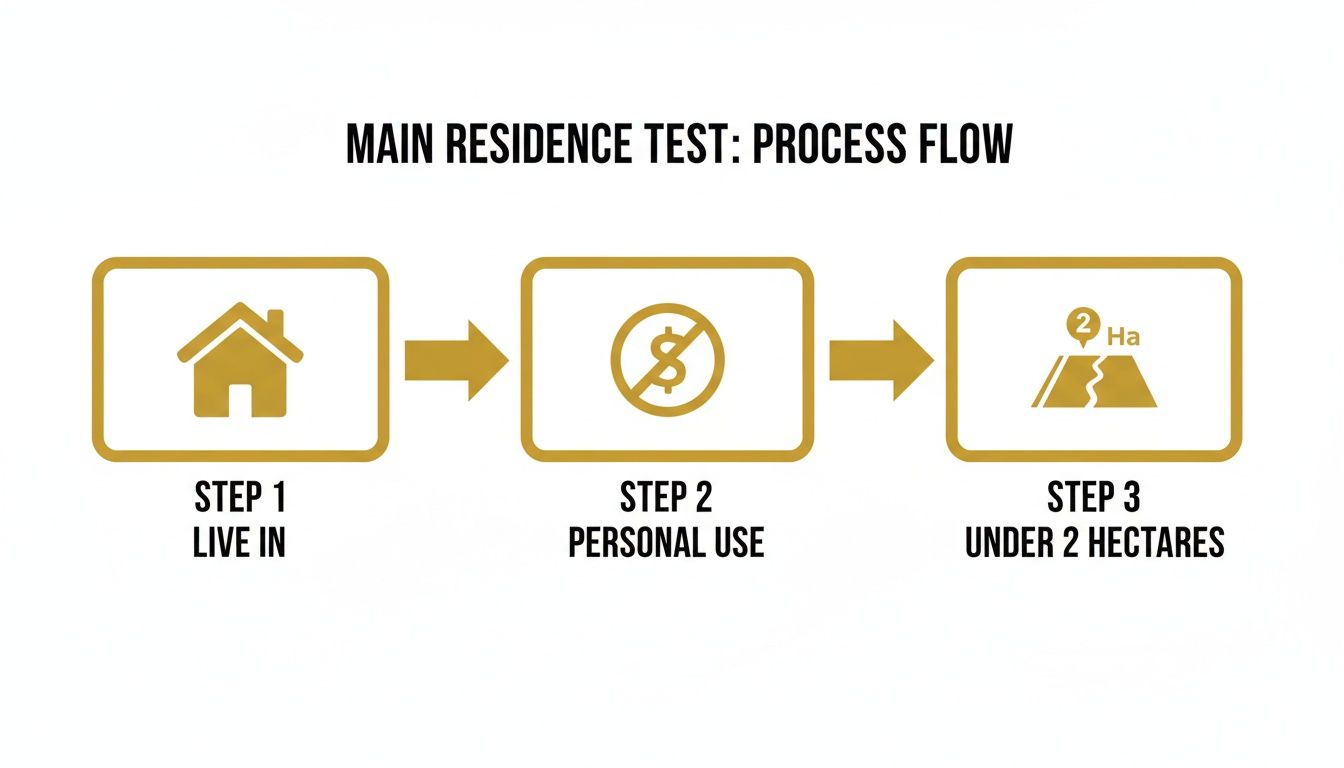
As it shows, to qualify you need to actually live in the property, use it for personal enjoyment rather than to make money, and the land must be under two hectares.
Step-by-Step Apportionment Calculation
The formula itself can look a bit intimidating at first glance, but it makes a lot more sense when you walk through a real-world example.
The basic formula is:
Total Capital Gain x (Number of Non-Main Residence Days / Total Days of Ownership) = Assessable Capital Gain
Let’s put this into a story.
Example: A Homeowner's Journey
Imagine Sarah bought a house on 1 July 2014 for $500,000. She lived in it as her main home for exactly five years.
- Ownership Start: 1 July 2014
- Main Residence Period: 1 July 2014 to 30 June 2019 (1,826 days)
On 1 July 2019, she moved out and rented the property to tenants for the next five years.
- Income-Producing Period: 1 July 2019 to 30 June 2024 (1,827 days)
On 1 July 2024, she sells the house for $900,000, making a total capital gain of $400,000. Her total ownership period was 3,653 days (a neat 10 years).
Here’s how we apply the formula to Sarah's situation:
- Calculate the Total Capital Gain:
- Sale Price: $900,000
- Cost Base: $500,000
- Total Capital Gain: $900,000 - $500,000 = $400,000
- Identify the Non-Exempt Period:
- The property was rented out for 1,827 days. This is the part of the timeline that's taxable.
- Apply the Apportionment Formula:
- $400,000 (Total Gain) x (1,827 Non-Main Residence Days / 3,653 Total Ownership Days) = $200,082
So, in this case, Sarah’s assessable capital gain is $200,082. The other half of the gain, roughly $199,918, is completely tax-free thanks to the main residence exemption.
The Financial Significance of This Exemption
The main residence exemption isn't just a small tax break; it’s one of Australia’s most significant. Treasury estimates show it resulted in $47.5 billion of forgone revenue in 2023–24—a figure larger than the entire Defence budget.
This benefit largely flows to established homeowners. Research indicates that nearly 90% of the financial benefit goes to the top half of income earners, while those who rent or are on lower incomes receive no direct advantage.
Understanding this calculation is crucial for anyone who has rented out their home, even for a short time. It allows you to plan for a potential tax liability and avoid any nasty surprises when it comes time to sell.
Navigating Special Rules and Life Events
Life rarely stays still. A new job offer overseas, a family inheritance, or the breakdown of a relationship can turn your world upside down—and your tax situation along with it. When your home is involved, these major life events can create tricky scenarios for the capital gains tax main residence exemption. Get it wrong, and you could be staring down an unexpected and hefty tax bill.
Thankfully, the ATO has built in several special rules to handle these exact situations. Knowing how they work is the key to protecting your exemption when your life takes an unexpected turn.
The Powerful Six-Year Absence Rule
Of all the special provisions, the six-year absence rule is one of the most valuable tools available to homeowners. It’s like a pause button for your main residence status. It lets you move out of your home—even rent it out and earn an income—and continue treating it as your tax-free main residence for up to six years.
This rule is a lifesaver for anyone who needs to relocate temporarily. Think of an overseas work assignment, an interstate secondment, or even an extended trip. You get the flexibility to generate rental income from your property without immediately exposing it to capital gains tax.
There’s just one critical catch: you can’t treat any other property as your main residence during that same period. If you buy and move into a new place while renting out the old one, you have to choose which property gets the CGT exemption for that overlapping time. You can’t double-dip.
Key Insight: The six-year absence rule isn't something that happens automatically. It’s a choice you make when you lodge your tax return for the year you sell the property. This gives you the power to look back and apply the exemption to whichever property delivers the better tax outcome.
Understanding the Six-Year Rule in Practice
When applied correctly, this rule can save homeowners a fortune. Picture a professional who buys a home, lives in it for a couple of years, and then lands a dream job contract overseas. This is the classic scenario where the six-year absence rule becomes a game-changer.
The financial impact is huge. Let's look at Chloe's situation. She bought a Melbourne home for $800,000 in 2022 and lived in it for two years. In 2024, she took a job in London and rented out her home. Her contract ends in 2029, and after five years away, she decides to sell the property for $1.3 million.
Thanks to the six-year rule, she could pocket the entire $500,000 capital gain completely tax-free, provided she didn't nominate another home as her main residence while she was gone. You can find more detail on this powerful ATO provision in recent tax research.
Comparing Key Special Rules
To help you get a quick handle on these provisions, here’s a simple table comparing the most common scenarios.
| Special Rule | Key Condition | Potential CGT Outcome |
|---|---|---|
| Six-Year Absence Rule | You don't nominate another property as your main residence during the absence. | Full exemption for up to six years while the property is income-producing. |
| Inherited Main Residence | You sell the property within two years of the deceased's passing. | Full exemption is often available if it was the deceased's home and not used for income. |
| Divorce/Separation Rollover | Ownership is transferred between spouses as part of a relationship breakdown. | No immediate CGT. The original cost base is "rolled over" to the receiving partner. |
This table is just a starting point, as each rule has its own set of detailed conditions. It's always best to get advice tailored to your specific circumstances to make sure you're ticking all the right boxes.
Inheriting a Main Residence
When you inherit a property that was the main residence of the person who passed away, a special set of CGT rules comes into play. The tax treatment isn't one-size-fits-all and hinges on a few key questions:
- Was the property the deceased's main residence right before they died?
- Was it being used to produce income at that time?
- How long do you hold onto it before selling?
As a general guide, if you sell the inherited property within two years of the person's death, you can often claim a full main residence exemption. If you hold it for longer than two years, you’ll likely face a partial CGT bill, calculated from the date of death.
Divorce or Separation
A relationship breakdown is tough enough without adding a massive tax bill to the mix. The family home is usually the biggest asset to be divided, and special ‘rollover’ rules are designed to prevent an immediate CGT event during this difficult time.
These rules allow the main residence to be transferred from one partner to the other without triggering any capital gains tax at the time of the transfer. The original cost base of the property simply "rolls over" to the receiving partner, deferring any CGT liability until the property is eventually sold down the track.
This is a critical provision that prevents separating couples from being forced into a fire sale just to cover an immediate and often unmanageable tax bill. The partner who keeps the house effectively inherits its entire CGT history.
Essential Record Keeping and Common Pitfalls

Claiming the capital gains tax main residence exemption isn’t as simple as ticking a box. The Australian Taxation Office (ATO) works on a "show, don't tell" basis, and they expect you to have the proof to back up your claim. Without the right paperwork, your exemption could be challenged, leaving you with a massive and completely unexpected tax bill.
Think of your records as the evidence that validates your property's story. Keeping a meticulous file is your best defence against ATO scrutiny and the only way to ensure you can confidently apply the rules to your unique situation. This goes way beyond just the purchase and sale contracts; it’s about documenting the entire life of the property under your ownership.
Your Essential Documentation Checklist
To properly support your main residence exemption claim, you need a solid file of documents. It’s a whole lot easier to collect these as you go rather than trying to dig them up years down the track when memories are fuzzy and paperwork is lost.
Your file must include:
- Proof of Ownership: This is the obvious one. Keep the contracts of sale for both the purchase and sale of the property, along with all conveyancing documents.
- Cost Base Records: Hang on to receipts for every cost tied to buying, holding, and selling the property. This means stamp duty, legal fees, agent commissions, and—crucially—the costs of major capital improvements like that new kitchen or extension.
- Proof of Residency: This is where you prove the "main residence" part of the claim. Gather documents like utility bills, bank statements, and any other mail showing your name at that address. Being on the electoral roll for that address is also powerful evidence.
- Income-Producing Periods: If you rented out the property or ran a business from a home office, you absolutely must keep detailed records. We’re talking rental agreements, property manager statements, and clear records of all income earned and expenses claimed.
Key Takeaway: The ATO can go back several years to review your tax affairs. As a non-negotiable rule, you must keep organised records for at least five years after you sell your property.
Common Mistakes That Jeopardise Your Exemption
Even homeowners with the best intentions can stumble into traps that put their tax-free exemption at risk. Knowing what these common pitfalls are is the first step to making sure you don't make a costly mistake.
Here are some of the most frequent blunders we see:
- Nominating the Wrong Property: If you own more than one property, you can only claim one as your main residence at any given time. A classic mistake is continuing to claim the old family home after you’ve already bought and moved into a new place. You have to make a choice.
- Miscalculating Income-Producing Periods: People often forget that renting out a room on Airbnb or claiming home office deductions officially turns part of their home into an income-producing asset. Failing to calculate the partial capital gain for these periods is a major red flag for the ATO.
- Ignoring Foreign Residency Rules: The rules for Australian expats and foreign residents have tightened significantly. In most cases, if you are a non-resident for tax purposes when you sign the contract to sell your property, you may lose the main residence exemption entirely, even for the years you did live in it.
- Forgetting the Two-Hectare Limit: If your home is on a block of land larger than two hectares, the exemption gets limited. You must calculate CGT on the portion of land that exceeds this limit.
Avoiding these errors comes down to careful planning and being honest about how you’ve used your property. Getting it right from the start protects this valuable tax break and gives you total peace of mind when it’s finally time to sell.
How to Get Expert CGT Guidance
Figuring out the rules for the capital gains tax main residence exemption can feel like you're walking through a minefield. One wrong step could easily cost you tens, or even hundreds, of thousands of dollars. As this guide shows, what seems simple on the surface gets complicated fast with life events, renting out a room, or special tax conditions. Frankly, getting it wrong is a risk you can’t afford to take.
This is exactly where getting professional advice becomes a non-negotiable. An expert can cut through the dense ATO legislation and give you clear, practical steps for your exact situation—whether you're a homeowner, a seasoned property investor, or an Aussie living overseas. They make sure you’re applying the rules correctly and squeezing every last drop out of the tax benefits available to you.
Personalised Strategies for Property Owners
No two property journeys are the same, and your tax advice shouldn't be either. At Australia Wide Tax Solutions, we live and breathe property and capital gains tax, providing specialised guidance that fits your unique circumstances.
Our services are designed to give you clarity and confidence, including:
- Accurate CGT Calculations: We handle the tricky apportionment for partial exemptions, making absolutely sure you only pay the tax you legally owe.
- Strategic Rental Property Advice: We’ll help you understand the tax impact of earning rental income from your home, now or in the past.
- Tax Planning for Property Sales: Before you even think about selling, we identify opportunities to minimise your tax bill and protect your hard-earned profit.
Don’t leave your biggest asset to chance. A proactive approach to tax planning means you’re fully prepared. You can go into your property sale with complete peace of mind, knowing your financial future is secure.
The rules are detailed, but you don't have to become an expert overnight. For support tailored to your property goals, take a look at our capital gains tax services and book a chat with our experienced team today.
The Six-Year Rule Explained
One of the most valuable features of the main residence exemption is the "six-year rule." If you move out of your home and rent it out, you can continue to treat it as your main residence for capital gains tax purposes for up to six years.
How the Six-Year Rule Works
During that period, a sale can still be fully exempt from CGT — provided you are not claiming another property as your main residence at the same time. If you move back in and leave again, the six-year period resets. If the property is left vacant rather than rented, the exemption can apply indefinitely. This rule makes it possible to relocate for work or family reasons without immediately losing your exemption, but the "only one main residence at a time" condition is the common trap.
Common Questions Answered
When you're dealing with the main residence exemption, a lot of specific "what if" scenarios pop up. It's one of the most common areas we get questions about. Here are some straightforward answers to the tricky situations homeowners often face.
Can I Have Two Main Residences at the Same Time?
No, you can't. The Australian Taxation Office (ATO) is very clear on this: for any single period, you can only nominate one property as your main residence.
Even if you own and live in multiple homes—say, a city apartment for the work week and a house on the coast for weekends—you have to pick one. That choice determines which property gets the tax-free exemption for that specific timeframe. This becomes really important when you sell one of them, as you'll need to declare which periods it was your main residence to work out if you owe any CGT.
What if My Land is Bigger Than Two Hectares?
The full exemption is capped at a dwelling and its adjacent land up to a maximum of two hectares (which is about five acres). If your property is larger than this, it doesn't mean you lose the whole exemption, but it does get a bit more complicated.
You can still claim the full exemption on your home and the two hectares you use most for private purposes. However, the capital gain on the rest of the land will be subject to CGT. You'll need to get a formal valuation to figure out what portion of the sale price is tied to that excess land so you can calculate the taxable gain correctly.
Heads Up: This two-hectare rule is a hard limit. It doesn't matter if local council zoning prevents you from subdividing and selling the extra land separately. For tax purposes, the ATO still treats that excess area as a separate asset.
Does Working from Home Affect My Exemption?
This is a big one, and the answer is: it depends on how you use your home for work. If you're just using a home office or have your laptop set up on the dining table, you generally have nothing to worry about. The ATO knows this is just part of modern life and it won’t affect your capital gains tax main residence exemption.
The situation changes when you start claiming business expenses for your home's running costs—things like a portion of your mortgage interest, council rates, or home insurance. By claiming these deductions, you're officially telling the ATO that part of your home was used to produce income. That's the trigger that will almost certainly lead to a partial CGT bill when you sell.
Do I Owe CGT if I Knock Down and Rebuild My Home?
Usually, no. If you demolish your main residence to build a new one on the same block of land, you can continue treating the property as your main residence right through the construction period.
The ATO gives you a handy concession here. It allows you to treat the vacant land as your main residence for up to four years, as long as you move into the new home as soon as it's practical to do so. This is a lifesaver, ensuring you don't lose your valuable exemption while the builders are on site. Just make sure you keep meticulous records of all the building costs, as they'll become part of the cost base for your new home.
Getting the main residence exemption right can save you a fortune, but a small mistake can be costly. The team at Australia Wide Tax Solutions lives and breathes this stuff, helping homeowners and investors get the best possible tax outcomes while staying fully compliant.
For advice tailored to your specific situation, book a consultation!
CGT is not a separate tax — a capital gain is included in your assessable income for the year a CGT event occurs. It applies when you dispose of a CGT asset including shares, investment properties, business assets, and cryptocurrency. Your primary residence is generally exempt, though partial exemptions apply in specific circumstances.
The capital gain is capital proceeds (sale price) minus the cost base. The cost base includes purchase price, stamp duty, legal fees, and capital improvement costs. If the asset was held for more than 12 months, apply the 50% CGT discount to reduce the gain before adding it to taxable income. Keep all acquisition records from the purchase date.
Australian resident individuals and trusts that have held a CGT asset for more than 12 months can reduce their capital gain by 50% before inclusion in assessable income. Superannuation funds receive a one-third discount. Companies do not qualify. The holding period begins on the purchase date and ends on the disposal contract date.
Shares are CGT assets. When you sell shares, the gain or loss is proceeds less cost base (purchase price plus brokerage). Gains on shares held more than 12 months qualify for the 50% discount. Capital losses can only offset capital gains — they cannot reduce other income. Carry forward unused losses to offset future gains.
The main residence exemption can entirely or partially exempt the gain from selling your home. Full exemption applies if the property was your main residence throughout the ownership period, was never used to produce income, and sits on land of two hectares or less. Partial exemption applies where it was rented or used for business during part of the ownership period.
Understanding Your Australian Tax Obligations from Abroad
Filing taxes from another country can feel like a headache waiting to happen, but the core idea is pretty simple. Think of it as a mandatory financial update you send back to Australia, detailing any income you've generated within its borders. The whole process boils down to one critical question: are you a resident or a non-resident for tax purposes? Getting this right is the first, and most important, step. Your residency status has nothing to do with your citizenship or visa—it’s all about where the ATO determines your economic and personal life is centred based on a few specific tests. Once you’ve confirmed you are a non-resident, your job is to figure out exactly which income needs to be declared. This guide will walk you through everything you need to know, covering:- Taxable Income: Pinpointing exactly what earnings you must declare, from rental income on an Australian property to capital gains.
- Tax Rates and Rules: Getting to grips with how the unique non-resident tax rates apply to your income.
- The Lodgement Process: A step-by-step breakdown of how to file your return correctly and on time.
Defining Your Australian Tax Residency Status
Before you can even think about lodging a tax return, you need to answer one fundamental question: are you considered a resident for tax purposes in Australia? This is the bedrock of all your tax obligations, and it’s a point that trips up many people. Forget your citizenship or visa status for a moment. The Australian Taxation Office (ATO) is focused on something else entirely: where your economic and personal life is primarily centred. Think of it as your financial "home base." Are your daily routines, personal connections, and financial ties firmly planted in Australia, or are they elsewhere? Getting this right is absolutely critical, as it dictates every single step that follows when you prepare your non-resident tax return in Australia.ATO Residency Tests At a Glance
The ATO doesn't just look at a single factor to figure out your residency status. Instead, they use four key tests to get a complete picture of your situation. Understanding these is the first step to knowing where you stand.| Residency Test | Key Criteria | Common Scenario |
|---|---|---|
| The Resides Test | Do you live and behave like a permanent resident? This looks at your intentions, family ties, and living arrangements. | Someone who moves to Australia for an indefinite period, sets up a home, and enrols their kids in a local school. |
| The Domicile Test | Is your permanent home, by law, in Australia? If so, you're a resident unless you've set up a new permanent home overseas. | An Australian citizen who goes to work in the UK for a few years but hasn't established a permanent home there. |
| The 183-Day Test | Have you been physically in Australia for more than half the financial year (183 days or more)? | A backpacker who stays and works in Australia for seven months during the tax year. |
| The Commonwealth Superannuation Test | Are you a member of certain government super funds, working for the government overseas? | An Australian public servant posted at an embassy abroad who contributes to the PSS or CSS super schemes. |
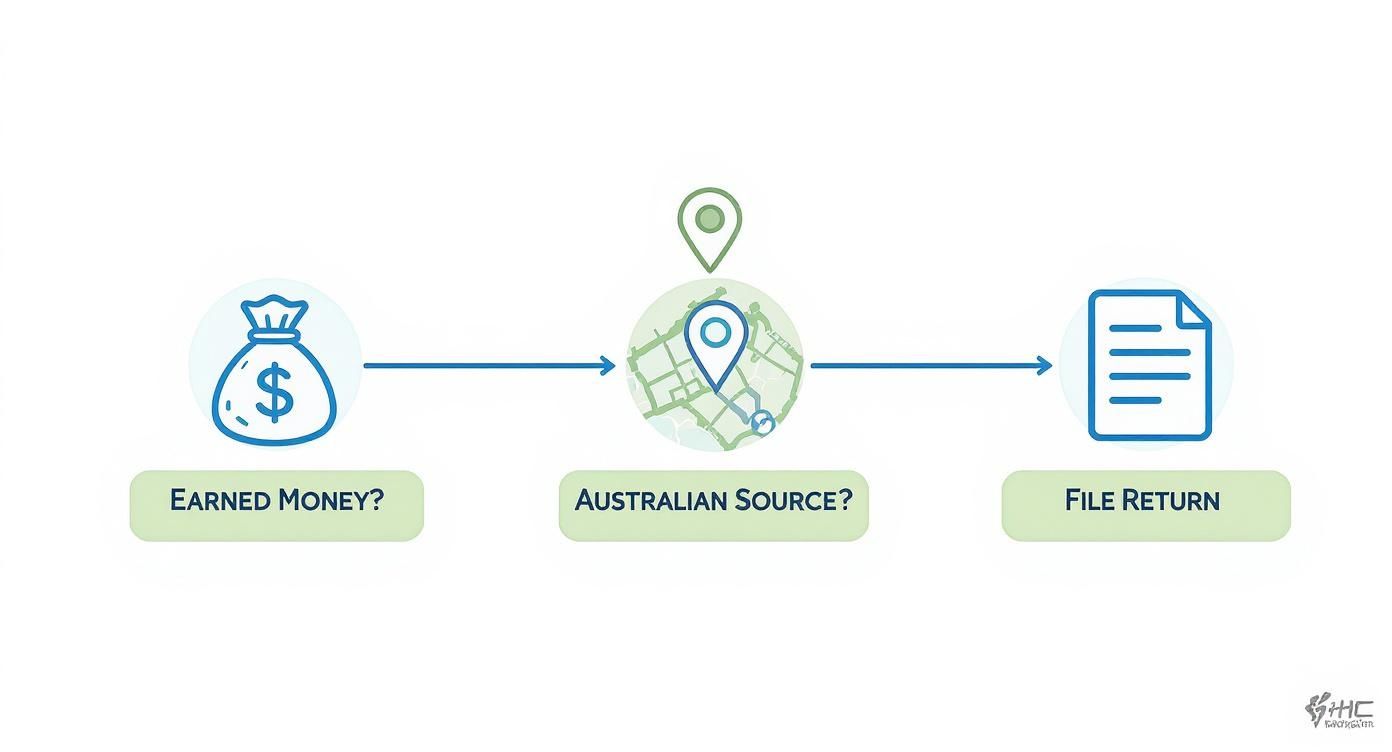
Why This Distinction Matters So Much
Getting your residency status right isn't just a box-ticking exercise; it has a huge impact on how much tax you pay. The biggest difference is that Australian residents get a tax-free threshold, meaning they don't pay tax on the first chunk of their income. Non-residents don't get this benefit.As a non-resident, you are taxed on your Australian-sourced income from the very first dollar you earn. Residents, on the other hand, are taxed on their worldwide income but benefit from a tax-free threshold.This means if you earn even $1 from an Australian source, you must lodge a tax return. Misclassifying your status can lead to an incorrect filing, which could attract the ATO's attention and result in penalties. That’s why figuring this out is easily the most important first step in the whole process.
What Australian Income You Must Declare
Once you’ve worked out you’re a non-resident for tax purposes, the next step is figuring out exactly what income you need to report. The rule of thumb is pretty simple: if the money came from an Australian source, the Australian Taxation Office (ATO) expects to see it on your non resident tax return australia. This goes way beyond just a salary you might have earned from an Australian employer. You need to cast your net a bit wider to make sure you catch all the different income streams the ATO is interested in. Think of it as a checklist, and for each item, you’re just asking, "Did this originate in Australia?"
Common Sources of Australian Income
To make sure nothing slips through the cracks, it’s worth running through the most common types of Australian-sourced income that non-residents have to declare. These are the usual suspects the ATO will be looking for. Common examples include:- Employment Income: This is the obvious one. It covers any salary, wages, commissions, or allowances you picked up from work you actually did in Australia, even if your stay was short.
- Rental Income: If you own a property in Australia and rent it out, the net rental profit is definitely considered Australian-sourced income.
- Australian Pensions or Annuities: Payments from most Australian superannuation funds or annuity policies are taxable here.
- Business or Partnership Income: Any profits you’ve made from a business you operate or have a stake in that's based in Australia.
- Interest and Dividends: Earnings from Aussie bank accounts or shares in Australian companies are also on the list, though you might find withholding tax has already been taken out.
A common mistake is assuming that if tax has already been withheld from interest or dividends, you can just ignore them. While that's sometimes the case, it’s not a golden rule. You should always check if the correct amount was withheld, as you might still need to include it on your return to be fully compliant.
The Special Case of Capital Gains
Now, one of the trickiest areas for non-residents is Capital Gains Tax (CGT). The rules here are very specific and can have a massive impact on your finances, especially when property is involved. As a non-resident, you’re generally only on the hook for CGT on what the ATO calls 'taxable Australian property'. For most people, this just means real estate located in Australia. If you sell an Aussie property, any capital gain you make is considered Australian-sourced income and has to be reported. Crucially, non-residents usually don’t get the 50% CGT discount that residents are entitled to, which means your taxable gain could be a whole lot higher. Getting this right is absolutely vital, as the ATO keeps a very close eye on property sales. For a deeper dive into how different investments can affect your tax, it’s worth reading our dedicated article on why it's so important to declare all investment income in your tax return. Being thorough here can save you from some very unwelcome surprises down the track.How Non-Resident Income Tax Rates Work
One of the biggest financial shocks for newcomers lodging a non-resident tax return in Australia is how differently their income is taxed. Unlike Australian residents, non-residents get zero tax-free threshold. This is a critical point to wrap your head around from day one. Think of the resident tax-free threshold as a head start in a race. Residents get to earn their first $18,200 without paying a cent of tax. As a non-resident, you don't get that head start. You’re taxed from the very first dollar you earn from an Australian source.The Non-Resident Tax Brackets
The rates applied to your income are pretty straightforward but can feel steep, especially at lower income levels. For the 2024-2025 financial year, the marginal tax rates for non-residents are designed to ensure every dollar earned in Australia is taxed. Here’s a simple breakdown of how it works:- $0 – $120,000: Your income in this bracket is taxed at a flat 32.5 cents for each dollar.
- $120,001 – $180,000: For every dollar you earn in this range, you'll pay 37 cents in tax.
- Over $180,000: Any income above this threshold is taxed at the top rate of 45 cents for each dollar.
It's essential to remember that these rates apply only to your Australian-sourced income. Any money you earn in your home country or from other international sources doesn't need to be reported to the Australian Taxation Office (ATO).
Understanding Withholding Tax
Another key concept you'll encounter is withholding tax. This is basically a system where tax is taken out of certain payments before you even receive the money. It’s the ATO’s way of ensuring it collects tax on passive income that’s heading out of the country. Common payments that fall under this system include:- Interest earned from Australian bank accounts
- Dividends from shares in Australian companies
- Royalties
Your Step-by-Step Guide to Lodging the Return
Alright, you’ve sorted out your residency status and figured out which income sources the ATO is interested in. Now for the practical part: actually lodging your non-resident tax return in Australia. This is where the rubber hits the road, but thankfully, the process isn't a one-size-fits-all ordeal. You’ve got a few clear pathways to choose from, depending on how comfortable you are with the details and your personal circumstances.
Choosing Your Lodgement Method
Ultimately, your options come down to three choices. You can go it alone using the ATO’s online or paper forms, or you can bring in an expert to handle the heavy lifting for you.- Engage a Registered Tax Agent: For most non-residents, this is hands-down the safest and simplest route. A good agent lives and breathes the specific tax rules that apply to you. They know what to look for, can help you find every eligible deduction, and ensure your return is spot on. Plus, they get extended deadlines, which can be a lifesaver.
- Lodge Online with myTax: If you already have a myGov account linked to the ATO and your tax affairs are pretty straightforward, this can be a quick and easy option. The main catch? Trying to navigate it from overseas can sometimes throw up frustrating technical glitches.
- Lodge by Paper: Good old-fashioned paper forms are still an option if you prefer them or can’t get the online services to work. You'll just need to download the right form from the ATO website, fill it out, and pop it in the mail to the address they provide.
Your Essential Lodgement Checklist
No matter which path you take, a little preparation goes a long way. Running through a checklist helps make sure nothing important gets missed and keeps the whole process moving smoothly.- Gather Your Documents: Start by collecting all your income statements (like payment summaries from employers), details of any rental income, records of capital gains, and bank interest statements.
- Collect Proof of Expenses: Next, pull together all the receipts and records for any deductions you plan to claim. This could be anything from maintenance costs for a rental property to work-related expenses you incurred while in Australia.
- Confirm Your TFN: Make sure you have your Australian Tax File Number (TFN) ready. You can’t lodge a return without it.
- Complete the Return: Carefully fill out every relevant section of the form, whether you’re doing it online or on paper. It pays to double-check all your figures and personal details for accuracy.
- Submit Before the Deadline: This one’s critical. If you're lodging yourself, the deadline is October 31. Missing it can lead to penalties, so don’t leave it to the last minute.
By methodically working through these steps, you transform a potentially confusing task into a manageable one. Organising your information beforehand is the best way to ensure a smooth and stress-free lodgement experience.
Common Mistakes to Avoid for a Smooth Filing
Lodging your non resident tax return in Australia on time is one thing, but getting it right is another game entirely. It’s worth taking a moment for a final pre-flight check to catch those simple errors that can cause frustrating delays or, worse, attract unwanted attention from the Australian Taxation Office (ATO). Many people stumble at the very first hurdle: getting their tax residency status wrong. Even if you're almost certain you're a non-resident, it never hurts to quickly run through the official tests one last time just to be sure. Another classic slip-up is accidentally leaving out certain types of Australian-sourced income. Capital gains from property sales are a big one here, as they come with their own very specific set of rules that can easily trip you up. And of course, the most avoidable mistake of all is simply missing the lodgement deadline.By learning from these common missteps, you can look over your own return with a more critical, experienced eye. This proactive approach helps you manage your Australian tax affairs effectively, making the whole process as smooth and stress-free as possible.Hopefully, this guide has given you a clear, actionable path to follow. By understanding your obligations and steering clear of these common pitfalls, you can confidently handle your Australian tax responsibilities. The goal is always 100% compliance—it gives you peace of mind, no matter where in the world you're based.
Frequently Asked Questions
When you're dealing with a non resident tax return in Australia, it’s natural for a bunch of questions to pop up. We get it. Below are some quick, clear answers to the queries we hear most often, designed to give you a bit more confidence before you lodge.Do I Really Need an Australian Tax File Number as a Non-Resident?
Yes, absolutely. Getting an Australian Tax File Number (TFN) is non-negotiable. While you can technically earn income without one, any employer or bank is legally required to withhold tax from you at the highest possible rate—currently a painful 45%. Having a TFN is the only way to ensure you’re taxed at the correct non-resident rates. It’s also a must-have for actually lodging your tax return.Can I Lodge My Australian Tax Return Online From Overseas?
You sure can. The Australian Taxation Office (ATO) has an online system called myTax, which is available to non-residents. The catch is you'll need a myGov account that’s properly linked to the ATO to get access. It’s often the fastest way to lodge, but be warned—we’ve seen plenty of people run into technical glitches trying to access it from outside Australia.Lodging online is great when it works. But if you hit a wall, engaging a registered tax agent is a rock-solid backup plan. They can lodge for you and often get access to later deadlines, which takes a lot of stress out of the process.
What Sorts of Deductions Can I Claim on My Return?
As a non-resident, you can still claim deductions, but there’s a strict rule: the expenses must be directly tied to earning your Australian-sourced income. Here are a couple of common examples:- Rental Property Costs: If you’re leasing out an Australian property, you can claim things like agent fees, council rates, and money spent on repairs.
- Work-Related Expenses: Did you have a job while you were physically in Australia? You can claim the costs you paid for things like specific uniforms or tools needed for that job.
Do I Still Have to Lodge if Tax Was Already Taken Out?
This is a common point of confusion, and the answer is: it depends. If the only Australian income you earned was from interest, dividends, or royalties, and the right amount of withholding tax was taken out at the source, you might not have to lodge a return for it. However, if you had any other type of income (like wages or rent), or if you think too much tax was withheld, you absolutely need to file a non resident tax return in Australia. This is how you square things up with the ATO and, more importantly, get any potential refund you’re owed. Always double-check your specific situation to be certain.Trying to make sense of Australian tax law from another country can feel like a maze. The team at Australia Wide Tax Solutions lives and breathes this stuff, specialising in helping non-residents get their tax obligations sorted accurately and without the headache. Whether it's lodging a return, figuring out capital gains, or managing rental income, we offer clear, expert guidance. Contact us today to get your Australian tax affairs in order.
The ATO provides guidance through ato.gov.au, the Small Business Support Line (13 28 66), and Online Services for individuals and businesses. For complex situations, a registered tax agent provides advice tailored to your specific circumstances and professional indemnity protection. You can verify agent registration at the TPB register at tpb.gov.au.
Most tax records must be kept for five years from the date of lodgement or the date the transaction occurred, whichever is later. Records must be in English or convertible to English and must be sufficient to explain the income and deductions in your return. The ATO can request records at any time during the retention period.
Consider a registered tax agent when your affairs involve multiple income sources, business activity, investment properties, capital gains, or overseas income. Agents extend your lodgement deadline, provide safe harbour protection, and take professional responsibility for the advice given. Verify registration at tpb.gov.au.
The failure to lodge penalty is based on penalty units ($313 per unit from 1 July 2023), accruing per 28-day period for late returns and BAS lodgements. Incorrect information penalties range from 25% to 75% of the tax shortfall depending on whether the behaviour was careless, reckless, or intentional. Proactive disclosure before an audit begins typically results in significantly reduced penalties.
Tax minimisation is the legal arrangement of your affairs to reduce tax — claiming all eligible deductions, using appropriate structures, and timing income and expenses. Tax avoidance involves arrangements that technically comply with the law but achieve outcomes parliament did not intend. The ATO can apply Part IVA anti-avoidance rules to cancel benefits from avoidance arrangements.