
Why Working Holiday Makers in Australia Need Medical Cover If Earning Over $84,000
Working holiday makers (WHMs) flock to Australia for adventure, cultural exchange, and the opportunity to earn a solid income. But what many don’t realise is that when annual earnings exceed $84,000, the Australian Taxation Office (ATO) applies a key tax rule that can impact your take-home pay—unless you have the right medical cover in place.
- Why Working Holiday Makers in Australia Need Medical Cover If Earning Over $84,000
- The Medicare Levy Surcharge Explained.
- How AWTS Helps Working Holiday Makers
Medical cover that, when you apply for your VISA, does not constitute cover for taxation purposes. If your income is below this threshold, you do not need to worry. For both earners over $84,000 and under, please read our blog on how to retrieve a medicare levy exemption statement.
The Medicare Levy Surcharge Explained.
Australia’s Medicare system is funded by a levy on taxpayers. However, those on higher incomes who don’t have adequate private hospital cover may also be subject to the Medicare Levy Surcharge (MLS)—an additional tax of 1% to 1.5% on top of the standard Medicare Levy.
For WHMs, this becomes relevant as soon as taxable income crosses the $84,000 threshold (for singles in 2024-25).
Why WHMs Are Affected - **Not automatically exempt:** Unlike some other visa holders, WHMs are generally considered Australian residents for tax purposes if they work and live here for an extended period. - No reciprocal Medicare agreement:
Most WHMs are not eligible for Medicare unless from a country with a reciprocal agreement. -
Income triggers the surcharge:
Once earnings surpass $84,000, the ATO expects proof of adequate hospital cover or payment of the surcharge. What Counts as “Adequate” Medical Cover? To avoid the MLS, you must hold an approved private hospital insurance policy for the entire financial year. Overseas Visitor Health Cover (OVHC) that meets ATO requirements can be sufficient, but not all policies qualify—always check the policy details. Consequences of Not Having Cover - Extra tax: For a WHM earning $90,000, the MLS could mean an additional $900–$1,350 in tax. - No refund:
The surcharge is calculated automatically when you lodge your tax return—there is no option to “opt out” if you missed taking out cover. - Late action, late penalty: If you only realise at tax time, you can’t backdate most insurance policies.
How AWTS Helps Working Holiday Makers
Upfront advice: We advise all WHMs approaching the $84,000 threshold to secure compliant medical cover early. - Documentation checks:
Our tax checklists ensure you submit proof of cover, maximising refunds and preventing surcharge surprises. -
Audit protection: In the event of an ATO review, our systems double-check your documentation and income reporting for compliance.
Key Takeaways - WHMs earning over $84,000 must have adequate hospital cover or pay the MLS. - AWTS’s audit and checklist systems help you stay compliant and avoid unnecessary tax.
Get in touch for a personalised tax review and advice on the right cover for your situation.
The ATO provides guidance through ato.gov.au, the Small Business Support Line (13 28 66), and Online Services for individuals and businesses. For complex situations, a registered tax agent provides advice tailored to your specific circumstances and professional indemnity protection. You can verify agent registration at the TPB register at tpb.gov.au.
Most tax records must be kept for five years from the date of lodgement or the date the transaction occurred, whichever is later. Records must be in English or convertible to English and must be sufficient to explain the income and deductions in your return. The ATO can request records at any time during the retention period.
Consider a registered tax agent when your affairs involve multiple income sources, business activity, investment properties, capital gains, or overseas income. Agents extend your lodgement deadline, provide safe harbour protection, and take professional responsibility for the advice given. Verify registration at tpb.gov.au.
The failure to lodge penalty is based on penalty units ($313 per unit from 1 July 2023), accruing per 28-day period for late returns and BAS lodgements. Incorrect information penalties range from 25% to 75% of the tax shortfall depending on whether the behaviour was careless, reckless, or intentional. Proactive disclosure before an audit begins typically results in significantly reduced penalties.
Tax minimisation is the legal arrangement of your affairs to reduce tax — claiming all eligible deductions, using appropriate structures, and timing income and expenses. Tax avoidance involves arrangements that technically comply with the law but achieve outcomes parliament did not intend. The ATO can apply Part IVA anti-avoidance rules to cancel benefits from avoidance arrangements.
Welcome to Australia! So, you're here on a working holiday, ready for an incredible adventure. But amidst the excitement of new jobs and exploring stunning landscapes, there's one crucial thing you can't ignore: your working holiday visa tax return.
Think of it as a mandatory check-in with the Australian Taxation Office (ATO). It’s how you officially declare your income and the tax you've paid. More importantly, it's your ticket to getting a refund on any overpaid tax and making sure you stay on the right side of Australian law. A little bit of paperwork for a lot of peace of mind.
Your No-Nonsense Guide to Aussie Working Holiday Taxes
Lodging a tax return isn't just about ticking a box for the government; it's your opportunity to claim back money you're owed. For heaps of backpackers, this means a welcome cash injection that can fund the next leg of their travels or a few extra nights out.
We're going to cut through the official jargon and give you a straightforward rundown of the Australian tax system for working holiday makers. By the end of this guide, you’ll know exactly what you need to do.
The Two Things You Absolutely Must Get Right
Before you even think about lodging a return, there are two initial steps that will have the biggest impact on your bank account in Australia. Getting these sorted from day one will save you a world of headaches and a serious amount of cash.
- Your Tax Residency Status: This is, without a doubt, the single most important factor affecting how much tax you'll pay. Your visa type and your tax residency are completely separate things. We'll dive into this later, but the difference between being a 'non-resident' and a 'resident for tax purposes'—often decided by whether you travel constantly or stay put—can completely change your tax rate.
- Getting a Tax File Number (TFN): Your TFN is your unique ID in the Australian tax system. Applying for one the moment you arrive is non-negotiable. If you don't have one, your employer is legally forced to tax you at the highest possible rate, which is a staggering 45%. Handing over your TFN ensures you're taxed at the much, much lower rate for working holiday makers.
Getting a handle on these two concepts is the difference between losing nearly half your pay cheque to tax and keeping more of your hard-earned dollars for what you actually came here for: the adventure.
This guide will walk you through everything you need to know to manage your taxes confidently. You'll learn how to lodge your return, what expenses you can claim, and how to get back every dollar you are legally entitled to. Let's make sure your Aussie experience is rewarding in every sense of the word.
Understanding The Backpacker Tax Rates
Jumping into the Australian tax system can feel a bit daunting at first, but figuring out the rates for working holiday makers is actually more straightforward than you might think. What the ATO officially calls the 'Working Holiday Maker tax rate' is known by just about everyone else as the 'Backpacker Tax'.
This system is set up specifically for anyone on a subclass 417 or 462 visa. It’s designed to be simple, making sure you pay a fair amount right from the very first dollar you earn in Australia. Unlike Australian residents who enjoy a tax-free threshold, your earnings are taxed from dollar one. It removes the guesswork and lets you know exactly what to expect when that first payslip lands.
The Magic Number Is 15 Percent
For the vast majority of your working holiday, the number to burn into your memory is 15%.
This is the flat tax rate that applies to every dollar you earn, right up to $45,000 in a single financial year. So whether you're picking fruit in sunny Queensland, pulling espressos in a Sydney café, or on a construction site in Melbourne, this is the rate that will almost certainly apply to your income.
This special tax bracket was created to give temporary visitors a clear and predictable system. But there's a catch, and it's a big one: these rates only apply if you've given your employer a valid Tax File Number (TFN).
The difference between having a TFN and not having one is enormous. Without it, your employer is legally forced to withhold tax at the highest possible rate of 45%. It's the ATO's way of making sure tax gets paid, but it means you could lose nearly half your paycheque until you get things sorted.
This infographic really drives home just how crucial a TFN is.
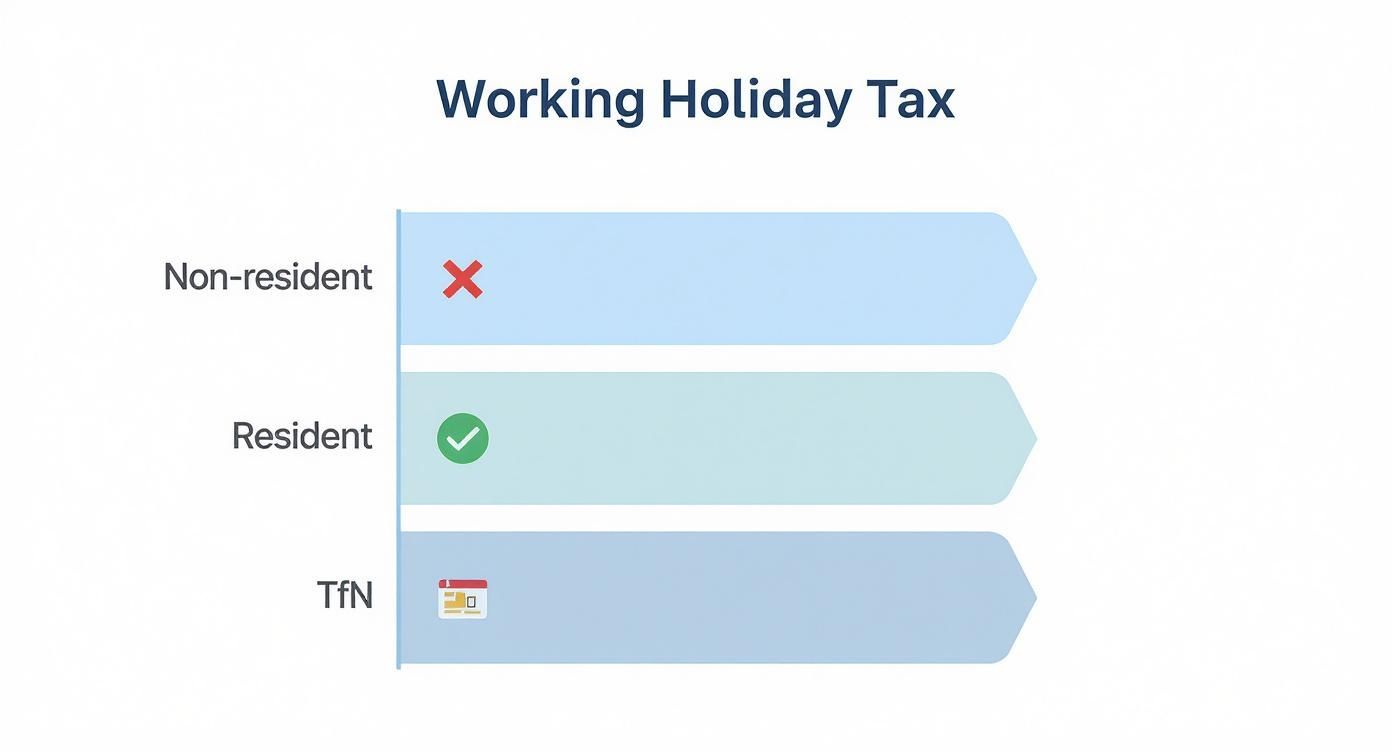
As you can see, sorting out your TFN is a simple step with a massive impact on your take-home pay, no matter what your residency status ends up being.
What Happens If You Earn More Than $45,000
While plenty of backpackers keep their earnings under the $45,000 mark, it's definitely possible to earn more, especially if you work for a full year or land a few higher-paying gigs. If you do cross that threshold, your tax rate simply increases for the money you earn above that initial amount.
It’s a tiered system. You don't suddenly pay a higher rate on all your income, only on the portion that falls into the next bracket.
The Australian government has set these specific, progressive rates for anyone on a 417 or 462 visa. Here’s a simple table showing how it works for the 2024-2025 financial year.
Working Holiday Maker Tax Rates
| Income Bracket | Tax Rate |
|---|---|
| $0 – $45,000 | 15% |
| $45,001 – $135,000 | 30% |
| $135,001 – $190,000 | 37% |
| $190,001 and over | 45% |
Getting your head around this structure is the key to lodging your tax return correctly. It helps you calculate what you owe and, more importantly, spot if you've paid too much tax—which is often the case and leads to a refund.
While these are the standard rates, everyone's situation is a little different. For a deeper look at how these numbers stack up against other tax classifications, check out our detailed guide on non-resident tax rates in Australia.
Determining Your Tax Residency Status
One of the biggest tripwires for anyone lodging a working holiday visa tax return is the whole concept of tax residency. So many travellers just assume that because they’re on a temporary visa, they're automatically a non-resident for tax purposes. This is an incredibly common—and often expensive—mistake.
Let's get one thing straight: your visa status and your tax residency are two totally separate things in the eyes of the Australian Taxation Office (ATO). Your visa gives you the right to be here, but it's your lifestyle and behaviour while you're in Australia that decides how you get taxed.
Getting this right is absolutely critical because it dictates the tax rates you’ll pay. Being classed as an Australian resident for tax purposes means you’re taxed at the same rates as locals. This includes getting access to the tax-free threshold, which was $18,200 for the 2023-24 financial year.
On the flip side, non-residents (which includes most working holiday makers by default) are taxed from the very first dollar they earn, at a flat rate of 15% on income up to $45,000.
The Deciding Factor: Your Lifestyle in Australia
So, how does the ATO figure out if you're a resident for tax purposes? It’s not about ticking a box on a form. It’s about looking at your actual life and what you're doing in Australia. The main test they use is called the 'resides test'.
Think of it this way: are you just passing through, or have you started to build a life here?
Someone who's constantly on the move, living out of a backpack and working in a new town every few weeks, is clearly behaving like a tourist. Their actions scream "I'm just visiting".
But what about someone who rents a room in one city for six months, joins the local footy team, opens a bank account, and holds down the same job for a while? Their day-to-day life starts to look a lot like a local's. They are showing behaviour consistent with residing here.
The core idea behind the resides test is to look beyond your visa and assess your genuine connection to Australia. It's about your physical presence, your intentions, and the real-life ties you've formed.
Key Factors in the Resides Test
The ATO looks at a bunch of factors together to get the full picture. No single thing is the deciding factor, but combined, they paint a pretty clear image of your residency status.
- Length of Stay: While it's not a hard-and-fast rule, staying in Australia for more than six months (183 days) is a strong signal that you might be a resident.
- Living Arrangements: Do you have a stable address, like a lease or a long-term room rental? Or are you hopping between hostels every week? A fixed address points towards residency.
- Social and Community Ties: Have you joined a gym, a library, or local clubs? Have you built a solid group of friends in one particular area? These social roots matter.
- Financial Connections: Things like having an Australian bank account, a local mobile phone plan, and keeping your personal belongings here all suggest you've established a base.
To really nail this down, let’s look at two different scenarios.
Example One: The Classic Backpacker
Chloe lands in Sydney and stays for two weeks before heading up to Byron Bay for a month. From there, she travels to Queensland for fruit-picking, moving between farms every few weeks and living in hostels. Chloe’s behaviour is a textbook example of a non-resident for tax purposes.
Example Two: The Settled Backpacker
Liam arrives in Melbourne and quickly finds a job in a café. He rents a room in a share house on a six-month agreement, joins a local soccer team, and even buys a cheap car. Even though he’s on a working holiday visa, Liam's lifestyle strongly suggests he is a resident for tax purposes.
Getting this distinction right is the most important step in lodging your tax return correctly. For a deeper dive into the tests the ATO uses, check out our guide on how to be an Australian tax resident. Making the right call here ensures you pay the correct amount of tax and can lodge your return with confidence.
How to Lodge Your Tax Return Step by Step
Alright, now that you’ve got a handle on your tax residency and the rates that apply, you’re ready for the final hurdle: lodging your working holiday visa tax return. Think of this as the final check-in with the tax office, where you report what you’ve earned and officially claim back any refund you're owed. The good news is, you've got options.
The key is to take it one step at a time. Starting with gathering the right documents before you even think about how to file will make the whole process much smoother and way less stressful.
Step 1: Gather Your Essential Documents
Before you can fill out a single form or log into a portal, you need to get your financial paperwork in order. Trying to lodge without these key documents is like trying to bake a cake without the main ingredients—it’s just not going to work.
Make sure you have these ready to go:
- Your Tax File Number (TFN): This is your unique ID with the ATO. You absolutely cannot lodge a return without it.
- Your Income Statement: This document, which used to be called a PAYG payment summary or group certificate, shows how much you earned and how much tax your employer withheld. Your boss has until 14 July to finalise this, and it will pop up directly in your myGov account.
- Bank Account Details: You’ll need an Australian bank account so the ATO has somewhere to send any refund you’re due.
- Records of Work-Related Expenses: If you're planning to claim deductions for things you bought for work, you need the receipts and logbooks to prove you actually spent the money.
Step 2: Choose Your Lodgement Method
Once your documents are all lined up, it’s time to decide how you'll actually lodge. There are three main paths you can take, and each has its pros and cons depending on your situation.
- Lodge Online with myGov: This is the ATO's own digital portal and it’s a great choice for simple, straightforward returns. It's free, and it even pre-fills a lot of your income information for you.
- Use a Registered Tax Agent: If your tax situation is a bit more complex or you just want to be certain you're getting the biggest refund possible, a tax agent is an excellent choice. They are experts in tax law and can spot deductions you might have missed.
- Lodge a Paper Tax Return: While it’s still technically an option, this is by far the slowest method. It can take up to 50 business days to process, so it’s generally not recommended unless you have no other choice.
For most working holiday makers, the big decision is between using myGov or a tax agent. If you only had one or two jobs and aren't claiming many deductions, myGov can be fast and simple. But if you've had multiple jobs or have a stack of work-related expenses, an agent's fee can often pay for itself through a larger refund.
And you're not alone in this. Data shows that a huge chunk of working holiday makers—around 70-80%—lodge an Australian tax return each year. The vast majority earn below $45,000, which keeps their tax affairs relatively simple. In 2023 alone, the ATO processed over 250,000 returns from this group, with about 60% getting a refund.
Step 3: Lodging Your Return Through myGov
If you've decided to go the DIY route, using myGov is your best bet. The whole process is designed to be user-friendly, guiding you through each section of the tax return one piece at a time.
Here's a quick breakdown of the steps:
- Create a myGov Account: If you don't have one, you'll need to set one up on the official myGov website.
- Link to the ATO: Once you’re in myGov, you have to link your account to the ATO's online services. You'll need your TFN and a few other personal details to prove it's you.
- Start Your Tax Return: Head to the ATO section and find the option to prepare your tax return for the right financial year.
- Check Pre-Filled Information: The system is pretty clever and will automatically pull in data from your employers and bank. Your job is to carefully check that it's all correct.
- Add Your Deductions: This is where you manually enter any work-related expenses you want to claim. The system will ask questions to guide you through it.
- Review and Submit: Give everything one last look. Once you're confident it’s all accurate, you can lodge it directly from the portal.
Lodging a tax return for the first time can feel a bit overwhelming, but breaking it down into these manageable steps makes all the difference. For a more detailed walkthrough, check out our tax return step-by-step guide, which has extra tips and visuals to help you through the process.
Claiming Deductions to Maximise Your Refund
Lodging your working holiday visa tax return is about more than just declaring what you've earned; it's your chance to legally shrink your taxable income and get more of your hard-earned cash back in your pocket. So many travellers leave money on the table simply because they don't realise what work-related costs they're allowed to claim.

Think of a tax deduction as the ATO giving you a discount on something you had to buy for your job. When you claim these expenses, you lower your total income that gets taxed. This often means you’ve already paid more tax through your wages than you actually owe, which is exactly how you end up with a healthy refund.
The Three Golden Rules of Deductions
Before you start digging through receipts, you need to get your head around the ATO's core principles. For any expense claim to be legitimate, it has to tick all three of these boxes. No exceptions.
- You must have spent the money yourself and your boss didn't pay you back for it.
- The expense must be directly related to earning your income. There has to be a clear link between what you bought and your job.
- You must have a record to prove it. This is usually a receipt, but bank statements or logbooks can also work.
Following these three golden rules is non-negotiable. The ATO can ask for proof of any claim you make, so keeping organised records is your best defence against having a claim denied.
Common Deductions for Backpacker Jobs
Working holiday jobs are often unique, and that means your potential deductions are too. Whether you're working in the red dust of the outback or a bustling city cafe, your expenses will be different. Let's break down some of the most common claims that pop up for backpackers.
Many working holiday makers find they can claim for expenses like tools, sun protection, or specific training courses. We've summarised some of the most frequent ones below.
Common Deductions for Working Holiday Makers
| Deduction Category | Examples | Key Requirement |
|---|---|---|
| Vehicle & Travel | Using your car to travel between job sites (e.g., a tradie visiting multiple locations). | You can't claim travel from home to your main workplace. |
| Clothing & Laundry | Uniforms with a company logo, protective gear (steel-cap boots, high-vis vests). | Cannot be conventional clothing (e.g., plain black t-shirt and jeans). |
| Tools & Equipment | A chef's knife set, a carpenter's power tools, a laptop for an admin role. | Items over $300 must be depreciated (claimed over several years). |
| Self-Education | A Responsible Service of Alcohol (RSA) course for bar work, a White Card for construction. | The course must have a direct connection to your current job. |
| Protective Items | Sunscreen, sunglasses, and hats for outdoor work (e.g., fruit picking, landscaping). | The item must protect you from a specific risk in your work environment. |
Remember, this isn't an exhaustive list, but it covers the main areas where backpackers can often claim. The key is always to connect the expense directly back to how you earned your income.
Real-World Deduction Examples
Let's put this into practice to see how it works.
Example: The Farm Worker
Mia is working on a banana farm up in Queensland. The sun is relentless, so she buys a proper wide-brimmed hat, high-SPF sunscreen, and sunglasses just for her days on the farm. Because these items are specifically to protect her from the hazards of her job, she can claim them as deductions. She's smart and keeps all the receipts from the chemist.
Example: The Cafe Barista
Ben lands a job at a cafe that requires all staff to wear a branded apron and t-shirt, which he has to buy himself. He buys two sets so he always has a clean one. He can claim the full cost of these items. On top of that, he can claim laundry expenses at $1 per load for washing his uniform separately from his regular clothes.
By carefully tracking these small but necessary costs, you can make a huge difference to your final tax refund. It's your money, after all—so make sure you claim everything you're entitled to.
Tying Up the Loose Ends: Claiming Your Super and Finalising Your Taxes
Your time in Australia might be coming to an end, but don't pack your bags just yet. There are a couple of crucial financial tasks to tick off before you fly out, and getting them right can put a serious amount of cash back into your travel fund.
We're talking about claiming your superannuation and, if you're leaving for good, filing your tax return early. Think of these as the final, most rewarding chores of your working holiday. Completing them means you leave Australia with every dollar you're owed and no messy financial threads left dangling.
Get Your Superannuation Back
While you were working, every employer you had was legally required to pay a portion of your wages into a superannuation fund. It's basically a forced savings account for retirement. For most working holiday makers, this "super" can quickly add up to hundreds, or even thousands, of dollars just sitting there.
The best part? You don't have to wait until you're 65 to get it. Once your visa has expired and you've physically left Australia, you can claim this money through a process called the Departing Australia Superannuation Payment (DASP).
Think of your super as a hidden savings pot you get to cash out when your trip is over. Not claiming it is like walking away from your last paycheque—it's your money, and you're entitled to it.
The tax rate applied to your DASP depends on your visa, but the process itself is pretty straightforward and can be kicked off online. Just make sure you have all your super fund details handy before you leave the country.
Lodging an Early Tax Return
Normally, the Australian financial year wraps up on 30 June, with tax returns due by 31 October. But if you’re leaving Australia permanently before the end of the financial year, you don't have to wait around. You can lodge an early tax return.
This is a massive advantage. It means you can sort out your tax affairs as soon as you finish your last job, rather than trying to deal with it from the other side of the world months later. Any refund you're due will land in your bank account much faster, ready to fund the next leg of your journey.
To lodge early, you'll need to use a paper form or go through a registered tax agent, as the online myGov portal isn't set up for it. This process makes sure your Australian income is squared away properly. It all ties back to the 'Backpacker Tax' rules introduced in 2017, which simplified things with a flat 15% tax rate on the first $45,000 you earn. You can get more insights on how the Backpacker Tax works over at etax.com.au.
By taking care of these two final steps, you can wrap up your working holiday visa tax return and claim back your super, making for a financially tidy and rewarding end to your Aussie adventure.
Common Questions About Your WHV Tax Return
Still got a few questions buzzing around about your working holiday tax return? Don't worry, you're not the first and you definitely won't be the last.
We've pulled together the most common queries that trip up backpackers. Think of this as your cheat sheet to lodging with confidence.
- Do I even need to lodge a tax return? It all comes down to the ATO's residency tests and how much you've earned. We'll help you figure it out.
- What records should I have kept? Your TFN is a big one, along with your income statements and any receipts for work-related expenses.
- Can I claim my travel costs or work clothes? You absolutely can, as long as they tick the ATO's three golden rules for work expenses.
- What if I'm leaving Australia before the tax year ends? No problem. You can lodge an early return and also get your superannuation back through a process called DASP.
Answers on Residency and Income
Your residency status isn't just about your visa; it's decided by things like where you live and for how long you stay in one spot.
For example, if you've been renting a room for more than six months and have a local bank account, the ATO might see you as an Australian resident for tax purposes.
Getting this right is crucial because being classed as a tax resident could mean you're eligible for the tax-free threshold, which puts more of your hard-earned cash back in your pocket.
Tip: If you're unsure, the ATO has a handy online residency tool that gives you a quick answer.
Filing Steps and Deductions
Lodging your return online through myGov is a popular option. Once the ATO pre-fills your income information, it can take as little as 20 minutes.
Of course, using a registered tax agent is another great way to go. They handle the entire process for you and are experts at spotting deductions you might have missed.
It's amazing how many people forget to claim things like work-specific uniforms, travel between different job sites, or essential protective gear. Every little bit adds up!
| Step | Action | Time Estimate |
|---|---|---|
| 1 | Link your TFN to your myGov account | 5 minutes |
| 2 | Check the pre-filled income information | 5–10 minutes |
| 3 | Add your deductions and hit submit | 5 minutes |
Once lodged, any refund you're owed usually lands in your Australian bank account within two weeks. Just be sure to keep all your records for five years, in case the ATO wants to double-check anything.
Common Filing Pitfalls
One of the most frequent mistakes we see is forgetting to provide a TFN to an employer. This simple error means they have to withhold tax at the highest rate of 45% by default. Ouch.
Another classic mistake is guessing your deductions or claiming expenses without having the receipts to back them up. If the ATO questions these, they'll be disallowed, which could lead to delays or even a tax bill.
Always take a moment to cross-check everything before you submit. It's the best way to avoid headaches later on.
Avoid Pitfalls: Your new mantra: Double-check your TFN is on all forms and save every single receipt.
For expert support with your working holiday tax return, get in touch with the team at Australia Wide Tax Solutions.
Yes, if you are under 75 and meet the work test (if aged 67–74). Lodge a notice of intent to claim with your fund before the earlier of the tax return due date or the lodgement date. Once the fund acknowledges the notice, the contribution becomes concessional and is taxed at 15% inside the fund.
The concessional contributions cap for 2025-26 is $30,000. This covers employer SG contributions, salary sacrifice, and personal deductible contributions combined. Contributions above the cap are included in assessable income at your marginal rate, with a 15% tax offset for the tax already paid inside the fund.
The Super Guarantee rate for 2025-26 is 11.5%, rising to 12% from 1 July 2025. Employers must contribute this percentage of each eligible employee's ordinary time earnings to a complying super fund at least quarterly. Late or missing payments trigger the Super Guarantee Charge, which includes interest and is not tax deductible.
Salary sacrifice contributions come from pre-tax income and are taxed at 15% inside super rather than at your marginal rate (up to 47%). The difference is your tax saving. A taxpayer in the 37% bracket saves 22 cents per dollar sacrificed, subject to the $30,000 concessional cap.
Yes, if your total super balance was below $500,000 on 30 June of the prior year. Unused cap amounts from the previous five years can be carried forward and used in a higher-income year. The oldest unused amounts are applied first, allowing catch-up contributions that significantly reduce tax for eligible individuals.
Understanding the Medicare Levy Exemption Form:
A Guide to Reducing Your Tax Burden
Introduction to the Medicare Levy Exemption.
As tax season rolls around, many Australians find themselves navigating the complexities of the healthcare system and its associated costs. One aspect often comes into play is the Medicare levy, a tax that helps fund the country's universal healthcare program. However, did you know you may be eligible for an exemption from this levy?
- Understanding the Medicare Levy Exemption Form:
- A Guide to Reducing Your Tax Burden
The Medicare Levy Exemption Form is a crucial document that can help reduce your tax burden if you meet specific criteria. In this comprehensive blog post, we'll explore the ins and outs of this form, including who qualifies for an exemption, how to fill it out, and the potential benefits it can provide.
What is the Medicare Levy?
Before delving into the exemption form, let's first understand the Medicare levy. The Medicare levy is a tax that all Australian residents are required to pay, with a few exceptions. This levy helps fund the country's universal healthcare system, Medicare, which provides Australians access to free or subsidized medical services.
The Medicare levy is calculated as a percentage of your taxable income, and the current rate is 2%. If your taxable income is $50,000, you will pay $1,000 in Medicare levies (2% of $50,000).
Who Qualifies for a Medicare Levy Exemption?
Not everyone is required to pay the Medicare levy. There are several circumstances in which you may be eligible for an exemption, including:
- Low-income earners: If your taxable income is below a certain threshold, you may be exempt from paying the Medicare levy. The current thresholds are:
- Single: $23,365 or less
- Couple/family: $39,402 or less (plus $3,471 for each dependent child or student)
- Individuals with a disability: If you have a disability that prevents you from working, you may be eligible for a full or partial exemption from the Medicare levy.
- Norfolk Island residents are exempt from paying the Medicare levy as they are not eligible for Medicare benefits.
- Foreign residents: If you are a foreign resident for tax purposes, you are not required to pay the Medicare levy.
- Members of a religious group: If you are a member of a religious group with a conscientious objection to insurance, you may be eligible for an exemption.
- Temporary residents: If you are a temporary resident in Australia, you may be eligible for an exemption from the Medicare levy.
It's important to note that the criteria for exemption can change over time, so it's always best to check the latest information on the Australian Taxation Office (ATO) website.
How to Fill Out the Medicare Levy Exemption Form
If you believe you qualify for a Medicare levy exemption, you must complete the Medicare Levy Exemption Application form. This form can be found on the ATO website and can be submitted either online or by mail. Call us if you are not sure.
Here's a step-by-step guide on how to fill out the form:
- Personal information: Please provide your details, such as your name, date of birth, and tax file number.
- Reason for exemption: Select the reason for your exemption from the list provided. This could be one of the reasons mentioned in the previous section, such as low income, disability, or religious objection.
- Supporting documentation: Depending on the reason for your exemption, you may need to provide additional documentation to support your claim. This could include things like a Centrelink income statement, a letter from a medical professional, or a statement from your religious organization.
- Declaration: Finally, you'll need to sign the statement at the bottom of the form, confirming that the information you've provided is accurate and true.
Once you've completed the form, you can submit it online or by mail to the ATO. It's important to note that the ATO may take several weeks to process your application. Submit it well before your tax return deadline.
Benefits of the Medicare Levy Exemption
Obtaining a Medicare levy exemption can provide several benefits, including:
- Reduced tax burden: Being exempt from the Medicare levy can reduce your overall tax burden, potentially resulting in a larger tax refund or a lower tax bill.
- Improved financial flexibility: The money you save from not paying the Medicare levy can be used to cover other expenses or invest in your future.
- Peace of mind: Knowing that you don't have to pay the Medicare levy can provide financial security and peace of mind, especially for those on a tight budget.
- Fairness: The exemption helps ensure that those who cannot pay the levy, such as low-income earners or individuals with disabilities, are not unfairly burdened by this tax.
Potential Drawbacks and Considerations
While the Medicare levy exemption can be beneficial, there are a few potential drawbacks and considerations to keep in mind:
- Ineligibility for Medicare benefits: If you are exempt from paying the Medicare levy, you may also be ineligible for certain Medicare benefits. This is something to consider if you rely on these services.
- The requirement to maintain private health insurance: If you are a high-income earner and are exempt from the Medicare levy, you may be required to maintain a certain level of private health insurance to avoid the Medicare Levy Surcharge.
- The complexity of the application process: Filling out the Medicare Levy Exemption Form can be complex and time-consuming, especially if you need to provide additional documentation.
- Potential for audits: The ATO may audit your exemption claim, so it's essential to ensure that you meet the eligibility criteria and have the necessary documentation to support your claim.
Conclusion
The Medicare Levy Exemption Form is a valuable tool for Australians who meet the eligibility criteria. By understanding the exemption process and the potential benefits it can provide, you can take steps to reduce your tax burden and potentially improve your financial situation.
If you believe you may qualify for a Medicare levy exemption, we encourage you to review the information provided in this blog post and visit the ATO website. For the most up-to-date information and instructions on how to apply. Remember, the key to a successful exemption claim is ensuring that you have the necessary documentation and that your application is accurate and complete.
By taking advantage of the Medicare Levy Exemption Form, you can save money on your taxes and contribute to the overall fairness and accessibility of Australia's healthcare system. So, if you're eligible, don't hesitate to explore this option and take control of your financial well-being.
The ATO provides guidance through ato.gov.au, the Small Business Support Line (13 28 66), and Online Services for individuals and businesses. For complex situations, a registered tax agent provides advice tailored to your specific circumstances and professional indemnity protection. You can verify agent registration at the TPB register at tpb.gov.au.
Most tax records must be kept for five years from the date of lodgement or the date the transaction occurred, whichever is later. Records must be in English or convertible to English and must be sufficient to explain the income and deductions in your return. The ATO can request records at any time during the retention period.
Consider a registered tax agent when your affairs involve multiple income sources, business activity, investment properties, capital gains, or overseas income. Agents extend your lodgement deadline, provide safe harbour protection, and take professional responsibility for the advice given. Verify registration at tpb.gov.au.
The failure to lodge penalty is based on penalty units ($313 per unit from 1 July 2023), accruing per 28-day period for late returns and BAS lodgements. Incorrect information penalties range from 25% to 75% of the tax shortfall depending on whether the behaviour was careless, reckless, or intentional. Proactive disclosure before an audit begins typically results in significantly reduced penalties.
Tax minimisation is the legal arrangement of your affairs to reduce tax — claiming all eligible deductions, using appropriate structures, and timing income and expenses. Tax avoidance involves arrangements that technically comply with the law but achieve outcomes parliament did not intend. The ATO can apply Part IVA anti-avoidance rules to cancel benefits from avoidance arrangements.
Understanding the Medicare Levy Threshold:
A Comprehensive Guide
Introduction
As an Australian taxpayer, you may have heard the term "Medicare levy" before, but do you fully understand how it works and the threshold? The Medicare levy threshold is a critical component of the Australian tax system, and knowing how it applies to your financial situation is essential.
- Understanding the Medicare Levy Threshold:
- A Comprehensive Guide
- Introduction
- What is the Medicare Levy?
- Understanding the Medicare Levy Threshold
In this blog post, we'll explore the Medicare levy threshold, exploring what it is, how it's calculated, and why it's a crucial consideration when it comes to taxes. Whether you're a first-time taxpayer or a seasoned veteran, this guide will provide you with the information you need to navigate the Medicare levy landscape confidently.
What is the Medicare Levy?
The Medicare levy is a tax that all Australian residents are required to pay, with a few exceptions. Its purpose is to help fund the country's universal healthcare system, Medicare. The levy is calculated as a percentage of your taxable income and added to the income tax you owe.
The current Medicare levy rate is 2% of your taxable income. If your taxable income is $50,000, you would pay an additional $1,000 in Medicare levy (2% of $50,000).
Understanding the Medicare Levy Threshold
The Medicare levy threshold is when you become liable to pay the Medicare levy. If your taxable income falls below the threshold, you may be eligible for a reduction or exemption from the levy.
The Medicare levy threshold is determined by your filing status and the number of dependents you have. For the 2022-2023 financial year, the thresholds are as follows:
- Single taxpayers: $23,365
- Couples (with or without children): $39,402
- Single parents: $32,742
It's important to note that these thresholds are adjusted annually to account for changes in the cost of living and other economic factors.
Calculating the Medicare Levy
You'll need to know your taxable income to calculate the Medicare levy you owe. Your taxable income is your total income minus any allowable deductions, such as work-related expenses, charitable donations, and other eligible deductions.
Once you have your taxable income, the calculation is straightforward:
- Determine if your taxable income is above the Medicare levy threshold for your filing status.
- If your taxable income is above the threshold, multiply your taxable income by 2% to calculate the Medicare levy amount.
- If your taxable income is below the threshold, you may be eligible for a reduction or exemption from the levy.
For example, let's say your taxable income is $55,000, and you're filing as a single taxpayer. The Medicare levy threshold for single taxpayers is $23,365, so your taxable income is above the threshold. To calculate the Medicare levy, you would multiply $55,000 by 2%, which equals $1,100.
Reductions and Exemptions
As mentioned earlier, if your taxable income falls below the Medicare levy threshold, you may be eligible for a reduction or exemption from the levy. Here's a closer look at these options:
Medicare Levy Reduction
If your taxable income is below the full Medicare levy threshold, you may be eligible for a reduced Medicare levy. The reduction is calculated on a sliding scale, with the levy gradually increasing as your taxable income rises.
For the 2022-2023 financial year, the reduced Medicare levy rates are as follows:
- Taxable income between $23,365 and $29,206 (single): Reduced levy of 10% to 100% of the full levy
- Taxable income between $39,402 and $49,252 (couples/families): Reduced levy of 10% to 100% of the full levy
- Taxable income between $32,742 and $40,958 (single parents): Reduced levy of 10% to 100% of the full levy
Medicare Levy Exemption
In some cases, you may be eligible for a complete exemption from the Medicare levy. This is typically the case if you:
- Are a low-income earner with a taxable income below the relevant threshold
- Have a spouse who is eligible for a Medicare levy reduction
- Are a foreign resident who is not eligible for Medicare benefits
- Have a Commonwealth concession card, such as a Pensioner Concession Card or a Health Care Card
To claim a Medicare levy exemption, complete the relevant section on your tax return and provide any necessary supporting documentation. If you need the Medicare levy Exemption form, please click here.
Importance of Understanding the Medicare Levy Threshold
Understanding the Medicare levy threshold is essential for several reasons:
- Tax Planning: Knowing the threshold can help you plan your finances more effectively. If you're close to the threshold, you may be able to adjust your taxable income through deductions or other strategies to reduce your Medicare levy liability.
- Budgeting: The Medicare levy is a significant expense for many Australians, so it's important to factor it into your overall budget and financial planning.
- Eligibility for Reductions and Exemptions: If your taxable income falls below the threshold, you may be eligible for a reduced levy or a complete exemption, which can result in significant savings.
- Compliance: Failing to pay the correct Medicare levy can lead to penalties and other legal consequences, so it's crucial to understand your obligations and ensure you're meeting them.
Strategies for Reducing Your Medicare Levy
If your taxable income is above the Medicare levy threshold, there are a few strategies you can use to reduce your liability potentially:
- Maximizing Deductions: Consider ways to reduce your taxable income through eligible deductions, such as work-related expenses, charitable donations, and superannuation contributions.
- Income Splitting: If you're married or in a de facto relationship, you may be able to split your income with your partner to bring both of your taxable incomes below the threshold.
- Timing Income and Deductions: Consider timing the recognition of your income and deductions to ensure you stay below the threshold in a given financial year.
- Claiming Exemptions: If you're eligible for a Medicare levy exemption, claim it on your tax return.
- Seeking Professional Advice: Consult with a tax professional who can help you navigate the complexities of the Medicare levy and identify any opportunities for reducing your liability.
Conclusion
The Medicare levy threshold is a crucial aspect of the Australian tax system that every taxpayer should understand. By knowing the threshold, calculating your liability, and exploring strategies for reducing your levy, you can ensure that you're meeting your tax obligations while also maximizing your financial well-being.
Remember, the Medicare levy is an important contribution to our universal healthcare system, so it's a responsibility we all share as Australian residents. By staying informed and proactive about your tax situation, you can make the most of the available exemptions and reductions and contribute to Medicare's continued success.
If you have any further questions or need assistance navigating the complexities of the Medicare levy, don't hesitate to contact a tax professional or the Australian Taxation Office for guidance.
The ATO provides guidance through ato.gov.au, the Small Business Support Line (13 28 66), and Online Services for individuals and businesses. For complex situations, a registered tax agent provides advice tailored to your specific circumstances and professional indemnity protection. You can verify agent registration at the TPB register at tpb.gov.au.
Most tax records must be kept for five years from the date of lodgement or the date the transaction occurred, whichever is later. Records must be in English or convertible to English and must be sufficient to explain the income and deductions in your return. The ATO can request records at any time during the retention period.
Consider a registered tax agent when your affairs involve multiple income sources, business activity, investment properties, capital gains, or overseas income. Agents extend your lodgement deadline, provide safe harbour protection, and take professional responsibility for the advice given. Verify registration at tpb.gov.au.
The failure to lodge penalty is based on penalty units ($313 per unit from 1 July 2023), accruing per 28-day period for late returns and BAS lodgements. Incorrect information penalties range from 25% to 75% of the tax shortfall depending on whether the behaviour was careless, reckless, or intentional. Proactive disclosure before an audit begins typically results in significantly reduced penalties.
Tax minimisation is the legal arrangement of your affairs to reduce tax — claiming all eligible deductions, using appropriate structures, and timing income and expenses. Tax avoidance involves arrangements that technically comply with the law but achieve outcomes parliament did not intend. The ATO can apply Part IVA anti-avoidance rules to cancel benefits from avoidance arrangements.