
Think of your accountant. For most business owners, they’re the person who looks after the past—lodging tax returns, finalising compliance, and telling you what happened last year. But what if you had a partner focused on your future?
- Beyond Bookkeeping: What Are Business Advisory Services?
- The Core Pillars of Business Advisory Support
- Warning Signs Your Business Needs an Advisor
- How to Choose the Right Business Advisory Partner
- Seeing the Real-World Impact of Business Advisory
That’s the difference between standard accounting and business advisory services.
Beyond Bookkeeping: What Are Business Advisory Services?

Many business owners see their accountant as someone who just handles tax and keeps them out of trouble with the ATO. This historical reporting is absolutely crucial, but it only ever gives you a picture of where you’ve been. Business advisory services are all about where you’re going.
It’s like having a coach who doesn’t just show you the tape from last week’s game (your financial reports) but uses it to build a winning game plan for the next season (your business growth). A business advisor uses your financial data to map out the road ahead, helping you make smarter, more strategic decisions.
From Compliance to Strategy
Moving from standard accounting to advisory means shifting from a reactive to a proactive mindset. Instead of just lodging your Business Activity Statement (BAS), an advisor digs into what those numbers really mean for your future.
This strategic partnership empowers you to:
- Solve problems before they start: Proactively spot potential cash flow gaps or operational issues before they become full-blown crises.
- Grab opportunities with both hands: Use real data to identify market trends, plan an expansion, or go after funding with a solid, confident case.
- Build real, sustainable growth: Create a clear roadmap for your future, making informed choices that support long-term success, not just short-term wins.
The demand for this kind of forward-looking guidance is exploding. The Australian consulting market, which covers these critical advisory functions, hit USD 5.7 billion in 2025 and is forecast to reach USD 10.2 billion by 2034. This growth is driven by businesses needing expert direction to navigate digital changes and plan for sustainability.
An advisor’s job is to turn your financial data from a history book into a strategic playbook. They don’t just tell you what happened; they help you decide what happens next.
What an Advisor Really Is
The "advisor" role isn't one-size-fits-all; it can take many forms depending on what your business needs most. To see the full picture, it helps to look at specialised areas. For example, understanding what goes into expert digital marketing consulting shows how targeted advice can accelerate growth in one specific part of your business.
In the same way, a financial advisor might help you restructure your business for better tax outcomes or build a detailed cash flow forecast to get you through a tough patch. The goal is always the same: to provide expert guidance that moves your business forward, turning challenges into opportunities and ambitions into achievements. It’s a powerful partnership focused squarely on your success.
The Core Pillars of Business Advisory Support
Business advisory isn't about some secret formula or a single magic fix. It’s about building a solid foundation for your business's future, focusing on a few core areas that work together to make your operation more resilient, profitable, and ready for what’s next.
Let's put it this way: if your business is a car, traditional accounting is like looking in the rearview mirror—it shows you where you’ve been. Business advisory is your GPS, your dashboard, and your expert mechanic all rolled into one. It guides you toward your destination while making sure the engine is running perfectly.
Here are the five pillars that form the backbone of effective advisory support.
Strategic Business Planning
The first, and most important, pillar is Strategic Business Planning. This is so much more than just a mission statement gathering dust on a shelf. It’s about creating a detailed, actionable roadmap that clearly defines where you want your business to be in the future and exactly how you're going to get there.
An advisor works with you to crystallise your vision. We help set measurable goals (like boosting market share by 15% or launching a new product line) and identify the Key Performance Indicators (KPIs) you need to track your progress. It’s all about answering the big questions: what’s our long-term ambition, and what concrete steps do we need to take this quarter to make it happen?
This process turns vague dreams into a solid plan, making sure every decision you make is intentional and moves you closer to your ultimate goals.
Financial Management and Analysis
Once you have a strategic plan, the next step is building the financial engine to power it. That's where Financial Management comes in. This is about more than just keeping clean books; it's about understanding the story your numbers are telling.
This involves a few key activities:
- Budgeting and Forecasting: We help you create realistic budgets that actually align with your strategic goals and project what your financial performance will look like down the track.
- Profitability Analysis: This means digging deep into your products, services, and even customer types to see what’s genuinely driving profit and what’s quietly draining your resources.
- Performance Monitoring: We'll regularly review your financial statements to see how your actual results stack up against your budget, spotting any issues early before they become major problems.
Good financial management ensures your business isn't just running, but running efficiently and profitably. It gives you the stability you need to chase growth.
Cash Flow Forecasting
Connected to financial management but so vital it deserves its own spotlight is Cash Flow Forecasting. We’ve seen plenty of profitable businesses fail simply because they ran out of cash. This pillar is your business’s financial weather report, giving you a clear view of the money moving in and out of your bank account over the coming weeks and months.
A business can be profitable on paper but cash-poor in reality. Cash flow forecasting is the tool that bridges this gap, giving you the foresight to manage your bank balance effectively and avoid liquidity crises.
An advisor helps you see cash surpluses and shortfalls coming. This foresight lets you:
- Prepare for the quiet months by organising a line of credit well in advance.
- Know exactly when you have the spare cash to invest in new equipment or stock up on inventory.
- Strategically manage your payments and receivables to keep a healthy cash buffer.
If you're looking to get a better handle on your company's finances, you can learn more about how to manage cash flow in a small business in our detailed guide. This proactive approach stops nasty surprises and puts you firmly in control of your financial destiny.
Strategic Tax Planning
While a standard accountant handles your yearly tax compliance, a business advisor focuses on Strategic Tax Planning. This is a forward-looking process designed to legally minimise your tax bill and keep more capital in your business. It’s not about scrambling for deductions at the last minute on June 30th.
Instead, your advisor helps you structure your business and its transactions in the most tax-effective way possible, all year round. This might involve advice on the timing of asset purchases, managing Capital Gains Tax (CGT), or choosing the right business structure. The goal is simple: help your business keep more of its hard-earned money to reinvest in growth.
BAS and Compliance Support
Finally, while advisory is all about looking forward, it never ignores the fundamentals. Expert Business Activity Statement (BAS) and compliance support is the pillar that ensures your foundation is rock-solid and meets all its ATO obligations.
A good advisor takes this off your plate, ensuring accurate and on-time lodgements. This frees up your time and mental energy from getting bogged down in admin, so you can focus on running and growing your business with the confidence that all the compliance is handled perfectly. It's the peace of mind that underpins every other strategic move you make.
Warning Signs Your Business Needs an Advisor
Most business owners are so deep in the daily grind they can’t see the critical signals their business is sending them. Spotting these red flags is the first step toward getting the strategic support you need to build a more resilient and profitable company.
Ignoring them is like putting a piece of tape over the check-engine light in your car. It doesn't make the problem go away; it just makes a major breakdown more likely. An advisor is the master mechanic who can diagnose the issue and fix it before it becomes critical.
They focus on the core pillars of business health to make sure everything works together as a system.

You’re Profitable on Paper But Always Short on Cash
It’s one of the most frustrating traps in business. Your profit and loss statement looks great, showing healthy profits, but your bank account is perpetually empty. This dangerous gap between paper profit and real cash flow creates constant stress and makes it impossible to invest in growth.
An advisor gets to the root cause fast. They’ll analyse your cash conversion cycle, review your payment terms with customers and suppliers, and check your inventory levels to find out where the money is going. This isn’t just about survival; it’s about creating the financial breathing room to run your business with confidence.
You Feel Stuck in Reactive Mode
Does your day consist of putting out one fire after another? If you’re constantly reacting to surprise problems, client complaints, and urgent deadlines, you’re not in control of your business—it’s controlling you.
This is a classic sign of a missing strategic roadmap. An advisor helps you shift from a reactive to a proactive mindset. They work with you to implement forward-looking plans and systems that allow you to anticipate challenges and steer your business with purpose, instead of being pulled in ten different directions at once.
When your business decisions are driven by urgency rather than strategy, you are sacrificing long-term growth for short-term survival. An advisor helps you break this cycle by creating the space and clarity needed for proactive leadership.
Growth Opportunities Are Passing You By
Ever had to turn down a huge order because you didn't have the cash flow to fund the materials? Or missed a chance to expand because you were too buried in admin to develop a proper plan?
When operational drag holds you back, it's a clear sign you need an expert on your team. This is precisely what business advisory services are for. An advisor helps you get your financial house in order and streamline your operations, so when a golden opportunity appears, you have the capacity and confidence to grab it. If you're not sure how your business is really performing, a deep dive might be in order. You can learn more about the benefits of a business health check-up in our detailed article.
The demand for this kind of expert help is growing rapidly. Australia's accounting services sector, a key provider of business advisory, hit USD 20.5 billion in 2024 and is forecast to reach USD 23.24 billion by 2030. This growth is fuelled by businesses seeking guidance on everything from digital systems to complex tax planning, proving just how vital this support has become in today's market.
How to Choose the Right Business Advisory Partner
Picking the right business advisory partner is one of the most important decisions you’ll make for your company’s future. This isn't just about hiring someone to punch numbers into a calculator; it's about finding a genuine strategic partner. The right advisor will challenge you, support your vision, and give you the clarity you need to hit your goals.
Don’t just look at the price tag. A cheap advisor offering only surface-level advice is a business cost, not an investment. The real value is in finding a firm that’s genuinely aligned with your ambitions and has a proven history of helping businesses just like yours succeed.
Look Beyond the Numbers
The biggest difference between a standard, compliance-focused accountant and a real, growth-oriented advisor is their perspective. A traditional accountant looks backwards, making sure your history is recorded correctly. A true business advisor uses that same data to look forward and ask, "What's next?"
Their focus must be on future strategy, not just historical reporting. This forward-looking approach is absolutely vital. Australia's professional services market, which includes these essential advisory roles, was valued at over USD 300 billion in 2024. Despite some economic challenges, this huge number shows just how critical specialised advice is for navigating things like capital gains tax and complex financial planning. You can find out more about the professional services market size in Australia to see the full picture.
Key Criteria for Evaluation
When you’re assessing potential advisory partners, you need a clear checklist. Don’t get distracted by a fancy presentation or a slick sales pitch. You have to dig deeper to find hard evidence of their expertise and commitment.
Your checklist should cover these key areas:
- Proven Industry Experience: Have they actually worked with businesses in your specific sector? Industry-specific knowledge can make a massive difference.
- Strong Client Testimonials: What are their current clients saying? Look for reviews that talk about real, tangible results and a strong working relationship.
- A Transparent Communication Style: You need an advisor who speaks plainly and gets in touch proactively. They should be easy to reach and able to explain complicated ideas in simple terms.
It’s also a great idea to see how they run their own business. A firm with a solid growth blueprint for consulting firms clearly knows what it takes to succeed and is better equipped to help you do the same.
Choosing an advisor is like picking a co-pilot for your business journey. You need someone you trust completely, who can read the instruments you can't, and who is fully committed to getting you to your destination safely and efficiently.
Critical Questions to Ask Potential Advisors
To sort the true partners from the simple service providers, you need to ask sharp questions that reveal how they think strategically.
Make sure you have these questions ready for your first meetings:
- How will you help me achieve my three-year goals? This question forces them to think beyond today's compliance tasks and look at your long-term vision.
- What is your process for finding financial blind spots in a business like mine? A great advisor will have a clear, structured method for uncovering hidden risks and opportunities.
- Can you give me an example of how you helped another client solve a problem similar to one we're facing? This is a direct test of their real-world experience and problem-solving skills.
An advisor who can answer these questions with confidence and detail is someone who’s ready to be a genuine partner in your success story.
Seeing the Real-World Impact of Business Advisory

It’s one thing to talk about strategy, but it’s another thing entirely to see it deliver real, tangible results. The true power of business advisory services isn’t found in a textbook or a spreadsheet; it’s in the turnaround stories of everyday businesses.
These are the businesses that went from surviving to thriving because they brought a strategic partner into their corner. Let’s look at a couple of common scenarios we see, showing how the right advice can completely change a business's trajectory.
The Retailer Who Conquered Seasonal Cash Flow
Let's start with Sarah, who runs a gorgeous gift shop in a coastal town. On paper, her business was a success, raking it in during the summer tourist rush. But come winter, the story changed dramatically. She’d face a crippling cash crunch that left her stressed out and unable to properly stock up for the next peak season.
Her problem was a classic boom-and-bust cycle. She couldn’t order enough inventory for summer because cash was tight, and during the quiet months, she was constantly worrying about just covering rent and wages.
An advisor came in to build a proper cash flow forecasting system. This wasn't just about tracking money; it was about creating a financial weather report for her entire year.
- The Advisory Process:
- We started by analysing years of her sales data to accurately map out her seasonal peaks and troughs.
- A 12-month rolling cash flow forecast was created to predict future shortfalls and surpluses well in advance.
- This identified the perfect time to secure a small, short-term line of credit to smooth out the winter lull.
- We then developed a strategic inventory purchasing plan, giving her the confidence to order the right stock at the right time.
The result was a total game-changer. Sarah stopped making decisions based on fear and started planning with data-driven confidence. Her winter months became a time for strategy, not panic. With stable cash flow, she even funded a small expansion, adding a coffee counter that generated consistent revenue all year round.
The Tech Startup That Secured Growth Funding
Now, think about Ben and his tech startup. He and his team had built an incredible piece of software with a small but dedicated user base. Ben knew it had massive potential, but the business was running on fumes. To scale his development team and marketing, he needed a significant injection of capital.
His biggest challenge was convincing investors. He had a brilliant idea but lacked a professional, defensible financial story. His business plan was light on detail, and he struggled to articulate the company's value or growth path in a way that would open chequebooks.
For a startup, a brilliant idea is only half the battle. Investors fund credible plans, not just clever concepts. A business advisor helps translate raw potential into a compelling, data-backed investment case.
The advisory team got to work, focusing on building a rock-solid business plan and financial model. An accurate financial picture is critical; knowing how to apply the right business valuation formula, for example, can make or break a funding pitch.
- The Advisory Process:
- First, we built a comprehensive five-year financial model, projecting revenue, expenses, and profitability based on real market data.
- The business plan was refined with detailed market analysis, a competitive breakdown, and clear go-to-market strategies.
- We coached Ben for his investor meetings, running him through how to present his financials and confidently answer tough questions about his assumptions.
Armed with a professional pitch deck and airtight financials, Ben approached investors with a whole new level of confidence. He successfully secured a $750,000 seed funding round. That capital allowed him to hire two senior developers and a marketing manager, fast-tracking his growth and setting the company on a path to dominate its niche.
These stories show that business advisory isn't an expense—it's an investment in capability, confidence, and control.
Partnering With Australia Wide Tax Solutions
Knowing you need business advisory is one thing. Finding the right partner to deliver it is another entirely. At Australia Wide Tax Solutions (AWTS), we don't just talk about potential; we help you turn it into real-world results. We stitch together our deep expertise in tax and accounting with a forward-looking advisory mindset, creating a single, unified strategy for your business.
Our goal is simple: to help you build a more profitable, resilient business. We see compliance as the starting line, not the finish line. It's the foundation we use to help you make smarter decisions, grow your bottom line, and secure your future.
The AWTS Difference
What really sets us apart is our hands-on, partner-led approach. When you work with us, you’re never just another file number. You get personalised advice from senior experts who are genuinely invested in understanding and achieving your long-term goals. We thrive on the complex tax situations that SMBs and investors face, from sorting out rental properties to minimising capital gains.
Your business deserves more than a historian who simply records the past. It needs a strategic partner who helps you write the future. That’s the core of our advisory philosophy.
We firmly believe the best advice grows from a deep understanding of your unique world. We take the time to learn your goals, your frustrations, and your vision. This is the only way to deliver advice that isn’t just technically correct, but is actually practical and relevant to your daily operations and future growth.
A Unified Strategy for Your Success
At AWTS, our advisory process is built on a seamless integration of services. We don’t see tax, accounting, and strategic planning as separate jobs. They are all essential pieces of the same puzzle—a complete picture of your financial health and your business’s potential.
This integrated model allows us to:
- Maximise Your Capital: We use smart tax planning to make sure you keep as much of your hard-earned money as possible, freeing up cash for you to reinvest.
- Drive Profitability: By digging into your financial data, we pinpoint opportunities to boost efficiency, trim unnecessary costs, and improve your overall profit margins.
- Build Resilience: Our cash flow forecasting and risk management services give you the foresight needed to navigate economic curveballs and build a more stable, durable business.
Take the Next Step Towards Growth
You’ve seen the difference that proactive guidance can make. Now it's time to see how it can personally transform your business. We invite you to book a no-obligation consultation with our advisory team. Let’s sit down and have a real conversation about your specific goals, challenges, and aspirations.
This is your chance to discover how a genuine partnership with AWTS can help you achieve the success you've been working so hard for. Contact us today to schedule your meeting and take the first real step towards building a stronger, more profitable future.
Frequently Asked Questions About Business Advisory
When business owners hear the term ‘business advisory’, a lot of the same questions tend to pop up. Is it just for the big end of town? What does it actually involve, and how is it different from what my accountant already does?
Let's cut through the noise. Here are the straight answers to the most common questions we hear from business owners just like you.
Are Business Advisory Services Only for Large Companies?
This is a huge misconception, and the answer is a definite no. In our experience, it's the small and medium-sized businesses (SMBs) that get the most immediate and game-changing results from proper advisory.
Large corporations have entire departments for strategy. Advisory services give you access to that same high-level expertise without the massive overhead. Think of it as an investment in your business’s future, no matter its size. It’s about building strong financial foundations, spotting growth opportunities before your competitors do, and navigating the hurdles that trip up so many growing businesses.
What Is the Difference Between an Accountant and an Advisor?
The easiest way to think about this is direction. A traditional accountant and a business advisor are looking in two different directions.
- A traditional accountant is backward-looking. Their job is to accurately record what has already happened. They focus on compliance, making sure your history is tidy for the ATO, and lodging your tax returns based on past results.
- A business advisor is forward-looking. We take that same historical data and use it as a launchpad to map out your future. The focus shifts to strategic growth, improving efficiency, and hitting your long-term business goals.
At AWTS, we do both. We make sure your compliance is rock-solid, then we use those insights to help you build a more profitable, resilient business for tomorrow.
An accountant makes sure you’ve recorded your journey correctly. An advisor helps you draw the map for where you’re going next.
How Is the Cost of Advisory Services Determined?
There’s no one-size-fits-all price tag, because every business has unique challenges and goals. The cost really depends on the scope and complexity of what you need. Some firms might bill by the hour, but we prefer offering fixed-fee packages for specific projects or ongoing retainers for continuous support.
The most important thing is to stop seeing it as a cost and start seeing it as an investment designed to deliver a tangible return. That return on investment might be finding thousands in tax savings, boosting your profit margins, or unlocking a growth path you simply couldn't see on your own. We always provide a transparent, fixed quote after our first chat, once we fully understand your business and where you want to take it.
How Do I Get Started With an Advisor?
We’ve made the process straightforward and completely pressure-free. It all starts with a no-obligation chat.
This first meeting is all about us getting to know your business—your wins, your current headaches, and what you want to achieve. It’s your chance to ask us anything and see if we’re the right fit for you. There's no hard sell, just a genuine conversation.
To get the ball rolling, just get in touch with our Sydney or Brisbane office or fill out the contact form on our website. One of our advisory specialists will reach out to book a meeting when it works for you.
Key warning signs include persistent cash flow shortfalls despite reasonable revenue, declining gross margins, increasing creditor days as you delay paying suppliers, growing reliance on debt to fund operating expenses, and failure to meet super or PAYG obligations on time. These signals often appear six to twelve months before insolvency if not addressed promptly.
Act immediately. Contact creditors proactively before debts become overdue. Engage the ATO to negotiate a payment arrangement before debts attract additional penalties. Review cash flow projections to understand the shortfall's duration and extent. Consider engaging an accountant experienced in business restructuring to assess formal and informal options.
Insolvency applies to companies and means inability to pay debts as they fall due. An insolvent company may enter voluntary administration or liquidation. Bankruptcy applies to individuals under the Bankruptcy Act 1966, where a trustee takes control of assets to repay creditors. Directors of insolvent companies can face personal liability through Director Penalty Notices for unpaid PAYG and super.
Yes. The ATO offers payment plan arrangements for businesses in genuine difficulty. Apply online or contact the Small Business Support Line (13 28 66). Interest continues to accrue during the arrangement, but penalty remission may be available if you engage proactively and comply with plan terms. Early engagement significantly improves outcomes.
Engage your accountant immediately for an accurate view of current financial position and short-term cash flow. If restructuring is needed, a registered liquidator or voluntary administrator provides formal options. Early professional intervention significantly improves outcomes — options narrow and costs increase the longer action is delayed.
Ready to move from just managing your business to strategically growing it? The team at Australia Wide Tax Solutions is here to build the roadmap for your success. Book your no-obligation consultation today and see what a real advisory partnership can do for your business.
A Non-Lodgement Advice is a simple declaration you make to the Australian Taxation Office (ATO), telling them you don't need to lodge a tax return for a particular financial year. It’s a crucial step that stops the ATO from assuming your return is just overdue, which can lead to unnecessary penalties and headaches.
- What Is a Non-Lodgement Advice, and Why Does It Matter?
- Who Qualifies to Submit a Non Lodgement Advice
- A Step-By-Step Guide to Submitting Your NLA
- The Real Consequences of Ignoring Your Tax Obligations
- Real-World Scenarios When an NLA Is Your Best Move
What Is a Non-Lodgement Advice, and Why Does It Matter?

Think of a Non-Lodgement Advice (NLA) as sending an official RSVP to the ATO's annual 'tax season' party. Instead of just not showing up, you’re formally letting them know you won't be attending this year because you don't meet the filing requirements.
This simple message keeps your tax record clean and prevents a whole lot of trouble.
Without it, the ATO’s automated systems just see a missing tax return. This can trigger a cascade of problems, starting with reminder letters and escalating to costly “Failure to Lodge” (FTL) penalties. Submitting an NLA is a proactive move that costs nothing and takes only a few minutes.
The Problem with Doing Nothing
Ignoring your tax obligations—even when you believe you don’t have any—leaves a blank space in your official record. The ATO operates on a system of record; if you've ever had a Tax File Number (TFN), they expect to hear from you every single year.
An NLA fills that gap with a clear, official statement. It's especially important for:
- Low-Income Earners: If you earned less than the $18,200 tax-free threshold and had no tax withheld.
- Students and Casual Workers: People with part-time jobs whose total income for the year was low.
- Australians Living Overseas: Expats who had no Australian-sourced income during the financial year.
- New Businesses: Startups that registered an ABN but didn't generate any revenue in their first year.
For anyone in these situations, an NLA isn’t just a formality—it’s a shield. It protects you from the stress and financial hit of penalties that can pop up from a simple misunderstanding.
A Non-Lodgement Advice is your official signal to the ATO that you have met your obligations by confirming you do not need to lodge a return. It turns an unknown "missing" return into a known "not required" status.
The Consequences of Silence
Australia's self-assessment system puts the responsibility squarely on you to report your situation accurately. When the ATO receives neither a tax return nor an NLA, it assumes the worst: that you're actively dodging your obligations.
This assumption can lead to automated penalties, default tax assessments (where the ATO just estimates what you owe), and a complicated administrative mess that’s far harder to untangle later on. If you're not sure where you stand, you can check out our guide on whether you need to lodge a tax return to clarify your position.
By submitting an NLA, you take control of the story, ensuring your compliance record stays spotless and you avoid future headaches.
Who Qualifies to Submit a Non Lodgement Advice
Trying to figure out if you need to lodge a tax return can feel like a headache, but the rules around lodging a Non-Lodgement Advice (NLA) are actually pretty clear. It mostly boils down to one thing: your income.
The most common reason for lodging an NLA is when your total earnings for the financial year are below the tax-free threshold of $18,200, and—this part is crucial—you had no tax withheld from your pay. If your boss didn't take any tax out and your income was under that magic number, you don't owe any tax, and the ATO doesn't owe you a refund. In this situation, an NLA is the perfect way to tell the ATO, "Nothing to see here!" and keep your tax record clean.
This applies to all sorts of people, from a school-leaver in their first part-time job to a retiree with a small, steady income stream. It’s a simple check: what was your total income, and did you pay any tax on it? If the answer is "low" and "no," an NLA is your next move.
Common Profiles for NLA Eligibility
To paint a clearer picture, let's look at a few real-world examples. Many Australians fall into specific categories where an NLA is the standard, correct thing to do.
Students with Casual Jobs: Think of a uni student pulling shifts at a local cafe. They earn $15,000 for the year and ticked the tax-free threshold box on their TFN declaration, so no tax was taken out. They don't need to lodge a full return, but they should absolutely submit an NLA to keep the ATO in the loop.
Retirees with Minimal Income: Picture a retiree who gets a small, non-taxable pension and earns a tiny bit of bank interest, keeping their total income well under $18,200. Lodging an NLA is the right way to confirm their tax status for that year.
Australians Working Overseas: An Aussie expat living and working in London for the whole financial year with zero Australian-sourced income is likely a non-resident for tax purposes. If they have no obligation to pay tax here, they should lodge an NLA. This stops the ATO from flagging their account for a missing return. Your residency status is key here, and you can get a better handle on it by reading our guide to the Australian tax residency test.
Eligibility for Businesses and Organisations
It's not just individuals. Certain businesses and not-for-profit organisations might also find themselves in a position where an NLA is the right choice.
For example, a new startup that spent its first year building its product without making a single sale has no income to declare. Instead of lodging a nil-income tax return, submitting an NLA is a much simpler way to meet their compliance duties for that initial period. Understanding if you're eligible can sometimes involve different scenarios, including those related to a Purchaser's Statement of Tax Exemption.
The not-for-profit (NFP) sector is another area where this is common, especially with the ATO recently sharpening its focus on compliance for these organisations.
As part of a new self-review process, the ATO reported that nearly 1,000 NFPs lodged a non lodgement advice for the 2023–24 income year, declaring taxable income under $416.
This really highlights how important it is for all types of entities, not just people, to report their status correctly. This is part of a bigger push for transparency, where previously incorrect self-assessments might have led to audits or penalties down the line. You can discover more insights about this NFP initiative on the ATO website.
A Step-By-Step Guide to Submitting Your NLA
Ready to lodge your non-lodgement advice? Good. Letting the ATO know where you stand is always the smartest move. The process itself is pretty straightforward, and you’ve got two main ways to get it done: doing it yourself through myGov or getting a professional tax agent on your side.
Both paths work, but they’re built for different situations. We’ll walk you through each option so you can pick the one that feels right for you. We’ve also put together a quick checklist to make sure you have everything you need before you start.
Lodging Your NLA via myGov
For most people with simple tax affairs, jumping onto myGov is the fastest way to lodge a non-lodgement advice. The platform is designed to guide you step-by-step, making it hard to go wrong.
Here’s how it generally works:
- Log in to myGov: Sign in and head over to your linked Australian Taxation Office (ATO) services.
- Find the Tax Section: Once you're in the ATO portal, look for the 'Tax' menu, then click 'Lodgements'.
- Select 'Non-lodgement advice': You'll see an option to submit an NLA for the financial year you need. The system will then ask you to confirm that you don't need to lodge a tax return.
- Answer the Questions: A few simple questions will pop up to check you’re eligible. Just answer them honestly and accurately.
- Review and Submit: You’ll see a summary of your declaration. Give it a final check—especially the financial year—and hit submit. You should get a receipt number almost instantly, which is your proof that the ATO has it.
This flowchart shows some of the common profiles that end up lodging an NLA.
As you can see, eligibility usually comes from straightforward situations like having a low income, being a student, or living overseas with no Aussie income to declare.
Using a Registered Tax Agent
While myGov is great for simple, current-year NLAs, it’s not always the right tool for the job. If your situation is a bit more complex, or if you’ve got a backlog of overdue returns from previous years, a registered tax agent is your best bet.
Bringing in a professional from Australia Wide Tax Solutions gives you a few key advantages:
- Certainty and Verification: An agent will double-check that you genuinely don't need to lodge a return, so you don't make an accidental mistake that could cause headaches later.
- Handling Overdue Returns: If you need to sort out several years of non-lodgement, an agent can manage the whole process and get your ATO record up to date. Trying to do this for older years through myGov can be a real pain.
- Peace of Mind: Knowing an expert has handled your compliance takes all the stress out of it. They can also deal with the ATO on your behalf if any questions come up.
If you decide to work with us, you’ll just need to link us as your agent. We’ve put together a detailed guide on how to add your tax agent to your myGov account.
Key Takeaway: Using a tax agent isn't just for complex tax returns. It's for getting total certainty, especially when you're dealing with past years or unique circumstances that don't quite fit the standard online form.
Your Pre-Lodgement Checklist
Before you sit down to lodge, getting a few details together first will make everything go much quicker. Having this info on hand means you can get it all done in one go.
- Your Tax File Number (TFN): You’ll need this for any chat with the ATO.
- myGov Login Details: If you’re going the online route, have your username and password ready.
- Income Details for the Year: Even if you were under the threshold, know the final figure. This includes any wages, government payments, or bank interest.
- Financial Year: Be absolutely sure which financial year you’re lodging for (e.g., 1 July 2024 to 30 June 2025). Getting this wrong is a common mistake.
The Real Consequences of Ignoring Your Tax Obligations
Choosing not to lodge a tax return or submit a Non-Lodgement Advice isn't a mistake that flies under the radar. For the Australian Taxation Office (ATO), it's a glaring red flag. The ATO works from a clear system of records, and a blank space where your lodgement should be automatically signals that something is wrong.
When you don't communicate your situation, the ATO’s systems simply assume you're overdue. This is what kicks off a compliance process that can quickly snowball from a minor oversight into a serious financial and administrative headache.
The Failure to Lodge Penalty System
The first and most immediate consequence is the Failure to Lodge (FTL) penalty. This isn't a fine that someone decides to issue; it's an automated penalty applied by the system to enforce compliance. These penalties are calculated in units, with one penalty unit currently valued at $330.
For individuals and small businesses, the penalties are charged for every 28-day period (or part of one) that a return or advice is overdue. This continues up to a maximum of five penalty units.
Here’s how quickly it can add up for an individual:
- 1 – 28 days overdue: $330 (1 penalty unit)
- 29 – 56 days overdue: $660 (2 penalty units)
- 57 – 84 days overdue: $990 (3 penalty units)
- 85 – 112 days overdue: $1,320 (4 penalty units)
- 113+ days overdue: $1,650 (5 penalty units)
These fines are slapped on automatically, which means they can rack up without you even knowing until a nasty letter arrives in the mail. For medium and large businesses, the penalties are much, much higher. A simple, free Non-Lodgement Advice acts as a powerful shield against these escalating costs. It's critical to understand just how serious this can get, as this guide on What Happens If You Don't File Taxes explains the significant repercussions for those who ignore their obligations.
Beyond the Initial Fines
FTL penalties are really just the beginning. Let your lodgement obligations slide, and you open the door to a whole range of more severe consequences that create long-term problems.
The ATO has powerful data-matching technology, pulling information from employers, banks, and other government agencies. If they see income linked to your Tax File Number but no tax return to account for it, they can trigger an audit or a more focused review of your finances.
The ATO may issue a Default Assessment. This is their own estimate of your taxable income and the tax they believe you owe. These assessments are often based on incomplete information and can result in a tax bill that is far higher than what you actually owed.
Trying to fight a Default Assessment is a stressful, complicated ordeal that puts the burden of proof on you to show the ATO's figures are wrong. It's a battle you can completely sidestep by simply lodging your return or an NLA on time.
The Hidden Financial Impacts
The fallout extends well beyond your dealings with the ATO. A shaky compliance history can have a very real impact on your broader financial life.
When you apply for a loan—whether it’s a mortgage or business financing—lenders will almost always ask for your recent tax returns or Notices of Assessment. If you can’t provide them because they’re unlodged, it can be an instant dealbreaker. It sends a clear signal to lenders that your financial management might be unreliable.
This is where the true value of a Non-Lodgement Advice becomes crystal clear. It’s not just a form; it’s a vital compliance tool that stops penalties in their tracks. For example, if you earned under the $18,200 threshold in the 2024–25 financial year and had no tax to pay, you don't need to lodge a full return. But without an NLA, the ATO assumes you do, and the penalty system can kick in.
Real-World Scenarios When an NLA Is Your Best Move
Knowing the rules for a non-lodgement advice is one thing, but seeing it in action is where it all clicks. The theory only becomes a practical tool when you can connect it to real-life situations you might actually find yourself in.
Let’s walk through a few common scenarios to show you exactly when an NLA is the smartest, safest move. These stories cover different Australians in everyday circumstances, making it easier to see how this simple declaration can save you a world of stress and potential ATO penalties.
The Property Investor with a Vacant Rental
Meet David. He owns a rental property in Melbourne, but last year it was empty for the entire financial year while he had major renovations done. Because there were no tenants, David’s rental income was exactly $0.
Sure, he had plenty of renovation expenses, but with no income from the property and no other Australian earnings to declare, lodging a full tax return would have been a pointless exercise.
Instead, David did the smart thing and submitted a non-lodgement advice. He effectively told the ATO he had no assessable income for the year, which stopped the system from automatically flagging him for a missing tax return. This simple action saved him from chasing up ATO letters and avoided the risk of a "Failure to Lodge" penalty, all while keeping his tax record clean for when the property gets tenanted again.
The First-Year Small Business Owner
Next up is Sarah, who launched her graphic design business. She registered her ABN, set up her home office, and bought all the necessary software. But then a family emergency put her plans on hold, meaning she didn't land a single client or make a sale in her first financial year.
Even though she had business expenses, Sarah had zero income to report. For a new business in this exact spot, an NLA is the most efficient way to stay on the right side of the ATO.
It sends a clear message: "Yes, this business exists, but we had no income to assess this year." That simple step stopped her ABN from being flagged as inactive and shielded her from penalties. When she started earning income the following year, she just lodged a normal tax return with her perfect compliance history intact.
By lodging an NLA, you are actively managing your tax record. It’s the difference between telling the ATO, "I have nothing to report," and having the ATO assume you're hiding something.
The Australian Expat with No Local Income
Consider Michael, an Aussie citizen who moved to Dubai for a job. For tax purposes, he’s a non-resident, so his income earned in Dubai isn't taxed in Australia. During the 2024-25 financial year, he had no Australian-sourced income—no rent, no bank interest, no dividends from Aussie shares. Nothing.
His worldwide income was also below the lowest repayment threshold for his HELP debt, so he didn't have to make a compulsory repayment. His only obligation was to let the ATO know his situation.
The right move for Michael was lodging a non-lodgement advice. This officially confirmed his status for the year and stopped the ATO from assuming he’d just forgotten to declare his overseas income. It's a critical step for any expat wanting to maintain a clean and compliant relationship with the ATO, even from thousands of kilometres away.
The University Student Working Casually
Finally, let's look at Chloe, a full-time uni student with a casual job at a bookstore. She earned a total of $14,500 over the financial year. When she started, she correctly ticked the box on her TFN declaration form to claim the tax-free threshold.
Because of this, her employer didn't withhold any tax from her pay. Since her total income was well below the $18,200 tax-free threshold, she had no tax to pay and no refund to claim, so lodging a full tax return wasn't necessary.
Chloe fulfilled her responsibilities by submitting a non-lodgement advice through her myGov account. It took less than five minutes and made sure the ATO knew exactly why they weren't getting a tax return from her, protecting her from any future headaches.
How a Tax Agent Can Simplify Your Compliance

Sure, lodging a simple non-lodgement advice through myGov is pretty straightforward for the current year. But what happens when things get messy? What if you've missed a few years and need to get back on track? Or if you're a property investor or small business owner juggling multiple tax duties?
This is where getting an expert in your corner becomes your best move. A registered tax agent does far more than just tick a box on a form. They bring certainty and a clear plan to the table, especially when your tax affairs aren't so black and white.
Bringing in a professional service like Australia Wide Tax Solutions means you have an expert managing the whole process, making sure every single detail is handled correctly.
Handling Overdue and Complex Situations
One of the biggest headaches we see is people trying to clean up years of messy tax records. If you've got a backlog of unlodged returns or NLAs, trying to unravel it all yourself can be incredibly stressful.
A good tax agent lives and breathes this kind of remediation work. They can:
- Lodge multiple NLAs for previous years, bringing your entire ATO record up to date.
- Talk directly to the ATO on your behalf, sorting out any lingering issues or questions.
- Help minimise potential penalties by showing the ATO you're taking proactive steps to get compliant.
This level of support lifts a huge administrative weight off your shoulders, and the peace of mind that comes with it is priceless.
With the ATO ramping up its compliance checks, having a professional make sure your records are spotless is more critical than ever. It's your best defence against unnecessary scrutiny and financial penalties.
More Than Just a Non-Lodgement Advice
Our help goes way beyond just submitting a non-lodgement advice. We look after the full spectrum of tax and accounting needs for both individuals and businesses. This is especially important now, as the ATO sharpens its focus for 2025 on everything from late BAS lodgements to undeclared cash from the $11 billion shadow economy. If you’re a small business owner or an Aussie living abroad, a clean tax record is non-negotiable. You can learn more about the ATO's latest compliance focus and what it means for you.
At Australia Wide Tax Solutions, we help:
- Property investors sort out their rental schedules and capital gains tax calculations.
- Small businesses stay on top of BAS lodgements and day-to-day accounting.
- Australians overseas who need to navigate their unique tax obligations from afar.
Ultimately, partnering with a tax agent gives you the confidence that your compliance is managed accurately and efficiently, freeing you up to focus on what really matters.
Frequently Asked Questions
When you're sorting out your tax affairs, a few common questions about Non-Lodgement Advice tend to pop up. Let's run through the most frequent ones to clear up any lingering confusion and make sure you're confident in your next steps.
What Happens If I Submit an NLA by Mistake?
It happens more often than you'd think. You lodge a Non-Lodgement Advice, only to realise later you actually needed to file a tax return. The key is to fix it promptly.
If you had tax taken out of your pay or earned more than the $18,200 tax-free threshold, the ATO's data-matching systems will almost certainly flag the inconsistency. This can lead to an amended assessment down the track, and you might even cop a penalty for lodging a late return.
Your best move is to get on the front foot. The quickest way to sort this out is by getting in touch with a registered tax agent. They can prepare the correct tax return for that year and speak to the ATO on your behalf, which often helps in getting any potential penalties reduced or waived.
Think of it like this: an NLA is a final statement. If that statement is incorrect, you need to officially retract it and replace it with the correct information—a full tax return—to keep your record clean.
How Far Back Can I Submit a Non-Lodgement Advice?
You can absolutely submit a Non-Lodgement Advice for past financial years where you weren't required to lodge a return. While there isn't a hard-and-fast official limit on how far back you can go, it's always a good idea to get your records completely up-to-date.
For recent years, you can often handle this yourself through your myGov account. But when you start dealing with older financial years, or if you have a backlog of several NLAs to submit, the online system can get a bit tricky to navigate. In these more complex situations, it’s much easier to work with a tax agent. They have the right tools and know-how to efficiently clear your entire ATO record, no matter how many years you need to tidy up.
Does an NLA Affect My Centrelink Benefits?
Yes, it certainly can. Government agencies like Services Australia (which runs Centrelink) rely on your ATO tax information to work out your eligibility for payments and to make sure you're getting the right amount.
When you submit an NLA, you're telling them you have no taxable income to assess for that year. If you did earn some income, even if it was below the tax-free threshold, you may still need to declare it directly to Centrelink. It’s absolutely vital that the information you give the ATO and Services Australia matches up. If you're at all unsure how an NLA could impact your benefits, having a chat with a tax professional is a really smart move.
The ATO provides guidance through ato.gov.au, the Small Business Support Line (13 28 66), and Online Services for individuals and businesses. For complex situations, a registered tax agent provides advice tailored to your specific circumstances and professional indemnity protection. You can verify agent registration at the TPB register at tpb.gov.au.
Most tax records must be kept for five years from the date of lodgement or the date the transaction occurred, whichever is later. Records must be in English or convertible to English and must be sufficient to explain the income and deductions in your return. The ATO can request records at any time during the retention period.
Consider a registered tax agent when your affairs involve multiple income sources, business activity, investment properties, capital gains, or overseas income. Agents extend your lodgement deadline, provide safe harbour protection, and take professional responsibility for the advice given. Verify registration at tpb.gov.au.
The failure to lodge penalty is based on penalty units ($313 per unit from 1 July 2023), accruing per 28-day period for late returns and BAS lodgements. Incorrect information penalties range from 25% to 75% of the tax shortfall depending on whether the behaviour was careless, reckless, or intentional. Proactive disclosure before an audit begins typically results in significantly reduced penalties.
Tax minimisation is the legal arrangement of your affairs to reduce tax — claiming all eligible deductions, using appropriate structures, and timing income and expenses. Tax avoidance involves arrangements that technically comply with the law but achieve outcomes parliament did not intend. The ATO can apply Part IVA anti-avoidance rules to cancel benefits from avoidance arrangements.
Feeling overwhelmed by overdue returns or complex tax situations? Let the experts at Australia Wide Tax Solutions take the stress out of compliance. We'll help you get your records straight and ensure you're on the right track. Visit our website to book your appointment today.
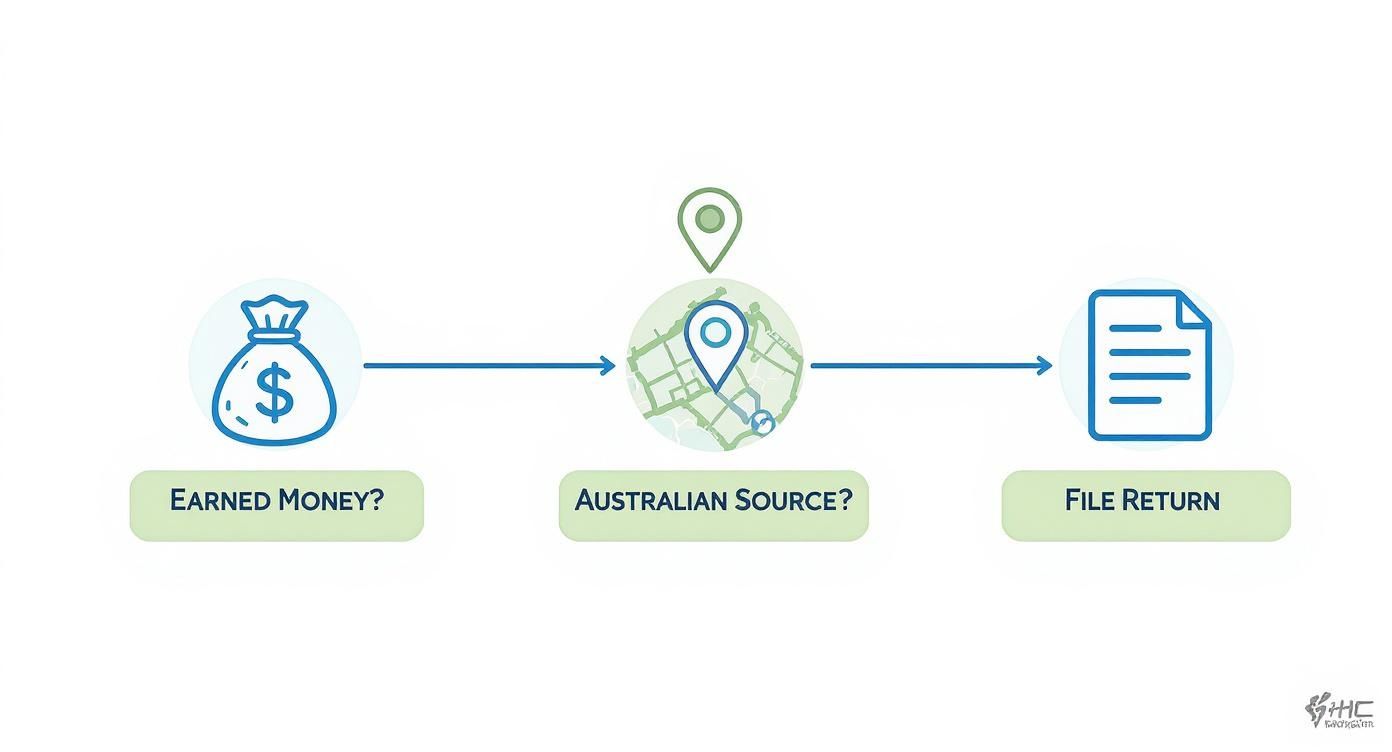
If you've earned money from an Australian source while living overseas, you're almost certainly going to need to lodge a non-resident tax return in Australia. This isn't optional. Unlike Australian residents, non-residents are typically taxed from the very first dollar they earn here, which makes staying on top of your obligations with the Australian Taxation Office (ATO) absolutely essential.Understanding Your Australian Tax Obligations from Abroad
Filing taxes from another country can feel like a headache waiting to happen, but the core idea is pretty simple. Think of it as a mandatory financial update you send back to Australia, detailing any income you've generated within its borders. The whole process boils down to one critical question: are you a resident or a non-resident for tax purposes? Getting this right is the first, and most important, step. Your residency status has nothing to do with your citizenship or visa—it’s all about where the ATO determines your economic and personal life is centred based on a few specific tests. Once you’ve confirmed you are a non-resident, your job is to figure out exactly which income needs to be declared. This guide will walk you through everything you need to know, covering:- Taxable Income: Pinpointing exactly what earnings you must declare, from rental income on an Australian property to capital gains.
- Tax Rates and Rules: Getting to grips with how the unique non-resident tax rates apply to your income.
- The Lodgement Process: A step-by-step breakdown of how to file your return correctly and on time.
Defining Your Australian Tax Residency Status
Before you can even think about lodging a tax return, you need to answer one fundamental question: are you considered a resident for tax purposes in Australia? This is the bedrock of all your tax obligations, and it’s a point that trips up many people. Forget your citizenship or visa status for a moment. The Australian Taxation Office (ATO) is focused on something else entirely: where your economic and personal life is primarily centred. Think of it as your financial "home base." Are your daily routines, personal connections, and financial ties firmly planted in Australia, or are they elsewhere? Getting this right is absolutely critical, as it dictates every single step that follows when you prepare your non-resident tax return in Australia.ATO Residency Tests At a Glance
The ATO doesn't just look at a single factor to figure out your residency status. Instead, they use four key tests to get a complete picture of your situation. Understanding these is the first step to knowing where you stand.| Residency Test | Key Criteria | Common Scenario |
|---|---|---|
| The Resides Test | Do you live and behave like a permanent resident? This looks at your intentions, family ties, and living arrangements. | Someone who moves to Australia for an indefinite period, sets up a home, and enrols their kids in a local school. |
| The Domicile Test | Is your permanent home, by law, in Australia? If so, you're a resident unless you've set up a new permanent home overseas. | An Australian citizen who goes to work in the UK for a few years but hasn't established a permanent home there. |
| The 183-Day Test | Have you been physically in Australia for more than half the financial year (183 days or more)? | A backpacker who stays and works in Australia for seven months during the tax year. |
| The Commonwealth Superannuation Test | Are you a member of certain government super funds, working for the government overseas? | An Australian public servant posted at an embassy abroad who contributes to the PSS or CSS super schemes. |
Why This Distinction Matters So Much
Getting your residency status right isn't just a box-ticking exercise; it has a huge impact on how much tax you pay. The biggest difference is that Australian residents get a tax-free threshold, meaning they don't pay tax on the first chunk of their income. Non-residents don't get this benefit.As a non-resident, you are taxed on your Australian-sourced income from the very first dollar you earn. Residents, on the other hand, are taxed on their worldwide income but benefit from a tax-free threshold.This means if you earn even $1 from an Australian source, you must lodge a tax return. Misclassifying your status can lead to an incorrect filing, which could attract the ATO's attention and result in penalties. That’s why figuring this out is easily the most important first step in the whole process.
What Australian Income You Must Declare
Once you’ve worked out you’re a non-resident for tax purposes, the next step is figuring out exactly what income you need to report. The rule of thumb is pretty simple: if the money came from an Australian source, the Australian Taxation Office (ATO) expects to see it on your non resident tax return australia. This goes way beyond just a salary you might have earned from an Australian employer. You need to cast your net a bit wider to make sure you catch all the different income streams the ATO is interested in. Think of it as a checklist, and for each item, you’re just asking, "Did this originate in Australia?"
Common Sources of Australian Income
To make sure nothing slips through the cracks, it’s worth running through the most common types of Australian-sourced income that non-residents have to declare. These are the usual suspects the ATO will be looking for. Common examples include:- Employment Income: This is the obvious one. It covers any salary, wages, commissions, or allowances you picked up from work you actually did in Australia, even if your stay was short.
- Rental Income: If you own a property in Australia and rent it out, the net rental profit is definitely considered Australian-sourced income.
- Australian Pensions or Annuities: Payments from most Australian superannuation funds or annuity policies are taxable here.
- Business or Partnership Income: Any profits you’ve made from a business you operate or have a stake in that's based in Australia.
- Interest and Dividends: Earnings from Aussie bank accounts or shares in Australian companies are also on the list, though you might find withholding tax has already been taken out.
A common mistake is assuming that if tax has already been withheld from interest or dividends, you can just ignore them. While that's sometimes the case, it’s not a golden rule. You should always check if the correct amount was withheld, as you might still need to include it on your return to be fully compliant.
The Special Case of Capital Gains
Now, one of the trickiest areas for non-residents is Capital Gains Tax (CGT). The rules here are very specific and can have a massive impact on your finances, especially when property is involved. As a non-resident, you’re generally only on the hook for CGT on what the ATO calls 'taxable Australian property'. For most people, this just means real estate located in Australia. If you sell an Aussie property, any capital gain you make is considered Australian-sourced income and has to be reported. Crucially, non-residents usually don’t get the 50% CGT discount that residents are entitled to, which means your taxable gain could be a whole lot higher. Getting this right is absolutely vital, as the ATO keeps a very close eye on property sales. For a deeper dive into how different investments can affect your tax, it’s worth reading our dedicated article on why it's so important to declare all investment income in your tax return. Being thorough here can save you from some very unwelcome surprises down the track.How Non-Resident Income Tax Rates Work
One of the biggest financial shocks for newcomers lodging a non-resident tax return in Australia is how differently their income is taxed. Unlike Australian residents, non-residents get zero tax-free threshold. This is a critical point to wrap your head around from day one. Think of the resident tax-free threshold as a head start in a race. Residents get to earn their first $18,200 without paying a cent of tax. As a non-resident, you don't get that head start. You’re taxed from the very first dollar you earn from an Australian source.The Non-Resident Tax Brackets
The rates applied to your income are pretty straightforward but can feel steep, especially at lower income levels. For the 2024-2025 financial year, the marginal tax rates for non-residents are designed to ensure every dollar earned in Australia is taxed. Here’s a simple breakdown of how it works:- $0 – $120,000: Your income in this bracket is taxed at a flat 32.5 cents for each dollar.
- $120,001 – $180,000: For every dollar you earn in this range, you'll pay 37 cents in tax.
- Over $180,000: Any income above this threshold is taxed at the top rate of 45 cents for each dollar.
It's essential to remember that these rates apply only to your Australian-sourced income. Any money you earn in your home country or from other international sources doesn't need to be reported to the Australian Taxation Office (ATO).
Understanding Withholding Tax
Another key concept you'll encounter is withholding tax. This is basically a system where tax is taken out of certain payments before you even receive the money. It’s the ATO’s way of ensuring it collects tax on passive income that’s heading out of the country. Common payments that fall under this system include:- Interest earned from Australian bank accounts
- Dividends from shares in Australian companies
- Royalties
Your Step-by-Step Guide to Lodging the Return
Alright, you’ve sorted out your residency status and figured out which income sources the ATO is interested in. Now for the practical part: actually lodging your non-resident tax return in Australia. This is where the rubber hits the road, but thankfully, the process isn't a one-size-fits-all ordeal. You’ve got a few clear pathways to choose from, depending on how comfortable you are with the details and your personal circumstances.
Choosing Your Lodgement Method
Ultimately, your options come down to three choices. You can go it alone using the ATO’s online or paper forms, or you can bring in an expert to handle the heavy lifting for you.- Engage a Registered Tax Agent: For most non-residents, this is hands-down the safest and simplest route. A good agent lives and breathes the specific tax rules that apply to you. They know what to look for, can help you find every eligible deduction, and ensure your return is spot on. Plus, they get extended deadlines, which can be a lifesaver.
- Lodge Online with myTax: If you already have a myGov account linked to the ATO and your tax affairs are pretty straightforward, this can be a quick and easy option. The main catch? Trying to navigate it from overseas can sometimes throw up frustrating technical glitches.
- Lodge by Paper: Good old-fashioned paper forms are still an option if you prefer them or can’t get the online services to work. You'll just need to download the right form from the ATO website, fill it out, and pop it in the mail to the address they provide.
Your Essential Lodgement Checklist
No matter which path you take, a little preparation goes a long way. Running through a checklist helps make sure nothing important gets missed and keeps the whole process moving smoothly.- Gather Your Documents: Start by collecting all your income statements (like payment summaries from employers), details of any rental income, records of capital gains, and bank interest statements.
- Collect Proof of Expenses: Next, pull together all the receipts and records for any deductions you plan to claim. This could be anything from maintenance costs for a rental property to work-related expenses you incurred while in Australia.
- Confirm Your TFN: Make sure you have your Australian Tax File Number (TFN) ready. You can’t lodge a return without it.
- Complete the Return: Carefully fill out every relevant section of the form, whether you’re doing it online or on paper. It pays to double-check all your figures and personal details for accuracy.
- Submit Before the Deadline: This one’s critical. If you're lodging yourself, the deadline is October 31. Missing it can lead to penalties, so don’t leave it to the last minute.
By methodically working through these steps, you transform a potentially confusing task into a manageable one. Organising your information beforehand is the best way to ensure a smooth and stress-free lodgement experience.
Common Mistakes to Avoid for a Smooth Filing
Lodging your non resident tax return in Australia on time is one thing, but getting it right is another game entirely. It’s worth taking a moment for a final pre-flight check to catch those simple errors that can cause frustrating delays or, worse, attract unwanted attention from the Australian Taxation Office (ATO). Many people stumble at the very first hurdle: getting their tax residency status wrong. Even if you're almost certain you're a non-resident, it never hurts to quickly run through the official tests one last time just to be sure. Another classic slip-up is accidentally leaving out certain types of Australian-sourced income. Capital gains from property sales are a big one here, as they come with their own very specific set of rules that can easily trip you up. And of course, the most avoidable mistake of all is simply missing the lodgement deadline.By learning from these common missteps, you can look over your own return with a more critical, experienced eye. This proactive approach helps you manage your Australian tax affairs effectively, making the whole process as smooth and stress-free as possible.Hopefully, this guide has given you a clear, actionable path to follow. By understanding your obligations and steering clear of these common pitfalls, you can confidently handle your Australian tax responsibilities. The goal is always 100% compliance—it gives you peace of mind, no matter where in the world you're based.
Frequently Asked Questions
When you're dealing with a non resident tax return in Australia, it’s natural for a bunch of questions to pop up. We get it. Below are some quick, clear answers to the queries we hear most often, designed to give you a bit more confidence before you lodge.Do I Really Need an Australian Tax File Number as a Non-Resident?
Yes, absolutely. Getting an Australian Tax File Number (TFN) is non-negotiable. While you can technically earn income without one, any employer or bank is legally required to withhold tax from you at the highest possible rate—currently a painful 45%. Having a TFN is the only way to ensure you’re taxed at the correct non-resident rates. It’s also a must-have for actually lodging your tax return.Can I Lodge My Australian Tax Return Online From Overseas?
You sure can. The Australian Taxation Office (ATO) has an online system called myTax, which is available to non-residents. The catch is you'll need a myGov account that’s properly linked to the ATO to get access. It’s often the fastest way to lodge, but be warned—we’ve seen plenty of people run into technical glitches trying to access it from outside Australia.Lodging online is great when it works. But if you hit a wall, engaging a registered tax agent is a rock-solid backup plan. They can lodge for you and often get access to later deadlines, which takes a lot of stress out of the process.
What Sorts of Deductions Can I Claim on My Return?
As a non-resident, you can still claim deductions, but there’s a strict rule: the expenses must be directly tied to earning your Australian-sourced income. Here are a couple of common examples:- Rental Property Costs: If you’re leasing out an Australian property, you can claim things like agent fees, council rates, and money spent on repairs.
- Work-Related Expenses: Did you have a job while you were physically in Australia? You can claim the costs you paid for things like specific uniforms or tools needed for that job.
Do I Still Have to Lodge if Tax Was Already Taken Out?
This is a common point of confusion, and the answer is: it depends. If the only Australian income you earned was from interest, dividends, or royalties, and the right amount of withholding tax was taken out at the source, you might not have to lodge a return for it. However, if you had any other type of income (like wages or rent), or if you think too much tax was withheld, you absolutely need to file a non resident tax return in Australia. This is how you square things up with the ATO and, more importantly, get any potential refund you’re owed. Always double-check your specific situation to be certain.Trying to make sense of Australian tax law from another country can feel like a maze. The team at Australia Wide Tax Solutions lives and breathes this stuff, specialising in helping non-residents get their tax obligations sorted accurately and without the headache. Whether it's lodging a return, figuring out capital gains, or managing rental income, we offer clear, expert guidance. Contact us today to get your Australian tax affairs in order.
The ATO provides guidance through ato.gov.au, the Small Business Support Line (13 28 66), and Online Services for individuals and businesses. For complex situations, a registered tax agent provides advice tailored to your specific circumstances and professional indemnity protection. You can verify agent registration at the TPB register at tpb.gov.au.
Most tax records must be kept for five years from the date of lodgement or the date the transaction occurred, whichever is later. Records must be in English or convertible to English and must be sufficient to explain the income and deductions in your return. The ATO can request records at any time during the retention period.
Consider a registered tax agent when your affairs involve multiple income sources, business activity, investment properties, capital gains, or overseas income. Agents extend your lodgement deadline, provide safe harbour protection, and take professional responsibility for the advice given. Verify registration at tpb.gov.au.
The failure to lodge penalty is based on penalty units ($313 per unit from 1 July 2023), accruing per 28-day period for late returns and BAS lodgements. Incorrect information penalties range from 25% to 75% of the tax shortfall depending on whether the behaviour was careless, reckless, or intentional. Proactive disclosure before an audit begins typically results in significantly reduced penalties.
Tax minimisation is the legal arrangement of your affairs to reduce tax — claiming all eligible deductions, using appropriate structures, and timing income and expenses. Tax avoidance involves arrangements that technically comply with the law but achieve outcomes parliament did not intend. The ATO can apply Part IVA anti-avoidance rules to cancel benefits from avoidance arrangements.