
Yes, in most cases, your income protection insurance premiums are generally tax deductible in Australia if you pay for them personally. This is a huge benefit. Claiming this deduction lowers your taxable income, which means you’ll either pay less tax throughout the year or get a welcome boost to your refund from the Australian Taxation Office (ATO).
- Your Quick Guide to Income Protection and Tax
- Understanding the Golden Rule of Deductibility
- Deducting Premiums for Personal Policies
- Income Protection Held Inside Your Super Fund
- Smart Policy Structures for Small Business Owners
Think of it as the government giving you a hand to secure your own financial safety net. It’s a powerful incentive.
Your Quick Guide to Income Protection and Tax
When it comes to the tax treatment of income protection, the answer almost always comes down to one simple question: who owns and pays for the policy? The way your policy is structured is the key that unlocks everything, from whether you can claim the premiums to how any benefits you receive are taxed.
Income protection is your financial Plan B. It’s there to replace a chunk of your income if an illness or injury stops you from working. While the specifics can vary, the core purpose is consistent across different types of cover. For a look at how similar policies work elsewhere, this practical guide to Long Term Disability in Canada offers some useful parallels.
The Three Main Scenarios for Your Policy
Getting your head around the tax side of things isn't as complex as it seems. It really just boils down to three common ways a policy can be owned, and each has its own clear tax rules.
- You Own It Personally: This is the most direct and common setup. You pay the premiums straight from your own bank account, and come tax time, you can claim those premiums as a deduction. Simple.
- Your Super Fund Owns It: A lot of Aussies have income protection inside their super, often as a default cover. Here, your super fund is paying the premiums, which means you can't personally claim a tax deduction for them.
- Your Business Owns It: If you run your own company, the business might pay the premiums on your behalf. While the business can usually claim a deduction for the expense, it can open up other tax headaches like Fringe Benefits Tax (FBT) that need careful management.
This flowchart breaks down the decision process visually, showing exactly how ownership dictates whether you can claim a deduction.
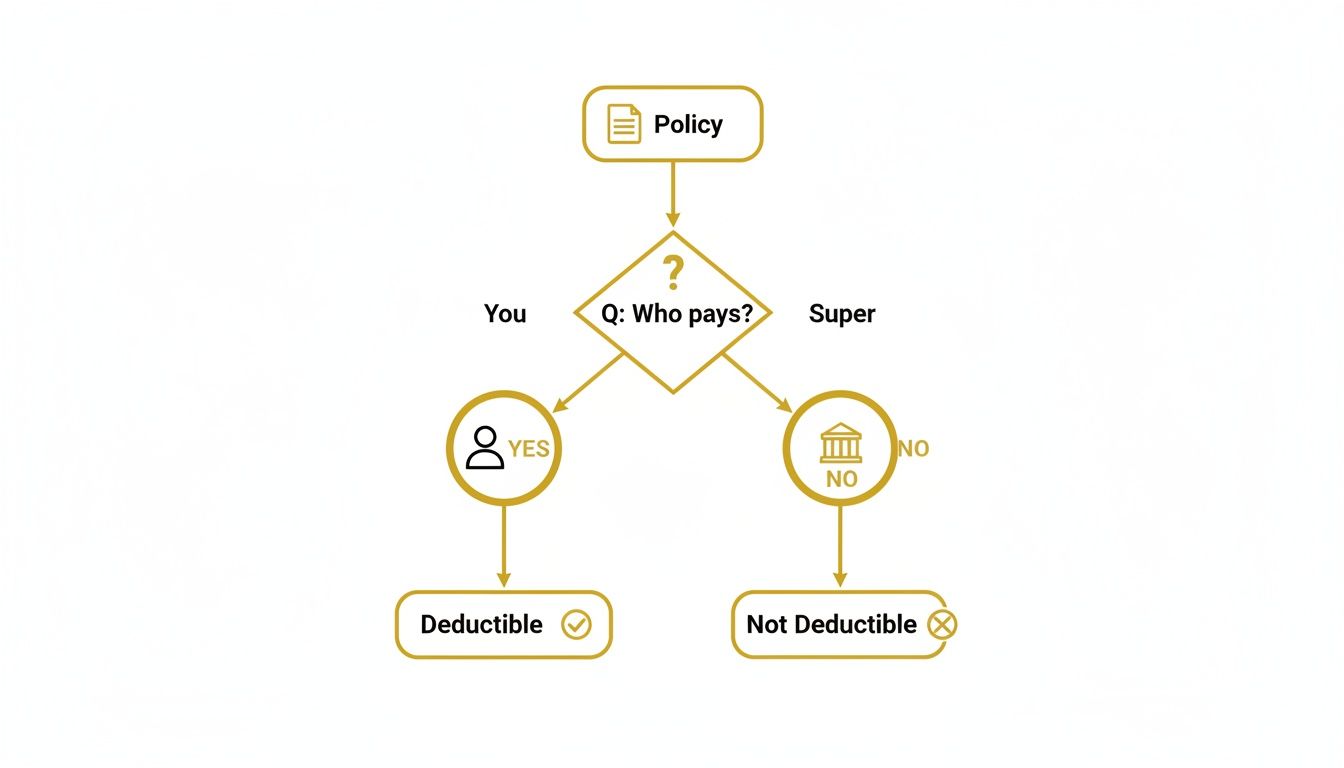
As you can see, the path is pretty clear. If you're the one footing the bill personally, the deduction is yours to claim. If your super fund is paying, that deduction isn't available to you on your personal tax return.
To make it even clearer, here’s a quick overview of how the tax rules apply to each setup. This table gives you a snapshot of the key differences, which we'll explore in more detail.
Income Protection Tax Deductibility At a Glance
This table summarises the tax treatment of income protection premiums and benefits based on the policy ownership structure.
| Policy Ownership | Are Premiums Tax Deductible? | Are Benefits Taxable? | Who It's For |
|---|---|---|---|
| Personal | Yes, for the individual | Yes, as income | Employees, sole traders, and contractors |
| Superannuation | No, for the individual | Yes, as income | Anyone with a superannuation account |
| Business-Owned | Yes, for the business | Yes, as income | Company directors and key employees |
This framework is your starting point for understanding how the ATO views your policy. Knowing which category you fall into is the first step to making sure you're getting it right on your tax return.
Understanding the Golden Rule of Deductibility

When it comes to claiming tax deductions, the Australian Taxation Office (ATO) isn’t trying to be complicated. In fact, most of it boils down to one straightforward principle. Getting your head around this "golden rule" is the key to understanding why you can claim your income protection premiums, but not your morning coffee.
At its heart, the rule is this: you can claim a deduction for any expense directly incurred in earning your assessable income. Think of it like a tradie buying a new nail gun. It’s not a weekend toy; it’s an essential tool that helps them do their job and get paid. Because the cost is directly tied to their ability to earn a living, it’s a legitimate deduction.
Your income protection policy is no different. It’s a financial tool designed to protect your single most important asset—your ability to earn an income. The premiums you pay are simply the cost of ensuring that income stream continues, even if an injury or illness stops you from working.
What Is Assessable Income?
So, what does the ATO actually count as "assessable income"? Put simply, it’s your gross income from all sources before any deductions are taken out. It’s the total amount the government can apply tax to.
For most people, this includes:
- Salary and wages from your employment.
- Business income if you're a contractor or sole trader.
- Certain government payments and allowances.
- Income from investments, like bank interest or share dividends.
When you pay for your own income protection policy, the premiums are clearly linked to protecting the salary or business income that makes up your assessable income. It's this direct connection that makes the premiums a valid claim. You can find out more by reading our full guide on what qualifies as a tax-deductible expense.
This is why the answer to "is income protection tax deductible?" is almost always a 'yes' for policies you hold personally. You're paying to protect your taxable income, and the ATO recognises that as a legitimate cost of doing business.
The Two Sides of the Tax Coin
But this golden rule is a two-way street. It creates a balance between deductions and income that you absolutely need to be aware of.
The Golden Rule’s Flip Side: If an expense is tax-deductible, any income or benefit you receive from it is considered taxable income.
This isn’t optional; it’s a fundamental part of Australia’s tax system. You can’t have the deduction without the tax on the benefit. Because your income protection premiums are tax-deductible, any monthly payments you receive from the policy must be declared as assessable income.
This means you treat those benefit payments just like a regular salary on your tax return. The ATO sees the insurance payout as a replacement for your lost wages, so it needs to be taxed in the same way.
Forgetting this can leave you with a nasty surprise and a big tax bill. Imagine receiving $4,000 a month from your insurer. If you haven't set aside money for tax, you could be on the hook for thousands at the end of the financial year. Understanding this relationship from the start keeps you compliant and financially prepared.
Deducting Premiums for Personal Policies
This is the most common setup for millions of Australian employees and sole traders. When you hold an income protection policy in your own name and pay the premiums yourself, those premiums are almost always tax deductible.
Think of it this way: your ability to earn an income is your most valuable financial asset. The money you spend on income protection is a direct cost of protecting that asset. The ATO agrees with this logic, which is why in this situation, the answer to "is income protection tax deductible?" is a clear 'yes'.
How Deductions Cut Your Tax Bill
Claiming your income protection premiums isn't just an administrative task; it directly reduces your taxable income. This translates to a very real tax saving, and the size of that saving depends on your marginal tax rate—the rate of tax you pay on the last dollar you earn.
Simply put, the higher your income, the higher your marginal tax rate, and the more valuable your deduction becomes.
Let's see how this works with a real-world example.
Worked Example: Meet Sarah, the Graphic Designer
Sarah is a freelance graphic designer earning a taxable income of $120,000 a year. She pays an annual premium of $2,500 for her personal income protection policy.
Find the Marginal Tax Rate: Under the 2025-2026 tax brackets, Sarah's income puts her in the bracket where she pays 30 cents for every dollar earned between $45,001 and $135,000. Her marginal tax rate is 30%.
Calculate the Tax Saving: We just multiply her premium cost by her tax rate.
- $2,500 (Premium) x 0.30 (Tax Rate) = $750
Work Out the True Cost: By claiming the deduction, Sarah gets a $750 reduction on her tax bill. This effectively drops the real cost of her insurance from $2,500 to just $1,750 for the year.
This shows just how much the tax system helps make vital financial protection more affordable. The higher your tax bracket, the bigger this saving gets.
The Catch with Bundled Policies
It's very common for insurers to "bundle" different types of cover into one policy package. You might find your income protection is combined with:
- Life Insurance (or Death Cover): Pays a lump sum to your loved ones if you pass away.
- Total and Permanent Disability (TPD) Cover: Pays a lump sum if you're permanently disabled and can never work again.
- Trauma (or Critical Illness) Cover: Pays a lump sum if you're diagnosed with a major illness like cancer or a heart attack.
Here’s the critical detail: the ATO only allows you to claim the portion of the premium that pays for your income protection cover. Premiums for life, TPD, and trauma cover are considered "capital in nature" and are not tax deductible when held in a personal policy.
If you claim the entire premium for a bundled policy, you are making an incorrect claim. This can lead to ATO audits and potential penalties. You must separate the deductible component from the non-deductible ones.
How to Correctly Apportion Your Premium
So, how do you find the exact figure you can claim? You don’t have to do the maths yourself. Your insurance company is legally required to provide this information.
You need to get an apportionment statement or policy schedule from your insurer. This document will clearly break down your total premium, showing you precisely how much is for income protection versus the other types of cover.
For instance, your statement might look like this:
- Total Annual Premium: $3,000
- Income Protection Component: $2,100 (Deductible)
- Life & TPD Cover Component: $900 (Not Deductible)
In this scenario, you can only claim the $2,100 on your tax return. Relying on this official statement is the only way to be sure you're maximising your deduction without falling foul of the ATO rules.
Income Protection Held Inside Your Super Fund
Lots of Australians hold their income protection insurance inside their superannuation fund—it's a common and often convenient setup. But when it comes to tax time, the rules flip completely, and it's a critical difference you need to get your head around.
The short answer is no, you can’t personally claim a tax deduction for the premiums.
Think of your super fund as a totally separate legal entity. It’s like another person managing your retirement nest egg for you. When the fund owns the income protection policy, it pays the premiums directly from your super balance. Because you aren't personally paying for it, you can't claim a deduction on your personal tax return.

This separation is the key. The expense wasn't something you paid to earn your personal income; it was paid by the fund. It's a fundamentally different setup from a personal policy, where you pay the premiums yourself from your after-tax salary.
The Super Fund's Own Tax Deduction
While you don't get the personal tax deduction, there is still a tax benefit happening behind the scenes. Your super fund can claim a tax deduction for the insurance premiums it pays for you.
Since super funds pay tax on their earnings and contributions at a concessional rate of just 15%, this is where the advantage lies.
By claiming the premiums as a deduction, the fund lowers its own taxable income. This 15% deduction effectively reduces the cost of the insurance, which helps to preserve more of your retirement savings.
This is a major reason why holding cover inside super can be so cost-effective. The tax saving is passed on to you indirectly by softening the blow of the premium costs on your overall super balance. Beyond this, there are other powerful strategies you can use to legally cut your tax rate through your super.
The Pros and Cons of Cover Inside Super
Choosing between a personal policy and one held in super means weighing up convenience against how comprehensive the cover is. It's vital to understand these trade-offs before you lock anything in.
Advantages of Holding Cover in Super:
- Cash Flow Friendly: Premiums come out of your super balance, not your take-home pay. This can seriously ease the pressure on your daily budget.
- Automatic Acceptance: Many funds offer a basic level of default cover without needing a medical exam, making it simple to get some protection in place fast.
- Tax-Effective Premiums: The fund’s 15% tax deduction helps to reduce the real cost of the insurance premiums.
Disadvantages to Consider:
- Erodes Retirement Savings: Even though they're tax-effective, premiums still drain your super balance. That means less money for you in retirement.
- Stricter Definitions: Policies inside super often have tougher definitions of disability and longer waiting periods compared to what you can get with a personal policy.
- Less Comprehensive Cover: They might offer lower levels of cover (e.g., capped at 70% of your income) and have fewer optional benefits available.
- Benefit Payments Are Taxed: Just like a personal policy, if you make a claim, any benefit payments you receive are treated as taxable income and you must declare them.
These details are especially important if you run a Self-Managed Super Fund (SMSF). To get a better handle on that particular structure, you can learn more about what an SMSF is and how it operates.
While a personal policy offers that direct tax deduction, it's worth putting it in the context of the broader tax landscape. For instance, in the 2025/26 financial year, thanks to tax reforms, someone in the $45,001 to $135,000 bracket will save $300 on a $1,000 personal policy premium—a significant saving that simply isn't available for policies held in super. You can find more insights on income protection tax deductibility to see how these rules work in practice.
Smart Policy Structures for Small Business Owners
As a small business owner, how you set up your income protection policy isn't just a bit of admin—it's a crucial strategic move. The way you pay your premiums has huge tax consequences, especially when your company or trust is footing the bill.
At first glance, it seems simple. When a business pays the premium for a director's or employee's policy, it looks like a straightforward tax-deductible expense. But this is where many business owners get caught out by a major complication: Fringe Benefits Tax (FBT).
The Fringe Benefits Tax Trap
Think of FBT as a tax on the "perks" of the job. It's paid by employers on non-cash benefits they provide to employees, like a company car or, in this case, a personal insurance policy paid for by the business.
Because your income protection policy is a personal benefit, the ATO sees the company paying for it as a fringe benefit. This means that while your business might get a tax deduction for the premium, it could get hit with an FBT liability, often at the highest marginal tax rate. This can easily wipe out, or even exceed, the value of the original tax deduction.
In short, you get a deduction with one hand, only to create a new, potentially bigger tax bill with the other. This FBT trap is a common mistake that makes a business-paid policy far more expensive than it looks on paper.
Proper planning is key here. If you're exploring other ways to get your company's tax position in order, looking at a wider range of tax deductions for small business owners can uncover some valuable opportunities.
A Smarter Way to Structure Your Policy
So, how do you get the best of both worlds—making sure the premium is covered without triggering FBT for your business? A common and highly effective strategy is what’s known as an 'employee-reimbursement' arrangement.
It’s a simple, two-step process that cleverly shifts the tax deduction from the business to the individual, sidestepping the FBT problem entirely.
Here’s how it works:
- The Individual Pays: The director or employee takes out the income protection policy in their own name and pays the premium from their personal bank account. This is the crucial step that makes them the policy owner.
- The Business Reimburses: The business then increases the individual’s salary or pays them a director’s fee to cover the exact cost of that premium. This extra payment is just a normal, tax-deductible wage expense for the business and doesn’t attract any FBT.
This setup gives you the same financial result but through a much cleaner, more tax-effective structure. The business gets its deduction for the higher salary, and the individual can then claim a personal tax deduction for the income protection premium they paid. It’s a win-win that keeps things simple and compliant.
Business Expense Insurance Is Not Income Protection
It is absolutely vital for business owners not to mix up personal income protection with Business Expense Insurance. They might both sound like a safety net, but they cover completely different things and have entirely different tax rules.
- Income Protection: This replaces your personal income if you can’t work. It’s for your mortgage, groceries, and family living costs.
- Business Expense Insurance: This covers your fixed business overheads if you can't work. Think office rent, staff wages, utility bills, and equipment leases.
The tax treatment for Business Expense Insurance is also different. The premiums are generally tax deductible for the business, and if you ever make a claim, the benefits paid are treated as assessable income to the business, not you personally. It’s designed purely to keep the lights on at your business, not to pay your household bills. Getting this distinction right is fundamental to solid risk management and tax planning.
Getting Your Tax Claim Right: A Practical Guide

So, you’ve got the theory down. You know if your income protection is tax deductible. But knowing the rules and actually getting the money back from the ATO are two different things. Getting it right at tax time is what counts.
Let’s be clear: if you pay for a personal policy, the premiums are generally deductible, but any benefits you receive will be taxed. If your cover is inside super, you can’t claim the premiums yourself. And if it's a business-owned policy, you need to be very careful to avoid Fringe Benefits Tax headaches.
Your Tax Time Checklist
When it comes to lodging your tax return, a little preparation goes a long way. Before you or your accountant start, pull these details together to make sure you claim the right amount and stay on the ATO’s good side.
- Dig Out Your Annual Statement: Your insurer will send you a statement for the financial year. This is your single source of truth.
- Check for Bundled Cover: Read the statement carefully. If it also includes life, TPD, or trauma insurance, it must show a clear apportionment of the premium.
- Find the Right Number: You can only claim the specific dollar amount listed against "income protection." Don't make the mistake of claiming the entire premium on a bundled policy.
- Lodge It Correctly: On your tax return, this deduction goes in the "Other work-related expenses" section, which is label D5.
When to Call in a Tax Expert
This guide will get you through a straightforward claim. But let’s be honest, tax is rarely simple for long. If your financial life has a few moving parts beyond a basic salary, professional advice isn't just a good idea—it's essential.
Seeking personalised advice isn't an admission of defeat; it's a strategic decision to protect your financial wellbeing and ensure you get every deduction you're legally entitled to.
You absolutely need an expert accountant in your corner if you're dealing with:
- Overdue or late tax returns.
- Complex business or trust structures.
- Rental properties and the maze of capital gains tax.
- Any uncertainty around Fringe Benefits Tax (FBT).
A specialist advisor from a firm like AWTS will cut through the complexity for you. They’ll make sure your claims are not only maximised but also fully compliant, giving you peace of mind and the best possible result on your tax return.
Got Questions About Income Protection and Tax? We’ve Got Answers.
Even once you’ve got the basics down, real-world situations can muddy the waters. It's easy to get confused about what you can and can't claim. Here, we tackle some of the most common questions we hear from clients, giving you clear, straightforward answers to help you lodge your tax return with confidence.
What if My Policy Is Bundled with Life Insurance?
This is a classic trap. You absolutely cannot claim the entire premium if your income protection is bundled with other cover like life or trauma insurance. The Australian Taxation Office (ATO) is very strict on this point: you can only deduct the portion of the premium that directly pays for your income protection cover.
Your insurer is legally required to send you an annual statement that breaks this down. They’ll clearly apportion the cost, showing you the exact dollar figure for the income protection component. That’s the number you must use. Claiming the full amount is a surefire way to attract unwanted attention from the ATO.
Can I Claim a Deduction if I Paid My Premium Annually?
Yes, you certainly can. If you've paid for your entire policy a year in advance, you can generally claim a deduction for the whole prepaid amount in the financial year you made the payment. This applies as long as the coverage period you paid for is 12 months or less.
For instance, if you paid $2,400 in May 2025 for a policy that covers you until May 2026, you can claim the full $2,400 deduction on your 2025 tax return.
What Records Do I Need to Keep for the ATO?
Think of your records as your proof. Without them, your claim is just a number on a form. The ATO can ask you to verify your expenses for up to five years after you lodge, so meticulous record-keeping is non-negotiable.
You must hold onto:
- Your annual policy statement from the insurer. This is your most important document, as it confirms the premium and breaks down the costs if your policy is bundled.
- Receipts or bank statements that show you actually paid the premiums.
If the ATO comes knocking and you can’t produce these documents, they can disallow the claim and you could be hit with penalties. It’s not worth the risk.
Are Benefits Taxed if My Policy Is in Super?
Yes. This is a crucial point that catches many people out. Just like a policy you hold personally, any benefit payments you receive from an income protection policy held inside your superannuation fund are considered taxable income.
The process is a little different—the insurer pays the benefit to your super fund, which then pays it out to you. But when that money lands in your bank account, it's treated as income, and you must declare it on your tax return.
The ATO provides guidance through ato.gov.au, the Small Business Support Line (13 28 66), and Online Services for individuals and businesses. For complex situations, a registered tax agent provides advice tailored to your specific circumstances and professional indemnity protection. You can verify agent registration at the TPB register at tpb.gov.au.
Most tax records must be kept for five years from the date of lodgement or the date the transaction occurred, whichever is later. Records must be in English or convertible to English and must be sufficient to explain the income and deductions in your return. The ATO can request records at any time during the retention period.
Consider a registered tax agent when your affairs involve multiple income sources, business activity, investment properties, capital gains, or overseas income. Agents extend your lodgement deadline, provide safe harbour protection, and take professional responsibility for the advice given. Verify registration at tpb.gov.au.
The failure to lodge penalty is based on penalty units ($313 per unit from 1 July 2023), accruing per 28-day period for late returns and BAS lodgements. Incorrect information penalties range from 25% to 75% of the tax shortfall depending on whether the behaviour was careless, reckless, or intentional. Proactive disclosure before an audit begins typically results in significantly reduced penalties.
Tax minimisation is the legal arrangement of your affairs to reduce tax — claiming all eligible deductions, using appropriate structures, and timing income and expenses. Tax avoidance involves arrangements that technically comply with the law but achieve outcomes parliament did not intend. The ATO can apply Part IVA anti-avoidance rules to cancel benefits from avoidance arrangements.
Navigating the fine print of income protection can get tricky, especially when business structures or complex finances are involved. To make sure you’re staying compliant while getting the best possible tax outcome, the team at Australia Wide Tax Solutions is here to help. Contact us today for a confidential discussion about your tax needs.
The big question for any business owner in Australia—sole trader or company—really boils down to one thing: how your profits are taxed. As a sole trader, every dollar you earn is taxed at your personal marginal rate. As your business grows, so does your tax bill. In contrast, a company pays a flat corporate tax rate, which can be a game-changer for reinvesting profits and scaling up.
- Choosing Your Business Structure: Key Tax Differences
- How Tax Rates And Profit Treatment Differ
- Navigating Deductions And Business Expenses
- Comparing Asset Protection And Legal Liability
- Understanding Compliance Costs And Administration
This single difference is the foundation upon which your financial future is built. Getting it wrong can mean handing over a huge chunk of your hard-earned profits to the tax office.
Choosing Your Business Structure: Key Tax Differences
Deciding to operate as a sole trader versus a company is one of the most important financial calls you'll make. It directly shapes your tax bill, how protected your personal assets are, and your capacity to grow. The simplicity of being a sole trader is tempting, but the tax realities are worlds apart from a company structure.
Let's cut through the noise and focus on what really hits your bottom line: the tax treatment of your profits.
- Tax Treatment: As a sole trader, your business profit is your personal income, so it's taxed at ever-increasing individual rates. Company profits are taxed at a fixed, lower corporate rate, creating a clear advantage for keeping more money in the business to fuel growth.
- Legal Liability: When you're a sole trader, there's no legal distinction between you and the business. Your personal assets—your house, your car—are on the line. A company is a separate legal entity, which acts as a shield to protect your personal wealth from business debts.
- Administrative Burden: Sole traders have it easy here with minimal setup and compliance. Companies demand formal registration with ASIC, annual reviews, and much more rigorous record-keeping. It's more work, no doubt about it.
This infographic gives you a quick visual snapshot of the key trade-offs.
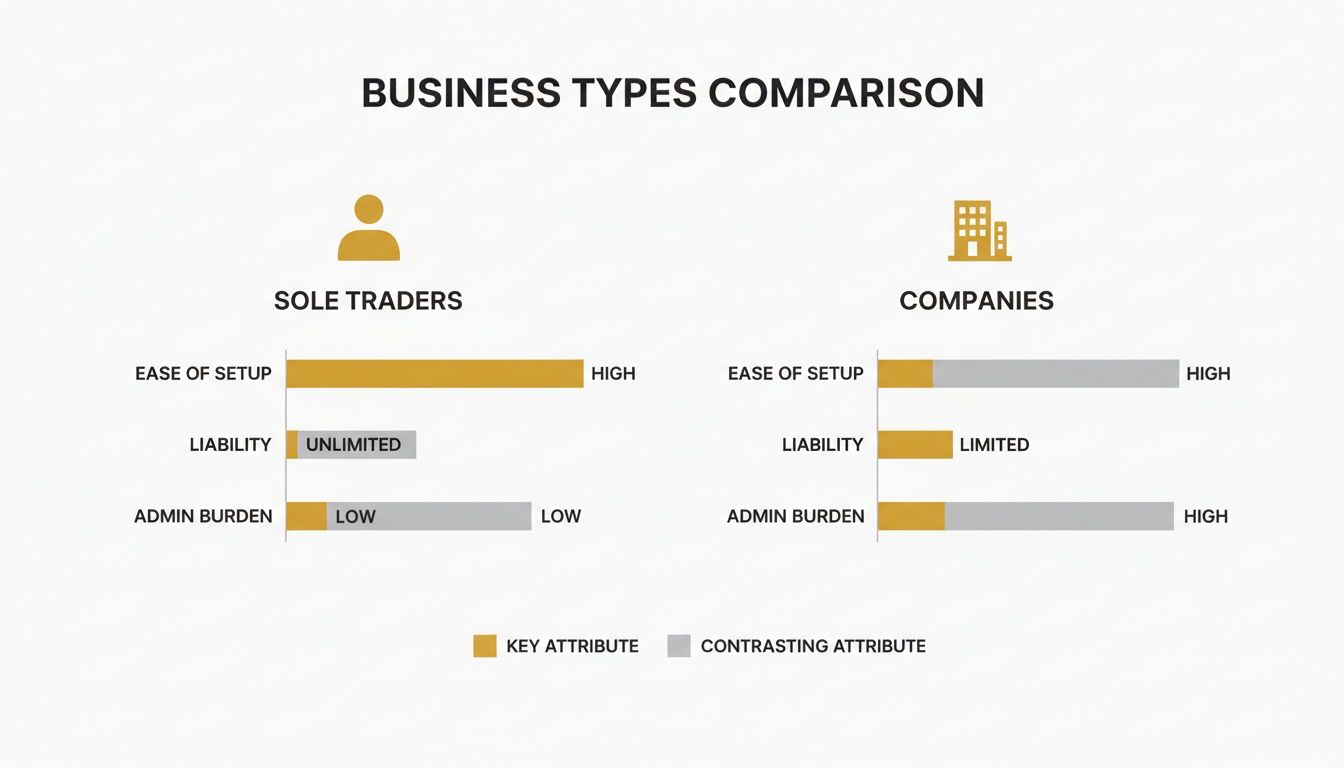
As you can see, it's a classic balancing act. The sole trader route offers simplicity but comes with high personal risk. A company provides that crucial legal protection but at the cost of more admin.
The core decision hinges on balancing immediate simplicity against long-term financial efficiency and legal protection. As your business grows, the tax benefits of a company structure often become too significant to ignore.
In Australia, where a massive 67% of businesses are sole traders, the tax pain kicks in quickly as you become more successful. Under the 2023-24 ATO rates, a sole trader pulling in $180,000 in profit pays an effective tax rate of around 40%. A company with the same profit (as a base rate entity) is taxed at a flat 25%. That's a huge difference that highlights a powerful path for scaling your operations.
When you're trying to make this call, a solid guide on how to choose your business structure can be invaluable, especially when you start weighing up these significant tax implications.
How Tax Rates And Profit Treatment Differ
The biggest financial question when comparing a sole trader to a company comes down to one thing: how each dollar of profit gets taxed. This isn't just a small detail on a tax form; it's the core difference that could save—or cost—you thousands over the life of your business. The structure you choose directly dictates how much cash stays in your pocket and how much you can reinvest.
For a sole trader, the maths is simple. Your business profit is your personal income. It gets lumped in with any other income you earn and is taxed at your marginal personal income tax rate. As your business grows and your profits climb, you inevitably get pushed into higher tax brackets, meaning the ATO takes a bigger slice of every new dollar you make.
A company, however, is a completely separate legal and tax entity. It pays tax on its profits at a flat corporate rate, which for most small businesses in Australia is currently 25%. This separation is what creates a clear and often immediate tax advantage, especially for businesses that want to keep profits in the tank to fund future growth.

A Real-World Profit Scenario
Let's make this tangible. Imagine you're a skilled plumber in Sydney having a great year, clearing $80,000 in profit. As a sole trader, that entire $80,000 lands on your personal tax return. Once you account for the different tax brackets and the 2% Medicare levy, you'd be looking at a tax bill of roughly $18,447.
Now, let's see what happens if that same business is structured as a company. The $80,000 profit is first taxed at the flat 25% corporate rate, resulting in a $20,000 tax bill. The crucial part is what happens next. The company now holds the remaining $60,000. That money can be used to buy new equipment, hire staff, or invest in marketing—all without you personally paying any more tax on it until it's paid out to you as a wage or dividend.
Here's the key takeaway: As a sole trader, every dollar of profit is taxed at your personal rate, straight away. With a company, only the money you physically take out is taxed at your personal rate. Profits left inside the business are taxed at the lower, flat corporate rate.
Tax Liability At Different Income Levels
This difference in tax treatment becomes much more dramatic as your income rises. Because personal tax rates are progressive, a sole trader's tax burden accelerates far more quickly than a company's. For a closer look at how the brackets work, check out our detailed guide on Australian sole trader tax rates.
To really see the impact, let's run the numbers and compare the tax payable at different profit levels. This shows the potential savings a company offers if you plan on retaining profits in the business.
Tax Liability Comparison: Sole Trader vs Company
This table breaks down the tax payable for each structure, assuming all profits are kept within the business for the company scenario.
| Taxable Income | Sole Trader Tax Payable (incl. Medicare Levy) | Company Tax Payable (at 25%) | Potential Annual Tax Saving on Retained Profits |
|---|---|---|---|
| $80,000 | ~$18,447 | $20,000 | -$1,553 (Sole trader is slightly better) |
| $150,000 | ~$44,247 | $37,500 | $6,747 |
| $250,000 | ~$87,497 | $62,500 | $24,997 |
As you can see, the numbers tell a clear story. Once your taxable income climbs past the $90,000 mark, the company structure starts to pull ahead, delivering significant tax savings on any profits you want to reinvest. For any business owner focused on scaling up, this is a critical tipping point to be aware of.
Navigating Deductions And Business Expenses
On the surface, both sole traders and companies can claim deductions for legitimate business costs. But that’s where the similarities end. The real story behind the tax benefits of a company versus a sole trader emerges when you dig into the strategic planning opportunities a company structure unlocks.
Sure, both can deduct everyday expenses like rent, supplies, and marketing. However, the company’s status as a separate legal entity opens up powerful avenues for reducing taxable profit that a sole trader simply can't access.
When you're weighing up these structures, understanding how to properly claim everything you're entitled to is essential. For sole traders, knowing the full scope of available sole trader tax deductions can make a huge difference to your final tax bill, ensuring nothing gets missed.
The game changes with a company, though, as it introduces deductions that are completely off the table for a sole trader.
Strategic Deductions for Companies
A massive advantage for a proprietary limited company is its ability to pay its owners (who are also directors) a salary, superannuation, and even director's fees. These aren't just drawings; they are treated as legitimate business expenses.
This directly reduces the company's taxable profit before the 25% corporate tax rate is even applied.
For example, paying yourself a director's salary provides a steady personal income while simultaneously lowering the company's tax bill. On top of that, the compulsory superannuation contributions paid on that salary are also a deductible expense for the business. It’s a tax-efficient way to pull money out of the business while building your own retirement nest egg.
The ability to treat owner remuneration and superannuation as deductible business expenses is a fundamental tax benefit of the company structure. It allows you to strategically lower company profit while building personal wealth in a tax-effective manner.
Limitations for Sole Traders
Sole traders, on the other hand, run into a few walls that companies don't. The biggest one is the Personal Services Income (PSI) rules. If the ATO decides your income is mainly a reward for your personal skills or effort, your ability to claim certain deductions can be severely restricted. This can include things like payments to family members for non-principal work or even some superannuation contributions.
A company structure also naturally enforces better record-keeping. The formal separation between business and personal finances creates a much clearer paper trail. This not only makes tax time simpler but also significantly lowers your risk profile if the ATO ever comes knocking for an audit, making it a much safer vehicle for growth.
Comparing Asset Protection And Legal Liability
While the tax benefits are a massive part of the sole trader vs company debate, we can't stop there. For a lot of business owners I speak to, this next point is actually more important than saving a few dollars on tax. It's about personal liability, and it hits right at your financial security and peace of mind, especially as your business starts to grow and take on bigger risks.
As a sole trader, the law sees absolutely no difference between you and your business. You are one and the same. This means if your business gets into financial strife or someone decides to sue you, your personal assets are fair game. We're talking about your family home, your car, your savings – it's all on the line to settle business debts.
This complete lack of separation is hands down the single biggest risk of being a sole trader. If you're in an industry with a higher chance of things going wrong, like construction or professional consulting, this unlimited liability can be a constant source of stress.

The Company's Corporate Veil
Now, flip the coin. A company is a separate legal entity. This isn't just fancy legal talk; it creates a genuine barrier, often called the 'corporate veil', that stands between the business's finances and your personal finances. It's one of the most powerful reasons to incorporate, completely separate from any tax advantages.
What this legal wall means is that if the company racks up debt or gets sued, the liability is generally capped at the assets the company itself owns. Creditors can go after the business bank account or its equipment, but your personal assets are safely tucked away on the other side of that veil.
The corporate veil is your personal financial shield. It means a business failure doesn't have to become a personal financial catastrophe, giving you the confidence to take calculated risks and grow your venture.
A Practical Liability Scenario
Let's make this real. Imagine a business lawsuit goes badly and results in a $100,000 liability.
- Sole Trader Outcome: The business only has $30,000 in assets. The creditors can, and will, legally come after the owner for the remaining $70,000. This could mean being forced to sell your car or even having a lien slapped on your family home.
- Company Director Outcome: The company has the same $30,000 in assets. The creditors can only claim that $30,000. The director's personal assets are protected. Assuming they've acted lawfully, they are not personally on the hook for the $70,000 shortfall.
This stark difference shows exactly why asset protection is a critical piece of the sole trader vs company tax benefits conversation. The legal shield a company provides is often invaluable, laying a much safer foundation for long-term, sustainable growth.
Understanding Compliance Costs And Administration
Beyond the tax rates themselves, the day-to-day admin is a huge factor that hits your two most valuable resources: your time and your money. For many new ventures, the sheer simplicity of being a sole trader is its biggest selling point. The setup is dead simple—often just an Australian Business Number (ABN)—and the ongoing compliance is just as straightforward, usually just rolling everything into your personal tax return.
A company, on the other hand, is a completely different beast when it comes to admin. Getting started means a formal registration with the Australian Securities and Investments Commission (ASIC), which has its own upfront costs. And that’s really just the first step on a much more demanding compliance journey.
The Ongoing Demands Of A Company
Running a company means committing to a whole host of ongoing regulatory requirements. These aren't just 'nice-to-haves'; they're legal obligations, and ignoring them comes with hefty penalties. The administrative price tag you pay for the tax and liability benefits is significantly higher.
Here’s a taste of the key ongoing obligations you’re signing up for:
- Annual ASIC Review: Every year, you have to pay an annual review fee just to keep your company registered.
- Separate Tax Returns: You’ll need to prepare and lodge a separate, more complex company tax return each year. We break this down in our guide on how to lodge a company tax return.
- Stricter Record-Keeping: Corporate law demands that you keep meticulous financial records. This isn't just about receipts; it includes formal minutes of meetings and resolutions from the director.
All this extra work almost always translates into higher fees from your accountant. For instance, companies have to deal with ASIC reporting, which includes annual fees of $311, and you can expect accounting costs to be two or three times higher than for a sole trader. Despite these costs, the ATO still sees around 83% compliance among small businesses, which tells you that for many, the trade-off is worth it. You can find out more by reading this in-depth analysis of the company structure vs sole trader costs.
It all boils down to a fundamental trade-off: Do the potential tax savings and asset protection a company offers actually outweigh the extra costs and administrative headaches? This is exactly where getting professional advice is non-negotiable for making a smart financial decision.
Ultimately, the right choice really depends on the scale of your business, your risk profile, and where you see it going. A sole trader structure is perfect for low-risk, simple operations where keeping costs and complexity down is the number one priority. A company is built for businesses with big growth plans, those who need to protect their personal assets, and are ready to take on the administrative load that comes with it.
Making The Right Choice: When To Switch To a Company
Deciding when to jump from a sole trader to a company structure isn't just about tax; it’s a strategic pivot for your business's future. The beautiful simplicity of being a sole trader is perfect for getting off the ground, but there are clear signals that it’s time to evolve.
Ignoring these signs can mean handing over unnecessary tax to the ATO, putting your personal assets on the line, and artificially capping your growth potential.
This isn’t about hitting a single magic number. It's about a combination of factors reaching a tipping point. The key is spotting these triggers before they become problems, ensuring your business structure is a springboard for your long-term goals, not an anchor holding you back.

Key Triggers for Incorporation
Thinking about making the switch? Keep an eye out for these classic scenarios. If one or more of these sounds familiar, it’s a strong sign that a company structure is the next logical move.
Your Income Is Hitting Higher Tax Brackets: Once your taxable income as a sole trader consistently pushes past the $120,000 mark, your personal marginal tax rate starts to seriously outpace the flat 25% corporate rate. This is the most common financial trigger we see.
You Need to Protect Your Personal Assets: As your business grows, so does its risk profile. If you've built up personal wealth—like a family home or an investment portfolio—the unlimited liability of a sole trader structure becomes a huge, unacceptable risk. A company creates a legal firewall.
You Want to Reinvest Profits Into the Business: A company is a far more tax-efficient vehicle for growth. It lets you keep post-tax profits (taxed at just 25%) in the business to fund expansion, buy assets, or hire staff, without that money first being hit at your higher personal tax rate.
The decision to incorporate is fundamentally a forward-looking one. It’s about building a foundation that can handle increased profit, greater risk, and future complexity, turning your successful operation into a scalable and protected enterprise.
- You're Bringing on Partners or Investors: If the plan is to bring other people into the business, a company structure is non-negotiable. It provides a clean, clear framework for issuing shares, defining ownership, and managing control in a way a sole trader setup simply can't.
Recognising these triggers is the first step; the next is taking action. If you're ready to look into this more deeply, our guide on how to set up a PTY LTD company in Australia lays out a clear roadmap for the incorporation process. Making this change at the right time is absolutely crucial for locking in the best possible financial outcomes.
Your Questions Answered
When you're weighing up the sole trader vs company structure, a lot of specific questions pop up. Let's tackle some of the most common ones we hear from clients every day.
How Do I Pay Myself from a Company?
This is a fundamental shift from being a sole trader. As a sole trader, you just take 'drawings' from the business profits whenever you like. Simple.
When you're a director of a company, it’s more formal. You pay yourself a proper salary or wage, just like any other employee. This payment becomes a deductible business expense for the company, which helps lower its taxable profit.
The catch is that this brings you into the formal payroll system. You'll need to manage Pay As You Go (PAYG) withholding and meet your superannuation guarantee obligations. Your salary is then taxed at your individual marginal rate, completely separate from the company's tax affairs.
How Does Capital Gains Tax Differ?
The way Capital Gains Tax (CGT) is handled really highlights the structural divide between these two setups.
If a sole trader sells a business asset and makes a profit, that capital gain just gets added to their personal income for the year. The good news is they can often access the 50% CGT discount if they've owned the asset for more than 12 months, effectively halving the tax impact.
A company, on the other hand, gets no such discount. The entire capital gain is taxed at the flat corporate rate. It’s not all bad news, though. Companies can often access a different set of small business CGT concessions which can sometimes reduce or even wipe out the tax bill. It's a complex area, but potentially very rewarding.
The loss of the 50% CGT discount is a major sticking point for companies. However, the other small business CGT concessions available can sometimes lead to a better outcome. This is definitely not a DIY calculation—getting professional advice is essential when selling significant assets.
Is It Hard to Switch from a Sole Trader to a Company?
Making the jump isn't just paperwork; it’s a formal process with real financial implications. The transition involves registering a new company with ASIC and then officially transferring all your business assets—think equipment, client lists, and goodwill—from your name over to the new company entity.
Here's the critical part: that transfer can trigger tax events. Moving assets can crystallise a capital gain (and a CGT bill) or even attract stamp duty in some states.
Because of this, you absolutely need to get professional guidance. A good accountant can help you structure the transition in the most tax-effective way, ensuring you don't get hit with unexpected financial penalties during the changeover.
The four main structures are sole trader, partnership, company, and trust. A sole trader is simplest and cheapest but offers no liability protection. A company provides limited liability at a flat tax rate but costs more to run. A trust offers tax flexibility and asset protection but is complex to administer. The right choice depends on income, risk profile, and growth plans.
Base rate entities — companies with aggregated turnover under $50 million that derive no more than 80% of income from passive sources — pay 25%. All other companies pay 30%. Shareholders pay income tax on dividends, potentially offset by franking credits for tax already paid at the corporate level.
Consider a company when business net profit consistently exceeds $100,000–$120,000 and the rate differential generates meaningful savings, when you need liability protection from business creditors, when you plan to bring in investors, or when you want to retain earnings at the lower corporate rate rather than distributing everything as personal income.
A family trust (discretionary trust) holds assets for a class of beneficiaries. The trustee decides each year how much income to distribute to each beneficiary. By directing income to members in lower tax brackets, the trust reduces the overall family tax burden. Income retained in the trust is taxed at the highest marginal rate (47%).
Ongoing costs include the ASIC annual review fee (currently $310 for a proprietary company), company tax return lodgement fees, accounting fees for financial statements, and potentially payroll and BAS compliance. Total annual compliance costs typically range from $2,000 to $8,000 depending on activity levels and complexity.
Starting a business in Australia can cost anywhere from a few hundred dollars to $15,000 or more, depending on the industry, structure, and specific needs. The initial expenses can include business registration, legal fees, licenses, insurance, and potentially office space or equipment.
- Essential Startup Costs (Mandatory)
- Industry-Specific Startup Costs
- Technology & Digital Infrastructure ($1,000-$8,000)
- Ongoing Running Costs (Monthly/Annual)
- Tax Obligations & Professional Services
However, understanding the full financial picture requires looking beyond just startup costs to include ongoing operational expenses that will determine your business's long-term viability.
Essential Startup Costs (Mandatory)
Government Registration & Legal Structure ($500-$2,500)
- ASIC company registration: $506 (Pty Ltd)
- ABN registration: Free through ATO
- Business name registration: $37 for 1 year, $87 for 3 years
- TFN application: Free
- GST registration: Free (mandatory if turnover exceeds $75,000)
- Legal consultation for structure advice: $300-$800
Licenses & Permits ($100-$5,000+)
- Industry-specific licenses vary dramatically
- Food handling permits: $150-$400
- Building/construction licenses: $500-$2,000
- Professional service licenses: $200-$1,500
- Import/export permits: $1,000-$5,000+
Industry-Specific Startup Costs
Retail Business ($5,000-$50,000)
- Initial inventory: $2,000-$20,000
- Point-of-sale system: $500-$3,000
- Shop fitting and displays: $2,000-$15,000
- Security systems: $500-$2,000
Professional Services ($2,000-$10,000)
- Professional indemnity insurance: $800-$3,000 annually
- Office setup and furniture: $1,000-$5,000
- Professional software licenses: $500-$2,000
- Marketing materials and branding: $500-$2,000
Manufacturing/Production ($10,000-$100,000+)
- Equipment and machinery: $5,000-$80,000
- Initial raw materials: $2,000-$10,000
- Safety equipment and compliance: $1,000-$5,000
- Quality control systems: $2,000-$8,000
Technology & Digital Infrastructure ($1,000-$8,000)
Essential Digital Setup
- Domain name registration: $15-$50 annually
- Professional website development: $1,500-$5,000
- E-commerce platform setup: $500-$2,000
- Email hosting and business communications: $100-$300 annually
- Cloud storage and backup solutions: $200-$600 annually
Business Software & Tools
- Accounting software (Xero, MYOB): $300-$800 annually
- Customer relationship management (CRM): $500-$2,000 annually
- Project management tools: $200-$1,000 annually
- Industry-specific software: $500-$5,000
Ongoing Running Costs (Monthly/Annual)
Fixed Operating Expenses
- Commercial rent: $2,000-$10,000+ monthly (depending on location)
- Utilities (electricity, gas, water): $200-$800 monthly
- Internet and telecommunications: $100-$300 monthly
- Insurance premiums: $200-$1,500 monthly
- Equipment leasing: $300-$2,000 monthly
Variable Operating Costs
- Staff wages and superannuation: $4,000-$20,000+ monthly per employee
- Raw materials and inventory restocking: 20-40% of revenue
- Marketing and advertising: 5-15% of revenue
- Professional services (accounting, legal): $500-$2,000 monthly
- Equipment maintenance and repairs: $200-$1,000 monthly
Tax Obligations & Professional Services
Ongoing Tax Compliance Costs
- Business Activity Statements (BAS): $330 per quarter (professional preparation)
- Annual tax returns: $1,100+ (professional preparation)
- Payroll tax (if applicable): Varies by state, typically 4.85-6.85%
- Workers' compensation insurance: $500-$5,000 annually
- Tax audit insurance: $685/hour coverage recommended
Professional Advisory Costs
- Ongoing accounting services: $350+ monthly
- Legal advice and contract reviews: $300-$500 per consultation
- Business coaching and development: $200-$800 monthly
- Industry association memberships: $200-$1,000 annually
Location-Specific Considerations
Sydney CBD Premium Costs
- Office rent: $800-$1,200 per sqm annually
- Parking: $300-$600 monthly per space
- Higher insurance premiums due to location
Regional Areas Cost Advantages
- Office rent: $200-$400 per sqm annually
- Lower utility costs
- Reduced insurance premiums
- Lower staff wage expectations
Hidden Costs Often Overlooked
Cash Flow Management
- Working capital requirements: 3-6 months of operating expenses
- Debt servicing and interest payments
- Equipment depreciation and replacement funds
- Emergency fund: 10-20% of annual revenue
Growth and Scaling Costs
- Additional staff recruitment and training: $5,000-$15,000 per hire
- Expanded premises and fit-out costs
- Increased insurance coverage
- Technology upgrades and scalability investments
Cost-Saving Strategies
Smart Financial Planning
- Choose an appropriate business structure for tax efficiency
- Leverage government grants and incentives
- Consider shared office spaces initially
- Implement cloud-based solutions for scalability
- Regular review of all subscriptions and services
Professional Guidance Investment
- Quality accounting advice prevents costly mistakes
- Proper tax planning can save thousands annually
- Legal structure optimisation reduces long-term costs
- Regular financial health checks identify cost-cutting opportunities
Conclusion
While starting a business in Australia can range from $500 for a simple sole trader setup to $50,000+ for complex operations, the key to success lies in thorough financial planning that accounts for both startup and ongoing operational costs.
Remember that the cheapest option isn't always the most cost-effective long-term. Investing in proper professional advice, quality systems, and appropriate insurance from the start can save significant money and reduce stress in the long term.
Consider consulting with qualified professionals who can provide personalised advice based on your specific industry and business goals. The initial investment in proper planning and setup often pays for itself many times over through avoided mistakes and optimised operations.
#BusinessCostsAustralia #StartupExpenses #RunningCosts #AustralianBusiness #SmallBusinessAU #BusinessBudgeting #EntrepreneurAustralia #BusinessPlanning #StartupGuide #ASICRegistration #BusinessSetup #CashFlowManagement #BusinessFinance #AustralianTax #BusinessInsurance #OperationalCosts #BusinessStrategy #StartupTips #BusinessCompliance #ProfessionalServices
The ATO provides guidance through ato.gov.au, the Small Business Support Line (13 28 66), and Online Services for individuals and businesses. For complex situations, a registered tax agent provides advice tailored to your specific circumstances and professional indemnity protection. You can verify agent registration at the TPB register at tpb.gov.au.
Most tax records must be kept for five years from the date of lodgement or the date the transaction occurred, whichever is later. Records must be in English or convertible to English and must be sufficient to explain the income and deductions in your return. The ATO can request records at any time during the retention period.
Consider a registered tax agent when your affairs involve multiple income sources, business activity, investment properties, capital gains, or overseas income. Agents extend your lodgement deadline, provide safe harbour protection, and take professional responsibility for the advice given. Verify registration at tpb.gov.au.
The failure to lodge penalty is based on penalty units ($313 per unit from 1 July 2023), accruing per 28-day period for late returns and BAS lodgements. Incorrect information penalties range from 25% to 75% of the tax shortfall depending on whether the behaviour was careless, reckless, or intentional. Proactive disclosure before an audit begins typically results in significantly reduced penalties.
Tax minimisation is the legal arrangement of your affairs to reduce tax — claiming all eligible deductions, using appropriate structures, and timing income and expenses. Tax avoidance involves arrangements that technically comply with the law but achieve outcomes parliament did not intend. The ATO can apply Part IVA anti-avoidance rules to cancel benefits from avoidance arrangements.
What Happens if You're a Contractor and They Don't Pay Super?
As a contractor, you rely on a steady income stream to keep your business running smoothly. One critical component of that income is the superannuation contributions your clients legally must pay on your behalf. But what happens if a client fails to pay your super?
- What Happens if You're a Contractor and They Don't Pay Super?
- Understanding Superannuation Obligations for Contractors
- What Happens if Your Client Doesn't Pay Your Super?
- Steps to Protect Yourself as a Contractor
- Superannuation Guarantee for Contractors
In this blog post, we'll explore the potential consequences and the steps you can take to protect your financial future. You may be called a contractor, but for superannuation purposes, you may be an employee of a company. Contractor or employee for Superannuation purposes
Understanding Superannuation Obligations for Contractors
In Australia, employers are legally required to pay a minimum level of superannuation contributions, known as the Superannuation Guarantee (SG), for their employees. This obligation also extends to contractors considered "employees" for superannuation purposes.
The current SG rate is 10.5% of an employee's ordinary time earnings, which is set to increase gradually over the coming years, reaching 12% by 2025. Failure to pay the required SG contributions can result in significant penalties for the employer.
What Happens if Your Client Doesn't Pay Your Super?
If a client fails to pay your superannuation contributions, there are several potential consequences you may face:
1. Loss of Retirement Savings
The most immediate impact is the loss of potential retirement savings. Superannuation is designed to help you build a nest egg for your golden years, and missing contributions can significantly reduce the amount of money you'll have available when you retire.
2. Tax Implications
You may also face tax-related issues when your superannuation contributions are not paid. The unpaid super should have been remitted to the Australian Taxation Office (ATO) as part of your client's regular tax payments. Failure to do so can result in penalties and interest charges.
3. Difficulty Accessing Government Benefits
Your superannuation balance can also affect your eligibility for certain government benefits, such as the Age Pension. If your super balance is lower than it should be due to unpaid contributions, it may impact your ability to access these benefits in the future.
4. Potential Legal Action
Sometimes, you may need legal action to recover the unpaid superannuation contributions. This can be time-consuming and costly, but protecting your financial interests may be necessary.
Steps to Protect Yourself as a Contractor
To minimize the risks of unpaid superannuation, there are several steps you can take as a contractor:
1. Communicate Superannuation Obligations
When negotiating a contract, clearly outline the client's superannuation obligations and your expectations for timely payments. This can help set the tone for the working relationship and reduce the likelihood of misunderstandings.
2. Monitor Superannuation Payments Closely
Keep a close eye on your clients' superannuation payments. This may involve regularly checking your superannuation account balance or requesting payment statements from your super fund.
3. Seek Assistance from the ATO
If you suspect your client is not making the required superannuation contributions, contact the ATO for assistance. The ATO has the authority to investigate non-compliance and enforce against employers who fail to meet their superannuation obligations.
4. Consider Superannuation Clearing Houses
Superannuation clearing houses are third-party services that can help streamline the process of making superannuation contributions. Using a clearing house, you can ensure that your contributions are paid on time and on a complete basis, reducing the risk of non-payment.
5. Incorporate Superannuation Provisions in Contracts
When drafting your contracts, include specific clauses outlining the client's superannuation obligations and consequences for non-payment. This can provide additional legal recourse if clients fail to fulfil their responsibilities.
Superannuation Guarantee for Contractors
The Superannuation Guarantee (SG) is the mandatory employer contribution to an employee's superannuation fund. For most employees, their employer is required to contribute 10.5% of their ordinary time earnings into their super account.
However, the rules are slightly different for contractors. As a contractor, you may be considered an "employee" for superannuation purposes if you meet certain criteria, such as:
- Working under a contract that is primarily for your labor
- Being paid for time worked, rather than for a specific task or outcome
- Using the client's equipment, tools, or premises to perform your work
If you are deemed an employee for superannuation, your client must pay the 10.5% SG contribution into your nominated super fund. This is an important distinction, as it means you have the same superannuation entitlements as a regular employee, even though you're working in a contractor role.
On the other hand, if you are considered a "contractor" for superannuation purposes, you may be responsible for making your own superannuation contributions. In this case, you can claim a tax deduction for your super contributions.
Understanding your specific employment status and how it affects your superannuation obligations is crucial. Seeking advice from a qualified accountant or financial advisor can help ensure you meet all your requirements.
Conclusion
Unpaid superannuation contributions can have serious financial consequences for contractors, from the loss of retirement savings to potential legal action. Understanding your rights and obligations and taking proactive steps to protect yourself can minimize the risks and ensure that your superannuation is adequately managed.
Remember, your superannuation is an essential component of your financial security, and taking the necessary steps to safeguard it is crucial. If you're ever unsure about your rights or the actions you should take, don't hesitate to seek professional advice from an accountant or legal expert.
The ATO provides guidance through ato.gov.au, the Small Business Support Line (13 28 66), and Online Services for individuals and businesses. For complex situations, a registered tax agent provides advice tailored to your specific circumstances and professional indemnity protection. You can verify agent registration at the TPB register at tpb.gov.au.
Most tax records must be kept for five years from the date of lodgement or the date the transaction occurred, whichever is later. Records must be in English or convertible to English and must be sufficient to explain the income and deductions in your return. The ATO can request records at any time during the retention period.
Consider a registered tax agent when your affairs involve multiple income sources, business activity, investment properties, capital gains, or overseas income. Agents extend your lodgement deadline, provide safe harbour protection, and take professional responsibility for the advice given. Verify registration at tpb.gov.au.
The failure to lodge penalty is based on penalty units ($313 per unit from 1 July 2023), accruing per 28-day period for late returns and BAS lodgements. Incorrect information penalties range from 25% to 75% of the tax shortfall depending on whether the behaviour was careless, reckless, or intentional. Proactive disclosure before an audit begins typically results in significantly reduced penalties.
Tax minimisation is the legal arrangement of your affairs to reduce tax — claiming all eligible deductions, using appropriate structures, and timing income and expenses. Tax avoidance involves arrangements that technically comply with the law but achieve outcomes parliament did not intend. The ATO can apply Part IVA anti-avoidance rules to cancel benefits from avoidance arrangements.
In today's fast-paced world, effectively managing and maintaining records is a critical skill for both personal and professional success. Whether you're an individual juggling bills and important documents or a business owner overseeing a wealth of financial and operational data, having a reliable record-keeping system in place can make all the difference in staying organized, efficient, and on top of your responsibilities.
- The Importance of Record-Keeping
- Methods and Tools for Effective Record-Keeping
- Strategies for Effective Record-Keeping
- Conclusion
In this comprehensive blog post, we'll explore the important ways of record-keeping, dive into various methods and tools for keeping your records in order, and provide practical tips to help you streamline your record-keeping processes. By the end, you'll better understand how to implement a robust record-keeping system that suits your unique needs and sets you up for long-term success.
The Importance of Record-Keeping
Record-keeping is more than just a tedious chore - it's a fundamental practice that offers a multitude of benefits for individuals and businesses alike. Let's delve into the key reasons why maintaining accurate, up-to-date Invoices is so crucial:
1. Compliance and Legal Requirements
Whether you're an individual or a business owner, legal and regulatory requirements often mandate the proper maintenance of certain records. For example, individuals may need to keep tax documents, receipts, and other financial invoices to comply with tax laws, while businesses must adhere to industry-specific regulations and accounting standards. Proper record-keeping ensures you can meet these obligations and avoid penalties or legal issues.
2. Financial Management and Accountability
Accurate scans of invoices are the foundation of sound financial management. By meticulously tracking your income, expenses, assets, and liabilities, you can make informed decisions about budgeting, investing, and spending. This level of financial accountability is especially critical for business owners, as it allows them to monitor the financial health of their organization, identify areas for improvement, and provide detailed reports to stakeholders, investors, and tax authorities.
3. Improved Decision-Making
Well-organized records can provide valuable insights that inform your decision-making process. Whether you're trying to make smart financial choices or a business owner evaluating potential growth strategies, having access to accurate, up-to-date information can help you make more informed, data-driven decisions that lead to better outcomes.
4. Time and Stress Reduction
Maintaining a robust invoice system can save you significant time and reduce stress in the long run. Instead of frantically searching for misplaced documents or struggling to piece together financial information, you'll have a streamlined process that allows you to quickly retrieve the information you need, when you need it.
5. Historical Reference and Audit Preparedness
Your receipts are a valuable historical reference, allowing you to track changes, monitor trends, and document important events or transactions over time. This can be especially useful when preparing for audits, whether it's a personal tax audit or a financial review for your business. A well-organized record-keeping system can make the audit process much smoother and less stressful.
Now that we've explored the importance of record-keeping, let's dive into the various methods and tools you can use to keep your receipts organized and accessible.
Methods and Tools for Effective Record-Keeping
When it comes to record-keeping, there are a variety of approaches and technologies you can leverage to suit your specific needs. Here are some of the most popular and effective methods:
1. Paper-based record-keeping
While perhaps not as technologically advanced as some modern solutions, traditional paper-based record-keeping can still be a reliable and practical option for many individuals and small businesses. This method involves physically storing important documents, receipts, and records in folders, binders, or filing cabinets. Some key benefits of paper-based record-keeping include:
- Tangible, easy-to-reference documents
- Potential for better long-term preservation of physical records
- Simplicity and familiarity for some users
To optimize your paper-based record-keeping system, consider implementing organizational strategies such as colour-coding, tabbing, and labelling to make locating and retrieving specific documents easy.
2. Digital Record-Keeping
In today's increasingly digital world, many individuals and businesses have embraced the convenience and efficiency of electronic record-keeping. This approach involves storing documents, files, and data in digital formats like PDFs, spreadsheets, and databases. Some popular digital record-keeping tools and methods include:
- Cloud-based storage solutions (e.g., Google Drive, Dropbox, iCloud)
- Dedicated document management software (e.g., Evernote, OneNote, Zoho Docs)
- Accounting and financial management software (e.g., QuickBooks, FreshBooks, Xero)
- Scanning and digitizing physical documents
The key advantages of digital record-keeping include:
- Increased accessibility and mobility - access your records from anywhere with an internet connection
- Enhanced search and retrieval capabilities
- Reduced physical storage requirements
- Automatic backups and version control
- Easier collaboration and sharing of invoices
When implementing a digital invoice keeping system, establish proper file-naming conventions, folder structures, and backup protocols to ensure the long-term integrity and security of your invoices.
3. Hybrid Approaches
For many individuals and businesses, a hybrid approach that combines paper-based and digital Invoice keeping can be the most effective solution. This allows you to leverage the benefits of both methods, such as the tangibility and long-term preservation of physical documents and the convenience and searchability of digital invoices.
A hybrid system might involve scanning and digitizing important physical documents while still maintaining a well-organized physical filing system for certain Invoices. This approach can be particularly useful for businesses that must comply with specific regulatory requirements or industries that still rely heavily on paper-based documentation.
4. Specialized Record-Keeping Tools
In addition to the general methods mentioned above, a variety of specialized tools and technologies can enhance your record-keeping capabilities. Some examples include:
- Barcode scanners or mobile apps for quickly cataloguing and organizing physical documents
- Optical character recognition (OCR) software for converting physical documents into searchable digital files
- Document management systems (DMS) that offer advanced features like version control, workflow automation, and secure access permissions
- Blockchain-based record-keeping solutions for enhanced data security and transparency
When selecting the right record-keeping tools and technologies for your needs, consider factors such as ease of use, integration with your existing systems, data security, and scalability to ensure a seamless and effective implementation.
Strategies for Effective Record-Keeping
Regardless of the specific methods and tools you choose, there are several strategies and best practices you can adopt to optimize your record-keeping processes and ensure long-term success:
1. Establish a Clear Record-Keeping System
Begin by defining a transparent, consistent system for organizing and storing your records. This might involve creating a standardized file naming convention, developing a logical folder structure, or implementing a consistent labelling system for physical documents. Establishing a well-defined system upfront will make it much easier to maintain order and quickly locate the information you need.
2. Regularly Review and Purge Records
Review your records to identify and remove outdated, irrelevant, or redundant information. This will help you maintain a lean, efficient record-keeping system and free up valuable storage space, whether physical or digital. Remember to follow relevant retention policies or legal requirements when deciding which records to keep or discard.
3. Implement Backup and Disaster Recovery Protocols
Regardless of whether you're using paper-based or digital record-keeping, it's crucial to have a robust backup and disaster recovery plan in place. This might involve storing duplicates in a separate location or using fireproof/waterproof storage containers for physical receipts. For digital records, regular backups to external hard drives, cloud storage, or redundant servers can help ensure your data is protected during a system failure, natural disaster, or other unexpected event.
4. Automate and Streamline Processes
Look for opportunities to automate and streamline your record-keeping processes to improve efficiency and reduce the risk of human error. This might involve using optical character recognition (OCR) to digitize physical documents, setting up automatic backups and sync schedules, or leveraging workflow automation tools to streamline data entry and document management.
5. Foster a Culture of Record-Keeping
If you're a business owner or manager, it's essential to cultivate a culture of record-keeping within your organization. Communicate the importance of proper record-keeping, provide training and resources to your team, and ensure that record-keeping responsibilities are clearly defined and integrated into your standard operating procedures. By prioritising record-keeping, you can help ensure consistency and accountability across your entire organization.
6. Stay Informed and Adaptable
Record-keeping best practices and technologies are constantly evolving, so staying informed and adaptable is important. Regularly research new tools and techniques, attend industry events or webinars, and be open to adjusting your record-keeping system as your needs change over time. By remaining agile and proactive, you can ensure your record-keeping processes continue to serve you well in the long run.
Conclusion
Effective record-keeping is a fundamental skill that can profoundly impact your personal and professional success. By implementing a well-designed record-keeping system, you can improve compliance, enhance financial management, streamline decision-making, and reduce stress and frustration.
Whether you choose a paper-based, digital, or hybrid approach, finding a method that works best for your unique needs and circumstances is key. By incorporating the strategies and best practices outlined in this blog post, you can develop a robust record-keeping system that will serve you well for years to come.
Remember, the true value of record-keeping lies not just in organizing your documents but also in the insights, efficiencies, and peace of mind it can provide. So take the time to master the art of record-keeping and unlock the countless benefits it can offer for your life and business. if you need suggestions for apps, let us know here.
The ATO provides guidance through ato.gov.au, the Small Business Support Line (13 28 66), and Online Services for individuals and businesses. For complex situations, a registered tax agent provides advice tailored to your specific circumstances and professional indemnity protection. You can verify agent registration at the TPB register at tpb.gov.au.
Most tax records must be kept for five years from the date of lodgement or the date the transaction occurred, whichever is later. Records must be in English or convertible to English and must be sufficient to explain the income and deductions in your return. The ATO can request records at any time during the retention period.
Consider a registered tax agent when your affairs involve multiple income sources, business activity, investment properties, capital gains, or overseas income. Agents extend your lodgement deadline, provide safe harbour protection, and take professional responsibility for the advice given. Verify registration at tpb.gov.au.
The failure to lodge penalty is based on penalty units ($313 per unit from 1 July 2023), accruing per 28-day period for late returns and BAS lodgements. Incorrect information penalties range from 25% to 75% of the tax shortfall depending on whether the behaviour was careless, reckless, or intentional. Proactive disclosure before an audit begins typically results in significantly reduced penalties.
Tax minimisation is the legal arrangement of your affairs to reduce tax — claiming all eligible deductions, using appropriate structures, and timing income and expenses. Tax avoidance involves arrangements that technically comply with the law but achieve outcomes parliament did not intend. The ATO can apply Part IVA anti-avoidance rules to cancel benefits from avoidance arrangements.
Tax return step-by-step guide
Tax season can be a daunting time for many people, but it doesn't have to be.
- Tax return step-by-step guide
- Gather Your Documents
- Determine Your Filing Status
- Understand Tax Deductions and Credits
- Choose Your Lodgement Method
Lodging your tax return doesn't have to be a complicated or stressful process.
In this comprehensive guide, we'll walk you through a tax return step-by-step process for successfully lodging tax returns, ensuring the best possible outcome.
Whether you're filing your taxes for the first time or a seasoned pro, this post will provide you with the knowledge and tools you need to confidently navigate the tax landscape.
From gathering the necessary documents to understanding tax deductions and credits, we've got you covered.
So, let's dive in and explore the ins and outs of lodging your tax return.
Gather Your Documents
The first step in lodging your tax return is to gather all the necessary documents. This includes:
- Income Statements: Collect any income statements you've received, such as your payment summaries (previously known as group certificates), interest statements from banks, dividend statements, and any other documents that show your income sources.
- Deduction Receipts: Gather all receipts and documents related to any potential tax deductions, such as work-related expenses, charitable donations, medical expenses, and more.
- Government Assistance Statements: If you've received any government assistance, such as Centrelink payments or the JobKeeper or JobSeeker programs, make sure you have the relevant statements.
- Investment Statements: Collect any statements related to your investments, such as shares, rental properties, or managed funds.
- Personal Information: Have your personal details on hand, including your tax file number, date of birth, and contact information.
Organizing these documents ahead of time will make the lodgement process much smoother and ensure you don't miss any important information.
Determine Your Filing Status
Your filing status is an important factor in determining your tax obligations and the deductions or credits you may be eligible for. The main filing statuses in Australia are:
- Individual: If you're filing your tax return as a single person, you'll use the individual filing status.
- Married/De Facto: If you're married or in a de facto relationship, you may be able to file a joint tax return with your spouse or partner.
- Head of Household: This status applies if you're supporting a dependent, such as a child or a parent, and you're not married or in a de facto relationship.
- Sole Trader: If you're self-employed and operating as a sole trader, you'll need to file your tax return as a sole trader.
Carefully review the eligibility requirements for each filing status to ensure you select the one that best fits your personal and financial situation.
Understand Tax Deductions and Credits
Tax deductions and credits can significantly reduce your tax liability, so it's essential to understand what you may be eligible for. Some common deductions and credits include:
- Work-Related Expenses: This includes expenses you've incurred as part of your job, such as tools, uniforms, travel, and continuing education.
- Charitable Donations: Donations to registered charities and non-profit organizations are generally tax-deductible.
- Medical Expenses: Certain medical expenses, such as those related to disability or chronic illness, may be eligible for a tax deduction.
- Investment Expenses: Expenses related to managing your investments, such as accounting fees or interest on investment loans, may be deductible.
- Tax Offsets: Tax offsets, such as the low-income tax offset or the seniors and pensioners tax offset, can directly reduce the amount of tax you owe.
Carefully review the eligibility criteria for each deduction and credit to ensure you're claiming everything you're entitled to. If not sure please download our tax checklist here.
Choose Your Lodgement Method
There are several ways to lodge your tax return in Australia, each with its own advantages and considerations:
- Australian Taxation Office (ATO) e-tax: The ATO's e-tax platform allows you to lodge your tax return online using a secure, user-friendly interface. This is a popular option for many taxpayers as it's free and relatively straightforward.
- Tax Agent: Engaging a registered tax agent, such as an accountant or tax professional, can be beneficial if your tax situation is more complex. They can ensure you're maximizing your deductions and credits, and they can handle the lodgement process on your behalf.
- Tax Preparation Software: Various tax preparation software programs, such as TaxAct or TurboTax, are available that can guide you through the lodgement process. These can be a good option if you're comfortable handling your own tax return but want some additional support.
- Paper Tax Return: While less common these days, you can still lodge your tax return by mail using a paper form. This may be preferable if you're uncomfortable with digital platforms or your tax situation is relatively simple. Click here if you want the paper version of the income-tax return 2024
When choosing your lodgement method, consider your personal preferences, the complexity of your tax situation, and any potential cost savings.
Understand Key Deadlines and Dates
Staying on top of important tax deadlines and dates is crucial to ensure you lodge your return on time and avoid any penalties or late fees. Some key dates to be aware of include:
- 30 June: This is the end of the financial year in Australia, and it's the last day to claim deductions for the previous year.
- 31 October: This is the standard due date for individual tax returns. If you're lodging your own return, it needs to be submitted by this date.
- 15 May: If you're using a registered tax agent, your tax return is typically due by this date. However, tax agents can often obtain an extension to lodge returns later in the year.
- 5 September: This is the deadline for making any required amendments to your tax return for the previous financial year.
It's important to note that the ATO may impose penalties or interest charges if you miss these deadlines, so be sure to plan accordingly.
Review and Submit Your Tax Return
Before you submit your tax return, it's essential to carefully review it to ensure all the information is accurate and complete. Double-check the following:
- Personal Details: Verify that your name, address, tax file number, and other personal information are correct.
- Income and Deductions: Ensure all your income sources are accurately reported and that you've claimed all eligible deductions and credits.
- Calculations: Carefully review the calculations to make sure your tax liability and any refund amounts are correct.
- Lodgement Method: Confirm that you've selected the appropriate lodgement method (e.g., e-tax, tax agent, or paper return) and that you've followed all the necessary steps.
Once you're satisfied that your tax return is complete and accurate, you can proceed with the lodgement process. If you're using e-tax or tax preparation software, this will typically involve submitting your return electronically. If you're working with a tax agent, they will handle the lodgement on your behalf.
Understand the ATO's Response and Next Steps
After you've lodged your tax return, you can expect to receive a response from the ATO. This may include:
- Notice of Assessment: The ATO will issue a Notice of Assessment, which outlines your final tax liability and any refund or payment due.
- Refund: If you're entitled to a tax refund, the ATO will process the payment and deposit the funds into your nominated bank account.
- Tax Debt: If you owe additional tax, the ATO will provide instructions on how to make the payment, including due dates and payment options.
- Amendments: If the ATO identifies any issues or discrepancies in your tax return, they may request additional information or require you to make amendments.
It's important to carefully review the ATO's response and take any necessary action, such as making a payment or providing additional documentation. Staying on top of these steps will help ensure a smooth tax season and avoid any potential penalties or issues.
Conclusion
Lodging your tax return doesn't have to be a daunting task. By following the steps outlined in this guide, you can navigate the process with confidence and ensure you get the best possible outcome.
Remember to gather all the necessary documents, understand your filing status and available deductions. Credits, choose the right lodgement method, and stay on top of key deadlines.
With a little preparation and attention to detail, you can take the stress out of tax season and focus on maximizing your tax return.
If you have any further questions or need additional support, don't hesitate to consult a registered tax agent or the Australian Taxation Office. Happy tax season!
The ATO provides guidance through ato.gov.au, the Small Business Support Line (13 28 66), and Online Services for individuals and businesses. For complex situations, a registered tax agent provides advice tailored to your specific circumstances and professional indemnity protection. You can verify agent registration at the TPB register at tpb.gov.au.
Most tax records must be kept for five years from the date of lodgement or the date the transaction occurred, whichever is later. Records must be in English or convertible to English and must be sufficient to explain the income and deductions in your return. The ATO can request records at any time during the retention period.
Consider a registered tax agent when your affairs involve multiple income sources, business activity, investment properties, capital gains, or overseas income. Agents extend your lodgement deadline, provide safe harbour protection, and take professional responsibility for the advice given. Verify registration at tpb.gov.au.
The failure to lodge penalty is based on penalty units ($313 per unit from 1 July 2023), accruing per 28-day period for late returns and BAS lodgements. Incorrect information penalties range from 25% to 75% of the tax shortfall depending on whether the behaviour was careless, reckless, or intentional. Proactive disclosure before an audit begins typically results in significantly reduced penalties.
Tax minimisation is the legal arrangement of your affairs to reduce tax — claiming all eligible deductions, using appropriate structures, and timing income and expenses. Tax avoidance involves arrangements that technically comply with the law but achieve outcomes parliament did not intend. The ATO can apply Part IVA anti-avoidance rules to cancel benefits from avoidance arrangements.
Understanding the Contractor Definition by the Australian Tax Office
In the complex world of employment and taxation, the distinction between employees and contractors can have significant implications. As a business owner or individual seeking to engage workers, it's crucial to understand the definition of a contractor as outlined by the Australian Tax Office (ATO). This blog post will delve into the ATO's contractor definition, explore the key characteristics that differentiate contractors from employees, and provide guidance on how to correctly classify workers to ensure compliance with Australian tax laws.
- Understanding the Contractor Definition by the Australian Tax Office
- What is a Contractor According to the ATO?
- Key Characteristics of a Contractor
- Implications of Misclassifying Workers
- Seeking Professional Advice
What is a Contractor According to the ATO?
The ATO defines a contractor as an individual or entity engaged to perform work or provide services for a business but is not an employee of that business. Contractors are typically self-employed individuals or small businesses that offer their services to clients on a project-by-project or task-based basis.
The ATO's contractor definition is based on factors that help determine the nature of the relationship between the worker and the business. These factors include:
- Control and Independence: Contractors generally have more control over how they perform their work, including deciding when, where, and how the work is done. On the other hand, employees are typically subject to a greater level of direction and supervision from their employer.
- Risk and Responsibility: Contractors often bear more financial risk and responsibility for their own work, such as providing their own tools, equipment, and insurance. Employees, in contrast, are typically provided with the necessary resources and have their work covered by the employer's insurance policies.
- Basis of Payment: Contractors are typically paid based on the completion of a specific task or project, rather than a regular salary or wage. Employees, on the other hand, receive a regular, ongoing payment for their work.
- Ability to Subcontract or Delegate: Contractors generally have the ability to subcontract or delegate work to other individuals or entities, while employees are typically required to perform the work themselves.
- Commercial Relationship: Contractors often have a more commercial relationship with the business, where they provide their services in exchange for a fee. Employees, in contrast, have an employment relationship with the business, where they receive a salary or wage in exchange for their labor.
It's important to note that the ATO's contractor definition is not a one-size-fits-all approach, and the specific circumstances of each working arrangement must be considered. In some cases, a worker may exhibit characteristics of both an employee and a contractor, which can lead to ambiguity and potential tax implications.
Key Characteristics of a Contractor
To further understand the ATO's contractor definition, let's explore the key characteristics that distinguish contractors from employees:
1. Control and Independence
As mentioned earlier, contractors generally have a higher degree of control over how they perform their work. This means that they can decide when, where, and how the work is done, as long as the final result meets the client's requirements. Contractors are also responsible for managing their own workload, scheduling, and deadlines.
In contrast, employees are typically subject to a greater level of direction and supervision from their employer. They are often required to work during specific hours, at a designated location, and under the guidance of their manager or supervisor.
2. Risk and Responsibility
Contractors are typically responsible for providing their tools, equipment, and insurance coverage. They also bear the financial risk of their work, meaning they are responsible for their own tax obligations, superannuation contributions, and other business expenses.
Employees, on the other hand, are usually provided with the necessary resources and equipment by their employer. Additionally, the employer is responsible for deducting taxes and superannuation contributions from the employee's wages, as well as providing various employee benefits and insurance coverage.
3. Basis of Payment
Contractors are typically paid based on the completion of a specific task or project, rather than a regular salary or wage. This means that their income is directly tied to the value of the work they have performed, and they may invoice the client for their services.
Employees, in contrast, receive a regular, ongoing payment for their work, regardless of the specific tasks or projects they have completed. Their income is not directly tied to the value of their individual contributions, but rather to their agreed-upon salary or wage.
4. Ability to Subcontract or Delegate
Contractors generally have the ability to subcontract or delegate work to other individuals or entities. This allows them to leverage their expertise and resources to complete a project, and to potentially increase their earning potential.
Employees, on the other hand, are typically required to perform the work themselves, and are not able to subcontract or delegate their responsibilities to others.
5. Commercial Relationship
Contractors have a more commercial relationship with the business, where they provide their services in exchange for a fee. This relationship is typically governed by a contract or agreement that outlines the terms of the engagement, such as the scope of work, timeline, and payment terms.
Employees, in contrast, have an employment relationship with the business, where they receive a salary or wage in exchange for their labor. This relationship is typically governed by an employment contract, which outlines the terms of the employment, such as the job description, working hours, and benefits.
Implications of Misclassifying Workers
Properly classifying workers as either employees or contractors is crucial for ensuring compliance with Australian tax laws and regulations. Misclassifying workers can have significant consequences for both the business and the worker, including:
- Tax Obligations: If a worker is misclassified as a contractor when they should be considered an employee, the business may be liable for unpaid taxes, including income tax, superannuation contributions, and payroll tax.
- Workers' Compensation and Insurance are required for employees but not for contractors. If a worker is misclassified as a contractor and sustains an injury on the job, the business may be liable for the associated costs.
- Entitlements and Benefits: Employees are entitled to various benefits, such as paid leave, sick leave, and superannuation contributions, which are not typically provided to contractors. Misclassifying a worker as a contractor can deprive them of these important entitlements.
- Compliance and Penalties: Businesses that misclassify workers can face significant penalties and legal consequences, including fines and potential legal action from the ATO or other regulatory bodies.
To avoid these potential pitfalls, it's essential for businesses to carefully evaluate the nature of their working relationships and ensure that workers are properly classified as either employees or contractors based on the ATO's guidelines.
Seeking Professional Advice
Navigating the complexities of worker classification can be challenging, especially for businesses that engage diverse workers. If you're unsure about the appropriate classification of your workers, it's recommended to seek professional advice from a qualified tax or legal advisor.
These professionals can help you understand the ATO's contractor definition, assess the specific characteristics of your working relationships, and provide guidance on how to properly classify your workers. They can also assist with ensuring compliance with relevant tax laws and regulations, and help you avoid potential penalties or legal issues.
Conclusion
Understanding the ATO's contractor definition is crucial for businesses and individuals engaging workers in Australia. By recognizing the key characteristics that distinguish contractors from employees, you can ensure that your working relationships are properly classified and that you are fulfilling your tax obligations.
Remember, the ATO's contractor definition is not a one-size-fits-all approach, and the specific circumstances of each working arrangement must be considered. If you're unsure about the appropriate classification of your workers, don't hesitate to seek professional advice to safeguard your business and protect the rights of your workers.
The ATO provides guidance through ato.gov.au, the Small Business Support Line (13 28 66), and Online Services for individuals and businesses. For complex situations, a registered tax agent provides advice tailored to your specific circumstances and professional indemnity protection. You can verify agent registration at the TPB register at tpb.gov.au.
Most tax records must be kept for five years from the date of lodgement or the date the transaction occurred, whichever is later. Records must be in English or convertible to English and must be sufficient to explain the income and deductions in your return. The ATO can request records at any time during the retention period.
Consider a registered tax agent when your affairs involve multiple income sources, business activity, investment properties, capital gains, or overseas income. Agents extend your lodgement deadline, provide safe harbour protection, and take professional responsibility for the advice given. Verify registration at tpb.gov.au.
The failure to lodge penalty is based on penalty units ($313 per unit from 1 July 2023), accruing per 28-day period for late returns and BAS lodgements. Incorrect information penalties range from 25% to 75% of the tax shortfall depending on whether the behaviour was careless, reckless, or intentional. Proactive disclosure before an audit begins typically results in significantly reduced penalties.
Tax minimisation is the legal arrangement of your affairs to reduce tax — claiming all eligible deductions, using appropriate structures, and timing income and expenses. Tax avoidance involves arrangements that technically comply with the law but achieve outcomes parliament did not intend. The ATO can apply Part IVA anti-avoidance rules to cancel benefits from avoidance arrangements.
Understanding Royalty Income:
A Comprehensive Guide
Introduction
The concept of royalty income is often discussed in business and finance, but not everyone fully understands its significance. Royalty income can be a crucial source of revenue for individuals and companies across various industries, from entertainment to technology. This comprehensive blog post will delve into the intricacies of royalty income, exploring its definition, types, and the key factors that influence its generation.
- Understanding Royalty Income:
- A Comprehensive Guide
- Types of Royalty Income
- Factors Influencing Royalty Income
- Maximizing Royalty Income
What is Royalty Income?
Royalty income refers to the payments received by the owner of an asset or intellectual property (IP) for another party's use or exploitation of that asset. This can include using patents, copyrights, trademarks, or other forms of IP. The party that owns the asset, known as the licensor, grants the right to use the asset to another party, called the licensee, in exchange for a royalty payment.
Royalty income can be generated from a wide range of industries and activities, such as:
- Intellectual Property: This includes the licensing of patents, copyrights, and trademarks to third parties for the use of the protected technology, creative work, or brand.
- Entertainment and Media: Authors, musicians, actors, and other creative professionals who license their work to publishers, record labels, or production companies can earn royalties.
- Natural Resources: Owners of mineral rights, oil and gas reserves, or other natural resources can receive royalty payments from companies that extract and sell these resources.
- Franchising: Franchisors receive royalty payments from franchisees for using the franchisor's brand, systems, and intellectual property.
The income generated can vary greatly depending on factors such as the asset's value, the licensing agreement's terms, the market's size, and the demand for the licensed product or service.
Types of Royalty Income
Royalty income can be classified into several different types, each with its unique characteristics and considerations:
- Patent Royalties are payments made to the patent owner for the use of the patented technology or invention by a third party.
- Copyright Royalties: Copyright holders, such as authors, musicians, and filmmakers, receive royalties when their creative works are used, reproduced, or distributed by others.
- Trademark Royalties: Owners of trademarks can earn royalties from companies that use their brand name, logo, or other trademarked assets.
- Mineral Royalties: Owners of mineral rights, such as oil, gas, or mining rights, receive royalties from companies that extract and sell natural resources from their property.
- Franchise Royalties: Franchisors earn royalties from franchisees for using the franchisor's brand, systems, and intellectual property.
- Software Royalties: Software developers can earn royalties from licensing their software to users or other companies.
Understanding the different types of income is crucial for individuals and businesses to manage and maximize their generating assets effectively.
Factors Influencing Royalty Income
Royalty income can be influenced by various factors, both internal and external to the asset or IP being licensed. Some of the key factors that can impact royalty income include:
- Asset Value: The inherent value and uniqueness of the asset or IP being licensed play a significant role in determining the royalty rate and the overall royalty income generated.
- Market Demand: The level of demand for the licensed product or service in the target market can greatly influence the royalty income. Higher demand typically allows for higher royalty rates.
- Licensing Terms: The specific terms of the licensing agreement, such as the royalty rate, exclusivity, and duration of the license, can significantly impact the royalty income.
- Competition: The presence and competitiveness of alternative products or technologies in the market can affect the licensor's bargaining power and the royalty rates they can command.
- Inflation and Economic Conditions: Macroeconomic factors, such as inflation and overall economic conditions, can influence the purchasing power and willingness of licensees to pay higher royalty rates.
- Legal and Regulatory Environment: Changes in laws, regulations, and intellectual property rights can impact the enforceability and value of the licensed assets.
- Technological Advancements: Technological advancements can either enhance or diminish the value of specific intellectual properties, leading to corresponding changes.
Understanding these factors can help individuals and businesses effectively manage and optimize their royalty-generating assets, ensuring they receive the maximum possible return on their investments.
Calculating Royalty Income
Calculating royalty income can be a complex process involving various factors and variables. However, the general formula for calculating royalty income is as follows:
Royalty Income = Royalty Rate × Gross Revenue or Sales
The royalty rate is typically a percentage of the gross revenue or sales of the licensed product or service. However, the royalty rate can vary significantly depending on the industry, the asset's value, and the licensing agreement terms.
For example, let's say a software company licenses its proprietary software to a customer for a royalty rate of 5% of the customer's gross revenue from using the software. If the customer generates $1 million in gross revenue from the use of the software, the royalty income for the software company would be:
Royalty Income = 5% × $1,000,000 = $50,000
In addition to the basic formula, other factors can influence the calculation of royalty income, such as:
- Minimum Royalties: Some licensing agreements may stipulate a minimum royalty payment, regardless of sales or revenue generated.
- Tiered Royalty Rates: The royalty rate may be structured with different tiers based on sales volume or revenue thresholds.
- Royalty Advances: Licensors may receive an upfront payment, known as a royalty advance, deducted from future royalty payments.
- Royalty Audits: Licensors may have the right to audit the licensee's records to verify the accuracy of the reported sales and royalty payments.
Accurately calculating and managing royalty income is crucial for both licensors and licensees to ensure fair and equitable compensation for using the licensed assets.
Maximizing Royalty Income
To maximize royalty income, both licensors and licensees can employ various strategies and best practices:
- Careful Licensing Negotiations: Licensors should negotiate favourable terms, such as higher royalty rates, longer license durations, and exclusivity clauses, to maximize their potential royalty income.
- Diversification of Royalty Streams: Licensors can seek to license their assets to multiple parties in different markets or industries, reducing their reliance on a single royalty stream.
- Continuous Monitoring and Auditing: Licensors should regularly monitor the performance of their licensed assets and conduct periodic audits to ensure accurate reporting and payment of royalties.
- Innovation and Adaptation: Licensors should continuously invest in improving and updating their assets to maintain their competitive edge and market relevance, which can lead to higher royalty rates.
- Effective Royalty Management: Licensees should implement robust systems and processes to accurately track and report sales, revenue, and royalty payments to their licensors.
- Leveraging Data and Analytics: Licensors and licensees can use data and analytics to better understand market trends, customer behaviour, and the performance of licensed assets, enabling more informed decision-making.
- Collaborative Partnerships: Developing strong, mutually beneficial relationships between licensors and licensees can lead to greater trust, transparency, and opportunities for royalty income growth.
By employing these strategies, both licensors and licensees can optimize their royalty income and ensure a mutually beneficial partnership.
Royalty Income Tax and Accounting
Royalty income is subject to taxation, and the specific tax treatment can vary depending on the jurisdiction and the nature of the royalty income. Generally, royalty income is considered ordinary and subject to standard income tax rates.
Regarding accounting, royalty income is typically recorded as revenue on the income statement. Licensors may also need to account for any expenses associated with licensing their assets, such as legal fees, marketing costs, or ongoing maintenance and support.
Both licensors and licensees must consult with tax and accounting professionals to ensure compliance with relevant laws and regulations and maximize the tax efficiency of their royalty income.
Conclusion
This type of income is a crucial and often overlooked source of revenue for individuals and businesses across various industries. By understanding its different types, the factors that influence it, and the strategies for maximizing it, individuals and organizations can effectively manage and optimize their royalty-generating assets.
Whether you are a licensor seeking to maximize the value of your intellectual property or a licensee looking to build a mutually beneficial partnership, this comprehensive guide has provided you with the necessary knowledge and insights to navigate the world of royalty income. By leveraging this information, you can unlock new opportunities for growth, revenue generation, and long-term success.
The ATO provides guidance through ato.gov.au, the Small Business Support Line (13 28 66), and Online Services for individuals and businesses. For complex situations, a registered tax agent provides advice tailored to your specific circumstances and professional indemnity protection. You can verify agent registration at the TPB register at tpb.gov.au.
Most tax records must be kept for five years from the date of lodgement or the date the transaction occurred, whichever is later. Records must be in English or convertible to English and must be sufficient to explain the income and deductions in your return. The ATO can request records at any time during the retention period.
Consider a registered tax agent when your affairs involve multiple income sources, business activity, investment properties, capital gains, or overseas income. Agents extend your lodgement deadline, provide safe harbour protection, and take professional responsibility for the advice given. Verify registration at tpb.gov.au.
The failure to lodge penalty is based on penalty units ($313 per unit from 1 July 2023), accruing per 28-day period for late returns and BAS lodgements. Incorrect information penalties range from 25% to 75% of the tax shortfall depending on whether the behaviour was careless, reckless, or intentional. Proactive disclosure before an audit begins typically results in significantly reduced penalties.
Tax minimisation is the legal arrangement of your affairs to reduce tax — claiming all eligible deductions, using appropriate structures, and timing income and expenses. Tax avoidance involves arrangements that technically comply with the law but achieve outcomes parliament did not intend. The ATO can apply Part IVA anti-avoidance rules to cancel benefits from avoidance arrangements.
The Gender Pay Gap in Australia has become a pressing issue affecting millions of women in Australia. Despite progress in gender equality, women continue to face significant financial challenges, with lower savings and superannuation balances compared to their male counterparts. This blog post delves into the factors contributing to the superannuation gender gap and proposes measures to address this disparity. Additionally, we provide practical strategies for women to increase their super balances and secure their financial future.
- Section 1: Understanding the Superannuation Gender Gap
- Section 2: Pay Disparity (The Wage Gap)
- Section 3: Caregiving Responsibilities
- Section 4: Part-time Work and Career Progression
- Section 5: Compound Interest Effects
Section 1: Understanding the Superannuation Gender Gap
The superannuation gender gap refers to the disparity in retirement savings between men and women. Statistics reveal that women consistently have lower super balances, fewer assets, and face greater financial stress in retirement. To illustrate this discrepancy, let's consider some data:
- In the 20-24 age bracket, the average super balance for women is $8,051, while men in the same age group have an average balance of $9,481.
- In the 40-44 age bracket, the average super balance for men is $134,992, while women in that age group possess only $98,572.
These figures highlight the significant gap in retirement savings that women experience. Several factors contribute to this disparity, predominantly affecting women more than men.
Section 2: Pay Disparity (The Wage Gap)
One of the primary contributors to the Gender Pay Gap in Australia is that women earn approximately 22.8% less than men. For every $10 earned by a man, a woman earns only $7.72 on average. This wage gap directly impacts women's ability to save and accumulate wealth for retirement.
Addressing pay disparity is crucial in closing the superannuation gender gap. Advocacy for equal pay and implementing policies that promote pay equity can significantly improve women's financial prospects in retirement.
Section 3: Caregiving Responsibilities
Another significant factor contributing to the superannuation gender gap is the disproportionate burden of caregiving responsibilities borne by women. More than 70% of primary caregiving duties are performed by females, often resulting in extended periods out of the workforce. These caregiving responsibilities encompass childcare, looking after ill or Senior family members, and other family-related obligations.
Taking time off work for caregiving purposes directly impacts women's earning potential and career progression. The years spent out of the workforce translate into reduced superannuation contributions and compound interest over time. Addressing this issue requires implementing policies that support work-life balance, flexible working arrangements, and affordable childcare options.
Section 4: Part-time Work and Career Progression
Women are more likely to work part-time or in casual positions, largely due to the lack of workplace flexibility to accommodate caregiving responsibilities. Part-time employment not only affects income levels but also hinders career progression opportunities. As a result, women earn less, contribute less to their superannuation accounts, and miss out on potential employer contributions.
Promoting workplace flexibility and implementing policies that encourage career advancement for women is crucial in reducing the superannuation gender gap. Providing equal opportunities for women to access full-time employment and supporting their career development will contribute to more significant superannuation savings.
Section 5: Compound Interest Effects
Compound interest plays a pivotal role in wealth accumulation and retirement savings. It refers to the interest earned on both the principal amount and the accumulated interest from previous years. As such, compound interest has a snowball effect over time, leading to exponential growth in savings.
The superannuation gender gap is further perpetuated by compound interest effects. Men tend to have larger savings and accumulate more interest over their lifetime due to higher earnings and longer periods of uninterrupted employment. This disparity widens over time and significantly impacts women's retirement savings.
Section 6: Proposed Measures to Address the Superannuation Gender Gap
Addressing the superannuation gender gap requires comprehensive measures at a macro level. Here are three proposed strategies that could help bridge this gap:
- Including Superannuation Guarantee Contributions in the Paid Parental Leave Scheme: As a majority of paid parental leave recipients are women, incorporating superannuation guarantee contributions into this scheme would mitigate the exacerbation of the gender gap during periods of maternity leave.
- Allowing Unused Concessional Contributions for Commonwealth Paid Parental Leave Recipients: Currently, recipients of Commonwealth Paid Parental Leave face time limits on making concessional contributions to their superannuation accounts. Removing these limits would prevent further harm to women's retirement outcomes and enable them to catch up on contributions once they return to work.
- Amending the Sex Discrimination Act: Modifying existing legislation to ensure employers can make higher superannuation payments for female employees without contravening anti-discrimination laws would encourage companies to take proactive steps toward closing the gender gap.
Section 7: Strategies for Women to Increase Super Balances
While systemic changes are necessary to address the superannuation gender gap, there are practical steps women can take individually to increase their super balances. Consider implementing the following strategies:
- Contribution Splitting: Spouses can transfer some of their superannuation contributions to their partner's account, thereby boosting their overall balance.
- Salary Sacrifice: Women who have taken time off work or worked part-time can make up for any shortfall by salary-sacrificing additional contributions into their super accounts.
- Take Advantage of Government Initiatives: Stay informed about government initiatives such as co-contributions or low-income super tax offsets that can help boost your super balance.
- Seek Professional Advice: Consult with financial advisors or specialists who can provide personalized guidance on maximizing your superannuation savings and investment strategies.
Conclusion
Bridging the superannuation gender gap is crucial for empowering women's financial futures and ensuring equitable retirement outcomes. By addressing pay disparities, supporting work-life balance, promoting career progression opportunities, and implementing legislative changes, we can take significant steps toward closing this gap. Additionally, individual strategies such as contribution splitting and salary sacrifice can help women increase their super balances until systemic changes take effect. By taking proactive measures at both individual and systemic levels, we can create a future where women have equal financial security in retirement.
The ATO provides guidance through ato.gov.au, the Small Business Support Line (13 28 66), and Online Services for individuals and businesses. For complex situations, a registered tax agent provides advice tailored to your specific circumstances and professional indemnity protection. You can verify agent registration at the TPB register at tpb.gov.au.
Most tax records must be kept for five years from the date of lodgement or the date the transaction occurred, whichever is later. Records must be in English or convertible to English and must be sufficient to explain the income and deductions in your return. The ATO can request records at any time during the retention period.
Consider a registered tax agent when your affairs involve multiple income sources, business activity, investment properties, capital gains, or overseas income. Agents extend your lodgement deadline, provide safe harbour protection, and take professional responsibility for the advice given. Verify registration at tpb.gov.au.
The failure to lodge penalty is based on penalty units ($313 per unit from 1 July 2023), accruing per 28-day period for late returns and BAS lodgements. Incorrect information penalties range from 25% to 75% of the tax shortfall depending on whether the behaviour was careless, reckless, or intentional. Proactive disclosure before an audit begins typically results in significantly reduced penalties.
Tax minimisation is the legal arrangement of your affairs to reduce tax — claiming all eligible deductions, using appropriate structures, and timing income and expenses. Tax avoidance involves arrangements that technically comply with the law but achieve outcomes parliament did not intend. The ATO can apply Part IVA anti-avoidance rules to cancel benefits from avoidance arrangements.
Personal Services Income and How It Impacts You and Your Taxes?
If you're a budding entrepreneur, making over half of your earnings through your personal skills rather than selling goods or using assets, you're dealing with what's known as personal services income (PSI). This can have implications for your tax deductions, so let's break down the essentials.
- Personal Services Income and How It Impacts You and Your Taxes?
PSI can come from your role as an independent contractor Sole trader or through a business entity like a company, partnership, or trust. The key question is whether your income qualifies as PSI, as this influences the deductions you're eligible for.
What is Personal Services Income (PSI)?
Imagine you're a skilled professional, offering your expertise in various projects. If the majority of your income stems from your direct involvement and skills, PSI is at play. This is different from businesses that primarily sell products or leverage assets.
When PSI is at play, it can impact the deductions you can claim on your tax return. The Australian Taxation Office (ATO) outlines specific tests to determine whether your earnings fall under the PSI category.
Navigating the Personal Service Business Tests
So, how do you know if PSI affects your deductions? This is where the Personal Service Business (PSB) Tests come in. These tests determine whether your deductions will be subject to specific limitations or if you can fully claim them.
To qualify as a PSB, you can follow these paths:
- Results Test: If at least 75% of your PSI passes the results test, you can consider yourself a PSB.
- Alternative PSB Tests: Alternatively, you can meet one of the alternative PSB tests. Here's the breakdown:
- Unrelated Clients Test: You need to earn PSI from two or more unrelated clients and show a direct link between the public offer and your engagement.
- Employment Test: If you hire or contract others for work generating your PSI, meeting certain conditions, like involving others in 20% of the principal work or employing apprentices for at least 6 months, makes you eligible.
- Business Premises Test: Your business premises must meet specific criteria, like being used mainly to generate PSI, being exclusively yours, and being physically separate from both your personal space and your client's space.
PSB and Tax Deductions what can you claim?
When you qualify as a PSB, the regular PSI rules no longer apply. This means you can claim all relevant expenses tied to your PSI, assuming you meet other deduction regulations.
Seeking Expert Guidance
Understanding whether you fall under the PSI umbrella can be quite a puzzle, especially when you're just starting your venture. Sometimes, seeking guidance from professionals who specialize in tax and financial matters can save you a lot of hassle.
At the end of the day, comprehending PSI and its implications is essential from day one of your business journey. So, if you find yourself in the complex world of PSI, don't hesitate to start a conversation with a trusted advisor who can guide you through the process. Your financial clarity starts with informed decisions!
The ATO provides guidance through ato.gov.au, the Small Business Support Line (13 28 66), and Online Services for individuals and businesses. For complex situations, a registered tax agent provides advice tailored to your specific circumstances with professional indemnity protection. Verify agent registration at the TPB register at tpb.gov.au.
Most tax records must be kept for five years from the date of lodgement or the date the transaction occurred, whichever is later. Records must be in English or convertible to English and sufficient to explain your income and deductions. The ATO can request records at any time within the retention period and may disallow claims without adequate supporting evidence.
Consider a registered tax agent when your affairs involve multiple income sources, business activity, investment properties, capital gains, or overseas income. Agents extend your lodgement deadline, provide safe harbour protection, and take professional responsibility for the advice given. Verify registration at tpb.gov.au before engaging any tax adviser.
The failure to lodge penalty is based on penalty units ($313 per unit from 1 July 2023), accruing per 28-day period. Incorrect information penalties range from 25% to 75% of the tax shortfall depending on whether the behaviour was careless, reckless, or intentional. Proactive voluntary disclosure before an audit significantly reduces the penalty applied.
Tax minimisation is the legal arrangement of your affairs to reduce tax within the law — claiming all eligible deductions, using appropriate structures, and timing income and expenses. Tax avoidance involves arrangements that achieve outcomes parliament did not intend. The ATO can apply Part IVA anti-avoidance rules to cancel benefits from avoidance arrangements.