
A Guide to record keeping requirements ato
- Why ATO Record Keeping Is Your Financial Blueprint
- The 5-Year Rule and Other Critical Timelines
- The Essential Records You Absolutely Must Keep
- Choosing Your Ideal Record Keeping System
- Common Record Keeping Mistakes and How to Avoid Them
Keeping good records isn't just a box-ticking exercise for the Australian Taxation Office (ATO). It’s the absolute bedrock of managing your tax obligations correctly. Simply put, the ATO expects you to hold onto records that clearly explain all your business transactions—proof of every dollar earned, and every eligible expense claimed—for at least five years.
Why ATO Record Keeping Is Your Financial Blueprint
Think of your business records as the detailed blueprint for your entire financial structure. You wouldn't build a house without a solid plan, and you can't build a compliant, financially sound business without clear, organised records. They are the hard evidence that proves your income, justifies your expenses, and ensures you pay the right amount of tax—no more, no less.
This is about more than just keeping the ATO happy; it’s about creating a transparent financial story for your business. Every invoice, receipt, and bank statement is a sentence in that story, showing exactly how you earned your money and where you spent it to generate that income.
More Than Just a Chore
Let's be honest, many people see record-keeping as a tedious admin chore. But it's a vital business practice that offers powerful protection and real benefits. Good records give you a crystal-clear view of your business's financial health, help you make smarter strategic decisions, and make preparing your Business Activity Statements (BAS) and end-of-year tax returns infinitely easier.
Strong record keeping is your first line of defence in an audit. When the ATO comes asking questions, your records provide the answers. They demonstrate transparency and diligence, which can often resolve inquiries quickly and without penalties.
What Really Counts as a Record?
When the ATO talks about record-keeping requirements, they’re not just talking about sales receipts. A "record" is any document that details a transaction related to your tax and superannuation affairs. It's a broad definition.
This includes documents like:
- Sales Records: Tax invoices, cash register tapes, and daily sales summaries.
- Expense Records: Supplier tax invoices, receipts from cash purchases, and credit card statements.
- Bank Records: Statements for all business-related accounts, including any loan and credit card accounts.
- Asset Records: Paperwork showing the purchase price of your business assets, which is crucial for depreciation and Capital Gains Tax (CGT) calculations.
It’s not always about paper, either. Sometimes, verbal agreements are part of doing business. If this happens, it's critical to understand the legal aspects of recording conversations to make sure any recordings you make are compliant and valid. The main principle is simple: if a transaction affects your tax, there must be a paper or digital trail to prove it. Adopting this mindset turns record-keeping from a reactive chore into a proactive strategy for financial integrity and success.
The 5-Year Rule and Other Critical Timelines
One of the first questions business owners ask is, "How long do I actually need to keep all this paperwork?" The answer you’ll often hear is a simple five years, but stopping there can be a costly mistake. To keep your business safe, you need to understand the nuances behind that number.
Think of the standard five-year rule as your starting point. For most of your day-to-day income and expense records, the Australian Taxation Office (ATO) sets a clear five-year retention period. This covers the bulk of your documents, from sales invoices and supplier bills to GST records and superannuation payments.
But here’s the critical detail that catches so many people out: when does that five-year clock actually start ticking? It’s not from the date printed on the receipt.
The five-year retention period begins from the date you lodge your tax return for that financial year, not from the date of the transaction itself.
This means a record from the start of a financial year could easily need to be kept for almost six years.
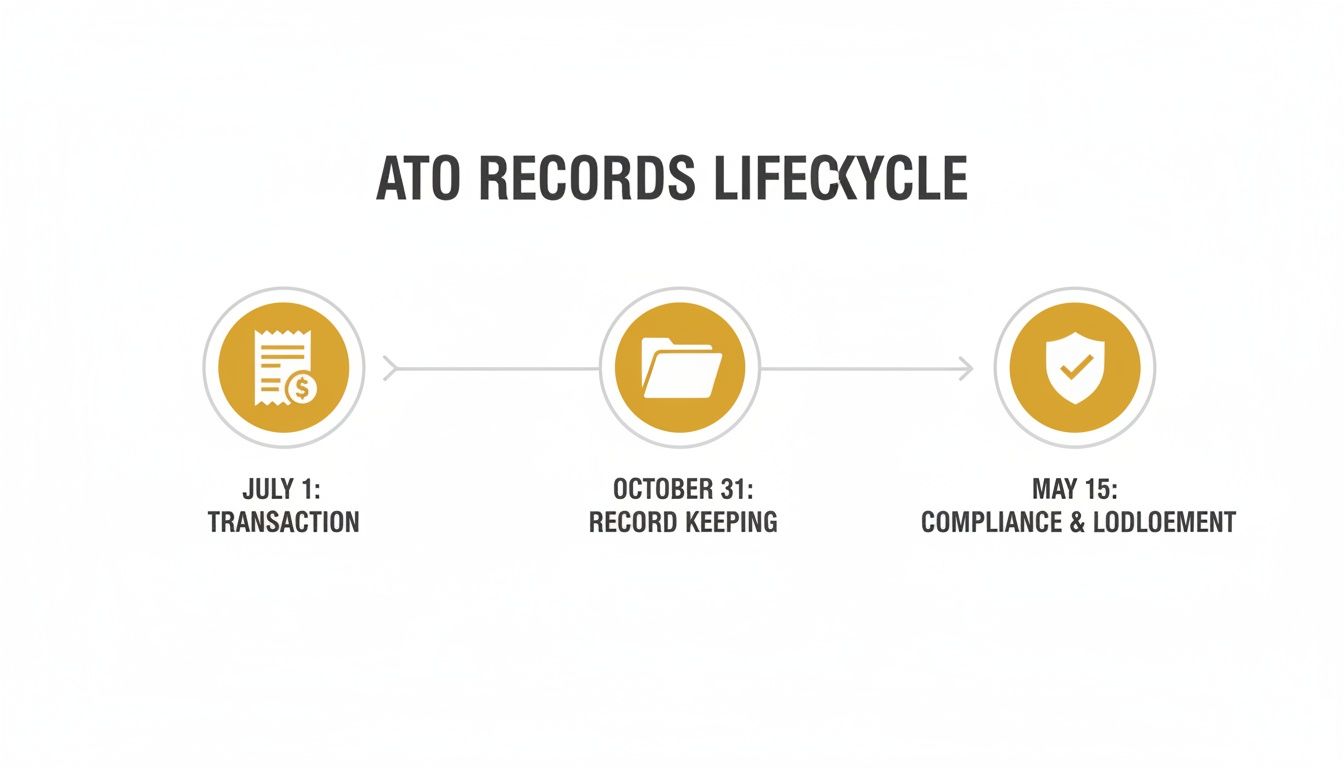
As you can see, the clock only starts after you’ve finalised your tax obligations for that period.
When Five Years Becomes Seven Years or More
A one-size-fits-all approach to shredding documents is risky because the ATO isn’t the only regulator in town. Other government bodies have their own rules, and where timelines overlap, you must always follow the longest one.
A classic example is payroll. If you have employees, your obligations stretch well beyond the ATO’s rulebook. Fair Work Australia requires that all employment and payroll records be retained for seven years after the employment relationship ends.
This includes documents like:
- Employee details and their start date
- Pay rates, hours worked, and leave balances
- Records of superannuation contributions
- Termination details
Failing to meet this seven-year requirement can lead to hefty penalties from Fair Work, even if you’ve done everything right by the ATO. You can learn more in our detailed guide on how long to keep tax records in Australia.
Special Timelines for Companies and Assets
The rules get even more specific when you factor in different business structures and long-term assets. Companies registered with the Australian Securities and Investments Commission (ASIC), for instance, have their own set of obligations.
Key company documents, such as minutes of board meetings and shareholder resolutions, must often be retained for seven years to ensure a clear record of company governance is always available.
Records related to capital assets—such as investment properties, business vehicles, or major equipment—typically have a much longer life. You must keep all documents related to buying, owning, and selling an asset for five years after you’ve lodged the tax return for the year you sold it.
So, if you bought a commercial property 20 years ago and sell it today, you’ll need to hang onto those original purchase documents for at least another five years from the date you lodge this year's return. Without them, correctly calculating your capital gain or loss is virtually impossible, and you could end up paying far more tax than you need to.
The Essential Records You Absolutely Must Keep
Knowing how long to keep your records is only half the battle. The other, arguably more important, half is knowing exactly what to keep. The Australian Taxation Office (ATO) has clear expectations, and getting this right is your ticket to substantiating every single figure on your tax return.
Think of it like building a case in court. You wouldn't just tell the judge you spent money on business supplies; you'd present the receipt as irrefutable evidence. Your business records are that proof—a clear, undeniable trail for all your financial activities.
Let’s break down the essential documents into logical categories, creating a practical checklist so you can confidently manage your record keeping requirements ato.
Core Income Records
First things first: you have to prove the money coming in. It’s not enough to just show deposits hitting your bank account; the ATO wants to see the source transaction that generated that income.
Your essential income records should include:
- Tax Invoices: The official invoices you send to clients, showing GST details if you're registered.
- Sales Receipts: Copies of receipts you give customers for goods or services.
- Cash Register Tapes: The daily summaries or 'Z tapes' from your point-of-sale system are perfect.
- Bank Statements: While not enough on their own, they're crucial for corroborating that the income you've declared was actually deposited.
- Income Summaries: Any spreadsheets or reports you create detailing daily or weekly sales.
Together, these documents paint a complete and verifiable picture of your earnings.
Crucial Expense Records
Every dollar you claim as a business deduction needs a paper trail. The record has to prove not only that you spent the money but that the expense was directly tied to earning your assessable income.
The golden rule for expense records is simple: if you want to claim it, you must be able to prove it. A bank statement showing a payment to "Officeworks" is a start, but the corresponding tax invoice showing you bought printer paper—and not a new video game for your kid—is the vital piece of evidence.
Your expense documentation must clearly show:
- The name of the supplier
- The amount of the expense
- The nature of the goods or services
- The date the expense was paid
- The date of the document
This is exactly why proper tax invoices are the gold standard for your records.
Essential Record Keeping Checklist by Taxpayer Type
To help you pinpoint exactly what's needed for your situation, we've put together a quick reference table. This checklist breaks down the core records required by the ATO for different types of taxpayers.
| Taxpayer Type | Income Records Examples | Expense Records Examples | Other Critical Records |
|---|---|---|---|
| Sole Trader / Small Business | Tax invoices, sales receipts, cash register tapes, bank statements. | Supplier tax invoices, receipts for materials, utility bills, software subscriptions. | BAS statements, payroll records (if applicable), asset register. |
| Property Investor | Rental statements from agent, tenant ledgers, bank deposits for rent. | Council rates, water bills, insurance policies, body corporate fees, repair receipts. | Purchase contract, stamp duty records, loan documents (for CGT cost base). |
| Individual with Deductions | Not applicable (unless for side hustle). | Receipts for work-related expenses (e.g., uniforms, self-education). | Vehicle logbook (if claiming car use), diary of work-from-home hours. |
This table serves as a starting point. Always remember that the better your records, the stronger your position will be if the ATO ever comes knocking.
Tailored Records for Different Taxpayers
Record keeping isn't one-size-fits-all. A sole trader's needs are vastly different from a property investor's, and someone claiming work-from-home expenses needs very specific proof.
For Small Businesses and BAS Lodgers
If you're registered for GST and lodging a Business Activity Statement (BAS), your record-keeping duties step up a notch. You must keep records that let you accurately calculate and report:
- GST on Sales: All tax invoices you've issued.
- GST on Purchases: All tax invoices from suppliers to claim your GST credits.
- Wages and PAYG Withholding: Payroll summaries, payslips, and superannuation contribution receipts.
For Property Investors
Rental properties have their own unique record-keeping world. To correctly calculate your net rental income (or loss) and any future Capital Gains Tax (CGT), you must hang on to:
- Purchase Records: The original contract of sale, stamp duty documents, and all legal fees. These are non-negotiable for establishing your CGT cost base.
- Rental Income: Copies of all rental statements from your property manager or your own records of rent received.
- All Expenses: This means everything—council rates, water bills, insurance policies, body corporate fees, land tax assessments, and receipts for every single repair and maintenance job.
For Individuals with Complex Deductions
Claiming deductions for things like your car or a home office requires meticulous records. The ATO puts these claims under the microscope, so your proof needs to be rock-solid.
- Vehicle Expenses: A logbook to establish your work-use percentage (if using that method), plus every receipt for fuel, insurance, registration, servicing, and loan interest.
- Work-From-Home Expenses: A diary or timesheet showing your hours worked from home, along with receipts for utility bills, internet, and stationery to correctly apportion your costs.
By organising your documents this way, you shift from just collecting paper to building a structured, audit-proof system that ticks every ATO box.
Choosing Your Ideal Record Keeping System
The days of frantically digging through a shoebox for a faded receipt are, thankfully, long gone. Today, how you choose to keep your records is a strategic decision. It directly impacts your efficiency, accuracy, and—most importantly—your peace of mind come tax time. A good system doesn't just store documents; it actively simplifies your compliance with ATO record-keeping requirements.
Sure, paper-based systems are still technically compliant, but they come with a hefty list of drawbacks. Physical documents can be lost, destroyed in a fire or flood, or simply fade into illegibility over time. In contrast, a well-managed digital system offers security, accessibility, and powerful organisational tools that make the old ways feel archaic.
The ATO fully endorses digital records, and for good reason. They recognise how much more reliable and efficient they are for modern business. This isn't just about convenience; it's about the integrity and accessibility of your financial information.
Making Your Digital Records ATO-Proof
Switching to digital isn’t as simple as snapping a blurry photo of a receipt with your phone. To be considered a valid record by the ATO, your electronic copies have to meet some pretty specific criteria. Think of it as creating a certified true copy in the digital world.
Each digital record must be:
- A true and clear reproduction of the original paper document.
- Complete and unaltered, containing all the necessary information.
- Stored securely in a format that prevents tampering or degradation.
- Easily accessible and retrievable for the entire five-year retention period.
This is exactly why a systematic approach is so crucial. The ATO is strict about this: all business records must be readily available upon request, in English (or easily translatable), and accurately reflect the original transaction. This move toward digital compliance simply mirrors modern business, where electronic systems offer huge advantages in storage, access, and audit preparation.
The Power of Cloud Accounting Software
For most small businesses, cloud accounting software is the gold standard. Platforms like Xero, MYOB, and QuickBooks are built from the ground up to handle Australian tax obligations, creating a seamless workflow from the moment a transaction occurs through to the lodgement of your tax return.
Picture this: a supplier emails you an invoice. Instead of hitting 'print', you just forward it directly to your accounting software. The system uses smart technology (optical character recognition, or OCR) to read all the key details—supplier name, date, amount, and GST—and pre-fills a bill for you. All you have to do is check it, approve it, and the digital invoice is attached to that transaction forever.
This isn't just storage; it's active bookkeeping. The software automatically categorises your expenses, tracks your GST, and generates reports in an instant. It transforms a messy pile of records into financial data you can actually use. When it's time to lodge your BAS, the platform can prepare the statement with just a few clicks.
Secure Storage and Backup Strategies
Whether you use dedicated accounting software or a cloud storage solution like Google Drive or Dropbox, your backup strategy is non-negotiable. Digital records aren't indestructible. They can be lost to a hard drive crash, a cyberattack, or even an accidental 'delete'.
Here are a few best practices to keep your data safe:
- Automate Your Backups: Pick a system that automatically and regularly backs up your files to a separate, secure location. Relying on yourself to remember to do it is a recipe for disaster.
- Use the 3-2-1 Rule: It's a classic for a reason. Keep three copies of your data on two different types of media, with one copy stored off-site. The cloud absolutely counts as off-site, making this easier than ever. This redundancy means you can recover your records no matter what happens.
- Control Your Access: Use strong, unique passwords and switch on two-factor authentication for all your accounts. You should also limit who can access sensitive financial data to only those who absolutely need it.
Choosing the right system is all about finding that sweet spot between compliance, efficiency, and security. For more ideas on structuring your files, exploring document management best practices can offer some valuable insights. To dive deeper into different methods, check out our guide on the various ways of record-keeping available.
Ultimately, the best system is the one you’ll actually use consistently, turning what feels like a daunting task into a simple, automated part of your business workflow.
Common Record Keeping Mistakes and How to Avoid Them
Learning from other people's mistakes is one of the smartest things you can do in business. Even with the best intentions, simple slip-ups in your record-keeping can put you on the ATO’s radar, leading to audits, surprise tax bills, and penalties.
The good news is that most of these errors don't come from trying to cheat the system. They happen because of simple oversights or a misunderstanding of the ATO’s record-keeping requirements. By knowing what these pitfalls are, you can build a system that’s genuinely audit-proof.
Let's walk through the most common mistakes we see business owners make and, more importantly, the straightforward ways you can fix them.
Mistake 1: Mixing Business and Personal Expenses
Using a single bank account for both your business and personal life is probably the most common and damaging mistake we see. When your morning coffee shows up on the same statement as a payment to a major supplier, you create a tangled mess that’s a nightmare for you—and the ATO—to unravel.
It becomes almost impossible to get a clear picture of your business's financial health. You’ll either miss out on claiming legitimate deductions or, even worse, accidentally claim a personal expense, which is a massive red flag for auditors.
The Simple Solution: From day one, open a separate bank account and credit card just for the business. All your income goes in, and all your business expenses go out. This single act of separation instantly creates a clean, easy-to-follow financial trail and makes bookkeeping a thousand times easier.
Mistake 2: Relying Only on Bank Statements
Think of your bank statement as just one piece of the puzzle. It proves you spent money, but it doesn't tell the ATO the crucial part of the story: what you bought and why it was for your business. A line item showing "$150 at a major retailer" is not meaningful on its own.
Without the matching tax invoice, you can’t prove the purchase was a legitimate business expense. It also means you can’t claim any GST credits you might be entitled to.
- The Proactive Fix: Make it a non-negotiable rule to get a tax invoice for every single business purchase. Get into the habit of using a receipt-scanning app on your phone—the Xero or MYOB apps are great for this—to snap a digital copy on the spot. This links the proof directly to the transaction, creating an unbreakable chain of evidence.
Mistake 3: Losing Receipts for Cash Purchases
Cash is the king of forgotten expenses. It’s so easy to pay for something small with cash, stuff the receipt in a pocket, and then it’s gone forever. While they seem minor, these little purchases can add up to thousands of dollars in missed tax deductions over the course of a year.
If you lose the receipt, you lose the claim. The ATO's rule is simple: no proof, no claim. Cash transactions leave almost no other trace, so that little piece of paper is everything.
- The Immediate Action: Start a 'no receipt, no reimbursement' policy, even if it's just for yourself. Keep a dedicated envelope or section in your wallet for physical receipts, and scan them at the end of each day or week. Consistency here is your best weapon against lost deductions.
Mistake 4: Forgetting About an Asset's Cost Base
When you buy a major asset like an investment property or a significant piece of equipment, your record-keeping job doesn’t end with the purchase price. The "cost base" of an asset includes the purchase price plus all other costs associated with acquiring and eventually disposing of it.
So many people forget to track things like stamp duty, legal fees, or agent commissions. Forgetting to add these to your cost base means that when you sell the asset, your capital gain will look much bigger than it actually is, and you'll end up paying way more tax than you need to.
- The Long-Term Strategy: For each major asset, create a dedicated digital folder or physical file. In it, keep the purchase contract, invoices for stamp duty and legal fees, and receipts for any capital improvements you make along the way. Keeping this organised over the life of the asset ensures you can calculate your Capital Gains Tax correctly and only pay what you truly owe.
How Professional Support Can Simplify Your Compliance
Knowing the rules is one thing. Actually applying them day in, day out while you’re busy running a business or managing investments is another challenge entirely. This is where professional support bridges the gap between theory and reality.
Engaging a tax professional transforms your ATO record-keeping requirements from a source of stress into a seamless part of your financial management.
A good tax accountant does far more than just lodge your return once a year; they build the entire framework for your compliance from the ground up. They can set up a streamlined digital system for you, ensuring every transaction is captured and correctly categorised from day one. This proactive approach completely eliminates that mad year-end scramble and makes BAS and tax time a smooth, straightforward process.
Audit-Proofing Your Investments
For anyone with more complex affairs, like rental properties or significant capital gains, expert help is invaluable. A professional ensures every detail is meticulously documented—from the initial property purchase costs down to the smallest receipt for a minor repair.
This builds an audit-proof history of your investment's cost base and ongoing expenses. When it comes time to sell, this robust paper trail safeguards you from overpaying Capital Gains Tax. They know precisely what the ATO looks for and create the records to back up every claim.
Engaging a professional is an investment in certainty. It provides peace of mind that your records are not just stored, but structured in a way that fully supports your tax position and minimises risk.
Getting Back on Track with Overdue Returns
Falling behind on tax returns can feel incredibly daunting. Often, it’s because the records you need seem lost or the task of piecing them together is just too overwhelming.
This is a situation where professional help is most powerful. A tax agent can help reconstruct your financial history by reviewing bank statements, supplier invoices, and other available data.
They also handle all communication with the ATO on your behalf, navigating the process to get you back into compliance while minimising potential penalties. You can discover more about the benefits of using a tax accountant in our detailed guide.
Ultimately, the right support system turns chaotic paperwork into an organised, compliant, and stress-free financial foundation.
ATO Record Keeping FAQs
When it comes to ATO record-keeping, a few questions come up repeatedly. Getting straight answers is the key to a solid compliance strategy and helps you avoid those simple, costly mistakes. Here are the answers to the questions we hear most often.
Do I Still Need the Paper Receipt if I’ve Scanned It?
Generally, no. You don’t need to keep the original paper receipt as long as you have a clear, complete, and accurate digital copy. The ATO is perfectly happy with electronic records, provided they are a true and clear reproduction of the original document.
The critical part is that the digital copy must be stored securely and be easily accessible for the entire retention period, which is typically five years. Make sure your scans are legible and, most importantly, properly backed up to prevent data loss.
What Happens if I Lose a Receipt for a Business Expense?
Losing a receipt isn’t the end of the world. You might still be able to claim the deduction if you can provide other evidence to back it up. A bank or credit card statement is a good starting point, but on its own, it usually isn’t enough detail for the ATO.
Your best bet is to support the bank transaction with a diary entry that details the supplier, date, amount, and the specific business purpose of the expense. For larger amounts, it’s always worth contacting the supplier to ask for a copy of the invoice.
How Long Should I Keep Records for a Property I've Sold?
This one has a special timeline. Selling an investment property is a capital gains tax (CGT) event, and the record-keeping rules are strict. You must keep all records related to the property's purchase and sale for five years after you lodge the tax return that includes that sale.
This means you could be holding onto purchase documents from decades ago. It’s absolutely vital for correctly calculating your property’s cost base, which in turn ensures you don't pay a cent more in Capital Gains Tax than you have to when you eventually sell.
Navigating these rules can feel like a minefield, but you don't have to do it alone. The team at Australia Wide Tax Solutions specialises in making compliance straightforward for individuals and businesses just like you. Contact us today to ensure your records are audit-proof and your tax position is fully optimised.
The ATO provides guidance through ato.gov.au, the Small Business Support Line (13 28 66), and Online Services for individuals and businesses. For complex situations, a registered tax agent provides advice tailored to your specific circumstances and professional indemnity protection. You can verify agent registration at the TPB register at tpb.gov.au.
Most tax records must be kept for five years from the date of lodgement or the date the transaction occurred, whichever is later. Records must be in English or convertible to English and must be sufficient to explain the income and deductions in your return. The ATO can request records at any time during the retention period.
Consider a registered tax agent when your affairs involve multiple income sources, business activity, investment properties, capital gains, or overseas income. Agents extend your lodgement deadline, provide safe harbour protection, and take professional responsibility for the advice given. Verify registration at tpb.gov.au.
The failure to lodge penalty is based on penalty units ($313 per unit from 1 July 2023), accruing per 28-day period for late returns and BAS lodgements. Incorrect information penalties range from 25% to 75% of the tax shortfall depending on whether the behaviour was careless, reckless, or intentional. Proactive disclosure before an audit begins typically results in significantly reduced penalties.
Tax minimisation is the legal arrangement of your affairs to reduce tax — claiming all eligible deductions, using appropriate structures, and timing income and expenses. Tax avoidance involves arrangements that technically comply with the law but achieve outcomes parliament did not intend. The ATO can apply Part IVA anti-avoidance rules to cancel benefits from avoidance arrangements.
Quick Guide to Australian Tax Record Retention
Getting a handle on how long to keep tax records is a non-negotiable part of good financial housekeeping, whether you're an individual or running a business. The ATO sets the standard rule: most records need to be kept for a five-year period after you've lodged the relevant tax return. So, what does this actually cover? It’s a pretty broad range of documents—essentially, anything you used to figure out your tax submission. This includes things like:- Income statements from your employer(s)
- All those receipts and invoices for your expense claims
- Bank statements that show interest earned
- Dividend statements if you hold shares
- Any records detailing capital gains or losses
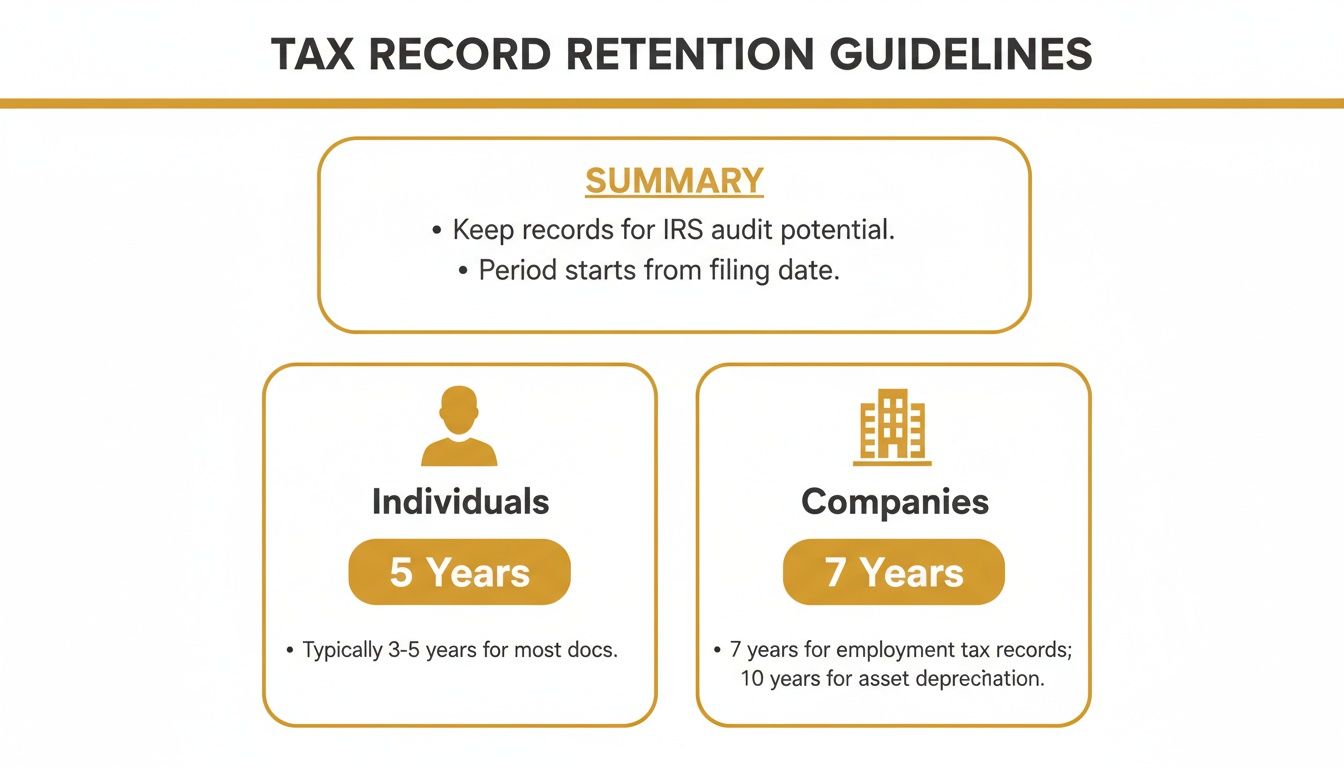
Tax Record Retention Periods At a Glance
To make things easier, here’s a quick summary table of the minimum timeframes you need to know, as required by the ATO and other key Australian bodies.| Taxpayer or Record Type | Minimum Retention Period | Key Authority |
|---|---|---|
| Individuals & Sole Traders | 5 years from date of lodgement | Australian Taxation Office (ATO) |
| Companies | 7 years | Australian Securities and Investments Commission (ASIC) |
| Capital Gains Tax (CGT) Assets | 5 years after the CGT event is declared | Australian Taxation Office (ATO) |
| Superannuation Records | 5 to 10 years depending on the record | Australian Taxation Office (ATO) / APRA |
| Fringe Benefits Tax (FBT) | 5 years from date of lodgement | Australian Taxation Office (ATO) |
The Five Year Rule for Individuals and Sole Traders
For most everyday Aussies and sole traders, the magic number to remember for tax records is five. This is the standard rule of thumb set by the Australian Taxation Office (ATO) and it's the bedrock of good personal tax compliance.
Calculating Your Retention Period
So, how does this work in practice? It's pretty straightforward. Let’s say you lodged your 2023 tax return on 15 October 2023. That means you need to hang onto all the related paperwork for that return until at least 15 October 2028. If you toss them out before then, you could be left high and dry if the ATO comes knocking for a review. This rule covers the whole gamut of documents that support what you've put in your return. Keeping these records organised, whether in a shoebox or a cloud folder, is the key to proving both your income and your expenses without any last-minute panic.Key Records to Keep for Five Years
Basically, you need to keep any document that helped you or your tax agent prepare your return. Having a system makes life a whole lot easier if the ATO ever asks for more information. The absolute must-haves include:- Income Statements: This includes PAYG summaries from employers, Centrelink statements, or details from any other income source.
- Expense Receipts: All those receipts for work-related gear, uniforms, self-education courses, or home office costs.
- Bank and Dividend Statements: Any documents showing the interest you've earned or dividends you've received.
- Logbooks: If you're claiming car or travel expenses, your logbook is non-negotiable.
The most critical thing to remember is that this responsibility is 100% yours. Even if you use a fantastic tax agent to lodge your return, you're the one who must be able to pull out the supporting documents for the entire five-year period.If you’re running a business as an individual or sole trader, the five-year rule is a pretty solid benchmark. But for company directors, the goalposts shift. You’re playing a different game with a more stringent set of rules. The answer to "how long to keep tax records in Australia" for a company is a definitive seven years. This isn't an arbitrary number cooked up by the ATO. This extended retention period is mandated by the Australian Securities and Investments Commission (ASIC) under the Corporations Act 2001. It's a legal requirement that sits above the standard tax rules, meaning company directors absolutely must stick to this longer timeframe to stay compliant with corporate law.
Why Seven Years Is the Magic Number
So, why the extra two years? It comes down to the complex nature of a company. Unlike a sole trader, a company has deeper legal and financial duties, particularly to its shareholders and creditors. ASIC needs that seven-year paper trail to ensure there's complete transparency and accountability in a company's financial history. Under Australian corporate law, specifically section 286 of the Corporations Act 2001, financial records must be kept for seven years from the date the transactions are completed. It's a non-negotiable part of corporate governance. If you want a broader view, you can find more global insights about accounting record retention from various industry publications. Ignoring this can bring down serious penalties on directors, and make no mistake, ASIC actively pursues non-compliance cases every year.The Company Records You Must Keep
The seven-year rule isn't just for a few select documents; it covers everything that explains your company's financial position and performance. Getting this wrong can lead to hefty fines or, in serious cases, legal action against the directors. Here’s a quick list of the core records you need to hold onto for the full seven years:- Financial Statements: This includes your Profit and Loss Statements and Balance Sheets.
- Tax and BAS Records: Every single Business Activity Statement and company tax return.
- General Ledgers: The detailed logs of all your financial transactions.
- Asset Registers: All paperwork related to buying, depreciating, and selling company assets.
At the end of the day, the buck stops with the company directors. It’s on you to ensure these records are kept properly for the entire seven-year period. Think of it less as a tax chore and more as a fundamental pillar of good corporate governance and staying on the right side of the law in Australia.
Special Record Rules for Capital Gains Tax Events
When it comes to the question "how long to keep tax records in Australia," Capital Gains Tax (CGT) events are the big exception that can catch people out. Unlike your standard income or expense receipts, the clock for keeping records on CGT assets—like property or shares—starts much, much later. You really need a long-term mindset for this one. The rule itself is simple enough, but it’s where a lot of people get tripped up. You must keep all records for any CGT asset for five years after the tax year you finally lodge the return that includes the CGT event (which is usually when you sell or dispose of it).Calculating the CGT Record Timeline
Let's walk through a real-world example. Say you bought an investment property way back in 2010. You held it for years, and then finally sold it, with the settlement happening in March 2024. This CGT event will be declared on your 2024 tax return, which you might lodge in September 2024. In this scenario, that five-year countdown only begins from September 2024. This means you must hang onto every single record related to that property—from the initial purchase contract in 2010 right through to the final sale documents in 2024—until at least September 2029. Tossing them out early could leave you completely exposed if the ATO ever queries the transaction down the track, as you’d have no way to prove your cost base.Essential CGT Documents to Retain
Having the right paperwork is non-negotiable for correctly calculating your capital gain or loss. If you want to get into the nitty-gritty of this, you can learn more about when you pay capital gains tax in our detailed guide. The key records you absolutely must keep include:- Purchase and Sale Contracts: These are your primary evidence, establishing the original purchase price and what you eventually sold it for.
- Proof of Ownership: Think title deeds for property or share certificates for investments.
- Records of Capital Improvements: Kept all your invoices for that big renovation? Good. These costs form part of the asset’s cost base, which can reduce your final tax bill.
- Incidental Costs: Don't forget the other expenses like stamp duty, legal fees, and real estate agent commissions. Every one of these receipts helps build an accurate picture of your costs.
Superannuation and Deceased Estates: When the Rules Change
The standard five-year rule isn't a one-size-fits-all solution, especially when you step into the more specialised worlds of superannuation and deceased estates. These areas have their own unique timelines, and getting them right is critical for staying compliant. If you’re managing a self-managed super fund (SMSF), you’ll find the record-keeping demands are far more extensive. While many of the usual financial documents still fall under the five-year rule, a whole host of others need to be kept for much, much longer.
SMSF Record Retention Timelines
As a trustee, you need to be across the different retention periods for specific SMSF documents. It's not something you can afford to get wrong.- 10 Years: Key governance documents have a decade-long retention period. This includes minutes of trustee meetings, records of any changes to trustees, and member reports.
- 5 Years: Your fund's operational records, such as financial statements, tax returns, and BAS lodgements, must be kept for at least five years.
Handling a Deceased Estate
When you're the executor or administrator of a deceased estate, you take on responsibility for the deceased person's tax affairs. This is a significant duty, covering everything right up to their final tax return. The rule here is clear: all of the deceased's tax records must be kept for five years, starting from the date the ATO issues their final notice of assessment. This ensures that any lingering tax matters can be finalised correctly. This responsibility is all about ensuring that any questions from the ATO down the track can be answered accurately and promptly, giving you peace of mind during what is already a difficult time. You can learn more about the complexities involved in managing a deceased estate in our dedicated article.Best Practices for Storing Tax Records Securely
Knowing how long you need to keep your tax records is only half the battle. How you store them is just as critical for staying compliant and ensuring you can find what you need, when you need it. Peace of mind is the goal here. Whether you're a fan of old-school paper files or prefer everything in the cloud, the principles are the same: security, organisation, and accessibility. For your physical records, a dedicated, fireproof filing cabinet tucked away in a secure home office is a fantastic, reliable option. I always recommend labelling folders clearly by financial year and then by category (e.g., "FY2023 - Work Expenses") so you can pull them out in a flash. Whatever you do, avoid storing them in damp places like the garage or a shed, as that's a surefire way to have them degrade over time.Digital Storage Solutions
Going digital is where you gain huge advantages in accessibility and backup security. Storing your records in the cloud or within dedicated accounting software means you can access them from anywhere—a massive step up from a filing cabinet locked in your office. Here are a few solid digital methods to consider:- Cloud Storage: Services like Google Drive or Dropbox are incredibly convenient. The trick is to create a logical folder structure that mirrors how you'd file paper records. And it goes without saying, but always use strong, unique passwords and enable two-factor authentication.
- Accounting Software: Platforms such as Xero or MYOB are brilliant because they often have built-in document storage. This allows you to link a digital copy of a receipt directly to the transaction it relates to, which is a game-changer for organisation.
- External Hard Drive: This is a good backup solution, but make sure the drive is encrypted and, crucially, stored in a separate physical location from your main computer. A backup isn't much use if it gets destroyed in the same incident as the original!
No matter which method you land on, having a consistent backup strategy is completely non-negotiable. The ATO is perfectly happy to accept digital copies of your records, but only if they are a true and clear reproduction of the original document. You can explore various ways of record keeping to figure out what system works best for you and your business.Once the legal retention period is finally up, don't just toss your old files in the bin. Make sure you are securely disposing of old tax records with a cross-cut paper shredder to protect your sensitive personal and financial information from falling into the wrong hands.
Frequently Asked Questions About Tax Records
When it comes to the nitty-gritty of keeping tax records, there are always a few curly questions that pop up. We get it. Here are some straight answers to the most common queries we hear from clients, helping you handle your tax admin with confidence.
What Should I Do If I Lose My Tax Records?
First off, don’t panic. If you’ve lost records, your first move is to try and piece them back together. You can often get old bank statements, ask suppliers for duplicate invoices, or request a copy of your income statement from your employer. If you're facing an audit, being proactive is absolutely critical. The ATO might accept these reconstructed records, but only if they’re credible and you have a good explanation for why the originals are gone. A tax professional can be invaluable here, helping you navigate the process and communicate effectively with the ATO on your behalf.Are Digital Scans of Records Acceptable to the ATO?
Yes, they absolutely are. The ATO is fine with both physical and digital records, as long as the digital copy is a true and clear reproduction of the original document. Once you have a quality scan, you can typically shred the paper version unless another law says you have to keep it. Just make sure your digital files are stored securely and backed up regularly. Use a format that can't be easily messed with, and come up with a logical naming system. It makes finding a specific document months or years later a whole lot easier.Do I Need Records for Tax Returns Lodged Late?
Yes, 100%. This is a point that trips a lot of people up. The standard five-year retention period doesn't start ticking until after you’ve lodged your tax return and received your notice of assessment. So, if you have unlodged returns from seven or eight years ago, you're still on the hook for keeping all the relevant records for them. Once you finally lodge those late returns, the clock starts – you must then hold onto the supporting documents for another five years from that lodgement date. It's a crucial detail to remember when getting your old tax affairs in order.Bringing late or complex tax returns up to date can feel like a huge weight on your shoulders, but you don't have to tackle it alone. The team at Australia Wide Tax Solutions are experts in getting you back on track with zero stress. Contact us today to get your tax affairs compliant and sorted for good.
CGT is not a separate tax — a capital gain is included in your assessable income for the year a CGT event occurs. It applies when you dispose of a CGT asset including shares, investment properties, business assets, and cryptocurrency. Your primary residence is generally exempt, though partial exemptions apply in specific circumstances.
The capital gain is capital proceeds (sale price) minus the cost base. The cost base includes purchase price, stamp duty, legal fees, and capital improvement costs. If the asset was held for more than 12 months, apply the 50% CGT discount to reduce the gain before adding it to taxable income. Keep all acquisition records from the purchase date.
Australian resident individuals and trusts that have held a CGT asset for more than 12 months can reduce their capital gain by 50% before inclusion in assessable income. Superannuation funds receive a one-third discount. Companies do not qualify. The holding period begins on the purchase date and ends on the disposal contract date.
Shares are CGT assets. When you sell shares, the gain or loss is proceeds less cost base (purchase price plus brokerage). Gains on shares held more than 12 months qualify for the 50% discount. Capital losses can only offset capital gains — they cannot reduce other income. Carry forward unused losses to offset future gains.
The main residence exemption can entirely or partially exempt the gain from selling your home. Full exemption applies if the property was your main residence throughout the ownership period, was never used to produce income, and sits on land of two hectares or less. Partial exemption applies where it was rented or used for business during part of the ownership period.