
It's late June. You've got a BAS due, the bank feed is full of half-labelled transactions, and a box of curled receipts is sitting under the desk like a tax problem you can ignore by not looking at it. You can't. In Australia, small businesses claim over $50 billion in deductions annually, and the ATO notes average refunds of $8,700 for compliant small businesses in 2023 according to ATO-based guidance.
Most business owners don't miss deductions because they're lazy. They miss them because they treat expense claims like a shopping list instead of a system. That's why they either underclaim out of fear or overclaim and walk straight into avoidable trouble. If you want to know how to claim business expenses properly, start with records, apportionment, and timing. The list of deductions comes after that.
- That Shoebox Full of Receipts Is Costing You Money
- The ATOs Three Golden Rules for Expense Claims
- Identifying Your Most Common Business Deductions
- Substantiation: The Art of Proving Your Claims
- Putting It Together: Apportionment, GST, and Your BAS
Table of Contents
- That Shoebox Full of Receipts Is Costing You Money
- The ATOs Three Golden Rules for Expense Claims
- Identifying Your Most Common Business Deductions
- Substantiation The Art of Proving Your Claims
- Putting It Together Apportionment, GST, and Your BAS
- Claiming Major Purchases Depreciation and Instant Write-Offs
- Your Next Steps An Error-Free Claims Checklist
That Shoebox Full of Receipts Is Costing You Money
A sole trader plumber buys materials from three suppliers, fuel from two servos, software on a monthly subscription, and the odd tool on the way to a job. By tax time, none of that feels organised. Some receipts are faded. Others are missing. The bank statement shows money went out, but not always what it was for.

That mess costs money in two directions. First, you miss legitimate deductions because you can't identify or prove them. Second, you waste hours reconstructing basic bookkeeping that should've been captured when the expense happened. If you're still typing receipt details by hand, stop. Tools for automated receipt processing via OkraPDF can pull structured data out of receipts, which makes categorising and retaining records far less painful.
A messy file is a tax problem
The ATO doesn't care that you were busy. It cares whether the expense was business-related, whether any private use has been excluded, and whether you can prove the claim. A receipt system doesn't need to be fancy, but it does need to be consistent.
Three setups usually work in practice:
- Simple operator setup: business bank account, one card for business purchases, receipt photos saved straight away.
- Software setup: Xero or MYOB with bank feeds and supplier rules.
- Hybrid setup: spreadsheet plus cloud folder, if volume is low and you're disciplined.
A shoebox is not a record-keeping system. It's delayed admin with interest attached.
If your current process relies on memory, rebuild it before the next quarter. A practical starting point is this guide to ways of record keeping for tax and business use. Why this matters: the businesses that claim cleanly aren't guessing at year end. They've made the claim easy to prove months earlier.
The ATOs Three Golden Rules for Expense Claims
You don't start with “Can I claim it?” You start with the three tests the ATO applies. If the claim fails one of them, the category doesn't matter.

ATO statistics show that of the $22.4 billion in work-related expenses claimed, adjustments are most common when one of the three golden rules is broken, according to this ATO-based summary. That same framework applies to business claims. The rule set is simple. Applying it properly isn't.
Rule one means a real connection to income
The expense must be incurred in earning your assessable income. Rent for your shop fits. Advertising fits. Accounting software usually fits. School shoes for your child don't become deductible because you answered work emails while buying them.
The problem isn't the obvious stuff. It's the grey-area spending that owners try to force into a business label after the fact. If the purpose is mixed, only the business portion is claimable.
Rule two means private use must be carved out
Many otherwise valid claims fail at this stage. Your mobile phone can be partly deductible. Your ute can be partly deductible. Home internet can be partly deductible. None of that means the full amount is fair game.
Common Pitfall
- Branded car myth: Putting your logo on the side of a car doesn't turn private travel into business use.
- Phone bill shortcut: Using your personal phone for client calls doesn't make the whole monthly plan deductible.
- Home expense overreach: Working from the kitchen table doesn't justify claiming every household cost.
Practical rule: If you can't explain how you worked out the business percentage, the claim is weak.
The legal backbone for this sits in the ordinary deductibility rules under tax law, but the practical version is easier to remember. Business use only. Private use excluded. Proof kept. If you need a plain-English companion piece, this article on what is a tax deductible expense is useful.
Rule three means records, not intentions
Wanting to claim an expense isn't evidence. A bank transaction alone often isn't enough because it may not show what was purchased, from whom, or why. The ATO wants records that tie the payment to the business purpose.
That's why rushed claims assembled from memory are risky. A clean claim is built from documents created at the time of purchase, not from stories built months later. Why this matters: once you understand the rules, you stop arguing with the tax law and start structuring your records to fit it.
Identifying Your Most Common Business Deductions
I see the same problem every year. A business owner has spent money that should be deductible, but the claim falls apart because the expense was coded badly, mixed with private spending, or treated as an immediate deduction when it should have been handled as a capital item.
The useful question is not just what can you claim. It is what kind of cost it is, when the deduction is available, and how you prove the business portion if the expense is mixed-use.
A practical way to sort deductions is by function. Running costs sit in one group. Asset purchases sit in another. Property expenses need separate attention because repairs, improvements, borrowing costs, and holding costs do not all get the same treatment. If you want a broader self-employed overview, this guide to claimable business expenses for sole traders is a useful companion.
Operating costs you can usually claim
For sole traders and SMEs, the regular deductions usually come from ordinary operating costs. These are the recurring expenses that keep the business trading.
| Expense Type | Example | Deductibility Status |
|---|---|---|
| Office supplies | Printer paper, stationery, postage | Generally deductible if used for business |
| Advertising | Online ads, flyers, website hosting | Generally deductible if tied to business activity |
| Professional fees | Tax agent, bookkeeping, legal advice related to the business | Usually deductible |
| Vehicle costs | Fuel, servicing, registration | Claim only the business portion |
| Software | Xero, MYOB, job management platforms, design tools | Usually deductible if used for business |
| Insurance | Public liability, business contents, professional indemnity | Usually deductible |
| Rent and utilities | Commercial premises rent, electricity for business site | Usually deductible |
| Home office costs | Running expenses for business use at home | Apportioned claim only |
| Rental property expenses | Council rates, agent fees, eligible repairs | Depends on the nature of the expense and use |
That table is the easy part. The actual work is in the grey areas.
A builder using a ute for site visits, school drop-off, and weekend trips cannot claim the lot. A consultant working from home cannot throw the full internet bill into the tax return. A café owner paying for accounting software with a package that also covers a separate side project needs to split the cost properly. Those are the claims that get adjusted because the category might be right, but the percentage is wrong.
Different businesses also attract different scrutiny. Trades usually rack up tools, protective equipment, vehicle costs, insurances, and contractor payments. Consultants often claim software, phone, home office running costs, industry subscriptions, and training that relates to their current income-earning work. Retailers need clean treatment of merchant fees, POS systems, freight, packaging, and stock-related spending. For more Australian examples by category, see this guide to small business tax deductions in Australia.
Property investors get caught on repairs versus improvements
Property claims are where poor classification gets expensive.
A repair generally fixes wear and tear and puts something back into working order. An improvement gives you something better than what was there before, changes the character of the asset, or forms part of a larger upgrade. That difference affects whether you claim it now, over time, or as part of the property's cost base.
A leaking tap replaced with a similar tap will often be a repair. Replacing an entire kitchen with better finishes, extra cabinetry, and new appliances is usually not a repair just because the old kitchen was tired. I spend a lot of time correcting rental schedules where owners have bundled new assets, structural work, and genuine repairs into one line called "maintenance". That shortcut creates problems fast.
The safest approach is to separate property spending as you go. Keep invoices detailed. Note what was done. If one bill includes both repair work and improvement work, split it before year-end while the facts are still clear.
Substantiation: The Art of Proving Your Claims
An expense without proof is just a claim waiting to be cut back. The ATO compliance position is blunt. Claims are disallowed in 68% of reviews due to a lack of substantiation, particularly missing logbooks or diaries, and records must be kept for five years according to ATO compliance data.

What counts as proof
A proper record should show the supplier, date, amount, and what you bought. For some lower-value items, a diary record supported by a bank transaction may help. For larger or more scrutinised claims, get the tax invoice and keep it legible.
The tax invoice threshold that often matters in practice is more than $82.50 GST-exclusive, with records retained under the substantiation rules noted in the verified data. Digital copies are fine if they're clear and retrievable. That means a phone photo can work. A blurry image buried in your camera roll is asking for trouble.
Pro-Tip
- Capture immediately: photograph the receipt before it fades.
- Name consistently: supplier, date, amount, and category in the file name or app notes.
- Store centrally: don't split records across text messages, email folders, and random downloads.
- Match monthly: reconcile receipts against the bank feed while the purchase is still fresh.
Xero and MYOB are practical for ongoing bookkeeping. The ATO app can also help if your setup is simpler. For clients with catch-up work, Australia Wide Tax Solutions handles BAS preparation and tax lodgements, which is useful when the issue isn't just missing receipts but years of untidy records.
Vehicle records are where good claims go bad
Vehicle claims attract mistakes because owners mix methods, estimate usage, or rely on memory. For motor vehicles, the accepted methods in the verified data include the logbook method using a representative 12-week period, or the cents-per-kilometre method with the applicable cap and rate for the relevant year. The record-keeping requirement matters as much as the method itself.
A logbook often works better when business use is high and consistent. The cents-per-kilometre method is simpler, but simple doesn't mean sloppy. You still need a reasonable basis for the kilometres claimed.
This short explainer is worth watching before you try to backfill a year of fuel and travel from memory.
Keep the evidence that proves the method, not just the final number you typed into the return.
Why this matters: substantiation isn't admin for admin's sake. It's the difference between a defensible deduction and a claim that disappears the minute someone asks for backup.
Putting It Together: Apportionment, GST, and Your BAS
Business owners often find themselves in a difficult situation at this stage. They understand that an expense is partly business. They even know some GST may be claimable. Then they lodge a BAS with rough percentages and inconsistent coding, and the numbers no longer agree with the year-end return.
Around 55% of BAS errors stem from misclassifying items or incorrectly claiming GST credits, especially on mixed-use expenses, and late lodgers can face a General Interest Charge of up to 11.5% p.a. (FY25) according to the ATO guidance summarised in this BAS error resource.
Apportionment is where judgment matters
Apportionment means splitting an expense between business and private use on a fair basis. That sounds straightforward. It isn't, unless you keep a method and stick to it.
For example:
- Mobile phone: review a representative period and work out business call and data use.
- Home internet: estimate business usage based on actual working patterns.
- Home office running costs: use the accepted fixed-rate method where appropriate. The verified data refers to 67 cents per hour for 2024-25 for eligible work-from-home running costs.
- Vehicle expenses: apply the method you've chosen and keep the supporting records.
Common Pitfall
Claiming 100% of the GST on an expense with a private component is one of the most common BAS mistakes. If only part of the expense relates to business use, only that part of the GST credit is available.
GST doesn't fix a bad deduction. If the underlying expense is partly private, the GST claim is partly private too.
BAS errors usually start with lazy coding
The trouble rarely starts at lodgement. It starts months earlier when transactions are coded without thinking. A café owner uses the same card for stock, groceries, and a family fuel stop. A consultant lets software subscriptions renew on a personal card and sorts them out later. A landlord pays for repairs and improvements from the same account with no notes.
That's how BAS prep turns into detective work. Use clear chart-of-account categories, review mixed-use expenses before quarter end, and don't leave GST treatment to guesswork. If you need a practical walk-through, this guide on how to prepare a Business Activity Statement is worth keeping open while you reconcile. Why this matters: BAS accuracy affects cash flow, compliance risk, and how much rework you create for yourself at year end.
Claiming Major Purchases, Depreciation, and Instant Write-Offs
Big purchases need a different mindset. Buying a laptop, office furniture, or a work vehicle isn't the same as buying printer paper. These items are usually capital assets, which means the cost may need to be claimed over time rather than all at once.

The simplified depreciation rules under Division 40 have been a major change in Australian tax practice, and the verified data notes an immediate deduction threshold of $20,000 extended through 2023-24 for eligible businesses, while separate verified data also refers to a $150,000 instant write-off threshold for 2024-25 announced in the May 2024 Budget for eligible entities under the relevant settings. The key point is simple. Check the rule that applies for your year and eligibility before assuming you can deduct the full amount immediately.
Immediate deduction or depreciation
Take a common example. A sole trader buys a laptop used entirely for business. If it qualifies under the instant asset write-off rules that apply for that year and the business is eligible, the deduction may be immediate. If it doesn't qualify, the asset is generally depreciated over its effective life under the depreciation rules.
Now change the facts. The same sole trader uses the laptop partly for personal streaming and family admin. The claim has to be apportioned for business use first. The tax treatment only starts after that percentage is worked out.
A vehicle purchase raises the same issue. Owners focus on the sticker price. The primary questions are:
- Eligibility: Does the business meet the turnover and asset conditions for the year?
- Use: What percentage is business use?
- Timing: When was the asset first used or installed,, ready for use?
- Evidence: do the invoice and finance records line up with the claim?
For a deeper look at the immediate deduction side of the rules, keep this guide to what is an instant asset write-off handy. Why this matters: the tax outcome on a major purchase depends on timing, use, and eligibility, not on what the salesperson told you.
Your Next Steps An Error-Free Claims Checklist
The businesses that claim cleanly at tax time usually do the work in small steps during the year. Good records are not about admin for its own sake. They are what let you prove the claim, apply the right business-use percentage, and avoid redoing six months of transactions when the BAS or return is due.
Use this checklist to tighten the part of your process that is causing errors.
- Pick one system: use Xero, MYOB, the ATO app, or a spreadsheet with a cloud folder. Any of them can work if you use them consistently.
- Separate business and private spending: a dedicated business bank account makes coding cleaner and makes mixed-use problems easier to spot early.
- Review recurring charges: scan bank and card statements for software, memberships, subscriptions, and direct debits. Match them to tax invoices and check whether any are partly private.
- Start usage records now: for cars, phones, internet, and home office costs, keep the logbook, diary, or working papers from the start. Reconstructing business use later usually falls apart under review.
- Set a quarterly check-in: reconcile transactions, review GST coding, and test whether your expense categories still reflect how the business is operating before the BAS is lodged.
- Train the person doing the data entry: if staff or a bookkeeper post transactions, give them a written procedure with examples of common edge cases. A short SOP cuts repeat mistakes. If you need a model for documenting workflow, this guide on using Learniverse to automate procedure training is a practical example of turning ad hoc admin into a repeatable process.
Some claims need extra care. A sole trader using one mobile for both client calls and personal use needs a reasonable method for apportionment. A property investor paying for repairs through the same account used for private spending needs records that show what relates to the rental. An SME claiming software, vehicles, and contractor costs across multiple entities needs coding that matches the legal structure, not just the bank feed description.
DIY works for straightforward records. Once you are dealing with overdue lodgements, mixed-use assets, rental property adjustments, capital purchases, or messy books, professional advice can prevent expensive errors.
If you need help sorting overdue returns, preparing BAS, or working out how to claim business expenses without creating audit problems, Australia Wide Tax Solutions can help you get the records straight, apportion claims properly, and lodge with confidence.
Tax depreciation allows businesses and investors to deduct the cost of income-producing assets over their ATO-determined effective life. Rather than claiming the full cost in the purchase year, you deduct a portion annually using the prime cost or diminishing value method. The effective life of each asset determines how many years it is depreciated.
The instant asset write-off allows eligible businesses to immediately deduct the full cost of qualifying depreciable assets in the year they are first used or installed. Eligibility criteria, thresholds, and turnover limits change regularly — confirm current rules with the ATO for the 2025-26 income year rather than relying on prior-year thresholds, which are frequently amended.
Prime cost depreciates the asset at a constant percentage of original cost, producing equal annual deductions. Diminishing value applies a higher percentage to the remaining undeducted value, generating larger deductions in early years that reduce over time. The choice affects when deductions are taken but not the total amount ultimately claimed.
Residential property investors can claim plant and equipment depreciation (Division 40) on removable items like appliances and carpet, and the capital works deduction (Division 43) on structural components at 2.5% per year for buildings constructed after 15 September 1987. Legislation from May 2017 restricts Division 40 claims on second-hand residential assets for properties acquired after that date.
Keep purchase receipts, invoices, and documents establishing the date and cost of each depreciable asset. For property, retain construction contracts, settlement statements, and a quantity surveyor's schedule. The ATO can request records for up to five years after the relevant income year. Without records, depreciation claims can be reduced or disallowed on audit.
You give a good employee a perk because cash is tight. Maybe you cover their car parking. Maybe you pay a health insurance bill. It feels practical, decent, and far simpler than another pay rise.
Then payroll asks whether it creates FBT. Your employee later finds an unfamiliar figure on their income statement. They don't owe tax on that figure directly, but it can still affect HELP repayments, family assistance, and other income tests. That's the part many owners miss when they ask how to run a business well. Good intentions don't cancel bad tax treatment.
Most business owners don't get into trouble because they're reckless. They get into trouble because a benefit looked too small or too ordinary to matter.
- The 'Free Lunch' That Isnt Free for Your Business
- Decoding Reportable Fringe Benefits and RFBA
- The Gross-Up Calculation Demystified
- Your Reporting Duties as an Employer
- How RFBA Impacts Your Employees Finances
Table of Contents
- The 'Free Lunch' That Isnt Free for Your Business
- Decoding Reportable Fringe Benefits and RFBA
- The Gross-Up Calculation Demystified
- Your Reporting Duties as an Employer
- How RFBA Impacts Your Employees Finances
- Strategic Planning and Common Compliance Pitfalls
- Your Next Steps for FBT Compliance
The 'Free Lunch' That Isnt Free for Your Business
On Tuesday, you're trying to keep a good staff member from walking out the door. They've had a big quarter. You can't justify a salary jump yet, so you offer something that feels harmless. Covered parking near the office. A phone. Maybe a gym membership because morale matters.
By Friday, you've created a tax question.
That's how this usually starts. Not with fraud. Not with some elaborate scheme. Just with a business owner trying to do right by their team and assuming a non-cash perk sits outside the tax system.
The everyday decision that turns into a tax issue
A fringe benefit is often just an employer-paid expense or perk connected to someone's job. The business sees goodwill. The ATO asks a harder question. Was something of value provided to an employee or their associate because of employment?
If the answer is yes, Fringe Benefits Tax may be in play. And if the benefit crosses the reporting line, the employee may end up with a reportable amount on their income statement.
Practical rule: If you'd describe it as "just something extra we cover for them", stop and check it before you process it.
That sounds technical, but the business lesson is simple. Running a business isn't just selling well or hiring well. It's building systems that catch the hidden costs of ordinary decisions.
Why this matters for small businesses in particular
Australia had 2,589,595 small businesses, making up 97.2% of all businesses, and those small businesses employed over 5.1 million people. The same ABS release also notes that 60% fail within three years and 20% in the first year (ABS business counts and entries and exits). Those numbers matter because tax mistakes rarely arrive alone. They show up alongside cash flow pressure, weak records, rushed payroll, and owners doing ten jobs at once.
If you're still getting comfortable with the basics, a plain-English guide to fundamental business definitions can help put the commercial side and the compliance side on the same map.
Here's the blunt truth. Owners love to treat perks as culture. The ATO may treat them as taxable benefits. If your records are loose, the problem gets expensive fast.
Why this matters: a business survives on margins and discipline, not on assumptions that a "free lunch" is free.
Decoding Reportable Fringe Benefits and RFBA
The jargon confuses people because the terms sound alike. They aren't alike. If you mix them up, you can explain the wrong thing to your employee and report the wrong thing in payroll.

The four terms that people mix up
It's similar to a sponsored dinner.
The fringe benefit is the meal itself. It's the non-cash thing provided because of employment. That could be a car, parking, private expense payment, entertainment, or another benefit depending on the facts.
The FBT is the tax the employer may have to pay for providing that meal. The employee doesn't generally pay this tax. The business does.
A reportable fringe benefit is a fringe benefit that falls into the group that must be reported when the employee's total crosses the reporting threshold.
The RFBA, or Reportable Fringe Benefits Amount, is the figure that ends up recorded for the employee. It isn't their salary. It isn't taxed like normal wages. But it can still affect income-tested calculations.
The reporting trigger matters. If an employee has reportable fringe benefits with a grossed-up value of more than $2,000 in an FBT year, you generally need to report that amount on their income statement.
If you want a more technical walk-through of the tax itself, this guide on what is FBT tax is a useful companion.
Common benefits at a glance
| Benefit Provided | FBT / RFBA Status | AWTS Pro-Tip |
|---|---|---|
| Car parking | Often needs review for FBT treatment and possible reporting consequences | Don't assume parking is too minor to matter. Ask who used it, why it was provided, and how you valued it. |
| Employer-paid private expense | Often a fringe benefit and may become reportable | If the business pays a personal bill, flag it immediately in bookkeeping rather than burying it in general expenses. |
| Work device used mainly for work | May be exempt or treated differently depending on the facts | Keep evidence showing the business purpose. Vague claims like "they use it for work sometimes" won't help in a review. |
| Entertainment or meals | Can be tricky because the treatment depends on the type of benefit and method used | Entertainment is where owners get casual. Don't get casual. |
| Salary packaged benefit | May create both employer FBT issues and employee RFBA consequences | Explain the downstream employee effects before they agree to the package. |
A useful test is this. Ask two separate questions. "Do we owe FBT?" and "Will this be reportable to the employee?" They are related, but they are not the same question.
People searching how to run a business often want one neat rule for every perk. That rule doesn't exist. The value sits in classifying the benefit correctly, then treating tax payment and employee reporting as two separate tasks.
Why this matters: once you separate the vocabulary, the rest of the compliance process becomes much easier to manage.
The Gross-Up Calculation Demystified
The gross-up calculation scares people because it looks like accountant-only maths. It isn't. It's just the ATO's way of comparing a non-cash benefit with the pre-tax salary someone would have needed to buy that benefit themselves.

Why the ATO grosses up benefits
If an employee receives a perk instead of cash, the ATO doesn't want to compare apples with toolboxes. Cash salary is earned before tax. A benefit is received in another form. So the ATO grosses up the taxable value to estimate the equivalent gross salary.
That is the logic. Fair comparison.
There are two broad gross-up categories. Type 1 applies where the employer can claim a GST credit on the benefit. Type 2 applies where the employer can't. Which one you use depends on the underlying benefit and GST credit position, not on what feels convenient in payroll.
Get the category right before you touch the calculator. Wrong classification makes a neat spreadsheet useless.
If you've never worked through the timing and valuation side before, this refresher on fringe benefits tax time helps tie the moving parts together.
A simple worked example
Say your business provides an employee with a benefit worth $5,000. Start there. That's the taxable value before gross-up.
Then ask the key question. Could the business claim a GST credit on that benefit?
- If yes, you use the Type 1 gross-up rate.
- If no, you use the Type 2 gross-up rate.
I won't invent a rate here because the only safe way to handle rates is to use the current ATO figures that apply to the relevant FBT year. Rates can change, and lazy copying causes errors.
So the practical method looks like this:
-
Identify the benefit
Work out what was provided. Not the nickname used in the office. The legal character of the benefit. -
Calculate taxable value
In this example, that's $5,000. -
Check GST credit entitlement
That decides whether the benefit is Type 1 or Type 2. -
Apply the correct gross-up rate
The result becomes the grossed-up figure used for reporting analysis. -
Compare the employee's total reportable benefits with the reporting threshold
If the grossed-up total is more than $2,000 for the FBT year, reporting can be triggered.
A lot of owners get stuck because they focus on the formula before they classify the benefit. That's backwards. Tax is like building a house. If the slab is crooked, measuring the kitchen perfectly won't save it.
Common pitfall
- Using one gross-up rate for everything because it's quicker.
- Skipping GST analysis because bookkeeping hasn't been reconciled.
- Treating reimbursement and direct payment as identical when the facts may differ.
- Forgetting aggregation across benefits given to the same employee during the FBT year.
Why this matters: the gross-up step is where a modest-looking perk turns into a reportable figure with real consequences for payroll and staff communication.
Your Reporting Duties as an Employer
FBT reporting isn't glamorous. Neither is BAS. Both keep businesses out of trouble. Owners who treat these tasks as admin clutter usually pay for it later in cash, time, or ATO correspondence.
Treat FBT like BAS, not like an afterthought
For Australian SMEs, BAS compliance efficiency is a serious operational measure. Late BAS lodgements can trigger penalties starting at 2% of unpaid GST plus 2% per 28-day period thereafter, and firms with over 95% on-time delivery were reported to have 25% lower client churn and 12% higher year-on-year revenue growth (CPA Australia). I don't cite that to blur BAS and FBT into one tax. I cite it because the business habit is the same. Timely, accurate reporting protects the business.
That same discipline should sit behind your FBT process. Not because the ATO likes paperwork, but because your business needs one clean source of truth.
If you're reviewing your systems, a practical look at payroll software solutions can help you think through how data should move from payroll to reporting without manual chaos.
Your employer checklist
You need a working process, not good intentions. A solid checklist usually includes the following:
-
Identify benefits early
Flag potential fringe benefits when they are approved or paid. Don't wait until year-end and hope someone remembers why the company paid a personal invoice. -
Calculate taxable value
Work out the value using the correct method for that benefit type. FBT errors often begin with rough estimates that were never checked. -
Decide whether an FBT return is required
If tax is payable, the return and payment need to follow the ATO rules for the relevant year. -
Report any RFBA correctly
If the employee's reportable amount crosses the line, it must be shown on their income statement. -
Keep evidence
Logbooks, declarations, invoices, reimbursement records, and supporting notes matter. In an audit, memory is worthless.
A lot of this sits beside STP workflows, which is why this overview of Single Touch Reporting STP is worth having on hand when you map your payroll obligations.
Records are your first line of defence
Good records do more than prove numbers. They explain decisions.
Keep notes on who received the benefit, why it was provided, the dates involved, how you valued it, and whether GST credits applied. That last point matters more often than owners think.
If your file can't answer "what was provided, to whom, when, and why", it isn't an FBT file. It's a guess.
Why this matters: employer duties around FBT are manageable when they are part of a system, and expensive when they rely on memory.
How RFBA Impacts Your Employees Finances
Most employers stop thinking once they've dealt with the business tax side. That's a mistake. An employee can look at their income statement, see a reportable figure, and panic. If nobody explained it earlier, trust takes a hit.

Why employees care even when they pay no FBT
The employee usually doesn't pay the FBT itself. But the RFBA can still change how other systems assess them.
Think of it as financial amplification. In finance, this principle allows an amount to have a greater practical effect. The ATO uses a similar idea for some income tests. According to the ATO material on income tests, an employee's RFBA can affect calculations for up to 1.2 million Australians who access government benefits or have student debt (ATO income tests guidance).
That matters because your employee may say, "But I never received that amount in cash." They're right. The system may still count it for specific purposes.
If you're weighing packaged benefits against other remuneration options, this guide to what can you salary sacrifice is a helpful starting point.
Where RFBA shows up in real life
Here is where the confusion becomes personal.
-
HELP and HECS style debts
A reportable amount can increase the income figure used for repayment calculations. The employee may feel they have less breathing room even though their cash salary didn't jump by the same amount. -
Family assistance and other government support
Income-tested entitlements can shift when RFBA is included in the relevant calculation. -
Medicare levy surcharge assessments
For some employees, the broader income test position matters here too, especially when private health insurance choices are already in play.
The issue isn't just the number. It's timing. Employees often discover the effect after the benefit was agreed, after the year has been processed, and after their personal budget is already set.
An attractive package can still be a bad surprise if nobody explains the downstream effects.
A short explainer can help staff absorb the concept before you discuss package changes.
A better way to talk to staff about benefits
Don't present a benefit as "tax free" unless you're certain that's accurate in the context that matters. Even when the employee doesn't pay FBT directly, the benefit can still affect assessed income elsewhere.
Use plain language:
- Explain what the business is paying for
- Explain whether it may create an RFBA
- Explain that RFBA can affect income tests
- Tell the employee to consider their own HELP, family support, and health cover position before agreeing
This is one of the underrated parts of how to run a business. Staff don't just judge what you pay. They judge whether you warned them about the consequences.
Why this matters: transparency about RFBA protects trust, and trust is harder to rebuild than a payroll file.
Strategic Planning and Common Compliance Pitfalls
Most FBT problems don't come from obscure law. They come from ordinary sloppiness under pressure. Cash flow gets tight, wage pressure rises, and owners start using perks to solve morale problems without checking the tax treatment first.

The traps that catch ordinary businesses
One common trap is misclassification. A payment gets coded as staff welfare or office costs when it's really a personal benefit. Once that happens, the wrong data flows through bookkeeping, payroll, and year-end reporting.
Another is the casual use of the phrase "minor benefit". Owners hear that some small or infrequent benefits can be treated more favourably, then stretch that idea beyond recognition. In practice, the facts matter. Frequency matters. Records matter.
Car benefits create their own mess. If your logbook habits are poor, your certainty is fake.
Good FBT planning starts with scepticism. If a benefit seems too easy to ignore, it probably isn't.
International arrangements add another layer. There were 1.2 million Australians living abroad in 2025, and 22% of expat returns were late in 2025, highlighting how often remote compliance goes wrong (ABS overseas migration release). Fringe benefits can become especially messy when staff move between countries, remain on Australian payroll, or trigger dual-residency questions.
That isn't unique to Australia. Employment rules get technical fast across borders. If you want a comparison point for how detailed workforce obligations can become elsewhere, this guide to California labor compliance is a useful reminder that "we'll tidy it up later" is not a legal strategy.
Smarter ways to plan benefits
A better approach is to choose benefits with your eyes open.
-
Use salary packaging carefully
Salary sacrifice can be useful, but only if the employee understands the downstream effects and the employer understands the reporting consequences. -
Prefer cleaner options where possible
Some benefits are easier to support, easier to document, or more likely to fit exemptions or exclusions depending on the facts. Complexity is a cost. Treat it like one. -
Review overseas staff separately
Don't fold international workers into the standard local checklist and assume the answer will hold. -
Check interaction with other reportable items
Employees may already have other reportable amounts in the picture. This guide to reportable superannuation contributions helps show why remuneration planning should be done as one package, not in silos.
Common pitfall box
-
Contractor confusion
If a person is really an employee in substance, calling them a contractor won't magically remove risk. -
Patchy declarations
Missing paperwork turns a manageable issue into an argument you may lose. -
Overseas assumptions
Remote work and travel don't make Australian obligations disappear. -
Perk creep
One-off benefits have a habit of becoming regular practice. Repetition changes the risk profile.
Why this matters: strategy is what stops a nice gesture from becoming a tax problem with staff fallout attached.
Your Next Steps for FBT Compliance
If you're serious about how to run a business well, don't leave benefits in the "we'll sort that at year-end" basket. That's where expensive admin stories begin.
Economic pressure doesn't excuse weak systems. It exposes them. One cited measure showed Australian small business insolvencies rose 28% in 2025, while compliant businesses using integrated accounting grew 12% year-on-year versus a 5% average, reinforcing that proactive management of obligations like FBT and BAS supports resilience (analysis on underserved entrepreneurs and compliance pressure).
A practical action list
Start with a blunt review of what you're already giving people.
-
List every non-cash perk
Cars, parking, reimbursements, devices, entertainment, insurance, and any personal expense paid by the business. Don't rely on memory. Pull ledger accounts and payroll notes. -
Match each item to a tax treatment
Is it a fringe benefit, exempt, excluded, or something you need advice on? If you can't classify it confidently, flag it. Guessing is not efficiency. -
Check whether any employee may cross the reporting threshold
This matters for income statements and employee conversations, not just tax returns. -
Gather your support records
Invoices, declarations, logbooks, and GST treatment notes should all be together before deadline pressure kicks in. -
Review your payroll and bookkeeping workflow
If FBT data sits in email chains and memory, the process is broken.
When to get help quickly
Some situations deserve immediate advice rather than more reading:
- You offered benefits instead of pay rises during a tough trading period.
- Your records are incomplete and you aren't sure what was reported before.
- You have overseas staff or expat issues mixed into the arrangement.
- An employee is asking why their assessed income looks higher than expected.
- You have late or unlodged obligations and need to get compliant without making the mess bigger.
The cheapest time to fix an FBT issue is before you lodge the wrong figure. The second cheapest time is now.
The best operators I deal with aren't perfect. They're organised, honest about what they don't know, and quick to clean up weak spots. That's what keeps a business stable.
Why this matters: FBT compliance is not just a tax task. It's a business discipline that protects cash flow, staff trust, and decision-making.
FBT is paid by employers on non-cash benefits provided to employees in connection with employment. Common benefits include company cars for private use, below-market loans, and entertainment. The employer pays FBT at a flat rate of 47% on the taxable value of benefits. The employee does not pay FBT directly but the benefit may affect their adjusted taxable income.
The FBT year runs from 1 April to 31 March. Returns must be lodged and any liability paid by 21 May following the end of the FBT year. Tax agents may have extended dates. Employers who provide no fringe benefits do not need to lodge an FBT return, but should document the basis for not lodging.
Eligible battery electric vehicles and hydrogen fuel cell cars first used on or after 1 July 2022, with a purchase price below the luxury car tax threshold, can be provided as a fringe benefit without FBT applying. Plug-in hybrids lost exemption eligibility from 1 April 2025. The exempt benefit still generates a reportable fringe benefits amount for the employee.
Benefits with a GST-inclusive taxable value under $300 that are provided infrequently and irregularly are exempt from FBT. Examples include occasional restaurant meals and ad-hoc gifts. The exemption cannot be used for regular or systematic benefits — each occurrence must be assessed individually. Keep records showing the value and frequency of benefits relied upon.
Salary sacrifice does not reduce the employer's FBT liability in most cases. However, employees at public benevolent institutions, health promotion charities, and certain public hospitals can salary sacrifice significant amounts before FBT applies due to concessional FBT treatment. Private sector employees generally do not receive this concession — confirm with a tax adviser before establishing an arrangement.
If you need help untangling fringe benefits, cleaning up late reporting, or checking whether a staff perk has created a hidden obligation, Australia Wide Tax Solutions can help you get clear answers quickly. Their team works with business owners, individuals with overdue returns, property investors, and Australians living overseas, with practical support across tax returns, BAS, salary sacrifice questions, rental schedules, capital gains, and audit-risk issues.
If you're running a small business in Australia, you know it's a constant juggling act. But of all the balls you have in the air, tax compliance is the one you absolutely can't afford to drop. Getting it wrong isn't just a headache; it's a direct threat to your bottom line.
- Why Australian Small Business Tax Is So Complex
- What a Small Business Tax Accountant Actually Does
- Key Signs You Need an Accountant Immediately
- How to Choose the Right Accountant for Your Business
- Navigating Tax with Australia Wide Tax Solutions
Why Australian Small Business Tax Is So Complex

Picture your business revenue like water filling up a bucket. Every dollar you earn from your hard work goes straight in. The trouble is, the Australian tax system is riddled with complexities that can poke small, almost invisible holes in that bucket.
These leaks aren't a sudden gush of water; they're the slow, steady drips you barely notice. It might be an expense you categorised incorrectly, a deduction you didn't know you could claim, or a simple miscalculation on your Business Activity Statement (BAS). Month to month, it seems minor. But by the end of the financial year, those drips have drained away a significant chunk of your profit. You can get a better handle on this in our guide explaining what is BAS in accounting.
The Multi-Billion Dollar Tax Gap
This isn’t just a turn of phrase—it's a massive, quantifiable problem. The Australian Taxation Office (ATO) measures the "tax gap," which is the difference between the tax they calculate should be paid and what they actually receive. For small businesses, this gap is colossal.
In 2022–23, the ATO estimated the net small business income tax gap was a staggering $27.2 billion. This means only about 83% of the theoretical tax liability was actually paid. You can read the ATO's full findings on the small business income tax gap on their website.
This figure tells a clear story: the system is incredibly complex, and mistakes are common. Even fundamental concepts that seem straightforward, like understanding ce este TVA (what is VAT), can trip up business owners trying to do the right thing.
Without an expert on your side, you're left trying to plug these leaks on your own, risking your hard-earned money and inviting ATO scrutiny. This is where a professional small business tax accountant becomes your financial plumber. They find and patch those leaks, maximise your deductions, and make sure your bucket stays as full as possible.
What a Small Business Tax Accountant Actually Does

Many business owners only think about their small business tax accountant when the tax deadline is looming. But seeing them as just a once-a-year number-cruncher is a huge missed opportunity. A great accountant is more like a financial co-pilot, helping you navigate the complexities of Australian tax law all year round.
Their real job isn't just lodging your tax return. It's about providing a constant 'financial health check' on your business, spotting trouble before it costs you, and making sure you stay compliant and profitable. They shift from being just another expense to one of your most valuable strategic partners.
Beyond the Annual Tax Return
While getting your end-of-year tax return lodged is absolutely critical, it’s really just the tip of the iceberg. A dedicated small business accountant offers a whole range of services that protect your cash flow and keep your business on track.
Here’s what they are actually doing behind the scenes:
- Business Activity Statement (BAS) Preparation: They handle the nuts and bolts of your GST, PAYG withholding, and other tax obligations, ensuring your BAS is accurate and lodged on time, every time.
- Strategic Tax Planning: This is where you get the most value. They work with you to legally structure your business and finances to minimise your tax bill and keep more of your hard-earned money.
- Bookkeeping Support and Oversight: While they don't always replace your bookkeeper, they make sure your financial records are clean and correct. Many now use tools like automated data entry software for accountants to keep things efficient and error-free.
- Compliance and ATO Liaison: If the ATO comes knocking with questions or a review, your accountant is your first line of defence. They handle the communication and sort out any issues on your behalf.
When you bring in a professional, you're doing more than just outsourcing paperwork. You're gaining an expert advisor who knows the rules of the game inside and out—and can help you play it better. The right accountant is an essential part of your growth strategy.
From Cost Centre to Strategic Partner
At the end of the day, a modern small business accountant provides two things: peace of mind and financial clarity. They take care of the stressful compliance work that pulls you away from what you do best—running your business. As we cover in our guide, there are some serious benefits of using a tax agent in Australia.
This partnership makes sure your business not only meets its tax obligations but is also set up for long-term financial success. They find deductions you never knew about, offer advice on big purchases, and help you build a more resilient operation.
Key Signs You Need an Accountant Immediately
Thinking you need professional help isn't a sign of failure—it's the mark of a smart business owner who knows when to call in an expert. Too many entrepreneurs wait for a full-blown crisis before they pick up the phone to a small business tax accountant. The truth is, the warning signs are usually flashing long before that.
Think of it like the check engine light in your car. You can ignore it for a while, but that won't fix the underlying problem. It just makes a major breakdown on the side of the road more likely. Your business finances have similar warning lights, and they demand immediate attention.
When Your Finances Send an SOS
Certain situations are undeniable red flags. If you recognise any of these in your business, it’s time to stop what you’re doing and get an expert on your side. The longer you put it off, the more tangled and expensive the fix becomes.
Here are the most common distress signals we see:
You're Behind on BAS or Tax Lodgements: This is one of the most urgent signs there is. Falling behind with the ATO means penalties and interest charges are piling up, and they can spiral out of control fast. An accountant can talk to the ATO for you and map out a clear plan to get you back on track.
You’ve Received an ATO Audit or Review Notice: Nothing gets the heart racing like an official letter from the tax office. Trying to navigate an audit on your own is incredibly risky. A good accountant knows exactly what the ATO is looking for and can manage the entire process to secure the best possible outcome for you.
Your Cash Flow Is Unpredictable: Are you profitable on paper but always scraping by to pay the bills? This is a classic symptom of poor cash flow management. An accountant can dig into your numbers, pinpoint the bottlenecks, and help you build a more financially resilient business. It's why a regular business health check-up is so vital to stay ahead of these issues.
Proactive Triggers for Hiring an Accountant
It’s not all about crisis management. There are strategic moments in your business’s journey where an accountant’s advice isn’t just helpful—it’s invaluable. Getting expert input before you make a big move is the key to setting yourself up for tax-efficient success. Even when things look good, sharp financial oversight is crucial. For instance, recent Xero research shows small business sales have been volatile, with growth of only +3.0% y/y in the June quarter—a reminder that you always need to be on top of your numbers.
Consider bringing an accountant on board when you are:
Planning a Major Asset Purchase: Buying significant equipment, vehicles, or property has huge tax implications. An accountant can advise on the smartest way to structure the purchase to maximise your tax benefits, whether that’s through the instant asset write-off or by structuring depreciation schedules correctly.
Hiring Your First Employee: Taking on staff adds a whole new layer of complexity. Suddenly you're dealing with payroll, superannuation, and PAYG withholding. An accountant will make sure you’re set up correctly from day one, helping you sidestep costly payroll mistakes that can come back to bite you.
How to Choose the Right Accountant for Your Business
Picking a tax accountant is one of the biggest decisions you'll make as a small business owner. This isn't just about handing over a shoebox of receipts to get your tax return lodged. It's about finding a strategic partner who will protect your business, spot opportunities, and help you grow.
Getting this choice right can be the difference between just surviving and genuinely thriving. You need to treat this process like you're hiring a key member of your team—because that’s exactly what you’re doing.
This flowchart gives you a quick visual on when it's time to stop DIY-ing and call in a professional.

As you can see, falling behind on your tax is a massive red flag. It’s a clear signal you need an expert to get you back on track with the ATO, fast.
Your Accountant Hiring Checklist
Before you start booking calls, get your non-negotiables sorted. This checklist ensures you're only talking to legitimate, qualified professionals who actually understand the maze of Australian tax law.
Here’s what you absolutely must confirm:
- Professional Credentials: Are they a Certified Practising Accountant (CPA), a Chartered Accountant (CA), or a registered tax agent with the Tax Practitioners Board (TPB)? These aren't just letters after their name; they're your guarantee of their training and ethical standards.
- Relevant Industry Experience: Have they actually worked with businesses like yours before? An accountant who gets the unique cash flow challenges of a construction business or the specific deductions for an e-commerce store is worth their weight in gold.
- Tech-Savviness: Do they live and breathe modern cloud accounting software like Xero, MYOB, or QuickBooks? A tech-forward accountant means streamlined processes and real-time advice, not clunky spreadsheets.
Ticking these boxes confirms they have the baseline skills. The real test is finding out how they think, communicate, and plan. That’s where the interview comes in.
Key Interview Questions to Ask
Once you’ve got a shortlist, it’s time to dig deeper. Your goal isn't to talk about fees—not yet. It's to understand their service style and how they partner with their clients. Don't be afraid to ask direct questions.
To make sure you find the right fit, it's helpful to have a structured set of questions ready. Here are some essentials we recommend asking any potential accountant.
Essential Accountant Interview Questions
| Category | Question to Ask | What to Listen For |
|---|---|---|
| Communication | How do you prefer to communicate with your clients? How often will I hear from you? | You want a style that matches yours. Do you prefer quick emails, scheduled phone calls, or face-to-face meetings? A good accountant proactively communicates, not just when a deadline is looming. |
| Tax Strategy | What is your approach to proactive tax planning? | Bad answer: "We'll sort it out at tax time." Good answer: "We look at your numbers quarterly to find savings opportunities and help you plan for tax payments well before 30 June." |
| ATO Dealings | How do you handle an ATO audit or enquiry for a client? | The only acceptable answer is that they manage the entire process for you. They should act as your shield, your representative, and your advocate, so you can focus on running your business. |
| Service & Value | What do you do for clients beyond just lodging their tax returns? | Listen for mentions of cash flow forecasting, business structuring advice, or performance reports. You're looking for a partner, not just a data entry clerk. |
| Technology | Which accounting software are you most experienced with, and how do you use it to help your clients? | They should be experts in the major platforms and be able to explain how technology helps them provide better, faster, and more strategic advice. |
Asking these questions gives you a much clearer picture of whether they are just a compliance-focused number cruncher or a genuine strategic advisor who can add real value to your business.
Understanding Common Pricing Models
Finally, you need to talk money. The right fee structure should fit your budget and the level of service you need. The most important thing here is transparency—no surprise bills.
Here are the most common models you’ll encounter:
- Fixed-Fee: A set price for a defined scope of work, like your quarterly BAS lodgements and annual tax return. This is great for budget certainty.
- Hourly Rate: You pay for the time spent on your accounts. This can work for one-off projects or quick questions but can be unpredictable for ongoing work.
- Monthly Retainer: A recurring monthly fee for a package of ongoing services and advisory support. This is the best model for businesses that want a true financial partner they can call on anytime.
Navigating Tax with Australia Wide Tax Solutions
Choosing a small business tax accountant isn’t just about getting your compliance paperwork filed. It's about finding a partner who genuinely understands what it takes to run a business in Australia and is invested in your financial wellbeing. At Australia Wide Tax Solutions, we've built our entire service model around the real-world problems business owners face, offering practical support that goes far beyond ticking boxes.
We get it. You're not just running a business; you're building a livelihood. Your time is your most precious resource, which is why we’ve made our services incredibly convenient. Forget blocking out half your day to travel to an office. Our secure online appointments let you connect with an expert accountant from anywhere—whether you're in a regional town or working from overseas.
Solutions for Real-World Business Problems
Every business hits a few bumps in the road, and tax is often one of the biggest. We don't just talk theory; we deliver targeted solutions for the challenges you’re actually up against.
Our specialised services are designed to fix common business headaches:
- Late or Unlodged Returns: Falling behind with the ATO is stressful. Our team is brilliant at getting you back on track. We handle all the ATO communications, work to minimise any penalties, and still fight to get you the maximum refund you're entitled to.
- Complex BAS Preparation: Business Activity Statements can turn into a nightmare of paperwork and calculations. We can take the entire process off your hands, ensuring everything is calculated correctly and lodged on time so you can dodge costly mistakes and get back to running your business.
This kind of practical support is vital. Australia’s small business community is a true powerhouse, with nearly 2.7 million businesses generating almost $590 billion in revenue and employing 42% of the private-sector workforce. To see just how important this sector is, you can explore detailed insights on small business tax reform. We're here to help you protect your contribution to that success.
More Than an Accountant—A True Partner
We believe in empowering our clients, not just processing their numbers. Alongside our hands-on support, we provide a whole suite of resources like easy-to-use tax calculators and checklists. These tools help you make smarter financial decisions every single day, not just once a year at tax time.
Our mission is simple: to provide personalised, efficient service with a maximum refund guarantee. We're not just another number-cruncher; we are your strategic partners, dedicated to helping you protect your assets and build a more profitable future.
From our offices in Sydney and Brisbane to our appointment-only services in Greece for Australian expats, we offer seamless, nationwide support. Australia Wide Tax Solutions gives you the deep expertise of a large firm combined with the personal care and attention you'd expect from a local accountant, giving you total confidence to meet your tax obligations and smash your business goals.
Your Top Questions About Business Tax Accountants, Answered
Thinking about getting professional tax help often brings up a lot of questions around cost, value, and whether it’s truly necessary. If you’re a business owner weighing this decision, you’re in good company. We hear these questions all the time.
Here are some clear, straight-to-the-point answers to the most common queries we get from business owners. Our aim is to cut through the jargon and give you the confidence to make the right call for your business's financial future.
How Much Does a Small Business Tax Accountant Cost in Australia?
It's best to think of an accountant's fee as an investment, not just a cost. The price tag really depends on your business’s complexity, its size, and how much support you're after. Most accountants will use one of three common pricing models, so you know what you’re in for.
Here’s what you’ll likely come across:
- Fixed-Fee Packages: Many firms, including ours, offer bundled pricing for recurring jobs like your quarterly BAS and annual tax return. These packages can run anywhere from $1,500 to over $5,000 a year, which gives you certainty for budgeting.
- Hourly Rates: For one-off projects or a quick bit of advice, an accountant might charge by the hour. You can expect this to be between $150 and $450 per hour.
- Monthly Retainers: For businesses that need ongoing strategic advice, a monthly retainer is the way to go. These often start from $300 per month and build a real partnership between you and your accountant.
At Australia Wide Tax Solutions, we believe in up-front, transparent pricing that’s tailored to what you actually need. You get maximum value without any nasty surprises when the bill arrives.
Can an Accountant Help with My Overdue Tax Returns?
Yes, absolutely. Dealing with late tax returns is a core part of what a good small business tax accountant does. The stress of having overdue lodgements hanging over your head is immense, and an accountant can lift that weight immediately.
They become your official representative, speaking directly with the ATO for you. This is a game-changer when it comes to negotiating payment plans or asking for penalties and interest to be reduced or waived.
A specialist firm like Australia Wide Tax Solutions focuses on helping clients with late and unlodged returns. Our job is to get you compliant as quickly and painlessly as possible, all while working to secure the maximum refund you're entitled to, even for past financial years. An accountant creates a clear path forward and removes the stress of dealing with the ATO alone.
What Is the Difference Between a Bookkeeper and an Accountant?
That's a great question, and it’s easy to get them mixed up. The roles are very different but work together.
Think of it like building a house. Your bookkeeper is the builder on the ground, meticulously laying every brick and making sure the day-to-day work gets done right. They handle tasks like:
- Recording daily transactions
- Reconciling your bank accounts
- Managing payroll and sending invoices
The accountant is the architect who designed the blueprint. They take all the work the builder has done and ensure the final structure is sound, compliant, and built for the long haul. Their job includes:
- Preparing official financial statements
- Lodging tax returns and Business Activity Statements (BAS)
- Providing strategic tax planning advice to legally minimise what you owe
- Helping you make smart, long-term business decisions based on the numbers
A bookkeeper organises your financial past; an accountant helps you strategically shape your financial future.
Do I Need an Accountant If I Use Software Like Xero or MYOB?
Yes, we strongly recommend it. Tools like Xero or MYOB are fantastic for keeping your financial data organised, but a tool is only as good as the person using it. It's no substitute for professional expertise.
Imagine your accounting software is a high-performance car—it’s powerful and has all the features you need. Your accountant, however, is the expert driver who knows all the road rules, the hidden shortcuts that save you money, and how to steer clear of traffic jams (like an ATO audit).
An accountant takes the data from your software and provides insights the program simply can't. They interpret what the numbers mean, spot tax-saving opportunities you might miss, ensure you’re compliant with ever-changing Australian tax laws, and guarantee your reporting is 100% accurate. The software organises your numbers; the accountant gives them meaning.
The ATO provides guidance through ato.gov.au, the Small Business Support Line (13 28 66), and Online Services for individuals and businesses. For complex situations, a registered tax agent provides advice tailored to your specific circumstances and professional indemnity protection. You can verify agent registration at the TPB register at tpb.gov.au.
Most tax records must be kept for five years from the date of lodgement or the date the transaction occurred, whichever is later. Records must be in English or convertible to English and must be sufficient to explain the income and deductions in your return. The ATO can request records at any time during the retention period.
Consider a registered tax agent when your affairs involve multiple income sources, business activity, investment properties, capital gains, or overseas income. Agents extend your lodgement deadline, provide safe harbour protection, and take professional responsibility for the advice given. Verify registration at tpb.gov.au.
The failure to lodge penalty is based on penalty units ($313 per unit from 1 July 2023), accruing per 28-day period for late returns and BAS lodgements. Incorrect information penalties range from 25% to 75% of the tax shortfall depending on whether the behaviour was careless, reckless, or intentional. Proactive disclosure before an audit begins typically results in significantly reduced penalties.
Tax minimisation is the legal arrangement of your affairs to reduce tax — claiming all eligible deductions, using appropriate structures, and timing income and expenses. Tax avoidance involves arrangements that technically comply with the law but achieve outcomes parliament did not intend. The ATO can apply Part IVA anti-avoidance rules to cancel benefits from avoidance arrangements.
Ready to gain clarity and confidence in your business finances? The team at Australia Wide Tax Solutions is here to provide personalised, expert support for all your tax and accounting needs. Book your appointment online today and discover how a true financial partner can help you thrive.
So, you're ready to register your business in Australia. It's a massive step, but the paperwork can feel like a maze of acronyms and forms. Essentially, it boils down to choosing a business structure, getting an Australian Business Number (ABN), registering a name with ASIC if you need to, and sorting out your tax registrations like GST. Getting this right turns your idea into a real, legally recognised business ready to start trading.Your Starting Point for Business Registration in Australia
Launching a business is a huge milestone, but the registration process can seem overwhelming. I'm here to give you a clear roadmap, starting with the big decisions that will shape your entire venture. We'll look at why choosing the right business structure is so much more than just ticking a box and how getting your ABN is the key that unlocks your ability to operate legally. Instead of drowning you in jargon, this is your high-level overview of the journey ahead. You'll go from picking a unique business name to getting your head around your initial tax obligations. Think of this as the strategic briefing before we dive into the nitty-gritty steps that turn your business plan into a fully compliant reality.The Path to a Registered Business
You're about to join a pretty vibrant community. The Australian business scene is thriving, with 2,729,648 actively trading businesses on the books as of mid-2025. That number includes a net increase of 66,650 businesses in just one year, driven by a healthy 16.4% entry rate. Interestingly, companies saw the most significant growth at 4.7%, which shows a real trend towards people setting up more formal business structures right from the get-go. If you're a data nerd, you can dig deeper into these numbers on business entries and exits from the ABS. This infographic breaks down the core phases of the journey to help you picture the path forward.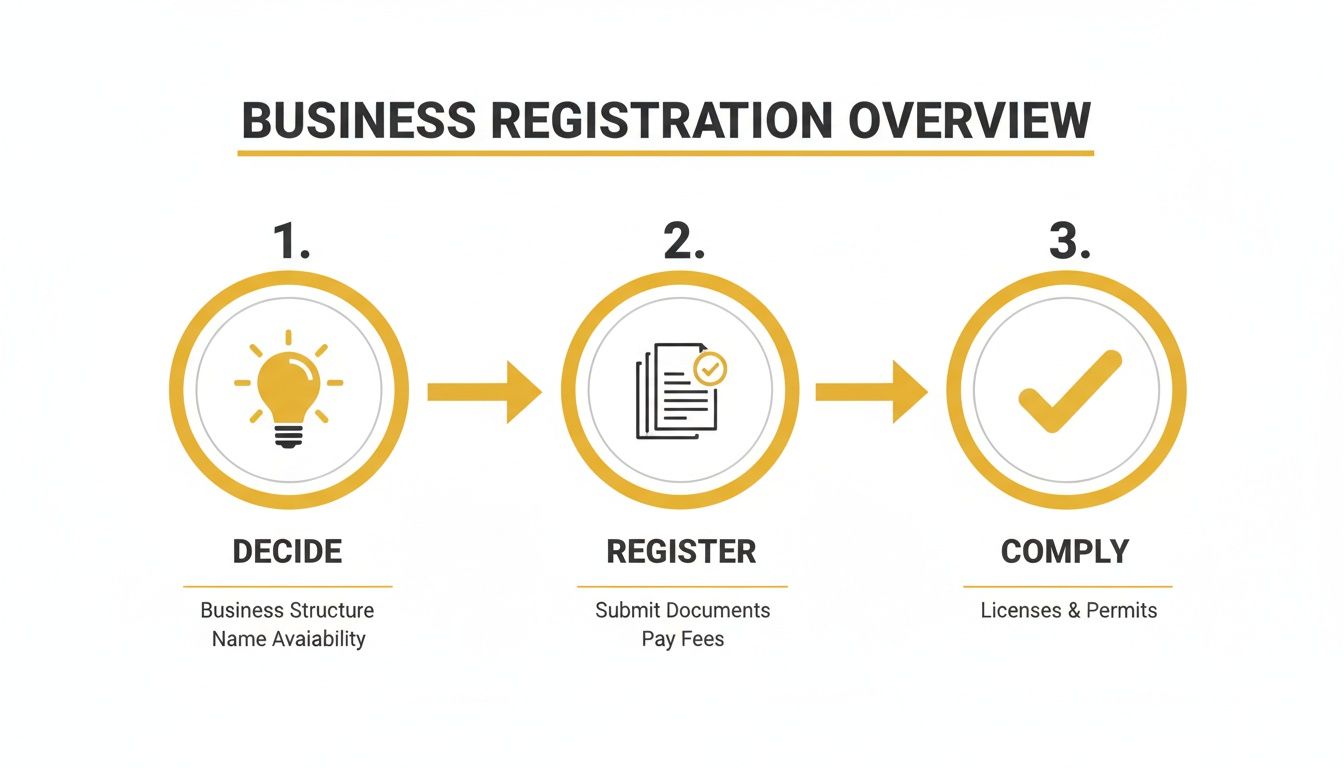
From my experience, the most successful business launches always start with a solid foundation. Getting these initial steps right—your structure, ABN, and name—prevents costly administrative headaches down the track and sets you up for sustainable growth.Let's start breaking these foundational pieces down into simple, manageable actions, beginning with the most critical decision you'll make.
Choosing the Right Business Structure
Deciding on your business structure is hands down one of the most critical calls you'll make when you first get your business off the ground in Australia. This isn't just about filling out forms; it fundamentally shapes your personal liability, how much tax you end up paying, and the sheer volume of admin work on your plate. Get this right from day one, and you’ll save yourself a world of headaches and costly restructuring dramas later on. Think of it this way: a freelance graphic designer just starting out will likely lean towards a sole trader structure. It’s simple, the setup costs are low, and it just makes sense when you're a one-person show. Legally, their personal and business finances are one and the same. While that's straightforward, it also means their personal assets—like their house or car—are on the line if the business gets into hot water with debt.Sole Trader Simplicity Versus Company Protection
As a sole trader, you are the business. You’ll use your personal Tax File Number (TFN) to lodge tax returns and you have total control. It's the most common structure for new ventures for a reason, with over 822,000 sole traders actively operating across Australia. But what if you're launching a tech startup and bringing in investors? Or a construction business where the risks are much higher? In those cases, a proprietary limited (Pty Ltd) company is a far better shield. This structure creates a completely separate legal entity, which protects your personal assets from business debts. This is the power of "limited liability." The company gets its own TFN, lodges its own tax returns, and any profits it makes belong to the company until they’re paid out to shareholders as dividends.The key takeaway is this: your choice of structure must align with both your current situation and your future growth plans. Don't just pick the easiest option without considering where you want to be in five years.
Understanding Partnerships and Trusts
Beyond those two common paths, you've got a couple of other options. A partnership is where two or more people (or entities) run a business together. They're fairly simple to set up, but the catch is that all partners are generally on the hook personally for business debts—including those racked up by another partner. Then there's the trust, which is a more complex setup. Here, a trustee (an individual or a company) holds assets for the benefit of others, known as beneficiaries. Trusts are fantastic for asset protection and offer great tax flexibility, which is why you often see them used for family businesses or investment portfolios. The trade-off? They come with higher setup and ongoing administration costs. The table below gives a quick snapshot of how these structures stack up against each other.Comparing Australian Business Structures at a Glance
| Feature | Sole Trader | Partnership | Company (Pty Ltd) | Trust |
|---|---|---|---|---|
| Legal Status | You and the business are one legal entity | Two or more partners; not a separate legal entity | A separate legal entity from its owners | Trustee holds assets for beneficiaries; not separate entity |
| Liability | Unlimited. Personal assets are at risk | Unlimited. Partners are jointly and severally liable | Limited. Personal assets are generally protected | Trustee liability may be limited; beneficiaries are protected |
| Tax | Taxed at individual marginal tax rates | Profits/losses distributed to partners and taxed individually | Taxed at the flat company tax rate (25% or 30%) | Income distributed to beneficiaries and taxed at their rates |
| Setup Cost | Very low (just ABN registration) | Low (partnership agreement is recommended) | Higher (ASIC registration fees apply) | Highest (requires a formal trust deed) |
Securing Your Australian Business Number (ABN)

Proving You're a Genuine Enterprise
One of the biggest hurdles that trips people up is proving they are actually 'carrying on an enterprise'. This is the Australian Taxation Office (ATO)'s way of separating a real business from a hobby or a passive investment. You have to show a clear plan and a genuine intention to make a profit. It’s the difference between selling a few old books from your shelf on eBay (a hobby) versus buying books specifically to resell online with a clear business plan and a separate bank account (an enterprise). To back up your application, you should be able to demonstrate that you’ve:- Made a conscious decision to start a business and have a plan for it.
- Taken real steps to get started, like buying assets, building a website, or printing business cards.
- Reasonably expect your activities to eventually turn a profit.
What to Prepare for Your Application
To make the application process as smooth as possible, it pays to have your documents ready to go. You won't get far without these key details. Make sure you have:- Your Tax File Number (TFN), plus the TFNs of any partners or directors.
- Proof of identity documents on hand.
- The details of your business structure (sole trader, company, etc.).
- A clear and specific description of your main business activities.
Pro Tip: When describing your business, be specific. Instead of putting "consulting," try something like "providing marketing strategy consulting for small retail businesses." This kind of clarity helps the ABR understand what you do and approve your application without a fuss.For a more detailed walkthrough, our guide to registering an Australian Business Number (ABN) in Australia has even more tips to help you secure your ABN without a hitch.
Registering Your Business Name and Company

The ASIC Registration Process
Getting a company registered is a bigger deal than just reserving a business name. You'll be dealing with the ASIC portal, formally appointing directors, and taking on specific legal responsibilities. It's a step more business owners are taking seriously. In July 2025, for example, while 118,162 new ABNs were registered, a whopping 35,844 of those were new companies. That's a 20.41% jump from the previous year, which tells us that founders are increasingly prioritising the protection and growth potential that a company structure provides. You can see more on this trend in the full New Business Index Report. Be prepared for a fee when you register with ASIC. Currently, setting up a standard proprietary limited company will set you back around $576. For a full walkthrough of what's involved, have a look at our detailed guide on how to set up a Pty Ltd company in Australia.It's vital to remember that a business name registration offers zero ownership or protection over the name itself. It's simply a registration that allows you to trade under that alias. True brand protection comes from trademarking.
Name Selection and Protection
Before you get too attached to a name, you absolutely must check if it's available. A quick search on ASIC’s online tool will show you if your dream business name or company name is already being used anywhere in Australia. A few practical tips from experience:- Be Unique: Don't pick a name that sounds like five other businesses in your industry. You want to stand out, not blend in.
- Check Everywhere: Search the business name register and the company register. Crucially, also check for existing trademarks on the IP Australia website.
- Secure Your Domain: As you're checking names, open another tab and see if the .com.au domain is available. Grab it immediately if it is.
Navigating Your Tax and GST Obligations

The GST Threshold Explained
The Australian Taxation Office (ATO) has a clear rule: GST registration becomes mandatory once your business has a current or projected annual turnover of $75,000 or more. For non-profits, that figure is $150,000. Remember, turnover is your gross business income—every dollar that comes in—not your profit. This is a classic tripwire for new business owners, especially in service-based fields where growth can be unpredictable. Imagine a freelance IT consultant starting out. They might only be making $5,000 a month. But if they suddenly land a big project and their projected income for the year shoots past that $75,000 mark, they have just 21 days to register for GST.Don’t just wait until you hit the $75,000 mark. Proactively monitor your cash flow and forecasts. Registering late can lead to penalties and a messy back-payment process that catches many new entrepreneurs off guard.
Should You Register for GST Voluntarily?
What if you're nowhere near the threshold? You can still choose to register for GST voluntarily. This isn't a simple yes-or-no answer; it’s a strategic decision with real financial consequences.- The Upside: You can claim GST credits on your business purchases. If you've had major setup costs—think computers, specialised equipment, or software—registering lets you claim back the 10% GST you paid on those items.
- The Downside: You must charge GST on all your sales. This effectively increases your prices by 10%. If your customers are the general public (who can't claim GST credits), this could make you less competitive.
- The Admin: It adds another layer of paperwork. Once registered, you are legally required to lodge a Business Activity Statement (BAS) with the ATO, which for most new businesses is a quarterly task.
Other Essential Tax Registrations
GST is just one piece of the puzzle. As your business evolves, other tax registrations will come into play, usually triggered by specific milestones. Two of the most common ones are:- Pay As You Go (PAYG) Withholding: This is non-negotiable the moment you hire your first employee. You're required to withhold tax from their salary and wages and send it to the ATO on their behalf.
- Fringe Benefits Tax (FBT): If you start providing certain benefits to employees—like a company car for private use or paying for their health insurance—you'll likely need to register for FBT.
Final Steps and Staying Compliant
You’ve done the heavy lifting and got the core registrations sorted. But don't pop the champagne just yet. Getting registered is a one-time sprint; staying compliant is a marathon that protects the business you’ve worked so hard to build. Your first practical move? Open a dedicated business bank account. Seriously, do this now. It’s not just a friendly suggestion; it’s absolutely essential for clean financial management. I’ve seen countless new business owners create a bookkeeping nightmare for themselves by mixing personal and business funds. It’s a fast track to chaos at tax time. A separate account gives you a crystal-clear record of income and expenses, which makes tracking your financial health and lodging your BAS a whole lot simpler.Keeping on Top of Your Ongoing Duties
With your banking sorted, your focus now shifts to the recurring tasks that keep your business in good standing. Think of these as your business's regular health check-ups. Ignoring them can lead to penalties and, worse, damage your professional reputation. Here’s what you’ll need to manage:- Business Name Renewal: That business name you registered isn't yours forever. You have to renew it with ASIC every one or three years. Miss the deadline, and you could lose the right to use it.
- ASIC Annual Review: If you're running a company, you'll get an annual statement from ASIC. You must check it, update any company details that have changed, and pay the annual review fee. It's a non-negotiable part of keeping your company registration active.
- Keeping Your ABN Details Fresh: Your details on the Australian Business Register (ABR) must always be current. If you move your business, change your contact info, or alter your structure, you have just 28 days to update it.
Staying compliant is about more than just dodging fines. It's about building a professional operation that earns trust with customers, suppliers, and the ATO. Cutting corners here undermines the very credibility you're trying to build.One last thing that often gets missed in the rush: industry-specific licences. A café needs a food licence from the local council. A builder needs a state-based contractor licence. These aren't optional extras; they're critical for operating legally. Ticking off this final checklist ensures your business starts on solid, lawful ground.
Got Questions? We've Got Answers
Stepping into the world of business registration always brings up a few curly questions. Let's tackle some of the most common ones we hear from entrepreneurs just starting out.How Long Does This Whole Registration Thing Take?
Honestly, it varies. Some parts are incredibly fast. For instance, applying for your ABN online through the Australian Business Register can often spit out your number almost instantly. Registering your business name is usually just as quick once the payment goes through. The real waiting game is typically with a company registration. Once you've lodged all your paperwork with ASIC, you should expect it to take about one to two business days. The longest part of the process is almost always the prep work on your end—finalising your structure and getting all your details in order before you even start the applications.Do I Have to Register for GST Straight Away?
Not necessarily. The key trigger for mandatory GST registration is your turnover. You only have to register once your annual business turnover is projected to hit $75,000 or more. For non-profits, that threshold is higher at $150,000. However, you can choose to register voluntarily before you reach that magic number. Why would you? Registering early means you can start claiming GST credits back on your business purchases. The trade-off is that you must also start charging GST on your sales and lodging regular Business Activity Statements (BAS) with the ATO. It's a strategic choice you'll need to make based on your business model and expected expenses.Quick Tip: ABN vs. ACN An ABN is your 11-digit Australian Business Number, used by all business types for tax purposes. An ACN, on the other hand, is a 9-digit Australian Company Number given only to registered companies. If you set up a company, you'll have both.
The four main structures are sole trader, partnership, company, and trust. A sole trader is simplest and cheapest but offers no liability protection. A company provides limited liability at a flat tax rate but costs more to run. A trust offers tax flexibility and asset protection but is complex to administer. The right choice depends on income, risk profile, and growth plans.
Base rate entities — companies with aggregated turnover under $50 million that derive no more than 80% of income from passive sources — pay 25%. All other companies pay 30%. Shareholders pay income tax on dividends, potentially offset by franking credits for tax already paid at the corporate level.
Consider a company when business net profit consistently exceeds $100,000–$120,000 and the rate differential generates meaningful savings, when you need liability protection from business creditors, when you plan to bring in investors, or when you want to retain earnings at the lower corporate rate rather than distributing everything as personal income.
A family trust (discretionary trust) holds assets for a class of beneficiaries. The trustee decides each year how much income to distribute to each beneficiary. By directing income to members in lower tax brackets, the trust reduces the overall family tax burden. Income retained in the trust is taxed at the highest marginal rate (47%).
Ongoing costs include the ASIC annual review fee (currently $310 for a proprietary company), company tax return lodgement fees, accounting fees for financial statements, and potentially payroll and BAS compliance. Total annual compliance costs typically range from $2,000 to $8,000 depending on activity levels and complexity.