
From 2019 to 2023, short-term residential landlords in Australia dropped by 25%, while listings fell by only 11%. That gap matters. It shows the market is getting harder for casual hosts and more rewarding for operators who run the property like a business.
If you want to learn How to monetise on short term rental market in Australia, focus on net return, not gross booking revenue. High occupancy means very little if poor record-keeping, GST mistakes, private-use errors, or local rule breaches wipe out your profit later. I have seen plenty of owners post strong booking numbers and still end up with weak cash flow, messy BAS issues, or an ATO review they were not prepared for.
The hosts who keep more of what they earn are disciplined. They price properly, keep clean records, separate private and income-producing use, understand deduction limits, and treat council rules as a profit issue, not an admin nuisance.
The ones who struggle usually chase nightly rates, copy what other Airbnb hosts are doing, and assume tax will sort itself out at year-end. It does not. In short-term rental, revenue gets attention, but compliance decides whether the investment works.
- The STR Paradox Why More Listings Mean Fewer Landlords
- Australia's 2026 STR Market Landscape By The Numbers
- The Great Debate STR vs Long-Term Rental
- Navigating the Minefield of State and Council Rules
- Your Tax Obligations You Can't Hide from the ATO
Table of Contents
- The STR Paradox Why More Listings Mean Fewer Landlords
- Australia's 2026 STR Market Landscape By The Numbers
- The Great Debate STR vs Long-Term Rental
- Navigating the Minefield of State and Council Rules
- Your Tax Obligations You Can't Hide from the ATO
- Boosting Your Bottom Line Advanced Monetisation Tactics
- Tax-Smart Strategies to Maximise Your Net Return
- Your Next Steps to STR Success with AWTS
The STR Paradox Why More Listings Mean Fewer Landlords

Short-term rental attracts plenty of first-time hosts because the income looks straightforward. It rarely stays straightforward for long.
As noted earlier, the market has seen fewer landlords without an equivalent drop in listings. That points to consolidation. Casual owners are leaving, while better-run operators keep expanding, refining systems, and protecting margin. If you are entering this market now, you are not competing against someone renting out a spare apartment on weekends. You are competing against operators who treat STR as a real business.
Why consolidation matters
The pressure shows up in three places fast:
- Pricing gets tighter: Professional hosts adjust rates constantly, protect occupancy, and avoid leaving money on the table.
- Operations get sharper: Slow replies, average cleaning, and poor presentation now cost bookings.
- Compliance gets more expensive to ignore: The bigger and more visible the sector becomes, the easier it is for poor record-keeping, weak tax treatment, and council breaches to turn into real financial damage.
Practical rule: Run the property with separate accounts, documented processes, and audit-ready records from day one.
That is the part many investors get wrong. They focus on nightly rate and ignore the admin burden until the ATO, their accountant, or their local council forces the issue. By then, the fix is usually expensive.
What separates profitable hosts from ATO problems
The operators who last usually get three decisions right early:
- They buy or hold in the right location, not just the property they already happen to own.
- They calculate net return after cleaning, platform fees, vacancy, insurance, and tax, instead of fixating on gross booking revenue.
- They set up tax and compliance properly before launch, including records for deductions, occupancy, private use, and future CGT treatment.
The third point is where real money is kept or lost. A property can book well and still produce a poor after-tax result if the owner mixes private and rental use, overclaims expenses, ignores GST risk, or creates a capital gains problem they never priced in.
The key takeaway is simple. Monetising a short-term rental in Australia is not about chasing bookings alone. The market now rewards disciplined operators who can price well, run clean systems, and defend every tax position if the ATO asks questions.
Australia's 2026 STR Market Landscape By The Numbers

$71,770 average annual revenue, $317 ADR, and 62.20% occupancy. Those 2025 national figures, reported by Airbtics’ Australia short-term rental market report, explain why investors keep piling into short-term rental.
They also mislead people.
National averages are useful for spotting demand. They are poor tools for choosing a property. I have seen owners buy off a citywide revenue number, then discover their suburb has weak midweek demand, heavy cleaning costs, stricter local rules, and an after-tax result that looks nothing like the headline.
What the headline figures actually mean
Value lies in the spread between markets. Brisbane recorded stronger occupancy than Melbourne in the same dataset, while Melbourne still showed solid revenue. That should reset how you assess an STR opportunity. Size of city does not protect margin. Demand quality does.
A prestige postcode with too much competing stock can underperform a less fashionable area with steadier booking patterns. That matters even more once you price in platform fees, furnishing, consumables, insurance, and the tax treatment of mixed private use.
Use a market screen that reflects profit, not vanity.
| Market signal | What it means for you |
|---|---|
| High occupancy | Demand is recurring across the year, not just driven by one holiday spike |
| Strong ADR | Guests will pay for the property type, fit-out, and location |
| Healthy annual revenue | The property can carry off-peak periods without relying on one short season |
| Fast supply growth | New competition will pressure weaker listings and thinner margins |
Where investors get the numbers wrong
A lot of buyers still choose with their emotions first. They buy the beach unit they like personally, the city apartment near a favourite restaurant strip, or the property they plan to use for themselves during school holidays. That is a lifestyle purchase. It is not disciplined STR investing.
Benchmark the property against its likely guest and booking pattern, not against a city average.
As noted earlier, demand has stayed firmer in prime pockets than broad national summaries suggest. The best operators target a clear guest type, longer stays where the market supports them, and booking channels that reduce empty nights. They do not assume the city average will save a mediocre asset.
There is also a tax angle investors ignore. If your numbers only work before tax, they do not work. Private use days, poor apportionment, and sloppy expense claims can wipe out the upside quickly. Before you chase higher gross income, understand how rental deductions and ownership strategy interact with broader property tax settings such as negative gearing for property investment.
A blunt filter before you buy or furnish
Ask four questions early.
- What drives demand here? Business travel, events, holiday traffic, hospital visits, relocation stays, or contractor demand all produce different booking patterns.
- What supports a premium rate? Parking, family layout, pet-friendliness, views, walkability, design, and low-friction check-in all affect pricing power.
- What does turnover do to margin? High occupancy with constant changeovers can still produce weak net return.
- Can the property operate within local rules without losing too many available nights? A strong suburb means little if regulation cuts your usable inventory.
City averages are a starting point. The takeaway is that data stops you from paying premium money for average performance.
The Great Debate STR vs Long-Term Rental
Short-term rental can produce more gross income than a standard lease. It can also produce more admin, more record-keeping, and more tax mistakes. Investors who focus only on the top-line nightly rate usually find that out too late.
The actual comparison is not STR versus LTR on revenue. It is STR versus LTR on net return after cleaning, platform fees, utilities, vacancy gaps, depreciation treatment, private use, and ATO scrutiny. A property that looks brilliant on Airbnb can still underperform a plain long-term rental once those items are counted properly.
The clean comparison
Here’s the side-by-side view investors should use before choosing a model.
| Metric | Short-Term Rental (STR) | Long-Term Rental (LTR) |
|---|---|---|
| Revenue potential | Higher upside if pricing, occupancy, and presentation are strong | Lower upside, but steadier |
| Cash flow pattern | Uneven, seasonal, and booking-dependent | Predictable rent cycle |
| Management effort | High. Guest messages, cleaning, calendar control, reviews | Lower. Tenant management is slower-paced |
| Vacancy risk | Frequent gaps between bookings | Lower day-to-day churn |
| Operating costs | More cleaning, supplies, platform fees, restocking, utilities | Usually simpler cost base |
| Regulatory burden | Heavier. Registration, caps, local rules, guest compliance | Usually simpler |
| Tax complexity | Higher. Mixed-use issues, detailed records, apportionment, CGT planning, possible GST questions in some structures | Still important, but more straightforward |
| Lifestyle flexibility | Greater owner use if structured carefully | Less owner access during tenancy |
| Scalability | Works with strong systems and process | Easier administratively, but less opportunity to increase revenue |
A lot of investors choose STR for flexibility and higher income potential. Fair enough. But flexibility has a tax cost if you or your family use the property privately. Once private days enter the picture, deductions often need to be apportioned. Get that wrong and your return is overstated before you even lodge.
Who should choose which model
STR suits investors who are prepared to operate a small accommodation business, not just hold an investment property. That means active pricing, fast guest communication, reliable cleaning, clear evidence for every expense, and discipline around private use. If you dislike admin or want passive income, STR is usually the wrong fit.
LTR suits investors who want consistency, lower turnover, and a cleaner compliance position. It is less exciting. It is often more durable. Plenty of experienced property owners make better money long term by avoiding operational chaos and keeping deductions straightforward.
Use this filter.
- Choose STR if the property has genuine nightly-rate power and you will run it like a business.
- Choose LTR if stable occupancy, simpler management, and fewer tax adjustments matter more to you.
- Choose based on net profit after tax, not the gross booking screenshots that get posted online.
If gearing is part of your strategy, read our guide to negative gearing for property investment before you commit to a structure that only works on paper.
The wrong rental model does not just trim profit. It creates avoidable admin, weak records, and tax positions that are hard to defend later.
Choose the model you can operate properly. Higher potential yield means very little if poor systems, private use, and weak records hand part of that income back to the ATO.
Navigating the Minefield of State and Council Rules

Council rules can destroy a good-looking STR deal faster than a bad guest ever will.
A lot of hosts still act as if the only real challenge is getting bookings. That’s naive. Night caps, registration systems, local zoning pressure, safety requirements, and state-based levies all change what a property can earn. If your legal operating window is restricted, your monetisation strategy has to change with it.
Rules shape profit more than most hosts admit
One of the clearest examples comes from New South Wales. Under regulatory pressure such as the 180-night cap for unhosted rentals, 43% of hosts said they would rather leave the property empty for the rest of the year than convert to long-term rental, according to EurekAlert’s coverage of the host response to caps. That tells you two things. First, caps materially affect business decisions. Second, many hosts haven’t built a plan B.
Byron Bay’s 60-day cap is even tighter, based on the same verified material. If you own in a restricted market, you need to think less like a landlord and more like a yield manager. Every available night has to count.
Common Pitfall
Assuming the rules are the same everywhere is one of the most expensive mistakes in this space.
A compliant setup in one Local Government Area may fail in another because councils can apply different requirements around registration, zoning, safety, or allowable nights. Investors often discover this after purchase, which is far too late.
Use this pre-listing checklist:
- Check your LGA first: Don’t rely on agent chatter or forum comments.
- Confirm hosting category: Hosted and unhosted arrangements can be treated differently.
- Review operational caps: Your annual revenue model is meaningless if legal nights are capped.
- Budget for compliance costs: Levies, registration, and admin time reduce margin.
If your rental turnover is pushing you toward business-style obligations, review when to register for GST before the issue becomes urgent.
A restricted property can still be profitable. An illegally operated property is just a future liability.
Some hosts respond to regulation by doing less. Smart operators do the opposite. They refine pricing, target longer stays, and make sure each permitted booking window earns properly.
Why this matters: Compliance isn’t paperwork sitting on the edge of the business. It shapes the business model itself.
Your Tax Obligations You Can't Hide from the ATO
The ATO doesn’t need to guess whether you earned short-term rental income. Platform data, bank records, and digital payment trails make that fantasy obsolete.
The tax side of STR gets messy because the sector is shifting from casual hosting to professional operation. Verified reporting notes that the sector is professionalising, and that professional operators face different rules for deductions and GST registration than casual hosts, while Victoria’s 7.5% short-stay levy adds another layer of complexity, according to Mortgage Professional Australia’s report on the shift toward professional operators. That’s where owners get caught. They still think like occasional hosts while operating like a business.
Income tax is the easy part
Every dollar of rental income belongs in your tax return. That includes platform payouts, cleaning fees charged to guests, and other booking-related amounts that form part of your assessable income position.
That part isn’t controversial. The problems start when hosts mix private use and income-producing use, fail to apportion correctly, or claim expenses they can’t substantiate. If you use the property yourself, your records need to show exactly when it was available for rent and when it wasn’t.
A good starting point is understanding rental income tax rules before your first year-end scramble.
GST BAS and CGT are where mistakes get expensive
The biggest blind spots usually sit in three areas.
-
GST registration
The verified material states that GST registration becomes mandatory once turnover hits the $75,000 threshold in the context of professional STR activity. Plenty of owners drift into that threshold without noticing because they track booking income loosely across platforms and bank accounts.
-
BAS obligations
Once you’re registered, BAS isn’t optional admin. It becomes part of your operating rhythm. Late or inaccurate lodgements create compounding problems fast.
-
Capital gains tax
If a property has been used to produce income, especially if it was once your home, you need to think beyond annual tax returns. STR use can affect the main residence exemption when you sell. Owners who ignore that issue often get an unpleasant surprise years later.
Here’s the line I use with clients: if the property is run for profit with repeat commercial activity, don’t assume the ATO will see you as a casual host just because you started that way.
| Tax area | What hosts often get wrong |
|---|---|
| Income tax | Under-reporting platform income or poor apportionment |
| GST | Missing the turnover threshold and registering late |
| BAS | Treating lodgements as occasional admin instead of core compliance |
| CGT | Ignoring future sale consequences while focusing only on current cash flow |
Why this matters: Revenue problems hurt. Tax problems compound, attract penalties, and often surface long after the income has been spent.
Boosting Your Bottom Line Advanced Monetisation Tactics

Basic listings don’t win anymore. They just exist.
If you want to know How to monetise on short term rental market in Australia, stop obsessing over whether your property is “on Airbnb” and start asking whether it’s priced, positioned, and presented better than competing stock. That’s what moves revenue.
Average hosts get average results
Verified market analysis from Beyond Pricing’s Australia STR earnings article says hosts using dynamic pricing algorithms can increase revenue by 20% to 30%, and notes that for a typical Sydney listing this could lift annual revenue from $45,750 to over $60,000 through better rate optimisation. That’s not magic. It’s disciplined pricing.
Dynamic pricing tools don’t just raise prices. Good ones also protect occupancy by responding to local demand, lead time, event calendars, day-of-week patterns, and competitor positioning. Tools like Beyond Pricing are useful because they force hosts to stop guessing.
The hosts I trust operationally tend to focus on four levers:
- Pricing discipline: No flat nightly rate year-round.
- Stay-length strategy: Longer stays can reduce turnover cost and cleaning friction.
- Guest segment targeting: Families, business travellers, relocation guests, and premium leisure travellers book differently.
- Listing quality: Professional photos, clear house rules, and strong amenity positioning still matter.
Pro-Tip
Multi-channel distribution works, but only if your systems can handle it.
Listing across Airbnb, Stayz, and Booking.com can widen occupancy opportunities, but you need synced calendars and a proper workflow. Otherwise you’re inviting double bookings and refund headaches. If you want practical ideas to boost rental property bookings, that resource gives useful marketing angles beyond just lowering price.
Better monetisation usually comes from better positioning, not from panicking and discounting.
A smarter property also targets booking types that fit local constraints. In cap-heavy or high-turnover markets, longer stays often stabilise operations. In event-heavy markets, short premium windows can outperform broad discounting.
For a city-specific operational playbook, this guide on how to run a successful short-term rental in Sydney is a strong reference point.
Why this matters: The biggest gap in STR isn’t between bad hosts and good hosts. It’s between hosts who react and hosts who run revenue systems.
Tax-Smart Strategies to Maximise Your Net Return
Gross income flatters owners. Net return tells the truth.
A property can look brilliant on booking platforms and still underperform after interest, cleaning, platform fees, repairs, insurance, utilities, levy impacts, and tax. Investors who last in STR learn to think like operators. That means every expense needs a commercial purpose, every deduction needs support, and every record needs to survive scrutiny.
Claim what you’re entitled to and prove it
The deduction side of STR usually falls into two buckets.
First, there are immediate deductions for recurring operating costs. These commonly include agent or platform commissions, cleaning, insurance, council rates, loan interest related to the investment, consumables, and repairs where eligible.
Second, there are longer-term claims tied to the property itself, including capital works deductions and depreciation on eligible assets. Consequently, DIY tax returns often leave money behind because owners don’t have the right reports, don’t understand apportionment, or don’t separate capital and revenue items properly.
A disciplined expense system should include:
- Dedicated bank account: Keep rental cash flow separate from private spending.
- Digital storage: Save invoices, platform statements, levy records, and receipts as you go.
- Private-use diary: If you use the property yourself, document it properly.
- Asset tracking: Furniture, appliances, and improvements need clean records.
If you haven’t reviewed building and asset claims properly, start with an investment property depreciation schedule. Many hosts miss deductions because they never get the schedule prepared.
Structure beats improvisation
I’m sceptical of blanket advice in this area because entity choice depends on facts. Still, one principle is constant. Randomly mixing private ownership, family use, and business-style activity creates tax mess.
Net return improves when records are clean, ownership is intentional, and claims are prepared before lodgement pressure hits.
Keep these judgment calls front of mind:
| Decision area | Tax-smart approach |
|---|---|
| Expense claims | Claim eligible costs with invoices and clear business purpose |
| Private use | Apportion honestly and keep a usage record |
| Improvements | Separate repairs from capital works |
| Entity choice | Get advice before scaling, not after |
| Year-end prep | Reconcile platform income to bank deposits and records |
The hosts who keep more money aren’t always the ones with the highest gross revenue. Usually they’re the ones who document better, classify better, and plan before year-end instead of hoping their accountant can fix everything in a week.
Why this matters: Tax efficiency isn’t aggressive claiming. It’s organised, defensible claiming that protects profit and reduces audit risk.
Your Next Steps to STR Success with AWTS
Reading about short-term rental won’t make it profitable. Systems will.
Most failures happen before the first booking. Investors buy in the wrong area, ignore local restrictions, underestimate setup and compliance costs, and keep poor records from day one. Cleaning, guest communication, and pricing all matter, but they only work when the structure underneath is solid.
Use this checklist before you list
-
Research your LGA
Go straight to the council source. Don’t trust forums, property chat groups, or what a selling agent “reckons”.
-
Run the numbers properly
Model income conservatively. Include downtime, cleaning, consumables, utilities, maintenance, platform fees, compliance costs, and tax effects. If the deal only works in a perfect month, it doesn’t work.
-
Open a separate bank account
This sounds basic because it is. It also saves an enormous amount of pain at tax time.
-
Choose your systems early
Use a spreadsheet if you must, but make sure every booking, expense, and payout is tracked from the start.
What disciplined operators do differently
They don’t wait until June to organise receipts. They don’t guess about GST. They don’t leave cleaning standards to chance.
For operators refining turnover standards between guests, this article on short-term rental cleanliness secrets is practical and worth saving. Cleanliness isn’t just hospitality. It affects reviews, repeat bookings, damage detection, and dispute handling.
A final operating checklist:
- Know your legal limits: Allowed nights, registration, and local conditions.
- Know your numbers: Gross revenue, net margin, and tax exposure.
- Know your evidence: Invoices, statements, usage records, and improvement costs.
- Know your exit impact: Today’s rental decisions can affect future CGT outcomes.
If you’re serious about learning How to monetise on short term rental market in Australia, think like an owner-operator, not a casual host. The market still rewards well-run properties. It punishes sloppy ones.
Why this matters: A profitable STR doesn’t come from one clever trick. It comes from dozens of disciplined decisions made early and repeated consistently.
Declare all rental income received: regular rent, advance rent, rent in kind, insurance payouts for lost rent, and bond money kept for unpaid rent. Gross rent before expenses is included in assessable income. The rental property schedule of the tax return captures income and expenses separately from other income.
Deductible expenses include council rates, water charges, land tax, insurance, property agent fees, repairs and maintenance, loan interest on funds borrowed for the property, advertising for tenants, and depreciation on eligible assets. Capital improvements are depreciated over time; borrowing costs are spread over five years or the loan term, whichever is shorter.
Negative gearing occurs when rental expenses exceed rental income. The net rental loss is deducted from your other assessable income (such as wages), reducing total taxable income and therefore tax payable. It is most beneficial for taxpayers in higher marginal brackets and must be reported accurately on the rental property schedule.
Yes. The sale triggers a CGT event. The gain is proceeds less cost base (purchase price, stamp duty, legal fees, and improvement costs). If owned for more than 12 months, apply the 50% CGT discount before adding the gain to assessable income. Previously claimed capital works deductions reduce the cost base and increase the eventual gain.
Yes, if the property is genuinely available for rent at a market rate. Expenses during a vacancy are deductible while the property is advertised. If the property is not genuinely available — reserved for personal use or listed above market rent — deductions may be denied or apportioned for the vacant period.
If you want expert help getting the structure right from day one, speak with Australia Wide Tax Solutions. Their team helps property investors and business owners handle rental schedules, BAS lodgements, GST questions, capital gains tax issues, and overdue returns so your short-term rental runs on compliance as well as revenue.
Of course. Many of the costs you sink into your rental property can be claimed as tax deductions in Australia. The main condition is that the property was genuinely on the rental market when you incurred the expense.
- Understanding Your Rental Property Tax Deductions
- Claiming Interest on Your Investment Loan
- Capital Works and Depreciation Deductions Explained
- Claiming Your Day-to-Day Running Costs
- Common Mistakes and ATO Focus Areas
Getting these deductions right can seriously reduce your taxable income and give your investment’s cash flow a healthy boost. But it’s crucial to know exactly which costs are eligible and how to claim them correctly.
Understanding Your Rental Property Tax Deductions
The easiest way to think about this is to treat your rental property like a small business. Any legitimate cost you incur to earn rental income is a potential tax deduction. This guide is here to demystify the world of rental property tax deductible expenses for Aussie investors.
The Australian Taxation Office (ATO) sorts these deductions into three main buckets, based on when you can claim them. Getting your head around these categories is the first step to legally shrinking your tax bill and making smarter investment moves. When you get it right, you not only improve your cash flow but also keep the ATO happy, avoiding the stress of a potential audit.
The Three Types of Rental Deductions
The secret to maximising your claims is understanding that the ATO doesn't treat all expenses the same. You can't just claim everything in the same financial year you paid for it.
Immediate Deductions: These are the costs you can claim in full in the same income year you paid them. They're usually the day-to-day running expenses, like council rates, property management fees, and minor repairs.
Deductions Over Several Years: Some expenses provide a benefit that lasts longer than one year, so you have to spread the claim out over a set period. A classic example is borrowing expenses, such as loan setup fees, which are typically claimed over five years.
Capital Works Deductions: These deductions are for the big-ticket items—the building's structure itself and any major improvements you make. Known as Division 43 deductions, you can generally claim these costs at a rate of 2.5% per year for up to 40 years from the date the construction was completed.
To help you get a quick handle on what's what, we've put together a simple summary table. This is your go-to reference for spotting common deductions and understanding when you can claim them.
At-a-Glance Guide to Common Rental Deductions
| Expense Category | What It Covers | When to Claim |
|---|---|---|
| Running Costs | Council rates, water charges, land tax, property management fees, advertising for tenants. | Immediately (in the year incurred) |
| Maintenance & Repairs | Fixing a broken window, plumbing repairs, replacing a faulty appliance with a similar model. | Immediately (if it's a repair, not an improvement) |
| Borrowing Expenses | Loan application fees, lender's mortgage insurance, title search fees. | Over 5 years (if over $100) |
| Depreciating Assets | Ovens, dishwashers, carpets, blinds, air conditioners. | Over the asset's effective life (depreciation schedule) |
| Capital Works | Building construction costs, major renovations, structural improvements. | Over 40 years (at 2.5% per year) |
This table is a great starting point, but remember that every investor's situation is unique. The key is to keep meticulous records for every dollar you spend.
The core principle is simple: if you spent money to generate rental income, that expense is likely deductible. The complexity lies in figuring out when and how much you can claim.
For a deeper dive into how to legally reduce your taxable income and keep more of your earnings, you can explore detailed strategies on how to Maximize Your Short Term Rental Tax Deductions. This approach helps you make the most of every eligible expense.
Claiming Interest on Your Investment Loan
For most Aussie property investors, the interest you pay on your investment loan is the single biggest tax deduction you can claim. It's often the cornerstone of making a property investment financially viable.
But it’s not as simple as just claiming every dollar of interest paid. The Australian Taxation Office (ATO) has a very clear rule that governs this deduction: the 'purpose test.' Think of it like this: the ATO only allows you to claim interest on the portion of the loan that was used to produce rental income. Getting this right is absolutely crucial.
The Critical Purpose Test
This test is pretty straightforward if you take out a single loan to buy one rental property. Simple. But where things get messy is when you start redrawing from that loan or refinancing and using some of the money for personal reasons.
Maybe you used a redraw to buy a new car, pay for a family holiday, or clear some credit card debt. Once you do that, the loan has a mixed purpose.
You absolutely must apportion the interest. You can only claim the slice of the interest that directly relates to the investment property. Mixing personal and investment funds in the same loan account is a classic mistake, and it's a huge red flag for the ATO.
The ATO is laser-focused on this: you cannot claim interest on parts of a loan used for private expenses. It's one of the first things they look at during an audit, so keeping meticulous records isn't just a good idea—it's non-negotiable.
Let's look at an example. The ATO's guidance on rental property deductions is built around this 'purpose test.' If you borrowed $500,000 solely to buy a property that you rent out, then the interest on that entire amount is in play. At a rate of 6.5%, that could be around $32,500 in deductible interest for the year.
This simple flowchart helps you see where different types of expenses fit.
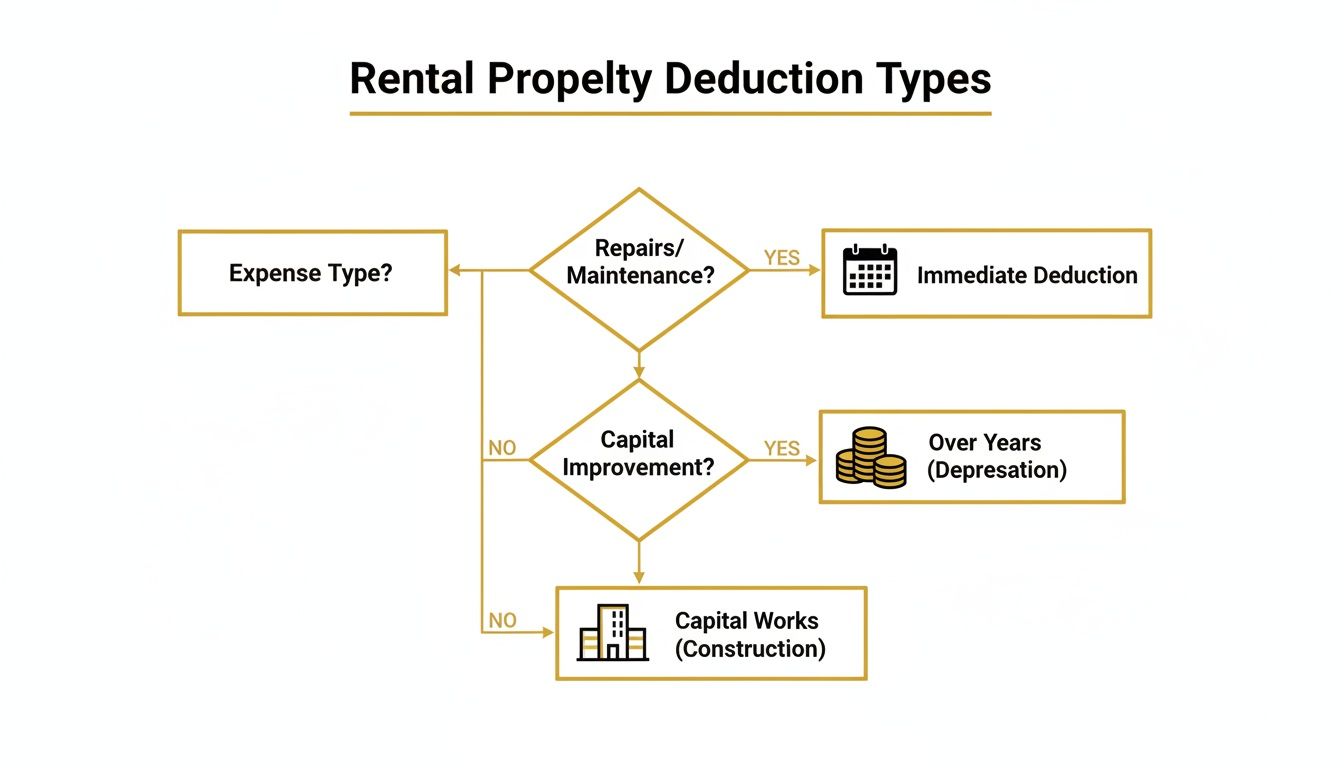
As the flowchart shows, expenses fall into different buckets. Some you can claim straight away, while others you have to claim over several years (depreciation) or as long-term capital works.
How to Calculate Your Claim Correctly
To make sure you're only claiming what you're entitled to and stay out of trouble with the ATO, you need to follow a clear process.
- Identify the Purpose: Go through your loan statements. Pinpoint exactly what every dollar drawn from the loan was used for. Was it for the deposit? Stamp duty? Or was it for a new boat?
- Separate the Portions: If your loan has a mixed purpose, you must calculate the exact percentage used for the investment versus your private life. The cleanest way to handle this is with a split loan from the very beginning.
- Calculate Deductible Interest: Apply the investment percentage to the total interest charged for the financial year.
For instance, say your $500,000 loan is split 80% for the rental property ($400,000) and 20% for personal use ($100,000). You can only claim 80% of the total interest paid on that loan. If you get this apportionment wrong, you could be facing hefty penalties.
Capital Works and Depreciation Deductions Explained
Beyond the day-to-day running costs, some of the most powerful deductions you can claim are what we accountants call 'non-cash' deductions. It’s a slightly strange concept, but it simply means you're claiming the gradual wear and tear on your property and everything in it—even though you’re not physically spending money on it that year.
These deductions fall into two main camps: Capital Works and Plant & Equipment Depreciation. Getting your head around both is absolutely essential if you want to unlock the full tax-saving power of your investment.
Capital Works Building Deductions
Think of Capital Works—also known as Division 43 deductions—as a claim for the ageing of the building's permanent structure itself. It covers the wear and tear on things that are fixed to the property, like the original walls, roof, floors, doors, and windows. It also applies to any major structural improvements or renovations you might undertake, such as building a new deck or remodelling a bathroom.
For properties that qualify, you can generally claim these costs at a set rate over a very long time. Capital works deductions allow you to claim 2.5% per year over 40 years on the building’s construction cost or improvements. So, if the eligible construction portion of your rental cost $400,000, you could claim a $10,000 deduction every single year, which makes a massive difference to your taxable income.
Plant and Equipment Depreciation
Plant and equipment (or Division 40) assets are all the items inside the property that have a limited lifespan. The easy way to think about them is as items that can generally be removed without causing major damage to the building.
A few common examples include:
- Ovens, cooktops, and rangehoods
- Carpets and vinyl flooring
- Blinds and curtains
- Air conditioning units
- Hot water systems
- Smoke alarms
Each of these items loses value over time, and you're able to claim that decline as a depreciation deduction. How much you can claim comes down to the asset’s cost and its ‘effective life’ as set out by the ATO. To really squeeze every last dollar out of these claims, it’s vital you understand how to calculate depreciation on your rental property the right way.
A critical rule change from May 2017 means you can no longer claim depreciation on previously used plant and equipment assets in second-hand residential properties. This means if you buy an established property, you can't claim the oven or carpets that were already there. However, you can still claim any brand-new assets you purchase and install yourself.
Because working out what’s what and putting a value on it all is so complex, getting a specialist involved is often the smartest move. A qualified quantity surveyor can inspect your property and put together a comprehensive tax depreciation schedule for you. This report splits out the capital works from the plant and equipment, values every item, and maps out the deductions you can claim for up to 40 years. It’s a one-off investment that very often uncovers thousands in deductions you would have otherwise missed.
Claiming Your Day-to-Day Running Costs

While the big-ticket items like loan interest grab most of the attention, the day-to-day running costs of your investment property are just as critical for your tax return. These are the expenses you can claim in full, in the same financial year you paid for them, giving you an immediate benefit.
Think of these as the essential, ongoing costs of keeping your rental property ticking over. They are routine, expected, and directly linked to earning that rental income.
Immediately Deductible Expenses
Some of the most common running costs you can claim as a rental property tax deductible expense cover a whole range of everyday payments.
- Council and water rates: These regular charges are fully deductible for the time your property was rented or genuinely on the market for rent.
- Land tax: This state-based tax is another immediate deduction that property investors can claim.
- Property management fees: Using an agent to manage tenants and collect rent? Their fees are a direct cost of doing business and are 100% deductible.
- Advertising for tenants: Any money spent listing your property online or in print to find new tenants can be claimed straight away.
Another significant running cost, and one that is generally tax-deductible, is insurance. A good landlord insurance policy is absolutely crucial for protecting your investment against risks like tenant damage or loss of rent. Keeping all your receipts and statements for these expenses is vital, and our guide on record-keeping requirements for the ATO can help you stay organised.
The Crucial Line Between Repairs and Improvements
This is a classic trip-up for many investors. The ATO draws a very clear line between a 'repair' and an 'improvement', and it massively changes when you can claim the cost.
A repair is work done to fix something that’s broken or worn out, simply to restore it to its original condition. Replacing a few cracked tiles or fixing a leaking tap are perfect examples. You can claim these costs immediately.
An improvement, however, is any work that makes something better, more valuable, or changes its character. Knocking out a wall for an open-plan living space or swapping a basic kitchen for a high-end one are clear improvements.
The key difference is restoration versus enhancement. Repairs restore function, while improvements add value or upgrade the asset. Improvements are treated as capital works and must be claimed over many years, not immediately.
Why Apportionment Is Non-Negotiable
You can only claim expenses for the period your property was genuinely available for rent. If you used the property for your own private holiday for four weeks of the year, you must reduce your claims to match.
For example, if the property was available for rent for 48 out of 52 weeks (that's about 92% of the year), you can only claim 92% of your running costs like council rates and insurance. The ATO's data-matching systems are very good at spotting incorrect apportionment, so getting this calculation right is essential to staying compliant.
Not all rental property expenses are a simple, one-off deduction. Some costs deliver a benefit that stretches far beyond a single financial year, and the Australian Taxation Office (ATO) needs you to account for them that way.
Think of it like paying for a five-year magazine subscription upfront. You wouldn't dream of claiming the entire cost in the first year because the benefit—the magazines arriving at your door—is spread over the full five years. The tax rules for certain long-term rental costs work on the exact same principle.
These specific costs are called borrowing expenses. They are the costs you paid directly to take out the loan used to buy your investment property.
What Are Borrowing Expenses?
Borrowing expenses are much more than just the interest on your loan. They cover a whole range of upfront fees you pay to secure the finance for your rental property.
The most common examples we see include:
- Loan establishment fees: These are the administrative charges your bank or lender hits you with just for setting up the loan.
- Lender’s Mortgage Insurance (LMI): This can be a huge one. It’s an insurance premium required by lenders when your deposit is below a certain threshold, usually 20% of the purchase price.
- Title search fees: The costs you pay a solicitor or conveyancer to check that the property’s title is clean and clear.
- Stamp duty on the mortgage: It's crucial to understand this is different from the stamp duty on the property purchase itself. Stamp duty on the mortgage is a borrowing expense, while stamp duty on the property is a capital cost.
- Mortgage broker fees: If you used a broker to find your loan, their commission or fee may be deductible here.
Here’s the key rule: if the total of these costs is over $100, the ATO requires you to claim the deduction over five years. If the total is $100 or less, you can claim the whole lot in the same financial year you paid it.
Example: You paid a $2,500 loan application fee to your bank. Because this is well over $100 and relates to the entire life of your loan, you have to spread the deduction over five years. This works out to a neat $500 deduction you can claim each year for five consecutive years.
A Common Mistake: Initial Repairs
One of the most frequent errors we see new investors make is getting tripped up by "initial repairs". They confuse these with the standard, immediately deductible repairs you make once a property is up and running.
If you buy a place that needs fixing up before you can rent it out for the first time, these costs are almost always considered capital expenses by the ATO.
For instance, say you buy a property with a broken back fence. You fix it before your first tenant even sees the place. That repair cost is not an immediate deduction. Instead, the ATO views it as part of the property's acquisition cost—you were improving the asset to get it ready for its income-producing life. This cost gets added to your property's cost base and is claimed over time as part of the capital works deduction, not as a lump sum repair.
Common Mistakes and ATO Focus Areas
Navigating your rental property deductions can feel a bit like walking a tightrope, but staying on the right side of the Australian Taxation Office (ATO) is easier than you think. The key is to avoid a few common, yet simple, errors. With powerful data-matching technology, the ATO is more skilled than ever at spotting incorrect claims, making rental properties a major focus area for them.
Understanding the common pitfalls is your best defence against a potential audit. So many investors trip up on the same few issues, turning legitimate tax savings into stressful compliance headaches. Think of this section as your checklist for sidestepping those mistakes and lodging your return with confidence.
Incorrectly Apportioning Expenses
One of the biggest red flags for the ATO is failing to properly apportion expenses for private use. This is a classic mistake, especially with holiday homes. If you used your beach house for a few weeks over summer or stayed in the property while doing renovations, you absolutely cannot claim 100% of the year's expenses. It’s a non-negotiable.
You must work out the percentage of the year the property was used privately and reduce your claims accordingly. This rule applies to every single cost, including loan interest, council rates, and insurance. The ATO scrutinises holiday home claims very closely, so it pays to be meticulous with your calculations.
A core ATO principle is that you can only claim expenses for the period your property was genuinely available for rent. Claiming deductions for periods of private use is a fast track to an audit and potential penalties.
Confusing Repairs with Improvements
Another frequent mix-up is misclassifying capital improvements as immediate repairs. The distinction is critical.
A repair restores something to its original working order—like fixing a broken fence panel. The cost is immediately deductible in the same financial year. An improvement, however, makes something better, different, or more valuable than it was originally. Think replacing the entire old fence with a new, modern one. These costs are capital in nature and must be depreciated over several years.
Similarly, be wary of initial repairs. Any work you do to fix defects that existed when you bought the property is generally considered a capital cost. These expenses are seen as part of acquiring the asset and must be claimed as capital works, not as an instant deduction.
Poor Record Keeping
Finally, we come to the most fundamental mistake of all: failing to keep good records. It might sound basic, but it’s the bedrock of every claim you make.
Without receipts, invoices, and bank statements to prove your expenses, your claims can be denied entirely during an audit. The ATO requires you to keep records for all income and expenses for five years after you lodge your tax return. Getting your documentation in order isn't just good practice; it's a non-negotiable requirement for claiming any rental property deduction.
Your Rental Property Tax Questions Answered
When you're navigating the world of rental property tax, a few common questions always seem to pop up. We hear them from investors all the time. Let's tackle some of the most frequent queries with clear, direct answers to help you stay compliant while making sure you claim everything you're entitled to.
Can I Claim Travel Expenses for Inspecting My Rental Property?
Unfortunately, the short answer is generally no. Since 1 July 2017, the ATO has disallowed deductions for travel expenses related to inspecting, maintaining, or collecting rent for a residential rental property.
There are some very limited exceptions, like for investors who are classed as carrying on a property rental business, but the criteria to qualify are incredibly strict. It’s always best to chat with a tax professional to see if your specific situation meets these narrow requirements before you even think about making a claim.
What Happens If My Rental Expenses Are More Than My Income?
When your total deductible expenses for the year are greater than your rental income, you have what's known as a 'negatively geared' property. This situation creates a rental loss.
This loss isn't just a number on a page; it can typically be offset against your other income, like your salary or business income. Doing this reduces your overall taxable income for the year. This is a common and completely legitimate tax strategy for many Australian property investors, turning a cash-flow loss into an immediate tax benefit.
The ability to offset rental losses against other income is a cornerstone of negative gearing. It allows investors to reduce their tax liability while holding a long-term growth asset.
How Long Do I Need to Keep Records for My Rental Property?
Good record-keeping is non-negotiable. The ATO requires you to keep records for all your income and expenses for five years from the date you lodge your tax return. This includes all receipts, bank statements, property manager reports, and loan documents.
For Capital Gains Tax (CGT) purposes, the rules are even stricter. You must keep all records related to buying and selling the property for the entire time you own it, plus an additional five years after you sell it and lodge that year’s tax return.
Can I Claim Deductions for a Vacant Rental Property?
Yes, you absolutely can. You're able to claim expenses for a rental property for any period it is genuinely available for rent, even if it’s temporarily sitting empty between tenants.
The key phrase here is 'genuinely available'. This means you must be actively advertising the property for rent at a realistic market rate. You can't just leave it empty and hope for the best. You also cannot claim deductions for any periods when the property is not on the rental market or when you're using it for your own private purposes. Our guide on how to prepare an investment property tax return offers further insights into getting this right.
Depreciation reduces an asset's cost base. When you sell, previously claimed Division 40 depreciation triggers a balancing adjustment. For Division 43 capital works deductions claimed from 1 July 2017, the amount reduces the building's cost base, increasing the eventual capital gain. The interaction between depreciation and CGT requires careful calculation at time of sale.
A quantity surveyor prepares a tax depreciation schedule by physically inspecting the property and identifying all depreciable assets and their values. The ATO accepts these estimates for depreciation claims where original receipts are unavailable. The fee is tax deductible. A schedule maximises your annual depreciation claims based on a comprehensive site assessment.
Division 43 covers the capital works deduction on structural components (walls, floors, roof) at 2.5% per year for buildings constructed after 15 September 1987. Division 40 covers plant and equipment (appliances, carpet, blinds) depreciated over their ATO-determined effective life. Post-May 2017 legislation restricts Division 40 claims on second-hand residential assets for new buyers.
Yes. The May 2017 restrictions on second-hand plant and equipment only apply to residential properties. Commercial property investors can still claim Division 40 depreciation on second-hand assets. Division 43 capital works deductions apply to both property types based on construction date, not acquisition date.
Keep the purchase contract, settlement statement, receipts for capital improvements, and a quantity surveyor's depreciation schedule. The ATO can request these records for five years after the relevant income year. Without records, depreciation claims can be reduced or disallowed on audit, and you may lose the ability to substantiate cost base adjustments at sale.
Navigating the complexities of rental property tax can feel overwhelming, but you don't have to do it alone. The expert team at Australia Wide Tax Solutions can help you confidently lodge your return and maximise every single legitimate claim. Contact us today to ensure your investment is working for you.
To get your head around calculating depreciation on a rental property, you need to start with the property's cost basis, split out the value of the land, and then claim deductions over the asset's useful life. The Australian Taxation Office (ATO) allows this as a non-cash deduction to account for the wear and tear on your investment, and it's a brilliant way to reduce your taxable income.What Is Rental Property Depreciation and Why It Matters

The Two Pillars of Depreciation Claims
To successfully navigate the world of depreciation, you have to know the two distinct categories the ATO recognises. Getting this right is the absolute foundation for maximising your claim.- Capital Works (Division 43): This is all about the building’s fixed structure. It covers the big-ticket construction costs for things like the foundation, walls, roof, and even built-in cupboards. You'll typically claim these deductions at a steady rate of 2.5% per year for up to 40 years.
- Plant and Equipment (Division 40): Now, this category is for all the easily removable items or "fittings" inside the property. These assets usually have a much shorter effective life than the building itself. We're talking about things like carpets, blinds, ovens, hot water systems, and smoke alarms.
The distinction here is critical. Capital Works gives you a slow and steady deduction over decades, whereas Plant and Equipment assets depreciate much faster, giving you bigger claims in the first few years you own the property.Understanding this separation is the first real step in the process. It completely shapes how you should approach your tax return, ensuring you're claiming every single deduction you're entitled to. An investor who only claims for Capital Works is leaving a serious amount of money on the table by ignoring all the faster-depreciating assets inside their property.
Choosing Your Depreciation Calculation Method
When it comes to claiming depreciation on your rental property’s assets, the Australian Taxation Office (ATO) gives you two distinct pathways. This isn't just about ticking a box on a form; it’s a strategic decision that has a very real impact on your annual cash flow and tax position.
The Steady Path: Prime Cost Method
The Prime Cost method is all about simplicity and predictability. It spreads the depreciation deduction evenly over the asset's effective life, meaning you claim the exact same amount every single financial year. No surprises. This is the perfect choice for investors who crave consistency in their financial planning. If you'd rather have a stable, predictable tax deduction that you can budget around for years, this is the one for you. The formula itself is nice and straightforward: Asset's cost × (days held ÷ 365) × (100% ÷ asset's effective life) This linear approach means you recover the cost of the asset in equal chunks until its value hits zero. It’s a reliable, set-and-forget strategy.The Accelerated Path: Diminishing Value Method
On the flip side, the Diminishing Value method is designed to be front-loaded. You get a much larger deduction in the first few years, which then tapers off as the asset gets older. This approach calculates the deduction on the asset's remaining value each year, not its original cost. It’s a powerful tool if you're looking to maximise your tax refund right now, freeing up cash for other investments or property upgrades. Here’s the formula for this method: Base value × (days held ÷ 365) × (200% ÷ asset's effective life) Let’s look at a real-world example. Say an investor, Laura, installs a new $1,500 air conditioning unit with a five-year effective life.- Using the Diminishing Value method, her first-year claim is a hefty $600.
- If she chose the Prime Cost method, her deduction would be a consistent $300.
This choice has a real impact. The Diminishing Value method gives Laura double the deduction in year one, which significantly improves her immediate tax outcome. Over the asset's full life, the total claim is the same, but the timing is completely different.
Prime Cost vs Diminishing Value Method at a Glance
To make the choice clearer, here’s a quick side-by-side comparison of the two methods for depreciating your Plant and Equipment assets.| Feature | Prime Cost Method | Diminishing Value Method |
|---|---|---|
| Deduction Pattern | A consistent, flat amount each year. | Larger deductions in the early years, decreasing over time. |
| Calculation Basis | Based on the asset's original cost. | Based on the asset's remaining base value each year. |
| Best For | Investors who want predictable, stable tax planning and consistent cash flow. | Investors aiming to maximise tax savings and cash flow in the short term. |
| Complexity | Simple and easy to forecast. | Slightly more complex as the base value changes annually. |
Making the Right Choice for Your Strategy
So, which one is better? Honestly, there’s no single right answer. It all comes down to your personal financial situation and investment goals.- Choose Prime Cost if: You want predictable deductions that are easy to forecast and manage over the long haul. It’s the steady-as-she-goes option.
- Choose Diminishing Value if: Your main goal is to maximise tax savings now. This improves your immediate cash flow and reduces your taxable income as much as possible in the early years.
How to Identify Your Depreciable Assets
To get depreciation right, you first need to know exactly what you can claim. So many investors leave thousands of dollars on the table because they miss the small but valuable items scattered throughout their property. Maximising your claim is all about spotting every single one. The Australian Taxation Office (ATO) gives us a clear framework by splitting assets into two distinct groups. Getting your head around this difference is the key to building a comprehensive, audit-proof claim that seriously boosts your cash flow.Capital Works vs. Plant and Equipment
First up, you have Capital Works, often called Division 43 deductions. Think of these as the bones of your property—the fixed structure you can't just pick up and move. This category covers the construction costs of things like the foundation, walls, roof, and even built-in cupboards. Then there’s Plant and Equipment, or Division 40 assets. These are the freestanding or easily removable items within the property. The list here is long, covering everything from big-ticket appliances right down to smaller fixtures. Honestly, this is where most investors miss out. We see people overlook common Plant and Equipment items all the time, including:- Smoke alarms and security systems
- Garbage and recycling bins
- Door closers and light fittings
- Exhaust fans and ceiling fans
- Even the letterbox out front
The Role of a Quantity Surveyor
So, how on earth do you identify and put a value on everything from the concrete slab to the last light switch? This is exactly where a qualified quantity surveyor becomes your most valuable player. While your accountant lodges your tax return, only a quantity surveyor is recognised by the ATO as having the expertise to estimate construction costs and value assets for depreciation.A quantity surveyor doesn't just make a list. They create a detailed depreciation schedule that puts a value on every single qualifying asset, maps out your annual deductions for its entire effective life, and makes sure you stay compliant with some very complex tax laws.Bringing in a professional isn't an expense; it's a strategic investment. The fee you pay for a depreciation schedule is 100% tax-deductible, and the deductions they uncover almost always dwarf the initial cost—often within the first year alone. They have the specialist eye to find hidden value you’d walk straight past, turning overlooked items into powerful, legitimate tax deductions that chip away at your taxable income, year after year.
Calculating Depreciation: Let's Run the Numbers
Theory is one thing, but seeing depreciation in action is where it really starts to make sense. Let's walk through a real-world scenario to show you exactly how this works on the ground. We'll use a classic Aussie investment: a brand-new, three-bedroom house. For this example, let's say the construction cost was $400,000. It's crucial to remember we don't depreciate the land value—only the building itself. The whole game here is about separating the property's structure from all the removable bits and pieces inside. This is fundamental to getting the biggest possible claim. This diagram breaks down how we split a single property into two distinct categories for tax purposes.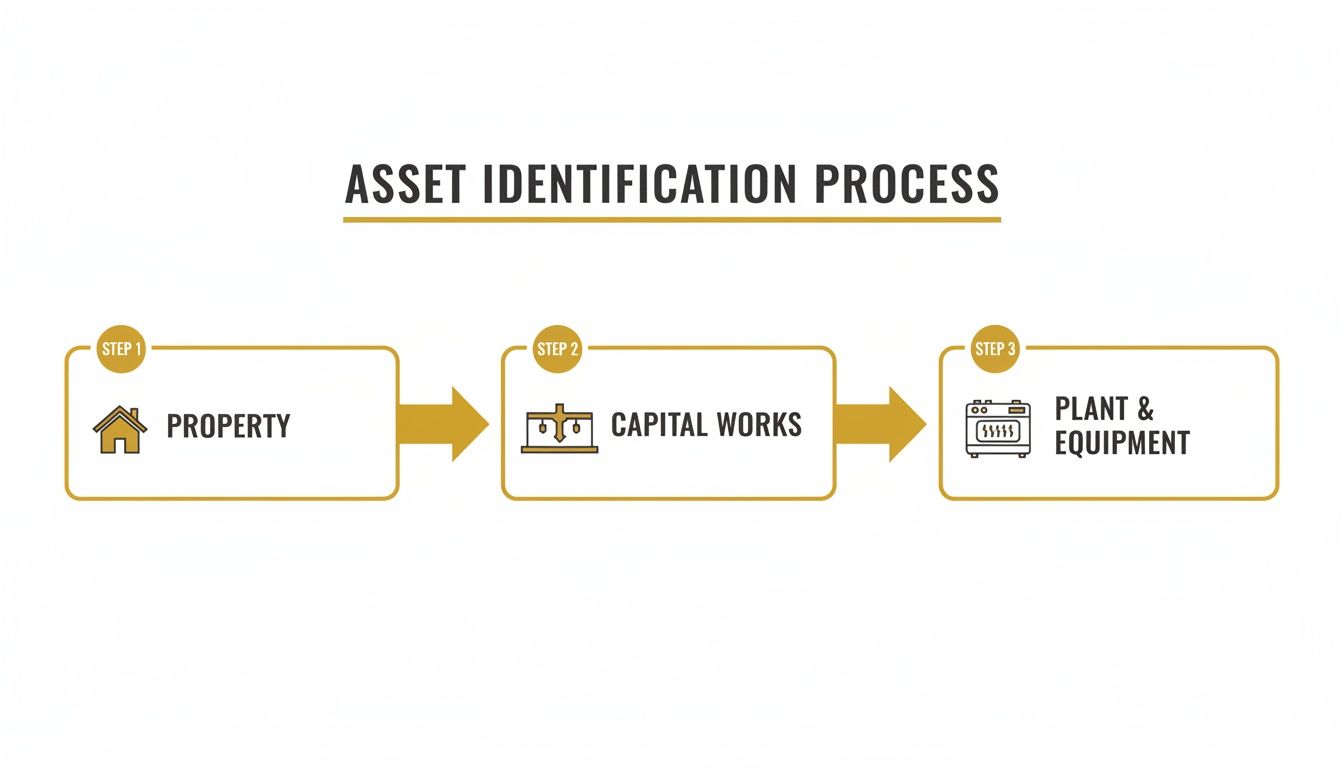
Calculating the Capital Works Deduction
First up, let's tackle the building's structure. In tax speak, this is called Capital Works, or Division 43 assets. Honestly, this is the most straightforward part of the calculation. For new residential properties built after 15 September 1987, the ATO lets you claim a flat 2.5% depreciation rate on the original construction cost, every single year for up to 40 years. For our $400,000 house, the maths is simple: $400,000 × 2.5% (or 0.025) = $10,000 Just like that, you have a $10,000 tax deduction for the first full financial year, purely from the building's structure. It's a solid, predictable claim you can count on year after year.Diving into Plant and Equipment
Now for the fun part, where the details really matter: the Plant and Equipment (Division 40) assets. These are all the removable items like ovens, carpets, and blinds, and they depreciate much faster than the building. A quantity surveyor's report would list dozens of items, but let's just focus on three common big-ticket examples to see how it works:- Carpets: Valued at $4,000 with an effective life of 10 years.
- Oven: Valued at $2,000 with an effective life of 12 years.
- Hot Water System: Valued at $1,500 with an effective life of 12 years.
The Diminishing Value method gives you a much larger deduction in the early years of owning an asset. It's a powerful strategy for boosting your cash flow right after you've bought a property.
Prime Cost vs Diminishing Value Calculations
Let's put them side-by-side. Prime Cost Method (Straight-Line) This method spreads the deduction evenly over the asset's life.- Carpets: ($4,000 / 10 years) = $400
- Oven: ($2,000 / 12 years) = $167
- Hot Water System: ($1,500 / 12 years) = $125
- Carpets: ($4,000 / 10 years) × 200% = $800
- Oven: ($2,000 / 12 years) × 200% = $333
- Hot Water System: ($1,500 / 12 years) × 200% = $250
Tying It All Together for Your Total Claim
Now, let's combine the building claim with our plant and equipment figures to get the total first-year deduction.- Total Claim (using Prime Cost): $10,000 (Capital Works) + $692 (P&E) = $10,692
- Total Claim (using Diminishing Value): $10,000 (Capital Works) + $1,383 (P&E) = $11,383
Don't Get Caught Out by These ATO Rules
Figuring out the depreciation calculation is one thing, but making sure you're playing by the Australian Taxation Office (ATO) rules is where it really counts. Even experienced investors can get tripped up by a few key regulations, which can lead to some expensive mistakes or leaving serious money on the table. One of the biggest shake-ups was the 2017 legislation that targeted Plant and Equipment. This rule put a stop to investors claiming deductions on second-hand or previously used assets in their residential properties. So, if you bought your rental after 9 May 2017, you generally can't claim depreciation on the existing oven, carpets, or blinds that came with it. But—and this is a big but—there are important exceptions. This rule does not apply to:- Brand new residential properties.
- Commercial rental properties.
- Any new assets you purchase and install yourself after you've settled.
The Low-Value Pool: Your Cash Flow Accelerator
Here’s a smart strategy that can really accelerate your deductions: the low-value pool. This lets you bundle together lower-value assets and claim them at a much faster rate, which is fantastic for your cash flow. You can allocate an asset to this pool if its opening value is less than $1,000 at the start of the financial year. Once an asset joins the pool, it depreciates at a set rate, completely separate from its individual effective life. The ATO fully recognises this method as a way to fast-track your write-offs.Pooling these smaller items simplifies your paperwork and brings forward a more significant deduction. It’s a powerful way to make those small-ticket items work much harder for your bottom line.
Scrapping Old Assets During a Reno? Don't Throw Away a Deduction
Renovations are a common source of confusion. What happens when you rip out that dated kitchen or finally replace that ancient hot water system? That old asset might still have some depreciable value left on your schedule. This is where the idea of "scrapping" becomes so valuable. If an asset is removed and can no longer be used, you can often claim its entire remaining value as an immediate tax deduction in that same financial year. This is a deduction that countless investors miss out on. For instance, if that old kitchen you just demolished had a residual written-down value of $2,500, you can claim that entire amount as a loss right away. It's the correct way to account for the asset's disposal and ensures you're squeezing every last tax benefit out of your renovation project. For a deeper dive into specific asset categories, our guide to ATO depreciation rates breaks it all down. Getting these rules right means you’re not just improving your property, you're optimising your tax position every step of the way.Why a Quantity Surveyor Is Your Best Investment
Look, I get it. When you're trying to keep costs down, it's tempting to try and calculate depreciation yourself. But hiring a qualified quantity surveyor is arguably the single best move you can make to maximise your claims. These professionals are formally recognised by the ATO as the experts in construction costs. Their reports carry a weight and authority that a self-assessed schedule just can't compete with. Their job goes way beyond spotting the obvious stuff like ovens and carpets. A good surveyor will get on-site, comb through the property, and identify hundreds of assets you’d never think of—from the exhaust fans and smoke alarms right down to the towel rails and door closers. Every single item adds up, and they make sure every claim is properly substantiated. This isn’t just about getting a bigger refund; it's about protecting yourself. An ATO-compliant depreciation schedule is your ironclad defence if you ever face an audit, giving you a clear, defensible basis for every dollar you claim.The Financial Upside of Expert Help
Many investors get hung up on the upfront cost of a report, but you need to see this as a strategic investment, not an expense. The fee for a depreciation schedule is 100% tax-deductible, after all. More importantly, the financial return it generates almost always dwarfs the initial cost, often within the very first year.Engaging a specialist isn't just about spending money. It's about unlocking thousands in legitimate tax deductions that would otherwise be lost forever. It's the key to making your investment property work harder for you from day one.I’ve seen this play out time and time again. One real-world case study showed an investor claiming $17,291 in deductions in the first year alone from a single inspection. That return covered his weekly holding costs more than three times over. That's the kind of powerful impact a professional report delivers. And that’s not a rare result. A comprehensive report from a quantity surveyor ensures no stone is left unturned, uncovering hidden value you didn't even know existed. If you want a deeper look at what these reports cover, check out our complete guide on the benefits of an investment property depreciation schedule. In the complex world of property tax, a quantity surveyor gives you two critical things: peace of mind and a much healthier bottom line.
Your Top Depreciation Questions Answered
Even once you get your head around the formulas, it's completely normal to have a few lingering questions. Property depreciation isn't always straightforward, especially when you're dealing with older homes or recent renovations. Let’s dig into some of the most common questions we get from Australian property investors. Getting these details right is the key to staying compliant and making sure you’re claiming every last dollar you're entitled to.Can I Claim Depreciation on an Older Property?
Yes, you absolutely can, but there are some critical dates to be aware of. For the building's structure (what the ATO calls Capital Works), you can claim deductions on any residential property where construction kicked off after 15 September 1987. So, even a place built in the 90s can still offer up some hefty claims. The rules for Plant and Equipment, however, got a shake-up in 2017. For second-hand properties, you generally can't claim depreciation on assets that were already used by the previous owner. This is where a quantity surveyor is worth their weight in gold—they can spot any newer assets a previous owner installed that might still be eligible for claims.Do I Need a New Depreciation Schedule After Renovating?
Definitely. If you don't update your schedule after a reno, you are leaving serious money on the table. A renovation brings in a whole host of brand-new assets, from ovens to air conditioners, that need to be properly valued and added to your schedule. Just as importantly, you need to account for any old assets you ripped out and threw away. This is called "scrapping," and updating your schedule lets you correctly write off the remaining value of those discarded items.Scrapping is a game-changer. It allows you to claim any leftover depreciable value as an immediate loss in that financial year. It's a powerful deduction that a surprising number of investors completely miss out on.
How Long Can I Claim Depreciation For?
The claim period is different for the building versus the assets inside it.- Capital Works: You can claim deductions on the building's structure for a maximum of 40 years, starting from the day construction was finished.
- Plant and Equipment: Every individual asset has its own 'effective life' set by the ATO. For instance, carpets might have an effective life of 10 years, while a hot water system could be 12 years. You claim it over that specific timeframe.
Is the Fee for a Quantity Surveyor Report Tax Deductible?
Yes, it is! The cost of hiring a qualified quantity surveyor to prepare your depreciation schedule is 100% tax-deductible. This makes the decision to get one a no-brainer. The fee directly reduces your taxable income in the same financial year you pay for it.Navigating the world of property depreciation is crucial for getting the best possible return on your investment. The team at Australia Wide Tax Solutions specialises in crafting accurate, ATO-compliant rental schedules for property investors, ensuring you claim every deduction possible. Contact us today to see how we can help you optimise your tax position.
Depreciation reduces an asset's cost base. When you sell, previously claimed Division 40 depreciation triggers a balancing adjustment. For Division 43 capital works deductions claimed from 1 July 2017, the amount reduces the building's cost base, increasing the eventual capital gain. The interaction between depreciation and CGT requires careful calculation at time of sale.
A quantity surveyor prepares a tax depreciation schedule by physically inspecting the property and identifying all depreciable assets and their values. The ATO accepts these estimates for depreciation claims where original receipts are unavailable. The fee is tax deductible. A schedule maximises your annual depreciation claims based on a comprehensive site assessment.
Division 43 covers the capital works deduction on structural components (walls, floors, roof) at 2.5% per year for buildings constructed after 15 September 1987. Division 40 covers plant and equipment (appliances, carpet, blinds) depreciated over their ATO-determined effective life. Post-May 2017 legislation restricts Division 40 claims on second-hand residential assets for new buyers.
Yes. The May 2017 restrictions on second-hand plant and equipment only apply to residential properties. Commercial property investors can still claim Division 40 depreciation on second-hand assets. Division 43 capital works deductions apply to both property types based on construction date, not acquisition date.
Keep the purchase contract, settlement statement, receipts for capital improvements, and a quantity surveyor's depreciation schedule. The ATO can request these records for five years after the relevant income year. Without records, depreciation claims can be reduced or disallowed on audit, and you may lose the ability to substantiate cost base adjustments at sale.