
If you've ever changed jobs, moved house, or even just worked a casual gig years ago, there's a good chance you have some missing super. It’s not just a minor bit of admin you forgot about; it’s a super common side effect of a modern career, and it could be costing you a fortune in unnecessary fees.
- Why You Might Have a Missing Super and Not Even Know It
- Your Primary Tool for Finding Lost Super
- Got No myGov Access? Here's How to Track Down Old Super Accounts
- Why Consolidating Your Super Is a Power Move
- When to Get Professional Help with Your Super
Why You Might Have a Missing Super and Not Even Know It
It’s surprisingly easy to lose track of a super account. Think back through your own work history.
Remember that part-time job you had as a teenager? The short-term contract you picked up between roles? Every time you start a new job, there's a risk a new super account is opened for you, especially if you didn't nominate a preferred fund. This is exactly how most people end up with lost super.
The real problem isn't just that the money is "lost"—it's that it's actively being eaten away.
Every single one of those extra accounts is likely charging its own set of administration fees and insurance premiums. A few dollars here and there might not seem like much, but over a 30 or 40-year career, this can literally add up to tens of thousands of dollars that should have been growing for your retirement.
The scale of this is staggering. The Australian Taxation Office (ATO) reports there's over $20 billion in unclaimed super sitting in around 4.5 million accounts across the country. That's a huge amount of money that isn't working for its owners.
This is why getting a handle on your superannuation guarantee contributions is so important. It's your money, and you need to protect it.
Some of the most common ways people lose track of their super include:
- Changing your name after getting married or divorced, but not updating every single super fund.
- Moving house and forgetting to pass on your new address to an old fund. Mail gets returned, and the account is flagged as "lost."
- Working for multiple employers in a short space of time, leading to a new default fund being opened for each job.
At the end of the day, finding and consolidating your super isn't just a box-ticking exercise. It's one of the smartest financial moves you can make to secure your future. It stops the fee leakage and puts your retirement savings back where they belong—working hard for you.
Your Primary Tool for Finding Lost Super
Forget digging through dusty old paperwork or trying to remember the name of an employer from a decade ago. The most effective and direct way to find your missing super is through the Australian Taxation Office's (ATO) online services, all conveniently linked to your myGov account.
Think of this secure portal as your central command centre for all things superannuation.
If you don’t have a myGov account yet, that's your first port of call. Setting one up is pretty straightforward and gives you access to a whole range of government services, not just the ATO. Once you're in, you’ll need to link it to the ATO, which just involves verifying your identity with details like your Tax File Number (TFN).
This little bit of admin is a one-time effort that pays off big time. It provides a complete overview of your super history, showing every account that has ever been held in your name.
Navigating the ATO Portal to Find Your Funds
Once you’re logged into myGov and have clicked through to the linked ATO service, find the 'Super' tab. This section is where the magic happens. Here, you'll find a list of all known super accounts tied to your TFN. It’s often a real eye-opener for people who didn’t realise how many small pots of money they had scattered around.
And we're not just talking about pocket change. Lost superannuation is a massive issue in Australia. APRA's latest stats revealed over 11 million inactive accounts holding a staggering $17.8 billion in unclaimed funds. As you can see from the APRA annual superannuation data, it affects everyone from Aussies working overseas to small business owners who've had a few jobs over the years.
While the average inactive balance was $1,620, some of these forgotten pots were worth over $50,000. That’s a serious amount of money to leave on the table.
This infographic shows just how easily it can happen.

As you can see, simple life events like changing your job or address are the main culprits. It’s easy to lose track.
To make things easier, here’s a quick rundown of your options for tracking down lost super.
A Quick Comparison of Super Search Methods
| Method | What You Need | Best For | Potential Outcome |
|---|---|---|---|
| myGov/ATO Portal | myGov login, TFN | The most comprehensive and direct method for finding all known accounts. | Complete list of all accounts; ability to consolidate online instantly. |
| Contacting Your Super Fund | Your member number, personal details | If you know which fund you were with and just need to update details or find a balance. | Confirmation of your account and balance with that specific fund. |
| Paper Statement Search | Old paperwork, historical addresses | A last resort if you can't access online services or have no TFN record. | Finding details of a specific fund to contact directly; often slow and difficult. |
| Using a Financial Adviser | Professional engagement | Complex financial situations or if you prefer professional assistance. | A consolidated view and strategic advice, but involves fees. |
While other methods exist, starting with the myGov/ATO portal is almost always the fastest and most thorough approach.
Understanding Your Super Account Status
Inside the portal, you’ll see your accounts listed with different statuses. It's important to know what these mean.
- Held by fund: This means your money is still with a retail, industry, or self-managed super fund. It's active, even if you've forgotten about it.
- Held by ATO: This tells you an account was classified as "lost" or had a low balance and was transferred to the ATO for safekeeping. Don't worry, it's still your money.
The myGov portal does more than just show you where your money is; it gives you the power to act on it immediately. You can start the process of consolidating your various funds into a single, preferred account right from the dashboard.
Got No myGov Access? Here's How to Track Down Old Super Accounts
If you can't get into your myGov account or you just prefer a more hands-on approach, don't stress. There are still a few old-school, but very effective, ways to find your missing super. It takes a little bit of detective work, but it’s a solid backup plan for tracking down those forgotten accounts.

Your first port of call should be your previous employers. Their payroll or HR department will have records of which super fund they paid into for you. This is especially handy for jobs you held before the ‘stapled super’ rules kicked in.
Time to Contact Past Employers
When you get in touch, whether it's by phone or email, you’ll need to give them enough information to find you in their old system. Be ready with:
- Your full name (and any previous names you used while working there).
- The rough dates you were employed.
- Your date of birth.
With that, they should be able to dig up the name of the super fund and maybe even your old member number. Funnily enough, a lot of the logic behind finding super is similar to tracking down anything else you've misplaced. If you're curious, you can check out some general strategies to find lost items fast for a different perspective.
A quick phone call is often the fastest way to get what you need. Ask to speak with someone in payroll or HR, as they’re the ones most likely to have access to historical super contribution records.
If you’ve managed to hang onto an old payslip or a super statement, you're one step ahead. That bit of paperwork will have the fund's name and your membership number right there, letting you go straight to the source.
When you call the fund, have your Tax File Number (TFN) handy, as they'll need it to confirm your identity. If you've lost your TFN, don't worry—our guide on how to find your lost Tax File Number has you covered. Taking this direct route can sometimes uncover accounts that, for one reason or another, haven't been properly linked to your ATO profile.
Why Consolidating Your Super Is a Power Move
Finding those lost super accounts is a fantastic start, but the real game-changer is rolling them all into one hardworking fund.
Think of it this way: every single super account you have is probably charging its own set of fees. They might seem small, but these fees are like tiny leaks in a bucket, constantly draining your retirement savings without you even noticing.
Let's say you've got three different super accounts from old jobs. Each one might be stinging you for a $100 admin fee and another $300 for insurance you don't need. That adds up to a staggering $1,200 a year just to keep accounts you've likely forgotten about.
Over a 30-year career, that’s a whopping $36,000 gone, and that's before you even factor in the lost investment growth on that money.

Consolidating your super instantly plugs those leaks. By moving everything into a single account, you pay just one set of fees. That leaves a whole lot more of your hard-earned cash in the pot to compound and grow over time. Getting a handle on your super fund fees and whether yours are high or low is a critical first step here.
Gain Clarity and Control Over Your Future
Beyond just saving a fortune on fees, consolidation seriously simplifies your financial life. No more juggling multiple statements or trying to keep track of different investment strategies.
You get one clear, simple picture of your retirement savings. This makes it so much easier to:
- Track your performance: See exactly how your single investment portfolio is doing at a glance.
- Adjust your strategy: Make smart decisions about your investment options without needing to log into three different websites.
- Manage your insurance: Check that you have the right level of life and disability cover in one place, instead of paying for multiple, overlapping policies.
Consolidating your super is all about taking back control. It turns a messy pile of forgotten accounts into a single, powerful asset that you can actively manage to build the future you actually want.
The principle of simplifying and centralising your retirement savings is a universal one. While our Australian system is unique, the core idea holds true globally. For a look at how this works in other systems, you can find some great insights on managing multiple retirement accounts. It just reinforces the value of bringing all your assets under one roof for maximum efficiency—a key benefit once you find and consolidate that lost super.
When to Get Professional Help with Your Super
Look, hunting down your own lost super is often a pretty straightforward DIY job. For most people, a few clicks on myGov is all it takes. But let's be real—some financial situations are just plain messy.
If you're a small business owner, have a few overdue tax returns lurking, or you're juggling investment properties, that’s when it’s smart to call in an expert.
It's More Than Just Paperwork
A good tax agent or financial adviser does way more than just fill out forms. Their real value is in navigating the tricky tax implications that can pop up when you start moving super around. Depending on the amounts and the funds involved, consolidating your super isn't always as simple as it sounds.
They’ll make sure all your ducks are in a row with the ATO before any money gets moved, which can save you a world of headaches.
Making a Strategic Move for Your Future
Bringing in a professional isn't about admitting defeat; it's about making a smart, strategic decision for your financial future. They can look at your specific goals and advise on the best fund structure to get you there, making sure your retirement savings are working as hard as you are.
A professional can spot the pitfalls you’d never see coming. Think losing valuable life insurance that was tied to an old fund, or accidentally creating a surprise tax bill just by consolidating your accounts in the wrong order.
This kind of expert advice is absolutely essential in more unique circumstances, like:
- Running a Self-Managed Super Fund (SMSF).
- Sorting out superannuation from a deceased estate.
- Planning a retirement that involves multiple streams of income.
Ultimately, getting the right help is about giving yourself peace of mind. It ensures your financial future is not only secure but fully optimised for growth.
Got Questions About Finding Your Super?
Diving into the world of super can feel a bit confusing, and it's natural to have a few questions before you start. Let's tackle some of the most common ones we hear from clients, so you can get started with confidence.
How Long Does This Whole Process Take?
Finding your super accounts using the ATO's online service via myGov is incredibly fast. In most cases, you'll see a list of all your known accounts pop up almost instantly.
Once you’ve spotted them and decided to consolidate, the next step—kicking off the transfer online—only takes a few minutes.
The actual heavy lifting, where the money moves between your old and new super funds, is pretty quick too. You can usually expect the transfer to be wrapped up within three to seven business days. If you’re claiming super held directly by the ATO, they generally pay it out to you or your chosen fund within 28 days of your claim being processed.
What Happens to My Insurance When I Consolidate?
This is a big one, and it’s something people often miss. When you close an old super account, you’re not just moving money—you’re also cancelling any insurance cover attached to it. That includes things like life, Total and Permanent Disablement (TPD), or income protection insurance.
Before you hit that consolidate button, you absolutely must check the insurance you have in each account. Compare what you're about to lose with the cover you'll have in your main account. The last thing you want is to be left unintentionally uninsured.
Sometimes, you might need to apply for new or increased cover in your main fund before you close down the old ones.
Is There a Fee for This Service?
Good news—no, there isn't. Using the ATO's services through myGov to track down and consolidate your super is completely free. Most super funds have also done away with fees for rolling your money in or closing an old account.
It’s always a good idea to double-check with the funds involved, just in case they have specific exit fees, though this is becoming quite rare.
Just be wary of any third-party services that pop up offering to find your super for a fee. You can easily do it yourself for free, so there's no need to pay someone else for it.
If you're sorting through a more complex financial picture or just want an expert eye to make sure your super consolidation is done right, the team at Australia Wide Tax Solutions is here to help. We guide you through the process to ensure you’re making smart decisions that optimise your financial future. Reach out to us for personalised advice at https://www.awts.net.au.
The ATO provides guidance through ato.gov.au, the Small Business Support Line (13 28 66), and Online Services for individuals and businesses. For complex situations, a registered tax agent provides advice tailored to your specific circumstances and professional indemnity protection. You can verify agent registration at the TPB register at tpb.gov.au.
Most tax records must be kept for five years from the date of lodgement or the date the transaction occurred, whichever is later. Records must be in English or convertible to English and must be sufficient to explain the income and deductions in your return. The ATO can request records at any time during the retention period.
Consider a registered tax agent when your affairs involve multiple income sources, business activity, investment properties, capital gains, or overseas income. Agents extend your lodgement deadline, provide safe harbour protection, and take professional responsibility for the advice given. Verify registration at tpb.gov.au.
The failure to lodge penalty is based on penalty units ($313 per unit from 1 July 2023), accruing per 28-day period for late returns and BAS lodgements. Incorrect information penalties range from 25% to 75% of the tax shortfall depending on whether the behaviour was careless, reckless, or intentional. Proactive disclosure before an audit begins typically results in significantly reduced penalties.
Tax minimisation is the legal arrangement of your affairs to reduce tax — claiming all eligible deductions, using appropriate structures, and timing income and expenses. Tax avoidance involves arrangements that technically comply with the law but achieve outcomes parliament did not intend. The ATO can apply Part IVA anti-avoidance rules to cancel benefits from avoidance arrangements.
Think of a Self-Managed Super Fund (SMSF) as the ultimate DIY approach to your retirement savings. It’s a private super fund that you—and up to five other members—control directly. You're in the driver's seat, making all the investment decisions yourself.
- What Is a Self-Managed Super Fund
- Is an SMSF the Right Fit for You?
- How SMSFs Compare to Other Super Funds
- The Real Benefits and Risks of an SMSF
- Your Guide to Setting Up and Managing an SMSF
This is a world away from the typical industry or retail super funds, where professional fund managers handle everything for you. With an SMSF, you get complete command over your nest egg.
What Is a Self-Managed Super Fund

Let's use an analogy. Imagine your retirement savings as a ship sailing towards the horizon. In a standard super fund, you're a passenger on a massive cruise liner. The fund manager sets the course, chooses the destinations (the investments), and takes care of all the navigation. Your job is to sit back and trust they’ll get you to your retirement destination safely.
An SMSF, on the other hand, puts you at the helm of your own vessel. You're the captain. You chart the course, you trim the sails, and you make every single decision that determines your journey. This structure gives you the freedom to invest in a much broader universe of assets than what’s usually available in mainstream funds.
Taking Control of Your Investments
With an SMSF, you can build a portfolio that truly reflects your personal financial goals and how much risk you’re comfortable taking on. This opens the door to some unique investment opportunities that are often out of reach for members of the big funds.
Some of these possibilities include:
- Direct Property: You can use your super to purchase residential or commercial properties directly.
- Specific Shares: Fancy yourself a stock picker? You can invest in the individual Australian and international companies you believe in.
- Unlisted Assets: It's even possible to invest in things like private companies or physical assets like gold bullion.
The core trade-off at the heart of an SMSF is simple but crucial: with greater control comes greater responsibility. While you're in charge, you are also personally accountable for navigating the complex legal and financial waters.
Understanding Your Role as Trustee
This shift from passenger to captain is the defining feature of an SMSF. As a member, you also become a trustee, which means you are legally on the hook for the fund's operations. This covers everything from creating a formal investment strategy to making sure you're following Australia's strict super and tax laws to the letter.
Despite the responsibility, this model is incredibly popular. As of September 2025, there are 661,384 SMSFs in Australia, holding a massive $1.07 trillion in assets for 1.22 million members. You can find out more by exploring the latest SMSF statistics and trends.
Is an SMSF the Right Fit for You?

While the idea of total control over your super is tempting, an SMSF isn't a one-size-fits-all solution. Far from it. This is a highly specialised vehicle for people with clear financial goals, a genuine willingness to get their hands dirty, and a solid grasp of the responsibilities involved.
These are not your average set-and-forget investors. SMSF trustees are proactive. They view their superannuation as a powerful tool for building wealth strategically, not just a savings account that ticks along in the background.
Who Benefits Most from an SMSF?
Certain financial situations and life stages make the unique advantages of an SMSF incredibly compelling. If any of the following profiles sound like you, this structure might be the perfect match for your retirement goals.
The Savvy Business Owner: Imagine you run a successful small business and are sick of paying rent. An SMSF could allow you to buy your commercial property with your super funds. Your business then pays rent directly into your retirement nest egg, securing your location while building a massive asset for the future.
The Experienced Property Investor: If you know your way around the real estate market, an SMSF opens the door to adding direct residential or commercial property to your super portfolio. It’s a fantastic way to diversify and put your existing expertise to work growing your retirement wealth.
The High-Net-Worth Individual: For those with a substantial super balance, an SMSF unlocks a world of sophisticated investment options that are simply off-limits in mainstream funds. We’re talking about unlisted assets, private equity, or even collectibles—all part of a highly customised strategy.
An SMSF is best suited for those who are not just willing, but eager, to steer their own financial ship. It demands a significant investment of time for research, administration, and compliance management.
This hands-on approach requires both the time and the financial literacy to make sound decisions. The numbers clearly show who is typically drawn to this model. As of June 2025, a huge 68% of the 653,062 SMSFs had two members, usually couples working together. The data also shows that members are often older, with 85% aged 45 or over. You can dig deeper into these trends in the latest SMSF demographic statistics.
Key Considerations Before You Commit
Before you jump in, it’s vital to be honest about whether you have the right foundations in place. A successful SMSF journey isn’t just about investment smarts; it’s about understanding the entire lifecycle of your super, including the rules that govern how and when you can access it. For a solid overview, check out our guide on superannuation withdrawal rules.
Ultimately, the decision boils down to a trade-off. Is the incredible control and investment freedom worth the heavy legal and administrative responsibilities you will personally carry as a trustee?
How SMSFs Compare to Other Super Funds
Choosing a super fund is a huge financial decision, a bit like deciding where you’re going to live. An APRA-regulated fund—think of your typical industry or retail fund—is like buying an apartment in a big, managed complex. It’s convenient, someone else handles all the maintenance, and it requires very little day-to-day effort from you. The catch? Your choices are limited to what the body corporate offers.
An SMSF, on the other hand, is like designing and building your own custom home from the ground up. You have complete freedom over the layout, the materials, and every single detail. This gives you ultimate control, but it also means you’re personally on the hook for all the construction, maintenance, and making sure everything is built to code.
The Trade-Off: Control vs. Simplicity
The fundamental difference really boils down to who is in the driver's seat. With a standard super fund, you’re essentially a passenger, delegating all the investment decisions and legal compliance to a professional trustee. Your role is pretty passive.
With an SMSF, you are the trustee. That single shift—from passenger to driver—introduces a whole new level of responsibility.
This hands-on approach means you are legally accountable for everything: the fund’s investment strategy, its administration, and sticking to complex tax laws. While APRA-regulated funds offer a safety net through statutory compensation schemes for theft or fraud, SMSF trustees have no such protection. You bear the full weight of your decisions, good or bad.
A Clear Comparison of Your Options
To truly get your head around what an SMSF means in practice, it helps to see a direct comparison. The choice isn't just about investments; it dramatically impacts your costs, your time commitment, and your legal obligations. It’s absolutely crucial to weigh the appeal of total flexibility against the heavy demands of running the show yourself.
This table breaks down the key differences to help you see where each option shines.
SMSF vs APRA-Regulated Funds: A Quick Comparison
| Feature | Self-Managed Super Fund (SMSF) | APRA-Regulated Fund (Industry/Retail) |
|---|---|---|
| Control | You are the trustee with complete control over all investment and strategic decisions. | Decisions are made by professional fund managers; you have limited or no say. |
| Investment Options | Extremely broad, including direct property, unlisted assets, and specific shares. | Limited to a menu of pre-selected investment options offered by the fund. |
| Cost Structure | Generally flat-rate fees for administration, audit, and advice, regardless of balance. | Typically percentage-based fees that scale with your superannuation balance. |
| Compliance | You are personally and legally responsible for all compliance, reporting, and audits. | The fund's professional trustee handles all legal and compliance obligations for you. |
Ultimately, the right choice comes down to your financial situation, your level of expertise, and just how willing you are to take on a significant new responsibility. An SMSF can be an incredibly powerful tool for building wealth if you’re the right person for the job. But for those who are unprepared for the commitment it demands, it can quickly become a complex and costly burden.
The Real Benefits and Risks of an SMSF
Taking the captain's chair of your own super fund gives you incredible power, but it’s a role that also comes with serious accountability. An SMSF isn’t just another account type; it’s a fundamental shift in how you manage your retirement wealth. Before you even think about committing, you absolutely have to understand both the compelling upsides and the significant potential downsides.
The number one drawcard is, without a doubt, investment control. Unlike big industry or retail funds that offer a set menu of investment options, an SMSF gives you the freedom to invest in assets that perfectly match your personal strategy. We’re talking direct property, specific shares, unlisted assets, and even things like art or collectibles.
For many people, this flexibility is a complete game-changer. It allows you to use your own expertise—whether that's in real estate, business, or the stock market—to directly build your retirement nest egg. You can get a better feel for how this works in practice by reading our detailed guide on SMSF and property investment.
The Power of Greater Flexibility
Beyond the investment choices, SMSFs offer remarkable tax flexibility, especially as you get closer to retirement. With the right advice and a solid strategy, you can structure your fund to minimise tax in ways that are simply out of reach in a large public fund.
For example, let's say your SMSF holds shares that have shot up in value. By timing the sale of these assets until after you've retired and moved your super into the tax-free pension phase, you could potentially reduce the capital gains tax to zero. This level of strategic tax management is a major reason why many high-net-worth individuals are drawn to the SMSF structure.
The greatest strengths of an SMSF—complete control and flexibility—are also the source of its greatest risks. Every decision, from investment choices to compliance paperwork, rests squarely on your shoulders as the trustee.
Understanding the Serious Risks Involved
This brings us to the other side of the coin. The responsibility you take on as a trustee is immense and legally binding. A few bad investment decisions can have a devastating impact on your retirement savings. And unlike APRA-regulated funds, there is no government compensation scheme to bail you out if you fall victim to fraud or simply make a poor choice. You wear the full financial consequences.
A classic cautionary tale is the investor who sinks their entire fund into a single speculative startup that goes bust, losing their life savings with no safety net. This isn't just a scary story; it's a real risk without a diversified and well-thought-out investment plan.
Beyond just investment risk, there are three other critical factors you must consider:
- Time Commitment: Running an SMSF is not a set-and-forget task. It requires hours of your time each month for research, administration, and keeping meticulous records.
- Compliance Burden: The rules laid down by the Australian Taxation Office (ATO) are strict, complex, and constantly changing. A breach, even an accidental one, can lead to massive personal fines or your fund being declared 'non-complying'. This can trigger a tax penalty of up to 47% of your fund’s entire assets.
- Personal Liability: As a trustee, you are personally on the hook for the fund's actions. If the fund breaks the law, the ATO can direct the penalties straight at you.
To protect yourself from these potential downsides and ensure your SMSF is a healthy, long-term vehicle for wealth, it’s vital to follow the best practices for risk management. An SMSF can be an incredibly powerful tool, but only if you are fully prepared for the heavy responsibilities that come with it.
Your Guide to Setting Up and Managing an SMSF
Deciding to set up an SMSF is a bit like choosing to build your own custom home instead of buying an off-the-plan apartment. It puts you in the driver's seat, but it also means you're responsible for the entire project—from laying the foundations to ongoing maintenance. It demands a solid plan, the right structure from day one, and a crystal-clear understanding of your duties as the fund's trustee.
Think of this as your practical roadmap, covering both the launch and the long-term running of your fund. The setup process involves several critical, non-negotiable steps. Each one is a foundational block ensuring your fund is legally sound and recognised by the Australian Taxation Office (ATO), which acts as the regulator for all SMSFs.
The Initial Setup Checklist
Getting your fund off the ground isn't something you rush. It requires careful thought and precise execution to get the legal and administrative tasks ticked off before your fund can even think about investing.
Here are the essential steps you absolutely must follow:
- Choose Your Trustee Structure: You've got two main options here. You can have individual trustees, where every member is also a trustee, or a corporate trustee, where you set up a company to act as the trustee. The corporate structure is often recommended because it makes life much simpler down the track, especially when a member joins or leaves the fund.
- Appoint Trustees: Simple enough. All members of the fund must be appointed as trustees (if you go the individual route) or as directors of the corporate trustee.
- Draft a Trust Deed: This is the legal rulebook for your SMSF. It’s not a DIY job. You'll need a solicitor or a specialist provider to create a legally binding trust deed that spells out exactly how your fund will operate.
- Register with the ATO: This makes it official. You must register your fund to get an Australian Business Number (ABN) and a Tax File Number (TFN). This formally establishes your SMSF as a legal entity in the eyes of the tax office.
- Open a Dedicated Bank Account: Your SMSF’s money must be kept completely separate from your personal or business finances. That means opening a dedicated bank account in the fund's name to handle all contributions, investments, and expenses.
This chart breaks down the core trade-offs you're making—balancing the benefits you gain against the risks you personally accept when you take charge of your own fund.
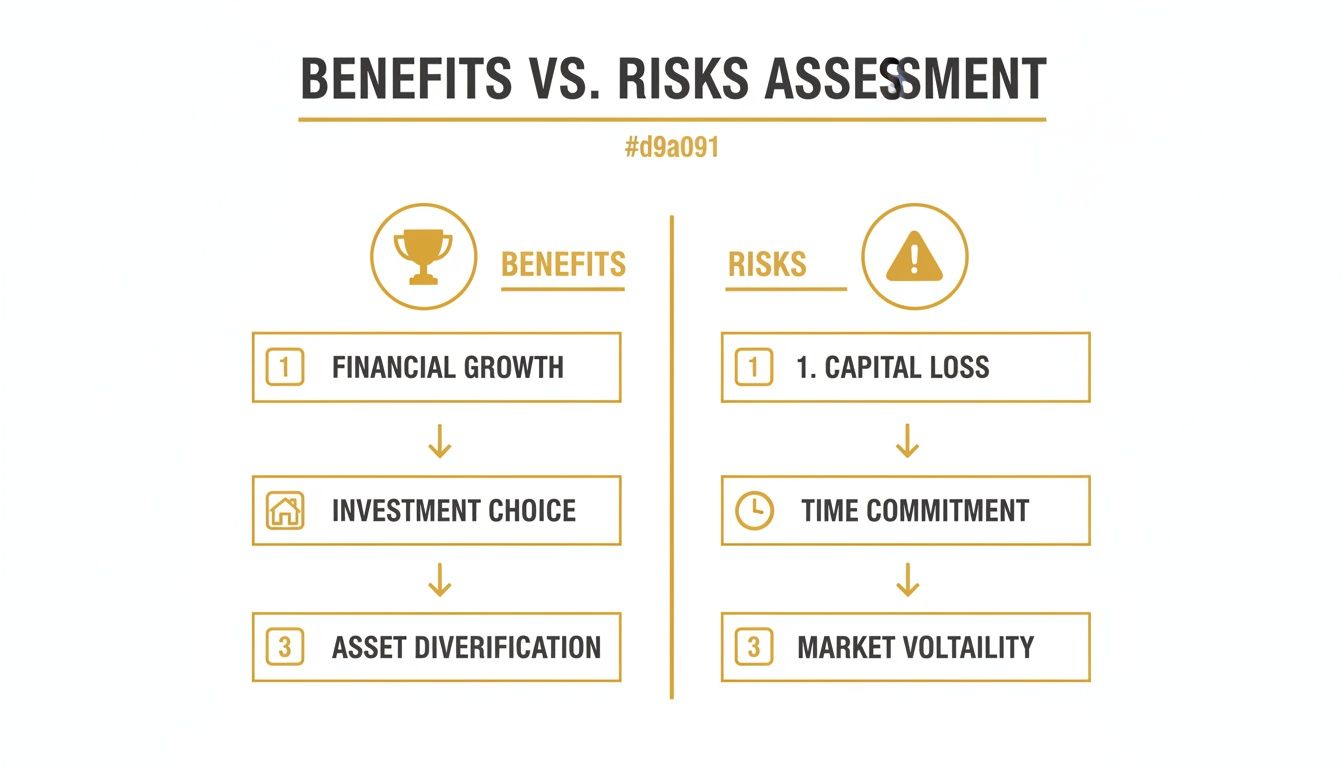
As you can see, the huge appeal of having total control over your investments is directly balanced by the significant time commitment and personal risk involved.
Ongoing Management and Annual Duties
Once your SMSF is up and running, your role as captain truly begins. Your focus shifts from setup to ongoing management, making sure the fund stays compliant and always operates in the best interests of its members. This is not a set-and-forget task; it’s an active, year-round commitment.
As a trustee, you are personally liable for the fund's compliance. Meticulous record-keeping and a clear understanding of your annual obligations are not just best practices—they are legal requirements.
Your annual duties are the heartbeat of a compliant fund. Think of this as your captain's log, where every decision and transaction must be documented, justified, and accounted for. On top of that, effective management also demands robust practices in cybersecurity and accounting to protect the fund's data and keep everything in order.
Here’s a look at what you must do, every single year, without fail:
- Implement an Investment Strategy: You are legally required to have a written investment strategy. This document outlines the fund's objectives and the plan to achieve them, and it must be reviewed regularly.
- Maintain Meticulous Records: Every single transaction—from contributions and investments to expenses and pension payments—must be accurately recorded and backed up with documentation.
- Value Fund Assets: At the end of each financial year, all the fund's assets must be valued at their current market price.
- Arrange an Independent Audit: An approved SMSF auditor must review your fund's financial statements and compliance records each year. This is non-negotiable.
- Lodge Your Annual Return: You must prepare and lodge an SMSF annual return with the ATO, which includes all the fund's financial statements and tax information for the year.
How to Start Your SMSF Journey
Getting your head around what an SMSF actually is marks the beginning. But the real question you need to ask yourself next is: does this genuinely fit with where I want to be financially?
This is precisely where getting the right professional guidance becomes a non-negotiable. An SMSF isn’t just a glorified savings account; it's a sophisticated financial structure with a lot of moving parts. This is especially true if you have specific goals in mind, like investing in property or using your super to support your business.
Trying to navigate this journey solo is a recipe for disaster. The setup process is intricate, keeping up with the ATO's compliance rules is a constant demand, and the tax scenarios can get complex—fast. Having a specialist advisor in your corner is crucial to shoulder these administrative burdens. It frees you up to focus on the part that actually matters: your investment strategy.
An expert consultation is the single most effective way to build a retirement strategy that's perfectly aligned with your unique financial situation, whether you're a property investor, business owner, or high-net-worth individual.
This kind of tailored advice ensures every decision you make is not only compliant but also strategically sound, right from day one. By partnering with experts, you can steer your financial future with confidence and start building the retirement you’ve always envisioned.
To get a clearer picture of what's involved in the initial stages, it’s also a good idea to learn more about the typical SMSF setup costs.
Common Questions About SMSFs
Thinking about starting your own super fund is a big step, and it naturally brings up a lot of practical questions. Before you dive in, you need clear, no-nonsense answers. Let's tackle some of the most common things people ask when they first look into an SMSF.
This is all about cutting through the jargon to give you the key details on costs, borrowing, time commitment, and what happens if you get things wrong.
How Much Money Do I Need to Start an SMSF?
While there isn't a strict legal minimum, the general rule of thumb from most financial experts is a starting balance of at least $200,000 to $500,000.
Why so much? It all comes down to costs. The fixed annual fees for running an SMSF—like audits, accounting, and any advice—can really eat into your returns on a smaller balance. Below that $200,000 mark, these costs take a much bigger bite, and you'd likely be better off growing your super in a standard industry or retail fund.
Can I Borrow Money to Buy Property in My SMSF?
Yes, you can, but it’s not as simple as taking out a regular home loan. An SMSF can only borrow to buy property through a very specific structure called a Limited Recourse Borrowing Arrangement (LRBA).
This is one of the most heavily regulated areas of superannuation, and for good reason. The ATO has strict rules to make sure the other assets in your fund are protected if the property loan goes bad. It is absolutely essential to get professional financial and legal advice before even thinking about an LRBA to make sure you stay compliant and understand every single risk involved.
Getting the rules wrong, even by accident, can lead to serious penalties from the ATO. We’re not talking about a slap on the wrist; this can mean significant fines that you, as the trustee, are personally responsible for.
In the most serious cases, the ATO could declare your fund 'non-complying'. This is the nightmare scenario, as it could result in your fund's assets being taxed at the highest marginal rate. It really highlights why getting professional guidance isn’t just a good idea—it’s a necessity.
What Is the Time Commitment for Managing an SMSF?
Don't underestimate the time it takes to run your own super fund properly. Most trustees report spending several hours every month just on the basics: administration, meticulous record-keeping, and researching investments.
The exact time you’ll need to put in depends on how complex your investments are and how much of the heavy lifting you outsource. If you hire professionals like accountants, administrators, and financial advisers to handle the admin, your time commitment will obviously be lower, but it never drops to zero.
The ATO provides guidance through ato.gov.au, the Small Business Support Line (13 28 66), and Online Services for individuals and businesses. For complex situations, a registered tax agent provides advice tailored to your specific circumstances and professional indemnity protection. You can verify agent registration at the TPB register at tpb.gov.au.
Most tax records must be kept for five years from the date of lodgement or the date the transaction occurred, whichever is later. Records must be in English or convertible to English and must be sufficient to explain the income and deductions in your return. The ATO can request records at any time during the retention period.
Consider a registered tax agent when your affairs involve multiple income sources, business activity, investment properties, capital gains, or overseas income. Agents extend your lodgement deadline, provide safe harbour protection, and take professional responsibility for the advice given. Verify registration at tpb.gov.au.
The failure to lodge penalty is based on penalty units ($313 per unit from 1 July 2023), accruing per 28-day period for late returns and BAS lodgements. Incorrect information penalties range from 25% to 75% of the tax shortfall depending on whether the behaviour was careless, reckless, or intentional. Proactive disclosure before an audit begins typically results in significantly reduced penalties.
Tax minimisation is the legal arrangement of your affairs to reduce tax — claiming all eligible deductions, using appropriate structures, and timing income and expenses. Tax avoidance involves arrangements that technically comply with the law but achieve outcomes parliament did not intend. The ATO can apply Part IVA anti-avoidance rules to cancel benefits from avoidance arrangements.
Ready to explore if an SMSF is the right fit for your financial future? The team at Australia Wide Tax Solutions provides expert guidance on SMSF setup, compliance, and strategic management. Contact us today for a personalised consultation and take the next step with confidence.
The super contribution caps are on the move for the 2024-2025 financial year, and it’s good news for your retirement savings. The concessional (before-tax) contribution limit is now $30,000 per year, while the non-concessional (after-tax) limit has jumped to $120,000.
- Understanding the New Super Contribution Caps
- Mastering Your Before-Tax Concessional Contributions
- Using Catch-Up Contributions to Your Advantage
- Boosting Your Super With After-Tax Contributions
- Avoiding Common Pitfalls and Tax Penalties
These new figures, which kick in from 1 July 2024, are adjusted based on indexation and give savvy Australians more room to build their nest egg, tax-effectively.
Understanding the New Super Contribution Caps

Think of your super contribution caps as the annual speed limit for putting money into your retirement fund. If you stick to these limits, you get the benefit of favourable tax treatment. Exceed them, and you could face extra tax.
This isn't just a minor tweak to the rules; it’s a genuine opportunity to get ahead. The increases give you more flexibility in how you structure your savings, whether you’re salary sacrificing, making personal deductible contributions, or putting in a lump sum from savings or an inheritance. Getting your head around these new boundaries is the first step.
Super Contribution Caps At a Glance 2023-24 vs 2024-25
To see just how much things have changed, it helps to put the old and new limits side-by-side. This simple comparison shows exactly how much more you can contribute from 1 July 2024.
| Contribution Type | 2023-24 Financial Year Cap | 2024-25 Financial Year Cap |
|---|---|---|
| Concessional (Before-Tax) | $27,500 | $30,000 |
| Non-Concessional (After-Tax) | $110,000 | $120,000 |
As you can see, both caps have received a healthy boost, opening up new strategic possibilities.
Why These Changes Matter for Your Strategy
So, why the increase? The caps are indexed in line with Average Weekly Ordinary Time Earnings (AWOTE), which means they’re designed to keep pace with wage growth. But for anyone serious about their financial future, this is more than just an inflation adjustment—it's a signal to review and optimise your financial plan.
Your ability to maximise these new contribution caps is a cornerstone of a strong financial future. It's about making deliberate choices now that will compound significantly over the long term, securing your lifestyle in retirement.
By strategically using these higher limits, you can potentially lower your taxable income today while building a larger, tax-advantaged fund for tomorrow. For a bigger picture on how this fits into securing your future, our guide on effective retirement planning provides some fantastic broader context.
Now, let's dig into how these new rules work and how you can make the most of them.
Mastering Your Before-Tax Concessional Contributions
Think of concessional contributions as the fast track for your retirement savings. This is money that goes into your super fund straight from your pre-tax income, getting a massive tax advantage on the way in. It’s a powerful way to build your nest egg while cutting your current tax bill at the same time.
These contributions are typically taxed at just 15% inside your super fund. For most people, that’s a whole lot lower than their marginal tax rate. That immediate tax saving means more of your hard-earned cash gets put to work for you, compounding year after year.
The New Concessional Cap for 2024
This year brought a significant boost for Aussie super savers. From 1 July 2024, the annual concessional contributions cap jumped to $30,000, a healthy increase from the previous $27,500. This rise is linked to wage growth and gives you more breathing room to make tax-effective contributions.
This isn't just a number change; it's a genuine opportunity to rethink your savings strategy and maybe even fast-track your path to a comfortable retirement.
How Concessional Contributions Work in Practice
So, what actually counts towards this $30,000 limit? It’s not just a single type of payment, and getting your head around the different sources is key to avoiding an accidental over-contribution.
The main types of concessional contributions are:
- Superannuation Guarantee (SG): These are the compulsory payments your employer makes for you, currently sitting at 11% of your ordinary time earnings.
- Salary Sacrifice Arrangements: This is where you arrange with your employer to pay a slice of your pre-tax salary directly into your super fund.
- Personal Deductible Contributions: If you're self-employed or your employer doesn't offer salary sacrificing, you can make contributions from your own pocket and then claim them as a tax deduction on your tax return.
Picture your income as a river. Salary sacrificing is like digging a channel that sends some of that water into your superannuation reservoir before it tumbles over the high-tax waterfall of your personal income tax rate.
Real-World Example: Salary Sacrificing in Action
Let’s put this into a real-life scenario. Sarah earns $120,000 a year. Her employer is already contributing $13,200 (which is 11%) in compulsory SG payments.
This leaves Sarah with $16,800 ($30,000 - $13,200) of her concessional cap to play with for the financial year. She decides to set up a salary sacrifice arrangement to chip in an extra $1,000 a month ($12,000 a year) into her super.
By doing this, her taxable income drops from $120,000 down to $108,000. It's a simple move that not only pumps up her retirement savings but also cuts her income tax bill for the year, leaving more money in her pocket today. For a deeper dive into the mechanics and rules, check out our detailed guide on the concessional contributions cap.
Why Getting This Right Is Crucial
Sticking to the $30,000 limit is absolutely essential. If you go over, the excess amount gets added to your assessable income and taxed at your marginal rate, which can completely wipe out the tax benefits you were aiming for.
For business owners, concessional contributions are a cornerstone of smart tax planning. For employees, it’s a direct line to turning highly taxed income into low-taxed retirement savings. Getting this right is a fundamental step on the road to financial independence.
To truly master your contributions, it pays to understand every strategy at your disposal. While the system is different, learning how to maximize your employer 401(k) match in the US offers great insight into the mindset of leveraging every employer-related benefit. It reinforces the importance of grabbing every contribution opportunity available to you.
Using Catch-Up Contributions to Your Advantage
Ever wish you could go back in time and top up your super for the years you didn’t contribute much? Well, with ‘carry-forward’ or ‘catch-up’ contributions, you practically can. This is a powerful strategy that lets you use any leftover concessional (before-tax) contribution caps from previous years.
Think of your annual concessional cap like a bucket you can fill each year. If you only filled it halfway in previous years, that unused space doesn't just vanish. The carry-forward rule lets you pour that leftover capacity into your current year's bucket, opening the door for a much larger, tax-effective contribution.
This is an absolute game-changer for people with lumpy or inconsistent incomes. It’s perfect if you’ve taken time off to raise a family, started a business with low initial earnings, or work in the gig economy with fluctuating pay cheques.
Who Is Eligible for Catch-Up Contributions?
This feature isn't open to everyone. There are two key criteria you must meet to take advantage of your unused concessional caps:
- Your total super balance must have been less than $500,000 on 30 June of the previous financial year.
- You must have unused concessional cap amounts from any of the previous five financial years (the clock started ticking from the 2018–19 financial year).
It’s important to remember that this five-year window is a rolling one. This means that each financial year, the oldest year's unused cap expires for good. For example, in the current 2024–25 financial year, any unused cap from the 2018–19 year will disappear if you don't use it.
A Practical Example of Catch-Up Contributions
Let’s see how this plays out in the real world. Meet David, a property investor who just sold an investment property and is now facing a significant capital gain. He wants to find a way to reduce his taxable income for the year, and super is on his radar.
First, David checks his total super balance on 30 June 2024, which was $420,000. Because this is under the $500,000 threshold, he’s eligible to make a catch-up contribution. He then logs into his myGov account to check his unused concessional caps.
Here’s a snapshot of what David can bring forward to the current financial year:
Example Carry-Forward Contribution Calculation
| Financial Year | Annual Cap | Actual Contribution | Unused Cap Amount |
|---|---|---|---|
| 2021–22 | $27,500 | $15,000 | $12,500 |
| 2022–23 | $27,500 | $16,000 | $11,500 |
| 2023–24 | $27,500 | $18,000 | $9,500 |
From the last three years alone, he has a total of $33,500 in unused caps he can tap into.
For the current 2024–25 financial year, the standard concessional cap is $30,000. David can add his unused $33,500 from previous years on top of this year's standard cap.
This means David can make a total personal deductible contribution of up to $63,500 this year ($30,000 + $33,500). This huge contribution can significantly reduce his capital gains tax bill while giving his retirement savings a massive boost.
This visual shows the main pathways for making these before-tax contributions, whether it’s through your employer or from your own pocket.

As the flowchart shows, both salary sacrifice and personal deductible contributions are powerful tools because they go into your super fund before your higher marginal income tax rates are applied.
How to Find Your Unused Cap Amounts
The easiest way to check exactly how much you can carry forward is through your myGov account linked to the Australian Taxation Office (ATO). The superannuation section gives you a clear, year-by-year breakdown of your contributions and any unused amounts for the past five years.
But a word of caution: the ATO's data is only as good as the tax returns you've lodged. If you have any overdue returns, the figures you see might not be accurate. It is absolutely critical to make sure your tax affairs are up to date before you even think about making a large catch-up contribution.
Navigating the maximum super contribution 2024 rules, especially with catch-up amounts in the mix, demands precision. Getting professional advice is a smart move to ensure your calculations are spot on so you can make the most of this fantastic opportunity.
Boosting Your Super With After-Tax Contributions

While pre-tax contributions give you an immediate tax deduction, there's another powerful way to build your retirement nest egg: after-tax contributions. Known as non-concessional contributions, these are simply payments made into your super from money you’ve already paid tax on.
So, what's the point? Think of it like this: pre-tax contributions cut your tax bill now. After-tax contributions let you shift significant wealth into super's low-tax world, where future investment earnings are taxed at a maximum of just 15%.
This is an incredibly useful strategy for anyone who has received a lump sum of cash—perhaps from an inheritance, selling a business, or an investment property. It's a direct route to turbocharging your retirement savings using funds from outside your regular income.
Understanding the New Annual Cap
From 1 July 2024, the annual non-concessional contributions cap has jumped to $120,000. That’s a $10,000 increase from the previous financial year, giving you more room to move your personal savings into the super system.
But the real magic isn’t just this yearly limit. The true game-changer is a provision called the ‘bring-forward rule’, which lets you seriously accelerate your contributions.
The bring-forward rule is like a super savings multiplier. It lets eligible individuals group up to three years' worth of their non-concessional caps into a single, massive contribution, providing immense flexibility for major financial events.
By using this rule, you can make a strategic, large-scale injection into your super fund, fast-tracking your journey towards your retirement goals.
Unlocking the Power of the Bring-Forward Rule
The bring-forward arrangement allows you to contribute up to $360,000 ($120,000 x 3) in one financial year. Essentially, you're pulling forward the non-concessional caps from the next two financial years and using them all at once. If you do this, you won’t be able to make any more non-concessional contributions for the next two years.
Of course, this powerful strategy isn't available to everyone. Your eligibility depends on two key things:
- Your age: You generally need to be under 75 at some point during the financial year.
- Your total super balance: This is the big one. Different balance thresholds determine exactly how much you can bring forward.
The ATO's recent changes really shine a light on these rules. The cap rose to $120,000 for 2024-25 (up from $110,000), opening the door for the three-year $360,000 bring-forward contribution—as long as your total super balance was under $1.66 million on 30 June of the previous year. It’s a clear signal that this is a key strategy for tax-effective wealth consolidation. Just be aware that if your balance is $1.9 million or more, you can't make any new non-concessional contributions at all.
How Your Total Super Balance Affects Eligibility
Your total super balance, as measured on 30 June of the previous financial year, is the critical number that determines your bring-forward capacity. The rules are tiered to make sure the benefit is directed appropriately.
Here’s a simple breakdown for the 2024-25 financial year:
- Total Super Balance under $1.66 million: You can access the full three-year bring-forward period, allowing a contribution of up to $360,000.
- Total Super Balance between $1.66 million and $1.78 million: You can access a two-year bring-forward period, for a maximum contribution of $240,000.
- Total Super Balance between $1.78 million and $1.9 million: You’re limited to the standard annual cap of $120,000 and can't use the bring-forward rule.
- Total Super Balance of $1.9 million or more: You are ineligible to make any non-concessional contributions for the year.
A Real-World Scenario for Maximum Impact
Let's look at an example. Maria, aged 62, sells a long-held investment property and nets a significant after-tax profit. On 30 June 2024, her total super balance was $1.5 million.
Because her balance is well under the $1.66 million threshold, Maria is clear to trigger the full bring-forward provision. She decides to contribute $360,000 into her super fund in October 2024.
This single move lets her shift a huge chunk of wealth into the tax-friendly super environment, where it can grow for her retirement with a much lower tax burden on its earnings. For property owners like Maria, another fantastic strategy worth looking into is making downsizer contributions, which you can read about in our guide on downsizing contributions into superannuation.
Properly using the maximum super contribution 2024 rules requires careful planning around your total super balance and timing. Getting professional advice is essential to make sure you execute this strategy correctly and avoid any costly mistakes.
Avoiding Common Pitfalls and Tax Penalties
Knowing the rules for your maximum super contribution 2024 is one thing, but skilfully avoiding the traps is what truly protects your wealth. Even with the best of intentions, a simple miscalculation can lead to unexpected tax bills and penalties from the ATO that chip away at your hard-earned retirement savings.
Think of the contribution caps as a clearly marked path. Sticking to it keeps your journey smooth and tax-effective. Straying off that path, however, can be a costly mistake. This section is your guide to navigating the common hazards and making sure your super strategy works for you, not against you.
The Real Cost of Exceeding Contribution Caps
Accidentally tipping over your annual concessional or non-concessional caps isn’t a minor slap on the wrist. It triggers a series of unwelcome consequences from the Australian Taxation Office (ATO), with penalties designed to strip away any tax benefit you might have gained.
If you exceed your concessional (before-tax) cap, the excess amount is simply added back to your assessable income for that year. This means it gets taxed at your personal marginal tax rate, plus an extra charge. This can be a real shock, especially for those in higher tax brackets.
Breaching the non-concessional (after-tax) cap is even more serious. Excess non-concessional contributions are taxed at the highest marginal tax rate, which is currently a painful 47% (including the Medicare levy). This is a punitive rate designed to strongly discourage over-contributions. While you usually have the option to withdraw the excess to avoid this tax, failing to act quickly can be a very expensive mistake.
Demystifying the Division 293 Tax
For high-income earners, there’s another layer of tax to be aware of: the Division 293 tax. This isn't a penalty for doing something wrong; it's a specific tax designed to reduce the tax concession that high earners receive on their super contributions.
Here’s how it works in simple terms:
- Standard concessional contributions are taxed at 15% inside your super fund.
- The Division 293 tax adds an extra 15% tax on some or all of these contributions.
- This effectively brings the total tax rate on those contributions up to 30%.
This extra tax is triggered if your combined income and certain super contributions go over a specific threshold. For the 2024-25 financial year, this threshold is $250,000. If your income is above this level, Division 293 tax will likely apply to your concessional contributions, making it a critical factor in your financial planning. You can explore more about the various layers of tax on super contributions in our detailed guide.
Understanding the Division 293 tax is non-negotiable for high earners. Factoring this additional 15% into your calculations ensures there are no surprises and that your contribution strategy remains effective even with the higher tax rate.
Why Professional Advice Is an Investment, Not an Expense
Navigating the complexities of superannuation can quickly become overwhelming. From tracking multiple contribution sources to managing carry-forward rules and understanding thresholds like Division 293, the financial landscape is filled with nuances where a small oversight can have big financial consequences.
This is where seeking professional advice becomes one of the smartest moves you can make. A qualified tax advisor or financial planner can:
- Ensure Accuracy: They will meticulously track all your contributions—from employer SG and salary sacrifice to personal top-ups—to ensure you stay safely within the maximum super contribution 2024 limits.
- Strategic Planning: An expert can help you strategically use features like carry-forward contributions to maximise your savings, especially after a significant financial event like selling an asset.
- Proactive Management: They can help you plan for taxes like Division 293, so it’s an expected part of your strategy rather than a surprise bill from the ATO.
Ultimately, professional guidance isn't just about compliance; it’s about optimisation. It transforms your super strategy from a guessing game into a precise plan, protecting your wealth and ensuring your money is positioned for optimal growth within the rules.
Common Questions About Super Contributions Answered
Even with the best strategy on paper, real-world questions always pop up when it's time to put your super plan into action. The rules around the maximum super contribution for 2024 can feel a bit tangled, but getting clear answers to those nagging questions can give you the confidence to move forward. This is where we tackle the practical 'what if' and 'how do I' scenarios that come up all the time.
Let's cut through the jargon and give you straightforward answers so you can make smart decisions about your retirement nest egg.
How Can I Check My Unused Concessional Contribution Caps?
Finding out how much of your concessional cap you haven't used from previous years is easier than you might think. This isn't buried in some complex report; it's waiting for you in your myGov account, linked directly to the Australian Taxation Office (ATO).
Once you're logged in, just head to the 'Super' section. You'll find a line item for 'carry-forward concessional contributions' that gives you a neat, year-by-year summary of your unused amounts for the last five years. This is your go-to spot for planning any larger, catch-up contributions.
Crucial Warning: The ATO portal is only as smart as the information you've given it. If you have any overdue tax returns, the figures you see could be wrong or incomplete. It's absolutely essential to make sure all your lodgements are up to date before you rely on these numbers to make a big contribution.
Does My Employer's Super Guarantee Count Towards the Cap?
Yes, and this is a big one that catches a lot of people out. Every single dollar your employer contributes to your super counts towards your annual concessional cap. This includes the compulsory Superannuation Guarantee (SG) payments they make for you.
Think of it this way: for the 2024-25 financial year, the concessional cap is $30,000. If your employer chips in $12,000 in SG payments, you've already used up that much of your limit. This leaves you with a remaining $18,000 that you can put in yourself, either through salary sacrificing or personal deductible contributions, before you hit the ceiling.
Getting this calculation right is fundamental to avoiding an accidental over-contribution and the tax headaches that follow.
What if My Super Balance Goes Over the Threshold Mid-Year?
This is a really common point of confusion, but the rule is actually designed to give you certainty. Your eligibility to make non-concessional contributions (and use the bring-forward rule) is locked in based on your total super balance on one specific date.
That date is 30 June of the previous financial year.
So, any investment growth, market swings, or contributions that push your balance over a key threshold during the current financial year won't change your eligibility for this year. This fixed reference point means you can plan your contributions with confidence, without worrying that a good day on the market will suddenly change the rules on you.
Can I Make Contributions for My Spouse?
Absolutely. Contributing to your spouse's super is a brilliant and often overlooked strategy for couples wanting to build their retirement savings together. It’s especially powerful in a few common situations.
- When there's a pay gap: If your spouse's income is under a certain threshold (currently $40,000 for the full benefit), you can make a non-concessional contribution into their super.
- You can get a tax break: For your generosity, you could be eligible for a tax offset of up to $540.
- It helps balance things out: This is a fantastic way to boost the super of a partner who might have taken time off work for family or worked in lower-paying jobs, ensuring you both have a healthy balance.
This strategy helps equalise your super accounts and makes the most of the tax-friendly super system for your household. It's a smart move to make sure both of you are set up for a comfortable retirement.
Yes, if you are under 75 and meet the work test (if aged 67–74). Lodge a notice of intent to claim with your fund before the earlier of the tax return due date or the lodgement date. Once the fund acknowledges the notice, the contribution becomes concessional and is taxed at 15% inside the fund.
The concessional contributions cap for 2025-26 is $30,000. This covers employer SG contributions, salary sacrifice, and personal deductible contributions combined. Contributions above the cap are included in assessable income at your marginal rate, with a 15% tax offset for the tax already paid inside the fund.
The Super Guarantee rate for 2025-26 is 11.5%, rising to 12% from 1 July 2025. Employers must contribute this percentage of each eligible employee's ordinary time earnings to a complying super fund at least quarterly. Late or missing payments trigger the Super Guarantee Charge, which includes interest and is not tax deductible.
Salary sacrifice contributions come from pre-tax income and are taxed at 15% inside super rather than at your marginal rate (up to 47%). The difference is your tax saving. A taxpayer in the 37% bracket saves 22 cents per dollar sacrificed, subject to the $30,000 concessional cap.
Yes, if your total super balance was below $500,000 on 30 June of the prior year. Unused cap amounts from the previous five years can be carried forward and used in a higher-income year. The oldest unused amounts are applied first, allowing catch-up contributions that significantly reduce tax for eligible individuals.
Staying on top of the super rules requires careful attention and current knowledge. At Australia Wide Tax Solutions, our experts provide clear, personalised advice to help you get the most out of your retirement savings while staying fully compliant. Whether you're planning a one-off contribution or optimising your year-on-year strategy, we're here to help you hit your financial goals. Contact us today to ensure your super strategy is on the right track.
Think of the concessional contributions cap as the annual speed limit for your pre-tax super contributions. For the 2024–25 financial year, that limit is $30,000 for everyone, no matter your age. Staying under this cap is the key to making the most of your super's tax-friendly environment without getting hit with a penalty.Understanding the Concessional Contributions Cap

What Counts Towards the Cap
It’s easy to think the cap only applies to extra money you choose to put in, but that's not the case. The ATO adds up all the pre-tax funds that land in your super account during the financial year. Before we dive into the specifics, here’s a quick summary of what counts.| Contribution Type | Description | Who It's For |
|---|---|---|
| Employer Super Guarantee (SG) | The mandatory 11.5% your employer pays on your wages. | All employees. |
| Salary Sacrifice | Extra pre-tax money you ask your employer to direct to your super. | Employees wanting to boost their super and lower their taxable income. |
| Personal Deductible Contributions | Money you add from your own pocket and then claim as a tax deduction. | Self-employed people, or anyone wanting to top up their super. |
- Employer Superannuation Guarantee (SG): This is the big one. It's the compulsory 11.5% of your ordinary time earnings that your boss has to pay into your super. For many people, this makes up the bulk of their concessional contributions.
- Salary Sacrifice Contributions: This is a popular strategy where you arrange for your employer to pay a portion of your pre-tax salary directly into your super. It’s a double win: you boost your retirement savings and reduce your taxable income at the same time.
- Personal Deductible Contributions: This is when you make a contribution using your after-tax money, then claim it as a tax deduction when you lodge your return. It’s a great tool for the self-employed or anyone looking to top up their contributions at the end of the year.
The concessional contributions cap isn't a target to be ignored, but a strategic guideline. By staying within its limits, you ensure every pre-tax dollar you contribute to your super works as efficiently as possible for your retirement.When you look at it this way, the cap stops being a restriction and becomes a roadmap. It helps you structure your savings for the best possible outcome, whether you're salary sacrificing, managing business profits, or using super to offset other income.
Understanding How the Contribution Cap Has Changed
The concessional contributions cap isn't some fixed number set in stone. Think of it more like a speed limit that the government adjusts every so often, trying to find that sweet spot between encouraging us to save for retirement and keeping the national budget in check. Understanding how and why it’s changed over the years isn't just a history lesson—it gives you real context for the rules we have today and why careful planning is so critical. A key driver behind these shifts is a metric called Average Weekly Ordinary Time Earnings (AWOTE). The government links the cap to this figure, which means as general wages go up across the country, the cap is designed to follow suit. It’s a way of making sure the limit stays relevant.A Look Back at Previous Caps
If you wind the clock back, the super landscape looked quite different. The rules have come a long way, moving from a system based on your age to the more uniform cap we see today. In the early days, older Australians often had much higher contribution caps. This was a deliberate move to help people closer to retirement make a final push and top up their nest egg before they hung up their boots for good. For instance, back in the 2007–08 financial year, the cap was a hefty $50,000 for anyone aged 50 or over. We saw another key change in 2013–14 when it temporarily jumped to $35,000 for those aged 59 or older, giving that group one more chance to boost their super before tax. You can dig into the full history of these changes over on the ATO website's page on super rates and thresholds.Why This History Matters to You
You might be thinking, "Why do I care about old numbers?" Fair question. But this historical context is actually super important for a few practical reasons, especially if you’re sorting out your tax affairs.- Lodging Late Tax Returns: If you’re playing catch-up on old tax returns, you can't just apply today's rules. You have to use the specific cap that was in place for that financial year. You can’t use the current cap for a tax return from 2014.
- Understanding Carry-Forward Rules: This is a big one. The carry-forward rule, which we'll dive into next, lets you use up any leftover cap space from previous years. To do that accurately, you first need to know exactly what the cap was in those prior years.
- Anticipating Future Changes: Seeing how the cap has been tweaked in the past gives you a better feel for how it might change in the future. It helps you build a more flexible, resilient retirement strategy that isn't easily derailed by policy shifts.
Knowing the history of the concessional contributions cap isn’t just for trivia night. It's a practical tool for staying compliant on late tax returns and making smarter decisions about your future contributions.Ultimately, the shift from those higher, age-based limits to the standardised cap we have now is part of a bigger trend in super policy. The goal is to create a consistent framework for everyone, while still offering powerful tools like carry-forward contributions to give you the flexibility you need.
Using Carry-Forward Contributions to Your Advantage
One of the most powerful—and often overlooked—rules in super is the ability to use carry-forward contributions. Think of it as a second chance to catch up on your retirement savings, letting you use any leftover concessional cap space from previous years in one strategic move. This isn't some sneaky loophole; it's a feature designed to give you flexibility. It’s a recognition that life isn't always linear. Your income might jump around, you might take time off work, or a sudden financial windfall—like selling a property—could create the perfect opening to seriously boost your super and slash your tax bill.Who Is Eligible for Carry-Forward Contributions?
Before you start planning a big contribution, there's a crucial checkpoint you have to pass. The main eligibility rule is all about your total superannuation balance. To use your unused cap amounts, your total super balance must have been less than $500,000 on the 30th of June of the previous financial year. For example, to make a carry-forward contribution in the 2024–25 financial year, your total super balance on 30 June 2024 needed to be under that threshold. It’s a clear line in the sand, making sure this benefit is there for people still in the process of building their retirement nest egg.How the Five-Year Rolling Window Works
The carry-forward rule operates on a five-year rolling basis. This means you can look back over the past five financial years and scoop up any unused portion of your concessional cap from each of those years. But there’s a catch: these unused amounts expire. The oldest unused cap from five years ago is the first to disappear. It's a "use it or lose it" system that creates a powerful incentive for proactive financial planning. The infographic below shows how the standard concessional cap has changed over the years, which is essential context for calculating what you have available.
A Practical Example of the Carry-Forward Rule
Let’s walk through how this works in a real-world scenario. Imagine a business owner whose income has been a bit up and down.- Financial Year: 2023–24
- Total Super Balance on 30 June 2023: $420,000 (safely below the $500k threshold)
- Goal: Make a large, tax-deductible contribution to offset a recent spike in business profits.
| Financial Year | Concessional Cap | Contributions Made | Unused Cap Amount |
|---|---|---|---|
| 2019–20 | $25,000 | $15,000 | $10,000 |
| 2020–21 | $25,000 | $15,000 | $10,000 |
| 2021–22 | $27,500 | $18,000 | $9,500 |
| 2022–23 | $27,500 | $18,000 | $9,500 |
| Total Unused Carry-Forward: | $39,000 |
The carry-forward rule transforms the concessional contributions cap from a rigid annual limit into a flexible, multi-year savings tool. It’s perfect for those with lumpy income or one-off capital gains.This strategy can be incredibly powerful. Since its introduction on 1 July 2018, the rules allow eligible individuals to consolidate substantial amounts. For the 2025–26 financial year, someone with a super balance below $500,000 on 30 June 2025 could potentially access unused caps from the previous five years, which could total over $137,500, plus the current year's cap. It pays to stay informed about these limits as they change.
How to Handle Exceeding the Contributions Cap
Accidentally tipping over the concessional contributions cap can feel like a costly mistake, but knowing how the process works makes it much more manageable. While it’s definitely something to avoid, the Australian Taxation Office (ATO) has a clear procedure for dealing with these situations. When you contribute more than the annual limit, the excess amount doesn’t just get hit with a flat penalty tax. Instead, the ATO simply adds these excess concessional contributions to your assessable income for that financial year. This means the extra amount is taxed at your marginal tax rate—just like your salary or business income. To be fair, you get a 15% tax offset to account for the tax your super fund already paid. It's a logical approach, but it can still leave you with an unexpected tax bill.What Happens Step by Step
The ATO will spot the excess amount after your super fund reports all the contributions you've received for the year and you lodge your tax return. Once they connect the dots, they’ll issue you an excess concessional contributions determination. This notice will spell out a few key things:- The total amount of your excess concessional contributions.
- The extra income tax you now owe on this amount.
- An interest charge, known as the excess concessional contributions charge (ECCC), which compensates the government for the deferred tax.
The Financial Impact: An Example
Let's see how this plays out for a high-income earner. Meet Sarah, who earns $195,000 a year. During the 2024–25 financial year, a miscalculation leads her to contribute $35,000 to her super—that’s $5,000 over the $30,000 concessional cap. Here’s how the ATO handles her $5,000 excess:- Added to Taxable Income: The $5,000 is tacked onto her assessable income, pushing it from $195,000 to $200,000.
- Taxed at Marginal Rate: This excess amount is taxed at her top marginal rate of 45% (plus the Medicare levy).
- 15% Tax Offset: She receives a 15% tax offset on the excess amount, recognising the contributions tax her super fund already paid.
An Extra Consideration: Division 293 Tax
For high-income earners like Sarah, there’s another layer to think about: Division 293 tax. This is an extra 15% tax on concessional contributions for anyone whose combined income and contributions go over the $250,000 threshold.Because Sarah's adjusted taxable income plus her total concessional contributions ($200,000 + $30,000) is well over this threshold, the extra tax applies. This is exactly why careful monitoring is essential, particularly for those in higher tax brackets.Navigating an excess contribution scenario can get complicated. While the ATO's process is clear, the financial fallout highlights just how important it is to plan meticulously and get professional advice to keep your super strategy on track.
Practical Strategies to Optimise Your Contributions

Align Your Contributions with Your Financial Goals
The best strategy is always the one that fits your specific financial situation. Whether you're an employee, a business owner, or an investor, there are specific moves you can make to get the cap working for you. A fantastic starting point for employees is a salary sacrifice arrangement. This is simply an agreement with your employer to direct a slice of your pre-tax salary straight into your super fund. It’s a straightforward but powerful way to consistently build your super while trimming down your taxable income for the year. To get into the nitty-gritty, you can learn more about how salary sacrifice works in our detailed guide. For those with more unpredictable incomes, like freelancers or business owners, timing is everything. You can make personal deductible contributions and then claim them back on your tax return. This is especially handy in high-profit years, letting you make a chunky contribution that directly offsets a larger tax bill.Monitor Your Contributions in Real Time
Honestly, one of the most common reasons people go over the concessional contributions cap is that they just lose track. It's easy to forget that your employer’s Superannuation Guarantee (SG) payments, any salary sacrifice amounts, and your own personal contributions all get funnelled into the same bucket.The easiest way to keep tabs on everything is through your myGov account linked to the ATO. Head to the 'Super' tab, and you can see your concessional contributions in near real-time. This gives you a clear picture of exactly how much cap space you have left to play with.This quick check can save you from a very costly mistake. And remember, contributions are counted when your fund receives the money, not when your employer pays it. That little timing difference, especially around the 30th of June, trips a lot of people up.
Advanced Strategies for Business Owners and Investors
Once you’ve got the basics down, certain situations open the door for more sophisticated planning, turning what would be a tax headache into a genuine savings opportunity.- Business Owners: If you run your business through a company, you’re in the driver’s seat when it comes to timing director fees and dividends. You can strategically time these payments to land in a year where you have plenty of cap space available—including any carry-forward amounts—to make a large, tax-deductible super contribution.
- Property Investors: Selling an investment property can create a massive capital gains tax event. With a bit of forward planning, you can use your carry-forward concessional contributions to make a significant contribution in the same year you sell. You're effectively using your super to help absorb the capital gain and shrink your overall tax liability.
Common Contribution Mistakes (And How to Avoid Them)
Navigating the super contribution rules can feel like a minefield. Even the most switched-on savers can slip up, leading to unexpected tax bills or missed opportunities. Knowing where the common traps lie is the first step to making sure your super strategy stays on course. Most of these mistakes boil down to simple misunderstandings about what counts towards your cap and, crucially, when it counts. A little bit of know-how here can save you a massive headache later on. Let’s walk through the most frequent errors so you can sidestep them with confidence.Getting the Timing Wrong
This is probably the most common and costly mistake we see. People confuse the date they pay a contribution with the date the super fund receives it. This becomes a massive issue as the 30 June deadline looms.Key Takeaway: The ATO doesn't care when the money left your bank account. A contribution only counts for the financial year once the cash is physically sitting in your super fund's account.If you make a last-minute payment on 29 June, there's a good chance it won't clear until 1 July. That means it gets counted towards the next financial year's cap, which can completely derail your plans. The simple fix? Get your contributions in well before the end of June.
Forgetting Your Employer's Contributions
It’s so easy to get focused on the extra amounts you're putting in, like salary sacrificing or personal deductible contributions. The big oversight here is forgetting to account for your employer’s compulsory Superannuation Guarantee (SG) payments. Those SG payments chew up a big chunk of your annual concessional cap. Before you even think about adding extra money, you have to work out how much of your cap your employer has already used up for you. Forgetting this step is the fastest way to accidentally go over the limit. You can keep a close eye on all contributions, including SG, by linking your myGov account to the ATO. It gives you a near real-time view of where you stand.Miscalculating Your Remaining Cap Space
Another classic error is getting the maths wrong on how much cap space you have left, especially if you’re using a few different contribution methods. This is where people who combine strategies often get caught out. Here’s a scenario that happens all the time:- Salary Sacrificing: You set up a regular salary sacrifice at the start of the year, thinking you've got it all planned out.
- An Unexpected Bonus: You get a performance bonus you weren't banking on. Your employer pays SG on that bonus, using up more of your cap than you had factored in.
- A Final Top-Up: Not realising the bonus SG has reduced your available room, you make a personal deductible contribution at year-end and accidentally push yourself over the annual limit.
Got Questions About Contribution Caps? We've Got Answers.
When you're dealing with concessional contribution caps, a few common questions always seem to pop up. Let's tackle them head-on with some straightforward, practical answers.How Do I Check My Unused Carry-Forward Cap?
The best and most reliable source for this information is directly from the tax office. You can find your exact carry-forward balance by logging into your myGov account and making sure it's linked to the Australian Taxation Office (ATO). Once you're in, it's a simple three-step process:- Head to the ‘Super’ section.
- From there, select ‘Information’.
- Finally, click on ‘Concessional contributions’.
Concessional vs Non-Concessional Contributions
The easiest way to think about this is "pre-tax money vs. after-tax money."- Concessional Contributions: This is money that flows into your super before your regular income tax rate has been applied. It covers things like your employer's super guarantee payments, any salary sacrificing you do, and personal contributions you claim as a tax deduction. This money gets taxed at a friendly 15% inside your super fund and counts towards the annual concessional contributions cap.
- Non-Concessional Contributions: This is money you've already paid income tax on, which you then transfer into your super from your personal bank account. Since the tax has already been paid, it isn't taxed again when it enters your super fund. These contributions have their own, much higher limit called the non-concessional contributions cap.
Can I Still Use the Carry-Forward Rule if My Balance Is Now Over the Limit?
This is a great question, and the answer comes down to timing. Your eligibility to use the carry-forward rule hinges on your total super balance on a very specific date: 30 June of the previous financial year. To be eligible, your balance must have been under $500,000 on that day.This is a crucial detail many people miss: The check is based on your balance at the start of the financial year, not the end.Let's say your balance was $480,000 on 30 June. Even if good investment returns pushed it to $510,000 by December, you are still eligible to make a carry-forward contribution for that entire financial year. This rule creates a valuable window of opportunity for people whose balances are getting close to that $500,000 mark. However, the moment your balance ticks over $500,000 on 30 June, you lose access to the carry-forward strategy for the next financial year. It really highlights why getting timely, personalised advice is so important for making the most of these rules.
Getting your concessional contributions right can make a huge difference to your retirement nest egg and your tax bill each year. For expert guidance tailored to your specific situation, the team at Australia Wide Tax Solutions is here to help you navigate the rules with confidence. Get in touch with us today.
The ATO provides guidance through ato.gov.au, the Small Business Support Line (13 28 66), and Online Services for individuals and businesses. For complex situations, a registered tax agent provides advice tailored to your specific circumstances and professional indemnity protection. You can verify agent registration at the TPB register at tpb.gov.au.
Most tax records must be kept for five years from the date of lodgement or the date the transaction occurred, whichever is later. Records must be in English or convertible to English and must be sufficient to explain the income and deductions in your return. The ATO can request records at any time during the retention period.
Consider a registered tax agent when your affairs involve multiple income sources, business activity, investment properties, capital gains, or overseas income. Agents extend your lodgement deadline, provide safe harbour protection, and take professional responsibility for the advice given. Verify registration at tpb.gov.au.
The failure to lodge penalty is based on penalty units ($313 per unit from 1 July 2023), accruing per 28-day period for late returns and BAS lodgements. Incorrect information penalties range from 25% to 75% of the tax shortfall depending on whether the behaviour was careless, reckless, or intentional. Proactive disclosure before an audit begins typically results in significantly reduced penalties.
Tax minimisation is the legal arrangement of your affairs to reduce tax — claiming all eligible deductions, using appropriate structures, and timing income and expenses. Tax avoidance involves arrangements that technically comply with the law but achieve outcomes parliament did not intend. The ATO can apply Part IVA anti-avoidance rules to cancel benefits from avoidance arrangements.
What Does It Really Cost to Set Up an SMSF

A Snapshot of Establishment Fees
The most significant cost difference comes from that trustee choice. For those opting for an individual trustee structure, setup costs can start from as low as $450. But if you go the corporate trustee route, you're looking at a range of $1,200 to $2,500 for professional services. A big chunk of that higher cost for a corporate trustee comes from a mandatory $576 fee charged by the Australian Securities and Investments Commission (ASIC) just to register the special purpose company that will act as your fund's trustee. For a more detailed look at all the fees involved, you can explore a complete guide to SMSF costs. To make it easier, here’s a quick summary of what you can expect to pay upfront.Typical SMSF Establishment Costs At a Glance
The table below gives you an at-a-glance comparison of the one-time expenses involved in setting up your fund, breaking down the costs for both individual and corporate trustee structures.| Fee Component | Typical Cost Range (Individual Trustee) | Typical Cost Range (Corporate Trustee) |
|---|---|---|
| Trust Deed Establishment | $150 - $500 | $150 - $500 |
| Professional Setup Service | $300 - $800 | $600 - $1,500 |
| ASIC Company Registration Fee | N/A | $576 (mandatory fee) |
| Estimated Total | $450 - $1,300 | $1,326 - $2,576+ |
Breaking Down Your One-Time Establishment Fees

The Foundation: Your SMSF Trust Deed
The very first piece of the puzzle is the SMSF trust deed. Think of it as the constitution or rulebook for your fund. It’s a vital legal document that dictates how your SMSF will operate, who can be a member, and what it can and can't do with your money. You have two main paths to go down here:- Standard Template Deed: This is the cost-effective choice, often bundled into setup packages. It’s perfectly fine for most straightforward funds.
- Customised Legal Deed: If you have complex strategies in mind, a specialist SMSF lawyer can draft a deed tailored to your unique situation. It's pricier but offers far more flexibility.
The Critical Choice: Individual vs Corporate Trustee
The biggest decision influencing your initial SMSF setup costs is your choice of trustee structure. This is a bit like choosing between renting a house (Individual Trustee) or buying one (Corporate Trustee). Each has its own upfront costs and long-term consequences. An Individual Trustee structure simply means that you and up to three other members are personally named as the trustees. It’s generally the cheaper and quicker option to get off the ground. A Corporate Trustee, on the other hand, means setting up a special purpose company to act as the trustee for your fund. While this has a higher initial cost, the long-term benefits can be massive. If you want a deeper look at company registration, you can find some great insights on the costs to set up a company in Australia.A key advantage of the corporate structure is asset protection. If legal issues ever crop up, the company's assets are at risk, not the personal assets of the members. It also makes admin tasks like adding or removing members down the track much simpler.The major cost difference comes from a mandatory ASIC fee. To set up a special purpose company, you have to pay an ASIC registration fee, which is currently $576. This fee doesn't apply if you choose the individual trustee structure, making it the more affordable starting point.
Paying for Your Setup Costs
A question we hear all the time is whether you can use your existing super to pay for these establishment fees. The short answer is yes, but you have to do it by the book. You can typically pay these costs out-of-pocket and then reimburse yourself from the SMSF once it has received its first rollover and has cash in its bank account. This reimbursement needs to happen promptly. If you wait too long, the ATO might view the payment as a personal contribution from you to the fund, which could mess with your contribution caps. It's also important to remember that while ongoing administration fees are generally tax-deductible for the fund, the initial setup costs are seen as capital expenses. This means they are not immediately tax-deductible. The real financial win comes from setting your fund up correctly from day one to minimise ongoing costs and maximise your investment control over the long haul.Planning for Ongoing Annual SMSF Costs

The Essential Administration Fees
For most SMSFs, the biggest ongoing expense is administration. This covers all the critical bookkeeping, accounting, and compliance work needed to keep your fund ticking over. It includes preparing the annual financial statements, keeping track of member balances, and lodging your SMSF's annual tax return. The cost for administration can vary wildly, a bit like the difference between hiring a personal chef and using a meal-kit delivery service.- Full-Service Providers: These are often traditional accounting firms that give you a comprehensive, hands-on service. They manage absolutely everything, which is perfect if you want minimal involvement, but it usually comes with a premium price tag.
- Online Platforms & Software: In recent years, online SMSF administration platforms have become a popular and much more affordable alternative. These services leverage technology to streamline the process, often offering fixed-fee packages that are significantly cheaper than old-school accountants.
The ATO Supervisory Levy
Every single SMSF in Australia must pay an annual supervisory levy to the Australian Taxation Office (ATO). This fee helps the ATO regulate the entire SMSF sector, conduct audits, and provide guidance and support to trustees.The current ATO supervisory levy is $259 per year. Be aware that for newly registered funds, you'll pay $518 in your first year of lodgement. This covers both the current financial year and the one in which your fund was established. It's a fixed cost for all SMSFs, no matter their size or complexity.This levy is a mandatory part of keeping your fund’s compliant status. It's automatically included in your SMSF's annual tax return, so your administrator or accountant will typically handle the payment for you.
The Non-Negotiable Annual Audit
Before you can even think about lodging your annual return, your SMSF must be independently audited by an approved SMSF auditor. This isn't optional—it's a legal requirement designed to protect your retirement savings and confirm the fund has complied with superannuation laws. The auditor is like an independent umpire, checking your fund's financial statements and verifying that all transactions and investments are above board. They make sure your fund has operated according to both its trust deed and the law. Audit fees usually fall somewhere between $350 and $700 for straightforward funds. This cost can climb, though, if your fund holds complex assets like property or has had compliance slip-ups in the past. A well-organised fund with clear, tidy records will almost always lead to a lower audit fee.What Is the Average Cost to Run an SMSF?
So, when you add up the administration, the ATO levy, and the audit fee, what's the total damage? Recent data gives us a pretty clear picture. The Australian Taxation Office (ATO) estimates that for the 2023 financial year, the median administration and operating expenses for an SMSF were $4,628. However, the ATO also found that the median total expenses, which captures a wider range of costs, hit $9,297. This shows that while the core compliance costs are fairly predictable, other factors can definitely influence your total annual bill. It's also a great reminder to check how your fund's expenses stack up against others. If you're wondering about your own fees, you can get a better sense by exploring our guide on whether your super fund fees are high, medium, or low.Looking Beyond Admin: Your Investment and Advisory Fees
While getting your SMSF set up and handling the annual admin are big parts of the puzzle, they only tell half the story. The whole point of an SMSF is to grow your retirement nest egg, and that means investing. This is where another layer of costs comes into play – the fees tied directly to managing and growing your fund's assets. It's easy for new trustees to get laser-focused on the initial SMSF setup costs and yearly compliance fees, completely missing the ongoing investment and advisory expenses. These are the costs that can quietly nibble away at your returns if you’re not watching them. Think of it like owning a high-performance car; the registration is a predictable annual cost, but your fuel bill is going to change depending on how, where, and what you drive. Investment costs are the "fuel" for your SMSF's growth engine. They are highly variable and are directly linked to the assets you decide to hold and the strategies you put in place. Let’s shine a light on these often-overlooked fees so you can get a complete financial picture.The Cost of Trading and Holding Investments
Every time you buy or sell an asset inside your SMSF, there’s almost always a cost attached. These transaction fees might seem small on their own, but they can add up surprisingly quickly over a year, especially if you’re an active trader. On top of that, many popular investment products come with their own built-in management fees. Here are the most common investment-related costs you'll run into:- Brokerage Fees: This is the commission you pay a stockbroker every time you buy or sell shares, ETFs, or other securities on the market. Fees can be anywhere from under $10 to $30+ per trade, depending on the platform you use and the size of the trade.
- Management Expense Ratios (MERs): If your SMSF invests in Exchange Traded Funds (ETFs) or managed funds, you’ll be paying an MER. This is an annual fee, shown as a percentage of your investment, that covers the fund manager's operational costs.
- Platform Fees: Some investment platforms or wrap accounts charge their own administration fee just for holding your assets with them. This is often calculated as a percentage of your total balance on their platform.
Asset-Specific Expenses to Keep on Your Radar
Certain assets bring their own unique set of costs that go well beyond simple trading fees. This is especially true for SMSFs that venture into more complex investments, like holding direct property.Holding direct property is a popular strategy for many SMSFs, but it brings a whole host of specific expenses. You've got to budget for property valuations, landlord insurance, council rates, and ongoing maintenance. These are all legitimate fund expenses, but they must be planned for.If you're thinking about going down this path, it is critical to understand every single financial obligation involved. You can find a detailed breakdown of what to consider in our guide to SMSF and property investment. Forgetting these asset-specific costs is a surefire way to run into cash flow problems inside your fund.
Navigating Financial Advice Fees
One of the biggest variable costs you might face is for professional financial advice. As an SMSF trustee, the buck stops with you on all investment decisions, so it’s no surprise that many people seek expert guidance to make sure they're making smart choices. The cost for this advice really depends on how much support you need. It helps to think about financial advice in two main categories:- One-Off Strategic Advice: This is where you pay a fixed fee for a specific service, like creating the initial investment strategy for your brand-new fund. A financial planner sits down with you to map out your goals, risk tolerance, and asset allocation, delivering a comprehensive roadmap. It’s a great way to get started on the right foot.
- Ongoing Advisory Retainer: This is a recurring fee, usually charged quarterly or annually, for continuous portfolio management. Here, an adviser is actively watching your investments, making tweaks based on market conditions, and giving you regular performance reviews. This hands-on approach is more expensive but is perfect for trustees who want that active, professional oversight.
Is an SMSF Cost-Effective for Your Super Balance?
Deciding if a Self-Managed Super Fund is the right move isn't just about adding up the initial smsf setup costs and ongoing fees. The real question comes down to scale: at what point does an SMSF actually become cheaper for you compared to a standard industry or retail fund? The answer, as you might guess, isn't the same for everyone. Whether an SMSF is cost-effective hinges almost entirely on the size of your retirement nest egg. Think of the annual SMSF fees as a fixed cost, like a flat subscription for a premium service. Whether that fee feels like a bargain or an extravagance depends completely on the value you're managing.The Power of Scale in Action
Let’s imagine your total annual SMSF costs—covering administration, the ATO supervisory levy, and your audit—come to a neat $4,000. On its own, that number doesn't tell you much. But when you look at it as a percentage of your super balance, the picture gets a whole lot clearer. This is where we talk about the "break-even" point. It’s the super balance where the fixed costs of running an SMSF dip below the percentage-based fees charged by most traditional super funds. Let's run a quick comparison to see how this plays out.- Fund Balance of $200,000: With $4,000 in annual fees, you're paying a hefty 2% of your balance in costs. This is almost certainly more expensive than what you’d pay in a typical industry super fund.
- Fund Balance of $1,000,000: Suddenly, with the same $4,000 in fees, your cost plummets to just 0.4% of your balance. That’s an incredibly competitive rate that very few APRA-regulated funds can touch.
Finding Your Break-Even Point
So, where is that sweet spot? While there's no single magic number, industry analysis consistently suggests that SMSFs start to become a genuinely cost-effective option once the fund balance pushes past the $250,000 mark. They become even more compelling as the balance approaches $500,000. At these levels, the fixed annual fees typically fall below the 1% mark, making the SMSF a serious competitor to mainstream super funds. For instance, a $500,000 fund paying $4,000 in annual fees is only paying 0.8%, a rate that often outperforms many retail super products. You can dive deeper into the numbers by exploring these insights on SMSF establishment costs and ongoing fees. This infographic breaks down some of the variable investment fees that also contribute to your total costs.
Benchmarking Against the Average Australian SMSF
To give you some real-world context, it helps to know what a typical SMSF looks like in Australia. As of June 2025, the average SMSF holds assets of approximately $1.6 million, with the average balance per member sitting around $881,000.This tells us that, for the majority of trustees, the fund balance is substantial enough to make the fixed-cost structure of an SMSF highly economical. Their fees represent a very small fraction of their total assets, unlocking significant long-term savings.Ultimately, figuring out if an SMSF is cost-effective is a personal calculation. You need to weigh your current super balance, your future earning and contribution capacity, and your comfort with the responsibilities of being a trustee against the clear financial benefits that come with scale.
Common Questions About SMSF Costs
When you start digging into the world of Self-Managed Super Funds, a few key questions always seem to come up. The details around SMSF setup costs and the ongoing fees can feel a bit tangled, but getting clear answers is the first step to making a smart decision for your future. Let's tackle the most common queries we hear from people thinking about becoming trustees. We'll give you direct, practical answers to clear up any doubts so you can move forward with confidence.Can I Pay for Setup Costs from My Existing Super Fund?
This is easily one of the most common—and important—questions we get. The short answer is yes, you generally can. You don't have to fund the entire setup out of your personal savings. The mechanism for this is a "rollover" from your current superannuation fund. As soon as your SMSF is legally established with its own trust deed and bank account, you can start the process of rolling over a portion of your existing super balance. Those funds can then be used to cover the initial setup costs, like the trust deed, ASIC registration for your corporate trustee, and any professional advice you received.It's absolutely crucial to handle this the right way. The standard process is for a member to pay the initial setup costs out-of-pocket and then reimburse themselves from the SMSF once the first rollover has landed in the fund's bank account. This needs to happen pretty quickly to avoid any compliance headaches.If you wait too long, the ATO might see that payment as a personal contribution to your fund, which could mess with your annual contribution caps.
Are SMSF Administration Fees Tax-Deductible?
Getting your head around the tax side of things is key to seeing the real value of an SMSF over the long term. And yes, a lot of the ongoing costs of running your SMSF are tax-deductible to the fund itself. This means these expenses help lower the fund's taxable income, which is a massive plus. The list of deductible running costs typically includes:- The annual ATO Supervisory Levy
- Fees for your mandatory independent annual audit
- General administration fees for preparing financial statements and lodging the annual return
- Investment-related costs like brokerage, investment advice, or management fees
What Are the Penalties for Poor Compliance?
The Australian Taxation Office is not messing around when it comes to SMSF compliance. As a trustee, the buck stops with you, and you are personally responsible for making sure your fund plays by the rules. The penalties for getting it wrong can be severe. We’re not talking about a minor slap on the wrist. Breaches can lead to hefty fines that must be paid by the trustees personally—you can't use the fund's money to pay them. Penalties can be dished out for anything from lodging your annual return late to more serious breaches like allowing illegal early access to super. In the most extreme cases, the ATO can declare your fund "non-complying." This is a catastrophic outcome. It can trigger a tax penalty of up to 45% of your fund's entire asset value. This fact alone shows why paying for professional administration and a proper annual audit isn't just another cost—it's a critical investment to protect your retirement savings from a devastating risk.How Can I Reduce My Ongoing SMSF Costs?
While some costs are fixed, there are definitely smart ways to trim your annual SMSF expenses and make your fund run more efficiently. After all, keeping costs down means higher net returns for your retirement. Here are a few practical tips to keep those ongoing fees under control:- Shop Around for Service Providers: The SMSF admin space is competitive. Don't feel locked in—review your accountant's or administrator's fees every couple of years. Modern online platforms often deliver comprehensive services for a fraction of the cost of a traditional accounting firm.
- Simplify Your Investment Portfolio: A sprawling, complex portfolio with dozens of tiny holdings just creates more work, which means higher admin and brokerage fees. Consolidating your investments into a smaller number of high-quality assets can slash transaction costs and make the accounting and auditing process much simpler and cheaper.
- Be Organised: This is the single best thing you can do to lower your professional fees. If you dump a shoebox full of receipts on your accountant's desk, you're paying for their time to sort it all out. By keeping clean, organised digital records throughout the year, you make their job faster and your bill smaller.
Ready to take control of your super with expert guidance? The team at Australia Wide Tax Solutions can help you navigate the complexities of SMSF compliance and tax obligations, ensuring your fund is structured for success from day one. Contact us for a consultation.
The ATO provides guidance through ato.gov.au, the Small Business Support Line (13 28 66), and Online Services for individuals and businesses. For complex situations, a registered tax agent provides advice tailored to your specific circumstances and professional indemnity protection. You can verify agent registration at the TPB register at tpb.gov.au.
Most tax records must be kept for five years from the date of lodgement or the date the transaction occurred, whichever is later. Records must be in English or convertible to English and must be sufficient to explain the income and deductions in your return. The ATO can request records at any time during the retention period.
Consider a registered tax agent when your affairs involve multiple income sources, business activity, investment properties, capital gains, or overseas income. Agents extend your lodgement deadline, provide safe harbour protection, and take professional responsibility for the advice given. Verify registration at tpb.gov.au.
The failure to lodge penalty is based on penalty units ($313 per unit from 1 July 2023), accruing per 28-day period for late returns and BAS lodgements. Incorrect information penalties range from 25% to 75% of the tax shortfall depending on whether the behaviour was careless, reckless, or intentional. Proactive disclosure before an audit begins typically results in significantly reduced penalties.
Tax minimisation is the legal arrangement of your affairs to reduce tax — claiming all eligible deductions, using appropriate structures, and timing income and expenses. Tax avoidance involves arrangements that technically comply with the law but achieve outcomes parliament did not intend. The ATO can apply Part IVA anti-avoidance rules to cancel benefits from avoidance arrangements.
Accessing your superannuation before the standard preservation age (60) is tightly controlled in Australia — but there are legitimate legal conditions of release that allow earlier access in specific circumstances. In 2026, the most commonly applicable conditions include severe financial hardship, compassionate grounds, terminal illness, and permanent incapacity. Understanding what qualifies and what does not is critical before pursuing early super access.
What Is the Preservation Age?
Most Australians must reach their preservation age before accessing super. For everyone born after 30 June 1964, the preservation age is 60. At 60, you can access super as a lump sum (tax-free) or income stream when you retire or start a transition to retirement (TTR) income stream while still working.
Legitimate Early Access Conditions in 2026
1. Severe Financial Hardship
You may access super on severe financial hardship grounds if you have been receiving a Commonwealth income support payment (e.g., Centrelink) for 26 continuous weeks AND are unable to meet immediate basic family living expenses. The amount you can access is between $1,000 and $10,000 gross per 12-month period. Your super fund assesses this application — not the ATO or Centrelink.
2. Compassionate Grounds
The ATO (via myGov) approves early access on compassionate grounds for specific purposes including: preventing foreclosure on your home or mortgage arrears; unpaid expenses for medical treatment for you or a dependant; making a modification to your home or vehicle for a disability; palliative care or funeral expenses for a dependant. The amount approved is limited to what is needed to meet the specific expense.
3. Terminal Illness
If two medical practitioners (one of whom is a specialist in the relevant field) certify that you have a terminal illness likely to result in death within 24 months, you can access all your super tax-free as a lump sum.
4. Permanent Incapacity
If you are permanently incapacitated — meaning you are unlikely to be able to work again in any occupation you are qualified for — your super fund can release your balance as a lump sum or income stream. This is distinct from TPD insurance held inside super, which pays separately on meeting the TPD definition.
5. Small Superannuation Balances
If you have left an employer and your lost super balance is under $200, your fund may be able to pay it out directly. For amounts between $200-$999, specific rules apply for cashing out small balances on termination of employment.
Frequently Asked Questions
Can I access super early to pay off debt?
Debt repayment is not itself a condition of release. However, if you are at risk of having your home foreclosed on due to mortgage arrears, that may qualify under compassionate grounds. General consumer debt (credit cards, personal loans, car loans) does not qualify. Schemes that claim to access super early to pay off general debts are likely SMSF or structuring fraud — the ATO pursues these aggressively.
Are there illegal schemes to access super early?
Yes. Illegal early release schemes — often promoted on social media and involving SMSF setup, rollover to a new fund, and cash distribution — are a major ATO enforcement priority. Participants face having their entire super balance assessed as taxable income plus severe penalties. The ATO has successfully prosecuted many scheme promoters and participants. If someone offers to help you access super early outside the legitimate conditions, it is a scam.
Have questions about when and how you can legitimately access your superannuation? Contact AWTS for expert super advice tailored to your circumstances.
Superannuation is Australia's most tax-effective savings vehicle — earnings inside super are taxed at just 15% (or 0% in pension phase), far below standard investment income tax rates. In 2026, three key strategies allow you to legally and efficiently boost your superannuation balance: salary sacrifice, personal deductible contributions, and spouse contributions. Here is how each works and how to maximise the benefit.
1. Salary Sacrifice into Super
Salary sacrifice allows you to redirect part of your pre-tax salary directly into super before income tax is applied. These contributions are taxed at 15% inside the fund — versus your marginal rate of up to 47%. The saving is the difference between your marginal rate and 15%.
Example: An employee earning $120,000 (37% marginal rate) who salary sacrifices $10,000 per year saves 37% - 15% = 22% = $2,200 in tax per year, while also growing their super balance.
- Concessional contributions cap 2025-26: $30,000 total (including employer SG contributions)
- Important: Salary sacrifice reduces your take-home pay dollar-for-dollar — ensure you can afford the cash flow reduction
- Set up through: Your employer's payroll team — usually a simple form
2. Personal Deductible Contributions (Self-Employed or PAYG)
If you are self-employed or receive wages with spare cash to invest, you can make a personal contribution to your super fund and claim a tax deduction for it. The contribution is taxed at 15% inside the fund, and you receive a deduction at your marginal rate — achieving the same tax saving as salary sacrifice.
- Lodge a "Notice of Intent to Claim a Deduction" (form NAT 71121) with your super fund before lodging your tax return or before 30 June of the following year
- Subject to the same $30,000 concessional cap
- Available to employees too — not just self-employed (since 2017 rule changes)
3. Catch-Up Concessional Contributions
If your total super balance was below $500,000 on 30 June of the prior year, you can carry forward unused concessional contribution cap space from up to 5 prior years and make a larger concessional contribution in the current year. This is particularly valuable for those who took time off work (career breaks, parenting, illness) and want to accelerate super contributions now.
Spouse Contributions and Tax Offset
If your spouse earns under $37,000, you can contribute up to $3,000 to their super and receive a tax offset of up to $540. The offset phases out entirely when your spouse's income reaches $40,000. Spouse contributions also boost your spouse's retirement savings using after-tax dollars (non-concessional), which grow tax-effectively inside super.
Frequently Asked Questions
What is the super concessional contributions cap for 2025-26?
The concessional contributions cap is $30,000 per person for the 2025-26 financial year. This includes your employer's SG contributions (12% of ordinary time earnings), salary sacrifice amounts, and personal deductible contributions. If your employer contributes $12,000 in SG, you have $18,000 of cap remaining.
What is the super guarantee rate in 2026?
The Super Guarantee (SG) rate is 12% of ordinary time earnings for the 2025-26 financial year. It will remain at 12% indefinitely — the legislated increase schedule reached its final rate of 12% on 1 July 2025.
Want to boost your super and reduce your 2026 tax bill? Contact AWTS — our advisers help you develop a superannuation contribution strategy tailored to your income and retirement goals.