
An Activity Statement is the form Australian businesses use to report and pay key taxes like GST and employee tax withholdings to the Australian Taxation Office (ATO). Think of it as your business’s regular ‘tax check-in’. The two main types are the Business Activity Statement (BAS) for GST-registered businesses and the Instalment Activity Statement (IAS) for everyone else.
- What Is an Activity Statement in Plain English
- How to Read Your Business Activity Statement (BAS)
- Who Needs to Lodge an Activity Statement and When
- Navigating Lodgement Deadlines and Avoiding Penalties
- Your Step-by-Step Guide to Lodging Your Activity Statement
What Is an Activity Statement in Plain English
Let's cut through the confusing tax jargon for a moment.
Imagine your business is a small shop. Throughout the month, you collect a little extra on every sale for the government (that's the GST). At the same time, you set aside money from your employees' wages for their income tax (PAYG Withholding). An Activity Statement is simply the form you use to tell the ATO exactly how much you’ve collected and then pay it to them.
But it’s a two-way street. The form is also where you claim back the GST you paid on things you bought for your business, like new equipment or office supplies. This ensures you only hand over the net difference.
The Activity Statement is essentially the scorecard that keeps your business and the ATO on the same page. It reconciles the taxes you've collected on the government's behalf with the tax credits you're entitled to claim.
The Two Main Types of Activity Statements
While many people use the term "BAS" as a catch-all, there are actually two distinct forms you might receive from the ATO. Getting this right is the first step to staying compliant.
- Business Activity Statement (BAS): This is the one most businesses deal with. You'll use a BAS if your business is registered for Goods and Services Tax (GST). It’s an all-in-one form for reporting your GST, PAYG withholding for staff, PAYG instalments for your own income tax, and a few other tax obligations. You can get a deeper look at the fundamentals in our guide explaining what BAS is in accounting.
- Instalment Activity Statement (IAS): This is a much simpler version. You’ll receive an IAS if you are not registered for GST but still need to report other taxes to the ATO. This is common for businesses that need to remit PAYG withholding for employees or pay their own PAYG instalments to pre-pay income tax throughout the year.
The table below breaks down the key taxes you'll find on a typical Activity Statement.
Key Taxes Reported on Your Activity Statement
This table breaks down the primary taxes on a typical Business Activity Statement, helping you quickly identify what applies to your business.
| Tax Component | What It Means for You | Who It Typically Affects |
|---|---|---|
| GST | Reconciling the Goods and Services Tax you’ve collected on sales against the GST you’ve paid on purchases. | All businesses registered for GST (turnover of $75,000+ or voluntary registration). |
| PAYG Withholding | Reporting and paying the income tax you’ve withheld from your employees' wages and salaries. | Any business with employees. |
| PAYG Instalments | Pre-paying your estimated income tax in instalments throughout the year so you don't face a large bill at tax time. | Sole traders, partners, and other individuals who earn business or investment income. |
| FBT Instalment | Paying your estimated Fringe Benefits Tax liability for benefits provided to employees, like a company car for private use. | Businesses that provide fringe benefits to staff and have a liability over a certain threshold. |
Understanding these components is crucial because it directly impacts your business's cash flow and compliance. Missing one can lead to trouble down the road.
Why Is It So Important for Your Business
Your Activity Statement isn't just another bit of paperwork; it's a fundamental part of Australia's tax system. Introduced alongside the GST on 1 July 2000, the BAS has become the backbone of tax compliance for over 4.5 million businesses as of 2025. You can explore more government statistics on the Australian economy at the ABS website.
For the businesses we work with every day at Australia Wide Tax Solutions, lodging an Activity Statement correctly and on time is non-negotiable. It ensures you meet your legal obligations, helps you manage cash flow by giving you a clear picture of your tax liabilities, and—most importantly—prevents stressful and expensive penalties from the ATO for late or incorrect reporting.
How to Read Your Business Activity Statement (BAS)
Cracking open your first Business Activity Statement can feel intimidating. It often looks like a wall of codes, boxes, and tax jargon that makes little sense at first glance.
But once you know what you’re looking at, that jumble of numbers starts to tell a clear story about your business's financial health over the last quarter. Think of it less as a chore and more as a financial snapshot—a tool you can use to stay on top of your obligations.
Let's walk through it with a simple, real-world example. Imagine you’re a digital marketing consultant. Every time you invoice a client, you include GST. And every time you buy software or a new laptop for your business, you pay GST. The BAS is simply where these two sides of the coin meet.
The diagram below shows exactly how your day-to-day business activities flow through to the ATO via your Activity Statement.

This visualises the direct line connecting what you do every day in your business, the ATO’s reporting framework, and the BAS form that makes it all official.
Decoding the GST Section
For most businesses, the heart of the BAS is the GST section. This is where you'll spend most of your time.
- G1 Total Sales: This is your starting point—the total amount you've invoiced during the period. It includes all your sales, whether they had GST on them or not. For our consultant, this would be the total of all their client invoices for the quarter.
- 1A GST on Sales: Here, you report only the GST component you collected on behalf of the ATO. If our consultant invoiced a total of $11,000, they would report $1,000 at 1A (which is 1/11th of the total sales figure).
- 1B GST on Purchases: This is where you get your money back. You report the total GST you paid on business-related purchases and expenses. Think software subscriptions, fuel, office supplies, or that new laptop.
The final calculation is simple: 1A (GST collected) minus 1B (GST paid). If you get a positive number, you owe that amount to the ATO. If it's negative, congratulations—the ATO owes you a refund.
At its core, the BAS is a balancing act. It ensures you only pay the net difference between the GST you collected for the government and the GST you paid as a business expense.
Understanding Your Payroll and Income Tax Obligations
If you have staff or you're a sole trader paying your own income tax in advance, your BAS will cover these areas too.
- W1 Total Salary, Wages, and Other Payments: If you have employees, you report the total gross amount you paid them right here.
- W2 Amount Withheld from Payments at W1: This is the income tax (PAYG Withholding) you've held back from your employees' pay. You're now passing this on to the ATO on their behalf.
For sole traders, the PAYG Instalment section is just as important. This is how you pre-pay your own income tax throughout the year to avoid a massive bill at tax time. The ATO will either give you a set amount to pay (T1) or a rate to calculate the payment yourself (T2).
Since its introduction with the GST back in 2000, the Business Activity Statement has become a cornerstone of the Australian tax system, processing trillions in business transactions. With GST collections projected to hit a staggering $87.6 billion in the 2024-25 financial year, getting it right is crucial. At Australia Wide Tax Solutions, we see that 78% of the small-to-medium businesses we work with prefer quarterly lodgement cycles, which speaks to its power as a regular tool for financial management. You can find more insights about BAS in Australia from recent analyses.
Who Needs to Lodge an Activity Statement and When
Figuring out if you need to lodge an activity statement can feel confusing, but the rules are actually quite clear once you know what to look for. Not every business owner has to do it, and understanding where you stand is the first step to avoiding missed deadlines and unnecessary stress.
The main trigger for lodging a Business Activity Statement (BAS) comes down to one thing: GST registration. If your business has a current or projected annual turnover of $75,000 or more, the law says you must register for GST. Once you're registered, lodging a BAS becomes a non-negotiable part of your tax life. This threshold ensures smaller operators and side-hustles aren’t tangled up in the same reporting as larger companies. For non-profit organisations, that bar is set higher at $150,000.
At its core, the requirement to lodge is all about accountability. If you're collecting GST on behalf of the government or withholding tax from employee wages, the ATO needs a formal way for you to report and hand over those funds. The activity statement is that official channel.
But it’s not just about GST. If your business has employees, you have to withhold tax from their wages under the Pay As You Go (PAYG) withholding system. This obligation means you must report those amounts to the ATO through an activity statement, even if you’re not registered for GST.
Your Lodgement Frequency
How often you need to report to the ATO depends on the size and turnover of your business. Your lodgement frequency is automatically set when you register for an Australian Business Number (ABN) and GST.
- Quarterly: This is the default for most small to medium-sized businesses. If your annual turnover is less than $20 million, you’ll generally lodge your BAS every three months. It's the most common cycle we see with our clients.
- Monthly: Once your business grows and your annual turnover hits $20 million or more, you’ll be moved to a monthly lodgement schedule. Some smaller businesses also opt for monthly reporting to keep a tighter grip on their cash flow.
- Annually: This is reserved for very small businesses that have voluntarily registered for GST but still have an annual turnover below the $75,000 threshold.
Don't Forget the Instalment Activity Statement (IAS)
So, what happens if you have tax obligations but you're not registered for GST? This is where the Instalment Activity Statement (IAS) comes into play. You’ll need to lodge an IAS if you handle PAYG withholding for employees but don't meet the GST registration threshold.
On top of that, individuals and sole traders who earn significant business or investment income might be asked by the ATO to pay PAYG instalments. This is a system designed to help you pre-pay your income tax in smaller chunks throughout the year, so you don't get hit with a massive tax bill when you lodge your annual return. If this applies to you, the ATO will send you an IAS to report and pay these amounts.
Navigating Lodgement Deadlines and Avoiding Penalties
Getting your activity statements lodged on time isn’t just good housekeeping—it's absolutely critical for avoiding some hefty penalties from the Australian Taxation Office (ATO). The first step to staying in control of your business finances and keeping the ATO happy is knowing exactly when your lodgements are due.
For most small and medium businesses, this means lodging on a quarterly basis. Getting ahead of these dates is non-negotiable, as the ATO has a very strict compliance framework.

Standard Quarterly BAS Lodgement Deadlines for 2026-2027
To keep you on track, here is a clear schedule of the standard ATO lodgement and payment due dates for quarterly Business Activity Statements for the upcoming financial year.
| Quarter | Period Covered | Due Date |
|---|---|---|
| Quarter 1 | 1 July 2026 – 30 September 2026 | 28 October 2026 |
| Quarter 2 | 1 October 2026 – 31 December 2026 | 28 February 2027 |
| Quarter 3 | 1 January 2027 – 31 March 2027 | 28 April 2027 |
| Quarter 4 | 1 April 2027 – 30 June 2027 | 28 July 2027 |
It's vital to remember that these aren't just suggestions. Missing these dates triggers a cascade of financial consequences that can turn a simple oversight into a significant debt.
The Real Cost of Being Late
The ATO doesn’t mess around with late lodgements. For a small business, a penalty is calculated at a rate of one penalty unit for every 28-day period (or part thereof) that your statement is overdue, capped at a maximum of five penalty units.
But that’s not all. On top of the initial penalty, the ATO applies a General Interest Charge (GIC) to any tax you haven't paid. This interest compounds daily, meaning a small debt can snowball with alarming speed.
Late filings are a massive issue. In the 2024-25 period alone, there were 180,000 overdue BAS lodgements. This resulted in a staggering $52 million in penalties, with fines ranging from $313 to $3,130 per late lodgement, plus the GIC on top. You can dig into these figures in the latest Treasury economic and fiscal updates.
The combination of a Failure to Lodge (FTL) penalty and compounding daily interest creates a double-hit that can seriously impact your business's cash flow. What might start as a small unpaid GST amount can spiral into a debt several times larger if left unaddressed.
The Advantage of Using a Tax Professional
Here’s a crucial tip: one of the biggest advantages of working with a registered tax professional like us at Australia Wide Tax Solutions is gaining access to extended lodgement deadlines. Because we lodge electronically for our clients, the ATO gives us special agent-only due dates.
This can give you up to an extra four weeks to lodge and pay your quarterly BAS.
That extra breathing room is invaluable. It dramatically reduces compliance stress, gives you more time to get your records in order, and is the single best way to avoid the harsh penalties that come with being late. If you’re finding it hard to keep up, our guide on tax deadlines and how to avoid fines is packed with more detailed strategies.
Your Step-by-Step Guide to Lodging Your Activity Statement
Lodging your Activity Statement shouldn't be a quarterly headache. When you have a solid process, it becomes just another part of your business rhythm. This guide breaks it all down into simple, repeatable steps, turning what feels like a complicated chore into a straightforward task.

Step 1: Get Your Records in Order
Before you even touch the form, you need clean and accurate records. Good bookkeeping isn't just a "nice-to-have"; it’s the absolute foundation of a painless BAS lodgement.
Start by pulling together all the key documents for the reporting period. Here’s your must-have checklist:
- Sales Records: A complete summary of your business sales, making sure to separate taxable sales from any GST-free ones.
- Expense Records: Every single receipt and invoice for business purchases where you paid GST. Don't miss any – these are your credits!
- Bank Statements: All your business bank and credit card statements. Use these to double-check your transactions so nothing slips through the cracks.
- Payroll Summary: If you have staff, you'll need the total gross wages you paid (W1) and the total tax you withheld from their pay (W2).
Having this information organised and ready to go makes everything that follows a thousand times easier. For a deeper dive, our guide on https://awts.net.au/blog/how-to-prepare-business-activity-statement/ is an invaluable resource.
Step 2: Choose How You'll Lodge
With your numbers sorted, it's time to decide how you're going to file your statement. You have a few options, and the right one depends on your business and your confidence level.
Choosing your lodgement method comes down to a trade-off between convenience, cost, and how comfortable you are with the process. What’s perfect for a sole trader might not work for a growing business with a team.
Here are the main ways to lodge:
| Lodgement Method | The Good | The Not-So-Good |
|---|---|---|
| Accounting Software | Highly automated, slashes manual errors, and links directly with your bookkeeping (e.g., Xero, MYOB). | You'll need a paid subscription and some initial setup time. |
| Directly via myGov | It’s free and gives you direct access to your ATO online services. | It's a completely manual process, which means the risk of making an error is much higher. |
| Registered Agent | Guarantees accuracy, gives you access to expert advice, and often comes with extended deadlines. | Involves a professional fee for the service. |
Many business owners find online portals a good middle ground. If you’re going it alone, you can find a solid guide on how to lodge BAS online to walk you through it.
Step 3: Settle the Account
Once you've lodged, the final piece of the puzzle is settling up with the ATO. If the GST you collected on sales (1A) is more than the GST you paid on purchases (1B), you'll have a bill to pay.
The ATO offers plenty of ways to pay, including BPAY, credit/debit card, or setting up a direct debit.
On the flip side, if you’re owed a refund, the ATO will usually deposit it straight into your nominated bank account within 14 days. This final step closes the loop on your Activity Statement for the period, keeping you compliant and on track.
Take Control of Your Business Tax Obligations
Getting your head around what an activity statement is is a great first step. But real control comes from getting the lodgement right, every single time.
For most business owners we talk to, managing BAS or IAS lodgements feels like a constant battle. It’s a grind of time-consuming admin, the ever-present risk of costly mistakes, and the stress of a deadline that’s always just around the corner. This is where getting the right professional support can turn a major headache into a smooth, strategic part of your business.
At Australia Wide Tax Solutions, we offer BAS services specifically designed to take this pressure completely off your shoulders. Our expert accountants make sure every detail is accurate, every credit you're entitled to is claimed, and every lodgement is on time, guaranteed.
The Benefits of Expert Support
Working with us is about more than just ticking a compliance box; it’s about giving you genuine peace of mind. Here’s what our clients gain:
- Extended Lodgement Deadlines: As registered tax agents, we get access to later due dates from the ATO, giving you valuable breathing room to get your information together.
- Maximised Credits: We comb through your expenses to ensure you claim every single dollar of GST credit you're entitled to. This directly improves your cash flow.
- Guaranteed Accuracy: Our professional review process eliminates the risk of those small errors that can attract unwanted ATO attention and painful penalties.
We provide expert guidance tailored for small businesses and property investors, all backed by convenient online services and offices right across Australia. When our team is handling your activity statements, you can get back to focusing your energy on what you actually love doing—running and growing your business.
Let us help you turn your tax obligations into a seamless and efficient part of your financial strategy.
Frequently Asked Questions About Activity Statements
Even after you get your head around the basics, a few specific questions always seem to pop up right when it's time to lodge. We hear these all the time from business owners, so let's tackle the most common ones to clear up any confusion for good.
What Happens if I Make a Mistake on My BAS?
It’s a common worry, but don't panic—it's usually fixable. If you find a mistake on a BAS you've already lodged, you can often correct it on your next activity statement. The ATO allows this as long as the error is within certain time and value limits.
For bigger or more complicated errors, you might need to formally revise the original statement. A tax professional can quickly figure out the best way to handle it, ensuring you stay compliant without creating a bigger headache down the track.
Do I Have to Lodge a BAS with No Business Activity?
Yes, absolutely. If you're registered for GST, you have to lodge an activity statement for every single reporting period, even if you made zero sales and had zero expenses. This is what's known as lodging a 'nil' BAS.
Failing to lodge, even when you don't owe any tax, can still trigger penalties for lodging late. Lodging a nil BAS is a non-negotiable step that tells the ATO you're on top of your obligations, you just had nothing to report for that period.
Lodging a 'nil' BAS is a crucial signal to the ATO. It communicates that you are actively managing your tax obligations, preventing your business from being flagged for non-compliance.
Can I Get an Extension on My BAS Due Date?
Requesting a deferral directly from the ATO is possible in truly exceptional circumstances, but it’s definitely not a standard option. The most reliable way to get an extension is to work with a registered tax or BAS agent.
Agents have access to a special lodgement program with later due dates for their clients. This often gives you up to an extra four weeks to get everything prepared and filed without risking a penalty.
Of course, your questions might go beyond just activity statements. For other frequently asked questions, you can find great resources that provide extra context.
Feeling overwhelmed by your BAS or IAS? Let the experts at Australia Wide Tax Solutions take the stress out of tax time. We ensure your lodgements are accurate, on time, and optimised to maximise your credits. Contact us today to streamline your business tax obligations.
#TaxTips #SmallBusinessAU #BAS #ATO #AccountingSolutions #AWTS #BusinessCompliance #ActivityStatement #AustralianTax #Bookkeeping
The ATO provides guidance through ato.gov.au, the Small Business Support Line (13 28 66), and Online Services for individuals and businesses. For complex situations, a registered tax agent provides advice tailored to your specific circumstances and professional indemnity protection. You can verify agent registration at the TPB register at tpb.gov.au.
Most tax records must be kept for five years from the date of lodgement or the date the transaction occurred, whichever is later. Records must be in English or convertible to English and must be sufficient to explain the income and deductions in your return. The ATO can request records at any time during the retention period.
Consider a registered tax agent when your affairs involve multiple income sources, business activity, investment properties, capital gains, or overseas income. Agents extend your lodgement deadline, provide safe harbour protection, and take professional responsibility for the advice given. Verify registration at tpb.gov.au.
The failure to lodge penalty is based on penalty units ($313 per unit from 1 July 2023), accruing per 28-day period for late returns and BAS lodgements. Incorrect information penalties range from 25% to 75% of the tax shortfall depending on whether the behaviour was careless, reckless, or intentional. Proactive disclosure before an audit begins typically results in significantly reduced penalties.
Tax minimisation is the legal arrangement of your affairs to reduce tax — claiming all eligible deductions, using appropriate structures, and timing income and expenses. Tax avoidance involves arrangements that technically comply with the law but achieve outcomes parliament did not intend. The ATO can apply Part IVA anti-avoidance rules to cancel benefits from avoidance arrangements.
It’s a question every Australian taxpayer eventually asks: when exactly are my taxes due?
- Why Does the Australian Tax Year Run From July to June?
- Tax Deadlines for Individuals and Sole Traders
- Managing Business Tax Dates: BAS, PAYG, and Super
- Handling Special Tax Situations and Deadlines
- Your Action Plan for a Stress-Free Tax Time
For most people going it alone, the answer is simple: 31 October. But the story doesn't start there. The Australian tax year actually runs from 1 July to 30 June, a financial calendar that sets us apart from many other countries. This unique timeline, combined with different deadlines for businesses and those who use a tax agent, can easily cause confusion.
Getting these key dates right is the first step toward a stress-free tax season. It means you can lodge on time, avoid a headache, and steer clear of any unnecessary penalties from the ATO.
Decoding the Australian Tax Year: More Than Just One Date
The Australian financial year, stretching from 1 July to 30 June, is the foundational 12-month block for everything tax-related. This structure isn't just a random choice; it has historical roots designed to align with the country's economic rhythms and is formally set out in the Income Tax Assessment Act 1997. This specific timeframe is what dictates when you need to tally up your income, claim your deductions, and ultimately, lodge your tax return.
Think of the tax year as a financial snapshot. Every dollar you earn, from your main job to a side hustle, and every deductible expense, from a work-related training course to a donation to your favourite charity, is counted within this July-to-June window. Once the clock ticks past midnight on 30 June, that window closes. Then, the process of reporting that financial picture to the Australian Taxation Office (ATO) begins.
Here’s a simple look at the core timeline:

This visual shows the main dates every taxpayer should have on their radar. The period between 1 July and 31 October is your opportunity to get your financial house in order and prepare to lodge.
But while the 31 October deadline gets all the attention, it’s not the only date that matters. The tax system has a web of deadlines depending on your specific situation:
- Individuals and Sole Traders: If you’re lodging your own tax return, the deadline is firm: 31 October.
- Businesses: Companies, trusts, and other business structures often follow a different rhythm, with quarterly Business Activity Statement (BAS) deadlines throughout the year.
- Using a Tax Agent: Here's where things get interesting. Engaging a registered tax agent, like the experts here at AWTS, gives you a significant advantage. Tax agents have access to special lodgement programs that can extend your deadline, often well into the following year. This gives you much-needed breathing room to gather your documents and make sure your return is spot on.
Staying on top of these dates is crucial for avoiding late lodgement penalties, which the ATO can issue for every 28-day period your return is overdue. To get a clearer picture of how these deadlines might affect you, you can explore our detailed guide on tax return due dates. Understanding this framework is the first step to managing your tax obligations with confidence.
Why Does the Australian Tax Year Run From July to June?
Ever found yourself frantically gathering receipts in October while your American mates were done with their taxes back in April? It’s a common point of confusion, but Australia's unique financial year, running from 1 July to 30 June, wasn’t just picked at random. It’s a system deeply rooted in a blend of colonial history and agricultural common sense.
The tradition stems from our ties to Great Britain. Back in the day, the UK tax year ended on 25 March, which lined up neatly with the end of the farming season. As a British colony, Australia inherited many of its administrative structures, including the financial calendar. Over time, this was tweaked to a 30 June end date, a far better fit for the seasonal rhythms of the Southern Hemisphere and our once-dominant agricultural economy.

A Timeline That Matches Our Economic Heartbeat
For a country built on the back of farming and agriculture, ending the financial year mid-way through the calendar year just made sense.
- Harvest and Sales Cycles: Winter signals the end of the main harvest for many key crops. This timing lets farmers and agricultural businesses tally up their income and expenses for the entire production cycle before they need to settle their tax affairs.
- Smarter Business Planning: It creates a natural break for all businesses to review their performance and finalise their books. Crucially, it avoids the major holiday disruptions of Christmas and Easter, allowing for cleaner planning and reporting.
This pragmatic structure stuck, becoming woven into the very fabric of Australia's financial and legal systems.
A Century of Tax Evolution
While South Australia first introduced an income tax in 1884, it was the immense pressure of World War I that led to a federal income tax in 1915. For decades, Aussies were double-taxed, paying both state and federal governments. It wasn't until World War II that income tax was centralised under the federal government in 1942, a move that saw the national tax-to-GDP ratio explode from 5% in 1901 to 12% by 1945.
This 1 July to 30 June fiscal year was officially locked into law, most recently in the Income Tax Assessment Act 1997. This Act also cemented the standard 31 October deadline for anyone lodging their own tax return.
Since then, the revenue collected has ballooned, growing from around $355 billion in 2015 to well over $550 billion by 2022, funding everything from our hospitals to our highways. It's interesting to note that despite these huge figures, Australia's tax-to-GDP ratio remains one of the lower ones among developed nations. You can read more about the history of Australian income tax on Wikipedia.
Did You Know? The 1 July start date is a massive day on the legislative calendar. It’s the go-live date for countless new rules, including superannuation changes, award rate increases, and adjustments to government fees, all kicking in at the start of the new financial year.
Today, this timeline dictates the financial rhythm of the entire country. It’s when we finalise our records, when businesses close their books, and when we all turn our minds to tax. While it might seem a bit odd to the rest of the world, our July-to-June financial year is a direct link to our history—and a practical system that has served our economy for over a century.
Tax Deadlines for Individuals and Sole Traders
If you're an individual or a sole trader, the Australian financial year wraps up on June 30th. Once it does, the clock starts ticking towards one of the most important dates on your calendar: October 31st.
This is the standard deadline for lodging your own tax return. For many, it’s a date that looms large, bringing with it the pressure of gathering documents, untangling your obligations, and hoping you haven’t missed anything important.
Failing to meet this deadline isn't just a minor slip-up; it can have real financial consequences. The Australian Taxation Office (ATO) can impose a Failure to Lodge (FTL) penalty, which is calculated for every 28-day period your return is late. This can add up surprisingly quickly, turning a simple task into a costly mistake.
But what if you need more time? Life happens. You might be waiting on important documents, dealing with a complex financial situation, or simply feeling overwhelmed. This is where a strategic approach can turn tax time from a stressful scramble into a managed process.
The Power of a Tax Agent: Extending Your Deadline
Many people believe the October 31st deadline is set in stone, but it's not the only option. By engaging a registered tax agent, you can access a much more flexible timeline. The ATO has a special lodgment program for clients of registered agents, which can extend your deadline well into the following year, often as late as May.
This extension isn't a loophole; it’s a system designed to ensure accuracy and compliance. The ATO recognises that professionals need more time to properly manage their clients' affairs. Here's how it works:
- You must be on an agent's client list by October 31st. This is the crucial step. You can't wait until November and then ask an agent to get you an extension.
- The agent manages your new deadline. Your new due date will depend on your individual circumstances and lodgment history, but it’s almost always much later than the standard one.
- It provides valuable breathing room. This extra time allows you to gather all your necessary paperwork—from bank statements and receipts to investment summaries—without the last-minute panic.
This extended timeframe is especially helpful for sole traders, who often have more complex tax affairs than a standard PAYG employee. Properly categorising your income and expenses is vital for maximising your return, and a longer deadline ensures you don't miss out on legitimate claims. For a deeper understanding of what you can claim, it's worth reviewing a comprehensive small business tax deductions list, which can help you identify all eligible expenses.
By using a tax agent, you're not just buying time; you're investing in peace of mind and professional expertise to ensure your tax return is both compliant and optimised.
From Reactive to Proactive: A Smarter Approach
Shifting your mindset from simply meeting a deadline to proactively managing your tax obligations makes a world of difference. Instead of a frantic race to October 31st, working with a professional turns the process into a structured, year-round conversation. This approach allows you to:
- Plan ahead: Discuss potential tax implications of financial decisions before you make them.
- Maximise deductions: An expert can identify deductions and offsets you might have overlooked.
- Ensure accuracy: Reduce the risk of errors that could trigger an audit or penalties.
- Gain peace of mind: Hand over the stress of tax compliance to someone who does it for a living.
Ultimately, understanding and using the available tax deadlines is about more than just avoiding trouble. It’s about taking control of your financial health and making the system work for you, not against you.
Managing Business Tax Dates: BAS, PAYG, and Super
For business owners, the 30 June financial year-end is just one date on a packed calendar. Unlike individuals who mostly worry about one annual tax return, businesses run on a continuous cycle of reporting and payments to the Australian Taxation Office (ATO). Getting a handle on this schedule isn't just good admin; it's essential for keeping your business financially healthy and avoiding nasty penalties.
Three acronyms rule the world of business tax: BAS (Business Activity Statement), PAYG (Pay As You Go), and Super (Superannuation Guarantee). They might sound like jargon, but they represent distinct, ongoing tasks that keep your business compliant all year round.
Decoding Your Business Obligations
First things first, let's break down what each of these actually means for you and your business. They’re not just boxes to tick; they’re fundamental parts of your financial management.
Business Activity Statement (BAS): This is your regular report card to the ATO. It's where you report the Goods and Services Tax (GST) you’ve collected on sales and claim back the GST you’ve paid on business expenses. Most small businesses do this every quarter.
Pay As You Go (PAYG): This system has two main parts. PAYG withholding is where you, as an employer, hold back tax from your employees' wages and send it to the ATO. Then there's PAYG instalments, which are pre-payments towards your own business's income tax bill, helping you sidestep a massive, unexpected debt at tax time.
Superannuation Guarantee (SG): As an employer, you are legally required to pay super contributions into your eligible employees' chosen super funds. These payments are due quarterly and are based on a percentage of their earnings. As of 1 July 2023, the super guarantee rate is 11%.
Think of these as regular check-ins with the ATO. They break down what would otherwise be a huge annual task into smaller, more manageable chunks, helping both your business and the government maintain stable cash flow. For a deep dive into what goes into your activity statements, you can learn more about Business Activity Statement lodgement.
Your Quarterly Business Compliance Calendar
For most small and medium businesses, these key obligations fall into a predictable quarterly rhythm. Knowing these dates is absolutely non-negotiable.
Here’s a clear look at the recurring deadlines that should be locked into your calendar.
| Quarter | Period Covered | BAS & PAYG Instalment Deadline | Superannuation Guarantee Deadline |
|---|---|---|---|
| 1 | 1 July – 30 Sept | 28 October | 28 October |
| 2 | 1 Oct – 31 Dec | 28 February | 28 January |
| 3 | 1 Jan – 31 Mar | 28 April | 28 April |
| 4 | 1 Apr – 30 June | 28 July | 28 July |
This quarterly pulse is the heartbeat of your business’s tax compliance. As you can see, the due dates for BAS and PAYG instalments mostly fall on the 28th of the month after the quarter ends. The key exception is the December quarter lodgement, which is pushed back to 28 February to give businesses a bit of breathing room after the holiday period.
Notice that super payments have slightly different timing for the second quarter. It's a small detail, but missing it can cause big headaches.
The Real Cost of Missing Deadlines
The ATO is serious about these dates. For the quarterly BAS, the key deadlines are 28 October, 28 February, 28 April, and 28 July. Fail to lodge on time, and you could be looking at penalties of up to $222 per outstanding statement, even for a small business.
Staying organised isn't just about good bookkeeping; it's a critical risk management strategy. Setting calendar reminders, using accounting software, and working with a tax professional are all effective ways to ensure you never miss a beat.
To stay on top of PAYG withholding and superannuation, good payroll software solutions are a game-changer. These tools can automate calculations, manage payments, and send reminders, massively reducing the risk of human error and the costly penalties that follow.
Handling Special Tax Situations and Deadlines
While most of us work with the standard tax year and its deadlines, life and business rarely fit into neat little boxes. Things like working overseas, investing in property, or even just falling behind on paperwork create special tax situations. It can all feel a bit daunting, but with the right approach, it's entirely manageable.
For many Australians, the most common "special situation" is simply falling behind. Life gets in the way, the shoebox of receipts overflows, and suddenly you're staring down the barrel of multiple overdue tax returns. This is more common than you might think, and the worst thing you can do is nothing.
The Australian Taxation Office (ATO) can hit you with a Failure to Lodge (FTL) penalty for every 28-day period a return is late. Letting these obligations slide only makes the financial sting and the stress worse. The best first step is always to get a tax professional involved; they can talk to the ATO for you and help you get back on track.
Tax Implications for Property Investors
If you're a property investor, the 30 June end of financial year isn't just a date—it's a critical deadline for strategic planning. The decisions you make around this time can have a massive impact on your tax bill, especially when it comes to Capital Gains Tax (CGT).
- The 12-Month Rule: This is a big one. If you hold an investment property for at least 12 months before selling, you're eligible for the 50% CGT discount. Timing your sale to fall just after that 12-month anniversary can literally halve your taxable gain.
- Repairs vs. Improvements: Getting repairs and maintenance done before 30 June means you can claim those expenses in the current financial year. But you need to be careful. A repair (like fixing a broken window) is immediately deductible, while a capital improvement (like a new kitchen) is depreciated over time. A good tax agent is invaluable for telling the difference.
- Pre-Paying Expenses: You can often claim a deduction for certain costs this year, even if they cover the next one, by prepaying them before 30 June. This includes things like insurance premiums and the interest on your investment loan.
Navigating International and Estate-Related Tax
As our lives become more global, so do our tax affairs. Working overseas or managing the final tax matters for a deceased loved one requires careful handling to make sure every box is ticked correctly.
For Aussies living and working abroad, the single most important factor is your tax residency status. This determines whether you need to declare your worldwide income to the ATO or just the income you've earned in Australia. It's a notoriously complex area of tax law, and getting it wrong can be a very expensive mistake.
Managing a deceased estate is similar in its need for precision. It involves lodging a final tax return, often called a "date of death" return, which reports all income the person earned up to their passing.
Whether you've fallen behind, are juggling property investments, or have overseas income, these situations have specific rules. For those with unlodged returns, penalties can start adding up from the 31 October deadline. However, working with a professional gives you access to personalised service and expertise to get back in control and claim any refunds you're owed. You can find more detail on the general rules on the Wikipedia page for income tax in Australia.
Ultimately, whether you're dealing with back taxes, property investments, or international tax law, you don't have to figure it all out alone. The tax system has frameworks for all these situations, but they almost always need an expert to navigate them effectively. A qualified tax agent provides the clarity and support to handle these special circumstances with confidence.
Your Action Plan for a Stress-Free Tax Time
Feeling like you're staring at a complex puzzle when it comes to the Australian tax year? You're not alone. But with a solid plan, you can tackle it confidently and avoid that last-minute scramble. Whether you’re a seasoned business owner or lodging for the first time, breaking the process down into simple, manageable steps is the secret to a smooth tax season.
The first rule? Get your records in order. Don't put it off until June, thinking you'll "get around to it." A little organisation throughout the year will save you from a mountain of paperwork and stress later on.
Step 1: Gather Your Essential Documents
Before you can even think about lodging, you need to pull together all your key financial information from the past financial year. This isn’t just about digging up a few receipts; it’s about painting a complete picture of your financial life.
- Income Statements: This includes your PAYG payment summary from your employer, details of any government payments you've received, and records of all income, whether from rental properties, investments, or that side hustle you've been running.
- Deduction Records: Hold onto every receipt for work-related expenses. Think vehicle use, home office costs, and self-education. Having these ready means you can claim every single dollar you're entitled to. For a detailed list, our comprehensive tax return checklist is an invaluable resource.
- Investment Details: If you have investments, you'll need all the relevant statements showing dividends, interest earned, and any capital gains or losses from selling off assets.
Step 2: Choose Your Lodgement Path
Once you’ve got all your documents in a neat pile, you need to decide how you're going to lodge your return. You really have two main paths: go it alone or bring in a registered tax agent.
If you're lodging on your own, burn this date into your memory: 31 October. This single deadline is the cornerstone of the entire Australian tax system. To give you some perspective, this system processed over $801.7 billion in revenue in 2023-24—a 6.1% jump from the previous year—and handled over 15 million individual and business returns. It's a massive operation, and you're a part of it.
But if you feel overwhelmed, or if your situation has a few more moving parts—like rental properties or capital gains—engaging a professional like AWTS is a smart move. It's not just about us finding every possible deduction for you; we also give you access to extended lodgement deadlines, buying you precious extra time to get everything spot on.
Frequently Asked Questions About Tax Deadlines
The world of Australian tax is filled with dates and deadlines that can easily become a blur. To give you some clarity and confidence, we've put together answers to some of the most common questions we hear from taxpayers about deadlines and tricky situations.

What Happens If I Miss the 31 October Tax Deadline?
Missing the 31 October self-lodgement deadline is a classic trap that can trigger a Failure to Lodge (FTL) penalty from the ATO. This isn't a one-off fine; the penalty is calculated for every 28-day period your return is overdue, so it can stack up fast.
Even worse, the ATO might issue a default assessment. This is their own estimate of your tax bill, and it’s almost always higher than what you actually owe.
If you’ve missed the date, the single best thing you can do is contact a tax agent right away. They can often lodge your return under their extended schedule and communicate with the ATO on your behalf, which is a key step in getting penalties waived or reduced.
Can I Get an Extension on My BAS Lodgement?
Yes, extensions for your Business Activity Statement (BAS) are possible, but they are certainly not automatic. While registered tax and BAS agents get slightly extended due dates for their clients, you can't just decide to file late without a consequence.
If an unexpected event throws a spanner in the works and stops you from lodging on time, your agent can formally request a deferral from the ATO. The crucial part? This request must be made before the original deadline hits. Proactively managing this with a professional is the best way to stay compliant and sidestep unnecessary penalties and interest.
Do I Need to Lodge a Tax Return If I Live Overseas?
This is a big one, and the answer hinges entirely on your residency status for tax purposes. It’s a notoriously complex area of tax law, but the fundamental rules are:
- Australian Resident for Tax Purposes: If the ATO classifies you as a tax resident, you’re required to declare your worldwide income. It doesn’t matter where you earned it; it all needs to be reported in your Australian tax return.
- Foreign Resident: If you’re considered a foreign resident, you generally only need to lodge an Australian return if you've earned income from an Australian source. This could be from a rental property, local investments, or work you physically performed while in Australia.
Because getting residency status wrong can lead to major headaches and ATO scrutiny down the track, getting professional advice is non-negotiable. It ensures you meet your obligations correctly from the start.
The ATO provides guidance through ato.gov.au, the Small Business Support Line (13 28 66), and Online Services for individuals and businesses. For complex situations, a registered tax agent provides advice tailored to your specific circumstances and professional indemnity protection. You can verify agent registration at the TPB register at tpb.gov.au.
Most tax records must be kept for five years from the date of lodgement or the date the transaction occurred, whichever is later. Records must be in English or convertible to English and must be sufficient to explain the income and deductions in your return. The ATO can request records at any time during the retention period.
Consider a registered tax agent when your affairs involve multiple income sources, business activity, investment properties, capital gains, or overseas income. Agents extend your lodgement deadline, provide safe harbour protection, and take professional responsibility for the advice given. Verify registration at tpb.gov.au.
The failure to lodge penalty is based on penalty units ($313 per unit from 1 July 2023), accruing per 28-day period for late returns and BAS lodgements. Incorrect information penalties range from 25% to 75% of the tax shortfall depending on whether the behaviour was careless, reckless, or intentional. Proactive disclosure before an audit begins typically results in significantly reduced penalties.
Tax minimisation is the legal arrangement of your affairs to reduce tax — claiming all eligible deductions, using appropriate structures, and timing income and expenses. Tax avoidance involves arrangements that technically comply with the law but achieve outcomes parliament did not intend. The ATO can apply Part IVA anti-avoidance rules to cancel benefits from avoidance arrangements.
Navigating these complexities doesn't have to be a solo journey. The experts at Australia Wide Tax Solutions are here to provide clear, reliable guidance for your unique situation. Whether you're behind on your returns or managing a complex investment portfolio, we can help you stay compliant and maximise your financial outcome. Visit us at https://www.awts.net.au to learn more and book a consultation today.
Navigating the Australian tax system can feel like a complex puzzle, but understanding how to legally reduce your taxable income is one of the most powerful financial skills you can develop. For many individuals and businesses, the end of the financial year brings a sense of unease, often stemming from uncertainty about how much tax they'll owe. However, with deliberate planning, you can transform tax time from a source of stress into an opportunity for wealth creation.
- 1. Harness Negative Gearing for Investment Properties
- 2. Salary Sacrifice (Concessional Contributions)
- 3. Claim All Eligible Work-Related and Home Office Deductions
- 4. Capital Gains Tax (CGT) Planning and Discount
- 5. Business Structure Optimisation (Company, Trust, or Sole Trader)
This isn't about finding obscure loopholes; it’s about applying legitimate, ATO-approved strategies to ensure you only pay what you're legally required to and keep more of your hard-earned money working for you. This guide explores 10 proven ways to reduce taxable income Australia, offering actionable insights for everyone from PAYG employees and property investors to small business owners. As you embark on your journey to smarter tax management, understanding the broader landscape of strategic financial planning is crucial for long-term success.
We will delve into practical methods such as optimising superannuation contributions through salary sacrificing, structuring investments for tax efficiency like negative gearing, and maximising every work-related deduction you are entitled to claim. By implementing these strategies, you can significantly lower your tax bill, boost your savings, and build a more secure financial future. This comprehensive list covers everything from capital gains tax discounts to business structure optimisation, providing the tools you need to take control of your financial position. Let's get started on your path to greater tax efficiency.
1. Harness Negative Gearing for Investment Properties
Negative gearing is a cornerstone strategy for Australian property investors and one of the most effective ways to reduce taxable income in Australia. This situation occurs when your deductible expenses for a rental property, such as mortgage interest, council rates, and maintenance costs, are greater than the rental income it generates.
The resulting net rental loss can be offset against your other income sources, like your salary or business profits. This directly reduces your overall taxable income, potentially lowering your tax bill or increasing your tax refund. While the property itself runs at a cash flow loss, the primary financial goal is long-term capital growth, with tax reduction as a key annual benefit.
For example, an individual earning a $120,000 salary with an investment property generating a net rental loss of $15,000 for the year can reduce their taxable income to $105,000. This results in a significant tax saving, making the investment more affordable year-to-year. One powerful strategy involves leveraging investment properties; a comprehensive guide can help you to effectively maximize your rental property tax deductions and ensure you are claiming everything you're entitled to.
Key Insight: The success of negative gearing relies on the property's future capital appreciation outweighing the cumulative cash flow losses over time. It's a long-term wealth creation strategy, not a short-term profit scheme.
To implement this correctly, consider these actionable tips:
- Engage a Quantity Surveyor: A specialist can prepare a depreciation schedule to maximise claims for both capital works (the building's structure) and asset depreciation (e.g., carpets, ovens).
- Meticulous Record-Keeping: Maintain separate bank accounts for your property's income and expenses. Keep organised digital and physical records of all receipts and invoices to substantiate your claims.
- Structure Loans Correctly: Ensure your investment loan documentation is clearly separated from any personal borrowings. Only the interest on the investment portion is deductible.
2. Salary Sacrifice (Concessional Contributions)
Salary sacrificing into your superannuation is a highly effective strategy for employees looking to lower their taxable income while simultaneously boosting their retirement savings. This arrangement involves directing a portion of your pre-tax salary straight into your super fund. These contributions are then taxed at a concessional rate of just 15% inside the super fund, a significant discount compared to marginal tax rates that can reach as high as 45%.

By redirecting this income before it hits your bank account, you effectively reduce the gross salary on which your income tax is calculated. This is one of the most powerful and direct ways to reduce taxable income in Australia for those on a salary. The annual cap for these concessional contributions is currently $27,500 (2024-25), which includes your employer's compulsory contributions.
For instance, a professional earning $180,000 per year (in the 45% tax bracket) who chooses to salary sacrifice $15,000 will see that amount taxed at 15% instead. This creates an immediate tax saving of $4,500 for the year (30% tax rate difference on $15,000). To understand the full scope of what you can direct pre-tax, it's worth exploring the range of options available; a detailed guide on what you can salary sacrifice provides clarity on this.
Key Insight: The primary benefit of salary sacrificing is the tax arbitrage; you pay a lower tax rate (15%) on your contributions than you would on your personal income, leading to immediate and significant annual tax savings.
To correctly implement this strategy, consider these practical tips:
- Formal Agreement: Ensure you have a formal, documented salary sacrifice agreement in place with your employer before the income is earned. It cannot be applied retrospectively.
- Monitor Your Caps: Keep a close eye on your total concessional contributions throughout the financial year, including your employer's payments, to avoid exceeding the $27,500 annual limit and incurring extra tax.
- Assess Wider Impacts: Be aware that reducing your take-home pay can affect things like your borrowing capacity for loans and may increase your compulsory HELP debt repayments, as these are calculated on your adjusted income.
3. Claim All Eligible Work-Related and Home Office Deductions
Claiming deductions for expenses directly incurred to earn your income is a fundamental strategy for reducing your taxable income in Australia. This applies to both employees and business owners, covering a wide range of costs from professional development and travel to the increasingly common home office expenses. If an expense has a clear connection (or nexus) to your income-earning activities, a portion or the full amount can often be claimed.

The ATO provides two primary methods for claiming home office expenses: a fixed-rate method and an actual cost method. For example, a consultant with a dedicated home office could use the actual cost method to claim a proportion of their utilities and rent, while a software developer purchasing a $2,000 professional-grade monitor can claim its depreciation over its effective life. Even small, consistent claims add up; an employee working from home 20 hours a week could potentially claim over $800 annually using a simplified rate, directly lowering their tax bill.
For a deeper understanding of what you can claim when working from home, the ATO provides clear guidance.
Key Insight: The golden rule for work-related deductions is substantiation. You must be able to prove the expense was incurred and demonstrate its direct link to your job or business. Meticulous record-keeping is non-negotiable.
To implement this correctly, consider these actionable tips:
- Maintain a Detailed Logbook: If using a fixed-rate method for home office or car expenses, keep a diary or log of hours worked or kilometres travelled. For the actual cost method, you need detailed records of all expenses.
- Keep Every Receipt: Store digital or physical copies of all invoices and receipts for any work-related purchase. This includes subscriptions, tools, equipment, and travel costs.
- Document the Connection: For any significant claim, be prepared to explain how the expense helped you earn your income. A note on a receipt or in a spreadsheet can be invaluable months later.
- Separate Personal and Work Use: You can only claim the work-related portion of an expense. If a phone or internet plan is used 50% for work and 50% for personal use, you can only claim half the cost.
4. Capital Gains Tax (CGT) Planning and Discount
Strategic management of Capital Gains Tax (CGT) is a powerful method for investors and asset owners to reduce their taxable income in Australia. CGT applies to the profit you make when you sell a capital asset, such as shares, property, or a business. By planning the timing of these sales and applying available concessions, you can significantly lower the tax impact.
The most notable concession is the 50% CGT discount. If you are an individual and hold an asset for more than 12 months before selling it, you can reduce the taxable capital gain by half. This directly cuts the amount of income added to your tax return, offering a substantial saving. Additionally, capital losses can be used to offset capital gains, further minimising your tax liability.
For instance, an investor selling a property after 15 years realises a $200,000 capital gain. By holding it for over 12 months, the 50% discount reduces the taxable gain to $100,000. Similarly, if you have a share portfolio with $50,000 in gains and $30,000 in losses from other sales, you can offset them, resulting in a net taxable gain of only $20,000. These planning techniques are fundamental ways to reduce taxable income in Australia.
Key Insight: CGT planning is not just about reducing tax; it's about optimising the financial outcome of your investments. Timing your asset sales and using losses strategically can be as important as the investment's performance itself.
To implement this correctly, consider these actionable tips:
- Hold for the Discount: Aim to hold appreciating assets for at least 12 months and one day to become eligible for the 50% CGT discount.
- Harvest Losses: If you have assets that have performed poorly, consider selling them in the same financial year you realise a significant gain to offset your tax liability.
- Keep Detailed Records: Maintain meticulous records of the purchase date and cost base of your assets, including any improvement costs, as these amounts reduce your final calculated gain.
- Time Your Sales: If possible, consider spreading large asset sales across different financial years to avoid pushing yourself into a higher tax bracket in a single year.
5. Business Structure Optimisation (Company, Trust, or Sole Trader)
Choosing the optimal business structure is a fundamental decision that significantly impacts your tax obligations, asset protection, and long-term planning. This is one of the most powerful, yet often overlooked, ways to reduce taxable income in Australia. The structure you operate under - whether a sole trader, partnership, company, or trust - dictates how profits are taxed, your compliance burden, and your ability to distribute income.
Operating as a sole trader means all business income is treated as your personal income, taxed at your marginal rate. In contrast, a company is a separate legal entity taxed at a fixed corporate rate, allowing profits to be retained for growth. A trust offers flexibility in distributing income to beneficiaries, potentially shifting profits to family members in lower tax brackets to minimise the overall family tax bill.
For example, a family business operating as a sole trader where one partner earns a high income could convert to a discretionary trust. This allows them to distribute a portion of the business profits to a lower-income spouse, potentially saving tens of thousands in tax annually. Similarly, a small business can convert to a company to access small business CGT concessions upon sale. An in-depth analysis of the tax benefits of a sole trader vs company structure can provide clarity on which is right for your specific situation.
Key Insight: The right business structure isn't static. It should be reviewed annually against your business's growth, changes in family circumstances, and future exit strategies to ensure ongoing tax efficiency and asset protection.
To implement this correctly, consider these actionable tips:
- Analyse Income Projections: Map out the current and projected income for all relevant family members to identify potential benefits of income splitting through a trust structure.
- Consider Asset Protection: A company or trust structure can separate your personal assets from business liabilities, offering a layer of protection that a sole trader structure does not.
- Factor in Compliance Costs: While companies and trusts offer tax benefits, they also come with higher setup and ongoing administrative costs than operating as a sole trader. Weigh these expenses against the potential tax savings.
6. Deductibility of Interest on Investment Loans
Claiming interest paid on investment loans is a fundamental strategy for Australian investors and a powerful way to reduce taxable income in Australia. The Australian Taxation Office (ATO) allows you to claim a deduction for the interest charged on loans used to purchase income-producing assets. This applies to a range of investments, from property mortgages and share portfolios to business assets.
The core principle is that if an asset is bought with the intention to generate assessable income, the associated borrowing costs, primarily interest, become deductible. This deduction directly lowers your total taxable income, reducing your final tax liability. The key is establishing a clear and direct link between the borrowed funds and the income-generating investment.
For example, an investor with a $500,000 mortgage on a rental property at an interest rate of 6% per annum could claim a $30,000 deduction for the interest paid. Similarly, a share investor who borrows $200,000 to build a dividend-producing portfolio at a 5% interest rate can deduct the $10,000 in annual interest costs. These deductions make the cost of holding the investment more manageable while it appreciates in value.
Key Insight: The deductibility of interest is entirely dependent on the purpose of the loan, not the asset used as security. If you redraw from an investment loan for personal use, such as buying a car or funding a holiday, the interest on that redrawn portion is not deductible.
To ensure your interest claims are valid and maximised, consider these essential tips:
- Maintain Separate Loan Accounts: Never mix personal and investment borrowings. Keep loans for income-producing assets completely separate from your home mortgage or personal loans to avoid jeopardising your claims.
- Preserve Documentation: Keep all loan statements and documents that clearly link the borrowed funds to the purchase of the specific income-producing asset. Annual interest statements are crucial for your tax records.
- Be Cautious with Refinancing: If you refinance an investment loan, ensure the new funds are used exclusively for the original investment purpose. Refinancing to consolidate personal debts or access cash for private spending will complicate and likely reduce your deductible interest. It's wise to consult a tax specialist like AWTS before restructuring investment loans.
7. Trading Stock and Asset Valuation Methods
For businesses that hold trading stock, the valuation method chosen at the end of the financial year is a powerful, yet often overlooked, way to reduce taxable income in Australia. The Australian Taxation Office (ATO) allows businesses to value their closing stock using one of three methods: cost, market selling value, or replacement value. The value you assign to your closing stock directly impacts your cost of goods sold (COGS), which in turn affects your business's gross profit and taxable income.
Choosing the lowest of these three values for your closing stock will increase your COGS, thereby reducing your gross profit and lowering your overall tax liability for the year. This is a strategic decision that should be made annually based on current market conditions, stock turnover, and inflationary pressures. It's a key lever for managing your business's tax position from one year to the next.
For example, a retail business facing an inflationary period might find that the cost to replace its stock (replacement value) is higher than its original purchase cost. If the market selling value has not kept pace, the original cost may be the lowest valuation, increasing the COGS. Conversely, a wholesaler with obsolete stock might find the market selling value is the lowest, allowing for a write-down that reduces taxable income. An expert partner like a tax agent can provide guidance to optimise your stock valuation strategy and ensure compliance.
Key Insight: The ability to choose the most favourable valuation method each year provides significant flexibility. It allows a business to legitimately defer tax by adjusting its taxable profit based on the specific circumstances of its inventory at year-end.
To implement this correctly, consider these actionable tips:
- Document Your Method: Clearly record which valuation method you have chosen for the financial year and the rationale behind it. This is crucial for audit purposes.
- Conduct Annual Reviews: Don't just stick with the same method out of habit. Analyse stock movements and market prices before 30 June to determine which method will provide the best tax outcome.
- Consistency is Key (for Cost): If using the 'cost' method, the ATO requires you to be consistent. You can generally use either the first-in, first-out (FIFO) or weighted average cost method, but you must apply it consistently.
- Work With a Professional: Engage a tax agent or accountant to calculate the potential tax impact of each valuation method before finalising your accounts, ensuring you make the most informed decision.
8. Depreciation and Capital Works Deductions
Depreciation is a valuable non-cash deduction that allows property investors and businesses to claim the natural decline in value of an asset over its effective life. This is one of the most significant and often overlooked ways to reduce taxable income in Australia. For property investors, this is split into two parts: capital works deductions for the building's structure and plant and equipment depreciation for easily removable assets.
These deductions reduce your taxable income without you having to spend any additional money during the financial year. The Australian Taxation Office (ATO) recognises that assets wear out over time, and depreciation allows you to claim that loss in value as a tax deduction. For businesses, this applies to everything from vehicles and machinery to computers and office furniture.
For example, a property investor with a building that cost $500,000 to construct can claim capital works deductions of $12,500 annually (2.5% of the construction cost). A professionally prepared depreciation schedule might identify a further $5,000 in plant and equipment depreciation, bringing the total annual deduction to $17,500 and significantly reducing the investor's tax liability. Similarly, a small business with $100,000 in plant and equipment could claim annual depreciation of $15,000 to $20,000 depending on the assets and methods used.
Key Insight: Depreciation is a 'paper' deduction; it doesn't require you to spend cash annually to claim it. Engaging a quantity surveyor is crucial, as they are one of the few professions recognised by the ATO as qualified to estimate construction costs for depreciation purposes.
To implement this correctly, consider these actionable tips:
- Engage a Quantity Surveyor: A specialist will inspect your property and prepare a comprehensive depreciation schedule. This report details all available capital works and asset depreciation claims for up to 40 years, maximising your return.
- Maintain an Asset Register: For businesses, keep a detailed register of all depreciable assets, including their purchase date, cost, and any improvements. This is essential for accurate calculations and substantiation.
- Update Your Schedule After Renovations: If you renovate your property or purchase new assets, have your depreciation schedule updated to include these new items and maximise your claims.
- Understand CGT Implications: Be aware that claiming depreciation can reduce the cost base of your asset, which may increase your Capital Gains Tax (CGT) liability upon sale. It's a trade-off between immediate tax savings and future tax obligations.
9. Spouse Income Splitting and Family Tax Planning
Strategically distributing income among family members, particularly to a spouse in a lower tax bracket, is a highly effective way to reduce the overall tax burden on your family unit. This approach, often called income splitting, works by shifting income from a high-income earner to a low-income earner, taking advantage of their lower marginal tax rate and the tax-free threshold.
The core principle is simple: instead of one person paying a high rate of tax on a large income, the income is shared, and a larger portion is taxed at lower rates or not at all. This is a common method for families looking for ways to reduce taxable income in Australia, but it must be done carefully to comply with the Australian Taxation Office's (ATO) anti-avoidance rules, which scrutinise arrangements that appear designed solely for tax reduction.
For instance, consider a family where one spouse earns $180,000 and the other has no income. By transferring income-producing assets, like shares, into the lower-income spouse's name, the investment income generated is taxed in their hands. If this amounts to $25,000, it could be taxed at a much lower rate than if it were added to the $180,000 salary, potentially saving the family thousands in tax each year. Similarly, a business owner could genuinely employ their spouse for administrative work and pay them a market-rate salary of $30,000, creating a legitimate business deduction and shifting income.
Key Insight: The legitimacy of income splitting hinges on genuine transactions. The ATO will look for arrangements where the spouse has no real involvement or where payments are not reflective of market value. Proper documentation and structuring are non-negotiable.
To implement this strategy correctly and compliantly, consider these actions:
- Ensure Genuine Employment: If paying a spouse a salary, it must be for genuine work performed at a market-equivalent rate. Maintain a formal employment agreement and timesheets to document their role and hours.
- Use Discretionary Trusts: A family trust can own income-producing assets (like property or shares) and distribute the net income to beneficiaries (family members) in a tax-effective manner each year, based on their individual taxable incomes.
- Formalise Asset Transfers: When transferring an asset like an investment property or shares to a spouse, ensure the legal ownership is formally changed. This may trigger Capital Gains Tax (CGT) at the time of transfer, which must be factored into the decision.
- Seek Professional Advice: Due to the complexity and ATO scrutiny, it is vital to consult with a tax accountant and a legal advisor before setting up any income-splitting arrangements to ensure they are structured correctly and are not at risk of being deemed a tax avoidance scheme.
10. Timing of Income Recognition and Expense Claims
Strategically managing when you recognise income and claim expenses is a powerful tool, particularly for small businesses and those operating on an accruals basis of accounting. This method involves legally deferring income into the next financial year or bringing forward deductible expenses into the current one, directly influencing your taxable income for a specific period. It's a proactive way to manage your tax position year-on-year.
By controlling the timing of transactions around the 30 June end of the financial year, you can lower your current year's profit and, consequently, your tax bill. This is not about avoiding tax, but rather about legitimately timing it to your advantage, subject to the specific rules governing your accounting method (cash vs. accruals) and general anti-avoidance provisions from the ATO.
For instance, a consulting firm on an accruals basis could issue invoices for work completed in late June on 1 July instead. This simple action defers, say, $15,000 of income into the next financial year, reducing the current year's taxable income by that amount. Conversely, a business could accelerate the purchase of necessary supplies or schedule annual equipment maintenance costing $5,000 to occur in June rather than July, bringing the deduction forward.
Key Insight: The effectiveness of this strategy hinges on genuine business reasons for the timing of transactions. The ATO scrutinises arrangements that appear artificial or are solely for tax reduction, so documentation and commercial substance are critical.
To implement this correctly, consider these actionable tips:
- Accelerate Deductible Expenses: Before 30 June, consider pre-paying for expenses like insurance premiums, subscriptions, or repairs and maintenance for the following year to claim the deduction now.
- Defer Invoicing: If you are a business operating on an accruals basis, delay issuing invoices for work completed at the very end of June until the first few days of July, where commercially appropriate.
- Maintain Clear Records: Document the business purpose behind your timing decisions. Your invoice dates, payment records, and service delivery dates should reflect genuine commercial transactions.
- Consult Your Advisor: Timing strategies can be complex and are subject to specific tax laws, including Part IVA anti-avoidance rules. Always discuss your plans with a tax professional to ensure compliance.
10 Australian Tax-Reduction Strategies Compared
| Item | Implementation complexity 🔄 | Resource requirements ⚡ | Expected outcomes ⭐📊 | Ideal use cases | Key advantages 💡 |
|---|---|---|---|---|---|
| Negative Gearing for Investment Properties | Medium — loan structuring, record-keeping, tax lodgements | Moderate — mortgage, property management, accounting/depreciation fees | High tax deductions short-term; potential long-term capital growth | Property investors with other taxable income and long-term horizon | Reduces taxable income via interest/depreciation; supports portfolio growth |
| Salary Sacrifice (Concessional Contributions) | Low — payroll arrangement with employer | Low — reduced take-home pay, monitor contribution caps | Immediate tax savings; increased super balance | Employees (especially high earners) wanting retirement savings | Low-cost method to lower taxable income; taxed at 15% in super |
| Work-related and Home Office Deductions | Low–Medium — must meet nexus and substantiation rules | Low — receipts, hours logs; possible equipment purchases | Modest–significant reductions when substantiated; audit risk if weak | Remote workers, contractors, small business owners | Flexible claim methods; fixed-rate simple, actual method for larger costs |
| Capital Gains Tax (CGT) Planning and Discount | Medium–High — timing, tracking cost bases and exemptions | Moderate — recordkeeping, tax advice for timing/structures | Significant long-term tax savings (50% discount on 12+ month assets) | Long-term investors selling property, shares or business assets | Hold 12+ months for 50% discount; use losses/exemptions to reduce CGT |
| Business Structure Optimisation (Company/Trust/Sole Trader) | High — legal/accounting setup and compliance | High — setup costs, ongoing reporting, specialist advice | Improved tax efficiency, asset protection, income-splitting options | Growing businesses, family enterprises, asset protection needs | Tailored tax outcomes, profit retention and distribution flexibility |
| Deductibility of Interest on Investment Loans | Medium — must substantiate investment purpose and separation | Moderate — separate loan accounts, clear documentation, lender statements | Consistent annual deductions lowering taxable income; supports gearing | Investors financing income-producing assets (property, shares) | Clear ATO support when loan used solely for income-producing assets |
| Trading Stock and Asset Valuation Methods | Medium — choose, document and consistently apply method | Moderate — accounting system settings, possible ATO justification | Alters COGS and taxable profit; can reduce tax in inflationary periods | Retail, manufacturing, wholesale businesses with inventory | Method choice optimises taxable profit; weighted average smooths volatility |
| Depreciation and Capital Works Deductions | Medium — requires schedules and asset registers | Moderate — quantity surveyor fees (~$1.5k–3k), recordkeeping | Ongoing non-cash deductions; material tax benefits, esp. early years | Property investors and asset-heavy businesses | Professional schedules uncover overlooked deductions; capital works claims |
| Spouse Income Splitting and Family Tax Planning | High — must be genuine, documented; complex trust rules | High — trust setup/legal costs, ongoing compliance, advice | Can produce substantial family tax savings when compliant | Families with disparate incomes, estate and succession planning | Utilises lower tax brackets; income distribution flexibility when lawful |
| Timing of Income Recognition and Expense Claims | Medium — accrual vs cash rules and ATO constraints | Low–Moderate — robust bookkeeping and adviser input | Short-term tax smoothing and deferral opportunities; cash-flow alignment | Variable-income businesses managing year-end tax exposure | Aligns tax with cash flow; requires documented commercial rationale |
Your Path to Tax Efficiency Starts Here
Reducing your taxable income is an achievable goal that pays dividends year after year. Throughout this guide, we've explored the legitimate and effective strategies available to you under Australian tax law. The journey to lower your tax bill is not about finding loopholes; it is about smart, proactive financial management.
By now, it should be clear that the key to success lies in understanding and applying the right methods for your specific situation. From the timing of your income and expenses to the structure of your business, every decision has a tax implication. The most powerful takeaway is that these strategies are interconnected and deliver the best results when woven into a cohesive financial plan.
Recapping Your Key Opportunities
We've covered a significant amount of ground, from personal deductions to complex investment and business structures. Let's revisit the core concepts that form the foundation of effective tax planning in Australia:
- Superannuation Maximisation: Utilising concessional contributions through salary sacrificing remains one of the most direct ways to lower your taxable income while building your retirement nest egg.
- Strategic Investing: Understanding negative gearing, the 50% CGT discount, and the deductibility of interest are fundamental for any property or share investor looking to optimise their returns after tax.
- Business Acumen: Choosing the right business structure and using correct asset valuation methods can dramatically alter your company's tax position and your personal liability.
- Deduction Diligence: Meticulously tracking work-related expenses, home office costs, and claiming depreciation on assets ensures you are not paying a dollar more in tax than necessary.
Mastering these concepts transforms your relationship with tax from a reactive, annual chore into a proactive strategy for wealth creation. It's about making your money work harder for you, not for the Australian Taxation Office.
From Knowledge to Action: Your Next Steps
This article provides the map, but you are the one who must take the journey. The difference between reading about these methods and successfully implementing them often comes down to personalised, expert guidance. While the principles are universal, their application is deeply personal. For instance, the benefit of income splitting for one family might be negligible for another. Similarly, the optimal time to sell an asset to minimise Capital Gains Tax depends entirely on your individual income and investment portfolio.
This is where professional advice becomes invaluable. An experienced tax professional can analyse your complete financial picture, identify the most impactful strategies for you, and ensure you remain compliant with all ATO regulations. This is one of the most effective ways to reduce taxable income in Australia, as it ensures no opportunity is missed and no costly mistakes are made.
The value extends beyond a single tax return. A great tax advisor helps you build a long-term framework for financial success. They assist with structuring investments, planning for major life events, and adapting your strategy as your circumstances or tax laws change. This partnership is an investment in your financial future, providing peace of mind and unlocking potential you may not have realised you had. By implementing a well-considered plan, you ensure your efforts are fully rewarded, keeping more of your hard-earned money working for you and your future.
CGT is not a separate tax — a capital gain is included in your assessable income for the year a CGT event occurs. It applies when you dispose of a CGT asset including shares, investment properties, business assets, and cryptocurrency. Your primary residence is generally exempt, though partial exemptions apply in specific circumstances.
The capital gain is capital proceeds (sale price) minus the cost base. The cost base includes purchase price, stamp duty, legal fees, and capital improvement costs. If the asset was held for more than 12 months, apply the 50% CGT discount to reduce the gain before adding it to taxable income. Keep all acquisition records from the purchase date.
Australian resident individuals and trusts that have held a CGT asset for more than 12 months can reduce their capital gain by 50% before inclusion in assessable income. Superannuation funds receive a one-third discount. Companies do not qualify. The holding period begins on the purchase date and ends on the disposal contract date.
Shares are CGT assets. When you sell shares, the gain or loss is proceeds less cost base (purchase price plus brokerage). Gains on shares held more than 12 months qualify for the 50% discount. Capital losses can only offset capital gains — they cannot reduce other income. Carry forward unused losses to offset future gains.
The main residence exemption can entirely or partially exempt the gain from selling your home. Full exemption applies if the property was your main residence throughout the ownership period, was never used to produce income, and sits on land of two hectares or less. Partial exemption applies where it was rented or used for business during part of the ownership period.
Ready to turn these strategies into real savings? The team at Australia Wide Tax Solutions specialises in helping individuals, investors, and business owners navigate the complexities of Australian tax law. They can create a personalised plan to minimise your tax obligations and maximise your financial potential. Visit Australia Wide Tax Solutions to book a consultation and take control of your tax destiny today.
Googling "tax return accountant near me" is a reflex for millions of Australians, and for good reason. While DIY tax software is always an option, the expertise and sheer peace of mind a professional brings is often the best investment you can make at tax time. If you’re on the fence, this guide will show you why you’re right to seek out an expert.
- Why a Local Accountant Is Still Your Best Bet
- Pinpoint Your Tax Needs Before You Search
- Effective Ways to Find a Reputable Tax Accountant
- Critical Questions for Vetting Your Accountant
- Choosing Between In-Person and Online Services
Why a Local Accountant Is Still Your Best Bet

In an age of endless apps and online tools, you might think the local tax accountant is a dying breed. The reality is quite different. The numbers from the Australian Taxation Office (ATO) tell a compelling story about where people put their trust.
Take the 2025 financial year, for example. Over 6.7 million tax returns were lodged by registered tax agents. This slightly edged out the 6.0 million returns lodged by self-preparers. It proves that when it comes to getting their taxes right, a small majority of taxpayers still prefer the assurance that only a human expert can provide.
Navigating Complexity for Maximum Returns
Australia's tax system is notoriously complex, and a good accountant is your personal navigator through the maze. They do far more than just fill in the boxes on a form; they offer personalised advice that’s tuned to your exact financial situation.
Just think about these common scenarios we see every day:
- Property Investors: An accountant knows precisely how to structure deductions for a rental property. This goes beyond just interest and repairs to include complex depreciation schedules that can seriously reduce your taxable income.
- Small Business Owners: They manage your BAS lodgements and hunt down every eligible business expense. This is a world away from a simple individual tax return.
- Complex Investments: If you’ve dabbled in shares or cryptocurrency, you’re dealing with capital gains. A professional ensures it’s all calculated correctly, helping you avoid costly mistakes and ATO scrutiny down the track.
A good accountant doesn't just get your tax done—they find deductions and strategies you didn't even know existed. In many cases, their fee is easily covered by the extra refund they find for you, making their service a net financial gain.
Ultimately, engaging a local tax return accountant is about security. You walk away with confidence, knowing your return is accurate, compliant, and optimised to your best advantage. If you want to dive deeper, our article outlines even more benefits of using a tax agent in Australia.
Pinpoint Your Tax Needs Before You Search

Before you jump on Google and type "tax return accountant near me," it’s worth taking a moment to figure out exactly what you need. It sounds simple, but this quick self-assessment can make your search infinitely more effective.
Not all accountants are the same; many specialise in very specific areas of tax. Knowing what you're looking for helps you find the right expert from the get-go, saving you time and money.
Are you a PAYG employee with a pretty straightforward financial life? Or are you juggling multiple income streams, investments, a side hustle, and complex business expenses? Answering this question helps you avoid paying for high-level advisory services you don’t actually need. On the flip side, it also stops you from hiring an accountant who isn't equipped to handle your situation.
Individual vs Business Needs
Your tax affairs generally fall into one of two buckets, and each requires a different level of expertise. A registered tax agent can handle most situations, but their specialisation is what really counts. For a deeper dive, you can learn more about what a tax agent does in our detailed guide.
Think about these common personal tax scenarios. Do any of these apply to you?
- Capital Gains: Have you sold shares, cryptocurrency, or an investment property this financial year?
- Rental Properties: Do you need a hand managing income, expenses, and depreciation schedules for a rental?
- Late Returns: Are you behind on one or more tax returns and need to get back on track with the ATO?
By defining your needs first, you can immediately filter your search to find accountants with proven experience in your specific area. This ensures you’re matched with a professional who understands the unique deductions and obligations relevant to you.
For business owners, the game changes completely. You might just need help with quarterly Business Activity Statement (BAS) lodgements. Or perhaps you're after a firm that can provide comprehensive accounting—from payroll and bookkeeping to strategic tax planning and end-of-year financial statements.
Getting this distinction clear is crucial. An accountant who excels at individual tax returns might not be the best fit for managing the complex books of a growing small business. Pinpointing what you need is the essential first step toward finding the perfect local professional.
Effective Ways to Find a Reputable Tax Accountant

Alright, you know what kind of help you need. Now, where do you actually find the right person for the job? A quick Google search is a start, but finding a truly top-notch professional requires digging a bit deeper. Your best bet is to use a mix of strategies to uncover a trustworthy and effective tax return accountant near me.
A great first stop is the official industry bodies. Organisations like Chartered Accountants Australia and New Zealand (CA ANZ) and CPA Australia both have public directories of their members. Searching here immediately tells you one crucial thing: the accountant you're looking at has met strict professional standards and is required to keep their skills up to date.
Harness Local and Digital Search
Next, it's time to zoom in on your local area. Firing up Google Maps to see who's nearby is smart, but the real gold is in the reviews. Don't just glance at the star rating. Take a few minutes to read what actual clients have to say about their communication, their attention to detail, and the results they got. It’s the detailed, genuine reviews that paint the most honest picture.
When you're vetting any professional online, it's vital to look for signs of real credibility. You want to see strong E-E-A-T principles, particularly for YMYL (Your Money Your Life) topics like tax and finance. In simple terms, this means prioritising accountants who can clearly demonstrate their experience, expertise, authority, and trustworthiness.
But don't get completely lost in the digital world. The power of a good old-fashioned referral is immense. Ask friends, family, or business colleagues for recommendations, especially if their financial situation is similar to yours. If you're a property investor, for example, a referral from another investor is incredibly valuable because you know that accountant has direct experience with your specific needs.
An accountant recommended by someone you trust, who has already handled a similar tax situation, is often the most reliable lead you can get. They have a proven track record.
Finally, think about firms that give you the best of both worlds: a local presence combined with modern, online convenience. National firms like Australia Wide Tax Solutions are a perfect example of this hybrid model. You can book an in-office appointment in cities like Sydney and Brisbane for that face-to-face connection, or you can use their secure online services from anywhere in Australia. It’s a flexible approach that works no matter your schedule or where you're located.
Critical Questions for Vetting Your Accountant
You’ve shortlisted a few potential accountants—now comes the most important part. Think of this initial chat as more than just a job interview; it's your chance to see if they're the right long-term partner for your financial life.
It's easy to get fixated on fees, but the real value is found by digging deeper. The right questions will reveal their expertise, how they operate, and whether they're a good fit for you.
Are They Technically Up to Scratch?
First things first, you need to confirm they have the right qualifications and experience. This is about making sure they can handle your specific tax situation, whether it’s a simple return or something more complex involving things like overdue lodgements, investment properties, or capital gains.
Here are the non-negotiables to start with:
- Are you a Registered Tax Agent with the Tax Practitioners Board (TPB)? This isn't just a nice-to-have; it's the legal minimum for anyone in Australia charging a fee to prepare and lodge tax returns.
- What’s your experience with clients who have [mention your specific situation here, e.g., rental properties, shares, or overdue returns]?
- How do you stay on top of all the changes in Australian tax law?
That last question is especially telling. A good accountant should be proactive. For example, they should be able to clearly explain how major shifts, like the recent stage 3 tax cuts, will affect your take-home pay. With personal income tax growth forecast to slow to just 1.3% in the 2024-25 financial year, having someone who is ahead of the curve is crucial.
How Do They Actually Work?
Once you’ve ticked the technical boxes, you need to get a feel for their communication style and processes. An accountant who knows the tax act inside and out is useless if they can't explain it to you or manage your work efficiently.
To help you with this, we’ve put together a quick checklist. Use this table during your call or meeting to make sure you cover all the bases.
Vetting Your Potential Tax Accountant
| Area of Inquiry | What to Ask | What a Good Answer Looks Like |
|---|---|---|
| Qualifications | "Are you a Registered Tax Agent? What are your qualifications?" | "Yes, I'm a Registered Tax Agent and a CPA/CA. My registration number is..." |
| Experience | "What's your experience with [your specific situation]?" | A confident, detailed response with specific examples, not a generic "we can handle that." |
| Communication | "How will you keep me updated? Can you explain [a tax concept] to me simply?" | Clear, jargon-free language. They should define a clear process for updates (e.g., email, phone). |
| Technology | "What software and tools do you use to manage your clients' work?" | Mention of professional, secure software. Bonus points if they mention things like accounting practice management software that show they value efficiency. |
| Fees | "Can you walk me through your fee structure? Is it a fixed fee or hourly?" | A transparent, easy-to-understand explanation with no hidden charges. They should be able to give you a clear quote. |
This table isn't just a list of questions; it’s a framework for a meaningful conversation. The goal is to find someone you can trust and communicate with easily for years to come.
A great accountant makes you feel smarter, not confused. If their answers are filled with industry jargon and you walk away feeling more lost than before, that's a major red flag for your future interactions.
Finally, make sure you ask them to explain their fee structure. Is it a fixed price for your tax return, or do they charge by the hour? Getting this clarity upfront means no nasty surprises when the invoice arrives.
Choosing Between In-Person and Online Services

The classic picture of going to the accountant is a desk piled high with paperwork. While some people still prefer that face-to-face connection, technology has opened up far more convenient ways to get your taxes sorted.
Your choice between an in-person meeting and a digital service often boils down to personal comfort, your schedule, and just how complex your finances are.
A traditional in-office appointment is fantastic if you value direct, personal interaction. It’s perfect for anyone who wants to ask questions in real-time and feels more comfortable handing over physical documents. If your tax situation involves sensitive discussions or you’re simply not a fan of digital tools, sitting down with a local professional is probably your best bet.
The Rise of the Hybrid Model
On the other hand, purely online services offer unmatched flexibility. You can upload documents, send messages, and sign forms from anywhere, at any time. This is a game-changer for busy people, those in remote areas, or anyone who lives and breathes on their devices. If you're keen on this route, our guide explains more about how to lodge your tax return online.
But you don’t have to pick one extreme. Many modern firms, including Australia Wide Tax Solutions, have perfected a hybrid approach. It gives you the best of both worlds.
The ideal setup combines the trust and local knowledge of an in-person firm with the efficiency of secure online lodgement. It’s about making the process fit your life, not the other way around.
This means you could have an initial face-to-face meeting in our Sydney or Brisbane offices to build that relationship, then handle all future communication and document sharing digitally. It’s the perfect solution for finding a "tax return accountant near me" who also respects your time.
Your Top Questions About Tax Accountants, Answered
When you start searching for a "tax return accountant near me," a few common questions always seem to come up. Getting clear, straightforward answers is the best way to feel confident you're making a smart financial decision.
Let's dive into the queries we hear most often.
How Much Does a Tax Accountant Cost in Australia?
This is the big one, and the honest answer is: it depends on how complex your tax situation is.
For a straightforward individual return—think a PAYG employee with a few simple deductions—you can generally expect to pay somewhere between $150 and $300. It’s a small price for professional accuracy.
If your financial life has more moving parts, like a rental property, shares you’ve sold, or a small sole trader business, the fee will naturally be higher. In these cases, you're likely looking at a range of $300 to $800+. But here's the great news: the accountant's fee is tax-deductible on your next return, which makes it an investment that pays for itself.
Is It Really Worth Paying for a Tax Accountant?
For the vast majority of Australians, the answer is a resounding yes. It's not just about getting the paperwork done; a great accountant actively looks for deductions and offsets you probably wouldn't have found on your own.
More often than not, the extra refund they uncover easily covers the cost of their service, putting more money back in your pocket.
Beyond just the numbers, there's immense value in peace of mind. An accountant ensures your return is accurate and fully compliant with ATO regulations, protecting you from the stress and potential penalties of an audit.
What's the Difference Between a Tax Agent and an Accountant?
This is a crucial distinction. While many accountants are also registered tax agents, the two terms aren't automatically interchangeable.
An accountant is a professional who helps manage and interpret financial records. A Registered Tax Agent, however, holds a specific legal qualification from the Tax Practitioners Board (TPB). This registration is what authorises them to legally prepare and lodge tax returns on your behalf for a fee.
When you hire someone, always make sure they are a Registered Tax Agent. It’s your guarantee of professionalism and legal standing.
Can an Accountant Help with My Late or Overdue Tax Returns?
Absolutely. In fact, this is one of the most common reasons people first seek us out. Don't feel embarrassed or overwhelmed—accountants are experts at sorting this out.
They know exactly how to manage late lodgements. They can communicate with the ATO on your behalf, help you track down and organise years of past records, and often negotiate to have late filing penalties reduced or even wiped completely. It is hands-down the most effective way to get your tax affairs back on solid ground.
The ATO provides guidance through ato.gov.au, the Small Business Support Line (13 28 66), and Online Services for individuals and businesses. For complex situations, a registered tax agent provides advice tailored to your specific circumstances and professional indemnity protection. You can verify agent registration at the TPB register at tpb.gov.au.
Most tax records must be kept for five years from the date of lodgement or the date the transaction occurred, whichever is later. Records must be in English or convertible to English and must be sufficient to explain the income and deductions in your return. The ATO can request records at any time during the retention period.
Consider a registered tax agent when your affairs involve multiple income sources, business activity, investment properties, capital gains, or overseas income. Agents extend your lodgement deadline, provide safe harbour protection, and take professional responsibility for the advice given. Verify registration at tpb.gov.au.
The failure to lodge penalty is based on penalty units ($313 per unit from 1 July 2023), accruing per 28-day period for late returns and BAS lodgements. Incorrect information penalties range from 25% to 75% of the tax shortfall depending on whether the behaviour was careless, reckless, or intentional. Proactive disclosure before an audit begins typically results in significantly reduced penalties.
Tax minimisation is the legal arrangement of your affairs to reduce tax — claiming all eligible deductions, using appropriate structures, and timing income and expenses. Tax avoidance involves arrangements that technically comply with the law but achieve outcomes parliament did not intend. The ATO can apply Part IVA anti-avoidance rules to cancel benefits from avoidance arrangements.
Ready to partner with an expert who can handle your tax return with personalised care? The team at Australia Wide Tax Solutions is here to help you maximise your refund and ensure full compliance, whether online or in our offices. Book your appointment with Australia Wide Tax Solutions today.
In Australia, a tax agent is a legally recognised professional you can authorise to handle your tax affairs, whether for you personally or for your business. They're far more than just form-fillers; think of them as your strategic partner and chief navigator for all dealings with the Australian Taxation Office (ATO). Their job is to make sure you meet all your obligations while legally maximising every entitlement you're due.
- Demystifying the Role of a Tax Agent
- Your Financial Advocate The Responsibilities of a Tax Agent
- The Rigorous Path to Becoming a Registered Tax Agent
- Key Benefits of Partnering With a Professional Tax Agent
- How to Find and Choose the Right Tax Agent for You
Demystifying the Role of a Tax Agent
Trying to navigate Australia's tax system on your own can feel like hacking your way through a dense jungle without a map or a compass. A registered tax agent is your professional guide on this journey. They have the knowledge and, crucially, the legal authority to lead you safely to your destination: full compliance and the best possible financial outcome.
A great way to think of them is as a specialised interpreter. The ATO speaks the language of tax law, which is often complex and downright confusing. A tax agent translates this for you, explaining exactly what you need to do, what deductions you can claim, and how to structure your finances to stay on the right side of the law.
More Than Just an Accountant
This is a really common point of confusion, but it's vital to understand: not all accountants are tax agents.
While an accountant is fantastic for managing your books and offering general financial advice, only a Registered Tax Agent is legally allowed by the Tax Practitioners Board (TPB) to charge a fee for preparing and lodging tax returns or providing specific tax advice.
This distinction is there for your protection. The TPB ensures that every registered agent meets strict criteria for qualifications, hands-on experience, and ethical conduct. Their role is so fundamental to the system that the official data speaks volumes.
Under the Tax Agent Services Act 2009 (TASA), registered tax agents are a cornerstone of Australia's tax system. For the 2023–24 period, they lodged a staggering 61% of all individual income tax returns and an even more dominant 95% of non-individual returns. You can dig into more data in the Tax Practitioners Board Annual Report.
The infographic below breaks down the key differences between a tax agent and other financial professionals you might work with.

As you can see, each professional occupies a specific niche. The tax agent holds the unique legal authority for tax lodgement and advice, which sets them apart. To clarify these roles even further, here’s a quick comparison.
Tax Agent vs BAS Agent vs Accountant at a Glance
This table breaks down the main differences in authority and services between these three key professional roles. It helps to see where the lines are drawn and who you need for specific tasks.
| Professional Role | Governing Body and Authority | Core Services Offered |
|---|---|---|
| Tax Agent | Tax Practitioners Board (TPB) | Prepares and lodges income tax returns, Business Activity Statements (BAS), and provides comprehensive tax advice for a fee. Can represent clients to the ATO on all tax matters. |
| BAS Agent | Tax Practitioners Board (TPB) | Provides services specifically related to BAS, including GST, PAYG withholding, superannuation guarantee contributions, and fuel tax credits. Their scope is narrower than a Tax Agent's. |
| Accountant | Varies (e.g., CPA, CA ANZ) | Offers general business advice, bookkeeping, financial reporting, and budgeting. Cannot legally provide tax agent services for a fee unless also registered as a Tax Agent. |
Ultimately, while there's overlap, knowing who is legally authorised to do what is crucial for ensuring your tax affairs are handled correctly and you're fully protected.
Your Financial Advocate The Responsibilities of a Tax Agent

Knowing what a tax agent is legally allowed to do is one thing. But understanding what they actually do for you? That’s where their real value becomes clear.
A registered tax agent is far more than just a form-filler for your annual return. They are your financial advocate, your problem-solver, and your strategic advisor, translating the complexities of Australian tax law into tangible, real-world benefits for you.
Their job isn't just about ticking boxes for compliance; it's about optimising your entire financial position. They go beyond simple data entry to dig into your unique situation and apply their expertise to get you the best possible outcome. That might mean a bigger refund, a minimised tax bill, or simply the peace of mind that comes from knowing it’s all been handled correctly.
Let's look at how this plays out in some common scenarios many Australians find themselves in.
Solving Problems for Individuals
Imagine you've fallen a few years behind on your tax returns. It happens. The idea of calling the ATO can be incredibly daunting, with the worry of fines and penalties hanging over your head. This is where a tax agent steps in as your essential go-between.
Instead of you having to face the ATO alone, your agent takes control of the whole process. In this situation, their duties include:
- Handling ATO Communication: They become the official point of contact, managing all letters, calls, and negotiations on your behalf. You don't have to speak to the ATO at all.
- Negotiating Penalties: A good agent can often negotiate with the ATO to have penalties significantly reduced or even waived entirely, especially when you're making a voluntary effort to get back on track.
- Lodging Overdue Returns: They have the systems and know-how to prepare and lodge multiple years of returns efficiently and, most importantly, accurately.
This proactive approach turns a highly stressful situation into a structured, manageable process, helping you become compliant again with the least possible financial pain.
Maximising Returns for Property Investors
For anyone who owns an investment property, the tax landscape is loaded with both opportunities and traps. Here, a tax agent’s role shifts from problem-solving to strategic wealth optimisation. They dive deep into the numbers of your investment to make sure you're not leaving money on the table.
They take care of the complex areas that are so often missed, like preparing detailed rental property schedules and calculating Capital Gains Tax (CGT) when it's time to sell.
A skilled tax agent doesn’t just add up your rental income and expenses. They proactively hunt down every single legitimate deduction you’re entitled to—from depreciation on assets and borrowing costs to council rates and maintenance. This directly boosts your cash flow and the overall return on your investment.
Ensuring Compliance for Small Business Owners
Small business owners have to wear countless hats, and "accountant" shouldn't have to be one of them. A tax agent provides critical backup by managing key compliance jobs like the Business Activity Statement (BAS).
This ensures you're correctly reporting and paying your Goods and Services Tax (GST) and PAYG withholding on time, every time.
By handing over these tasks, you're not just saving hours of paperwork. You're gaining the confidence that your business is meeting all its legal obligations. This frees you up to focus on what you do best—growing your business, knowing the financial foundations are solid. A great agent becomes a genuine partner in your success.
The Rigorous Path to Becoming a Registered Tax Agent
Not just anyone can hang a shingle and call themselves a tax agent. The title is protected for a very good reason, earned through a demanding process overseen by the Tax Practitioners Board (TPB). This isn't some weekend course; it’s a serious professional commitment designed to ensure anyone you trust with your finances has proven expertise and integrity.
Think of it like hiring a licensed builder. You wouldn't let someone construct your home without the right qualifications and a track record of experience, right? The same principle applies to your taxes. The TPB acts as the gatekeeper, setting a high bar to protect consumers like you.
The Core Requirements for Registration
To even get a foot in the door, an aspiring agent has to meet strict education and experience benchmarks. This guarantees they have a deep, practical grasp of Australia's notoriously complex tax laws, not just some textbook theory.
The journey involves a few non-negotiable steps:
- Tertiary Education: First up, they need to complete TPB-approved courses at a university level. This covers the nuts and bolts of Australian taxation law and commercial law, forming the academic bedrock of their expertise.
- Extensive Practical Experience: This is where the rubber meets the road. An individual must clock a huge amount of relevant, supervised work experience. We're talking thousands of hours preparing tax returns and tackling real client problems, all under the watchful eye of a registered agent.
This powerful combination of formal study and hands-on training is what separates the professionals from the pretenders. The path to becoming a registered tax agent involves rigorous qualifications and practical experience. For those interested in a similar professional journey, a practical guide on how to become a chartered accountant in the UK offers valuable insights into the dedication required.
Upholding a Strict Code of Conduct
But qualifications are only half the story. Every single tax agent has to pass an ongoing character assessment. This is known as the ‘fit and proper person’ test. The TPB looks into an individual’s background to ensure they have a history of good conduct and are of sound character.
This crucial check confirms that your agent is not just technically skilled, but also trustworthy and ethical. It’s a core part of the consumer protection framework and highlights why you should steer clear of unqualified advice. Learn more about the risks of using an unregistered tax accountant in Australia in our detailed guide.
Finally, the learning never stops. To keep their registration active, agents are required to complete continuous professional education every single year. This forces them to stay on top of the latest legislative changes, ATO rulings, and industry practices, ensuring their skills are always sharp and relevant.
Key Benefits of Partnering With a Professional Tax Agent
Deciding to hire a tax agent instead of tackling your own return is about much more than just convenience; it's a strategic financial move. A professional tax agent brings a level of expertise and insight that software just can't replicate, turning what feels like a chore into a genuine opportunity for financial gain. Their real value goes far beyond simply meeting the annual lodgement deadline.

Think of them as your financial advocate, dedicated to ensuring total accuracy while legally maximising your position. This proactive partnership helps you sidestep costly errors and brings invaluable peace of mind, knowing a qualified professional is handling this critical part of your finances. For most people, it's one of the smartest investments they'll make all year.
Maximising Your Legal Deductions
One of the most immediate and tangible benefits is an agent's knack for identifying every single deduction you're legally entitled to claim. Tax law is a moving target, and what was claimable last year might be completely different this year. It's a tax agent's job to stay on top of every single one of these nuances.
For example, a freelance graphic designer might not realise they can claim a portion of their home internet, phone bills, or even specific software subscriptions. A good tax agent knows exactly what questions to ask to uncover these often-missed deductions, which can add up to a significantly better tax outcome.
A registered tax agent's primary goal is to ensure you pay exactly the amount of tax you legally owe—and not a cent more. Their detailed knowledge translates directly into keeping more of your hard-earned money in your pocket.
How a Tax Agent Delivers Value to Different Taxpayers
The benefits of a tax agent aren't one-size-fits-all. Their expertise is applied differently depending on your specific situation, whether you're a PAYG employee, a small business owner, or an investor.
| Client Profile | Primary Tax Challenge | How a Tax Agent Helps |
|---|---|---|
| PAYG Employee | Missing out on work-related deductions (e.g., uniforms, self-education). | Proactively identifies all eligible work-related expenses, ensuring nothing is overlooked. |
| Sole Trader | Juggling income, expenses, and GST obligations while running a business. | Structures records correctly, maximises business deductions, and manages BAS/GST compliance. |
| Investor | Complexities of capital gains, franking credits, and rental property expenses. | Correctly calculates capital gains tax (CGT), claims all investment-related costs, and maximises franking credit refunds. |
| Small Business Owner | Managing payroll, FBT, superannuation, and company tax compliance. | Provides strategic advice on business structure, handles complex compliance, and identifies tax planning opportunities. |
Ultimately, a tax agent tailors their approach to your unique financial landscape, turning complex challenges into clear, actionable benefits.
Ensuring Accuracy and Avoiding Audits
Lodging an incorrect tax return, even by accident, can trigger a stressful and time-consuming audit from the ATO. A tax agent is your first and best line of defence against this. They meticulously check your information against current tax legislation to ensure complete accuracy and compliance.
This is especially critical for more complex situations, like managing capital gains from a property sale or declaring income from overseas. A professional agent can also help you make sense of new tools, like the various AI bookkeeping features in platforms like Xero and QuickBooks, to keep your records spotless.
This expert oversight provides a crucial safety net, significantly reducing your risk of facing penalties or audit proceedings. If you want to dive deeper, we explore this in our related article on the 7 benefits of using a tax agent in Australia.
How to Find and Choose the Right Tax Agent for You
Choosing a tax agent is one of the biggest financial calls you’ll make. This isn't just about handing over receipts to get a return lodged; it's about finding a professional partner you can trust with your entire financial story. Who you choose has a direct line to your financial outcomes, so it pays to get this right.
Before you do anything else, your first and most critical step is to check that any agent you’re considering is registered with the Tax Practitioners Board (TPB). This is an absolute deal-breaker. The TPB register is the only official source of truth, confirming that a person has the qualifications, experience, and ethical standing to legally provide tax agent services.
Never engage anyone who is not on this register. You can check an agent’s registration status in seconds on the official TPB Register Search. This simple check is your first line of defence against unqualified or fraudulent operators and the foundation of a safe partnership.
Asking the Right Questions
Once you’ve confirmed their registration, it's time to see if they're the right fit for you. Think of it like a job interview—you're the one hiring. Get a short list of questions ready for your first chat.
- What are your areas of specialisation? You want someone who lives and breathes your situation, whether it’s investment properties, small business accounting, or untangling a few late returns.
- How do you structure your fees? Get clarity upfront. Do they charge a flat fee or an hourly rate? Ask for a ballpark estimate for your work so there are no surprises.
- What is your preferred method of communication? Make sure their style works for you. Do you prefer quick emails, phone calls, or face-to-face meetings?
- Who will be my primary point of contact? Find out if you'll be dealing directly with the registered agent or if your file will be handled by a junior staff member.
These questions will give you a feel for their expertise and whether their service style is a match. The industry is packed with experience; statistics show 58% of individual tax agents are over 50 years old. This demographic often brings incredible expertise, perfect for complex situations like deceased estates, but it's always smart to make sure the firm has a modern, efficient approach to service. You can discover more on the ageing tax practitioner population.
Choosing the right person is step one. Next, you’ll need to officially link them to your tax affairs. For a step-by-step walkthrough, check out our guide on how to add your tax agent to myGov.
Got Questions About Tax Agents? We've Got Answers.
Even after you get the gist of what a tax agent does, a few practical questions always pop up. It's completely normal. Here, we'll cut through the noise and tackle the most common queries we hear day in and day out, giving you straight answers so you can move forward with confidence.
Let's clear up these final details so you know exactly what you're getting into.
What Is the Difference Between a Tax Agent and an Accountant?
This is easily the biggest point of confusion, and getting it right is crucial. While a lot of tax agents are also qualified accountants, you can't use the terms interchangeably—at least not in a legal sense.
Think of "accountant" as a broad umbrella for a financial professional. However, only a Registered Tax Agent has the legal green light from the Tax Practitioners Board (TPB) to charge a fee for preparing and lodging your tax returns or giving specific tax advice here in Australia. An accountant who doesn't hold this specific registration simply can't legally offer these services for a fee. It's a protected title for a reason, designed to ensure a high standard of skill and ethical conduct.
So, before you hand over your documents to anyone, your first move should always be to check their credentials on the official TPB register.
How Much Does a Tax Agent Cost in Australia?
There’s no single price tag, as the cost really hinges on how complex your financial life is. It's not a one-size-fits-all service. Still, we can look at some general ranges to give you a ballpark idea.
- Simple Individual Returns: If you're a standard PAYG employee with just a few straightforward deductions, you're likely looking at a fee between $100 and $400.
- Complex Returns: Got an investment property, sold some shares (hello, capital gains), or have a long list of work-related expenses? The fee will naturally be higher to cover the extra time and expertise needed.
- Business Services: Fees for company tax returns, BAS lodgements, and year-round accounting support are a different ball game and are priced to reflect the comprehensive work involved.
Here's the best part: any fee you pay a registered tax agent for help with your tax affairs is fully tax-deductible on next year's return. It's a smart investment that literally pays for itself.
Can a Tax Agent Help Me With Overdue Tax Returns?
Absolutely. In fact, this is one of the most valuable things a tax agent can do. Falling behind on your lodgements is incredibly stressful, but an agent can step in and wrestle the situation under control for you.
They become your official representative, acting as the intermediary between you and the ATO. This means they handle all the stressful phone calls and correspondence. They’ll efficiently prepare all the necessary returns to bring you back up to date and work hard to minimise the financial damage. A good agent can often negotiate a payment plan or even request that penalties be reduced or waived, offering massive relief and a clear path forward.
Do I Need a Tax Agent if I Use Online Tax Software?
Online tax software can work well for people with truly simple finances—say, one salary and almost no deductions. But that's where its usefulness ends.
That software is just a data-entry tool. It can't give you strategic, personalised advice. It won't ask the clever questions a human expert would to uncover deductions you never even knew existed. A real tax agent interprets complex tax law and applies it to your unique situation, bringing a level of professional judgment that software just can't match. They provide that vital layer of review and protection, making sure your return is not just lodged, but optimised and accurate—something that's priceless if the ATO ever comes knocking.
The ATO provides guidance through ato.gov.au, the Small Business Support Line (13 28 66), and Online Services for individuals and businesses. For complex situations, a registered tax agent provides advice tailored to your specific circumstances and professional indemnity protection. You can verify agent registration at the TPB register at tpb.gov.au.
Most tax records must be kept for five years from the date of lodgement or the date the transaction occurred, whichever is later. Records must be in English or convertible to English and must be sufficient to explain the income and deductions in your return. The ATO can request records at any time during the retention period.
Consider a registered tax agent when your affairs involve multiple income sources, business activity, investment properties, capital gains, or overseas income. Agents extend your lodgement deadline, provide safe harbour protection, and take professional responsibility for the advice given. Verify registration at tpb.gov.au.
The failure to lodge penalty is based on penalty units ($313 per unit from 1 July 2023), accruing per 28-day period for late returns and BAS lodgements. Incorrect information penalties range from 25% to 75% of the tax shortfall depending on whether the behaviour was careless, reckless, or intentional. Proactive disclosure before an audit begins typically results in significantly reduced penalties.
Tax minimisation is the legal arrangement of your affairs to reduce tax — claiming all eligible deductions, using appropriate structures, and timing income and expenses. Tax avoidance involves arrangements that technically comply with the law but achieve outcomes parliament did not intend. The ATO can apply Part IVA anti-avoidance rules to cancel benefits from avoidance arrangements.
At Australia Wide Tax Solutions, our registered tax agents are experts in navigating every corner of the Australian tax system. Whether you're catching up on overdue returns, juggling complex investments, or need help with your business accounting, we provide clear, professional guidance to lock in your best possible financial outcome. Contact us today to see how we can help.
Think of a Self-Managed Super Fund (SMSF) as the ultimate DIY approach to your retirement savings. It’s a private super fund that you—and up to five other members—control directly. You're in the driver's seat, making all the investment decisions yourself.
- What Is a Self-Managed Super Fund
- Is an SMSF the Right Fit for You?
- How SMSFs Compare to Other Super Funds
- The Real Benefits and Risks of an SMSF
- Your Guide to Setting Up and Managing an SMSF
This is a world away from the typical industry or retail super funds, where professional fund managers handle everything for you. With an SMSF, you get complete command over your nest egg.
What Is a Self-Managed Super Fund

Let's use an analogy. Imagine your retirement savings as a ship sailing towards the horizon. In a standard super fund, you're a passenger on a massive cruise liner. The fund manager sets the course, chooses the destinations (the investments), and takes care of all the navigation. Your job is to sit back and trust they’ll get you to your retirement destination safely.
An SMSF, on the other hand, puts you at the helm of your own vessel. You're the captain. You chart the course, you trim the sails, and you make every single decision that determines your journey. This structure gives you the freedom to invest in a much broader universe of assets than what’s usually available in mainstream funds.
Taking Control of Your Investments
With an SMSF, you can build a portfolio that truly reflects your personal financial goals and how much risk you’re comfortable taking on. This opens the door to some unique investment opportunities that are often out of reach for members of the big funds.
Some of these possibilities include:
- Direct Property: You can use your super to purchase residential or commercial properties directly.
- Specific Shares: Fancy yourself a stock picker? You can invest in the individual Australian and international companies you believe in.
- Unlisted Assets: It's even possible to invest in things like private companies or physical assets like gold bullion.
The core trade-off at the heart of an SMSF is simple but crucial: with greater control comes greater responsibility. While you're in charge, you are also personally accountable for navigating the complex legal and financial waters.
Understanding Your Role as Trustee
This shift from passenger to captain is the defining feature of an SMSF. As a member, you also become a trustee, which means you are legally on the hook for the fund's operations. This covers everything from creating a formal investment strategy to making sure you're following Australia's strict super and tax laws to the letter.
Despite the responsibility, this model is incredibly popular. As of September 2025, there are 661,384 SMSFs in Australia, holding a massive $1.07 trillion in assets for 1.22 million members. You can find out more by exploring the latest SMSF statistics and trends.
Is an SMSF the Right Fit for You?

While the idea of total control over your super is tempting, an SMSF isn't a one-size-fits-all solution. Far from it. This is a highly specialised vehicle for people with clear financial goals, a genuine willingness to get their hands dirty, and a solid grasp of the responsibilities involved.
These are not your average set-and-forget investors. SMSF trustees are proactive. They view their superannuation as a powerful tool for building wealth strategically, not just a savings account that ticks along in the background.
Who Benefits Most from an SMSF?
Certain financial situations and life stages make the unique advantages of an SMSF incredibly compelling. If any of the following profiles sound like you, this structure might be the perfect match for your retirement goals.
The Savvy Business Owner: Imagine you run a successful small business and are sick of paying rent. An SMSF could allow you to buy your commercial property with your super funds. Your business then pays rent directly into your retirement nest egg, securing your location while building a massive asset for the future.
The Experienced Property Investor: If you know your way around the real estate market, an SMSF opens the door to adding direct residential or commercial property to your super portfolio. It’s a fantastic way to diversify and put your existing expertise to work growing your retirement wealth.
The High-Net-Worth Individual: For those with a substantial super balance, an SMSF unlocks a world of sophisticated investment options that are simply off-limits in mainstream funds. We’re talking about unlisted assets, private equity, or even collectibles—all part of a highly customised strategy.
An SMSF is best suited for those who are not just willing, but eager, to steer their own financial ship. It demands a significant investment of time for research, administration, and compliance management.
This hands-on approach requires both the time and the financial literacy to make sound decisions. The numbers clearly show who is typically drawn to this model. As of June 2025, a huge 68% of the 653,062 SMSFs had two members, usually couples working together. The data also shows that members are often older, with 85% aged 45 or over. You can dig deeper into these trends in the latest SMSF demographic statistics.
Key Considerations Before You Commit
Before you jump in, it’s vital to be honest about whether you have the right foundations in place. A successful SMSF journey isn’t just about investment smarts; it’s about understanding the entire lifecycle of your super, including the rules that govern how and when you can access it. For a solid overview, check out our guide on superannuation withdrawal rules.
Ultimately, the decision boils down to a trade-off. Is the incredible control and investment freedom worth the heavy legal and administrative responsibilities you will personally carry as a trustee?
How SMSFs Compare to Other Super Funds
Choosing a super fund is a huge financial decision, a bit like deciding where you’re going to live. An APRA-regulated fund—think of your typical industry or retail fund—is like buying an apartment in a big, managed complex. It’s convenient, someone else handles all the maintenance, and it requires very little day-to-day effort from you. The catch? Your choices are limited to what the body corporate offers.
An SMSF, on the other hand, is like designing and building your own custom home from the ground up. You have complete freedom over the layout, the materials, and every single detail. This gives you ultimate control, but it also means you’re personally on the hook for all the construction, maintenance, and making sure everything is built to code.
The Trade-Off: Control vs. Simplicity
The fundamental difference really boils down to who is in the driver's seat. With a standard super fund, you’re essentially a passenger, delegating all the investment decisions and legal compliance to a professional trustee. Your role is pretty passive.
With an SMSF, you are the trustee. That single shift—from passenger to driver—introduces a whole new level of responsibility.
This hands-on approach means you are legally accountable for everything: the fund’s investment strategy, its administration, and sticking to complex tax laws. While APRA-regulated funds offer a safety net through statutory compensation schemes for theft or fraud, SMSF trustees have no such protection. You bear the full weight of your decisions, good or bad.
A Clear Comparison of Your Options
To truly get your head around what an SMSF means in practice, it helps to see a direct comparison. The choice isn't just about investments; it dramatically impacts your costs, your time commitment, and your legal obligations. It’s absolutely crucial to weigh the appeal of total flexibility against the heavy demands of running the show yourself.
This table breaks down the key differences to help you see where each option shines.
SMSF vs APRA-Regulated Funds: A Quick Comparison
| Feature | Self-Managed Super Fund (SMSF) | APRA-Regulated Fund (Industry/Retail) |
|---|---|---|
| Control | You are the trustee with complete control over all investment and strategic decisions. | Decisions are made by professional fund managers; you have limited or no say. |
| Investment Options | Extremely broad, including direct property, unlisted assets, and specific shares. | Limited to a menu of pre-selected investment options offered by the fund. |
| Cost Structure | Generally flat-rate fees for administration, audit, and advice, regardless of balance. | Typically percentage-based fees that scale with your superannuation balance. |
| Compliance | You are personally and legally responsible for all compliance, reporting, and audits. | The fund's professional trustee handles all legal and compliance obligations for you. |
Ultimately, the right choice comes down to your financial situation, your level of expertise, and just how willing you are to take on a significant new responsibility. An SMSF can be an incredibly powerful tool for building wealth if you’re the right person for the job. But for those who are unprepared for the commitment it demands, it can quickly become a complex and costly burden.
The Real Benefits and Risks of an SMSF
Taking the captain's chair of your own super fund gives you incredible power, but it’s a role that also comes with serious accountability. An SMSF isn’t just another account type; it’s a fundamental shift in how you manage your retirement wealth. Before you even think about committing, you absolutely have to understand both the compelling upsides and the significant potential downsides.
The number one drawcard is, without a doubt, investment control. Unlike big industry or retail funds that offer a set menu of investment options, an SMSF gives you the freedom to invest in assets that perfectly match your personal strategy. We’re talking direct property, specific shares, unlisted assets, and even things like art or collectibles.
For many people, this flexibility is a complete game-changer. It allows you to use your own expertise—whether that's in real estate, business, or the stock market—to directly build your retirement nest egg. You can get a better feel for how this works in practice by reading our detailed guide on SMSF and property investment.
The Power of Greater Flexibility
Beyond the investment choices, SMSFs offer remarkable tax flexibility, especially as you get closer to retirement. With the right advice and a solid strategy, you can structure your fund to minimise tax in ways that are simply out of reach in a large public fund.
For example, let's say your SMSF holds shares that have shot up in value. By timing the sale of these assets until after you've retired and moved your super into the tax-free pension phase, you could potentially reduce the capital gains tax to zero. This level of strategic tax management is a major reason why many high-net-worth individuals are drawn to the SMSF structure.
The greatest strengths of an SMSF—complete control and flexibility—are also the source of its greatest risks. Every decision, from investment choices to compliance paperwork, rests squarely on your shoulders as the trustee.
Understanding the Serious Risks Involved
This brings us to the other side of the coin. The responsibility you take on as a trustee is immense and legally binding. A few bad investment decisions can have a devastating impact on your retirement savings. And unlike APRA-regulated funds, there is no government compensation scheme to bail you out if you fall victim to fraud or simply make a poor choice. You wear the full financial consequences.
A classic cautionary tale is the investor who sinks their entire fund into a single speculative startup that goes bust, losing their life savings with no safety net. This isn't just a scary story; it's a real risk without a diversified and well-thought-out investment plan.
Beyond just investment risk, there are three other critical factors you must consider:
- Time Commitment: Running an SMSF is not a set-and-forget task. It requires hours of your time each month for research, administration, and keeping meticulous records.
- Compliance Burden: The rules laid down by the Australian Taxation Office (ATO) are strict, complex, and constantly changing. A breach, even an accidental one, can lead to massive personal fines or your fund being declared 'non-complying'. This can trigger a tax penalty of up to 47% of your fund’s entire assets.
- Personal Liability: As a trustee, you are personally on the hook for the fund's actions. If the fund breaks the law, the ATO can direct the penalties straight at you.
To protect yourself from these potential downsides and ensure your SMSF is a healthy, long-term vehicle for wealth, it’s vital to follow the best practices for risk management. An SMSF can be an incredibly powerful tool, but only if you are fully prepared for the heavy responsibilities that come with it.
Your Guide to Setting Up and Managing an SMSF
Deciding to set up an SMSF is a bit like choosing to build your own custom home instead of buying an off-the-plan apartment. It puts you in the driver's seat, but it also means you're responsible for the entire project—from laying the foundations to ongoing maintenance. It demands a solid plan, the right structure from day one, and a crystal-clear understanding of your duties as the fund's trustee.
Think of this as your practical roadmap, covering both the launch and the long-term running of your fund. The setup process involves several critical, non-negotiable steps. Each one is a foundational block ensuring your fund is legally sound and recognised by the Australian Taxation Office (ATO), which acts as the regulator for all SMSFs.
The Initial Setup Checklist
Getting your fund off the ground isn't something you rush. It requires careful thought and precise execution to get the legal and administrative tasks ticked off before your fund can even think about investing.
Here are the essential steps you absolutely must follow:
- Choose Your Trustee Structure: You've got two main options here. You can have individual trustees, where every member is also a trustee, or a corporate trustee, where you set up a company to act as the trustee. The corporate structure is often recommended because it makes life much simpler down the track, especially when a member joins or leaves the fund.
- Appoint Trustees: Simple enough. All members of the fund must be appointed as trustees (if you go the individual route) or as directors of the corporate trustee.
- Draft a Trust Deed: This is the legal rulebook for your SMSF. It’s not a DIY job. You'll need a solicitor or a specialist provider to create a legally binding trust deed that spells out exactly how your fund will operate.
- Register with the ATO: This makes it official. You must register your fund to get an Australian Business Number (ABN) and a Tax File Number (TFN). This formally establishes your SMSF as a legal entity in the eyes of the tax office.
- Open a Dedicated Bank Account: Your SMSF’s money must be kept completely separate from your personal or business finances. That means opening a dedicated bank account in the fund's name to handle all contributions, investments, and expenses.
This chart breaks down the core trade-offs you're making—balancing the benefits you gain against the risks you personally accept when you take charge of your own fund.
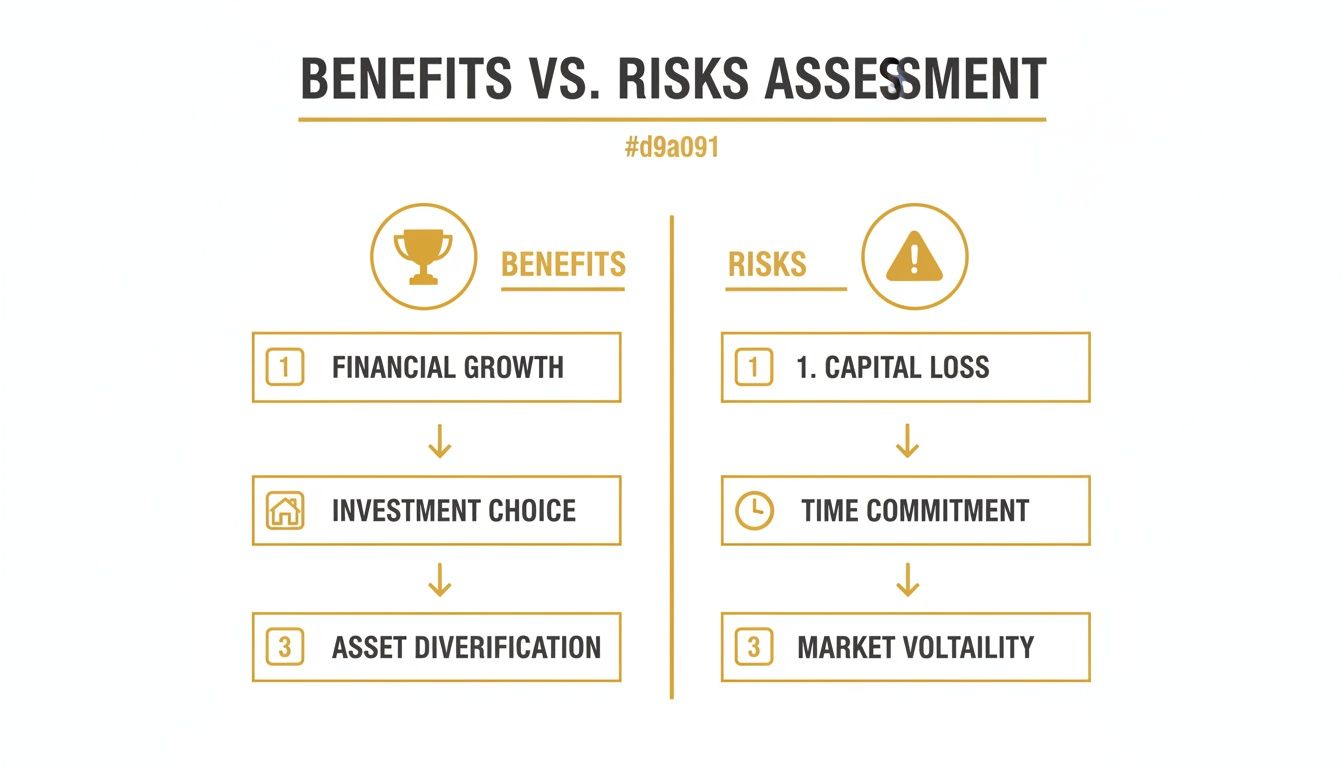
As you can see, the huge appeal of having total control over your investments is directly balanced by the significant time commitment and personal risk involved.
Ongoing Management and Annual Duties
Once your SMSF is up and running, your role as captain truly begins. Your focus shifts from setup to ongoing management, making sure the fund stays compliant and always operates in the best interests of its members. This is not a set-and-forget task; it’s an active, year-round commitment.
As a trustee, you are personally liable for the fund's compliance. Meticulous record-keeping and a clear understanding of your annual obligations are not just best practices—they are legal requirements.
Your annual duties are the heartbeat of a compliant fund. Think of this as your captain's log, where every decision and transaction must be documented, justified, and accounted for. On top of that, effective management also demands robust practices in cybersecurity and accounting to protect the fund's data and keep everything in order.
Here’s a look at what you must do, every single year, without fail:
- Implement an Investment Strategy: You are legally required to have a written investment strategy. This document outlines the fund's objectives and the plan to achieve them, and it must be reviewed regularly.
- Maintain Meticulous Records: Every single transaction—from contributions and investments to expenses and pension payments—must be accurately recorded and backed up with documentation.
- Value Fund Assets: At the end of each financial year, all the fund's assets must be valued at their current market price.
- Arrange an Independent Audit: An approved SMSF auditor must review your fund's financial statements and compliance records each year. This is non-negotiable.
- Lodge Your Annual Return: You must prepare and lodge an SMSF annual return with the ATO, which includes all the fund's financial statements and tax information for the year.
How to Start Your SMSF Journey
Getting your head around what an SMSF actually is marks the beginning. But the real question you need to ask yourself next is: does this genuinely fit with where I want to be financially?
This is precisely where getting the right professional guidance becomes a non-negotiable. An SMSF isn’t just a glorified savings account; it's a sophisticated financial structure with a lot of moving parts. This is especially true if you have specific goals in mind, like investing in property or using your super to support your business.
Trying to navigate this journey solo is a recipe for disaster. The setup process is intricate, keeping up with the ATO's compliance rules is a constant demand, and the tax scenarios can get complex—fast. Having a specialist advisor in your corner is crucial to shoulder these administrative burdens. It frees you up to focus on the part that actually matters: your investment strategy.
An expert consultation is the single most effective way to build a retirement strategy that's perfectly aligned with your unique financial situation, whether you're a property investor, business owner, or high-net-worth individual.
This kind of tailored advice ensures every decision you make is not only compliant but also strategically sound, right from day one. By partnering with experts, you can steer your financial future with confidence and start building the retirement you’ve always envisioned.
To get a clearer picture of what's involved in the initial stages, it’s also a good idea to learn more about the typical SMSF setup costs.
Common Questions About SMSFs
Thinking about starting your own super fund is a big step, and it naturally brings up a lot of practical questions. Before you dive in, you need clear, no-nonsense answers. Let's tackle some of the most common things people ask when they first look into an SMSF.
This is all about cutting through the jargon to give you the key details on costs, borrowing, time commitment, and what happens if you get things wrong.
How Much Money Do I Need to Start an SMSF?
While there isn't a strict legal minimum, the general rule of thumb from most financial experts is a starting balance of at least $200,000 to $500,000.
Why so much? It all comes down to costs. The fixed annual fees for running an SMSF—like audits, accounting, and any advice—can really eat into your returns on a smaller balance. Below that $200,000 mark, these costs take a much bigger bite, and you'd likely be better off growing your super in a standard industry or retail fund.
Can I Borrow Money to Buy Property in My SMSF?
Yes, you can, but it’s not as simple as taking out a regular home loan. An SMSF can only borrow to buy property through a very specific structure called a Limited Recourse Borrowing Arrangement (LRBA).
This is one of the most heavily regulated areas of superannuation, and for good reason. The ATO has strict rules to make sure the other assets in your fund are protected if the property loan goes bad. It is absolutely essential to get professional financial and legal advice before even thinking about an LRBA to make sure you stay compliant and understand every single risk involved.
Getting the rules wrong, even by accident, can lead to serious penalties from the ATO. We’re not talking about a slap on the wrist; this can mean significant fines that you, as the trustee, are personally responsible for.
In the most serious cases, the ATO could declare your fund 'non-complying'. This is the nightmare scenario, as it could result in your fund's assets being taxed at the highest marginal rate. It really highlights why getting professional guidance isn’t just a good idea—it’s a necessity.
What Is the Time Commitment for Managing an SMSF?
Don't underestimate the time it takes to run your own super fund properly. Most trustees report spending several hours every month just on the basics: administration, meticulous record-keeping, and researching investments.
The exact time you’ll need to put in depends on how complex your investments are and how much of the heavy lifting you outsource. If you hire professionals like accountants, administrators, and financial advisers to handle the admin, your time commitment will obviously be lower, but it never drops to zero.
The ATO provides guidance through ato.gov.au, the Small Business Support Line (13 28 66), and Online Services for individuals and businesses. For complex situations, a registered tax agent provides advice tailored to your specific circumstances and professional indemnity protection. You can verify agent registration at the TPB register at tpb.gov.au.
Most tax records must be kept for five years from the date of lodgement or the date the transaction occurred, whichever is later. Records must be in English or convertible to English and must be sufficient to explain the income and deductions in your return. The ATO can request records at any time during the retention period.
Consider a registered tax agent when your affairs involve multiple income sources, business activity, investment properties, capital gains, or overseas income. Agents extend your lodgement deadline, provide safe harbour protection, and take professional responsibility for the advice given. Verify registration at tpb.gov.au.
The failure to lodge penalty is based on penalty units ($313 per unit from 1 July 2023), accruing per 28-day period for late returns and BAS lodgements. Incorrect information penalties range from 25% to 75% of the tax shortfall depending on whether the behaviour was careless, reckless, or intentional. Proactive disclosure before an audit begins typically results in significantly reduced penalties.
Tax minimisation is the legal arrangement of your affairs to reduce tax — claiming all eligible deductions, using appropriate structures, and timing income and expenses. Tax avoidance involves arrangements that technically comply with the law but achieve outcomes parliament did not intend. The ATO can apply Part IVA anti-avoidance rules to cancel benefits from avoidance arrangements.
Ready to explore if an SMSF is the right fit for your financial future? The team at Australia Wide Tax Solutions provides expert guidance on SMSF setup, compliance, and strategic management. Contact us today for a personalised consultation and take the next step with confidence.
Introduction
Australia's taxation system is one of the most sophisticated and comprehensive in the world, serving as the financial backbone that funds essential government services while maintaining economic stability. Whether you're a new Australian resident navigating your first tax return, an established business owner seeking to optimise your tax strategy, or an international investor exploring Australian opportunities, understanding the intricacies of the Australian tax system is crucial for your financial success.
- Introduction
This comprehensive guide will take you through every aspect of Australian taxation, from basic concepts to advanced strategies, ensuring you have the knowledge needed to make informed decisions and remain compliant with Australian tax law.
The Foundation of Australian Taxation
Historical Context and Structure
Australia's modern tax system evolved from British colonial taxation models, developing into a sophisticated federal system that balances revenue generation with economic growth incentives. The Australian Taxation Office (ATO), established in 1910, serves as the primary tax collection agency, administering federal taxes on behalf of the Commonwealth Government.
The system operates on several key principles:
- Equity: Fair distribution of tax burden based on ability to pay
- Efficiency: Minimal economic distortion while maximising revenue
- Simplicity: Clear rules and processes for taxpayers
- Transparency: Open and accountable tax administration
Federal vs State Taxation
Australia operates a federal tax system where the Commonwealth Government collects the majority of taxes, including income tax, GST, and company tax. State and territory governments primarily collect stamp duty, payroll tax, and land tax, creating a coordinated approach to taxation across all levels of government.
Individual Income Tax: A Deep Dive
Progressive Tax System Explained
Australia's progressive income tax system is designed to ensure those with higher incomes contribute proportionally more to government revenue. The marginal tax rate system means you only pay the higher rate on income above each threshold, not on your entire income.
Detailed Tax Brackets for 2024-25 Financial Year:
| Taxable Income | Tax Rate | Tax on This Income |
|---|---|---|
| $0 – $18,200 | 0% | Nil |
| $18,201 – $45,000 | 19% | 19c for each $1 over $18,200 |
| $45,001 – $120,000 | 32.5% | $5,092 plus 32.5c for each $1 over $45,000 |
| $120,001 – $180,000 | 37% | $29,467 plus 37c for each $1 over $120,000 |
| $180,001 and above | 45% | $51,667 plus 45c for each $1 over $180,000 |
Tax-Free Threshold Benefits
The $18,200 tax-free threshold is a significant benefit for all Australian residents, meaning the first $18,200 of income is completely tax-free. This threshold is particularly beneficial for:
- Part-time workers and students
- Retirees with modest incomes
- Small business owners in their startup phase
Residency for Tax Purposes
Understanding your tax residency status is crucial as it determines your tax obligations:
Australian Tax Residents:
- Taxed on worldwide income
- Entitled to the tax-free threshold
- Subject to the Medicare Levy
Non-Residents:
- Taxed only on Australian-sourced income
- No tax-free threshold (taxed from the first dollar)
- Generally not subject to the Medicare Levy
Factors Determining Residency:
- Physical presence in Australia
- Intention to remain in Australia
- Family and business ties
- Accommodation arrangements
Medicare Levy and Healthcare Funding
Medicare Levy Structure
The Medicare Levy is a 2% tax on taxable income that funds Australia's universal healthcare system. Key features include:
Standard Rate: 2% of taxable income. Low-Income Thresholds for 2024-25:
- Singles: $29,207
- Families: $49,304 (plus $4,530 for each dependent child)
- Single seniors and pensioners: $36,056
- Family seniors and pensioners: $57,198
Medicare Levy Surcharge
High-income earners without adequate private health insurance pay an additional Medicare Levy Surcharge:
| Income Thresholds | Singles | Families | Surcharge Rate |
|---|---|---|---|
| Tier 1 | $97,000-$113,000 | $194,000-$226,000 | 1.0% |
| Tier 2 | $113,001-$151,000 | $226,001-$302,000 | 1.25% |
| Tier 3 | $151,001+ | $302,001+ | 1.5% |
Business Taxation Comprehensive Overview
Company Tax Rates and Structures
Small Business Company Tax Rate (25%):
- Companies with aggregated turnover under $50 million
- Eligible for various small business concessions
- Access to simplified accounting methods
Standard Company Tax Rate (30%):
- Large companies with a turnover of over $50 million
- Subject to additional compliance requirements
- May be eligible for specific industry concessions
Goods and Services Tax (GST) Deep Dive
GST is a broad-based consumption tax of 10% applied to most goods and services in Australia.
GST Registration Requirements:
- Mandatory for businesses with a turnover over $75,000
- Voluntary registration available for smaller businesses
- Non-profit organisations: $150,000 threshold
GST-Free Supplies Include:
- Basic food items
- Medical and health services
- Educational courses and materials
- Exports
- Financial supplies
Input Tax Credits: Businesses can claim credits for GST paid on business purchases, effectively making GST a tax on final consumption rather than business inputs.
Business Activity Statements (BAS)
Reporting Frequencies:
- Monthly: Large businesses (turnover over $20 million)
- Quarterly: Most businesses
- Annually: Small businesses with simple affairs
BAS Components:
- GST collected and paid
- PAYG withholding from employees
- PAYG instalments for income tax
- Fringe Benefits Tax (if applicable)
Capital Gains Tax (CGT) Detailed Analysis
CGT Event Triggers
Capital gains tax applies when a CGT event occurs, typically the sale or disposal of an asset acquired after September 19, 1985.
Common CGT Events:
- Sale of real estate (excluding main residence)
- Sale of shares and securities
- Disposal of business assets
- Cryptocurrency transactions
- Granting of options or rights
CGT Calculation Methods
Method 1: Discount Method
- Available for assets held longer than 12 months
- 50% discount for individuals and trusts
- 33.33% discount for complying superannuation funds
- No discount for companies
Method 2: Indexation Method
- Available for assets acquired before September 21, 1999
- Adjusts cost base for inflation
- Generally less favourable than the discount method
Method 3: Other Method
- No discount or indexation
- Used for assets held less than 12 months
- Applied to companies (no discount available)
Main Residence Exemption
The family home is generally exempt from CGT, but specific rules apply:
- Must be your main residence
- Used primarily for private purposes
- Land area generally under 2 hectares
- Special rules for partial exemptions
Superannuation: Australia's Retirement System
Superannuation Guarantee
Employers must contribute a minimum percentage of employee wages to superannuation:
- Current Rate: 11.5% (as of July 1, 2023)
- Future Increases: Rising to 12% by July 1, 2025
Contribution Types and Limits
Concessional Contributions (2024-25):
- Annual limit: $30,000
- Includes employer contributions and salary sacrifice
- Taxed at 15% in the fund
Non-Concessional Contributions (2024-25):
- Annual limit: $120,000
- After-tax contributions
- Not taxed in the fund
- Bring-forward rule allows up to $360,000 over three years
Self-Managed Super Funds (SMSFs)
SMSFs provide greater control over investment decisions but come with increased responsibilities:
- Maximum 6 members
- All members must be trustees
- Strict compliance requirements
- Annual audit requirements
Tax Deductions and Optimisation Strategies
Work-Related Deductions
Clothing and Uniforms:
- Compulsory uniforms with the employer logo
- Protective clothing and safety equipment
- Conventional clothing is not deductible
Vehicle Expenses:
- Logbook method (actual expenses based on business use percentage)
- Cents per kilometre method (up to 5,000 business kilometres)
Home Office Expenses:
- Fixed rate method: $0.67 per hour worked from home
- Actual cost method: Proportion of actual expenses
- Shortcut method: $0.80 per hour (temporary COVID-19 measure)
Self-Education Expenses:
- Course fees, textbooks, and materials
- Travel to and from the place of education
- Must have sufficient connection to current employment
Investment Property Deductions
Immediately Deductible:
- Interest on loans
- Property management fees
- Insurance premiums
- Council rates and land tax
- Repairs and maintenance
Capital Works Deductions:
- Building construction costs (2.5% per year over 40 years)
- Renovations and structural improvements
- Plant and equipment depreciation
International Taxation and Cross-Border Issues
Tax Treaties and Double Tax Agreements
Australia has comprehensive tax treaties with over 45 countries, designed to:
- Prevent double taxation
- Reduce withholding tax rates
- Facilitate information exchange
- Provide dispute resolution mechanisms
Foreign Income and Assets
Reporting Requirements:
- All foreign income must be declared
- Foreign tax credits are available for tax paid overseas
- Controlled Foreign Company (CFC) rules may apply
- Transfer pricing rules for related party transactions
Common International Scenarios:
- Australian residents working overseas
- Foreign residents with Australian investments
- Multinational business operations
- Cryptocurrency held on foreign exchanges
Compliance, Penalties, and ATO Powers
Lodgment Requirements and Deadlines
Individual Tax Returns:
- Self-preparers: October 31
- Tax agent clients: May 15 (following year)
- Extensions available in special circumstances
Business Obligations:
- BAS: 28 days after quarter end
- Annual company returns: Due dates vary
- PAYG withholding: Monthly or quarterly
ATO Data Matching and Technology
The ATO uses sophisticated data matching to verify tax return information:
- Bank interest and dividend data
- Employment income from payroll systems
- Government payment information
- Cryptocurrency exchange data
- Property transaction records
Penalty Structure
Administrative Penalties:
- Failure to lodge: $330-$1,650 per period
- Late payment: General interest charge
- False or misleading statements: 25-75% of the shortfall
Criminal Penalties:
- Tax evasion: Up to 10 years imprisonment
- Serious tax fraud: Up to 12 years imprisonment
Industry-Specific Tax Considerations
Healthcare Professionals
- Professional development expenses
- Medical equipment depreciation
- Professional indemnity insurance
- Locum and relief work considerations
Airline Staff
- Travel allowances and overseas per diems
- Uniform and equipment expenses
- Irregular work patterns and tax implications
- International flight crew considerations
Cryptocurrency and Digital Assets
- CGT implications for trading
- Mining income and deductions
- DeFi and staking rewards
- Record-keeping requirements
E-commerce and Digital Business
- GST on digital services
- International sales considerations
- Platform fees and commissions
- Inventory valuation methods
Advanced Tax Planning Strategies
Small Business CGT Concessions
Four main concessions available for qualifying small businesses:
- 15-year exemption: Complete exemption for assets held 15+ years
- 50% active asset reduction: Additional 50% reduction
- Retirement exemption: Up to $500,000 lifetime limit
- Rollover relief: Defer CGT by acquiring replacement assets
Family Trust Elections and Distributions
- Income splitting opportunities
- Trust loss restrictions
- Beneficiary tax implications
- Streaming of different income types
Negative Gearing Strategies
- Cash flow implications
- Long-term capital growth focus
- Risk management considerations
- Alternative investment structures
Technology and Digital Transformation
ATO Digital Services
- MyGov integration for individuals
- Business Portal for companies
- Real-time reporting initiatives
- Artificial intelligence in compliance
Record-Keeping in the Digital Age
- Cloud-based accounting systems
- Digital receipt management
- Automated bank feeds
- Blockchain and audit trails
Future of Australian Taxation
Proposed Reforms and Changes
- Stage 3 tax cuts implementation
- Multinational tax avoidance measures
- Digital services tax considerations
- Environmental tax incentives
Economic Trends Impacting Tax Policy
- An aging population and healthcare costs
- Infrastructure investment needs
- Climate change and carbon pricing
- Digital economy growth
Getting Professional Tax Help
When to Engage a Tax Professional
Complex Situations Requiring Expert Advice:
- International tax obligations
- Business restructuring
- Large capital gains events
- ATO audit or review
- Complex investment structures
Choosing the Right Tax Advisor
Qualifications to Look For:
- Registered Tax Agent status
- Professional memberships (CPA, CA, IPA)
- Industry-specific experience
- Continuing professional development
- Technology adoption and efficiency
Questions to Ask Potential Advisors:
- Experience with your industry or situation
- Fee structure and transparency
- Communication and availability
- Technology and digital capabilities
- Professional indemnity insurance
Conclusion
Australia's taxation system, while complex, provides a stable framework for funding essential government services while supporting economic growth and development. Understanding your obligations and opportunities within this system is crucial for financial success and legal compliance.
The key to navigating Australian taxation successfully lies in:
- Staying informed about changes and updates
- Maintaining accurate and comprehensive records
- Seeking professional advice for complex situations
- Planning ahead rather than reacting to tax obligations
- Understanding the broader economic context of tax policy
As tax laws continue to evolve with changing economic conditions and government priorities, the importance of professional guidance becomes even more critical. Whether you're an individual taxpayer or business owner, investing in proper tax advice and planning will pay dividends in terms of compliance, optimisation, and peace of mind.
Remember that tax planning is not about avoiding your obligations but about understanding and optimising your position within the legal framework. With proper knowledge and professional support, you can ensure that you're meeting your tax responsibilities while maximising your financial outcomes.
The ATO provides guidance through ato.gov.au, the Small Business Support Line (13 28 66), and Online Services for individuals and businesses. For complex situations, a registered tax agent provides advice tailored to your specific circumstances and professional indemnity protection. You can verify agent registration at the TPB register at tpb.gov.au.
Most tax records must be kept for five years from the date of lodgement or the date the transaction occurred, whichever is later. Records must be in English or convertible to English and must be sufficient to explain the income and deductions in your return. The ATO can request records at any time during the retention period.
Consider a registered tax agent when your affairs involve multiple income sources, business activity, investment properties, capital gains, or overseas income. Agents extend your lodgement deadline, provide safe harbour protection, and take professional responsibility for the advice given. Verify registration at tpb.gov.au.
The failure to lodge penalty is based on penalty units ($313 per unit from 1 July 2023), accruing per 28-day period for late returns and BAS lodgements. Incorrect information penalties range from 25% to 75% of the tax shortfall depending on whether the behaviour was careless, reckless, or intentional. Proactive disclosure before an audit begins typically results in significantly reduced penalties.
Tax minimisation is the legal arrangement of your affairs to reduce tax — claiming all eligible deductions, using appropriate structures, and timing income and expenses. Tax avoidance involves arrangements that technically comply with the law but achieve outcomes parliament did not intend. The ATO can apply Part IVA anti-avoidance rules to cancel benefits from avoidance arrangements.
Are you seeking a tax agent in Sydney to help you with your tax affairs? Choosing a tax agent can be difficult, considering many factors.
Here are some tips to help you make an informed decision:
- Look for a tax agent registered with the Tax Practitioners Board (TPB). This ensures they have the qualifications and experience to provide tax advice and services. Our Tax Agent number is 78641007, Australia Wide Tax Solutions Pty Ltd.
- Consider the type of tax services you need. Do you need help with your tax return, or are you a business owner looking for tax planning and compliance advice? Ensure the tax agent you choose has expertise in the areas you need assistance with.
- Check out the tax agent's reputation. Look for reviews and testimonials from previous clients to understand their expertise and customer service.
- Consider the tax agent's fees. Tax services can be expensive, but finding the right tax agent in Sydney who offers competitive rates is essential. Don't hesitate to negotiate or shop around to find the best deal. You know what they say: pay peanuts, and you get monkeys.
Our team of experienced and knowledgeable tax agents dedicates itself to providing top-quality tax services to individuals and businesses. We commit to helping our clients navigate the complexities of the tax system and maximise their tax savings.
Contact us today to learn how we can help you with your tax and accounting needs.
The ATO provides guidance through ato.gov.au, the Small Business Support Line (13 28 66), and Online Services for individuals and businesses. For complex situations, a registered tax agent provides advice tailored to your specific circumstances and professional indemnity protection. You can verify agent registration at the TPB register at tpb.gov.au.
Most tax records must be kept for five years from the date of lodgement or the date the transaction occurred, whichever is later. Records must be in English or convertible to English and must be sufficient to explain the income and deductions in your return. The ATO can request records at any time during the retention period.
Consider a registered tax agent when your affairs involve multiple income sources, business activity, investment properties, capital gains, or overseas income. Agents extend your lodgement deadline, provide safe harbour protection, and take professional responsibility for the advice given. Verify registration at tpb.gov.au.
The failure to lodge penalty is based on penalty units ($313 per unit from 1 July 2023), accruing per 28-day period for late returns and BAS lodgements. Incorrect information penalties range from 25% to 75% of the tax shortfall depending on whether the behaviour was careless, reckless, or intentional. Proactive disclosure before an audit begins typically results in significantly reduced penalties.
Tax minimisation is the legal arrangement of your affairs to reduce tax — claiming all eligible deductions, using appropriate structures, and timing income and expenses. Tax avoidance involves arrangements that technically comply with the law but achieve outcomes parliament did not intend. The ATO can apply Part IVA anti-avoidance rules to cancel benefits from avoidance arrangements.
AGENT Nomination
- What is myGov?
- Why Add Your Tax Agent to myGov?
- How to Add Your Tax Agent to myGov
- Benefits of Having Your Tax Agent Linked to myGov
- Tips for Effectively Managing Your Tax Agent Linkage
Tax season can be a stressful and overwhelming time for many Australians. Between gathering all the necessary documents, understanding complex tax laws, and ensuring you're claiming every eligible deduction, the process of filing your taxes can feel daunting. Fortunately, there's an easy way to make tax time a little easier - by adding your tax agent to your myGov account.
In this blog post, we'll walk you through the step-by-step process of how to add your tax agent to myGov.au. By doing so, you can seamlessly share information, communicate, and collaborate with your tax professional, streamlining the entire tax filing experience. Whether you're a first-time filer or a seasoned taxpayer, this guide will help you navigate the process with confidence and ease.
What is myGov?
MyGov.au is the Australian government's online platform that allows citizens to access a variety of government services and information in one convenient location. Through your myGov.au account, you can manage your interactions with agencies such as the Australian Taxation Office (ATO), Centrelink, Medicare, and more.
One of the key benefits of using myGov.au is the ability to link your various government accounts, including your tax agent, to your single sign-on portal. This integration makes it easier to share information, upload documents, and communicate with your tax professional, all while keeping your personal and financial data secure.
Why Add Your Tax Agent to myGov?
There are several compelling reasons why you should consider adding your tax agent to your myGov account:
- Improved Communication and Collaboration: By linking your tax agent to your myGov.au account, you can easily share information, upload documents, and communicate directly with your tax agent through the platform. This streamlines the tax preparation process and ensures that your tax agent has access to all the necessary information to file your taxes accurately and efficiently.
- Secure Data Sharing: myGov.au provides a secure platform for sharing your personal and financial information with your tax agent. This helps protect your sensitive data and ensures it is accessed only by authorised individuals.
- Increased Convenience: With your tax agent linked to your myGov.au account, you can access all your tax-related information and communicate with your agent in one central location. This eliminates the need to juggle multiple platforms or physically deliver documents, making the process more convenient and efficient.
- Better Organisation and Record-Keeping: By adding your tax agent to myGov.au, you can keep all your tax-related documents and communications in one place, making it easier to stay organised and maintain accurate records for future reference.
- Improved Tax Preparation and Filing: With your tax agent directly connected to your myGov.au account, they can more effectively prepare and file your tax return, ensuring you're taking advantage of all available deductions and maximising your tax refund.
How to Add Your Tax Agent to myGov
Adding your tax agent to your myGov account is a straightforward process. Here are the steps:
- Log in to your myGov account: Visit the myGov website (my.gov.au) and sign in using your username and password.
- Navigate to the "Linked Services" section: Once logged in, locate the "Linked Services" section, typically found on the left-hand side of the dashboard.
- Select "Add or remove a service": Click on the "Add or remove a service" option within the Linked Services section.
- Search for and select the "Australian Taxation Office": In the search bar, type "Australian Taxation Office" and select it from the list of available services.
- Choose the "Link my tax agent" option: On the ATO page, look for the "Link my tax agent" option and click on it.
- Provide your tax agent's details: You'll be prompted to enter your tax agent's name, Australian Business Number (ABN), and tax agent number. Make sure this information is readily available before starting the process. Australia Wide Tax Solutions' tax agent number is 78641007, and ABN is 92135466689.
- Confirm the linkage: Once you've entered your tax agent's details, review the information and confirm the linkage. Your tax agent will then be added to your myGov account.
It's important to note that your tax agent will need an active myGov account and be registered with the ATO so they can link to your account successfully. If your tax agent doesn't have a myGov account, they'll need to create one before you can proceed with the linking process.
Why is client-to-agent linking required?
The ATO takes the security of your personal information seriously.
Client-to-agent linking helps keep your personal information safe and protects you against identity-related fraud and theft. It ensures only your nominated agent can access your information and act on your behalf for your tax and super affairs.
Download the guide here on how to add a tax agent.
For all other issues, please call the ATo direct on 132866
Benefits of Having Your Tax Agent Linked to myGov
By adding your tax agent to your myGov account, you can enjoy a range of benefits that can make the tax filing process more efficient and stress-free. Here are some of the key advantages:
- Seamless Communication: With your tax agent linked to your myGov account, you can easily share documents, ask questions, and receive updates on the status of your tax return, all within the secure myGov platform.
- Improved Organization: myGov provides a centralized location for all tax-related information and communications, making it easier to stay organized and track your tax affairs.
- Faster Tax Preparation and Filing: Your tax agent can more quickly and accurately prepare your tax return with direct access to your myGov account and its information.
- Reduced Errors: Linking your tax agent to myGov can help reduce the risk of errors in your tax return by eliminating the need to transfer data between platforms manually.
- Increased Transparency: With your tax agent linked to your myGov account, you can easily monitor the progress of your tax return and stay informed throughout the process.
- Convenient Access to Tax Records: All your tax-related documents and communications with your agent will be stored securely within your myGov account, making it easy to access them whenever needed.
- Simplified Tax Time: By streamlining the tax preparation and filing process, adding your tax agent to myGov can help make tax time a little less stressful and more manageable.
Tips for Effectively Managing Your Tax Agent Linkage
To make the most of having your tax agent linked to your myGov account, consider the following tips:
- Keep Your Contact Information Up-to-Date: Ensure your personal and tax agent's contact information is accurate and up-to-date in your myGov account. This will help ensure smooth communication and information sharing.
- Regularly Review Your Linked Services: Check your myGov account to ensure your tax agent is still correctly linked. If you change tax agents, be sure to update the linkage accordingly.
- Communicate Proactively: Don't wait until the last minute to start sharing information with your tax agent. Please provide them with any necessary documents or updates throughout the year so they can better prepare your tax return.
- Understand Your Tax Agent's Responsibilities: Familiarize yourself with the roles and responsibilities of your tax agent so you can effectively collaborate with them and ensure a successful tax filing experience.
- Utilize myGov's Security Features: Use myGov's security features, such as two-factor authentication, to protect your personal and financial information.
- Regularly Review Your Tax Return: Even with your tax agent linked to your myGov account, it is essential to review your tax return thoroughly before submission to ensure accuracy and catch any potential errors.
Conclusion
How to add your tax agent to your myGov account is a simple yet powerful way to streamline the tax filing process and make tax time less stressful. By leveraging the secure and convenient features of myGov, you can improve communication, collaboration, and organization with your tax professional, ultimately ensuring that your taxes are filed accurately and efficiently.
Whether you're a first-time filer or a seasoned taxpayer, following the steps outlined in this guide will help you seamlessly link your tax agent to your myGov account and enjoy the benefits of this integration. So, take the time to add your tax agent to myGov today and simplify your tax time experience.
The ATO provides guidance through ato.gov.au, the Small Business Support Line (13 28 66), and Online Services for individuals and businesses. For complex situations, a registered tax agent provides advice tailored to your specific circumstances and professional indemnity protection. You can verify agent registration at the TPB register at tpb.gov.au.
Most tax records must be kept for five years from the date of lodgement or the date the transaction occurred, whichever is later. Records must be in English or convertible to English and must be sufficient to explain the income and deductions in your return. The ATO can request records at any time during the retention period.
Consider a registered tax agent when your affairs involve multiple income sources, business activity, investment properties, capital gains, or overseas income. Agents extend your lodgement deadline, provide safe harbour protection, and take professional responsibility for the advice given. Verify registration at tpb.gov.au.
The failure to lodge penalty is based on penalty units ($313 per unit from 1 July 2023), accruing per 28-day period for late returns and BAS lodgements. Incorrect information penalties range from 25% to 75% of the tax shortfall depending on whether the behaviour was careless, reckless, or intentional. Proactive disclosure before an audit begins typically results in significantly reduced penalties.
Tax minimisation is the legal arrangement of your affairs to reduce tax — claiming all eligible deductions, using appropriate structures, and timing income and expenses. Tax avoidance involves arrangements that technically comply with the law but achieve outcomes parliament did not intend. The ATO can apply Part IVA anti-avoidance rules to cancel benefits from avoidance arrangements.
A registered tax accountant does far more than lodge your annual tax return — they are a year-round strategic partner for individuals and businesses seeking to legally minimise tax, stay ATO-compliant, and plan for long-term financial outcomes. In 2026, the complexity of the Australian tax system (Stage 3 cuts, crypto reporting, STP Phase 2, instant write-off changes) means the value of professional tax advice has never been higher. Here are five compelling benefits of using a registered tax accountant in 2026.
1. Proactive Tax Planning — Not Just Compliance
The most significant value from a tax accountant is what happens before 30 June — not after. Reviewing your income position in May or June, advising on super contribution top-ups, timing of asset purchases, prepaying deductible expenses, and harvesting capital losses are all strategies that can only be executed before year-end. A good tax accountant reviews your situation annually and proactively advises on planning opportunities — not just reports what happened.
2. ATO Audit Defence and Review Support
The ATO audits thousands of individual and business returns each year. Having a registered tax accountant means any ATO correspondence, audit, or review is handled by a professional who knows the ATO's internal processes, how to present documentation effectively, and how to negotiate penalty remissions. Facing an ATO audit without professional representation is a significant disadvantage — and the risk of an adverse outcome is substantially higher.
3. Business Structuring Advice
Whether to operate as a sole trader, company, trust, or partnership affects not just your current tax rate but your liability exposure, asset protection, super contribution capacity, and CGT position when you eventually sell or wind up. A tax accountant models the financial impact of different structures for your specific income level and business type — and restructuring at the right time can save tens of thousands of dollars over the life of a business.
4. Investor Tax Optimisation
Investment property owners, share investors, SMSF trustees, and crypto traders all face complex tax obligations that myTax is not designed to handle accurately. A tax accountant ensures depreciation schedules are applied correctly, capital gains are calculated with the correct cost base, negative gearing losses are fully claimed, franking credits are correctly applied, and crypto transactions are properly reported — all of which require specialist knowledge.
5. Time and Stress Savings
For business owners and high-income individuals, the time cost of managing tax compliance internally is significant. A tax accountant handles BAS preparation, payroll tax, SMSF accounting, FBT returns, and annual income tax returns — freeing business owners to focus on their business. The cost of accounting is also entirely tax deductible in the following year.
Frequently Asked Questions
Is a tax accountant the same as a financial planner?
No. A registered tax accountant (CPA or CA) specialises in tax compliance, structuring, and advice under Australian tax law. A financial planner holds an Australian Financial Services Licence (AFSL) and advises on investment products, superannuation strategy, and insurance. Many tax issues benefit from both perspectives — particularly for business owners, investors, and retirees. Some firms offer integrated accounting and financial planning services.
How much does a tax accountant cost?
Fees vary by complexity. An individual return with simple income and standard deductions: $150-$400. An individual with rental properties, shares, and capital gains: $400-$900. A small business (company or trust) annual return: $800-$3,000+. The fee is tax deductible the following year, reducing the effective cost by your marginal tax rate. Most accountants will provide a fee estimate before commencing work.
Looking for a proactive registered tax accountant in 2026? Contact AWTS — we serve individuals, investors, and businesses across Australia with comprehensive tax and accounting services.