
What Australians with Property in Greece Need to Know
If you're an Australian resident with property in Greece — whether it's a family holiday home, an inherited house, or an investment you rent out — you've probably come across the terms "Certificate of Residency" and "overseas tax relief form" at some point. Greek notaries, tax offices, and even your own accountant may ask for one.
For many of our clients with ties to Greece, this paperwork feels unfamiliar and, frankly, a bit confusing.
This guide explains what these documents actually are, why the ATO issues them, and why they matter more than usual if your property is in Greece specifically.
What is a Certificate of Residency?
A Certificate of Residency is a document issued by the ATO confirming that, for a specific period, you were an Australian resident for tax purposes and therefore liable to pay tax in Australia on your worldwide income. In plain terms, it's official proof — accepted by foreign governments and institutions — that you pay tax in Australia, not in the other country.
Individuals apply using the ATO's request form (NAT 75441);
businesses and other entities use a separate version (NAT 75442).
The certificate typically covers a specific income year or period, so if you need proof for several years, you may need to request more than one.
What is an overseas tax relief form, and how is it different?
An overseas tax relief form is a document issued by a foreign tax authority — not the ATO — that a taxpayer asks the ATO to certify. Certifying it confirms to the foreign authority that you're an Australian tax resident, which can then be used to access reduced withholding tax rates or exemptions under a tax treaty (for example, on foreign dividends, interest, or pension income).
Here's the important part: the ATO will only certify one of these overseas forms where a comprehensive tax treaty is in force between Australia and that country. If no such treaty exists, there's no treaty mechanism for the ATO to certify against — so instead, you simply request the standard Certificate of Residency and use that as your evidence of Australian tax residency.
Why this matters more if your property is in Greece
This is where things get particularly relevant for many of our clients. Australia has income tax treaties in force with dozens of countries — the UK, the US, Germany, Italy, and many more — but Australia and Greece do not currently have a comprehensive double tax agreement. The only tax arrangement between the two countries is a narrow 1981 agreement covering airline profits, which has nothing to do with property, rental income, or individuals.
There has been genuine movement on this: in early 2026, Australian and Greek officials confirmed they were advancing talks toward a full bilateral tax treaty, driven by the size of the Greek-Australian community and the volume of cross-border investment, including property. But talks are not a treaty — until one is signed, ratified by both parliaments, and brought into force, there is no treaty-based relief available between the two countries.
Practically, that has a few consequences for property owners:
- You can't get a Greek-specific relief form certified by the ATO, because there's no treaty for the ATO to certify it under. If Greek authorities ask you to prove Australian tax residency, a standard Certificate of Residency is what you'll provide instead.
- Double taxation is a real risk, not just a theoretical one. Because there's no treaty to divide taxing rights or guarantee relief, both Australia and Greece can legitimately tax the same rental income or capital gain. Australia's relief in this situation comes not from a treaty, but from the Foreign Income Tax Offset (FITO) — a unilateral credit for foreign tax you've genuinely paid, which reduces (but doesn't always fully eliminate) the Australian tax on the same income.
- A Certificate of Residency helps support your position with Greek authorities and with the ATO. It's useful evidence when you're establishing to Greek tax authorities, a notary, or a bank that you are an Australian tax resident and not a Greek one, and it's good supporting documentation to keep on file when claiming a FITO for Greek tax paid.
Where a Certificate of Residency actually comes up for Greek property
A few practical touchpoints where this document tends to matter:
Getting an AFM (Greek tax number). You can't buy property, open a Greek bank account, or sign at a notary in Greece without an AFM. Getting one doesn't automatically require a Certificate of Residency, but having your Australian tax residency clearly documented helps avoid confusion about which country you should be reporting and paying tax in — an AFM does not make you a Greek tax resident, but the distinction is one Greek authorities, notaries, and even Australian advisers sometimes need spelled out.
Rental income from Greek property. If you rent out a Greek property, Greece taxes that income at progressive rates — currently 15% up to €12,000, 35% between €12,001 and €35,000, and 45% above that, with a standard 5% deduction applied instead of claiming actual expenses. That same rental income is also assessable in Australia as part of your worldwide income. Good records of your Australian residency and the Greek tax you've paid are essential to claim your FITO correctly and avoid paying full tax twice.
Selling Greek property. Capital gains tax on Greek property sales is currently suspended under a legislative measure in force until at least 31 December 2026 — but this is a temporary exemption, not a permanent rule, and it can change. Any gain will still need to be considered under Australian capital gains tax rules, where your Australian residency status is central to how the gain is taxed.
ENFIA (annual Greek property tax). Foreign owners are required to lodge a property statement (E9) and pay ENFIA on Greek real estate, just like Greek residents — residency status doesn't exempt you from this particular tax. It's a separate issue from income tax residency, but it's another reminder that Greek property ownership brings ongoing compliance obligations in both countries.
Estates and inheritance. If a Greek property passes to you, or you're managing a deceased estate with Greek assets, Greek authorities and notaries will often want clear documentation of the beneficiaries' tax residency status as part of the process.
Getting your Certificate of Residency ready to use in Greece
Two things trip people up when they try to actually use an ATO Certificate of Residency in Greece:
- Apostille. Both Australia and Greece are members of the Hague Apostille Convention, so rather than going through a lengthy embassy legalisation process, you can have DFAT attach an apostille to your certificate, which Greek authorities will generally accept as proof of authenticity.
- Translation. Greek government offices and notaries typically require an official Greek translation of the certificate, not just the English original.
Building both of these steps into your timeline — rather than discovering you need them the week before a settlement or filing deadline — will save a lot of stress.
How AWTS can help
Because there's no treaty to lean on, getting the Australia–Greece side of a property purchase, rental, sale, or estate right takes more care than it does with treaty countries. At AWTS, we help clients apply for their Certificate of Residency, work out what's owed in Australia after accounting for any Greek tax paid, and make sure the paperwork lines up with what Greek notaries and tax offices actually expect. If you own — or are about to buy, sell, or inherit — property in Greece, get in touch and we'll walk you through exactly what you need.
This article is general information only and doesn't take into account your personal circumstances or the current state of Greek tax law, which can change. For advice specific to your situation, speak with a registered tax agent. Emmanuel Sarris Tax Agent number 78641007
#CertificateOfResidency #AustraliaGreece #GreekProperty #DoubleTaxation #TaxResidency #ATO #ForeignIncomeTaxOffset #ExpatTax #PropertyInGreece #AustralianTaxAgent
A step-by-step guide to lodging your 2025–26 Australian tax return — key dates, what you need, common deductions, and how AWTS can help you get it right.
Tax time comes around every year, but that doesn't mean it gets any less confusing. Between remembering what you can claim, chasing down payment summaries, and trying to figure out whether you're better off lodging yourself or using an agent, it's easy to put your tax return off until the last minute.
This guide walks you through everything you need to know to complete and lodge your 2025–26 tax return — the return that covers income you earned between 1 July 2025 and 30 June 2026. We'll cover the key dates, what's changed this year, what to gather before you start, how to lodge, and the deductions people most commonly miss.
Key dates for the 2025–26 tax return
Missing a deadline is one of the easiest ways to end up with a penalty, so it's worth putting these dates in your calendar now.
- 1 July 2026 — Tax time officially opens, and you can lodge your return. It's usually worth waiting a couple of weeks before you lodge, since employers, banks and health funds have until mid-to-late July to finalise their data with the ATO. Lodging too early can mean your pre-fill information is incomplete, increasing the risk you'll need to amend it later. Please never lodge before 18 July 20XX, any year.
- 31 October 2026 — The deadline to lodge your own tax return if you're not using a registered tax agent. This applies whether you lodge through myTax or on paper.
- 15 May 2027 — You can access the extended deadline if you're registered with a tax agent, such as AWTS, by 31 October 2026. To qualify for this extension, you generally need to be up to date with your previous returns and not have any overdue debts with the ATO or Centrelink.
If you can't lodge by 31 October and you're not signed up with a tax agent, it's worth registering with one before that date — even if your agent doesn't get to your return straight away, being on their client list before the deadline can protect you from late lodgment penalties.
What's new for the 2025–26 tax return
A few things have changed since last year that are worth knowing about before you lodge.
Gifts and donations. The old $2 minimum for claiming a tax-deductible gift has been removed, so donations of any amount to an eligible deductible gift recipient can now be claimed, provided you have the right records.
Interest charges are no longer deductible. General interest charges (GIC) and shortfall interest charges (SIC) that you incur on or after 1 July 2025 can no longer be claimed as a tax deduction.
If you're carrying ATO debt, this makes it more important than ever to pay it down or set up a payment plan. Or refinance it with an external provider, which will be tax-deductible.
Rental property rules have been clarified. The ATO has issued updated guidance on when rental income is assessable and which expenses are deductible, including how to apportion expenses fairly for holiday homes and properties with mixed personal and rental use. If you own an investment property, it's worth reviewing your records against the latest guidance, or better yet, having an agent check it for you. You need to remember the grandfathering rules for existing properties before budget night.
The Junior Minerals Exploration Incentive has ended. This scheme closed on 30 June 2025, so exploration credits can no longer be claimed for the 2025–26 year onwards.
One thing that's not changing this year: the income tax brackets. The next round of tax cuts (a drop in the 16% rate to 15%) doesn't take effect until 1 July 2026, so it will apply to next year's return, not this one.
What you need before you start
Getting your paperwork together before you sit down to lodge will save you a lot of back-and-forth. Have these ready:
- Your tax file number (TFN) and myGov account linked to the ATO.
- Income statements from your employer(s) — most are now sent electronically via Single Touch Payroll and will show as "Tax ready" in myGov, but check every employer you worked for during the year, including short-term or casual roles.
- Bank interest statements and details of any dividend income, managed fund distributions, or crypto asset disposals.
- Government payment summaries, if you received JobSeeker, Youth Allowance, or other Centrelink payments.
- Private health insurance statement, if applicable. Recommended for incomes over $90k for singles.
- Records of work-related expenses — receipts, logbooks, or diary entries for anything you plan to claim.
- Details of any spouse's income, since this affects offsets like the Medicare levy surcharge and some tax offsets.
- Bank account details for your refund.
How to lodge your return
You have three main options.
1. Lodge yourself through myTax. This is the ATO's free online lodgment service, accessed through myGov. Most of your income information — wages, bank interest, private health insurance — will be pre-filled automatically once your employer and financial institutions report it, usually by late July. You then add any deductions, check everything is correct, and submit. Most electronic returns are processed within two weeks.
2. Use a registered tax agent. A tax agent can lodge on your behalf, offer advice on what you're entitled to claim, and give you access to the later 15 May deadline. Only registered agents are legally allowed to charge a fee for preparing and lodging your return, and their fee is generally tax-deductible next year. This is usually the better option if your return is more complex — multiple income sources, an investment property, capital gains, or a business — or if you'd simply rather have a professional check your figures than risk an ATO review later.
3. Lodge a paper return. Still possible, but slower, with refunds typically taking up to 50 business days. Most people avoid this option unless they have a specific reason to use it.
Deductions people often miss
The golden rule for any deduction is that you must have spent the money yourself, it must directly relate to earning your income, and you need a record to prove it. Some commonly overlooked deductions include:
- Working-from-home costs, using either the fixed rate method (which covers electricity, internet, phone and stationery at a set rate per hour) or the actual cost method, provided you keep the right records for whichever method you choose.
- Self-education expenses, where the course directly relates to your current role.
- Income protection insurance premiums, if the policy isn't paid through your super fund.
- Union and professional membership fees.
- Tools, equipment and uniforms specific to your job, including laundering costs for compulsory or protective uniforms.
- Donations to registered charities, now deductible from the first dollar.
- The cost of managing your tax affairs, including any fee you paid a tax agent last year.
- Please download our quote and tax checklist and deductions spreadsheet for the 2026 year here: Tax Checklist
If you're not sure whether something qualifies, it's far safer to ask than to guess — over-claiming is one of the most common triggers for an ATO review.
Mistakes that slow things down or cost you money
A few things consistently trip people up at tax time:
- Lodging before your income statement is finalised, which often means having to amend your return later.
- Forgetting a second job, short-term gig work, or bank interest, all of which the ATO can already see through data-matching, even if you don't declare it.
- Claiming deductions without records. The ATO can (and does) ask for evidence, sometimes years after you've lodged.
- Missing the 31 October deadline without being registered with a tax agent, which can trigger a failure-to-lodge penalty.
- Not declaring capital gains from selling shares, crypto, or an investment property.
Do you need a tax agent?
If your tax situation is simple — one employer, no investments, straightforward deductions — lodging through myTax yourself is often perfectly manageable. But if you've got rental property income, capital gains, multiple income streams, or you're just not confident you're claiming everything you're entitled to, a registered tax agent can make a real difference, both in accuracy and in what ends up in your refund.
Frequently asked questions
What happens if I miss the 31 October deadline? If you're not registered with a tax agent and you lodge late, the ATO can apply a failure-to-lodge penalty, generally charged in 28-day blocks. If you know you're going to be late, the best move is to lodge as soon as you can, or register with a tax agent before the deadline to access the extended date.
Do I still need to lodge if I earned under the tax-free threshold? Possibly. Even if your income was below $18,200, you may still need to lodge a return or receive a non-lodgment advice, particularly if tax was withheld from your pay. It's worth checking rather than assuming you're exempt. If you think you may inherit property overseas, we suggest lodging a tax return so you can qualify for the certificate of residency.
How long does it take to get my refund? Returns lodged online through myTax or a tax agent are usually processed within two weeks. Paper returns can take up to 50 business days.
Can I amend my return after I've lodged it? Yes. If you realise you've left something out or made a mistake, you can request an amendment through myGov or ask your tax agent to do it for you. It's far better to fix it yourself than to wait for the ATO to catch it.
Getting it right the first time
At AWTS, we specialise in making tax returns simple. Whether you've got a straightforward return, a late lodgment to sort out, or something more complex like an investment property or a deceased estate to manage, we'll walk you through exactly what you need and take care of the lodgment for you. Get in touch to book a consultation, online or in person, before the rush hits closer to the October deadline. For all quotes, click here; for just the individual tax checklist, click here; for a business tax checklist, click here
This article is general information only and doesn't take into account your personal circumstances. For advice specific to your situation, speak with a registered tax agent.
AWTS Tax Registered number is 78641007
Please text us for everything else. Please include your email and first name in the sms or WHATSAPP 0488854200
The super contribution caps are on the move for the 2024-2025 financial year, and it’s good news for your retirement savings. The concessional (before-tax) contribution limit is now $30,000 per year, while the non-concessional (after-tax) limit has jumped to $120,000.
- Understanding the New Super Contribution Caps
- Mastering Your Before-Tax Concessional Contributions
- Using Catch-Up Contributions to Your Advantage
- Boosting Your Super With After-Tax Contributions
- Avoiding Common Pitfalls and Tax Penalties
These new figures, which kick in from 1 July 2024, are adjusted based on indexation and give savvy Australians more room to build their nest egg, tax-effectively.
Understanding the New Super Contribution Caps

Think of your super contribution caps as the annual speed limit for putting money into your retirement fund. If you stick to these limits, you get the benefit of favourable tax treatment. Exceed them, and you could face extra tax.
This isn't just a minor tweak to the rules; it’s a genuine opportunity to get ahead. The increases give you more flexibility in how you structure your savings, whether you’re salary sacrificing, making personal deductible contributions, or putting in a lump sum from savings or an inheritance. Getting your head around these new boundaries is the first step.
Super Contribution Caps At a Glance 2023-24 vs 2024-25
To see just how much things have changed, it helps to put the old and new limits side-by-side. This simple comparison shows exactly how much more you can contribute from 1 July 2024.
| Contribution Type | 2023-24 Financial Year Cap | 2024-25 Financial Year Cap |
|---|---|---|
| Concessional (Before-Tax) | $27,500 | $30,000 |
| Non-Concessional (After-Tax) | $110,000 | $120,000 |
As you can see, both caps have received a healthy boost, opening up new strategic possibilities.
Why These Changes Matter for Your Strategy
So, why the increase? The caps are indexed in line with Average Weekly Ordinary Time Earnings (AWOTE), which means they’re designed to keep pace with wage growth. But for anyone serious about their financial future, this is more than just an inflation adjustment—it's a signal to review and optimise your financial plan.
Your ability to maximise these new contribution caps is a cornerstone of a strong financial future. It's about making deliberate choices now that will compound significantly over the long term, securing your lifestyle in retirement.
By strategically using these higher limits, you can potentially lower your taxable income today while building a larger, tax-advantaged fund for tomorrow. For a bigger picture on how this fits into securing your future, our guide on effective retirement planning provides some fantastic broader context.
Now, let's dig into how these new rules work and how you can make the most of them.
Mastering Your Before-Tax Concessional Contributions
Think of concessional contributions as the fast track for your retirement savings. This is money that goes into your super fund straight from your pre-tax income, getting a massive tax advantage on the way in. It’s a powerful way to build your nest egg while cutting your current tax bill at the same time.
These contributions are typically taxed at just 15% inside your super fund. For most people, that’s a whole lot lower than their marginal tax rate. That immediate tax saving means more of your hard-earned cash gets put to work for you, compounding year after year.
The New Concessional Cap for 2024
This year brought a significant boost for Aussie super savers. From 1 July 2024, the annual concessional contributions cap jumped to $30,000, a healthy increase from the previous $27,500. This rise is linked to wage growth and gives you more breathing room to make tax-effective contributions.
This isn't just a number change; it's a genuine opportunity to rethink your savings strategy and maybe even fast-track your path to a comfortable retirement.
How Concessional Contributions Work in Practice
So, what actually counts towards this $30,000 limit? It’s not just a single type of payment, and getting your head around the different sources is key to avoiding an accidental over-contribution.
The main types of concessional contributions are:
- Superannuation Guarantee (SG): These are the compulsory payments your employer makes for you, currently sitting at 11% of your ordinary time earnings.
- Salary Sacrifice Arrangements: This is where you arrange with your employer to pay a slice of your pre-tax salary directly into your super fund.
- Personal Deductible Contributions: If you're self-employed or your employer doesn't offer salary sacrificing, you can make contributions from your own pocket and then claim them as a tax deduction on your tax return.
Picture your income as a river. Salary sacrificing is like digging a channel that sends some of that water into your superannuation reservoir before it tumbles over the high-tax waterfall of your personal income tax rate.
Real-World Example: Salary Sacrificing in Action
Let’s put this into a real-life scenario. Sarah earns $120,000 a year. Her employer is already contributing $13,200 (which is 11%) in compulsory SG payments.
This leaves Sarah with $16,800 ($30,000 - $13,200) of her concessional cap to play with for the financial year. She decides to set up a salary sacrifice arrangement to chip in an extra $1,000 a month ($12,000 a year) into her super.
By doing this, her taxable income drops from $120,000 down to $108,000. It's a simple move that not only pumps up her retirement savings but also cuts her income tax bill for the year, leaving more money in her pocket today. For a deeper dive into the mechanics and rules, check out our detailed guide on the concessional contributions cap.
Why Getting This Right Is Crucial
Sticking to the $30,000 limit is absolutely essential. If you go over, the excess amount gets added to your assessable income and taxed at your marginal rate, which can completely wipe out the tax benefits you were aiming for.
For business owners, concessional contributions are a cornerstone of smart tax planning. For employees, it’s a direct line to turning highly taxed income into low-taxed retirement savings. Getting this right is a fundamental step on the road to financial independence.
To truly master your contributions, it pays to understand every strategy at your disposal. While the system is different, learning how to maximize your employer 401(k) match in the US offers great insight into the mindset of leveraging every employer-related benefit. It reinforces the importance of grabbing every contribution opportunity available to you.
Using Catch-Up Contributions to Your Advantage
Ever wish you could go back in time and top up your super for the years you didn’t contribute much? Well, with ‘carry-forward’ or ‘catch-up’ contributions, you practically can. This is a powerful strategy that lets you use any leftover concessional (before-tax) contribution caps from previous years.
Think of your annual concessional cap like a bucket you can fill each year. If you only filled it halfway in previous years, that unused space doesn't just vanish. The carry-forward rule lets you pour that leftover capacity into your current year's bucket, opening the door for a much larger, tax-effective contribution.
This is an absolute game-changer for people with lumpy or inconsistent incomes. It’s perfect if you’ve taken time off to raise a family, started a business with low initial earnings, or work in the gig economy with fluctuating pay cheques.
Who Is Eligible for Catch-Up Contributions?
This feature isn't open to everyone. There are two key criteria you must meet to take advantage of your unused concessional caps:
- Your total super balance must have been less than $500,000 on 30 June of the previous financial year.
- You must have unused concessional cap amounts from any of the previous five financial years (the clock started ticking from the 2018–19 financial year).
It’s important to remember that this five-year window is a rolling one. This means that each financial year, the oldest year's unused cap expires for good. For example, in the current 2024–25 financial year, any unused cap from the 2018–19 year will disappear if you don't use it.
A Practical Example of Catch-Up Contributions
Let’s see how this plays out in the real world. Meet David, a property investor who just sold an investment property and is now facing a significant capital gain. He wants to find a way to reduce his taxable income for the year, and super is on his radar.
First, David checks his total super balance on 30 June 2024, which was $420,000. Because this is under the $500,000 threshold, he’s eligible to make a catch-up contribution. He then logs into his myGov account to check his unused concessional caps.
Here’s a snapshot of what David can bring forward to the current financial year:
Example Carry-Forward Contribution Calculation
| Financial Year | Annual Cap | Actual Contribution | Unused Cap Amount |
|---|---|---|---|
| 2021–22 | $27,500 | $15,000 | $12,500 |
| 2022–23 | $27,500 | $16,000 | $11,500 |
| 2023–24 | $27,500 | $18,000 | $9,500 |
From the last three years alone, he has a total of $33,500 in unused caps he can tap into.
For the current 2024–25 financial year, the standard concessional cap is $30,000. David can add his unused $33,500 from previous years on top of this year's standard cap.
This means David can make a total personal deductible contribution of up to $63,500 this year ($30,000 + $33,500). This huge contribution can significantly reduce his capital gains tax bill while giving his retirement savings a massive boost.
This visual shows the main pathways for making these before-tax contributions, whether it’s through your employer or from your own pocket.

As the flowchart shows, both salary sacrifice and personal deductible contributions are powerful tools because they go into your super fund before your higher marginal income tax rates are applied.
How to Find Your Unused Cap Amounts
The easiest way to check exactly how much you can carry forward is through your myGov account linked to the Australian Taxation Office (ATO). The superannuation section gives you a clear, year-by-year breakdown of your contributions and any unused amounts for the past five years.
But a word of caution: the ATO's data is only as good as the tax returns you've lodged. If you have any overdue returns, the figures you see might not be accurate. It is absolutely critical to make sure your tax affairs are up to date before you even think about making a large catch-up contribution.
Navigating the maximum super contribution 2024 rules, especially with catch-up amounts in the mix, demands precision. Getting professional advice is a smart move to ensure your calculations are spot on so you can make the most of this fantastic opportunity.
Boosting Your Super With After-Tax Contributions

While pre-tax contributions give you an immediate tax deduction, there's another powerful way to build your retirement nest egg: after-tax contributions. Known as non-concessional contributions, these are simply payments made into your super from money you’ve already paid tax on.
So, what's the point? Think of it like this: pre-tax contributions cut your tax bill now. After-tax contributions let you shift significant wealth into super's low-tax world, where future investment earnings are taxed at a maximum of just 15%.
This is an incredibly useful strategy for anyone who has received a lump sum of cash—perhaps from an inheritance, selling a business, or an investment property. It's a direct route to turbocharging your retirement savings using funds from outside your regular income.
Understanding the New Annual Cap
From 1 July 2024, the annual non-concessional contributions cap has jumped to $120,000. That’s a $10,000 increase from the previous financial year, giving you more room to move your personal savings into the super system.
But the real magic isn’t just this yearly limit. The true game-changer is a provision called the ‘bring-forward rule’, which lets you seriously accelerate your contributions.
The bring-forward rule is like a super savings multiplier. It lets eligible individuals group up to three years' worth of their non-concessional caps into a single, massive contribution, providing immense flexibility for major financial events.
By using this rule, you can make a strategic, large-scale injection into your super fund, fast-tracking your journey towards your retirement goals.
Unlocking the Power of the Bring-Forward Rule
The bring-forward arrangement allows you to contribute up to $360,000 ($120,000 x 3) in one financial year. Essentially, you're pulling forward the non-concessional caps from the next two financial years and using them all at once. If you do this, you won’t be able to make any more non-concessional contributions for the next two years.
Of course, this powerful strategy isn't available to everyone. Your eligibility depends on two key things:
- Your age: You generally need to be under 75 at some point during the financial year.
- Your total super balance: This is the big one. Different balance thresholds determine exactly how much you can bring forward.
The ATO's recent changes really shine a light on these rules. The cap rose to $120,000 for 2024-25 (up from $110,000), opening the door for the three-year $360,000 bring-forward contribution—as long as your total super balance was under $1.66 million on 30 June of the previous year. It’s a clear signal that this is a key strategy for tax-effective wealth consolidation. Just be aware that if your balance is $1.9 million or more, you can't make any new non-concessional contributions at all.
How Your Total Super Balance Affects Eligibility
Your total super balance, as measured on 30 June of the previous financial year, is the critical number that determines your bring-forward capacity. The rules are tiered to make sure the benefit is directed appropriately.
Here’s a simple breakdown for the 2024-25 financial year:
- Total Super Balance under $1.66 million: You can access the full three-year bring-forward period, allowing a contribution of up to $360,000.
- Total Super Balance between $1.66 million and $1.78 million: You can access a two-year bring-forward period, for a maximum contribution of $240,000.
- Total Super Balance between $1.78 million and $1.9 million: You’re limited to the standard annual cap of $120,000 and can't use the bring-forward rule.
- Total Super Balance of $1.9 million or more: You are ineligible to make any non-concessional contributions for the year.
A Real-World Scenario for Maximum Impact
Let's look at an example. Maria, aged 62, sells a long-held investment property and nets a significant after-tax profit. On 30 June 2024, her total super balance was $1.5 million.
Because her balance is well under the $1.66 million threshold, Maria is clear to trigger the full bring-forward provision. She decides to contribute $360,000 into her super fund in October 2024.
This single move lets her shift a huge chunk of wealth into the tax-friendly super environment, where it can grow for her retirement with a much lower tax burden on its earnings. For property owners like Maria, another fantastic strategy worth looking into is making downsizer contributions, which you can read about in our guide on downsizing contributions into superannuation.
Properly using the maximum super contribution 2024 rules requires careful planning around your total super balance and timing. Getting professional advice is essential to make sure you execute this strategy correctly and avoid any costly mistakes.
Avoiding Common Pitfalls and Tax Penalties
Knowing the rules for your maximum super contribution 2024 is one thing, but skilfully avoiding the traps is what truly protects your wealth. Even with the best of intentions, a simple miscalculation can lead to unexpected tax bills and penalties from the ATO that chip away at your hard-earned retirement savings.
Think of the contribution caps as a clearly marked path. Sticking to it keeps your journey smooth and tax-effective. Straying off that path, however, can be a costly mistake. This section is your guide to navigating the common hazards and making sure your super strategy works for you, not against you.
The Real Cost of Exceeding Contribution Caps
Accidentally tipping over your annual concessional or non-concessional caps isn’t a minor slap on the wrist. It triggers a series of unwelcome consequences from the Australian Taxation Office (ATO), with penalties designed to strip away any tax benefit you might have gained.
If you exceed your concessional (before-tax) cap, the excess amount is simply added back to your assessable income for that year. This means it gets taxed at your personal marginal tax rate, plus an extra charge. This can be a real shock, especially for those in higher tax brackets.
Breaching the non-concessional (after-tax) cap is even more serious. Excess non-concessional contributions are taxed at the highest marginal tax rate, which is currently a painful 47% (including the Medicare levy). This is a punitive rate designed to strongly discourage over-contributions. While you usually have the option to withdraw the excess to avoid this tax, failing to act quickly can be a very expensive mistake.
Demystifying the Division 293 Tax
For high-income earners, there’s another layer of tax to be aware of: the Division 293 tax. This isn't a penalty for doing something wrong; it's a specific tax designed to reduce the tax concession that high earners receive on their super contributions.
Here’s how it works in simple terms:
- Standard concessional contributions are taxed at 15% inside your super fund.
- The Division 293 tax adds an extra 15% tax on some or all of these contributions.
- This effectively brings the total tax rate on those contributions up to 30%.
This extra tax is triggered if your combined income and certain super contributions go over a specific threshold. For the 2024-25 financial year, this threshold is $250,000. If your income is above this level, Division 293 tax will likely apply to your concessional contributions, making it a critical factor in your financial planning. You can explore more about the various layers of tax on super contributions in our detailed guide.
Understanding the Division 293 tax is non-negotiable for high earners. Factoring this additional 15% into your calculations ensures there are no surprises and that your contribution strategy remains effective even with the higher tax rate.
Why Professional Advice Is an Investment, Not an Expense
Navigating the complexities of superannuation can quickly become overwhelming. From tracking multiple contribution sources to managing carry-forward rules and understanding thresholds like Division 293, the financial landscape is filled with nuances where a small oversight can have big financial consequences.
This is where seeking professional advice becomes one of the smartest moves you can make. A qualified tax advisor or financial planner can:
- Ensure Accuracy: They will meticulously track all your contributions—from employer SG and salary sacrifice to personal top-ups—to ensure you stay safely within the maximum super contribution 2024 limits.
- Strategic Planning: An expert can help you strategically use features like carry-forward contributions to maximise your savings, especially after a significant financial event like selling an asset.
- Proactive Management: They can help you plan for taxes like Division 293, so it’s an expected part of your strategy rather than a surprise bill from the ATO.
Ultimately, professional guidance isn't just about compliance; it’s about optimisation. It transforms your super strategy from a guessing game into a precise plan, protecting your wealth and ensuring your money is positioned for optimal growth within the rules.
Common Questions About Super Contributions Answered
Even with the best strategy on paper, real-world questions always pop up when it's time to put your super plan into action. The rules around the maximum super contribution for 2024 can feel a bit tangled, but getting clear answers to those nagging questions can give you the confidence to move forward. This is where we tackle the practical 'what if' and 'how do I' scenarios that come up all the time.
Let's cut through the jargon and give you straightforward answers so you can make smart decisions about your retirement nest egg.
How Can I Check My Unused Concessional Contribution Caps?
Finding out how much of your concessional cap you haven't used from previous years is easier than you might think. This isn't buried in some complex report; it's waiting for you in your myGov account, linked directly to the Australian Taxation Office (ATO).
Once you're logged in, just head to the 'Super' section. You'll find a line item for 'carry-forward concessional contributions' that gives you a neat, year-by-year summary of your unused amounts for the last five years. This is your go-to spot for planning any larger, catch-up contributions.
Crucial Warning: The ATO portal is only as smart as the information you've given it. If you have any overdue tax returns, the figures you see could be wrong or incomplete. It's absolutely essential to make sure all your lodgements are up to date before you rely on these numbers to make a big contribution.
Does My Employer's Super Guarantee Count Towards the Cap?
Yes, and this is a big one that catches a lot of people out. Every single dollar your employer contributes to your super counts towards your annual concessional cap. This includes the compulsory Superannuation Guarantee (SG) payments they make for you.
Think of it this way: for the 2024-25 financial year, the concessional cap is $30,000. If your employer chips in $12,000 in SG payments, you've already used up that much of your limit. This leaves you with a remaining $18,000 that you can put in yourself, either through salary sacrificing or personal deductible contributions, before you hit the ceiling.
Getting this calculation right is fundamental to avoiding an accidental over-contribution and the tax headaches that follow.
What if My Super Balance Goes Over the Threshold Mid-Year?
This is a really common point of confusion, but the rule is actually designed to give you certainty. Your eligibility to make non-concessional contributions (and use the bring-forward rule) is locked in based on your total super balance on one specific date.
That date is 30 June of the previous financial year.
So, any investment growth, market swings, or contributions that push your balance over a key threshold during the current financial year won't change your eligibility for this year. This fixed reference point means you can plan your contributions with confidence, without worrying that a good day on the market will suddenly change the rules on you.
Can I Make Contributions for My Spouse?
Absolutely. Contributing to your spouse's super is a brilliant and often overlooked strategy for couples wanting to build their retirement savings together. It’s especially powerful in a few common situations.
- When there's a pay gap: If your spouse's income is under a certain threshold (currently $40,000 for the full benefit), you can make a non-concessional contribution into their super.
- You can get a tax break: For your generosity, you could be eligible for a tax offset of up to $540.
- It helps balance things out: This is a fantastic way to boost the super of a partner who might have taken time off work for family or worked in lower-paying jobs, ensuring you both have a healthy balance.
This strategy helps equalise your super accounts and makes the most of the tax-friendly super system for your household. It's a smart move to make sure both of you are set up for a comfortable retirement.
Yes, if you are under 75 and meet the work test (if aged 67–74). Lodge a notice of intent to claim with your fund before the earlier of the tax return due date or the lodgement date. Once the fund acknowledges the notice, the contribution becomes concessional and is taxed at 15% inside the fund.
The concessional contributions cap for 2025-26 is $30,000. This covers employer SG contributions, salary sacrifice, and personal deductible contributions combined. Contributions above the cap are included in assessable income at your marginal rate, with a 15% tax offset for the tax already paid inside the fund.
The Super Guarantee rate for 2025-26 is 11.5%, rising to 12% from 1 July 2025. Employers must contribute this percentage of each eligible employee's ordinary time earnings to a complying super fund at least quarterly. Late or missing payments trigger the Super Guarantee Charge, which includes interest and is not tax deductible.
Salary sacrifice contributions come from pre-tax income and are taxed at 15% inside super rather than at your marginal rate (up to 47%). The difference is your tax saving. A taxpayer in the 37% bracket saves 22 cents per dollar sacrificed, subject to the $30,000 concessional cap.
Yes, if your total super balance was below $500,000 on 30 June of the prior year. Unused cap amounts from the previous five years can be carried forward and used in a higher-income year. The oldest unused amounts are applied first, allowing catch-up contributions that significantly reduce tax for eligible individuals.
Staying on top of the super rules requires careful attention and current knowledge. At Australia Wide Tax Solutions, our experts provide clear, personalised advice to help you get the most out of your retirement savings while staying fully compliant. Whether you're planning a one-off contribution or optimising your year-on-year strategy, we're here to help you hit your financial goals. Contact us today to ensure your super strategy is on the right track.
Trying to get your head around Australian tax when you're not a resident can feel like a maze. But the fundamental rule is actually quite simple: if you make money from an Australian source, you'll almost certainly have tax to pay here. This isn't just for expats; it's for anyone with an Australian investment property, temporary workers, and more.
- Your No-Nonsense Guide to Non-Resident Tax in Australia
- Determining Your Tax Residency Status
- How Non-Resident Income Is Taxed in Australia
- Claiming Deductions You Are Entitled To
- How to Lodge Your Non-Resident Tax Return
Your No-Nonsense Guide to Non-Resident Tax in Australia
This is your go-to guide for handling your Australian tax obligations as a non-resident. It might seem daunting at first, but we're here to cut through the jargon and show you exactly how to manage your tax affairs with confidence. Getting your tax residency status right is the absolute first step—everything else flows from there.
We'll walk you through a clear roadmap covering all the essentials:
- How to nail down your correct tax residency status.
- The specific tax rates that apply to you as a non-resident.
- A step-by-step process for getting your tax return lodged.
- What you can actually claim to lower your tax bill.
And if you're a non-resident looking at property here, our comprehensive guide to investing in overseas property is a fantastic resource for understanding the global markets and tax implications for your portfolio.
Think of this as your starting line for getting compliant and making sure you're not paying a dollar more in tax than you need to. Even if your financial situation is complicated or you're years behind on lodging, this guide gives you the solid foundation you need to move forward and make smart decisions about your Australian income.
Determining Your Tax Residency Status
Getting your tax residency status right is the single most important step in managing your Australian tax. Think of it as a fork in the road—your status as a resident or non-resident determines which path you take, what rules apply, and ultimately, how much tax you'll pay.
This isn't about your citizenship or what your visa says. It's about how the Australian Taxation Office (ATO) views your specific circumstances. Getting it wrong can lead to some serious headaches down the track, so it pays to understand how the ATO makes its decision.
This visual decision tree gives you a quick overview of the process, from earning income to figuring out your status and lodging your return.
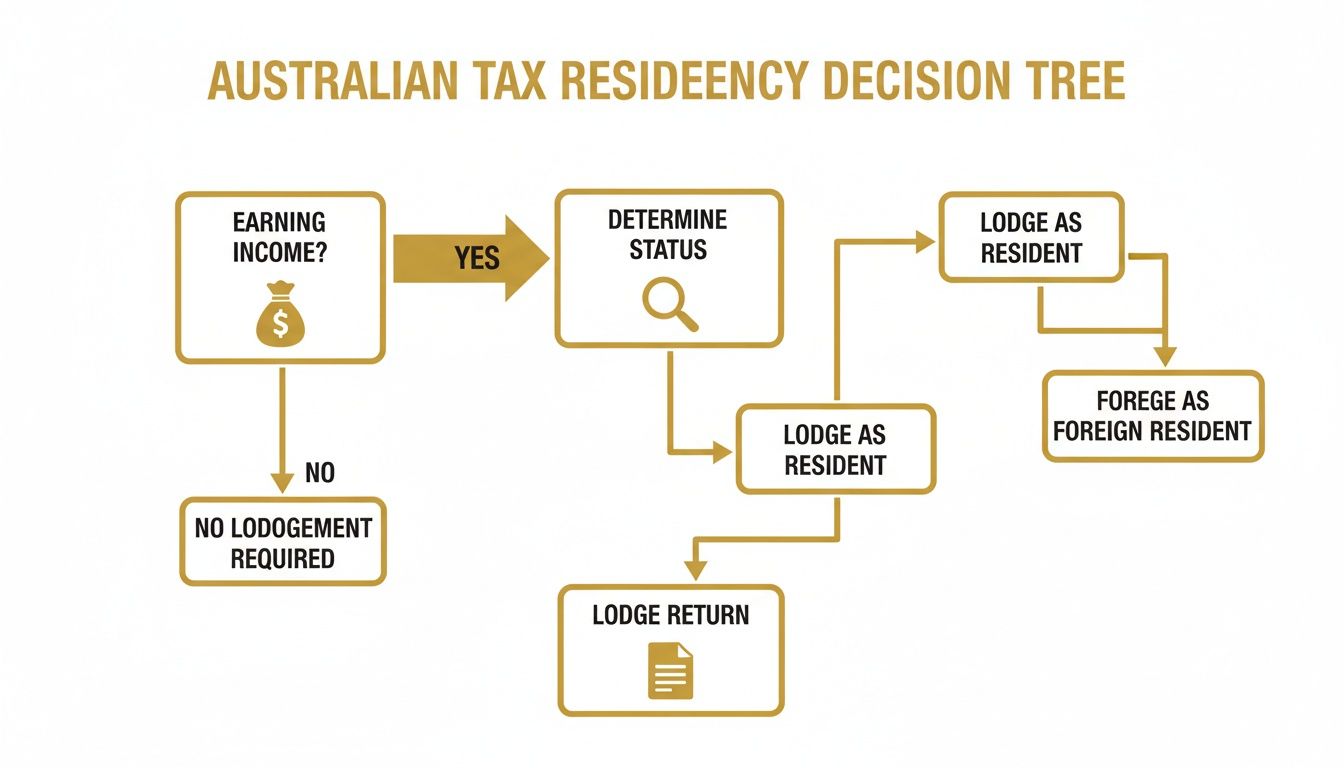
As the flowchart shows, determining your residency is the central, unavoidable step before you can even think about lodging an accurate tax return.
The Four Key Residency Tests Explained
The ATO uses four different tests to work out your residency for tax purposes. You only need to pass one of these tests to be considered an Australian resident for tax.
1. The Resides Test
This is the main test, and it’s all about the big picture. It asks a simple question: do you actually reside in Australia? This isn't just about where you sleep; it looks at your physical presence, your intentions, your family and business ties, and your social life. It's about whether you've set up a 'settled or usual' home here.
2. The Domicile Test
Your domicile is your permanent home according to the law. If your domicile is Australia, you're a tax resident. The only way out of this one is if the ATO is convinced your permanent place of abode is genuinely outside Australia.
3. The 183-Day Test
This one is a simple numbers game. If you're physically in Australia for more than half the financial year—that's 183 days or more—you’ll be treated as a tax resident. There's an exception, but only if your usual home is outside Australia and you have absolutely no intention of moving here.
4. The Superannuation Test
This test is very specific and usually only applies to Australian government employees working overseas. If you're a member of certain public sector superannuation schemes, you're automatically considered a resident for tax. Simple as that.
For a deeper dive into these complex rules, you can learn more about the Australian tax residency test and see how each one might apply to your unique situation.
Why Your Residency Status Matters So Much
Your tax residency status completely changes the game. Getting this right from the very beginning is crucial for staying compliant and avoiding costly penalties related to Australian tax for non-residents.
Let's break down the key differences in how you're treated.
Resident vs Non-Resident Tax Treatment At a Glance
Here’s a quick comparison of the major differences that will affect your back pocket.
| Tax Rule | Australian Resident | Non-Resident for Tax Purposes |
|---|---|---|
| Taxable Income | Taxed on worldwide income (from all sources, both in and out of Australia). | Taxed only on Australian-sourced income. |
| Tax-Free Threshold | Receives a tax-free threshold (currently $18,200). | Does not receive a tax-free threshold; taxed from the first dollar. |
| Medicare Levy | Generally liable to pay the 2% Medicare levy. | Not required to pay the Medicare levy. |
| Capital Gains Tax | May be eligible for the 50% CGT discount on assets held over 12 months. | Generally not eligible for the 50% CGT discount. |
As you can see, the implications are huge. A resident gets the benefit of the tax-free threshold, but in return, they have to declare their global income. A non-resident only pays tax on what they earn here, but they pay it from the very first dollar.
How Non-Resident Income Is Taxed in Australia
Once the ATO officially considers you a non-resident for tax purposes, the rules of the game change completely. The biggest shift—and the one that catches most people off guard—is how your income is taxed from the very first dollar you earn.
Unlike Australian residents, who enjoy a generous tax-free threshold (currently $18,200), non-residents don't get this benefit. This means every single dollar of your Australian-sourced income has tax taken out of it. It’s a fundamental difference you absolutely need to factor into your financial planning.

This strict approach is exactly why getting your head around Australian tax for non residents is so critical. Without that tax-free buffer, your take-home pay can end up being a lot lower than you might expect.
What Is Australian-Sourced Income?
So, what does the ATO actually count as income from an Australian source? Put simply, it’s any money that has a direct link back to Australia.
Here are the most common things that fall into this bucket:
- Employment Income: Wages or salary you were paid for work you physically did in Australia.
- Rental Income: The profit you make from an Australian investment property.
- Capital Gains: Any profit from selling ‘Taxable Australian Property’, which almost always means real estate.
- Business Income: Earnings from a business you’re running inside Australia.
- Dividends and Interest: Payouts you receive from Australian companies or banks.
Essentially, if the money originates from an Australian asset, activity, or company, the ATO wants its share. This holds true even if the funds are paid directly into your overseas bank account.
In the 2022-23 income year, non-residents contributed a massive $12.4 billion in net tax. That’s about 4.2% of all individual tax collected, even though non-residents only lodged 1.3% of all tax returns. This really shows how non-residents, often here on temporary visas, can earn higher average incomes that push them into top tax brackets without any of the resident offsets to soften the blow. You can dig into more of this data in the official ATO statistics for 2022-23.
Non-Resident Income Tax Rates
For non-residents, the tax rates are structured in brackets, just like they are for residents. The key difference is that the rates start much higher, right from the get-go. Knowing these rates is vital for figuring out what you’ll actually owe.
If you want a deeper dive, check out our complete guide on Australian non-resident tax rates.
For now, here’s a clear summary of what you can expect to pay on your Australian-sourced income.
Non-Resident Income Tax Rates
| Income Bracket (Australian Sourced) | Tax Rate |
|---|---|
| $0 – $120,000 | 32.5 cents for each $1 |
| $120,001 – $180,000 | $39,000 + 37 cents for each $1 over $120,000 |
| Over $180,000 | $61,200 + 45 cents for each $1 over $180,000 |
As you can see, that starting tax rate of 32.5% is a pretty big hit. It applies from your very first dollar, which just reinforces how important it is to manage your finances carefully when you’re earning income in Australia as a non-resident.
Claiming Deductions You Are Entitled To
One of the most common and costly myths we see is that non-residents are completely shut out from claiming tax deductions in Australia. Nothing could be further from the truth.
The reality is far more favourable: you can absolutely claim deductions, as long as they meet one simple, golden rule. The expense must be directly related to earning your Australian-sourced income.
Think of it this way: if you had to spend money specifically to earn money here in Australia, the Australian Taxation Office (ATO) generally lets you subtract that cost from your income. This is a critical part of managing your Australian tax for non residents, as every dollar you claim lowers your taxable income, reduces the tax you owe, and can even tip you into a tax refund.

The non-negotiable part of this is keeping detailed records. Without receipts, invoices, or bank statements, even the most legitimate expense claim can be rejected if the ATO decides to take a closer look.
Common Work-Related Deductions for Non-Residents
If you were employed while in Australia, you might be surprised by what qualifies as a deductible expense. It always comes back to that direct link between the cost and your job.
Here are some of the most common claims we process for non-resident workers:
- Vehicle and Travel Expenses: This is for when you used your own car to travel between different work sites or for work-related errands after your day had started. A crucial point here: your regular daily commute from home to your main workplace doesn't count.
- Clothing and Laundry: Did you have to buy and clean a specific uniform with your employer's logo on it? Or maybe protective gear essential for your safety? Those costs are claimable.
- Tools and Equipment: The cost of any tools or equipment you needed to buy to do your job is deductible. For items costing over $300, you generally can't claim the full amount upfront. Instead, you'll claim the decline in value (depreciation) over a few years.
- Self-Education Expenses: If you paid for a course or professional training that was directly tied to maintaining or upgrading the skills for your Australian job, those costs are often deductible.
It's essential to remember that you can't claim any portion of an expense that your employer paid you back for. The ATO only allows deductions for money you were genuinely out-of-pocket for.
Essential Deductions for Property Investors
For non-residents who own and rent out an Australian property, claiming every single eligible deduction is the single best way to improve your net return. Because your rental income is Australian-sourced, the costs of running that investment are absolutely deductible against it.
You should be keeping meticulous records for these key expenses:
- Loan Interest: This is almost always the biggest deduction. The interest charged on the mortgage you used to buy the property is fully claimable.
- Council and Water Rates: These are standard, ongoing costs of property ownership and are completely deductible.
- Land Tax: If your property holdings mean you have to pay state-based land tax, that's another legitimate claim.
- Property Management Fees: The fees you pay a real estate agent to find tenants, collect rent, and manage the day-to-day of the property are a direct business expense and are deductible.
- Repairs and Maintenance: The costs of keeping the property in good shape for your tenants—like fixing a leaky tap, patching a wall, or repairing a broken window—can be claimed immediately.
- Insurance: Any premiums you pay for building, contents, and landlord insurance policies are deductible.
By carefully tracking and claiming these expenses, you can significantly reduce your taxable rental income. This ensures you’re only paying tax on your true profit, not on your turnover.
How to Lodge Your Non-Resident Tax Return
Alright, you've figured out your residency status and what income you need to declare. Now for the final, crucial step: actually lodging your non-resident tax return correctly. Think of it as the last leg of the race – getting it right ensures you meet all your obligations to the Australian tax office.
Before you even think about lodging, get your paperwork in order. This means gathering your income statements (what used to be called group certificates), detailed records of any rental income you've earned, and receipts for every single expense you plan to claim as a deduction.
Remember, the Australian financial year runs from 1 July to 30 June. If you’re brave enough to lodge it yourself, the deadline is a firm 31 October.
Choosing Your Lodgement Method
As a non-resident, you have three main paths to get your tax return to the ATO. Each has its pros and cons, really depending on how comfortable you are navigating the Aussie tax system from afar.
Online via myGov: If you already have an Australian Tax File Number (TFN) linked to a myGov account, you can use the ATO's myTax portal. It's a free and pretty efficient option, but honestly, it can be a real headache to navigate from overseas, especially if you run into technical issues.
By Paper Form: The old-school method. You can download the tax return form, fill it out, and mail it to the ATO. When you're dealing with these forms, knowing how to efficiently fill PDF forms can save you a surprising amount of time and frustration. The big downside? Paper returns take much longer for the ATO to process.
Using a Registered Tax Agent: For most non-residents, this is hands-down the most reliable and stress-free choice. A good tax agent handles the entire process for you. They make sure you’re compliant, work to maximise your deductions, and can often secure a lodgement extension, pushing your deadline all the way to May of the following year.
The ATO's own historical data tells a compelling story. The number of non-resident tax returns has been steadily climbing, jumping 22% from 162,000 in 2020-21 to 198,000 in 2022-23. The most telling statistic? A huge majority (68%) of non-residents choose to lodge via a tax agent, which really highlights the value of getting professional guidance.
Bringing in an expert is especially smart if your situation is a bit complex—say, you have overdue returns or need to deal with capital gains from selling a property. A specialist can navigate the tricky parts for you, ensuring you get the best possible financial outcome while making sure everything is lodged by the book.
If you need a bit more help with the process, our guide on filing a non-resident tax return in Australia has some extra tips to get you started.
Common Tax Mistakes and How to Avoid Them
Figuring out Australian tax as a non-resident can feel like navigating a maze, but you’d be surprised how easy it is to stay out of trouble once you know what to look for. Most slip-ups we see aren't about trying to pull a fast one on the Australian Taxation Office (ATO); they’re just simple, honest misunderstandings.
The smartest thing you can do is learn from the common pitfalls other non-residents fall into. Let's walk through the most frequent tripwires and give you some clear, practical advice on how to sidestep them for good.
Misjudging Your Residency Status
This is, without a doubt, the biggest mistake people make. It’s so easy to assume your visa or your passport dictates your tax status, but when it comes to Australian tax, the only thing that matters is how the ATO sees you.
For example, a backpacker on a working holiday might spend more than 183 days in Australia without realising they've accidentally tripped into becoming a tax resident, completely changing their tax obligations. On the flip side, an expat working here for a year might incorrectly assume they are a resident when, in fact, they haven't set up the kind of settled, permanent home the ATO looks for.
Key Takeaway: You absolutely have to run your personal situation through the four main residency tests: the resides test, the domicile test, the 183-day test, and the superannuation test. If you're even slightly unsure, getting professional advice upfront is a whole lot cheaper than trying to fix a residency mistake down the line.
Forgetting to Declare All Australian Income
Another classic blunder is failing to report every single dollar earned from Australian sources. It's tempting to think small amounts of interest or a few weeks of rental income won't matter, but the ATO’s data-matching technology is incredibly powerful and misses very little.
Imagine you own an investment property here. A common mistake is to only declare the profit you made after all the expenses are paid. But that’s not how it works – you must declare the gross rental income first, and then claim your deductions. Likewise, forgetting to include the $50 in interest you earned from an Australian bank account is an oversight the ATO will almost certainly pick up on.
Claiming Ineligible Deductions
While non-residents can definitely claim deductions, there's a strict rule: the expense must be directly linked to earning your Australian income. People often get tripped up trying to claim costs that don't meet this crystal-clear requirement. A perfect example is trying to claim the cost of your flight to Australia to check on your investment property – that’s a no-go.
To keep yourself safe, follow these simple steps:
- Keep meticulous records of every single expense you plan on claiming. Digital copies, paper receipts—hoard them all.
- Stick to the golden rule: Ask yourself, "Did I spend this money for the direct purpose of earning my declared Australian income?" If the answer isn't a clear "yes," don't claim it.
- Never claim personal expenses. This includes costs like the portion of your car usage that was for private trips, not for work.
By getting your head around these common mistakes, you can take control of your tax situation and make sure your lodgement is smooth, correct, and penalty-free.
Your Non-Resident Tax Questions Answered
Working out the specifics of Australian tax for non-residents always throws up a few common questions. Let's tackle some of the most practical queries we see, clearing up the confusion around the situations you’re most likely to face.
Do I Need to Lodge a Tax Return If Tax Was Already Withheld?
Yes, in almost every situation, you absolutely still need to lodge a tax return.
Think of the tax withheld by your employer or a financial institution as a pre-payment or an instalment towards your final tax bill. It’s just an estimate. Lodging your official tax return is how you formally square up with the Australian Taxation Office (ATO), confirming your total Australian-sourced income for the year.
It’s also the only way you can claim any deductions you might be entitled to. Filing a return is what triggers a potential refund if it turns out you’ve overpaid through the year. Failing to lodge when you're required to can lead to penalties, so it's a step you don't want to skip.
What if I Was a Resident for Only Part of the Year?
This is a really common scenario that makes you a part-year resident. For tax purposes, your financial year gets split into two distinct periods, and each is treated differently.
- Your Resident Period: For the months you were an Australian tax resident, you’re taxed on your worldwide income. You get the benefit of the tax-free threshold, but it's calculated on a pro-rata basis—meaning it’s adjusted down to reflect only the number of months you were actually a resident.
- Your Non-Resident Period: For the rest of the year, the non-resident rules kick in. You’ll only pay tax on your Australian-sourced income, and you don’t get any tax-free threshold for this portion of the year.
The tax calculation for a part-year resident can get tricky very quickly. Because of this complexity, getting professional advice is a smart move to make sure everything is calculated correctly and you've met all your obligations.
How Does Capital Gains Tax Work for Non-Residents Selling Property?
When a non-resident sells what the ATO calls 'Taxable Australian Property'—which is mostly real estate—they have to pay Capital Gains Tax (CGT).
The biggest sting for non-residents is that they are generally not eligible for the 50% CGT discount. This is a major difference compared to residents, who can often halve their taxable gain if they've owned the asset for more than 12 months. Losing this discount can dramatically increase the final tax bill.
The rules around property sales can be incredibly intricate, especially for properties bought before certain tax law changes. For property investors, getting expert tax advice isn't just helpful; it's essential.
Can a Non-Resident Get an Australian Business Number?
Yes, it’s definitely possible for a non-resident to apply for and hold an Australian Business Number (ABN).
To be eligible, you need to be ‘carrying on an enterprise in Australia’. This could mean you’re providing freelance services to an Australian company or working as an independent contractor from overseas.
It’s crucial to remember, though, that having an ABN doesn't change your tax residency status. You’ll still be taxed as a non-resident on the income you earn through your business activities, and you might also have to lodge Business Activity Statements (BAS).
The ATO provides guidance through ato.gov.au, the Small Business Support Line (13 28 66), and Online Services for individuals and businesses. For complex situations, a registered tax agent provides advice tailored to your specific circumstances and professional indemnity protection. You can verify agent registration at the TPB register at tpb.gov.au.
Most tax records must be kept for five years from the date of lodgement or the date the transaction occurred, whichever is later. Records must be in English or convertible to English and must be sufficient to explain the income and deductions in your return. The ATO can request records at any time during the retention period.
Consider a registered tax agent when your affairs involve multiple income sources, business activity, investment properties, capital gains, or overseas income. Agents extend your lodgement deadline, provide safe harbour protection, and take professional responsibility for the advice given. Verify registration at tpb.gov.au.
The failure to lodge penalty is based on penalty units ($313 per unit from 1 July 2023), accruing per 28-day period for late returns and BAS lodgements. Incorrect information penalties range from 25% to 75% of the tax shortfall depending on whether the behaviour was careless, reckless, or intentional. Proactive disclosure before an audit begins typically results in significantly reduced penalties.
Tax minimisation is the legal arrangement of your affairs to reduce tax — claiming all eligible deductions, using appropriate structures, and timing income and expenses. Tax avoidance involves arrangements that technically comply with the law but achieve outcomes parliament did not intend. The ATO can apply Part IVA anti-avoidance rules to cancel benefits from avoidance arrangements.
Struggling with the complexities of non-resident tax returns or overdue lodgements? The specialists at Australia Wide Tax Solutions are here to simplify the process and ensure you get the best possible outcome.
Get expert help with your non-resident tax return today
If you're an Australian resident for tax purposes, the Australian Taxation Office (ATO) wants to know about your entire worldwide income. This is a fundamental rule and the absolute starting point for getting your head around foreign income tax in Australia.
- Understanding Your Foreign Income Tax Obligations
- Figuring Out If You’re An Australian Resident For Tax Purposes
- How To Report Your Foreign Income To The ATO
- Using The Foreign Income Tax Offset To Avoid Double Taxation
- How Australia's Double Tax Agreements Can Help You
It means every single dollar you earn, whether it's a salary from a job in Singapore, rent from a property in London, or dividends from US stocks, has to be included on your Aussie tax return.
Understanding Your Foreign Income Tax Obligations

Juggling your tax duties when you've got money coming in from overseas can feel like you're trying to keep a complex global financial diary. But the core principle is actually quite simple: if the ATO considers you an Australian resident for tax purposes, your tax obligations stretch way beyond our borders. Your total assessable income includes everything from all sources, both here at home and abroad.
This concept of "worldwide income" is the bedrock of our tax system for residents. It's designed to make sure all your earnings are taxed consistently, no matter where on the map they came from. It's a very common and costly mistake to think that income already taxed in another country is automatically exempt from being reported here. That’s just not the case, and it’s a fast track to an ATO audit.
What Counts As Foreign Income
So, what exactly does the ATO consider to be foreign income? They cast a pretty wide net, and it's vital to know what gets caught in it to stay compliant.
Here are the usual suspects:
- Employment Income: This is the obvious one – salaries, wages, bonuses, and allowances you earn from working for an overseas employer.
- Investment Returns: Think interest from a foreign bank account, dividends from international shares, or royalties from intellectual property you hold in another country.
- Rental Income: Any rent you collect from an investment property located outside Australia fits the bill.
- Pensions and Annuities: Those regular payments you might get from a foreign superannuation fund or pension scheme need to be declared.
- Capital Gains: If you sell an overseas asset like shares or real estate and make a profit, that's foreign income too.
Preventing Double Taxation
Right about now, most people ask the big question: "Does this mean I'll be taxed twice?" Thankfully, the system is set up to stop that from happening. The main tool for this is the Foreign Income Tax Offset (FITO).
Think of FITO as a credit you get for the tax you’ve already paid to another country's government on that same income.
The purpose of the foreign income tax offset is to prevent double taxation by allowing you to reduce your Australian income tax liability by the amount of foreign income tax you have already paid.
This offset makes sure you don't end up paying more tax than you would have if you’d earned the money in Australia. We'll get into the nitty-gritty of calculating and claiming this offset later, as well as the role of Double Tax Agreements (DTAs). Australia has these treaties with over 40 countries, and they set clear rules on which country gets the first bite of the tax cherry for specific types of income, giving you another layer of protection.
Getting these foundational concepts right is the first, most important step to managing your foreign income tax with confidence.
Figuring Out If You’re An Australian Resident For Tax Purposes
Your tax residency status is the single most important factor in how your foreign income is handled in Australia. It’s a classic mistake to think residency is tied to your passport or how long your visa lasts. For the Australian Taxation Office (ATO), it all comes down to where you ‘live’ based on a specific set of legal tests.
Getting this wrong can open you up to a world of pain, including hefty tax bills and penalties you never saw coming. Before you even think about lodging a tax return with overseas income, figuring out your residency status is the absolute first step.
The Four Key Residency Tests
The ATO has four main tests to work out your residency status. The important thing to remember is you only need to pass one of these tests to be considered an Australian resident for tax purposes. These tests look at everything from your physical presence in the country to your deeper connections to Australia. Nailing down your Australian Tax Residency is the foundation of getting your foreign income tax right.
Let's break down each one.
- The Resides Test: This is the big one and looks at the whole picture of your life. It considers where you physically are, your intentions, family and business ties, and whether you've maintained a home here. It’s less of a checklist and more of a "what would a reasonable person say?" test.
- The Domicile Test: Your domicile is basically your permanent home by law. If your legal home is in Australia, you're considered a resident unless you can prove to the ATO that your permanent home is now genuinely outside Australia.
- The 183-Day Rule: This one is much more about counting the days. If you're physically in Australia for more than half the financial year (183 days or more), you're likely a resident. The only way out is if it's crystal clear your usual home is overseas and you have zero intention of moving here.
- The Commonwealth Superannuation Test: This is a very specific test for Australian Government employees working overseas. If you're a member of a Commonwealth super scheme (and so is your spouse), you’re generally considered an Aussie resident for tax purposes, no matter where in the world you're posted.
To give you a clearer picture of how these work, here's a quick summary of what the ATO is looking for.
Quick Guide To ATO Tax Residency Tests
| Residency Test | What It Means | Key Indicators To Consider |
|---|---|---|
| The Resides Test | Do you "live" in Australia in the ordinary sense of the word? | Physical presence, family and social ties, maintaining a home, business interests, intention. |
| The Domicile Test | Is your legal permanent home in Australia? | Where you were born, where you intend to live indefinitely. |
| The 183-Day Rule | Are you physically in Australia for more than half the year? | Presence for 183+ days in a financial year, behaviour consistent with a visitor. |
| The Commonwealth Superannuation Test | Are you an Australian Government employee paid into a specific super fund? | Membership in the PSS or CSS super schemes. |
These tests can seem a bit abstract on paper, so let's look at how they play out in the real world.
Residency In The Real World
Imagine two people:
- Chloe, an Aussie software developer, lands a two-year contract in Berlin. She rents out her Sydney apartment, moves over with her partner, and starts joining local clubs in Germany.
- Ben, a backpacker from the UK on a working holiday visa. He plans to travel around Australia for 12 months, picking up odd jobs in different towns to fund his adventure.
Despite being an Australian citizen, Chloe would almost certainly be classed as a non-resident for tax purposes. She has clearly set up a new permanent home in Berlin and cut her day-to-day ties with Australia while she's on contract.
On the flip side, Ben, a foreign citizen, will likely become an Australian resident for tax purposes. He’s physically present for more than 183 days and doesn't have a permanent home anywhere else, so he easily passes the 183-day rule. This means he has to declare his worldwide income to the ATO, even the interest he earns from his bank account back in the UK.
These examples hammer home a crucial point: tax residency has nothing to do with the passport you hold. It’s all about your personal circumstances, your intentions, and your physical location, all weighed against the ATO's specific rules.
Working out which test applies to you is critical. If you're wrestling with this, it's worth digging deeper into the complexities of the Australian tax residency test and how it applies to your specific situation.
Once you’ve confidently figured out your status, you’ve laid the groundwork for correctly managing your foreign income tax in Australia. From there, you can move on to the practical steps of reporting your income and making sure you aren't paying a cent more in tax than you legally have to.
How To Report Your Foreign Income To The ATO
Declaring your foreign income isn’t just about telling the ATO you earned money overseas. It's a structured process that demands precision, especially when converting currencies and filling out the right sections of your tax return.
Getting these details correct from the start is the key to a smooth, audit-proof lodgement. It’s not just about having the numbers; it’s about presenting them exactly the way the ATO expects. The whole process really begins the moment you receive the income, because meticulous record-keeping is your best defence when tax time rolls around.
Step 1: Convert Your Income To Australian Dollars
Before you can report a single cent, you must convert all your foreign income, deductions, and tax paid into Australian Dollars (AUD). The ATO has specific rules about which exchange rates you can use, and picking one and sticking with it is essential.
You've got two main options here:
- The Specific Time Rate: You can convert each amount using the exchange rate that was active at the exact time you received the income or paid the expense. This is by far the most accurate method, but it means you need to be tracking everything in detail.
- The Average Rate: For a much simpler life, the ATO allows you to use an average exchange rate for the entire financial year. The tax office publishes these average rates on its website, which makes this a far more straightforward option for most people.
Whichever method you choose, you have to apply it consistently across all your foreign income transactions for that financial year. You can’t chop and change, using one rate for your UK salary and another for your US dividends.
Step 2: Gather Your Supporting Documents
Just like with your Australian income, you need proof. The ATO can ask you to show evidence supporting your claims for up to five years after you lodge your return, so keeping good records isn't just a suggestion—it's a necessity.
Your documentation checklist should absolutely include:
- Proof of Income: Things like foreign employment payslips, bank statements showing interest, dividend summaries, and rental income records.
- Proof of Expenses: Receipts for any deductions you plan to claim against that foreign income, such as property management fees for an overseas rental.
- Proof of Foreign Tax Paid: This is non-negotiable if you want to claim the Foreign Income Tax Offset. You'll need official tax assessment notices or statements from the foreign tax authority showing the exact amount of tax you paid.
Having these documents organised and ready to go will make the reporting process infinitely easier and will be your saving grace if the ATO ever comes knocking for a review.
Step 3: Complete The Right Sections Of Your Tax Return
Once your figures are converted and your paperwork is in order, the final piece of the puzzle is knowing exactly where to put the information in your tax return. The specific sections will change depending on the type of income you’ve earned.
If you're using the myTax online portal, for example, you'll need to navigate to the "Foreign income" section. From there, you'll find different categories to declare your various earnings.
A Practical Example: Alex the Investor
Alex is an Australian resident who owns a rental property in New Zealand and holds shares in a Canadian company. This year, he received NZ$15,000 in rent and CA$2,000 in dividends.
- Currency Conversion: Alex decides to keep it simple and uses the ATO’s average annual exchange rates to convert both amounts into AUD.
- Documentation: He digs out his NZ rental statements, the official notice showing the NZ tax he paid, and his Canadian dividend statement.
- Reporting: In his tax return, he declares the converted rental income under the "Foreign rental income" section and the converted dividends under the "Foreign investment income" section. It's that straightforward when you're prepared.
This decision tree helps visualise the first critical step of determining if you're an Australian tax resident, which dictates your reporting obligations.
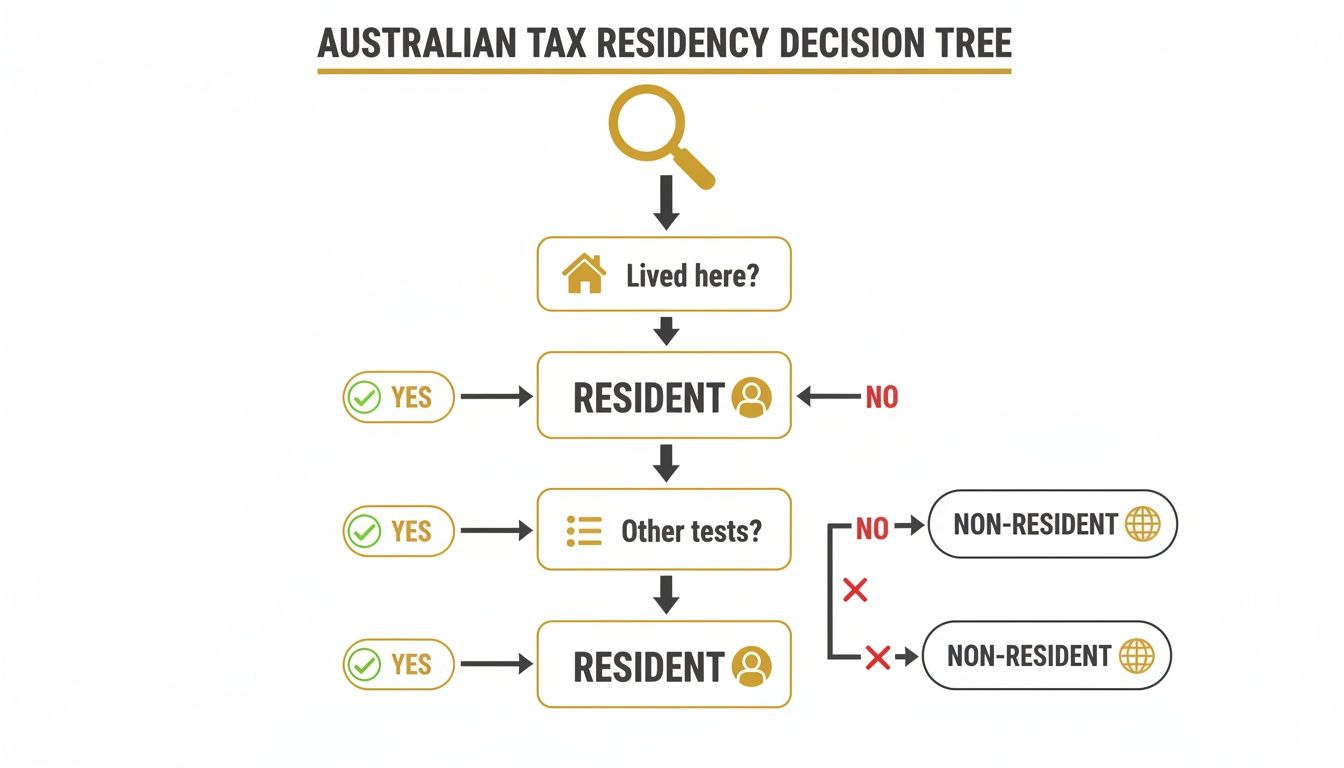
The flowchart clearly shows that if you meet the primary "resides test," your status is confirmed. If not, you have to work your way through the other tests to be certain.
By following these steps, you translate your overseas financial activities into a language the ATO understands. This methodical approach removes the guesswork from reporting foreign income tax in Australia and ensures you meet your obligations accurately, the first time.
Using The Foreign Income Tax Offset To Avoid Double Taxation
The biggest fear for anyone earning money overseas is getting taxed twice—once in the foreign country and then again by the ATO. It's a valid concern, but thankfully, the system is specifically designed to stop that from happening.
The key to preventing this is the Foreign Income Tax Offset (FITO).
Think of FITO as a credit for the tax you've already paid to another government. Its entire purpose is to make sure your total tax bill on that income doesn't end up being more than what you would have paid if you'd earned it all here in Australia. It’s the cornerstone of how foreign income tax in Australia is managed fairly.
How The Foreign Income Tax Offset Works
To get the FITO, you just need to tick two boxes. First, you must have actually paid tax on your foreign income to an overseas tax authority. Second, you must have included that same income in your assessable income for your Australian tax return. Simple as that.
If you meet these two conditions, you can claim the offset to slash your Australian tax bill. But it's not a free-for-all. The amount you can claim is capped to keep the system fair and balanced.
This cap is called the FITO limit. Your offset is restricted to whichever of these two amounts is lower:
- The actual foreign tax you paid (after converting it to AUD).
- The amount of extra Australian tax you have to pay simply because you included that foreign income in your return.
In other words, you can’t use the offset to wipe out tax on your Aussie-sourced income. It can only cancel out the Australian tax that applies to your foreign earnings.
Calculating Your FITO Limit
Working out the FITO limit sounds complicated, but it's really just a logical, step-by-step process. The ATO is essentially trying to figure out how much more tax you owe because of that foreign income.
The FITO limit is the amount of Australian tax that would be payable on your foreign income. This prevents you from claiming an offset that is higher than the Australian tax liability on that same income, ensuring you don't profit from the offset.
Let's jump back to our example of Alex and his rental income from New Zealand to see how this works in practice. For a really deep dive, you can also check out our guide on the foreign income tax offset and its specific rules.
Alex's FITO Calculation Example
Here's a quick summary of Alex's finances for the year:
- Australian Salary: $90,000
- Net Foreign Rental Income (NZ): $10,000 (after conversion and deductions)
- Foreign Tax Paid (NZ): $1,500
Now, let's walk through the calculation to find his FITO limit.
Step 1: Calculate Tax on Total Income (Including Foreign Income)
First, we work out the tax on his total income of $100,000 ($90,000 Aussie salary + $10,000 NZ rent). Using the standard tax rates, the total tax payable on this amount comes to $22,967 (including the Medicare levy).
Step 2: Calculate Tax on Australian Income Only
Next, we figure out what his tax would have been without the NZ income—so, just on his $90,000 Australian salary. The tax on this amount is $19,517 (including the Medicare levy).
Step 3: Determine the FITO Limit
The difference between these two figures is the extra Australian tax Alex is paying because of his NZ rental income.
- FITO Limit = $22,967 - $19,517 = $3,450
Finally, Alex compares his FITO limit ($3,450) to the actual foreign tax he paid ($1,500). He can only claim the lesser of the two.
In this case, the $1,500 he paid in NZ tax is lower than his FITO limit. So, Alex can claim a foreign income tax offset of $1,500. This directly reduces his Australian tax bill from $22,967 down to $21,467, completely wiping out the effect of double taxation.
How Australia's Double Tax Agreements Can Help You
While the Foreign Income Tax Offset (FITO) is your main line of defence against paying tax twice, it’s not the only tool you have. Australia has built a network of international agreements with over 40 countries, all designed specifically to stop you from being taxed into oblivion.
These are known as Double Tax Agreements (DTAs), and they’re essentially an official rulebook between two countries. They lay out exactly which country gets the first shot at taxing certain types of income, giving individuals and businesses much-needed certainty when operating across borders.
The Role of a Double Tax Agreement
Think of a DTA like a referee in a financial match. When both Australia and another country reckon they have the right to tax your income, the DTA blows the whistle and makes the final call based on the agreed-upon rules.
This is a game-changer for passive income streams like dividends, interest, and royalties. A DTA can dramatically cut the tax a foreign country withholds from your payment before it even gets to you, which means better cash flow and less hassle. It's a different kind of protection from the FITO, which you have to claim back later.
A Double Tax Agreement is a treaty between two countries to prevent international double taxation of income and property. The main purpose of a DTA is to divide the right of taxation between the contracting countries, to avoid differences, grant concessions on taxes, and promote economic relations.
Getting your head around these agreements is a crucial part of managing your foreign income tax in Australia, particularly if you have investments or business interests overseas. To see how these treaties really work, check out our detailed guide on a double tax agreement in Australia.
DTAs in Action: A Real-World Example
Let's make this practical. Say you're an Aussie tax resident and you own shares in a company based in the United States. When that company pays you dividends, the US will almost always withhold tax from that payment.
Without a DTA, the US could legally keep up to 30% of your dividend payment. But because Australia and the US have a DTA, the agreement caps the amount of tax the US can withhold on dividends paid to an Australian resident, often slashing it to just 15%.
Right away, more money lands in your bank account. You'll still need to declare this income in Australia, of course, but the DTA has already done the heavy lifting by minimising the foreign tax you paid upfront.
How Treaties Affect Different Income Types
DTAs aren't a one-size-fits-all solution; they contain specific articles that lay down different rules for different types of income.
- Pensions: The DTA with the United Kingdom, for example, often gives Australia the sole right to tax UK-sourced pensions paid to an Australian resident. This can stop the UK from levying any tax on your pension payments at all.
- Royalties and Interest: Just like with dividends, DTAs usually put a ceiling on the rate of withholding tax that the source country can charge on royalty and interest payments.
- Business Profits: Treaties set up clear rules to figure out when a business from one country has a "permanent establishment" in the other, which is the deciding factor on where its profits get taxed.
The golden rule, however, never changes: as an Australian tax resident, you must report all your worldwide income to the ATO, no matter where it was earned or if tax was paid on it elsewhere. For the 2024–25 income year, you have to convert all foreign income to Australian dollars using approved exchange rates.
And it’s not just about regular income. If you sell assets overseas, you'll also have to navigate how Australia handles capital gains. For a deeper look into this, the guide on capital gains tax on foreign property is an excellent resource.
Common And Costly Mistakes To Avoid

Navigating the rules for foreign income tax in Australia can feel like walking through a minefield. Even small, honest mistakes can trigger a stressful audit and expensive penalties from the Australian Taxation Office (ATO).
The best way to stay off the ATO’s radar is to understand where others go wrong. Think of this section as your guide to getting things right the first time, learning from the common pitfalls that catch so many taxpayers out.
Forgetting The Small Stuff
One of the most frequent errors we see is people assuming that tiny amounts of foreign income aren't worth reporting. It’s easy to think that a few dollars of interest from an overseas bank account or a minor dividend from a handful of foreign shares is insignificant.
But to the ATO, every single dollar counts. There’s no tax-free threshold for this stuff. The ATO has sophisticated data-matching agreements with tax agencies worldwide, which means they often know about your foreign earnings before you even lodge your return. Ignoring these small amounts is a guaranteed way to attract their attention.
Poor Record Keeping For Offsets
Claiming the Foreign Income Tax Offset (FITO) is your best defence against double taxation, but you can't just claim it without rock-solid proof. A critical and costly mistake is failing to keep detailed records of the actual foreign tax you’ve paid.
Without official documentation, such as a tax assessment notice from the foreign tax authority, your FITO claim can be denied. Simply showing a bank transfer is not enough; you need government-issued proof.
This oversight can be incredibly expensive. It could effectively force you to pay tax twice on the same income, all because you couldn't back up your claim. Meticulous record-keeping is non-negotiable.
Using The Wrong Exchange Rate
Currency conversion is another area where things can easily go wrong. You can't just pluck a random exchange rate out of thin air on the day you lodge your return. The ATO has very specific rules you need to follow.
You must either use the exchange rate from the time each transaction happened or apply the average annual rate the ATO publishes. A common tripwire is mixing these methods or using a rate from an unapproved source.
Let's look at a real-world example:
- The Mistake: Sarah receives her UK pension quarterly. To make things "easier," she just converts the entire annual amount using the exchange rate on 30 June.
- The Consequence: If the ATO reviews her return, they could deem her conversion method non-compliant. This would force her to recalculate everything, potentially leading to more tax owed, plus penalties for incorrect reporting.
The key here is consistency. Pick an approved method and stick with it for the whole financial year. This ensures your declarations are accurate and, more importantly, defensible if the ATO comes knocking.
Got Questions About Foreign Income Tax? We've Got Answers.
When you're dealing with money from overseas, a lot of questions can pop up. It’s a tricky area of tax law, and it’s easy to feel unsure about what you need to do. Here are some of the most common questions we get from clients, with clear, straight-to-the-point answers.
Do I Really Have To Declare Tiny Amounts Of Foreign Income?
Yes, you absolutely do. This is a big one that catches a lot of people out. There is no tax-free threshold for foreign income when you're an Australian resident for tax purposes.
Every single dollar has to be on your tax return. That means the $5 of interest from an old UK bank account or that small dividend from some US shares you own—it all counts. The ATO has incredibly sophisticated data-matching programs with tax agencies around the world, so it's very likely they already know about it. Full disclosure isn't just good practice; it's essential.
But What If I Already Paid Tax On It In Another Country?
This is where a lot of people worry about being taxed twice, and thankfully, Australia's system is designed to prevent that from happening. If you've paid tax in another country on income that's also taxable here, you can generally claim the Foreign Income Tax Offset (FITO).
Think of the FITO as a credit. It directly reduces the Australian tax you have to pay by the amount of foreign tax you've already handed over. The goal is to ensure you don't end up paying more tax than if you had earned that same income right here in Australia.
The key here is proof. To claim this offset, you must have the documents to show you paid foreign tax, like an official tax assessment notice from the overseas authority.
How Do I Convert My Foreign Income To Australian Dollars?
You can't just pick a random exchange rate from Google on the day you do your tax return. The ATO has specific rules you need to follow for converting currency.
You have two main options:
- The "On the Day" Rate: You can convert the income using the exchange rate on the exact day it landed in your account.
- The Average Annual Rate: To make things simpler, the ATO publishes average exchange rates for the whole financial year. You can use this average rate across all your foreign income for that year.
Whichever method you choose, you have to stick with it for all your foreign income in that tax year. Consistency is crucial for keeping your reporting accurate and staying on the right side of the ATO for your foreign income tax in Australia.
The ATO provides guidance through ato.gov.au, the Small Business Support Line (13 28 66), and Online Services for individuals and businesses. For complex situations, a registered tax agent provides advice tailored to your specific circumstances and professional indemnity protection. You can verify agent registration at the TPB register at tpb.gov.au.
Most tax records must be kept for five years from the date of lodgement or the date the transaction occurred, whichever is later. Records must be in English or convertible to English and must be sufficient to explain the income and deductions in your return. The ATO can request records at any time during the retention period.
Consider a registered tax agent when your affairs involve multiple income sources, business activity, investment properties, capital gains, or overseas income. Agents extend your lodgement deadline, provide safe harbour protection, and take professional responsibility for the advice given. Verify registration at tpb.gov.au.
The failure to lodge penalty is based on penalty units ($313 per unit from 1 July 2023), accruing per 28-day period for late returns and BAS lodgements. Incorrect information penalties range from 25% to 75% of the tax shortfall depending on whether the behaviour was careless, reckless, or intentional. Proactive disclosure before an audit begins typically results in significantly reduced penalties.
Tax minimisation is the legal arrangement of your affairs to reduce tax — claiming all eligible deductions, using appropriate structures, and timing income and expenses. Tax avoidance involves arrangements that technically comply with the law but achieve outcomes parliament did not intend. The ATO can apply Part IVA anti-avoidance rules to cancel benefits from avoidance arrangements.
Juggling overseas income rules can feel like a headache, but you don't have to figure it all out on your own. The experts at Australia Wide Tax Solutions specialise in helping Australians with foreign income to meet their ATO obligations while making sure their tax position is optimised.
Let us handle the complexity for you. Visit https://www.awts.net.au to book your consultation today.
Calculating your taxable income in Australia follows a pretty simple formula: you start with your total assessable income and then subtract all the allowable deductions you're eligible to claim. The number you end up with is your taxable income, which is what the Australian Taxation Office (ATO) uses to figure out how much tax you owe.
- Your Starting Point: Understanding Assessable Income
- Finding Every Allowable Deduction
- A Practical Calculation Walkthrough
- Navigating Special Circumstances and Complex Income
- Applying Tax Rates and Offsets
Your Starting Point: Understanding Assessable Income

Before you can even think about deductions, you first need to get a crystal-clear picture of your assessable income. This is the absolute first step. It’s essentially your gross income—every single dollar you've earned from any source that the ATO considers taxable. For most of us, this begins with a regular salary or wages, but it very rarely stops there.
Getting this right is crucial for staying compliant. It's a common mistake to think only your main job's income counts, but leaving out another source of income, no matter how small, can lead to an incorrect tax return and potential headaches with the ATO later on.
Identifying All Your Income Streams
To get an accurate total, you have to look beyond your payslip and account for all the money that came in during the financial year.
Think about all the potential places income could come from:
- Employment Income: This is the most obvious one. It covers your salary, wages, any bonuses you received, allowances, and reportable fringe benefits.
- Government Payments: Most Centrelink payments, like JobSeeker or parenting payments, are generally considered assessable income.
- Business or Sole Trader Income: If you run a small business or have a side hustle, you need to include all your gross earnings before you take out any expenses.
- Investment Returns: This is a big category. It includes things like dividends from shares, distributions you get from trusts, and any rental income from an investment property.
It's also important to get the small details right. For instance, any interest you earn from your savings accounts has to be declared. It might not seem like much, but it all adds up to your total assessable income. If you're unsure about this, you can learn more in our guide on what is interest income.
The key takeaway is simple: if you earned it, the ATO most likely wants to know about it. Taking the time to gather all this information meticulously ensures your tax calculation starts on the right foot.
For a clearer view, here’s a quick rundown of what typically falls under assessable income.
Common Sources of Assessable Income
| Income Source | What It Typically Includes |
|---|---|
| Salary and Wages | Your regular pay, bonuses, commissions, and allowances from your employer. |
| Pensions & Annuities | Payments from super funds, government pensions (like the Age Pension), and private annuities. |
| Government Allowances | Centrelink payments such as JobSeeker, Youth Allowance, and Parenting Payment. |
| Investment Income | Dividends from shares, distributions from trusts, and interest from bank accounts. |
| Rental Property Income | Gross rent received from tenants before any expenses are deducted. |
| Business Income | Gross earnings from any business you operate as a sole trader, partnership, or company. |
| Capital Gains | Profits made from selling assets like property, shares, or cryptocurrency. |
| Foreign Sourced Income | Income earned from overseas sources, which must be declared in Australia for tax residents. |
This table should help you tick off the different income types as you gather your information.
Remember, this initial tally of all your income sources is the foundation of your entire tax return. For the 2024-25 financial year, the tax-free threshold is set at $18,200, which is a huge help for millions of low-income earners. Just to give you an idea of the scale, ATO statistics for 2022-23 showed that over 15 million Aussies lodged tax returns, with a median taxable income sitting around $50,000. You can dig deeper into the official numbers by reviewing the ATO's individual taxation statistics.
Finding Every Allowable Deduction
Once we've tallied up your assessable income, the game shifts to bringing that number down. This is where allowable deductions come into play, and frankly, mastering this is how you seriously lower your final tax bill. For every legitimate expense you claim, you're directly shrinking the taxable income figure the ATO uses to work out what you owe.
A lot of people just claim the obvious stuff and stop there, but digging a little deeper can uncover some pretty substantial savings. The golden rule is simple: if you spent money as a direct result of earning your income, you can probably claim it—as long as you have the records to prove it.
Common Work-Related Deductions
For most employees, work-related expenses are the biggest source of deductions. The massive shift towards working from home has opened up a whole new world of claims that just weren't that common a decade ago.
Here are the key areas I always tell my clients to review:
- Home Office Expenses: If you work from home, even for a day or two a week, you're almost certainly eligible to claim a portion of your running costs. This can cover things like electricity, internet, and the wear and tear (depreciation) on your office furniture. The ATO offers a simple fixed-rate method to make it easy, but if your costs are high, using the actual cost method might put more money back in your pocket.
- Vehicle and Travel Expenses: Do you use your personal car for work-related trips? That's a claim. This doesn't include your daily commute to the office, but any other travel for your job counts. You can use the straightforward cents-per-kilometre method for smaller claims or keep a logbook to claim a percentage of your total car running costs, like fuel, insurance, and servicing.
- Self-Education Expenses: If you’ve paid for a course or training that's directly linked to your current job—think upskilling, not training for a totally new career—you can often claim those costs. This includes course fees, textbooks, and any related travel.
A quick word of advice: the absolute golden rule of deductions is having proof. A shoebox full of faded receipts is better than nothing, but clean digital records, bank statements, and a proper logbook make your tax return bulletproof and take away all the stress.
Beyond the Usual Claims
Thinking outside the box can uncover some less obvious but perfectly valid deductions that many people completely miss. This is where a deep understanding of what expenses I can claim on tax becomes a powerful tool in your financial arsenal.
These can include:
- Cost of Managing Tax Affairs: Here’s one most people don't know: the fee you pay a registered tax agent like us at Australia Wide Tax Solutions is deductible. You claim it in the following year's tax return.
- Charitable Donations: Any donation of $2 or more to a registered charity (known as a Deductible Gift Recipient or DGR) is claimable. Just hang on to the receipt.
- Income Protection Insurance: If you pay for your own income protection insurance premiums outside of your superannuation, these are typically deductible.
Specific Deductions for Investors
If you're a property investor, there's a unique set of deductions available that can significantly offset the rental income you earn. Meticulous record-keeping here is non-negotiable, as you can bet the ATO often takes a close look at these claims.
Common deductions for investment properties include:
- Interest on the Loan: The interest you’re charged on the mortgage for your investment property is almost always the single biggest deduction you can claim.
- Depreciation: This is a fantastic one. You can claim a deduction for the decline in value of the building's structure and the assets inside it (like ovens, blinds, or carpets) over time. It’s a "non-cash" deduction, meaning you don’t actually have to spend money each year to be able to claim it.
- Property Management Fees: Any fees you pay to a real estate agent to manage the property, find tenants, and collect the rent are 100% deductible.
By methodically working through every potential deduction category, you ensure you’re not handing over a single dollar more in tax than you're legally required to. Every valid claim you make chips away at your taxable income, getting you that much closer to a better tax outcome.
A Practical Calculation Walkthrough
Sometimes, the best way to get your head around calculating taxable income is to see the numbers in action. Let's step away from the theory and walk through a couple of real-world scenarios we see all the time, showing exactly how the formula (Assessable Income - Allowable Deductions = Taxable Income) plays out.
Scenario 1: Salaried Employee With WFH Expenses
First up, meet Sarah. She's a marketing manager in Sydney pulling in a $95,000 salary. This year, she also landed a $5,000 performance bonus—great news for her, but it all goes into the income pot.
Sarah works from home a couple of days a week and has been brilliant at keeping records of her expenses.
First, we need to figure out her total assessable income:
- Salary: $95,000
- Bonus: $5,000
- Total Assessable Income: $100,000
Now for the fun part—tallying up her allowable deductions to reduce that figure:
- Home office expenses (a portion of her internet, electricity, and stationery): $1,550
- Self-education (she did a relevant industry course to upskill): $1,200
- Donations to a registered charity: $250
- Total Allowable Deductions: $3,000
With those figures, we can calculate her final taxable income:
$100,000 (Assessable Income) - $3,000 (Deductions) = $97,000 (Taxable Income)
See the difference? Sarah’s tax bill will be based on the $97,000 figure, not her gross income of $100,000. For more complex situations, especially when you're juggling different income streams, punching the numbers into an online tax calculator can give you a pretty solid estimate.
This flow chart breaks down some of the most common deduction categories for people just like Sarah.

As the visual shows, a methodical approach to tracking what you spend on your home office, vehicle, and donations is absolutely essential if you want to maximise what you get back.
Scenario 2: Sole Trader Managing Business Income
Now, let's look at David, a freelance graphic designer who runs his business as a sole trader. His invoices for the financial year totalled $120,000. For a sole trader, that's his assessable income.
But running a business comes with costs, and David had quite a few:
- Software subscriptions (Adobe Creative Cloud, etc.): $3,500
- New computer (the depreciated amount for this year): $800
- Home office running costs: $2,200
- Professional insurance: $1,100
- Total Allowable Deductions: $7,600
Here’s how David’s taxable income shakes out:
$120,000 (Assessable Income) - $7,600 (Deductions) = $112,400 (Taxable Income)
The power of deductions is magnified for business owners. Official ATO data for 2022-23 shows that 2.8 million sole traders reported $450 billion in total income. Crucially, they claimed $320 billion in deductions, slashing their collective taxable income by an average of 70%.
Throughout this process, tools like an AI Finance Tax Document Analyzer can be a huge help in getting your tax documents categorised and processed accurately. What these examples make crystal clear is that your final taxable income is the direct result of subtracting every single legitimate expense from what you’ve earned.
Navigating Special Circumstances and Complex Income
The simple formula for taxable income is great for a basic payslip, but let's be honest—life and finances are rarely that simple. Many Australians have unique situations that add extra layers to their tax returns.
Getting these details wrong can be an expensive mistake. So, let’s walk through some of the most common complexities you might face.
Understanding Capital Gains Tax
One of the most frequent curveballs is Capital Gains Tax (CGT). This tax kicks in when you sell an asset—like an investment property or a parcel of shares—for more than you originally paid. That profit, known as a capital gain, gets added to your assessable income for the year, which can easily bump you into a higher tax bracket.
The good news? There are smart ways to manage your CGT liability.
If you've owned the asset for more than 12 months, you’re generally eligible for the CGT discount. This is a big one. It allows you to slash your taxable capital gain by a huge 50%, which can make a massive difference to your final tax bill.
Let’s say you made a $50,000 profit selling shares you’d held for two years. Thanks to the discount, you’d only need to add $25,000 to your assessable income. It’s a significant concession from the ATO, designed to encourage long-term, stable investment.
Foreign Income and Tax Residency
Another area that trips people up is foreign-sourced income. If you're an Australian resident for tax purposes, the ATO wants to know about all your income, no matter where in the world you earned it.
This isn’t just about work you’ve done overseas. It also includes things like rent from a property in another country or dividends from international shares.
To stop you from being taxed twice on the same dollar (once overseas and again here), you can often claim a foreign income tax offset. This gives you a credit for the tax you've already paid to another country's government.
Navigating CGT, foreign income, and deceased estates requires careful attention to detail. These are not areas where you want to guess. Seeking professional advice ensures you meet your obligations while taking advantage of every available concession.
Dealing With Late or Unlodged Returns
Falling behind on your tax returns can feel overwhelming, but it’s a situation that can absolutely be fixed. The ATO is generally more interested in getting you back into the system than in hitting you with penalties, especially if you take the first step.
Historical tax data shows just how much things have changed for people with complex assets. Analysis of ATO and ABS data from 1921-2003 showed that bringing in capital gains after the 1985 reforms was a major factor in how wealth was distributed.
Fast forward to 2022-23, when 15.7 million Australians reported a total taxable income of $1.18 trillion. This highlights just how much money the ATO is managing and why they need things to be accurate. You can discover more about how tax calculations have evolved over the last century.
When lodging overdue returns, the key is to accurately reconstruct your income and deductions for each specific year you missed. It takes some effort, but getting it done brings you back into compliance and gives you serious peace of mind. A tax professional can make this process a whole lot smoother.
Applying Tax Rates and Offsets

Once you’ve nailed down your final taxable income figure, you’re on the home stretch. Now, it's time to apply Australia's progressive tax rates to that number to work out your initial tax bill. The system is called 'progressive' for a simple reason: the rate of tax you pay increases as your income rises.
Your income gets sliced into different brackets, and each portion is taxed at a specific marginal rate. This is a key point—you don't pay the highest rate on your entire income, only on the part that falls into that top bracket.
The Power of Tax Offsets
But before you get to the final number, another crucial element comes into play: tax offsets. It’s absolutely vital to understand that an offset is much more powerful than a deduction. They are not the same thing.
- A deduction reduces your taxable income before the tax is calculated.
- A tax offset directly reduces the actual tax you have to pay, dollar for dollar.
To put it into perspective, a $1,000 deduction might only save you $325 in tax (if you're in the 32.5% bracket). But a $1,000 offset saves you the full $1,000. Think of it as a direct discount on your final tax bill.
The most significant mistake people make when they learn how to calculate taxable income in Australia is underestimating offsets. They are a direct, dollar-for-dollar reduction of your tax bill, making them far more impactful than deductions for lowering what you actually owe.
Key Offsets You Should Know
Several offsets can dramatically lower the tax you pay, and many are automatically calculated based on your income level.
A perfect example is the Low Income Tax Offset (LITO). This is specifically designed to provide tax relief for lower-income earners, and the best part is that it's automatically applied. You don't have to do anything extra to claim it if you're eligible.
Another common one is the seniors and pensioners tax offset (SAPTO), which provides similar relief to eligible older Australians. The availability and amount of these offsets really depend on your specific circumstances and final taxable income.
Recent ATO statistics highlight just how much the progressive system and offsets impact different earners. Of 15.7 million taxpayers, the bottom 50% had a median taxable income under $52,000. At the other end of the scale, the top 1% earned over $350,000 on average, showing the vast income spectrum the tax brackets have to cover. You can dig deeper into these trends by exploring the analysis of top incomes using tax record data.
By correctly applying the tax rates to your taxable income and then subtracting any eligible offsets, you finally arrive at your tax position—either the amount you owe the ATO or the refund you’ll be getting back.
Common Questions About Calculating Taxable Income
Even with a clear formula, the finer points of calculating taxable income can trip anyone up. We get a lot of the same questions from clients, so let's run through the most common ones to clear up any lingering confusion.
Assessable Income vs Taxable Income
So, what's the real difference between assessable and taxable income? It’s a great question and gets right to the heart of how tax works.
Assessable income is the big number—it's your gross income. Think of it as every dollar that comes your way from your salary, business activities, investments, and any other sources before you've claimed a single thing.
Taxable income is the figure you actually get taxed on. It’s what’s left after you subtract all your allowable deductions from that big assessable income number. The formula is simple but powerful: Assessable Income - Deductions = Taxable Income. This final, lower figure is what the ATO uses to work out how much tax you owe.
Do I Include Superannuation Payments?
This is another classic point of confusion. For the most part, the super contributions your employer makes for you (under the Superannuation Guarantee) are not part of your personal assessable income. That money gets taxed separately inside your super fund.
Where it gets tricky is with personal contributions. If you're salary sacrificing, that amount is technically part of your assessable income, but you then claim it straight back as a deduction. On the other hand, any after-tax (non-concessional) contributions you make are not included in your assessable income, and you can't claim them as a deduction.
The most common mistakes we see are not just about numbers, but about mindset. People either miss out on valid claims due to poor records or overclaim out of confusion, both of which can be costly. Getting organised is the single best way to improve your tax outcome.
What Are the Most Common Mistakes?
When you're learning how to calculate taxable income in Australia, a few tripwires pop up time and time again.
- Poor Record-Keeping: This is, without a doubt, the number one reason people miss out on legitimate deductions. No receipt, no invoice, no logbook? The ATO can deny your claim, no questions asked. You need proof.
- Incorrectly Claiming Expenses: A huge error is claiming 100% of an item that you also use personally, like your phone or laptop. You have to work out the work-related percentage and claim only that portion.
- Forgetting to Declare All Income: It’s surprisingly easy to forget about the little things, like a few dollars of bank interest or that one-off cash job. But with the ATO's sophisticated data-matching systems, they'll almost certainly find it.
- Confusing Deductions and Offsets: This is a big one. People often don't realise that a tax offset gives you a dollar-for-dollar reduction in your final tax bill. That makes it much more powerful than a deduction, which only reduces your taxable income.
If your financial situation is anything but straightforward, getting advice from financial services professionals can ensure everything is calculated correctly. It’s the best way to avoid these common pitfalls and lodge your return with total confidence.
The ATO provides guidance through ato.gov.au, the Small Business Support Line (13 28 66), and Online Services for individuals and businesses. For complex situations, a registered tax agent provides advice tailored to your specific circumstances and professional indemnity protection. You can verify agent registration at the TPB register at tpb.gov.au.
Most tax records must be kept for five years from the date of lodgement or the date the transaction occurred, whichever is later. Records must be in English or convertible to English and must be sufficient to explain the income and deductions in your return. The ATO can request records at any time during the retention period.
Consider a registered tax agent when your affairs involve multiple income sources, business activity, investment properties, capital gains, or overseas income. Agents extend your lodgement deadline, provide safe harbour protection, and take professional responsibility for the advice given. Verify registration at tpb.gov.au.
The failure to lodge penalty is based on penalty units ($313 per unit from 1 July 2023), accruing per 28-day period for late returns and BAS lodgements. Incorrect information penalties range from 25% to 75% of the tax shortfall depending on whether the behaviour was careless, reckless, or intentional. Proactive disclosure before an audit begins typically results in significantly reduced penalties.
Tax minimisation is the legal arrangement of your affairs to reduce tax — claiming all eligible deductions, using appropriate structures, and timing income and expenses. Tax avoidance involves arrangements that technically comply with the law but achieve outcomes parliament did not intend. The ATO can apply Part IVA anti-avoidance rules to cancel benefits from avoidance arrangements.
At Australia Wide Tax Solutions, our team of experts is here to simplify the process for you. Whether you have overdue returns, an investment property, or a small business, we'll help you find every deduction and offset you're entitled to. Contact us today to maximise your tax return with confidence.
Feeling the sting of a smaller-than-expected tax refund this year? You’re not alone. The most common reason is that recent changes to tax withholding rates meant less tax was taken out of your pay throughout the year. Essentially, you’ve already received your ‘refund’ in small increments with every payslip, instead of getting it as one big lump sum after lodging your return.Why 2026 Refunds Are Coming In Lower
If your 2026 refund looks smaller than past years, you're not alone — and it usually isn't a mistake. The tax cuts that began on 1 July 2024 lowered the tax withheld from most pay packets, so you kept more through the year and have less to be refunded at the end (ATO, 2026). A smaller refund can actually mean you paid less tax overall.
- Fewer work-from-home dollars: the stricter 70c full-year records rule means some people now claim less — see our 2026 WFH guide.
- HECS/HELP indexation and the Medicare levy can also reduce your net result.
- Missed deductions are the most common fixable cause — many people simply don't claim everything they're entitled to.
Think your refund is too low? AWTS can review your return and find deductions you may have missed — book an appointment or lodge online.
Understanding the New Tax Withholding Rates
If your tax refund felt disappointing, the main driver is a fundamental shift in how your pay-as-you-go (PAYG) tax is calculated by your employer. Think of your tax refund like a savings jar. In previous years, your employer would put a little extra into that jar with each paycheque. At the end of the year, you get to open it and enjoy the lump sum. This year, the government changed the rules. Instead of putting that extra bit into the jar, it was given directly to you in your regular pay. So, while your take-home pay likely increased slightly each fortnight, that end-of-year savings jar was much lighter. This isn't an error; it's a deliberate change in the system designed to put more money in your pocket sooner.How the Stage 3 Tax Cuts Changed Your Pay
The major legislative change responsible for this is the Stage 3 tax cuts, which took effect from 1 July 2024. These adjustments lowered the tax rates for most income brackets. For example, the tax rate for incomes between $45,001 and $135,000 dropped from 32.5% down to 30%. Because a lower percentage of tax was withheld from your salary, the amount you "overpaid" to the ATO during the year was much smaller, resulting in a reduced refund.The key takeaway is this: A lower tax refund often means you paid the correct amount of tax during the year and didn't give the ATO an interest-free loan.Let's break down how this might have looked for you.
How Tax Withholding Changes Impacted Your Pay
The table below shows a simplified comparison of the old and new tax rates, illustrating why less tax was taken from your pay each cycle.| Income Bracket | Previous Tax Rate | Current Tax Rate | Impact on Your Paycheck |
|---|---|---|---|
| $18,201 – $45,000 | 19% | 16% | Less tax withheld, leading to slightly more take-home pay. |
| $45,001 – $135,000 | 32.5% | 30% | A significant drop, meaning more cash in your pocket each pay. |
| $135,001 – $190,000 | 37% | 30% | The largest rate reduction, substantially increasing take-home pay. |
| Over $190,000 | 45% | 45% | No change for the highest bracket, but lower rates apply below it. |
How Unseen Government Debts Claim Your Refund
It’s a gut-wrenching moment. You’ve lodged your tax return, you’re expecting a nice refund to hit your account, but when the money lands, it’s far less than you anticipated. Or worse, it's not there at all. If the figure on your Notice of Assessment doesn't line up with what’s in your bank, there's a strong chance an old government debt has scooped it up first. The Australian Taxation Office (ATO) wears another hat as a collection agent for other government departments, and they have the power to automatically divert your refund to settle any outstanding accounts you might have. Think of the ATO as a central clearinghouse. Before any refund is sent your way, their system does a quick scan to see if you owe money to other federal agencies. If a debt pops up, your refund is automatically rerouted to pay that off first. Only what's left over—if anything—makes its way to you.
Common Debts That Reduce Your Refund
There are several types of government debts that can shrink your refund, and it’s often an old, forgotten debt that catches people by surprise. The most common culprits we see are:- Centrelink Overpayments: Did your circumstances change partway through the year? If it wasn't updated with Centrelink immediately, you might have been overpaid benefits, creating a debt that needs to be repaid.
- Child Support Obligations: Any overdue child support payments are high on the priority list. The government will take these directly from your tax refund before you see a cent.
- Old ATO Tax Debts: If you had a tax bill from a previous year that was never fully settled, the ATO will use your current refund to clear that outstanding balance first.
- Student Loans (HECS-HELP): Your compulsory repayment is calculated based on your total income for the year. If your employer didn't withhold enough tax to cover it, the ATO will use your refund to make up the difference. You can learn more about what your HECS debt is costing you this year in our detailed guide.
A smaller-than-expected tax refund often isn't an error in your tax return. It's usually the system working exactly as designed to clear your outstanding obligations with other government agencies.The best defence here is to be proactive. Before you even think about lodging, log in to your myGov account and check the linked services like Centrelink and the ATO. A quick look can uncover any hidden debts, helping you avoid a nasty surprise and giving you a true picture of your financial situation.
Unclaimed Deductions: The Money You Left Behind
Leaving money on the table is easily one of the most frustrating—and preventable—reasons for a disappointing tax refund. A tax deduction is essentially a discount the government gives you for certain expenses. If you don't claim these discounts, you end up paying more tax than you legally need to, which directly shrinks your refund. Every single eligible deduction you miss is a dollar you’ve unnecessarily handed over to the ATO. It's like going to the supermarket with a handful of coupons but choosing to pay full price for everything anyway. The result is a much higher bill, or in this case, a much smaller tax refund. A few small missed deductions might not seem like a big deal on their own. But when you add them all up over a full financial year, the total can be staggering. This is especially true for property investors, small business owners, and even employees with specific work-related costs.Beyond the Obvious Work Expenses
Most people know they can claim obvious things like uniforms or tools. The real value, though, comes from uncovering the less common deductions tailored to your unique circumstances. This is where a deep understanding of tax rules becomes your most powerful tool for turning a low refund around. Commonly missed deductions include:- Income Protection Insurance: The premiums you pay on a policy that protects your income are almost always tax-deductible.
- Charitable Donations: Any contribution of $2 or more to a registered charity is a claimable deduction. Just make sure you keep the receipts.
- Home Office Expenses: If you work from home, even occasionally, you can usually claim a portion of running costs like internet, phone, and electricity. Our guide explains in more detail what you can claim on your tax in Australia.
- Self-Education Costs: If you paid for a course or study that directly improves the skills needed for your current job, those expenses are often deductible.
High-Value Claims for Investors and Businesses
For anyone running a small business or investing in property, the impact of missed deductions is even greater. CommBank data shows that small businesses received an average tax return of $5,000 for FY24. High performers, like tradespeople and manufacturers, achieved this by thoroughly claiming everything from tools and vehicles to home office expenses.Maximising your refund isn't about finding sneaky loopholes. It’s about systematically claiming every legitimate expense the ATO allows. A tax professional ensures you don't miss a single one.Property investors can claim depreciation on their building and its assets, on top of standard costs like maintenance. Small business owners have powerful tools like instant asset write-offs at their disposal. The key to unlocking all of this? Meticulous record-keeping. It’s what turns a disappointing refund into a genuinely positive financial outcome.
How Your Changing Income Can Shrink Your Tax Refund
Your financial life rarely stays the same for a full year. Getting a raise, starting a side hustle, or landing a big bonus are all great news—but they are also common reasons why a once-healthy tax refund suddenly shrinks or, worse, turns into a tax bill. Australia’s tax system is progressive. That’s just a fancy way of saying the more you earn, the higher the percentage of tax you pay. When your income jumps mid-year, the tax being withheld by your employer might not keep up with this new reality, creating a shortfall when the ATO adds everything up. Think of it this way: your main job's income is like a suitcase you’ve packed perfectly for a trip. But then you pick up a second job or get a bonus—that’s like buying a bunch of extra souvenirs. Suddenly, your suitcase is overflowing. At tax time, the ATO doesn't care about the individual bags; they look at the total weight of all your luggage combined and calculate the final "excess baggage" fee (your tax) based on that. If you haven't been setting aside enough for that fee along the way, you'll be left with a bill to pay.When More Money Means More Tax Problems
It’s an easy trap to fall into. Most people assume that because their employer is withholding tax, they're covered. The problem is that each employer withholds tax as if they are your only source of income. This is where things get messy. Even if you correctly tell your second employer not to claim the tax-free threshold, the amount they withhold often isn't enough to cover your true overall tax liability once both incomes are combined. Here are a few common scenarios that catch people out:- Starting a second job: Your second employer will take out tax, but their calculation doesn't know about your first job. When the ATO adds both incomes together, it can easily push you into a higher tax bracket than either employer accounted for.
- Earning 'gig economy' income: If you're driving for Uber, delivering for DoorDash, or doing odd jobs on Airtasker, that income usually has no tax withheld at all. The responsibility is 100% on you to put money aside for the tax man.
- Receiving a bonus or redundancy payment: These lump sums are taxed, but the withholding rate might not be high enough to cover the impact that extra cash has on your total annual income.
The core issue here is a mismatch. The tax you paid week-to-week doesn't line up with the tax you actually owe on your total income for the entire financial year. The bigger that income jump, the bigger the potential tax shock.Let's look at a real-world example: Sarah has a full-time job where she earns $70,000 a year, and her employer withholds the correct amount of tax. Halfway through the year, she picks up a weekend gig and earns an extra $20,000. Her new total income for the year is $90,000. While her second employer does withhold some tax, their system doesn't fully grasp how that extra $20,000 pushes more of her total income into the 32.5% tax bracket. Come tax time, the ATO will look at the full $90,000, do the maths, and see she has underpaid tax throughout the year. Her refund is wiped out, and she might even owe money. A simple way to avoid this is to ask one of your employers to withhold a little extra tax from each paycheque. It might feel like you're losing money at the time, but it saves you from a nasty surprise later on.
The Disappearing LMITO Tax Offset Explained
For the last few years, many Aussies got used to a nice little top-up on their tax refund. It came from something called the Low and Middle Income Tax Offset, or LMITO for short. If you've lodged your return and are now staring at the result, wondering, "Why is my tax refund so low?", the end of this offset is almost certainly the main culprit. Think of the LMITO as a temporary bonus from the government. While it was running, it automatically slashed the tax bill for people on lower and middle incomes, which usually meant a bigger chunk of cash came back to you at tax time. For the 2021-2022 financial year, this bonus was worth up to $1,500. But here's the catch: it was never meant to be permanent. The government had always planned for it to end, and it wasn't extended past the 2021-2022 financial year. So, its disappearance isn't a mistake on your tax return—it's a major policy change that’s affecting millions of us.Why Its Absence Makes Such a Big Difference
The impact of the LMITO ending is painfully simple: your tax bill is higher now than it was in previous years, even if your income and deductions haven't changed. Without that offset working in the background to lower your tax payable, there's far less "overpaid" tax left to be refunded. Let's break it down with a quick example:- With LMITO: If you were eligible for the full $1,500 offset, your final tax assessment was instantly reduced by that amount. This often pushed the tax you paid from your salary during the year into a surplus, creating a healthy refund.
- Without LMITO: That $1,500 reduction is gone. Your final tax bill is calculated without that helping hand, eating up a much larger slice of the tax you’ve already paid and leaving very little—or nothing at all—to come back to you.
This single change can easily explain why a refund is over a thousand dollars smaller than what you’ve come to expect. You haven’t done anything wrong; a major government benefit that artificially inflated refunds has simply finished up, just as it was scheduled to.Realising this helps put things in perspective. Your lower refund is much more likely due to this big-picture policy change than a mistake you made while lodging. It’s the number one reason the figures just don't look the same this year.
Your Action Plan for a Bigger Tax Refund Next Year

Master Your Record-Keeping
The absolute foundation of a brilliant tax return is flawless record-keeping. Let's be honest, a shoebox stuffed with faded receipts just doesn't cut it anymore. Today's tools make this whole process ridiculously simple—almost automatic—ensuring you never miss out on a deduction because of a lost receipt again. It all starts with a digital system. This could be as simple as:- Using dedicated apps: The ATO’s myDeductions tool is a great start, but other receipt-scanning apps let you just snap a photo the moment you get a receipt. Done.
- Creating a dedicated email folder: Bought something work-related online? Flick the digital receipt straight into a folder you’ve labelled "Tax 2025". You'll thank yourself later.
- Reviewing your bank statements regularly: Pop a reminder in your calendar each month. A quick scan of your statements to tag work expenses is all it takes.
Get Strategic with Deductions and Timing
Just collecting receipts isn’t enough; you need to know what you can claim and, crucially, when. This is where you can actively start boosting your refund potential. A classic strategy is prepaying expenses. Got a professional subscription, union fees, or income protection insurance due in July? If you can, pay it before 30 June. This simple move allows you to bring that deduction into the current financial year, giving your refund an immediate lift.Your refund is a direct result of the actions you take during the financial year. By becoming organised and strategic, you're not just hoping for a better outcome—you're actively creating it.Next, do a deep dive into the specific deductions for your industry. A tradie on a construction site has a completely different set of claims to a marketer working from a home office. Our detailed guide offers more powerful tips on how to get a bigger tax refund in 2024 in Australia. Finally, take a look at your broader financial picture. Are your investment loans structured for maximum tax efficiency? Could salary sacrificing a bit more into your superannuation lower your taxable income? Asking these bigger-picture questions now is what sets you up for a much healthier tax return next year.
Frequently Asked Tax Refund Questions
After digging into why your refund might be smaller than expected, it's natural to still have a few things on your mind. We'll tackle some of the most common questions we hear, giving you clear, straightforward answers to help you feel more in control of your tax situation.Can I Ask My Employer to Withhold More Tax?
Yes, you absolutely can. If you’d rather get a bigger lump-sum refund at tax time, or you just want to make sure you never end up with a surprise tax bill, this is a very smart move. All you need to do is fill out a Withholding Declaration form from the ATO and give it to your payroll department. It’s a simple way to tell them to set aside a bit more from each paycheque. This is especially handy if you have a second job, a side hustle, or other income sources that aren't being taxed properly through the year.My Friend Got a Huge Refund. Why Was Mine Different?
Comparing tax refunds with friends is like comparing apples and oranges—everyone’s financial world is completely different. A bigger refund doesn't mean your friend is smarter with money; it just reflects their unique circumstances. There are dozens of reasons why their refund might be larger:- They could be in a different tax bracket due to a higher or lower income.
- Their job might allow for more work-related deductions (think tools for a tradie or professional development for a doctor).
- They might have private health insurance, which can eliminate the Medicare Levy Surcharge.
- Things like having dependents or making large charitable donations can also make a big difference.
Your refund is a direct reflection of your personal financial story for that specific year. The best thing you can do is stop comparing and focus on making sure your own tax return is accurate and claims everything you're entitled to.
Is a Tax Agent Worth It if My Refund Is Already Low?
It might seem backwards, but hiring a tax agent is often most valuable when you’re staring down a low refund or, even worse, a tax bill. A good accountant is trained to find every single deduction and tax offset you can legally claim, many of which are easily missed if you’re doing it yourself. They know the ins and outs of complex tax law and can often turn a disappointing result into a much better one, all while making sure you're fully compliant. Plus, the fee you pay a registered tax agent is deductible on next year's tax return, making it a solid investment in your financial health.If you're ready to make next year's tax time a success, the team at Australia Wide Tax Solutions can help you build a strategy to maximise your refund from day one. Book a consultation today and see what our experts can do for you.
The ATO provides guidance through ato.gov.au, the Small Business Support Line (13 28 66), and Online Services for individuals and businesses. For complex situations, a registered tax agent provides advice tailored to your specific circumstances and professional indemnity protection. You can verify agent registration at the TPB register at tpb.gov.au.
Most tax records must be kept for five years from the date of lodgement or the date the transaction occurred, whichever is later. Records must be in English or convertible to English and must be sufficient to explain the income and deductions in your return. The ATO can request records at any time during the retention period.
Consider a registered tax agent when your affairs involve multiple income sources, business activity, investment properties, capital gains, or overseas income. Agents extend your lodgement deadline, provide safe harbour protection, and take professional responsibility for the advice given. Verify registration at tpb.gov.au.
The failure to lodge penalty is based on penalty units ($313 per unit from 1 July 2023), accruing per 28-day period for late returns and BAS lodgements. Incorrect information penalties range from 25% to 75% of the tax shortfall depending on whether the behaviour was careless, reckless, or intentional. Proactive disclosure before an audit begins typically results in significantly reduced penalties.
Tax minimisation is the legal arrangement of your affairs to reduce tax — claiming all eligible deductions, using appropriate structures, and timing income and expenses. Tax avoidance involves arrangements that technically comply with the law but achieve outcomes parliament did not intend. The ATO can apply Part IVA anti-avoidance rules to cancel benefits from avoidance arrangements.
Australian tax residency determines whether you pay tax in Australia on your worldwide income or only on Australian-sourced income. For individuals, the ATO uses a series of residency tests — and the consequences of getting residency status wrong can be significant, particularly for people who have moved overseas or arrived in Australia from abroad. Here is how to determine your Australian tax residency status in 2026.
The Primary Residency Test: Resides in Australia
The first and most important test: do you actually reside in Australia? The ATO considers your physical presence, intention to remain in Australia, and the circumstances of your life here (family ties, property ownership, employment) in determining this. For most people living permanently in Australia, this test is met automatically. The complexity arises for people who move between countries.
The Four Residency Tests
- Resides test: Actually living in Australia as your ordinary place of abode
- Domicile test: Your domicile (legal permanent home) is Australia, unless the ATO is satisfied your permanent place of abode is overseas
- 183-day test: Physically present in Australia for more than half the income year, unless your usual home is overseas and you do not intend to take up residence in Australia
- Superannuation test: Applies to Australian government employees working overseas — they are treated as residents
Australian Resident for Tax Purposes: Consequences
- Taxed on worldwide income (Australian and foreign)
- Access to the tax-free threshold ($18,200)
- Medicare Levy applies (2%)
- Access to tax offsets (LITO, LMITO for prior years)
- Foreign income tax offset available for tax paid overseas
Non-Resident for Tax Purposes: Consequences
- Taxed only on Australian-sourced income
- No tax-free threshold — the first dollar of Australian income is taxed at 32.5%
- No Medicare Levy (but also no Medicare access)
- Withholding tax on Australian dividends (typically 30%, or 15% under a tax treaty) and interest (10%)
- Foreign resident CGT rules apply — cannot access main residence exemption; 15% withholding on property sales applies
Working Holiday Makers (WHM)
Working holiday makers on subclass 417 or 462 visas are taxed at a flat 15% on their first $45,000 of earnings from Australian employers registered in the WHM tax regime. Income above $45,000 is taxed at standard non-resident rates. They do not access the tax-free threshold.
Frequently Asked Questions
If I move overseas, am I still an Australian tax resident?
It depends on the permanence and circumstances of your departure. Leaving Australia for a fixed-term overseas work assignment while maintaining your home, family, and ties in Australia often means you remain an Australian resident. Permanently emigrating and establishing a home overseas typically results in becoming a non-resident. The ATO's residency rules have been subject to court decisions (FCT v Pike, Harding) that have narrowed the "domicile" test — seek specific advice if your situation is complex.
How does a tax treaty affect my residency?
Australia has double tax agreements (DTAs) with over 40 countries. If you are a tax resident of both Australia and another treaty country under each country's domestic rules, the treaty's "tie-breaker" provisions determine which country gets primary taxing rights — typically based on where your permanent home is, then where your centre of vital interests is, then habitual abode, then nationality.
Unsure of your Australian tax residency status? Contact AWTS — we provide specialist residency determinations for individuals moving to or from Australia.