
A step-by-step guide to lodging your 2025–26 Australian tax return — key dates, what you need, common deductions, and how AWTS can help you get it right.
Tax time comes around every year, but that doesn't mean it gets any less confusing. Between remembering what you can claim, chasing down payment summaries, and trying to figure out whether you're better off lodging yourself or using an agent, it's easy to put your tax return off until the last minute.
This guide walks you through everything you need to know to complete and lodge your 2025–26 tax return — the return that covers income you earned between 1 July 2025 and 30 June 2026. We'll cover the key dates, what's changed this year, what to gather before you start, how to lodge, and the deductions people most commonly miss.
Key dates for the 2025–26 tax return
Missing a deadline is one of the easiest ways to end up with a penalty, so it's worth putting these dates in your calendar now.
- 1 July 2026 — Tax time officially opens, and you can lodge your return. It's usually worth waiting a couple of weeks before you lodge, since employers, banks and health funds have until mid-to-late July to finalise their data with the ATO. Lodging too early can mean your pre-fill information is incomplete, increasing the risk you'll need to amend it later. Please never lodge before 18 July 20XX, any year.
- 31 October 2026 — The deadline to lodge your own tax return if you're not using a registered tax agent. This applies whether you lodge through myTax or on paper.
- 15 May 2027 — You can access the extended deadline if you're registered with a tax agent, such as AWTS, by 31 October 2026. To qualify for this extension, you generally need to be up to date with your previous returns and not have any overdue debts with the ATO or Centrelink.
If you can't lodge by 31 October and you're not signed up with a tax agent, it's worth registering with one before that date — even if your agent doesn't get to your return straight away, being on their client list before the deadline can protect you from late lodgment penalties.
What's new for the 2025–26 tax return
A few things have changed since last year that are worth knowing about before you lodge.
Gifts and donations. The old $2 minimum for claiming a tax-deductible gift has been removed, so donations of any amount to an eligible deductible gift recipient can now be claimed, provided you have the right records.
Interest charges are no longer deductible. General interest charges (GIC) and shortfall interest charges (SIC) that you incur on or after 1 July 2025 can no longer be claimed as a tax deduction.
If you're carrying ATO debt, this makes it more important than ever to pay it down or set up a payment plan. Or refinance it with an external provider, which will be tax-deductible.
Rental property rules have been clarified. The ATO has issued updated guidance on when rental income is assessable and which expenses are deductible, including how to apportion expenses fairly for holiday homes and properties with mixed personal and rental use. If you own an investment property, it's worth reviewing your records against the latest guidance, or better yet, having an agent check it for you. You need to remember the grandfathering rules for existing properties before budget night.
The Junior Minerals Exploration Incentive has ended. This scheme closed on 30 June 2025, so exploration credits can no longer be claimed for the 2025–26 year onwards.
One thing that's not changing this year: the income tax brackets. The next round of tax cuts (a drop in the 16% rate to 15%) doesn't take effect until 1 July 2026, so it will apply to next year's return, not this one.
What you need before you start
Getting your paperwork together before you sit down to lodge will save you a lot of back-and-forth. Have these ready:
- Your tax file number (TFN) and myGov account linked to the ATO.
- Income statements from your employer(s) — most are now sent electronically via Single Touch Payroll and will show as "Tax ready" in myGov, but check every employer you worked for during the year, including short-term or casual roles.
- Bank interest statements and details of any dividend income, managed fund distributions, or crypto asset disposals.
- Government payment summaries, if you received JobSeeker, Youth Allowance, or other Centrelink payments.
- Private health insurance statement, if applicable. Recommended for incomes over $90k for singles.
- Records of work-related expenses — receipts, logbooks, or diary entries for anything you plan to claim.
- Details of any spouse's income, since this affects offsets like the Medicare levy surcharge and some tax offsets.
- Bank account details for your refund.
How to lodge your return
You have three main options.
1. Lodge yourself through myTax. This is the ATO's free online lodgment service, accessed through myGov. Most of your income information — wages, bank interest, private health insurance — will be pre-filled automatically once your employer and financial institutions report it, usually by late July. You then add any deductions, check everything is correct, and submit. Most electronic returns are processed within two weeks.
2. Use a registered tax agent. A tax agent can lodge on your behalf, offer advice on what you're entitled to claim, and give you access to the later 15 May deadline. Only registered agents are legally allowed to charge a fee for preparing and lodging your return, and their fee is generally tax-deductible next year. This is usually the better option if your return is more complex — multiple income sources, an investment property, capital gains, or a business — or if you'd simply rather have a professional check your figures than risk an ATO review later.
3. Lodge a paper return. Still possible, but slower, with refunds typically taking up to 50 business days. Most people avoid this option unless they have a specific reason to use it.
Deductions people often miss
The golden rule for any deduction is that you must have spent the money yourself, it must directly relate to earning your income, and you need a record to prove it. Some commonly overlooked deductions include:
- Working-from-home costs, using either the fixed rate method (which covers electricity, internet, phone and stationery at a set rate per hour) or the actual cost method, provided you keep the right records for whichever method you choose.
- Self-education expenses, where the course directly relates to your current role.
- Income protection insurance premiums, if the policy isn't paid through your super fund.
- Union and professional membership fees.
- Tools, equipment and uniforms specific to your job, including laundering costs for compulsory or protective uniforms.
- Donations to registered charities, now deductible from the first dollar.
- The cost of managing your tax affairs, including any fee you paid a tax agent last year.
- Please download our quote and tax checklist and deductions spreadsheet for the 2026 year here: Tax Checklist
If you're not sure whether something qualifies, it's far safer to ask than to guess — over-claiming is one of the most common triggers for an ATO review.
Mistakes that slow things down or cost you money
A few things consistently trip people up at tax time:
- Lodging before your income statement is finalised, which often means having to amend your return later.
- Forgetting a second job, short-term gig work, or bank interest, all of which the ATO can already see through data-matching, even if you don't declare it.
- Claiming deductions without records. The ATO can (and does) ask for evidence, sometimes years after you've lodged.
- Missing the 31 October deadline without being registered with a tax agent, which can trigger a failure-to-lodge penalty.
- Not declaring capital gains from selling shares, crypto, or an investment property.
Do you need a tax agent?
If your tax situation is simple — one employer, no investments, straightforward deductions — lodging through myTax yourself is often perfectly manageable. But if you've got rental property income, capital gains, multiple income streams, or you're just not confident you're claiming everything you're entitled to, a registered tax agent can make a real difference, both in accuracy and in what ends up in your refund.
Frequently asked questions
What happens if I miss the 31 October deadline? If you're not registered with a tax agent and you lodge late, the ATO can apply a failure-to-lodge penalty, generally charged in 28-day blocks. If you know you're going to be late, the best move is to lodge as soon as you can, or register with a tax agent before the deadline to access the extended date.
Do I still need to lodge if I earned under the tax-free threshold? Possibly. Even if your income was below $18,200, you may still need to lodge a return or receive a non-lodgment advice, particularly if tax was withheld from your pay. It's worth checking rather than assuming you're exempt. If you think you may inherit property overseas, we suggest lodging a tax return so you can qualify for the certificate of residency.
How long does it take to get my refund? Returns lodged online through myTax or a tax agent are usually processed within two weeks. Paper returns can take up to 50 business days.
Can I amend my return after I've lodged it? Yes. If you realise you've left something out or made a mistake, you can request an amendment through myGov or ask your tax agent to do it for you. It's far better to fix it yourself than to wait for the ATO to catch it.
Getting it right the first time
At AWTS, we specialise in making tax returns simple. Whether you've got a straightforward return, a late lodgment to sort out, or something more complex like an investment property or a deceased estate to manage, we'll walk you through exactly what you need and take care of the lodgment for you. Get in touch to book a consultation, online or in person, before the rush hits closer to the October deadline. For all quotes, click here; for just the individual tax checklist, click here; for a business tax checklist, click here
This article is general information only and doesn't take into account your personal circumstances. For advice specific to your situation, speak with a registered tax agent.
AWTS Tax Registered number is 78641007
Please text us for everything else. Please include your email and first name in the sms or WHATSAPP 0488854200
You’re probably here because there’s an ATO letter sitting in your inbox, or worse, in a drawer you’ve been avoiding for weeks. That dread is normal. I see it all the time. Smart, organised people put off a late return because they’re worried they’ll owe money, they’re missing paperwork, or they think waiting until they feel “ready” will somehow make the problem smaller.
It usually does the opposite.
A late tax return australia problem is rarely about tax alone. It’s about stress, shame, and the very human habit of avoiding whatever feels uncomfortable. The fix starts when you stop treating the return like a verdict on your life and start treating it like an admin problem with a process. That shift matters more than is often realised.
- The Elephant in the Room Why We Procrastinate on Tax
- The Real Cost of Delay Deconstructing ATO Penalties
- Your Pre-Lodgement Checklist: Gathering Your Ammunition
- The Two Paths to Lodgement: DIY versus Tax Agent
- Beyond Lodgement: Managing Payments and Negotiating with the ATO
Table of Contents
- The Elephant in the Room Why We Procrastinate on Tax
- The Real Cost of Delay Deconstructing ATO Penalties
- Your Pre-Lodgement Checklist Gathering Your Ammunition
- The Two Paths to Lodgement DIY versus Tax Agent
- Beyond Lodgement Managing Payments and Negotiating with the ATO
- Your Questions on Late Tax Returns Answered
- Your Next Steps with Australia Wide Tax Solutions
The Elephant in the Room Why We Procrastinate on Tax
Most late returns don’t start with laziness. They start with a small delay.
You miss the 31 October date. Then you tell yourself you’ll sort it out after work settles down, after school holidays, after you find the receipts, after you feel less anxious. A month goes by. Then another. The unopened mail starts to feel heavier than it should.

I’ve watched people delay for every imaginable reason. Some were certain they owed tax and couldn’t pay. Some were sure they’d done something wrong. Others were due a refund but froze because the paperwork looked messy. The emotional pattern is usually the same. If the task feels threatening, your brain treats avoidance like relief.
That relief is short-lived.
Avoidance feels useful, but it isn’t
Tax procrastination has its own logic. You think, “I’ll deal with it once I’ve got every document.” Or, “I need a whole weekend to do this properly.” In practice, that mindset becomes a trap because perfect conditions rarely show up.
A better approach is to start before you feel ready. Open the notices. Check which years are outstanding. Find the obvious documents first. Momentum matters more than confidence at this stage.
Practical rule: You do not need to solve the whole problem today. You do need to stop making it bigger.
The ATO doesn’t care much about your internal stress cycle. It responds to action or inaction. When taxpayers engage early, they give themselves room to correct, explain, and negotiate. When they go silent, they lose options.
The story I hear most often
A common version goes like this. Someone changes jobs, moves house, has a relationship breakdown, starts a business, or goes overseas. Tax falls to the bottom of the list. By the time they come back to it, they’re convinced the situation must be terrible.
Often, it’s serious but fixable.
Sometimes there’s a refund waiting. Sometimes there’s tax to pay but not as much as feared. Sometimes the actual issue isn’t the return at all, but the fact the person hasn’t looked at their ATO account in far too long. Fear fills in the blanks, and fear is usually a terrible accountant.
Why acting now changes the outcome
The people who get out of this fastest aren’t the calmest. They’re the ones who move first.
Start with facts, not assumptions:
- Check what’s overdue: Log in and confirm which returns or statements are outstanding.
- Stop guessing: Don’t assume you owe money. Don’t assume you’re due a refund either.
- Get the oldest issue moving: If you have multiple years overdue, progress on the earliest one often helps get the others moving.
- Respond to correspondence: Ignored letters don’t become harmless with time.
- Ask for help early: If your return involves property, business income, capital gains, or overseas income, delay usually makes the clean-up harder.
Tax problems grow in the dark. Once you put dates, documents, and numbers around them, they usually become manageable.
Why this matters: the hardest part of a late return is often getting started, and once you do, the path forward becomes much clearer.
The Real Cost of Delay Deconstructing ATO Penalties
Late lodgement gets expensive faster than expected. Not because the ATO is mysterious, but because the penalty structure is blunt.
The core penalty is the Failure to Lodge penalty. The ATO applies one penalty unit for each 28-day period, or part of a 28-day period, that a return is overdue, up to five units. Each unit is $330 for 2025 to 2026, so a single late return can move from $330 to $1,650 depending on how long it remains outstanding, as outlined in this ATO late tax return fine guide.

What the penalty actually looks like
For individuals and small businesses, the structure is straightforward:
| Time overdue | FTL penalty |
|---|---|
| 1 to 28 days | $330 |
| 29 to 56 days | $660 |
| 57 to 84 days | $990 |
| 85 to 112 days | $1,320 |
| 113+ days | $1,650 |
That’s why a return lodged only a little late can still trigger the full first unit. One day into the next 28-day block counts. The ATO is measuring lateness, not effort.
And yes, this can apply even if you think you’re due a refund. The penalty targets the failure to lodge on time. It is not limited to people who owe tax. If you want more context on how Australian tax penalties fit into the bigger picture, this article on the failure to file penalty is useful as a cross-jurisdiction comparison because it shows a common tax-office principle. lodgement deadlines matter even before tax debt is calculated.
Common Pitfall Ignoring the notice
People often focus on the return and ignore the letter. That’s backwards.
Once the ATO issues a notice, the clock is no longer theoretical. You’re in the part of the process where ignoring correspondence can turn a manageable issue into an entrenched debt problem. The ATO generally notifies taxpayers in writing, and payment is due within a short window after the notice is issued, as explained in this overview of Australian tax fines and penalties.
If tax is also unpaid, the General Interest Charge can apply on the unpaid amount. I won’t dress that up. Interest and penalties together can create a very different problem from the one you started with.
The expensive mistake isn’t always lodging late. It’s going silent after the ATO tells you there’s a problem.
There’s another risk people don’t think about enough. If non-compliance drags on, the ATO can issue a default assessment. That means it estimates your income and tax position, often without the deductions or offsets you would have claimed. You then carry the burden of correcting it with evidence.
What works better than waiting
The best strategy is dull and effective. Act before the next 28-day block if you can. If you can’t lodge immediately, at least start the process and communicate. Tax offices tend to look more favourably at taxpayers who are visibly trying to get compliant than at taxpayers who disappear.
A practical example helps. If your standard due date was 31 October and you didn’t lodge until mid-January, you may have moved through several penalty blocks. That doesn’t mean all hope is lost. It does mean every week of delay after the deadline matters.
Use this order of attack:
- Confirm the overdue years
- Gather enough records to lodge accurately
- Lodge the return
- Deal with payment and remission straight after
- Keep every ATO message and respond to it
Why this matters: understanding the penalty mechanics turns vague dread into a clear timeline, and clear timelines are much easier to manage than uncertainty.
Your Pre-Lodgement Checklist: Gathering Your Ammunition
Tax clean-up is easier when you stop thinking in terms of “everything” and start thinking in categories. You don’t need a perfect archive. You need enough reliable information to prepare and support the return.
The fastest way to get traction is to build your file in layers. Start with what’s already visible through government systems, then add the records only you hold. If you’ve ever read a general business admin guide like how to prepare for tax season, the principle is the same. collect first, then sort, then lodge.
Start with what the ATO already knows
If you use myGov linked to the ATO, that account is often the best starting point. For many taxpayers, it will show income information and a list of outstanding years. It won’t solve the whole return, but it shortens the search.
Look for:
- Outstanding obligations: Confirm which income years are still unlodged.
- Income statements: Employment income often appears through ATO reporting systems.
- Prior notices: Old letters can explain whether penalties or follow-up action have already started.
- Account balances: You need to know whether there’s an existing debt, credit, or both.
If you want a practical list to work from while you gather documents, this Australian tax return checklist is a useful reference.
Then gather what the ATO won’t fully pre-fill
Late returns tend to get stuck. People assume the ATO has all the details. It doesn’t.
You may still need to find or rebuild records for:
- Work-related expenses: Receipts, diary notes, invoices, logbooks where relevant.
- Bank interest and investment income: Statements, dividend summaries, managed fund tax statements.
- Rental property records: Agent statements, loan interest records, council rates, insurance, repairs, depreciation schedules.
- Capital gains events: Contract dates, purchase and sale records, legal fees, and improvement costs.
- Business income and expenses: BAS records, invoices, software reports, bank feeds, merchant summaries.
- Foreign income: Overseas payslips, tax summaries, exchange records, residency-related paperwork.
- Private health insurance and super contributions: Annual statements or confirmations.
Not every return needs every category. That’s the point. Sort your life into the buckets that apply.
If a document is missing, don’t stop. Create a list of gaps and work the missing items one by one.
Pro-Tip Your myGov account is your best friend
Even if you plan to use a tax agent, logging into myGov early helps. It tells you what the ATO already has and what still needs chasing. That can save time, reduce duplicate effort, and stop you from paying someone to look for information you could have pulled in minutes.
A simple working method:
| Priority | What to collect first | Why |
|---|---|---|
| First | ATO account details and outstanding years | It tells you the scope of the problem |
| Second | Income records | You can’t prepare the return without them |
| Third | Deduction support | This improves accuracy and may reduce tax |
| Fourth | Complex schedules | Property, CGT, business, foreign income need extra care |
People often ask whether they should wait until every receipt is found. Usually, no. Start with the major records. Missing smaller items can often be followed up after the file is organised, but a blank desk helps no one.
Why this matters: good preparation reduces errors, speeds up lodgement, and gives you the documents you’ll need if the ATO asks questions later.
The Two Paths to Lodgement: DIY versus Tax Agent
You’ve pulled the records together. Now comes the decision that trips up a lot of people. Do you lodge it yourself tonight through myTax, or do you get a registered tax agent involved and deal with it properly the first time?
I’ve seen both approaches work. I’ve also seen people lose weeks trying to save a fee on a return that was never simple enough for DIY.

When DIY makes sense
DIY suits a narrow group of late returns. The facts need to be clean, the records complete, and the stakes fairly low.
That usually means one salary or wage income source, straightforward deductions, no rental property, no business activity, no capital gains issue, no overseas income, and no confusing ATO correspondence sitting in your inbox.
If that sounds like you, myTax can be a sensible option. It is low cost, reasonably user-friendly, and often good enough for a simple overdue return where the main problem is delay rather than complexity.
DIY is usually reasonable when:
- Your records are complete: You are not rebuilding income or expenses from memory.
- Your tax position is simple: No property schedules, trust distributions, business accounting, or residency questions.
- You can review pre-filled data properly: You understand that pre-fill helps, but it does not guarantee accuracy.
- The late lodgement issue is isolated: You are not dealing with several overdue years or a wider compliance problem.
The risk with DIY is not intelligence. It is misjudging the file. Plenty of capable people get stuck because they assume a late return is just data entry, when the harder part is working out what needs explanation, what needs evidence, and what could trigger follow-up from the ATO.
When a tax agent earns their fee
A tax agent is worth serious consideration once the problem stops being a single, straightforward form.
That includes multi-year lodgements, rental properties, capital gains, business income, trust distributions, share trading, or overseas issues. It also includes cases where you are anxious about penalties, old ATO letters, or whether your residency position has changed while living abroad.
A good agent does more than prepare the return. They help you sequence the years correctly, identify weak spots before the ATO does, and put a proper explanation around the delay where that explanation may affect penalty outcomes. That strategic side matters a lot in late lodgement work.
Agents can also access later lodgement concessions in some cases, including the common 15 May timetable for eligible clients who are on an agent's list by 31 October. On penalty remission, the H&R Block missed tax deadline guide says agents often have strong success seeking remission for a single late return where there is a reasonable excuse. In practice, results depend on the facts, the history on the file, and how well the case is put.
If you are unclear on the role, this plain-English guide on what a registered tax agent does explains it well.
Here’s the practical comparison:
| Issue | DIY through myTax | Registered tax agent |
|---|---|---|
| Basic salary return | Usually workable | Usually straightforward |
| Multiple overdue years | Easy to muddle the order and miss issues | Better for sequencing, catch-up work, and risk control |
| Rental or CGT | Higher chance of omissions or classification errors | Better for calculations, records, and support |
| ATO communication | You handle explanations and follow-up yourself | Agent can prepare and support remission or response requests |
| Overseas income or residency | Common area for mistakes | Better for residency analysis and foreign reporting |
For complex late tax return Australia matters, especially where there are several overdue years or cross-border issues, specialist help can save more than it costs. The value is not only in preparing forms. It is in reducing the chance that one overdue return turns into a larger dispute.
A short overview can help if you want to hear the topic explained aloud before deciding:
Common Pitfall The DIY trap
The DIY trap is usually emotional before it is technical. People want the problem gone, but they also want to avoid cost, embarrassment, or another difficult conversation with the ATO. So they pick the fastest-looking option and hope the file is simpler than it is.
Sometimes that works. Sometimes it produces a return that is lodged, but not completely cleaned up.
I regularly see the expensive mistakes in the details. A property schedule was left incomplete. Foreign income is reported in the wrong way. Deductions claimed without support. A remission request was sent with too little context to persuade anyone. Those errors can cost more than the original professional fee.
Free software is cheap only when the return is simple and the consequences of error are small.
A useful rule is this. If your questions are about judgment, history, residency, evidence, or how to explain a delay to the ATO, you are usually past DIY territory.
Beyond Lodgement: Managing Payments and Negotiating with the ATO
Lodging a return often brings relief. Then the next thought lands. “What if I can’t pay?”
That’s where many people stall again. They’ve done the hard part, but they’re afraid to face the account balance. Don’t make that mistake. The post-lodgement phase is where a lot of the financial damage can still be contained.
Lodging is step one, not the finish line
The ATO’s own lodgement data shows the system is dealing with a huge volume of returns. As of late March 2026, over 13.8 million individual returns had been lodged, up 2% on the prior year, according to the ATO tax time lodgment statistics. Late lodgement is common enough that the ATO has established processes for it. That should reassure you a bit, but it should also remind you that silence won’t make your file disappear.
After lodgement, focus on three things:
- Read the assessment carefully
- Check whether penalties or interest have been applied
- Deal with the balance immediately, even if you can’t pay it in full
If you’re looking into how penalty relief works after the return is lodged, this guide on overdue tax return penalties gives useful background.

Pro-Tip The words that help in remission requests
Penalty remission requests work best when they sound factual, accountable, and forward-looking. Not emotional. Not dramatic. Not evasive.
The ATO tends to respond better when you explain:
- What caused the delay: illness, disruption, missing records, relocation, or another real obstacle
- What you did once aware of the issue: gathered records, engaged help, and lodged promptly
- Why the problem is unlikely to repeat: better record-keeping, earlier action, agent support, updated contact details
Useful language includes statements like these:
I’ve now lodged the outstanding return and taken steps to bring my affairs up to date.
The delay arose from specific circumstances, and I acted as soon as I was able to do so.
I’m requesting remission based on my efforts to comply and my current engagement with the process.
That tone works better than blame, excuses, or anger.
If you owe money, deal with it early
You don’t need to pretend the debt is comfortable. You do need to address it.
If you can pay in full, do it. If you can’t, contact the ATO promptly about payment options. The worst move is waiting until collection pressure increases. A practical payment arrangement is usually easier to discuss when the return is lodged, the account is current, and you’re communicating clearly.
A few trade-offs are worth understanding:
- Paying fast reduces ongoing cost: If interest is applied, time matters.
- A realistic arrangement beats an ambitious one: Don’t agree to a payment plan you already know you can’t sustain.
- One clean request beats repeated partial explanations: Gather your facts before you call or submit a request.
- Evidence helps: Medical documents, relocation details, records of system issues, or other support can strengthen a remission case.
Why this matters: lodging removes the uncertainty, but timely communication after lodgement is what often determines whether the outcome stays manageable.
Your Questions on Late Tax Returns Answered
Late tax issues rarely arrive in neat, textbook form. The hard cases are the ones people lose sleep over. Multiple overdue years. Overseas work. Default assessments. Refund confusion.
Here’s the practical version.
What if I have been several years overdue
Start with the oldest year and work forward. That approach shows intent and usually creates order faster than jumping around.
Don’t wait until every year is perfect before lodging any of them. Build the file year by year. If records are thin, gather enough to prepare a defensible return, then fill gaps with proper support where needed. Multi-year cases usually benefit from a disciplined sequence and a written list of outstanding documents for each year.
I live overseas, do I still need to care about this
Yes.
The ATO is paying closer attention to Australians overseas with unlodged returns. One cited data point says automated international data-matching has increased detection by 22%, and expats can be due refunds that average $1,200, according to this article on late Australian tax returns in 2025 for overseas taxpayers.
Overseas taxpayers often assume distance equals invisibility. It doesn’t. The difficult part is usually not lodging from abroad. It’s getting the foreign income reporting and residency position right. If you’re working across countries, don’t rely on guesswork.
Living overseas changes the facts of your return. It doesn’t cancel the obligation to deal with it.
What is a default assessment, and why is it dangerous
A default assessment is the ATO’s estimate of your tax position when you haven’t lodged, and it decides to act without waiting for you. That estimate may omit deductions, losses, offsets, and other factors that would normally reduce the tax outcome.
The danger is practical. Once the ATO has raised the assessment, you’re no longer just lodging a normal return. You’re correcting an existing position and proving your case with records. That usually means more work, more stress, and less room for casual errors.
If you’ve received a default assessment, treat it as urgent.
Will I still get fined if I’m due a refund
Possibly. This confuses a lot of people.
A refund position doesn’t automatically protect you from late lodgement consequences because the issue is the missed deadline, not just tax payable. In practice, some late cases with refunds or nil tax can be treated more leniently, but relying on that without acting is risky. Lodge first, then deal with any remission request on the actual facts of your case.
Why this matters: edge cases are where late lodgements go from annoying to costly, and they usually improve when you tackle the specific complication directly instead of treating it like a standard return.
Your Next Steps with Australia Wide Tax Solutions
If your return is late, you don’t need a pep talk. You need a short list and a clean first move.
Here’s the checklist:
-
Confirm what’s outstanding
Log in to your ATO-linked myGov account and identify every overdue year, notice, and balance. -
Gather the core records
Pull income records, deduction support, property or business documents, and anything related to overseas income or capital gains. -
Choose your lodgement path and act this week
If the return is simple, DIY may be fine. If it involves multiple years, property, CGT, business activity, or penalty negotiation, get help through late tax return support.
The big win here isn’t just compliance. It’s getting your headspace back. Once the return is lodged and the next steps are clear, the problem usually shrinks to a size you can manage.
If you want help from Australia-wide Tax Solutions, reach out and get the overdue years identified first. From there, the job is simple in principle. Gather the right records, lodge properly, and deal with any penalty or payment issue with a clear plan rather than panic.
The ATO provides guidance through ato.gov.au, the Small Business Support Line (13 28 66), and Online Services for individuals and businesses. For complex situations, a registered tax agent provides advice tailored to your specific circumstances and professional indemnity protection. You can verify agent registration at the TPB register at tpb.gov.au.
Most tax records must be kept for five years from the date of lodgement or the date the transaction occurred, whichever is later. Records must be in English or convertible to English and must be sufficient to explain the income and deductions in your return. The ATO can request records at any time during the retention period.
Consider a registered tax agent when your affairs involve multiple income sources, business activity, investment properties, capital gains, or overseas income. Agents extend your lodgement deadline, provide safe harbour protection, and take professional responsibility for the advice given. Verify registration at tpb.gov.au.
The failure to lodge penalty is based on penalty units ($313 per unit from 1 July 2023), accruing per 28-day period for late returns and BAS lodgements. Incorrect information penalties range from 25% to 75% of the tax shortfall depending on whether the behaviour was careless, reckless, or intentional. Proactive disclosure before an audit begins typically results in significantly reduced penalties.
Tax minimisation is the legal arrangement of your affairs to reduce tax — claiming all eligible deductions, using appropriate structures, and timing income and expenses. Tax avoidance involves arrangements that technically comply with the law but achieve outcomes parliament did not intend. The ATO can apply Part IVA anti-avoidance rules to cancel benefits from avoidance arrangements.
Deciding to operate as a sole trader in Australia comes with some serious perks. We're talking a remarkably simple setup, minimal running costs, total control over your decisions, and far more privacy than other structures. For most new entrepreneurs, it’s the most straightforward and popular way to get a business off the ground.
- What Are the Main Advantages of Being a Sole Trader
- Get Started Fast: The Simple Setup and Compliance
- Keep Every Dollar with Full Control and Financial Rewards
- Understanding Your Tax Advantages as a Sole Trader
- Navigating the Risks and Knowing When to Evolve
What Are the Main Advantages of Being a Sole Trader
When you're starting out, the last thing you want is to be bogged down by complicated paperwork and expensive registration fees. This is exactly why the sole trader structure is so popular. It's the simplest and cheapest way to get up and running.
In fact, according to the Australian Bureau of Statistics, over 60% of small businesses operate without employees, and the vast majority of those begin life as sole traders. You can explore more about these business trends in this helpful Australian guide.
The real beauty of being a sole trader boils down to simplicity and control. Unlike a company, you and your business are treated as the same legal entity. This simple fact strips away layers of administrative complexity and cost right from day one.
The infographic below really nails the three core benefits that make this structure a go-to for freelancers, contractors, and new business owners.

These three pillars—ease of launch, total authority, and streamlined tax—form the foundation of the sole trader experience. To give you an even clearer picture, let's put it head-to-head with its main alternative: forming a company.
Sole Trader vs Company At a Glance
For anyone weighing up their options, this table cuts straight to the chase, highlighting the key differences between operating as a sole trader and setting up a proprietary limited (Pty Ltd) company in Australia.
| Feature | Sole Trader | Company (Pty Ltd) |
|---|---|---|
| Legal Status | You and the business are one entity. | A separate legal entity from its owners. |
| Setup Cost | Often free (just an ABN). | Hundreds of dollars in registration fees. |
| Tax Filing | Lodged with your personal tax return. | Requires a separate company tax return. |
| Profit | You keep all after-tax profits directly. | Profits are retained or paid via wages/dividends. |
| Liability | Unlimited personal liability for debts. | Limited liability; personal assets are protected. |
As you can see, it's a classic trade-off. A sole trader offers unmatched simplicity and rock-bottom costs, making it perfect for getting started. A company, on the other hand, provides crucial asset protection but comes with a much higher price tag in both complexity and cost.
Get Started Fast: The Simple Setup and Compliance
One of the biggest draws of the sole trader structure is just how ridiculously easy it is to get up and running. If starting a company is like building a house from the ground up—with architects, council approvals, and a construction crew—then launching as a sole trader is like setting up a market stall. You pick your spot, lay out your goods, and you’re in business.
This isn't just a nice idea; it's the practical reality. The barriers to entry are almost non-existent because you get to skip all the complicated and expensive steps that come with other business structures. You can genuinely go from having an idea to being fully operational in a single afternoon.
Your Fast-Track to Business Registration
The path to becoming a sole trader in Australia is refreshingly simple. It really just comes down to getting one thing: an Australian Business Number (ABN). The whole system is built for speed, cutting through the red tape so you can get on with what you do best.
Here’s what the process looks like:
- Use Your Personal TFN: There’s no need to apply for a separate Tax File Number. The Australian Taxation Office (ATO) sees you and your business as the same entity, so you just use your existing personal TFN.
- Apply for an ABN: This is a free application you can do online through the Australian Business Register. As long as you’re entitled to an ABN, you’ll often get it on the spot.
- Start Trading: The moment you have that ABN, you are officially in business. There are no registration fees with the Australian Securities and Investments Commission (ASIC) and no messing around with reserving a company name.
If this is new territory for you, we break it all down in our guide on how to register a business in Australia, which gives you a full step-by-step walkthrough.
Lower Costs and Minimal Ongoing Paperwork
The simplicity doesn’t just stop on day one. The ongoing admin for a sole trader is far lighter and cheaper than for a company, which is a massive win for anyone keeping a close eye on their time and money.
Being a sole trader means you're not burdened by the formal duties that companies face, like annual reviews, shareholder meetings, or keeping complex corporate records. This translates directly into more time and money you can pour back into your actual business.
Just look at the cost difference. Setting up a company can run you hundreds or even thousands of dollars in registration fees and professional advice. As a sole trader, your setup cost is typically zero.
That lean approach continues year after year. You won't be paying annual ASIC review fees, nor will you have the headache (and expense) of lodging a separate, more complex company tax return. Instead, your business income is simply declared on a business schedule that gets attached to your personal tax return. This not only makes tax time easier but also saves a bundle on accounting fees, cementing its place as the go-to structure for new ventures.
Keep Every Dollar with Full Control and Financial Rewards

Past the easy setup, the real power of being a sole trader comes down to two things: total control and direct financial reward. As a sole trader, you’re the one calling all the shots. There’s no board of directors, no partners to get on side, and zero shareholders to please.
Every call is yours. From the grand vision for your brand right down to what time you start work tomorrow, you have complete autonomy. This is a massive draw for entrepreneurs who want to build something that genuinely reflects their own values and goals. You can pivot on a dime to chase a new opportunity or change your services without getting bogged down in red tape.
Your Effort Directly Fuels Your Income
That total control flows straight through to your finances, creating a simple and incredibly motivating link between your work and your bank balance. Unlike a company where profits get trapped or paid out through complex dividends, the money side of being a sole trader is refreshingly straightforward.
The best part? You keep every dollar of profit. As we often explain to small business owners, once you’ve paid your expenses and tax, all the net profit is yours. It flows directly to you as personal income, building your personal wealth without being diluted. If you want to dive deeper into this topic, you can explore more insights on the financial benefits for sole traders.
This is especially powerful for clients like property investors, where our team at Australia Wide Tax Solutions often helps structure rental schedules to maximise these direct returns.
For a sole trader, there's no separation between business profit and personal reward. Every successful project, every new client, and every sale has an immediate and tangible impact on your personal bottom line.
This means you get to enjoy the fruits of your labour right away. Whether you want to put that money back into the business, save for a house deposit, or just pay the bills, the choice is entirely yours.
Leverage Personal Tax Thresholds
Another huge financial win is the way your income is taxed. Because your business profit is simply your personal income, you get to use the exact same tax rates and thresholds as any individual Aussie taxpayer.
This includes the all-important tax-free threshold. For the 2024-2025 financial year, you pay zero tax on the first $18,200 you earn. A company structure doesn't get this perk; it pays a flat tax rate from the very first dollar of profit.
For new businesses or anyone with modest profits, this single benefit can mean a much lower tax bill, leaving more cash in your pocket to support yourself and grow your venture.
Understanding Your Tax Advantages as a Sole Trader

One of the best things about being a sole trader is the straightforward and often kinder tax situation, especially when you’re just starting out. You can forget about the headaches of a separate company tax return. As a sole trader, your business’s financial results are simply included as a schedule in your personal tax return.
This all-in-one approach means one lodgement, one tax process, and one set of tax rates to worry about. It’s a clean, direct system that saves you a small fortune in time and accounting fees, letting you put your energy into growing the business instead of getting lost in complex tax rules.
How Your Profits Are Taxed
Unlike a company that pays a flat tax rate on its profits right from the first dollar, a sole trader’s income is taxed at your individual marginal rates. This is a massive advantage for anyone in the early stages of their business or earning a more modest income.
You get the same tax-free threshold as any other individual. For the 2024-25 financial year, that means the first $18,200 of your combined income is completely tax-free. For a full breakdown of the brackets, you can learn more about sole trader tax rates in our detailed guide. This progressive system almost always means you’ll pay less tax on lower profits than you would in a company structure.
Turning Business Losses into a Financial Cushion
What if your business has a tough first year? This is where another key tax advantage comes into play. You can often offset your business losses against any other income you’ve earned, like from a part-time job or investments.
This can be a real financial lifesaver. For example, say your new venture has a $5,000 loss in its first year, but you also earned $40,000 from a salary. You’d only be taxed on a total income of $35,000. This often results in a handy tax refund, injecting valuable cash back into your pocket when you need it most.
Of course, to claim every dollar you're entitled to, you need to have your records in perfect order. Knowing how to properly organize receipts for taxes isn't just good practice—it's a fundamental skill for maximising your financial position.
Accessing Small Business CGT Concessions
Finally, as a sole trader, you may be able to access some incredibly valuable Capital Gains Tax (CGT) concessions if you ever sell your business or a major business asset. These concessions can massively reduce, or in some cases, completely wipe out the tax you would otherwise pay on the profit.
The four small business CGT concessions can be a game-changer, potentially saving you thousands when you decide to sell your business or a significant asset, rewarding you for the value you've built over time.
Navigating the Risks and Knowing When to Evolve
While the simplicity of being a sole trader is a huge drawcard, it's crucial to go in with your eyes wide open. You need to understand the trade-offs, and the biggest one by far is unlimited liability. This isn’t just accounting jargon; it’s a fundamental risk that puts everything you own on the line.
Here’s what that really means: as a sole trader, the law sees no difference between you and your business. If your business racks up debts or gets hit with a lawsuit it can’t cover, your personal assets are fair game. We’re talking about your savings, your car, and even your family home. There is no firewall.
Unlimited liability is the number one reason successful sole traders eventually move to a company structure. It’s not about being afraid—it’s about smart risk management to protect the wealth you’re building.
Beyond that primary risk, there are a couple of other things to keep on your radar. You’re entirely responsible for sorting out your own superannuation, as there’s no employer to handle it for you. You may also find that some larger corporate or government clients have procurement policies that prefer dealing with registered companies, which can sometimes be a credibility hurdle.
Knowing When It's Time for an Upgrade
Starting out as a sole trader is a brilliant move, but it shouldn't always be the final stop. The key to long-term success is recognising the signs that your business has outgrown this structure, so you can protect what you’ve worked so hard to build.
Your business is likely ready to evolve if you’re seeing these triggers:
- Your Profits Are Rising Significantly: As your income pushes you into higher personal tax brackets, the flat company tax rate starts looking a lot more appealing.
- Your Liability Risk is Increasing: If you're taking on bigger contracts, hiring staff, or working in a riskier industry, the legal protection of a company becomes non-negotiable.
- You Want to Bring on Partners or Investors: A company structure is built for this. It makes issuing shares and bringing new owners into the business clean and straightforward.
- You're Building Significant Business Assets: Separating valuable equipment, intellectual property, or other assets into a company shields them from your personal financial situation, and vice-versa.
Making the switch from sole trader to a company is a common and positive step in any business's journey. To get into the nitty-gritty of the numbers, check out our guide comparing the sole trader vs company tax benefits. This is the move that protects your personal world and properly sets your business up for its next chapter of growth.
Ready To Get Started? Your Next Steps

So, you’ve weighed the pros and cons and decided the sole trader structure is the right move for you. That’s an exciting first step. The great news? Getting your business off the ground is surprisingly simple.
Here’s your practical action plan to go from idea to official business, often in just a single afternoon.
Your Essential Launch Checklist
Forget long, complicated processes. You can get this done quickly with just a few focused steps.
- Choose Your Business Name: You’re free to trade under your own personal name. If you have a specific brand in mind, you'll want to register that as your official business name.
- Apply for an ABN: This is non-negotiable. Your Australian Business Number (ABN) is your unique business identifier, and you can apply for it online, for free, via the Australian Business Register.
- Check Your GST Obligations: You only have to register for Goods and Services Tax (GST) if you expect your business to turn over $75,000 or more in a year.
- Set Up Your Records: Don’t overcomplicate this. A basic spreadsheet is a fantastic starting point for tracking every dollar that comes in and goes out.
If there's one piece of advice we give every new sole trader, it's this: open a separate bank account for your business. It isn't legally required, but it will make your bookkeeping and tax time infinitely simpler.
Let AWTS Handle the Details for You
As you map out your new venture, this guide on how to start a service business that thrives is a great resource, covering everything from validating your idea to launching it.
Feeling a bit overwhelmed by even these simple steps? You don't have to go it alone. The experts at Australia Wide Tax Solutions can give you the perfect launchpad.
We can manage your ABN and GST registrations for you, making sure every detail is correct from day one. As your business finds its feet, we'll handle your BAS lodgements and ensure your first tax return is structured to put the maximum refund back in your pocket.
You focus on what you do best. Let us handle the numbers.
Frequently Asked Questions
Once you've decided to become a sole trader, the practical questions start to surface. Getting these details right from the very beginning is crucial for staying compliant and setting yourself up for success.
Here are the answers to the questions our team at AWTS gets asked the most.
Do I Need a Separate Bank Account?
While the law doesn't force you to, opening a dedicated bank account for your business is non-negotiable from a practical standpoint. It is the single best piece of advice we give new sole traders.
Keeping your business and personal finances separate makes bookkeeping clean and simple. It ensures you have a crystal-clear picture of your cash flow and makes it far less likely you'll miss out on claiming legitimate tax deductions.
When tax time rolls around, both you and your accountant will thank you for keeping your transactions neatly divided.
Can I Hire Employees as a Sole Trader?
Yes, absolutely. Hiring staff is a natural part of growing your business. But the moment you do, you take on a new set of legal responsibilities as an employer.
You will be required to:
- Withhold tax from your staff’s wages through the Pay As You Go (PAYG) system.
- Pay their superannuation guarantee contributions into their nominated super fund.
- Ensure you have the correct workers' compensation insurance in place.
Stepping into the role of an employer adds an extra layer of admin, but it's a standard and manageable part of expanding your operations.
The second you hire your first employee, your role changes. You're no longer just a business owner; you're an employer with strict obligations to your team and the ATO. Getting this wrong from day one can lead to significant penalties.
What Happens if My Business Fails?
This is where the risk of being a sole trader becomes starkly clear. The concept of unlimited liability means there is no legal distinction between you and your business.
If the business racks up debts it can't pay, your creditors can legally pursue your personal assets—like your home or car—to settle the outstanding amount.
Should you need to wind things up, the process involves finalising all your tax obligations (like lodging a final tax return and BAS), settling all debts, and officially cancelling your ABN.
When Should a Sole Trader Switch to a Company?
Knowing when to move on from the sole trader structure is a key strategic decision. For most, the triggers are clear and are usually a sign of success. It might be time to consider becoming a company when:
- Your Income Hits a Certain Level: Your personal marginal tax rate starts to climb higher than the flat 30% company tax rate.
- You Need to Protect Your Assets: As your business grows, so do the risks. A company structure separates your personal assets from business liabilities.
- You Want to Bring on Partners or Investors: A company structure allows you to issue shares, making it easy to formalise partnerships or raise capital.
The ATO provides guidance through ato.gov.au, the Small Business Support Line (13 28 66), and Online Services for individuals and businesses. For complex situations, a registered tax agent provides advice tailored to your specific circumstances and professional indemnity protection. You can verify agent registration at the TPB register at tpb.gov.au.
Most tax records must be kept for five years from the date of lodgement or the date the transaction occurred, whichever is later. Records must be in English or convertible to English and must be sufficient to explain the income and deductions in your return. The ATO can request records at any time during the retention period.
Consider a registered tax agent when your affairs involve multiple income sources, business activity, investment properties, capital gains, or overseas income. Agents extend your lodgement deadline, provide safe harbour protection, and take professional responsibility for the advice given. Verify registration at tpb.gov.au.
The failure to lodge penalty is based on penalty units ($313 per unit from 1 July 2023), accruing per 28-day period for late returns and BAS lodgements. Incorrect information penalties range from 25% to 75% of the tax shortfall depending on whether the behaviour was careless, reckless, or intentional. Proactive disclosure before an audit begins typically results in significantly reduced penalties.
Tax minimisation is the legal arrangement of your affairs to reduce tax — claiming all eligible deductions, using appropriate structures, and timing income and expenses. Tax avoidance involves arrangements that technically comply with the law but achieve outcomes parliament did not intend. The ATO can apply Part IVA anti-avoidance rules to cancel benefits from avoidance arrangements.
Feeling ready to start but want to make sure the setup is handled correctly? The expert team at Australia Wide Tax Solutions can manage your ABN/GST registrations and BAS lodgements, giving you total peace of mind. Let us handle the compliance paperwork so you can focus on what you do best—building your business. Get in touch with us today!
An Activity Statement is the form Australian businesses use to report and pay key taxes like GST and employee tax withholdings to the Australian Taxation Office (ATO). Think of it as your business’s regular ‘tax check-in’. The two main types are the Business Activity Statement (BAS) for GST-registered businesses and the Instalment Activity Statement (IAS) for everyone else.
- What Is an Activity Statement in Plain English
- How to Read Your Business Activity Statement (BAS)
- Who Needs to Lodge an Activity Statement and When
- Navigating Lodgement Deadlines and Avoiding Penalties
- Your Step-by-Step Guide to Lodging Your Activity Statement
What Is an Activity Statement in Plain English
Let's cut through the confusing tax jargon for a moment.
Imagine your business is a small shop. Throughout the month, you collect a little extra on every sale for the government (that's the GST). At the same time, you set aside money from your employees' wages for their income tax (PAYG Withholding). An Activity Statement is simply the form you use to tell the ATO exactly how much you’ve collected and then pay it to them.
But it’s a two-way street. The form is also where you claim back the GST you paid on things you bought for your business, like new equipment or office supplies. This ensures you only hand over the net difference.
The Activity Statement is essentially the scorecard that keeps your business and the ATO on the same page. It reconciles the taxes you've collected on the government's behalf with the tax credits you're entitled to claim.
The Two Main Types of Activity Statements
While many people use the term "BAS" as a catch-all, there are actually two distinct forms you might receive from the ATO. Getting this right is the first step to staying compliant.
- Business Activity Statement (BAS): This is the one most businesses deal with. You'll use a BAS if your business is registered for Goods and Services Tax (GST). It’s an all-in-one form for reporting your GST, PAYG withholding for staff, PAYG instalments for your own income tax, and a few other tax obligations. You can get a deeper look at the fundamentals in our guide explaining what BAS is in accounting.
- Instalment Activity Statement (IAS): This is a much simpler version. You’ll receive an IAS if you are not registered for GST but still need to report other taxes to the ATO. This is common for businesses that need to remit PAYG withholding for employees or pay their own PAYG instalments to pre-pay income tax throughout the year.
The table below breaks down the key taxes you'll find on a typical Activity Statement.
Key Taxes Reported on Your Activity Statement
This table breaks down the primary taxes on a typical Business Activity Statement, helping you quickly identify what applies to your business.
| Tax Component | What It Means for You | Who It Typically Affects |
|---|---|---|
| GST | Reconciling the Goods and Services Tax you’ve collected on sales against the GST you’ve paid on purchases. | All businesses registered for GST (turnover of $75,000+ or voluntary registration). |
| PAYG Withholding | Reporting and paying the income tax you’ve withheld from your employees' wages and salaries. | Any business with employees. |
| PAYG Instalments | Pre-paying your estimated income tax in instalments throughout the year so you don't face a large bill at tax time. | Sole traders, partners, and other individuals who earn business or investment income. |
| FBT Instalment | Paying your estimated Fringe Benefits Tax liability for benefits provided to employees, like a company car for private use. | Businesses that provide fringe benefits to staff and have a liability over a certain threshold. |
Understanding these components is crucial because it directly impacts your business's cash flow and compliance. Missing one can lead to trouble down the road.
Why Is It So Important for Your Business
Your Activity Statement isn't just another bit of paperwork; it's a fundamental part of Australia's tax system. Introduced alongside the GST on 1 July 2000, the BAS has become the backbone of tax compliance for over 4.5 million businesses as of 2025. You can explore more government statistics on the Australian economy at the ABS website.
For the businesses we work with every day at Australia Wide Tax Solutions, lodging an Activity Statement correctly and on time is non-negotiable. It ensures you meet your legal obligations, helps you manage cash flow by giving you a clear picture of your tax liabilities, and—most importantly—prevents stressful and expensive penalties from the ATO for late or incorrect reporting.
How to Read Your Business Activity Statement (BAS)
Cracking open your first Business Activity Statement can feel intimidating. It often looks like a wall of codes, boxes, and tax jargon that makes little sense at first glance.
But once you know what you’re looking at, that jumble of numbers starts to tell a clear story about your business's financial health over the last quarter. Think of it less as a chore and more as a financial snapshot—a tool you can use to stay on top of your obligations.
Let's walk through it with a simple, real-world example. Imagine you’re a digital marketing consultant. Every time you invoice a client, you include GST. And every time you buy software or a new laptop for your business, you pay GST. The BAS is simply where these two sides of the coin meet.
The diagram below shows exactly how your day-to-day business activities flow through to the ATO via your Activity Statement.

This visualises the direct line connecting what you do every day in your business, the ATO’s reporting framework, and the BAS form that makes it all official.
Decoding the GST Section
For most businesses, the heart of the BAS is the GST section. This is where you'll spend most of your time.
- G1 Total Sales: This is your starting point—the total amount you've invoiced during the period. It includes all your sales, whether they had GST on them or not. For our consultant, this would be the total of all their client invoices for the quarter.
- 1A GST on Sales: Here, you report only the GST component you collected on behalf of the ATO. If our consultant invoiced a total of $11,000, they would report $1,000 at 1A (which is 1/11th of the total sales figure).
- 1B GST on Purchases: This is where you get your money back. You report the total GST you paid on business-related purchases and expenses. Think software subscriptions, fuel, office supplies, or that new laptop.
The final calculation is simple: 1A (GST collected) minus 1B (GST paid). If you get a positive number, you owe that amount to the ATO. If it's negative, congratulations—the ATO owes you a refund.
At its core, the BAS is a balancing act. It ensures you only pay the net difference between the GST you collected for the government and the GST you paid as a business expense.
Understanding Your Payroll and Income Tax Obligations
If you have staff or you're a sole trader paying your own income tax in advance, your BAS will cover these areas too.
- W1 Total Salary, Wages, and Other Payments: If you have employees, you report the total gross amount you paid them right here.
- W2 Amount Withheld from Payments at W1: This is the income tax (PAYG Withholding) you've held back from your employees' pay. You're now passing this on to the ATO on their behalf.
For sole traders, the PAYG Instalment section is just as important. This is how you pre-pay your own income tax throughout the year to avoid a massive bill at tax time. The ATO will either give you a set amount to pay (T1) or a rate to calculate the payment yourself (T2).
Since its introduction with the GST back in 2000, the Business Activity Statement has become a cornerstone of the Australian tax system, processing trillions in business transactions. With GST collections projected to hit a staggering $87.6 billion in the 2024-25 financial year, getting it right is crucial. At Australia Wide Tax Solutions, we see that 78% of the small-to-medium businesses we work with prefer quarterly lodgement cycles, which speaks to its power as a regular tool for financial management. You can find more insights about BAS in Australia from recent analyses.
Who Needs to Lodge an Activity Statement and When
Figuring out if you need to lodge an activity statement can feel confusing, but the rules are actually quite clear once you know what to look for. Not every business owner has to do it, and understanding where you stand is the first step to avoiding missed deadlines and unnecessary stress.
The main trigger for lodging a Business Activity Statement (BAS) comes down to one thing: GST registration. If your business has a current or projected annual turnover of $75,000 or more, the law says you must register for GST. Once you're registered, lodging a BAS becomes a non-negotiable part of your tax life. This threshold ensures smaller operators and side-hustles aren’t tangled up in the same reporting as larger companies. For non-profit organisations, that bar is set higher at $150,000.
At its core, the requirement to lodge is all about accountability. If you're collecting GST on behalf of the government or withholding tax from employee wages, the ATO needs a formal way for you to report and hand over those funds. The activity statement is that official channel.
But it’s not just about GST. If your business has employees, you have to withhold tax from their wages under the Pay As You Go (PAYG) withholding system. This obligation means you must report those amounts to the ATO through an activity statement, even if you’re not registered for GST.
Your Lodgement Frequency
How often you need to report to the ATO depends on the size and turnover of your business. Your lodgement frequency is automatically set when you register for an Australian Business Number (ABN) and GST.
- Quarterly: This is the default for most small to medium-sized businesses. If your annual turnover is less than $20 million, you’ll generally lodge your BAS every three months. It's the most common cycle we see with our clients.
- Monthly: Once your business grows and your annual turnover hits $20 million or more, you’ll be moved to a monthly lodgement schedule. Some smaller businesses also opt for monthly reporting to keep a tighter grip on their cash flow.
- Annually: This is reserved for very small businesses that have voluntarily registered for GST but still have an annual turnover below the $75,000 threshold.
Don't Forget the Instalment Activity Statement (IAS)
So, what happens if you have tax obligations but you're not registered for GST? This is where the Instalment Activity Statement (IAS) comes into play. You’ll need to lodge an IAS if you handle PAYG withholding for employees but don't meet the GST registration threshold.
On top of that, individuals and sole traders who earn significant business or investment income might be asked by the ATO to pay PAYG instalments. This is a system designed to help you pre-pay your income tax in smaller chunks throughout the year, so you don't get hit with a massive tax bill when you lodge your annual return. If this applies to you, the ATO will send you an IAS to report and pay these amounts.
Navigating Lodgement Deadlines and Avoiding Penalties
Getting your activity statements lodged on time isn’t just good housekeeping—it's absolutely critical for avoiding some hefty penalties from the Australian Taxation Office (ATO). The first step to staying in control of your business finances and keeping the ATO happy is knowing exactly when your lodgements are due.
For most small and medium businesses, this means lodging on a quarterly basis. Getting ahead of these dates is non-negotiable, as the ATO has a very strict compliance framework.

Standard Quarterly BAS Lodgement Deadlines for 2026-2027
To keep you on track, here is a clear schedule of the standard ATO lodgement and payment due dates for quarterly Business Activity Statements for the upcoming financial year.
| Quarter | Period Covered | Due Date |
|---|---|---|
| Quarter 1 | 1 July 2026 – 30 September 2026 | 28 October 2026 |
| Quarter 2 | 1 October 2026 – 31 December 2026 | 28 February 2027 |
| Quarter 3 | 1 January 2027 – 31 March 2027 | 28 April 2027 |
| Quarter 4 | 1 April 2027 – 30 June 2027 | 28 July 2027 |
It's vital to remember that these aren't just suggestions. Missing these dates triggers a cascade of financial consequences that can turn a simple oversight into a significant debt.
The Real Cost of Being Late
The ATO doesn’t mess around with late lodgements. For a small business, a penalty is calculated at a rate of one penalty unit for every 28-day period (or part thereof) that your statement is overdue, capped at a maximum of five penalty units.
But that’s not all. On top of the initial penalty, the ATO applies a General Interest Charge (GIC) to any tax you haven't paid. This interest compounds daily, meaning a small debt can snowball with alarming speed.
Late filings are a massive issue. In the 2024-25 period alone, there were 180,000 overdue BAS lodgements. This resulted in a staggering $52 million in penalties, with fines ranging from $313 to $3,130 per late lodgement, plus the GIC on top. You can dig into these figures in the latest Treasury economic and fiscal updates.
The combination of a Failure to Lodge (FTL) penalty and compounding daily interest creates a double-hit that can seriously impact your business's cash flow. What might start as a small unpaid GST amount can spiral into a debt several times larger if left unaddressed.
The Advantage of Using a Tax Professional
Here’s a crucial tip: one of the biggest advantages of working with a registered tax professional like us at Australia Wide Tax Solutions is gaining access to extended lodgement deadlines. Because we lodge electronically for our clients, the ATO gives us special agent-only due dates.
This can give you up to an extra four weeks to lodge and pay your quarterly BAS.
That extra breathing room is invaluable. It dramatically reduces compliance stress, gives you more time to get your records in order, and is the single best way to avoid the harsh penalties that come with being late. If you’re finding it hard to keep up, our guide on tax deadlines and how to avoid fines is packed with more detailed strategies.
Your Step-by-Step Guide to Lodging Your Activity Statement
Lodging your Activity Statement shouldn't be a quarterly headache. When you have a solid process, it becomes just another part of your business rhythm. This guide breaks it all down into simple, repeatable steps, turning what feels like a complicated chore into a straightforward task.

Step 1: Get Your Records in Order
Before you even touch the form, you need clean and accurate records. Good bookkeeping isn't just a "nice-to-have"; it’s the absolute foundation of a painless BAS lodgement.
Start by pulling together all the key documents for the reporting period. Here’s your must-have checklist:
- Sales Records: A complete summary of your business sales, making sure to separate taxable sales from any GST-free ones.
- Expense Records: Every single receipt and invoice for business purchases where you paid GST. Don't miss any – these are your credits!
- Bank Statements: All your business bank and credit card statements. Use these to double-check your transactions so nothing slips through the cracks.
- Payroll Summary: If you have staff, you'll need the total gross wages you paid (W1) and the total tax you withheld from their pay (W2).
Having this information organised and ready to go makes everything that follows a thousand times easier. For a deeper dive, our guide on https://awts.net.au/blog/how-to-prepare-business-activity-statement/ is an invaluable resource.
Step 2: Choose How You'll Lodge
With your numbers sorted, it's time to decide how you're going to file your statement. You have a few options, and the right one depends on your business and your confidence level.
Choosing your lodgement method comes down to a trade-off between convenience, cost, and how comfortable you are with the process. What’s perfect for a sole trader might not work for a growing business with a team.
Here are the main ways to lodge:
| Lodgement Method | The Good | The Not-So-Good |
|---|---|---|
| Accounting Software | Highly automated, slashes manual errors, and links directly with your bookkeeping (e.g., Xero, MYOB). | You'll need a paid subscription and some initial setup time. |
| Directly via myGov | It’s free and gives you direct access to your ATO online services. | It's a completely manual process, which means the risk of making an error is much higher. |
| Registered Agent | Guarantees accuracy, gives you access to expert advice, and often comes with extended deadlines. | Involves a professional fee for the service. |
Many business owners find online portals a good middle ground. If you’re going it alone, you can find a solid guide on how to lodge BAS online to walk you through it.
Step 3: Settle the Account
Once you've lodged, the final piece of the puzzle is settling up with the ATO. If the GST you collected on sales (1A) is more than the GST you paid on purchases (1B), you'll have a bill to pay.
The ATO offers plenty of ways to pay, including BPAY, credit/debit card, or setting up a direct debit.
On the flip side, if you’re owed a refund, the ATO will usually deposit it straight into your nominated bank account within 14 days. This final step closes the loop on your Activity Statement for the period, keeping you compliant and on track.
Take Control of Your Business Tax Obligations
Getting your head around what an activity statement is is a great first step. But real control comes from getting the lodgement right, every single time.
For most business owners we talk to, managing BAS or IAS lodgements feels like a constant battle. It’s a grind of time-consuming admin, the ever-present risk of costly mistakes, and the stress of a deadline that’s always just around the corner. This is where getting the right professional support can turn a major headache into a smooth, strategic part of your business.
At Australia Wide Tax Solutions, we offer BAS services specifically designed to take this pressure completely off your shoulders. Our expert accountants make sure every detail is accurate, every credit you're entitled to is claimed, and every lodgement is on time, guaranteed.
The Benefits of Expert Support
Working with us is about more than just ticking a compliance box; it’s about giving you genuine peace of mind. Here’s what our clients gain:
- Extended Lodgement Deadlines: As registered tax agents, we get access to later due dates from the ATO, giving you valuable breathing room to get your information together.
- Maximised Credits: We comb through your expenses to ensure you claim every single dollar of GST credit you're entitled to. This directly improves your cash flow.
- Guaranteed Accuracy: Our professional review process eliminates the risk of those small errors that can attract unwanted ATO attention and painful penalties.
We provide expert guidance tailored for small businesses and property investors, all backed by convenient online services and offices right across Australia. When our team is handling your activity statements, you can get back to focusing your energy on what you actually love doing—running and growing your business.
Let us help you turn your tax obligations into a seamless and efficient part of your financial strategy.
Frequently Asked Questions About Activity Statements
Even after you get your head around the basics, a few specific questions always seem to pop up right when it's time to lodge. We hear these all the time from business owners, so let's tackle the most common ones to clear up any confusion for good.
What Happens if I Make a Mistake on My BAS?
It’s a common worry, but don't panic—it's usually fixable. If you find a mistake on a BAS you've already lodged, you can often correct it on your next activity statement. The ATO allows this as long as the error is within certain time and value limits.
For bigger or more complicated errors, you might need to formally revise the original statement. A tax professional can quickly figure out the best way to handle it, ensuring you stay compliant without creating a bigger headache down the track.
Do I Have to Lodge a BAS with No Business Activity?
Yes, absolutely. If you're registered for GST, you have to lodge an activity statement for every single reporting period, even if you made zero sales and had zero expenses. This is what's known as lodging a 'nil' BAS.
Failing to lodge, even when you don't owe any tax, can still trigger penalties for lodging late. Lodging a nil BAS is a non-negotiable step that tells the ATO you're on top of your obligations, you just had nothing to report for that period.
Lodging a 'nil' BAS is a crucial signal to the ATO. It communicates that you are actively managing your tax obligations, preventing your business from being flagged for non-compliance.
Can I Get an Extension on My BAS Due Date?
Requesting a deferral directly from the ATO is possible in truly exceptional circumstances, but it’s definitely not a standard option. The most reliable way to get an extension is to work with a registered tax or BAS agent.
Agents have access to a special lodgement program with later due dates for their clients. This often gives you up to an extra four weeks to get everything prepared and filed without risking a penalty.
Of course, your questions might go beyond just activity statements. For other frequently asked questions, you can find great resources that provide extra context.
Feeling overwhelmed by your BAS or IAS? Let the experts at Australia Wide Tax Solutions take the stress out of tax time. We ensure your lodgements are accurate, on time, and optimised to maximise your credits. Contact us today to streamline your business tax obligations.
#TaxTips #SmallBusinessAU #BAS #ATO #AccountingSolutions #AWTS #BusinessCompliance #ActivityStatement #AustralianTax #Bookkeeping
The ATO provides guidance through ato.gov.au, the Small Business Support Line (13 28 66), and Online Services for individuals and businesses. For complex situations, a registered tax agent provides advice tailored to your specific circumstances and professional indemnity protection. You can verify agent registration at the TPB register at tpb.gov.au.
Most tax records must be kept for five years from the date of lodgement or the date the transaction occurred, whichever is later. Records must be in English or convertible to English and must be sufficient to explain the income and deductions in your return. The ATO can request records at any time during the retention period.
Consider a registered tax agent when your affairs involve multiple income sources, business activity, investment properties, capital gains, or overseas income. Agents extend your lodgement deadline, provide safe harbour protection, and take professional responsibility for the advice given. Verify registration at tpb.gov.au.
The failure to lodge penalty is based on penalty units ($313 per unit from 1 July 2023), accruing per 28-day period for late returns and BAS lodgements. Incorrect information penalties range from 25% to 75% of the tax shortfall depending on whether the behaviour was careless, reckless, or intentional. Proactive disclosure before an audit begins typically results in significantly reduced penalties.
Tax minimisation is the legal arrangement of your affairs to reduce tax — claiming all eligible deductions, using appropriate structures, and timing income and expenses. Tax avoidance involves arrangements that technically comply with the law but achieve outcomes parliament did not intend. The ATO can apply Part IVA anti-avoidance rules to cancel benefits from avoidance arrangements.
The super contribution caps are on the move for the 2024-2025 financial year, and it’s good news for your retirement savings. The concessional (before-tax) contribution limit is now $30,000 per year, while the non-concessional (after-tax) limit has jumped to $120,000.
- Understanding the New Super Contribution Caps
- Mastering Your Before-Tax Concessional Contributions
- Using Catch-Up Contributions to Your Advantage
- Boosting Your Super With After-Tax Contributions
- Avoiding Common Pitfalls and Tax Penalties
These new figures, which kick in from 1 July 2024, are adjusted based on indexation and give savvy Australians more room to build their nest egg, tax-effectively.
Understanding the New Super Contribution Caps

Think of your super contribution caps as the annual speed limit for putting money into your retirement fund. If you stick to these limits, you get the benefit of favourable tax treatment. Exceed them, and you could face extra tax.
This isn't just a minor tweak to the rules; it’s a genuine opportunity to get ahead. The increases give you more flexibility in how you structure your savings, whether you’re salary sacrificing, making personal deductible contributions, or putting in a lump sum from savings or an inheritance. Getting your head around these new boundaries is the first step.
Super Contribution Caps At a Glance 2023-24 vs 2024-25
To see just how much things have changed, it helps to put the old and new limits side-by-side. This simple comparison shows exactly how much more you can contribute from 1 July 2024.
| Contribution Type | 2023-24 Financial Year Cap | 2024-25 Financial Year Cap |
|---|---|---|
| Concessional (Before-Tax) | $27,500 | $30,000 |
| Non-Concessional (After-Tax) | $110,000 | $120,000 |
As you can see, both caps have received a healthy boost, opening up new strategic possibilities.
Why These Changes Matter for Your Strategy
So, why the increase? The caps are indexed in line with Average Weekly Ordinary Time Earnings (AWOTE), which means they’re designed to keep pace with wage growth. But for anyone serious about their financial future, this is more than just an inflation adjustment—it's a signal to review and optimise your financial plan.
Your ability to maximise these new contribution caps is a cornerstone of a strong financial future. It's about making deliberate choices now that will compound significantly over the long term, securing your lifestyle in retirement.
By strategically using these higher limits, you can potentially lower your taxable income today while building a larger, tax-advantaged fund for tomorrow. For a bigger picture on how this fits into securing your future, our guide on effective retirement planning provides some fantastic broader context.
Now, let's dig into how these new rules work and how you can make the most of them.
Mastering Your Before-Tax Concessional Contributions
Think of concessional contributions as the fast track for your retirement savings. This is money that goes into your super fund straight from your pre-tax income, getting a massive tax advantage on the way in. It’s a powerful way to build your nest egg while cutting your current tax bill at the same time.
These contributions are typically taxed at just 15% inside your super fund. For most people, that’s a whole lot lower than their marginal tax rate. That immediate tax saving means more of your hard-earned cash gets put to work for you, compounding year after year.
The New Concessional Cap for 2024
This year brought a significant boost for Aussie super savers. From 1 July 2024, the annual concessional contributions cap jumped to $30,000, a healthy increase from the previous $27,500. This rise is linked to wage growth and gives you more breathing room to make tax-effective contributions.
This isn't just a number change; it's a genuine opportunity to rethink your savings strategy and maybe even fast-track your path to a comfortable retirement.
How Concessional Contributions Work in Practice
So, what actually counts towards this $30,000 limit? It’s not just a single type of payment, and getting your head around the different sources is key to avoiding an accidental over-contribution.
The main types of concessional contributions are:
- Superannuation Guarantee (SG): These are the compulsory payments your employer makes for you, currently sitting at 11% of your ordinary time earnings.
- Salary Sacrifice Arrangements: This is where you arrange with your employer to pay a slice of your pre-tax salary directly into your super fund.
- Personal Deductible Contributions: If you're self-employed or your employer doesn't offer salary sacrificing, you can make contributions from your own pocket and then claim them as a tax deduction on your tax return.
Picture your income as a river. Salary sacrificing is like digging a channel that sends some of that water into your superannuation reservoir before it tumbles over the high-tax waterfall of your personal income tax rate.
Real-World Example: Salary Sacrificing in Action
Let’s put this into a real-life scenario. Sarah earns $120,000 a year. Her employer is already contributing $13,200 (which is 11%) in compulsory SG payments.
This leaves Sarah with $16,800 ($30,000 - $13,200) of her concessional cap to play with for the financial year. She decides to set up a salary sacrifice arrangement to chip in an extra $1,000 a month ($12,000 a year) into her super.
By doing this, her taxable income drops from $120,000 down to $108,000. It's a simple move that not only pumps up her retirement savings but also cuts her income tax bill for the year, leaving more money in her pocket today. For a deeper dive into the mechanics and rules, check out our detailed guide on the concessional contributions cap.
Why Getting This Right Is Crucial
Sticking to the $30,000 limit is absolutely essential. If you go over, the excess amount gets added to your assessable income and taxed at your marginal rate, which can completely wipe out the tax benefits you were aiming for.
For business owners, concessional contributions are a cornerstone of smart tax planning. For employees, it’s a direct line to turning highly taxed income into low-taxed retirement savings. Getting this right is a fundamental step on the road to financial independence.
To truly master your contributions, it pays to understand every strategy at your disposal. While the system is different, learning how to maximize your employer 401(k) match in the US offers great insight into the mindset of leveraging every employer-related benefit. It reinforces the importance of grabbing every contribution opportunity available to you.
Using Catch-Up Contributions to Your Advantage
Ever wish you could go back in time and top up your super for the years you didn’t contribute much? Well, with ‘carry-forward’ or ‘catch-up’ contributions, you practically can. This is a powerful strategy that lets you use any leftover concessional (before-tax) contribution caps from previous years.
Think of your annual concessional cap like a bucket you can fill each year. If you only filled it halfway in previous years, that unused space doesn't just vanish. The carry-forward rule lets you pour that leftover capacity into your current year's bucket, opening the door for a much larger, tax-effective contribution.
This is an absolute game-changer for people with lumpy or inconsistent incomes. It’s perfect if you’ve taken time off to raise a family, started a business with low initial earnings, or work in the gig economy with fluctuating pay cheques.
Who Is Eligible for Catch-Up Contributions?
This feature isn't open to everyone. There are two key criteria you must meet to take advantage of your unused concessional caps:
- Your total super balance must have been less than $500,000 on 30 June of the previous financial year.
- You must have unused concessional cap amounts from any of the previous five financial years (the clock started ticking from the 2018–19 financial year).
It’s important to remember that this five-year window is a rolling one. This means that each financial year, the oldest year's unused cap expires for good. For example, in the current 2024–25 financial year, any unused cap from the 2018–19 year will disappear if you don't use it.
A Practical Example of Catch-Up Contributions
Let’s see how this plays out in the real world. Meet David, a property investor who just sold an investment property and is now facing a significant capital gain. He wants to find a way to reduce his taxable income for the year, and super is on his radar.
First, David checks his total super balance on 30 June 2024, which was $420,000. Because this is under the $500,000 threshold, he’s eligible to make a catch-up contribution. He then logs into his myGov account to check his unused concessional caps.
Here’s a snapshot of what David can bring forward to the current financial year:
Example Carry-Forward Contribution Calculation
| Financial Year | Annual Cap | Actual Contribution | Unused Cap Amount |
|---|---|---|---|
| 2021–22 | $27,500 | $15,000 | $12,500 |
| 2022–23 | $27,500 | $16,000 | $11,500 |
| 2023–24 | $27,500 | $18,000 | $9,500 |
From the last three years alone, he has a total of $33,500 in unused caps he can tap into.
For the current 2024–25 financial year, the standard concessional cap is $30,000. David can add his unused $33,500 from previous years on top of this year's standard cap.
This means David can make a total personal deductible contribution of up to $63,500 this year ($30,000 + $33,500). This huge contribution can significantly reduce his capital gains tax bill while giving his retirement savings a massive boost.
This visual shows the main pathways for making these before-tax contributions, whether it’s through your employer or from your own pocket.

As the flowchart shows, both salary sacrifice and personal deductible contributions are powerful tools because they go into your super fund before your higher marginal income tax rates are applied.
How to Find Your Unused Cap Amounts
The easiest way to check exactly how much you can carry forward is through your myGov account linked to the Australian Taxation Office (ATO). The superannuation section gives you a clear, year-by-year breakdown of your contributions and any unused amounts for the past five years.
But a word of caution: the ATO's data is only as good as the tax returns you've lodged. If you have any overdue returns, the figures you see might not be accurate. It is absolutely critical to make sure your tax affairs are up to date before you even think about making a large catch-up contribution.
Navigating the maximum super contribution 2024 rules, especially with catch-up amounts in the mix, demands precision. Getting professional advice is a smart move to ensure your calculations are spot on so you can make the most of this fantastic opportunity.
Boosting Your Super With After-Tax Contributions

While pre-tax contributions give you an immediate tax deduction, there's another powerful way to build your retirement nest egg: after-tax contributions. Known as non-concessional contributions, these are simply payments made into your super from money you’ve already paid tax on.
So, what's the point? Think of it like this: pre-tax contributions cut your tax bill now. After-tax contributions let you shift significant wealth into super's low-tax world, where future investment earnings are taxed at a maximum of just 15%.
This is an incredibly useful strategy for anyone who has received a lump sum of cash—perhaps from an inheritance, selling a business, or an investment property. It's a direct route to turbocharging your retirement savings using funds from outside your regular income.
Understanding the New Annual Cap
From 1 July 2024, the annual non-concessional contributions cap has jumped to $120,000. That’s a $10,000 increase from the previous financial year, giving you more room to move your personal savings into the super system.
But the real magic isn’t just this yearly limit. The true game-changer is a provision called the ‘bring-forward rule’, which lets you seriously accelerate your contributions.
The bring-forward rule is like a super savings multiplier. It lets eligible individuals group up to three years' worth of their non-concessional caps into a single, massive contribution, providing immense flexibility for major financial events.
By using this rule, you can make a strategic, large-scale injection into your super fund, fast-tracking your journey towards your retirement goals.
Unlocking the Power of the Bring-Forward Rule
The bring-forward arrangement allows you to contribute up to $360,000 ($120,000 x 3) in one financial year. Essentially, you're pulling forward the non-concessional caps from the next two financial years and using them all at once. If you do this, you won’t be able to make any more non-concessional contributions for the next two years.
Of course, this powerful strategy isn't available to everyone. Your eligibility depends on two key things:
- Your age: You generally need to be under 75 at some point during the financial year.
- Your total super balance: This is the big one. Different balance thresholds determine exactly how much you can bring forward.
The ATO's recent changes really shine a light on these rules. The cap rose to $120,000 for 2024-25 (up from $110,000), opening the door for the three-year $360,000 bring-forward contribution—as long as your total super balance was under $1.66 million on 30 June of the previous year. It’s a clear signal that this is a key strategy for tax-effective wealth consolidation. Just be aware that if your balance is $1.9 million or more, you can't make any new non-concessional contributions at all.
How Your Total Super Balance Affects Eligibility
Your total super balance, as measured on 30 June of the previous financial year, is the critical number that determines your bring-forward capacity. The rules are tiered to make sure the benefit is directed appropriately.
Here’s a simple breakdown for the 2024-25 financial year:
- Total Super Balance under $1.66 million: You can access the full three-year bring-forward period, allowing a contribution of up to $360,000.
- Total Super Balance between $1.66 million and $1.78 million: You can access a two-year bring-forward period, for a maximum contribution of $240,000.
- Total Super Balance between $1.78 million and $1.9 million: You’re limited to the standard annual cap of $120,000 and can't use the bring-forward rule.
- Total Super Balance of $1.9 million or more: You are ineligible to make any non-concessional contributions for the year.
A Real-World Scenario for Maximum Impact
Let's look at an example. Maria, aged 62, sells a long-held investment property and nets a significant after-tax profit. On 30 June 2024, her total super balance was $1.5 million.
Because her balance is well under the $1.66 million threshold, Maria is clear to trigger the full bring-forward provision. She decides to contribute $360,000 into her super fund in October 2024.
This single move lets her shift a huge chunk of wealth into the tax-friendly super environment, where it can grow for her retirement with a much lower tax burden on its earnings. For property owners like Maria, another fantastic strategy worth looking into is making downsizer contributions, which you can read about in our guide on downsizing contributions into superannuation.
Properly using the maximum super contribution 2024 rules requires careful planning around your total super balance and timing. Getting professional advice is essential to make sure you execute this strategy correctly and avoid any costly mistakes.
Avoiding Common Pitfalls and Tax Penalties
Knowing the rules for your maximum super contribution 2024 is one thing, but skilfully avoiding the traps is what truly protects your wealth. Even with the best of intentions, a simple miscalculation can lead to unexpected tax bills and penalties from the ATO that chip away at your hard-earned retirement savings.
Think of the contribution caps as a clearly marked path. Sticking to it keeps your journey smooth and tax-effective. Straying off that path, however, can be a costly mistake. This section is your guide to navigating the common hazards and making sure your super strategy works for you, not against you.
The Real Cost of Exceeding Contribution Caps
Accidentally tipping over your annual concessional or non-concessional caps isn’t a minor slap on the wrist. It triggers a series of unwelcome consequences from the Australian Taxation Office (ATO), with penalties designed to strip away any tax benefit you might have gained.
If you exceed your concessional (before-tax) cap, the excess amount is simply added back to your assessable income for that year. This means it gets taxed at your personal marginal tax rate, plus an extra charge. This can be a real shock, especially for those in higher tax brackets.
Breaching the non-concessional (after-tax) cap is even more serious. Excess non-concessional contributions are taxed at the highest marginal tax rate, which is currently a painful 47% (including the Medicare levy). This is a punitive rate designed to strongly discourage over-contributions. While you usually have the option to withdraw the excess to avoid this tax, failing to act quickly can be a very expensive mistake.
Demystifying the Division 293 Tax
For high-income earners, there’s another layer of tax to be aware of: the Division 293 tax. This isn't a penalty for doing something wrong; it's a specific tax designed to reduce the tax concession that high earners receive on their super contributions.
Here’s how it works in simple terms:
- Standard concessional contributions are taxed at 15% inside your super fund.
- The Division 293 tax adds an extra 15% tax on some or all of these contributions.
- This effectively brings the total tax rate on those contributions up to 30%.
This extra tax is triggered if your combined income and certain super contributions go over a specific threshold. For the 2024-25 financial year, this threshold is $250,000. If your income is above this level, Division 293 tax will likely apply to your concessional contributions, making it a critical factor in your financial planning. You can explore more about the various layers of tax on super contributions in our detailed guide.
Understanding the Division 293 tax is non-negotiable for high earners. Factoring this additional 15% into your calculations ensures there are no surprises and that your contribution strategy remains effective even with the higher tax rate.
Why Professional Advice Is an Investment, Not an Expense
Navigating the complexities of superannuation can quickly become overwhelming. From tracking multiple contribution sources to managing carry-forward rules and understanding thresholds like Division 293, the financial landscape is filled with nuances where a small oversight can have big financial consequences.
This is where seeking professional advice becomes one of the smartest moves you can make. A qualified tax advisor or financial planner can:
- Ensure Accuracy: They will meticulously track all your contributions—from employer SG and salary sacrifice to personal top-ups—to ensure you stay safely within the maximum super contribution 2024 limits.
- Strategic Planning: An expert can help you strategically use features like carry-forward contributions to maximise your savings, especially after a significant financial event like selling an asset.
- Proactive Management: They can help you plan for taxes like Division 293, so it’s an expected part of your strategy rather than a surprise bill from the ATO.
Ultimately, professional guidance isn't just about compliance; it’s about optimisation. It transforms your super strategy from a guessing game into a precise plan, protecting your wealth and ensuring your money is positioned for optimal growth within the rules.
Common Questions About Super Contributions Answered
Even with the best strategy on paper, real-world questions always pop up when it's time to put your super plan into action. The rules around the maximum super contribution for 2024 can feel a bit tangled, but getting clear answers to those nagging questions can give you the confidence to move forward. This is where we tackle the practical 'what if' and 'how do I' scenarios that come up all the time.
Let's cut through the jargon and give you straightforward answers so you can make smart decisions about your retirement nest egg.
How Can I Check My Unused Concessional Contribution Caps?
Finding out how much of your concessional cap you haven't used from previous years is easier than you might think. This isn't buried in some complex report; it's waiting for you in your myGov account, linked directly to the Australian Taxation Office (ATO).
Once you're logged in, just head to the 'Super' section. You'll find a line item for 'carry-forward concessional contributions' that gives you a neat, year-by-year summary of your unused amounts for the last five years. This is your go-to spot for planning any larger, catch-up contributions.
Crucial Warning: The ATO portal is only as smart as the information you've given it. If you have any overdue tax returns, the figures you see could be wrong or incomplete. It's absolutely essential to make sure all your lodgements are up to date before you rely on these numbers to make a big contribution.
Does My Employer's Super Guarantee Count Towards the Cap?
Yes, and this is a big one that catches a lot of people out. Every single dollar your employer contributes to your super counts towards your annual concessional cap. This includes the compulsory Superannuation Guarantee (SG) payments they make for you.
Think of it this way: for the 2024-25 financial year, the concessional cap is $30,000. If your employer chips in $12,000 in SG payments, you've already used up that much of your limit. This leaves you with a remaining $18,000 that you can put in yourself, either through salary sacrificing or personal deductible contributions, before you hit the ceiling.
Getting this calculation right is fundamental to avoiding an accidental over-contribution and the tax headaches that follow.
What if My Super Balance Goes Over the Threshold Mid-Year?
This is a really common point of confusion, but the rule is actually designed to give you certainty. Your eligibility to make non-concessional contributions (and use the bring-forward rule) is locked in based on your total super balance on one specific date.
That date is 30 June of the previous financial year.
So, any investment growth, market swings, or contributions that push your balance over a key threshold during the current financial year won't change your eligibility for this year. This fixed reference point means you can plan your contributions with confidence, without worrying that a good day on the market will suddenly change the rules on you.
Can I Make Contributions for My Spouse?
Absolutely. Contributing to your spouse's super is a brilliant and often overlooked strategy for couples wanting to build their retirement savings together. It’s especially powerful in a few common situations.
- When there's a pay gap: If your spouse's income is under a certain threshold (currently $40,000 for the full benefit), you can make a non-concessional contribution into their super.
- You can get a tax break: For your generosity, you could be eligible for a tax offset of up to $540.
- It helps balance things out: This is a fantastic way to boost the super of a partner who might have taken time off work for family or worked in lower-paying jobs, ensuring you both have a healthy balance.
This strategy helps equalise your super accounts and makes the most of the tax-friendly super system for your household. It's a smart move to make sure both of you are set up for a comfortable retirement.
Yes, if you are under 75 and meet the work test (if aged 67–74). Lodge a notice of intent to claim with your fund before the earlier of the tax return due date or the lodgement date. Once the fund acknowledges the notice, the contribution becomes concessional and is taxed at 15% inside the fund.
The concessional contributions cap for 2025-26 is $30,000. This covers employer SG contributions, salary sacrifice, and personal deductible contributions combined. Contributions above the cap are included in assessable income at your marginal rate, with a 15% tax offset for the tax already paid inside the fund.
The Super Guarantee rate for 2025-26 is 11.5%, rising to 12% from 1 July 2025. Employers must contribute this percentage of each eligible employee's ordinary time earnings to a complying super fund at least quarterly. Late or missing payments trigger the Super Guarantee Charge, which includes interest and is not tax deductible.
Salary sacrifice contributions come from pre-tax income and are taxed at 15% inside super rather than at your marginal rate (up to 47%). The difference is your tax saving. A taxpayer in the 37% bracket saves 22 cents per dollar sacrificed, subject to the $30,000 concessional cap.
Yes, if your total super balance was below $500,000 on 30 June of the prior year. Unused cap amounts from the previous five years can be carried forward and used in a higher-income year. The oldest unused amounts are applied first, allowing catch-up contributions that significantly reduce tax for eligible individuals.
Staying on top of the super rules requires careful attention and current knowledge. At Australia Wide Tax Solutions, our experts provide clear, personalised advice to help you get the most out of your retirement savings while staying fully compliant. Whether you're planning a one-off contribution or optimising your year-on-year strategy, we're here to help you hit your financial goals. Contact us today to ensure your super strategy is on the right track.
When you need your Notice of Assessment (NOA), the absolute fastest way to get it is through your myGov account, as long as it’s linked to the Australian Taxation Office (ATO). As soon as your tax return is processed, the ATO drops the document straight into your myGov Inbox. This gives you immediate access without having to wait around for the postie.So, What Exactly Is a Notice of Assessment?
Think of your Notice of Assessment as more than just a tax receipt. It’s an official document from the ATO that breaks down the result of your tax return. It confirms all the critical details, like your taxable income, how much tax you owe, or the refund you’re getting back. You’ll find you need this document for some of life's biggest financial steps. For instance, when you're applying for a home loan, lenders will almost always ask for your last two NOAs. It's their way of verifying your income history and financial stability. It’s also a common requirement for certain visa applications or when applying for government benefits, so having it handy is a must.Why Digital is the New Normal
The ATO has made a huge push towards digital delivery, and for good reason—it speeds everything up. In fact, tax returns lodged online through myTax are often processed in as little as two weeks. Compare that to the potential 50 business days it can take for old-school paper forms, and you can see why going digital is a no-brainer. This speed directly affects how quickly that NOA lands in your hands. This flowchart gives you a simple visual of the main ways to get your document.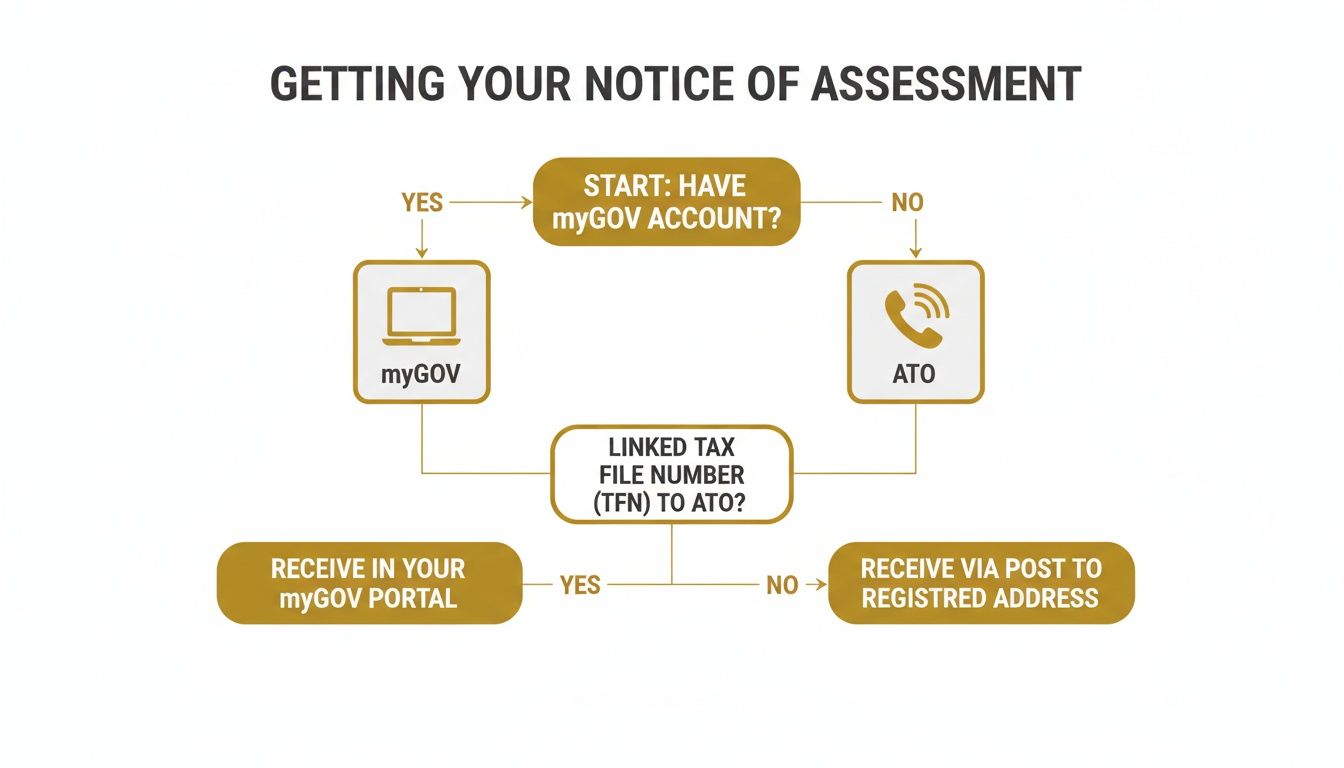
Methods for Accessing Your Notice of Assessment
| Method | Typical Timeframe | Best For |
|---|---|---|
| myGov Inbox | Within 2 weeks (after processing) | Instant, secure digital access for most people. |
| ATO Online Services | Within 2 weeks (after processing) | Direct access if you don't use myGov regularly. |
| Registered Tax Agent | Varies | Those who prefer an expert to handle everything. |
| By Post | Up to 6 weeks (after processing) | If you've opted out of digital or use paper forms. |
Using myGov for Instant Document Access
For most Aussies, the first and fastest answer to "how do I get my Notice of Assessment?" is myGov. If you’ve linked your Australian Taxation Office (ATO) services to your myGov account, you already have a secure digital hub for all your tax documents. It’s the gold standard for a reason. Picture this: you're in the middle of a home loan application, and the bank suddenly asks for your last two years of NOAs to verify your income. Instead of digging through a filing cabinet or waiting days for the post, you can just log into myGov, download the PDFs, and email them off in minutes. This isn't just about making life easier; it's about having immediate control over crucial financial documents exactly when you need them.Navigating to Your myGov Inbox
Once you're logged into myGov, you'll land on a dashboard showing your linked services. From here, you’ll click through to the Australian Taxation Office to get into your tax-specific area. This takes you straight into the ATO's online portal, where your letters and statements are all stored. No need to remember another password or worry about mail getting lost. To find your NOA, you can head to the 'Tax' dropdown menu, click 'Lodgments', and then look at your income tax history. But honestly, the most direct route is usually your myGov Inbox. It’s designed specifically to hold official mail from services like the ATO.Pro Tip: Make sure you've set up notifications in your myGov account settings to get an SMS or email. That way, you'll know the exact moment your tax return has been processed and your Notice of Assessment has arrived.This digital delivery is now the default for over 15 million Australian taxpayers every year. In fact, more than 90% of people who lodge their own return get their tax outcome this way, completely avoiding postal delays. The document that lands in your inbox even includes a tax receipt, breaking down how your taxes contribute to services like health and welfare. You can see more on the ATO's digital process and what your myTax estimate means.
Linking Services and Tax Agents
Of course, for any of this to work, your ATO account needs to be correctly linked to myGov first. If you haven't done it yet, the system will walk you through a quick verification process. You'll just need a few details on hand, like your Tax File Number (TFN) and information from a recent ATO-generated letter. And if you use a tax professional? The process can be even simpler. A common question we get is whether an agent can access these documents. The answer is yes. You can authorise your tax agent within myGov, giving them the access they need to manage your affairs efficiently. For anyone who prefers having an expert handle things, learning how to add your tax agent to myGov is a key step to making your tax life much easier.Alternative Ways to Request Your NOA
While jumping onto myGov is usually the fastest way to get your Notice of Assessment, it’s definitely not the only option. If you’re not online, wrestling with a forgotten password, or just prefer a different approach, the Australian Taxation Office (ATO) has a few other paths you can take. Knowing these alternatives means you’re never stuck, especially when you need that document in a hurry. Imagine you're trying to lock in a rental property and the agent needs your NOA by the end of the day. Of course, this is the one time you can’t remember your myGov password and the reset process is failing you. In a tight spot like this, your best bet is to get the ATO on the phone.
Contacting the ATO by Phone
You can give the ATO a call on 13 28 61 to request a copy of your NOA. Before you dial, it’s a good idea to have some key details handy so you can sail through their security check. They’ll almost certainly ask for:- Your full name and date of birth
- Your Tax File Number (TFN)
- Details from another recent ATO document or other personal information to confirm it’s you
Using a Registered Tax Agent
If you use a tax agent to lodge your return, you’ve got an even easier option. Your agent automatically gets a copy of your Notice of Assessment as soon as it’s issued by the ATO, and they’re required to keep these records on file for you.A quick email or phone call to your tax professional is often the simplest way to get what you need. They can usually fire over a digital PDF copy straight away, saving you the hassle of navigating the ATO’s phone system.This is a real lifesaver if you need NOAs from several different years, as your agent will have them all organised and ready to send.
The ATO Publications Ordering Service
For those who aren’t in a rush, the ATO also provides an online publications ordering service. You can use this portal to request a paper copy of your NOA from previous financial years. It's a reliable service, but it uses the same postal delivery timeframe, making it best suited for non-urgent record-keeping. At the end of the day, knowing how to get your notice of assessment through these different channels ensures you're prepared for any situation.Understanding When Your NOA Will Arrive
Once you’ve lodged your tax return, the next question on everyone's mind is, "So, when will I actually get my Notice of Assessment?" The answer really comes down to how and when you lodged. Your choice can be the difference between getting it in a couple of weeks or waiting for over a month. Lodging online through myTax early in the tax season—think July—is by far your fastest option. The ATO’s systems are built for digital returns, so you can realistically expect your NOA to pop up in your myGov Inbox in under two weeks. On the flip side, if you're mailing in a paper form closer to the October deadline, you're signing up for a much longer wait. It's a manual process, and that takes time.Key Factors Influencing Timelines
Even with a smooth lodgement, a few things can slow your NOA down. The sheer volume of returns hitting the ATO during peak periods can create a bit of a bottleneck, even for online lodgements. Certain details in your return can also flag it for a manual review by an actual person at the ATO, which naturally adds time. Common triggers for these delays include:- Mismatches between the income you've reported and the data the ATO has from your employer or bank.
- Complex or unusually high deduction claims that need a closer look.
- Information that needs to be cross-checked with another government department, like Services Australia.
Knowing about these variables helps you set realistic expectations. An online return lodged in August might take a bit longer than one submitted on July 1st, and that’s completely normal. Understanding why there might be a delay helps you figure out when it's genuinely time to start chasing it up.

Processing Benchmarks to Keep in Mind
The ATO’s digital-first approach makes a huge difference. Online myTax returns, which are used by over 70% of Australia’s 15+ million annual filers, are generally processed within a two-week timeframe. Paper lodgements? They have a much lengthier target of 50 business days. This stark difference is driven by efficiency, and Australia’s high on-time filing rate of 87.7% in 2023 helps keep the system moving. Even so, delays during peak periods can push wait times to three weeks for about 20% of cases. For a broader view, you can explore more OECD data on global tax administration trends.Troubleshooting Common NOA Problems
Even with the slickest online systems, tax matters don't always go off without a hitch. Knowing how to handle the most common issues with your Notice of Assessment (NOA) can save you a mountain of stress. What if your NOA never shows up, or you’ve simply misplaced the original? Don’t panic. Your first and best move is to jump back into your myGov Inbox. It’s the fastest way to get it and often holds documents you might have just overlooked. If it’s definitely not there, a quick call to your tax agent or the ATO directly will get a replacement sorted out for you.When the Numbers Don't Match
One of the most frequent calls we get is from clients confused because their final refund doesn't match the initial myTax estimate. This isn’t usually a mistake. Nine times out of ten, it’s because the ATO has used your refund to pay off an existing debt with another government agency—a process known as offsetting. Common debts that trigger this include:- Outstanding Centrelink or Services Australia payments
- Overdue child support obligations
- A tax debt from a previous year
Your Notice of Assessment is the final, legally binding calculation of your tax position for the year. The myTax estimate is just that—an estimate provided for your convenience before the ATO completes its final checks and balances.If you suspect an actual error on the assessment itself—like incorrect income figures or a disallowed deduction you believe was valid—you absolutely have the right to request an amendment. You can typically do this yourself online through myGov, or you can have your tax agent submit one on your behalf. In rare cases, if you notice suspicious activity or believe your details have been used fraudulently, it’s critical to act fast. Our guide on what to do about a compromised TFN provides the essential steps you need to take to protect your identity.
Frequently Asked Questions About Your Notice of Assessment
When you're trying to track down your Notice of Assessment, a few common questions always seem to pop up. Let's clear up some of the usual sticking points.
How Long Does the ATO Keep My NOAs?
For most practical purposes, the ATO keeps your NOAs for the last five years readily available right inside your linked myGov account. While they hold records for much longer, these recent documents are what you'll typically need for things like loan applications or rental agreements.Can I Get an NOA Without Lodging a Return?
In a word, no. A Notice of Assessment is only generated after a tax return has been lodged and the ATO has finished processing it. If you haven't lodged a return for a particular financial year, there's simply no NOA to find. Getting that return filed is your first and only step.It's easy to mix them up, but your NOA is a summary of a single tax return for one specific year. A Statement of Account, on the other hand, is more like a running bank ledger, showing all your transactions with the ATO over time—payments, credits, debts, the lot.
Why Is My Final Refund Different From My Estimate?
Ah, the classic question. The estimate you see in myTax when you lodge is just that—a preliminary calculation based on the figures you've entered. The final, official amount on your NOA comes after the ATO has done its homework. They verify everything and, most importantly, check for any existing debts you might have with other government agencies like Services Australia. If you owe money elsewhere, they'll use your refund to pay that off first, which is the most common reason the final figure changes.Navigating tax documents and lodgements can be tricky, but you don't have to do it alone. Australia Wide Tax Solutions offers expert, personalised service to handle everything from late returns to complex investments, ensuring you get the best possible outcome. Get in touch with our team today for a stress-free tax experience. "Need your Notice of Assessment for a loan or visa? The fastest route is digital! Check out our guide to accessing your NOA instantly via myGov or your tax agent. 📈📄 #TaxTips #AussieTax #NOA #LodgeWithConfidence #AWTS"
Estate planning ensures assets are distributed according to your wishes, minimises disputes among beneficiaries, and can reduce the tax and administrative burden on your estate. Without a valid Will, your estate is distributed under intestacy laws that may not reflect your intentions. A complete plan also addresses superannuation, powers of attorney, and advance care directives.
No. Superannuation is not automatically an estate asset and does not pass according to your Will. Your super fund trustee decides who receives the death benefit, guided by any binding death benefit nomination you have made. Without a valid binding nomination, the trustee has discretion to pay your legal personal representative or directly to a dependant.
Australia has no inheritance tax or estate duty. However, selling inherited assets can trigger CGT. The cost base of inherited assets is generally the market value at the date of death, and the 50% CGT discount applies if the beneficiary holds the asset for more than 12 months. Pre-CGT assets (acquired before 20 September 1985) have special rules.
Probate is a court order confirming a Will is valid and authorising the executor to administer the estate. It is generally required for estates that include real property, or when financial institutions require legal authority before releasing assets. Smaller estates where assets are held jointly may not require probate. The process is handled through the Supreme Court of the relevant state.
Review your Will after any major life event: marriage (which automatically revokes most Wills), divorce, birth of children, significant changes in financial position, or a beneficiary or executor dying. As a general rule, review every three to five years even without a triggering event to ensure it remains current.
"Sole Trader Tax Rates in Australia 2024-25:
What You Need to Know Before You Start"
- "Sole Trader Tax Rates in Australia 2024-25:
- Hashtags:
Thinking about becoming a sole trader in Australia? While it's the simplest business structure to set up, the tax implications might surprise you. Unlike companies that pay a flat 25-30% tax rate, sole traders face a progressive tax system that can significantly impact their take-home income.
Understanding Sole Trader Tax Rates 2024-25:
As a sole trader, your business income is added to your personal income and taxed at individual tax rates:
- $0 - $18,200: Tax-free threshold (0%)
- $18,201 - $45,000: 19%
- $45,001 - $120,000: 32.5%
- $120,001 - $180,000: 37%
- $180,001+: 45%
Plus Medicare Levy: 2% on taxable income over $23,226
Why You SHOULD Consider Being a Sole Trader:
- Simple Setup & Low Costs
- No ASIC registration fees
- Minimal ongoing compliance requirements
- Use your personal TFN (no separate ABN required for some activities)
- Tax Deductions You Can Claim:
- Home office expenses (dedicated workspace)
- Vehicle expenses (business portion only)
- Equipment and tools
- Professional development and training
- Insurance premiums
- Marketing and advertising costs
- Phone and internet (business portion)
- Professional memberships and subscriptions
- Immediate Access to Losses
- Business losses can offset other personal income
- Reduces your overall tax liability in loss-making years


Why You SHOULDN'T Be a Sole Trader:
- No Tax Benefits - It All Adds Up. Your business income is simply added to your salary, rental income, investment returns, and any other income. There's no tax advantage - you're just creating more taxable income without any structural benefits. Example: If you earn $80,000 salary + $30,000 sole trader income = $110,000 total taxable income at higher marginal rates.
- Unlimited Personal Liability
- You're personally responsible for ALL business debts
- Your home, car, and personal assets are at risk
- No asset protection from business creditors
- Professional indemnity claims can bankrupt you personally
- Limited Growth Potential
- Harder to raise capital or bring in investors
- Can't retain profits in the business at lower tax rates
- Difficult to sell the business as a going concern
- Higher Tax Rates at Higher Incomes. Once your combined income exceeds $45,000, you're paying 32.5% tax (plus Medicare levy) compared to a company's 25% rate.
The Hidden Trap: Many sole traders don't realise that success actually penalises them tax-wise. As your business grows and becomes profitable, you're pushed into higher personal tax brackets without any ability to retain profits at lower company tax rates.
When to Consider Alternatives:
- If your total income (including business) exceeds $45,000
- If you have significant business assets or liability risks
- If you want to reinvest profits back into the business
- If you're planning for long-term growth and potentially selling the business
Conclusion: While sole trader status offers simplicity, it's often a short-term solution. The lack of tax benefits, unlimited liability, and higher tax rates on success make it unsuitable for serious business ventures. Consider speaking with a qualified tax professional about whether a company structure might better serve your long-term goals.
"Complete guide to sole trader tax rates Australia 2024-25. Learn what you can claim, why business income adds to personal tax without benefits, and the unlimited liability risks. Expert tax advice from Australia Wide Tax Solutions - Sydney's trusted accountants."
Hashtags:
#SoleTraderTax #AustralianTax #TaxRates2024 #BusinessTax #SydneyAccountant #TaxAdvice #SmallBusiness #TaxDeductions #BusinessStructure #AWTS #AustraliaWideTaxSolutions #PersonalLiability #TaxPlanning #BusinessAccounting #TaxReturn
The ATO provides guidance through ato.gov.au, the Small Business Support Line (13 28 66), and Online Services for individuals and businesses. For complex situations, a registered tax agent provides advice tailored to your specific circumstances and professional indemnity protection. You can verify agent registration at the TPB register at tpb.gov.au.
Most tax records must be kept for five years from the date of lodgement or the date the transaction occurred, whichever is later. Records must be in English or convertible to English and must be sufficient to explain the income and deductions in your return. The ATO can request records at any time during the retention period.
Consider a registered tax agent when your affairs involve multiple income sources, business activity, investment properties, capital gains, or overseas income. Agents extend your lodgement deadline, provide safe harbour protection, and take professional responsibility for the advice given. Verify registration at tpb.gov.au.
The failure to lodge penalty is based on penalty units ($313 per unit from 1 July 2023), accruing per 28-day period for late returns and BAS lodgements. Incorrect information penalties range from 25% to 75% of the tax shortfall depending on whether the behaviour was careless, reckless, or intentional. Proactive disclosure before an audit begins typically results in significantly reduced penalties.
Tax minimisation is the legal arrangement of your affairs to reduce tax — claiming all eligible deductions, using appropriate structures, and timing income and expenses. Tax avoidance involves arrangements that technically comply with the law but achieve outcomes parliament did not intend. The ATO can apply Part IVA anti-avoidance rules to cancel benefits from avoidance arrangements.
Top 3 Tax Deductions to Maximise Your 2025 Tax Return in Australia
Tax time is an opportunity to review your finances and ensure you're not leaving any money on the table. For Australian taxpayers preparing their 2025 tax returns, understanding which deductions you can claim is essential. While work-from-home expenses have been popular in recent years, this year, many Australians may benefit more from other deductions that often go unnoticed. In this post, we'll cover the top 3 tax deductions to focus on for your 2025 tax return, helping you keep more of your hard-earned cash.
- Top 3 Tax Deductions to Maximise Your 2025 Tax Return in Australia
- Why Staying Updated Matters
- Conclusion
1. Self-Education Expenses
Investing in your education can pay off in multiple ways. If you’ve taken courses or training that relate directly to your current job or business, you might be able to claim self-education expenses as a deduction.
What Qualifies?
Self-education expenses can include tuition fees, textbooks, stationery, student union fees, and even travel costs between your home and the place of education (if it’s not your usual workplace). For example, if you’re an accountant who took an advanced tax course or a nurse who completed additional certification, these costs could be deductible.
Important Considerations
To qualify, the education must have a clear connection to your current employment or business activities. It cannot be for a qualification that leads to a new career. Keep detailed records such as receipts and course outlines to substantiate your claims.
2. Charitable Donations
Making charitable donations doesn’t just feel good; it can also reduce your tax bill. Donations to registered charities that have a Deductible Gift Recipient (DGR) status are deductible.
How It Works
You can claim donations of $2 or more made to eligible organisations. This includes cash gifts and donations of property such as shares. If you volunteer and incur out-of-pocket expenses, some of those costs might also be deductible.
Tips for Claiming
Always ask for a receipt when making a donation. Without proof, the ATO won’t accept your claim. Large or irregular donations might require additional documentation.
3. Investment Property Expenses
Owning an investment property comes with various costs, many of which can be claimed as deductions. These deductions help reduce your taxable income from other sources.
What Can You Claim?
Every day deductible expenses include interest on loans used to purchase the property, property agent fees, repairs (but not improvements), insurance premiums, council rates, and depreciation on the building and fixtures.
For example, if you had your investment property renovated, the cost of fixing a broken window is deductible as a repair; however, installing a new kitchen isn’t—it’s considered an improvement and is handled differently for tax purposes.
Make the Most of Depreciation
Depreciation can be complex but valuable. Consider hiring a quantity surveyor for a depreciation schedule if you want to maximise this deduction. This report helps identify all depreciable items within your property and can significantly increase your annual deductions.
Why Staying Updated Matters
Tax laws and allowable deductions are subject to change from year to year. Staying informed ensures you don’t miss out on new opportunities or accidentally claim something that isn’t allowed. The Australian Taxation Office website provides updates annually, and consulting with a tax professional is always a good idea if your financial situation is complex.
Conclusion
Knowing which deductions to claim can make a real difference in how much tax you owe—or how big your refund will be. For the 2025 tax year in Australia, focusing on self-education expenses, charitable donations, and investment property costs can help you maximise your return legally and smartly.
Remember to keep thorough records and receipts throughout the year and review any changes in tax laws that may affect your claims. If you’re unsure about what you can claim or want personalised advice, consider speaking with a qualified tax agent.
Take control of your tax return this year by making the most of these deductions—you deserve every dollar back that you’re entitled to!
The ATO provides guidance through ato.gov.au, the Small Business Support Line (13 28 66), and Online Services for individuals and businesses. For complex situations, a registered tax agent provides advice tailored to your specific circumstances and professional indemnity protection. You can verify agent registration at the TPB register at tpb.gov.au.
Most tax records must be kept for five years from the date of lodgement or the date the transaction occurred, whichever is later. Records must be in English or convertible to English and must be sufficient to explain the income and deductions in your return. The ATO can request records at any time during the retention period.
Consider a registered tax agent when your affairs involve multiple income sources, business activity, investment properties, capital gains, or overseas income. Agents extend your lodgement deadline, provide safe harbour protection, and take professional responsibility for the advice given. Verify registration at tpb.gov.au.
The failure to lodge penalty is based on penalty units ($313 per unit from 1 July 2023), accruing per 28-day period for late returns and BAS lodgements. Incorrect information penalties range from 25% to 75% of the tax shortfall depending on whether the behaviour was careless, reckless, or intentional. Proactive disclosure before an audit begins typically results in significantly reduced penalties.
Tax minimisation is the legal arrangement of your affairs to reduce tax — claiming all eligible deductions, using appropriate structures, and timing income and expenses. Tax avoidance involves arrangements that technically comply with the law but achieve outcomes parliament did not intend. The ATO can apply Part IVA anti-avoidance rules to cancel benefits from avoidance arrangements.
Notice of Assessment (NOA)
As a taxpayer in Australia, receiving your Notice of Assessment (NOA) from the Australian Taxation Office (ATO) is crucial to the annual tax filing process. This document is an official tax return record and provides valuable information about your tax obligations and entitlements. In this comprehensive guide, we'll explore the key components of the Notice of Assessment, explain its significance, and provide you with the knowledge to navigate this vital tax document effectively.
- Notice of Assessment (NOA)
- What is a Notice of Assessment?
- The Anatomy of a Notice of Assessment
- Understanding Your Tax Liability or Refund
- Reviewing Your Notice of Assessment
What is a Notice of Assessment?
A Notice of Assessment (NOA) is a formal document issued by the Australian Taxation Office (ATO) after you have filed your tax return. It outlines the ATO's assessment of your tax liability or refund for the relevant financial year. This assessment is based on the information you provided in your tax return, as well as any additional data the ATO has gathered from other sources.
The Anatomy of a Notice of Assessment
The Notice of Assessment typically includes the following key information:
Taxpayer Details
- Your name, address, and tax file number (TFN)
- The financial year the assessment is for
Tax Return Details
- The date your tax return was lodged
- The type of tax return you filed (e.g., individual, business, or trust)
- Your taxable income for the year
- The tax offsets and deductions you claimed
Tax Calculation
- The total amount of tax you are required to pay or the refund you are entitled to receive
- Any adjustments made by the ATO to your reported income or deductions
- The amount of tax already paid through pay-as-you-go (PAYG) withholding
Payment Information
- The due date for any outstanding tax payments
- Instructions on how to make the payment, including bank account details and payment reference numbers
Additional Information
- Notices or messages from the ATO regarding your tax affairs
- Information about your right to object or appeal the assessment
Understanding Your Tax Liability or Refund
The key information on your Notice of Assessment is the calculation of your tax liability or refund. This section will break down the various components that contribute to this figure:
Taxable Income
Your taxable income is earned minus any eligible deductions and offsets during the financial year. This figure determines the amount of tax you are required to pay.
Tax Rates and Thresholds
Australia's tax system uses a progressive tax rate structure, meaning that different tax rates apply to varying taxable income ranges. The NOA will show the tax rates and thresholds applied to your taxable income.
Tax Offsets and Deductions
Tax offsets and deductions can reduce the amount of tax you owe. Common examples include the Low and Middle Income Tax Offset, the Pensioners Tax Offset, and deductions for work-related expenses, charitable donations, and other eligible items.
PAYG Withholding
If employed during the financial year, your employer would have withheld a portion of your income as pay-as-you-go (PAYG) tax. The NOA will show the total amount of PAYG tax that has been paid, which is then credited against your overall tax liability.
Tax Refund or Balance Due
Based on the calculations above, the NOA will indicate whether you are entitled to a tax refund or if you have an outstanding tax balance to pay. If you are refunded, the ATO will issue a direct deposit to your nominated bank account or send you a cheque. If you have a balance due, the NOA will provide the due date and instructions for payment.
Reviewing Your Notice of Assessment
It's important to carefully review your Notice of Assessment to ensure that all the information is accurate and that you have claimed all eligible deductions and offsets. Here are some key things to look for:
Taxable Income
Verify that your reported income matches the information the ATO has on file. This includes wages, interest, dividends, and other income sources.
Deductions and Offsets
Ensure that all the deductions and offsets you claimed have been correctly applied. Double-check that you haven't missed any eligible claims.
Tax Calculations
Review the tax calculations to confirm that the correct tax rates and thresholds have been applied to your taxable income.
PAYG Withholding
Confirm that the PAYG tax withheld by your employer(s) during the year has been accurately reflected in the assessment.
Payment or Refund
If you have a balance due, ensure the payment due date and instructions are precise. If you are entitled to a refund, verify that the correct amount has been calculated.
What to Do If You Disagree with Your Notice of Assessment
If you believe there are errors or discrepancies in your Notice of Assessment, you have the right to object to the ATO's decision. Here are the steps to follow:
- Review the assessment carefully: Thoroughly examine the NOA and identify the specific areas you believe are incorrect.
- Gather supporting documentation: Collect any relevant evidence, such as receipts, invoices, or correspondence, that can support your position.
- Lodge an objection: You can lodge an objection with the ATO within a specific timeframe (usually 2 years from the assessment date). The objection must be in writing and include a clear explanation of the reasons for your disagreement.
- Await the ATO's response: The ATO will review your objection and provide a decision. If the ATO upholds its original assessment, you can appeal the decision to the Administrative Appeals Tribunal or the Federal Court.
It's important to note that the objection process has specific deadlines and requirements, so seeking professional tax advice is advisable if you plan to dispute your Notice of Assessment.
Keeping Track of Your Tax Records
To ensure a smooth tax filing process and facilitate the review of your Notice of Assessment, it's essential to maintain accurate and organized tax records throughout the year. This includes:
- Keeping copies of your tax returns and Notice of Assessments NOAs for at least 5 years
- Retaining receipts, invoices, and other documentation related to your income and deductions
- Tracking any changes to your personal or financial circumstances that may impact your tax obligations
By keeping track of your tax records, you'll be better equipped to understand your NOA, identify any issues, and ensure you're paying the correct amount of tax.
Conclusion
Your Notice of Assessment is a critical document that provides a comprehensive overview of your tax affairs for the financial year. By understanding the key components of the NOA and how to review it thoroughly, you can ensure that your tax obligations are accurately reflected and take appropriate action if discrepancies arise.
Remember, don't hesitate to seek professional tax advice if you have any questions or concerns about your Notice of Assessment. The team at Australia Wide Tax Solutions is always here to help you navigate the complexities of the Australian tax system and ensure you're making the most of your tax entitlements.
The ATO provides guidance through ato.gov.au, the Small Business Support Line (13 28 66), and Online Services for individuals and businesses. For complex situations, a registered tax agent provides advice tailored to your specific circumstances and professional indemnity protection. You can verify agent registration at the TPB register at tpb.gov.au.
Most tax records must be kept for five years from the date of lodgement or the date the transaction occurred, whichever is later. Records must be in English or convertible to English and must be sufficient to explain the income and deductions in your return. The ATO can request records at any time during the retention period.
Consider a registered tax agent when your affairs involve multiple income sources, business activity, investment properties, capital gains, or overseas income. Agents extend your lodgement deadline, provide safe harbour protection, and take professional responsibility for the advice given. Verify registration at tpb.gov.au.
The failure to lodge penalty is based on penalty units ($313 per unit from 1 July 2023), accruing per 28-day period for late returns and BAS lodgements. Incorrect information penalties range from 25% to 75% of the tax shortfall depending on whether the behaviour was careless, reckless, or intentional. Proactive disclosure before an audit begins typically results in significantly reduced penalties.
Tax minimisation is the legal arrangement of your affairs to reduce tax — claiming all eligible deductions, using appropriate structures, and timing income and expenses. Tax avoidance involves arrangements that technically comply with the law but achieve outcomes parliament did not intend. The ATO can apply Part IVA anti-avoidance rules to cancel benefits from avoidance arrangements.
- What You Can Actually Claim Without a Receipt
- Understanding the ATO $300 Rule for Work Expenses
- Claiming Car Expenses Without Keeping Every Receipt
- Using Bank Statements as Valid Proof of Purchase
- How a Diary Can Substantiate Small Expenses
ATO guide to work expenses.
Lost a receipt? It happens to the best of us. But don't write off that work-related expense just yet. The Australian Taxation Office (ATO) knows that paper receipts can be lost, damaged, or not provided. You might still be able to claim a deduction.
The most important thing to remember is this: 'no receipt' does not mean 'no record'. You absolutely still need to prove the expense was legitimate.
What You Can Actually Claim Without a Receipt

A missing docket doesn't automatically kill your claim. But it also isn't a free pass to claim whatever you want. To successfully deduct any expense from your taxable income—with or without a perfect paper trail—it has to pass the ATO’s three golden rules.
The Three Golden Rules of Tax Deductions
Think of these rules as a non-negotiable checklist for every single dollar you want to claim. They are the bedrock of Australia’s tax laws, and every claim must satisfy all three.
- You must have spent the money yourself. The expense had to come out of your own pocket, and you can’t have been paid back for it by your boss.
- The expense must be directly related to earning your income. There needs to be a clear, logical link between what you bought and how you make a living. A new laptop for your work-from-home setup? Absolutely. A new gaming console? Not a chance.
- You must have a record to prove it. This is the crucial part when a receipt goes missing. Without that original piece of paper, the burden is on you to provide some other form of solid evidence.
The core principle is simple: a claim must be legitimate, and you must be able to prove it. The ATO’s flexibility on receipts is a practical measure, not a loophole to be exploited.
Moving Beyond the Paper Receipt
So, what counts as a proper record if you don't have a receipt? The ATO accepts various forms of proof, and the documentation you need often depends on the type of expense and its amount.
This could be a detailed bank or credit card statement showing the transaction, a properly kept logbook for car expenses, or even a diary entry noting small cash purchases. For a deeper dive into what’s generally deductible, check out our guide on what you can claim on your tax return.
But what about the specific allowances the ATO provides for claims without receipts? Let's break down those rules, including the handy $300 total limit for work expenses, and look at exactly what kind of alternative records will keep you in the clear.
A Quick Summary of the Rules
To make things clearer, here’s a table that breaks down the main allowances and requirements for making a claim when you don’t have a standard receipt.
Key Allowances for Claims Without Receipts
| Allowance Category | Claim Limit or Rule | What You Need Instead |
|---|---|---|
| Small Expenses | Individual expenses of $10 or less, up to a total of $200 per year | A diary or notebook entry with the date, amount, and what it was for. |
| Total Work Expenses | Up to $300 for all work-related expenses, without needing receipts for any of them. | You still need to show how you calculated the claim (e.g., diary notes, bank statements). |
| Laundry Expenses | Up to $150 per year for laundering compulsory uniforms or protective clothing. | You don't need receipts, but you must show how you calculated the claim. |
| Car Expenses (Cents per km) | Claim up to 5,000 business kilometres per car, per year. | A logbook or diary records to show how you calculated your business kilometres. |
This table provides a great starting point, but it's important to understand the details behind each rule to make sure your claims are solid and ATO-proof.
Understanding the ATO $300 Rule for Work Expenses
Ah, the old "$300 rule". It’s one of the most talked-about parts of Australian tax law, yet so often misunderstood. Many people hear about it and think it's a free pass from the tax office—an automatic, no-questions-asked discount on their tax.
Let's be clear: that’s a risky way to think about it, and the ATO doesn't see it that way.
The rule allows you to claim up to $300 in work-related expenses without keeping individual receipts for each purchase. But this isn't a magic wand. You still have to prove you actually spent the money and that the expense was directly tied to earning your income.
What Is Covered by the $300 Rule?
This rule was really designed to make life a bit easier for those small, incidental costs that pop up in most jobs. Think of it as a way to handle the minor, everyday purchases you make to do your work.
Common things that fall under this umbrella include:
- Stationery like pens, notepads, and printer paper.
- Professional publications such as industry magazines or journals.
- Small tools and equipment you need for your trade.
- Union fees or professional association memberships.
For instance, a teacher buying stickers and posters for their classroom, or a graphic designer paying for a monthly subscription to a design journal, could potentially count these towards their $300 claim.
The $300 allowance is a threshold, not a gift. It simply changes the type of proof you need, shifting the focus from individual receipts to a credible explanation of how you calculated your claim.
What Is Not Covered by the Rule?
It's absolutely crucial to know where the line is drawn. This rule has firm limits, and certain expenses are completely excluded, no matter how small the cost. These categories have much stricter record-keeping rules.
You cannot use the $300 rule for:
- Car expenses (these must be claimed using the cents per kilometre or logbook method).
- Travel expenses like flights, accommodation, and meals away from home.
- Meal expenses (unless they're part of a formal travel allowance).
- Expenses for depreciating assets (items that lose value over time).
This provision allows employees and sole traders to claim up to $300 in total for certain work costs without receipts, as long as the expenses are genuine and work-related. If you want to dive deeper, you can discover more insights about tax deductions in Australia on scalesuite.com.au.
Essentially, the ATO has carved out this exception for minor, miscellaneous costs. For bigger or more specific claims like using your car for work, the standard of proof is much, much higher. You’ll need detailed logs and records to back up your claim and stay out of trouble if the ATO comes knocking.
Claiming Car Expenses Without Keeping Every Receipt
When it comes to work-related travel, the thought of hoarding a receipt for every single litre of petrol or every kilometre driven can feel overwhelming. Nobody wants that shoebox full of crumpled paper.
Thankfully, the Australian Taxation Office (ATO) gets it. They've set up a couple of ways to claim car expenses that don't demand such intense paperwork. These methods are designed to make life easier while still making sure your claims are fair and legitimate.
The two main paths you can take are the cents per kilometre method and the logbook method. Which one is right for you really depends on how often you're using your personal car for work.
The Cents Per Kilometre Method Explained
Think of this as the simple, set-and-forget option. The cents per kilometre method lets you claim a fixed rate for every work-related kilometre you drive, capped at a maximum of 5,000 kilometres per car, each year.
This method is perfect if you only use your car for work occasionally—maybe for driving to client meetings, visiting different work sites, or running a work-related errand. Its biggest selling point is simplicity. You can forget about keeping receipts for fuel, oil changes, insurance, or rego.
All you need is a way to show the ATO how you worked out your kilometres. A simple diary or note of your trips is usually enough.
This flowchart breaks down the key rules for claiming expenses without a receipt, including the all-important $300 rule.
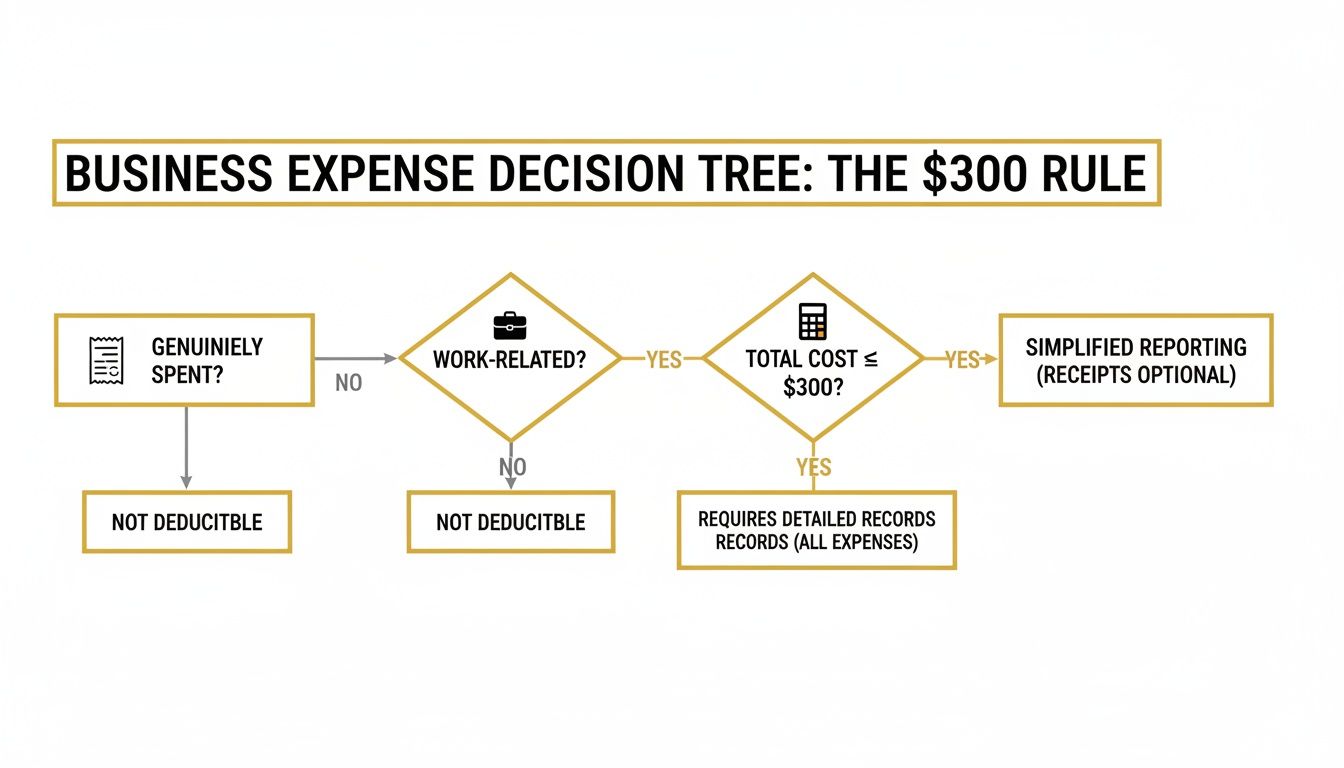
The key takeaway here is that every claim—receipt or not—has to be a genuine work expense that you actually paid for and falls within the ATO's limits.
When the Logbook Method Is Better
So, what happens if you're on the road constantly and clock up well over 5,000 work kilometres a year? The cents per kilometre method will hit its ceiling pretty fast, meaning you could be missing out on a much bigger deduction.
This is where the logbook method steps in. It does require a bit more effort upfront, but for people who drive a lot for work, it almost always leads to a significantly larger claim.
To use this method, you need to keep a detailed logbook for a continuous 12-week period. This snapshot of your driving habits is then used to calculate your car's business-use percentage.
The real power of the logbook is its longevity. Once you've done that initial 12-week stint, you can use that business-use percentage to calculate your claims for up to five years, as long as your driving patterns don't drastically change.
You then apply this percentage to all your actual car running costs—fuel, maintenance, insurance, depreciation, the lot. While you'll need to keep receipts for these costs, the logbook itself means you don't have to track every single trip for the next five years. For a deeper dive, check out our guide on claiming work-related car expenses.
Travel and Meal Allowances
The ATO also has rules for travel and meal allowances that can cut down on your receipt-keeping. If your employer pays you a travel allowance and your claim for accommodation, food, and other small costs is within the ATO's official 'reasonable amounts', you generally don't need to keep receipts.
But be careful. These "reasonable amounts" are very specific and change based on your salary, where you're travelling, and for how long. If you try to claim more than the reasonable amount, the ATO will want to see written evidence for your entire claim, not just the part that's over the limit. It pays to know what these thresholds are before you travel.
Using Bank Statements as Valid Proof of Purchase
We’ve all had that sinking feeling. You’ve lost a receipt for a decent-sized work expense, and you can almost hear the deduction disappearing. Before you give up, pull up your bank or credit card statements. In the eyes of the ATO, these financial records are often your next best thing.
A bank statement acts as clear, third-party proof that you actually spent the money. It shows the date, the exact amount paid, and who you paid it to. This is a powerful starting point for substantiating claims without receipts, especially for those bigger items where a simple note in your diary just won't cut it.
But hold on—a line on a bank statement is only one piece of the puzzle. By itself, it doesn't tell the whole story. A transaction entry for "Officeworks $150" doesn't explain what you bought or why it was essential for your job. To make it a rock-solid piece of evidence, you need to add some context.
How to Annotate Your Statements for the ATO
Think of your bank statement as the foundation of a house. Your own notes are the walls that complete the structure and make it useful. Without them, the ATO is left guessing. To turn a simple transaction line into compelling proof, you have to add the details that answer the questions an auditor would ask.
Your notes should clearly explain:
- What you bought: Be specific. Instead of "office supplies," write "HP printer ink cartridges and 2 reams of A4 paper."
- Who the supplier was: The statement usually shows this, but it’s good practice to clarify if the trading name is a bit obscure or different from the shopfront name.
- The nature of the expense: State its purpose directly. For example, "For printing client reports from my home office."
- How it connects to your work: This is the most crucial part. You must explicitly link the purchase to earning your income.
The goal is to paint a complete picture for the ATO. Your annotations should leave no doubt that the expense was legitimate, directly related to your work, and that you were the one who paid for it.
The Limitations of Bank Statements
While they are incredibly helpful, bank statements aren't a silver bullet for every lost receipt. It's important to understand their limits and know where they fall short.
The most obvious blind spot is cash purchases. If you paid with cash and lost the receipt, your bank statement won't show the transaction at all. You’re left with no financial trail to follow, which is exactly why keeping a diary is so vital for those small, under-$10 cash expenses.
Vague transaction descriptions can also weaken your claim. A payment to "General Store" or a simple person-to-person transfer doesn't offer much clarity. In these situations, you’ll need to back up the statement with other forms of evidence, like an email confirmation or even a photo of the item, to build a stronger case.
How a Diary Can Substantiate Small Expenses
It’s often the smallest expenses that are the biggest headache to track. Think about all those little cash costs that crop up in your workday—parking meters, road tolls, or buying a quick coffee for a client. Individually, they’re tiny, but over a full year, they can easily add up to a decent deduction. The problem? Getting a paper receipt for every single one is just not practical.
This is where a simple diary becomes one of your most powerful tax tools. The ATO understands that it’s not always possible to get a receipt for minor cash transactions. They allow you to use a diary or a similar record for small work-related expenses that are $10 or less each, as long as the total of these specific claims doesn’t go over $200 for the financial year.
This rule is tailor-made for those frequent, low-value cash outlays. Your diary essentially acts as a substitute receipt, so it needs to contain all the crucial details the ATO would look for on an actual docket to prove the expense is legitimate.
Crafting the Perfect Diary Entry
A valid diary entry is much more than a quick scribble in a notebook. To be compliant, it has to be detailed and, crucially, created at or very near the time you spent the money—not months later when you’re scrambling to do your tax.
For each entry to count, it must clearly state:
- The date the expense happened.
- The supplier or business name (e.g., "City Council Parking").
- The exact cost of the item or service.
- The nature of the goods or services and how it connects to your work (e.g., "Parking for client meeting at Collins St").
Consistency is your best friend here. If an auditor sees entries made regularly throughout the year, it paints a credible picture of your spending habits and gives your claim real strength.
A well-kept diary transforms vague memories into concrete evidence. It shows diligence and proves you are actively tracking your expenses, which is exactly what the ATO wants to see for any claim made without a standard receipt.
Real-World Diary Examples
Let's see what this looks like in practice. Imagine you're a sales rep who is constantly out of the office meeting clients. Your expense diary for one week might look something like this:
Sample Diary Entries
| Date | Supplier | Item | Cost | Work Purpose |
|---|---|---|---|---|
| 21 Oct | Central Brew Cafe | Coffee | $5.50 | Meeting with J. Smith |
| 22 Oct | City Council Parking | Parking Meter | $7.00 | Site visit at CBD project |
| 24 Oct | Metro Trains | Train Ticket | $4.80 | Travel to industry seminar |
This level of detail leaves no room for doubt. It clearly outlines each small expense and its direct link to earning your income, making it a rock-solid way to substantiate those everyday costs you can’t get receipts for.
Building a Proactive Record-Keeping System
The best way to handle the stress of a missing receipt is to build a system that prevents it from becoming a problem in the first place.
When you shift from a reactive mindset ("Where did that receipt go?") to a proactive one, tax time stops being a frantic scramble and turns into a simple, organised process. Good record-keeping isn't just about ticking compliance boxes; it's about having total clarity over your finances.
A solid system gives you the confidence to claim every single dollar you're entitled to. This all starts with embracing a few modern tools and simple, consistent habits. Instead of letting receipts pile up in a shoebox, you can lock them in digitally the moment you get them.
Go Digital with Your Receipts
The easiest first step is right in your pocket: your smartphone. Heaps of apps are designed specifically to scan, categorise, and store your receipts safely in the cloud. This creates an immediate, searchable digital backup that the ATO happily accepts as valid proof.
The key benefits of using receipt-scanning apps are pretty clear:
- Instant Backup: You’ll never have to worry about losing a paper receipt or watching the ink fade to nothing.
- Easy Categorisation: Tag expenses on the fly as travel, supplies, or meals right when you make the purchase.
- Simple Reporting: When tax time rolls around, generating expense reports is almost effortless.
This digital-first approach is one of the most effective ways of record-keeping available today, and it will save you countless hours of manual sorting down the line.
A proactive system isn't about giving yourself more work; it's about working smarter. A few seconds spent digitising a receipt today saves hours of hunting for it months from now.
Create a Dedicated Financial Workflow
For businesses or anyone with significant work-related expenses, separating your finances is an absolute game-changer.
Go and open a dedicated bank account or credit card used only for work-related purchases. This simple move creates a clean, automatic record of all your business spending, making it incredibly easy to review transactions without mixing them up with personal coffees or groceries.
If you're looking to build a more formalised approach, you could even use specialised process documentation software to map out a clear, repeatable workflow for how you and your team manage every expense.
But don't toss out your physical records entirely. It's still wise to maintain a simple folder system, maybe with sections for different expense types or months. By combining a dedicated bank account, digital receipt capture, and a basic physical filing method, you create a powerful, multi-layered system that has your back.
This ensures that when tax time arrives, you have all the information you need, right at your fingertips. No stress, no searching.
Common Questions About Claims Without Receipts
It’s easy to get tangled up in the rules for claiming expenses without receipts, so let's clear up a few of the most common points of confusion. Getting these right will give you the confidence that your claims will stand up to ATO scrutiny.
One of the biggest myths we see is the $300 rule. A lot of people think they can automatically claim $300 for work-related expenses, even if they never spent the money. This is a huge red flag for the ATO and completely incorrect.
The $300 limit is simply the threshold where you don't need to provide traditional receipts. It's not a free deduction. You absolutely must have spent the money on legitimate work costs.
What Happens During an ATO Audit?
So, the inevitable question: what if the ATO questions a claim and you don't have the receipt? This is where your other records become your safety net. The ATO will ask you for alternative evidence to prove you actually incurred the expense.
Your best defence will be things like annotated bank statements, detailed diary entries, or a well-kept logbook. If you can’t produce any proof at all, the ATO will almost certainly disallow the deduction. That means paying back the tax you saved, and you could also get hit with interest and penalties on top.
For anyone looking to get their bank records organised for tax time, a bank statement converter to Excel can be a massive help, turning messy statements into a neat, auditable spreadsheet.
How Long to Keep Your Records
Finally, how long do you need to hang onto all this proof? The ATO’s rule is clear: you must keep all tax-related records for five years from the date you lodge your tax return.
This five-year rule applies to everything—paper receipts, digital copies, diaries, and logbooks. It’s always a smart move to back up digital records to secure cloud storage, just in case your hardware fails.
Keeping good records isn't just about ticking a compliance box; it's about protecting every dollar you're entitled to claim.
Navigating the rules for tax claims can be complex, but you don't have to do it alone. The experts at Australia Wide Tax Solutions can provide personalised advice to ensure you claim everything you're entitled to while staying compliant. Maximise your tax outcome with confidence today.
The ATO provides guidance through ato.gov.au, the Small Business Support Line (13 28 66), and Online Services for individuals and businesses. For complex situations, a registered tax agent provides advice tailored to your specific circumstances and professional indemnity protection. You can verify agent registration at the TPB register at tpb.gov.au.
Most tax records must be kept for five years from the date of lodgement or the date the transaction occurred, whichever is later. Records must be in English or convertible to English and must be sufficient to explain the income and deductions in your return. The ATO can request records at any time during the retention period.
Consider a registered tax agent when your affairs involve multiple income sources, business activity, investment properties, capital gains, or overseas income. Agents extend your lodgement deadline, provide safe harbour protection, and take professional responsibility for the advice given. Verify registration at tpb.gov.au.
The failure to lodge penalty is based on penalty units ($313 per unit from 1 July 2023), accruing per 28-day period for late returns and BAS lodgements. Incorrect information penalties range from 25% to 75% of the tax shortfall depending on whether the behaviour was careless, reckless, or intentional. Proactive disclosure before an audit begins typically results in significantly reduced penalties.
Tax minimisation is the legal arrangement of your affairs to reduce tax — claiming all eligible deductions, using appropriate structures, and timing income and expenses. Tax avoidance involves arrangements that technically comply with the law but achieve outcomes parliament did not intend. The ATO can apply Part IVA anti-avoidance rules to cancel benefits from avoidance arrangements.