
Getting a bonus should be exciting, but that feeling often evaporates the moment you see how much tax has been taken out. It can feel confusing and, frankly, a bit unfair.
- How Your Bonus Is Actually Taxed
- How the ATO Calculates Tax on Your Lump Sum Payment
- How a Bonus Impacts Your Marginal Tax Rate
- Superannuation Rules for Bonus Payments
- Smart Strategies to Legally Reduce Tax on Your Bonus
Let’s clear up the biggest myth right away: there is no special ‘bonus tax’ in Australia. Your employer is simply required by the Australian Taxation Office (ATO) to withhold tax from your bonus at a much higher rate than your regular pay. This is the ATO’s way of pre-paying the tax you’ll likely owe for the year.
How Your Bonus Is Actually Taxed
When you see a huge chunk of your bonus disappear before it even hits your bank account, it’s natural to think you’re being penalised. But the system is actually designed to do the opposite—to stop you from getting a nasty surprise tax bill at the end of the financial year.
Think of your annual income like a bucket being filled with water. Your regular salary fills it steadily, week by week. A bonus is like pouring in a massive jug all at once. The Pay-As-You-Go (PAYG) withholding system sees that big splash of cash and assumes it will push your total income into a higher tax bracket. To prepare for this, it takes a larger upfront "down payment" on your estimated annual tax bill. To get your head around it properly, understanding the details of Australia's bonus payment tax is the first and most important step.
Withholding Isn't Your Final Tax Bill
It is absolutely crucial to understand the difference between the tax withheld from your bonus and the tax you actually owe. The amount your employer takes out is just an estimate, calculated by payroll software using formulas set by the ATO.
Your final, true tax obligation is only worked out when you lodge your tax return.
At tax time, your total income for the year—including your salary, bonus, and any other earnings—is all added together. The tax is then calculated on this total amount based on your marginal tax rates. The PAYG tax you've already paid throughout the year, including that big chunk from your bonus, is credited against this final bill.
This process ensures everything is squared away correctly. If too much tax was withheld, which is very common with large one-off bonuses, you’ll get the extra back as a tax refund. If not enough was withheld, you'll have an amount to pay.
The table below offers a simple comparison, showing how withholding is treated for your regular pay versus a one-off bonus. It really highlights the different approaches payroll has to take.
Bonus Tax Withholding vs Regular Pay Withholding
| Aspect | Regular Salary Payment | One-Off Bonus Payment |
|---|---|---|
| Calculation Basis | Based on your regular pay cycle (e.g., weekly, fortnightly) and annualised to estimate your yearly income. | Treated as an irregular, large payment. Payroll software often annualises this single payment to estimate a much higher total yearly income. |
| Withholding Rate | A predictable, consistent percentage based on your standard earnings. | A significantly higher percentage is withheld to cover the potential jump into a higher marginal tax bracket. |
| Tax Reconciliation | Forms part of the total PAYG credits applied against your final tax liability at year-end. | The higher amount withheld is also credited. This often leads to a larger tax refund once your actual total income is assessed. |
Ultimately, while the initial withholding on a bonus can be a shock, it's just a temporary measure. The final tax you pay is always based on your total income for the financial year, ensuring you're taxed fairly according to your marginal rate.
How the ATO Calculates Tax on Your Lump Sum Payment
When that much-anticipated bonus lands in your bank account, the tax withheld can feel brutal. It's often so high that it’s easy to think you’re being hit with a special, punishing "bonus tax." But the reality is far more straightforward—it’s all about how the Australian Taxation Office (ATO) requires your employer to estimate your Pay-As-You-Go (PAYG) withholding.
There’s no secret penalty. The ATO’s formulas are designed to look at that large, one-off payment, project what it could mean for your total annual income, and withhold enough tax to make sure you’re not left with a nasty bill at tax time. It’s a conservative approach designed to prevent a shortfall.
The process is about pre-payment, not an extra tax. Your final tax bill for the year is always calculated on your total income, and any extra PAYG withheld on your bonus simply counts towards that bill, often resulting in a refund.

Your employer will use one of two main ATO-prescribed methods to figure out this withholding. Let's break down how they work.
Method A: The Simple Averaging Approach
Method A is typically reserved for specific kinds of lump sums, like a payout for unused annual leave when you finish a job. It’s a more measured calculation that essentially spreads the bonus amount across the entire year to estimate the tax.
Here’s a quick look at the steps:
- Divide the Bonus: Your employer takes the total bonus and divides it by the number of pay periods in a year (e.g., 26 for fortnightly pay or 52 for weekly pay).
- Add to Regular Pay: This smaller, averaged amount gets added to your normal gross pay for a single pay cycle.
- Calculate Withholding: They then figure out the tax on this slightly higher weekly or fortnightly amount.
- Find the Difference: The tax on your normal pay is subtracted from the tax on the new total. This small difference is the extra tax for the averaged slice of your bonus.
- Multiply It Up: Finally, this extra tax is multiplied by the number of pay periods in the year (26 or 52) to get the total tax that needs to be withheld from your lump sum.
This method smooths the bonus out to estimate the tax, but it’s not the one you’ll usually see for a standard performance bonus.
Method B: The Annualising Formula
This is the big one. Method B is the standard for most performance bonuses, commissions, and other irregular payments you receive while employed. It’s also the reason the tax chunk taken from your bonus feels so massive.
Under Method B, your payroll system asks a hypothetical question: "If this person received this bonus every single pay day for the rest of the year, what would their annual salary be?" It then calculates withholding based on that massively inflated, imaginary income.
This approach is deliberately cautious. By treating your bonus as if it’s a permanent pay rise, the ATO ensures that even if the payment pushes you into a higher tax bracket, more than enough tax has been set aside.
Let’s walk through a simplified example:
- You normally earn $2,000 in a week.
- You get a one-off $10,000 bonus this week.
- The system temporarily treats your weekly pay as $12,000.
- It then calculates the tax to withhold for that single week as if your annual salary was $624,000 ($12,000 x 52 weeks).
This is exactly why the upfront tax hit is so significant. The system isn't hitting your bonus with a higher tax rate; it’s just following a formula that temporarily inflates your income to calculate a "safe" amount of withholding. This large tax credit is then applied against your actual tax liability when you lodge your return, which is why bonuses often lead to a bigger tax refund.
How a Bonus Impacts Your Marginal Tax Rate
That big chunk of tax your employer withholds from your bonus isn't the final story. It’s just an estimate. The real impact of that extra income only becomes clear when you lodge your tax return and it’s assessed against Australia's marginal tax rate system.
Think of our tax system like a set of stairs. Each step represents a higher income bracket with a higher tax rate. Crucially, you only pay that higher rate on the portion of your income that actually lands on that specific step—not on your entire salary.
A bonus is often the exact thing that pushes a chunk of your earnings onto a higher, more expensive step. This means while most of your salary is taxed at lower rates, the bonus itself can get hit with a significantly higher one.

A Practical Example of the Staircase Effect
Let's see this in action. We'll follow an employee, Chloe, to see exactly how a bonus affects her final tax bill.
Chloe's Situation (Before the Bonus):
- Taxable Income: $120,000 per year.
- Tax Bracket: Her income sits entirely within the $45,001 - $120,000 bracket, where the rate is 32.5 cents for each dollar over $45,000.
Without a bonus, Chloe’s tax calculation is straightforward. But let's see what happens when her great work is rewarded.
Chloe's Situation (With a Bonus):
- Bonus Payment: She receives a $10,000 performance bonus.
- New Taxable Income: Her total income for the year is now $130,000 ($120,000 + $10,000).
This $10,000 bonus pushes her over the $120,000 threshold and onto the next step of the tax staircase. This is the $120,001 - $180,000 bracket, which has a higher tax rate of 37%.
The key takeaway is that her entire $130,000 isn't suddenly taxed at 37%. Only the $10,000 from the bonus that falls into this new bracket is taxed at the higher rate. The first $120,000 is still taxed at the lower rates. We explore this concept in more detail in our dedicated article on how Australia's marginal tax rate works.
The Broader Impact on Your Finances
A bonus doesn't just affect your income tax; it increases your total earnings for the year, which can trigger a whole range of other financial obligations. Many government levies and repayment schemes are calculated based on your total income.
Beyond your marginal rate, the total impact is seen in your adjusted taxable income, which your bonus will directly increase.
Specifically, a bonus can affect:
- Medicare Levy Surcharge (MLS): If your income crosses a certain threshold and you don’t have private hospital cover, you may have to pay the MLS. A bonus could be just enough to tip you over the edge.
- HELP Debt Repayments: The percentage of your income you repay towards a HELP (formerly HECS) debt rises as your income does. A bonus will increase your compulsory repayment for that year.
- Child Care Subsidy: Your eligibility and the subsidy percentage you receive are income-tested. A higher income from a bonus can reduce the amount of subsidy you get.
Understanding these knock-on effects is critical. In the 2022-23 tax year, the average net tax for individuals was $23,562 on $74,240 of taxable income, showing just how quickly tax obligations stack up. As your income grows with bonuses, these moving parts become even more important to manage properly.
Superannuation Rules for Bonus Payments
Beyond the tax hit, the next big question on everyone's mind is, "Do I get super on my bonus?"
The answer, frustratingly, isn't a straight 'yes' or 'no'. It all comes down to what that bonus was for. The Australian Taxation Office (ATO) has a specific term for this: Ordinary Time Earnings (OTE).
Think of OTE as the money you're paid for your normal, standard hours of work. If a payment is considered OTE, your employer is legally required to pay the Superannuation Guarantee (SG) on it.
Performance Bonuses Are Almost Always OTE
This is where it gets interesting. The ATO is very clear: most bonuses are directly tied to your performance during your ordinary working hours, which means they are OTE.
The vast majority of bonuses—for hitting sales targets, meeting KPIs, or even company-wide profit-sharing—fall squarely into this category.
Why? Because the bonus isn't a payment for working extra hours; it's a reward for working well during your normal hours. That makes it part of your ordinary earnings, and your employer must pay super on top of it.
Key Takeaway: If your bonus is tied to your individual or company performance, it is considered part of your ordinary earnings, and you should be receiving superannuation on it. An employer failing to pay this can face serious penalties.
When Is Super Not Paid on a Bonus?
So, are there any loopholes? Yes, but they are very specific. A bonus is not considered OTE—and therefore doesn't attract super—if it's paid specifically for working overtime.
Since overtime is, by definition, outside your 'ordinary' hours, any bonus tied directly and exclusively to that extra work is exempt from the Superannuation Guarantee.
For example, imagine your boss offers a special bonus payment to complete a project that requires working every weekend for a month. That payment is for hours outside your ordinary work, so it likely wouldn't attract super.
To keep it simple, just ask one question: "Was this bonus for my performance during my regular hours, or was it for something extra?"
- For normal hours/performance? Super is almost always payable.
- For extra hours (overtime)? Super is generally not payable.
Getting this right is vital for making sure your retirement savings are growing as they should be. It's your money, and every last dollar counts. You can learn more about how different contributions are treated in our guide to the tax on super contributions.
Always double-check your payslip after receiving a bonus. If you think super has been missed on a performance payment, don't be afraid to have a confident chat with your payroll or HR team.
Smart Strategies to Legally Reduce Tax on Your Bonus
Getting a bonus is a fantastic reward for your hard work, but just letting it land in your bank account means you’ll feel the full force of that high upfront tax withholding. The good news is, you don’t have to.
With a bit of planning, you can legally and effectively manage the tax on your bonus, turning a potential tax headache into a powerful financial opportunity. The key is to be proactive before the money hits your account.
Bonuses are a massive part of the Australian economy. In March 2025, ABS data revealed that employers paid out a staggering $104.8 billion in total wages and salaries, a record figure driven heavily by seasonal bonus payments. This just goes to show how critical it is to get the tax treatment right on these lump sums. You can see how bonuses fuel wage growth from the ABS data analysis.

When it comes to smart tax management, you have two main strategies: salary sacrificing the bonus into super, or making a personal deductible contribution after you receive it.
Salary Sacrifice Your Bonus into Super
This is the most direct and, frankly, the most effective way to slash the tax on your bonus. Salary sacrificing is an arrangement you make with your employer to have your pre-tax bonus paid directly into your superannuation fund, instead of being paid to you as cash.
By funnelling the money straight to super, the bonus amount never becomes part of your assessable income for the year. This gives you two huge wins:
- A Lower Taxable Income: Your total taxable income for the year drops, which could be enough to keep you from being bumped into a higher tax bracket.
- Massively Reduced Tax: Instead of being taxed at your personal marginal rate (up to 45% plus the Medicare levy), the bonus is only taxed at the concessional rate of 15% when it enters your super fund. This applies as long as your total income is below $250,000.
Important Note: A salary sacrifice arrangement must be set up before you are entitled to the bonus payment. You can't decide to sacrifice it after the fact. You can dive deeper into the mechanics in our complete guide to salary sacrificing in Australia.
Make a Personal Deductible Contribution
If you’ve already received your bonus, don’t panic—you haven't missed your chance to be strategic. You can still use that money to make a personal concessional contribution to your super fund.
Here’s how it works: you take the post-tax bonus money and deposit it into your super account yourself. Then, before you lodge your tax return, you submit a ‘Notice of intent to claim a deduction’ form to your super fund. When you lodge, you claim that contribution as a tax deduction. The end result is the same: your taxable income is reduced, which usually means a much bigger tax refund.
Case Study: Taking a Bonus as Cash vs Salary Sacrificing
Let's see how this plays out in the real world. Meet Alex, who earns a $120,000 salary and is set to receive a $10,000 bonus in the 2025-26 financial year. Here’s how the numbers compare.
| Metric | Option 1: Take Bonus as Cash | Option 2: Salary Sacrifice Bonus |
|---|---|---|
| Taxable Income | $130,000 | $120,000 |
| Marginal Tax Rate on Bonus | 37% + 2% Medicare Levy = 39% | 15% (concessional contributions tax) |
| Tax Paid on Bonus | $3,900 | $1,500 |
| Cash in Hand (from bonus) | $6,100 | $0 |
| Amount Added to Super | $0 | $8,500 |
As you can see, by sacrificing the bonus, Alex saves $2,400 in tax straight away and boosts their retirement savings by $8,500. While the instant cash might seem tempting, the long-term wealth creation from being strategic with your bonus tax is undeniable.
Bonus Tax Rules for Special Circumstances
The standard PAYG rules for bonuses are designed for resident employees, but what happens when you don't fit into that neat box? For contractors, non-residents, and working holiday makers, the tax treatment on a bonus can be worlds apart.
Getting this wrong can lead to a nasty surprise at tax time. It’s absolutely crucial to understand how your specific situation changes the rules.
ATO statistics for the 2022-23 tax year highlight just how different individual circumstances can be. While 15.8 million people paid just 0.1% net tax on income under the $18,200 threshold, many others face much higher rates, especially on lump sums. As the ATO’s data on individuals' statistics shows, strategic planning is essential.
For Independent Contractors
If you're an independent contractor, the game changes completely. The biggest difference? No tax is withheld for you.
When you receive a bonus or a large project payment, it lands in your bank account in full. While this feels great in the moment, it puts the entire responsibility of managing your tax obligations squarely on your shoulders.
You're running a business. That means you have to proactively set aside money from every invoice to cover your future tax bill, which includes income tax and potentially GST. If you don't, you'll be facing a stressful and substantial debt when it's time to lodge your Business Activity Statements (BAS) and annual tax return.
A solid rule of thumb is to transfer at least 30% of any large payment into a separate savings account, just for tax.
For Non-Resident Employees
Non-residents working in Australia are hit with a different, and generally less favourable, set of tax rules on any bonus they receive.
Here are the key things to know:
- No Tax-Free Threshold: Non-residents are taxed from the very first dollar they earn in Australia. The $18,200 tax-free threshold doesn't apply, so every cent of your bonus is taxable.
- Different Tax Rates: The tax rates are higher, starting at a flat 32.5% for all income up to $120,000. A huge chunk of your bonus will be taxed at this rate, no matter how small it is.
- No Medicare Levy: The one small silver lining is that non-residents typically don't have to pay the 2% Medicare levy.
For Working Holiday Makers
If you’re here on a working holiday visa (subclass 417 or 462), you fall under the specific "backpacker tax" rates for all your earnings, including bonuses.
For the first $45,000 you earn, your income is taxed at a flat 15%. Any income you earn above this—including a bonus that tips you over the edge—is then taxed at much higher standard rates.
Because the initial rate is a flat 15%, the upfront PAYG withholding on a bonus might not feel as severe as it does for a resident employee. However, it's essential to track total earnings to anticipate when your income will cross into the higher tax brackets.
Burning Questions About Your Bonus Tax
Even when you know how the system works, seeing a big chunk of tax vanish from your hard-earned bonus can still be a shock. It’s a feeling we see all the time, and getting clear answers is the best way to feel back in control.
Let’s tackle some of the most common questions we get about tax on bonuses, with practical answers that make sense.
Can I Get That Extra Tax Back Sooner?
It’s a long wait until the end of the financial year for a refund, especially when you know a good portion of your bonus was over-taxed. The standard way to get that money back is, indeed, after you lodge your annual tax return.
But there is another path. You can apply to the ATO for a PAYG withholding variation.
Think of this as an application to tell the ATO: "Hey, my situation is a bit different, and the standard tax withholding is way too high for me." It’s often granted if you can show that the usual withholding will lead to a massive overpayment by year-end. This is common if you have large tax deductions (like from a rental property) or if your income is set to drop significantly.
If the ATO approves it, your employer will withhold less tax from your pay for a set period. This gives you that "refund" back in your pocket with each payslip, rather than in one lump sum after tax time.
Does the Timing of My Bonus Change How Much Tax I Pay?
This is a fantastic question, and the answer has two sides. Ultimately, the ATO calculates your final tax bill based on your total taxable income for the entire financial year. It doesn't really matter if your bonus lands in your bank account in July, December, or June—it all goes into the same pot.
However, the timing of your bonus is a powerful tool for tax planning.
For instance, if you know your income will be lower next financial year—maybe you're planning parental leave or changing careers—deferring your bonus could be a smart move. Pushing it into the new financial year might mean it gets taxed at a lower marginal rate, leaving more of it in your hands. So, while the final tax is based on your annual income, which year that income falls into matters a lot.
How Can I Double-Check the Tax on My Payslip?
It’s always a good idea to know how to check the numbers yourself. While payroll software is generally reliable, verifying the tax withheld gives you complete peace of mind. The ATO provides tools to do just this.
The ATO's online tax withheld calculator is your best friend here. You'll need your payslip handy to punch in the details, like your gross pay for that period and the exact bonus amount.
By entering the same information your payroll department used, you can see if the withholding figure on your payslip matches the ATO's calculation. If there's a big difference, it’s the perfect starting point for a chat with your employer or for getting some professional advice. It ensures you know exactly what’s happening with your money.
The ATO provides guidance through ato.gov.au, the Small Business Support Line (13 28 66), and Online Services for individuals and businesses. For complex situations, a registered tax agent provides advice tailored to your specific circumstances and professional indemnity protection. You can verify agent registration at the TPB register at tpb.gov.au.
Most tax records must be kept for five years from the date of lodgement or the date the transaction occurred, whichever is later. Records must be in English or convertible to English and must be sufficient to explain the income and deductions in your return. The ATO can request records at any time during the retention period.
Consider a registered tax agent when your affairs involve multiple income sources, business activity, investment properties, capital gains, or overseas income. Agents extend your lodgement deadline, provide safe harbour protection, and take professional responsibility for the advice given. Verify registration at tpb.gov.au.
The failure to lodge penalty is based on penalty units ($313 per unit from 1 July 2023), accruing per 28-day period for late returns and BAS lodgements. Incorrect information penalties range from 25% to 75% of the tax shortfall depending on whether the behaviour was careless, reckless, or intentional. Proactive disclosure before an audit begins typically results in significantly reduced penalties.
Tax minimisation is the legal arrangement of your affairs to reduce tax — claiming all eligible deductions, using appropriate structures, and timing income and expenses. Tax avoidance involves arrangements that technically comply with the law but achieve outcomes parliament did not intend. The ATO can apply Part IVA anti-avoidance rules to cancel benefits from avoidance arrangements.
Navigating the complexities of bonus tax and other lump-sum payments can be challenging. For personalised advice to ensure you're maximising your financial position, speak to the experts at Australia Wide Tax Solutions. We help individuals and businesses across Australia manage their tax obligations with confidence. Contact us today to book your appointment.
Keeping on top of your Business Activity Statement (BAS) is non-negotiable, and thankfully, the BAS due dates for 2025 follow a predictable quarterly rhythm. Typically, your BAS is due on the 28th of the month right after the end of a quarter.
- Your Quick Reference Guide to 2025 BAS Due Dates
- A Detailed Look at Quarterly BAS Deadlines
- Monthly and Annual BAS Lodgements: Who Fits Where?
- The Strategic Advantage of Using a Registered Agent
- Understanding the Penalties for a Late BAS
For instance, the BAS for the October-December 2024 quarter needs to be lodged by 28 February 2025. Similarly, the January-March 2025 quarter has a deadline of 28 April 2025. Hitting these dates is absolutely essential if you want to steer clear of penalties from the Australian Taxation Office (ATO).
Your Quick Reference Guide to 2025 BAS Due Dates
So, what exactly is a Business Activity Statement? It’s a reporting form that any Australian business registered for Goods and Services Tax (GST) has to lodge with the ATO. It’s designed to bundle several tax obligations into one report, making it simpler to stay compliant. If your business turns over less than $20 million in GST, you'll almost certainly be reporting on a quarterly basis.
This guide lays out the key lodgement and payment deadlines for the 2025 calendar year. Knowing these dates is the first step toward managing your business's financial health and avoiding unnecessary fines. The timeline below gives you a quick visual summary of the different reporting schedules—monthly, quarterly, and annual—that apply to different businesses.
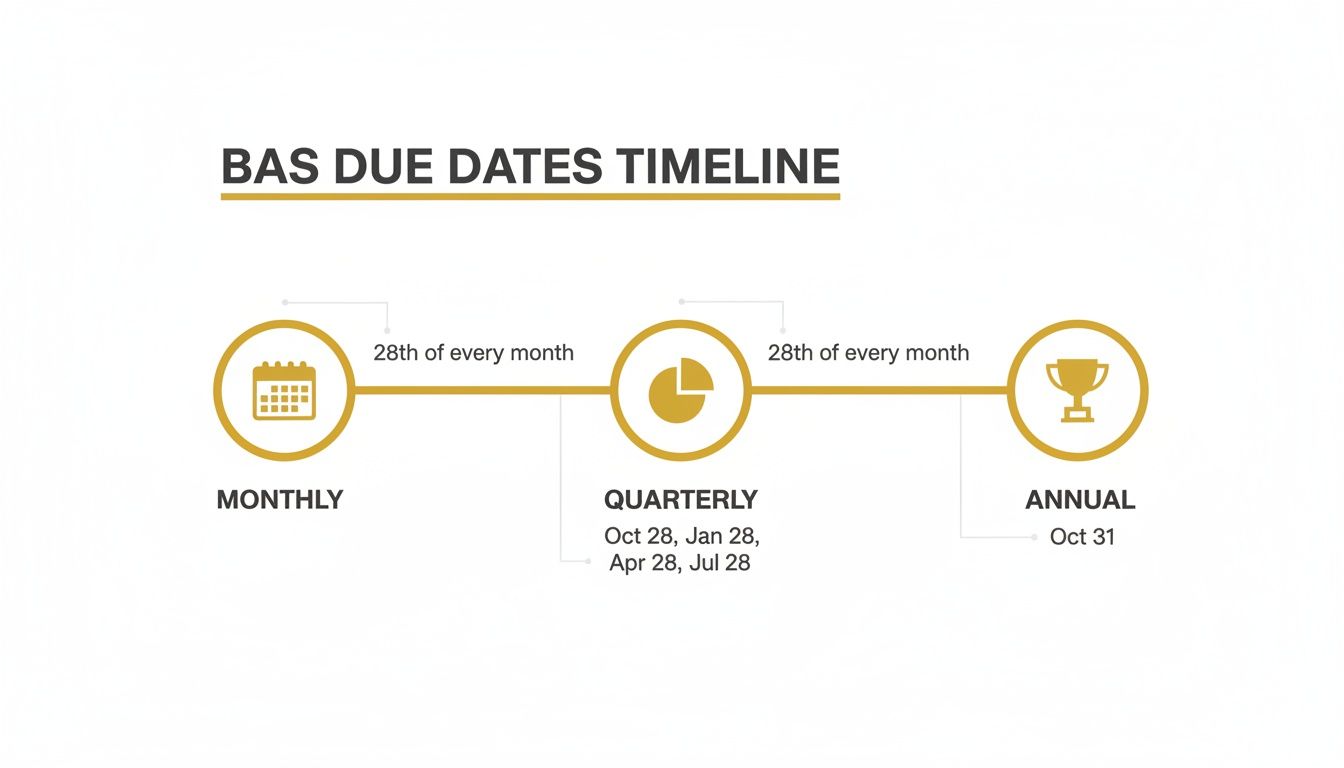
The key takeaway here is pretty clear: your lodgement frequency is directly tied to the size and turnover of your business, with the vast majority of small businesses landing in that quarterly cycle.
Who Needs to Lodge a BAS?
First things first, you need to be certain about your obligations. You're required to lodge a BAS if your business is registered for GST. This kicks in for most businesses once their annual turnover hits $75,000 or more (or $150,000 for non-profits).
Your BAS is used to report on a few key tax areas all at once:
- Goods and Services Tax (GST) you've collected on sales, minus any GST credits you can claim on purchases.
- Pay As You Go (PAYG) Withholding for the tax you’ve withheld from employee salaries.
- Pay As You Go (PAYG) Instalments to cover your own estimated income tax bill.
- Other taxes like fringe benefits tax (FBT) or fuel tax credits, if they apply to you.
If you want to get a better handle on what a BAS involves and why it's such a fundamental part of business accounting, our detailed article explains what BAS is in accounting. Having that foundational knowledge makes navigating the BAS due dates for 2025 a whole lot easier.
A Detailed Look at Quarterly BAS Deadlines
For most small businesses in Australia, lodging your BAS quarterly is the standard. It’s the default rhythm for keeping on top of your tax obligations. This applies to any business with a GST turnover of less than $20 million, and it strikes a good balance between staying compliant and not getting buried in paperwork. Getting these BAS due dates for 2025 right is one of the fundamentals of keeping the ATO happy.
The quarterly system simply chops the financial year into four reporting periods. For each quarter, you’ll need to pull together your GST info, PAYG withholding, and any other relevant tax figures, then lodge and pay by a set date. The deadlines are predictable, which helps a lot when you’re trying to plan your bookkeeping and manage cash flow.

Key Quarterly BAS Periods and Dates for 2025-2026
It's easy to get mixed up, as the 2025 calendar year straddles two different Australian financial years. You have to be careful to track the deadlines for both to make sure nothing slips through the cracks.
Here are the specific quarterly deadlines you need to circle in your calendar.
Covering the 2024-2025 Financial Year:
- Quarter 2 (October - December 2024): Due by 28 February 2025
- Quarter 3 (January - March 2025): Due by 28 April 2025
- Quarter 4 (April - June 2025): Due by 28 July 2025
Covering the 2025-2026 Financial Year:
- Quarter 1 (July - September 2025): Due by 28 October 2025
- Quarter 2 (October - December 2025): Due by 28 February 2026
Just remember, if a due date lands on a weekend or public holiday, the ATO gives you a pass—you can lodge and pay on the next business day without any drama.
The Power of Using a Registered BAS Agent
Handing your BAS over to a professional does more than just give you peace of mind. It unlocks some serious perks, with the biggest one being deadline extensions. The ATO offers concessional lodgement programs exclusively to registered BAS and tax agents, giving their clients a valuable buffer to get their books finalised.
Let's put that into perspective. Imagine you run a busy cafe in Sydney. You're juggling suppliers, staff, and customers, and suddenly the Quarter 1 BAS deadline for the 2025-26 financial year is staring you down. That period, from 1 July to 30 September 2025, has a standard lodgement date of 28 October 2025 if you're lodging it yourself.
But if you work with a registered BAS agent who lodges it electronically for you, that deadline gets pushed back to 25 November 2025. That extra month can be a complete lifesaver, giving you time to reconcile everything properly without the last-minute panic. You can find more details on how these extensions work across different quarters by exploring lodgement date insights from tax professionals.
This extension provides crucial breathing room, turning a stressful compliance scramble into a structured, calm process. It gives you and your agent the time needed to ensure total accuracy, seriously cutting down the risk of mistakes and a potential ATO audit.
Monthly and Annual BAS Lodgements: Who Fits Where?
While most businesses get into a comfortable quarterly BAS rhythm, your reporting schedule isn't a one-size-fits-all deal. The Australian Taxation Office (ATO) actually sets your frequency based on your turnover, creating different rules for big players and tiny operators. Knowing exactly where your business stands is key to hitting the right BAS due dates in 2025.
For the big end of town, the cycle is much faster. If your business has a GST turnover of $20 million or more, you’re on the hook for monthly BAS lodgements. This keeps a steady stream of tax information and payments flowing to the ATO, which makes sense given the sheer volume of transactions these larger companies handle.
This monthly schedule also helps big businesses manage their tax liabilities in smaller, more predictable chunks, which is a massive help for accurate cash flow forecasting.
Monthly Lodgement Deadlines
The rule for monthly lodgers is beautifully simple: your BAS is due on the 21st day of the month right after the end of the reporting period. Critically, there are no lodgement extensions available from registered agents for monthly BAS, so this date is set in stone.
- Example for a large wholesaler: Imagine a large import-export company in Sydney with a GST turnover of $25 million. They have to report monthly. For all their business activity in January 2025, their BAS lodgement and payment deadline is 21 February 2025. For February's activity, the due date is 21 March 2025, and so on throughout the year.
This constant rhythm keeps their financial data current and makes tax compliance a regular part of their monthly accounting process, rather than a monster task that builds up every quarter.
Annual Lodgement Rules and Dates
On the complete opposite end of the scale, some very small businesses can radically simplify their paperwork by reporting just once a year. This option is generally available to businesses that have voluntarily registered for GST and have an annual GST turnover of less than $75,000 (or $150,000 for non-profits).
The standard due date for an annual BAS is 31 October, following the end of the financial year. Conveniently, this lines up with the deadline for individual tax returns, letting business owners tackle both obligations in one go.
A sole trader running a small online craft store who voluntarily registered for GST is a perfect example. Annual reporting is a game-changer for them. Instead of wrestling with quarterly paperwork, they can consolidate all their GST info for the 2024-25 financial year and lodge their single BAS by 31 October 2025.
There's a handy exception, too. If you aren't required to lodge a tax return, the deadline for your annual BAS is pushed out to 28 February of the following year. And, as always, using a registered tax or BAS agent often opens up different due dates, making life even easier for micro-businesses.
The Strategic Advantage of Using a Registered Agent
Managing your Business Activity Statements is about more than just hitting deadlines. It's a core financial task where getting the numbers right is everything. Bringing a registered BAS or tax agent on board isn't just about outsourcing the work; it's a strategic move that turns a stressful compliance chore into a smoothly managed part of your business.
These professionals bring the expertise needed to sidestep the kind of costly errors that can quickly attract the wrong sort of attention from the Australian Taxation Office (ATO).
More importantly, working with a registered agent gets you access to the ATO's lodgement concession program. This is a game-changer for many businesses, as it provides valuable extensions on your quarterly BAS due dates for 2025. That extra time isn't just a buffer—it's crucial breathing room to get your accounts finalised without rushing. You can do a proper reconciliation, ensuring every GST credit is claimed and every dollar of PAYG withholding is accounted for correctly.

Comparing Due Dates: A Clear Advantage
The difference in deadlines between lodging yourself and using an agent is significant. This isn't just about avoiding a late lodgement; it’s a smart way to manage your finances better.
Let's look at a straight comparison for the main quarterly periods in the 2025-26 financial year:
| Reporting Period (2025-26) | Standard Due Date (Self-Lodged) | Registered Agent Due Date | Extra Time Gained |
|---|---|---|---|
| Quarter 1 (Jul - Sep 2025) | 28 October 2025 | 25 November 2025 | 4 weeks |
| Quarter 3 (Jan - Mar 2026) | 28 April 2026 | 26 May 2026 | 4 weeks |
| Quarter 4 (Apr - Jun 2026) | 28 July 2026 | 25 August 2026 | 4 weeks |
As you can see, you get an entire extra month for most quarters. The one exception is Quarter 2 (covering Oct-Dec), where the standard 28 February deadline already accounts for the Christmas and New Year break, so no further agent extension is typically offered. This extra time allows you to finalise your records without being under the pump, which always leads to better quality reporting.
Beyond Extensions: The Broader Benefits
The real value of using a registered agent goes well beyond just getting more time. Their expertise acts as a powerful defence against the financial pain and administrative headaches that come with non-compliance.
- Fewer Mistakes: Agents are trained to spot the common slip-ups in GST calculations, payroll figures, and income reporting. This protects you from those unintentional errors that could easily trigger an audit.
- Less Stress: Handing off the complexities of BAS prep frees up your time and mental energy. It lets you get back to focusing on what you do best—running and growing your business.
- Proactive Tax Management: A good agent does more than just lodge forms. They'll offer advice on managing cash flow around your BAS payments and keep you up to speed on any changes in tax law that affect you.
By bringing in an agent, you’re not just buying time. You're investing in accuracy, compliance, and genuine peace of mind. This proactive step dramatically reduces your risk of copping the Failure to Lodge penalties and General Interest Charges we detail in our section on penalties.
Understanding the Penalties for a Late BAS
Missing one of the key BAS due dates in 2025 is more than just a minor slip-up; it can trigger some pretty significant and escalating financial penalties from the Australian Taxation Office (ATO). The consequences go far beyond a simple late fee, hitting your business's cash flow and damaging your compliance record. Knowing what these penalties are is the first step to making sure you never have to pay them.
The main penalty you’ll face for missing a deadline is the Failure to Lodge (FTL) penalty. This is an automated system that applies a fine for every 28-day period (or even part of a period) that your BAS is outstanding. The amount isn't arbitrary—it's calculated using a system of penalty units, which the government adjusts from time to time.
How FTL Penalties Are Calculated
The size of the FTL penalty is directly tied to the size of your business. The ATO does this to ensure the fines are proportionate to turnover, but it means bigger businesses feel the sting much more.
- Small entities: If your business has a turnover of less than $1 million, you'll face a penalty for each 28-day block, capped at five penalty units.
- Medium entities: For businesses with turnover from $1 million up to $20 million, that penalty rate is doubled.
- Large entities: For those with turnover exceeding $20 million, the penalty rate is five times the base amount.
This tiered system means that an oversight that costs a small business a few hundred dollars could easily cost a larger company thousands for the exact same mistake.
The Real Cost of a Late BAS
Let's break it down with an example. A single penalty unit is currently $330. If a small business lodges its BAS just one day late, it immediately gets hit with a $330 penalty. If that BAS is still unlodged 30 days later, another $330 penalty is applied, bringing the total to $660. This can climb up to a maximum of $1,650 for a single late statement.
The reality is that the ATO is ramping up its enforcement activities. The penalty system works a bit like driver demerit points—initial fines get worse with each overdue cycle, hitting repeat offenders the hardest. With over 14.1 million individual tax returns lodged by April 2025 (a 3% jump from the previous year), it’s clear that more people are coming under increased ATO scrutiny.
On top of the FTL penalty, the ATO also applies a General Interest Charge (GIC) on any unpaid tax. This isn't a one-off charge; it's calculated daily and compounds, meaning your debt just keeps growing until both the outstanding tax and the FTL penalty are paid in full.
This one-two punch of penalties makes late lodgement a very expensive mistake. If you do find yourself falling behind, our guide on managing late BAS payments offers practical strategies to get back on track.
A Practical Checklist for Accurate BAS Preparation
Good preparation is the secret to lodging a Business Activity Statement without the usual last-minute panic. If you’re systematic about it, you can avoid common mistakes, claim every credit you're entitled to, and have everything ready long before the BAS due dates in 2025. A simple checklist can turn what feels like a complex chore into a manageable process.
This is a tool that helps you pull your financial data together methodically, whether you're lodging the BAS yourself or just getting the figures ready for your accountant. It's really about building a solid, repeatable habit that cleans up your bookkeeping and gives you real confidence in the numbers you're reporting.

To make this even easier, we've put together an actionable checklist. You can use this table each quarter to track your progress and make sure nothing gets missed.
Quarterly BAS Preparation Checklist
| Task | Status (To Do / Complete) | Notes |
|---|---|---|
| FINANCIAL RECONCILIATION | ||
| Reconcile all bank & credit card accounts | Match all transactions in your accounting software. | |
| Clear out any 'suspense' or unallocated accounts | Every transaction needs a proper home. | |
| Review accounts receivable and payable reports | Ensure invoices/bills are in the correct period. | |
| GST & SALES VERIFICATION | ||
| Check all sales for correct GST coding | GST-free vs. taxable sales. | |
| Verify you have a valid tax invoice for all GST credits claimed | No tax invoice = no GST credit claim. | |
| Review non-deductible expenses (e.g., entertainment) | Make sure you haven't claimed GST on these. | |
| PAYROLL & PAYG | ||
| Reconcile PAYG withholding from payroll reports to the ledger | The figures must match perfectly. | |
| Confirm gross wages reported on the BAS match payroll summaries | A common ATO check area. | |
| FINAL REVIEW & LODGEMENT | ||
| Generate BAS report from software and review all figures | Do the numbers look reasonable? | |
| Lodge the BAS via your preferred method | E.g., Online services for business, registered agent. | |
| Set a reminder for the payment due date | Lodge and pay are separate steps! |
Following these steps methodically will put you in a great position for a smooth, accurate BAS lodgement every single time. Now, let's break down the key areas in more detail.
Financial Reconciliation and Review
Before you even glance at the BAS form, your core financial accounts need to be spot-on. This is the foundation, and getting it right is non-negotiable for correct reporting.
- Reconcile All Bank Accounts: Go through every transaction in your business bank accounts, credit cards, and loan accounts. Make sure they are all matched and accounted for in your bookkeeping software. No exceptions.
- Clear Suspense Accounts: Take a look at your general ledger for anything sitting in "suspense" or "uncategorised" accounts. These are red flags. They must be properly allocated before you finalise your BAS.
- Review Accounts Receivable and Payable: Check that your outstanding invoices and bills are correctly dated. This ensures they land in the right reporting period, which is crucial for accurate GST timing.
To get your BAS right, you need to understand the mechanics behind the numbers. A great resource for this is a guide on how to work out VAT, as the principles of calculating tax on transactions are fundamental to GST.
GST and Sales Verification
Your Goods and Services Tax figures are the absolute heart of the BAS. A quick double-check here can prevent you from overpaying the ATO or, just as bad, claiming credits you aren't actually entitled to.
Honestly, the most common BAS errors we see come from incorrect GST coding. Taking ten minutes to review your sales and purchase transactions can save you from massive headaches and potential ATO penalties down the line.
Here’s exactly what to verify:
- Check All Sales for Correct GST: Run a sales report and scan it to make sure GST has been applied to all your taxable sales. At the same time, confirm your GST-free sales are coded correctly.
- Verify GST Credits on Purchases: Go through all your business purchases. You must hold a valid tax invoice for every single GST credit you intend to claim. The ATO is very strict on this.
- Account for Non-Deductible Expenses: Look at expenses like client entertainment or certain travel costs to ensure you haven’t incorrectly claimed GST credits on them. It's an easy mistake to make.
Payroll and PAYG Withholding
Finally, your payroll data must line up perfectly with what you report on the Business Activity Statement. Any discrepancies here will eventually be flagged.
- Reconcile PAYG Withholding: Match the total PAYG withholding from your payroll reports for the quarter with the corresponding liability account in your general ledger. The two figures should be identical.
- Confirm Gross Wages: Ensure the total gross wages figure you report on the BAS is exactly what your payroll summary reports show for the period. This is another critical number the ATO uses for data matching.
How to Lodge and Pay Your BAS Correctly
Once your Business Activity Statement is prepared and looks spot on, the final steps are lodging the form and paying whatever you owe the Australian Taxation Office (ATO). The ATO has several electronic methods designed to make this whole process as painless as possible, helping you hit those crucial BAS due dates for 2025 without any last-minute panic.
For many business owners, the most direct path is using the ATO’s Online services for business. It’s a secure government portal where you can lodge your BAS, look at old statements, and manage your tax accounts from one spot. It's a reliable, straightforward option if you handle your own compliance.
Another very efficient way to get it done is by lodging through Standard Business Reporting (SBR) enabled software. If you're already using an accounting platform like Xero, MYOB, or QuickBooks, you can usually lodge your BAS right from the software. This is a game-changer because it connects your bookkeeping directly to your reporting, slashing the risk of manual data entry errors.
Choosing Your Lodgement Method
How you choose to lodge often comes down to your business setup and how comfortable you are with digital tools. Each method has its own clear advantages.
- Online Services for Business: This is ideal for sole traders and small businesses who manage their own books and prefer to deal directly with the ATO's own platform.
- SBR-Enabled Software: Absolutely perfect for businesses that have their finances sorted in accounting software. It keeps everything neat and tidy within a single system.
- Registered BAS or Tax Agent: This is the best option if you want an expert to cast their eye over everything, check for accuracy, and get you access to those handy extended lodgement deadlines.
Lodging electronically isn't just a nice-to-have anymore; it's the standard way of doing things. It gives you a secure digital receipt of your submission and makes sure the ATO gets your info instantly—which is vital when a deadline is breathing down your neck.
Making Your BAS Payment
Just remember, lodging your BAS and paying it are two separate actions. Submitting the form on time is critical, but making sure the payment actually lands with the ATO by the due date is just as important.
The ATO offers a few different payment options to suit everyone. BPAY is one of the most common, letting you pay straight from your bank account using the unique biller code and reference number on your BAS. You can also pay online through the ATO website with a credit or debit card, but keep in mind a card payment fee might apply.
For a completely set-and-forget process, you can set up a direct debit from your ATO Online services account. This gives the ATO permission to withdraw the amount you owe on the due date, ensuring you never miss a payment. If you want to get a deeper understanding of the entire lodgement and payment cycle, our detailed guide on the Business Activity Statement lodgement process breaks it all down for you.
Answering Your Top BAS Deadline Questions
When it comes to your Business Activity Statement, a few common questions pop up time and time again. Getting these sorted is key to staying on the right side of the ATO and avoiding any last-minute panic as the BAS due dates for 2025 roll around. We've compiled the most frequent queries we get from business owners just like you.
One of the biggest questions is about due dates that land on a weekend or public holiday. Good news here: the Australian Taxation Office (ATO) gives you a bit of breathing room. The deadline automatically shifts to the next business day, so you can lodge and pay then without any risk of a penalty.
Correcting Mistakes and Asking for More Time
So, what happens if you spot a mistake right after you’ve lodged your BAS? Don't stress, it happens more often than you think, and the ATO has a clear process for fixing things. For most minor errors with GST or fuel tax credits, you can simply adjust it on your next BAS, as long as the mistake is within the ATO's defined limits.
For bigger stuff, especially anything related to PAYG withholding, you'll likely need to go back and revise the original BAS you submitted. The golden rule is to act fast and be upfront with the ATO—it goes a long way in maintaining a good compliance record.
Another hot topic is whether you can apply for a lodgement extension yourself. While registered BAS and tax agents get automatic extensions for their clients, you can ask the ATO for a deferral directly if you're facing exceptional circumstances.
To apply, you’ll need a solid reason, like a natural disaster, a serious personal illness, or another major event that's genuinely stopped you from lodging on time. You absolutely must get in touch with the ATO before the due date to talk through your situation.
Just remember, these kinds of deferrals are decided case-by-case and aren't a sure thing. If you want consistent, reliable extensions and professional oversight, partnering with a registered agent is still the sharpest strategy for managing your BAS obligations.
Feeling the pressure of BAS deadlines and compliance? The expert team at Australia Wide Tax Solutions can take BAS preparation and lodgement completely off your plate. We ensure everything is accurate and on time, so you can get back to what you do best—running your business. Contact us today to make your tax obligations simple by visiting https://www.awts.net.au.
The ATO provides guidance through ato.gov.au, the Small Business Support Line (13 28 66), and Online Services for individuals and businesses. For complex situations, a registered tax agent provides advice tailored to your specific circumstances and professional indemnity protection. You can verify agent registration at the TPB register at tpb.gov.au.
Most tax records must be kept for five years from the date of lodgement or the date the transaction occurred, whichever is later. Records must be in English or convertible to English and must be sufficient to explain the income and deductions in your return. The ATO can request records at any time during the retention period.
Consider a registered tax agent when your affairs involve multiple income sources, business activity, investment properties, capital gains, or overseas income. Agents extend your lodgement deadline, provide safe harbour protection, and take professional responsibility for the advice given. Verify registration at tpb.gov.au.
The failure to lodge penalty is based on penalty units ($313 per unit from 1 July 2023), accruing per 28-day period for late returns and BAS lodgements. Incorrect information penalties range from 25% to 75% of the tax shortfall depending on whether the behaviour was careless, reckless, or intentional. Proactive disclosure before an audit begins typically results in significantly reduced penalties.
Tax minimisation is the legal arrangement of your affairs to reduce tax — claiming all eligible deductions, using appropriate structures, and timing income and expenses. Tax avoidance involves arrangements that technically comply with the law but achieve outcomes parliament did not intend. The ATO can apply Part IVA anti-avoidance rules to cancel benefits from avoidance arrangements.
Your marginal tax rate is one of those terms that gets thrown around a lot, but what does it actually mean for your pay packet? Put simply, it’s the tax rate you pay on the very last dollar you earn.
- How Marginal Tax Rates Really Work
- The Evolution of Australian Tax Brackets
- Marginal Rate vs Average Rate: What Is the Real Difference?
- Calculating Your Tax Bill Step by Step
- How Recent Tax Reforms Affect Your Pay
It's not a flat tax on your entire salary. Instead, it’s the rate that applies to the highest portion of your income, as determined by Australia’s progressive tax brackets. Getting your head around this is the first step to truly understanding how tax works in this country.
How Marginal Tax Rates Really Work
There's a common myth that if you get a pay rise that bumps you into a higher tax bracket, your entire income is suddenly taxed at that scary new rate. Thankfully, that’s not how it works at all.
Australia uses what’s called a progressive tax system. The best way to think about it is like a series of buckets. As you earn money throughout the year, you start filling up the first bucket. Once that one is full, your income spills over into the second bucket, which gets taxed at a slightly higher rate. This continues for each bucket, or tax bracket, that your income reaches.
Your marginal tax rate is just the tax rate for the highest bucket your income has started to fill.
The Bucket Analogy Explained
Let’s visualise this. Imagine your annual income is water pouring from a tap, and below it are several buckets lined up, each representing a different tax bracket.
- Bucket 1 (The Tax-Free Threshold): The first chunk of your income goes in here. Everything inside this bucket is taxed at 0%. You can learn more about how this works by reading our guide on the tax-free threshold in Australia.
- Bucket 2 (Low-Rate Bracket): Once the first bucket is full, any extra income spills into this one. The money in this second bucket is taxed at a low rate (e.g., 19%).
- Bucket 3 (Mid-Rate Bracket): If your income is high enough to fill the second bucket, it then flows into the third, where it’s taxed at a higher rate again (e.g., 32.5%).
- And so on... This process continues for higher income levels, with each new bucket having a higher tax rate.
The most important thing to remember is this: a pay rise never changes the tax rate on the money you've already earned in the lower buckets. Only the additional income is taxed at the new, higher rate.
This diagram shows exactly how your total income is carved up into different brackets, with your marginal rate only applying to that top slice.

As you can see, the marginal rate is all about the highest bracket your income touches, not your total earnings.
The Evolution of Australian Tax Brackets
To really get your head around today’s tax system, it helps to know that things weren’t always this way. The marginal tax rates we pay in Australia have gone through some pretty dramatic shifts over the decades, usually mirroring big changes in economic policy and what society valued at the time.
This isn't just a history lesson for trivia night. It’s crucial context for anyone planning their finances long-term. Understanding that tax policies can—and do—change is vital for investors and high-net-worth individuals who need to build strategies that can withstand future government reforms. The rates you're planning for today could look completely different in a decade.
From Post-War Highs to Modern Norms
If you think taxes are high now, take a look at the mid-20th century. The rates back then would seem absolutely staggering today. After World War II, the government needed a huge amount of revenue to rebuild the country and roll out social services, which led to incredibly high top marginal tax rates. This period set the scene for a high-tax environment that stuck around for decades.
Just to give you an idea of how much has changed, back in 1951, the top marginal tax rate was a whopping 75 per cent for anyone earning over £10,000 (which is about $425,000 in today's money). That rate didn't drop much for a long time, either—it hovered at 67 per cent from 1955 right through to the mid-1980s before major economic reforms started to bring it down. You can dig deeper into these historical shifts on Australia's income tax history page on Wikipedia.
This long era of high taxation eventually made way for a new way of thinking as the century wore on.
The Great Tax Reforms
The 1980s was a massive turning point. A wave of economic reforms, designed to make Australia more competitive and encourage investment, led to a slow but steady drop in the top marginal tax rates. This wasn't just happening here; it was a global trend moving towards lower, more broadly applied taxes.
This big shift really hammers home a key principle for every taxpayer: tax laws are not set in stone. They are living, breathing tools that governments use to shape the economy, and they can change in a big way from one political cycle to the next.
Since then, the brackets have been rejigged countless times. These tweaks are usually driven by a few key things:
- Economic Conditions: When the economy is struggling, governments might lower taxes to encourage spending and stimulate growth.
- Political Ideology: Different governments have very different ideas about what’s fair when it comes to tax.
- Inflation: Brackets are often adjusted to account for rising wages, stopping people from being pushed into higher tax brackets just because of inflation. This is what's known as "bracket creep."
Keeping an eye on proposed changes to the marginal tax rate in Australia is a non-negotiable part of smart financial management. It’s what allows you to pivot your investment and income strategies before it’s too late.
Marginal Rate vs Average Rate: What Is the Real Difference?

Here’s one of the most common tax misunderstandings we see: people think their marginal tax rate applies to their entire income. It’s a simple mistake, but it can make your annual tax bill seem far more intimidating than it really is.
To get the true picture, you need to know the difference between your marginal tax rate and your average tax rate. They tell two very different stories about your finances.
Your marginal tax rate is just the rate you pay on the last dollars you earn—the portion of your income that tips into your highest tax bracket. Your average tax rate, on the other hand, shows what's really going on.
Your average tax rate is the total tax you paid divided by your total taxable income. It gives you the actual percentage of your earnings that goes to the Australian Taxation Office (ATO).
Because of Australia’s progressive tax system, your average rate will always be lower than your marginal rate (unless you’re in the rare situation where all your income sits in a single tax bracket). Thinking in terms of your average rate is a much more realistic way to understand your tax position.
Seeing Both Rates in Action
Let’s walk through a practical example. Imagine a professional named Alex has a taxable income of $75,000. Using the 2024-2025 tax brackets (and ignoring the Medicare Levy for simplicity), this is how the tax is calculated piece by piece:
- The first $18,200: This is tax-free, so $0.
- The next chunk ($18,201 to $45,000): This part, which is $26,800, is taxed at 16%. That’s $4,288.
- The final slice ($45,001 to $75,000): This last $30,000 of income is taxed at 30%, which comes to $9,000.
Add it all up, and Alex’s total tax payable is $13,288. Now we can figure out both key rates.
Calculating Alex’s Rates
So, what’s Alex's marginal tax rate? Because Alex's income reaches into the $45,001 - $135,000 bracket, their last dollar earned is taxed at 30%. This is their marginal rate—it's the one most people quote, but it only applies to a part of their income.
Now for the far more insightful number: the average tax rate.
- Average Tax Rate Formula: Total Tax Paid ÷ Total Taxable Income
- The Calculation: $13,288 ÷ $75,000 = 0.177
- Alex's Average Rate: 17.7%
Look at that difference. While Alex’s marginal rate is 30%, the reality is that only 17.7% of their total income actually went to the tax office. It shows the true tax impact is much lower than the highest bracket suggests. This distinction is also vital when considering things like the low income tax offset, which can further reduce your effective tax paid.
Calculating Your Tax Bill Step by Step
Theory is one thing, but seeing the numbers in action is where it all starts to make sense. Let’s walk through a real-world example to see exactly how your tax bill is calculated.
We'll use a hypothetical Australian resident, Sarah, who has a taxable income of $90,000. This step-by-step breakdown will show you how the progressive system works, ensuring only parts of her income get taxed at higher rates. To keep things simple, we'll ignore the Medicare Levy for now.
Breaking Down The Income
Remember that bucket analogy? Sarah’s $90,000 income will fill up a few of those tax buckets, one by one. Each bucket, or bracket, has its own tax rate.
Based on the 2024–2025 tax rates, here’s how her income is carved up:
- First Bracket ($0 – $18,200): This is the tax-free threshold. The first $18,200 Sarah earns is taxed at a lovely 0%. No tax is paid here.
- Second Bracket ($18,201 – $45,000): The next chunk of her income ($26,800 worth) falls into this bracket. This portion is taxed at 16%.
- Third Bracket ($45,001 – $135,000): The rest of her income, which is $45,000 ($90,000 minus $45,000), lands in this bracket and is taxed at 30%.
So, Sarah's marginal tax rate is 30%, because that's the rate applied to the last dollar she earns. Crucially, it's not the rate applied to her entire income.
Calculating The Tax For Each Bracket
Now, let's do the maths. The table below shows exactly how much tax is paid inside each "bucket" before we add it all up.
Example Tax Calculation for a $90,000 Salary
| Income Portion | Tax Rate | Tax Payable |
|---|---|---|
| First $18,200 | 0% | $0 |
| $18,201 – $45,000 ($26,800) | 16% | $4,288 |
| $45,001 – $90,000 ($45,000) | 30% | $13,500 |
| Total | $17,788 |
Adding it all together, Sarah’s total income tax for the year comes to $17,788. This shows why simply knowing your marginal tax rate is only one piece of the puzzle.
The Final Steps: Deductions and Offsets
But the calculation doesn't always stop there. That $17,788 figure is the tax on her gross income, but the final amount she pays could be lower.
This is where tax deductions and tax offsets come into play. Deductions reduce your taxable income before the tax is calculated, while offsets (or tax credits) directly reduce the final tax bill after it’s been calculated.
For instance, if Sarah had $2,000 in legitimate work-related deductions, her taxable income would drop to $88,000, which would lower her total tax bill. An offset, on the other hand, would be subtracted directly from the $17,788 tax payable.
This is why understanding how to calculate your taxable income in Australia is such a crucial first step, even before you start thinking about the brackets.
How Recent Tax Reforms Affect Your Pay
Australia’s tax laws are anything but static. They’re constantly being tweaked, and keeping up with these shifts is crucial for managing your finances properly. Even small adjustments to tax brackets can make a noticeable difference to your take-home pay.
Over the last few years, we’ve seen some significant reforms designed to reshape the tax landscape. This isn't just something for accountants to worry about; it’s vital information for anyone who wants to plan a budget, make smart investment decisions, or simply understand what their next payslip will look like. These updates impact everyone, from low and middle-income earners right through to those in the highest brackets.
The Stage 3 Tax Cut Reforms
One of the biggest recent changes has been the rollout of the revised Stage 3 tax cuts. Kicking off from 1 July 2024, these reforms were designed to deliver widespread tax relief by adjusting both the tax rates and the income thresholds for several key brackets.
So, how does this affect your marginal tax rate? Put simply, it changes the size of the "buckets" your income flows into, meaning more of your money is taxed at lower rates.
The key adjustments were:
- The lowest tax rate was cut from 19% down to 16% for income between $18,201 and $45,000.
- The next rate was reduced from 32.5% to 30% for a much wider income bracket of $45,001 to $135,000.
- The 37% tax bracket now kicks in at a higher threshold of $135,001.
- The top 45% marginal rate now only applies to income starting from $190,001.
What does this all mean for you? Essentially, every Australian taxpayer earning over $45,000 will see a reduction in their tax bill. The new structure ensures that more of your earnings are taxed at lower rates, putting more money back in your pocket.
The financial impact of these reforms is significant. The changes provide substantial tax relief right across the board. For example, workers earning over $45,000 are set to get a tax cut of $268 in 2026-27, which will then double to $536 per year from 2027-28 compared to the old system. You can see a more detailed breakdown of these figures and discover more insights about Australia's income tax rates on SuperGuide.
These changes are a perfect example of why staying informed is so important. When you understand how the system is evolving, you can better anticipate your tax obligations and make smarter financial moves.
Using Tax Brackets for Smart Financial Planning

Getting your head around your marginal tax rate isn't just a numbers game—it's the secret to making the Australian tax system work for you, not against you. Once you know which tax bracket your next dollar of income will fall into, you can start making strategic financial moves that legally shrink your overall tax bill.
This is where proactive financial planning really shines. The goal isn't to just react to a tax bill at the end of the year; it's about actively managing your taxable income so as little of it as possible spills over into those higher-rate brackets. It’s about being clever with your money long before tax time rolls around.
Key Strategies to Lower Your Taxable Income
By taking a few specific actions throughout the financial year, you can pull your taxable income down and keep more money away from your highest marginal rate. Some of the most effective methods we see clients use include:
- Salary Sacrificing to Superannuation: This is a classic for a reason. You can arrange with your employer to have a portion of your pre-tax salary funnelled directly into your super fund. This immediately lowers your taxable income, and those contributions are only taxed at a concessional rate of 15%—often a fraction of your marginal tax rate.
- Timing Capital Gains: If you’re planning to sell an asset like shares or an investment property, timing is everything. It can be far more effective to sell during a financial year when your other income is lower, preventing the profit from that sale from accidentally pushing you into a higher tax bracket.
- Maximising Deductions: From work-related car expenses to the fees you pay to manage your investments, every legitimate deduction you claim directly reduces your taxable income, dollar for dollar. Don't leave money on the table.
These tactics aren’t about tax evasion; they're about smart tax management. By strategically lowering your taxable income, you’re simply ensuring you pay only the tax you're legally required to. The result? More of your hard-earned money stays with you.
For those on higher incomes, applying the best tax strategies for high income earners is even more critical for managing tax obligations effectively and building wealth.
Ultimately, a crystal-clear understanding of what a marginal tax rate is in Australia gives you the power to make informed choices that help you build wealth more efficiently over the long term.
Getting Your Head Around Marginal Tax Rates
Even once you get the basics, a few questions always seem to pop up when people try to wrap their heads around marginal tax rates in Australia. Let's tackle some of the most common myths and frequently asked questions head-on, so you can feel completely confident about how your income is taxed.
Getting these straight will help you manage your tax and make smarter financial decisions, without falling for those old, stubborn misconceptions.
Will a Pay Rise Push Me Into a Higher Bracket and Cost Me Money?
Absolutely not. This is hands-down the biggest and most persistent myth out there. A pay rise will never result in you taking home less money.
Because we have a progressive system, it’s only the portion of your income that tips into the new, higher bracket that gets taxed at that higher rate. Everything you earned up to that point is still taxed at the lower rates it always was. Your overall take-home pay will always go up after a salary bump.
How Does the Medicare Levy Fit In?
The Medicare Levy is a separate beast from your income tax. For most taxpayers, it’s a flat 2% charged on your total taxable income. It's collected alongside your income tax bill and goes directly towards funding Australia's public health system.
Crucially, it is not part of the marginal tax brackets. It's also worth noting that some low-income earners might qualify for a reduction or even a complete exemption from paying it.
Key Takeaway: Think of the Medicare Levy as an extra charge on top of your income tax. It's calculated on your total taxable income, not progressively through brackets like your income tax.
Are Capital Gains Taxed at a Special Rate?
In Australia, there's no special, separate tax rate for capital gains. Instead, your net capital gain for the financial year (that’s your profit after subtracting any losses) gets added directly to your regular taxable income.
This combined total is then taxed at your personal marginal tax rates. This means a large capital gain from selling an asset, like a property or shares, could easily push a chunk of your income into a higher tax bracket for that year, leading to a bigger overall tax bill.
The ATO provides guidance through ato.gov.au, the Small Business Support Line (13 28 66), and Online Services for individuals and businesses. For complex situations, a registered tax agent provides advice tailored to your specific circumstances and professional indemnity protection. You can verify agent registration at the TPB register at tpb.gov.au.
Most tax records must be kept for five years from the date of lodgement or the date the transaction occurred, whichever is later. Records must be in English or convertible to English and must be sufficient to explain the income and deductions in your return. The ATO can request records at any time during the retention period.
Consider a registered tax agent when your affairs involve multiple income sources, business activity, investment properties, capital gains, or overseas income. Agents extend your lodgement deadline, provide safe harbour protection, and take professional responsibility for the advice given. Verify registration at tpb.gov.au.
The failure to lodge penalty is based on penalty units ($313 per unit from 1 July 2023), accruing per 28-day period for late returns and BAS lodgements. Incorrect information penalties range from 25% to 75% of the tax shortfall depending on whether the behaviour was careless, reckless, or intentional. Proactive disclosure before an audit begins typically results in significantly reduced penalties.
Tax minimisation is the legal arrangement of your affairs to reduce tax — claiming all eligible deductions, using appropriate structures, and timing income and expenses. Tax avoidance involves arrangements that technically comply with the law but achieve outcomes parliament did not intend. The ATO can apply Part IVA anti-avoidance rules to cancel benefits from avoidance arrangements.
Nailing these details is the first step towards smart tax planning. For personalised advice on your specific financial situation, from managing late returns to optimising your investments, the experts at Australia Wide Tax Solutions are here to help. Discover how our professional accounting services can maximise your tax outcome by visiting us at https://www.awts.net.au.
- Decoding the Company Tax Return Form
- Choosing Your Lodgement Path: DIY or Tax Agent
- Avoiding Common and Costly Tax Return Mistakes
- What to Do After You Have Lodged Your Return
- Your Top Company Tax Return Questions, Answered
How to Lodge Company Tax Return A Guide for Australian Businesses
Lodging your company tax return isn't a single action, but a three-part process: you gather your records, get the numbers right on the form, and then submit it to the ATO. It sounds simple, but the real work happens before you even log into any online portal.
Getting the preparation right is everything. Having your financial statements ready and reconciled from the get-go is the difference between a smooth lodgement and a stressful one.
Gathering Your Financials for a Smooth Lodgement
Before touching the company tax return form itself, you need to get your financial records in order. This isn't just about ticking off a list; it's about building a bulletproof foundation for your return. I’ve seen it time and again—business owners who rush this stage end up with missed deductions or incorrectly reported income, creating major headaches down the track.
Key Documents and Why They Matter
Think of your financial documents as the evidence that backs up every single number on your tax return. Without them, you're just guessing.
Let's break down the non-negotiables.
Your Pre-Lodgement Document Checklist
This table summarises the core documents you'll need to pull together. Think of these as the absolute minimum for a compliant and accurate tax return.
| Document Type | What It Shows | Why It's Critical |
|---|---|---|
| Profit and Loss (P&L) Statement | A complete story of your company's income and expenses over the financial year. | This is the engine of your tax return, determining your taxable income. Every dollar must be accounted for. |
| Balance Sheet | A snapshot of your company’s assets, liabilities, and equity at year-end. | The ATO uses this to check the financial health and structure of your company. It must reconcile perfectly. |
| Bank Reconciliations | Proof that your accounting software transactions match your business bank statements exactly. | This confirms no income has been missed or expenses duplicated—a common area for ATO audits. |
Having these three reports finalised and double-checked is your green light to start the lodgement process. It ensures the numbers you're about to enter are solid.
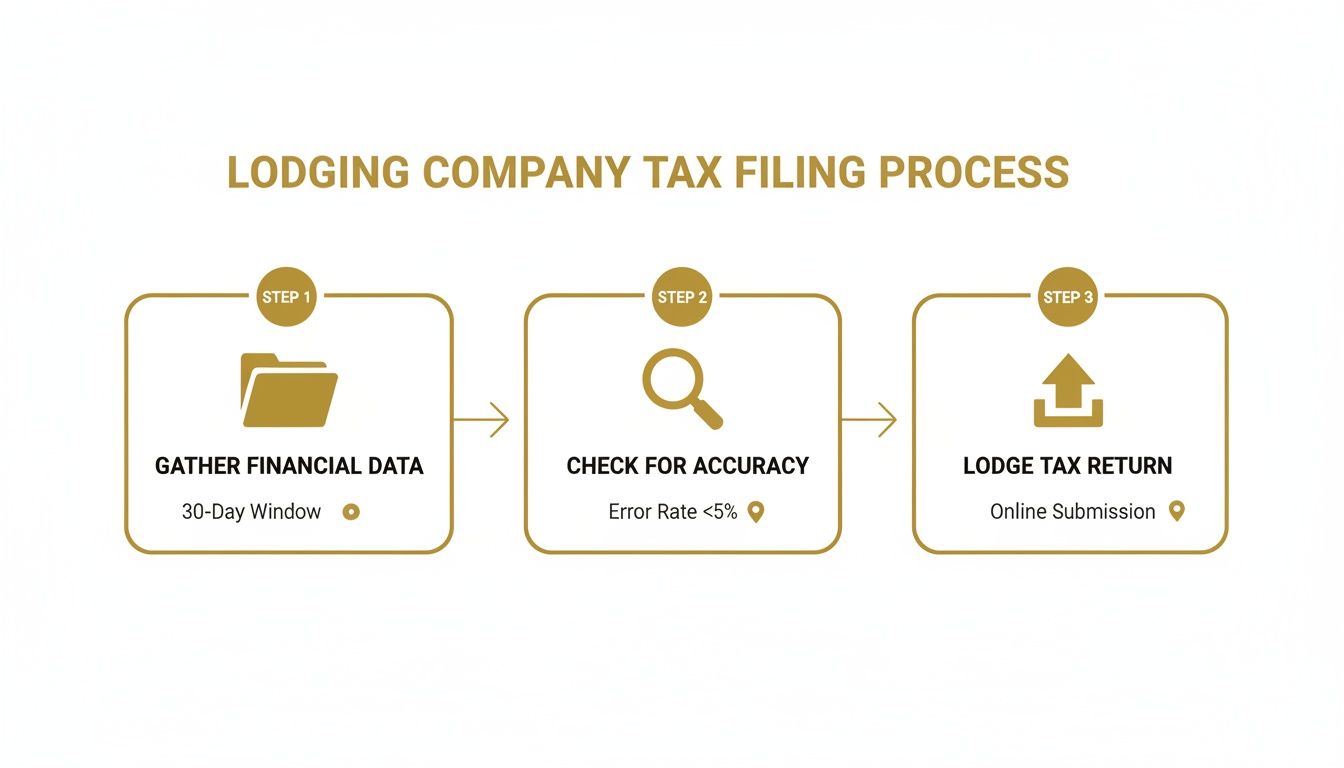
As you can see, the "Gather" phase is the foundation. Nail this, and the rest of the process becomes much, much easier.
A Common Pitfall to Avoid
I recently worked with a small retail business owner who nearly missed out on thousands in legitimate deductions. She was fantastic at recording her major supplier invoices but had a literal shoebox full of receipts for smaller items—stationery, client coffees, minor store repairs. On top of that, a loan she’d made to the company wasn't properly documented, blurring the lines between personal and business funds.
This scenario is incredibly common. Those small, disorganised expenses add up to significant deductions. And getting director loans wrong is a huge red flag for the ATO. Proper documentation is crucial for compliance.
A big piece of this puzzle is mastering revenue recognition principles, which ensures the income on your P&L statement is reported in the correct period.
For a complete rundown of everything you’ll need, grab our comprehensive https://awts.net.au/business-tax-checklist/. Taking the time to organise your records now is your best insurance policy against future ATO questions.
Decoding the Company Tax Return Form
Let's be honest, opening the official Company Tax Return form for the first time can feel like trying to decipher a secret code. It’s dense, littered with jargon, and seems almost designed to be confusing. But don't let it intimidate you.
At its core, the form is just a structured way for you to tell the ATO your company's financial story for the year. The trick is to stop seeing it as one giant, impossible puzzle and start viewing it as a series of smaller, more manageable questions about your business. Each section simply asks for a specific piece of your financial history—from what you earned to what you spent.

Reporting Your Company Income
The first major section you'll tackle is all about the money your company brought in. This isn’t just your primary sales revenue; the ATO needs a complete picture of your assessable income.
You'll find that the form asks you to report different types of income in specific sections. For instance, a small consulting company's income might be broken down like this:
- Gross professional fees: The total amount you've billed clients for your services.
- Interest income: Any interest earned from your business bank accounts or term deposits.
- Capital gains: Profit made from selling a significant asset, like an office space or even company shares.
Each of these needs to be correctly categorised. A common mistake we see is people lumping everything into a single "sales" figure, which can lead to miscalculations and attract unwanted attention from the ATO.
Demystifying Business Deductions
Once you've laid out your income, it's time to claim your deductions. This is where you get to subtract your legitimate business expenses from your income to figure out your actual profit. Think of it as telling the ATO, "We earned this much, but it cost us this much to do it."
The golden rule for deductions is simple: the expense must be directly related to earning your assessable income. And you absolutely must have a record, like a receipt or invoice, to prove it.
Some of the most common deductions businesses claim include:
- Operating Costs: Everyday expenses like office rent, utility bills, and supplier invoices.
- Employee Salaries: All the wages, superannuation contributions, and other benefits you pay your staff.
- Asset Depreciation: The decline in value of business assets worth over $300, such as computers, vehicles, or machinery. You don't claim the full cost upfront; instead, you claim a portion of it over several years.
Getting these deductions right is absolutely critical for an accurate return. It’s the difference between paying the correct amount of tax and needlessly overpaying.
Calculating Your Taxable Income
After you’ve listed all your income and subtracted all your legitimate deductions, you arrive at your company's taxable income. This is the final profit figure that the ATO will apply tax to.
The calculation itself is straightforward:
Total Assessable Income - Total Deductions = Taxable Income
With this number, you then apply the correct company tax rate. While the standard rate is 30%, many small and medium businesses actually qualify for a lower rate of 25%. To be eligible, your company needs an aggregated turnover under AUD 50 million and less than 80% of its assessable income can come from passive sources (like rent or interest).
This is a key incentive, particularly for clients of firms like AWTS who might be dealing with overdue returns or BAS preparations. For a deeper dive, you can find more insights on corporate tax rates in Australia from PwC.
Knowing which rate applies to your business is the final piece of the puzzle. It transforms all your financial data into a clear tax obligation, completing the main part of lodging your company tax return.
Choosing Your Lodgement Path: DIY or Tax Agent
Alright, you've got your financials sorted and you've wrestled with the company tax return form. Now you’ve hit a fork in the road. Do you tackle the ATO’s online services yourself, or do you bring in a registered tax agent?
This isn’t a small decision. It directly affects your deadlines, your stress levels, and your chances of making a costly error.
The DIY route always looks tempting at first glance. The biggest draw is saving money on professional fees, no doubt about it. You get to keep total control of the process from start to finish. If your company's finances are dead simple—maybe just a handful of transactions and no complicated investments—then going it alone can be a perfectly reasonable choice.
But be warned, flying solo has its risks. The most immediate one is the deadline. If you’re lodging yourself, the ATO expects your company return much earlier than if you use an agent. More importantly, the odds of making an honest mistake shoot way up. A simple mix-up with a deduction rule or one wrong calculation can put you on the ATO’s radar and lead to penalties down the line.
The Case for Using a Tax Agent
This is where you see the real value of bringing in a professional. A registered tax agent is much more than a form-filler; they're your expert guide and a critical safety net. They live and breathe Australian tax law, making sure you claim every single deduction you're entitled to while keeping everything above board.
One of the biggest perks is getting access to extended lodgement deadlines. That extra time can be a lifesaver for busy business owners who are already juggling a dozen other things.
Beyond the extra time, the real benefit of an agent is confidence. Having an expert look over your figures, ask the tough questions, and sign off on the return gives you a peace of mind that’s hard to put a price on.
The official numbers back this up. The ATO’s latest tax time statistics show just how many people rely on professional help, especially when things get complicated with capital gains or overdue returns. You can dive into the full tax time lodgement statistics from the ATO to see the trends for yourself.
Of course, choosing an agent means handing over sensitive financial data. It's smart to ask about their security protocols, like whether they use a professional cloud backup for accountants to keep your information safe. To get a better feel for what an agent can bring to the table, check out our breakdown of the key benefits of using a tax agent in Australia.
Avoiding Common and Costly Tax Return Mistakes
Even the most organised business owners can get tripped up by common tax traps. Getting your company tax return wrong can be a painful lesson, costing you not just in ATO penalties but also in the time and stress it takes to unravel the mess.
The good news? Most of these errors are entirely avoidable once you know what to look for.
One of the first things the ATO’s systems flag is a mismatch in your GST reporting. The total GST you’ve collected and paid on your Business Activity Statements (BAS) throughout the year must line up perfectly with the figures you report in your annual income tax return. Any discrepancy, no matter how small, is a clear signal that something’s not right with your books.
Another huge red flag is blurring the lines between business and personal expenses. It’s so easy to claim a chunk of your home internet or mobile phone bill, but you absolutely must have clear, justifiable records that prove the business-use percentage. Claiming 100% of a personal mobile bill as a business expense is a classic mistake the ATO’s systems are specifically designed to catch.
Poor Records and Unsubstantiated Claims
At the end of the day, flimsy record-keeping is the root cause of most tax return headaches. Without the right receipts, invoices, and logbooks, your claims are just numbers on a form with zero evidence to back them up. This gets particularly dicey when you’re dealing with more complex areas of tax law.
A classic example I see with new or struggling businesses is misunderstanding the non-commercial loss rules. If your company has a side hustle or an activity that consistently loses money, you generally can't just offset that loss against your other income unless you meet some very specific tests. Getting this wrong can quickly lead to a detailed ATO review.
Navigating these complexities is precisely why so many business owners bring in an expert. The ATO consistently spotlights issues like income omissions, GST errors, and non-commercial losses as key audit triggers for small businesses.
Timely, accurate lodgement is your best line of defence. For small businesses, the ATO's 2025 focus areas are crystal clear on these red flags. With audit activity on the rise, penalties for shortfalls can be severe—sometimes reaching up to 75% of the tax you owe, plus interest. You can read more about corporate tax obligations from PwC.
To sidestep these issues, you need to get meticulous with your finances:
- Reconcile regularly. Don't leave your BAS vs. annual return reconciliation until the last minute. Get into the habit of checking it every quarter.
- Keep finances separate. A dedicated business bank account and credit card are non-negotiable. This keeps a clean separation between your personal and business spending.
- Document everything. Keep detailed logbooks for any vehicle use and write down your reasoning for splitting costs like your internet and phone bills.
By learning from these common missteps, you can lodge a clean, accurate return with confidence—one that won’t attract any unwanted attention.
What to Do After You Have Lodged Your Return
Hitting ‘lodge’ on your company tax return feels like the finish line, but it’s really just the start of the final lap. What you do next is critical for staying on the right side of the Australian Taxation Office (ATO). The first thing you'll be waiting for is your Notice of Assessment (NOA).
This is the ATO’s official verdict on your return. It’s their calculation of your tax position, and it will clearly state whether you have a tax bill to pay, a refund coming your way, or if everything is square. You absolutely must check this document thoroughly the moment it arrives.

Reading Your Notice of Assessment
Don't just file it away. Pull out your own records—or the final figures from your tax agent—and compare them line by line with the NOA. Does the taxable income match? Is the tax payable what you expected?
If there’s a discrepancy, you need to find out why, fast. The ATO sometimes makes adjustments based on data they hold, and you need to understand the reason. For a deeper dive, you can learn more about how to get your notice of assessment and what it all means.
If the NOA shows a tax liability, it will have a non-negotiable due date. Miss it, and the ATO will start adding interest charges and potential penalties, so make sure you pay on time.
After lodging, your focus must shift from preparation to verification and record-keeping. The NOA is your first checkpoint, and retaining your financial records for a minimum of five years is your ongoing legal obligation.
Maintaining Your Records and Ongoing Compliance
Even after you've settled any tax bill, you’re not quite done. The law is clear: companies must keep all financial records related to their tax return for at least five years from the date they lodged it. This isn’t optional. We're talking everything from receipts and invoices to bank statements and asset registers.
Think of this five-year rule as your safety net. If the ATO ever comes knocking for an audit or a review, solid, organised records are your best and only defence.
Beyond record-keeping, remember that your company tax return is just one piece of a much larger compliance puzzle. You still need to stay on top of your other obligations, like lodging your Business Activity Statements (BAS) on time and paying employee superannuation. These things all contribute to your overall relationship with the ATO.
Economic shifts can also play a part. Recent ABS government finance statistics revealed that company income tax totalled $143.3 billion for 2024-25, a slight dip influenced by market fluctuations. It’s a good reminder that the business landscape is always changing. You can explore more government finance statistics on the ABS website.
Your Top Company Tax Return Questions, Answered
Lodging a company tax return always seems to bring up a few last-minute questions. It's perfectly normal. Dealing with the Australian Taxation Office (ATO) can feel complex, and you want to get it right.
Let's run through some of the most common queries we hear from business owners every single tax season. Getting these straight can save you from simple mistakes that might cause delays or, worse, flag your return for a closer look.
How Long Does a Company Tax Return Take to Process?
This is, without a doubt, the question we get asked most. You’ve done the work, you’ve lodged the return, and now you just want to know where you stand.
For most online lodgements, the ATO aims to process company tax returns within 14 business days. But think of that as a guideline, not a guarantee. A few things can easily stretch out that timeline.
- Manual Reviews: If your return includes unusually large deductions, complex asset write-offs, or anything out of the ordinary for your business, the ATO might pull it aside for a manual review. This is just them doing their due diligence.
- Outstanding Debts: Have an existing debt with the ATO or another government agency? The process will take longer while they sort out the accounts and determine your final position.
- Multiple Lodgements: Trying to catch up by filing a few years' worth of returns all at once can create a logjam in the system and lead to delays.
And if you're lodging by paper? Be prepared for a much longer wait—up to 50 business days. It’s a powerful argument for lodging electronically, either through ATO online services or with a tax agent.
What Happens if I Miss the Lodgement Deadline?
Life happens, and sometimes deadlines get missed. The key is not to bury your head in the sand. The ATO is far more reasonable when you're upfront about the situation.
Ignoring the deadline can lead to financial penalties and interest charges stacking up. The initial penalty for failing to lodge on time is just the start; it can increase for every 28-day period your return remains overdue, up to a maximum of five periods. On top of that, the General Interest Charge (GIC) will start ticking on any unpaid tax from the original due date.
If you know you're going to miss the deadline, the absolute best thing you can do is contact the ATO or your tax agent immediately. It’s often possible to get a deferral or set up a payment plan, which looks infinitely better on your record than radio silence.
Can I Amend a Return After I Have Lodged It?
Yes, you can. It’s more common than you think. You might unearth a folder of receipts for deductions you forgot to claim or realise you keyed in an income figure incorrectly after hitting 'submit'.
You can amend your company tax return, but there's a time limit. Generally, you have a two-year window from the date your Notice of Assessment was issued to make changes.
The simplest way to file an amendment is through the same channel you used to lodge originally—either via ATO online services or by asking your tax agent to handle it for you. Once you submit the amendment, the ATO will process it and send you an amended Notice of Assessment, showing any change to your tax bill or refund. Just be aware that lodging an amendment will reset that processing clock.
Navigating your company's tax obligations can be a minefield, but you don't have to walk it alone. The team at Australia Wide Tax Solutions is here to make sure your lodgement is accurate, on time, and structured to get you the best possible outcome. Let our experts handle the ATO, so you can get back to what you do best. https://www.awts.net.au
The ATO provides guidance through ato.gov.au, the Small Business Support Line (13 28 66), and Online Services for individuals and businesses. For complex situations, a registered tax agent provides advice tailored to your specific circumstances and professional indemnity protection. You can verify agent registration at the TPB register at tpb.gov.au.
Most tax records must be kept for five years from the date of lodgement or the date the transaction occurred, whichever is later. Records must be in English or convertible to English and must be sufficient to explain the income and deductions in your return. The ATO can request records at any time during the retention period.
Consider a registered tax agent when your affairs involve multiple income sources, business activity, investment properties, capital gains, or overseas income. Agents extend your lodgement deadline, provide safe harbour protection, and take professional responsibility for the advice given. Verify registration at tpb.gov.au.
The failure to lodge penalty is based on penalty units ($313 per unit from 1 July 2023), accruing per 28-day period for late returns and BAS lodgements. Incorrect information penalties range from 25% to 75% of the tax shortfall depending on whether the behaviour was careless, reckless, or intentional. Proactive disclosure before an audit begins typically results in significantly reduced penalties.
Tax minimisation is the legal arrangement of your affairs to reduce tax — claiming all eligible deductions, using appropriate structures, and timing income and expenses. Tax avoidance involves arrangements that technically comply with the law but achieve outcomes parliament did not intend. The ATO can apply Part IVA anti-avoidance rules to cancel benefits from avoidance arrangements.
How Long Will Your 2026 Refund Take?
Most online tax returns are processed and refunded within about two weeks when there are no issues and your bank details are correct. Paper returns take longer — up to around 10 weeks. In 2026, the single biggest cause of delay is lodging too early.
- Wait until late July: employer income statements must be finalised by 14 July, and bank and managed-fund data can take until late July, so lodging before pre-fill is ready often triggers a review or amendment.
- Check your details: incorrect bank details or income that doesn't match ATO data are the most common delays.
Want your refund fast and right? AWTS lodges electronically and checks your pre-fill data first — book an appointment or lodge online.
Your Australian Tax Refund Timeline Explained
Once you hit that ‘lodge’ button, your tax return starts a journey through the ATO's systems. Knowing how this process works helps set a realistic expectation for when your refund will land in your bank account. The single biggest factor that dictates this timeline? How you choose to submit your return. These days, lodging electronically has completely changed the game, making the process incredibly fast. In fact, a whopping 94% of online returns—whether submitted through myGov or a registered tax agent—are finalised within just 12 business days. This means most people can expect their refund in their account in about two to three weeks. You can dig deeper into Australian refund processing statistics on nanakaccountants.com.au. On the flip side, going the old-school route with a paper return is a much slower journey. These returns need to be manually keyed in and processed, which can stretch out the wait time considerably.ATO Tax Refund Timelines at a Glance
To give you a crystal-clear picture of what to expect, here’s a simple breakdown of the timelines based on how you lodge.| Lodgement Method | Average Processing Time | Best For |
|---|---|---|
| Electronic (myGov/Tax Agent) | 2 Weeks (10-14 business days) | The vast majority of taxpayers who want a fast, secure, and accurate refund. |
| Paper Form | Up to 10 Weeks (50 business days) | Individuals who can't get online or simply prefer the traditional paper-based method. |
The Step-by-Step Journey of Your Tax Return
Ever wondered what really happens after you hit ‘lodge’? Think of your tax return like a package you’re tracking. It goes on a specific journey inside the Australian Taxation Office's (ATO) systems before any refund lands in your account. Getting a handle on this process helps demystify why your refund takes the time it does. This infographic breaks down the core stages your tax return moves through, from the moment you submit it to the day the money is paid.
The Balancing Account Stage
After those initial checks, your return moves to the critical ‘In Progress – Balancing Account’ stage. This is where the magic really happens. The ATO finalises all the sums, confirms the exact refund or debt amount, and runs a final check for any other outstanding obligations you might have with the government, like Centrelink or child support payments.This critical checkpoint ensures that all your financial affairs with the government are squared away before any money is released. It's the ATO’s final verification step before issuing your refund.For most people with straightforward tax affairs, this stage usually takes around 3–5 days. But, it can stretch out longer if your return is more complex or if the system flags potential debts that need to be offset against your refund. Finally, once the balancing is complete and everything checks out, your status will flip to ‘Issued’. This is the green light. It means your Notice of Assessment is ready and the refund has been sent to your nominated bank account. For a complete walkthrough of lodging your return, check out our tax return step-by-step guide.
Common Roadblocks That Can Delay Your Tax Refund

Simple Errors and Data Mismatches
You’d be surprised how often the longest delays come from small, completely avoidable mistakes. A single wrong digit in your BSB, a typo in your name, or using an old address can grind the whole process to a halt. The ATO’s systems are all about matching the information you provide with what they’ve already received from your employer, bank, and other government agencies. If something doesn't line up perfectly, it raises a red flag and kicks your return out of the fast lane for a manual review. That means an actual person at the ATO has to step in, and that can easily add days—or even weeks—to your wait. Common data issues that cause delays include:- Incorrect Bank Details: The most frustrating one. One wrong number in your account details and the payment will simply fail.
- Name or TFN Mismatches: Your details need to match exactly what the ATO has on file. No nicknames or variations.
- Missing Income: Forgetting to declare some income that's already been reported to the ATO is a major red flag for their systems.
Complex Returns and Government Debts
If your tax situation is a bit more involved, you should automatically budget for some extra processing time. The automated system is designed for straightforward returns. If yours includes things like capital gains, rental property income, or large work-from-home deductions, it's more likely to be passed to a human for a closer look.A huge part of avoiding delays is having your ducks in a row with proper documentation. To make sure your return sails through, it's critical to know what receipts to keep for taxes to back up every claim you make.Your refund can also be held up if you have an outstanding debt with another government agency. The ATO is legally required to use your tax refund to pay off money you might owe to bodies like Centrelink or for child support. This cross-agency check happens during the final ‘Balancing Account’ stage and will definitely delay the payment while they calculate and apply the offset.
How to Check the Status of Your Refund Online

Using myGov to Track Your Refund
Getting an update is a pretty simple affair. Once you’ve logged into your myGov account and made sure it's linked to the ATO, you’re just a few clicks away from the information you need. Here’s the straightforward process to follow:- Log in to myGov: Jump onto the website and sign in with your usual details.
- Navigate to the ATO: From your list of linked services, click on the Australian Taxation Office.
- Find Your Lodgement: On the ATO homepage, look for the 'Tax' dropdown menu. From there, select 'Lodgements' and then 'Income tax'.
- Check the Status: You'll see a history of your recent tax returns. The status of your latest lodgement will be clearly shown right next to it.
Once your refund status updates to ‘Issued’, you’re on the home stretch. This is the final confirmation that the ATO has sent the payment to your bank account and your Notice of Assessment is ready to view.Knowing how to get your Notice of Assessment is really important, as this is the official document that breaks down your tax return and confirms the exact refund amount. For those who prefer to check things on the move, the ATO app gives you the same functionality, so you can check in from anywhere.
Actionable Tips for a Faster Tax Refund
While you can’t exactly control the internal workload at the Australian Taxation Office (ATO), there are definitely simple steps you can take to make sure your tax return flies through their system without a hitch. Getting your tax refund faster often just comes down to good preparation and double-checking the small details. The single most effective thing you can do is lodge electronically. Paper returns need a real person to manually enter everything, which can easily stretch your wait time to a painful ten weeks. In stark contrast, lodging online through myGov or with a tax agent like Australia Wide Tax Solutions puts you on the fast track, with most refunds processed in about two weeks.Get Your Details Right
It's the small, silly mistakes that cause the biggest delays. Before hitting submit, just take an extra minute to carefully review your personal information. This is the low-hanging fruit of a speedy refund.- Bank Account Details: Make absolutely sure your BSB and account number are 100% correct. A single wrong digit is all it takes for the payment to fail, forcing the ATO to contact you and start the whole process over again.
- Tax File Number (TFN): Check that your TFN and name match the ATO’s records exactly. Using a nickname or an old surname after a name change can flag your return for a manual review, slowing everything down.
Your return’s journey through the ATO system is largely automated. Providing clean, accurate data is the key to keeping it on the automated path and avoiding the much slower manual review queue.
Prepare Your Documents in Advance
Don't wait until you sit down to lodge your return to start hunting for paperwork. Having everything organised and ready to go beforehand makes the process smoother and dramatically reduces the chance of errors or forgetting a key deduction. Get all your necessary documents together before you even begin, such as:- Your final income statement from your employer.
- Summaries from any private health insurance.
- Receipts and records for all the deductions you plan to claim.
Frequently Asked Questions About Tax Refunds
Lodging your tax return is one thing, but the waiting game for your refund can bring up a whole new set of questions. Here are some straightforward answers to the queries we hear most often from taxpayers.What If My Refund Takes Longer Than a Month?
If you’ve lodged online and are still waiting after 30 days, that’s usually a sign your return has been pulled aside for a manual review by an ATO officer. Don't panic, but it's time to be proactive. Your first port of call should be checking its status on myGov. Log in to your ATO online services and look for any updates or messages—they’ll often leave a note there. If there’s nothing new, the next step is to contact the ATO directly. Have your Tax File Number (TFN) ready when you call. Better yet, if you used a tax agent, reach out to them first. They have dedicated channels and can often get a much clearer, faster update on your behalf.Can the ATO Take Money From My Refund?
Yes, they absolutely can. The ATO has the power to use your tax refund to pay off any outstanding debts you have with them or other government departments. This is officially known as an ‘offset’. It’s a very common practice for clearing up things like:- Old tax debts from previous years
- HECS/HELP student loan obligations
- Centrelink overpayments or other debts
- Child support payments
The refund estimate you see when you lodge is just that—an estimate. It doesn’t factor in potential offsets. Your final refund can change if the ATO's records don't match yours, a deduction is disallowed, or a government debt is applied against it.For taxpayers with international ties, factors like the US-Australia tax treaty can also introduce complexities that affect your final tax position. Always compare your initial estimate with the final Notice of Assessment to understand exactly where your money went.
Navigating tax complexities is our specialty. At Australia Wide Tax Solutions, we ensure your return is accurate and lodged correctly to avoid unnecessary delays and maximise your outcome. Get started with an expert tax agent today.
The ATO provides guidance through ato.gov.au, the Small Business Support Line (13 28 66), and Online Services for individuals and businesses. For complex situations, a registered tax agent provides advice tailored to your specific circumstances and professional indemnity protection. You can verify agent registration at the TPB register at tpb.gov.au.
Most tax records must be kept for five years from the date of lodgement or the date the transaction occurred, whichever is later. Records must be in English or convertible to English and must be sufficient to explain the income and deductions in your return. The ATO can request records at any time during the retention period.
Consider a registered tax agent when your affairs involve multiple income sources, business activity, investment properties, capital gains, or overseas income. Agents extend your lodgement deadline, provide safe harbour protection, and take professional responsibility for the advice given. Verify registration at tpb.gov.au.
The failure to lodge penalty is based on penalty units ($313 per unit from 1 July 2023), accruing per 28-day period for late returns and BAS lodgements. Incorrect information penalties range from 25% to 75% of the tax shortfall depending on whether the behaviour was careless, reckless, or intentional. Proactive disclosure before an audit begins typically results in significantly reduced penalties.
Tax minimisation is the legal arrangement of your affairs to reduce tax — claiming all eligible deductions, using appropriate structures, and timing income and expenses. Tax avoidance involves arrangements that technically comply with the law but achieve outcomes parliament did not intend. The ATO can apply Part IVA anti-avoidance rules to cancel benefits from avoidance arrangements.
Why 2026 Refunds Are Coming In Lower
If your 2026 refund looks smaller than past years, you're not alone — and it usually isn't a mistake. The tax cuts that began on 1 July 2024 lowered the tax withheld from most pay packets, so you kept more through the year and have less to be refunded at the end (ATO, 2026). A smaller refund can actually mean you paid less tax overall.
- Fewer work-from-home dollars: the stricter 70c full-year records rule means some people now claim less — see our 2026 WFH guide.
- HECS/HELP indexation and the Medicare levy can also reduce your net result.
- Missed deductions are the most common fixable cause — many people simply don't claim everything they're entitled to.
Think your refund is too low? AWTS can review your return and find deductions you may have missed — book an appointment or lodge online.
Understanding the New Tax Withholding Rates
If your tax refund felt disappointing, the main driver is a fundamental shift in how your pay-as-you-go (PAYG) tax is calculated by your employer. Think of your tax refund like a savings jar. In previous years, your employer would put a little extra into that jar with each paycheque. At the end of the year, you get to open it and enjoy the lump sum. This year, the government changed the rules. Instead of putting that extra bit into the jar, it was given directly to you in your regular pay. So, while your take-home pay likely increased slightly each fortnight, that end-of-year savings jar was much lighter. This isn't an error; it's a deliberate change in the system designed to put more money in your pocket sooner.How the Stage 3 Tax Cuts Changed Your Pay
The major legislative change responsible for this is the Stage 3 tax cuts, which took effect from 1 July 2024. These adjustments lowered the tax rates for most income brackets. For example, the tax rate for incomes between $45,001 and $135,000 dropped from 32.5% down to 30%. Because a lower percentage of tax was withheld from your salary, the amount you "overpaid" to the ATO during the year was much smaller, resulting in a reduced refund.The key takeaway is this: A lower tax refund often means you paid the correct amount of tax during the year and didn't give the ATO an interest-free loan.Let's break down how this might have looked for you.
How Tax Withholding Changes Impacted Your Pay
The table below shows a simplified comparison of the old and new tax rates, illustrating why less tax was taken from your pay each cycle.| Income Bracket | Previous Tax Rate | Current Tax Rate | Impact on Your Paycheck |
|---|---|---|---|
| $18,201 – $45,000 | 19% | 16% | Less tax withheld, leading to slightly more take-home pay. |
| $45,001 – $135,000 | 32.5% | 30% | A significant drop, meaning more cash in your pocket each pay. |
| $135,001 – $190,000 | 37% | 30% | The largest rate reduction, substantially increasing take-home pay. |
| Over $190,000 | 45% | 45% | No change for the highest bracket, but lower rates apply below it. |
How Unseen Government Debts Claim Your Refund
It’s a gut-wrenching moment. You’ve lodged your tax return, you’re expecting a nice refund to hit your account, but when the money lands, it’s far less than you anticipated. Or worse, it's not there at all. If the figure on your Notice of Assessment doesn't line up with what’s in your bank, there's a strong chance an old government debt has scooped it up first. The Australian Taxation Office (ATO) wears another hat as a collection agent for other government departments, and they have the power to automatically divert your refund to settle any outstanding accounts you might have. Think of the ATO as a central clearinghouse. Before any refund is sent your way, their system does a quick scan to see if you owe money to other federal agencies. If a debt pops up, your refund is automatically rerouted to pay that off first. Only what's left over—if anything—makes its way to you.
Common Debts That Reduce Your Refund
There are several types of government debts that can shrink your refund, and it’s often an old, forgotten debt that catches people by surprise. The most common culprits we see are:- Centrelink Overpayments: Did your circumstances change partway through the year? If it wasn't updated with Centrelink immediately, you might have been overpaid benefits, creating a debt that needs to be repaid.
- Child Support Obligations: Any overdue child support payments are high on the priority list. The government will take these directly from your tax refund before you see a cent.
- Old ATO Tax Debts: If you had a tax bill from a previous year that was never fully settled, the ATO will use your current refund to clear that outstanding balance first.
- Student Loans (HECS-HELP): Your compulsory repayment is calculated based on your total income for the year. If your employer didn't withhold enough tax to cover it, the ATO will use your refund to make up the difference. You can learn more about what your HECS debt is costing you this year in our detailed guide.
A smaller-than-expected tax refund often isn't an error in your tax return. It's usually the system working exactly as designed to clear your outstanding obligations with other government agencies.The best defence here is to be proactive. Before you even think about lodging, log in to your myGov account and check the linked services like Centrelink and the ATO. A quick look can uncover any hidden debts, helping you avoid a nasty surprise and giving you a true picture of your financial situation.
Unclaimed Deductions: The Money You Left Behind
Leaving money on the table is easily one of the most frustrating—and preventable—reasons for a disappointing tax refund. A tax deduction is essentially a discount the government gives you for certain expenses. If you don't claim these discounts, you end up paying more tax than you legally need to, which directly shrinks your refund. Every single eligible deduction you miss is a dollar you’ve unnecessarily handed over to the ATO. It's like going to the supermarket with a handful of coupons but choosing to pay full price for everything anyway. The result is a much higher bill, or in this case, a much smaller tax refund. A few small missed deductions might not seem like a big deal on their own. But when you add them all up over a full financial year, the total can be staggering. This is especially true for property investors, small business owners, and even employees with specific work-related costs.Beyond the Obvious Work Expenses
Most people know they can claim obvious things like uniforms or tools. The real value, though, comes from uncovering the less common deductions tailored to your unique circumstances. This is where a deep understanding of tax rules becomes your most powerful tool for turning a low refund around. Commonly missed deductions include:- Income Protection Insurance: The premiums you pay on a policy that protects your income are almost always tax-deductible.
- Charitable Donations: Any contribution of $2 or more to a registered charity is a claimable deduction. Just make sure you keep the receipts.
- Home Office Expenses: If you work from home, even occasionally, you can usually claim a portion of running costs like internet, phone, and electricity. Our guide explains in more detail what you can claim on your tax in Australia.
- Self-Education Costs: If you paid for a course or study that directly improves the skills needed for your current job, those expenses are often deductible.
High-Value Claims for Investors and Businesses
For anyone running a small business or investing in property, the impact of missed deductions is even greater. CommBank data shows that small businesses received an average tax return of $5,000 for FY24. High performers, like tradespeople and manufacturers, achieved this by thoroughly claiming everything from tools and vehicles to home office expenses.Maximising your refund isn't about finding sneaky loopholes. It’s about systematically claiming every legitimate expense the ATO allows. A tax professional ensures you don't miss a single one.Property investors can claim depreciation on their building and its assets, on top of standard costs like maintenance. Small business owners have powerful tools like instant asset write-offs at their disposal. The key to unlocking all of this? Meticulous record-keeping. It’s what turns a disappointing refund into a genuinely positive financial outcome.
How Your Changing Income Can Shrink Your Tax Refund
Your financial life rarely stays the same for a full year. Getting a raise, starting a side hustle, or landing a big bonus are all great news—but they are also common reasons why a once-healthy tax refund suddenly shrinks or, worse, turns into a tax bill. Australia’s tax system is progressive. That’s just a fancy way of saying the more you earn, the higher the percentage of tax you pay. When your income jumps mid-year, the tax being withheld by your employer might not keep up with this new reality, creating a shortfall when the ATO adds everything up. Think of it this way: your main job's income is like a suitcase you’ve packed perfectly for a trip. But then you pick up a second job or get a bonus—that’s like buying a bunch of extra souvenirs. Suddenly, your suitcase is overflowing. At tax time, the ATO doesn't care about the individual bags; they look at the total weight of all your luggage combined and calculate the final "excess baggage" fee (your tax) based on that. If you haven't been setting aside enough for that fee along the way, you'll be left with a bill to pay.When More Money Means More Tax Problems
It’s an easy trap to fall into. Most people assume that because their employer is withholding tax, they're covered. The problem is that each employer withholds tax as if they are your only source of income. This is where things get messy. Even if you correctly tell your second employer not to claim the tax-free threshold, the amount they withhold often isn't enough to cover your true overall tax liability once both incomes are combined. Here are a few common scenarios that catch people out:- Starting a second job: Your second employer will take out tax, but their calculation doesn't know about your first job. When the ATO adds both incomes together, it can easily push you into a higher tax bracket than either employer accounted for.
- Earning 'gig economy' income: If you're driving for Uber, delivering for DoorDash, or doing odd jobs on Airtasker, that income usually has no tax withheld at all. The responsibility is 100% on you to put money aside for the tax man.
- Receiving a bonus or redundancy payment: These lump sums are taxed, but the withholding rate might not be high enough to cover the impact that extra cash has on your total annual income.
The core issue here is a mismatch. The tax you paid week-to-week doesn't line up with the tax you actually owe on your total income for the entire financial year. The bigger that income jump, the bigger the potential tax shock.Let's look at a real-world example: Sarah has a full-time job where she earns $70,000 a year, and her employer withholds the correct amount of tax. Halfway through the year, she picks up a weekend gig and earns an extra $20,000. Her new total income for the year is $90,000. While her second employer does withhold some tax, their system doesn't fully grasp how that extra $20,000 pushes more of her total income into the 32.5% tax bracket. Come tax time, the ATO will look at the full $90,000, do the maths, and see she has underpaid tax throughout the year. Her refund is wiped out, and she might even owe money. A simple way to avoid this is to ask one of your employers to withhold a little extra tax from each paycheque. It might feel like you're losing money at the time, but it saves you from a nasty surprise later on.
The Disappearing LMITO Tax Offset Explained
For the last few years, many Aussies got used to a nice little top-up on their tax refund. It came from something called the Low and Middle Income Tax Offset, or LMITO for short. If you've lodged your return and are now staring at the result, wondering, "Why is my tax refund so low?", the end of this offset is almost certainly the main culprit. Think of the LMITO as a temporary bonus from the government. While it was running, it automatically slashed the tax bill for people on lower and middle incomes, which usually meant a bigger chunk of cash came back to you at tax time. For the 2021-2022 financial year, this bonus was worth up to $1,500. But here's the catch: it was never meant to be permanent. The government had always planned for it to end, and it wasn't extended past the 2021-2022 financial year. So, its disappearance isn't a mistake on your tax return—it's a major policy change that’s affecting millions of us.Why Its Absence Makes Such a Big Difference
The impact of the LMITO ending is painfully simple: your tax bill is higher now than it was in previous years, even if your income and deductions haven't changed. Without that offset working in the background to lower your tax payable, there's far less "overpaid" tax left to be refunded. Let's break it down with a quick example:- With LMITO: If you were eligible for the full $1,500 offset, your final tax assessment was instantly reduced by that amount. This often pushed the tax you paid from your salary during the year into a surplus, creating a healthy refund.
- Without LMITO: That $1,500 reduction is gone. Your final tax bill is calculated without that helping hand, eating up a much larger slice of the tax you’ve already paid and leaving very little—or nothing at all—to come back to you.
This single change can easily explain why a refund is over a thousand dollars smaller than what you’ve come to expect. You haven’t done anything wrong; a major government benefit that artificially inflated refunds has simply finished up, just as it was scheduled to.Realising this helps put things in perspective. Your lower refund is much more likely due to this big-picture policy change than a mistake you made while lodging. It’s the number one reason the figures just don't look the same this year.
Your Action Plan for a Bigger Tax Refund Next Year
Master Your Record-Keeping
The absolute foundation of a brilliant tax return is flawless record-keeping. Let's be honest, a shoebox stuffed with faded receipts just doesn't cut it anymore. Today's tools make this whole process ridiculously simple—almost automatic—ensuring you never miss out on a deduction because of a lost receipt again. It all starts with a digital system. This could be as simple as:- Using dedicated apps: The ATO’s myDeductions tool is a great start, but other receipt-scanning apps let you just snap a photo the moment you get a receipt. Done.
- Creating a dedicated email folder: Bought something work-related online? Flick the digital receipt straight into a folder you’ve labelled "Tax 2025". You'll thank yourself later.
- Reviewing your bank statements regularly: Pop a reminder in your calendar each month. A quick scan of your statements to tag work expenses is all it takes.
Get Strategic with Deductions and Timing
Just collecting receipts isn’t enough; you need to know what you can claim and, crucially, when. This is where you can actively start boosting your refund potential. A classic strategy is prepaying expenses. Got a professional subscription, union fees, or income protection insurance due in July? If you can, pay it before 30 June. This simple move allows you to bring that deduction into the current financial year, giving your refund an immediate lift.Your refund is a direct result of the actions you take during the financial year. By becoming organised and strategic, you're not just hoping for a better outcome—you're actively creating it.Next, do a deep dive into the specific deductions for your industry. A tradie on a construction site has a completely different set of claims to a marketer working from a home office. Our detailed guide offers more powerful tips on how to get a bigger tax refund in 2024 in Australia. Finally, take a look at your broader financial picture. Are your investment loans structured for maximum tax efficiency? Could salary sacrificing a bit more into your superannuation lower your taxable income? Asking these bigger-picture questions now is what sets you up for a much healthier tax return next year.
Frequently Asked Tax Refund Questions
After digging into why your refund might be smaller than expected, it's natural to still have a few things on your mind. We'll tackle some of the most common questions we hear, giving you clear, straightforward answers to help you feel more in control of your tax situation.Can I Ask My Employer to Withhold More Tax?
Yes, you absolutely can. If you’d rather get a bigger lump-sum refund at tax time, or you just want to make sure you never end up with a surprise tax bill, this is a very smart move. All you need to do is fill out a Withholding Declaration form from the ATO and give it to your payroll department. It’s a simple way to tell them to set aside a bit more from each paycheque. This is especially handy if you have a second job, a side hustle, or other income sources that aren't being taxed properly through the year.My Friend Got a Huge Refund. Why Was Mine Different?
Comparing tax refunds with friends is like comparing apples and oranges—everyone’s financial world is completely different. A bigger refund doesn't mean your friend is smarter with money; it just reflects their unique circumstances. There are dozens of reasons why their refund might be larger:- They could be in a different tax bracket due to a higher or lower income.
- Their job might allow for more work-related deductions (think tools for a tradie or professional development for a doctor).
- They might have private health insurance, which can eliminate the Medicare Levy Surcharge.
- Things like having dependents or making large charitable donations can also make a big difference.
Your refund is a direct reflection of your personal financial story for that specific year. The best thing you can do is stop comparing and focus on making sure your own tax return is accurate and claims everything you're entitled to.
Is a Tax Agent Worth It if My Refund Is Already Low?
It might seem backwards, but hiring a tax agent is often most valuable when you’re staring down a low refund or, even worse, a tax bill. A good accountant is trained to find every single deduction and tax offset you can legally claim, many of which are easily missed if you’re doing it yourself. They know the ins and outs of complex tax law and can often turn a disappointing result into a much better one, all while making sure you're fully compliant. Plus, the fee you pay a registered tax agent is deductible on next year's tax return, making it a solid investment in your financial health.If you're ready to make next year's tax time a success, the team at Australia Wide Tax Solutions can help you build a strategy to maximise your refund from day one. Book a consultation today and see what our experts can do for you.
The ATO provides guidance through ato.gov.au, the Small Business Support Line (13 28 66), and Online Services for individuals and businesses. For complex situations, a registered tax agent provides advice tailored to your specific circumstances and professional indemnity protection. You can verify agent registration at the TPB register at tpb.gov.au.
Most tax records must be kept for five years from the date of lodgement or the date the transaction occurred, whichever is later. Records must be in English or convertible to English and must be sufficient to explain the income and deductions in your return. The ATO can request records at any time during the retention period.
Consider a registered tax agent when your affairs involve multiple income sources, business activity, investment properties, capital gains, or overseas income. Agents extend your lodgement deadline, provide safe harbour protection, and take professional responsibility for the advice given. Verify registration at tpb.gov.au.
The failure to lodge penalty is based on penalty units ($313 per unit from 1 July 2023), accruing per 28-day period for late returns and BAS lodgements. Incorrect information penalties range from 25% to 75% of the tax shortfall depending on whether the behaviour was careless, reckless, or intentional. Proactive disclosure before an audit begins typically results in significantly reduced penalties.
Tax minimisation is the legal arrangement of your affairs to reduce tax — claiming all eligible deductions, using appropriate structures, and timing income and expenses. Tax avoidance involves arrangements that technically comply with the law but achieve outcomes parliament did not intend. The ATO can apply Part IVA anti-avoidance rules to cancel benefits from avoidance arrangements.
So, What Exactly Is a Notice of Assessment?
Think of your Notice of Assessment as more than just a tax receipt. It’s an official document from the ATO that breaks down the result of your tax return. It confirms all the critical details, like your taxable income, how much tax you owe, or the refund you’re getting back. You’ll find you need this document for some of life's biggest financial steps. For instance, when you're applying for a home loan, lenders will almost always ask for your last two NOAs. It's their way of verifying your income history and financial stability. It’s also a common requirement for certain visa applications or when applying for government benefits, so having it handy is a must.Why Digital is the New Normal
The ATO has made a huge push towards digital delivery, and for good reason—it speeds everything up. In fact, tax returns lodged online through myTax are often processed in as little as two weeks. Compare that to the potential 50 business days it can take for old-school paper forms, and you can see why going digital is a no-brainer. This speed directly affects how quickly that NOA lands in your hands. This flowchart gives you a simple visual of the main ways to get your document.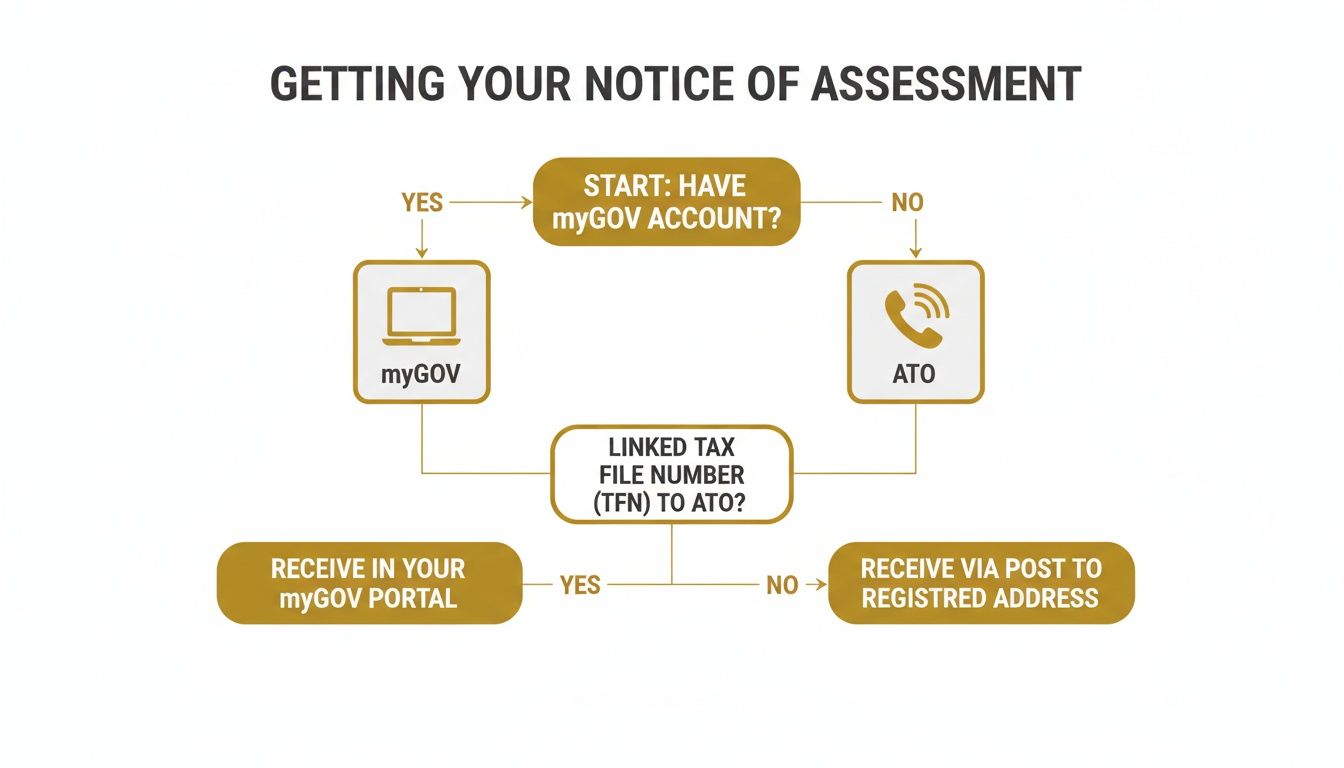
Methods for Accessing Your Notice of Assessment
| Method | Typical Timeframe | Best For |
|---|---|---|
| myGov Inbox | Within 2 weeks (after processing) | Instant, secure digital access for most people. |
| ATO Online Services | Within 2 weeks (after processing) | Direct access if you don't use myGov regularly. |
| Registered Tax Agent | Varies | Those who prefer an expert to handle everything. |
| By Post | Up to 6 weeks (after processing) | If you've opted out of digital or use paper forms. |
Using myGov for Instant Document Access
For most Aussies, the first and fastest answer to "how do I get my Notice of Assessment?" is myGov. If you’ve linked your Australian Taxation Office (ATO) services to your myGov account, you already have a secure digital hub for all your tax documents. It’s the gold standard for a reason. Picture this: you're in the middle of a home loan application, and the bank suddenly asks for your last two years of NOAs to verify your income. Instead of digging through a filing cabinet or waiting days for the post, you can just log into myGov, download the PDFs, and email them off in minutes. This isn't just about making life easier; it's about having immediate control over crucial financial documents exactly when you need them.Navigating to Your myGov Inbox
Once you're logged into myGov, you'll land on a dashboard showing your linked services. From here, you’ll click through to the Australian Taxation Office to get into your tax-specific area. This takes you straight into the ATO's online portal, where your letters and statements are all stored. No need to remember another password or worry about mail getting lost. To find your NOA, you can head to the 'Tax' dropdown menu, click 'Lodgments', and then look at your income tax history. But honestly, the most direct route is usually your myGov Inbox. It’s designed specifically to hold official mail from services like the ATO.Pro Tip: Make sure you've set up notifications in your myGov account settings to get an SMS or email. That way, you'll know the exact moment your tax return has been processed and your Notice of Assessment has arrived.This digital delivery is now the default for over 15 million Australian taxpayers every year. In fact, more than 90% of people who lodge their own return get their tax outcome this way, completely avoiding postal delays. The document that lands in your inbox even includes a tax receipt, breaking down how your taxes contribute to services like health and welfare. You can see more on the ATO's digital process and what your myTax estimate means.
Linking Services and Tax Agents
Of course, for any of this to work, your ATO account needs to be correctly linked to myGov first. If you haven't done it yet, the system will walk you through a quick verification process. You'll just need a few details on hand, like your Tax File Number (TFN) and information from a recent ATO-generated letter. And if you use a tax professional? The process can be even simpler. A common question we get is whether an agent can access these documents. The answer is yes. You can authorise your tax agent within myGov, giving them the access they need to manage your affairs efficiently. For anyone who prefers having an expert handle things, learning how to add your tax agent to myGov is a key step to making your tax life much easier.Alternative Ways to Request Your NOA
While jumping onto myGov is usually the fastest way to get your Notice of Assessment, it’s definitely not the only option. If you’re not online, wrestling with a forgotten password, or just prefer a different approach, the Australian Taxation Office (ATO) has a few other paths you can take. Knowing these alternatives means you’re never stuck, especially when you need that document in a hurry. Imagine you're trying to lock in a rental property and the agent needs your NOA by the end of the day. Of course, this is the one time you can’t remember your myGov password and the reset process is failing you. In a tight spot like this, your best bet is to get the ATO on the phone.
Contacting the ATO by Phone
You can give the ATO a call on 13 28 61 to request a copy of your NOA. Before you dial, it’s a good idea to have some key details handy so you can sail through their security check. They’ll almost certainly ask for:- Your full name and date of birth
- Your Tax File Number (TFN)
- Details from another recent ATO document or other personal information to confirm it’s you
Using a Registered Tax Agent
If you use a tax agent to lodge your return, you’ve got an even easier option. Your agent automatically gets a copy of your Notice of Assessment as soon as it’s issued by the ATO, and they’re required to keep these records on file for you.A quick email or phone call to your tax professional is often the simplest way to get what you need. They can usually fire over a digital PDF copy straight away, saving you the hassle of navigating the ATO’s phone system.This is a real lifesaver if you need NOAs from several different years, as your agent will have them all organised and ready to send.
The ATO Publications Ordering Service
For those who aren’t in a rush, the ATO also provides an online publications ordering service. You can use this portal to request a paper copy of your NOA from previous financial years. It's a reliable service, but it uses the same postal delivery timeframe, making it best suited for non-urgent record-keeping. At the end of the day, knowing how to get your notice of assessment through these different channels ensures you're prepared for any situation.Understanding When Your NOA Will Arrive
Once you’ve lodged your tax return, the next question on everyone's mind is, "So, when will I actually get my Notice of Assessment?" The answer really comes down to how and when you lodged. Your choice can be the difference between getting it in a couple of weeks or waiting for over a month. Lodging online through myTax early in the tax season—think July—is by far your fastest option. The ATO’s systems are built for digital returns, so you can realistically expect your NOA to pop up in your myGov Inbox in under two weeks. On the flip side, if you're mailing in a paper form closer to the October deadline, you're signing up for a much longer wait. It's a manual process, and that takes time.Key Factors Influencing Timelines
Even with a smooth lodgement, a few things can slow your NOA down. The sheer volume of returns hitting the ATO during peak periods can create a bit of a bottleneck, even for online lodgements. Certain details in your return can also flag it for a manual review by an actual person at the ATO, which naturally adds time. Common triggers for these delays include:- Mismatches between the income you've reported and the data the ATO has from your employer or bank.
- Complex or unusually high deduction claims that need a closer look.
- Information that needs to be cross-checked with another government department, like Services Australia.
Knowing about these variables helps you set realistic expectations. An online return lodged in August might take a bit longer than one submitted on July 1st, and that’s completely normal. Understanding why there might be a delay helps you figure out when it's genuinely time to start chasing it up.

Processing Benchmarks to Keep in Mind
The ATO’s digital-first approach makes a huge difference. Online myTax returns, which are used by over 70% of Australia’s 15+ million annual filers, are generally processed within a two-week timeframe. Paper lodgements? They have a much lengthier target of 50 business days. This stark difference is driven by efficiency, and Australia’s high on-time filing rate of 87.7% in 2023 helps keep the system moving. Even so, delays during peak periods can push wait times to three weeks for about 20% of cases. For a broader view, you can explore more OECD data on global tax administration trends.Troubleshooting Common NOA Problems
Even with the slickest online systems, tax matters don't always go off without a hitch. Knowing how to handle the most common issues with your Notice of Assessment (NOA) can save you a mountain of stress. What if your NOA never shows up, or you’ve simply misplaced the original? Don’t panic. Your first and best move is to jump back into your myGov Inbox. It’s the fastest way to get it and often holds documents you might have just overlooked. If it’s definitely not there, a quick call to your tax agent or the ATO directly will get a replacement sorted out for you.When the Numbers Don't Match
One of the most frequent calls we get is from clients confused because their final refund doesn't match the initial myTax estimate. This isn’t usually a mistake. Nine times out of ten, it’s because the ATO has used your refund to pay off an existing debt with another government agency—a process known as offsetting. Common debts that trigger this include:- Outstanding Centrelink or Services Australia payments
- Overdue child support obligations
- A tax debt from a previous year
Your Notice of Assessment is the final, legally binding calculation of your tax position for the year. The myTax estimate is just that—an estimate provided for your convenience before the ATO completes its final checks and balances.If you suspect an actual error on the assessment itself—like incorrect income figures or a disallowed deduction you believe was valid—you absolutely have the right to request an amendment. You can typically do this yourself online through myGov, or you can have your tax agent submit one on your behalf. In rare cases, if you notice suspicious activity or believe your details have been used fraudulently, it’s critical to act fast. Our guide on what to do about a compromised TFN provides the essential steps you need to take to protect your identity.
Frequently Asked Questions About Your Notice of Assessment
When you're trying to track down your Notice of Assessment, a few common questions always seem to pop up. Let's clear up some of the usual sticking points.
How Long Does the ATO Keep My NOAs?
For most practical purposes, the ATO keeps your NOAs for the last five years readily available right inside your linked myGov account. While they hold records for much longer, these recent documents are what you'll typically need for things like loan applications or rental agreements.Can I Get an NOA Without Lodging a Return?
In a word, no. A Notice of Assessment is only generated after a tax return has been lodged and the ATO has finished processing it. If you haven't lodged a return for a particular financial year, there's simply no NOA to find. Getting that return filed is your first and only step.It's easy to mix them up, but your NOA is a summary of a single tax return for one specific year. A Statement of Account, on the other hand, is more like a running bank ledger, showing all your transactions with the ATO over time—payments, credits, debts, the lot.
Why Is My Final Refund Different From My Estimate?
Ah, the classic question. The estimate you see in myTax when you lodge is just that—a preliminary calculation based on the figures you've entered. The final, official amount on your NOA comes after the ATO has done its homework. They verify everything and, most importantly, check for any existing debts you might have with other government agencies like Services Australia. If you owe money elsewhere, they'll use your refund to pay that off first, which is the most common reason the final figure changes.Navigating tax documents and lodgements can be tricky, but you don't have to do it alone. Australia Wide Tax Solutions offers expert, personalised service to handle everything from late returns to complex investments, ensuring you get the best possible outcome. Get in touch with our team today for a stress-free tax experience. "Need your Notice of Assessment for a loan or visa? The fastest route is digital! Check out our guide to accessing your NOA instantly via myGov or your tax agent. 📈📄 #TaxTips #AussieTax #NOA #LodgeWithConfidence #AWTS"
Estate planning ensures assets are distributed according to your wishes, minimises disputes among beneficiaries, and can reduce the tax and administrative burden on your estate. Without a valid Will, your estate is distributed under intestacy laws that may not reflect your intentions. A complete plan also addresses superannuation, powers of attorney, and advance care directives.
No. Superannuation is not automatically an estate asset and does not pass according to your Will. Your super fund trustee decides who receives the death benefit, guided by any binding death benefit nomination you have made. Without a valid binding nomination, the trustee has discretion to pay your legal personal representative or directly to a dependant.
Australia has no inheritance tax or estate duty. However, selling inherited assets can trigger CGT. The cost base of inherited assets is generally the market value at the date of death, and the 50% CGT discount applies if the beneficiary holds the asset for more than 12 months. Pre-CGT assets (acquired before 20 September 1985) have special rules.
Probate is a court order confirming a Will is valid and authorising the executor to administer the estate. It is generally required for estates that include real property, or when financial institutions require legal authority before releasing assets. Smaller estates where assets are held jointly may not require probate. The process is handled through the Supreme Court of the relevant state.
Review your Will after any major life event: marriage (which automatically revokes most Wills), divorce, birth of children, significant changes in financial position, or a beneficiary or executor dying. As a general rule, review every three to five years even without a triggering event to ensure it remains current.