
Yes, in most cases, your income protection insurance premiums are generally tax deductible in Australia if you pay for them personally. This is a huge benefit. Claiming this deduction lowers your taxable income, which means you’ll either pay less tax throughout the year or get a welcome boost to your refund from the Australian Taxation Office (ATO).
- Your Quick Guide to Income Protection and Tax
- Understanding the Golden Rule of Deductibility
- Deducting Premiums for Personal Policies
- Income Protection Held Inside Your Super Fund
- Smart Policy Structures for Small Business Owners
Think of it as the government giving you a hand to secure your own financial safety net. It’s a powerful incentive.
Your Quick Guide to Income Protection and Tax
When it comes to the tax treatment of income protection, the answer almost always comes down to one simple question: who owns and pays for the policy? The way your policy is structured is the key that unlocks everything, from whether you can claim the premiums to how any benefits you receive are taxed.
Income protection is your financial Plan B. It’s there to replace a chunk of your income if an illness or injury stops you from working. While the specifics can vary, the core purpose is consistent across different types of cover. For a look at how similar policies work elsewhere, this practical guide to Long Term Disability in Canada offers some useful parallels.
The Three Main Scenarios for Your Policy
Getting your head around the tax side of things isn't as complex as it seems. It really just boils down to three common ways a policy can be owned, and each has its own clear tax rules.
- You Own It Personally: This is the most direct and common setup. You pay the premiums straight from your own bank account, and come tax time, you can claim those premiums as a deduction. Simple.
- Your Super Fund Owns It: A lot of Aussies have income protection inside their super, often as a default cover. Here, your super fund is paying the premiums, which means you can't personally claim a tax deduction for them.
- Your Business Owns It: If you run your own company, the business might pay the premiums on your behalf. While the business can usually claim a deduction for the expense, it can open up other tax headaches like Fringe Benefits Tax (FBT) that need careful management.
This flowchart breaks down the decision process visually, showing exactly how ownership dictates whether you can claim a deduction.
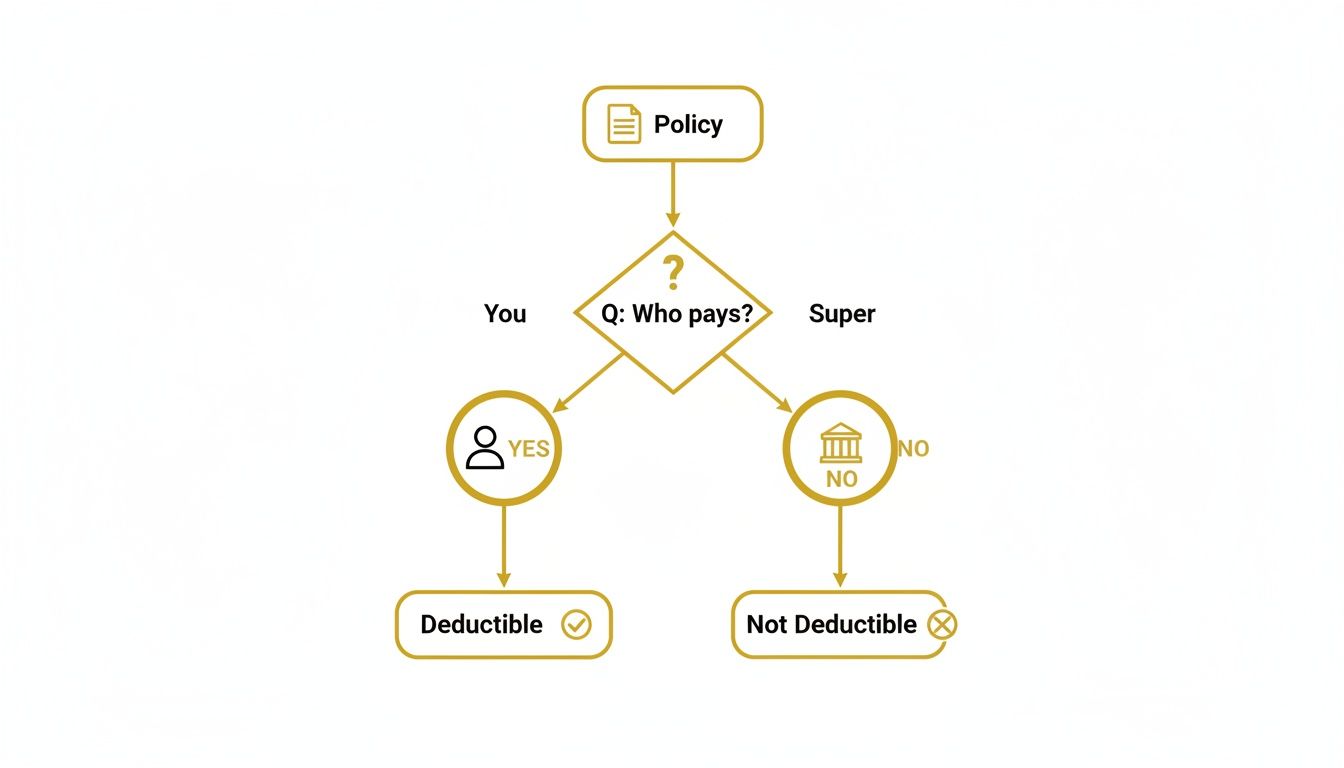
As you can see, the path is pretty clear. If you're the one footing the bill personally, the deduction is yours to claim. If your super fund is paying, that deduction isn't available to you on your personal tax return.
To make it even clearer, here’s a quick overview of how the tax rules apply to each setup. This table gives you a snapshot of the key differences, which we'll explore in more detail.
Income Protection Tax Deductibility At a Glance
This table summarises the tax treatment of income protection premiums and benefits based on the policy ownership structure.
| Policy Ownership | Are Premiums Tax Deductible? | Are Benefits Taxable? | Who It's For |
|---|---|---|---|
| Personal | Yes, for the individual | Yes, as income | Employees, sole traders, and contractors |
| Superannuation | No, for the individual | Yes, as income | Anyone with a superannuation account |
| Business-Owned | Yes, for the business | Yes, as income | Company directors and key employees |
This framework is your starting point for understanding how the ATO views your policy. Knowing which category you fall into is the first step to making sure you're getting it right on your tax return.
Understanding the Golden Rule of Deductibility

When it comes to claiming tax deductions, the Australian Taxation Office (ATO) isn’t trying to be complicated. In fact, most of it boils down to one straightforward principle. Getting your head around this "golden rule" is the key to understanding why you can claim your income protection premiums, but not your morning coffee.
At its heart, the rule is this: you can claim a deduction for any expense directly incurred in earning your assessable income. Think of it like a tradie buying a new nail gun. It’s not a weekend toy; it’s an essential tool that helps them do their job and get paid. Because the cost is directly tied to their ability to earn a living, it’s a legitimate deduction.
Your income protection policy is no different. It’s a financial tool designed to protect your single most important asset—your ability to earn an income. The premiums you pay are simply the cost of ensuring that income stream continues, even if an injury or illness stops you from working.
What Is Assessable Income?
So, what does the ATO actually count as "assessable income"? Put simply, it’s your gross income from all sources before any deductions are taken out. It’s the total amount the government can apply tax to.
For most people, this includes:
- Salary and wages from your employment.
- Business income if you're a contractor or sole trader.
- Certain government payments and allowances.
- Income from investments, like bank interest or share dividends.
When you pay for your own income protection policy, the premiums are clearly linked to protecting the salary or business income that makes up your assessable income. It's this direct connection that makes the premiums a valid claim. You can find out more by reading our full guide on what qualifies as a tax-deductible expense.
This is why the answer to "is income protection tax deductible?" is almost always a 'yes' for policies you hold personally. You're paying to protect your taxable income, and the ATO recognises that as a legitimate cost of doing business.
The Two Sides of the Tax Coin
But this golden rule is a two-way street. It creates a balance between deductions and income that you absolutely need to be aware of.
The Golden Rule’s Flip Side: If an expense is tax-deductible, any income or benefit you receive from it is considered taxable income.
This isn’t optional; it’s a fundamental part of Australia’s tax system. You can’t have the deduction without the tax on the benefit. Because your income protection premiums are tax-deductible, any monthly payments you receive from the policy must be declared as assessable income.
This means you treat those benefit payments just like a regular salary on your tax return. The ATO sees the insurance payout as a replacement for your lost wages, so it needs to be taxed in the same way.
Forgetting this can leave you with a nasty surprise and a big tax bill. Imagine receiving $4,000 a month from your insurer. If you haven't set aside money for tax, you could be on the hook for thousands at the end of the financial year. Understanding this relationship from the start keeps you compliant and financially prepared.
Deducting Premiums for Personal Policies
This is the most common setup for millions of Australian employees and sole traders. When you hold an income protection policy in your own name and pay the premiums yourself, those premiums are almost always tax deductible.
Think of it this way: your ability to earn an income is your most valuable financial asset. The money you spend on income protection is a direct cost of protecting that asset. The ATO agrees with this logic, which is why in this situation, the answer to "is income protection tax deductible?" is a clear 'yes'.
How Deductions Cut Your Tax Bill
Claiming your income protection premiums isn't just an administrative task; it directly reduces your taxable income. This translates to a very real tax saving, and the size of that saving depends on your marginal tax rate—the rate of tax you pay on the last dollar you earn.
Simply put, the higher your income, the higher your marginal tax rate, and the more valuable your deduction becomes.
Let's see how this works with a real-world example.
Worked Example: Meet Sarah, the Graphic Designer
Sarah is a freelance graphic designer earning a taxable income of $120,000 a year. She pays an annual premium of $2,500 for her personal income protection policy.
Find the Marginal Tax Rate: Under the 2025-2026 tax brackets, Sarah's income puts her in the bracket where she pays 30 cents for every dollar earned between $45,001 and $135,000. Her marginal tax rate is 30%.
Calculate the Tax Saving: We just multiply her premium cost by her tax rate.
- $2,500 (Premium) x 0.30 (Tax Rate) = $750
Work Out the True Cost: By claiming the deduction, Sarah gets a $750 reduction on her tax bill. This effectively drops the real cost of her insurance from $2,500 to just $1,750 for the year.
This shows just how much the tax system helps make vital financial protection more affordable. The higher your tax bracket, the bigger this saving gets.
The Catch with Bundled Policies
It's very common for insurers to "bundle" different types of cover into one policy package. You might find your income protection is combined with:
- Life Insurance (or Death Cover): Pays a lump sum to your loved ones if you pass away.
- Total and Permanent Disability (TPD) Cover: Pays a lump sum if you're permanently disabled and can never work again.
- Trauma (or Critical Illness) Cover: Pays a lump sum if you're diagnosed with a major illness like cancer or a heart attack.
Here’s the critical detail: the ATO only allows you to claim the portion of the premium that pays for your income protection cover. Premiums for life, TPD, and trauma cover are considered "capital in nature" and are not tax deductible when held in a personal policy.
If you claim the entire premium for a bundled policy, you are making an incorrect claim. This can lead to ATO audits and potential penalties. You must separate the deductible component from the non-deductible ones.
How to Correctly Apportion Your Premium
So, how do you find the exact figure you can claim? You don’t have to do the maths yourself. Your insurance company is legally required to provide this information.
You need to get an apportionment statement or policy schedule from your insurer. This document will clearly break down your total premium, showing you precisely how much is for income protection versus the other types of cover.
For instance, your statement might look like this:
- Total Annual Premium: $3,000
- Income Protection Component: $2,100 (Deductible)
- Life & TPD Cover Component: $900 (Not Deductible)
In this scenario, you can only claim the $2,100 on your tax return. Relying on this official statement is the only way to be sure you're maximising your deduction without falling foul of the ATO rules.
Income Protection Held Inside Your Super Fund
Lots of Australians hold their income protection insurance inside their superannuation fund—it's a common and often convenient setup. But when it comes to tax time, the rules flip completely, and it's a critical difference you need to get your head around.
The short answer is no, you can’t personally claim a tax deduction for the premiums.
Think of your super fund as a totally separate legal entity. It’s like another person managing your retirement nest egg for you. When the fund owns the income protection policy, it pays the premiums directly from your super balance. Because you aren't personally paying for it, you can't claim a deduction on your personal tax return.

This separation is the key. The expense wasn't something you paid to earn your personal income; it was paid by the fund. It's a fundamentally different setup from a personal policy, where you pay the premiums yourself from your after-tax salary.
The Super Fund's Own Tax Deduction
While you don't get the personal tax deduction, there is still a tax benefit happening behind the scenes. Your super fund can claim a tax deduction for the insurance premiums it pays for you.
Since super funds pay tax on their earnings and contributions at a concessional rate of just 15%, this is where the advantage lies.
By claiming the premiums as a deduction, the fund lowers its own taxable income. This 15% deduction effectively reduces the cost of the insurance, which helps to preserve more of your retirement savings.
This is a major reason why holding cover inside super can be so cost-effective. The tax saving is passed on to you indirectly by softening the blow of the premium costs on your overall super balance. Beyond this, there are other powerful strategies you can use to legally cut your tax rate through your super.
The Pros and Cons of Cover Inside Super
Choosing between a personal policy and one held in super means weighing up convenience against how comprehensive the cover is. It's vital to understand these trade-offs before you lock anything in.
Advantages of Holding Cover in Super:
- Cash Flow Friendly: Premiums come out of your super balance, not your take-home pay. This can seriously ease the pressure on your daily budget.
- Automatic Acceptance: Many funds offer a basic level of default cover without needing a medical exam, making it simple to get some protection in place fast.
- Tax-Effective Premiums: The fund’s 15% tax deduction helps to reduce the real cost of the insurance premiums.
Disadvantages to Consider:
- Erodes Retirement Savings: Even though they're tax-effective, premiums still drain your super balance. That means less money for you in retirement.
- Stricter Definitions: Policies inside super often have tougher definitions of disability and longer waiting periods compared to what you can get with a personal policy.
- Less Comprehensive Cover: They might offer lower levels of cover (e.g., capped at 70% of your income) and have fewer optional benefits available.
- Benefit Payments Are Taxed: Just like a personal policy, if you make a claim, any benefit payments you receive are treated as taxable income and you must declare them.
These details are especially important if you run a Self-Managed Super Fund (SMSF). To get a better handle on that particular structure, you can learn more about what an SMSF is and how it operates.
While a personal policy offers that direct tax deduction, it's worth putting it in the context of the broader tax landscape. For instance, in the 2025/26 financial year, thanks to tax reforms, someone in the $45,001 to $135,000 bracket will save $300 on a $1,000 personal policy premium—a significant saving that simply isn't available for policies held in super. You can find more insights on income protection tax deductibility to see how these rules work in practice.
Smart Policy Structures for Small Business Owners
As a small business owner, how you set up your income protection policy isn't just a bit of admin—it's a crucial strategic move. The way you pay your premiums has huge tax consequences, especially when your company or trust is footing the bill.
At first glance, it seems simple. When a business pays the premium for a director's or employee's policy, it looks like a straightforward tax-deductible expense. But this is where many business owners get caught out by a major complication: Fringe Benefits Tax (FBT).
The Fringe Benefits Tax Trap
Think of FBT as a tax on the "perks" of the job. It's paid by employers on non-cash benefits they provide to employees, like a company car or, in this case, a personal insurance policy paid for by the business.
Because your income protection policy is a personal benefit, the ATO sees the company paying for it as a fringe benefit. This means that while your business might get a tax deduction for the premium, it could get hit with an FBT liability, often at the highest marginal tax rate. This can easily wipe out, or even exceed, the value of the original tax deduction.
In short, you get a deduction with one hand, only to create a new, potentially bigger tax bill with the other. This FBT trap is a common mistake that makes a business-paid policy far more expensive than it looks on paper.
Proper planning is key here. If you're exploring other ways to get your company's tax position in order, looking at a wider range of tax deductions for small business owners can uncover some valuable opportunities.
A Smarter Way to Structure Your Policy
So, how do you get the best of both worlds—making sure the premium is covered without triggering FBT for your business? A common and highly effective strategy is what’s known as an 'employee-reimbursement' arrangement.
It’s a simple, two-step process that cleverly shifts the tax deduction from the business to the individual, sidestepping the FBT problem entirely.
Here’s how it works:
- The Individual Pays: The director or employee takes out the income protection policy in their own name and pays the premium from their personal bank account. This is the crucial step that makes them the policy owner.
- The Business Reimburses: The business then increases the individual’s salary or pays them a director’s fee to cover the exact cost of that premium. This extra payment is just a normal, tax-deductible wage expense for the business and doesn’t attract any FBT.
This setup gives you the same financial result but through a much cleaner, more tax-effective structure. The business gets its deduction for the higher salary, and the individual can then claim a personal tax deduction for the income protection premium they paid. It’s a win-win that keeps things simple and compliant.
Business Expense Insurance Is Not Income Protection
It is absolutely vital for business owners not to mix up personal income protection with Business Expense Insurance. They might both sound like a safety net, but they cover completely different things and have entirely different tax rules.
- Income Protection: This replaces your personal income if you can’t work. It’s for your mortgage, groceries, and family living costs.
- Business Expense Insurance: This covers your fixed business overheads if you can't work. Think office rent, staff wages, utility bills, and equipment leases.
The tax treatment for Business Expense Insurance is also different. The premiums are generally tax deductible for the business, and if you ever make a claim, the benefits paid are treated as assessable income to the business, not you personally. It’s designed purely to keep the lights on at your business, not to pay your household bills. Getting this distinction right is fundamental to solid risk management and tax planning.
Getting Your Tax Claim Right: A Practical Guide

So, you’ve got the theory down. You know if your income protection is tax deductible. But knowing the rules and actually getting the money back from the ATO are two different things. Getting it right at tax time is what counts.
Let’s be clear: if you pay for a personal policy, the premiums are generally deductible, but any benefits you receive will be taxed. If your cover is inside super, you can’t claim the premiums yourself. And if it's a business-owned policy, you need to be very careful to avoid Fringe Benefits Tax headaches.
Your Tax Time Checklist
When it comes to lodging your tax return, a little preparation goes a long way. Before you or your accountant start, pull these details together to make sure you claim the right amount and stay on the ATO’s good side.
- Dig Out Your Annual Statement: Your insurer will send you a statement for the financial year. This is your single source of truth.
- Check for Bundled Cover: Read the statement carefully. If it also includes life, TPD, or trauma insurance, it must show a clear apportionment of the premium.
- Find the Right Number: You can only claim the specific dollar amount listed against "income protection." Don't make the mistake of claiming the entire premium on a bundled policy.
- Lodge It Correctly: On your tax return, this deduction goes in the "Other work-related expenses" section, which is label D5.
When to Call in a Tax Expert
This guide will get you through a straightforward claim. But let’s be honest, tax is rarely simple for long. If your financial life has a few moving parts beyond a basic salary, professional advice isn't just a good idea—it's essential.
Seeking personalised advice isn't an admission of defeat; it's a strategic decision to protect your financial wellbeing and ensure you get every deduction you're legally entitled to.
You absolutely need an expert accountant in your corner if you're dealing with:
- Overdue or late tax returns.
- Complex business or trust structures.
- Rental properties and the maze of capital gains tax.
- Any uncertainty around Fringe Benefits Tax (FBT).
A specialist advisor from a firm like AWTS will cut through the complexity for you. They’ll make sure your claims are not only maximised but also fully compliant, giving you peace of mind and the best possible result on your tax return.
Got Questions About Income Protection and Tax? We’ve Got Answers.
Even once you’ve got the basics down, real-world situations can muddy the waters. It's easy to get confused about what you can and can't claim. Here, we tackle some of the most common questions we hear from clients, giving you clear, straightforward answers to help you lodge your tax return with confidence.
What if My Policy Is Bundled with Life Insurance?
This is a classic trap. You absolutely cannot claim the entire premium if your income protection is bundled with other cover like life or trauma insurance. The Australian Taxation Office (ATO) is very strict on this point: you can only deduct the portion of the premium that directly pays for your income protection cover.
Your insurer is legally required to send you an annual statement that breaks this down. They’ll clearly apportion the cost, showing you the exact dollar figure for the income protection component. That’s the number you must use. Claiming the full amount is a surefire way to attract unwanted attention from the ATO.
Can I Claim a Deduction if I Paid My Premium Annually?
Yes, you certainly can. If you've paid for your entire policy a year in advance, you can generally claim a deduction for the whole prepaid amount in the financial year you made the payment. This applies as long as the coverage period you paid for is 12 months or less.
For instance, if you paid $2,400 in May 2025 for a policy that covers you until May 2026, you can claim the full $2,400 deduction on your 2025 tax return.
What Records Do I Need to Keep for the ATO?
Think of your records as your proof. Without them, your claim is just a number on a form. The ATO can ask you to verify your expenses for up to five years after you lodge, so meticulous record-keeping is non-negotiable.
You must hold onto:
- Your annual policy statement from the insurer. This is your most important document, as it confirms the premium and breaks down the costs if your policy is bundled.
- Receipts or bank statements that show you actually paid the premiums.
If the ATO comes knocking and you can’t produce these documents, they can disallow the claim and you could be hit with penalties. It’s not worth the risk.
Are Benefits Taxed if My Policy Is in Super?
Yes. This is a crucial point that catches many people out. Just like a policy you hold personally, any benefit payments you receive from an income protection policy held inside your superannuation fund are considered taxable income.
The process is a little different—the insurer pays the benefit to your super fund, which then pays it out to you. But when that money lands in your bank account, it's treated as income, and you must declare it on your tax return.
The ATO provides guidance through ato.gov.au, the Small Business Support Line (13 28 66), and Online Services for individuals and businesses. For complex situations, a registered tax agent provides advice tailored to your specific circumstances and professional indemnity protection. You can verify agent registration at the TPB register at tpb.gov.au.
Most tax records must be kept for five years from the date of lodgement or the date the transaction occurred, whichever is later. Records must be in English or convertible to English and must be sufficient to explain the income and deductions in your return. The ATO can request records at any time during the retention period.
Consider a registered tax agent when your affairs involve multiple income sources, business activity, investment properties, capital gains, or overseas income. Agents extend your lodgement deadline, provide safe harbour protection, and take professional responsibility for the advice given. Verify registration at tpb.gov.au.
The failure to lodge penalty is based on penalty units ($313 per unit from 1 July 2023), accruing per 28-day period for late returns and BAS lodgements. Incorrect information penalties range from 25% to 75% of the tax shortfall depending on whether the behaviour was careless, reckless, or intentional. Proactive disclosure before an audit begins typically results in significantly reduced penalties.
Tax minimisation is the legal arrangement of your affairs to reduce tax — claiming all eligible deductions, using appropriate structures, and timing income and expenses. Tax avoidance involves arrangements that technically comply with the law but achieve outcomes parliament did not intend. The ATO can apply Part IVA anti-avoidance rules to cancel benefits from avoidance arrangements.
Navigating the fine print of income protection can get tricky, especially when business structures or complex finances are involved. To make sure you’re staying compliant while getting the best possible tax outcome, the team at Australia Wide Tax Solutions is here to help. Contact us today for a confidential discussion about your tax needs.
When it comes to tax, taxable income is the figure that really matters. It’s the final number the Australian Taxation Office (ATO) uses to calculate how much tax you actually owe.
- Your Taxable Income Explained Simply
- Decoding Your Assessable Income
- Finding Your Allowable Deductions
- What Counts and What Does Not
- Putting It All Together: A Practical Calculation
Your Taxable Income Explained Simply
Think of your taxable income as the bottom line on your personal financial statement for the year. You start with all the money you’ve earned, and then you subtract all the eligible costs you incurred to make that money happen. What's left is your taxable income.
The formula itself is refreshingly simple:
Taxable Income = Assessable Income – Allowable Deductions
Getting your head around this concept is the first step towards taking control of your tax affairs. Whether you're an employee with a few work-from-home expenses, a landlord with a rental property, or a small business owner, this calculation is central to your tax return. In fact, legally reducing this number is the whole point of smart tax planning.
For instance, not all of your income might even be taxed to begin with. Our guide on the tax-free threshold explains how the first slice of your income is often yours to keep, tax-free.
This flowchart breaks down the process visually.

As you can see, you start with your total earnings and then chip away at it with any legitimate deductions. The ATO applies Australia’s progressive tax rates to this final figure. If you're curious, the ATO publishes detailed taxation statistics each year, offering a fascinating glimpse into how income is earned and taxed across the country.
Understanding this core formula isn’t just about compliance; it’s about putting yourself in the best possible position to maximise your tax refund.
The Core Components of Your Taxable Income
To really grasp how it all works, let's break down the two key parts of the taxable income equation. This table shows what goes into each component.
| Component | What It Means | Common Examples |
|---|---|---|
| Assessable Income | Pretty much all the income you receive. It's the starting point before any subtractions are made. | • Salary and wages • Business income • Investment dividends • Rental income • Some government payments |
| Allowable Deductions | These are the eligible expenses you paid to help you earn your assessable income. | • Work-related car expenses • Home office running costs • Tools and equipment for your job • Fees for managing an investment property |
Simply put, you tally up everything in the "Assessable Income" column and then subtract everything you can claim from the "Allowable Deductions" column. The result is what the tax man is interested in.
Decoding Your Assessable Income
Before we can get to your taxable income, we first need to get our heads around assessable income. Think of it as your gross earnings—the total amount of income the Australian Taxation Office (ATO) expects you to declare before you start subtracting any deductions.
It’s a common trap to think this is just the salary that lands in your bank account from your employer. The reality is that assessable income casts a much wider net, catching just about every dollar you earn from all your various income streams. It's the starting line for working out what’s actually taxable in Australia.

This total figure is incredibly important. Individual income tax has been the backbone of the federal government's revenue for decades, consistently pulling in about half of all tax receipts. ATO stats from 2022-23 really show how broad this tax base is, with over 572,136 people aged 70+ reporting a median taxable income of $43,941. You can dig deeper into Australia's tax revenue composition to see how these numbers fit into the bigger economic picture.
Common Sources of Assessable Income
So, what exactly does the ATO want you to include in your assessable income? It's a long list, but here are the usual suspects you absolutely need to report:
- Employment Income: This is the big one for most people. It covers your regular salary or wages, but also any bonuses, commissions, allowances, or overtime payments you get from your job.
- Business and Sole Trader Income: If you're running a business or freelancing in Sydney, you need to include all your gross earnings from selling goods or services—that’s the total revenue before you take out your expenses.
- Investment Returns: This is a broad category. It includes dividends from any shares you own, the interest earned from your savings accounts, and any distributions you receive from managed funds.
- Rental Property Income: For any property investor in Brisbane, the entire amount of rent your tenants pay you throughout the financial year is considered assessable income.
- Certain Government Payments: Not all government payments are tax-free. Some Centrelink payments and other government allowances are taxable and must be declared.
Forgetting to report any of these income sources can lead to some unwelcome attention and penalties from the ATO. That’s why getting your assessable income right is the most critical first step in nailing your tax return.
Finding Your Allowable Deductions
Now for the good part—the bit where you can legally and actively lower your tax bill. **Allowable deductions** are simply the eligible costs you've paid to earn your income. Think of them as the cost of doing business, even if that business is just being an employee.The Australian Taxation Office (ATO) has three non-negotiable rules for claiming any expense. If you can confidently answer "yes" to all three, you're usually on solid ground.
The Three Golden Rules of Deductions
Before you even think about claiming something, run it past this simple checklist. The expense must meet all these core ATO requirements:
- You must have spent the money yourself and weren't paid back for it by your boss or anyone else.
- The expense must directly relate to earning your income. There has to be a clear and logical link between the cost and your job or business activities.
- You must have a record to prove it. This is your evidence—usually a receipt, bank statement, or invoice.
Keeping good records isn’t just a suggestion; it's the foundation of maximising your claims. To make sure you’re not leaving money on the table, it's vital to learn how to properly organize receipts for taxes.
An allowable deduction isn't a dollar-for-dollar refund. It works by reducing your taxable income. For someone in the 32.5% tax bracket, every $100 they claim in deductions saves them $32.50 in tax.
The world of deductions is huge and really depends on your specific job and how you earn your money. For a much deeper dive into what you might be able to claim, check out our detailed guide on what expenses you can claim on tax.
Some of the most common types of deductions we see include:
- Work-Related Car Expenses: This covers using your personal car for work travel, but not your regular trip from home to the office.
- Home Office Expenses: If your job requires you to have a dedicated workspace at home, you can claim the costs of running it.
- Self-Education Expenses: Think course fees or training that is directly linked to improving your skills in your current role.
- Investment Property Costs: For landlords, this includes expenses like loan interest, council rates, and maintenance on a rental property.
Getting a firm grasp on every single deduction you're entitled to is the single most effective way to lower your what is taxable income australia figure and get a better result at tax time.
What Counts and What Does Not

Knowing exactly what money you need to tell the ATO about is half the battle at tax time. Getting your taxable income calculation right means drawing a clear line between what’s considered assessable income (the stuff you pay tax on) and what’s exempt (the stuff you don’t).
It’s a common trap to think only your regular salary counts. But the Australian Taxation Office (ATO) takes a much broader view. That annual bonus, the interest earned on your savings account, and even certain government payments like JobSeeker all need to go into the pot.
On the other hand, some types of money you receive are genuinely yours to keep, no tax attached.
The simplest rule of thumb is this: genuine gifts or one-off windfalls that have zero connection to your job or business are usually not considered assessable income. Think lottery wins or an inheritance from a relative.
Getting this distinction right is crucial. Declare exempt income by mistake, and you'll pay more tax than you need to. Forget to include something assessable, and you could be facing ATO penalties down the track. The goal is simple: report exactly what you’re required to, and nothing more.
Taxable vs Non-Taxable Income: A Quick Comparison
To make it crystal clear, this table gives you a straightforward comparison of common income types. Use it as a quick reference to help you sort your funds correctly when it's time to do your tax.
| What Is Usually Taxable (Assessable Income) | What Is Usually Not Taxable (Exempt Income) |
|---|---|
| • Your salary, wages, and work bonuses | • Genuine gifts or inheritance money |
| • Bank interest and investment dividends | • Lottery winnings and other prizes from gambling |
| • Income from a rental property | • Most child support and spousal maintenance payments |
| • Profits from running a business or sole trade | • The majority of government pensions and allowances |
| • Capital gains from selling assets like shares | • NDIS payments made to you or your provider |
Keep in mind that this is a general guide. If you have income from an unusual source, it's always best to double-check the specifics with the ATO or a tax professional to be sure.
Putting It All Together: A Practical Calculation
Theory is one thing, but seeing the numbers in action makes everything click. Let's walk through three different scenarios to show how the formula Taxable Income = Assessable Income – Allowable Deductions works in the real world for everyday Australians.
These examples use simplified figures to keep things crystal clear. You can apply the exact same logic to your own situation to get a better handle on where you stand.
Example 1: The PAYG Employee
Meet Sarah. She works a standard full-time office job, so her situation is nice and straightforward.
- Assessable Income: Her annual salary is $85,000.
- Allowable Deductions: She spent $1,500 on a new laptop she needs for work and kept a logbook for $500 in work-related car trips. Her total deductions are $2,000.
To get her taxable income, we just subtract her deductions from her income:
$85,000 (Assessable Income) – $2,000 (Allowable Deductions) = $83,000 (Taxable Income)
The ATO will now use that $83,000 figure to work out how much tax Sarah owes for the year. Simple.
Example 2: The Property Investor
Now, let's look at Ben. He owns a rental property, which adds a few more moving parts to his tax calculation.
Calculate Total Assessable Income:
- Salary from his main job: $100,000
- Gross rental income he received: $26,000
- Total Assessable Income: $100,000 + $26,000 = $126,000
Calculate Total Allowable Deductions:
- Interest on the investment loan: $18,000
- Real estate agent fees: $2,000
- Council rates and property repairs: $3,000
- Total Allowable Deductions: $18,000 + $2,000 + $3,000 = $23,000
Ben’s final taxable income calculation looks like this:
$126,000 (Assessable Income) – $23,000 (Allowable Deductions) = $103,000 (Taxable Income)
Example 3: The Sole Trader
Finally, there’s Chloe, a freelance graphic designer. As a sole trader, she needs to calculate her business profit first, which then becomes her income.
- Assessable Income: She invoiced her clients a total of $95,000. This is her gross business income.
- Allowable Deductions (Business Expenses): Her software subscriptions, home office costs, and other business-related expenses came to $20,000.
Her net business profit is $75,000 ($95,000 - $20,000). For tax purposes, this profit is her assessable income. Assuming Chloe has no other deductions to claim, her taxable income is $75,000.
As you can see, no matter how you earn your money, the core principle stays the same. If you want to dive deeper into the nuts and bolts, our guide on how to calculate taxable income in Australia has a comprehensive breakdown.
Frequently Asked Questions

Even with a clear formula, navigating the specifics of Australian tax law can bring up some tricky questions. Let's break down a few of the most common queries we get from clients about what counts as taxable income.
Is Superannuation Taxable Income?
This is a common point of confusion. The super contributions your employer makes on your behalf (under the Superannuation Guarantee) aren't typically counted as your personal assessable income.
Instead, those contributions are taxed at a concessional rate of 15% within the super fund itself. It’s a separate process.
However, the game changes when you decide to withdraw your super after reaching preservation age. At that point, parts of your payout might become taxable, depending on your age and the specific components of the withdrawal.
Are Gifts Considered Taxable Income?
In most situations, no. A genuine gift given out of pure generosity or family affection is not considered assessable income. You don't need to declare that birthday money from mum and dad to the ATO.
The key here is the nature of the "gift". If it's a one-off cash present from a relative, you're in the clear. But if that payment is actually for a service you provided or a product you sold, the ATO will see it for what it is—income.
What About Overseas Income?
If you are an Australian resident for tax purposes, the ATO wants to know about your worldwide income. This isn't just about what you earn on Aussie soil.
You must declare any salary, investment returns, or business profits you’ve earned overseas. This applies even if you've already paid tax on it in another country.
To prevent you from being taxed twice, you can often claim a foreign income tax offset. For anyone living a global lifestyle, understanding the broader tax implications of travel history is also vital for staying compliant. Your residency status is the linchpin here, so getting it right is non-negotiable.
The ATO provides guidance through ato.gov.au, the Small Business Support Line (13 28 66), and Online Services for individuals and businesses. For complex situations, a registered tax agent provides advice tailored to your specific circumstances and professional indemnity protection. You can verify agent registration at the TPB register at tpb.gov.au.
Most tax records must be kept for five years from the date of lodgement or the date the transaction occurred, whichever is later. Records must be in English or convertible to English and must be sufficient to explain the income and deductions in your return. The ATO can request records at any time during the retention period.
Consider a registered tax agent when your affairs involve multiple income sources, business activity, investment properties, capital gains, or overseas income. Agents extend your lodgement deadline, provide safe harbour protection, and take professional responsibility for the advice given. Verify registration at tpb.gov.au.
The failure to lodge penalty is based on penalty units ($313 per unit from 1 July 2023), accruing per 28-day period for late returns and BAS lodgements. Incorrect information penalties range from 25% to 75% of the tax shortfall depending on whether the behaviour was careless, reckless, or intentional. Proactive disclosure before an audit begins typically results in significantly reduced penalties.
Tax minimisation is the legal arrangement of your affairs to reduce tax — claiming all eligible deductions, using appropriate structures, and timing income and expenses. Tax avoidance involves arrangements that technically comply with the law but achieve outcomes parliament did not intend. The ATO can apply Part IVA anti-avoidance rules to cancel benefits from avoidance arrangements.
Feeling like you're drowning in tax rules? The team at Australia Wide Tax Solutions is here to throw you a life raft. We provide clear, expert advice to help you nail your taxable income calculation and get the best possible refund. Get in touch with us today for personalised tax assistance.
Calculating your taxable income in Australia follows a pretty simple formula: you start with your total assessable income and then subtract all the allowable deductions you're eligible to claim. The number you end up with is your taxable income, which is what the Australian Taxation Office (ATO) uses to figure out how much tax you owe.
- Your Starting Point: Understanding Assessable Income
- Finding Every Allowable Deduction
- A Practical Calculation Walkthrough
- Navigating Special Circumstances and Complex Income
- Applying Tax Rates and Offsets
Your Starting Point: Understanding Assessable Income
Before you can even think about deductions, you first need to get a crystal-clear picture of your assessable income. This is the absolute first step. It’s essentially your gross income—every single dollar you've earned from any source that the ATO considers taxable. For most of us, this begins with a regular salary or wages, but it very rarely stops there.
Getting this right is crucial for staying compliant. It's a common mistake to think only your main job's income counts, but leaving out another source of income, no matter how small, can lead to an incorrect tax return and potential headaches with the ATO later on.
Identifying All Your Income Streams
To get an accurate total, you have to look beyond your payslip and account for all the money that came in during the financial year.
Think about all the potential places income could come from:
- Employment Income: This is the most obvious one. It covers your salary, wages, any bonuses you received, allowances, and reportable fringe benefits.
- Government Payments: Most Centrelink payments, like JobSeeker or parenting payments, are generally considered assessable income.
- Business or Sole Trader Income: If you run a small business or have a side hustle, you need to include all your gross earnings before you take out any expenses.
- Investment Returns: This is a big category. It includes things like dividends from shares, distributions you get from trusts, and any rental income from an investment property.
It's also important to get the small details right. For instance, any interest you earn from your savings accounts has to be declared. It might not seem like much, but it all adds up to your total assessable income. If you're unsure about this, you can learn more in our guide on what is interest income.
The key takeaway is simple: if you earned it, the ATO most likely wants to know about it. Taking the time to gather all this information meticulously ensures your tax calculation starts on the right foot.
For a clearer view, here’s a quick rundown of what typically falls under assessable income.
Common Sources of Assessable Income
| Income Source | What It Typically Includes |
|---|---|
| Salary and Wages | Your regular pay, bonuses, commissions, and allowances from your employer. |
| Pensions & Annuities | Payments from super funds, government pensions (like the Age Pension), and private annuities. |
| Government Allowances | Centrelink payments such as JobSeeker, Youth Allowance, and Parenting Payment. |
| Investment Income | Dividends from shares, distributions from trusts, and interest from bank accounts. |
| Rental Property Income | Gross rent received from tenants before any expenses are deducted. |
| Business Income | Gross earnings from any business you operate as a sole trader, partnership, or company. |
| Capital Gains | Profits made from selling assets like property, shares, or cryptocurrency. |
| Foreign Sourced Income | Income earned from overseas sources, which must be declared in Australia for tax residents. |
This table should help you tick off the different income types as you gather your information.
Remember, this initial tally of all your income sources is the foundation of your entire tax return. For the 2024-25 financial year, the tax-free threshold is set at $18,200, which is a huge help for millions of low-income earners. Just to give you an idea of the scale, ATO statistics for 2022-23 showed that over 15 million Aussies lodged tax returns, with a median taxable income sitting around $50,000. You can dig deeper into the official numbers by reviewing the ATO's individual taxation statistics.
Finding Every Allowable Deduction
Once we've tallied up your assessable income, the game shifts to bringing that number down. This is where allowable deductions come into play, and frankly, mastering this is how you seriously lower your final tax bill. For every legitimate expense you claim, you're directly shrinking the taxable income figure the ATO uses to work out what you owe.
A lot of people just claim the obvious stuff and stop there, but digging a little deeper can uncover some pretty substantial savings. The golden rule is simple: if you spent money as a direct result of earning your income, you can probably claim it—as long as you have the records to prove it.
Common Work-Related Deductions
For most employees, work-related expenses are the biggest source of deductions. The massive shift towards working from home has opened up a whole new world of claims that just weren't that common a decade ago.
Here are the key areas I always tell my clients to review:
- Home Office Expenses: If you work from home, even for a day or two a week, you're almost certainly eligible to claim a portion of your running costs. This can cover things like electricity, internet, and the wear and tear (depreciation) on your office furniture. The ATO offers a simple fixed-rate method to make it easy, but if your costs are high, using the actual cost method might put more money back in your pocket.
- Vehicle and Travel Expenses: Do you use your personal car for work-related trips? That's a claim. This doesn't include your daily commute to the office, but any other travel for your job counts. You can use the straightforward cents-per-kilometre method for smaller claims or keep a logbook to claim a percentage of your total car running costs, like fuel, insurance, and servicing.
- Self-Education Expenses: If you’ve paid for a course or training that's directly linked to your current job—think upskilling, not training for a totally new career—you can often claim those costs. This includes course fees, textbooks, and any related travel.
A quick word of advice: the absolute golden rule of deductions is having proof. A shoebox full of faded receipts is better than nothing, but clean digital records, bank statements, and a proper logbook make your tax return bulletproof and take away all the stress.
Beyond the Usual Claims
Thinking outside the box can uncover some less obvious but perfectly valid deductions that many people completely miss. This is where a deep understanding of what expenses I can claim on tax becomes a powerful tool in your financial arsenal.
These can include:
- Cost of Managing Tax Affairs: Here’s one most people don't know: the fee you pay a registered tax agent like us at Australia Wide Tax Solutions is deductible. You claim it in the following year's tax return.
- Charitable Donations: Any donation of $2 or more to a registered charity (known as a Deductible Gift Recipient or DGR) is claimable. Just hang on to the receipt.
- Income Protection Insurance: If you pay for your own income protection insurance premiums outside of your superannuation, these are typically deductible.
Specific Deductions for Investors
If you're a property investor, there's a unique set of deductions available that can significantly offset the rental income you earn. Meticulous record-keeping here is non-negotiable, as you can bet the ATO often takes a close look at these claims.
Common deductions for investment properties include:
- Interest on the Loan: The interest you’re charged on the mortgage for your investment property is almost always the single biggest deduction you can claim.
- Depreciation: This is a fantastic one. You can claim a deduction for the decline in value of the building's structure and the assets inside it (like ovens, blinds, or carpets) over time. It’s a "non-cash" deduction, meaning you don’t actually have to spend money each year to be able to claim it.
- Property Management Fees: Any fees you pay to a real estate agent to manage the property, find tenants, and collect the rent are 100% deductible.
By methodically working through every potential deduction category, you ensure you’re not handing over a single dollar more in tax than you're legally required to. Every valid claim you make chips away at your taxable income, getting you that much closer to a better tax outcome.
A Practical Calculation Walkthrough
Sometimes, the best way to get your head around calculating taxable income is to see the numbers in action. Let's step away from the theory and walk through a couple of real-world scenarios we see all the time, showing exactly how the formula (Assessable Income - Allowable Deductions = Taxable Income) plays out.
Scenario 1: Salaried Employee With WFH Expenses
First up, meet Sarah. She's a marketing manager in Sydney pulling in a $95,000 salary. This year, she also landed a $5,000 performance bonus—great news for her, but it all goes into the income pot.
Sarah works from home a couple of days a week and has been brilliant at keeping records of her expenses.
First, we need to figure out her total assessable income:
- Salary: $95,000
- Bonus: $5,000
- Total Assessable Income: $100,000
Now for the fun part—tallying up her allowable deductions to reduce that figure:
- Home office expenses (a portion of her internet, electricity, and stationery): $1,550
- Self-education (she did a relevant industry course to upskill): $1,200
- Donations to a registered charity: $250
- Total Allowable Deductions: $3,000
With those figures, we can calculate her final taxable income:
$100,000 (Assessable Income) - $3,000 (Deductions) = $97,000 (Taxable Income)
See the difference? Sarah’s tax bill will be based on the $97,000 figure, not her gross income of $100,000. For more complex situations, especially when you're juggling different income streams, punching the numbers into an online tax calculator can give you a pretty solid estimate.
This flow chart breaks down some of the most common deduction categories for people just like Sarah.

As the visual shows, a methodical approach to tracking what you spend on your home office, vehicle, and donations is absolutely essential if you want to maximise what you get back.
Scenario 2: Sole Trader Managing Business Income
Now, let's look at David, a freelance graphic designer who runs his business as a sole trader. His invoices for the financial year totalled $120,000. For a sole trader, that's his assessable income.
But running a business comes with costs, and David had quite a few:
- Software subscriptions (Adobe Creative Cloud, etc.): $3,500
- New computer (the depreciated amount for this year): $800
- Home office running costs: $2,200
- Professional insurance: $1,100
- Total Allowable Deductions: $7,600
Here’s how David’s taxable income shakes out:
$120,000 (Assessable Income) - $7,600 (Deductions) = $112,400 (Taxable Income)
The power of deductions is magnified for business owners. Official ATO data for 2022-23 shows that 2.8 million sole traders reported $450 billion in total income. Crucially, they claimed $320 billion in deductions, slashing their collective taxable income by an average of 70%.
Throughout this process, tools like an AI Finance Tax Document Analyzer can be a huge help in getting your tax documents categorised and processed accurately. What these examples make crystal clear is that your final taxable income is the direct result of subtracting every single legitimate expense from what you’ve earned.
Navigating Special Circumstances and Complex Income
The simple formula for taxable income is great for a basic payslip, but let's be honest—life and finances are rarely that simple. Many Australians have unique situations that add extra layers to their tax returns.
Getting these details wrong can be an expensive mistake. So, let’s walk through some of the most common complexities you might face.
Understanding Capital Gains Tax
One of the most frequent curveballs is Capital Gains Tax (CGT). This tax kicks in when you sell an asset—like an investment property or a parcel of shares—for more than you originally paid. That profit, known as a capital gain, gets added to your assessable income for the year, which can easily bump you into a higher tax bracket.
The good news? There are smart ways to manage your CGT liability.
If you've owned the asset for more than 12 months, you’re generally eligible for the CGT discount. This is a big one. It allows you to slash your taxable capital gain by a huge 50%, which can make a massive difference to your final tax bill.
Let’s say you made a $50,000 profit selling shares you’d held for two years. Thanks to the discount, you’d only need to add $25,000 to your assessable income. It’s a significant concession from the ATO, designed to encourage long-term, stable investment.
Foreign Income and Tax Residency
Another area that trips people up is foreign-sourced income. If you're an Australian resident for tax purposes, the ATO wants to know about all your income, no matter where in the world you earned it.
This isn’t just about work you’ve done overseas. It also includes things like rent from a property in another country or dividends from international shares.
To stop you from being taxed twice on the same dollar (once overseas and again here), you can often claim a foreign income tax offset. This gives you a credit for the tax you've already paid to another country's government.
Navigating CGT, foreign income, and deceased estates requires careful attention to detail. These are not areas where you want to guess. Seeking professional advice ensures you meet your obligations while taking advantage of every available concession.
Dealing With Late or Unlodged Returns
Falling behind on your tax returns can feel overwhelming, but it’s a situation that can absolutely be fixed. The ATO is generally more interested in getting you back into the system than in hitting you with penalties, especially if you take the first step.
Historical tax data shows just how much things have changed for people with complex assets. Analysis of ATO and ABS data from 1921-2003 showed that bringing in capital gains after the 1985 reforms was a major factor in how wealth was distributed.
Fast forward to 2022-23, when 15.7 million Australians reported a total taxable income of $1.18 trillion. This highlights just how much money the ATO is managing and why they need things to be accurate. You can discover more about how tax calculations have evolved over the last century.
When lodging overdue returns, the key is to accurately reconstruct your income and deductions for each specific year you missed. It takes some effort, but getting it done brings you back into compliance and gives you serious peace of mind. A tax professional can make this process a whole lot smoother.
Applying Tax Rates and Offsets

Once you’ve nailed down your final taxable income figure, you’re on the home stretch. Now, it's time to apply Australia's progressive tax rates to that number to work out your initial tax bill. The system is called 'progressive' for a simple reason: the rate of tax you pay increases as your income rises.
Your income gets sliced into different brackets, and each portion is taxed at a specific marginal rate. This is a key point—you don't pay the highest rate on your entire income, only on the part that falls into that top bracket.
The Power of Tax Offsets
But before you get to the final number, another crucial element comes into play: tax offsets. It’s absolutely vital to understand that an offset is much more powerful than a deduction. They are not the same thing.
- A deduction reduces your taxable income before the tax is calculated.
- A tax offset directly reduces the actual tax you have to pay, dollar for dollar.
To put it into perspective, a $1,000 deduction might only save you $325 in tax (if you're in the 32.5% bracket). But a $1,000 offset saves you the full $1,000. Think of it as a direct discount on your final tax bill.
The most significant mistake people make when they learn how to calculate taxable income in Australia is underestimating offsets. They are a direct, dollar-for-dollar reduction of your tax bill, making them far more impactful than deductions for lowering what you actually owe.
Key Offsets You Should Know
Several offsets can dramatically lower the tax you pay, and many are automatically calculated based on your income level.
A perfect example is the Low Income Tax Offset (LITO). This is specifically designed to provide tax relief for lower-income earners, and the best part is that it's automatically applied. You don't have to do anything extra to claim it if you're eligible.
Another common one is the seniors and pensioners tax offset (SAPTO), which provides similar relief to eligible older Australians. The availability and amount of these offsets really depend on your specific circumstances and final taxable income.
Recent ATO statistics highlight just how much the progressive system and offsets impact different earners. Of 15.7 million taxpayers, the bottom 50% had a median taxable income under $52,000. At the other end of the scale, the top 1% earned over $350,000 on average, showing the vast income spectrum the tax brackets have to cover. You can dig deeper into these trends by exploring the analysis of top incomes using tax record data.
By correctly applying the tax rates to your taxable income and then subtracting any eligible offsets, you finally arrive at your tax position—either the amount you owe the ATO or the refund you’ll be getting back.
Common Questions About Calculating Taxable Income
Even with a clear formula, the finer points of calculating taxable income can trip anyone up. We get a lot of the same questions from clients, so let's run through the most common ones to clear up any lingering confusion.
Assessable Income vs Taxable Income
So, what's the real difference between assessable and taxable income? It’s a great question and gets right to the heart of how tax works.
Assessable income is the big number—it's your gross income. Think of it as every dollar that comes your way from your salary, business activities, investments, and any other sources before you've claimed a single thing.
Taxable income is the figure you actually get taxed on. It’s what’s left after you subtract all your allowable deductions from that big assessable income number. The formula is simple but powerful: Assessable Income - Deductions = Taxable Income. This final, lower figure is what the ATO uses to work out how much tax you owe.
Do I Include Superannuation Payments?
This is another classic point of confusion. For the most part, the super contributions your employer makes for you (under the Superannuation Guarantee) are not part of your personal assessable income. That money gets taxed separately inside your super fund.
Where it gets tricky is with personal contributions. If you're salary sacrificing, that amount is technically part of your assessable income, but you then claim it straight back as a deduction. On the other hand, any after-tax (non-concessional) contributions you make are not included in your assessable income, and you can't claim them as a deduction.
The most common mistakes we see are not just about numbers, but about mindset. People either miss out on valid claims due to poor records or overclaim out of confusion, both of which can be costly. Getting organised is the single best way to improve your tax outcome.
What Are the Most Common Mistakes?
When you're learning how to calculate taxable income in Australia, a few tripwires pop up time and time again.
- Poor Record-Keeping: This is, without a doubt, the number one reason people miss out on legitimate deductions. No receipt, no invoice, no logbook? The ATO can deny your claim, no questions asked. You need proof.
- Incorrectly Claiming Expenses: A huge error is claiming 100% of an item that you also use personally, like your phone or laptop. You have to work out the work-related percentage and claim only that portion.
- Forgetting to Declare All Income: It’s surprisingly easy to forget about the little things, like a few dollars of bank interest or that one-off cash job. But with the ATO's sophisticated data-matching systems, they'll almost certainly find it.
- Confusing Deductions and Offsets: This is a big one. People often don't realise that a tax offset gives you a dollar-for-dollar reduction in your final tax bill. That makes it much more powerful than a deduction, which only reduces your taxable income.
If your financial situation is anything but straightforward, getting advice from financial services professionals can ensure everything is calculated correctly. It’s the best way to avoid these common pitfalls and lodge your return with total confidence.
The ATO provides guidance through ato.gov.au, the Small Business Support Line (13 28 66), and Online Services for individuals and businesses. For complex situations, a registered tax agent provides advice tailored to your specific circumstances and professional indemnity protection. You can verify agent registration at the TPB register at tpb.gov.au.
Most tax records must be kept for five years from the date of lodgement or the date the transaction occurred, whichever is later. Records must be in English or convertible to English and must be sufficient to explain the income and deductions in your return. The ATO can request records at any time during the retention period.
Consider a registered tax agent when your affairs involve multiple income sources, business activity, investment properties, capital gains, or overseas income. Agents extend your lodgement deadline, provide safe harbour protection, and take professional responsibility for the advice given. Verify registration at tpb.gov.au.
The failure to lodge penalty is based on penalty units ($313 per unit from 1 July 2023), accruing per 28-day period for late returns and BAS lodgements. Incorrect information penalties range from 25% to 75% of the tax shortfall depending on whether the behaviour was careless, reckless, or intentional. Proactive disclosure before an audit begins typically results in significantly reduced penalties.
Tax minimisation is the legal arrangement of your affairs to reduce tax — claiming all eligible deductions, using appropriate structures, and timing income and expenses. Tax avoidance involves arrangements that technically comply with the law but achieve outcomes parliament did not intend. The ATO can apply Part IVA anti-avoidance rules to cancel benefits from avoidance arrangements.
At Australia Wide Tax Solutions, our team of experts is here to simplify the process for you. Whether you have overdue returns, an investment property, or a small business, we'll help you find every deduction and offset you're entitled to. Contact us today to maximise your tax return with confidence.