
When it comes to tax, taxable income is the figure that really matters. It’s the final number the Australian Taxation Office (ATO) uses to calculate how much tax you actually owe.
- Your Taxable Income Explained Simply
- Decoding Your Assessable Income
- Finding Your Allowable Deductions
- What Counts and What Does Not
- Putting It All Together: A Practical Calculation
Your Taxable Income Explained Simply
Think of your taxable income as the bottom line on your personal financial statement for the year. You start with all the money you’ve earned, and then you subtract all the eligible costs you incurred to make that money happen. What's left is your taxable income.
The formula itself is refreshingly simple:
Taxable Income = Assessable Income – Allowable Deductions
Getting your head around this concept is the first step towards taking control of your tax affairs. Whether you're an employee with a few work-from-home expenses, a landlord with a rental property, or a small business owner, this calculation is central to your tax return. In fact, legally reducing this number is the whole point of smart tax planning.
For instance, not all of your income might even be taxed to begin with. Our guide on the tax-free threshold explains how the first slice of your income is often yours to keep, tax-free.
This flowchart breaks down the process visually.
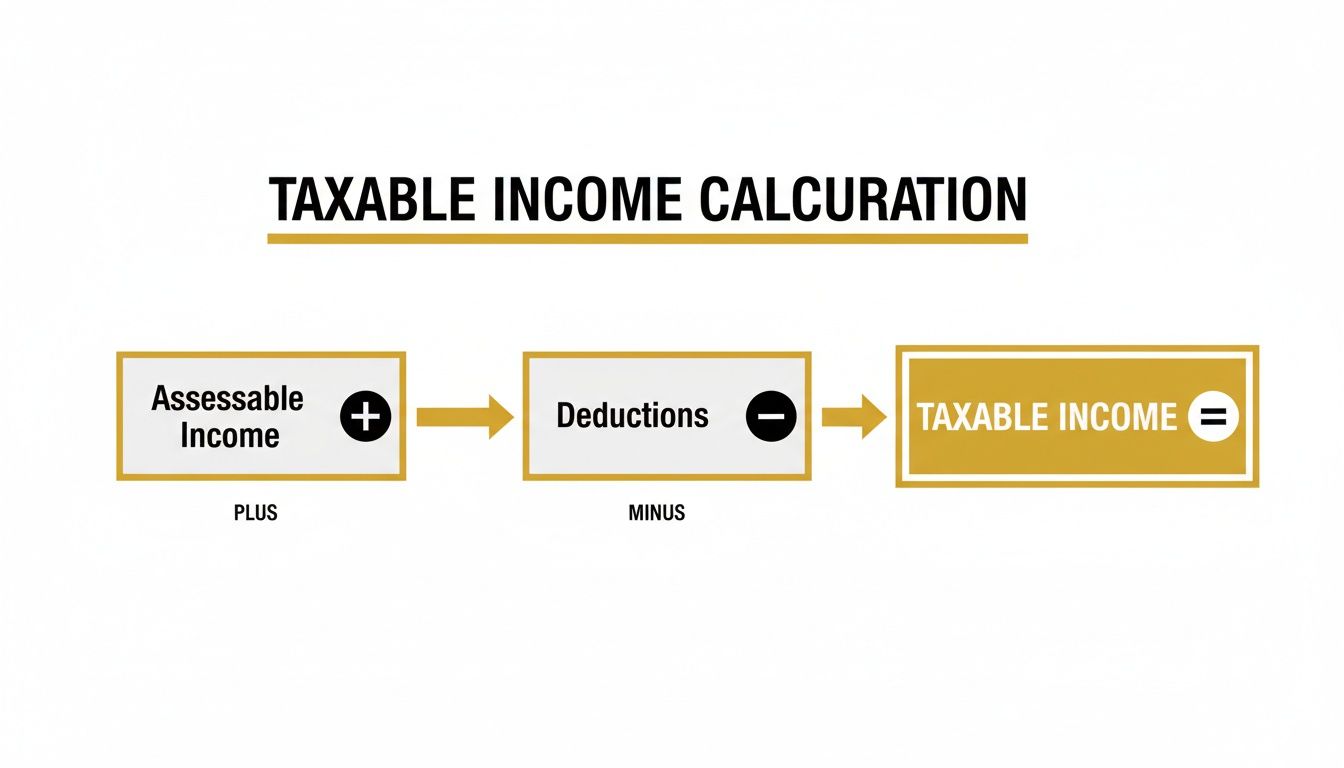
As you can see, you start with your total earnings and then chip away at it with any legitimate deductions. The ATO applies Australia’s progressive tax rates to this final figure. If you're curious, the ATO publishes detailed taxation statistics each year, offering a fascinating glimpse into how income is earned and taxed across the country.
Understanding this core formula isn’t just about compliance; it’s about putting yourself in the best possible position to maximise your tax refund.
The Core Components of Your Taxable Income
To really grasp how it all works, let's break down the two key parts of the taxable income equation. This table shows what goes into each component.
| Component | What It Means | Common Examples |
|---|---|---|
| Assessable Income | Pretty much all the income you receive. It's the starting point before any subtractions are made. | • Salary and wages • Business income • Investment dividends • Rental income • Some government payments |
| Allowable Deductions | These are the eligible expenses you paid to help you earn your assessable income. | • Work-related car expenses • Home office running costs • Tools and equipment for your job • Fees for managing an investment property |
Simply put, you tally up everything in the "Assessable Income" column and then subtract everything you can claim from the "Allowable Deductions" column. The result is what the tax man is interested in.
Decoding Your Assessable Income
Before we can get to your taxable income, we first need to get our heads around assessable income. Think of it as your gross earnings—the total amount of income the Australian Taxation Office (ATO) expects you to declare before you start subtracting any deductions.
It’s a common trap to think this is just the salary that lands in your bank account from your employer. The reality is that assessable income casts a much wider net, catching just about every dollar you earn from all your various income streams. It's the starting line for working out what’s actually taxable in Australia.

This total figure is incredibly important. Individual income tax has been the backbone of the federal government's revenue for decades, consistently pulling in about half of all tax receipts. ATO stats from 2022-23 really show how broad this tax base is, with over 572,136 people aged 70+ reporting a median taxable income of $43,941. You can dig deeper into Australia's tax revenue composition to see how these numbers fit into the bigger economic picture.
Common Sources of Assessable Income
So, what exactly does the ATO want you to include in your assessable income? It's a long list, but here are the usual suspects you absolutely need to report:
- Employment Income: This is the big one for most people. It covers your regular salary or wages, but also any bonuses, commissions, allowances, or overtime payments you get from your job.
- Business and Sole Trader Income: If you're running a business or freelancing in Sydney, you need to include all your gross earnings from selling goods or services—that’s the total revenue before you take out your expenses.
- Investment Returns: This is a broad category. It includes dividends from any shares you own, the interest earned from your savings accounts, and any distributions you receive from managed funds.
- Rental Property Income: For any property investor in Brisbane, the entire amount of rent your tenants pay you throughout the financial year is considered assessable income.
- Certain Government Payments: Not all government payments are tax-free. Some Centrelink payments and other government allowances are taxable and must be declared.
Forgetting to report any of these income sources can lead to some unwelcome attention and penalties from the ATO. That’s why getting your assessable income right is the most critical first step in nailing your tax return.
Finding Your Allowable Deductions
Now for the good part—the bit where you can legally and actively lower your tax bill. **Allowable deductions** are simply the eligible costs you've paid to earn your income. Think of them as the cost of doing business, even if that business is just being an employee.The Australian Taxation Office (ATO) has three non-negotiable rules for claiming any expense. If you can confidently answer "yes" to all three, you're usually on solid ground.
The Three Golden Rules of Deductions
Before you even think about claiming something, run it past this simple checklist. The expense must meet all these core ATO requirements:
- You must have spent the money yourself and weren't paid back for it by your boss or anyone else.
- The expense must directly relate to earning your income. There has to be a clear and logical link between the cost and your job or business activities.
- You must have a record to prove it. This is your evidence—usually a receipt, bank statement, or invoice.
Keeping good records isn’t just a suggestion; it's the foundation of maximising your claims. To make sure you’re not leaving money on the table, it's vital to learn how to properly organize receipts for taxes.
An allowable deduction isn't a dollar-for-dollar refund. It works by reducing your taxable income. For someone in the 32.5% tax bracket, every $100 they claim in deductions saves them $32.50 in tax.
The world of deductions is huge and really depends on your specific job and how you earn your money. For a much deeper dive into what you might be able to claim, check out our detailed guide on what expenses you can claim on tax.
Some of the most common types of deductions we see include:
- Work-Related Car Expenses: This covers using your personal car for work travel, but not your regular trip from home to the office.
- Home Office Expenses: If your job requires you to have a dedicated workspace at home, you can claim the costs of running it.
- Self-Education Expenses: Think course fees or training that is directly linked to improving your skills in your current role.
- Investment Property Costs: For landlords, this includes expenses like loan interest, council rates, and maintenance on a rental property.
Getting a firm grasp on every single deduction you're entitled to is the single most effective way to lower your what is taxable income australia figure and get a better result at tax time.
What Counts and What Does Not
Knowing exactly what money you need to tell the ATO about is half the battle at tax time. Getting your taxable income calculation right means drawing a clear line between what’s considered assessable income (the stuff you pay tax on) and what’s exempt (the stuff you don’t).
It’s a common trap to think only your regular salary counts. But the Australian Taxation Office (ATO) takes a much broader view. That annual bonus, the interest earned on your savings account, and even certain government payments like JobSeeker all need to go into the pot.
On the other hand, some types of money you receive are genuinely yours to keep, no tax attached.
The simplest rule of thumb is this: genuine gifts or one-off windfalls that have zero connection to your job or business are usually not considered assessable income. Think lottery wins or an inheritance from a relative.
Getting this distinction right is crucial. Declare exempt income by mistake, and you'll pay more tax than you need to. Forget to include something assessable, and you could be facing ATO penalties down the track. The goal is simple: report exactly what you’re required to, and nothing more.
Taxable vs Non-Taxable Income: A Quick Comparison
To make it crystal clear, this table gives you a straightforward comparison of common income types. Use it as a quick reference to help you sort your funds correctly when it's time to do your tax.
| What Is Usually Taxable (Assessable Income) | What Is Usually Not Taxable (Exempt Income) |
|---|---|
| • Your salary, wages, and work bonuses | • Genuine gifts or inheritance money |
| • Bank interest and investment dividends | • Lottery winnings and other prizes from gambling |
| • Income from a rental property | • Most child support and spousal maintenance payments |
| • Profits from running a business or sole trade | • The majority of government pensions and allowances |
| • Capital gains from selling assets like shares | • NDIS payments made to you or your provider |
Keep in mind that this is a general guide. If you have income from an unusual source, it's always best to double-check the specifics with the ATO or a tax professional to be sure.
Putting It All Together: A Practical Calculation
Theory is one thing, but seeing the numbers in action makes everything click. Let's walk through three different scenarios to show how the formula Taxable Income = Assessable Income – Allowable Deductions works in the real world for everyday Australians.
These examples use simplified figures to keep things crystal clear. You can apply the exact same logic to your own situation to get a better handle on where you stand.
Example 1: The PAYG Employee
Meet Sarah. She works a standard full-time office job, so her situation is nice and straightforward.
- Assessable Income: Her annual salary is $85,000.
- Allowable Deductions: She spent $1,500 on a new laptop she needs for work and kept a logbook for $500 in work-related car trips. Her total deductions are $2,000.
To get her taxable income, we just subtract her deductions from her income:
$85,000 (Assessable Income) – $2,000 (Allowable Deductions) = $83,000 (Taxable Income)
The ATO will now use that $83,000 figure to work out how much tax Sarah owes for the year. Simple.
Example 2: The Property Investor
Now, let's look at Ben. He owns a rental property, which adds a few more moving parts to his tax calculation.
Calculate Total Assessable Income:
- Salary from his main job: $100,000
- Gross rental income he received: $26,000
- Total Assessable Income: $100,000 + $26,000 = $126,000
Calculate Total Allowable Deductions:
- Interest on the investment loan: $18,000
- Real estate agent fees: $2,000
- Council rates and property repairs: $3,000
- Total Allowable Deductions: $18,000 + $2,000 + $3,000 = $23,000
Ben’s final taxable income calculation looks like this:
$126,000 (Assessable Income) – $23,000 (Allowable Deductions) = $103,000 (Taxable Income)
Example 3: The Sole Trader
Finally, there’s Chloe, a freelance graphic designer. As a sole trader, she needs to calculate her business profit first, which then becomes her income.
- Assessable Income: She invoiced her clients a total of $95,000. This is her gross business income.
- Allowable Deductions (Business Expenses): Her software subscriptions, home office costs, and other business-related expenses came to $20,000.
Her net business profit is $75,000 ($95,000 - $20,000). For tax purposes, this profit is her assessable income. Assuming Chloe has no other deductions to claim, her taxable income is $75,000.
As you can see, no matter how you earn your money, the core principle stays the same. If you want to dive deeper into the nuts and bolts, our guide on how to calculate taxable income in Australia has a comprehensive breakdown.
Frequently Asked Questions
Even with a clear formula, navigating the specifics of Australian tax law can bring up some tricky questions. Let's break down a few of the most common queries we get from clients about what counts as taxable income.
Is Superannuation Taxable Income?
This is a common point of confusion. The super contributions your employer makes on your behalf (under the Superannuation Guarantee) aren't typically counted as your personal assessable income.
Instead, those contributions are taxed at a concessional rate of 15% within the super fund itself. It’s a separate process.
However, the game changes when you decide to withdraw your super after reaching preservation age. At that point, parts of your payout might become taxable, depending on your age and the specific components of the withdrawal.
Are Gifts Considered Taxable Income?
In most situations, no. A genuine gift given out of pure generosity or family affection is not considered assessable income. You don't need to declare that birthday money from mum and dad to the ATO.
The key here is the nature of the "gift". If it's a one-off cash present from a relative, you're in the clear. But if that payment is actually for a service you provided or a product you sold, the ATO will see it for what it is—income.
What About Overseas Income?
If you are an Australian resident for tax purposes, the ATO wants to know about your worldwide income. This isn't just about what you earn on Aussie soil.
You must declare any salary, investment returns, or business profits you’ve earned overseas. This applies even if you've already paid tax on it in another country.
To prevent you from being taxed twice, you can often claim a foreign income tax offset. For anyone living a global lifestyle, understanding the broader tax implications of travel history is also vital for staying compliant. Your residency status is the linchpin here, so getting it right is non-negotiable.
The ATO provides guidance through ato.gov.au, the Small Business Support Line (13 28 66), and Online Services for individuals and businesses. For complex situations, a registered tax agent provides advice tailored to your specific circumstances and professional indemnity protection. You can verify agent registration at the TPB register at tpb.gov.au.
Most tax records must be kept for five years from the date of lodgement or the date the transaction occurred, whichever is later. Records must be in English or convertible to English and must be sufficient to explain the income and deductions in your return. The ATO can request records at any time during the retention period.
Consider a registered tax agent when your affairs involve multiple income sources, business activity, investment properties, capital gains, or overseas income. Agents extend your lodgement deadline, provide safe harbour protection, and take professional responsibility for the advice given. Verify registration at tpb.gov.au.
The failure to lodge penalty is based on penalty units ($313 per unit from 1 July 2023), accruing per 28-day period for late returns and BAS lodgements. Incorrect information penalties range from 25% to 75% of the tax shortfall depending on whether the behaviour was careless, reckless, or intentional. Proactive disclosure before an audit begins typically results in significantly reduced penalties.
Tax minimisation is the legal arrangement of your affairs to reduce tax — claiming all eligible deductions, using appropriate structures, and timing income and expenses. Tax avoidance involves arrangements that technically comply with the law but achieve outcomes parliament did not intend. The ATO can apply Part IVA anti-avoidance rules to cancel benefits from avoidance arrangements.
Feeling like you're drowning in tax rules? The team at Australia Wide Tax Solutions is here to throw you a life raft. We provide clear, expert advice to help you nail your taxable income calculation and get the best possible refund. Get in touch with us today for personalised tax assistance.
Finding yourself without your Tax File Number can be stressful, especially when tax time approaches. Don't worry – you're not alone, and there are several straightforward ways to retrieve your lost TFN. Here's your comprehensive guide to getting back on track.
- What is a Tax File Number?
- Quick Ways to Find Your Lost TFN
- How to Apply for a New TFN (If You Never Had One)
- What If You Can't Find Your TFN?
- Important Reminders
What is a Tax File Number?
Your Tax File Number (TFN) is a unique identifier issued by the Australian Taxation Office (ATO) that stays with you for life. It's essential for:
- Lodging tax returns
- Starting new employment
- Opening bank accounts
- Accessing government services
- Claiming tax-free thresholds
Quick Ways to Find Your Lost TFN
1. Check Your myGov Account
The fastest way to find your TFN is through your myGov account:
- Log in to myGov.gov.au
- Link to the ATO if not already connected
- Your TFN will be displayed on your ATO online services dashboard
- If you can't access myGov, you can recover your account using your email or mobile number
2. Look Through Your Documents
Your TFN appears on various documents you might have at home:
- Previous tax returns or notices of assessment
- Group certificates or payment summaries
- Bank account opening documents
- Superannuation statements
- Centrelink correspondence
3. Contact Your Employer or Previous Employers
Your current or former employers will have your TFN on file. Simply call their payroll or HR department and request it.
4. Check with Your Bank
If you provided your TFN when opening bank accounts, your bank can provide it to you upon request with proper identification.
How to Apply for a New TFN (If You Never Had One)
If you've never had a TFN, you'll need to apply for one:
Online Application
- Visit ato.gov.au
- Complete the online TFN application
- You'll need proof of identity documents
- Processing takes 10-28 days
Paper Application
- Download form NAT 1432 from the ATO website
- Complete and mail with certified copies of identity documents
- Processing takes longer than online applications
What If You Can't Find Your TFN?
Contact the ATO Directly
If other methods don't work:
- Call the ATO on 13 28 61
- Have your personal details ready for verification
- Have a document identification ready so they can verify you (NOA)
- The ATO can help you retrieve your existing TFN or issue a replacement
Visit an ATO Shopfront
For face-to-face assistance:
- Book an appointment at your nearest ATO office
- Bring photo identification
- ATO staff can help retrieve or reissue your TFN
Important Reminders
You Only Get One TFN for Life
- Your TFN never expires
- You don't need to renew it
- Keep it secure and confidential
Protect Your TFN
- Never share it unnecessarily
- Only provide it to authorised entities
- Report suspected misuse to the ATO immediately
Common Mistakes to Avoid
- Don't apply for multiple TFNs – you only need one
- Don't delay – start looking for your TFN as soon as you realise it's missing
- Don't panic – there are always solutions available
Professional Help Available
If you're struggling with tax-related issues beyond just finding your TFN, consider consulting with a qualified tax professional. At Australia Wide Tax Solutions, we help thousands of Australians navigate their tax obligations efficiently, ensuring you don't miss out on legitimate deductions due to simple oversights like incomplete yes/no boxes that can cost thousands.
Conclusion
Losing your TFN isn't the end of the world. With these methods, you should be able to retrieve it quickly and get back to managing your tax affairs. Remember, your TFN is for life, so once you find it, store it securely for future reference.
The key is acting promptly – whether you're checking your myGov account, contacting employers, or reaching out to the ATO directly, there's always a solution available. Please do not contact us unless you are our current client.
The ATO provides guidance through ato.gov.au, the Small Business Support Line (13 28 66), and Online Services for individuals and businesses. For complex situations, a registered tax agent provides advice tailored to your specific circumstances and professional indemnity protection. You can verify agent registration at the TPB register at tpb.gov.au.
Most tax records must be kept for five years from the date of lodgement or the date the transaction occurred, whichever is later. Records must be in English or convertible to English and must be sufficient to explain the income and deductions in your return. The ATO can request records at any time during the retention period.
Consider a registered tax agent when your affairs involve multiple income sources, business activity, investment properties, capital gains, or overseas income. Agents extend your lodgement deadline, provide safe harbour protection, and take professional responsibility for the advice given. Verify registration at tpb.gov.au.
The failure to lodge penalty is based on penalty units ($313 per unit from 1 July 2023), accruing per 28-day period for late returns and BAS lodgements. Incorrect information penalties range from 25% to 75% of the tax shortfall depending on whether the behaviour was careless, reckless, or intentional. Proactive disclosure before an audit begins typically results in significantly reduced penalties.
Tax minimisation is the legal arrangement of your affairs to reduce tax — claiming all eligible deductions, using appropriate structures, and timing income and expenses. Tax avoidance involves arrangements that technically comply with the law but achieve outcomes parliament did not intend. The ATO can apply Part IVA anti-avoidance rules to cancel benefits from avoidance arrangements.
Navigating Deceased Estates Australia:
A Comprehensive Guide
Deceased Estates Australia
Losing a loved one is an incredibly difficult and emotional time. On top of the grief, there are often complex legal and financial matters that need to be addressed when it comes to their estate.
- Navigating Deceased Estates Australia:
- A Comprehensive Guide
- What Happens if There is No Will?
- Applying for a Tax File Number for the Deceased Estate Australia
- The Administration Process for a Deceased Estate
Whether or not they left behind a will, managing a deceased estate can be daunting and overwhelming for those left behind.
With Deceased Estates Australia, we'll explain what happens if there is no will, how to apply for a tax file number for the estate, the administration process, and what to do if assets need to be sold.
By the end, you'll better understand the steps involved in handling a deceased estate in Australia so you can navigate this challenging time with more confidence.
What Happens if There is No Will?
When someone passes away without leaving a valid will, they are considered to have died "intestate." This means their estate will be distributed according to the intestacy laws in the state or territory where they lived rather than according to their own wishes.
The intestacy laws vary across Australia, but generally, they dictate that the deceased's assets will be distributed in the following order:
- Spouse (including a de facto partner) - they will receive the entire estate.
- Children - if no spouse exists, the children will receive the entire estate in equal shares.
- Parents - if there are no children, the estate goes to the deceased's parents.
- Siblings - if there are no parents, the estate is divided among the deceased's siblings.
- Other next of kin - if there are no siblings, the estate goes to other more distant relatives like nieces, nephews, grandparents, etc.
Without surviving relatives, the entire estate will go to the state or territory government.
It's important to note that the definition of "spouse" can sometimes include a de facto partner, same-sex partner, or multiple partners. The intestacy laws aim to distribute the estate in a way that reflects the deceased's likely wishes, but this may not always align with their actual preferences.
Without a will, administering the estate can be more complicated and time-consuming. You need to make an application to the Supreme Court for a grant of letters of administration, which gives you the legal authority to manage the estate. This person is usually the closest living relative.
Overall, having a valid will makes distributing a deceased person's assets much smoother and ensures that you honour their final wishes. If you do not have a will, intestacy laws will determine how you handle the estate, which may not align with what the deceased would have wanted.
Applying for a Tax File Number for the Deceased Estate Australia
One of the first steps in managing a deceased estate is to obtain a tax file number (TFN) for the estate itself. This is necessary for the estate to be able to carry out various tax-related activities, such as:
- Filing tax returns for the deceased person's final year
- Reporting income earned by the estate
- Paying any taxes owed by the estate
- Distributing income to beneficiaries
To apply for a TFN for a deceased estate, complete the "Application for a Tax File Number for a Deceased Estate" form, which you can find on the Australian Taxation Office (ATO) website.
The form requires the following information:
- Details of the deceased person, including their full name, date of birth, date of death, and last residential address
- Details of the person applying for the TFN, including their full name, address, phone number, and relationship to the deceased
- A copy of the death certificate
- Proof of the applicant's identity, such as a driver's license or passport
- Details of the executor or administrator of the estate, if applicable
Once you complete the form and gather all required documents, submit it to the ATO either online, by mail, or in person at an ATO shopfront.
The ATO will then process the application and issue a TFN for the deceased estate. You will use this TFN for all tax-related activities and reporting for the estate going forward.
Obtain the TFN as soon as possible, as you cannot complete many of the next steps in administering the estate, such as filing the final tax return, without it. If you fail to apply for a TFN promptly, you can cause delays and complications in the estate administration.
The Administration Process for a Deceased Estate
Once you obtain a TFN and determine whether there is a valid will, you can begin the process of administering the deceased estate. This involves several key steps:
- Locate the will and identify the executor: If there is a will, the first step is to locate it and identify the executor. The executor manages and distributes the deceased's assets according to the will's instructions.
- Apply for a grant of probate: If there is a will, the executor must apply for a grant of probate from the Supreme Court. This legal document confirms the executor's authority to administer the estate.
- Identify and value the assets: The executor or administrator must compile a comprehensive list of all the deceased's assets, including real estate, bank accounts, investments, personal possessions, and any outstanding debts or liabilities.
- Notify relevant parties: The executor or administrator must notify various parties of the death, such as banks, insurance companies, government agencies, and any creditors or debtors.
- Manage the estate's finances: This includes closing accounts, transferring ownership of assets, paying outstanding debts and taxes, and opening a bank account for the estate.
- Distribute the assets: Once you pay all debts and taxes, distribute the remaining assets to the beneficiaries named in the will or according to the intestacy laws if there is no will..
- File the final tax return: The executor or administrator is responsible for filing the deceased's final tax return and any tax returns for the estate itself.
- Provide a final accounting: Finally, the executor or administrator must provide a detailed accounting of how they managed and distributed the estate to the beneficiaries.
The entire administration process can take several months to a year or more. To ensure you handle the estate properly, you must be diligent in fulfilling your duties and seek professional advice when needed.
Failure to follow the correct procedures or mismanagement of the estate can result in legal issues and disputes among beneficiaries.
Therefore, the executor or administrator must understand their responsibilities and seek help from experts, such as lawyers, accountants, and financial advisors, throughout the process.
Selling Assets of the Deceased Estate
In some cases, selling assets from the deceased estate may be necessary to pay outstanding debts, cover administration costs, or distribute the remaining assets to beneficiaries.
This can be a complex process, so it's important to understand the steps involved.
- Identify assets that need to be sold: The executor or administrator should review the estate's assets and determine which ones to sell. These may include real estate, vehicles, investments, or personal possessions.
- Obtain valuations: Before selling any assets, the executor or administrator should obtain professional valuations to ensure they sell the assets for a fair price. This may involve hiring real estate agents, auctioneers, or other experts.
- Obtain necessary approvals: Depending on the type of asset, the executor or administrator may need approval from the court or the beneficiaries before selling. For example, the sale of real estate often requires court approval.
- Market and sell the assets: Once the necessary approvals are in place, the executor or administrator can begin marketing and selling the assets. This may involve listing properties for sale, holding auctions, or negotiating private sales.
- Distribute the proceeds: Use any funds from the sale of assets to pay outstanding debts and administration costs first. Then, distribute any remaining funds to the beneficiaries according to the terms of the will or the intestacy laws..
It's important to note that selling assets from a deceased estate can have tax implications, such as capital gains tax. The executor or administrator should consult with a tax professional to ensure they understand and comply with all relevant tax laws and regulations.
Additionally, the sale of certain assets, such as the deceased's primary residence, may be subject to specific rules and exemptions. The executor or administrator should seek legal advice to ensure they are handling the sale of assets correctly and protecting the interests of the beneficiaries.
Overall, selling assets from a deceased estate can be a complex and sensitive process. By working closely with professionals and following the proper procedures, the executor or administrator ensures that they sell the assets fairly and transparently and distribute the proceeds appropriately
Conclusion
Navigating the process of a deceased estate in Australia can be a daunting and emotional experience. However, it is important to understand the key steps involved, including what happens if there is no will and how to apply for a tax file number. Through the administration process and the sale of assets, you can better prepare yourself and your loved ones for this challenging time.
Remember, it is important to seek professional advice from lawyers, accountants, and financial advisors throughout the process to ensure that you handle the estate correctly and honour the deceased's wishes. With the proper guidance and support, you can successfully manage a deceased estate and provide closure for your family.
If you have any further questions or need assistance with a deceased estate, don't hesitate to reach out to the relevant authorities or seek professional help. By being informed and proactive, you can navigate this process with greater confidence and ease.
Estate planning ensures assets are distributed according to your wishes, minimises disputes among beneficiaries, and can reduce the tax and administrative burden on your estate. Without a valid Will, your estate is distributed under intestacy laws that may not reflect your intentions. A complete plan also addresses superannuation, powers of attorney, and advance care directives.
No. Superannuation is not automatically an estate asset and does not pass according to your Will. Your super fund trustee decides who receives the death benefit, guided by any binding death benefit nomination you have made. Without a valid binding nomination, the trustee has discretion to pay your legal personal representative or directly to a dependant.
Australia has no inheritance tax or estate duty. However, selling inherited assets can trigger CGT. The cost base of inherited assets is generally the market value at the date of death, and the 50% CGT discount applies if the beneficiary holds the asset for more than 12 months. Pre-CGT assets (acquired before 20 September 1985) have special rules.
Probate is a court order confirming a Will is valid and authorising the executor to administer the estate. It is generally required for estates that include real property, or when financial institutions require legal authority before releasing assets. Smaller estates where assets are held jointly may not require probate. The process is handled through the Supreme Court of the relevant state.
Review your Will after any major life event: marriage (which automatically revokes most Wills), divorce, birth of children, significant changes in financial position, or a beneficiary or executor dying. As a general rule, review every three to five years even without a triggering event to ensure it remains current.