
It's payroll day. You've just processed wages the same way you have for years — hours in, tax out, money hits the account, super gets sorted at the end of the quarter like it always has. Except from 1 July 2026, that last part is no longer true. Super now has to move on the same day as wages, not whenever it's convenient before the quarterly deadline. If your payroll process hasn't changed to match, you're already behind.
This is Payday Super, and it's not a minor tweak to how superannuation gets reported. It changes the mechanics of every single pay run.
**Key takeaways**
- Super Guarantee contributions must now reach an employee's fund within 7 business days of payday, not quarterly.
- The Small Business Super Clearing House has closed permanently — there's no fallback to the old free tool.
- Missed payments trigger automatic penalties from day eight, with far less room for "we'll catch it up next quarter."
- The rate is still 12%, but the timing discipline required is completely different.
## What Payday Super Actually Changes
For as long as most business owners have been running payroll, superannuation worked on a lag. Pay your staff each week or fortnight, then square up the Super Guarantee (SG) contributions by the 28th day after each quarter ends. Plenty of businesses treated that quarterly deadline as a cash flow buffer — a bill that could wait a little longer than wages.
That buffer is gone. From 1 July 2026, employers have to pay SG contributions at the same time as salary and wages, and those contributions need to land in the employee's nominated fund within seven business days of payday. Miss that window and you're not "a bit behind on paperwork" — you're technically in breach from day eight.
### The Small Business Super Clearing House is closed
If your business used the ATO's free Small Business Super Clearing House to distribute contributions across multiple employee funds, that option no longer exists. The SBSCH shut permanently on 1 July 2026. You now need a payroll system or commercial clearing house that can process super in the same cycle as wages — not a once-a-quarter batch job.
For businesses that were quietly relying on the SBSCH as their entire super process, this is the part that catches people off guard. It's not just a timing change. It's a systems change.
## How the New Timing Actually Works
Super is still calculated at 12% of ordinary time earnings (OTE) — that part hasn't moved. What's changed is the clock. The moment you pay wages, a seven-business-day countdown starts for the matching super contribution to actually arrive in the employee's fund, not just be initiated on your end.
That distinction matters. "I sent it" and "it landed" are different things once processing delays, fund details, or clearing house timing get involved. If you're used to setting super payments in motion a day or two before you think you need to, that habit needs tightening. Reporting runs through Single Touch Payroll, so the ATO has visibility into whether contributions are actually keeping pace with wages — not just whether you say they are.
**Why this matters:** the old system tolerated a slow quarter here and there because the penalty structure assumed occasional lateness. The new one assumes contributions move as routinely as wages do, and it's built to notice immediately when they don't.
Picture a fortnightly pay run on a Thursday. Under the old rules, that fortnight's super simply joined a running quarterly total, due weeks or months later. Under Payday Super, the seven-business-day clock starts that same Thursday. By the following Wednesday of the next week, the contribution needs to have actually reached the employee's fund — not just been submitted through your software. Multiply that by every pay run, every fortnight, all year, and it's easy to see why "set and forget" payroll habits don't survive the transition.
## The Penalties You Can't Talk Your Way Out Of
This is the part worth taking seriously. Under the old quarterly system, missing a payment could trigger a Superannuation Guarantee Charge of up to 200% in the worst cases — painful, but there was usually time and process involved before it got there.
Under Payday Super, penalties start automatically from day eight, with no built-in discretion for a minor delay. Depending on your compliance history, penalties can reach 25% to 50% of the unpaid SG amount. If the shortfall is still unpaid 28 days after the ATO issues a notice, an additional penalty of 25% (or 50% for businesses with a pattern of non-compliance) can apply on top.
There is some breathing room built into the first year. Under PCG 2026/1, the ATO has said it will take a risk-based approach between 1 July 2026 and 30 June 2027 — employers who genuinely try to pay on time and fix errors quickly won't be a compliance priority. That's a grace period, not a pass. It rewards businesses that are visibly making an effort, not ones that ignore the change and hope it blows over.
## Does This Apply to Every Business?
Yes. Payday Super applies to all employers, regardless of size. There's no small business carve-out and no phase-in based on headcount. If you have even one employee on the books, the same seven-business-day rule and the same penalty structure apply to you as they do to a business with fifty staff.
That's a change in itself. Plenty of compliance measures over the years have given small operators extra time or lighter obligations. This one didn't. A sole trader with one part-time employee has exactly the same clock running as a larger payroll team — just with fewer people to catch a missed payment before it becomes a problem.
## What This Actually Means for Your Payroll Process
The practical shift is this: super can no longer be an admin task you get to eventually. It has to be built into the same process as running wages, every single pay cycle.
A few things worth checking now, not in September:
- **Confirm your payroll software or clearing house can process super on-cycle.** If you were using the SBSCH, you need a replacement sorted already — not mid-crisis after a missed payday.
- **Check your cash flow timing.** Super leaving your account weekly or fortnightly instead of quarterly changes how money moves through the business. Build that into your forecasting now.
- **Tighten your OTE calculations.** Getting the earnings base wrong is a much bigger problem when it happens every pay run instead of every quarter.
- **Don't assume "processed" means "received."** Confirm contributions are actually landing within the seven-business-day window, not just leaving your account on time.
Where businesses tend to get caught out isn't malice — it's inertia. The old quarterly rhythm is muscle memory, and muscle memory is exactly what needs to change here.
## Getting Payday Super Right From the Start
Payday Super isn't complicated in concept — pay super when you pay wages. Where it gets difficult is in the mechanics: making sure your systems, your cash flow, and your record-keeping can actually support that rhythm without a slip every few pay runs.
If your payroll setup was built around the old quarterly cycle, or you're not confident your current process would survive the seven-business-day test, now is the time to check — not after a penalty notice arrives. Australia Wide Tax Solutions works with small business owners on payroll and BAS compliance and can review whether your current systems are actually ready for Payday Super. [Book an appointment] and we'll walk through it with you before it becomes a problem.
A Practical Guide to Tax Savings Ever heard of salary sacrificing? It's a clever (and completely legal) way to pay for certain things straight from your paycheque before the taxman takes his cut. In short, it’s a formal deal you make with your employer to get some of your salary as benefits instead of cash. The big win? It can lower your taxable income, which often means paying less tax.What Is Salary Sacrificing and How Does It Work?
Let's break it down. Picture your total salary as a pie. Normally, the Australian Taxation Office (ATO) comes along and takes its slice before you get what's left. Salary sacrificing—sometimes called salary packaging—lets you earmark a piece of that pie for specific, approved benefits before the ATO figures out your tax. Because you’ve set that piece aside, the pie the ATO looks at is now smaller. A smaller pie means a smaller tax slice. You still get the full value of what you earned, but part of it shows up as a benefit—like extra superannuation contributions or a novated car lease—instead of just cash in the bank. At its core, it’s a simple idea: you're turning taxable cash into a tax-effective benefit. By reducing your income on paper, you could drop into a lower tax bracket, keeping more of your hard-earned money in your pocket.A Simple Before-and-After Example
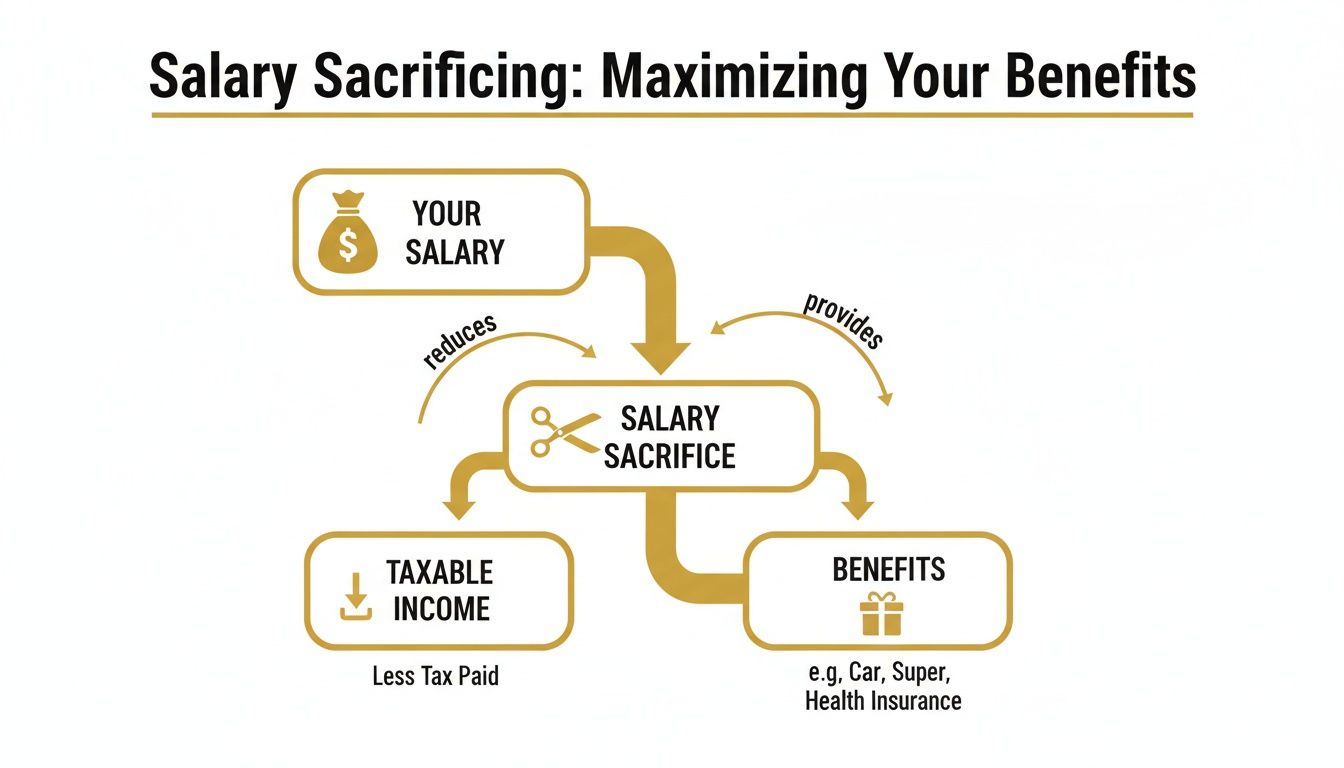
Say you earn an annual salary of $90,000. Without any arrangements, you’d be taxed on that full amount. Now, imagine you decide to salary sacrifice $10,000 directly into your super fund. Just like that, your taxable income drops to $80,000. You'll only pay income tax on this lower figure, leading to some serious savings over the financial year, all while giving your retirement nest egg a healthy boost.Key Takeaway: This isn't something you can do on a whim. The arrangement has to be locked in with your employer before you've actually earned the income. You can't sacrifice money that's already landed in your bank account.This flowchart gives you a quick visual of how it all works.
Supercharge Your Retirement with Superannuation Contributions

Staying Within The Limits
To get the most out of this strategy, you need to play by the rules. The government sets annual limits on how much you can contribute this way. Your salary sacrificed contributions, along with your employer’s mandatory Superannuation Guarantee payments, all count towards your concessional contributions cap. Go over this cap, and you could face extra tax, completely wiping out the benefits you were aiming for. It’s a simple but absolutely vital rule to follow. For a deeper dive on how these caps work, you can check out our detailed guide on the Concessional Contributions Cap.A Critical Check To Make
Before you jump in, there’s one crucial conversation you must have with your employer.Your employer must continue to pay their Superannuation Guarantee (SG) contributions based on your ordinary salary before the sacrificed amount is deducted. An arrangement should not reduce the SG you’re entitled to.Make sure this is crystal clear in your salary sacrifice agreement. Get into the habit of checking your payslips and super statements to confirm you’re still receiving your full, legally required super payments on top of your own voluntary contributions. For our friends across the ditch in New Zealand looking to boost their own retirement funds, understanding things like KiwiSaver employer contributions can offer some valuable parallels.
Driving Down Your Tax with a Novated Car Lease

How a Novated Lease Simplifies Car Ownership
One of the biggest draws of a novated lease is just how simple it makes everything. All your major car expenses are bundled into one single, predictable deduction from your payroll. The big win? Because it’s coming from your pre-tax salary, you often end up paying less overall. Your bundled payments can cover a whole range of costs:- The lease payments for the car itself
- Fuel or electricity costs
- Comprehensive insurance
- Registration and CTP (Compulsory Third Party)
- Scheduled servicing and maintenance
- Even tyre replacements
This "all-in-one" approach makes budgeting a breeze and gets rid of the headache of juggling multiple bills. On top of that, you get the benefit of GST savings on the car’s purchase price and on its running costs.Managing these expenses is often made even easier with a fuel card, which usually comes as part of the package. It's worth understanding what a fuel card is and how it helps you track all your vehicle-related spending without fuss. Essentially, you get access to fleet discounts when buying the car and get to pay for almost everything else with untaxed money. If you're weighing up your options, taking a look at which motor vehicle expenses the ATO allows can give you a much clearer picture of the potential savings.
Exploring Other Common Fringe Benefits

Common Items You Can Package
So, what else is on the menu? Many employers allow you to package items that are essential for your job, like laptops and mobile phones, particularly if they are used primarily for work. This is a fantastic way to fund necessary tech upgrades without feeling the full pinch in your post-tax paycheque. Beyond the tools of the trade, some policies extend to your personal and family life. You might find you can salary sacrifice expenses such as:- Self-education fees that are directly related to your current role.
- Professional memberships and industry journal subscriptions.
- Financial advice from a qualified professional.
- Childcare centre fees (this is a big one for eligible employees).
It’s crucial to know that providing these benefits can trigger Fringe Benefits Tax (FBT) for your employer. Understanding what FBT is and how it works is essential, as it heavily influences which benefits a company is willing to put on the table for its staff.To give you a clearer picture, the table below breaks down some of the most common fringe benefits you might come across.
Common Salary Sacrifice Items at a Glance
This table offers a quick summary of the items you can often package, how they work, and who they’re best suited for.| Benefit Item | How It Works (Pre-tax) | Key Tax Consideration | Best Suited For |
|---|---|---|---|
| Laptop/Portable Device | The cost of a work-related laptop is deducted from your pre-tax salary. | Generally FBT-exempt if the device is primarily used for work. Limit of one per FBT year. | Professionals who need up-to-date technology for their job. |
| Mobile Phone | Your phone plan or the cost of the handset can be paid from pre-tax income. | Also typically FBT-exempt if used mainly for work purposes. | Anyone who relies on their mobile for work calls and communication. |
| Professional Memberships | Annual fees for industry associations are paid directly from your salary. | Usually deductible and FBT-exempt as a work-related expense. | Individuals in industries requiring professional accreditation. |
What You Need to Know Before You Start
Jumping into a salary sacrifice arrangement can be a fantastic financial move, but it really pays to understand the rules of the road first. The single most important rule is all about timing: the arrangement must be formally documented with your employer before you’ve earned the income you intend to sacrifice. You simply can't package money that has already been paid to you. Beyond this golden rule, it's vital to see the bigger picture. Lowering your taxable income might sound great on the surface, but it can have flow-on effects on other parts of your financial life.This is because many government calculations don't just look at your taxable income. Instead, they use your 'adjusted taxable income', which adds back any sacrificed amounts.This adjusted figure is the one that really counts when assessing things like:
- Your HELP debt repayment obligations
- Child support payments
- Eligibility for certain Centrelink or family assistance benefits
Understanding the Full Financial Impact
Even with economic pressures, salary sacrifice plans are holding strong. Recent survey data shows a massive 81% of Australian employees would consider salary sacrificing if offered, with the top priorities being mortgage help (37%) and boosting their super contributions (24%). You can explore more about these trends and what drives employee decisions in this insightful report from Computershare. This popularity highlights just how important it is to make an informed choice. Before you commit, take the time to dig into your employment contract to get clear on your company's specific policies. Because everyone's situation is unique, getting professional financial advice is one of the smartest steps you can take. A good financial advisor can help you properly weigh the tax benefits against any potential impacts, making sure your salary sacrifice strategy truly works for you and supports your long-term goals—without any unwelcome surprises down the line.Common Questions About Salary Sacrificing
Getting into the nitty-gritty of salary sacrificing often brings up a few common questions. Let's tackle some of the most frequent queries to give you a clearer picture of how it all works in practice and what it means for your finances.Can Salary Sacrificing Lower My Employer's Super Payments?
This is a big one. Legally, your employer has to pay the Superannuation Guarantee (SG) on your ordinary time earnings (OTE). The catch? Some employers might calculate this on your reduced cash salary after you've sacrificed a portion. It's absolutely vital to get this clarified in your agreement to make sure your mandatory super contributions aren't accidentally cut.What Happens If I Change Jobs?
Think of your salary sacrifice arrangement as being tied directly to your current employer. The moment you leave, that agreement ends. You'll need to start from scratch and negotiate a brand new arrangement with your new employer, and there's no guarantee their policies or the benefits on offer will be the same.Salary sacrificing really shines thanks to Australia's progressive tax rates, which is why higher earners often see the biggest benefits. For someone on $90,000 a year, sacrificing $5,000 into super means they avoid a 37% tax hit on that amount, saving them a cool $1,100. Compare that to someone earning $50,000 with a 32.5% marginal rate, who would only save $875. You can find more detail on how income levels affect super contribution tax savings on moneymanagement.com.au.
Are There Limits on How Much I Can Salary Sacrifice?
While there isn't a single, overarching limit on the total amount you can package, there are definitely caps on specific benefits. The most common one is the annual limit on concessional superannuation contributions. If you go over these caps, you can get hit with extra tax, so it's crucial to keep a running tally of your contributions throughout the financial year.Can I Package My Mortgage or Rent Payments?
For most people, the answer is no. Mortgage and rent are considered private expenses and can't be salary sacrificed. However, there’s a major exception for people working for certain tax-exempt organisations, like public benevolent institutions (PBIs) and public hospitals. Thanks to special Fringe Benefits Tax (FBT) concessions, eligible employees in these sectors can often package these living costs, which is a massive financial advantage. Always double-check your eligibility based on where you work.Ready to make your salary work smarter for you and lock in every possible deduction? The expert team at Australia Wide Tax Solutions can give you personalised advice to structure your finances for the best possible outcome. Contact us today to maximise your tax position.
Yes, if you are under 75 and meet the work test (if aged 67–74). Lodge a notice of intent to claim with your fund before the earlier of the tax return due date or the lodgement date. Once the fund acknowledges the notice, the contribution becomes concessional and is taxed at 15% inside the fund.
The concessional contributions cap for 2025-26 is $30,000. This covers employer SG contributions, salary sacrifice, and personal deductible contributions combined. Contributions above the cap are included in assessable income at your marginal rate, with a 15% tax offset for the tax already paid inside the fund.
The Super Guarantee rate for 2025-26 is 11.5%, rising to 12% from 1 July 2025. Employers must contribute this percentage of each eligible employee's ordinary time earnings to a complying super fund at least quarterly. Late or missing payments trigger the Super Guarantee Charge, which includes interest and is not tax deductible.
Salary sacrifice contributions come from pre-tax income and are taxed at 15% inside super rather than at your marginal rate (up to 47%). The difference is your tax saving. A taxpayer in the 37% bracket saves 22 cents per dollar sacrificed, subject to the $30,000 concessional cap.
Yes, if your total super balance was below $500,000 on 30 June of the prior year. Unused cap amounts from the previous five years can be carried forward and used in a higher-income year. The oldest unused amounts are applied first, allowing catch-up contributions that significantly reduce tax for eligible individuals.