
Unlocking Your Maximum Tax Refund

Why Correct Claims Matter
Because teachers consistently have a high volume of work-related claims, the profession is often on the ATO's radar. In the 2023-24 financial year, around 7.3 million taxpayers claimed work-related deductions averaging $2,008 each, and the ATO has already flagged teaching as a key focus area for 2025. This puts extra pressure on getting your claims right. You can learn more about the ATO's focus on teacher expenses from Dolman Bateman. This guide is built to give you the knowledge to do just that—demystify the process, clarify what you can claim, and show you how to do it properly. By the end, you’ll be ready to tackle tax time with confidence.A tax deduction is simply a recognised expense that lowers your assessable income. For every dollar you claim correctly, you reduce the amount of tax you have to pay, putting more money back into your bank account.To give you a head start, here’s a quick snapshot of the most common deductions available to teachers. This table provides a scannable preview of what's possible when it comes to maximising your tax return.
Common Teacher Tax Deductions at a Glance
| Deduction Category | Examples | Key Consideration |
|---|---|---|
| Car and Travel Expenses | Driving between schools, attending excursions or parent-teacher nights, public transport costs. | You can't claim normal home-to-work travel, but trips during the workday are usually deductible. |
| Home Office Expenses | Internet, phone, electricity for work-related tasks, portion of rent or mortgage interest (if eligible). | Must have a dedicated workspace and keep detailed records of hours worked from home. |
| Self-Education | Course fees, textbooks, stationery, and travel for professional development related to your current role. | The study must be directly linked to improving skills in your current teaching position. |
| Teaching Aids & Supplies | Stationery, art supplies, books, stickers, prizes, and other materials you buy for the classroom. | You need receipts for these purchases, and you can only claim the work-related portion. |
| Union & Professional Fees | Annual union fees, registration with teacher's boards, and subscriptions to professional journals. | These are generally 100% deductible as they are a direct cost of your employment. |
A Complete Checklist of Teacher Deductions

Classroom and Teaching Aids
This is a big one for most educators. Let's be honest, you're constantly dipping into your own pocket for things to make your classroom a better place for your students. The good news is, you can claim it back.- Stationery and Supplies: Think about all those pens, markers, whiteboard cleaners, stickers, prizes, and posters. Every little bit counts.
- Textbooks and Educational Games: Any books, learning aids, or even digital subscriptions you use for lesson planning or directly with students are claimable.
- Art and Craft Materials: Glitter, paint, cardboard, and all those other bits and pieces for creative projects are classic teacher tax write-offs.
Professional Development and Subscriptions
Investing in your own growth as a teacher is essential, and thankfully, the ATO agrees. Any costs tied to maintaining and sharpening your skills in your current role are deductible. This includes things like:- Union and Professional Association Fees: Your annual fees for teacher registration or union membership are 100% deductible. No grey area here.
- Self-Education Courses: If a course is directly linked to your current teaching job—like getting a first aid certificate or the disabled certification—you can claim the cost.
- Subscriptions: Subscriptions to academic journals, educational magazines, or teacher-specific resource websites are all on the list.
Just remember the golden rule for self-education: the expense must relate directly to your current job. You generally can't claim a TAFE course that's designed to help you switch careers or open up a new line of work.
Work From Home Expenses
Lesson planning, marking assignments, and communicating with parents rarely fit neatly between the school bells. Since so much of that work happens at home, you can claim a portion of your home running costs. This is one of the most common—and often under-claimed—teacher tax write-offs. Common work-from-home claims include:- Phone and Internet Bills: You can claim the work-related percentage of your monthly bills. A logbook or diary notes can help you establish a reasonable percentage.
- Computer and Equipment Depreciation: The value of your personal laptop, printer, or even the desk and chair you use for work declines over time. You can claim that depreciation.
- Electricity and Gas: A portion of your utility bills that covers heating, cooling, and lighting for your home office space is also claimable.
Vehicle and Travel Expenses
This is a point of confusion for many, but it's simple once you know the rule. Your daily drive from home to your main school isn't claimable—that's considered a private expense. However, any other work-related travel you do during the day is fair game. This could be:- Driving between different school campuses if you work at multiple sites.
- Transporting students to an excursion, sports carnival, or another event.
- Attending a conference, seminar, or training day at a location that isn't your usual school.
- Trips to the post office or stationery shop to pick up school supplies.
Protective Items and Uniforms
Finally, don't forget about items that either protect you while you're on the job or are part of a compulsory school uniform. For teachers, this often includes things like claiming sunscreen and a hat for playground duty, a lab coat if you're a science teacher, or any specific shirts or jackets with the school logo that you're required to wear.The Three Golden Rules for Claiming Expenses
Trying to figure out teacher tax write-offs can feel like navigating a maze, but it all boils down to three core principles the ATO lives by. Once you get your head around these "golden rules," you'll have a simple but powerful framework to size up any potential claim. Think of them as the essential checklist every single expense must pass before you can even think about putting it on your tax return. Getting these right is the difference between guessing what you can claim and knowing what’s a legitimate deduction.Rule 1: You Must Have Paid for It
This one’s the most straightforward: you have to be the one who actually spent the money, and you can't have been paid back for it by your school or employer. If the school reimbursed you for those art supplies or that first aid course, you can’t claim it. Simple as that. A tax deduction is meant to offset a cost you personally shouldered to do your job. Claiming something you were already paid back for is what the ATO calls "double-dipping," and they take a very dim view of it.Rule 2: It Must Directly Relate to Your Job
This is the big one. The expense must be directly connected to earning your income as a teacher. It’s like buying ingredients for a recipe—if you’re baking a cake, you can claim the flour and sugar, but you can’t claim the steak you bought for a completely different meal. For example, a subscription to an educational resource website is a clear yes. On the other hand, the cost of a general interest magazine you flick through in the staffroom is a no, even if you read it at work. The link has to be direct and obvious.The question you always need to ask is: "Did this purchase have a direct role in helping me do my job as a teacher?" If the answer is a confident yes, you've cleared the second golden rule.
Rule 3: You Must Have a Record to Prove It
The final rule is all about proof. You absolutely must have a record to back up your claim, whether that’s a receipt, an invoice, or a clear bank statement. Without that evidence, even the most legitimate expense can be thrown out if the ATO decides to take a closer look at your return.- If your total work-related claims add up to more than $300, you need detailed records for everything. No exceptions.
- For small expenses under $10 each where getting a receipt is tough (like a parking meter), you can keep a diary note instead.
How to Calculate Your Claims Correctly
Knowing which teacher tax write-offs you can claim is half the battle. The other half—and where things can get tricky—is knowing how to calculate them accurately. Let’s make the numbers less intimidating by breaking down the two most common areas for educators: your home office and your car. Getting these calculations right is crucial. It ensures you claim every dollar you're entitled to without raising any red flags with the Australian Taxation Office (ATO). Each method has its pros and cons, and the best choice often comes down to your specific work habits and how you like to keep records. Before we dive in, let’s remember the three golden rules. Every single expense has to pass these three simple checks before you can even think about claiming it.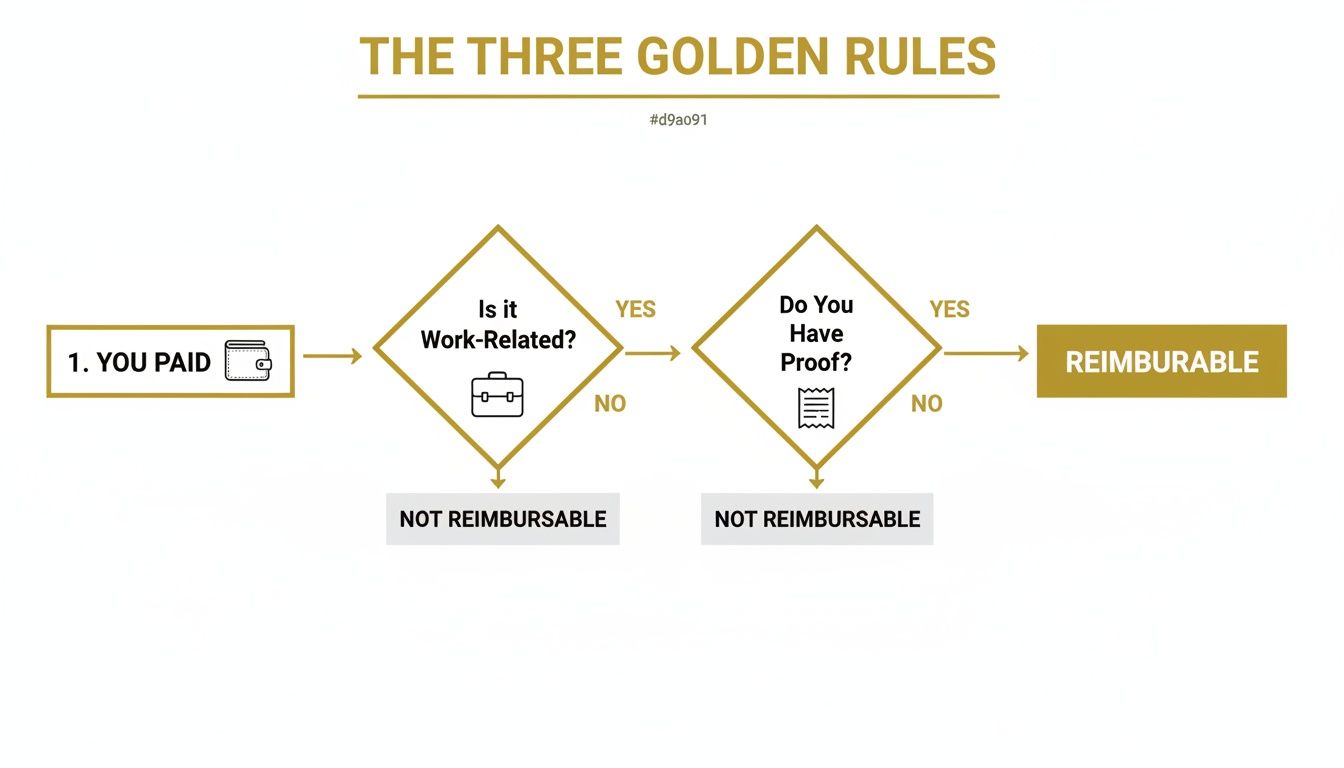
Calculating Home Office Expenses
When it comes to claiming the costs of working from home—whether it’s lesson planning, marking, or parent-teacher calls—the ATO gives you two ways to do the maths. Choosing the right one can make a surprising difference to your tax refund.- Fixed Rate Method: This is the straightforward, no-fuss option. It lets you claim a set rate for every hour you work from home, which is designed to cover your running costs like electricity, gas, internet, and phone usage.
- Actual Cost Method: This method is more hands-on but can lead to a much bigger deduction if you have significant expenses. It involves calculating the work-related portion of each individual home office cost separately.
Comparing Home Office Calculation Methods
| Feature | Fixed Rate Method | Actual Cost Method |
|---|---|---|
| Simplicity | High - easy to calculate and track. | Low - requires detailed record-keeping. |
| What's Covered | Electricity, gas, internet, phone, stationery, and computer consumables. | All actual running costs (power, internet, etc.) plus depreciation on equipment. |
| Record-Keeping | A log of hours worked from home. | Receipts for all expenses and a diary showing work-related use. |
| Best For | Teachers who work from home occasionally and prefer simplicity. | Teachers with a dedicated home office and significant equipment costs. |
Calculating Your Car Expenses
Just like with your home office, you have two ways to calculate your car expense claims. It’s important to remember your daily commute from home to your main school isn't claimable, but pretty much all other work-related travel is.- Cents Per Kilometre Method: By far the easiest way to claim. You can claim a set rate for up to 5,000 work-related kilometres per car, each year. No logbook needed, just a way to show how you calculated the kilometres.
- Logbook Method: This one requires more effort upfront but can be well worth it. You need to keep a detailed logbook for 12 consecutive weeks to figure out the business-use percentage of your car. You can then claim that percentage of all your car's running costs, including fuel, insurance, registration, and even depreciation.
Let’s look at an example. Sarah, a primary school teacher, drives her own car to a professional development workshop that’s 20km away and back. She also drives 10km each way twice a month for district meetings. Using the cents per kilometre method, her claim is quick and easy to work out. However, if Sarah were a specialist music teacher who constantly drives between five different schools all week, the logbook method would almost certainly result in a much, much larger deduction.
Mastering Your Records for a Stress-Free Tax Time

Your Year-Round System for Success
Forget the shoebox stuffed with crumpled dockets. A proactive, organised approach throughout the year is your best defence against tax-time anxiety. The trick is to find a simple system that actually works for you and then stick to it religiously. Here are a few practical methods that work for our clients:- Go Digital: Set up a dedicated folder on your computer or cloud storage like Google Drive. Snap a photo of every receipt with your phone the moment you get it and file it away. Done.
- Keep a Simple Spreadsheet: Log each expense as it happens. All you need are columns for the date, the item you bought, how much it cost, and a quick note on how it relates to your teaching job.
- Use a Mobile App: There are plenty of apps designed to scan and categorise your receipts for you. Technologies like OCR for receipts can effortlessly transform your physical dockets into organised digital data, saving you a massive headache later.
What Actually Counts as a Valid Record?
When we say "record," it means more than just a receipt from the newsagent. The ATO accepts several forms of proof, which gives you a bit of flexibility.Key Takeaway: You must keep all your records for five years from the date you lodge your tax return. This ensures you're prepared with clear evidence if the ATO ever comes knocking with questions about a past claim.Your essential records include things like:
- Receipts, Invoices, and Tax Invoices: These are your gold standard—the most direct and common form of proof.
- Bank or Credit Card Statements: These are great for showing a transaction happened, but be warned: you may still need the original receipt to prove exactly what you bought. A bank statement just showing a charge from Officeworks isn't enough on its own.
- Diary or Logbook Entries: These are perfect for tracking small, hard-to-receipt cash expenses (under $10 each) or for calculating the work-related portion of ongoing costs, like your home internet or mobile phone bill.
Partnering with an Expert to Maximise Your Return
After digging into all the potential tax write-offs for teachers, it’s completely normal to wonder if you’re still leaving money on the table. This brings up the big question educators face every tax season: is it actually worth paying for a tax agent? The short answer is, for most teachers, a definite yes. Think of a great tax professional less like a cost and more like a strategic partner in your corner. An expert who lives and breathes the education sector knows the specific, and often overlooked, nuances of your profession. They’re trained to spot deductions you might have missed, making sure you claim every single dollar you're legally entitled to.It's Not Just About Compliance, It's About Maximisation
Sure, you can lodge your own tax return. But a specialist agent’s job goes way beyond just ticking the boxes for compliance. Their entire focus is on getting you the best possible result, transforming a tangled mess of tax rules into a maximised refund. The whole point is to make the process accurate, efficient, and completely stress-free for you. This is more important than ever now, with the ATO ramping up its data-matching capabilities. Given that 74% of Australians already trust a tax agent, it makes sense for educators to do the same. An expert can confidently navigate tricky areas like asset depreciation or the cents-per-kilometre car claim method, which now stands at 85 cents for the 2023-24 financial year. You can read more on how professionals help prevent costly mistakes from Dolman Bateman.And here's the best part: the fee you pay a registered tax agent to prepare and lodge your return is also tax-deductible the following year. It’s a direct investment in your own financial outcome.Ultimately, hiring a professional buys you peace of mind. It turns tax time from a source of stress into a confident, straightforward process handled by someone who has your back and knows exactly how to get you the most for all your hard work.
Your Top Questions About Teacher Tax Write-Offs, Answered
When it comes to teacher tax write-offs, a few common questions always pop up. It’s completely normal to feel a bit stuck on the finer details. We've put together some quick, clear answers to the queries we hear most often from educators just like you.Can I Claim My Daily Commute to School?
This is probably the number one question we get, and unfortunately, the trip from your home to your regular school is considered private travel by the ATO, so it isn't deductible. However, it’s not all bad news. If you’re travelling between different school campuses during the day, driving to a professional development course, or heading out to pick up supplies, those kilometres are absolutely claimable.What if I Don't Have a Receipt for a Small Purchase?
We’ve all been there – you grab a small item for the classroom and pay with cash, but the receipt vanishes. Don't worry. For those minor cash expenses under $10 each, you don’t need a formal receipt, as long as the total of these small claims doesn't exceed $200 for the year. All the ATO requires is a clear diary entry. Just jot down the date, the amount you paid, what the item was, and how it was used for your work. That's enough to back up your claim.How Much Can Teachers Actually Get Back?
It's a big question with a surprising answer. Over the last decade, Australian teachers have paid an average of $9.5 billion in income tax each year. That's a staggering amount. You can read more about teacher tax contributions on the Australia Institute's website. The good news is that strategic, well-documented deductions can make a real dent in that figure. While it varies for everyone, we often see average tax refunds for teachers landing somewhere between $1,000 to $3,000, all depending on the specific work-related expenses you’ve incurred.Just remember, a tax deduction works by reducing your taxable income; it isn't a straight dollar-for-dollar refund. The actual cash you get back is determined by the total value of your claims and which marginal tax rate you fall into.
Feeling like you're drowning in the details? Let the experts at Australia Wide Tax Solutions take the guesswork out of your tax return. We'll make sure you claim every last dollar you're entitled to and get your maximum refund, guaranteed. Get professional tax help today.
The ATO provides guidance through ato.gov.au, the Small Business Support Line (13 28 66), and Online Services for individuals and businesses. For complex situations, a registered tax agent provides advice tailored to your specific circumstances and professional indemnity protection. You can verify agent registration at the TPB register at tpb.gov.au.
Most tax records must be kept for five years from the date of lodgement or the date the transaction occurred, whichever is later. Records must be in English or convertible to English and must be sufficient to explain the income and deductions in your return. The ATO can request records at any time during the retention period.
Consider a registered tax agent when your affairs involve multiple income sources, business activity, investment properties, capital gains, or overseas income. Agents extend your lodgement deadline, provide safe harbour protection, and take professional responsibility for the advice given. Verify registration at tpb.gov.au.
The failure to lodge penalty is based on penalty units ($313 per unit from 1 July 2023), accruing per 28-day period for late returns and BAS lodgements. Incorrect information penalties range from 25% to 75% of the tax shortfall depending on whether the behaviour was careless, reckless, or intentional. Proactive disclosure before an audit begins typically results in significantly reduced penalties.
Tax minimisation is the legal arrangement of your affairs to reduce tax — claiming all eligible deductions, using appropriate structures, and timing income and expenses. Tax avoidance involves arrangements that technically comply with the law but achieve outcomes parliament did not intend. The ATO can apply Part IVA anti-avoidance rules to cancel benefits from avoidance arrangements.