

If you're an Australian resident for tax purposes, the Australian Taxation Office (ATO) wants to know about your entire worldwide income. This is a fundamental rule and the absolute starting point for getting your head around foreign income tax in Australia.
- Understanding Your Foreign Income Tax Obligations
- Figuring Out If You’re An Australian Resident For Tax Purposes
- How To Report Your Foreign Income To The ATO
- Using The Foreign Income Tax Offset To Avoid Double Taxation
- How Australia's Double Tax Agreements Can Help You
It means every single dollar you earn, whether it's a salary from a job in Singapore, rent from a property in London, or dividends from US stocks, has to be included on your Aussie tax return.
Understanding Your Foreign Income Tax Obligations

Juggling your tax duties when you've got money coming in from overseas can feel like you're trying to keep a complex global financial diary. But the core principle is actually quite simple: if the ATO considers you an Australian resident for tax purposes, your tax obligations stretch way beyond our borders. Your total assessable income includes everything from all sources, both here at home and abroad.
This concept of "worldwide income" is the bedrock of our tax system for residents. It's designed to make sure all your earnings are taxed consistently, no matter where on the map they came from. It's a very common and costly mistake to think that income already taxed in another country is automatically exempt from being reported here. That’s just not the case, and it’s a fast track to an ATO audit.
What Counts As Foreign Income
So, what exactly does the ATO consider to be foreign income? They cast a pretty wide net, and it's vital to know what gets caught in it to stay compliant.
Here are the usual suspects:
- Employment Income: This is the obvious one – salaries, wages, bonuses, and allowances you earn from working for an overseas employer.
- Investment Returns: Think interest from a foreign bank account, dividends from international shares, or royalties from intellectual property you hold in another country.
- Rental Income: Any rent you collect from an investment property located outside Australia fits the bill.
- Pensions and Annuities: Those regular payments you might get from a foreign superannuation fund or pension scheme need to be declared.
- Capital Gains: If you sell an overseas asset like shares or real estate and make a profit, that's foreign income too.
Preventing Double Taxation
Right about now, most people ask the big question: "Does this mean I'll be taxed twice?" Thankfully, the system is set up to stop that from happening. The main tool for this is the Foreign Income Tax Offset (FITO).
Think of FITO as a credit you get for the tax you’ve already paid to another country's government on that same income.
The purpose of the foreign income tax offset is to prevent double taxation by allowing you to reduce your Australian income tax liability by the amount of foreign income tax you have already paid.
This offset makes sure you don't end up paying more tax than you would have if you’d earned the money in Australia. We'll get into the nitty-gritty of calculating and claiming this offset later, as well as the role of Double Tax Agreements (DTAs). Australia has these treaties with over 40 countries, and they set clear rules on which country gets the first bite of the tax cherry for specific types of income, giving you another layer of protection.
Getting these foundational concepts right is the first, most important step to managing your foreign income tax with confidence.
Figuring Out If You’re An Australian Resident For Tax Purposes
Your tax residency status is the single most important factor in how your foreign income is handled in Australia. It’s a classic mistake to think residency is tied to your passport or how long your visa lasts. For the Australian Taxation Office (ATO), it all comes down to where you ‘live’ based on a specific set of legal tests.
Getting this wrong can open you up to a world of pain, including hefty tax bills and penalties you never saw coming. Before you even think about lodging a tax return with overseas income, figuring out your residency status is the absolute first step.
The Four Key Residency Tests
The ATO has four main tests to work out your residency status. The important thing to remember is you only need to pass one of these tests to be considered an Australian resident for tax purposes. These tests look at everything from your physical presence in the country to your deeper connections to Australia. Nailing down your Australian Tax Residency is the foundation of getting your foreign income tax right.
Let's break down each one.
- The Resides Test: This is the big one and looks at the whole picture of your life. It considers where you physically are, your intentions, family and business ties, and whether you've maintained a home here. It’s less of a checklist and more of a "what would a reasonable person say?" test.
- The Domicile Test: Your domicile is basically your permanent home by law. If your legal home is in Australia, you're considered a resident unless you can prove to the ATO that your permanent home is now genuinely outside Australia.
- The 183-Day Rule: This one is much more about counting the days. If you're physically in Australia for more than half the financial year (183 days or more), you're likely a resident. The only way out is if it's crystal clear your usual home is overseas and you have zero intention of moving here.
- The Commonwealth Superannuation Test: This is a very specific test for Australian Government employees working overseas. If you're a member of a Commonwealth super scheme (and so is your spouse), you’re generally considered an Aussie resident for tax purposes, no matter where in the world you're posted.
To give you a clearer picture of how these work, here's a quick summary of what the ATO is looking for.
Quick Guide To ATO Tax Residency Tests
| Residency Test | What It Means | Key Indicators To Consider |
|---|---|---|
| The Resides Test | Do you "live" in Australia in the ordinary sense of the word? | Physical presence, family and social ties, maintaining a home, business interests, intention. |
| The Domicile Test | Is your legal permanent home in Australia? | Where you were born, where you intend to live indefinitely. |
| The 183-Day Rule | Are you physically in Australia for more than half the year? | Presence for 183+ days in a financial year, behaviour consistent with a visitor. |
| The Commonwealth Superannuation Test | Are you an Australian Government employee paid into a specific super fund? | Membership in the PSS or CSS super schemes. |
These tests can seem a bit abstract on paper, so let's look at how they play out in the real world.
Residency In The Real World
Imagine two people:
- Chloe, an Aussie software developer, lands a two-year contract in Berlin. She rents out her Sydney apartment, moves over with her partner, and starts joining local clubs in Germany.
- Ben, a backpacker from the UK on a working holiday visa. He plans to travel around Australia for 12 months, picking up odd jobs in different towns to fund his adventure.
Despite being an Australian citizen, Chloe would almost certainly be classed as a non-resident for tax purposes. She has clearly set up a new permanent home in Berlin and cut her day-to-day ties with Australia while she's on contract.
On the flip side, Ben, a foreign citizen, will likely become an Australian resident for tax purposes. He’s physically present for more than 183 days and doesn't have a permanent home anywhere else, so he easily passes the 183-day rule. This means he has to declare his worldwide income to the ATO, even the interest he earns from his bank account back in the UK.
These examples hammer home a crucial point: tax residency has nothing to do with the passport you hold. It’s all about your personal circumstances, your intentions, and your physical location, all weighed against the ATO's specific rules.
Working out which test applies to you is critical. If you're wrestling with this, it's worth digging deeper into the complexities of the Australian tax residency test and how it applies to your specific situation.
Once you’ve confidently figured out your status, you’ve laid the groundwork for correctly managing your foreign income tax in Australia. From there, you can move on to the practical steps of reporting your income and making sure you aren't paying a cent more in tax than you legally have to.
How To Report Your Foreign Income To The ATO
Declaring your foreign income isn’t just about telling the ATO you earned money overseas. It's a structured process that demands precision, especially when converting currencies and filling out the right sections of your tax return.
Getting these details correct from the start is the key to a smooth, audit-proof lodgement. It’s not just about having the numbers; it’s about presenting them exactly the way the ATO expects. The whole process really begins the moment you receive the income, because meticulous record-keeping is your best defence when tax time rolls around.
Step 1: Convert Your Income To Australian Dollars
Before you can report a single cent, you must convert all your foreign income, deductions, and tax paid into Australian Dollars (AUD). The ATO has specific rules about which exchange rates you can use, and picking one and sticking with it is essential.
You've got two main options here:
- The Specific Time Rate: You can convert each amount using the exchange rate that was active at the exact time you received the income or paid the expense. This is by far the most accurate method, but it means you need to be tracking everything in detail.
- The Average Rate: For a much simpler life, the ATO allows you to use an average exchange rate for the entire financial year. The tax office publishes these average rates on its website, which makes this a far more straightforward option for most people.
Whichever method you choose, you have to apply it consistently across all your foreign income transactions for that financial year. You can’t chop and change, using one rate for your UK salary and another for your US dividends.
Step 2: Gather Your Supporting Documents
Just like with your Australian income, you need proof. The ATO can ask you to show evidence supporting your claims for up to five years after you lodge your return, so keeping good records isn't just a suggestion—it's a necessity.
Your documentation checklist should absolutely include:
- Proof of Income: Things like foreign employment payslips, bank statements showing interest, dividend summaries, and rental income records.
- Proof of Expenses: Receipts for any deductions you plan to claim against that foreign income, such as property management fees for an overseas rental.
- Proof of Foreign Tax Paid: This is non-negotiable if you want to claim the Foreign Income Tax Offset. You'll need official tax assessment notices or statements from the foreign tax authority showing the exact amount of tax you paid.
Having these documents organised and ready to go will make the reporting process infinitely easier and will be your saving grace if the ATO ever comes knocking for a review.
Step 3: Complete The Right Sections Of Your Tax Return
Once your figures are converted and your paperwork is in order, the final piece of the puzzle is knowing exactly where to put the information in your tax return. The specific sections will change depending on the type of income you’ve earned.
If you're using the myTax online portal, for example, you'll need to navigate to the "Foreign income" section. From there, you'll find different categories to declare your various earnings.
A Practical Example: Alex the Investor
Alex is an Australian resident who owns a rental property in New Zealand and holds shares in a Canadian company. This year, he received NZ$15,000 in rent and CA$2,000 in dividends.
- Currency Conversion: Alex decides to keep it simple and uses the ATO’s average annual exchange rates to convert both amounts into AUD.
- Documentation: He digs out his NZ rental statements, the official notice showing the NZ tax he paid, and his Canadian dividend statement.
- Reporting: In his tax return, he declares the converted rental income under the "Foreign rental income" section and the converted dividends under the "Foreign investment income" section. It's that straightforward when you're prepared.
This decision tree helps visualise the first critical step of determining if you're an Australian tax resident, which dictates your reporting obligations.
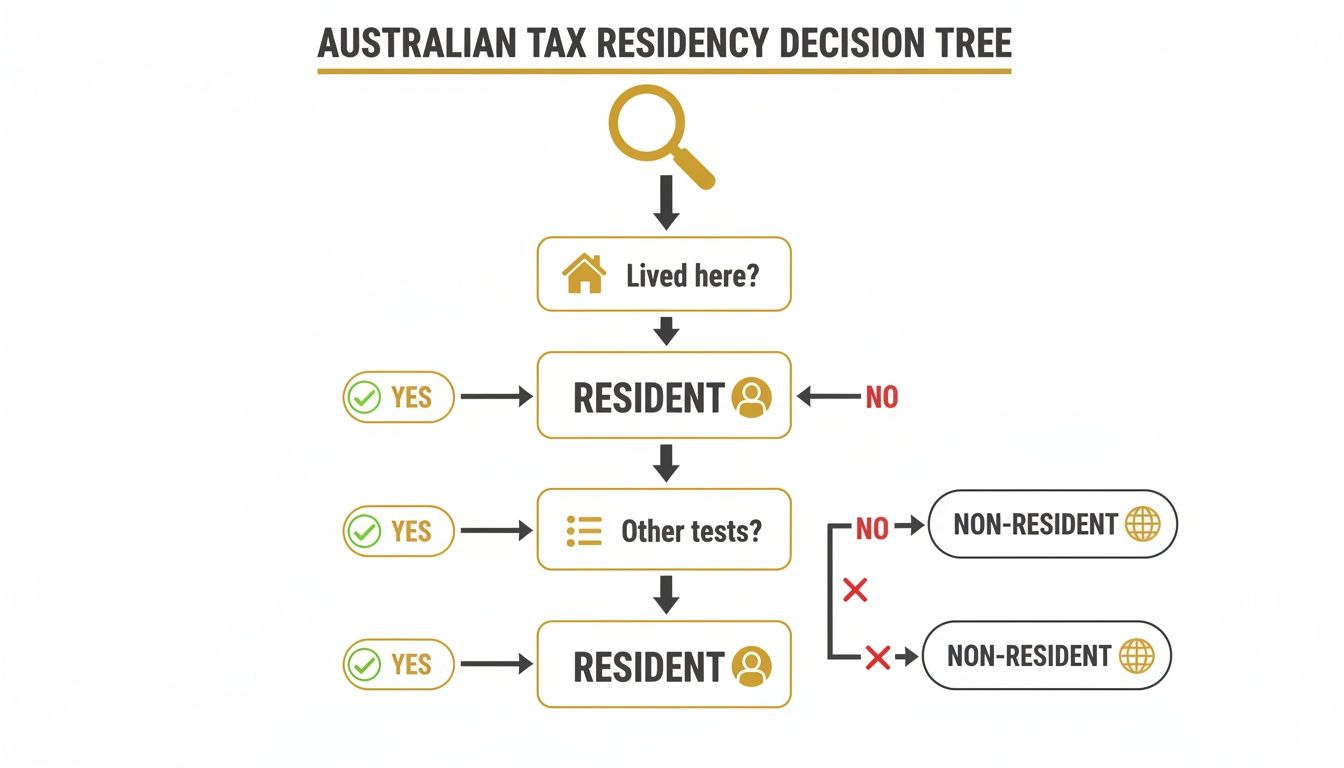
The flowchart clearly shows that if you meet the primary "resides test," your status is confirmed. If not, you have to work your way through the other tests to be certain.
By following these steps, you translate your overseas financial activities into a language the ATO understands. This methodical approach removes the guesswork from reporting foreign income tax in Australia and ensures you meet your obligations accurately, the first time.
Using The Foreign Income Tax Offset To Avoid Double Taxation
The biggest fear for anyone earning money overseas is getting taxed twice—once in the foreign country and then again by the ATO. It's a valid concern, but thankfully, the system is specifically designed to stop that from happening.
The key to preventing this is the Foreign Income Tax Offset (FITO).
Think of FITO as a credit for the tax you've already paid to another government. Its entire purpose is to make sure your total tax bill on that income doesn't end up being more than what you would have paid if you'd earned it all here in Australia. It’s the cornerstone of how foreign income tax in Australia is managed fairly.
How The Foreign Income Tax Offset Works
To get the FITO, you just need to tick two boxes. First, you must have actually paid tax on your foreign income to an overseas tax authority. Second, you must have included that same income in your assessable income for your Australian tax return. Simple as that.
If you meet these two conditions, you can claim the offset to slash your Australian tax bill. But it's not a free-for-all. The amount you can claim is capped to keep the system fair and balanced.
This cap is called the FITO limit. Your offset is restricted to whichever of these two amounts is lower:
- The actual foreign tax you paid (after converting it to AUD).
- The amount of extra Australian tax you have to pay simply because you included that foreign income in your return.
In other words, you can’t use the offset to wipe out tax on your Aussie-sourced income. It can only cancel out the Australian tax that applies to your foreign earnings.
Calculating Your FITO Limit
Working out the FITO limit sounds complicated, but it's really just a logical, step-by-step process. The ATO is essentially trying to figure out how much more tax you owe because of that foreign income.
The FITO limit is the amount of Australian tax that would be payable on your foreign income. This prevents you from claiming an offset that is higher than the Australian tax liability on that same income, ensuring you don't profit from the offset.
Let's jump back to our example of Alex and his rental income from New Zealand to see how this works in practice. For a really deep dive, you can also check out our guide on the foreign income tax offset and its specific rules.
Alex's FITO Calculation Example
Here's a quick summary of Alex's finances for the year:
- Australian Salary: $90,000
- Net Foreign Rental Income (NZ): $10,000 (after conversion and deductions)
- Foreign Tax Paid (NZ): $1,500
Now, let's walk through the calculation to find his FITO limit.
Step 1: Calculate Tax on Total Income (Including Foreign Income)
First, we work out the tax on his total income of $100,000 ($90,000 Aussie salary + $10,000 NZ rent). Using the standard tax rates, the total tax payable on this amount comes to $22,967 (including the Medicare levy).
Step 2: Calculate Tax on Australian Income Only
Next, we figure out what his tax would have been without the NZ income—so, just on his $90,000 Australian salary. The tax on this amount is $19,517 (including the Medicare levy).
Step 3: Determine the FITO Limit
The difference between these two figures is the extra Australian tax Alex is paying because of his NZ rental income.
- FITO Limit = $22,967 - $19,517 = $3,450
Finally, Alex compares his FITO limit ($3,450) to the actual foreign tax he paid ($1,500). He can only claim the lesser of the two.
In this case, the $1,500 he paid in NZ tax is lower than his FITO limit. So, Alex can claim a foreign income tax offset of $1,500. This directly reduces his Australian tax bill from $22,967 down to $21,467, completely wiping out the effect of double taxation.
How Australia's Double Tax Agreements Can Help You
While the Foreign Income Tax Offset (FITO) is your main line of defence against paying tax twice, it’s not the only tool you have. Australia has built a network of international agreements with over 40 countries, all designed specifically to stop you from being taxed into oblivion.
These are known as Double Tax Agreements (DTAs), and they’re essentially an official rulebook between two countries. They lay out exactly which country gets the first shot at taxing certain types of income, giving individuals and businesses much-needed certainty when operating across borders.
The Role of a Double Tax Agreement
Think of a DTA like a referee in a financial match. When both Australia and another country reckon they have the right to tax your income, the DTA blows the whistle and makes the final call based on the agreed-upon rules.
This is a game-changer for passive income streams like dividends, interest, and royalties. A DTA can dramatically cut the tax a foreign country withholds from your payment before it even gets to you, which means better cash flow and less hassle. It's a different kind of protection from the FITO, which you have to claim back later.
A Double Tax Agreement is a treaty between two countries to prevent international double taxation of income and property. The main purpose of a DTA is to divide the right of taxation between the contracting countries, to avoid differences, grant concessions on taxes, and promote economic relations.
Getting your head around these agreements is a crucial part of managing your foreign income tax in Australia, particularly if you have investments or business interests overseas. To see how these treaties really work, check out our detailed guide on a double tax agreement in Australia.
DTAs in Action: A Real-World Example
Let's make this practical. Say you're an Aussie tax resident and you own shares in a company based in the United States. When that company pays you dividends, the US will almost always withhold tax from that payment.
Without a DTA, the US could legally keep up to 30% of your dividend payment. But because Australia and the US have a DTA, the agreement caps the amount of tax the US can withhold on dividends paid to an Australian resident, often slashing it to just 15%.
Right away, more money lands in your bank account. You'll still need to declare this income in Australia, of course, but the DTA has already done the heavy lifting by minimising the foreign tax you paid upfront.
How Treaties Affect Different Income Types
DTAs aren't a one-size-fits-all solution; they contain specific articles that lay down different rules for different types of income.
- Pensions: The DTA with the United Kingdom, for example, often gives Australia the sole right to tax UK-sourced pensions paid to an Australian resident. This can stop the UK from levying any tax on your pension payments at all.
- Royalties and Interest: Just like with dividends, DTAs usually put a ceiling on the rate of withholding tax that the source country can charge on royalty and interest payments.
- Business Profits: Treaties set up clear rules to figure out when a business from one country has a "permanent establishment" in the other, which is the deciding factor on where its profits get taxed.
The golden rule, however, never changes: as an Australian tax resident, you must report all your worldwide income to the ATO, no matter where it was earned or if tax was paid on it elsewhere. For the 2024–25 income year, you have to convert all foreign income to Australian dollars using approved exchange rates.
And it’s not just about regular income. If you sell assets overseas, you'll also have to navigate how Australia handles capital gains. For a deeper look into this, the guide on capital gains tax on foreign property is an excellent resource.
Common And Costly Mistakes To Avoid

Navigating the rules for foreign income tax in Australia can feel like walking through a minefield. Even small, honest mistakes can trigger a stressful audit and expensive penalties from the Australian Taxation Office (ATO).
The best way to stay off the ATO’s radar is to understand where others go wrong. Think of this section as your guide to getting things right the first time, learning from the common pitfalls that catch so many taxpayers out.
Forgetting The Small Stuff
One of the most frequent errors we see is people assuming that tiny amounts of foreign income aren't worth reporting. It’s easy to think that a few dollars of interest from an overseas bank account or a minor dividend from a handful of foreign shares is insignificant.
But to the ATO, every single dollar counts. There’s no tax-free threshold for this stuff. The ATO has sophisticated data-matching agreements with tax agencies worldwide, which means they often know about your foreign earnings before you even lodge your return. Ignoring these small amounts is a guaranteed way to attract their attention.
Poor Record Keeping For Offsets
Claiming the Foreign Income Tax Offset (FITO) is your best defence against double taxation, but you can't just claim it without rock-solid proof. A critical and costly mistake is failing to keep detailed records of the actual foreign tax you’ve paid.
Without official documentation, such as a tax assessment notice from the foreign tax authority, your FITO claim can be denied. Simply showing a bank transfer is not enough; you need government-issued proof.
This oversight can be incredibly expensive. It could effectively force you to pay tax twice on the same income, all because you couldn't back up your claim. Meticulous record-keeping is non-negotiable.
Using The Wrong Exchange Rate
Currency conversion is another area where things can easily go wrong. You can't just pluck a random exchange rate out of thin air on the day you lodge your return. The ATO has very specific rules you need to follow.
You must either use the exchange rate from the time each transaction happened or apply the average annual rate the ATO publishes. A common tripwire is mixing these methods or using a rate from an unapproved source.
Let's look at a real-world example:
- The Mistake: Sarah receives her UK pension quarterly. To make things "easier," she just converts the entire annual amount using the exchange rate on 30 June.
- The Consequence: If the ATO reviews her return, they could deem her conversion method non-compliant. This would force her to recalculate everything, potentially leading to more tax owed, plus penalties for incorrect reporting.
The key here is consistency. Pick an approved method and stick with it for the whole financial year. This ensures your declarations are accurate and, more importantly, defensible if the ATO comes knocking.
Got Questions About Foreign Income Tax? We've Got Answers.
When you're dealing with money from overseas, a lot of questions can pop up. It’s a tricky area of tax law, and it’s easy to feel unsure about what you need to do. Here are some of the most common questions we get from clients, with clear, straight-to-the-point answers.
Do I Really Have To Declare Tiny Amounts Of Foreign Income?
Yes, you absolutely do. This is a big one that catches a lot of people out. There is no tax-free threshold for foreign income when you're an Australian resident for tax purposes.
Every single dollar has to be on your tax return. That means the $5 of interest from an old UK bank account or that small dividend from some US shares you own—it all counts. The ATO has incredibly sophisticated data-matching programs with tax agencies around the world, so it's very likely they already know about it. Full disclosure isn't just good practice; it's essential.
But What If I Already Paid Tax On It In Another Country?
This is where a lot of people worry about being taxed twice, and thankfully, Australia's system is designed to prevent that from happening. If you've paid tax in another country on income that's also taxable here, you can generally claim the Foreign Income Tax Offset (FITO).
Think of the FITO as a credit. It directly reduces the Australian tax you have to pay by the amount of foreign tax you've already handed over. The goal is to ensure you don't end up paying more tax than if you had earned that same income right here in Australia.
The key here is proof. To claim this offset, you must have the documents to show you paid foreign tax, like an official tax assessment notice from the overseas authority.
How Do I Convert My Foreign Income To Australian Dollars?
You can't just pick a random exchange rate from Google on the day you do your tax return. The ATO has specific rules you need to follow for converting currency.
You have two main options:
- The "On the Day" Rate: You can convert the income using the exchange rate on the exact day it landed in your account.
- The Average Annual Rate: To make things simpler, the ATO publishes average exchange rates for the whole financial year. You can use this average rate across all your foreign income for that year.
Whichever method you choose, you have to stick with it for all your foreign income in that tax year. Consistency is crucial for keeping your reporting accurate and staying on the right side of the ATO for your foreign income tax in Australia.
The ATO provides guidance through ato.gov.au, the Small Business Support Line (13 28 66), and Online Services for individuals and businesses. For complex situations, a registered tax agent provides advice tailored to your specific circumstances and professional indemnity protection. You can verify agent registration at the TPB register at tpb.gov.au.
Most tax records must be kept for five years from the date of lodgement or the date the transaction occurred, whichever is later. Records must be in English or convertible to English and must be sufficient to explain the income and deductions in your return. The ATO can request records at any time during the retention period.
Consider a registered tax agent when your affairs involve multiple income sources, business activity, investment properties, capital gains, or overseas income. Agents extend your lodgement deadline, provide safe harbour protection, and take professional responsibility for the advice given. Verify registration at tpb.gov.au.
The failure to lodge penalty is based on penalty units ($313 per unit from 1 July 2023), accruing per 28-day period for late returns and BAS lodgements. Incorrect information penalties range from 25% to 75% of the tax shortfall depending on whether the behaviour was careless, reckless, or intentional. Proactive disclosure before an audit begins typically results in significantly reduced penalties.
Tax minimisation is the legal arrangement of your affairs to reduce tax — claiming all eligible deductions, using appropriate structures, and timing income and expenses. Tax avoidance involves arrangements that technically comply with the law but achieve outcomes parliament did not intend. The ATO can apply Part IVA anti-avoidance rules to cancel benefits from avoidance arrangements.
Juggling overseas income rules can feel like a headache, but you don't have to figure it all out on your own. The experts at Australia Wide Tax Solutions specialise in helping Australians with foreign income to meet their ATO obligations while making sure their tax position is optimised.
Let us handle the complexity for you. Visit https://www.awts.net.au to book your consultation today.
