

Sorting out your Tax File Number (TFN) in Australia is one of the first, most crucial steps you'll take. The process is free and usually handled online through myGovID with the Australian Taxation Office (ATO). You'll need a few key identity documents, like a passport or birth certificate, to get it done.
- Your TFN Application Document Checklist
- Navigating the Online TFN Application
- Application Options for Unique Situations
- What to Expect After You Hit Submit
- Common Questions About Getting a TFN
Why Your TFN Is Non-Negotiable
Think of a TFN as your financial passport in Australia. It’s a unique number the ATO gives you that’s tied to nearly every part of your economic life here. Without one, you’re not just missing a number; you're putting yourself at a serious financial disadvantage right from the start.
For starters, getting a job becomes a real headache. Your employer will ask for your TFN as soon as you start. If you don't provide it within 28 days, they are legally forced to withhold tax from your pay at the highest possible rate. It’s a painful lesson many newcomers learn the hard way.
The Financial Impact of Not Having a TFN
The consequences here are severe. Anyone without a TFN gets taxed at the highest marginal rate of 47%. Depending on your income, that could mean losing thousands of dollars every year that should have been in your pocket.
It goes beyond just tax, too. A TFN is your key to accessing essential government services and benefits, including Medicare and Centrelink. Getting this sorted early prevents a world of future headaches.
This simple decision tree breaks down the right application path for your situation.
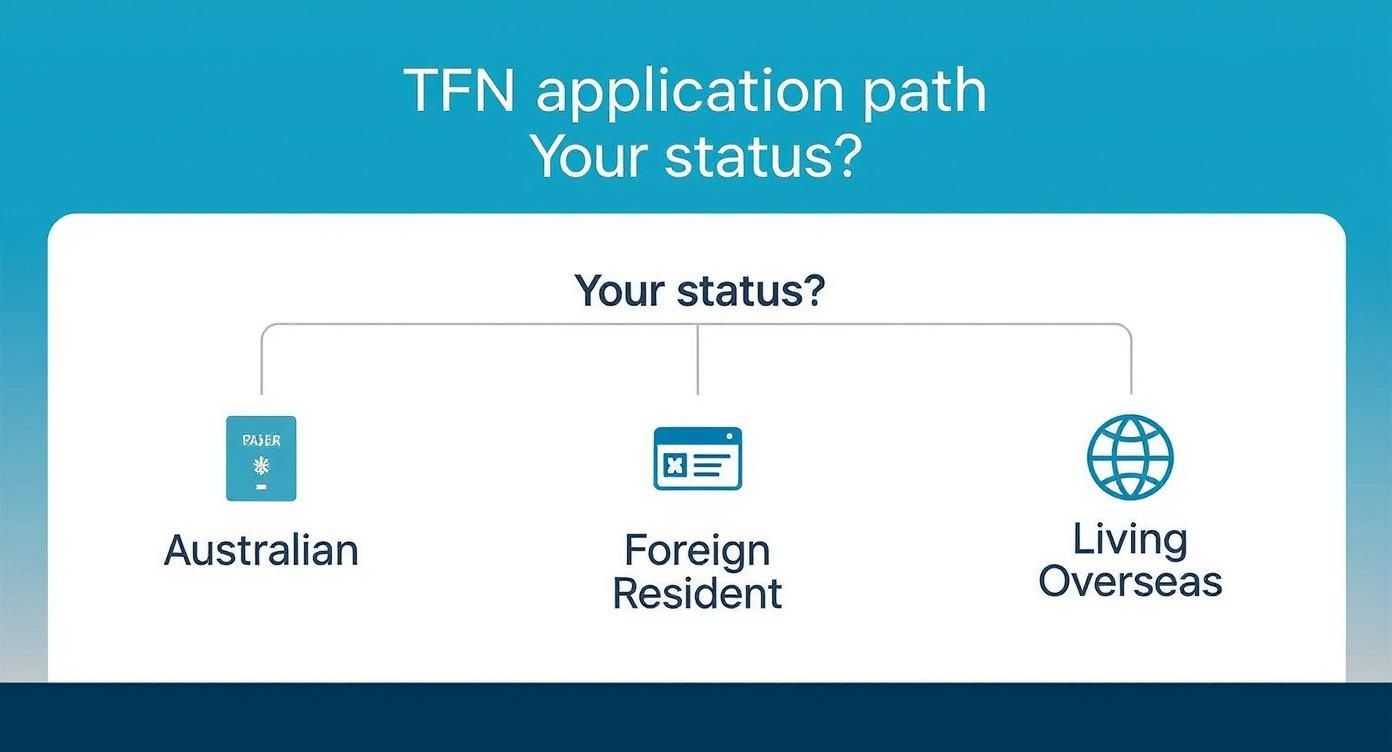
As the guide shows, how you apply really depends on your circumstances. Whether you're an Aussie citizen, a foreign resident with a valid visa, or applying from overseas, there’s a specific path you need to follow.
Not sure which application method fits your situation? This table breaks it down for a quick, at-a-glance comparison to help you find the right path instantly.
Which TFN Application Path Is Right for You?
| Your Situation | Best Application Method | What You'll Need |
|---|---|---|
| Australian citizen with an Australian passport | Online via myGovID and the ATO's online services | A strong identity strength myGovID, your passport, and one other identity document (e.g., driver's licence) |
| Foreign passport holder, permanent migrant, or temporary visitor (already in Australia) | Online via the Individual Auto Registration (IAR) system or at Australia Post | A valid visa, your passport, and other supporting documents like an Australian driver's licence or proof of address |
| Australian resident for tax purposes without standard identity documents (e.g., Norfolk Island resident) | Paper form (Tax file number – application or enquiry for individuals – NAT 1432) | Certified copies of your identity documents (birth certificate, etc.) |
| Applying from overseas (foreign resident for tax purposes) | Paper form (Tax file number – application or enquiry for individuals not residing in Australia – NAT 2628) | Certified copies of identity documents, proof of an Australian-sourced income (e.g., from investments) |
Choosing the correct method from the outset will save you time and ensure your application is processed without unnecessary delays. Each path has specific document requirements, so double-check what you need before you start.
Your Identifier for Super and Services
Your TFN is also critical for your superannuation. It allows your employer to pay contributions into your super fund and helps you keep all your retirement savings in one place, which is especially important if you change jobs. Trying to consolidate multiple super accounts without a linked TFN is a nightmare.
A TFN is more than a tax requirement; it's the fundamental tool for securing your financial identity and making sure you get the correct pay, benefits, and superannuation contributions you're entitled to.
Your TFN Application Document Checklist

Jumping into your TFN application without the right paperwork is the single biggest reason for delays. Trust me, I’ve seen it countless times. Getting everything organised beforehand is the secret to a smooth, quick process that saves you a world of frustration.
Think of this as your pre-flight checklist.
The Australian Taxation Office (ATO) uses a points-based system to confirm you are who you say you are. You’ll need to provide a combination of primary and secondary documents to tick all their boxes. It’s a smart move to have these either in your hand or scanned and ready to go before you even start the online form.
Primary Identity Documents
These are the heavy hitters—the foundational documents that prove your identity. For most applications, especially the online ones, you will need at least one of these.
- Australian full birth certificate (make sure it's not just an extract)
- Australian passport (can be current, or expired less than two years ago)
- Australian citizenship certificate
If you're applying on a foreign passport as a permanent migrant or temporary visitor, your foreign passport is the key primary document. Just make sure it’s the same one linked to your current visa, as the ATO and Home Affairs systems talk to each other.
Secondary and Supporting Documents
These documents add extra weight to your identity claim. You’ll usually need one or more of these to get your application over the line, depending on which path you take.
Some of the most common secondary documents are:
- Australian driver's licence or learner's permit (with your photo and signature)
- Medicare card
- Change of name certificate from the Registry of Births, Deaths and Marriages, if your name is different from your birth certificate.
- Marriage certificate (this is essential if you're using it to prove a name change)
For anyone heading into an Australia Post outlet to apply in person, you might also be able to use things like a recent bank statement or a utility bill that shows your current address. Always double-check the specific list of accepted documents for your chosen application method before you go.
Pro Tip: If the name on your primary document doesn't perfectly match the name on your secondary ones (often due to marriage or a legal name change), you must provide the official linking document. This could be your marriage certificate or an official change of name certificate. This is a non-negotiable step where so many applications get stuck.
Getting this part right from the start is genuinely the most effective thing you can do to ensure your application sails through. Take five minutes to get your documents in order now—it could save you weeks of waiting later on.
Navigating the Online TFN Application
For most people, jumping online is the quickest way to get a Tax File Number. It’s a far more direct route than dealing with paper forms or in-person appointments, but it hinges on getting two key digital tools set up first: myGovID and myGov.
It’s easy to mix them up, but they do completely different jobs. Think of myGovID as your digital ID on your phone—it’s like a virtual passport that proves you are who you say you are. myGov, on the other hand, is the online portal where you actually access government services like the ATO. You need them to work together to get your TFN application through.
Setting Up Your Digital Identity with myGovID
Before you even think about the TFN form, you have to get your myGovID sorted. This is an app you download to your phone or tablet that verifies your identity for the Australian Government. The strength of your myGovID is based on how many official documents you can successfully scan and verify in the app.
To reach a 'Standard' identity strength—which is what you’ll need for a TFN application—you have to verify at least two of these Australian identity documents:
- Driver’s licence or learner’s permit
- Passport (it can be expired, but not by more than three years)
- Birth certificate
- Visa (if you're using a foreign passport)
- Citizenship certificate
- Medicare card
The process involves scanning your documents using your device's camera, and often a quick face verification scan. This is the first critical hurdle, and it's where many people get stuck.
Key Takeaway: Don’t even start the ATO application until your myGovID is fully set up and verified. I’ve seen countless people try to do both at once, only for the session to time out, losing all their progress on the TFN form and forcing them to start from scratch.
Once your myGovID is ready to go, you can then link it to your myGov account. If you don't have one, the system will prompt you to create one. This connection is the secure handshake that lets you into the ATO’s services.
Completing the ATO Online Form
With your digital ID sorted, you can get to the main event. You’ll log into myGov, head to the ATO services section, and find the online TFN application. The form itself is mostly straightforward, but there are a few sections that regularly trip people up.
This image from the official myGovID site shows exactly how the app acts as your digital key.
As you can see, it’s the secure pass that unlocks access to different government portals, including the one you need for your TFN.
One of the most critical parts of the form is entering your personal details exactly as they appear on your identity documents. Even a tiny mistake—like a missing middle name or a slightly different spelling—can trigger an automatic rejection from the system, causing massive delays.
The section for your postal address is just as important. The ATO will mail your TFN to this address, so you absolutely must double-check it for accuracy. If you're travelling or staying somewhere temporarily, make sure you use a stable, reliable address. A simple typo here could mean your TFN letter never shows up, leaving you in a real bind with your employer. Take your time, read every field twice before submitting, and make sure every detail is a perfect match.
Application Options for Unique Situations
While the online application is the fastest path for most, it certainly doesn’t fit everyone. Life isn’t a one-size-fits-all template, and neither is applying for a TFN.
Fortunately, the Australian Taxation Office (ATO) has solid backup plans. This ensures everyone has a clear way forward, whether you’re dealing with digital ID hurdles or applying from the other side of the world.
The Australia Post In-Person Application
If you’re a foreign passport holder, permanent migrant, or temporary visitor already in Australia, this is your best alternative. It’s perfect if you're hitting a wall with the myGovID verification or just prefer a face-to-face interaction to know it's done right.
First, you’ll fill out a TFN application form on the ATO website. When you finish, you'll get a summary printout with a unique application reference number. This is not a submission—think of it as a pre-lodgement that you need to finalise in person.
You then have 30 days to pop into a participating Australia Post outlet. Bring your application summary and original identity documents. The staff there will verify your passport and visa, watch you sign, and send the application to the ATO for you. Simple, secure, and a great way to sidestep any digital frustrations.
Applying with a Paper Form from Overseas
What if you're not physically in Australia but need a TFN? This is a common scenario for people with Australian-sourced income from things like investments, property, or other assets, even if they live abroad. For this, you’ll need to go the old-school paper route.
The specific form you're looking for is the Tax file number – application or enquiry for individuals not residing in Australia (NAT 2628). You can download it straight from the ATO website.
Take your time filling this one out, as the details matter. Crucially, you need to provide certified copies of your identity documents—never send your originals. These copies must be certified by an authorised person in your country, like a notary public or an Australian consular officer. Once it's all complete, you mail the form and certified documents to the address listed on the form itself.
Understanding your residency status is a big deal when applying from overseas. Your tax obligations and even the application process can change dramatically depending on whether you are classed as an Australian resident for tax purposes. Our guide on this topic is essential reading if you're in this boat.
When to Use a Registered Tax Agent
Sometimes, your situation is just too complex for a standard application. You might be managing a deceased estate, running a business, or juggling a complicated investment portfolio. In these cases, getting a registered tax agent involved is less of a luxury and more of a necessity.
A good tax agent does far more than just fill out a form. They provide advice tailored to your financial situation and make sure your TFN is correctly linked to any business structures or trusts. They handle the ATO liaison, chase up the paperwork, and help you sidestep costly mistakes. It's the path that offers true peace of mind, especially when the stakes are high.
What to Expect After You Hit Submit
After you’ve double-checked all your details and finally hit that submit button, the waiting game begins. It’s completely normal to wonder what happens next, but understanding the process can save you a lot of stress.
The Australian Taxation Office (ATO) generally advises a processing time of up to 28 days. In the background, they’re meticulously verifying your identity documents against other government records. It’s a vital security step to make sure you are who you say you are before issuing such a critical piece of identification.
Receiving Your TFN
Don't expect an email or a text with your new Tax File Number once your application is approved. For security reasons, the ATO will physically mail your TFN to the postal address you put on your form.
This is exactly why you need to be absolutely certain your address is correct before submitting. A simple typo could send your TFN letter on a detour to the wrong address, leading to major delays and headaches you just don't need.
Important Takeaway: Your TFN is a highly sensitive piece of information. The ATO’s decision to mail it is a deliberate security measure to protect your identity. Treat any emails or texts claiming to contain your TFN as scams.
When Your TFN Hasn’t Arrived
So, what do you do if that 28-day mark has come and gone, and your letter is still nowhere in sight? First, don’t panic. Check the calendar for any recent public holidays that might have slowed down the mail or the ATO's processing centres.
If another week passes and you’re still checking an empty mailbox, it’s time to get in touch with the ATO directly. Give their dedicated enquiries line a call. Just be sure to have all your application details and identity documents handy, as they’ll need to confirm who you are over the phone before giving you an update.
Did You Already Have a TFN?
It’s surprisingly common for people to apply for a new TFN, completely forgetting they were issued one years ago—maybe from a part-time job as a teenager. The ATO only ever issues one TFN per person for life.
If you think this might be you, hunting down your old number is much faster than waiting for a new application. Here are a few places you can look:
- Check your myGov account: If you've linked it to the ATO, your TFN will be right there in your profile.
- Look at old payslips: Your TFN should be printed on payment summaries or payslips from previous jobs.
- Review superannuation statements: Your super fund uses your TFN as a key identifier, so it will be on your statements.
Finding an old TFN means you can give it to your employer right away and get paid correctly from day one. And if you’re ever worried that your details have fallen into the wrong hands, it’s worth knowing the signs of a compromised TFN and what to do to keep yourself safe.
Common Questions About Getting a TFN

Even with the clearest instructions, a few common questions always pop up when people are applying for their TFN. Getting straight answers can save you a lot of stress and help you know what to expect.
Let's dig into some of the most frequent queries we hear from clients.
One of the biggest worries is timing. While the Australian Taxation Office (ATO) officially says processing takes up to 28 days, that isn't always the full story. This timeframe can get stretched by real-world factors.
For instance, if you submit your application right before a major public holiday like Easter or Christmas, you can expect some slight delays. Simple mistakes on your form, like a name not quite matching your passport, can also pause the whole process while the ATO gets in touch for clarification.
Can You Start Working Without a TFN?
Yes, absolutely. You don't need to have your TFN in hand before you accept a job offer and start working. The law gives you a 28-day grace period from your first day to give your TFN to your employer.
But don't get too comfortable, because that deadline is firm. If you miss it, your employer is legally required to withhold tax from your pay at the highest possible rate—a painful 47%. This makes it incredibly important to track your application and follow up if it seems delayed.
It's a common myth that you can't start a job without a TFN. You absolutely can, but the clock starts ticking on day one to provide it and avoid those emergency tax rates.
What if Your TFN Application Is Rejected?
Getting a rejection notice can feel like a major setback, but it’s usually something you can fix. The first thing you need to do is read the notice from the ATO carefully—it will almost always explain exactly why the application was unsuccessful.
By far the most common reason for a rejection is an issue with identity documents. This could be a simple typo when you entered your details or a name on one document not perfectly matching another.
Here’s your recovery plan:
- Identify the problem: Read the ATO's letter to understand precisely what they've flagged.
- Double-check everything: Meticulously compare the information on your application with your official documents. Look for any tiny discrepancies.
- Correct and reapply: Once you've found the mistake, you can simply submit a fresh application with the corrected details.
If you’re certain all your details were correct but still hit a wall, it might be because you already have a TFN you've forgotten about. Our guide on how to find your lost Tax File Number has practical steps to help you track it down.
The ATO provides guidance through ato.gov.au, the Small Business Support Line (13 28 66), and Online Services for individuals and businesses. For complex situations, a registered tax agent provides advice tailored to your specific circumstances and professional indemnity protection. You can verify agent registration at the TPB register at tpb.gov.au.
Most tax records must be kept for five years from the date of lodgement or the date the transaction occurred, whichever is later. Records must be in English or convertible to English and must be sufficient to explain the income and deductions in your return. The ATO can request records at any time during the retention period.
Consider a registered tax agent when your affairs involve multiple income sources, business activity, investment properties, capital gains, or overseas income. Agents extend your lodgement deadline, provide safe harbour protection, and take professional responsibility for the advice given. Verify registration at tpb.gov.au.
The failure to lodge penalty is based on penalty units ($313 per unit from 1 July 2023), accruing per 28-day period for late returns and BAS lodgements. Incorrect information penalties range from 25% to 75% of the tax shortfall depending on whether the behaviour was careless, reckless, or intentional. Proactive disclosure before an audit begins typically results in significantly reduced penalties.
Tax minimisation is the legal arrangement of your affairs to reduce tax — claiming all eligible deductions, using appropriate structures, and timing income and expenses. Tax avoidance involves arrangements that technically comply with the law but achieve outcomes parliament did not intend. The ATO can apply Part IVA anti-avoidance rules to cancel benefits from avoidance arrangements.
Navigating Australia's tax system can be tricky, but you don't have to figure it all out on your own. The team at Australia Wide Tax Solutions is here to make the process simple and stress-free, ensuring you get everything right from the very start. Contact us today to see how we can help.
