

Yes, in most cases, your income protection insurance premiums are generally tax deductible in Australia if you pay for them personally. This is a huge benefit. Claiming this deduction lowers your taxable income, which means you’ll either pay less tax throughout the year or get a welcome boost to your refund from the Australian Taxation Office (ATO).
- Your Quick Guide to Income Protection and Tax
- Understanding the Golden Rule of Deductibility
- Deducting Premiums for Personal Policies
- Income Protection Held Inside Your Super Fund
- Smart Policy Structures for Small Business Owners
Think of it as the government giving you a hand to secure your own financial safety net. It’s a powerful incentive.
Your Quick Guide to Income Protection and Tax
When it comes to the tax treatment of income protection, the answer almost always comes down to one simple question: who owns and pays for the policy? The way your policy is structured is the key that unlocks everything, from whether you can claim the premiums to how any benefits you receive are taxed.
Income protection is your financial Plan B. It’s there to replace a chunk of your income if an illness or injury stops you from working. While the specifics can vary, the core purpose is consistent across different types of cover. For a look at how similar policies work elsewhere, this practical guide to Long Term Disability in Canada offers some useful parallels.
The Three Main Scenarios for Your Policy
Getting your head around the tax side of things isn't as complex as it seems. It really just boils down to three common ways a policy can be owned, and each has its own clear tax rules.
- You Own It Personally: This is the most direct and common setup. You pay the premiums straight from your own bank account, and come tax time, you can claim those premiums as a deduction. Simple.
- Your Super Fund Owns It: A lot of Aussies have income protection inside their super, often as a default cover. Here, your super fund is paying the premiums, which means you can't personally claim a tax deduction for them.
- Your Business Owns It: If you run your own company, the business might pay the premiums on your behalf. While the business can usually claim a deduction for the expense, it can open up other tax headaches like Fringe Benefits Tax (FBT) that need careful management.
This flowchart breaks down the decision process visually, showing exactly how ownership dictates whether you can claim a deduction.
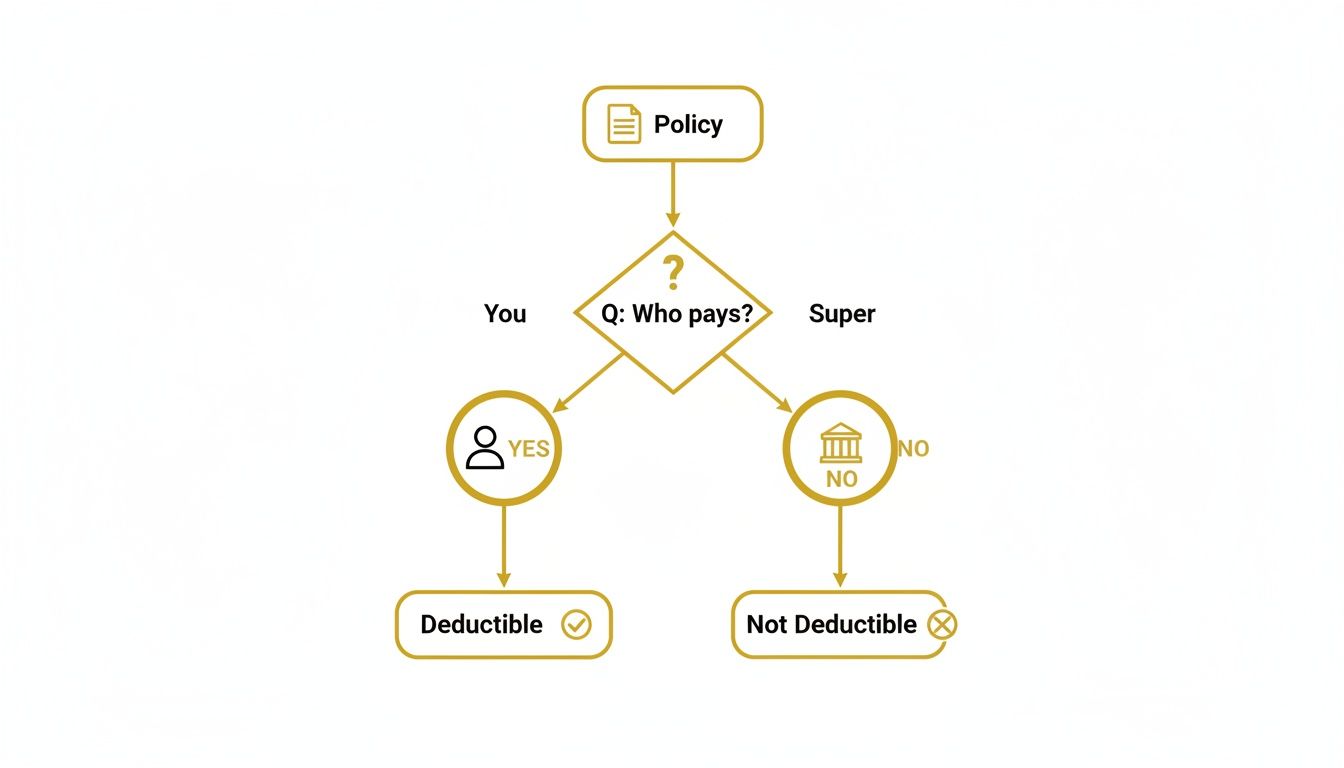
As you can see, the path is pretty clear. If you're the one footing the bill personally, the deduction is yours to claim. If your super fund is paying, that deduction isn't available to you on your personal tax return.
To make it even clearer, here’s a quick overview of how the tax rules apply to each setup. This table gives you a snapshot of the key differences, which we'll explore in more detail.
Income Protection Tax Deductibility At a Glance
This table summarises the tax treatment of income protection premiums and benefits based on the policy ownership structure.
| Policy Ownership | Are Premiums Tax Deductible? | Are Benefits Taxable? | Who It's For |
|---|---|---|---|
| Personal | Yes, for the individual | Yes, as income | Employees, sole traders, and contractors |
| Superannuation | No, for the individual | Yes, as income | Anyone with a superannuation account |
| Business-Owned | Yes, for the business | Yes, as income | Company directors and key employees |
This framework is your starting point for understanding how the ATO views your policy. Knowing which category you fall into is the first step to making sure you're getting it right on your tax return.
Understanding the Golden Rule of Deductibility

When it comes to claiming tax deductions, the Australian Taxation Office (ATO) isn’t trying to be complicated. In fact, most of it boils down to one straightforward principle. Getting your head around this "golden rule" is the key to understanding why you can claim your income protection premiums, but not your morning coffee.
At its heart, the rule is this: you can claim a deduction for any expense directly incurred in earning your assessable income. Think of it like a tradie buying a new nail gun. It’s not a weekend toy; it’s an essential tool that helps them do their job and get paid. Because the cost is directly tied to their ability to earn a living, it’s a legitimate deduction.
Your income protection policy is no different. It’s a financial tool designed to protect your single most important asset—your ability to earn an income. The premiums you pay are simply the cost of ensuring that income stream continues, even if an injury or illness stops you from working.
What Is Assessable Income?
So, what does the ATO actually count as "assessable income"? Put simply, it’s your gross income from all sources before any deductions are taken out. It’s the total amount the government can apply tax to.
For most people, this includes:
- Salary and wages from your employment.
- Business income if you're a contractor or sole trader.
- Certain government payments and allowances.
- Income from investments, like bank interest or share dividends.
When you pay for your own income protection policy, the premiums are clearly linked to protecting the salary or business income that makes up your assessable income. It's this direct connection that makes the premiums a valid claim. You can find out more by reading our full guide on what qualifies as a tax-deductible expense.
This is why the answer to "is income protection tax deductible?" is almost always a 'yes' for policies you hold personally. You're paying to protect your taxable income, and the ATO recognises that as a legitimate cost of doing business.
The Two Sides of the Tax Coin
But this golden rule is a two-way street. It creates a balance between deductions and income that you absolutely need to be aware of.
The Golden Rule’s Flip Side: If an expense is tax-deductible, any income or benefit you receive from it is considered taxable income.
This isn’t optional; it’s a fundamental part of Australia’s tax system. You can’t have the deduction without the tax on the benefit. Because your income protection premiums are tax-deductible, any monthly payments you receive from the policy must be declared as assessable income.
This means you treat those benefit payments just like a regular salary on your tax return. The ATO sees the insurance payout as a replacement for your lost wages, so it needs to be taxed in the same way.
Forgetting this can leave you with a nasty surprise and a big tax bill. Imagine receiving $4,000 a month from your insurer. If you haven't set aside money for tax, you could be on the hook for thousands at the end of the financial year. Understanding this relationship from the start keeps you compliant and financially prepared.
Deducting Premiums for Personal Policies
This is the most common setup for millions of Australian employees and sole traders. When you hold an income protection policy in your own name and pay the premiums yourself, those premiums are almost always tax deductible.
Think of it this way: your ability to earn an income is your most valuable financial asset. The money you spend on income protection is a direct cost of protecting that asset. The ATO agrees with this logic, which is why in this situation, the answer to "is income protection tax deductible?" is a clear 'yes'.
How Deductions Cut Your Tax Bill
Claiming your income protection premiums isn't just an administrative task; it directly reduces your taxable income. This translates to a very real tax saving, and the size of that saving depends on your marginal tax rate—the rate of tax you pay on the last dollar you earn.
Simply put, the higher your income, the higher your marginal tax rate, and the more valuable your deduction becomes.
Let's see how this works with a real-world example.
Worked Example: Meet Sarah, the Graphic Designer
Sarah is a freelance graphic designer earning a taxable income of $120,000 a year. She pays an annual premium of $2,500 for her personal income protection policy.
Find the Marginal Tax Rate: Under the 2025-2026 tax brackets, Sarah's income puts her in the bracket where she pays 30 cents for every dollar earned between $45,001 and $135,000. Her marginal tax rate is 30%.
Calculate the Tax Saving: We just multiply her premium cost by her tax rate.
- $2,500 (Premium) x 0.30 (Tax Rate) = $750
Work Out the True Cost: By claiming the deduction, Sarah gets a $750 reduction on her tax bill. This effectively drops the real cost of her insurance from $2,500 to just $1,750 for the year.
This shows just how much the tax system helps make vital financial protection more affordable. The higher your tax bracket, the bigger this saving gets.
The Catch with Bundled Policies
It's very common for insurers to "bundle" different types of cover into one policy package. You might find your income protection is combined with:
- Life Insurance (or Death Cover): Pays a lump sum to your loved ones if you pass away.
- Total and Permanent Disability (TPD) Cover: Pays a lump sum if you're permanently disabled and can never work again.
- Trauma (or Critical Illness) Cover: Pays a lump sum if you're diagnosed with a major illness like cancer or a heart attack.
Here’s the critical detail: the ATO only allows you to claim the portion of the premium that pays for your income protection cover. Premiums for life, TPD, and trauma cover are considered "capital in nature" and are not tax deductible when held in a personal policy.
If you claim the entire premium for a bundled policy, you are making an incorrect claim. This can lead to ATO audits and potential penalties. You must separate the deductible component from the non-deductible ones.
How to Correctly Apportion Your Premium
So, how do you find the exact figure you can claim? You don’t have to do the maths yourself. Your insurance company is legally required to provide this information.
You need to get an apportionment statement or policy schedule from your insurer. This document will clearly break down your total premium, showing you precisely how much is for income protection versus the other types of cover.
For instance, your statement might look like this:
- Total Annual Premium: $3,000
- Income Protection Component: $2,100 (Deductible)
- Life & TPD Cover Component: $900 (Not Deductible)
In this scenario, you can only claim the $2,100 on your tax return. Relying on this official statement is the only way to be sure you're maximising your deduction without falling foul of the ATO rules.
Income Protection Held Inside Your Super Fund
Lots of Australians hold their income protection insurance inside their superannuation fund—it's a common and often convenient setup. But when it comes to tax time, the rules flip completely, and it's a critical difference you need to get your head around.
The short answer is no, you can’t personally claim a tax deduction for the premiums.
Think of your super fund as a totally separate legal entity. It’s like another person managing your retirement nest egg for you. When the fund owns the income protection policy, it pays the premiums directly from your super balance. Because you aren't personally paying for it, you can't claim a deduction on your personal tax return.

This separation is the key. The expense wasn't something you paid to earn your personal income; it was paid by the fund. It's a fundamentally different setup from a personal policy, where you pay the premiums yourself from your after-tax salary.
The Super Fund's Own Tax Deduction
While you don't get the personal tax deduction, there is still a tax benefit happening behind the scenes. Your super fund can claim a tax deduction for the insurance premiums it pays for you.
Since super funds pay tax on their earnings and contributions at a concessional rate of just 15%, this is where the advantage lies.
By claiming the premiums as a deduction, the fund lowers its own taxable income. This 15% deduction effectively reduces the cost of the insurance, which helps to preserve more of your retirement savings.
This is a major reason why holding cover inside super can be so cost-effective. The tax saving is passed on to you indirectly by softening the blow of the premium costs on your overall super balance. Beyond this, there are other powerful strategies you can use to legally cut your tax rate through your super.
The Pros and Cons of Cover Inside Super
Choosing between a personal policy and one held in super means weighing up convenience against how comprehensive the cover is. It's vital to understand these trade-offs before you lock anything in.
Advantages of Holding Cover in Super:
- Cash Flow Friendly: Premiums come out of your super balance, not your take-home pay. This can seriously ease the pressure on your daily budget.
- Automatic Acceptance: Many funds offer a basic level of default cover without needing a medical exam, making it simple to get some protection in place fast.
- Tax-Effective Premiums: The fund’s 15% tax deduction helps to reduce the real cost of the insurance premiums.
Disadvantages to Consider:
- Erodes Retirement Savings: Even though they're tax-effective, premiums still drain your super balance. That means less money for you in retirement.
- Stricter Definitions: Policies inside super often have tougher definitions of disability and longer waiting periods compared to what you can get with a personal policy.
- Less Comprehensive Cover: They might offer lower levels of cover (e.g., capped at 70% of your income) and have fewer optional benefits available.
- Benefit Payments Are Taxed: Just like a personal policy, if you make a claim, any benefit payments you receive are treated as taxable income and you must declare them.
These details are especially important if you run a Self-Managed Super Fund (SMSF). To get a better handle on that particular structure, you can learn more about what an SMSF is and how it operates.
While a personal policy offers that direct tax deduction, it's worth putting it in the context of the broader tax landscape. For instance, in the 2025/26 financial year, thanks to tax reforms, someone in the $45,001 to $135,000 bracket will save $300 on a $1,000 personal policy premium—a significant saving that simply isn't available for policies held in super. You can find more insights on income protection tax deductibility to see how these rules work in practice.
Smart Policy Structures for Small Business Owners
As a small business owner, how you set up your income protection policy isn't just a bit of admin—it's a crucial strategic move. The way you pay your premiums has huge tax consequences, especially when your company or trust is footing the bill.
At first glance, it seems simple. When a business pays the premium for a director's or employee's policy, it looks like a straightforward tax-deductible expense. But this is where many business owners get caught out by a major complication: Fringe Benefits Tax (FBT).
The Fringe Benefits Tax Trap
Think of FBT as a tax on the "perks" of the job. It's paid by employers on non-cash benefits they provide to employees, like a company car or, in this case, a personal insurance policy paid for by the business.
Because your income protection policy is a personal benefit, the ATO sees the company paying for it as a fringe benefit. This means that while your business might get a tax deduction for the premium, it could get hit with an FBT liability, often at the highest marginal tax rate. This can easily wipe out, or even exceed, the value of the original tax deduction.
In short, you get a deduction with one hand, only to create a new, potentially bigger tax bill with the other. This FBT trap is a common mistake that makes a business-paid policy far more expensive than it looks on paper.
Proper planning is key here. If you're exploring other ways to get your company's tax position in order, looking at a wider range of tax deductions for small business owners can uncover some valuable opportunities.
A Smarter Way to Structure Your Policy
So, how do you get the best of both worlds—making sure the premium is covered without triggering FBT for your business? A common and highly effective strategy is what’s known as an 'employee-reimbursement' arrangement.
It’s a simple, two-step process that cleverly shifts the tax deduction from the business to the individual, sidestepping the FBT problem entirely.
Here’s how it works:
- The Individual Pays: The director or employee takes out the income protection policy in their own name and pays the premium from their personal bank account. This is the crucial step that makes them the policy owner.
- The Business Reimburses: The business then increases the individual’s salary or pays them a director’s fee to cover the exact cost of that premium. This extra payment is just a normal, tax-deductible wage expense for the business and doesn’t attract any FBT.
This setup gives you the same financial result but through a much cleaner, more tax-effective structure. The business gets its deduction for the higher salary, and the individual can then claim a personal tax deduction for the income protection premium they paid. It’s a win-win that keeps things simple and compliant.
Business Expense Insurance Is Not Income Protection
It is absolutely vital for business owners not to mix up personal income protection with Business Expense Insurance. They might both sound like a safety net, but they cover completely different things and have entirely different tax rules.
- Income Protection: This replaces your personal income if you can’t work. It’s for your mortgage, groceries, and family living costs.
- Business Expense Insurance: This covers your fixed business overheads if you can't work. Think office rent, staff wages, utility bills, and equipment leases.
The tax treatment for Business Expense Insurance is also different. The premiums are generally tax deductible for the business, and if you ever make a claim, the benefits paid are treated as assessable income to the business, not you personally. It’s designed purely to keep the lights on at your business, not to pay your household bills. Getting this distinction right is fundamental to solid risk management and tax planning.
Getting Your Tax Claim Right: A Practical Guide

So, you’ve got the theory down. You know if your income protection is tax deductible. But knowing the rules and actually getting the money back from the ATO are two different things. Getting it right at tax time is what counts.
Let’s be clear: if you pay for a personal policy, the premiums are generally deductible, but any benefits you receive will be taxed. If your cover is inside super, you can’t claim the premiums yourself. And if it's a business-owned policy, you need to be very careful to avoid Fringe Benefits Tax headaches.
Your Tax Time Checklist
When it comes to lodging your tax return, a little preparation goes a long way. Before you or your accountant start, pull these details together to make sure you claim the right amount and stay on the ATO’s good side.
- Dig Out Your Annual Statement: Your insurer will send you a statement for the financial year. This is your single source of truth.
- Check for Bundled Cover: Read the statement carefully. If it also includes life, TPD, or trauma insurance, it must show a clear apportionment of the premium.
- Find the Right Number: You can only claim the specific dollar amount listed against "income protection." Don't make the mistake of claiming the entire premium on a bundled policy.
- Lodge It Correctly: On your tax return, this deduction goes in the "Other work-related expenses" section, which is label D5.
When to Call in a Tax Expert
This guide will get you through a straightforward claim. But let’s be honest, tax is rarely simple for long. If your financial life has a few moving parts beyond a basic salary, professional advice isn't just a good idea—it's essential.
Seeking personalised advice isn't an admission of defeat; it's a strategic decision to protect your financial wellbeing and ensure you get every deduction you're legally entitled to.
You absolutely need an expert accountant in your corner if you're dealing with:
- Overdue or late tax returns.
- Complex business or trust structures.
- Rental properties and the maze of capital gains tax.
- Any uncertainty around Fringe Benefits Tax (FBT).
A specialist advisor from a firm like AWTS will cut through the complexity for you. They’ll make sure your claims are not only maximised but also fully compliant, giving you peace of mind and the best possible result on your tax return.
Got Questions About Income Protection and Tax? We’ve Got Answers.
Even once you’ve got the basics down, real-world situations can muddy the waters. It's easy to get confused about what you can and can't claim. Here, we tackle some of the most common questions we hear from clients, giving you clear, straightforward answers to help you lodge your tax return with confidence.
What if My Policy Is Bundled with Life Insurance?
This is a classic trap. You absolutely cannot claim the entire premium if your income protection is bundled with other cover like life or trauma insurance. The Australian Taxation Office (ATO) is very strict on this point: you can only deduct the portion of the premium that directly pays for your income protection cover.
Your insurer is legally required to send you an annual statement that breaks this down. They’ll clearly apportion the cost, showing you the exact dollar figure for the income protection component. That’s the number you must use. Claiming the full amount is a surefire way to attract unwanted attention from the ATO.
Can I Claim a Deduction if I Paid My Premium Annually?
Yes, you certainly can. If you've paid for your entire policy a year in advance, you can generally claim a deduction for the whole prepaid amount in the financial year you made the payment. This applies as long as the coverage period you paid for is 12 months or less.
For instance, if you paid $2,400 in May 2025 for a policy that covers you until May 2026, you can claim the full $2,400 deduction on your 2025 tax return.
What Records Do I Need to Keep for the ATO?
Think of your records as your proof. Without them, your claim is just a number on a form. The ATO can ask you to verify your expenses for up to five years after you lodge, so meticulous record-keeping is non-negotiable.
You must hold onto:
- Your annual policy statement from the insurer. This is your most important document, as it confirms the premium and breaks down the costs if your policy is bundled.
- Receipts or bank statements that show you actually paid the premiums.
If the ATO comes knocking and you can’t produce these documents, they can disallow the claim and you could be hit with penalties. It’s not worth the risk.
Are Benefits Taxed if My Policy Is in Super?
Yes. This is a crucial point that catches many people out. Just like a policy you hold personally, any benefit payments you receive from an income protection policy held inside your superannuation fund are considered taxable income.
The process is a little different—the insurer pays the benefit to your super fund, which then pays it out to you. But when that money lands in your bank account, it's treated as income, and you must declare it on your tax return.
The ATO provides guidance through ato.gov.au, the Small Business Support Line (13 28 66), and Online Services for individuals and businesses. For complex situations, a registered tax agent provides advice tailored to your specific circumstances and professional indemnity protection. You can verify agent registration at the TPB register at tpb.gov.au.
Most tax records must be kept for five years from the date of lodgement or the date the transaction occurred, whichever is later. Records must be in English or convertible to English and must be sufficient to explain the income and deductions in your return. The ATO can request records at any time during the retention period.
Consider a registered tax agent when your affairs involve multiple income sources, business activity, investment properties, capital gains, or overseas income. Agents extend your lodgement deadline, provide safe harbour protection, and take professional responsibility for the advice given. Verify registration at tpb.gov.au.
The failure to lodge penalty is based on penalty units ($313 per unit from 1 July 2023), accruing per 28-day period for late returns and BAS lodgements. Incorrect information penalties range from 25% to 75% of the tax shortfall depending on whether the behaviour was careless, reckless, or intentional. Proactive disclosure before an audit begins typically results in significantly reduced penalties.
Tax minimisation is the legal arrangement of your affairs to reduce tax — claiming all eligible deductions, using appropriate structures, and timing income and expenses. Tax avoidance involves arrangements that technically comply with the law but achieve outcomes parliament did not intend. The ATO can apply Part IVA anti-avoidance rules to cancel benefits from avoidance arrangements.
Navigating the fine print of income protection can get tricky, especially when business structures or complex finances are involved. To make sure you’re staying compliant while getting the best possible tax outcome, the team at Australia Wide Tax Solutions is here to help. Contact us today for a confidential discussion about your tax needs.
