

Decoding Reportable Superannuation Contributions

Why Are They Called 'Reportable'?
The word "reportable" is the key here. It's not just a fancy name. Your employer is legally required to report these extra contributions to the ATO on your yearly income statement. Now, here's the clever part. Making these contributions lowers your taxable income for the year, which means you'll pay less income tax. But—and this is a big but—they don’t just vanish from the ATO's records. The ATO adds your RESC back to your taxable income to create a new figure called your Adjusted Taxable Income (ATI). This ATI is what the government uses as a yardstick to test your eligibility for a whole range of benefits, offsets, and even some liabilities.An easy way to think about it is that RESC has a split personality. It helps you by reducing your income tax bill right now, but it's still counted when the government is assessing your overall financial situation for things like benefits and surcharges.To give you a clearer picture, let's break down the key differences between your standard, compulsory super and these optional, reportable top-ups.
Standard Super vs Reportable Super Contributions At a Glance
The table below offers a quick comparison between the mandatory Superannuation Guarantee (SG) contributions and the optional Reportable Superannuation Contributions (RESC) you can make.| Attribute | Standard Super (SG) | Reportable Super (RESC) |
|---|---|---|
| Who Pays? | Your employer is legally required to pay this. | You choose to make these from your pre-tax salary. |
| Nature | Compulsory and mandatory under Australian law. | Completely voluntary and optional. |
| Common Example | The 11% (as of 2023-24) super guarantee. | Salary sacrifice arrangements. |
| Tax Impact | Does not reduce your personal taxable income. | Reduces your personal taxable income. |
| Reporting | Reported to the ATO, but not added to your income for tests. | Must be reported to the ATO by your employer. |
| Effect on ATI | Not included in the Adjusted Taxable Income calculation. | Added back to calculate your Adjusted Taxable Income (ATI). |
The Foundation of Extra Contributions
The Superannuation Guarantee scheme, which kicked off back on 1 July 1992, completely changed the game for retirement savings in Australia. But beyond these compulsory payments, savvy individuals can use reportable superannuation contributions as a strategic tool to get ahead and build their nest egg faster. However, this strategy demands complete transparency with the tax office. As explained on financial planning sites like endurego.com.au, these amounts are added back to assess your income for various government programs. A higher Adjusted Taxable Income can impact your eligibility for things like:- Family Tax Benefit
- Child care subsidies
- The private health insurance rebate
- HELP debt repayment thresholds
The Two Main Types of Reportable Contributions
Reportable superannuation contributions don't just come out of nowhere. They're born from specific arrangements between you and your employer, designed to channel pre-tax dollars into your retirement savings. They come in two main flavours, but both are considered concessional contributions. This just means they're taxed at a special low rate of 15% inside your super fund, which is almost always a better deal than your marginal income tax rate. The catch is that they count towards your annual concessional contributions cap, a limit we'll dive into later.Salary Sacrifice Arrangements
This is the one you've probably heard of. A salary sacrifice arrangement is a formal agreement you set up with your employer to direct a slice of your pre-tax salary straight into your super fund, bypassing your bank account entirely. Think of it like this: you agree to "sacrifice" a part of your pay packet before the taxman sees it, in exchange for a boost to your retirement savings. Because this money is redirected from your gross pay, it has the fantastic side effect of lowering your taxable income for the year.It's a double win. You're building your nest egg faster while simultaneously reducing the amount of income the ATO can tax you on. This one-two punch is why it's such a popular wealth-building strategy.Let's look at a real-world example. Example: Sarah the Marketing Manager Sarah earns a salary of $95,000 a year. She’s keen to get ahead on her retirement savings and trim her tax bill. She sits down with her employer and arranges to salary sacrifice an extra $10,000 of her pre-tax income into her super fund.
- Original Taxable Income: $95,000
- Salary Sacrifice Amount: $10,000
- New Taxable Income: $85,000
Additional Employer Contributions
The second type of reportable contribution is any extra top-up your employer makes above their compulsory Superannuation Guarantee (SG) payments. These aren't required by law; they're usually a perk outlined in your employment contract, a workplace agreement, or as part of a bonus structure. For example, a company might have a policy to match any extra voluntary contributions you make, up to a certain limit. These matched payments, because they are over and above the mandatory SG amount, are also classed as reportable employer super contributions. Just like salary sacrifice amounts, they'll show up on your income statement and get factored into your Adjusted Taxable Income calculation.How RESC Can Impact Your Finances
Tipping extra money into your super through arrangements like salary sacrificing is a brilliant way to slash your income tax bill and build a healthier retirement fund. It feels like a win-win. But that word 'reportable' is there for a reason—these contributions create ripples across your entire financial life. They don’t just vanish after cutting your tax; the ATO keeps them on the books for a whole lot of other calculations. This is where you need to get familiar with a crucial term: Adjusted Taxable Income (ATI). Think of your normal taxable income as a standard snapshot of your earnings. Your ATI, on the other hand, is more like a financial MRI scan. It gives the government a much deeper, more complete picture of the actual financial resources you have access to. To work out your ATI, the ATO takes your taxable income (the figure after your salary sacrifice contributions have been taken out) and simply adds your RESC straight back on top. This new, higher ATI figure is then used as the yardstick to assess your eligibility for a huge range of government benefits, rebates, and even some extra taxes.The Real-World Impact of a Higher ATI
A higher ATI can change your financial situation, sometimes in ways you weren't expecting. It’s the deciding factor for many income-tested programs, which means your clever super strategy could accidentally reduce a government benefit you were counting on or even trigger a new bill you didn't see coming. Getting your head around this is absolutely vital for smart financial planning. If you don't, you could be in for a nasty surprise at tax time, like a smaller-than-expected Family Tax Benefit payment or a new tax liability. This can completely cancel out the benefits you were trying to achieve in the first place. This diagram breaks down how contributions from your employer, including salary sacrifice, are classified as reportable.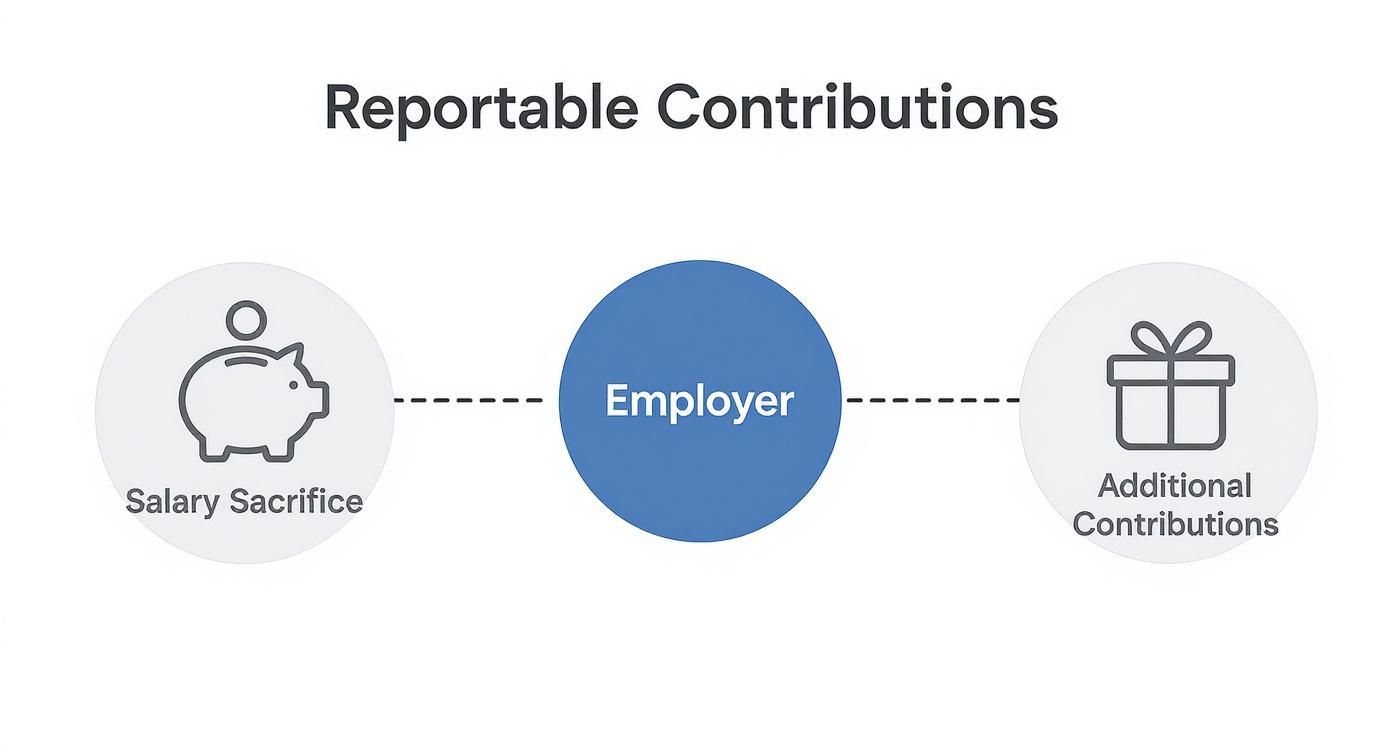
Impact of RESC on Common Income-Tested Benefits and Obligations
Here’s a quick rundown of how your Adjusted Taxable Income (ATI), which gets a boost from your RESC, can affect your eligibility for various government programs and financial obligations. The table below shows just how far-reaching the impact can be.| Benefit or Obligation | How RESC Impacts It | Potential Outcome |
|---|---|---|
| Family Tax Benefit (A & B) | Your ATI is a key component of the family income test used to calculate your payment. | A higher ATI could lead to a reduced payment rate or make you ineligible altogether. |
| Child Care Subsidy | The subsidy percentage you receive is directly tied to your family's ATI. | As your ATI increases, the percentage of subsidy you're entitled to may decrease. |
| Private Health Insurance Rebate | Eligibility for this government rebate is tiered based on your ATI. | Your RESC could push your ATI into a higher income tier, resulting in a lower rebate or none at all. |
| HELP Debt Repayments | Your compulsory repayment rate is determined by your repayment income, which includes your ATI. | A higher ATI means you'll likely have to repay a larger percentage of your income towards your student debt each year. |
| Division 293 Tax | This extra tax on super contributions applies if your income and concessional contributions (including RESC) exceed a threshold. | Your RESC could tip you over the $250,000 threshold, triggering this additional 15% tax on your contributions. |
| Government Co-contribution | Eligibility for the government's super co-contribution is based on an income threshold that includes RESC. | If your RESC pushes your ATI over the limit, you'll miss out on the government matching your personal super contributions. |
Finding and Reporting Contributions on Your Tax Return
Tax time can feel like a maze, but figuring out where to find and declare your reportable super contributions is surprisingly straightforward once you know the process. The good news is the Australian Taxation Office (ATO) has made this information pretty accessible, so you can tick this box on your return with confidence. Your employer is legally required to report these contributions directly to the ATO. This means the number should already be sitting in your tax records, ready to go when you are.Locating Your RESC Amount
The main place you'll find your Reportable Employer Superannuation Contributions (RESC) is on your income statement. You can pull this up anytime through your myGov account, as long as it's linked to the ATO. When you start your tax return online, this information is usually pre-filled for you, pulled straight from your employer’s payroll reports. It's always a smart move, however, to double-check this pre-filled amount against your own records—like your final payslip for the financial year—just to be sure.Think of your income statement as the official record of your earnings and the super contributions made for you. It's the single source of truth for your tax return, holding the exact RESC figure the ATO will use in all its calculations.

Practical Examples of Reporting RESC
The theory is one thing, but seeing how it works in the real world makes it all click. Let's walk through two common scenarios to show how RESC plays out at tax time. Example 1: The Nurse Reducing Taxable Income- Situation: Chloe is a registered nurse earning $85,000 a year. She sets up a salary sacrifice arrangement to put an extra $10,000 into her super, wanting to boost her retirement savings and lower her tax bill now.
- On Her Tax Return: Her taxable income is reported as $75,000 (that’s $85,000 minus the $10,000 she sacrificed). At the Reportable employer superannuation contributions label, she enters $10,000.
- Outcome: Chloe pays income tax on the lower $75,000 figure. Simple. But for calculating government benefits, her Adjusted Taxable Income (ATI) is bumped back up to $85,000 ($75,000 taxable income + $10,000 RESC).
- Situation: Ben is an IT professional on a $110,000 salary and still has a HELP debt to pay off. He decides to salary sacrifice $15,000 into his super.
- On His Tax Return: His taxable income drops to $95,000 ($110,000 - $15,000). He then reports the $15,000 as RESC.
- Outcome: Here's the catch. To work out his HELP debt repayments, the ATO calculates his 'repayment income' by adding his RESC back in. His repayment income is therefore $110,000 ($95,000 + $15,000). This higher figure puts him in a higher repayment bracket, meaning a bigger chunk of his salary will be withheld to pay down his student loan than if he hadn't made the extra contributions.
Smart Ways to Use Reportable Contributions
Knowing what reportable super contributions are is one thing, but using them as a smart financial strategy is a completely different ball game. For anyone in the middle-to-high income brackets, making these extra contributions can be a seriously powerful tool to lower your tax bill right now. It’s a fantastic way to put your retirement savings on the fast track. But it's critical to remember this isn't a silver bullet for everyone. A clever strategy means weighing up the immediate wins against any potential downsides. While the tax savings look great on paper, you have to think about the ripple effect across your entire financial situation.Weighing Up the Pros and Cons
The main advantage is crystal clear: you slash your taxable income for the year, which means less tax paid, all while pumping up your retirement nest egg. That money then gets to grow in the low-tax world of superannuation, a huge long-term benefit. On the flip side, the biggest drawback is the impact on your Adjusted Taxable Income (ATI). As we've seen, a higher ATI can trip you up, potentially reducing your eligibility for government benefits or increasing things like your HELP debt repayments. You also have to consider liquidity—once that money is in super, it's locked away until you're old enough to access it.At its core, a smart strategy is about making sure the tax benefits from your reportable superannuation contributions are greater than any potential hit to your government entitlements or other financial goals. It's a balancing act that’s completely unique to you.
Is This Strategy Right for You? A Quick Checklist
Before you jump in, it’s absolutely essential to ask yourself a few tough questions. Thinking it through properly will help you avoid nasty surprises down the track and make sure your super strategy is perfectly aligned with where you want to go. A quick run-through of this checklist can give you the clarity and confidence you need. Ask yourself these key questions:- Will this mess with my family benefits? You'll want to check your ATI against the thresholds for things like the Family Tax Benefit or Child Care Subsidy to see if extra contributions would cut your payments.
- Am I getting close to my concessional contributions cap? Don't forget, your reportable contributions get added to your employer's standard payments, and it all counts towards the annual concessional cap (currently $27,500). Go over, and you'll be hit with extra tax.
- Do I have a HELP/HECS debt? Pushing up your ATI will almost certainly increase the amount you're forced to repay each year.
- Could this trigger Division 293 tax? If your combined income and contributions push you over the $250,000 threshold, you’ll be stung with an extra 15% tax on those contributions.
- Can I genuinely afford to lock this money away? Be honest with yourself. Super is a long-term investment, so make sure you won't need that cash before you hit preservation age.
Got Questions About Reportable Super Contributions? We've Got Answers.
When you start digging into the rules around superannuation, it’s easy to get tangled up in the details. Reportable superannuation contributions (or RESC, as the ATO calls them) are a common source of confusion, and getting clear answers is vital for making smart financial moves and keeping your tax return clean. We’ve pulled together the top questions we hear from clients to give you the straightforward information you need to handle these contributions with confidence.Are Personal Deductible Contributions Also Reportable?
No, they’re not the same thing, even though they can feel similar from a tax perspective. Personal contributions—the ones you make from your own after-tax bank account and then claim a deduction for—are not considered Reportable Employer Superannuation Contributions (RESC). RESC are specifically the extra contributions your employer makes for you out of your pre-tax salary. Think salary sacrifice. While both types are concessional contributions and count towards the same annual cap, the Australian Taxation Office (ATO) defines and tracks them differently.What Happens If I Go Over the Concessional Cap?
This is a scenario you want to avoid. If your total concessional contributions shoot past the annual cap (currently $27,500), the excess amount gets added back to your assessable income for the year. In short, you’ll be taxed on it at your marginal tax rate. You might get a 15% tax offset to account for the tax your super fund already paid on the contribution, but it's still not an ideal outcome. The ATO will send you an 'excess concessional contributions determination' notice outlining what happens next. The best strategy is always to keep a close eye on your contributions throughout the year.Going over the cap can wipe out the very tax benefits you were trying to achieve. Staying on top of your numbers is the only way to make sure every dollar you put into super is working as hard as it can for your retirement.
How Does Salary Sacrificing Affect My Super Guarantee Payments?
This is a massive point to get crystal clear with your employer before you sign anything. By law, your employer has to pay the Superannuation Guarantee (SG) on your ordinary time earnings (OTE). The catch? Some employers might try to calculate the SG on your reduced salary after the sacrifice comes out. For example, if your salary is $100,000 and you sacrifice $10,000, they might only calculate your SG on the remaining $90,000. Best practice—and what’s required in many modern awards—is for the SG to be calculated on your original, pre-sacrifice salary. Always, always confirm this is written into your agreement.Can I Change or Stop a Salary Sacrifice Arrangement?
In most cases, yes. Salary sacrifice arrangements are usually flexible, but the specifics come down to the terms of your employment contract. The one hard-and-fast rule is that you can't make changes for salary you've already earned or are entitled to. It has to be for future pay. If you want to tweak your contributions or stop them altogether, you need to put it in writing to your employer. This gives them the green light to apply the new setup to your future pay runs. It’s a good habit to review your arrangement at least once a year, or any time your financial situation changes.Getting the details right on reportable super contributions is crucial for maximising your financial position. For personalised advice tailored to your unique circumstances, the team at Australia Wide Tax Solutions is here to help you navigate your tax and super obligations with confidence. Reach out and let’s make sure your strategy is working for you. Contact Australia Wide Tax Solutions
Yes, if you are under 75 and meet the work test (if aged 67–74). Lodge a notice of intent to claim with your fund before the earlier of the tax return due date or the lodgement date. Once the fund acknowledges the notice, the contribution becomes concessional and is taxed at 15% inside the fund.
The concessional contributions cap for 2025-26 is $30,000. This covers employer SG contributions, salary sacrifice, and personal deductible contributions combined. Contributions above the cap are included in assessable income at your marginal rate, with a 15% tax offset for the tax already paid inside the fund.
The Super Guarantee rate for 2025-26 is 11.5%, rising to 12% from 1 July 2025. Employers must contribute this percentage of each eligible employee's ordinary time earnings to a complying super fund at least quarterly. Late or missing payments trigger the Super Guarantee Charge, which includes interest and is not tax deductible.
Salary sacrifice contributions come from pre-tax income and are taxed at 15% inside super rather than at your marginal rate (up to 47%). The difference is your tax saving. A taxpayer in the 37% bracket saves 22 cents per dollar sacrificed, subject to the $30,000 concessional cap.
Yes, if your total super balance was below $500,000 on 30 June of the prior year. Unused cap amounts from the previous five years can be carried forward and used in a higher-income year. The oldest unused amounts are applied first, allowing catch-up contributions that significantly reduce tax for eligible individuals.
