

When you sell an investment property in Australia, getting your head around the selling investment property capital gains tax (CGT) implications is non-negotiable if you want to avoid a nasty surprise from the tax man. It’s important to know that CGT isn't a separate tax. It’s actually a part of your income tax.
- Understanding Capital Gains Tax on Your Investment Property
- How to Accurately Calculate Your Capital Gain or Loss
- Maximising the 50 Percent CGT Discount
- Finding Key CGT Exemptions and Concessions
- Strategic Timing and Smart Record Keeping
Put simply, any profit you make from selling the property gets added to your taxable income for that financial year, which can push you into a higher tax bracket and increase the tax you pay.
Understanding Capital Gains Tax on Your Investment Property
Think of Capital Gains Tax as the Australian Taxation Office's (ATO) share of the profit you've made from an asset's increase in value. For property investors, a capital gain happens when you sell your rental for more than what it cost you to buy and hold onto it. That profit is then tacked onto your income and taxed at your marginal rate.
But here’s the good news: the calculation isn't as blunt as 'sale price minus purchase price'. The ATO allows you to factor in a whole range of expenses to figure out your real profit. This is where a couple of key concepts come into play.
Key Terms You Need to Know
To really get how CGT works, you need to be comfortable with these core ideas:
- Capital Proceeds: This is the money you walk away with from the sale. It’s usually the contract sale price, but crucially, you get to subtract selling costs like real estate agent commissions and legal fees.
- Cost Base: This is probably the most powerful tool you have for minimising your tax bill. It’s not just the original purchase price. It also includes all the associated capital costs like stamp duty, conveyancing fees for the purchase, and the cost of any major improvements or renovations you’ve made over the years.
- Capital Gain or Loss: Your net capital gain is what’s left after you subtract the cost base from your capital proceeds. If you end up with a negative number, you’ve made a capital loss, which can be used to offset capital gains in the future.
The core principle is simple: the higher you can legitimately build your cost base, the lower your taxable capital gain will be. This is exactly why keeping meticulous records of every single expense related to buying and improving your property is so essential.
For a deeper dive, this essential guide to Capital Gains Tax on property is a great resource.
Getting on top of CGT early allows you to make strategic decisions long before you even think about putting the property on the market. One of the biggest strategies involves a powerful concession from the ATO. As you'll see, just holding your property for more than 12 months can slash your final tax bill thanks to the 50% CGT discount. We explore the timing of your sale and other strategic moves in our article on when you pay capital gains tax. A bit of forward planning can make a massive difference to your financial outcome.
How to Accurately Calculate Your Capital Gain or Loss
Working out the capital gains tax on your investment property isn't about getting tangled in complex algebra. At its heart, it's a simple process of addition and subtraction. Getting it right, however, is absolutely critical—both to stay on the right side of the ATO and to make sure you don't hand over a dollar more than you legally have to.
The whole calculation really boils down to three key numbers: your cost base, your capital proceeds, and the final gain or loss.
Think of it like working out the real profit you made from a side hustle. You wouldn't just look at the total sales; you’d carefully subtract all your setup costs and ongoing expenses first. Calculating your capital gain is exactly the same principle.
This diagram shows the straightforward, three-step flow of the calculation.
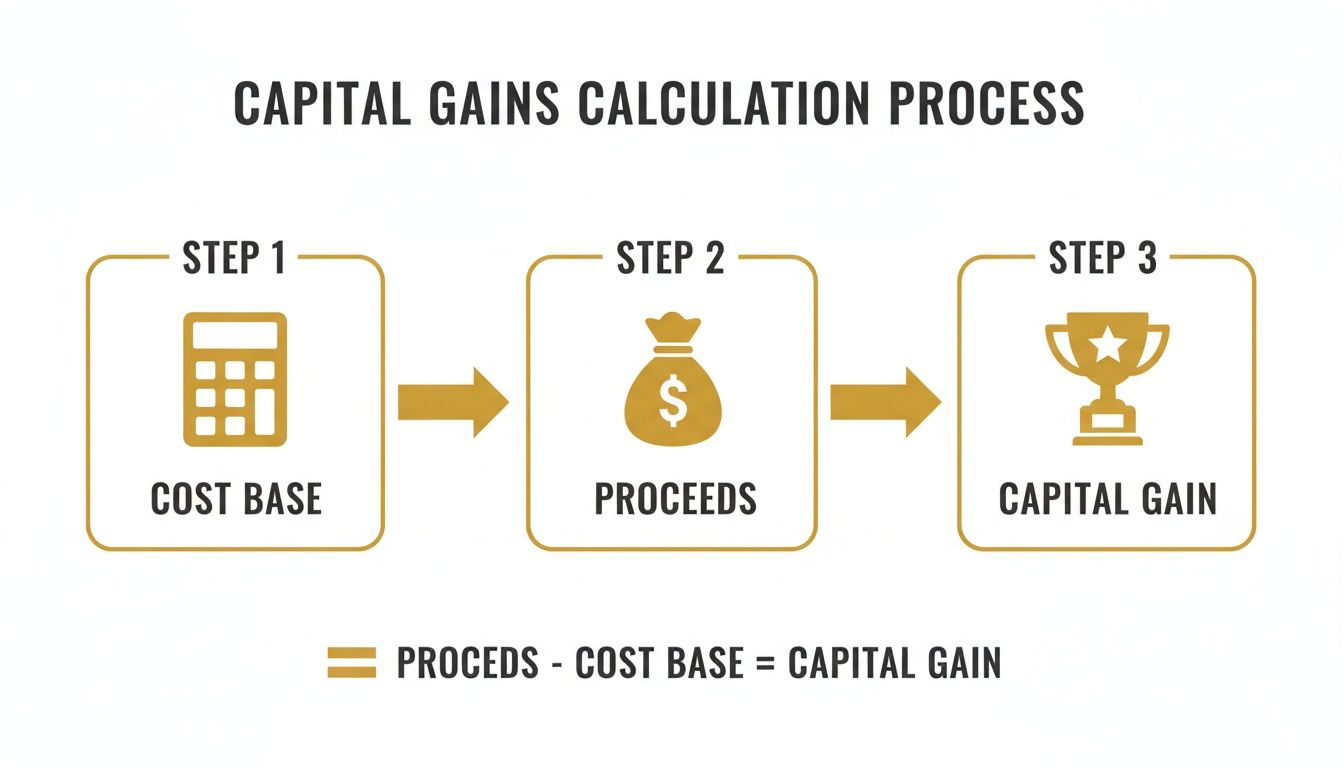
As you can see, the journey starts with locking down your costs, then defining what you walked away with from the sale, before finally arriving at the taxable figure.
Step 1: Build Your Property Cost Base
The cost base is the absolute foundation of your CGT calculation. More than that, it's your single most powerful tool for legally minimising your tax bill. It’s not just the purchase price; it's the grand total of every capital expense you've sunk into buying, holding, and improving the property over the years.
A truly comprehensive cost base is essential. Getting this right means you can significantly reduce your final capital gain, so it pays to be meticulous. Let's break down what goes into it.
The table below outlines the key elements that make up your property's cost base. Tracking these expenses diligently from day one can save you a small fortune when it's time to sell.
Key Components of Your Property's Cost Base
| Cost Element Category | Examples of Includable Expenses | Why It Matters |
|---|---|---|
| Initial Purchase Price | The final contract price you paid for the property. | This is the starting point for your calculation. |
| Acquisition Costs | Stamp duty, legal fees, conveyancing costs, buyer's agent fees, pest and building inspection reports. | These are significant upfront costs that directly increase your cost base. |
| Capital Improvement Costs | Major renovations (new kitchen/bathroom), adding a deck or extension, structural improvements, initial repairs to fix pre-existing defects. | These costs add to the property's value and your cost base, but routine maintenance doesn't count. |
| Title Costs | Legal fees related to preserving or defending your ownership or title of the property. | Any money spent legally protecting your asset can be included. |
| Disposal Costs | Real estate agent commissions, auction costs, advertising fees, legal fees for the sale. | These are the costs of selling, which are subtracted from your proceeds to reduce your final gain. |
By building a detailed and accurate cost base, you ensure that every legitimate expense works to reduce your final tax bill. It's the difference between paying tax on your true profit versus paying tax on an inflated figure.
Crucial point: You can't include any cost you've already claimed as a tax deduction during your ownership. Think things like interest on the investment loan, council rates, or repairs. This rule prevents "double-dipping" on tax benefits. For a deeper dive on what you can claim while you own the property, check out our guide on https://awts.net.au/blog/how-to-calculate-depreciation-on-rental-property/.
Step 2: Determine Your Capital Proceeds
Next up, you need to work out your capital proceeds. This is the total value you receive from selling your property.
For most people, this is simply the contract sale price. However, you don't stop there. You get to subtract the costs you paid to make the sale happen. This includes the real estate agent's commission, advertising fees, and any legal costs associated with the disposal. The figure you're left with is your net capital proceeds—the amount you truly pocketed.
Step 3: Calculate the Final Gain or Loss
Now it’s time to put it all together. The final step is beautifully simple:
Capital Proceeds - Cost Base = Total Capital Gain or Loss
If the result is a positive number, you’ve made a capital gain. If it's negative, you have a capital loss. You can’t claim a capital loss against your regular income, but you can use it to cancel out capital gains from other assets in the same year. If you have no other gains, you can carry it forward to offset future capital gains. To get this right, it's essential to understand how CGT on investment property is calculated in Australia.
For example, let’s say you sell a property for $1.2 million. Your cost base, after adding up the purchase price and all those eligible costs, is $500,000.
Your gross capital gain is $700,000. If you've held the property for more than 12 months, the 50% CGT discount kicks in, effectively halving your taxable gain. This means only $350,000 is added to your taxable income for the year. Assuming a marginal tax rate of 37%, your CGT bill would be around $129,500. Without that discount, you’d be looking at a staggering $259,000. It shows just how powerful the CGT discount can be.
Maximising the 50 Percent CGT Discount

When you wade into the world of selling investment property capital gains tax, the 50% CGT discount is easily the most powerful tool in the average Aussie investor's kit. It’s a major concession from the tax office that directly rewards a long-term, buy-and-hold investment strategy.
Simply put, this discount lets you chop your taxable capital gain clean in half. If you've made a decent profit on your property, applying this discount means only 50% of that gain gets added to your assessable income for the year. The difference this makes to your final tax bill can be monumental.
How to Qualify for the CGT Discount
The rules to get your hands on this discount are straightforward, but they are also incredibly strict. To unlock this massive tax saving, you have to meet two main conditions set by the Australian Taxation Office (ATO).
First up, the property must have been held for at least 12 months before you sign the contract of sale. This clock starts ticking from the date you acquired the asset and stops the moment you dispose of it. Timing is absolutely everything here—selling even one day short of that 12-month mark means you get nothing.
Secondly, the asset has to be owned by the right kind of entity. This includes:
- Individuals
- Trusts (including self-managed super funds)
- Partnerships
A Crucial Distinction: Companies are completely locked out of the 50% CGT discount. This is a vital point for investors who hold property inside a company structure. Understanding the tax implications of your ownership entity from day one is essential for any sensible tax planning.
This discount is a cornerstone of Australia's tax policy on investment. Analysis has shown that since it was introduced, the 50% CGT discount has resulted in forgone tax revenue of $247 billion over 25 years, a figure that highlights its immense value to investors. You can discover more insights into the financial impact of this tax concession on Accounting Times.
The Discount in Action: A Real-World Scenario
To really see the power of the 50% CGT discount, let’s walk through a clear before-and-after example. Imagine an investor named Chloe is getting ready to sell her investment property.
- Gross Capital Gain: Chloe works out her total capital gain is $200,000.
- Holding Period: She’s owned the property for five years.
- Her Marginal Tax Rate: Chloe's income puts her in the 37% tax bracket (plus the Medicare levy).
Now, let's see how the discount completely changes her tax outcome.
Scenario 1: Without the 50% CGT Discount
If Chloe wasn't eligible (let's say she sold after only 11 months), the full $200,000 capital gain would be tacked onto her taxable income. Her tax on this gain would be a painful $74,000 ($200,000 x 37%).
Scenario 2: With the 50% CGT Discount
Because Chloe was patient and held the property for over 12 months, she gets to apply the discount.
- Discount Applied: The $200,000 gain is slashed by 50%, leaving a taxable amount of $100,000.
- Tax Calculation: This $100,000 is added to her income. The tax on this much smaller gain is now only $37,000 ($100,000 x 37%).
Just by meeting that simple holding period rule, Chloe has pocketed an extra $37,000 in tax savings. This example shows exactly why strategic planning around that 12-month mark is so critical. It's a simple rule with a massive financial impact.
Finding Key CGT Exemptions and Concessions

While the 50% discount is a huge help, the Australian tax system has even more powerful tools to slash or completely wipe out your tax bill when you sell a property. Understanding the selling investment property capital gains tax rules becomes far more rewarding once you get your head around these key exemptions.
The biggest one by far is the main residence exemption. Put simply, your family home—the place you actually live—is generally exempt from Capital Gains Tax when you sell it. This rule makes sense; it acknowledges that your home is more than just a financial asset.
For property investors, though, things are rarely that straightforward. What happens if a property has served as both your home and an investment? This is exactly where a strategic understanding of the rules can save you tens of thousands of dollars.
The Main Residence Exemption Explained
At its core, the main residence exemption means you don't pay CGT on the sale of your primary home. To get the full exemption, the property must have been your main residence for the entire time you've owned it.
A couple of other conditions apply: the land around the home must be two hectares or less, and you can't have used the property to generate income. Tick all those boxes, and any capital gain you make is entirely tax-free.
But what if you've run a home business or, more commonly for investors, moved out and rented the place? This is where you might only qualify for a partial exemption. The ATO will need you to calculate the capital gain specifically for the period the property was used to earn an income. To dive deeper, you can learn more about how Australian capital gains tax exemptions work in practice.
The main residence exemption isn't an all-or-nothing rule. It's a flexible provision that can be applied partially, making it crucial for investors who have lived in their rental properties at some stage.
Getting the apportionment right between the exempt and non-exempt periods is absolutely vital for lodging an accurate tax return.
Unpacking the Powerful Six-Year Rule
This leads us to one of the most generous and frequently misunderstood provisions in Australian property tax: the six-year rule. This rule is a complete game-changer for anyone who has needed to move out of their home but wants to hold onto it as an investment.
In short, it allows you to move out of your main residence and rent it out for up to six years without losing the full main residence exemption. During that period, you can still treat the property as your home for tax purposes, meaning any capital gain that builds up during those rental years remains tax-free.
Of course, there are a few critical conditions:
- No Other Main Residence: You can't turn around and nominate another property as your main residence during that same period (with some minor exceptions for when you're moving between homes).
- Income-Producing Period: The six-year clock starts ticking the moment the property is first rented out.
- Multiple Absences: The best part? You can move back in, which resets the clock, and then use the six-year rule all over again for another absence down the track.
This provision offers incredible flexibility for modern life. It lets people take on work placements interstate or overseas, travel, or just try living somewhere new without being forced to sell their home to avoid a massive CGT bill later on.
Applying the Rules in a Real-World Scenario
Let's walk through how this works. Imagine you bought a home in 2018 for $600,000.
- Lived in it: You lived there as your main residence for four years, from 2018 to 2022.
- Rented it out: In 2022, you moved interstate for a new job and started renting the property out. You did this for three years.
- Sold it: In 2025, you decide to sell for $900,000, which gives you a total capital gain of $300,000.
Because your rental period of three years was well under the six-year limit, and you didn't purchase and nominate another main residence, you can apply the full main residence exemption. The entire $300,000 capital gain is completely tax-free.
Just by understanding this one rule, you've saved yourself a potential tax bill that could have easily topped $50,000.
Strategic Timing and Smart Record Keeping
When it comes to the selling investment property capital gains tax, a lot of the heavy lifting happens long before the "For Sale" sign goes up. It really boils down to two things you can actually control: when you sell and how well you’ve kept your records. This is where you move from just calculating tax to actively shaping your financial outcome.
Smart timing can literally shave thousands off your final tax bill. One of the most critical details people miss is that the CGT event is triggered on the date you sign the contract of sale, not the date of settlement. This small distinction opens up a huge window for strategic planning.
For example, if you know your income will be lower this financial year, you might hustle to exchange contracts before June 30. Conversely, if you expect a pay cut next year, delaying the contract signing until July 1 could be a game-changer. The goal is simple: have the capital gain added to your income in a year when your marginal tax rate is as low as possible.
The Power of the Calendar
Timing your sale isn't just about picking the right financial year; it's also about hitting key deadlines. The most famous one, of course, is holding the property for more than 12 months to qualify for that sweet 50% CGT discount. Selling just one day too early could literally double your tax liability. It’s a costly mistake to make.
Broader economic changes, like shifts in income tax brackets, also play a massive role. The Stage 3 tax reforms kicking in from July 2024 are a perfect example. Someone earning $120,000 who sells in the 2025 financial year will have their gain taxed at the new 30% rate, instead of the old 37%. That’s a huge difference, potentially saving thousands, purely by aligning the sale with more favourable tax laws. You can see a great breakdown of how the 2025 tax changes impact property sales with Amplify 11.
Your Non-Negotiable Record-Keeping Checklist
While timing is about strategy, meticulous record-keeping is the foundation everything is built on. Without proof, you can't add an expense to your cost base, and an incomplete cost base means you pay more tax than you need to. The Australian Taxation Office (ATO) can ask for evidence for every single dollar you claim, so keeping organised digital and physical records is simply non-negotiable.
Think of your records as a complete financial diary of the property. Start a folder the moment you even think about buying, and be religious about adding to it.
Your records are your ultimate defence against overpaying tax. Every receipt, invoice, and contract you keep is a tool that directly reduces your taxable capital gain, putting more of your hard-earned profit back in your pocket where it belongs.
Here is the definitive checklist of documents you absolutely must keep for at least five years after you lodge the tax return that includes the sale:
-
Acquisition Records:
- The original purchase contract.
- Conveyancing documents and all related legal fee invoices.
- Proof of stamp duty paid.
- Receipts for building and pest inspections.
-
Improvement Costs:
- Invoices and receipts for all capital works—think renovations, extensions, or any major structural improvements.
- Costs for initial repairs to fix defects that were there when you bought the place.
-
Holding Costs:
- Documents for legal fees if you ever had to defend your title to the property.
- Any loan application and mortgage discharge fees.
-
Disposal Records:
- The final contract of sale.
- Invoices for the real estate agent’s commission and advertising costs.
- Receipts for all legal fees tied to the sale.
This diligent approach ensures your cost base is as high and accurate as legally possible, which directly minimises the profit you’ll ultimately be taxed on.
When Your Former Home Becomes an Investment Property
Many investment properties started life as the owner's home. When you rent out a former main residence, special rules determine how much of any future capital gain is taxable.
Partial Exemption and the Market Value Rule
If a property was your home before becoming a rental, you are generally entitled to a partial main residence exemption for the period you lived there. Under the "home first used to produce income" rule, the property is typically deemed to have been acquired at its market value on the date you first rented it out — so a valuation at that point is essential. The six-year rule may also apply, potentially keeping the gain exempt for up to six years of rental. Getting the dates and valuations right here is where professional advice pays for itself.
Frequently Asked Questions About Selling and CGT
Once you get your head around the formulas for CGT, the real-world questions start popping up. It's one thing to know the principles of calculating tax, but how do they actually play out when you're in the thick of a property sale?
This is where the theory meets reality. Let's tackle some of the most common "what if" scenarios that investors face, so you can plan your sale with a clear head.
When Exactly Do I Pay the Capital Gains Tax?
This is easily one of the biggest points of confusion, especially for first-time sellers. Many people expect a separate tax bill to land in their letterbox shortly after the property settles.
But that’s not how it works. Your net capital gain is simply added to your assessable income for that financial year. You then pay tax on this new, higher total income when you lodge your annual tax return with the Australian Taxation Office (ATO). It’s all rolled into one.
The most important date to remember here is the contract of sale date, not the settlement date. The financial year you sign that contract is the financial year the gain is taxed in.
Can I Claim the Main Residence Exemption if I Rented My Home Out?
Yes, you often can, and this is where you can see the flexibility built into Australia’s tax laws. If the property was your primary home before you started renting it out, you can usually claim a partial exemption from CGT.
The ‘six-year rule’ is your best friend here. It’s a powerful provision that lets you treat the property as your main residence for up to six years after you’ve moved out, provided you’re using it to generate income (like renting it out).
Important Condition: The catch is that you cannot claim another property as your main residence during that same period. Get this right, and you can pocket some significant tax savings, even after the property has been an investment for years.
If you rented it out for more than six years, the exemption gets pro-rated. You’d calculate a partial gain based on the proportion of time it was an investment property versus your home.
What Happens if I Sell My Property at a Loss?
Selling for less than you paid results in a capital loss. While it’s disappointing, this loss is still a valuable asset for tax purposes. You just can’t use it to reduce your regular taxable income, like your salary.
Here’s the process:
- Offset Current Gains: First, you must use the capital loss to cancel out any other capital gains you’ve made in the same financial year. For instance, a loss on your property can wipe out a gain from selling some shares.
- Carry it Forward: If you don't have any other capital gains to offset, or your loss is bigger than your gains, the remaining loss can be carried forward indefinitely. You can then use it against capital gains in future years.
This means a loss today could still help reduce your tax bill on a different, successful investment years from now.
Are Ownership Costs Included in the Cost Base?
This is a crucial point to get right to avoid "double-dipping" on tax deductions. The general rule is you cannot include ongoing ownership costs in your cost base if you have already claimed them as tax deductions against your rental income.
These are your typical running expenses:
- Interest on the investment loan
- Council and water rates
- Land tax
- Insurance premiums
- Property management fees
- Repairs and maintenance
Your cost base is reserved for capital costs—the big-ticket items related to buying, significantly improving, and selling the property. Trying to include expenses you've already claimed is a surefire way to attract unwanted attention from the ATO.
How Does CGT Work for Inherited Properties?
Inheriting a property throws another layer of complexity into the mix. The tax rules depend heavily on when the deceased bought the property and what it was used for.
- Pre-CGT Asset (Acquired before 20 September 1985): If you inherit a property the deceased purchased before this date, you might be completely exempt from CGT when you sell it, as long as it wasn't used to produce income.
- Post-CGT Asset (Acquired on or after 20 September 1985): If the property was the deceased's main home, you’re generally exempt from CGT if you sell it within two years of their passing.
- Investment Property: If you inherit a rental property, you also inherit its cost base. When you sell, your capital gain or loss is calculated from what the deceased originally paid, not its value when you received it.
Given how tricky this can get, getting professional advice for an inherited property is always a smart move to ensure everything is handled correctly.
Depreciation reduces an asset's cost base. When you sell, previously claimed Division 40 depreciation triggers a balancing adjustment. For Division 43 capital works deductions claimed from 1 July 2017, the amount reduces the building's cost base, increasing the eventual capital gain. The interaction between depreciation and CGT requires careful calculation at time of sale.
A quantity surveyor prepares a tax depreciation schedule by physically inspecting the property and identifying all depreciable assets and their values. The ATO accepts these estimates for depreciation claims where original receipts are unavailable. The fee is tax deductible. A schedule maximises your annual depreciation claims based on a comprehensive site assessment.
Division 43 covers the capital works deduction on structural components (walls, floors, roof) at 2.5% per year for buildings constructed after 15 September 1987. Division 40 covers plant and equipment (appliances, carpet, blinds) depreciated over their ATO-determined effective life. Post-May 2017 legislation restricts Division 40 claims on second-hand residential assets for new buyers.
Yes. The May 2017 restrictions on second-hand plant and equipment only apply to residential properties. Commercial property investors can still claim Division 40 depreciation on second-hand assets. Division 43 capital works deductions apply to both property types based on construction date, not acquisition date.
Keep the purchase contract, settlement statement, receipts for capital improvements, and a quantity surveyor's depreciation schedule. The ATO can request these records for five years after the relevant income year. Without records, depreciation claims can be reduced or disallowed on audit, and you may lose the ability to substantiate cost base adjustments at sale.
Navigating the specifics of selling investment property capital gains tax requires careful planning and a clear understanding of the rules. To ensure you maximise your return and meet all your ATO obligations, professional guidance is invaluable. The experts at Australia Wide Tax Solutions specialise in property tax and can help you develop a strategy that minimises your tax liability.
Don't leave your hard-earned profits on the table. Contact us today for personalised advice at https://www.awts.net.au.
