

Who Can Claim Home Office Tax Deductions
The massive shift to remote and hybrid work has thrown the door wide open for many Australians to claim deductions. However, the Australian Taxation Office (ATO) has crystal-clear rules about who actually qualifies. It’s not enough to just work from your kitchen table; you need to meet specific criteria proving you have genuine, work-related expenses. Think of it this way: your home workspace is like a "mini-branch" of your main workplace. The ATO lets you claim the extra costs of running this branch. But what you can claim hinges on one critical question: are you an employee or are you running your own business from home? Getting this right is crucial.Running Expenses vs Occupancy Expenses
The ATO splits home office costs into two distinct buckets, and your eligibility for each is completely different.- Running Expenses: These are the day-to-day costs of using your home office. Both employees and business owners can claim these. This covers things like electricity for heating, cooling, and lighting; your internet and phone bills; and the depreciation of your office furniture and equipment.
- Occupancy Expenses: These are costs tied to owning or renting your home, like mortgage interest, rent, council rates, and home insurance. For employees, these are a definite no-go. The ATO sees them as private, domestic costs. But, if you’re a sole trader and your home is your main place of business, you might be able to claim a portion of these.
Employment Status Matters Most
At the end of the day, your employment status is the single biggest factor that decides what you can claim. An employee working from home—whether it's full-time or just a couple of days a week—must have paid for the expenses themselves and not been reimbursed by their boss. They can only claim the additional running costs that are a direct result of their work. On the other hand, sole traders, freelancers, and independent contractors usually have broader rights. If their home is their primary base of operations, they can often claim both running and occupancy expenses. It’s vital to know where you stand, and you can get more clarity by understanding the difference between an employee and an independent contractor. With the explosion of remote work in Australia, there's been a huge jump in claims for home office expenses. ATO data shows that a massive chunk of the workforce, from hybrid employees to sole traders, are now claiming these deductions. While employees are restricted to running costs, many sole traders successfully claim occupancy expenses like mortgage interest and rent when their home is their primary business base. No matter your status, you’ll need to pick one of two methods to calculate your claim. We’ll dive into those next.- Fixed Rate Method: A simple, all-in-one rate for every hour you work from home.
- Actual Cost Method: A detailed calculation where you add up every single real work-related expense.
Choosing Your Best Claiming Method
When it comes to claiming your work-from-home tax deductions, the Australian Taxation Office (ATO) gives you two distinct paths. Think of it like this: one is a straightforward, paved road, while the other is a more detailed, scenic route that could lead to a bigger reward at the end. Your choice between the Fixed Rate Method and the Actual Cost Method will directly shape your tax refund and the amount of paperwork you'll need to handle. Getting your head around the fundamental differences is the key to maximising your return without drowning in admin. So, let’s break down each approach to figure out which one is the right fit for you. This flowchart gives you a quick visual guide to see which path might suit you based on your job and the kinds of expenses you're racking up.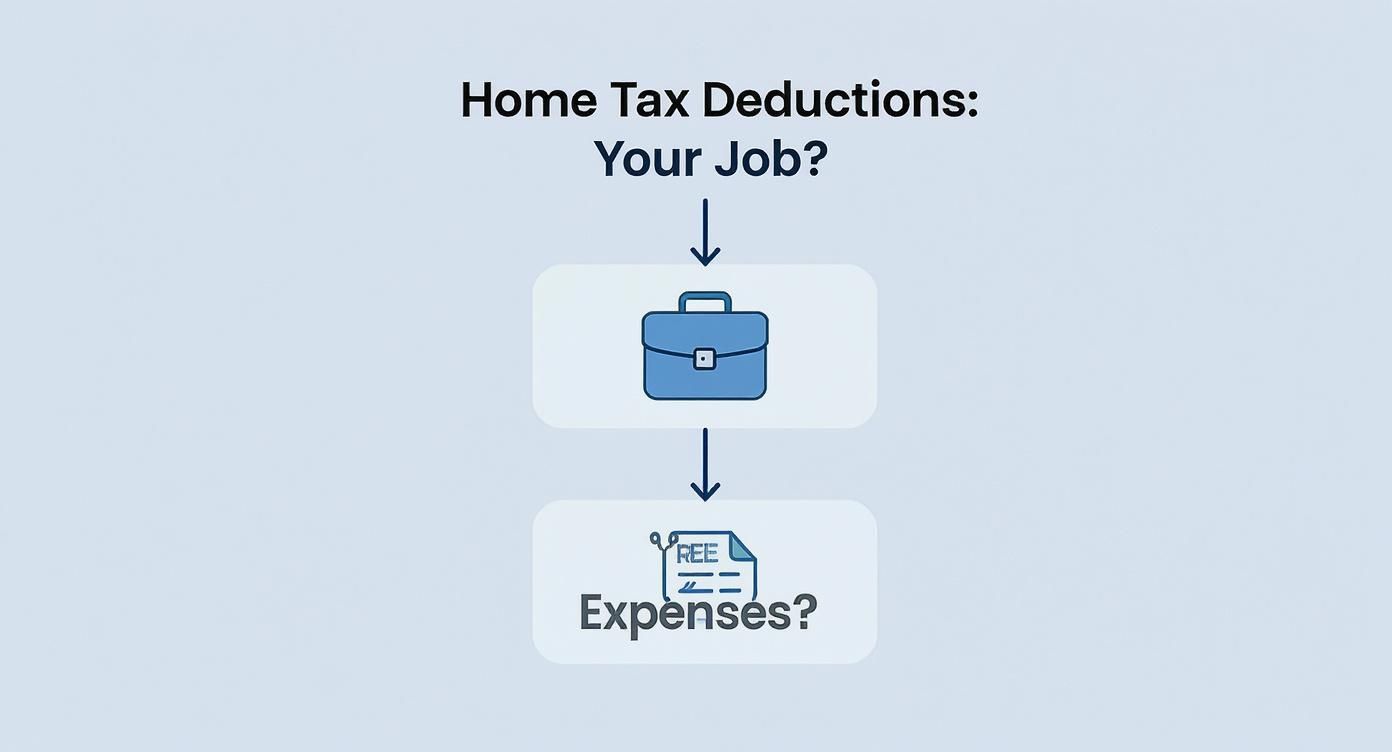
The Simple Path: The Fixed Rate Method
The Fixed Rate Method is basically the 'set-and-forget' option. It’s built for simplicity and convenience, making it a go-to choice for employees with fairly standard home office setups. Instead of calculating the work-related slice of every single bill, you just claim a flat rate for each hour you work from home. Easy. To keep up with the rising cost of living, the ATO has been updating this rate. For the 2024-25 financial year, the fixed rate is 67 cents per hour you work from home. This single figure is an all-in-one rate that covers common running expenses like electricity, gas for heating and cooling, home and mobile phone usage, internet, stationery, and computer consumables. You can get more insights on how the fixed rate method works at thriday.com.au.The biggest selling point of the fixed rate is its sheer simplicity. All you need is a record of the hours you've worked from home—like a timesheet or diary—instead of a shoebox overflowing with receipts for tiny expenses.But here’s the crucial trade-off. When you use this method, you can't double-dip by making separate claims for the specific expenses it already covers. For instance, you can't claim the 67 cents per hour and also claim a portion of your internet bill. You can, however, still claim the depreciation of big-ticket items like computers and office furniture separately.
The Detailed Route: The Actual Cost Method
On the other hand, the Actual Cost Method is the itemised approach. It’s like being a detective, meticulously tracking every single dollar you spent on running your home office. This method is often the better choice for people with significant or specialised expenses that blow past what the fixed rate would offer. With this approach, you calculate the actual work-related portion of all your home office running costs. This means you’ll need to keep excellent records—receipts, invoices, and utility bills—and then work out what percentage of each cost was genuinely for work. Common claims under this method include:- Utility Bills: A portion of your electricity and gas bills based on your actual work usage.
- Phone and Internet: The work-related percentage of your phone and internet expenses.
- Stationery and Supplies: The cost of items like printer paper, ink, pens, and notebooks.
- Asset Depreciation: The decline in value of expensive items like your desk, chair, computer, and monitors.
Calculating Your Work-Related Portion
To use the Actual Cost Method correctly, you need a fair and reasonable way to split your household bills between personal and work use. The ATO accepts a couple of common ways to do this:- Floor Area Method: You calculate the size of your dedicated home office as a percentage of your home's total floor area. If your office takes up 10% of your home's total space, you can claim 10% of your shared utility bills. This is perfect for those with a separate, dedicated home office.
- Diary Method: For expenses like your phone and internet, you can keep a detailed diary for a typical four-week period to track your work-related usage. If you find that 40% of your internet data was used for work during that month, you can apply that 40% to your internet bills for the whole year.
Fixed Rate vs Actual Cost Method at a Glance
Still on the fence? This table breaks down the key differences to help you decide which method aligns best with your situation.| Feature | Fixed Rate Method | Actual Cost Method |
|---|---|---|
| Record-Keeping | Simple. Just need a record of hours worked from home (e.g., timesheet, diary). | Detailed. Requires receipts, bills, and calculations for every expense. |
| Calculation Simplicity | Very easy. Hours worked × 67 cents. | Complex. Involves calculating work-related percentages of multiple individual expenses. |
| What's Covered | A bundle of running costs (utilities, phone, internet, stationery). | Claim the actual work-related portion of every single eligible expense. |
| Separate Claims | Can still claim depreciation on assets (e.g., computer, desk) separately. | All eligible expenses, including depreciation, are claimed individually. |
| Potential Claim Amount | Often lower, but offers convenience and predictability. | Potentially much higher, especially for those with significant home office costs. |
| Best For | Employees with simple setups, or those who value convenience over a larger deduction. | Self-employed individuals or employees with a dedicated office and high running costs. |
The Complete Checklist of Home Office Expenses
Running Costs: The Day-to-Day Essentials
These are the ongoing expenses that keep your home office ticking over. They’re often the easiest to forget about, but they really add up over a financial year. Just remember, you can only claim the work-related percentage of these bills.- Electricity and Gas: This covers the extra power you use for lighting, heating, and cooling your dedicated workspace while you're on the clock.
- Phone and Internet Bills: You can claim the portion of your mobile phone and home internet costs that directly relate to your work. Keeping a four-week diary is the best way to prove a reasonable work-use percentage to the ATO.
- Cleaning Costs: This is a big one that people often miss. If you have a dedicated home office, you can claim a portion of cleaning expenses—whether you hire a professional or buy the supplies yourself.
Office Assets: The Big-Ticket Items
Office assets are the more substantial, long-lasting items that form the backbone of your workspace. The Australian Taxation Office (ATO) has specific rules for these, and it all comes down to how much they cost. Think of it this way: small purchases are like snacks you eat right away, while larger ones are like pantry staples you use over a long period. The tax rules reflect this difference.The $300 Rule of Thumb: Any work-related asset you buy for $300 or less can usually be claimed as an immediate, full deduction in the same financial year. For anything costing more than $300, you have to claim its depreciation—the decline in value—over several years.Getting this distinction right is absolutely critical for lodging a correct claim and avoiding any red flags with the ATO.
What to Claim
- Office Furniture: Your desk, ergonomic chair, filing cabinets, and bookshelves all fall into this bucket.
- Technology and Equipment: This includes your computer, laptop, monitor, printer, and scanner.
- Depreciation of Assets: For any of those items costing over $300, you'll calculate their decline in value over their "effective life," as set by the ATO. It sounds complex, but it simply ensures your deduction accurately reflects how the asset is used over time.
Office Supplies and Subscriptions: The Consumables
Finally, we have the everyday items and services that you chew through in the course of your work. They might seem small individually, but their combined value can be surprisingly high when you add them all up. Make sure you keep receipts for these purchases. They’re often paid for out-of-pocket and are incredibly easy to forget when tax time rolls around.Common Supplies to Track
- Stationery: This is everything from printer paper and ink cartridges to pens, notebooks, and folders.
- Computer Consumables: Think USB drives, cables, mouse pads, and other small tech gear.
- Professional Subscriptions: The cost of work-related software (like Adobe Creative Suite or Microsoft 365), professional journals, or memberships to industry bodies are all claimable.
- Postage and Delivery: If your job requires you to send mail or packages, these costs are deductible.
How to Calculate Your Claim with Real-World Scenarios
Sarah the Hybrid Employee Using the Fixed Rate Method
First up is Sarah, a marketing manager who works from her Sydney apartment three days a week. She’s carved out a workspace in the corner of her living room. Since her expenses are pretty straightforward and she values simplicity, the Fixed Rate Method is the perfect fit. Her main job here is to keep an accurate log of her work-from-home hours. Sarah uses a simple digital timesheet, jotting down her start and finish times each day she works remotely. Easy. Step 1: Tally the Hours Worked from Home First, Sarah adds up her total hours for the year. She works a standard 8-hour day from home, three days a week.- Weekly Hours: 8 hours/day × 3 days/week = 24 hours
- Annual Hours: 24 hours/week × 48 working weeks/year = 1,152 hours
- Calculation: 1,152 hours × $0.67/hour = $771.84
Sarah's total deduction using the Fixed Rate Method is $771.84 plus the depreciation claim for her chair. This approach needed minimal paperwork—just her timesheet and the receipt for the chair.
David the Freelance Consultant Using the Actual Cost Method
Now, let's look at David. He's a freelance graphic designer who uses a spare bedroom in his house exclusively as his studio. With a dedicated space and significant running costs, the Actual Cost Method is a no-brainer to maximise his deduction. For David, meticulous record-keeping is key. He needs to hang onto every single relevant bill and receipt. Step 1: Calculate the Home Office Percentage First, David figures out what percentage of his home is used for his business. He'll use this percentage to divvy up his shared household bills.- David's Office Area: 12 square metres
- Total Home Area: 120 square metres
- Work-Use Percentage: (12 sqm / 120 sqm) × 100 = 10%
- Annual Electricity Bill: $2,200 → Claimable amount: $2,200 × 10% = $220
- Annual Gas Bill: $900 → Claimable amount: $900 × 10% = $90
- Annual Internet Bill: $1,080 (He tracks 50% business use via a diary) → Claimable amount: $1,080 × 50% = $540
- Stationery and Supplies: $350
- Business Software Subscription: $600
- Electricity Claim: $220
- Gas Claim: $90
- Internet Claim: $540
- Supplies: $350
- Software: $600
- Computer Depreciation: $700
- Total Claim: $2,500
Mastering Your Records to Satisfy the ATO
Making a claim for a tax deduction is only half the job. Proving it is what actually gets you the refund. Even the most legitimate work-from-home expense can be thrown out by the Australian Taxation Office (ATO) if you don’t have a solid audit trail to back it up. This isn't about drowning in paperwork; it's about being smart and consistent with your records. Think of your records like the foundation of a house. If it's weak, the whole thing will crumble under the slightest pressure—like an ATO audit. A strong one, however, ensures your claim stands firm, giving you complete peace of mind when you lodge. The goal is to shift your mindset. Keeping records isn't just a chore; it's the final, critical step in securing the tax deductions for working from home you've rightfully earned.Your Essential Documentation Checklist
The specific documents the ATO needs from you will hinge on which method you use to claim. Each path has its own set of non-negotiables.- For the Fixed Rate Method: The big advantage here is simplicity. Your main job is to keep a running tally of the total hours you worked from home during the financial year. A timesheet, entries in a digital calendar, or even a simple diary noting your hours each day will do the trick.
- For the Actual Cost Method: This is where the detail really matters. You need to hang on to every relevant receipt, invoice, and bill. We're talking everything from electricity and internet bills to receipts for stationery and the contract for your new office desk.
Red Flags That Attract ATO Attention
The ATO uses sophisticated data-matching technology to spot claims that look out of place. Certain patterns are far more likely to trigger a review, so you need to know what looks suspicious from their end.One of the quickest ways to attract unwanted scrutiny is by making claims that seem way out of proportion for your income or what you do for a living. Your best defence is always to be honest and reasonable.Here are a few common mistakes that can put your tax return squarely under the microscope:
- Claiming 100% of a shared utility bill. It's almost impossible that your phone, internet, or electricity is used entirely for work. You must have a clear method for calculating and claiming only the work-related portion.
- A massive, sudden jump in your claims. If your home office deductions suddenly double from one year to the next without a good reason (like a promotion or change of role), it can raise questions.
- Failing to apportion costs correctly. Just guessing at your work-use percentage won't cut it. You need a logical, defensible basis for your calculation, like a floor-space measurement for your home office or a detailed four-week usage diary.
Modern Tips for Organised Record-Keeping
Keeping your documents in order doesn’t have to mean a shoebox overflowing with faded receipts. Digital tools make it easier than ever to stay organised all year, which means no more last-minute panic when tax time rolls around. A simple trick is to set up dedicated digital folders on your computer or cloud drive, sorted by financial year and then by expense type. A basic spreadsheet where you log expenses as they happen is also incredibly powerful. If you want to take it a step further, check out the various digital ways of record-keeping available, including apps that let you snap a photo of a receipt and automatically file it away. Be aware that the 2025 Australian tax year brings stricter ATO rules for work-from-home deductions, largely in response to a surge in questionable claims. The ATO has made it clear: you can only claim the additional running expenses that are a direct result of working from home, and every single claim must be backed by solid evidence. While the fixed rate method is still an easy option, remember that it bundles costs like phone and internet, so you can't claim them separately on top.Your Common Home Office Deduction Questions Answered
When it comes to claiming tax deductions for working from home, a few tricky questions always seem to pop up. Even when you think you’ve got the rules down pat, specific situations can leave you feeling unsure. Let's clear up the most common queries we hear from our clients every single day. Think of this as your final checklist, designed to iron out any last-minute doubts so you can lodge your tax return with total confidence.Can I Claim Rent or Mortgage Interest as an Employee?
This is probably the number one question we get asked, and the Australian Taxation Office (ATO) has a very clear and firm answer: no. As an employee, you can’t claim occupancy expenses. This bucket includes your rent, mortgage interest, property insurance, and council rates. Why not? The ATO views these costs as private expenses you’d have anyway, just for owning or renting your home, regardless of your work setup. These kinds of deductions are really only for sole traders or business owners who use a part of their home exclusively as their main place of business.How Do I Calculate the Work-Use Part of My Phone and Internet?
If you're using the actual cost method, you can't just pluck a number out of thin air for shared bills like your phone and internet. The ATO needs to see that you have a reasonable, logical way of working out your work-use percentage. The best approach is to keep a detailed diary over a typical four-week period.- For your phone: Go through a bill from that period and work out what percentage of your calls or data was genuinely for work.
- For your internet: Estimate the percentage of your home internet data you used for work-related tasks during those four weeks.
What Happens If I Buy Office Furniture for Over $300?
Any single work-related asset you buy that costs more than $300 can't be claimed as an immediate, one-off deduction. This rule applies to bigger ticket items like a quality ergonomic chair, a new desk, or that fancy large monitor you’ve been eyeing. Instead, you claim the decline in its value over its useful life. This is a process called depreciation. The ATO provides guidelines on the "effective life" for different types of assets, which tells you over how many years you can claim a slice of its cost.For example, you’d claim a percentage of your new desk's value each year for several years. On the flip side, any items costing $300 or less can be claimed as an immediate deduction for the full work-related portion in the year you bought them.
Do I Need a Separate Room to Claim Deductions?
No, you don't need a completely separate room with a door to claim running expenses. Plenty of people successfully claim costs for working from a specific spot in a shared space, like a corner of the living room or a nook set up in a hallway. The key thing is that you must have a dedicated work area. You can then only claim the costs of running that specific spot for the hours you are actually working there. Of course, having a separate room does make life a lot easier, especially if you're using the actual cost method. It gives you a clear, defensible floor area percentage to apply to household bills like electricity for heating and cooling, which makes justifying your claim much more straightforward.Navigating tax deductions can be complex, but you don't have to do it alone. The experts at Australia Wide Tax Solutions are here to ensure you claim everything you're entitled to. Whether you prefer an in-office chat or a secure online process, we make lodging your tax return straightforward and stress-free. Book your appointment today.
The ATO provides guidance through ato.gov.au, the Small Business Support Line (13 28 66), and Online Services for individuals and businesses. For complex situations, a registered tax agent provides advice tailored to your specific circumstances and professional indemnity protection. You can verify agent registration at the TPB register at tpb.gov.au.
Most tax records must be kept for five years from the date of lodgement or the date the transaction occurred, whichever is later. Records must be in English or convertible to English and must be sufficient to explain the income and deductions in your return. The ATO can request records at any time during the retention period.
Consider a registered tax agent when your affairs involve multiple income sources, business activity, investment properties, capital gains, or overseas income. Agents extend your lodgement deadline, provide safe harbour protection, and take professional responsibility for the advice given. Verify registration at tpb.gov.au.
The failure to lodge penalty is based on penalty units ($313 per unit from 1 July 2023), accruing per 28-day period for late returns and BAS lodgements. Incorrect information penalties range from 25% to 75% of the tax shortfall depending on whether the behaviour was careless, reckless, or intentional. Proactive disclosure before an audit begins typically results in significantly reduced penalties.
Tax minimisation is the legal arrangement of your affairs to reduce tax — claiming all eligible deductions, using appropriate structures, and timing income and expenses. Tax avoidance involves arrangements that technically comply with the law but achieve outcomes parliament did not intend. The ATO can apply Part IVA anti-avoidance rules to cancel benefits from avoidance arrangements.
