

The Purpose of the Medicare Levy

Medicare Levy At a Glance
| Component | Brief Explanation |
|---|---|
| What it is | A premium paid by most Australian taxpayers to fund the public healthcare system. |
| How it's calculated | As a percentage of your taxable income, collected through your tax return. |
| Primary Purpose | To ensure all Australians have access to essential medical services. |
| Key Funded Services | Doctor visits, public hospital care, medical tests, and subsidised medicines. |
What the Levy Funds
So, where does your money actually go? The funds collected are specifically channelled into the Medicare system, helping to cover:- Doctor and specialist consultations: Subsidising the cost when you visit your local GP or a specialist.
- Public hospital services: Paying for treatment and accommodation if you need to be admitted to a public hospital.
- Tests and examinations: Helping cover the costs of crucial diagnostics like X-rays and blood tests.
- Pharmaceutical Benefits Scheme (PBS): Making thousands of prescription medicines significantly more affordable.
In essence, the Medicare levy is a social contract. It’s the shared commitment we all make to ensure that if a fellow Australian gets sick or injured, they can get the medical care they need without facing financial ruin.It's a foundational piece of our tax system, built on the idea of creating a healthier society by pooling our resources for the common good. Without it, the world-class healthcare we often take for granted just wouldn't be possible.
The Story Behind Australia's Medicare Levy
To really get your head around the Medicare levy, you have to look past the line item on your tax return. This isn't just another tax; it's a core piece of Australia's identity, hammered out over decades of fierce political debate and built on a promise of universal healthcare for everyone. The whole thing started with a pretty bold vision. The idea of a special tax just for public health has a long and often fiery history, kicking off with the Whitlam Labor Government way back in 1974. They proposed a 1.35% levy on income to fund their ambitious new system, called Medibank. But the Senate shot it down, putting the idea on ice. If you want the full legislative drama, you can dig into the backstory of Medicare's funding model. It took another decade for the idea to finally stick. In 1984, the Hawke Labor Government brought it back to life, rebranding the system as Medicare. This time, a 1% levy on taxable income came with it, creating that direct link between what we earn and how our public health system is funded.Evolving with the Nation's Needs
Since it was born, the Medicare levy has never just sat still. It's proven to be a flexible tool, changing over the years to keep up with the needs of a growing Australia. Different governments have tweaked the rate to make sure our social support systems not only survive but expand. One of the biggest recent changes was to help bankroll another huge social program: the National Disability Insurance Scheme (NDIS). The levy was increased specifically to help fund this scheme, which gives support to Australians with a permanent and significant disability. It’s a perfect example of how the levy can be adapted to fund critical national priorities, not just what we'd traditionally call healthcare.The history of the Medicare levy shows it’s more than a tax—it’s a living piece of social policy. It reflects Australia’s ongoing promise to care for its citizens, adapting its structure to uphold the principles of fairness and collective responsibility.
A Legacy of Universal Care
From its rocky start to its current form, the levy’s story is one of sheer persistence. It stands for a fundamental Aussie belief: that getting quality healthcare is a right, not something that should depend on how much money you have. This backstory is what gives the levy its meaning today. It’s not just a deduction from your paycheque; it's your contribution to a legacy of universal care that’s been fought for and fine-tuned over generations. It’s what keeps the system strong for all of us.How Your Medicare Levy Is Calculated
Figuring out what the Medicare levy costs you in practice comes down to three key numbers: your taxable income, the standard levy rate, and specific income thresholds set by the Australian Taxation Office (ATO). For most Aussies, the calculation is pretty straightforward. The standard Medicare levy is 2% of your taxable income. It’s applied to your income after you’ve claimed all your deductions, just like regular income tax. But it’s not a flat 2% for everyone—where your income lands in relation to certain thresholds determines what you actually pay. This infographic traces the history of the Medicare levy, from its initial proposal as Medibank all the way through to its current form.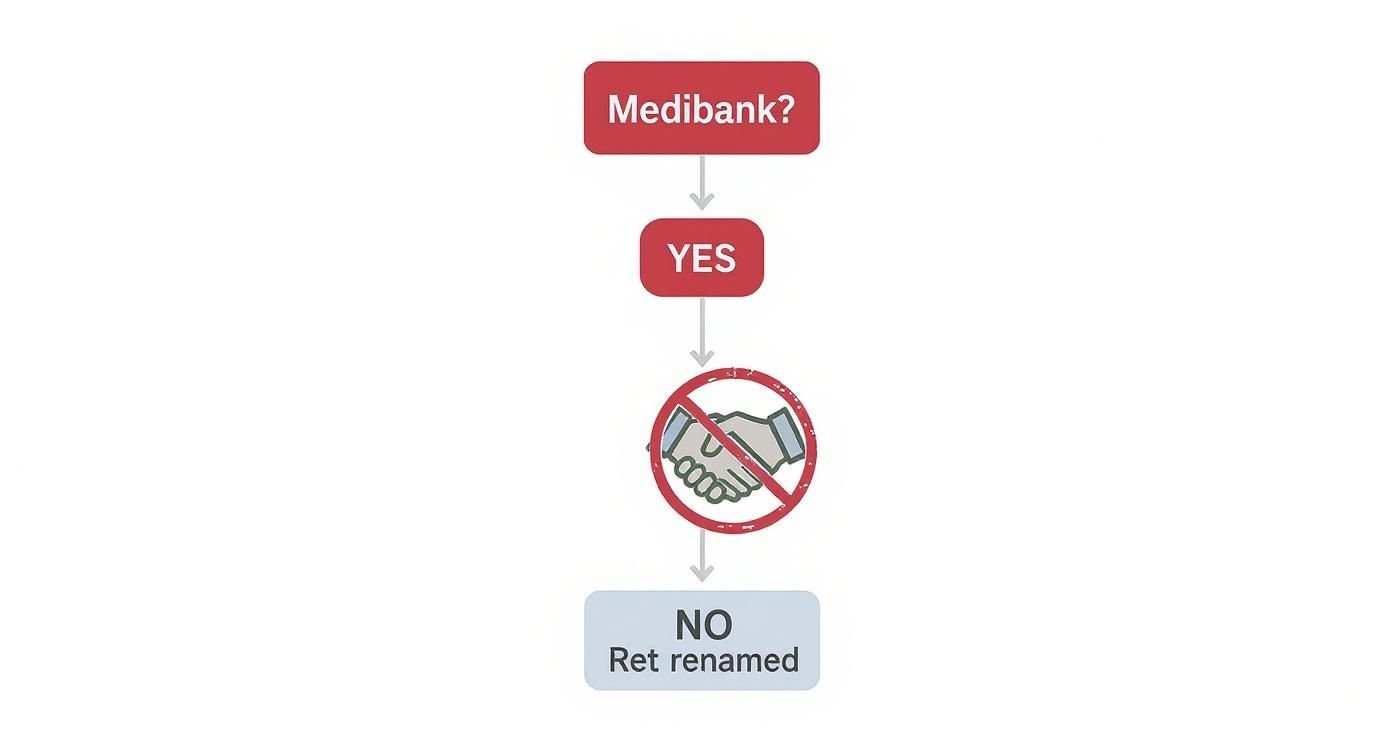
The Role of Income Thresholds
To keep the system fair, the ATO sets income thresholds every financial year. These thresholds decide whether you pay the full levy, a reduced amount, or nothing at all. It’s a progressive approach, meaning lower-income earners contribute less. There are three main outcomes based on these thresholds:- No levy: If your income is below the lower threshold, you don't pay any Medicare levy. Simple.
- Reduced levy: If your income falls within a specific "phase-in" range, you pay a reduced rate—something less than the full 2%.
- Full levy: If your income is above the upper threshold, you pay the full 2% levy.
Making Sense of the Phase-In Range
The "phase-in range" is where people often get confused, but the idea behind it is simple. Instead of a sudden jump from paying nothing to paying the full 2%, the levy is gradually introduced as your income increases between the lower and upper thresholds. If your taxable income falls into this sweet spot, the ATO calculates your levy at 10% of the income amount that is over the lower threshold. This makes for a smooth and gradual increase in the levy you pay.Key Takeaway: The Medicare levy isn't a one-size-fits-all tax. It's a progressive system designed to be fair, using income thresholds to adjust how much you contribute to Australia’s public health system.Let's look at a practical example. Imagine a single person with a taxable income that puts them just inside the phase-in range. They wouldn't pay the full 2%, but a smaller, calculated percentage based on how far their income is above that "no levy" starting point. For instance, if the lower threshold for a single person is $24,276 and their income is $25,000, they don't get hit with 2% on the full amount. Instead, they pay 10% of the difference ($25,000 - $24,276 = $724). Their total levy would be just $72.40—a much smaller figure than the $500 it would be at the full 2% rate. This graduated system is designed to protect low-income earners from a sudden tax hit.
Who Qualifies for Medicare Levy Exemptions
While most of us chip in for Medicare through our taxes, not everyone is required to. The system has specific rules for people who don't have to pay the levy, but getting an exemption isn't automatic. You need to meet some pretty strict criteria set by the Australian Taxation Office (ATO) and then formally claim it on your tax return. Figuring out if you qualify is a big deal—it can save you from paying tax you simply don’t owe. The exemptions are generally sorted into a few clear categories, each with its own specific rules. Whether you can claim a full or partial exemption will come down to your personal circumstances during the financial year.The Main Exemption Categories
The ATO lays out three main groups of people who might be off the hook for the Medicare levy. You could fit into one of these if you meet the conditions for all, or even just part, of the year.- Medical Exemption: This is for people with specific medical circumstances, like being certified legally blind or having received a sickness allowance from Centrelink.
- Foreign and Temporary Residents: If you're considered a foreign resident for tax purposes or you're a temporary resident not entitled to Medicare benefits, you may be exempt.
- Not Entitled to Medicare Benefits: This bucket covers people who, for one reason or another, can't access the Medicare system. It often applies to temporary visa holders from countries that don't have a reciprocal healthcare agreement with Australia.
Important Note: An exemption is not the same as a reduction. An exemption means you pay $0 levy for the time you qualify. A reduction, on the other hand, is for low-income earners and just brings down the amount you have to pay.
Proving Your Eligibility
If you think you fall into that third category—not being entitled to Medicare benefits—you can't just tick a box on your tax form and call it a day. First, you need to get official proof from Services Australia. This proof comes in the form of a Medicare Entitlement Statement (MES). It’s an official document that confirms you weren't eligible for Medicare benefits for a particular period. You absolutely must have this statement in hand before you lodge your tax return and claim the exemption with the ATO. The process involves an application and providing supporting documents to Services Australia to verify your status. This can be a tricky process, especially figuring out exactly which documents you need to supply. For a detailed walkthrough, learning more about the Medicare levy exemption form can give you the clarity you need to get your application right the first time and avoid any hold-ups with your tax return.Claiming a Partial Year Exemption
What if you only qualify for part of the year? That's completely fine. For instance, maybe you were a temporary resident for the first six months and then became a permanent resident. In that case, you could claim an exemption for that first half of the year. The ATO works this out based on the exact number of days you were exempt. If you qualify for the full 365 days of the income year, you pay no levy at all. But if you were exempt for, say, 180 days, you’ll get an exemption for roughly half the year, and your levy will be adjusted to reflect that.Understanding the Medicare Levy Surcharge

How the Surcharge Is Triggered
The MLS isn't a flat fee. It’s a percentage of your income, and it all comes down to specific income thresholds set by the ATO. For this calculation, the ATO looks at your ‘income for MLS purposes,’ which is more than just your taxable income—it also includes things like reportable fringe benefits and super contributions. The surcharge was first introduced in the early 2000s for taxpayers without private hospital cover who earned above certain income levels. Back then, the thresholds were $50,000 for singles and $100,000 for families, but these are adjusted over time. If you're curious about how Australian healthcare funding has evolved, this international policy overview is a great resource. Today, the surcharge is applied at different rates, climbing higher as your income increases. Getting your head around these tiers is absolutely essential for smart tax planning.The Medicare Levy Surcharge creates a direct financial link between your income, your private health insurance choices, and your final tax bill. It’s a clear case where making an informed decision about insurance can significantly reduce the tax you pay.For many higher-income earners, the annual cost of a basic private hospital policy can actually be less than the surcharge they would otherwise have to pay the ATO.
Surcharge Rates and Income Tiers
The ATO sets out specific income tiers that determine your MLS rate, which can be 1%, 1.25%, or 1.5% of your income. The base income threshold—the point where the surcharge starts—is currently $97,000 for singles and $194,000 for families. Here’s a simple breakdown of how the tiers work:- Base Tier: If you earn above the base threshold but below the next tier, you'll pay a 1% surcharge.
- Tier 2: As your income moves into the next bracket, the surcharge climbs to 1.25%.
- Tier 3: For the highest income earners, the surcharge maxes out at 1.5%.
Common Questions About the Medicare Levy
Even when you think you've got a handle on the Medicare levy, a few tricky questions always seem to pop up. It's a core part of our tax system, so it's only natural to have a few points of confusion. Let’s clear up some of the most common queries with straightforward, practical answers. Getting these details right is the key to lodging a clean tax return and making sure you’re meeting your obligations correctly.Do I Still Pay the Medicare Levy If I Have Private Health Insurance?
Yes, you almost certainly do. This is hands-down the most frequent point of confusion for Aussie taxpayers. Having private health insurance does not get you out of paying the standard 2% Medicare levy. Think of the levy as your fundamental membership fee for the entire public healthcare system—the one that’s there for all Australians. It’s what funds GP visits, public hospital stays, and the subsidised medicines we all rely on. It’s a collective responsibility. However, having an appropriate level of private hospital cover is what helps you avoid the separate Medicare Levy Surcharge (MLS), but only if you're a higher-income earner. The levy is for nearly everyone; avoiding the surcharge is a specific financial perk of taking out private cover.Is the Medicare Levy the Same As the NDIS Levy?
They're tightly connected, but you won't see two separate charges on your tax assessment. The government integrated the funding mechanism, which is where the confusion comes from. Back in 2014, the standard Medicare levy rate was bumped up from 1.5% to 2.0%. That extra 0.5% was specifically introduced to help fund the National Disability Insurance Scheme (NDIS), a critical program providing support to Australians with a permanent and significant disability.So, while a slice of the Medicare levy you pay goes directly towards the NDIS, it’s not a separate or additional tax. It's all collected within that single 2% Medicare levy, keeping the process simpler for taxpayers.
How Do I Prove I Am Exempt from the Medicare Levy?
Claiming an exemption isn't automatic; you have to actively prove to the ATO that you're eligible. An exemption means you weren't required to pay the levy for all or part of the financial year. The main reasons you might be exempt fall into a few key categories:- You have a specific medical reason (for example, you are certified as legally blind).
- You are considered a foreign resident for tax purposes.
- You are not entitled to Medicare benefits.
What Happens If I Cannot Pay the Medicare Levy?
The Medicare levy isn't a separate bill that arrives in the mail or a payment you can choose to skip. It is a non-negotiable part of your annual income tax assessment, calculated automatically by the ATO when you lodge your return. If you end up with a tax debt that includes the levy amount and you can't pay it, the ATO treats it just like any other unpaid tax. This is a serious matter that can lead to interest charges, penalties, and other debt recovery actions. It's simply not possible to "opt out" of paying the Medicare levy if you meet the income thresholds and don't qualify for an official exemption.Understanding the Medicare levy is the first step, but ensuring your tax return is accurate is what truly matters. For expert guidance on your individual tax situation, from exemptions to rental property schedules, the team at Australia Wide Tax Solutions is here to help you get it right.
The ATO provides guidance through ato.gov.au, the Small Business Support Line (13 28 66), and Online Services for individuals and businesses. For complex situations, a registered tax agent provides advice tailored to your specific circumstances and professional indemnity protection. You can verify agent registration at the TPB register at tpb.gov.au.
Most tax records must be kept for five years from the date of lodgement or the date the transaction occurred, whichever is later. Records must be in English or convertible to English and must be sufficient to explain the income and deductions in your return. The ATO can request records at any time during the retention period.
Consider a registered tax agent when your affairs involve multiple income sources, business activity, investment properties, capital gains, or overseas income. Agents extend your lodgement deadline, provide safe harbour protection, and take professional responsibility for the advice given. Verify registration at tpb.gov.au.
The failure to lodge penalty is based on penalty units ($313 per unit from 1 July 2023), accruing per 28-day period for late returns and BAS lodgements. Incorrect information penalties range from 25% to 75% of the tax shortfall depending on whether the behaviour was careless, reckless, or intentional. Proactive disclosure before an audit begins typically results in significantly reduced penalties.
Tax minimisation is the legal arrangement of your affairs to reduce tax — claiming all eligible deductions, using appropriate structures, and timing income and expenses. Tax avoidance involves arrangements that technically comply with the law but achieve outcomes parliament did not intend. The ATO can apply Part IVA anti-avoidance rules to cancel benefits from avoidance arrangements.
