

Here’s one of the most common misconceptions about Capital Gains Tax (CGT) in Australia: many people think you get a separate tax bill the moment you sell an asset. That's not how it works.
- Pinpointing Your CGT Event
- Using the CGT Discount to Reduce Your Tax
- How to Lodge and Pay Your CGT Liability
- Real-World CGT Scenarios Explained
- Common CGT Misconceptions That Can Cost You
Instead, your net capital gain gets bundled into your annual income tax return for the financial year the sale contract was signed. You then pay tax on it as part of your regular income tax assessment. There's no immediate, separate payment required right after the sale.
Understanding How Capital Gains Tax Works
It's much simpler to think of a capital gain as just another form of income, like a salary bonus. It gets added to all your other assessable income for the year (like wages and interest), and you’re taxed on the total amount at your marginal tax rate.
The most critical detail here is the CGT event date. This is what locks in the timing. For most asset sales, like an investment property or shares, the event date is the day you sign the contract of sale—not the settlement date when the cash actually hits your bank account. This distinction is absolutely crucial for proper tax planning.
Let’s look at a classic example. If you sign a contract to sell your investment property on 15 June 2024, that capital gain must be reported in your 2023–24 tax return. It doesn’t matter if the settlement and final payment happen two months later in August 2024. The contract date dictates the tax year.
Key Takeaway: Your CGT liability is calculated and paid through your annual income tax return. The timing is locked to the financial year of the contract date, which dictates when the gain must be declared to the ATO and paid.
A quick summary of common CGT events and when they are officially recognised by the ATO can help clarify this.
Key CGT Triggers and Their Tax Year Timing
| CGT Event Type | When the ATO Considers It to Have Occurred |
|---|---|
| Sale of an Asset (e.g., Property, Shares) | The date the contract is signed, not the settlement date. |
| Gift or Transfer of an Asset | The date the change of ownership occurs. |
| Asset is Lost or Destroyed | The date you first receive compensation for the loss. |
| Creation of Rights (e.g., Granting a Lease) | The date the contract is entered into or the right is created. |
Knowing these triggers helps you manage your finances effectively. It means you can set funds aside to cover the tax liability when your assessment notice arrives, preventing any nasty surprises. Better yet, it allows you to strategically plan asset sales around the end of the financial year if you’re looking to defer the tax obligation to the following year.
Pinpointing Your CGT Event
Working out when you pay capital gains tax all starts with a single moment: the CGT event. This is the specific trigger that creates your tax obligation, and it’s not always as simple as when cash hits your bank account. The Australian Taxation Office (ATO) has a whole list of events that can kickstart a CGT liability.
The most common one, of course, is selling an asset like an investment property or shares (officially known as CGT event A1). But here’s the detail that trips up so many investors: the CGT event happens on the date you sign the contract, not the settlement date when the money comes through. This is a critical distinction, especially for anyone trying to time a sale around the end of the financial year.
It's Not Always a Simple Sale
It's a common trap to think CGT only comes into play when you sell something for a profit. The reality is that several other situations can trigger a CGT event, even if no money changes hands at all. Knowing these less obvious triggers is key to staying on the right side of the ATO.
Some of these include:
- Gifting an asset: If you transfer ownership of an investment property to a family member, it’s treated as a disposal at its current market value for CGT purposes.
- An asset is lost or destroyed: If an insured asset is destroyed in a fire, the CGT event happens when you first receive the insurance payout.
- Ceasing to be an Australian resident: When you move overseas permanently, the ATO might treat it as a "deemed disposal" of your assets, triggering CGT.
This timeline clearly shows the key dates involved in a typical asset sale, from the contract date all the way through to lodging your tax return.
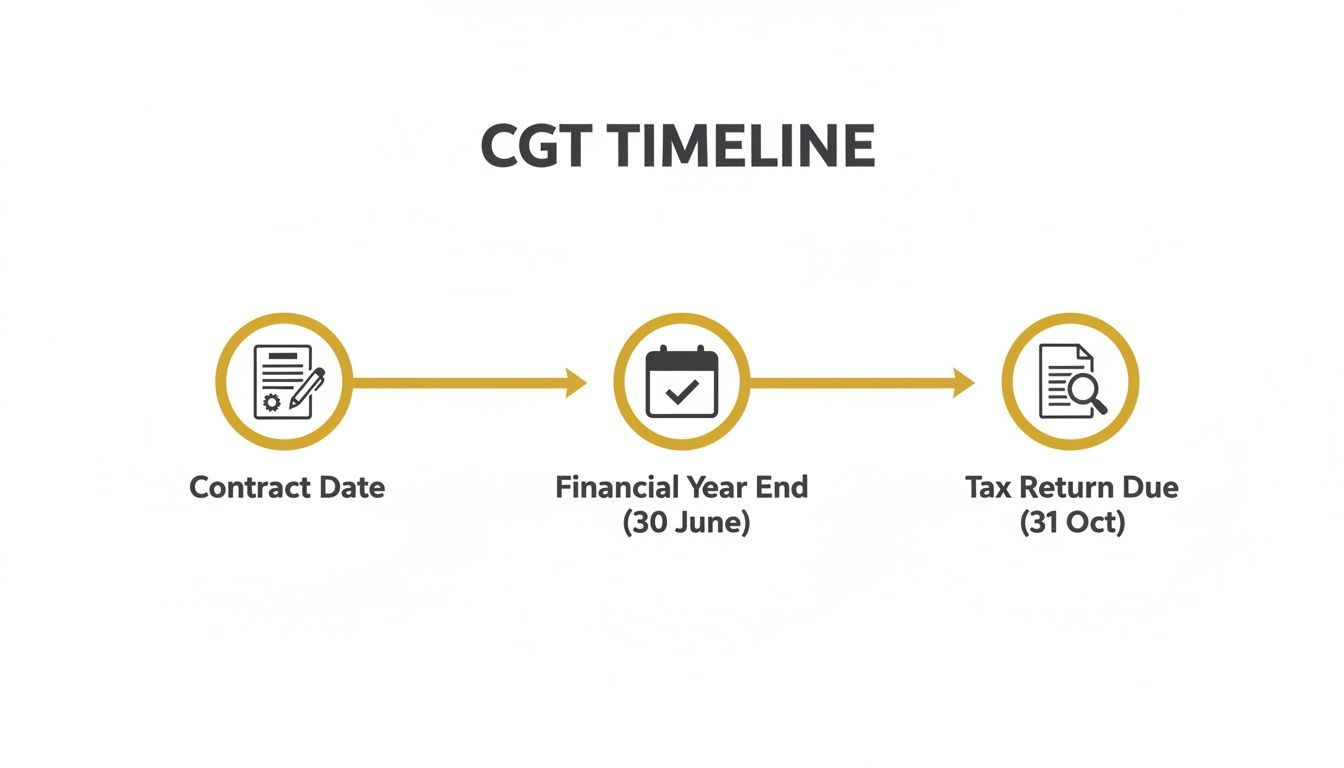
As you can see, that contract date is the definitive moment that locks your CGT obligation into a specific financial year.
The ATO is crystal clear on this: the contract date locks in your CGT event for that financial year, regardless of when settlement happens. For example, if you sign a contract to sell shares on 15 June, the gain or loss must be reported in that year's tax return—even if you don't see the funds until late July.
Keep in mind that some assets, like your family home, are usually exempt from CGT. You can get the full rundown on how that works in our guide to the capital gains tax main residence exemption.
Using the CGT Discount to Reduce Your Tax
So, you've made a capital gain. The next logical step is to legally minimise how much of it goes to the taxman. Thankfully, Australian investors have a powerful tool up their sleeve: the Capital Gains Tax (CGT) discount.
This is arguably one of the most effective concessions available, and it can instantly slice your taxable gain in half. The key is patience. To be eligible, individuals must own a CGT asset for more than 12 months before the CGT event, like selling it, occurs.
If you meet this holding period, you can reduce your capital gain by a massive 50%. This means only half of your profit gets added to your assessable income for the year.
How the 50 Percent Discount Works
Let’s put it into practice. Imagine you sold some shares and walked away with a gross capital gain of $50,000. Because you cleverly held onto those shares for over a year, you qualify for the CGT discount.
You can immediately apply the 50% discount, which brings your taxable capital gain down to just $25,000. It's this much smaller figure that gets added to your other income on your tax return. As you can see, holding an asset for just one extra day past the 12-month mark can make a huge difference to your final tax bill.
Crucial Tip: Meticulous record-keeping is non-negotiable here. You must be able to prove your asset's purchase and sale dates to the ATO. Without solid proof, you can't successfully claim the 12-month holding period and secure the discount.
Timing is everything in the world of CGT. Understanding how different holding periods affect your final liability is a vital part of smart tax planning. You can explore the nuances between long-term vs. short-term capital gains tax strategies to see how this plays out in different scenarios.
For more tailored Australian advice, dive into our detailed guide on how to reduce capital gains tax.
How to Lodge and Pay Your CGT Liability
Understanding the theory behind CGT is one thing, but knowing the practical steps for lodging and paying it is where it really counts. The good news is that CGT isn't some separate, complicated tax you have to pay on the spot. It's simply a component of your annual income tax return.
Your final net capital gain—after applying any discounts or offsetting losses—gets added to your other assessable income for the financial year. The whole lot is then taxed at your marginal tax rate. This means the higher your overall income, the higher the tax rate applied to your capital gain.
Meeting Your Lodgement Deadlines
The Australian Taxation Office (ATO) has firm deadlines for lodging your tax return, and the date you need to know depends on how you choose to lodge.
Here are the key dates to circle in your calendar:
- Self-Lodgers: If you prepare and submit your own tax return, the deadline is typically 31 October following the end of the financial year.
- Using a Tax Agent: Engaging a registered tax agent like us gives you much more breathing room, with deadlines often extended well into the next calendar year.
Once your return is lodged and the ATO assesses it, you'll receive a Notice of Assessment. This document spells out your total tax payable for the year, including the amount from your capital gain, and gives you the final payment due date.
Important Note: Paying CGT isn't something you need to do the moment you sell an asset. The obligation to pay only kicks in after you have lodged your tax return for that financial year and received your formal assessment from the ATO.
Solid record-keeping is the backbone of accurate tax reporting and lodging your CGT liability without any headaches. To get your documents in order for tax time, it pays to learn how to organize receipts for taxes efficiently.
For a complete walkthrough of the submission process itself, check out our guide on how to lodge a tax return with confidence.
Real-World CGT Scenarios Explained

Theory is one thing, but seeing how CGT works in the real world is where it all clicks. To give you a clear picture of when you pay capital gains tax, let's walk through a few common scenarios. Each one highlights different triggers and timelines, giving you a practical blueprint you can apply to your own situation.
Scenario One: Selling an Investment Property
Let's start with Sarah, a seasoned property investor who's decided to sell one of her rental units.
- Contract Date: Sarah signs the contract of sale on 10 June 2024. This is the key date.
- Settlement Date: The sale officially settles, and the money lands in her bank account on 5 August 2024.
Here's the crucial part: even though the cash didn't arrive until the new financial year, the CGT event itself happened on the contract date. This means Sarah has to report the capital gain in her 2023–24 tax return. The final tax bill will be calculated as part of that return, and she'll need to pay it after receiving her Notice of Assessment from the ATO, which will likely be before the end of 2024.
Scenario Two: Selling a Parcel of Shares
Now for Ben, who has a stake in the stock market. He bought a parcel of shares back on 1 March 2023 and has decided it's time to sell them for a profit.
- Sale Date: Ben hits 'sell' and executes the trade on 15 April 2024.
- Holding Period: He's held the shares for just over 13 months.
Because Ben held onto those shares for more than 12 months, he's eligible for the valuable 50% CGT discount. The CGT event date is 15 April 2024, which places the gain squarely in the 2023–24 financial year. When he lodges his tax return, he gets to cut his capital gain in half before adding the remainder to his assessable income.
By simply waiting until after the 12-month anniversary of his purchase, Ben significantly reduced his tax bill. A sale just a couple of months earlier would have meant the full gain was taxed at his marginal rate—a costly mistake.
Scenario Three: Ceasing Australian Tax Residency
Finally, we have Chloe. She’s an Australian citizen who has landed a long-term job in London and is about to move. When she officially stops being an Australian resident for tax purposes on 20 May 2024, the ATO triggers what's called a 'deemed disposal' for some of her assets.
This creates a CGT event on that date, even though she hasn't actually sold a thing. For tax purposes, she's treated as having disposed of certain assets for their market value. As a result, Chloe must calculate and report any capital gains in her 2023–24 tax return, making sure her Australian tax obligations are all squared away before she leaves.
Common CGT Misconceptions That Can Cost You
When it comes to Capital Gains Tax, a few persistent myths can trip up even savvy investors, leading to costly mistakes and unexpected bills from the ATO. Getting these fundamentals right is your first line of defence against paying more tax than you need to.
One of the most common blunders we see is thinking you only owe tax once the sale proceeds are safely in your bank account. That’s a dangerous assumption. As we’ve covered, the CGT event happens on the contract date, not when the money is transferred at settlement. This single detail determines which financial year your gain falls into, no matter when you actually get paid.
"It Was Only a Small Gain" and Other Costly Myths
Another trap is believing that small capital gains can just be ignored. The reality is that every single net capital gain, no matter how minor, must be declared on your tax return. The ATO has incredibly sophisticated data-matching systems that track asset sales, so undeclared profits rarely go unnoticed for long.
People also get confused thinking CGT is a separate, standalone tax. It isn't. Your net capital gain is simply added on top of your other assessable income for the year and taxed at your marginal rate. It’s not a different bill you pay on the side; it’s woven directly into your annual income tax lodgement.
Key Pitfall: The single most expensive error is poor record-keeping. If you don't track every element of your asset's cost base—the purchase price, stamp duty, legal fees, and improvement costs—you can't calculate your gain accurately. This almost always results in paying far more tax than necessary.
Don't Forget Your Capital Losses
Finally, never underestimate the power of capital losses. A frequent oversight is failing to carry forward losses from previous years to offset today's gains. If you have past capital losses sitting on your record, you must apply them against any current-year capital gains to bring down your taxable amount. Ignoring them is like voluntarily handing over cash to the tax office.
Steering clear of these simple but critical mistakes ensures your answer to "when do you pay capital gains tax?" is both correct and financially smart. Proper planning and a solid grasp of the rules are the best tools you have to avoid a nasty surprise at tax time.
Your Top CGT Questions, Answered
Let's cut to the chase and tackle some of the most common questions we get about Capital Gains Tax.
Do I Have to Pay CGT on My Main Residence?
Usually, no. For most Australians, the sale of their family home—what the ATO calls your ‘main residence’—is completely exempt from CGT. It’s one of the most significant tax concessions available.
But there are a few traps. You can lose part or all of this exemption if you’ve used your home to earn income. This could be anything from renting out a spare room on Airbnb to running your business from a home office. The exemption also gets tricky if your property is on more than two hectares of land.
What Happens If I Have a Capital Loss?
A capital loss is the flip side of a gain—it happens when you sell an asset for less than what it cost you. It’s a painful outcome, but you can put that loss to good use.
You can't use a capital loss to reduce your regular income, like your salary. Instead, you must use it to cancel out a capital gain you've made in the same financial year.
If your capital losses are bigger than your capital gains for the year, you don't lose them. You can carry that net capital loss forward indefinitely to wipe out future capital gains.
Can I Pay My CGT in Instalments?
CGT isn't a separate bill you receive. It's calculated as part of your income tax for the year and added to the total tax you owe when you lodge your annual return.
If this results in a large tax bill that you can’t pay by the due date, you don't have to panic. You can often arrange a payment plan directly with the ATO. This isn't an automatic right, though—you'll need to contact them to negotiate an arrangement based on your circumstances.
CGT is not a separate tax — a capital gain is included in your assessable income for the year a CGT event occurs. It applies when you dispose of a CGT asset including shares, investment properties, business assets, and cryptocurrency. Your primary residence is generally exempt, though partial exemptions apply in specific circumstances.
The capital gain is capital proceeds (sale price) minus the cost base. The cost base includes purchase price, stamp duty, legal fees, and capital improvement costs. If the asset was held for more than 12 months, apply the 50% CGT discount to reduce the gain before adding it to taxable income. Keep all acquisition records from the purchase date.
Australian resident individuals and trusts that have held a CGT asset for more than 12 months can reduce their capital gain by 50% before inclusion in assessable income. Superannuation funds receive a one-third discount. Companies do not qualify. The holding period begins on the purchase date and ends on the disposal contract date.
Shares are CGT assets. When you sell shares, the gain or loss is proceeds less cost base (purchase price plus brokerage). Gains on shares held more than 12 months qualify for the 50% discount. Capital losses can only offset capital gains — they cannot reduce other income. Carry forward unused losses to offset future gains.
The main residence exemption can entirely or partially exempt the gain from selling your home. Full exemption applies if the property was your main residence throughout the ownership period, was never used to produce income, and sits on land of two hectares or less. Partial exemption applies where it was rented or used for business during part of the ownership period.
