

Why Your Tax Residency Status Matters
Think of your residency status as the foundation of your entire tax situation. It dictates everything that comes next. The difference is huge. Australian residents get the benefit of the tax-free threshold (currently $18,200), meaning you don't pay a cent of tax on the first slice of your income. Non-residents don't get this perk. They're taxed from the very first dollar they earn here. If you want to see just how different the numbers can be, it's worth understanding how non-resident tax rates in Australia are applied.The Four Key Tests You Need to Know
To make things clear, the ATO has a structured framework with four distinct tests. You only need to pass one of them to be considered a resident for tax purposes. Here’s a quick rundown of each:- The Resides Test: This is the main one, a common-sense look at your life. The ATO considers your physical presence, intentions, and social ties to figure out if you genuinely "live" in Australia.
- The Domicile Test: This test looks at your legal "permanent home." If your domicile is in Australia, you're a resident unless you've set up a permanent home somewhere else.
- The 183-Day Test: This one is just a numbers game. If you're physically in Australia for 183 days or more in a financial year, you'll generally be considered a resident.
- The Superannuation Test: This is a very specific test for Commonwealth Government employees who are part of certain super funds while working overseas.
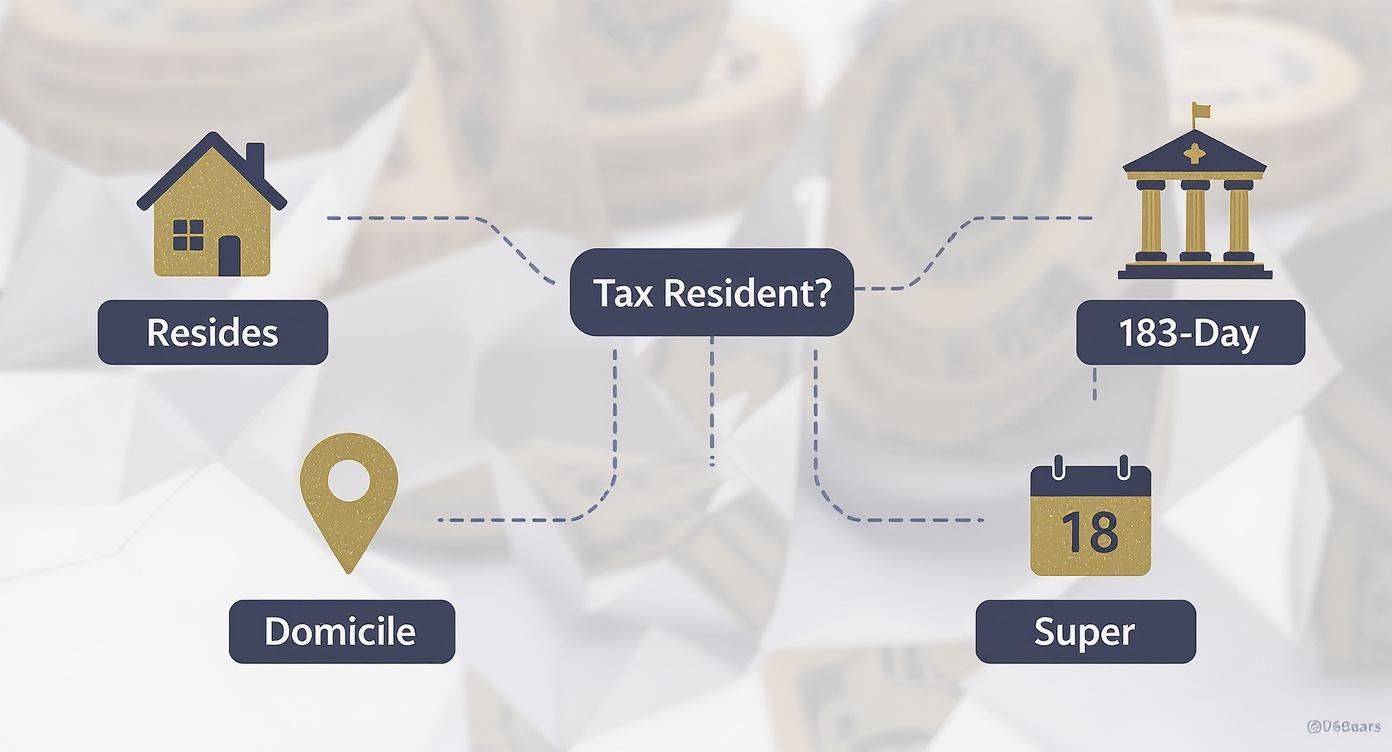
Australia's Four Key Tax Residency Tests at a Glance
To give you a clearer picture, here’s a quick summary of the four primary tests the ATO uses. This table can help you quickly identify which one might apply to your circumstances.| Test Name | Primary Focus | Most Relevant For |
|---|---|---|
| The Resides Test | Your overall living situation, intentions, and personal connections to Australia. | Individuals who spend significant time in Australia and have established a life here. |
| The Domicile Test | Your legal "permanent home" and whether you've established a new one elsewhere. | Australian citizens who have moved overseas but haven't permanently settled elsewhere. |
| The 183-Day Test | The total number of days you are physically present in Australia during a tax year. | Expats, backpackers, and anyone spending more than half the year in the country. |
| The Superannuation Test | Your membership in specific Commonwealth government superannuation schemes. | Australian government employees posted overseas. |
The Resides Test: Where Do You Truly Live?
Key Factors the ATO Looks At
To figure out if you "reside" here, officials examine the quality and character of your connection to Australia. It's a holistic review where your actions speak louder than any single document. The goal is to see if your behaviour lines up with someone who genuinely considers Australia their home base. Here's what they focus on:- Physical Presence: How much time are you actually spending in Australia? Is it a continuous stretch or just short, scattered visits? While there isn't a strict number for this test, being physically here for a significant period is a massive pointer.
- Intention and Purpose: Why are you in Australia? Are you here for a one-off, temporary project, or is your plan to stick around indefinitely? Your motivations really matter.
- Family and Business Ties: Where is your family based? Are your kids enrolled in school here? The ATO pays close attention to where your most important personal and financial relationships are centred.
- Maintenance of a Home: Do you own or rent a place in Australia? Crucially, is it available for you to live in whenever you want, or is it permanently leased out to someone else? Having a consistent place to return to strongly suggests residency.
- Social and Living Arrangements: Are you a member of local clubs, the gym, or community groups? Do you have Australian bank accounts, a Medicare card, and a local driver's licence? These everyday ties are powerful evidence of a settled life.
The resides test is intentionally subjective. It’s designed to capture the real essence of what it means to live somewhere, looking past simple checklists to understand your true situation. It's all about substance over form.
Real-World Examples
Let's put the australian tax residency test into practice with a couple of common scenarios. Scenario 1: The Expat on Secondment An engineer from Germany moves to Sydney for a two-year secondment with her company. She brings her family, enrols her children in a local school, and signs a lease on a house for the full two years. She also joins a local tennis club and shifts her daily banking to an Australian institution. She would almost certainly pass the resides test. Her actions clearly show she has set up a settled, ordinary life here, even if it's for a defined period. Scenario 2: The Backpacker A backpacker from Canada arrives on a working holiday visa. They spend their time travelling up the coast, staying in hostels and short-term rentals, and picking up casual work to fund their adventures. Their family, bank accounts, and long-term connections all remain back in Canada. They would likely fail the resides test. Their presence in Australia is transient and temporary, and they haven't established the kind of home or settled pattern of living that the ATO is looking for.Understanding The Domicile Test and Its Exceptions

What Is a Permanent Place of Abode?
This is where the ATO's interpretation gets tricky and where many people get tripped up. The phrase "permanent place of abode" doesn't mean you need to buy a "forever home" in another country. It's really about the nature and quality of your life overseas. The ATO wants to see that you've genuinely relocated and put down roots elsewhere, not just that you're on a long holiday or a temporary work gig. It’s about building a new home base with the intention of staying there for a significant, even if not strictly indefinite, period. To figure this out, the ATO will look at a few key factors:- Duration: How long have you been overseas, and what are your intentions? A stay of two years or more is often seen as a strong starting point.
- Accommodation: Where are you living? A long-term apartment lease holds much more weight than bouncing between hotels or short-term rentals.
- Family and Possessions: Have you moved your family and your significant personal belongings to the new country? Think furniture, not just suitcases.
- Local Ties: What steps have you taken to embed yourself in the new community? This could be opening local bank accounts, joining clubs, or getting a local driver's licence.
The key takeaway here is that your 'place of abode' refers to the town or country you are living in, not just a specific house or flat. It’s about the bigger picture of where you have made your home.
Practical Scenarios
Let's look at how this plays out for two different people. Scenario 1: The London Banker An Australian citizen gets a permanent job in London. She sells her car in Sydney, ships her furniture over, signs a three-year lease on a flat, and enrols her kids in a local school. It’s clear she has abandoned her previous home in Australia to establish a new one in the UK. She has successfully established a permanent place of abode overseas and would almost certainly not be a resident under the domicile test. Scenario 2: The Digital Nomad An Australian freelancer decides to travel through Southeast Asia for 18 months. They stay in Airbnbs for a few months at a time in different countries, keep their Australian bank accounts as their main accounts, and leave most of their belongings in storage at their parents' house in Melbourne. This person has not established a permanent place of abode anywhere else. Their lifestyle is transient, and their connection to Australia remains strong. They would still be considered a resident under the domicile test.The 183-Day Test: A Simple Count With a Major Catch
At first glance, the 183-day test looks like the easiest piece of the tax residency puzzle. It feels like simple maths: if you're physically in Australia for 183 days or more during the financial year (1 July to 30 June), you're a resident for tax purposes. End of story, right? This rule is designed to be a clear-cut benchmark. It catches people who spend a significant chunk of the year down under—think long-term travellers, professionals on extended contracts, or those on working holidays. It’s the ATO’s way of saying that if you're here for more than half the year, you're likely part of the Australian system. But this is exactly where a lot of people get tripped up. The 183-day count isn't the automatic trigger it seems to be. There's a massive exception built right into the rule that looks at your life beyond Australia's borders.The All-Important Exception Clause
The test comes with a critical "unless." You will not be considered a resident under this test, even if you’ve been here for over 183 days, if the ATO is satisfied that two specific things are true:- Your usual place of abode is outside Australia.
- You have no intention of taking up residence here.
It's crucial to understand that "usual place of abode" refers to your true home or the centre of your life. It’s not just a mailing address but the place where your life is established.
Real-World Scenarios Unpacked
Looking at a couple of contrasting examples makes this exception much easier to grasp. Let's see how the Australian tax residency test applies the 183-day rule in the real world. Example 1: The International Student A student from Malaysia enrols in a one-year master's program at an Australian university. He’s in Australia for the entire 10-month academic year, lives in student accommodation, has an Aussie bank account, and works part-time. He would be considered a resident. Even though his long-term plan is to go home after his studies, his "usual place of abode" for that year is effectively Australia. His entire daily life is centred here. Example 2: The Long-Term Tourist A retired couple from the UK spends seven months travelling around Australia in a campervan. They’ve kept their home in the UK, where their family, finances, and social circles are all based. They have zero intention of moving to Australia permanently. They would likely not be residents. Despite being present for well over 183 days, their usual place of abode is clearly still in the UK. Their stay is transient and lacks the deep, settled connections needed to establish tax residency.The Superannuation Test For Government Employees Abroad

Who Exactly Does This Test Apply To?
Now, this isn't a blanket rule for all government workers. It specifically targets members of either the Public Sector Superannuation Scheme (PSS) or the Commonwealth Superannuation Scheme (CSS). If you’re not a contributing member of one of these two schemes, this test simply doesn't apply to you, even if you’re on the government's payroll. This is a critical distinction to make. For instance, a government employee in a different super fund, or perhaps a contractor working for a government agency, wouldn't be captured by this test. Their residency status would be decided by one of the other three tests we've discussed: the resides test, the domicile test, or the 183-day rule.The superannuation test is a clear-cut rule for a clear-cut purpose. Unlike the other tests that weigh up your intentions, lifestyle, and connections, this one comes down to two simple facts: your employer and your membership in a designated government super fund.Figuring out your superannuation when leaving Australia or working overseas can get complicated. It’s vital to understand your obligations, and you can learn more about the rules for departing Australia superannuation payments to stay on the right side of the ATO. This test is a perfect example of how your financial ties, through these specific funds, can anchor your tax residency firmly in Australia, no matter where you are in the world.
The Future of Australian Tax Residency Rules
Anyone who has wrestled with the Australian tax residency test knows it can be a minefield. The current rules are a messy blend of subjective intentions ("Where do you plan to live?") and objective facts, often leaving individuals and their advisors stuck in a grey area. This uncertainty can lead to drawn-out, and sometimes very costly, disputes with the ATO. Recognising just how complicated this has become, there's been a major push to overhaul and simplify these foundational rules. The goal is to ditch a system that tries to read minds and instead build one based on clear, black-and-white facts. For everyone involved, this promises a far more predictable and straightforward process.A Proposed Two-Step Model
The most significant proposal for change came out of a landmark review by the Board of Taxation back in 2019. The recommendation was to scrap the old, tangled web of tests and bring in a clean, streamlined ‘two-step’ model. The idea starts with a simple physical presence test (183 days or more), followed by a secondary 'Factor Test' that uses four objective criteria to assess a person's ties to Australia. This whole approach is designed to cut down on complexity and legal battles by taking subjective intention out of the driver's seat. You can dig into the nitty-gritty of the proposal in the official Treasury consultation paper. Here’s how the proposed system would work:- The 183-Day Bright-Line Test: This is the first stop, and it’s dead simple. If you are physically in Australia for 183 days or more in a tax year, you are automatically a resident for tax purposes. No ifs, buts, or maybes about your long-term plans or where your "real" home is. It’s a straight day count.
- The Objective Factor Test: If you spend less than 183 days here, you move on to the second step. This test is designed to be much more factual and less interpretive than the current 'resides' or 'domicile' tests.
Moving Beyond Subjectivity
This secondary 'Factor Test' would look at your tangible connections to Australia using four measurable criteria, moving away from vague assessments of your life plans.The big idea is to swap ambiguity for clarity. Instead of the ATO asking, "What did you intend to do?", the new system would ask, "What have you actually done?". It’s a shift that makes it much easier for both taxpayers and the ATO to figure out where they stand.The four objective factors on the table are:
- Right to Reside: Do you have the legal right to live in Australia permanently?
- Australian Accommodation: Do you have ongoing access to a place to live in Australia?
- Australian Family: Is your immediate family (spouse, children) based in Australia?
- Australian Economic Connections: Do you have clear financial ties here, like bank accounts, major assets, or a job in Australia?
Common Questions About Tax Residency
Navigating the Australian tax residency test can throw up some curly questions, especially when your life doesn't fit neatly into a textbook example. Here are some of the most common queries we get from clients, answered in plain English.Can I Be a Tax Resident of Two Countries?
Yes, you absolutely can. It’s surprisingly common to be considered a tax resident in Australia and another country at the same time, all under each nation's local laws. This situation is known as dual residency. Obviously, you don't want to be taxed twice on the same dollar. To solve this, Australia has signed Double Taxation Agreements (DTAs) with dozens of countries. These agreements have 'tie-breaker' rules that sort out which country gets the primary taxing rights, ensuring you're not unfairly penalised.Does My Visa Type Automatically Decide My Residency?
This is a big one. While your visa is certainly a piece of the puzzle that the ATO looks at, it never automatically decides your tax residency. For instance, you might be here on a temporary student visa or a working holiday visa but still be classed as an Australian resident for tax purposes. If you pass one of the main tests—like the 183-day test—and you've clearly set up a life here, your visa status takes a backseat to what you're actually doing. The ATO cares more about your behaviour and ties to Australia than the stamp in your passport.A classic mistake is thinking a temporary visa means you're automatically a non-resident for tax. The reality is, your day-to-day actions and the life you build in Australia carry far more weight in the Australian tax residency test.
What Happens If My Residency Status Changes Mid-Year?
It’s very common for people's residency status to change during a financial year, particularly for those moving to or from Australia. When this happens, you’re considered a 'part-year resident.' This has a couple of key impacts on your tax return:- For the part of the year you were a resident: You'll be taxed on your income from all over the world, just like any other Aussie resident.
- For the part of the year you were a non-resident: You’ll only be taxed on income that came from Australian sources.
Whether you're dealing with part-year residency, dual status, or any tricky tax scenario, getting it right from the start is crucial. The team at Australia Wide Tax Solutions are experts in helping people just like you manage their Australian tax obligations without the headache. Book a consultation with our tax specialists today and let us sort it out for you.
The ATO provides guidance through ato.gov.au, the Small Business Support Line (13 28 66), and Online Services for individuals and businesses. For complex situations, a registered tax agent provides advice tailored to your specific circumstances and professional indemnity protection. You can verify agent registration at the TPB register at tpb.gov.au.
Most tax records must be kept for five years from the date of lodgement or the date the transaction occurred, whichever is later. Records must be in English or convertible to English and must be sufficient to explain the income and deductions in your return. The ATO can request records at any time during the retention period.
Consider a registered tax agent when your affairs involve multiple income sources, business activity, investment properties, capital gains, or overseas income. Agents extend your lodgement deadline, provide safe harbour protection, and take professional responsibility for the advice given. Verify registration at tpb.gov.au.
The failure to lodge penalty is based on penalty units ($313 per unit from 1 July 2023), accruing per 28-day period for late returns and BAS lodgements. Incorrect information penalties range from 25% to 75% of the tax shortfall depending on whether the behaviour was careless, reckless, or intentional. Proactive disclosure before an audit begins typically results in significantly reduced penalties.
Tax minimisation is the legal arrangement of your affairs to reduce tax — claiming all eligible deductions, using appropriate structures, and timing income and expenses. Tax avoidance involves arrangements that technically comply with the law but achieve outcomes parliament did not intend. The ATO can apply Part IVA anti-avoidance rules to cancel benefits from avoidance arrangements.
