

A Clear Guide to Penalties and Compliance
- The Real Cost of a Tax Mistake
- Decoding The Main Types Of ATO Penalties
- How Interest Charges Can Amplify Your Tax Debt
- Common Mistakes That Trigger ATO Penalties
- Proactive Strategies For Avoiding Tax Fines
That sinking feeling you get when an unexpected notice from the Australian Taxation Office (ATO) lands in your inbox? It’s something no one wants to experience. An ATO penalty isn't just a simple fee; it's a financial consequence for not meeting your tax obligations, whether you meant to or not.
These penalties are part of a structured system the ATO uses to keep Australia’s tax framework fair and functional. But what many people don’t realise is just how easy it is to trigger one. A late Business Activity Statement (BAS), forgetting to declare income from that side hustle, or claiming a deduction you weren't entitled to can all lead to a fine.
The Real Cost of a Tax Mistake
Getting hit with a penalty is often just the first step. The true cost of falling behind on your tax obligations can snowball, creating a ripple effect that puts a serious strain on your finances.
Think of it less like a one-off parking ticket and more like a high-interest credit card debt that just keeps growing if you ignore it. That’s because the ATO doesn’t just issue a fine; it also charges interest on any unpaid tax and penalties. What starts as a manageable amount can quickly become a significant financial headache.
The True Impact of Non-Compliance
For individuals and businesses, the fallout can be pretty serious. An overlooked tax return or a miscalculation can lead to:
- Financial Strain: Penalties and compounding interest can escalate fast, turning a small oversight into a major debt that’s hard to get out from under.
- Increased Scrutiny: Once you have a record of non-compliance, you can bet the ATO will be paying closer attention to you in the future. This means a higher chance of being audited.
- Stress and Uncertainty: Dealing with penalties, trying to communicate with the ATO, and fixing mistakes is incredibly time-consuming and stressful. It’s a distraction you just don’t need.
It’s important to remember that the point of these fines isn’t just to punish people. It’s about reinforcing why timely, accurate tax reporting is so crucial for everyone. Seeing it this way helps shift your mindset from fear to proactive compliance.
This guide is here to pull back the curtain on Australian tax fines. We’ll break down exactly how penalties are calculated, walk through the most common mistakes that lead to them, and give you practical, real-world advice to manage your tax obligations with confidence.
By understanding the rules of the game, you can avoid preventable financial pain and keep your relationship with the ATO on solid ground. That way, you can focus on what really matters—your personal and business goals, not chasing down tax problems.
Decoding The Main Types Of ATO Penalties
To stay out of trouble with Australian tax fines, you first have to know what you’re up against. The Australian Taxation Office (ATO) doesn’t just hand out one generic "fine" for every mistake. Instead, they have a structured system of penalties designed to tackle specific issues, from being a bit late with your paperwork to deliberately misleading them.
Think of it this way: the ATO cares about both the action and the intention. It’s not just about what you did wrong, but why you did it. Getting your head around this difference is the first step to building solid compliance habits and avoiding a whole lot of financial stress.
Let's break down the two main penalty categories you’re most likely to come across.
The Cost of Missing a Deadline
One of the easiest ways to get a penalty is by simply failing to lodge a document on time. This is called a Failure to Lodge (FTL) penalty. Whether it’s your personal tax return, a Business Activity Statement (BAS), or another report the ATO is expecting, those deadlines are there for a reason.
The ATO calculates these penalties using a system of penalty units. For the 2023–24 financial year, one penalty unit is worth $313. How many units you cop depends on the size of your business and just how late you are. A small business lodging something 1 to 28 days late will get hit with one penalty unit, but that can jump to five units if you’re over 112 days overdue.
The easiest way to picture it is like an overdue library book. The longer you take to bring it back, the bigger the fine gets. The ATO works on the same logic, with penalties ramping up over time to encourage everyone to get their documents in promptly.
This diagram shows how the ATO’s financial consequences are structured, with penalties and interest being their main tools.
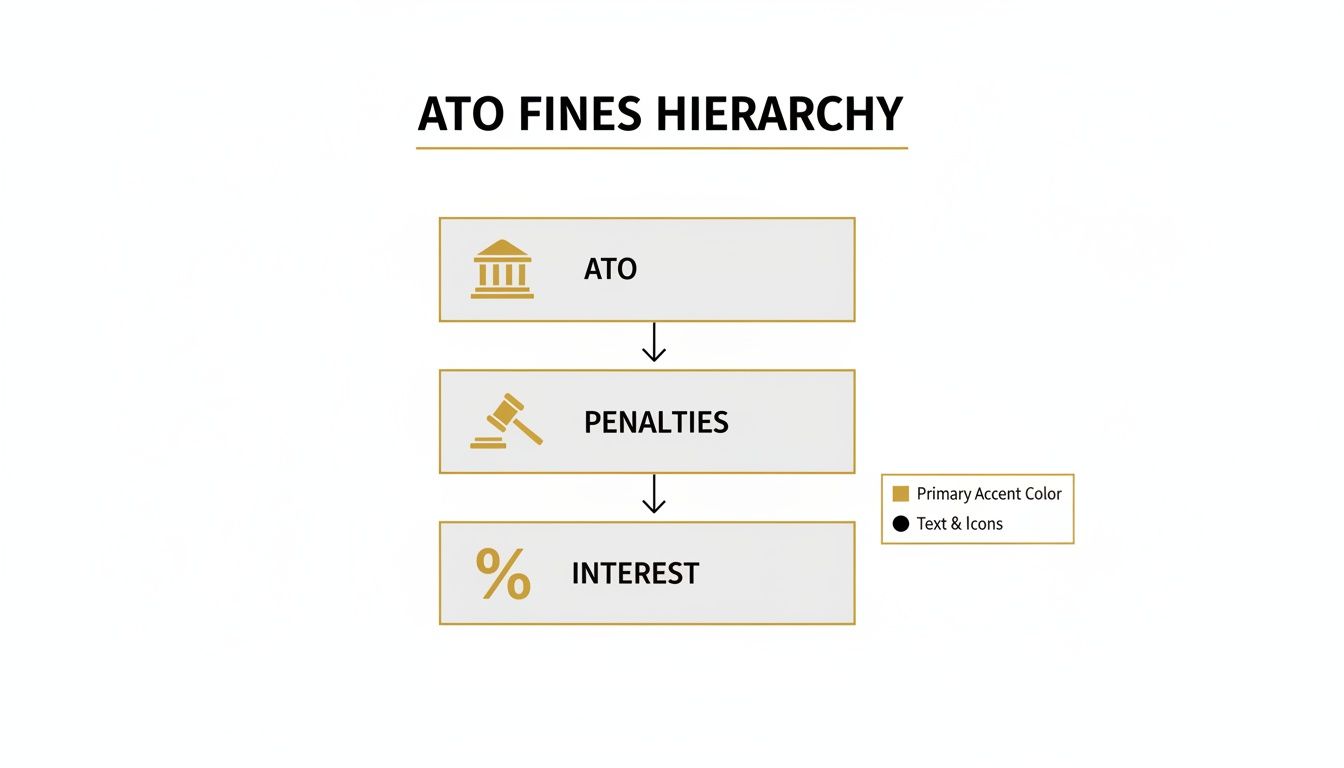
This hierarchy makes it crystal clear that penalties and interest are the two key levers the ATO pulls to enforce compliance and claw back revenue.
Penalties for Incorrect Information
The second big category of penalties is for making a false or misleading statement. This is what happens when you provide dodgy information that leads to you paying less tax than you should have, creating what’s known as a tax shortfall. When this happens, the ATO gets very interested in your behaviour and how much care you took.
The penalties are tiered, based on your conduct. They range from an honest mistake all the way up to outright deception.
- Failure to Take Reasonable Care: This is the lowest level of blame. It’s like making a typo on a crucial exam—an unintentional error, but one that still has consequences. Maybe you misread the instructions or just messed up a calculation, even though you were trying to do the right thing.
- Recklessness: This is a big step up. It's like guessing an answer on that exam when you knew you should have studied. You were aware of a risk that your statement was wrong but decided to push on anyway, ignoring that risk completely.
- Intentional Disregard: This is the most serious offence and is treated as such. It’s the equivalent of knowingly cheating on the exam. You were fully aware of your tax obligations but deliberately chose to ignore them to get a better financial outcome for yourself.
The key takeaway here is that your attitude towards your tax obligations matters—a lot. The ATO draws a very thick line between a taxpayer who makes a genuine mistake and one who knowingly breaks the law.
The penalty is worked out as a percentage of the tax shortfall. This is where it gets interesting, as your behaviour directly impacts the penalty rate.
ATO Penalty Rates For False Or Misleading Statements
Here’s a quick rundown of the base penalty rates the ATO applies based on a taxpayer's behaviour, before any reductions for coming forward voluntarily.
| Type Of Behaviour | Base Penalty Rate | Common Example |
|---|---|---|
| Failure to take reasonable care | 25% of the shortfall | Accidentally claiming a deduction you weren't entitled to after misinterpreting the rules. |
| Recklessness | 50% of the shortfall | Claiming large work expenses without any receipts, knowing you couldn't prove them if asked. |
| Intentional disregard | 75% of the shortfall | Deliberately hiding cash income to reduce your reported profit and pay less tax. |
This sliding scale shows the powerful incentive the ATO gives taxpayers to be proactive and honest. Owning up to a mistake is always treated far more favourably than waiting for them to find it.
For example, the 25% penalty for failing to take reasonable care can be significantly reduced if you voluntarily tell the ATO about the mistake before they start an audit. To get a better sense of how the numbers work, you can find out more about how these penalty tax rates apply.
How Interest Charges Can Amplify Your Tax Debt
Penalties for late lodgements or incorrect statements are just one part of the financial pressure the Australian Taxation Office (ATO) can apply. Often, the bigger threat to your finances comes from interest charges, which can quietly transform a manageable tax debt into an overwhelming one.
When you're dealing with the ATO, time truly is money.
Ignoring a tax shortfall is like leaving a small leak in your plumbing unchecked. At first, it’s a minor nuisance, but over time, the compounding damage can become incredibly expensive. The ATO applies two main types of interest to unpaid tax liabilities, each designed for a different scenario but both serving the same purpose: to compensate the government for the delay in receiving what it's owed.
These charges aren’t designed to be punitive in the same way a penalty is. Instead, they function more like interest on a loan, making sure the value of the tax debt isn't eroded by the time it takes for you to finally pay it.

Understanding the General Interest Charge
The most common interest you’re likely to encounter is the General Interest Charge (GIC). This gets slapped on pretty much any unpaid tax amount, including income tax, Business Activity Statement (BAS) debts, and even penalties themselves. The GIC rate is updated quarterly and is set deliberately higher than typical savings accounts to discourage you from delaying payment.
Think of the GIC as the ATO’s version of a high-interest credit card. The moment your tax payment is overdue, the GIC starts ticking. Critically, it compounds daily. This means every single day, interest is calculated not just on the original debt, but on all the interest that has already piled up. This daily compounding is what allows a tax debt to spiral out of control so quickly.
For instance, a $5,000 tax shortfall left unpaid for a year can balloon significantly, adding hundreds or even thousands of dollars to what you originally owed, depending on the GIC rate at the time. It’s a harsh lesson in how procrastination can be the most expensive decision a taxpayer can make.
What Is the Shortfall Interest Charge
The second type of interest is the Shortfall Interest Charge (SIC). This one is more specific. It applies when your tax bill goes up because of an amendment to a previous assessment. For example, if the ATO audits your tax return from two years ago and finds you under-reported your income, SIC is applied to that difference.
The goal of SIC is to compensate the government for the time it was without the funds you should have paid in the first place. The clock starts ticking from the due date of the original tax return and stops the day before the notice of your amended assessment is issued.
The key difference is that the SIC rate is lower than the GIC rate. It’s also calculated on a simple interest basis, not compounding. This reflects the fact that you may not have even known about the shortfall until the ATO pointed it out.
Despite the lower rate, SIC still drives home the importance of getting your tax returns right the first time. It’s a financial reminder that even honest mistakes have a cost, reinforcing the need for careful record-keeping and due diligence.
A common question we get is whether these charges can be claimed as a deduction. Understanding whether interest charged by the ATO is deductible is vital for managing the full financial impact. Ultimately, both GIC and SIC are powerful tools that highlight a core principle of the Australian tax system: timely and accurate payment is non-negotiable.
Common Mistakes That Trigger ATO Penalties
It’s one thing to understand the theory behind tax fines, but it’s another to see just how easily everyday slip-ups can land you with a penalty notice from the Australian Taxation Office (ATO). These aren't just for complex evasion schemes; they're for relatable, common errors that can catch even the most diligent person or business off guard.
Think of your tax obligations like regular car maintenance. You can ignore the small, routine checks—like lodging on time or keeping good records—but eventually, you're heading for a major, expensive breakdown. The ATO's penalty system works the same way, penalising oversights that might seem minor at first but which undermine the integrity of the whole system.
And these fines aren't just arbitrary punishments. They are a critical part of how the government collects Australia’s staggering $801.7 billion in tax revenue for the 2023-24 financial year. That figure is up 6.1% from the previous year and represents a massive 30.0% of Australia's GDP, which is why the ATO takes compliance so seriously. You can dive deeper into the numbers on the Australian Bureau of Statistics website.
Forgetting Key Lodgement Deadlines
This is probably the most common—and most avoidable—mistake of all. Life gets busy, and it's all too easy to let tax paperwork slide to the bottom of the to-do list. But in the eyes of the ATO, deadlines for individual tax returns and Business Activity Statements (BAS) are non-negotiable.
A classic example we see is the sole trader swamped with work who misses their quarterly BAS deadline. They figure they'll just catch up next quarter. But by then, a Failure to Lodge (FTL) penalty has already been automatically applied. A simple act of procrastination has turned into a direct financial cost, with interest charges sure to follow.
Under-Reporting Your Income
With the rise of the gig economy and side hustles, tracking every single dollar you earn has become a lot more complicated. A lot of people mistakenly believe that small amounts of cash-in-hand work or income from a hobby-turned-business don’t need to be declared. That’s a dangerous assumption.
Take a graphic designer who picks up a few small cash jobs to supplement her main salary. She doesn't declare the extra $5,000 on her tax return, thinking it's too minor to matter. A couple of years down the track, an ATO data-matching audit flags a discrepancy. This leads directly to a penalty for making a false or misleading statement, plus a bill for the unpaid tax with interest.
Common sources of forgotten income include:
- Freelance or side-gig earnings
- Cash payments for goods or services
- Rental income from an investment property
- Interest earned from bank accounts
- Dividends from shares
The ATO’s data-matching technology is incredibly sophisticated. It cross-references information from banks, employers, and other agencies. The chances of undeclared income going unnoticed are slimmer than ever.
Over-Claiming Deductions Without Proof
Claiming every legitimate deduction you're entitled to is just smart tax management. But every single claim must be backed up by evidence. The "I'll just estimate it" approach is a surefire way to get a penalty. You need records to prove you spent the money and to show how the expense directly relates to earning your income.
Picture a sales rep who claims the maximum 5,000 kilometres for work-related car travel using the cents-per-kilometre method but keeps no logbook or diary to justify it. When the ATO reviews the claim, they disallow the whole thing because there's no proof it was business-related. The result? A tax shortfall, a penalty for failing to take reasonable care, and a nasty bill for the outstanding amount plus interest.
Failing to Report Capital Gains
Another frequent misstep is forgetting about Capital Gains Tax (CGT). This tax applies whenever you sell an asset—like shares, an investment property, or even cryptocurrency—for a profit. Many people either don’t realise CGT is a factor or simply fail to keep the records needed to calculate it correctly.
For instance, an investor sells a parcel of shares they bought years ago for a tidy profit but completely omits the capital gain from their tax return. Maybe they just forgot, or perhaps they didn't understand their obligation. As soon as the ATO gets data from the share registry, the omission sticks out like a sore thumb, triggering an amended assessment and a shortfall penalty. It’s absolutely essential to keep detailed records of purchase and sale prices and dates for all your assets.
Proactive Strategies For Avoiding Tax Fines
Knowing the risks tied to Australian tax fines is one thing, but the real power comes from building a system that stops them from ever happening in the first place. The best way to handle the Australian Taxation Office (ATO) is to be so well-organised that you sidestep any potential issues from the get-go.
Think of it as preventative maintenance for your financial health. A few key habits can build a strong defence against penalties and interest, saving you a world of stress and money down the line. It's about shifting from a reactive mindset of fixing problems to a proactive one of preventing them.

Cultivate Excellent Record-Keeping Habits
Meticulous record-keeping is the absolute bedrock of tax compliance. Without accurate, organised records, it’s nearly impossible to prepare a correct tax return or defend your position if the ATO comes knocking. This is your primary evidence against any claim of negligence.
These days, that means going digital. That old shoebox overflowing with faded receipts is a recipe for disaster. Instead, get on board with accounting software or even simple cloud storage to keep digital copies of absolutely everything.
Key records you must maintain include:
- Proof of Income: All your invoices, bank statements, and summaries from platforms like Uber or Airbnb.
- Proof of Expenses: Digital receipts, invoices, and bank transaction details for every single deduction you claim.
- Asset Records: Paperwork showing the purchase and sale price of assets like property, shares, or crypto. This is crucial for calculating capital gains correctly.
Master Your Deadlines
Missing a lodgement deadline is one of the quickest ways to cop an automatic Failure to Lodge (FTL) penalty. The fix is simple but incredibly effective: get organised with a calendar.
Set multiple reminders for key dates, like your income tax return and quarterly Business Activity Statement (BAS) lodgements. If you use a tax agent, they’ll often manage these for you, but it’s still on you to get them the right info on time. Building a solid routine can help you avoid overdue tax fines in 3 easy steps.
The Power of Voluntary Disclosure
So, what happens if you find a mistake? The single best thing you can do is tell the ATO before they find out themselves. This is called making a voluntary disclosure, and it’s a powerful tool for slashing penalties.
Coming forward about an error shows the ATO you’re making a genuine effort to get things right. In many cases, especially for mistakes involving a 'failure to take reasonable care', penalties can be cut by up to 80% or even waived entirely.
Think of it like owning up to a mistake to get a second chance. It’s far better to control the narrative and prove your honesty than to wait for an audit to uncover the problem, which almost guarantees a much harsher penalty.
View Professional Advice as an Investment
Hiring a tax professional shouldn't be seen as just another cost. It’s a strategic investment in managing your risk. A qualified tax agent or accountant does more than just lodge your return; they provide a vital layer of protection against much bigger losses from fines and interest. They are always up-to-date on complex tax laws and can spot red flags you’d easily miss.
This proactive approach is crucial. It’s not just about saving yourself money, but about respecting the system. The ATO’s enforcement has evolved to protect the tax revenue that has averaged 21.9% of Australia’s GDP since 1972. By exploring the various ways to minimize your tax liability, you’re not only protecting your bottom line but also playing your part in maintaining the system's integrity.
What To Do If You Receive An ATO Penalty Notice
That official-looking envelope from the Australian Taxation Office (ATO) or a notification in your myGov inbox can make your heart skip a beat. Your first instinct might be to panic—or worse, shove it in a drawer and forget about it. But trust me, the best approach is a calm, methodical one.
Taking smart, immediate action can completely change the outcome. The single biggest mistake you can make is putting that notice aside. It won't go away on its own; in fact, ignoring it just means accumulating interest and inviting more serious compliance action from the ATO.
Your First Steps After Receiving A Notice
Before you do anything else, you need to understand exactly what the ATO is telling you. Don't just look at the dollar figure and despair. Read every single line. An ATO penalty notice is a formal document explaining why the penalty was applied, the exact amount, and the deadline for you to either pay or respond.
Once you’ve got a clear picture, your next job is to pull together all your relevant documents. This isn’t just about finding receipts; you’ll need a complete file, which could include:
- Bank statements and transaction records for the period in question.
- Receipts and invoices that relate to that tax year.
- Any previous letters or communication you’ve had with the ATO.
- Your own business ledgers or data from your accounting software.
Having all this information organised and at your fingertips is absolutely crucial. It allows you to properly assess the situation and build your case if you decide the penalty is unfair.
Understanding Your Options For A Response
After you’ve reviewed the notice and cross-checked it with your own records, you have a few ways forward. If the penalty is legitimate and you agree with the ATO's assessment, the simplest path is to pay the amount by the due date. This stops any further interest from being tacked on.
But an ATO penalty isn't always the final word. You absolutely have the right to object or ask the ATO to cancel or reduce it. This formal process is called requesting a remission. Getting an overdue tax return penalty is a very common reason people find themselves in this spot, but knowing your rights is key. You can learn more about how to manage these specific penalties and what your options for remission look like.
A request for remission isn't just about disagreeing with a fine. It’s about presenting a fair and reasonable case, supported by evidence, that explains why the penalty should be reconsidered.
The ATO can grant a full or partial remission, especially if you can show there were extenuating circumstances. These are situations that were genuinely outside your control, like a serious illness, a natural disaster that wiped out your records, or even relying on incorrect advice you received directly from the ATO.
Your compliance history also plays a huge role here. If you have a solid track record of lodging and paying on time, the ATO is often much more willing to show some leniency for a one-off mistake. If you present your case clearly and respectfully, you can turn a moment of high stress into a manageable process where you actually have a say in the outcome.
Common Questions About Tax Fines
Let's tackle some of the most common and practical questions taxpayers have when they’re facing a penalty from the ATO. These quick answers should give you the clarity you need to handle your obligations with confidence.
Can The ATO Completely Cancel a Fine?
Yes, absolutely. The Australian Taxation Office (ATO) has the power to completely cancel, or ‘remit’, a penalty. This isn't something they do lightly, but it often happens if you can show there were extenuating circumstances that stopped you from complying. Think major life events like a natural disaster or a serious illness.
Your track record with the ATO really matters here. Having a strong compliance history—meaning you’ve consistently lodged and paid on time in the past—massively improves your chances. It’s always worth putting forward a well-argued case for remission.
What Happens If I Can't Afford to Pay?
If you can't afford to pay a fine upfront, burying your head in the sand is the worst thing you can do. The ATO is actually quite willing to work with taxpayers who are genuinely experiencing financial hardship.
The key is to be proactive. You can contact them to discuss setting up a payment plan, which breaks the debt down into smaller, more manageable instalments over an agreed period. Reaching out shows you’re taking the debt seriously, which goes a long way.
Does My Tax Agent Take Responsibility?
This is a common point of confusion, but the answer is clear: you are ultimately legally responsible for the accuracy of your own tax return. That holds true even if a registered tax agent prepared and lodged it for you. While your agent has a professional duty of care, the liability for any tax shortfall or penalty rests squarely with you.
If a penalty was slapped on because your agent was reckless or failed to take reasonable care, you might have grounds to seek compensation from them. However, you still have to settle your debt with the ATO first.
What Are The Consequences of Ignoring a Fine?
Ignoring an ATO fine is a fast track to bigger problems. The situation escalates quickly. First, the debt will start growing every single day due to the General Interest Charge (GIC). Then, the ATO will begin firm recovery action.
This isn't just a threatening letter. We're talking about serious measures that can include:
- Garnisheeing your wages or taking money directly from your bank account.
- Issuing a Director Penalty Notice to a company director, making them personally liable.
- Kicking off legal proceedings to recover the debt through the courts.
Navigating the complexities of ATO penalties can be stressful, but you don't have to do it alone. The experts at Australia Wide Tax Solutions are here to provide clear guidance and help you manage your tax obligations effectively. If you've received a penalty notice or need help with overdue returns, get in touch with our team today.
The ATO provides guidance through ato.gov.au, the Small Business Support Line (13 28 66), and Online Services for individuals and businesses. For complex situations, a registered tax agent provides advice tailored to your specific circumstances and professional indemnity protection. You can verify agent registration at the TPB register at tpb.gov.au.
Most tax records must be kept for five years from the date of lodgement or the date the transaction occurred, whichever is later. Records must be in English or convertible to English and must be sufficient to explain the income and deductions in your return. The ATO can request records at any time during the retention period.
Consider a registered tax agent when your affairs involve multiple income sources, business activity, investment properties, capital gains, or overseas income. Agents extend your lodgement deadline, provide safe harbour protection, and take professional responsibility for the advice given. Verify registration at tpb.gov.au.
The failure to lodge penalty is based on penalty units ($313 per unit from 1 July 2023), accruing per 28-day period for late returns and BAS lodgements. Incorrect information penalties range from 25% to 75% of the tax shortfall depending on whether the behaviour was careless, reckless, or intentional. Proactive disclosure before an audit begins typically results in significantly reduced penalties.
Tax minimisation is the legal arrangement of your affairs to reduce tax — claiming all eligible deductions, using appropriate structures, and timing income and expenses. Tax avoidance involves arrangements that technically comply with the law but achieve outcomes parliament did not intend. The ATO can apply Part IVA anti-avoidance rules to cancel benefits from avoidance arrangements.
