

What Is Rental Property Depreciation and Why It Matters

The Two Pillars of Depreciation Claims
To successfully navigate the world of depreciation, you have to know the two distinct categories the ATO recognises. Getting this right is the absolute foundation for maximising your claim.- Capital Works (Division 43): This is all about the building’s fixed structure. It covers the big-ticket construction costs for things like the foundation, walls, roof, and even built-in cupboards. You'll typically claim these deductions at a steady rate of 2.5% per year for up to 40 years.
- Plant and Equipment (Division 40): Now, this category is for all the easily removable items or "fittings" inside the property. These assets usually have a much shorter effective life than the building itself. We're talking about things like carpets, blinds, ovens, hot water systems, and smoke alarms.
The distinction here is critical. Capital Works gives you a slow and steady deduction over decades, whereas Plant and Equipment assets depreciate much faster, giving you bigger claims in the first few years you own the property.Understanding this separation is the first real step in the process. It completely shapes how you should approach your tax return, ensuring you're claiming every single deduction you're entitled to. An investor who only claims for Capital Works is leaving a serious amount of money on the table by ignoring all the faster-depreciating assets inside their property.
Choosing Your Depreciation Calculation Method
When it comes to claiming depreciation on your rental property’s assets, the Australian Taxation Office (ATO) gives you two distinct pathways. This isn't just about ticking a box on a form; it’s a strategic decision that has a very real impact on your annual cash flow and tax position.
The Steady Path: Prime Cost Method
The Prime Cost method is all about simplicity and predictability. It spreads the depreciation deduction evenly over the asset's effective life, meaning you claim the exact same amount every single financial year. No surprises. This is the perfect choice for investors who crave consistency in their financial planning. If you'd rather have a stable, predictable tax deduction that you can budget around for years, this is the one for you. The formula itself is nice and straightforward: Asset's cost × (days held ÷ 365) × (100% ÷ asset's effective life) This linear approach means you recover the cost of the asset in equal chunks until its value hits zero. It’s a reliable, set-and-forget strategy.The Accelerated Path: Diminishing Value Method
On the flip side, the Diminishing Value method is designed to be front-loaded. You get a much larger deduction in the first few years, which then tapers off as the asset gets older. This approach calculates the deduction on the asset's remaining value each year, not its original cost. It’s a powerful tool if you're looking to maximise your tax refund right now, freeing up cash for other investments or property upgrades. Here’s the formula for this method: Base value × (days held ÷ 365) × (200% ÷ asset's effective life) Let’s look at a real-world example. Say an investor, Laura, installs a new $1,500 air conditioning unit with a five-year effective life.- Using the Diminishing Value method, her first-year claim is a hefty $600.
- If she chose the Prime Cost method, her deduction would be a consistent $300.
This choice has a real impact. The Diminishing Value method gives Laura double the deduction in year one, which significantly improves her immediate tax outcome. Over the asset's full life, the total claim is the same, but the timing is completely different.
Prime Cost vs Diminishing Value Method at a Glance
To make the choice clearer, here’s a quick side-by-side comparison of the two methods for depreciating your Plant and Equipment assets.| Feature | Prime Cost Method | Diminishing Value Method |
|---|---|---|
| Deduction Pattern | A consistent, flat amount each year. | Larger deductions in the early years, decreasing over time. |
| Calculation Basis | Based on the asset's original cost. | Based on the asset's remaining base value each year. |
| Best For | Investors who want predictable, stable tax planning and consistent cash flow. | Investors aiming to maximise tax savings and cash flow in the short term. |
| Complexity | Simple and easy to forecast. | Slightly more complex as the base value changes annually. |
Making the Right Choice for Your Strategy
So, which one is better? Honestly, there’s no single right answer. It all comes down to your personal financial situation and investment goals.- Choose Prime Cost if: You want predictable deductions that are easy to forecast and manage over the long haul. It’s the steady-as-she-goes option.
- Choose Diminishing Value if: Your main goal is to maximise tax savings now. This improves your immediate cash flow and reduces your taxable income as much as possible in the early years.
How to Identify Your Depreciable Assets
To get depreciation right, you first need to know exactly what you can claim. So many investors leave thousands of dollars on the table because they miss the small but valuable items scattered throughout their property. Maximising your claim is all about spotting every single one. The Australian Taxation Office (ATO) gives us a clear framework by splitting assets into two distinct groups. Getting your head around this difference is the key to building a comprehensive, audit-proof claim that seriously boosts your cash flow.Capital Works vs. Plant and Equipment
First up, you have Capital Works, often called Division 43 deductions. Think of these as the bones of your property—the fixed structure you can't just pick up and move. This category covers the construction costs of things like the foundation, walls, roof, and even built-in cupboards. Then there’s Plant and Equipment, or Division 40 assets. These are the freestanding or easily removable items within the property. The list here is long, covering everything from big-ticket appliances right down to smaller fixtures. Honestly, this is where most investors miss out. We see people overlook common Plant and Equipment items all the time, including:- Smoke alarms and security systems
- Garbage and recycling bins
- Door closers and light fittings
- Exhaust fans and ceiling fans
- Even the letterbox out front
The Role of a Quantity Surveyor
So, how on earth do you identify and put a value on everything from the concrete slab to the last light switch? This is exactly where a qualified quantity surveyor becomes your most valuable player. While your accountant lodges your tax return, only a quantity surveyor is recognised by the ATO as having the expertise to estimate construction costs and value assets for depreciation.A quantity surveyor doesn't just make a list. They create a detailed depreciation schedule that puts a value on every single qualifying asset, maps out your annual deductions for its entire effective life, and makes sure you stay compliant with some very complex tax laws.Bringing in a professional isn't an expense; it's a strategic investment. The fee you pay for a depreciation schedule is 100% tax-deductible, and the deductions they uncover almost always dwarf the initial cost—often within the first year alone. They have the specialist eye to find hidden value you’d walk straight past, turning overlooked items into powerful, legitimate tax deductions that chip away at your taxable income, year after year.
Calculating Depreciation: Let's Run the Numbers
Theory is one thing, but seeing depreciation in action is where it really starts to make sense. Let's walk through a real-world scenario to show you exactly how this works on the ground. We'll use a classic Aussie investment: a brand-new, three-bedroom house. For this example, let's say the construction cost was $400,000. It's crucial to remember we don't depreciate the land value—only the building itself. The whole game here is about separating the property's structure from all the removable bits and pieces inside. This is fundamental to getting the biggest possible claim. This diagram breaks down how we split a single property into two distinct categories for tax purposes.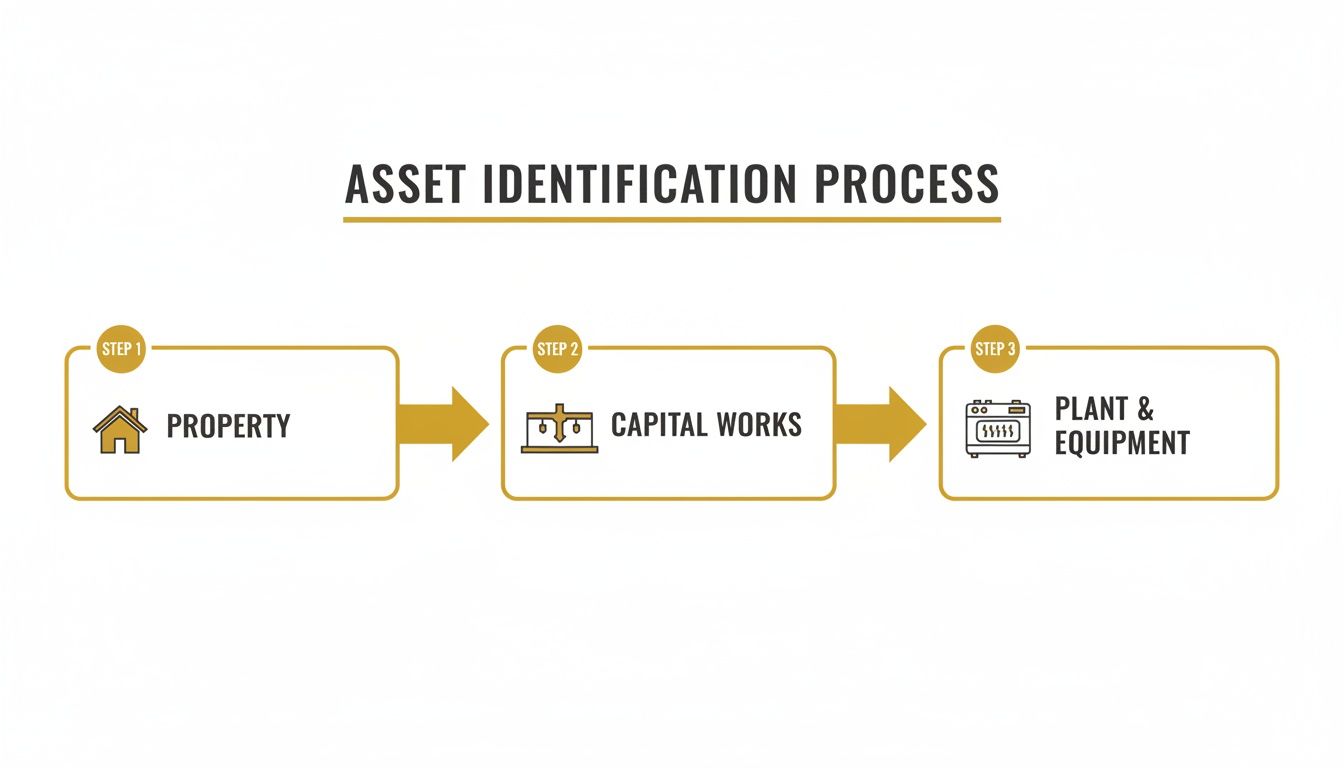
Calculating the Capital Works Deduction
First up, let's tackle the building's structure. In tax speak, this is called Capital Works, or Division 43 assets. Honestly, this is the most straightforward part of the calculation. For new residential properties built after 15 September 1987, the ATO lets you claim a flat 2.5% depreciation rate on the original construction cost, every single year for up to 40 years. For our $400,000 house, the maths is simple: $400,000 × 2.5% (or 0.025) = $10,000 Just like that, you have a $10,000 tax deduction for the first full financial year, purely from the building's structure. It's a solid, predictable claim you can count on year after year.Diving into Plant and Equipment
Now for the fun part, where the details really matter: the Plant and Equipment (Division 40) assets. These are all the removable items like ovens, carpets, and blinds, and they depreciate much faster than the building. A quantity surveyor's report would list dozens of items, but let's just focus on three common big-ticket examples to see how it works:- Carpets: Valued at $4,000 with an effective life of 10 years.
- Oven: Valued at $2,000 with an effective life of 12 years.
- Hot Water System: Valued at $1,500 with an effective life of 12 years.
The Diminishing Value method gives you a much larger deduction in the early years of owning an asset. It's a powerful strategy for boosting your cash flow right after you've bought a property.
Prime Cost vs Diminishing Value Calculations
Let's put them side-by-side. Prime Cost Method (Straight-Line) This method spreads the deduction evenly over the asset's life.- Carpets: ($4,000 / 10 years) = $400
- Oven: ($2,000 / 12 years) = $167
- Hot Water System: ($1,500 / 12 years) = $125
- Carpets: ($4,000 / 10 years) × 200% = $800
- Oven: ($2,000 / 12 years) × 200% = $333
- Hot Water System: ($1,500 / 12 years) × 200% = $250
Tying It All Together for Your Total Claim
Now, let's combine the building claim with our plant and equipment figures to get the total first-year deduction.- Total Claim (using Prime Cost): $10,000 (Capital Works) + $692 (P&E) = $10,692
- Total Claim (using Diminishing Value): $10,000 (Capital Works) + $1,383 (P&E) = $11,383
Don't Get Caught Out by These ATO Rules
Figuring out the depreciation calculation is one thing, but making sure you're playing by the Australian Taxation Office (ATO) rules is where it really counts. Even experienced investors can get tripped up by a few key regulations, which can lead to some expensive mistakes or leaving serious money on the table. One of the biggest shake-ups was the 2017 legislation that targeted Plant and Equipment. This rule put a stop to investors claiming deductions on second-hand or previously used assets in their residential properties. So, if you bought your rental after 9 May 2017, you generally can't claim depreciation on the existing oven, carpets, or blinds that came with it. But—and this is a big but—there are important exceptions. This rule does not apply to:- Brand new residential properties.
- Commercial rental properties.
- Any new assets you purchase and install yourself after you've settled.
The Low-Value Pool: Your Cash Flow Accelerator
Here’s a smart strategy that can really accelerate your deductions: the low-value pool. This lets you bundle together lower-value assets and claim them at a much faster rate, which is fantastic for your cash flow. You can allocate an asset to this pool if its opening value is less than $1,000 at the start of the financial year. Once an asset joins the pool, it depreciates at a set rate, completely separate from its individual effective life. The ATO fully recognises this method as a way to fast-track your write-offs.Pooling these smaller items simplifies your paperwork and brings forward a more significant deduction. It’s a powerful way to make those small-ticket items work much harder for your bottom line.
Scrapping Old Assets During a Reno? Don't Throw Away a Deduction
Renovations are a common source of confusion. What happens when you rip out that dated kitchen or finally replace that ancient hot water system? That old asset might still have some depreciable value left on your schedule. This is where the idea of "scrapping" becomes so valuable. If an asset is removed and can no longer be used, you can often claim its entire remaining value as an immediate tax deduction in that same financial year. This is a deduction that countless investors miss out on. For instance, if that old kitchen you just demolished had a residual written-down value of $2,500, you can claim that entire amount as a loss right away. It's the correct way to account for the asset's disposal and ensures you're squeezing every last tax benefit out of your renovation project. For a deeper dive into specific asset categories, our guide to ATO depreciation rates breaks it all down. Getting these rules right means you’re not just improving your property, you're optimising your tax position every step of the way.Why a Quantity Surveyor Is Your Best Investment
Look, I get it. When you're trying to keep costs down, it's tempting to try and calculate depreciation yourself. But hiring a qualified quantity surveyor is arguably the single best move you can make to maximise your claims. These professionals are formally recognised by the ATO as the experts in construction costs. Their reports carry a weight and authority that a self-assessed schedule just can't compete with. Their job goes way beyond spotting the obvious stuff like ovens and carpets. A good surveyor will get on-site, comb through the property, and identify hundreds of assets you’d never think of—from the exhaust fans and smoke alarms right down to the towel rails and door closers. Every single item adds up, and they make sure every claim is properly substantiated. This isn’t just about getting a bigger refund; it's about protecting yourself. An ATO-compliant depreciation schedule is your ironclad defence if you ever face an audit, giving you a clear, defensible basis for every dollar you claim.The Financial Upside of Expert Help
Many investors get hung up on the upfront cost of a report, but you need to see this as a strategic investment, not an expense. The fee for a depreciation schedule is 100% tax-deductible, after all. More importantly, the financial return it generates almost always dwarfs the initial cost, often within the very first year.Engaging a specialist isn't just about spending money. It's about unlocking thousands in legitimate tax deductions that would otherwise be lost forever. It's the key to making your investment property work harder for you from day one.I’ve seen this play out time and time again. One real-world case study showed an investor claiming $17,291 in deductions in the first year alone from a single inspection. That return covered his weekly holding costs more than three times over. That's the kind of powerful impact a professional report delivers. And that’s not a rare result. A comprehensive report from a quantity surveyor ensures no stone is left unturned, uncovering hidden value you didn't even know existed. If you want a deeper look at what these reports cover, check out our complete guide on the benefits of an investment property depreciation schedule. In the complex world of property tax, a quantity surveyor gives you two critical things: peace of mind and a much healthier bottom line.
Your Top Depreciation Questions Answered
Even once you get your head around the formulas, it's completely normal to have a few lingering questions. Property depreciation isn't always straightforward, especially when you're dealing with older homes or recent renovations. Let’s dig into some of the most common questions we get from Australian property investors. Getting these details right is the key to staying compliant and making sure you’re claiming every last dollar you're entitled to.Can I Claim Depreciation on an Older Property?
Yes, you absolutely can, but there are some critical dates to be aware of. For the building's structure (what the ATO calls Capital Works), you can claim deductions on any residential property where construction kicked off after 15 September 1987. So, even a place built in the 90s can still offer up some hefty claims. The rules for Plant and Equipment, however, got a shake-up in 2017. For second-hand properties, you generally can't claim depreciation on assets that were already used by the previous owner. This is where a quantity surveyor is worth their weight in gold—they can spot any newer assets a previous owner installed that might still be eligible for claims.Do I Need a New Depreciation Schedule After Renovating?
Definitely. If you don't update your schedule after a reno, you are leaving serious money on the table. A renovation brings in a whole host of brand-new assets, from ovens to air conditioners, that need to be properly valued and added to your schedule. Just as importantly, you need to account for any old assets you ripped out and threw away. This is called "scrapping," and updating your schedule lets you correctly write off the remaining value of those discarded items.Scrapping is a game-changer. It allows you to claim any leftover depreciable value as an immediate loss in that financial year. It's a powerful deduction that a surprising number of investors completely miss out on.
How Long Can I Claim Depreciation For?
The claim period is different for the building versus the assets inside it.- Capital Works: You can claim deductions on the building's structure for a maximum of 40 years, starting from the day construction was finished.
- Plant and Equipment: Every individual asset has its own 'effective life' set by the ATO. For instance, carpets might have an effective life of 10 years, while a hot water system could be 12 years. You claim it over that specific timeframe.
Is the Fee for a Quantity Surveyor Report Tax Deductible?
Yes, it is! The cost of hiring a qualified quantity surveyor to prepare your depreciation schedule is 100% tax-deductible. This makes the decision to get one a no-brainer. The fee directly reduces your taxable income in the same financial year you pay for it.Navigating the world of property depreciation is crucial for getting the best possible return on your investment. The team at Australia Wide Tax Solutions specialises in crafting accurate, ATO-compliant rental schedules for property investors, ensuring you claim every deduction possible. Contact us today to see how we can help you optimise your tax position.
Depreciation reduces an asset's cost base. When you sell, previously claimed Division 40 depreciation triggers a balancing adjustment. For Division 43 capital works deductions claimed from 1 July 2017, the amount reduces the building's cost base, increasing the eventual capital gain. The interaction between depreciation and CGT requires careful calculation at time of sale.
A quantity surveyor prepares a tax depreciation schedule by physically inspecting the property and identifying all depreciable assets and their values. The ATO accepts these estimates for depreciation claims where original receipts are unavailable. The fee is tax deductible. A schedule maximises your annual depreciation claims based on a comprehensive site assessment.
Division 43 covers the capital works deduction on structural components (walls, floors, roof) at 2.5% per year for buildings constructed after 15 September 1987. Division 40 covers plant and equipment (appliances, carpet, blinds) depreciated over their ATO-determined effective life. Post-May 2017 legislation restricts Division 40 claims on second-hand residential assets for new buyers.
Yes. The May 2017 restrictions on second-hand plant and equipment only apply to residential properties. Commercial property investors can still claim Division 40 depreciation on second-hand assets. Division 43 capital works deductions apply to both property types based on construction date, not acquisition date.
Keep the purchase contract, settlement statement, receipts for capital improvements, and a quantity surveyor's depreciation schedule. The ATO can request these records for five years after the relevant income year. Without records, depreciation claims can be reduced or disallowed on audit, and you may lose the ability to substantiate cost base adjustments at sale.
