

So, What Exactly Is a Notice of Assessment?
Think of your Notice of Assessment as more than just a tax receipt. It’s an official document from the ATO that breaks down the result of your tax return. It confirms all the critical details, like your taxable income, how much tax you owe, or the refund you’re getting back. You’ll find you need this document for some of life's biggest financial steps. For instance, when you're applying for a home loan, lenders will almost always ask for your last two NOAs. It's their way of verifying your income history and financial stability. It’s also a common requirement for certain visa applications or when applying for government benefits, so having it handy is a must.Why Digital is the New Normal
The ATO has made a huge push towards digital delivery, and for good reason—it speeds everything up. In fact, tax returns lodged online through myTax are often processed in as little as two weeks. Compare that to the potential 50 business days it can take for old-school paper forms, and you can see why going digital is a no-brainer. This speed directly affects how quickly that NOA lands in your hands. This flowchart gives you a simple visual of the main ways to get your document.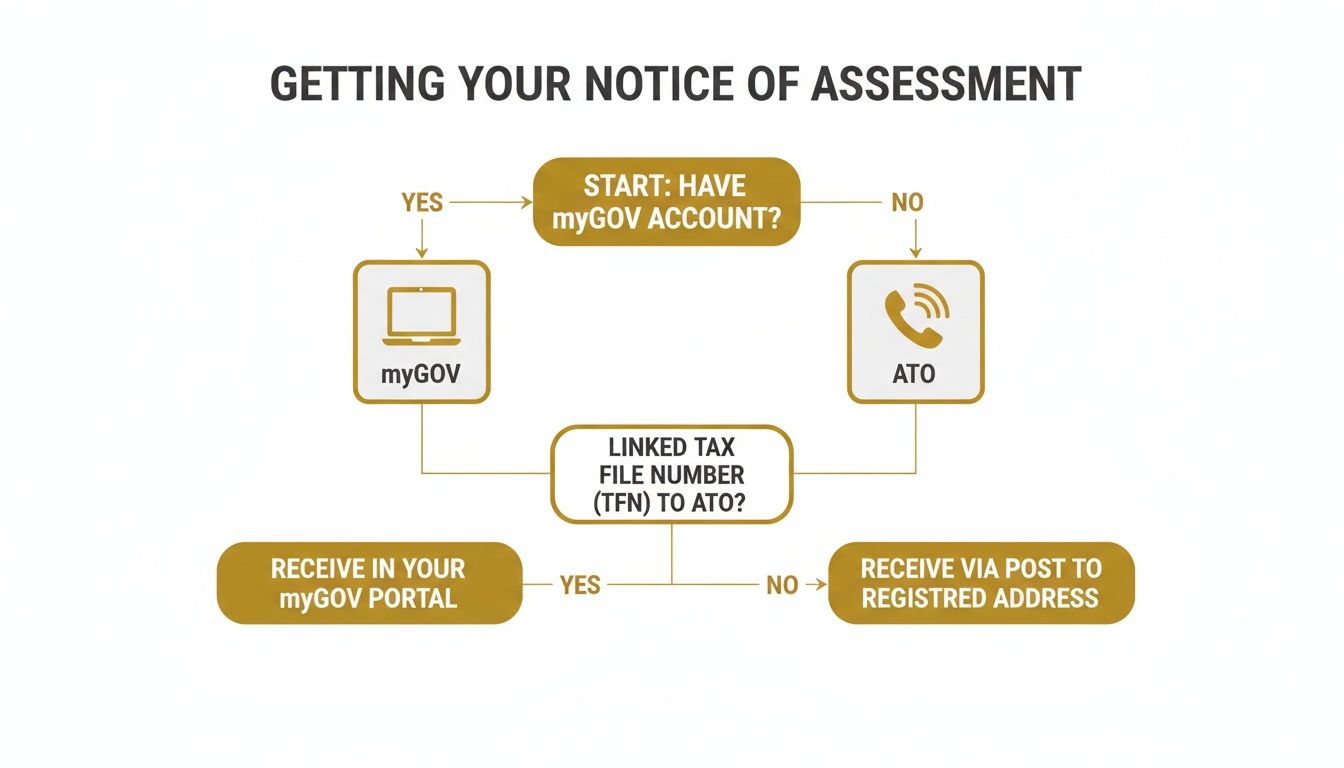
Methods for Accessing Your Notice of Assessment
| Method | Typical Timeframe | Best For |
|---|---|---|
| myGov Inbox | Within 2 weeks (after processing) | Instant, secure digital access for most people. |
| ATO Online Services | Within 2 weeks (after processing) | Direct access if you don't use myGov regularly. |
| Registered Tax Agent | Varies | Those who prefer an expert to handle everything. |
| By Post | Up to 6 weeks (after processing) | If you've opted out of digital or use paper forms. |
Using myGov for Instant Document Access
For most Aussies, the first and fastest answer to "how do I get my Notice of Assessment?" is myGov. If you’ve linked your Australian Taxation Office (ATO) services to your myGov account, you already have a secure digital hub for all your tax documents. It’s the gold standard for a reason. Picture this: you're in the middle of a home loan application, and the bank suddenly asks for your last two years of NOAs to verify your income. Instead of digging through a filing cabinet or waiting days for the post, you can just log into myGov, download the PDFs, and email them off in minutes. This isn't just about making life easier; it's about having immediate control over crucial financial documents exactly when you need them.Navigating to Your myGov Inbox
Once you're logged into myGov, you'll land on a dashboard showing your linked services. From here, you’ll click through to the Australian Taxation Office to get into your tax-specific area. This takes you straight into the ATO's online portal, where your letters and statements are all stored. No need to remember another password or worry about mail getting lost. To find your NOA, you can head to the 'Tax' dropdown menu, click 'Lodgments', and then look at your income tax history. But honestly, the most direct route is usually your myGov Inbox. It’s designed specifically to hold official mail from services like the ATO.Pro Tip: Make sure you've set up notifications in your myGov account settings to get an SMS or email. That way, you'll know the exact moment your tax return has been processed and your Notice of Assessment has arrived.This digital delivery is now the default for over 15 million Australian taxpayers every year. In fact, more than 90% of people who lodge their own return get their tax outcome this way, completely avoiding postal delays. The document that lands in your inbox even includes a tax receipt, breaking down how your taxes contribute to services like health and welfare. You can see more on the ATO's digital process and what your myTax estimate means.
Linking Services and Tax Agents
Of course, for any of this to work, your ATO account needs to be correctly linked to myGov first. If you haven't done it yet, the system will walk you through a quick verification process. You'll just need a few details on hand, like your Tax File Number (TFN) and information from a recent ATO-generated letter. And if you use a tax professional? The process can be even simpler. A common question we get is whether an agent can access these documents. The answer is yes. You can authorise your tax agent within myGov, giving them the access they need to manage your affairs efficiently. For anyone who prefers having an expert handle things, learning how to add your tax agent to myGov is a key step to making your tax life much easier.Alternative Ways to Request Your NOA
While jumping onto myGov is usually the fastest way to get your Notice of Assessment, it’s definitely not the only option. If you’re not online, wrestling with a forgotten password, or just prefer a different approach, the Australian Taxation Office (ATO) has a few other paths you can take. Knowing these alternatives means you’re never stuck, especially when you need that document in a hurry. Imagine you're trying to lock in a rental property and the agent needs your NOA by the end of the day. Of course, this is the one time you can’t remember your myGov password and the reset process is failing you. In a tight spot like this, your best bet is to get the ATO on the phone.
Contacting the ATO by Phone
You can give the ATO a call on 13 28 61 to request a copy of your NOA. Before you dial, it’s a good idea to have some key details handy so you can sail through their security check. They’ll almost certainly ask for:- Your full name and date of birth
- Your Tax File Number (TFN)
- Details from another recent ATO document or other personal information to confirm it’s you
Using a Registered Tax Agent
If you use a tax agent to lodge your return, you’ve got an even easier option. Your agent automatically gets a copy of your Notice of Assessment as soon as it’s issued by the ATO, and they’re required to keep these records on file for you.A quick email or phone call to your tax professional is often the simplest way to get what you need. They can usually fire over a digital PDF copy straight away, saving you the hassle of navigating the ATO’s phone system.This is a real lifesaver if you need NOAs from several different years, as your agent will have them all organised and ready to send.
The ATO Publications Ordering Service
For those who aren’t in a rush, the ATO also provides an online publications ordering service. You can use this portal to request a paper copy of your NOA from previous financial years. It's a reliable service, but it uses the same postal delivery timeframe, making it best suited for non-urgent record-keeping. At the end of the day, knowing how to get your notice of assessment through these different channels ensures you're prepared for any situation.Understanding When Your NOA Will Arrive
Once you’ve lodged your tax return, the next question on everyone's mind is, "So, when will I actually get my Notice of Assessment?" The answer really comes down to how and when you lodged. Your choice can be the difference between getting it in a couple of weeks or waiting for over a month. Lodging online through myTax early in the tax season—think July—is by far your fastest option. The ATO’s systems are built for digital returns, so you can realistically expect your NOA to pop up in your myGov Inbox in under two weeks. On the flip side, if you're mailing in a paper form closer to the October deadline, you're signing up for a much longer wait. It's a manual process, and that takes time.Key Factors Influencing Timelines
Even with a smooth lodgement, a few things can slow your NOA down. The sheer volume of returns hitting the ATO during peak periods can create a bit of a bottleneck, even for online lodgements. Certain details in your return can also flag it for a manual review by an actual person at the ATO, which naturally adds time. Common triggers for these delays include:- Mismatches between the income you've reported and the data the ATO has from your employer or bank.
- Complex or unusually high deduction claims that need a closer look.
- Information that needs to be cross-checked with another government department, like Services Australia.
Knowing about these variables helps you set realistic expectations. An online return lodged in August might take a bit longer than one submitted on July 1st, and that’s completely normal. Understanding why there might be a delay helps you figure out when it's genuinely time to start chasing it up.

Processing Benchmarks to Keep in Mind
The ATO’s digital-first approach makes a huge difference. Online myTax returns, which are used by over 70% of Australia’s 15+ million annual filers, are generally processed within a two-week timeframe. Paper lodgements? They have a much lengthier target of 50 business days. This stark difference is driven by efficiency, and Australia’s high on-time filing rate of 87.7% in 2023 helps keep the system moving. Even so, delays during peak periods can push wait times to three weeks for about 20% of cases. For a broader view, you can explore more OECD data on global tax administration trends.Troubleshooting Common NOA Problems
Even with the slickest online systems, tax matters don't always go off without a hitch. Knowing how to handle the most common issues with your Notice of Assessment (NOA) can save you a mountain of stress. What if your NOA never shows up, or you’ve simply misplaced the original? Don’t panic. Your first and best move is to jump back into your myGov Inbox. It’s the fastest way to get it and often holds documents you might have just overlooked. If it’s definitely not there, a quick call to your tax agent or the ATO directly will get a replacement sorted out for you.When the Numbers Don't Match
One of the most frequent calls we get is from clients confused because their final refund doesn't match the initial myTax estimate. This isn’t usually a mistake. Nine times out of ten, it’s because the ATO has used your refund to pay off an existing debt with another government agency—a process known as offsetting. Common debts that trigger this include:- Outstanding Centrelink or Services Australia payments
- Overdue child support obligations
- A tax debt from a previous year
Your Notice of Assessment is the final, legally binding calculation of your tax position for the year. The myTax estimate is just that—an estimate provided for your convenience before the ATO completes its final checks and balances.If you suspect an actual error on the assessment itself—like incorrect income figures or a disallowed deduction you believe was valid—you absolutely have the right to request an amendment. You can typically do this yourself online through myGov, or you can have your tax agent submit one on your behalf. In rare cases, if you notice suspicious activity or believe your details have been used fraudulently, it’s critical to act fast. Our guide on what to do about a compromised TFN provides the essential steps you need to take to protect your identity.
Frequently Asked Questions About Your Notice of Assessment
When you're trying to track down your Notice of Assessment, a few common questions always seem to pop up. Let's clear up some of the usual sticking points.
How Long Does the ATO Keep My NOAs?
For most practical purposes, the ATO keeps your NOAs for the last five years readily available right inside your linked myGov account. While they hold records for much longer, these recent documents are what you'll typically need for things like loan applications or rental agreements.Can I Get an NOA Without Lodging a Return?
In a word, no. A Notice of Assessment is only generated after a tax return has been lodged and the ATO has finished processing it. If you haven't lodged a return for a particular financial year, there's simply no NOA to find. Getting that return filed is your first and only step.It's easy to mix them up, but your NOA is a summary of a single tax return for one specific year. A Statement of Account, on the other hand, is more like a running bank ledger, showing all your transactions with the ATO over time—payments, credits, debts, the lot.
Why Is My Final Refund Different From My Estimate?
Ah, the classic question. The estimate you see in myTax when you lodge is just that—a preliminary calculation based on the figures you've entered. The final, official amount on your NOA comes after the ATO has done its homework. They verify everything and, most importantly, check for any existing debts you might have with other government agencies like Services Australia. If you owe money elsewhere, they'll use your refund to pay that off first, which is the most common reason the final figure changes.Navigating tax documents and lodgements can be tricky, but you don't have to do it alone. Australia Wide Tax Solutions offers expert, personalised service to handle everything from late returns to complex investments, ensuring you get the best possible outcome. Get in touch with our team today for a stress-free tax experience. "Need your Notice of Assessment for a loan or visa? The fastest route is digital! Check out our guide to accessing your NOA instantly via myGov or your tax agent. 📈📄 #TaxTips #AussieTax #NOA #LodgeWithConfidence #AWTS"
Estate planning ensures assets are distributed according to your wishes, minimises disputes among beneficiaries, and can reduce the tax and administrative burden on your estate. Without a valid Will, your estate is distributed under intestacy laws that may not reflect your intentions. A complete plan also addresses superannuation, powers of attorney, and advance care directives.
No. Superannuation is not automatically an estate asset and does not pass according to your Will. Your super fund trustee decides who receives the death benefit, guided by any binding death benefit nomination you have made. Without a valid binding nomination, the trustee has discretion to pay your legal personal representative or directly to a dependant.
Australia has no inheritance tax or estate duty. However, selling inherited assets can trigger CGT. The cost base of inherited assets is generally the market value at the date of death, and the 50% CGT discount applies if the beneficiary holds the asset for more than 12 months. Pre-CGT assets (acquired before 20 September 1985) have special rules.
Probate is a court order confirming a Will is valid and authorising the executor to administer the estate. It is generally required for estates that include real property, or when financial institutions require legal authority before releasing assets. Smaller estates where assets are held jointly may not require probate. The process is handled through the Supreme Court of the relevant state.
Review your Will after any major life event: marriage (which automatically revokes most Wills), divorce, birth of children, significant changes in financial position, or a beneficiary or executor dying. As a general rule, review every three to five years even without a triggering event to ensure it remains current.
