

- Understanding Your Rental Income Tax Obligations
- Calculating Your Total Assessable Rental Income
- Maximising Your Rental Property Tax Deductions
- Distinguishing Between Repairs and Improvements
- Understanding Negative Gearing and Capital Gains Tax
As a landlord in Australia, the profit you make from your investment property is considered part of your taxable income. The Australian Taxation Office (ATO) adds this profit to your other earnings, like your salary, and taxes it all at your personal marginal rate.
Understanding Your Rental Income Tax Obligations

Getting your head around your tax duties as a landlord doesn't need to be a headache. The easiest way to look at rental income tax is to treat your property like a small business.
The rent you collect is the revenue. The costs you pay to keep it running are the expenses. The difference between those two is your taxable profit (or loss). It's that simple.
This is the bedrock of your tax responsibilities. When your property brings in more cash than it costs to maintain, you've made a net rental profit. This profit gets added to your total income for the year, which can sometimes nudge you into a higher tax bracket.
The Basic Formula for Rental Profit
At its core, the maths is pretty straightforward. It all boils down to a simple equation that tells you whether you've made a profit or a loss for the financial year.
- Gross Rental Income: This is every dollar you've received from tenants, including rent and any other related payments.
- Allowable Deductions: These are all the eligible expenses you've paid to earn that rental income.
- Net Rental Profit/Loss: This is just your gross income minus all your deductions.
Let's say you earned $25,000 in rent and had $18,000 in deductible expenses. Your taxable rental income is $7,000. That’s the figure you’ll add to your tax return. Getting clear on whether rental income is taxable in Australia is the non-negotiable first step for any property investor.
The Australian Taxation Office (ATO) requires you to declare all income from rental properties, both here in Australia and overseas. Keeping meticulous records from day one isn't just good practice—it's absolutely essential for staying compliant and making sure you claim every dollar you're entitled to.
To make things even clearer, here’s a quick rundown of the core concepts you'll be dealing with.
Quick Guide to Core Rental Tax Concepts
| Concept | What It Means for You | Simple Analogy |
|---|---|---|
| Gross Rental Income | The total rent and related payments you receive from tenants before any expenses are taken out. | The total sales a shop makes before it pays for stock, rent, or wages. |
| Allowable Deductions | All the legitimate, running costs of the property that you can claim to reduce your taxable income. | The business expenses a cafe owner pays, like coffee beans, milk, and staff salaries. |
| Net Rental Profit/Loss | Your total income minus your total deductions. A positive number is a profit; a negative number is a loss. | A business's final profit or loss after all bills are paid for the year. |
| Assessable Income | The total income the ATO considers when calculating your tax, including your job salary plus your net rental profit. | All the money from your different income streams poured into one big bucket for tax purposes. |
Understanding these terms is the key to managing your investment property's finances with confidence.
Why This Matters for You
Nailing this concept is vital, whether you're a first-time landlord or a seasoned investor with a portfolio. For newcomers, it provides a clear roadmap and takes the stress out of managing tax for the first time. For experienced investors, it’s a good refresher, ensuring you don't overlook the fundamentals while juggling multiple properties.
Ultimately, mastering the basics of rental income tax means you can:
- Report your earnings to the ATO accurately and with confidence.
- Legally reduce your tax bill by claiming every single eligible deduction.
- Make smarter financial decisions about your investment property.
- Steer clear of common slip-ups that could trigger an ATO audit or penalties.
By building on this solid foundation, you’ll be able to manage your tax affairs like a pro and make sure your investment is working as hard for you as possible.
Calculating Your Total Assessable Rental Income
Before you even start thinking about deductions, you need to get a rock-solid figure for your total assessable income. This is the crucial "top line" number the Australian Taxation Office (ATO) starts with, and it’s often much more than just the weekly rent you collect.
Think of it like gathering all your ingredients before you start baking. You have to account for every single dollar your property generated throughout the year. Getting this right from the start is non-negotiable and saves a world of headaches later on.
The most obvious piece of the puzzle, of course, is the gross rent your tenants paid you over the financial year. This is the foundation, but it's rarely the full story.
Beyond the Weekly Rent
While rent is the main event, the ATO is interested in several other types of payments you might receive from your property. These are just as important as the regular rent and absolutely must be included in your total income figure.
Common extra income sources that catch people out include:
- Retained rental bonds: If a tenant leaves a mess or damages something and you keep part of their bond to cover the fix-up costs, that money is considered income.
- Insurance payouts: Received an insurance payment for lost rent while the property was empty or for property damage? That payout needs to be declared.
- Tenant payments for costs: Did your tenant reimburse you for a water bill or pay you directly for a window they broke? That’s assessable income.
- Letting and booking fees: Any fees passed on to you from a sharing economy platform like Airbnb or Stayz are part of your income.
Basically, if you received money in connection with your rental property, you need to have it on your radar.
Putting It All Together: An Example
Let's say you own a rental property in Brisbane and you've been diligent with your record-keeping all year.
Here’s a simple breakdown of how you'd tally up your assessable income:
- Annual Rent Received: Your tenant paid $500 per week for 52 weeks, which comes to $26,000.
- Insurance Payout: A nasty storm damaged the roof. Your insurer paid out $1,500 to cover the loss of rent while it was being fixed.
- Retained Bond Money: When a tenant moved out, you had to keep $300 from their bond to repair a damaged wall.
In this scenario, your total assessable rental income isn't just the $26,000 in rent. It’s the sum of everything: $26,000 + $1,500 + $300 = $27,800. This is the starting figure you must declare on your tax return before you can claim a single expense.
Getting this total income figure correct is the absolute first step in your rental tax journey. A precise starting point ensures your deductions are applied correctly and dramatically lowers your risk of attracting unwanted attention from the ATO.
It's worth noting that while the principle of declaring all income is universal, the specific rules can be wildly different from one country to another. For a different take on this, you can explore how rental income is handled under Zambian tax law.
By carefully identifying and adding up every income stream, you build a solid, compliant foundation for your tax return. Once that's locked in, you can confidently move on to the much more rewarding part: identifying every single deduction you're entitled to claim.
Maximising Your Rental Property Tax Deductions
Once you've tallied up your total assessable income, the real strategy begins. This is where you can legally and effectively shrink your final tax bill by claiming every legitimate deduction the Australian Taxation Office (ATO) allows.
Think of these deductions as the genuine costs of running your investment property. They are subtracted directly from your rental income, which lowers the amount of tax you ultimately have to pay.
Getting this right is crucial. If you fail to claim an expense you're entitled to, you're just handing over more tax than necessary. On the flip side, claiming something you shouldn't can attract ATO attention, audits, and penalties. The secret is knowing the rules and applying them carefully.
Immediate Deductions You Can Claim This Year
The most straightforward deductions are the day-to-day running costs of your property. These are the expenses you can claim in full in the same financial year you paid for them, representing the direct operational costs of your investment.
These instant write-offs cover a broad range of costs:
- Management and Agent Fees: Any money paid to a real estate agent for managing the property, finding tenants, or collecting rent.
- Council and Water Rates: The regular rates you pay to your local council and water authorities.
- Land Tax: The state-based tax calculated on the value of the land you own.
- Insurance: Premiums for your building, contents, and landlord insurance policies.
- General Repairs and Maintenance: Costs for fixing normal wear and tear, like repairing a leaky tap or replacing a broken window pane.
- Pest Control: Fees for annual termite inspections or other pest management services.
- Interest on Your Loan: The interest component of your mortgage repayments is almost always the single biggest deduction for property investors.
A key rule here is that these expenses must be directly related to the period the property was either rented out or genuinely available for rent.
Think of it this way: if your property was available for rent for the entire year, you can claim 100% of these ongoing costs. If you used it for personal holidays for one month, you can only claim these expenses for the 11 months it was part of your investment activity.
This flowchart gives you a simple visual guide to how your assessable income is calculated before you even start thinking about deductions.
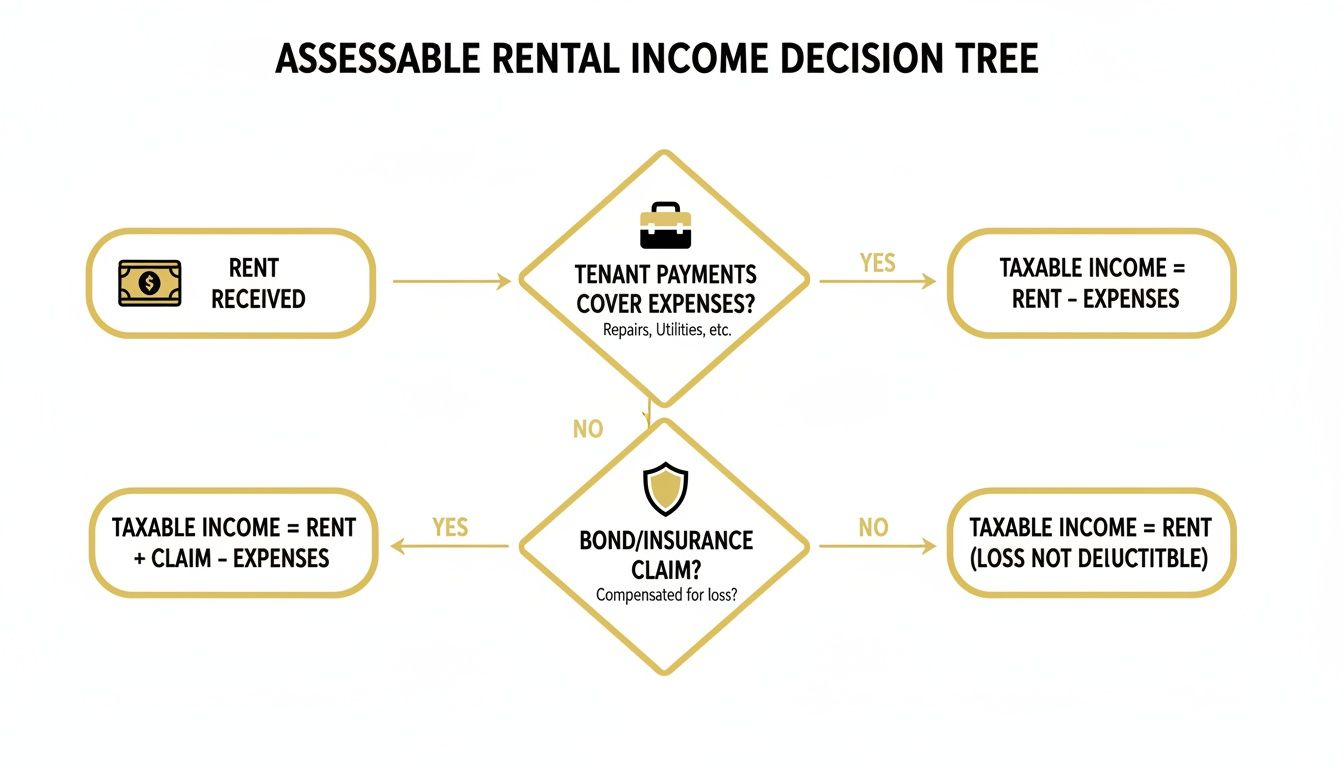
As you can see, assessable income isn't just the rent cheque. It also includes things like reimbursements from tenants for water usage or certain insurance payouts. This total figure is your starting point before you apply your deductions.
Deductions You Must Claim Over Time
Not every expense can be claimed upfront. Certain bigger costs provide a lasting benefit to your property, so the ATO requires you to spread the deduction over several years. This process reflects the gradual value these items lose over their useful life.
These long-term claims fall into two main camps:
- Borrowing Expenses: These are the costs you paid to set up your investment loan, like loan establishment fees, title search costs, and mortgage broker fees. If these expenses add up to more than $100, you must claim them over five years or the term of the loan, whichever is shorter.
- Capital Allowances (Depreciation): This is a non-cash deduction for the wear and tear on the building's structure (capital works) and the assets inside it, such as ovens, carpets, and air conditioners (depreciating assets). It's often one of the most powerful—and most overlooked—deductions available. Knowing how to calculate depreciation on a rental property is essential for any serious investor, as it allows you to claim a portion of an asset's cost each year without spending a cent.
While tax laws vary worldwide, the fundamental principle of deducting legitimate expenses is universal. For instance, this guide on U.S. short-term rental tax deductions shows different approaches, and while the specific rules don't apply in Australia, it highlights the global importance of understanding all your eligible claims.
A Practical Comparison
Getting the timing right between immediate and long-term deductions is vital for keeping your tax return compliant. Let's break down the difference with some real-world examples.
Immediate Claims vs Long-Term Deductions
Here’s a practical comparison of common rental expenses and how you claim them on your tax return.
| Expense Type | How It Is Claimed | Common Examples |
|---|---|---|
| Immediate Expenses | Claimed in full in the same financial year the cost is incurred. | Council rates, agent fees, insurance premiums, interest on loan, minor repairs. |
| Long-Term Expenses | Claimed over multiple years, reflecting the asset's lifespan or a set period. | Building construction costs (depreciation), ovens, carpets, loan establishment fees. |
By correctly categorising each expense, you ensure your tax return is accurate and that you are maximising your claims—both for this year and for years to come. It’s a cornerstone of smart rental property management.
Distinguishing Between Repairs and Improvements

Mixing up a repair and an improvement is one of the most common—and costly—mistakes we see landlords make with their rental income tax. The Australian Taxation Office (ATO) treats them worlds apart, and getting it wrong can directly hit your cash flow and tax position for years.
Think of it like owning a car. Replacing worn-out brake pads is a repair. It just gets the car back to its original working state. But bolting in a brand-new, high-performance engine? That’s an improvement, because it fundamentally enhances the car's function and value.
The same logic applies squarely to your investment property. Nail this difference, and you're well on your way to smarter financial management and bulletproof tax reporting.
The Repair Rule: Immediate Deduction
A repair is any work you do to fix damage or deterioration that’s happened while the property has been earning you rent. The goal is simply to restore something to how it was before. It's about maintenance, not upgrades.
The best part? You can claim a 100% immediate deduction for repairs in the same financial year you pay for them.
Here are a few classic examples of repairs:
- Fixing a leaking tap or a burst water pipe.
- Replacing a single cracked tile or a broken window pane.
- Repairing a faulty oven element.
- Mending a fence that was damaged in a storm.
If you’re just bringing something back to its former working condition, it’s almost certainly a repair.
The ATO puts it perfectly. The key question is: "Did the work restore the asset's function without changing its character or providing a superior function?" If the answer is yes, you're looking at a repair.
The Improvement Rule: Capital Works
An improvement, on the other hand, goes way beyond a simple fix. It’s about enhancing the property, substantially upgrading an asset, or adding something entirely new. These are considered capital expenses.
Instead of writing off the cost straight away, you have to claim improvements over many years as a capital works deduction. The rate is typically 2.5% per year for 40 years.
This distinction is a core principle in property tax law worldwide, though the exact rules can vary. For example, tax changes in Morocco show how local regulations can shape investor outcomes differently. You can review this study on Morocco's rental market to see a different perspective.
Common improvements include:
- Gutting the kitchen and installing a brand-new one.
- Adding a deck, pergola, or carport.
- Replacing an entire old fence with a new, better one.
- Upgrading all windows from single-glazed to double-glazed.
These jobs don’t just patch something up; they add lasting value and change the property's character.
Side-by-Side Scenario: The Hot Water System
Let’s make this crystal clear with a real-world scenario. Imagine the hot water system at your rental property gives up the ghost.
-
Repair Scenario: You call a plumber who replaces a faulty heating element. The system now works exactly as it did before it broke. This $400 cost is a repair, and you can claim the full amount on this year's tax return. Simple.
-
Improvement Scenario: Instead of fixing it, you decide to replace the old 125-litre tank with a modern, high-efficiency 250-litre system. This $2,000 cost is an improvement. You can't claim that $2,000 immediately. Instead, you’ll claim a small portion of its value each year as a depreciating asset.
Getting this right isn't just about being compliant. It's about accurately tracking your property’s value and making sure your tax claims work for you, not against you.
Understanding Negative Gearing and Capital Gains Tax
So far, we've covered the yearly ins and outs of rental income tax. Now it’s time to shift gears and look at the powerful, long-term strategies that truly define Australian property investment: negative gearing and Capital Gains Tax (CGT).
Think of them as two sides of the same coin. Negative gearing impacts your cash flow and tax position while you own the property. CGT, on the other hand, deals with the profit you lock in when you eventually sell it. To get the most out of your investment, you need a solid grasp of both.
How Negative Gearing Works
You’ve no doubt heard the term negative gearing thrown around, but the concept is much simpler than it sounds. A property is negatively geared when your total deductible expenses for the year are higher than the rental income it brings in. This creates a net rental loss.
Now, a loss might sound like a bad thing, but in this context, it can be a powerful strategic tool. The Australian Taxation Office (ATO) lets you take this rental loss and offset it against your other assessable income, like your salary. The immediate effect? It lowers your overall taxable income, meaning you pay less tax for that year.
Let's say you earn a $90,000 salary and your investment property runs at a $10,000 net rental loss. The ATO will only assess tax on $80,000 of your income. Investors use this strategy because they're banking on the long-term capital growth of the property to more than make up for these smaller, annual losses along the way.
Introducing Capital Gains Tax
While negative gearing is a year-to-year affair, Capital Gains Tax (CGT) comes into play at the very end—it's the tax you pay on the profit when you sell your asset. This profit is your 'capital gain', and it’s often where the real return on your investment is realised.
The capital gain isn’t just the sale price. It’s calculated by taking the sale price and subtracting what’s known as your ‘cost base’.
The cost base is far more than what you first paid for the property. It includes all the costs tied to buying, holding, and selling it—think stamp duty, legal fees, and the cost of major improvements you've made over the years. This is precisely why keeping meticulous records from day one is non-negotiable.
Here’s the basic formula for working out your gain:
- Capital Proceeds: This is the final sale price of your property.
- Cost Base: The original purchase price plus all those associated buying, holding, and selling costs (like stamp duty, conveyancing fees, and major renovations).
- Capital Gain: The Capital Proceeds minus the Cost Base.
This final capital gain figure gets added to your assessable income in the financial year you sell the property, where it's taxed at your personal marginal rate.
The 50 Percent CGT Discount
This is where a long-term strategy really pays off. If you hold onto your investment property for more than 12 months before you sell it, you generally become eligible for the 50% CGT discount.
This is a game-changer. It means you only have to add half of your total capital gain to your taxable income.
CGT Discount Example
Imagine you sell your property and make a capital gain of $100,000.
- Held for 11 months: The full $100,000 gets added to your assessable income for the year.
- Held for 13 months: You get to apply the 50% discount. You only need to add $50,000 to your assessable income.
As you can see, this single rule can save you tens of thousands of dollars in tax. It’s a cornerstone of strategic property investment in Australia, rewarding patient, long-term investors and proving just how important it is to time your exit from the market.
Keeping Meticulous Records for the ATO
Think of your record-keeping as the ultimate safety net for your investment property. It’s your single best defence against any questions from the Australian Taxation Office (ATO) and the key to a smooth, stress-free tax season when dealing with your rental income tax. A shoebox stuffed with faded receipts just won't fly; you need a simple, organised system.
This system tells the complete financial story of your property. It needs to include every single document, from the day you first bought the place right through to the minor, day-to-day running costs. Without this clear paper trail, you have no way to prove your claims if the ATO comes knocking.
What Records You Must Keep
Your records should be split into two distinct piles. This ensures you’ve got everything covered for both your annual tax claims and the eventual sale of the property down the track.
1. Initial Purchase and Ownership Documents:
- The original contract of sale.
- All your conveyancing and legal paperwork.
- Proof that you paid stamp duty.
- Your loan documents and a clear record of all borrowing expenses.
2. Ongoing Income and Expense Records:
- Statements from your property manager detailing all rent collected and costs paid.
- Receipts for every single expense you claim, from council rates and insurance premiums to that small plumbing repair.
- Bank statements that clearly show the interest paid on your loan.
When it comes to tracking rental income, using tools like essential rent receipts sample templates can be a massive help in keeping things accurate. This kind of detailed evidence isn't just a good idea—it's non-negotiable for backing up every claim you make.
How Long to Keep Your Records
The ATO is very clear on how long you need to hang onto your documents. As a general rule, you must keep all your records for at least five years from the day you lodge your tax return.
But—and this is a big one—for records related to buying the property and any capital improvements, the timeline is much longer. These documents make up your property’s ‘cost base’ and are absolutely critical for calculating Capital Gains Tax when you eventually sell. You have to hold onto these for five years after the sale is done and the capital gain or loss has been reported. For a deeper dive, check out our full guide on record-keeping requirements for the ATO.
A simple digital system can be an absolute lifesaver. Set up folders on your computer or in the cloud for each financial year. Get into the habit of scanning every receipt and document the moment it comes in and filing it away. This protects you from the classic headache of lost or faded paper receipts.
All this careful record-keeping comes together on the rental property schedule in your tax return. Every single number you enter there, from your total income down to each type of expense, must be directly traceable back to a receipt or statement in your files. A little bit of organisation throughout the year turns tax time from a mad scramble into a simple process of putting the right numbers in the right boxes.
Common Questions About Rental Property Tax
Even once you've got a handle on the basics of rental property tax, there are always those tricky, situation-specific questions that pop up. Every landlord's situation is a little different, and you need clear answers for your unique circumstances. Here, we'll tackle some of the most common queries we hear from Australian property investors, giving you direct guidance to help you manage your investment with confidence.
Can I Claim Travel Expenses to Inspect My Rental Property?
Generally, the answer is a straightforward no. Since 1 July 2017, the Australian Taxation Office (ATO) put a stop to deductions for travel expenses related to inspecting, maintaining, or collecting rent for a residential rental property. This rule was brought in to prevent claims for what could be seen as private travel with a quick property visit tacked on.
There are some very narrow exceptions to this rule, but they typically only apply to investors who are genuinely in the business of letting properties. Given how complex this area is, it's absolutely vital to get professional advice on your specific situation before even thinking about making a claim like this.
What Tax Deductions Can I Claim if My Property Is Vacant?
Good news here – you can usually continue to claim most of your ongoing expenses during vacant periods. But there's a big string attached: the property must be genuinely available for rent. This is a non-negotiable condition from the ATO.
So, what does "genuinely available" actually mean?
- It has to be actively advertised for rent, either through a property manager or a public listing.
- The property must be in a liveable condition, ready for new tenants to move straight in.
- You must be asking for a fair market rent. You can't just list it for an absurd price to keep it empty while claiming deductions.
As long as you tick all these boxes, you can keep claiming deductions for things like council rates, loan interest, insurance, and land tax for the entire time it’s on the rental market. The moment you take it off the market for personal use, however, your ability to claim those deductions stops.
How Is Rental Income Tax Handled for Co-Owned Properties?
When you own an investment property with someone else, the tax side of things is all about your legal ownership percentage. You have to split all the rental income and every single expense according to that legal stake. Your tax returns must then reflect this exact split.
For instance, if you and your partner own a property 50/50 as ‘tenants in common’, you are each required to declare 50% of the rental income and claim 50% of the allowable deductions on your individual tax returns. You can't just decide to give 70% of the deductions to the higher-income earner to get a better tax outcome. The split must always mirror your legal ownership.
This rule ensures that each owner reports their precise share of the net rental profit or loss, which is then taxed at their personal marginal rate. It keeps everything fair and square in the eyes of the ATO.
Depreciation reduces an asset's cost base. When you sell, previously claimed Division 40 depreciation triggers a balancing adjustment. For Division 43 capital works deductions claimed from 1 July 2017, the amount reduces the building's cost base, increasing the eventual capital gain. The interaction between depreciation and CGT requires careful calculation at time of sale.
A quantity surveyor prepares a tax depreciation schedule by physically inspecting the property and identifying all depreciable assets and their values. The ATO accepts these estimates for depreciation claims where original receipts are unavailable. The fee is tax deductible. A schedule maximises your annual depreciation claims based on a comprehensive site assessment.
Division 43 covers the capital works deduction on structural components (walls, floors, roof) at 2.5% per year for buildings constructed after 15 September 1987. Division 40 covers plant and equipment (appliances, carpet, blinds) depreciated over their ATO-determined effective life. Post-May 2017 legislation restricts Division 40 claims on second-hand residential assets for new buyers.
Yes. The May 2017 restrictions on second-hand plant and equipment only apply to residential properties. Commercial property investors can still claim Division 40 depreciation on second-hand assets. Division 43 capital works deductions apply to both property types based on construction date, not acquisition date.
Keep the purchase contract, settlement statement, receipts for capital improvements, and a quantity surveyor's depreciation schedule. The ATO can request these records for five years after the relevant income year. Without records, depreciation claims can be reduced or disallowed on audit, and you may lose the ability to substantiate cost base adjustments at sale.
Navigating all the details of your rental income tax can feel overwhelming, but you don't have to figure it all out on your own. The team at Australia Wide Tax Solutions specialises in helping property investors understand their obligations, maximise every possible deduction, and stay compliant. Whether you're a first-time landlord or a seasoned portfolio owner, we provide the expert guidance you need.
