

- Decoding the Company Tax Return Form
- Choosing Your Lodgement Path: DIY or Tax Agent
- Avoiding Common and Costly Tax Return Mistakes
- What to Do After You Have Lodged Your Return
- Your Top Company Tax Return Questions, Answered
How to Lodge Company Tax Return A Guide for Australian Businesses
Lodging your company tax return isn't a single action, but a three-part process: you gather your records, get the numbers right on the form, and then submit it to the ATO. It sounds simple, but the real work happens before you even log into any online portal.
Getting the preparation right is everything. Having your financial statements ready and reconciled from the get-go is the difference between a smooth lodgement and a stressful one.
Gathering Your Financials for a Smooth Lodgement
Before touching the company tax return form itself, you need to get your financial records in order. This isn't just about ticking off a list; it's about building a bulletproof foundation for your return. I’ve seen it time and again—business owners who rush this stage end up with missed deductions or incorrectly reported income, creating major headaches down the track.
Key Documents and Why They Matter
Think of your financial documents as the evidence that backs up every single number on your tax return. Without them, you're just guessing.
Let's break down the non-negotiables.
Your Pre-Lodgement Document Checklist
This table summarises the core documents you'll need to pull together. Think of these as the absolute minimum for a compliant and accurate tax return.
| Document Type | What It Shows | Why It's Critical |
|---|---|---|
| Profit and Loss (P&L) Statement | A complete story of your company's income and expenses over the financial year. | This is the engine of your tax return, determining your taxable income. Every dollar must be accounted for. |
| Balance Sheet | A snapshot of your company’s assets, liabilities, and equity at year-end. | The ATO uses this to check the financial health and structure of your company. It must reconcile perfectly. |
| Bank Reconciliations | Proof that your accounting software transactions match your business bank statements exactly. | This confirms no income has been missed or expenses duplicated—a common area for ATO audits. |
Having these three reports finalised and double-checked is your green light to start the lodgement process. It ensures the numbers you're about to enter are solid.
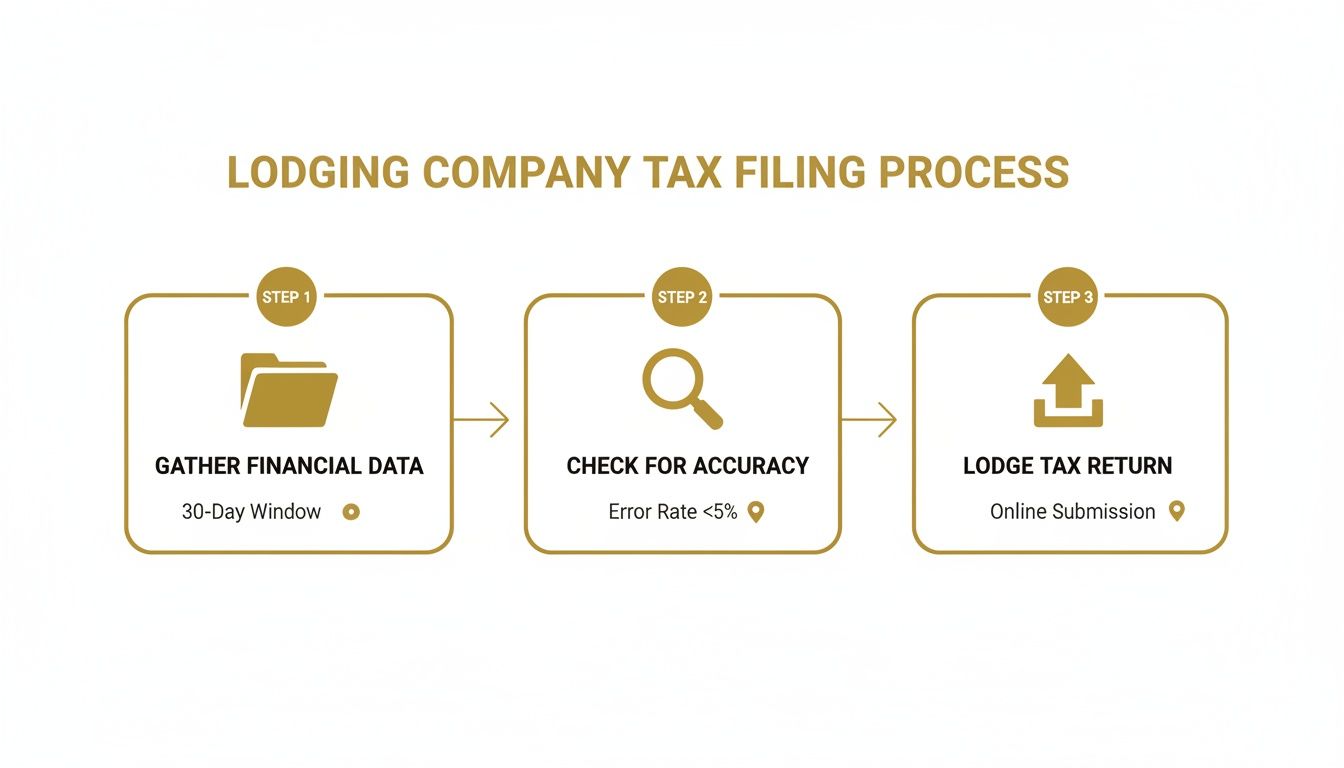
As you can see, the "Gather" phase is the foundation. Nail this, and the rest of the process becomes much, much easier.
A Common Pitfall to Avoid
I recently worked with a small retail business owner who nearly missed out on thousands in legitimate deductions. She was fantastic at recording her major supplier invoices but had a literal shoebox full of receipts for smaller items—stationery, client coffees, minor store repairs. On top of that, a loan she’d made to the company wasn't properly documented, blurring the lines between personal and business funds.
This scenario is incredibly common. Those small, disorganised expenses add up to significant deductions. And getting director loans wrong is a huge red flag for the ATO. Proper documentation is crucial for compliance.
A big piece of this puzzle is mastering revenue recognition principles, which ensures the income on your P&L statement is reported in the correct period.
For a complete rundown of everything you’ll need, grab our comprehensive https://awts.net.au/business-tax-checklist/. Taking the time to organise your records now is your best insurance policy against future ATO questions.
Decoding the Company Tax Return Form
Let's be honest, opening the official Company Tax Return form for the first time can feel like trying to decipher a secret code. It’s dense, littered with jargon, and seems almost designed to be confusing. But don't let it intimidate you.
At its core, the form is just a structured way for you to tell the ATO your company's financial story for the year. The trick is to stop seeing it as one giant, impossible puzzle and start viewing it as a series of smaller, more manageable questions about your business. Each section simply asks for a specific piece of your financial history—from what you earned to what you spent.

Reporting Your Company Income
The first major section you'll tackle is all about the money your company brought in. This isn’t just your primary sales revenue; the ATO needs a complete picture of your assessable income.
You'll find that the form asks you to report different types of income in specific sections. For instance, a small consulting company's income might be broken down like this:
- Gross professional fees: The total amount you've billed clients for your services.
- Interest income: Any interest earned from your business bank accounts or term deposits.
- Capital gains: Profit made from selling a significant asset, like an office space or even company shares.
Each of these needs to be correctly categorised. A common mistake we see is people lumping everything into a single "sales" figure, which can lead to miscalculations and attract unwanted attention from the ATO.
Demystifying Business Deductions
Once you've laid out your income, it's time to claim your deductions. This is where you get to subtract your legitimate business expenses from your income to figure out your actual profit. Think of it as telling the ATO, "We earned this much, but it cost us this much to do it."
The golden rule for deductions is simple: the expense must be directly related to earning your assessable income. And you absolutely must have a record, like a receipt or invoice, to prove it.
Some of the most common deductions businesses claim include:
- Operating Costs: Everyday expenses like office rent, utility bills, and supplier invoices.
- Employee Salaries: All the wages, superannuation contributions, and other benefits you pay your staff.
- Asset Depreciation: The decline in value of business assets worth over $300, such as computers, vehicles, or machinery. You don't claim the full cost upfront; instead, you claim a portion of it over several years.
Getting these deductions right is absolutely critical for an accurate return. It’s the difference between paying the correct amount of tax and needlessly overpaying.
Calculating Your Taxable Income
After you’ve listed all your income and subtracted all your legitimate deductions, you arrive at your company's taxable income. This is the final profit figure that the ATO will apply tax to.
The calculation itself is straightforward:
Total Assessable Income - Total Deductions = Taxable Income
With this number, you then apply the correct company tax rate. While the standard rate is 30%, many small and medium businesses actually qualify for a lower rate of 25%. To be eligible, your company needs an aggregated turnover under AUD 50 million and less than 80% of its assessable income can come from passive sources (like rent or interest).
This is a key incentive, particularly for clients of firms like AWTS who might be dealing with overdue returns or BAS preparations. For a deeper dive, you can find more insights on corporate tax rates in Australia from PwC.
Knowing which rate applies to your business is the final piece of the puzzle. It transforms all your financial data into a clear tax obligation, completing the main part of lodging your company tax return.
Choosing Your Lodgement Path: DIY or Tax Agent
Alright, you've got your financials sorted and you've wrestled with the company tax return form. Now you’ve hit a fork in the road. Do you tackle the ATO’s online services yourself, or do you bring in a registered tax agent?
This isn’t a small decision. It directly affects your deadlines, your stress levels, and your chances of making a costly error.
The DIY route always looks tempting at first glance. The biggest draw is saving money on professional fees, no doubt about it. You get to keep total control of the process from start to finish. If your company's finances are dead simple—maybe just a handful of transactions and no complicated investments—then going it alone can be a perfectly reasonable choice.
But be warned, flying solo has its risks. The most immediate one is the deadline. If you’re lodging yourself, the ATO expects your company return much earlier than if you use an agent. More importantly, the odds of making an honest mistake shoot way up. A simple mix-up with a deduction rule or one wrong calculation can put you on the ATO’s radar and lead to penalties down the line.
The Case for Using a Tax Agent
This is where you see the real value of bringing in a professional. A registered tax agent is much more than a form-filler; they're your expert guide and a critical safety net. They live and breathe Australian tax law, making sure you claim every single deduction you're entitled to while keeping everything above board.
One of the biggest perks is getting access to extended lodgement deadlines. That extra time can be a lifesaver for busy business owners who are already juggling a dozen other things.
Beyond the extra time, the real benefit of an agent is confidence. Having an expert look over your figures, ask the tough questions, and sign off on the return gives you a peace of mind that’s hard to put a price on.
The official numbers back this up. The ATO’s latest tax time statistics show just how many people rely on professional help, especially when things get complicated with capital gains or overdue returns. You can dive into the full tax time lodgement statistics from the ATO to see the trends for yourself.
Of course, choosing an agent means handing over sensitive financial data. It's smart to ask about their security protocols, like whether they use a professional cloud backup for accountants to keep your information safe. To get a better feel for what an agent can bring to the table, check out our breakdown of the key benefits of using a tax agent in Australia.
Avoiding Common and Costly Tax Return Mistakes
Even the most organised business owners can get tripped up by common tax traps. Getting your company tax return wrong can be a painful lesson, costing you not just in ATO penalties but also in the time and stress it takes to unravel the mess.
The good news? Most of these errors are entirely avoidable once you know what to look for.
One of the first things the ATO’s systems flag is a mismatch in your GST reporting. The total GST you’ve collected and paid on your Business Activity Statements (BAS) throughout the year must line up perfectly with the figures you report in your annual income tax return. Any discrepancy, no matter how small, is a clear signal that something’s not right with your books.
Another huge red flag is blurring the lines between business and personal expenses. It’s so easy to claim a chunk of your home internet or mobile phone bill, but you absolutely must have clear, justifiable records that prove the business-use percentage. Claiming 100% of a personal mobile bill as a business expense is a classic mistake the ATO’s systems are specifically designed to catch.
Poor Records and Unsubstantiated Claims
At the end of the day, flimsy record-keeping is the root cause of most tax return headaches. Without the right receipts, invoices, and logbooks, your claims are just numbers on a form with zero evidence to back them up. This gets particularly dicey when you’re dealing with more complex areas of tax law.
A classic example I see with new or struggling businesses is misunderstanding the non-commercial loss rules. If your company has a side hustle or an activity that consistently loses money, you generally can't just offset that loss against your other income unless you meet some very specific tests. Getting this wrong can quickly lead to a detailed ATO review.
Navigating these complexities is precisely why so many business owners bring in an expert. The ATO consistently spotlights issues like income omissions, GST errors, and non-commercial losses as key audit triggers for small businesses.
Timely, accurate lodgement is your best line of defence. For small businesses, the ATO's 2025 focus areas are crystal clear on these red flags. With audit activity on the rise, penalties for shortfalls can be severe—sometimes reaching up to 75% of the tax you owe, plus interest. You can read more about corporate tax obligations from PwC.
To sidestep these issues, you need to get meticulous with your finances:
- Reconcile regularly. Don't leave your BAS vs. annual return reconciliation until the last minute. Get into the habit of checking it every quarter.
- Keep finances separate. A dedicated business bank account and credit card are non-negotiable. This keeps a clean separation between your personal and business spending.
- Document everything. Keep detailed logbooks for any vehicle use and write down your reasoning for splitting costs like your internet and phone bills.
By learning from these common missteps, you can lodge a clean, accurate return with confidence—one that won’t attract any unwanted attention.
What to Do After You Have Lodged Your Return
Hitting ‘lodge’ on your company tax return feels like the finish line, but it’s really just the start of the final lap. What you do next is critical for staying on the right side of the Australian Taxation Office (ATO). The first thing you'll be waiting for is your Notice of Assessment (NOA).
This is the ATO’s official verdict on your return. It’s their calculation of your tax position, and it will clearly state whether you have a tax bill to pay, a refund coming your way, or if everything is square. You absolutely must check this document thoroughly the moment it arrives.

Reading Your Notice of Assessment
Don't just file it away. Pull out your own records—or the final figures from your tax agent—and compare them line by line with the NOA. Does the taxable income match? Is the tax payable what you expected?
If there’s a discrepancy, you need to find out why, fast. The ATO sometimes makes adjustments based on data they hold, and you need to understand the reason. For a deeper dive, you can learn more about how to get your notice of assessment and what it all means.
If the NOA shows a tax liability, it will have a non-negotiable due date. Miss it, and the ATO will start adding interest charges and potential penalties, so make sure you pay on time.
After lodging, your focus must shift from preparation to verification and record-keeping. The NOA is your first checkpoint, and retaining your financial records for a minimum of five years is your ongoing legal obligation.
Maintaining Your Records and Ongoing Compliance
Even after you've settled any tax bill, you’re not quite done. The law is clear: companies must keep all financial records related to their tax return for at least five years from the date they lodged it. This isn’t optional. We're talking everything from receipts and invoices to bank statements and asset registers.
Think of this five-year rule as your safety net. If the ATO ever comes knocking for an audit or a review, solid, organised records are your best and only defence.
Beyond record-keeping, remember that your company tax return is just one piece of a much larger compliance puzzle. You still need to stay on top of your other obligations, like lodging your Business Activity Statements (BAS) on time and paying employee superannuation. These things all contribute to your overall relationship with the ATO.
Economic shifts can also play a part. Recent ABS government finance statistics revealed that company income tax totalled $143.3 billion for 2024-25, a slight dip influenced by market fluctuations. It’s a good reminder that the business landscape is always changing. You can explore more government finance statistics on the ABS website.
Your Top Company Tax Return Questions, Answered
Lodging a company tax return always seems to bring up a few last-minute questions. It's perfectly normal. Dealing with the Australian Taxation Office (ATO) can feel complex, and you want to get it right.
Let's run through some of the most common queries we hear from business owners every single tax season. Getting these straight can save you from simple mistakes that might cause delays or, worse, flag your return for a closer look.
How Long Does a Company Tax Return Take to Process?
This is, without a doubt, the question we get asked most. You’ve done the work, you’ve lodged the return, and now you just want to know where you stand.
For most online lodgements, the ATO aims to process company tax returns within 14 business days. But think of that as a guideline, not a guarantee. A few things can easily stretch out that timeline.
- Manual Reviews: If your return includes unusually large deductions, complex asset write-offs, or anything out of the ordinary for your business, the ATO might pull it aside for a manual review. This is just them doing their due diligence.
- Outstanding Debts: Have an existing debt with the ATO or another government agency? The process will take longer while they sort out the accounts and determine your final position.
- Multiple Lodgements: Trying to catch up by filing a few years' worth of returns all at once can create a logjam in the system and lead to delays.
And if you're lodging by paper? Be prepared for a much longer wait—up to 50 business days. It’s a powerful argument for lodging electronically, either through ATO online services or with a tax agent.
What Happens if I Miss the Lodgement Deadline?
Life happens, and sometimes deadlines get missed. The key is not to bury your head in the sand. The ATO is far more reasonable when you're upfront about the situation.
Ignoring the deadline can lead to financial penalties and interest charges stacking up. The initial penalty for failing to lodge on time is just the start; it can increase for every 28-day period your return remains overdue, up to a maximum of five periods. On top of that, the General Interest Charge (GIC) will start ticking on any unpaid tax from the original due date.
If you know you're going to miss the deadline, the absolute best thing you can do is contact the ATO or your tax agent immediately. It’s often possible to get a deferral or set up a payment plan, which looks infinitely better on your record than radio silence.
Can I Amend a Return After I Have Lodged It?
Yes, you can. It’s more common than you think. You might unearth a folder of receipts for deductions you forgot to claim or realise you keyed in an income figure incorrectly after hitting 'submit'.
You can amend your company tax return, but there's a time limit. Generally, you have a two-year window from the date your Notice of Assessment was issued to make changes.
The simplest way to file an amendment is through the same channel you used to lodge originally—either via ATO online services or by asking your tax agent to handle it for you. Once you submit the amendment, the ATO will process it and send you an amended Notice of Assessment, showing any change to your tax bill or refund. Just be aware that lodging an amendment will reset that processing clock.
Navigating your company's tax obligations can be a minefield, but you don't have to walk it alone. The team at Australia Wide Tax Solutions is here to make sure your lodgement is accurate, on time, and structured to get you the best possible outcome. Let our experts handle the ATO, so you can get back to what you do best. https://www.awts.net.au
The ATO provides guidance through ato.gov.au, the Small Business Support Line (13 28 66), and Online Services for individuals and businesses. For complex situations, a registered tax agent provides advice tailored to your specific circumstances and professional indemnity protection. You can verify agent registration at the TPB register at tpb.gov.au.
Most tax records must be kept for five years from the date of lodgement or the date the transaction occurred, whichever is later. Records must be in English or convertible to English and must be sufficient to explain the income and deductions in your return. The ATO can request records at any time during the retention period.
Consider a registered tax agent when your affairs involve multiple income sources, business activity, investment properties, capital gains, or overseas income. Agents extend your lodgement deadline, provide safe harbour protection, and take professional responsibility for the advice given. Verify registration at tpb.gov.au.
The failure to lodge penalty is based on penalty units ($313 per unit from 1 July 2023), accruing per 28-day period for late returns and BAS lodgements. Incorrect information penalties range from 25% to 75% of the tax shortfall depending on whether the behaviour was careless, reckless, or intentional. Proactive disclosure before an audit begins typically results in significantly reduced penalties.
Tax minimisation is the legal arrangement of your affairs to reduce tax — claiming all eligible deductions, using appropriate structures, and timing income and expenses. Tax avoidance involves arrangements that technically comply with the law but achieve outcomes parliament did not intend. The ATO can apply Part IVA anti-avoidance rules to cancel benefits from avoidance arrangements.
